1 Samuel 10:9

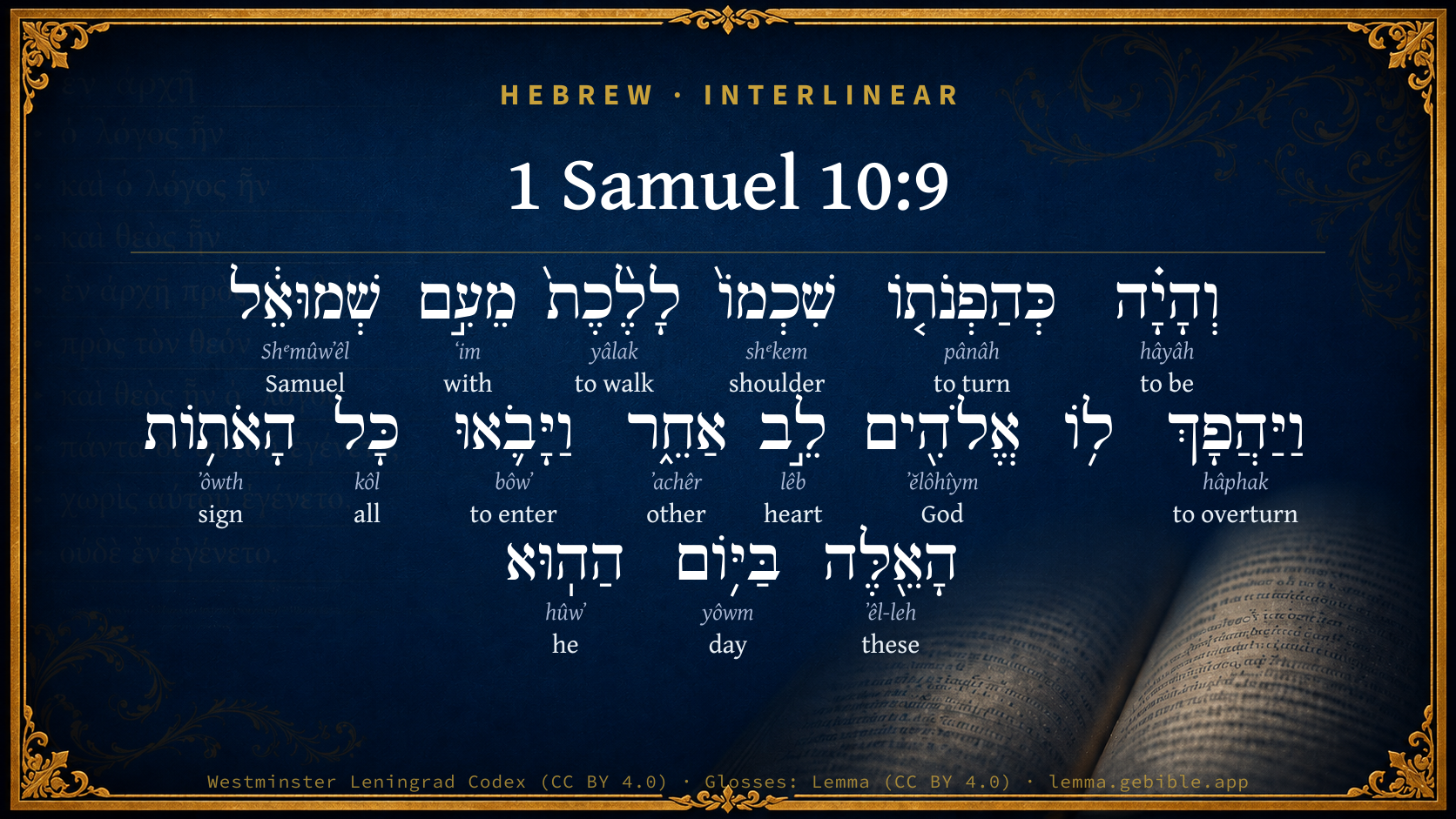
Hebrew (Westminster Leningrad Codex) 1 Samuel 10:9 appears in the Hebrew Old Testament. The text above is from the Westminster Leningrad Codex. Each word links to its Strong’s number, a concise gloss, and parsing drawn from the Open Scriptures Hebrew Bible morphology. Click any word for its full Brown-Driver-Briggs (BDB) entry.
Download image
Cite this verse

1 Samuel 10:9 (World English Bible). Public Domain. Lemma interlinear Bible study tool, https://lemma.gebible.app/v/1-samuel/10/9.

Show BibTeX & RIS
BibTeX
RIS
English Translation
It was so, that when he had turned his back to go from Samuel, God gave him another heart: and all those signs happened that day.
World English Bible · Public Domain
Download a study sheet

One document with this verse’s original text, its word-by-word gloss line, the meaning frame, cross-references with their text, attributed commentary, and full source and license credits — printable, and it pastes into notes with its structure intact.

This verse Autodidact and up

Study sheet (.html) Plain text (.txt)

A passage Seminary Student

Up to 50 verses in one chapter. A passage sheet keeps up to 6 commentary sources and 12 cross-references per verse, in the order this page ranks them, and says so on the sheet whenever that leaves anything out. Ask for a single verse and you get the Autodidact verse sheet above.

Everything on this page stays free to read, with no account — the sheet is a download of what is already on screen, not access to it.

Want to remove ads? Support Godless Engineer
Compare translations 3

The same verse in 3 English versions, stacked beneath the original-language interlinear above. Click any original word for its lexicon entry.

Each is an independent rendering of the whole verse — the interlinear is not word-aligned to these translations.

Highlighted words mark where these versions differ — a whole-verse word diff, not a word-by-word alignment.

  • World English Bible Public Domain
    It was so, that when he had turned his back to go from Samuel, God gave him another heart: and all those signs happened that day.
  • King James Version Public Domain
    And it was so, that when he had turned his back to go from Samuel, God gave him another heart: and all those signs came to pass that day.
  • unfoldingWord Literal Text CC BY-SA 4.0
    And it happened, as he turned his shoulder to go from with Samuel, that God changed to him another heart. And all of these signs came on that day.

unfoldingWord Literal Text — © unfoldingWord, licensed CC BY-SA 4.0. Word-aligned USFM3 via Door43 (git.door43.org/unfoldingWord/en_ult).

Versions to compare (up to 4)

3 of 4 selected

Show all 18 translations

Every available English version of this verse, each an independent rendering of the whole verse.

  • World English Bible Public Domain
    It was so, that when he had turned his back to go from Samuel, God gave him another heart: and all those signs happened that day.
  • Berean Standard Bible Public Domain
    As Saul turned to leave Samuel, God changed Saul’s heart, and all the signs came to pass that day.
  • Majority Standard Bible Public Domain
    As Saul turned to leave Samuel, God changed Saul’s heart, and all the signs came to pass that day.
  • King James Version Public Domain
    And it was so, that when he had turned his back to go from Samuel, God gave him another heart: and all those signs came to pass that day.
  • American Standard Version (1901) Public Domain
    And it was so, that, when he had turned his back to go from Samuel, God gave him another heart: and all those signs came to pass that day.
  • Revised Version (1885) Public Domain
    And it was so, that when he had turned his back to go from Samuel, God gave him another heart: and all those signs came to pass that day.
  • Geneva Bible (1599) Public Domain
    And when he had turned his backe to goe from Samuel, God gaue him another heart: and all those tokens came to passe that same day.
  • Douay-Rheims (1899) Public Domain
    So when he had turned his back to go from Samuel, God gave unto him another heart, and all these things came to pass that day.
  • Young's Literal Translation Public Domain
    And it hath been, at his turning his shoulder to go from Samuel, that God turneth to him another heart, and all these signs come on that day,
  • Literal Standard Version CC BY-SA 4.0
    And it has been, at his turning his shoulder to go from Samuel, that God turns to him another heart, and all these signs come on that day,
  • Unlocked Literal Bible CC BY-SA 4.0
    When Saul turned his back to leave Samuel, God gave him another heart. Then all these signs came to pass that day.
  • unfoldingWord Literal Text CC BY-SA 4.0
    And it happened, as he turned his shoulder to go from with Samuel, that God changed to him another heart. And all of these signs came on that day.
  • Darby Bible Public Domain
    And it was [so] that when he turned his back to go away from Samuel, God gave him another heart; and all those signs came to pass that day.
  • World Messianic Bible Public Domain
    It was so, that when he had turned his back to go from Samuel, God gave him another heart; and all those signs happened that day.
  • Webster's Bible Public Domain
    And it was so, that when he had turned his back to go from Samuel, God gave him another heart: and all those signs came to pass that day.
  • Free Bible Version CC BY-SA 4.0
    The moment Saul turned to leave Samuel, God gave Saul a different way of thinking, and all the signs were fulfilled that day.
  • Bible in Basic English Public Domain
    And it came about, that when he went away from Samuel, God gave him a changed heart: and all those signs took place that day.
  • JPS Tanakh (1917) Public Domain
    And it was so, that when he had turned his back to go from Samuel, God gave him another heart; and all those signs came to pass that day.

Literal Standard Version (2020), Covenant Press — licensed CC BY-SA 4.0. Text via the HelloAO Bible API (eBible.org). Unlocked Literal Bible (unfoldingWord) — licensed CC BY-SA 4.0. Text via the HelloAO Bible API (eBible.org). unfoldingWord Literal Text — © unfoldingWord, licensed CC BY-SA 4.0. Word-aligned USFM3 via Door43 (git.door43.org/unfoldingWord/en_ult). Free Bible Version, Dr. Jonathan Gallagher — licensed CC BY-SA 4.0. Text via the HelloAO Bible API (eBible.org).

Word by word

More ways to search: Search by grammar → Find every occurrence → Compare this word →

Practice this passage: Drill this verse → Learn its vocabulary →

שִׁכְמוֹ֙
shᵉkem
H7926
“shoulder · his”
Noun, Common, Masculine, Singular, Construct + Suffix, Personal, 3rd Person, Masculine, Singular
Part of Speech
Noun
Type
Common
Gender
Masculine
Number
Singular
State
Construct
Full BDB Definition

Origin: from H7925

TWOT: 2386a

shoulder, back - shoulder, shoulder-blade - back (in general)
  1. וְהָיָ֗ה hâyâh H1961 “and · to be” Conjunction + Verb, Qal, Perfect, 3rd Person, Masculine, Singular
  2. כְּהַפְנֹת֤וֹ pânâh H6437 “like/as · to turn · him” Preposition + Verb, Hiphil, Infinitive Construct + Suffix, Personal, 3rd Person, Masculine, Singular
  3. לָלֶ֨כֶת֙ yâlak H3212 “to walk” Preposition + Verb, Qal, Infinitive Construct
  4. מֵעִ֣ם ʻim H5973 “from · with” Preposition + Preposition
  5. שְׁמוּאֵ֔ל Shᵉmûwʼêl H8050 “Samuel” Noun, Proper
  6. וַיַּהֲפָךְ hâphak H2015 “and · to overturn” Conjunction + Verb, Qal, Sequential Imperfect, 3rd Person, Masculine, Singular
  7. אֱלֹהִ֖ים ʼĕlôhîym H430 “God(s)” Noun, Common, Masculine, Plural, Absolute
  8. לֵ֣ב lêb H3820 “heart” Noun, Common, Masculine, Singular, Absolute
  9. אַחֵ֑ר ʼachêr H312 “other” Adjective, Adjective, Masculine, Singular, Absolute
  10. וַיָּבֹ֛אוּ bôwʼ H935 “and · to enter” Conjunction + Verb, Qal, Sequential Imperfect, 3rd Person, Masculine, Plural
  11. כָּל kôl H3605 “all of” Noun, Common, Masculine, Singular, Construct
  12. הָאֹת֥וֹת ʼôwth H226 “the · signs” Particle, Definite Article + Noun, Common, Both, Plural, Absolute
  13. הָאֵ֖לֶּה ʼêl-leh H428 “the · these” Particle, Definite Article + Pronoun, Demonstrative, Common, Plural
  14. בַּיּ֥וֹם yôwm H3117 “in/at the · day” Preposition, Determined + Noun, Common, Masculine, Singular, Absolute
  15. הַהֽוּא hûwʼ H1931 “the · he” Particle, Definite Article + Pronoun, Personal, 3rd Person, Masculine, Singular

About this verse

These counts appear in no published source. They are computed here, from the morphology-tagged text and Lemma’s own curated glosses. What Lemma adds →

17
words
16
distinct lemmas
Historical
section

Notable vocabulary

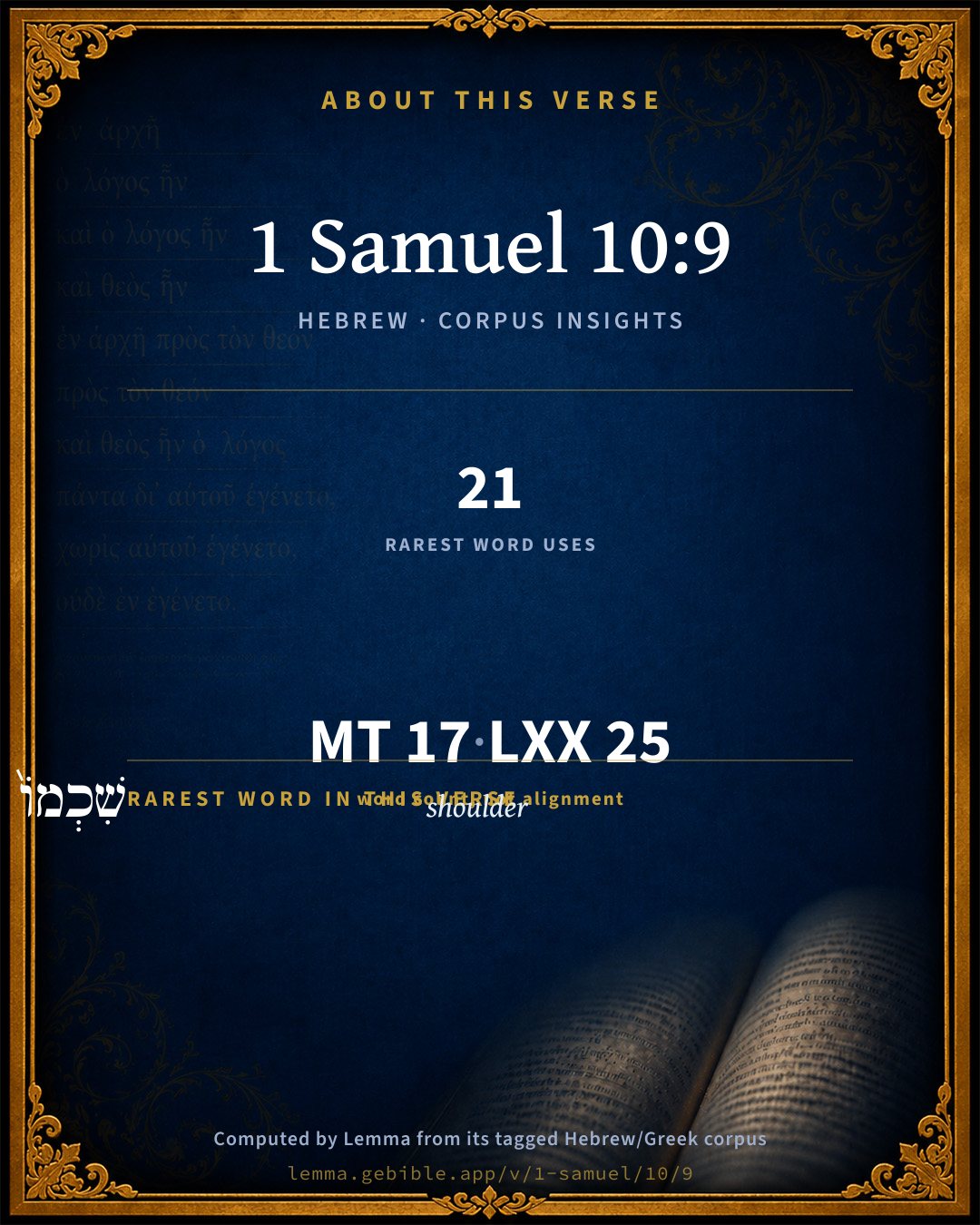
The rarest word here is שִׁכְמוֹ֙ shoulder H7926 — appearing just 21 times in the whole Hebrew Bible.

Shared distinctive vocabulary

שִׁכְמוֹ֙ shoulder H7926 occurs in 21 verses of the Hebrew Bible. Also found in:

Grammatical profile

  • 5 verbs
  • 7 nouns
  • 1 adjective
  • 2 pronouns
  • 2 prepositions

Verb forms

  • וְהָיָ֗ה Qal · Perfect
  • כְּהַפְנֹת֤וֹ Hiphil · Infinitive Construct
  • לָלֶ֨כֶת֙ Qal · Infinitive Construct
  • וַיַּהֲפָךְ Qal · Sequential Imperfect
  • וַיָּבֹ֛אוּ Qal · Sequential Imperfect

Hebrew & Septuagint length

In English translation the verse runs 26 words from the Hebrew and 29 from the Septuagint (LXX English) — closely comparable.

A rough comparison of the two English renderings, which tokenize alike — not a word-level alignment.

Word counts can differ between the Hebrew and the Greek without any difference in meaning — e.g. the Hebrew direct-object marker אֵת has no separate Greek word, and Greek often adds the article ὁ.

In the original languages it is 17 Hebrew tokens and 25 Greek tokens — but the two are counted differently (Hebrew bundles its prefixes and suffixes into one token; the Greek is in lemma form), so that isn’t a like-for-like length.

Cross-references

6

Topical passages linked to 1 Samuel 10:9 in the Treasury of Scripture Knowledge — connected by theme and wording, ordered by reader-vote popularity; previews shown in the World English Bible.

  • Judges 7:11 and you shall hear what they say; and afterward shall your hands be strengthened to go down into the camp. Then went he down with Purah his servant to the outermost part of the armed men who were in the camp.
  • Isaiah 38:7–8 This shall be the sign to you from Yahweh, that Yahweh will do this thing that he has spoken:
  • Judges 6:21 Then the angel of Yahweh put forth the end of the staff that was in his hand, and touched the flesh and the unleavened cakes; and there went up fire out of the rock, and consumed the flesh and the unleavened cakes; and the angel of Yahweh departed out of his sight.
  • Judges 6:36–40 Gideon said to God, If you will save Israel by my hand, as you have spoken,
  • 1 Samuel 10:2–6 When you are departed from me today, then you shall find two men by Rachel's tomb, in the border of Benjamin at Zelzah; and they will tell you, The donkeys which you went to seek are found; and, behold, your father has left off caring for the donkeys, and is anxious for you, saying, What shall I do for my son?
  • Mark 14:16 His disciples went out, and came into the city, and found things as he had said to them, and they prepared the Passover.

Cross-references courtesy of OpenBible.info (CC BY 4.0).

Hebrew and Greek witnesses Masoretic Hebrew ↔ Greek Septuagint

The same verse in the two great witnesses to the Old Testament, shown verse-for-verse.

These are two independent witnesses, not word-aligned to each other, and the Septuagint is shown in lemma (dictionary) form.

Hebrew 1 Samuel 10:9 Masoretic · Westminster Leningrad Codex

וְהָיָ֗ה כְּהַפְנֹת֤וֹ שִׁכְמוֹ֙ לָלֶ֨כֶת֙ מֵעִ֣ם שְׁמוּאֵ֔ל וַיַּהֲפָךְ ל֥וֹ אֱלֹהִ֖ים לֵ֣ב אַחֵ֑ר וַיָּבֹ֛אוּ כָּל הָאֹת֥וֹת הָאֵ֖לֶּה בַּיּ֥וֹם הַהֽוּא

It was so, that when he had turned his back to go from Samuel, God gave him another heart: and all those signs happened that day.

World English Bible · Public Domain

Greek LXX 1 Samuel 10:9 Septuagint · lemma form

καί γίγνομαι ὥστε ἐπιστρέφω ὁ ὦμος αὐτός ἀποἔρχομαι ἀπό σαμουηλ μεταστρέφω αὐτός ὁ θεός καρδία ἄλλος καί ἔρχομαι πᾶς ὁ σημεῖον ἐν ὁ ἡμέρα ἐκεῖνος

And it came to pass when he turned his back to depart from Samuel, God gave him another heart; and all these signs came to pass in that day.

LXX2012 (modern English Septuagint) · Public Domain

On this verse, Keil & Delitzsch discusses the Septuagint’s reading. Read the note in Commentary ↓

Hebrew: Westminster Leningrad Codex (CC BY 4.0). Greek: Septuagint (public domain); English from LXX2012 (modern English Septuagint) (Public Domain). How the Septuagint differs from the Hebrew →

Targum (Aramaic paraphrase)

1

The Targum is the ancient Jewish Aramaic paraphrase of the Hebrew Scriptures — an interpretive translation, not the Hebrew text itself. Onkelos (literal) and Pseudo-Jonathan (expansive) render the Torah, and Jonathan the Prophets. Coverage is partial: where no permissively-licensed English translation exists for a verse, only the Aramaic is shown. This is verse-level text, not a word-by-word alignment to the Hebrew.

  1. Targum Jonathan Prophets (Joshua–Malachi)
    וַהֲוָה כַּד אִתְפְּנֵי כִתְפֵיהּ לְמֵיזַל מִלְוַת שְׁמוּאֵל וְשַׁנִי לֵיהּ יְיָ לִבָּא אוֹחֲרָנָא וַאֲתָאָה כָּל אָתַיָא הָאִלֵין בְּיוֹמָא הַהוּא:

    (no public-domain English translation for this verse)

    Targum Jonathan — Aramaic: “Mikraot Gedolot” (public domain). English: “Sefaria Community Translation” (CC0 1.0 (public-domain dedication)); “London "Chaldee Paraphrase," 1871” (public domain). Text via Sefaria.

Commentary

Notes on 1 Samuel 10:9 from classic Christian and Jewish commentators (each source and its license shown beneath its notes). The classic Christian expositions comment on the surrounding passage and are grouped to its opening verse, so a note may address several verses; the Jewish commentaries on the Tanakh (Rashi and others) are per-verse, so they appear only where the commentator wrote on this verse.

Lemma curates 59 commentaries, every one of them public domain or Creative Commons licensed, each selected and text-cleaned for this edition rather than reprinted as found. About our sources →

Matthew Henry's Commentary

Saul has now taken his leave of Samuel, much amazed, we may well suppose, at what has been done to him, almost ready to question whether he be awake or no, and whether it be not all a dream. Now here we are told,

I. What occurred by the way, Sa1 10:9. Those signs which Samuel had given him came to pass very punctually; but that which gave him the greatest satisfaction of all was this, he found immediately that God had given him another heart. A new fire was kindled in his breast, such as he had never before been acquainted with: seeking the asses is quite out of his mind, and he thinks of nothing but fighting the Philistines, redressing the grievances of Israel, making laws, administering justice, and providing for the public safety; these are the things that now fill his head. He finds himself raised to such a pitch of boldness and bravery as he never thought he should be conscious of. He has no longer the heart of a husbandman, which is low, and mean, and narrow, and concerned only about his corn and cattle; but the heart of a statesman, a general, a prince. Whom God calls to any service he will make fit for it. If he advance to another station, he will give another heart, to those who sincerely desire to serve him with their power.

II. What occurred when he came near home. They came to the hill (Sa1 10:10), that is, to Gibeah, or Geba, which signifies a hill, and so the Chaldee here takes it as a proper name; he met with the prophets as Samuel had told him, and the Spirit of God came upon him, strongly and suddenly (so the word signifies), but not so as to rest and abide upon him. It came on so as to go off quickly. However, for the present, it had a strange effect upon him; for he immediately joined with the prophets in their devotion, and that with as much decorum and as great a transport of affection as any of them: He prophesied among them. Now,

1. His prophesying was publicly taken notice of, Sa1 10:11, Sa1 10:12. He was now among his acquaintance, who, when they saw him among the prophets, called one another to come and see a strange sight. This would prepare them to accept him as a king, though one of themselves, when they had seen how God had advanced him to the honour of a prophet. The seventy elders prophesied before they were made judges, Num 11:25. Now, (1.) They all wondered to see Saul among the prophets: What is this that has come to the son of Kish? Though this school of the prophets was near his father's house, yet he had never associated with them, nor shown them any respect, perhaps had sometimes spoken slightly of them; and now to see him prophesying among them was a surprise to them, as it was long after when his namesake, in the New Testament, preached that gospel which he had before persecuted, Act 9:21. Where God gives another heart it will soon show itself. (2.) One of them, that was wiser than the rest, asked, "Who is their father, or instructor? Is is not God? Are they not all taught of him? Do they not all owe their gifts to him? And is he limited? Cannot he make Saul a prophet, as well as any of them, if he please?" Or, "Is not Samuel their father?" Under God, he was so; and Saul had now lately been with him, which, by his servant, he might know. No marvel for him to prophesy who lay last night under Samuel's roof. (3.) It became a proverb, commonly used in Israel, when they would express their wonder at a bad man's either becoming good, or at least being found in good company, Is Saul among the prophets? Note, Saul among the prophets is a wonder to a proverb. Let not the worst be despaired of, yet let not an external show of devotion, and a sudden change for the present, be too much relied on; for Saul among the prophets was Saul still.

2. His being anointed was kept private. When he had done prophesying, (1.) It should seem he uttered all his words before the Lord, and recommended the affair to his favour, for he went straight to the high place (Sa1 10:13), to give God thanks for his mercies to him and to pray for the continuance of those mercies. But, (2.) He industriously concealed from his relations what had passed. His uncle, who met with him either at the high place or as soon as he came home, examined him, Sa1 10:14. Saul owned, for his servant knew it, that they had been with Samuel, and that he told them the asses were found, but said not a word of the kingdom, Sa1 10:14, Sa1 10:15. This was an instance, [1.] Of his humility. Many a one would have been so elated with this surprising elevation as to proclaim it upon the house-top. But Saul, though he might please himself with it in his own breast, did not pride himself in it among his neighbours. The heirs of the kingdom of glory are well enough pleased that the world knows them not, Jo1 3:1. [2.] Of his prudence. Had he been forward to proclaim it, he would have been envied, and he knew not what difficulty that might have created him. Samuel had communicated it to him as a secret, and he knows how to keep counsel. Thus it appears that he had another heart, a heart fit for government. [3.] Of his dependence upon God. He does not go about to make an interest for himself, but leaves it to God to carry on his own work by Samuel, and, for his own part, sits still, to see how the matter will fall.

Matthew Henry's Commentary on the Whole Bible (1708–1710) — public domain (CC PDM 1.0). Text via the HelloAO Bible API.

Trapp's Complete Commentary

John Trapp

1Sa 10:9 And it was [so], that when he had turned his back to go from Samuel, God gave him another heart: and all those signs came to pass that day.

Ver. 9. God gave him another heart.] According to 1Sa 10:6. {See Trapp on "1Sa 10:6"} It is remarkable that is reported of those Areopagite judges in Athens, that men of evil conversation, after they were once admitted into that company, abhorring and blushing at their former dispositions, changed their natures, and embraced virtue. {a}

{a} οκνουντες τη φυσει χρησθαι.

John Trapp, A Commentary or Exposition upon All the Books of the Old and New Testament (1647–1656) — public domain. Text from a community e-Sword module.

The Biblical Illustrator

Joseph S. Exell

1Sa_10:9

God gave him another heart.

Another heart

But not a better heart. He found himself suddenly fitted for the new place to which Providence had summoned him. In this there was nothing magical or extraordinary. It is indeed said that God gave him another heart, but we are not to understand the words as indicating a Divine operation independent of outward means and natural influences, or at all distinguishable, in the consciousness of its subject, from the effects of external circumstances. It is not more true that the man makes the place than that the place makes the man. Both, indeed, are most pregnant and concerning truths. Saul, transplanted into a new station, brought into new relations to life and society, felt the simultaneous upspringing within him of sentiments and purposes suited to his position, and became conscious of capabilities which had before lain dormant, and might have always remained so, but for this transformation of his outward state. Made a king, he became kingly. His soul expanded to the horizon of his new dignity and office. But, alas! there was no spiritual element in his change, and, therefore, it yielded no happy fruit for him, or to the church of God. It was but the direction of the same earthly mind to larger objects, stander schemes, a wider range. We may properly take occasion from this case, to discriminate between certain other changes to which the spirit of man is subject, and that great spiritual change which alone affects him savingly, planting in him the germ of holiness and immortal felicity; or to point out the difference between another heart and a new heart.

1. And, first, I will direct your attention to the nature and effects of spurious religious excitement. There is excitement almost necessarily in the serious and earnest contemplation of religious truth. Its revelations are fitted to stir the spirit of man deeply; the interests to which it pertains are too momentous to be contemplated without emotion. The nature of men is sympathetic. Hence feeling is contagious, and not only so, but excitement, where it exists already, rises, by the reacting influence of those who come within its sphere and imbibe its infection. But excitement is bounded by limits fixed in the constitution of our nature; and when these are reached a revulsion takes place, which issues either in stagnation or in a new excitement of a different description. And when these opposite emotions are produced by religious causes they are thought to indicate a work of the Spirit and involve conversion. It is quite remarkable, how little the moral and truly spiritual nature of man may have to do with such a process, how little of anything else there may be in it beside imagination and nervous sensibility. And yet, on the strength of it, a man often accounts himself a new man; and, whether he be right in that judgment or not, not infrequently, he thereupon becomes and permanently remains another man. His life henceforward assumes a new bent. He adopts new opinions, he talks a new language, he affects new associates, he frequents new walks, he lends himself to the promotion of new interests. And yet he is not new man. Only his outward life has taken a new impress, as Sauls did, in which the same worldly spirit finds a concealment and disguise.

2. There is another very different transformation to which men are subject, which yet is at no greater value; and tends to no better results--that which is brought about by the slow operation of time and the gradual alteration of outward circumstances. The lesson of life is a sobering lesson. The fire of youth burns out as the period of youth expires. Every day some leaf fails from the flower he is seeking to grasp. Continually the stern hand of irresistible Providence shuts up some avenue that allures his steps. But the worst disappointment is that which waits upon success--the bitter pain of finding a thing, when it is gotten, not worth the pains of getting. Sometimes there is but a change of follies and vices, the substitution of a calmer and more private form of sensuality or dissipation for another of a more boisterous and public character; but the impress of sin and worldliness remains, and is too visible to allow the supposition of any moral improvement. The result of time upon human character is very various, yet it seldom fails in one way or another to be evident and marked, and among persons whose course is not an abandoned one, is generally distinguished by a nearer approximation to the apparent effects of religion; and thus few men live on over the meridian of life without coming to have another heart, one which, in many instances, it may not be very difficult for themselves or others to mistake for a new and a better heart. What I said may be wanting in either of these, is a spiritual element, and as the absence of this fatally vitiates these cases, and every other ease where it appears, so its presence in either of them, or in any other change which the soul of man may undergo, declares the work to be of God, and furnishes a true mark of meetness for life eternal. Let us then look a little at this as it stands contradistinguished from all alterations, whose seat is either the imagination or the outward deportment, whose affinity to religion is limited to a certain accidental coincidence or similarity in some particulars, and whose religious phases are confined to the inferior and superficial portion of human nature.

(1) And first, look at this change in reference to the effect upon the heart of the grand and peculiar features of the Gospel an irreligious mind has either no clear or definite views of the scheme of salvation by Jesus Christ; or if it comprehends it intellectually, and is able to think and speak of it with a scientific precision, it does not perceive and feel its fitness and necessity. It wears an arbitrary appearance. The Gospel is unreal to it. But with the rise of spiritual affections the film is cleared away. The truths of the Gospel come forth from their obscurity and vagueness, and the heart at once learns what they are, loses its indifference to them, appreciates their value, loves them, and lives upon them.

(2) Look, secondly, at this change in respect to the power and influence of the Divine will upon the soul. The spirit of religion is an obedient spirit. The spirit of irreligion is a disobedient spirit. If a child pursue a course of conduct coincident with its parents will purely for its own gratification, that, is not obedience; or if it complies with his commands simply from fear of punishment, that is not obedience. Mans eyes may not distinguish it from obedience, but it is not obedience. Obedience requires a filial and submissive heart. There is the recognition of a new authority, the acknowledgment of a new rule. The man does the same act for a different reason.

(3) Look, thirdly, at this change as it affects a mans view of eternity. The view of the worldly man is comprised within the bounds of time. If he ever looks beyond it, it is with a stealthy and uneasy glance. There is a quickening of that mans spiritual nature to whom eternity comes forth out of this vague and unreal condition, and becomes a near and interesting reality, full of interests for which he would fain make provision, to be habitually borne in mind and cared for, to secure the benefit of which he counts it a privilege to live and labour. (R. A. Hallam, D. D.)

Getting another heart

He had come home from college, the ministers son. He had been a wild, harum-scarum kind of boy before he went. Many a sore heart did the minister get as the boisterous exploits of his wayward son oozed out to him from all parts of the parish. But at length he has gone to college and has come home now at the end of winter. The parish has heard of his shooting ahead of his fellows in the college classes, and they were all proud of their ministers boy. He is in the study along with his old father, but he is not receiving this time the usual parental little lecture. He is opening a tiny little case, while his fathers eyes are dancing with gladness. It is the gold medal for the best student of the year, and, as the looks of the father and son meet in tenderness, the once careless lad whispers in his fathers ear what brings a sob from the minister, but not a sob of sorrow: I have got something else than the gold medal this winter. I thought I would best tell it now. I have also got the new heart. There had been a revival that winter in the city, and many of the students had been converted, and among them the gold medallist of the year, our ministers brilliant boy. (John Robertson.)

The Biblical Illustrator, edited by Joseph S. Exell (c. 1880s–1900s) — public domain. Text from a community e-Sword module.

Joseph Benson's Commentary

1Sa 10:9-10. God gave him another heart — He immediately fulfilled the last and chief of these signs: for Saul was no sooner gone from Samuel than he felt another spirit coming into him, a spirit of holiness, wisdom, and fortitude, to qualify him for the government of God’s people; which afterward God took from him because of his sins, 1Sa 16:14. See Psa 51:12. He prophesied among them — The accomplishment of the two former signs is supposed, and this only is expressed, because this was more eminent than the former; the others were only transient acts, which passed in private, between two or three persons meeting together; but this was a more permanent and notorious sign, done in a more solemn manner, and before many witnesses.

Joseph Benson's Commentary on the Old and New Testaments (1811–1818) — public domain. Text from a community e-Sword module.

Tyndale Open Study Notes

Tyndale Open Resources

10:9 a new heart: God gave Saul courage and strength, helping him overcome his hesitancy and enabling him to be king (10:6).

Tyndale Open Study Notes — © Tyndale Open Resources, licensed CC BY-SA 4.0. Text via the HelloAO Bible API.

Geneva Bible (1599)

Geneva Bible translators

Hebrew, shoulder.

He gave him such virtues as were meet for a King.

Geneva Bible (1599) marginal notes — public domain. Text via Bolls.life.

Jamieson, Fausset & Brown

Robert Jamieson, A. R. Fausset & David Brown

when he had turned his back to go from Samuel, God gave him another heart--Influenced by the words of Samuel, as well as by the accomplishment of these signs, Saul's reluctance to undertake the onerous office was overcome. The fulfilment of the two first signs [Sa1 10:7-8] is passed over, but the third is specially described. The spectacle of a man, though more fit to look after his father's cattle than to take part in the sacred exercises of the young prophets--a man without any previous instruction, or any known taste, entering with ardor into the spirit, and skilfully accompanying the melodies of the sacred band, was so extraordinary a phenomenon, that it gave rise to the proverb, "Is Saul also among the prophets?" (see Sa1 19:24). The prophetic spirit had come upon him; and to Saul it was as personal and experimental an evidence of the truth of God's word that had been spoken to him, as converts to Christianity have in themselves from the sanctifying power of the Gospel.

Jamieson, Fausset & Brown — Commentary Critical and Explanatory on the Whole Bible (1871) — public domain (CC PDM 1.0). Text via the HelloAO Bible API.

The Cambridge Bible for Schools and Colleges

gen. ed. J. J. S. Perowne

9–16. The fulfilment of the signs

9 God gave him another heart] Lit. “turned him another heart.” Cp. 1Sa_10:6. The divine inspiration transformed the simple countryman into the King and Deliverer of Israel. The heart in Scripture denotes “the centre of the whole mental and spiritual life of will, desire, thought, perception, and feeling.”

The Cambridge Bible for Schools and Colleges (gen. ed. J. J. S. Perowne; Cambridge University Press, 1878–1918) — public domain. Text from a community e-Sword module.

John Gill's Exposition

And it was so, that when he had turned his back to go from Samuel,.... When he had taken his leave of him, and set forward on his journey:

God gave him another heart; not in a moral or spiritual sense, not a new heart, and a new spirit, as in conversion, but in a civil sense, a right heart, a heart fit for government; filled with wisdom and prudence to rule a people; with courage and magnanimity to protect and defend them against their enemies, and fight for them; a heart not taken up with the affairs of husbandry, with care for his father's asses, and looking after his herds, but filled with concern for the civil welfare of Israel, and with schemes and contrivances for their good, and with warm resolutions to deliver them out of the hands of their enemies:

and all these signs came to pass that day; the two first, which are not particularly mentioned as fulfilled, being more private, as finding two men at Rachel's sepulchre, and meeting with three others going to Bethel, which came to pass just as they were described; and the third, which was more public, and gave Saul more reverence and respect among the people, is next particularly observed.

John Gill's Exposition of the Whole Bible (1746–1763) — public domain (CC PDM 1.0). Text via the HelloAO Bible API.

Whedon's Commentary on the Bible

Daniel D. Whedon

9. When he had turned his back… God gave him another heart — In 1Sa_10:6 he is told that he would be turned into another man when he came in contact with the company of prophets, but here it appears that as soon as he left the company of Samuel God turned to him another heart. And so it doubtless was. The unexpected and impressive disclosures which the prophet had made to him began at once to work a revolution in his inner life. Every successive sign, as it came to pass, deepened the impression, and when he met the band of prophets he was a most proper subject to catch the inspiration of their contagious enthusiasm. So he truly returned to Gibeah another man from what he was when he left that place five days before.

Daniel D. Whedon (gen. ed.), Commentary on the Old and New Testaments (1874–1909) — public domain. Text from a community e-Sword module.

The Pulpit Commentary

God gave him another heart. The Hebrew is remarkable: "When he turned his shoulder to go from Samuel, God also turned for him another heart," i.e. God turned him round by giving him a changed heart. He grew internally up to the level of his changed circumstances. No longer had he the feelings of a husbandman, concerned only about corn and cattle; he had become a statesman, a general, and a prince. No man could have gone through such marvellous events, and experienced such varied emotions, without a vast inward change. But it might have been only to vanity and self-complacency. Saul"s change was into a hero.

Vers. 9-17.

The reasonableness of incongruities.

The facts are

1. Saul experiences the truth of all that Samuel had told him.

2. Being met by a company of prophets, Saul, under an inspiration fromGod, also prophesies.

3. The people remark on the incongruity of Saul"s being among theprophets.

4. Saul"s uncle, being too inquisitive in the matter of Samuel"s intercoursewith him, is not gratified. The general reader of the Bible is struck with the incongruity between Saul"s antecedents and his sudden participation in the gifts of prophecy; and men generally have sympathised with the surprise which expressed itself in the proverb, "Is Saul among the prophets?" Too frequently the event here recorded is left as one of the strange, unaccountable things scattered ever the page of sacred history, furnishing to the mind more of perplexity and embarrassment than of instruction and aid to faith. It will, however, be found that in the course of Providence the seeming incongruities play an important part, that they are not essentially unreasonable, and are all reducible to a common principle.

I The COURSE OF PROVIDENCE PRESENTS NUMEROUS INSTANCES OF STRIKING INCONGRUITY. Whatever the precise definition of incongruity, the thing itself may be found in the form of conduct, association, relation, and means. Leaving out all instances resulting from human folly and eccentricity; we may notice a few in the order of

Providence as seen in

1. Conduct. Saul"s is a case in point. He was an instrument in the hand of God of producing the strange impression indicated by the familiar proverb. To the Jews in Jerusalem on the day of Pentecost there was an unaccountable incongruity in the speech and bearing of men who, up to that time, had been timid, obscure followers of the Crucified. Considering the reputed character of Peter as a rash, impulsive man, it was, in the judgment of his companions and in the light of his denial, scarcely congruous to commit to him the "key" of the kingdom. And the joyful

2. songs which rose from the apostles when in the stocks were strange music to their warders. Modern history is not without its notable instances.

3. Associations. For Saul to be associated with a prophetic order was a marvel. That a glorious star should lead wise men from afar only to a babe in a manger, and that the hosts of heaven should sing on the birth of a helpless child, was an association rare and astonishing. The most perplexing incongruity to many is that the Eternal One should for a term of years be in association with a frail body, with all the sorrowful incidents inseparable therefrom.

4. Relations. We find this in Saul"s case; for men can see no congruity between his ecstatic excitement as prophet and the office of king to which he was being called. The relation of John the Baptist, an austere, unsociable ascetic, as forerunner to the mild, approachable Christ, struck men as remarkable, and needed the vindication that "wisdom is justified of her children". (Mat_11:16-19) It also occurred to John as a most incongruous thing that he should have to baptize the holy Saviour. (Mat_3:13-15)

5. Means. As a means of qualifying Saul for the discharge of kingly functions this prophetic excitement seemed to be most unsuitable. So, likewise, to many there is no propriety in the uplifting of a brazen serpent as a means of restoring health to the poisoned. Naaman could not think the Jordan better than the rivers of his own country. The cross of Christ was despised by the Greeks as foolishness a most incongruous means for the subjugation of the world to him who died thereon.

II The SEEMING INCONGRUITIES IN THE COURSE OF PROVIDENCE ARE RELATIVE TO OUR IGNORANCE. That is incongruous only which is not understood. "Things are not what they seem." Our surprises and astonishments are often the index of our lack of knowledge. It may not be possible in every instance to find a complete solution, but some clue may be found if we will consider all the events of Providence as interrelated, and throwing light on one another. The reasonableness of incongruities may be illustrated by taking as a typical instance the conduct of Saul. The appearance of a prophetic order at that juncture, under the direction of Samuel, was a necessary feature in the moral elevation of the people. The stagnant indifference of men could be best aroused by urgent zeal. The reasonableness of Saul"s excitement resolves itself into that of the order. We are to remember that a coming good in Messiah"s reign was the hope of the true Israel. In so far as their conviction was deep, and was attended by a corresponding pity for present degradation, it, when full on the spirit, would not unnaturally produce an excitement proportionate to the susceptibility of the temperament and the external occasion, and the utterance of the truth would be measured by the degree of excitement. Therefore the educational value of these men was great, and they were obedient, in their extravagance, to the laws of mind and the urgency of religions conviction. Now it was reasonable for Saul to share in this gift

1. For the people. It would call their attention to him, and prepare them for the subsequent action of Samuel.

2. For Saul himself. He was to be king, and the people imagined that their king would be after the pattern of other kings. But Israel"s king must rule in harmony with the spiritual destiny of the nation. He must be in sympathy with prophets.

3. For the order of prophets. This order was one of the great powers in fashioning the future of the people of God. It therefore was interested in the character and aspirations of whatever king might be chosen. Saul"s endowment with their own gift would assure them that he was worthy of their support, and would not be as the kings of the nations. The incongruity was most reasonable.

III The TRUE SOLUTION OF ANY INCONGRUITY IN THE COURSE OF PROVIDENCE IS TO BE FOUND IN THE SERIES OF WHICH THE EVENT IS BUT ONE. Saul"s conduct, regarded in relation to the antecedents of Israel"s life, and the gradual preparation of the world for Christ, stands out as most fit and useful; therefore, natural. No one can rightly judge of Scripture events who does not consider the course of Providence as a development from the imperfect to the more perfect. The place and power of every molecule in the universe are relative to the antecedent and subsequent movements of the whole. Astronomers have met with perturbations and irregularities which seemed incongruous with all they knew, but in time they discovered the place of these so called irregularities in the mechanism of the heavens, and they became at once beautiful regularities. The issue of redemptive methods will throw light on the process.

General lessons:

1. The most unlikely of men may be called to do God"s will in forms unlocked for.

2. The varied gifts requisite to an office will be forthcoming to all whomGod calls to the office.

3. We should be careful to keep our mind free from prejudice againstmethods which, though unusual, may be of God.

4. A deep and patient study of the Bible as a whole is the only means oflearning the beauty and harmony of his ways.

5. A true philosophy will induce us to suspend our judgment on somesubjects until we can see more clearly the relation of the past to the future.

Wise reticence.

The notice taken of an inquiry by Saul"s uncle is evidently for the purpose of bringing in bold relief Saul"s wisdom in being reticent on the important matters concerning the kingdom. It is probable that the bearing of Saul indicated that something unusual had transpired, and the prophesying would only confirm the suspicion. Saul"s replies do not make clear whether the uncle was designedly prying into what he knew were secrets, or was simply seeking general information. But in either case Saul formed a proper estimate of his own position, and manifested a proper reserve.

I A DEGREE OF RETICENCE IS ESSENTIAL TO A WISE LIFE. "There is a time to speak, and a time to be silent." Reticence, however, is more than silence; it is deliberate silence where speech is possible and sought. It may be considered with reference to

1. Its source. In every case its source is in the will acting freely in the form of a negative judgment. But still this judgment may in some persons be connected more with temperament than with an enlightened estimate of what is proper. The wise reticence is that which comes from a just estimate of what is due to the occasion and the subject matter.

2. Its proper subject matter. This must be determined by a calm judgment on the right of others to know what we know, and the utility of unveiling our knowledge. But taking a general view of human life, we may say that reticence is due to

(1) Our deepest religious experience. There are depths in the soul which no eye but God"s can penetrate, and there are experiences there so sacred, tender, and awful that it would be a species of profanity to endeavour to unfold them in form of speech. If, for purpose of seeking assistance, reference is made to secret experiences, the surface only is to be touched.

No one who reveres the sacredness of religious life will attempt to pry into what is secret between the soul and God, or to probe wounds which "shame would hide.

(2) Private and domestic affairs. There are in every life interests which belong to no one else; and in home there are solemn secrets on which the cold, critical eye of the world must not be allowed to gaze. Much of the sweet, binding influence of home lies in the unforced reticence of its members.

(3) Secrets pertaining to office. Office in Church, State, or commerce implies know]edge to be used only for specific purposes in relation thereto. No one is fit for office who cannot control his tongue and resist temptation to speak.

1. Its value. As a habit of mind, when distinguished from sullen reserve, the result of mere temperament, it gives power to the possessor. It reveals a sober, discriminating judgment, a strength of purpose that can resist inducement, and a profound regard for the sanctities of life. In society it, wisely exercised, insures confidence, renders transaction of affairs easy, and promotes respectful, courteous bearing. In religious associations it tends to reverence, devoutness of spirit, and sincerity.

2. Its dangers. It is, if not carefully guarded, likely to degenerate into a love of secrecy, an unnaturally close, reserved habit of mind. In religious life its excess may put a check on the free utterance of life"s sorrows and cares even to God, and also deprive the Church of the benefits of a rich experience.

II WISE RETICENCE WILL ALWAYS BE CONSISTENT WITH TRUTHFULNESS. It is possible to state partial truth in such a way as virtually to lie, and to be silent when silence may be designed to convey a false impression. Saul was truthful in his reticence. He answered questions; he did not volunteer information. Had he been pressed he most likely would have declined to answer. Christ was reticent when pressed on the question of John"s baptism, and when examined by Pilate, but no false impression was conveyed. In cases of difficulty it is better point blank to refuse information than incur the risk of suspected prevarication. Inquisitive men should be plainly rebuked rather than put off with questionable answers.

The Pulpit Commentary (1880–1919), ed. H.D.M. Spence-Jones & Joseph S. Exell — public domain. Text from a community e-Sword module.

Keil & Delitzsch

C. F. Keil & F. Delitzsch

When Saul went away from Samuel, to return to Gibeah, "God changed to him another heart," - a pregnant expression for "God changed him, and gave him another heart" (see at Sa1 10:6); and all these signs (the signs mentioned by Samuel) happened on that very day. As he left Samuel early in the morning, Saul could easily reach Gibeah in one day, even if the town where he had met with Samuel was situated to the south-west of Rachel's tomb, as the distance from that tomb to Gibeah was not more than three and a half or four hours.

Sa1 10:10

The third sign is the only one which is minutely described, because this caused a great sensation at Gibeah, Saul's home. "And they (Saul and his attendant) came thither to Gibeah." "Thither" points back to "thither to the city" in Sa1 10:5, and is defined by the further expression "to Gibeah" (Eng. version, "to the hill:" Tr.). The rendering ἔκειθεν (lxx) does not warrant us in changing שׁם into משּׁם; for the latter would be quite superfluous, as it was self-evident that they came to Gibeah from the place where they had been in the company of Samuel.

Sa1 10:11

When those who had known Saul of old saw that he prophesied with the prophets, the people said one to another, "What has happened to the son of Kish? Is Saul also among the prophets?" This expression presupposes that Saul's previous life was altogether different from that of the disciples of the prophets.

Sa1 10:12

And one from thence (i.e., from Gibeah, or from the crowd that was gathered round the prophets) answered, "And who is their father?" i.e., not "who is their president?" which would be a very gratuitous question; but, "is their father a prophet then?" i.e., according to the explanation given by Oehler (Herzog's Real. Enc. xii. p. 216), "have they the prophetic spirit by virtue of their birth?" Understood in this way, the retort forms a very appropriate "answer" to the expression of surprise and the inquiry, how it came to pass that Saul was among the prophets. If those prophets had not obtained the gift of prophecy by inheritance, but as a free gift of the Lord, it was equally possible for the Lord to communicate the same gift to Saul. On the other hand, the alteration of the text from אביהם (their father) into אביהוּ (his father), according to the lxx, Vulg., Syr., and Arab., which is favoured by Ewald, Thenius, and others, must be rejected, for the simple reason that the question, Who is his father? in the mouth of one of the inhabitants of Gibeah, to whom Saul's father was so well known that they called Saul the son of Kish at once, would have no sense whatever. From this the proverb arose, "Is Saul also among the prophets?" - a proverb which was used to express astonishment at the appearance of any man in a sphere of life which had hitherto been altogether strange to him.

Sa1 10:13-16

When Saul had left off prophesying, and came to Bamah, his uncle asked him and his attendant where they had been; and Saul told him, that as they had not found the asses anywhere, they had gone to Samuel, and had learned from him that the asses were found. But he did not relate the words which had been spoken by Samuel concerning the monarchy, from unambitious humility (cf. Sa1 10:22, Sa1 10:23) and not because he was afraid of unbelief and envy, as Thenius follows Josephus in supposing. From the expression "he came to Bamah" (Eng. ver. "to the high place"), we must conclude, that not only Saul's uncle, but his father also, lived in Bamah, as we find Saul immediately afterwards in his own family circle (see Sa1 10:14.).

Keil & Delitzsch — Biblical Commentary on the Old Testament (1861–1891) — public domain (CC PDM 1.0). Text via the HelloAO Bible API. (Old Testament only.)

unfoldingWord translationNotes

Door43 World Missions Community

God gave him another heart

God enabled Samuel to think differently from the way he had thought before. (See: Idiom)

the Spirit of God rushed upon him

Samuel speaks as if the Spirit of Yahweh were a person running up to Saul and taking complete control of him. See how you translated this in 1 Samuel 10:6. AT: "the Spirit of Yahweh took complete control of him" (See: Personification)

translationWords

Saul (OT)

turn

Samuel

God

heart

miracle

prophet

Holy Spirit

unfoldingWord translationNotes — © Distant Shores Media and the Door43 World Missions Community, licensed CC BY-SA 4.0. Source: git.door43.org/Door43/en_tn.

Rashi

Rabbi Shlomo Yitzchaki (Rashi)

Transformed his heart. [To] a spirit of royal power.

Rashi on the Tanakh — English translations: “The Judaica Press complete Tanach with Rashi, translated by A. J. Rosenberg” (CC BY 4.0); “Pentateuch with Rashi's commentary by M. Rosenbaum and A.M. Silbermann, 1929-1934” (public domain); “The Metsudah Tanach series, Lakewood, N.J” (CC BY 4.0); and “The Book of Joshua, Metsudah Publications, 1997” (CC BY 4.0). Text via Sefaria.

Lesson kit

Teaching starters — assembled from the data on this page, not authored interpretation. Every prompt links to the verse data it draws on. Edit before teaching.

1 Samuel, in the Historical, opens this verse with 17 words (16 distinct Hebrew lemmas). Its most distinctive word is shᵉkem (“shoulder”). A historical commentator’s framing appears above. Read the whole chapter for the surrounding context.

Discussion questions

  1. The word shᵉkem carries the sense “shoulder.” How does it shape the verse?
  2. Genesis 9:23 shares the word «shoulder» with this verse. How do the two illuminate each other?
  3. These translations render this verse differently. What is at stake in choosing one wording over another?
  4. The verb «וְהָיָ֗ה» is Qal Perfect. How does its form color the action?
  5. Reading how Matthew Henry's Commentary and Trapp's Complete Commentary read this verse, where do the two commentators agree and where do they part?

Things to notice

Reading settings

Reading text

Shown beneath each verse's original-language words.

Old Testament
Old Testament edition

Read the OT as the Masoretic Hebrew (MT) or the Greek Septuagint (LXX).

English shown for the Greek Septuagint (in the Hebrew ↔ Greek comparison).

Comparing translations? Open the Compare panel on any verse page to stack up to four side by side.