
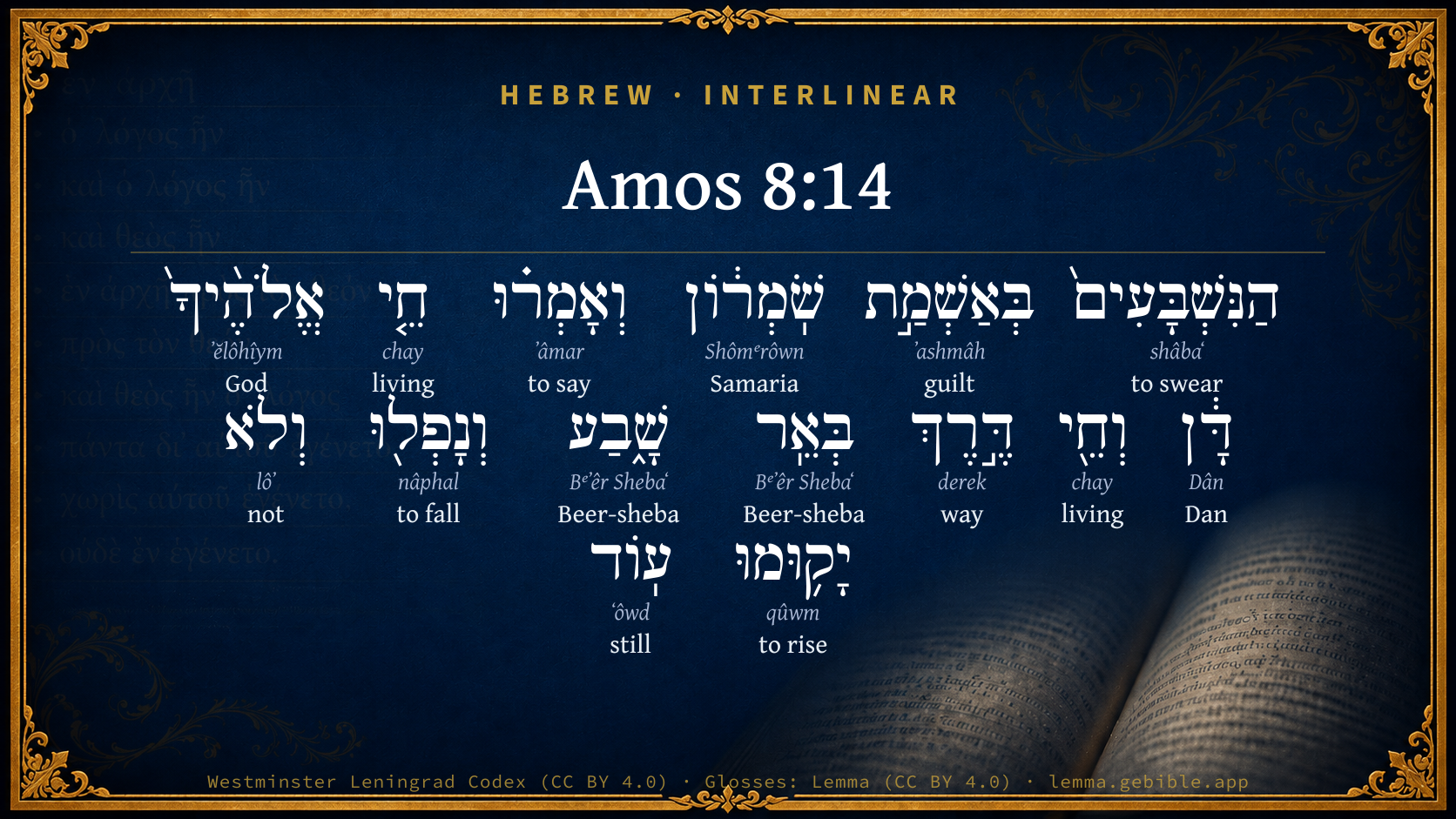
Amos 8:14

Hebrew (Westminster Leningrad Codex) Amos 8:14 appears in the Hebrew Old Testament. The text above is from the Westminster Leningrad Codex. Each word links to its Strong’s number, a concise gloss, and parsing drawn from the Open Scriptures Hebrew Bible morphology. Click any word for its full Brown-Driver-Briggs (BDB) entry.
Download image
Cite this verse

Amos 8:14 (World English Bible). Public Domain. Lemma interlinear Bible study tool, https://lemma.gebible.app/v/amos/8/14.

Show BibTeX & RIS
BibTeX
RIS
English Translation
Those who swear by the sin of Samaria, And say, 'As your god, Dan, lives;' And, 'As the way of Beersheba lives;' They will fall, and never rise up again."
World English Bible · Public Domain
Download a study sheet

One document with this verse’s original text, its word-by-word gloss line, the meaning frame, cross-references with their text, attributed commentary, and full source and license credits — printable, and it pastes into notes with its structure intact.

This verse Autodidact and up

Study sheet (.html) Plain text (.txt)

A passage Seminary Student

Up to 50 verses in one chapter. A passage sheet keeps up to 6 commentary sources and 12 cross-references per verse, in the order this page ranks them, and says so on the sheet whenever that leaves anything out. Ask for a single verse and you get the Autodidact verse sheet above.

Everything on this page stays free to read, with no account — the sheet is a download of what is already on screen, not access to it.

Want to remove ads? Support Godless Engineer
Compare translations 3

The same verse in 3 English versions, stacked beneath the original-language interlinear above. Click any original word for its lexicon entry.

Each is an independent rendering of the whole verse — the interlinear is not word-aligned to these translations.

Highlighted words mark where these versions differ — a whole-verse word diff, not a word-by-word alignment.

  • World English Bible Public Domain
    Those who swear by the sin of Samaria, And say, 'As your god, Dan, lives;' And, 'As the way of Beersheba lives;' They will fall, and never rise up again."
  • King James Version Public Domain
    They that swear by the sin of Samaria, and say, Thy god, O Dan, liveth; and, The manner of Beersheba liveth; even they shall fall, and never rise up again.
  • unfoldingWord Literal Text CC BY-SA 4.0
    Those who swear by the sin of Samaria and say, ‘As your god lives, Dan,’ and, ‘As the way to Beersheba exists’— they will fall and never rise again.”

unfoldingWord Literal Text — © unfoldingWord, licensed CC BY-SA 4.0. Word-aligned USFM3 via Door43 (git.door43.org/unfoldingWord/en_ult).

Versions to compare (up to 4)

3 of 4 selected

Show all 18 translations

Every available English version of this verse, each an independent rendering of the whole verse.

  • World English Bible Public Domain
    Those who swear by the sin of Samaria, And say, 'As your god, Dan, lives;' And, 'As the way of Beersheba lives;' They will fall, and never rise up again."
  • Berean Standard Bible Public Domain
    Those who swear by the guilt of Samaria and say, ‘As surely as your god lives, O Dan,’ or, ‘As surely as the way of Beersheba lives’—they will fall, never to rise again.”
  • Majority Standard Bible Public Domain
    Those who swear by the guilt of Samaria and say, ‘As surely as your god lives, O Dan,’ or, ‘As surely as the way of Beersheba lives’—they will fall, never to rise again.”
  • King James Version Public Domain
    They that swear by the sin of Samaria, and say, Thy god, O Dan, liveth; and, The manner of Beersheba liveth; even they shall fall, and never rise up again.
  • American Standard Version (1901) Public Domain
    They that swear by the sin of Samaria, and say, As thy god, O Dan, liveth; and, As the way of Beer-sheba liveth; they shall fall, and never rise up again.
  • Revised Version (1885) Public Domain
    They that swear by the sin of Samaria, and say, As thy God, O Dan, liveth; and, As the way of Beer-sheba liveth; even they shall fall, and never rise up again.
  • Geneva Bible (1599) Public Domain
    They that sweare by the sinne of Samaria, and that say, Thy God, O Dan, liueth, and the maner of Beer-sheba liueth, euen they shall fall, and neuer rise vp againe.
  • Douay-Rheims (1899) Public Domain
    They that swear by the sin of Samaria, and say: Thy God, O Dan, liveth: and the way of Bersabee liveth: and they shall fall, and shall rise no more.
  • Young's Literal Translation Public Domain
    Those swearing by the guilt of Samaria, And have said, Live doth thy god, O Dan, And, Live doth the way of Beer-Sheba, And they have fallen -- and rise not again!'
  • Literal Standard Version CC BY-SA 4.0
    Those swearing by the guilt of Samaria, || And who have said, Your god lives, O Dan, || And, The way of Beer-Sheba lives, || Indeed, they have fallen and do not rise again!”
  • Unlocked Literal Bible CC BY-SA 4.0
    Those who swear by the sin of Samaria and say, 'As your god lives, Dan,' and, 'As the way to Beersheba exists'— they will fall and never rise again.”
  • unfoldingWord Literal Text CC BY-SA 4.0
    Those who swear by the sin of Samaria and say, ‘As your god lives, Dan,’ and, ‘As the way to Beersheba exists’— they will fall and never rise again.”
  • Darby Bible Public Domain
    they that swear by the sin of Samaria, and say, [As] thy god, O Dan, liveth! and, [As] the way of Beer-sheba liveth! even they shall fall, and never rise up again.
  • World Messianic Bible Public Domain
    Those who swear by the sin of Samaria, and say, ‘As your god, Dan, lives,’ and, ‘As the way of Beersheba lives,’ they will fall, and never rise up again.”
  • Webster's Bible Public Domain
    They that swear by the sin of Samaria, and say, Thy god, O Dan, liveth; and, The manner of Beer-sheba liveth; even they shall fall, and never rise again.
  • Free Bible Version CC BY-SA 4.0
    Those who swear by the disgraceful idols of Samaria, who take oaths like, “By the life of your god, Dan,” or “A pilgrimage to the god of Beersheba”—they will fall, and never rise again.
  • Bible in Basic English Public Domain
    Those who make their oaths by the sin of Samaria and say, By the life of your God, O Dan; and, By the living way of Beer-sheba; even they will go down, never again to be lifted up.
  • JPS Tanakh (1917) Public Domain
    They that swear by the sin of Samaria, and say: 'As thy God, O Dan, liveth'; and: 'As the way of Beer-sheba liveth'; even they shall fall, and never rise up again.

Literal Standard Version (2020), Covenant Press — licensed CC BY-SA 4.0. Text via the HelloAO Bible API (eBible.org). Unlocked Literal Bible (unfoldingWord) — licensed CC BY-SA 4.0. Text via the HelloAO Bible API (eBible.org). unfoldingWord Literal Text — © unfoldingWord, licensed CC BY-SA 4.0. Word-aligned USFM3 via Door43 (git.door43.org/unfoldingWord/en_ult). Free Bible Version, Dr. Jonathan Gallagher — licensed CC BY-SA 4.0. Text via the HelloAO Bible API (eBible.org).

Word by word

More ways to search: Search by grammar → Find every occurrence → Compare this word →

Practice this passage: Drill this verse → Learn its vocabulary →

בְּאַשְׁמַ֣ת
ʼashmâh
H819
“in/at · guilt of”
Preposition + Noun, Common, Feminine, Singular, Construct
Part of Speech
Preposition + Noun
Type
Common
Gender
Feminine
Number
Singular
State
Construct
Full BDB Definition

Origin: from H817

TWOT: 180c

guiltiness, guilt, offense, sin, wrong-doing - doing wrong, committing a trespass or offense - becoming guilty, guilt - bringing a guilt-offering
  1. הַנִּשְׁבָּעִים֙ shâbaʻ H7650 “the · swearing” Particle, Definite Article + Verb, Niphal, Participle Active, Masculine, Plural, Absolute
  2. שֹֽׁמְר֔וֹן Shômᵉrôwn H8111 “Samaria” Noun, Proper
  3. וְאָמְר֗וּ ʼâmar H559 “and · to say” Conjunction + Verb, Qal, Sequential Perfect, 3rd Person, Common, Plural
  4. חֵ֤י chay H2416 “living” Adjective, Adjective, Masculine, Singular, Absolute
  5. אֱלֹהֶ֨יךָ֙ ʼĕlôhîym H430 “God(s) · your” Noun, Common, Masculine, Plural, Construct + Suffix, Personal, 2nd Person, Masculine, Singular
  6. דָּ֔ן Dân H1835 “Dan” Noun, Proper
  7. וְחֵ֖י chay H2416 “and · living” Conjunction + Adjective, Adjective, Masculine, Singular, Absolute
  8. דֶּ֣רֶךְ derek H1870 “way of” Noun, Common, Both, Singular, Construct
  9. בְּאֵֽר Bᵉʼêr Shebaʻ H884 “Beer-sheba” Noun, Proper
  10. שָׁ֑בַע Bᵉʼêr Shebaʻ H884 “Beer-sheba” Noun, Proper
  11. וְנָפְל֖וּ nâphal H5307 “and · to fall” Conjunction + Verb, Qal, Sequential Perfect, 3rd Person, Common, Plural
  12. וְלֹא lôʼ H3808 “and · not” Conjunction + Particle, Negative
  13. יָק֥וּמוּ qûwm H6965 “to rise” Verb, Qal, Imperfect, 3rd Person, Masculine, Plural
  14. עֽוֹד ʻôwd H5750 “still” Adverb

About this verse

These counts appear in no published source. They are computed here, from the morphology-tagged text and Lemma’s own curated glosses. What Lemma adds →

15
words
13
distinct lemmas
Prophets
section

Notable vocabulary

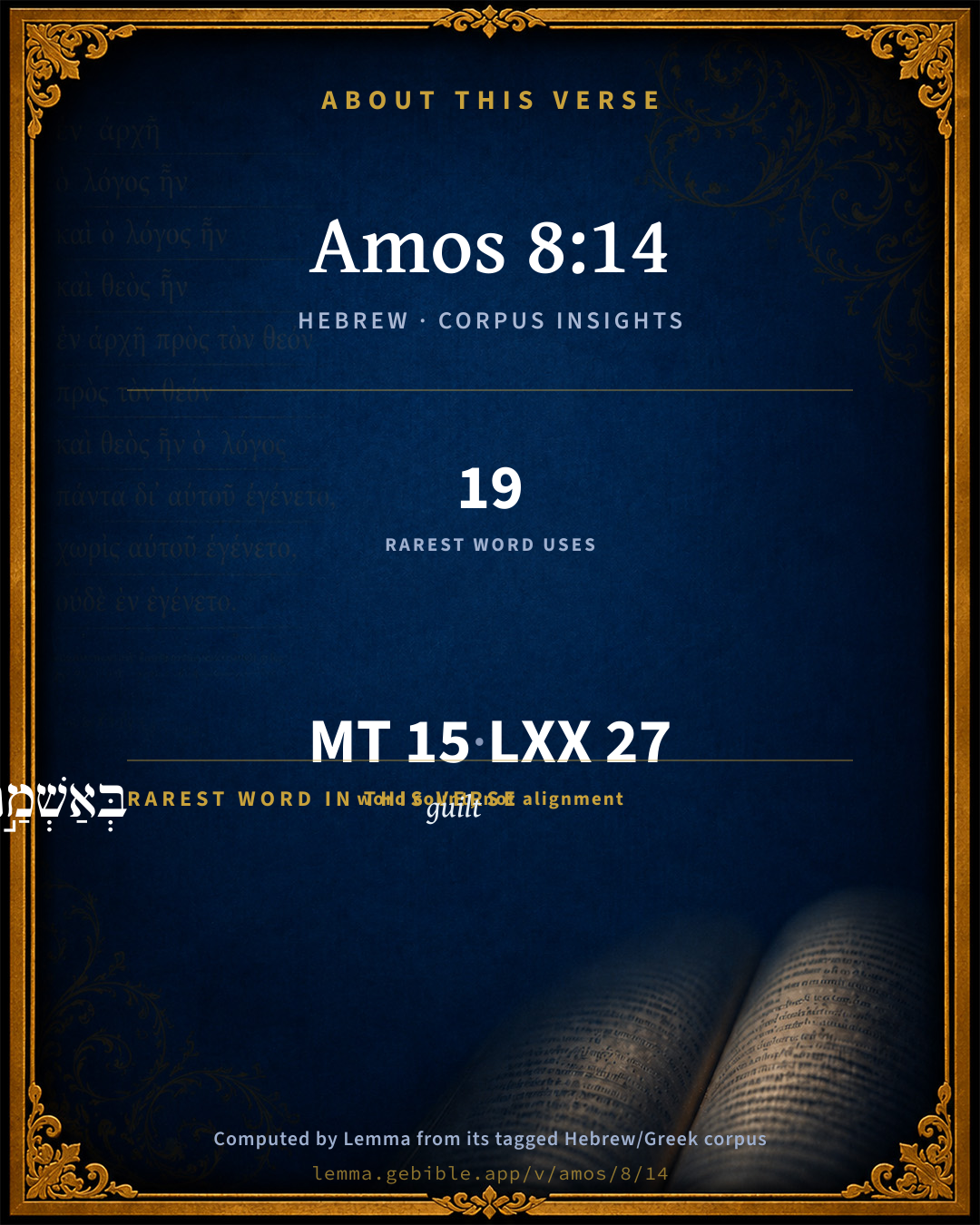
The rarest word here is בְּאַשְׁמַ֣ת guilt H819 — appearing just 19 times in the whole Hebrew Bible.

Shared distinctive vocabulary

בְּאַשְׁמַ֣ת guilt H819 occurs in 17 verses of the Hebrew Bible. Also found in:

Grammatical profile

  • 4 verbs
  • 7 nouns
  • 2 adjectives
  • 1 adverb
  • 1 particle

Verb forms

  • הַנִּשְׁבָּעִים֙ Niphal · Participle Active
  • וְאָמְר֗וּ Qal · Sequential Perfect
  • וְנָפְל֖וּ Qal · Sequential Perfect
  • יָק֥וּמוּ Qal · Imperfect

Repetition

Words recur within this verse — often emphatic in Hebrew:

  • חֵ֤י living H2416 ×2
  • בְּאֵֽר Beer-sheba H884 ×2

Hebrew & Septuagint length

In English translation the verse runs 30 words from the Hebrew and 32 from the Septuagint (LXX English) — closely comparable.

A rough comparison of the two English renderings, which tokenize alike — not a word-level alignment.

Word counts can differ between the Hebrew and the Greek without any difference in meaning — e.g. the Hebrew direct-object marker אֵת has no separate Greek word, and Greek often adds the article ὁ.

In the original languages it is 15 Hebrew tokens and 27 Greek tokens — but the two are counted differently (Hebrew bundles its prefixes and suffixes into one token; the Greek is in lemma form), so that isn’t a like-for-like length.

Cross-references

28

Topical passages linked to Amos 8:14 in the Treasury of Scripture Knowledge — connected by theme and wording, ordered by reader-vote popularity; previews shown in the World English Bible.

  • Amos 5:5 But don't seek Bethel, Nor enter into Gilgal, And don't pass to Beersheba: For Gilgal shall surely go into captivity, And Bethel shall come to nothing.
  • 1 Kings 12:28–29 Whereupon the king took counsel, and made two calves of gold; and he said to them, It is too much for you to go up to Jerusalem: see your gods, Israel, which brought you up out of the land of Egypt.
  • Deuteronomy 9:21 I took your sin, the calf which you had made, and burnt it with fire, and stamped it, grinding it very small, until it was as fine as dust: and I cast the dust of it into the brook that descended out of the mountain.
  • Acts 9:2 and asked for letters from him to the synagogues of Damascus, that if he found any who were of the Way, whether men or women, he might bring them bound to Jerusalem.
  • Deuteronomy 33:11 Bless, Yahweh, his substance, Accept the work of his hands: Smite through the loins of those who rise up against him, Of those who hate him, that they not rise again.
  • 1 Kings 12:32 Jeroboam ordained a feast in the eighth month, on the fifteenth day of the month, like the feast that is in Judah, and he went up to the altar; so did he in Bethel, sacrificing to the calves that he had made: and he placed in Bethel the priests of the high places that he had made.
  • 1 Kings 13:22–34 but came back, and have eaten bread and drunk water in the place of which he said to you, Eat no bread, and drink no water; your body shall not come to the tomb of your fathers.
  • 1 Kings 14:16 He will give Israel up because of the sins of Jeroboam, which he has sinned, and with which he has made Israel to sin.
  • 1 Kings 16:24 He bought the hill Samaria of Shemer for two talents of silver; and he built on the hill, and called the name of the city which he built, after the name of Shemer, the owner of the hill, Samaria.
  • 2 Kings 10:29 However from the sins of Jeroboam the son of Nebat, with which he made Israel to sin, Jehu didn't depart from after them, [to wit], the golden calves that were in Bethel, and that were in Dan.
  • 2 Chronicles 36:16 but they mocked the messengers of God, and despised his words, and scoffed at his prophets, until the wrath of Yahweh arose against his people, until there was no remedy.
  • Psalms 36:12 There the workers of iniquity are fallen. They are thrust down, and shall not be able to rise.
  • Psalms 140:10 Let burning coals fall on them. Let them be thrown into the fire, Into miry pits, from where they never rise.
  • Proverbs 29:1 He who is often rebuked and stiffens his neck Will be destroyed suddenly, with no remedy.
  • Isaiah 43:17 who brings forth the chariot and horse, the army and the mighty man (they lie down together, they shall not rise; they are extinct, they are quenched as a wick):
  • Jeremiah 25:27 You shall tell them, Thus says Yahweh of Hosts, the God of Israel: Drink you, and be drunken, and spew, and fall, and rise no more, because of the sword which I will send among you.
  • Jeremiah 51:64 and you shall say, Thus shall Babylon sink, and shall not rise again because of the evil that I will bring on her; and they shall be weary. Thus far are the words of Jeremiah.
  • Hosea 4:15 "Though you, Israel, play the prostitute, Yet don't let Judah offend; And don't come to Gilgal, Neither go up to Beth Aven, Nor swear, 'As Yahweh lives.'
  • Hosea 8:5–6 Let Samaria throw out his calf-idol! My anger burns against them! How long will it be before the are capable of purity?
  • Hosea 10:5 The inhabitants of Samaria will be in terror for the calves of Beth Aven; For its people will mourn over it, Along with its priests who rejoiced over it, For its glory, because it has departed from it.
  • Hosea 13:2 Now they sin more and more, And have made themselves molten images of their silver, Even idols according to their own understanding, All of them the work of the craftsmen. They say of them, "They offer human sacrifice and kiss the calves."
  • Hosea 13:16 Samaria will bear her guilt; For she has rebelled against her God. They will fall by the sword. Their infants will be dashed in pieces, And their pregnant women will be ripped open."
  • Amos 5:2 "The virgin of Israel has fallen; She shall rise no more. She is cast down on her land; There is no one to raise her up."
  • Zephaniah 1:5 those who worship the host of the sky on the housetops, those who worship and swear by Yahweh and also swear by Malcam,
  • Acts 18:25 This man had been instructed in the way of the Lord; and being fervent in spirit, he spoke and taught accurately the things concerning Jesus, although he knew only the baptism of John.
  • Acts 19:9 But when some were hardened and disobedient, speaking evil of the Way before the multitude, he departed from them, and separated the disciples, reasoning daily in the school of Tyrannus.
  • Acts 19:23 About that time there arose no small stir concerning the Way.
  • Acts 24:14 But this I confess to you, that after the Way, which they call a sect, so I serve the God of our fathers, believing all things which are according to the law, and which are written in the prophets;

Cross-references courtesy of OpenBible.info (CC BY 4.0).

Hebrew and Greek witnesses Masoretic Hebrew ↔ Greek Septuagint

The same verse in the two great witnesses to the Old Testament, shown verse-for-verse.

These are two independent witnesses, not word-aligned to each other, and the Septuagint is shown in lemma (dictionary) form.

Hebrew Amos 8:14 Masoretic · Westminster Leningrad Codex

הַנִּשְׁבָּעִים֙ בְּאַשְׁמַ֣ת שֹֽׁמְר֔וֹן וְאָמְר֗וּ חֵ֤י אֱלֹהֶ֨יךָ֙ דָּ֔ן וְחֵ֖י דֶּ֣רֶךְ בְּאֵֽר שָׁ֑בַע וְנָפְל֖וּ וְלֹא יָק֥וּמוּ עֽוֹד

Those who swear by the sin of Samaria, And say, 'As your god, Dan, lives;' And, 'As the way of Beersheba lives;' They will fall, and never rise up again."

World English Bible · Public Domain

Greek LXX Amos 8:14 Septuagint · lemma form

ὁ ὄμνυμι κατά ὁ ἱλασμός σαμαρεία καί ὁ λέγω ζάω ὁ θεός σύ δαν καί ζάω ὁ θεός σύ βηρσαβεε καί πίπτω καί οὐ μή ἀναἵστημι ἔτι

they who swear by the propitiation of Samaria, and who say, Your god, O Dan, lives; and, Your god, O Bersabee, lives; and they shall fall, and shall no more rise again.

LXX2012 (modern English Septuagint) · Public Domain

On this verse, Joseph Benson's Commentary discusses the Septuagint’s reading. Read the note in Commentary ↓

Hebrew: Westminster Leningrad Codex (CC BY 4.0). Greek: Septuagint (public domain); English from LXX2012 (modern English Septuagint) (Public Domain). How the Septuagint differs from the Hebrew →

Targum (Aramaic paraphrase)

1

The Targum is the ancient Jewish Aramaic paraphrase of the Hebrew Scriptures — an interpretive translation, not the Hebrew text itself. Onkelos (literal) and Pseudo-Jonathan (expansive) render the Torah, and Jonathan the Prophets. Coverage is partial: where no permissively-licensed English translation exists for a verse, only the Aramaic is shown. This is verse-level text, not a word-by-word alignment to the Hebrew.

  1. Targum Jonathan Prophets (Joshua–Malachi)
    דִי מְקַיְמִין בְּחוֹבַת שֹׁמְרוֹן וְאָמְרִין קַיָמָא דְחַלְתָּא דִי בְדָן וְקַיָמִין נִימוּסֵי בְאֵר שָׁבַע וְיִפְּלוּן וְלָא יְקוּמוּן עוֹד:

    (no public-domain English translation for this verse)

    Targum Jonathan — Aramaic: “Mikraot Gedolot” (public domain). English: “Sefaria Community Translation” (CC0 1.0 (public-domain dedication)); “London "Chaldee Paraphrase," 1871” (public domain). Text via Sefaria.

Commentary

Notes on Amos 8:14 from classic Christian and Jewish commentators (each source and its license shown beneath its notes). The classic Christian expositions comment on the surrounding passage and are grouped to its opening verse, so a note may address several verses; the Jewish commentaries on the Tanakh (Rashi and others) are per-verse, so they appear only where the commentator wrote on this verse.

Lemma curates 59 commentaries, every one of them public domain or Creative Commons licensed, each selected and text-cleaned for this edition rather than reprinted as found. About our sources →

Trapp's Complete Commentary

John Trapp

Amo 8:14 They that swear by the sin of Samaria, and say, Thy god, O Dan, liveth; and, The manner of Beersheba liveth; even they shall fall, and never rise up again.

Ver. 14. They that swear by the sin of Samaria] i.e. By the calf set up at Bethel, not far from Samaria. This calf is called the sin, or guilt, of Samaria, to show the abomination of it; for which cause also Paul calls it sinful sin, Rom 7:13, as not finding for it a worse epithet; and antichrist for like cause he calleth "that man of sin," 2Th 2:3, to note him merum scelus, pure wickedness, saith Beza, merely made up of sin. Now, to swear by this of Samaria was to deify it; to swear by anything besides the true God is to forsake him, Jer 5:7, which is a hateful wickedness, Jer 2:12-13; as in Papists who familiarly swear by their he-saints and she-saints, and so sacrilegiously transfer upon the creature that which pertaineth to God alone.

And say, Thy god, O Dan, liveth] God only liveth, to speak properly, 1Ti 6:17, but to say that Dan’s Deunculus lived (being no better than a dumb and dead idol), and to swear by the life of it (as the Spaniards do now in the pride of their monarchy, by the life of their king), this is horrible impiety. As for that of Abigail to David, 1Sa 25:26, "Now therefore, my lord, as the Lord liveth, and as thy soul liveth," the former was an oath, the latter was not an oath, but an asseveration or obtestation only, conjoined with an oath.

And, The manner of Beersheba liveth] That is, the forms and rites of worshipping in Beersheba (another nest of idolatry, Amo 5:5 Hos 10:13), as the Chaldee paraphraseth it. Durandus hath written, the Romish ritual, the way of worship used in that synagogue of Satan: Mercer rendereth it, Vivit peregrinatio Beersheba, the way or passage of Beersheba liveth. Beersheba had an idol, and was the way to Dan and Bethel; hence this superstitious oath drawn out to the full length, By the sin of Samaria, by the god of Dan, and by the manner of Beersheba: like as the Great Turk, Mahomet, promising his soldiers the spoil of Constantinople for three days together, if they could win it, for confirmation of his oath solemnly swore by the immortal God, and by the four hundred prophets, by Mahomet, by his father’s soul, by his own children, and by the sword wherewith he was girt, faithfully to perform whatsoever he had to them in his proclamation promised.

Even they shall fall, and never rise up again] Fall fatally, ferally, irrecoverably, as old Eli did when his neck was broken, but first his heart. The ten tribes, for their idolatry and contempt of the word, never returned out of captivity. From the famine foretold what could follow but irreparable ruin, though for a time they might flourish? see Pro 29:1. {See Trapp on "Pro 29:1"} Of that spiritual famine let us be most impatient, and say as Luther did, I would not live in paradise without the word; but with it I could make a shift to live in hell itself.

John Trapp, A Commentary or Exposition upon All the Books of the Old and New Testament (1647–1656) — public domain. Text from a community e-Sword module.

Joseph Benson's Commentary

Amo 8:14. They that swear by the sin of Samaria — That is, by the calf which Jeroboam set up as an object of worship at Beth-el, not far from Samaria, committing a great sin in so doing, and making Israel to sin. Swearing, according to the sense in which the word is here taken, is a solemn invocation of the name of God, and an appeal to him; and, as such, is a proper part of divine worship, (see Deu 6:13; Deu 10:20,) and therefore ought not to be given to idols. And say, Thy God — Or, As thy God, O Dan, liveth — That is, who say in the way of an oath, As the god who is worshipped in Dan liveth: at Dan was placed another of Jeroboam’s calves. And, The manner of Beer-sheba liveth — The LXX. render it, the god of Beer-sheba liveth; expressing the sense rather than the words of the original. The way or manner signifies the same with the way of worship; so that the people swore by the religion of Beer-sheba, or the manner of worship used there, which they looked upon as sacred. Thus the Papists swear by the mass: but they who thus give that honour to idols which is due to God alone, will find the God whom they thus affront is made their enemy. And they shall fall, &c. — And the gods they serve cannot raise them up; so that without better help they shall never rise again.

Joseph Benson's Commentary on the Old and New Testaments (1811–1818) — public domain. Text from a community e-Sword module.

Tyndale Open Study Notes

Tyndale Open Resources

8:14 The god of Dan refers to the northern shrine of the gold calf established by Jeroboam I (see 1 Kgs 12:28-29; 2 Kgs 10:29). • the god of Beersheba: Evidently Beersheba had become a center of worship in the southern kingdom. Archaeologists have found the remains of a horned altar in the ruins of Beersheba.

Tyndale Open Study Notes — © Tyndale Open Resources, licensed CC BY-SA 4.0. Text via the HelloAO Bible API.

Geneva Bible (1599)

Geneva Bible translators

For the idolaters did use to swear by their idols: which here he calleth their sin, as the Papists yet do by theirs.

That is, the common manner of worshipping, and the service or religion there used.

Geneva Bible (1599) marginal notes — public domain. Text via Bolls.life.

Jamieson, Fausset & Brown

Robert Jamieson, A. R. Fausset & David Brown

swear by the sin of Samaria--namely, the calves (Deu 9:21; Hos 4:15). "Swear by" means to worship (Psa 63:11).

The manner--that is, as "the way" is used (Psa 139:24; Act 9:2), the mode of worship.

Thy god, O Dan--the other golden calf at Dan (Kg1 22:26-30).

liveth . . . liveth--rather, "May thy god . . . live . . . may the manner . . . live." Or, "As (surely as) thy god, O Dan, liveth." This is their formula when they swear; not "May Jehovah live!" or, "As Jehovah liveth!"

Next: Amos Chapter 9

Jamieson, Fausset & Brown — Commentary Critical and Explanatory on the Whole Bible (1871) — public domain (CC PDM 1.0). Text via the HelloAO Bible API.

Adam Clarke's Commentary

Verse 14. By the sin of Samaria] Baal, who was worshipped here.

Thy god, O Dan] The golden calf, or ox, the representative of the Egyptian god Apis, or Osiris.

The manner of Beer-sheba] The worship, or object of worship. Another of the golden calves which Jeroboam had set up there. The word דרך derech, way, is here taken for the object and mode of worship; see Ac 19:9, where way is taken for the creed and form of Divine worship as practiced by the followers of Christ, and by which they were distinguished from the Jews. See also Ac 9:2.

Adam Clarke's Commentary on the Bible (1810–1826) — public domain. Text from a community e-Sword/MySword module.

John Calvin's Commentaries

He afterwards mentions the reason why the Lord would inflict such punishments on his people; it was, because they had prostituted themselves to wicked superstitions; They swear, he says, by the sin of Samaria; they say, Live does thy God, Dan; Live does the way of Beersheba Some understand “sin” here metaphorically, (as it is taken also in many other places,) as meaning sin-offerings, which are called by the Hebrews אשמות, ashimut, and by the Latins piacula — expiations: but this exposition is too refined. The Prophet then speaks only of the idols of Israelites: and they are called wickedness or sin, because superstitious men, we know, delight in their own devices. He therefore calls an idol sin by way of reproach, though they gave it the honorable name of a god. They swear, he says, in or by the sin of Samaria He calls it the sin of Samaria, for thence arose all their corruptions, it being the royal residence and the chief city of the whole country. Since then superstition proceeded from thence, the Prophet does not without reason say that all the idolatry, throughout the whole land, was the sin of Samaria; for he regarded the source where impiety originated.

And he afterwards explains himself by saying, Live does thy God, Dan; and, Live does the way of Beersheba: for we know that temples were raised both in Dan and in Beersheba. He then subjoins two forms of an oath, but for this end, — to show the character of the sin of Samaria, which he mentions. They swear then by the gods of Samaria, who were really detestable; for there is no greater atrocity in the sight of God than idolatry: but he afterwards adds, that they were gods who were worshipped at Dan and at Beersheba. What some say of the word דרך, darek, that it means pilgrimage or the way that leads there, is frivolous and puerile; for the Prophet, no doubt, used a common expression. He therefore calls custom “the way of Beersheba”, such as then was by common consent receded and approved. They then who swear by these fictitious forms of worship shall be parched, or pine away, with thirst

He then adds, They shall fall, and rise again no more; that is, their stroke shall be incurable, for God has hitherto employed moderate punishments, which could not heal them, as they had been obdurate in their evils. The Prophet then declares now that there would be no more any prospect of a remedy for them, and that the wound which God would inflict would be fatal, without any hope of being healed. This is the meaning. Let us now proceed —

John Calvin's Commentaries (1540-1563) — public domain. Text from the Calvin Translation Society English edition (1840s-50s) via the Christian Classics Ethereal Library (ccel.org). Calvin's coverage is partial (roughly two-thirds of the Bible); uncommented books and verses are honest gaps, never fabricated. The 19th-century editor's footnotes and remarks are omitted so the notes are faithfully Calvin's own voice.

Ellicott's Commentary for English Readers

(14) Thy God, O Dan, liveth.—Translate, By the life of thy God, O Dan, and by the life of the way of Beersheba. On such forms of oath, see Note on Amo_6:8. The “way of Beersheba” was the ritual practised at Beersheba, another mode of designating the deity himself (probably Baal).[18] So LXX. Similarly the “sin of Samaria” means the golden calf that was worshipped there (Hos_8:5). The supposition of Hitzig and Duhm (followed by W. R. Smith) that it refere to the Asherah worship (2Ki_13:6) is not so probable.

[18] From chap. 5:5 we infer that Beersheba, lying far south on the borders of Judah (twenty-five geographical miles south of Hebron), was a famous religious centre, so that inhabitants of the northern kingdom were in the habit of “crossing the frontier” in order to pay their vows, or enquire at this high place.

A Bible Commentary for English Readers, edited by Charles John Ellicott (1878–1897) — public domain. Text from a community e-Sword module.

The Cambridge Bible for Schools and Colleges

gen. ed. J. J. S. Perowne

14. They that swear …; even they shall fall] better, Who swear (connecting with Amo_8:13) …; and they shall fall &c.

swear by the Guilt of Samaria] Men swear by that which they revere: the Israelite was commanded to swear by Jehovah (Deu_6:13; Deu_10:20); and Jeremiah (Jer_4:2; Jer_12:16) promises a blessing upon those who swear by Him faithfully. Idolatrous Israelites swore by “not-gods” (Jer_5:7), or by Baal (Jer_12:16), or Milcom (Zep_1:5), &c. The ‘Guilt of Samaria’ is probably the calf at Beth-el, which Hosea alludes to ironically as unworthy of the Israelites’ regard (Hos_8:5-6, Hos_10:5): the golden calf which Aaron made is called “your sin” (Deu_9:21). Others suppose that the reference is to the Ashérah which was made by Ahab in Samaria, and which still stood there, at least in the days of Jehoahaz (2Ki_13:6)[193]. The Ashérah (cf. Exo_34:13, R.V. marg.) was a post or pole, regarded seemingly as the representative of the sacred tree, planted in the ground beside an altar, and venerated as a sacred symbol (see further W. R. Smith, Relig. of the Semites, p. 171 ff. (ed. 2, p. 187 ff.); D.B[194][195], s.v.; or the writer’s Commentary on Deu_16:21).

[193] So W. R. Smith, Proph., p. 140. Stade and Oort even suppose that guilt (אשמת) is an error for Ashérah (אשרת).

[194] .B. … Smith’s Dictionary of the Bible, ed. 1, or (from A to J) ed. 2.

[195] … Smith’s Dictionary of the Bible, ed. 1, or (from A to J) ed. 2.

and say, (As) thy God, O Dan, liveth] The formula of an oath: cf. the common (As) Jehovah liveth (1Sa_14:39 &c.). Here the reference is to the calf set up by Jeroboam I. (1Ki_12:29) at Dan, in the far North of Israel (now Tel el-Ḳaḍi), near the foot of Hermon, and not far from the principal source of the Jordan.

and, (As) the way of Beer-sheba liveth] For Beer-sheba, see on Amo_5:5. The expression is an unusual one; and it has been doubted whether the text is correct. But probably the reference is to the road taken by the pilgrims to Beer-sheba, which must have been a clearly-marked, much frequented route[196] and which, being regarded by the worshippers as unalterable and permanent, might not unnaturally form the object appealed to in an oath. “Strange as it may appear to us to speak of the life of the lifeless, this often happens among the Semites. To-day Arabs “swear wa hyât, ‘by the life of,’ even of things inanimate; ‘By the life of this fire, or of this coffee’ ” (Doughty, Arabia Deserta, i. 269). And as Amos here tells us that the Israelite pilgrims swore by the way to Beer-sheba, so do the Moslems affirm their oaths by the sacred way to Mecca[197]” (G. A. Smith, p. 186). Others understand ‘way’ in the sense of usage, cult. Although therefore it remains possible that the title of a deity, “thy …,” lies concealed under what is now read as ‘way,’ there seems to be no imperative necessity for questioning the correctness of the text.

[196] Comp. the Derb el Haj, or the route from Damascus to Mecca, a broad, clearly-marked track in the wilderness (Tristram, Moab, p. 170; P.E.F. Qu. St., 1895, p. 229).

[197] Baur, p. 424, who quotes Rückert’s translation of Ḥariri, i. 189 f., “By the pilgrimage, and the height of Mina, where the pious host stone Satan.”

shall fall, &c.] Cf. Amo_5:2.

The Cambridge Bible for Schools and Colleges (gen. ed. J. J. S. Perowne; Cambridge University Press, 1878–1918) — public domain. Text from a community e-Sword module.

Albert Barnes' Notes on the Bible

Who swear - Literally, “the swearing,” they who habitually swear. He assigns, at the end, the ground of all this misery, the forsaking of God. God had commanded that all appeals by oath should be made to Himself, who alone governs the world, to whom alone His creatures owe obedience, who alone revenges. “Thou shalt fear the Lord thy God and serve Him and swear by His Name” Deu 6:13; Deu 10:20. On the other hand Joshua warned them, “Neither make mention of the name of their gods nor cause to swear by them nor serve them” Jos 23:7. But these “sware by the sin of Samaria,” probably “the calf at Bethel,” which was near Samaria and the center of their idolatry, from where Hosea calls it “thy calf.” “Thy calf, O Samaria, hath cast thee off. The calf of Samaria shall be broken in pieces” Hos 8:5-6. He calls it “the guilt of Samaria,” as the source of all their guilt, as it is said of the princes of Judah using this same word, “they left the house of the Lord God of their fathers, and served idols, and wrath came upon Judah and Jerusalem for this their trespass” 2Ch 24:18. “And say, thy god, O Dan! liveth,” that is, as surely as thy god liveth! by the life of thy god! as they who worshiped God said, “as the Lord liveth!” It was a direct substitution of the creature for the Creator, an ascribing to it the attribute of God; “as the Father hath life in Himself” Joh 5:26. It was an appeal to it, as the Avenger of false-swearing, as though it were the moral Governor of the world.

The manner of Beersheba liveth! - Literally, “the way.” This may be, either the religion and worship of the idol there, as Paul says, “I persecuted this way unto the death” (Act 22:4, add Act 9:2; Act 19:9, Act 19:23), from where Muhammed learned to speak of his imposture, as “the way of God.” Or it might mean the actual “way to Beersheba,” and may signify all the idolatrous places of worship in the way there. They seem to have made the way there one long avenue of idols, culminating in it. For Josiah, in his great destruction of idolatry, “gathered all the priests from the cities of Judah, and defiled the high places, where the priests sacrificed from Gebah to Beersheba” 2Ki 23:8; only, this may perhaps simply describe the whole territory of Judah from north to south. Anyhow, Beersheba stands for the god worshiped there, as, “whoso sware by the Temple, sware,” our Lord tells us, “by it and by Him that dwelleth therein” Mat 23:21.

Albert Barnes' Notes on the Bible (1834–1885) — public domain. Text from a community e-Sword/MySword module.

Haydock's Catholic Bible Commentary

Sin. Septuagint, "propitiation," which the pagans deemed requisite; (Horace, i. ode 2.) or worship (Haydock) of Baal, (4 Kings xvii. 16.; Calmet) and all the other superstitions. (Haydock) --- Way. Septuagint, "thy God," or religion, (Acts ix. 2.) or pilgrimage to Bersabee, chap. v. 5. Perhaps the true God was here adored; but it was in a manner which he condemned. (Calmet) --- In vain do those pretend to honour Him, who follow the traditions of unbelieving men. (Haydock)

George Leo Haydock (1774–1849), Haydock's Catholic Family Bible and Commentary, 1859 edition — public domain. Excludes Psalms (Douay-Rheims chapter numbering differs from Protestant) and Deuterocanonical books (Catholic canon only).

Matthew Poole's English Annotations

They that swear by; who now do, as formerly they have done, trust in, sacrifice to, and swear by; who are obstinate idolaters, and trust to those lies.

The sin, that which was the sin, the occasion of the sin,

of Samaria, the calves at Dan and Beth-el.

And say, think, profess, and swear too,

Thy god, O Dan, liveth; the idol at Dan is the true and living God.

The manner of, the idols at, Beer-sheba, to which the zealous, mad, and bigoted idolaters in Israel made their pilgrimages.

They shall fall, be consumed by famine, sword, and captivity,

and never rise up again; never return out of captivity, nor recover of this consumption.

Matthew Poole's English Annotations on the Holy Bible (1683–1685) — public domain. Text from a community e-Sword/MySword module.

The Pulpit Commentary

They who trusted in idols shall find no help in them. They who swear by. Those who reverence and worship, as Deu_6:13 Deu_10:20. The sin of Samaria. The golden calf at Bethel. (comp. Deu_9:21; Hos_8:5, Hos_8:6) Septuagint, kataav, "by the propitiation of Samaria." Thy god, O Dan, liveth; i.e. as thy god liveth, by the life of thy god. This was the other calf erected at Dan, near the source of the Jordan, in the extreme north. (1Ki_12:29) The manner of Beersheba liveth; Septuagint, Zh oJ qeov sou bhrsabee, "Thy god, O Beersheba, lives." Some commentators, ancient and modem, think that the actual road which led to Beersheba is here meant, and would translate, "As the way to Beersheba liveth," "By the life of the way to Beersheba," as Mohammedans swear by the pilgrimage to Mecca. But it is best to take the word rendered "manner" in the sense of "way," as oJdov is used in Acts (Act_9:2 Act_19:9, Act_19:23) for mode of worship, or form of religion, the ritual, or use of the service there. (For Beersheba, see note on Amo_5:5) From Dan to Beersheba is just a hundred and forty-four miles. They shall fall, etc. This was partially fulfilled by the destruction of the kingdom of Israel and the deportation of its inhabitants; and its truth to this day is demonstrated by the fate of the Jews who will not receive Jesus as the promised Messiah.

Religious sincerity.

that swear by the sin of Samaria, and say, Thy god, O Dan, liveth; and, The manner of Beersheba liveth; even they shall fall, and never rise up again." "The sin of Samaria" means the idolatry of Samaria. In Samaria they worshipped the golden calf as the chief object; but it would seem there were other inferior idols. The god of Dan was the golden calf sot up by Jeroboam in Dan. (1Ki 12) "The fulfilment," says Delitzsch, "of these threats commenced with the destruction of the kingdom of Israel and the carrying away of the ten tribes into exile in Assyria, and continues to this day in the case of that portion of the Israelitish nation which is still looking for the Messiah, the Prophet promised by Moses, and looking in vain because they will not hearken to the preaching of the gospel concerning the Messiah who appeared as Jesus." The words suggest a thought or two in relation to religious sincerity.

I THAT RELIGIOUS SINCERITY IS NO PROOF OF THE ACCURACY OF RELIGIOUS CREED. These Israelites seem to have been sincere in their worship of the golden calf; "they swore by it." That dumb idol to them was everything. To it they pledged the homage of their being. Yet how blasphemously erroneous, how contrary to the expresss mandate of Jehovah, "Thou shalt have none other gods but me"! How contrary to the dictates of common sense and all sound reasoning! Idolatry, in every form and everywhere, is a huge falsehood. Hence sincerity is no proof that a man has the truth. There are millions of men in all theologies and religions, who are so sincere in believing lies, that they will fight for their lies, make any sacrifice for their lies, die for their lies. Error, perhaps, can number more martyrs than truth. Saul of Tarsus was sincere when he was persecuting the Church and endeavouring to blot the name of Christ from the memory of his age. "I verily thought with myself, that I ought to do many things contrary to the name of Jesus of Nazareth," etc.. (Act_26:9) Hence sincerity is not necessarily virtuous. A man is sincere when he is faithful to his convictions; but if his convictions are unsound, immoral, ungodly, his sincerity is a crime. The fact that thousands have died for dogmas is no proof of the truth of their dogmas.

II THAT RELIGIOUS SINCERITY IS NO PROTECTION AGAINST THE PUNISHMENT THAT FOLLOWS ERROR. "They shall fall, and never rise up again." The sincerity of the Israelites in their worship in Bethel and at Dan prevented not their ruin. There are those who bold that man is not responsible for his beliefs that so long as he is sincere he is a truthful man, and all things will go well with him. In every department of life God holds a man responsible for his beliefs. If a man takes poison into his system, sincerely believing that it is nutriment, will his belief save him? Error leads evermore to disappointment, confusion, and oftentimes to utter destruction. To follow error is to go away from reality; and to leave reality is to leave safety and peace.

CONCLUSION. Whilst there is no true man without sincerity, sincerity of itself does act make a man true. When a man"s convictions correspond and square with everlasting realities, then his sincerity is of incomparable world. D.T.

The Pulpit Commentary (1880–1919), ed. H.D.M. Spence-Jones & Joseph S. Exell — public domain. Text from a community e-Sword module.

John Wesley's Explanatory Notes

They - Who sacrifice to and swear by the calves at Daniel and Beth-el. By the sin - Who say the idol at Daniel is the true and living God. The manner - The idol which is worshipped at Beersheba.

John Wesley, Explanatory Notes Upon the Whole Bible (1754–1765) — public domain. Text via the GEBible commentary corpus.

Rashi

Rabbi Shlomo Yitzchaki (Rashi)

“As your god lives, O Dan,”—One of the calves that Jeroboam erected in Dan.

Rashi on the Tanakh — English translations: “The Judaica Press complete Tanach with Rashi, translated by A. J. Rosenberg” (CC BY 4.0); “Pentateuch with Rashi's commentary by M. Rosenbaum and A.M. Silbermann, 1929-1934” (public domain); “The Metsudah Tanach series, Lakewood, N.J” (CC BY 4.0); and “The Book of Joshua, Metsudah Publications, 1997” (CC BY 4.0). Text via Sefaria.

Lesson kit

Teaching starters — assembled from the data on this page, not authored interpretation. Every prompt links to the verse data it draws on. Edit before teaching.

Amos, in the Prophets, opens this verse with 15 words (13 distinct Hebrew lemmas). Its most distinctive word is ʼashmâh (“guilt”). A historical commentator’s framing appears above. Read the whole chapter for the surrounding context.

Discussion questions

  1. The word ʼashmâh carries the sense “guilt.” How does it shape the verse?
  2. How does Leviticus 4:3, which shares the word «guilt», read alongside this verse?
  3. What does the repetition of “living” (2× in this one verse) do in this verse?
  4. The translations on this page render this verse differently — a whole-verse word diff, not a word-by-word alignment. What might account for the different wordings?
  5. «הַנִּשְׁבָּעִים֙» is a Niphal Participle Active verb. How does that grammatical form shape the action described?
  6. Compare how Trapp's Complete Commentary and Joseph Benson's Commentary read this verse. Where do they agree or differ?

Things to notice

Reading settings

Reading text

Shown beneath each verse's original-language words.

Old Testament
Old Testament edition

Read the OT as the Masoretic Hebrew (MT) or the Greek Septuagint (LXX).

English shown for the Greek Septuagint (in the Hebrew ↔ Greek comparison).

Comparing translations? Open the Compare panel on any verse page to stack up to four side by side.