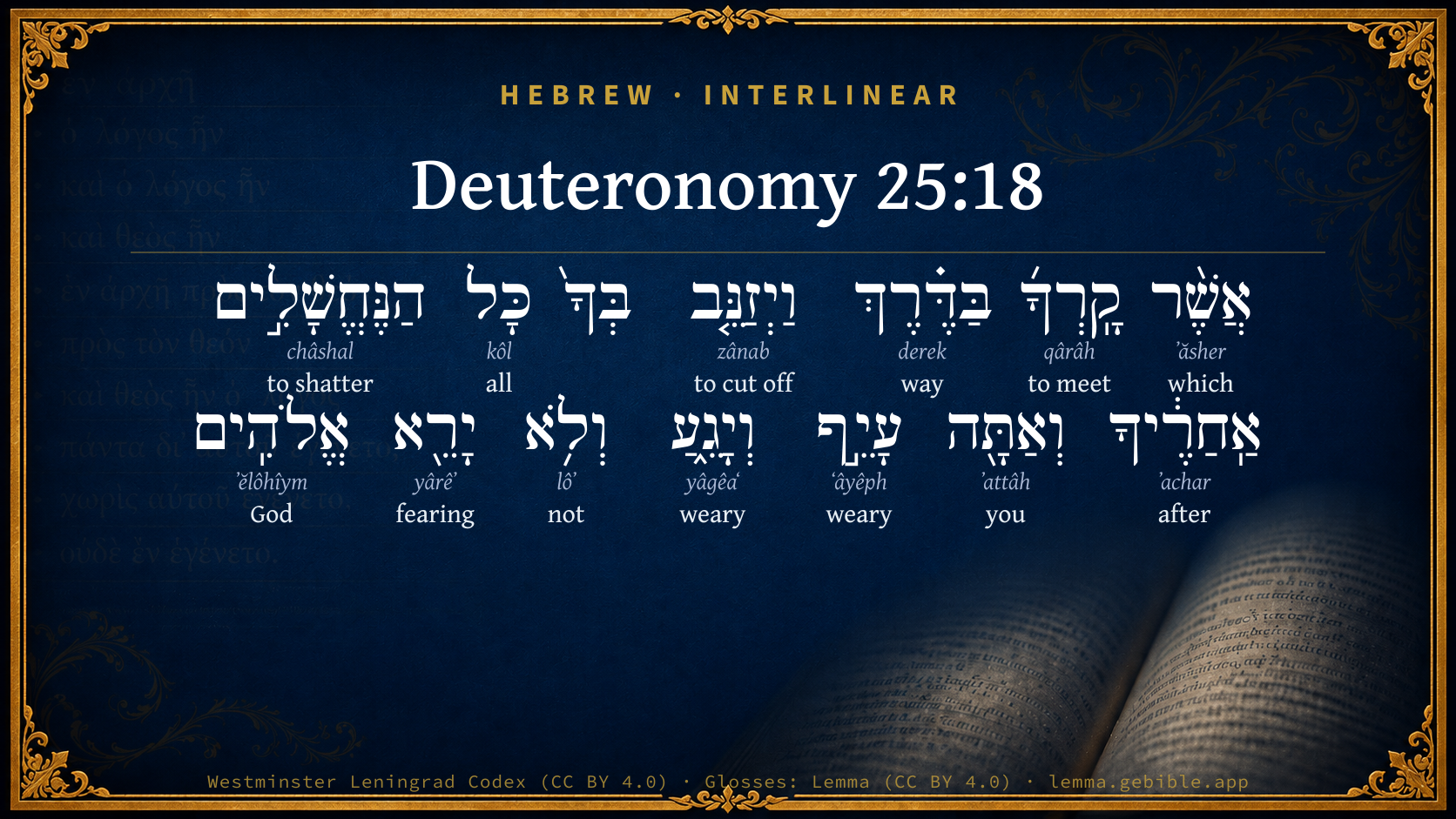
Deuteronomy 25:18

Hebrew (Westminster Leningrad Codex) Deuteronomy 25:18 appears in the Hebrew Old Testament. The text above is from the Westminster Leningrad Codex. Each word links to its Strong’s number, a concise gloss, and parsing drawn from the Open Scriptures Hebrew Bible morphology. Click any word for its full Brown-Driver-Briggs (BDB) entry.
Download image
Cite this verse

Deuteronomy 25:18 (World English Bible). Public Domain. Lemma interlinear Bible study tool, https://lemma.gebible.app/v/deuteronomy/25/18.

Show BibTeX & RIS
BibTeX
RIS
English Translation
how he met you by the way, and struck the hindmost of you, all who were feeble behind you, when you were faint and weary; and he didn't fear God.
World English Bible · Public Domain
Highlights
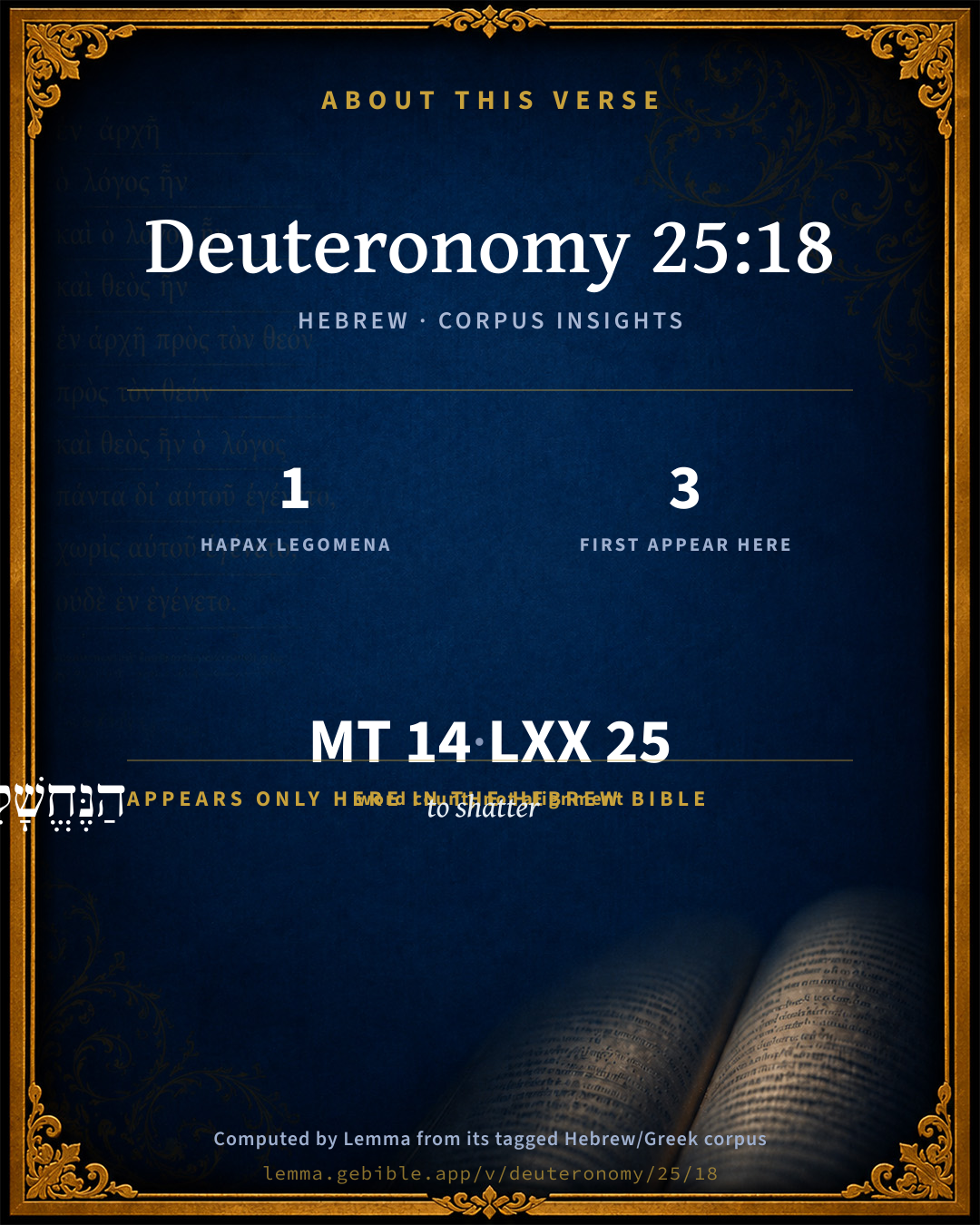
  • 1 hapax legomenon — only here in the Hebrew Bible
  • 3 first appearances in the Hebrew Bible
Full analysis ↓
Download a study sheet

One document with this verse’s original text, its word-by-word gloss line, the meaning frame, cross-references with their text, attributed commentary, and full source and license credits — printable, and it pastes into notes with its structure intact.

This verse Autodidact and up

Study sheet (.html) Plain text (.txt)

A passage Seminary Student

Up to 50 verses in one chapter. A passage sheet keeps up to 6 commentary sources and 12 cross-references per verse, in the order this page ranks them, and says so on the sheet whenever that leaves anything out. Ask for a single verse and you get the Autodidact verse sheet above.

Everything on this page stays free to read, with no account — the sheet is a download of what is already on screen, not access to it.

Want to remove ads? Support Godless Engineer
Compare translations 3

The same verse in 3 English versions, stacked beneath the original-language interlinear above. Click any original word for its lexicon entry.

Each is an independent rendering of the whole verse — the interlinear is not word-aligned to these translations.

Highlighted words mark where these versions differ — a whole-verse word diff, not a word-by-word alignment.

  • World English Bible Public Domain
    how he met you by the way, and struck the hindmost of you, all who were feeble behind you, when you were faint and weary; and he didn't fear God.
  • King James Version Public Domain
    How he met thee by the way, and smote the hindmost of thee, even all that were feeble behind thee, when thou wast faint and weary; and he feared not God.
  • unfoldingWord Literal Text CC BY-SA 4.0
    how he met you on the road and attacked you from behind, all the stragglers following you, and you faint and weary; and he did not fear God.

unfoldingWord Literal Text — © unfoldingWord, licensed CC BY-SA 4.0. Word-aligned USFM3 via Door43 (git.door43.org/unfoldingWord/en_ult).

Versions to compare (up to 4)

3 of 4 selected

Show all 18 translations

Every available English version of this verse, each an independent rendering of the whole verse.

  • World English Bible Public Domain
    how he met you by the way, and struck the hindmost of you, all who were feeble behind you, when you were faint and weary; and he didn't fear God.
  • Berean Standard Bible Public Domain
    how they met you on your journey when you were tired and weary, and they attacked all your stragglers; they had no fear of God.
  • Majority Standard Bible Public Domain
    how they met you on your journey when you were tired and weary, and they attacked all your stragglers; they had no fear of God.
  • King James Version Public Domain
    How he met thee by the way, and smote the hindmost of thee, even all that were feeble behind thee, when thou wast faint and weary; and he feared not God.
  • American Standard Version (1901) Public Domain
    how he met thee by the way, and smote the hindmost of thee, all that were feeble behind thee, when thou wast faint and weary; and he feared not God.
  • Revised Version (1885) Public Domain
    how he met thee by the way, and smote the hindmost of thee, all that were feeble behind thee, when thou wast faint and weary; and he feared not God.
  • Geneva Bible (1599) Public Domain
    How he met thee by ye way, and smote ye hindmost of you, all that were feeble behind thee, when thou wast fainted and weary, and he feared not God.
  • Douay-Rheims (1899) Public Domain
    How he met thee: and slew the hindmost of the army, who sat down, being weary, when thou wast spent with hunger and labour, and he feared not God.
  • Young's Literal Translation Public Domain
    that he hath met thee in the way, and smiteth in all those feeble behind thee (and thou wearied and fatigued), and is not fearing God.
  • Literal Standard Version CC BY-SA 4.0
    that he has met you in the way, and strikes among you all those feeble behind you (when you [were] weary and fatigued), and is not fearing God.
  • Unlocked Literal Bible CC BY-SA 4.0
    how he met you on the road and attacked those of you at the rear, all who were feeble in your rear, when you were faint and weary; he did not honor God.
  • unfoldingWord Literal Text CC BY-SA 4.0
    how he met you on the road and attacked you from behind, all the stragglers following you, and you faint and weary; and he did not fear God.
  • Darby Bible Public Domain
    how he met thee on the way, and smote the hindmost of thee, all the feeble that lagged behind thee, when thou wast faint and weary, and he feared not God.
  • World Messianic Bible Public Domain
    how he met you by the way, and struck the rearmost of you, all who were feeble behind you, when you were faint and weary; and he didn’t fear God.
  • Webster's Bible Public Domain
    How he met thee by the way, and smote the hindmost of thee, even all that were feeble behind thee, when thou wast faint and weary; and he feared not God.
  • Free Bible Version CC BY-SA 4.0
    They came out to confront you when you were tired and weary from your journey, and they attacked all those of you who were lagging behind. They didn't have any respect for God.
  • Bible in Basic English Public Domain
    How, meeting you on the way, he made an attack on you when you were tired and without strength, cutting off all the feeble ones at the end of your line; and the fear of God was not in him.
  • JPS Tanakh (1917) Public Domain
    how he met thee by the way, and smote the hindmost of thee, all that were enfeebled in thy rear, when thou wast faint and weary; and he feared not God.

Literal Standard Version (2020), Covenant Press — licensed CC BY-SA 4.0. Text via the HelloAO Bible API (eBible.org). Unlocked Literal Bible (unfoldingWord) — licensed CC BY-SA 4.0. Text via the HelloAO Bible API (eBible.org). unfoldingWord Literal Text — © unfoldingWord, licensed CC BY-SA 4.0. Word-aligned USFM3 via Door43 (git.door43.org/unfoldingWord/en_ult). Free Bible Version, Dr. Jonathan Gallagher — licensed CC BY-SA 4.0. Text via the HelloAO Bible API (eBible.org).

Word by word

More ways to search: Search by grammar → Find every occurrence → Compare this word →

Practice this passage: Drill this verse → Learn its vocabulary →

הַנֶּחֱשָׁלִ֣ים
châshal
H2826
“the · shattering”
Particle, Definite Article + Verb, Niphal, Participle Active, Masculine, Plural, Absolute
Part of Speech
Particle + Verb
Stem
Niphal
Form
Participle Active
Gender
Masculine
Number
Plural
State
Absolute
Full BDB Definition

Origin: a primitive root

TWOT: 770

to shatter - (Niphal) to be feeble
  1. אֲשֶׁ֨ר ʼăsher H834 “which” Particle, Relative
  2. קָֽרְךָ֜ qârâh H7136 “to meet · you” Verb, Qal, Perfect, 3rd Person, Masculine, Singular + Suffix, Personal, 2nd Person, Masculine, Singular
  3. בַּדֶּ֗רֶךְ derek H1870 “in/at the · way” Preposition, Determined + Noun, Common, Both, Singular, Absolute
  4. וַיְזַנֵּ֤ב zânab H2179 “and · to cut off” Conjunction + Verb, Piel, Sequential Imperfect, 3rd Person, Masculine, Singular
  5. כָּל kôl H3605 “all of” Noun, Common, Masculine, Singular, Construct
  6. אַֽחַרֶ֔יךָ ʼachar H310 “after · you” Preposition + Suffix, Personal, 2nd Person, Masculine, Singular
  7. וְאַתָּ֖ה ʼattâh H859 “and · you” Conjunction + Pronoun, Personal, 2nd Person, Masculine, Singular
  8. עָיֵ֣ף ʻâyêph H5889 “weary” Adjective, Adjective, Masculine, Singular, Absolute
  9. וְיָגֵ֑עַ yâgêaʻ H3023 “and · weary” Conjunction + Adjective, Adjective, Masculine, Singular, Absolute
  10. וְלֹ֥א lôʼ H3808 “and · not” Conjunction + Particle, Negative
  11. יָרֵ֖א yârêʼ H3373 “fearing” Verb, Qal, Perfect, 3rd Person, Masculine, Singular
  12. אֱלֹהִֽים ʼĕlôhîym H430 “God(s)” Noun, Common, Masculine, Plural, Absolute

About this verse

These counts appear in no published source. They are computed here, from the morphology-tagged text and Lemma’s own curated glosses. What Lemma adds →

14
words
13
distinct lemmas
Pentateuch
section

Notable vocabulary

1 hapax legomenon — a word that appears only here in the entire Hebrew Bible:

  • הַנֶּחֱשָׁלִ֣ים to shatter H2826

First appearance in Scripture

These words make their first canonical appearance in the Hebrew Bible here:

  • וַיְזַנֵּ֤ב to cut off H2179
  • הַנֶּחֱשָׁלִ֣ים to shatter H2826
  • וְיָגֵ֑עַ weary H3023

Shared distinctive vocabulary

וַיְזַנֵּ֤ב to cut off H2179 occurs in 2 verses of the Hebrew Bible. Also found in:

Grammatical profile

  • 4 verbs
  • 3 nouns
  • 2 adjectives
  • 1 pronoun
  • 2 prepositions
  • 2 particles

Verb forms

  • קָֽרְךָ֜ Qal · Perfect
  • וַיְזַנֵּ֤ב Piel · Sequential Imperfect
  • הַנֶּחֱשָׁלִ֣ים Niphal · Participle Active
  • יָרֵ֖א Qal · Perfect

Hebrew & Septuagint length

In English translation the verse runs 30 words from the Hebrew and 31 from the Septuagint (LXX English) — closely comparable.

A rough comparison of the two English renderings, which tokenize alike — not a word-level alignment.

Word counts can differ between the Hebrew and the Greek without any difference in meaning — e.g. the Hebrew direct-object marker אֵת has no separate Greek word, and Greek often adds the article ὁ.

In the original languages it is 14 Hebrew tokens and 25 Greek tokens — but the two are counted differently (Hebrew bundles its prefixes and suffixes into one token; the Greek is in lemma form), so that isn’t a like-for-like length.

Cross-references

5

Topical passages linked to Deuteronomy 25:18 in the Treasury of Scripture Knowledge — connected by theme and wording, ordered by reader-vote popularity; previews shown in the World English Bible.

  • Psalms 36:1 An oracle is within my heart about the disobedience of the wicked: "There is no fear of God before his eyes."
  • Romans 3:18 "There is no fear of God before their eyes."
  • Nehemiah 5:15 But the former governors who were before me were chargeable to the people, and took of them bread and wine, besides forty shekels of silver; yes, even their servants bore rule over the people: but I didn't do so, because of the fear of God.
  • Nehemiah 5:9 Also I said, The thing that you do is not good: ought you not to walk in the fear of our God, because of the reproach of the nations our enemies?
  • Proverbs 16:6 By mercy and truth iniquity is atoned for. By the fear of Yahweh men depart from evil.

Cross-references courtesy of OpenBible.info (CC BY 4.0).

Hebrew and Greek witnesses Masoretic Hebrew ↔ Greek Septuagint

The same verse in the two great witnesses to the Old Testament, shown verse-for-verse.

These are two independent witnesses, not word-aligned to each other, and the Septuagint is shown in lemma (dictionary) form.

Hebrew Deuteronomy 25:18 Masoretic · Westminster Leningrad Codex

אֲשֶׁ֨ר קָֽרְךָ֜ בַּדֶּ֗רֶךְ וַיְזַנֵּ֤ב בְּךָ֙ כָּל הַנֶּחֱשָׁלִ֣ים אַֽחַרֶ֔יךָ וְאַתָּ֖ה עָיֵ֣ף וְיָגֵ֑עַ וְלֹ֥א יָרֵ֖א אֱלֹהִֽים

how he met you by the way, and struck the hindmost of you, all who were feeble behind you, when you were faint and weary; and he didn't fear God.

World English Bible · Public Domain

Greek LXX Deuteronomy 25:18 Septuagint · lemma form

πῶς ἀντιἵστημι σύ ἐν ὁ ὁδός καί κόπτω σύ ὁ οὐραγία ὁ κοπιάω ὀπίσω σύ σύ δέ πεινάω καί κοπιάω καί οὐ φοβέω ὁ θεός

how he withstood you in the way, and harassed your rear, even those that were weary behind you, and you did hunger and was weary; and he did not fear God.

LXX2012 (modern English Septuagint) · Public Domain

Hebrew: Westminster Leningrad Codex (CC BY 4.0). Greek: Septuagint (public domain); English from LXX2012 (modern English Septuagint) (Public Domain). How the Septuagint differs from the Hebrew →

Targum (Aramaic paraphrase)

2

The Targum is the ancient Jewish Aramaic paraphrase of the Hebrew Scriptures — an interpretive translation, not the Hebrew text itself. Onkelos (literal) and Pseudo-Jonathan (expansive) render the Torah, and Jonathan the Prophets. Coverage is partial: where no permissively-licensed English translation exists for a verse, only the Aramaic is shown. This is verse-level text, not a word-by-word alignment to the Hebrew.

  1. Targum Onkelos Torah (Genesis–Deuteronomy)
    דִי עָרְעָךְ בְּאָרְחָא וְקָטֵל בָּךְ כָּל דַהֲווֹ מִתְאַחֲרִין בַּתְרָךְ וְאַתְּ מְשַׁלְהֵי וְלָאֵי וְלָא דָחֵיל מִן קֳדָם יְיָ

    (no public-domain English translation for this verse)

    Targum Onkelos — Aramaic: “Onkelos Genesis” (public domain); “Onkelos Exodus” (public domain); “Onkelos Leviticus” (public domain); “Onkelos Numbers” (public domain); “Onkelos Deuteronomy” (public domain). English: “Sefaria Community Translation” (CC0 1.0 (public-domain dedication)); “J.W. Etheridge. The Targums of Onkelos and Jonathan Ben Uzziel on the Pentateuch. London: Longmans, Green, 1862” (public domain). Text via Sefaria.

  2. Targum Pseudo-Jonathan Torah (Genesis–Deuteronomy)
    דְּאַרְעוּ יַתְכוֹן בְּאָרְחָא וַהֲוָה קָטִיל בְּכוֹן כָּל דַּהֲוָה מְהַרְהֵר לְמִסְטֵי בָּתַר מֵימְרִי הִינוּן גּוּבְרַיָא מִשִּׁבְטָא דְבֵית דָּן דַּהֲוָה בִידֵיהוֹן פּוּלְחָנָא נוּכְרָאָה וַהֲוָה עֲנָנָא פָּלִיט יַתְהוֹן וּדְבֵית עֲמָלֵק מְקַבֵּל יַתְהוֹן וְקָטַע בֵּית גִּבָּרֵיהוֹן וְשָׁדֵי לְעֵילָא וְאַתּוּן בֵּית יִשְרָאֵל הֲוֵיתוּן לְעִיַין וּמְשַׁלְהִין מִסּוּגֵי שִׁעֲבּוּדָא דְמִצְרָאֵי וּמִן דְּלוּחֵי גְּלִילֵי יַמָּא דַּעֲבַרְתּוּן בְּמִצְעֵיהוֹן וְלָא דַחֲלוּן בֵּית עֲמָלֵק מִן קֳדָם יְיָ

    how they overtook you in the way, and slew every one of those among you who were thinking to go aside from My Word; the men of the tribe of the house of Dan, in whose hands were idols (or things of strange worship), and the clouds overcast them, and they of the house of Amalek took them and mutilated them, and they were cast up: but you, O house of Israel, were faint and weary from great servitude of the Mizraee, and the terrors of the waves of the sea through the midst of which you had passed. Nor were the house of Amalek afraid before the Lord.

    Targum Pseudo-Jonathan — Aramaic: “Targum Jonathan on Genesis” (public domain); “Targum Jonathan on Exodus” (public domain); “Targum Jonathan on Leviticus” (public domain); “Targum Jonathan on Numbers” (public domain); “Targum Jonathan on Deuteronomy” (public domain). English: “The Targum of Jonathan ben Uzziel, trans. J. W. Etheridge, London, 1862” (public domain). Text via Sefaria.

Commentary

Notes on Deuteronomy 25:18 from classic Christian and Jewish commentators (each source and its license shown beneath its notes). The classic Christian expositions comment on the surrounding passage and are grouped to its opening verse, so a note may address several verses; the Jewish commentaries on the Tanakh (Rashi and others) are per-verse, so they appear only where the commentator wrote on this verse.

Lemma curates 59 commentaries, every one of them public domain or Creative Commons licensed, each selected and text-cleaned for this edition rather than reprinted as found. About our sources →

Trapp's Complete Commentary

John Trapp

Deu 25:18 How he met thee by the way, and smote the hindmost of thee, [even] all [that were] feeble behind thee, when thou [wast] faint and weary; and he feared not God.

Ver. 18. How he met thee by the way.] Not with bread and water, but with fire and sword. See Exo 17:8.

And he feared not God.] Who had so powerfully brought his Israel out of Egypt. See Job 6:14 Gen 20:11. {See Trapp on "Job 6:14"} {See Trapp on "Gen 20:11"}

John Trapp, A Commentary or Exposition upon All the Books of the Old and New Testament (1647–1656) — public domain. Text from a community e-Sword module.

Adam Clarke's Commentary

Verse 18. Smote the hindmost of thee] See Clarke on Ex 17:8. It is supposed that this command had its final accomplishment in the death of Haman and his ten sons, Esther iii., vii., ix., as from this time the memory and name of Amalek was blotted out from under heaven, for through every period of their history it might be truly said, They feared not God.

Adam Clarke's Commentary on the Bible (1810–1826) — public domain. Text from a community e-Sword/MySword module.

The Cambridge Bible for Schools and Colleges

gen. ed. J. J. S. Perowne

18. how he met thee by the way] better, fell on thee. Cp. 1Sa_15:2 : how he set himself against him (Israel) in the way.

and smote the hindmost of thee] Lit. docked the tail of thee; elsewhere only in Jos_10:19 (E?).

all that had broken down in thy rear] The vb. is not found elsewhere.

feared not God] See E, Gen_20:11; Gen_42:18, Exo_1:17, all of non-Israelites; and cp. Amos’ denunciations of foreign peoples for inhumanity (Amo_1:3 to Amo_2:3). A people so devoid of natural religion as to kill the non-combatants deserved no mercy, as the next v. declares.

The Cambridge Bible for Schools and Colleges (gen. ed. J. J. S. Perowne; Cambridge University Press, 1878–1918) — public domain. Text from a community e-Sword module.

John Gill's Exposition

How he met thee by the way,.... Not with necessary provisions, food and drink, which would have been but a piece of kindness and humanity to travellers; but met them sword in hand, in order to stop their journey, and make them captives, at least to harass and distress them:

and smote the hindmost of thee; came upon them in a sly cowardly manner, and attacked their rear:

even all that were feeble behind thee: women and children, and such men as were weak, sickly, labouring under some disorder, and so lagged behind, and could not keep up with the rest; on these Amalek first fell, and began his attack here:

when thou wast faint and weary; with travelling, and the more so for want of water, which was their case at Rephidim, when Amalek came out against them; which is another aggravation of their unkind usage of them they were not to forget:

and he feared not God; who was then in the pillar of cloud and fire with Israel, which phenomenon Amalek might see, and yet did not fear; and who had done such wonders for Israel in Egypt, and had brought them from thence, and had drowned Pharaoh and his host in the Red sea, of which doubtless Amalek had heard, and yet feared not the Lord, who had done such great things.

John Gill's Exposition of the Whole Bible (1746–1763) — public domain (CC PDM 1.0). Text via the HelloAO Bible API.

Haydock's Catholic Bible Commentary

God. This circumstance is not mentioned, Exodus xvii. 14.

George Leo Haydock (1774–1849), Haydock's Catholic Family Bible and Commentary, 1859 edition — public domain. Excludes Psalms (Douay-Rheims chapter numbering differs from Protestant) and Deuterocanonical books (Catholic canon only).

Matthew Poole's English Annotations

Smote the hindmost of thee; which God permitted, both for the punishment of Israel’s sins, and to harden and prepare them for the difficulties of their expedition.

Matthew Poole's English Annotations on the Holy Bible (1683–1685) — public domain. Text from a community e-Sword/MySword module.

The Pulpit Commentary

And smote the hindmost of thee; literally, and tailed thee; i.e. cut off thy tail, or rear. The verb (bNezi) occurs only here and in Jos_10:19. It is a denominative from bn; z; a tail, and, like many denominatives, both in the Hebrew and in other languages, it has the sense of taking away or cutting off the thing expressed by the noun from which it is formed, like the English verb to skin, for example.

The Pulpit Commentary (1880–1919), ed. H.D.M. Spence-Jones & Joseph S. Exell — public domain. Text from a community e-Sword module.

Rashi

Rabbi Shlomo Yitzchaki (Rashi)

אשר קרך בדרך HOW HE MET THEE BY THE WAY — The word קרך is connected in meaning with מקרה “a sudden happening”, i.e., he came against thee by surprise. Another explanation is: it is connected in meaning with the term קרי, nocturnal pollution and uncleanness, because he polluted them by pederasty. Yet another explanation is that it is connected in meaning with the expression קור in the phrase קור וחום “cold and heat” and it means: he made you cold and lukewarm after the boiling heat you had before. For all the nations were afraid to war against you and this one came and began to point out the way to others. A parable! It may be compared to a boiling hot bath into which no living creature could descend. A good-for-nothing came, and sprang down into it; although he scalded himself he made it appear cold to others (Midrash Tanchuma, Ki Teitzei 9).

ויזנב בך means, smiting the membrum; he cut off the membra and threw them up provocatively towards Heaven (God) (Midrash Tanchuma, Ki Teitzei 10).

כל הנחשלים אחריך [AND HE SMOTE THE HINDMOST OF THEE] EVEN THOSE THAT WERE FEEBLE BEHIND THEE — i.e., those who were enfeebled because of their sins and whom the clouds had expelled from the protection they afforded (Midrash Tanchuma, Ki Teitzei 10).

ואתה עיף ויגע AND THOU WAST FAINT AND WEARY — faint through thirst, for it is written, (Exodus 17:3) “And the people thirsted there for water” and it is written immediately afterwards (v. 8) “Then came Amalek”.

ויגע AND WEARY — from the journey (Midrash Tanchuma, Ki Teitzei 10).

ולא ירא AND HE FEARED NOT — Amalek feared not אלהים GOD so as to refrain from harming you (Sifrei Devarim 296:7).

Rashi on the Tanakh — English translations: “The Judaica Press complete Tanach with Rashi, translated by A. J. Rosenberg” (CC BY 4.0); “Pentateuch with Rashi's commentary by M. Rosenbaum and A.M. Silbermann, 1929-1934” (public domain); “The Metsudah Tanach series, Lakewood, N.J” (CC BY 4.0); and “The Book of Joshua, Metsudah Publications, 1997” (CC BY 4.0). Text via Sefaria.

Lesson kit

Teaching starters — assembled from the data on this page, not authored interpretation. Every prompt links to the verse data it draws on. Edit before teaching.

Deuteronomy, in the Pentateuch, opens this verse with 14 words (13 distinct Hebrew lemmas). Its most distinctive word is châshal (“to shatter”). A historical commentator’s framing appears above. Read the whole chapter for the surrounding context.

Discussion questions

  1. What does “to shatter” (châshal) contribute to the verse as a whole?
  2. 1 word here appears nowhere else in the Hebrew Bible. Why might the author reach for such rare wording?
  3. 3 words make their first appearance in Scripture here. What does this debut establish?
  4. How does Joshua 10:19, which shares the word «to cut off», read alongside this verse?
  5. These translations render this verse differently; the difference is in the English rendering, not the original. What questions does that raise?
  6. «קָֽרְךָ֜» is a Qal Perfect verb. How does that grammatical form shape the action described?
  7. Compare how Trapp's Complete Commentary and Adam Clarke's Commentary read this verse. Where do they agree or differ?

Things to notice

Reading settings

Reading text

Shown beneath each verse's original-language words.

Old Testament
Old Testament edition

Read the OT as the Masoretic Hebrew (MT) or the Greek Septuagint (LXX).

English shown for the Greek Septuagint (in the Hebrew ↔ Greek comparison).

Comparing translations? Open the Compare panel on any verse page to stack up to four side by side.