
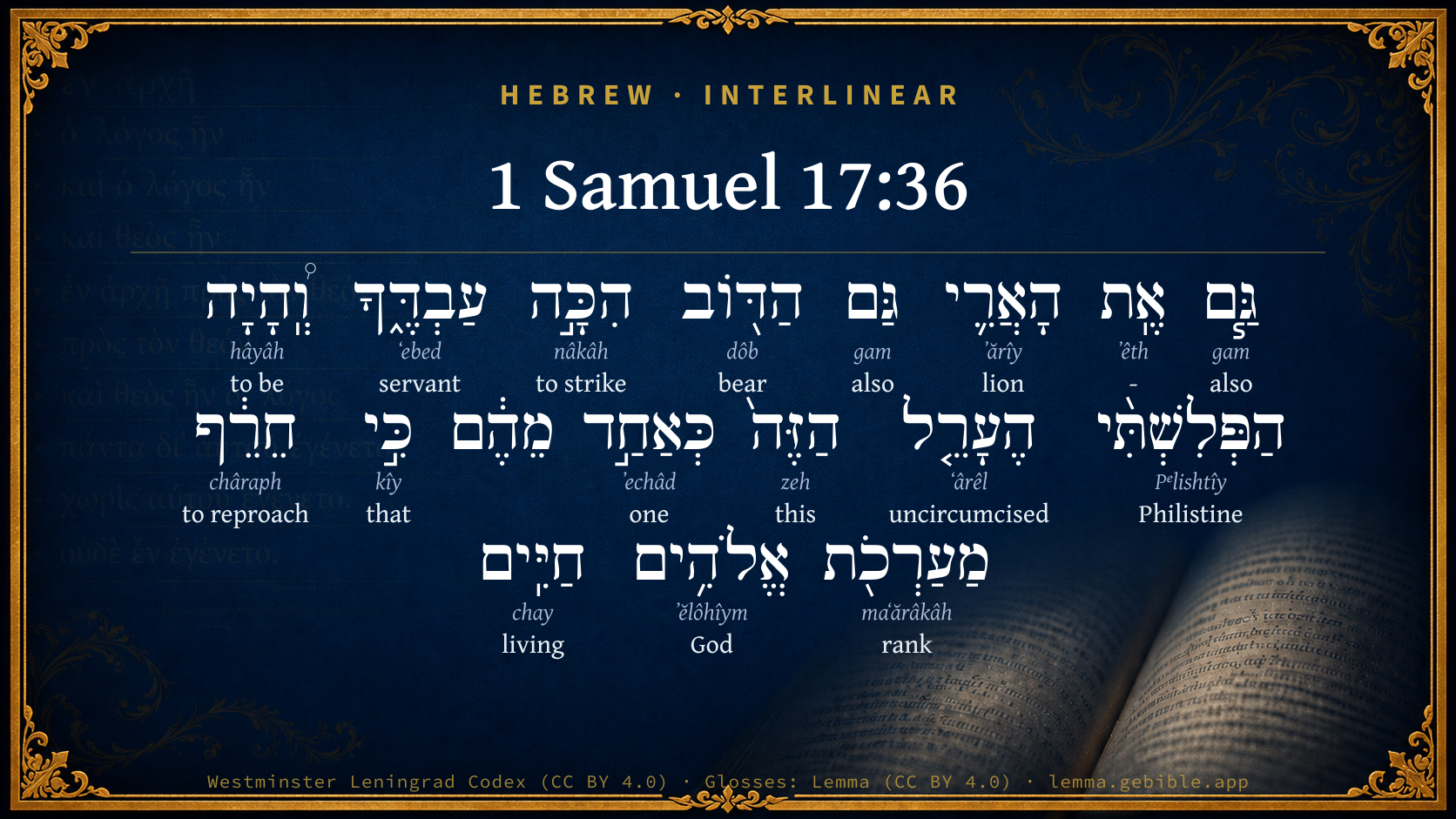
1 Samuel 17:36

Hebrew (Westminster Leningrad Codex) 1 Samuel 17:36 appears in the Hebrew Old Testament. The text above is from the Westminster Leningrad Codex. Each word links to its Strong’s number, a concise gloss, and parsing drawn from the Open Scriptures Hebrew Bible morphology. Click any word for its full Brown-Driver-Briggs (BDB) entry.
Download image
Cite this verse

1 Samuel 17:36 (World English Bible). Public Domain. Lemma interlinear Bible study tool, https://lemma.gebible.app/v/1-samuel/17/36.

Show BibTeX & RIS
BibTeX
RIS
English Translation
Your servant struck both the lion and the bear: and this uncircumcised Philistine shall be as one of them, seeing he has defied the armies of the living God.
World English Bible · Public Domain
Download a study sheet

One document with this verse’s original text, its word-by-word gloss line, the meaning frame, cross-references with their text, attributed commentary, and full source and license credits — printable, and it pastes into notes with its structure intact.

This verse Autodidact and up

Study sheet (.html) Plain text (.txt)

A passage Seminary Student

Up to 50 verses in one chapter. A passage sheet keeps up to 6 commentary sources and 12 cross-references per verse, in the order this page ranks them, and says so on the sheet whenever that leaves anything out. Ask for a single verse and you get the Autodidact verse sheet above.

Everything on this page stays free to read, with no account — the sheet is a download of what is already on screen, not access to it.

Want to remove ads? Support Godless Engineer
Compare translations 3

The same verse in 3 English versions, stacked beneath the original-language interlinear above. Click any original word for its lexicon entry.

Each is an independent rendering of the whole verse — the interlinear is not word-aligned to these translations.

Highlighted words mark where these versions differ — a whole-verse word diff, not a word-by-word alignment.

  • World English Bible Public Domain
    Your servant struck both the lion and the bear: and this uncircumcised Philistine shall be as one of them, seeing he has defied the armies of the living God.
  • King James Version Public Domain
    Thy servant slew both the lion and the bear: and this uncircumcised Philistine shall be as one of them, seeing he hath defied the armies of the living God.
  • unfoldingWord Literal Text CC BY-SA 4.0
    Your servant has struck both the lion and the bear, and this uncircumcised Philistine will be like one of them, for he has taunted the arrays of the living God.”

unfoldingWord Literal Text — © unfoldingWord, licensed CC BY-SA 4.0. Word-aligned USFM3 via Door43 (git.door43.org/unfoldingWord/en_ult).

Versions to compare (up to 4)

3 of 4 selected

Show all 18 translations

Every available English version of this verse, each an independent rendering of the whole verse.

  • World English Bible Public Domain
    Your servant struck both the lion and the bear: and this uncircumcised Philistine shall be as one of them, seeing he has defied the armies of the living God.
  • Berean Standard Bible Public Domain
    Your servant has killed lions and bears; this uncircumcised Philistine will be like one of them, for he has defied the armies of the living God.”
  • Majority Standard Bible Public Domain
    Your servant has killed lions and bears; this uncircumcised Philistine will be like one of them, for he has defied the armies of the living God.”
  • King James Version Public Domain
    Thy servant slew both the lion and the bear: and this uncircumcised Philistine shall be as one of them, seeing he hath defied the armies of the living God.
  • American Standard Version (1901) Public Domain
    Thy servant smote both the lion and the bear: and this uncircumcised Philistine shall be as one of them, seeing he hath defied the armies of the living God.
  • Revised Version (1885) Public Domain
    Thy servant smote both the lion and the bear: and this uncircumcised Philistine shall be as one of them, seeing he hath defied the armies of the living God.
  • Geneva Bible (1599) Public Domain
    So thy seruaunt slue both the lyon, and the beare: therefore this vncircumcised Philistim shall be as one of them, seeing hee hath railed on the hoste of the liuing God.
  • Douay-Rheims (1899) Public Domain
    For I thy servant have killed both a lion and a bear: and this uncircumcised Philistine shall be also as one of them. I will go now, and take away the reproach of the people: for who is this uncircumcised Philistine, who hath dared to curse the army of the living God?
  • Young's Literal Translation Public Domain
    Both the lion and the bear hath thy servant smitten, and this uncircumcised Philistine hath been as one of them, for he hath reproached the ranks of the living God.'
  • Literal Standard Version CC BY-SA 4.0
    Your servant has struck both the lion and the bear, and this uncircumcised Philistine has been as one of them, for he has reproached the ranks of the living God.”
  • Unlocked Literal Bible CC BY-SA 4.0
    Your servant has killed both a lion and a bear. This uncircumcised Philistine will be like one of them, since he has challenged the armies of the living God.”
  • unfoldingWord Literal Text CC BY-SA 4.0
    Your servant has struck both the lion and the bear, and this uncircumcised Philistine will be like one of them, for he has taunted the arrays of the living God.”
  • Darby Bible Public Domain
    Thy servant smote both the lion and the bear; and this uncircumcised Philistine shall be as one of them, because he has defied the armies of the living God.
  • World Messianic Bible Public Domain
    Your servant struck both the lion and the bear. This uncircumcised Philistine shall be as one of them, since he has defied the armies of the living God.”
  • Webster's Bible Public Domain
    Thy servant slew both the lion and the bear: and this uncircumcised Philistine shall be as one of them, seeing he hath defied the armies of the living God.
  • Free Bible Version CC BY-SA 4.0
    I have killed lions and bears, and this heathen Philistine will be just like one of them, for he has mocked the armies of the living God.”
  • Bible in Basic English Public Domain
    Your servant has overcome lion and bear: and the fate of this Philistine, who is without circumcision, will be like theirs, seeing that he has put shame on the armies of the living God.
  • JPS Tanakh (1917) Public Domain
    Thy servant smote both the lion and the bear; and this uncircumcised Philistine shall be as one of them, seeing he hath taunted the armies of the living God.'

Literal Standard Version (2020), Covenant Press — licensed CC BY-SA 4.0. Text via the HelloAO Bible API (eBible.org). Unlocked Literal Bible (unfoldingWord) — licensed CC BY-SA 4.0. Text via the HelloAO Bible API (eBible.org). unfoldingWord Literal Text — © unfoldingWord, licensed CC BY-SA 4.0. Word-aligned USFM3 via Door43 (git.door43.org/unfoldingWord/en_ult). Free Bible Version, Dr. Jonathan Gallagher — licensed CC BY-SA 4.0. Text via the HelloAO Bible API (eBible.org).

Word by word

More ways to search: Search by grammar → Find every occurrence → Compare this word →

Practice this passage: Drill this verse → Learn its vocabulary →

הַדּ֖וֹב
dôb
H1677
“the · bear”
Particle, Definite Article + Noun, Common, Masculine, Singular, Absolute
Part of Speech
Particle + Noun
Type
Common
Gender
Masculine
Number
Singular
State
Absolute
Full BDB Definition

Origin: from H1680

TWOT: 396a

bear
  1. גַּ֧ם gam H1571 “also” Particle, Accusative
  2. אֶֽת ʼêth H853 “-” Particle, Direct Object
  3. הָאֲרִ֛י ʼărîy H738 “the · lion” Particle, Definite Article + Noun, Common, Masculine, Singular, Absolute
  4. גַּם gam H1571 “also” Particle, Accusative
  5. הִכָּ֣ה nâkâh H5221 “to strike” Verb, Hiphil, Perfect, 3rd Person, Masculine, Singular
  6. עַבְדֶּ֑ךָ ʻebed H5650 “servant · your” Noun, Common, Masculine, Singular, Construct + Suffix, Personal, 2nd Person, Masculine, Singular
  7. וְֽ֠הָיָה hâyâh H1961 “and · to be” Conjunction + Verb, Qal, Perfect, 3rd Person, Masculine, Singular
  8. הַפְּלִשְׁתִּ֨י Pᵉlishtîy H6430 “the · Philistine” Particle, Definite Article + Noun, Gentilic, Masculine, Singular, Absolute
  9. הֶעָרֵ֤ל ʻârêl H6189 “the · uncircumcised” Particle, Definite Article + Adjective, Adjective, Masculine, Singular, Absolute
  10. הַזֶּה֙ zeh H2088 “the · this” Particle, Definite Article + Pronoun, Demonstrative, Masculine, Singular
  11. כְּאַחַ֣ד ʼechâd H259 “like/as · one” Preposition + Adjective, Cardinal number, Masculine, Singular, Construct
  12. כִּ֣י kîy H3588 “that” Conjunction
  13. חֵרֵ֔ף châraph H2778 “to reproach” Verb, Piel, Perfect, 3rd Person, Masculine, Singular
  14. מַעַרְכֹ֖ת maʻărâkâh H4634 “ranks of” Noun, Common, Feminine, Plural, Construct
  15. אֱלֹהִ֥ים ʼĕlôhîym H430 “God(s)” Noun, Common, Masculine, Plural, Absolute
  16. חַיִּֽים chay H2416 “living” Adjective, Adjective, Masculine, Plural, Absolute

About this verse

These counts appear in no published source. They are computed here, from the morphology-tagged text and Lemma’s own curated glosses. What Lemma adds →

18
words
16
distinct lemmas
Historical
section

Notable vocabulary

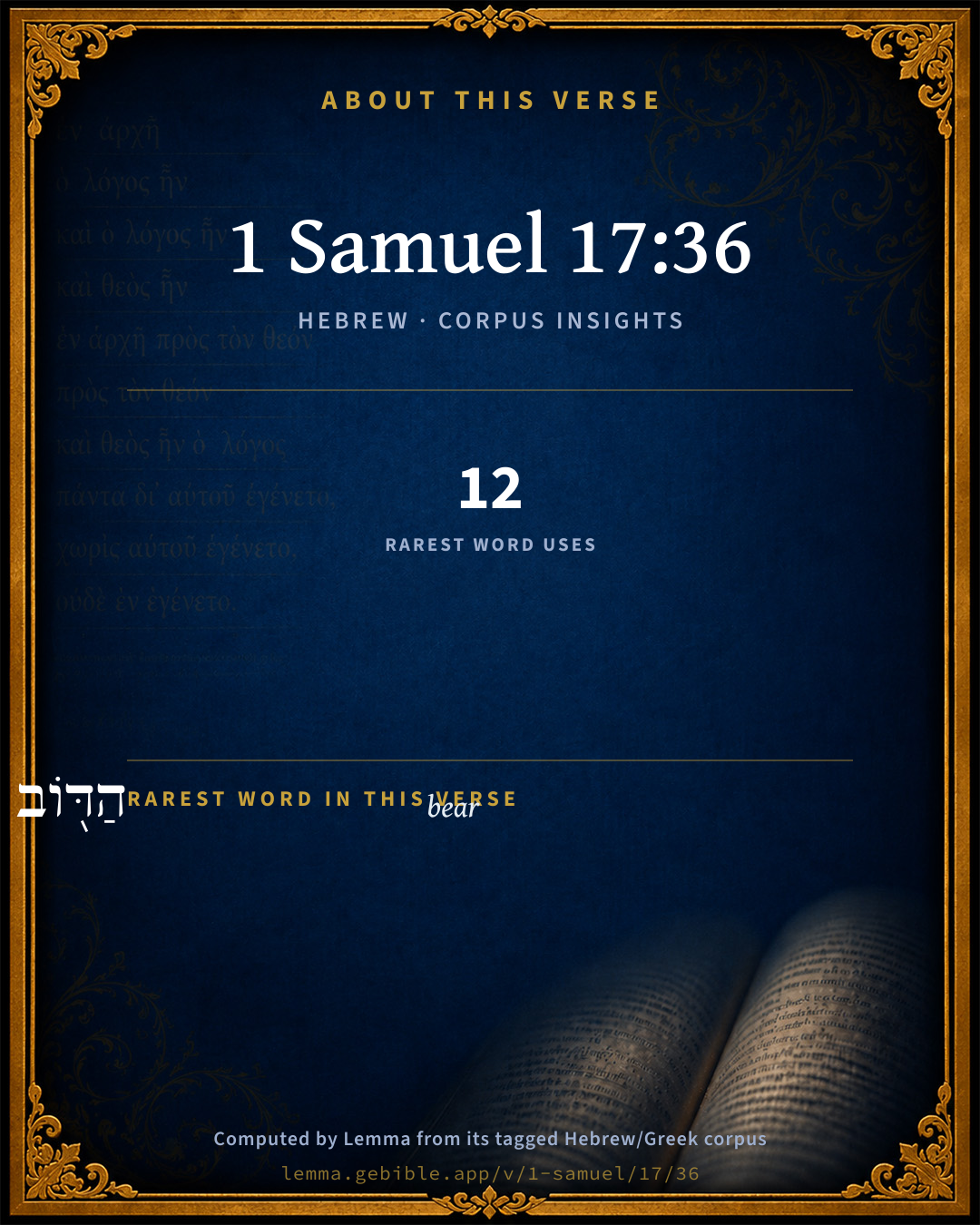
The rarest word here is הַדּ֖וֹב bear H1677 — appearing just 12 times in the whole Hebrew Bible.

Shared distinctive vocabulary

הַדּ֖וֹב bear H1677 occurs in 12 verses of the Hebrew Bible. Also found in:

Grammatical profile

  • 3 verbs
  • 6 nouns
  • 3 adjectives
  • 1 pronoun
  • 1 preposition
  • 1 conjunction
  • 3 particles

Verb forms

  • הִכָּ֣ה Hiphil · Perfect
  • וְֽ֠הָיָה Qal · Perfect
  • חֵרֵ֔ף Piel · Perfect

Repetition

A word recurs within this verse — often emphatic in Hebrew:

  • גַּ֧ם also H1571 ×2

Hebrew & Septuagint length

In English translation the verse runs 29 words from the Hebrew and 49 from the Septuagint (LXX English) — the Septuagint runs noticeably longer here. See the side-by-side →

A rough comparison of the two English renderings, which tokenize alike — not a word-level alignment.

Word counts can differ between the Hebrew and the Greek without any difference in meaning — e.g. the Hebrew direct-object marker אֵת has no separate Greek word, and Greek often adds the article ὁ.

Cross-references

16

Topical passages linked to 1 Samuel 17:36 in the Treasury of Scripture Knowledge — connected by theme and wording, ordered by reader-vote popularity; previews shown in the World English Bible.

  • 1 Samuel 17:10 The Philistine said, I defy the armies of Israel this day; give me a man, that we may fight together.
  • 1 Samuel 17:26 David spoke to the men who stood by him, saying, What shall be done to the man who kills this Philistine, and takes away the reproach from Israel? for who is this uncircumcised Philistine, that he should defy the armies of the living God?
  • Isaiah 10:15 Shall the axe boast itself against him who hews therewith? Shall the saw magnify itself against him who wields it? as if a rod should wield those who lift it up, [or] as if a staff should lift up [him who is] not wood.
  • Isaiah 36:8–10 Now therefore, please give pledges to my master the king of Assyria, and I will give you two thousand horses, if you are able on your part to set riders on them.
  • Isaiah 36:15 neither let Hezekiah make you trust in Yahweh, saying, Yahweh will surely deliver us; this city shall not be given into the hand of the king of Assyria.
  • Isaiah 36:18 Beware lest Hezekiah persuade you, saying, Yahweh will deliver us. Has any of the gods of the nations delivered his land out of the hand of the king of Assyria?
  • Isaiah 37:22–23 this is the word which Yahweh has spoken concerning him: The virgin daughter of Zion has despised you and ridiculed you; the daughter of Jerusalem has shaken her head at you.
  • Isaiah 37:28–29 But I know your sitting down, and your going out, and your coming in, and your raging against me.
  • Ezekiel 32:19 Whom do you pass in beauty? Go down, and be laid with the uncircumcised.
  • Ezekiel 32:27–32 They shall not lie with the mighty who are fallen of the uncircumcised, who are gone down to Sheol with their weapons of war, and have laid their swords under their heads, and their iniquities are on their bones; for [they were] the terror of the mighty in the land of the living.
  • Zechariah 2:8 For thus says Yahweh of hosts: 'For honor he has sent me to the nations which plundered you; for he who touches you touches the apple of his eye.
  • Zechariah 12:3 It will happen in that day, that I will make Jerusalem a burdensome stone for all the peoples. All who burden themselves with it will be severely wounded, and all the nations of the earth will be gathered together against it.
  • Acts 5:38–39 Now I tell you, withdraw from these men, and leave them alone. For if this counsel or this work is of men, it will be overthrown.
  • Acts 12:1–2 Now about that time, Herod the king stretched out his hands to oppress some of the assembly.
  • Acts 12:22–23 The people shouted, "The voice of a god, and not of a man!"
  • Romans 2:28–29 For he is not a Jew who is one outwardly, neither is that circumcision which is outward in the flesh;

Cross-references courtesy of OpenBible.info (CC BY 4.0).

Hebrew and Greek witnesses Masoretic Hebrew ↔ Greek Septuagint

The same verse in the two great witnesses to the Old Testament, shown verse-for-verse.

Here the Septuagint runs noticeably longer than the Hebrew — LXX2012 (modern English Septuagint) 49 words vs World English Bible 29. A rough length comparison of the two English translations, not a word-level alignment — read both below.

These are two independent witnesses, not word-aligned to each other, and the Septuagint is shown in lemma (dictionary) form.

Hebrew 1 Samuel 17:36 Masoretic · Westminster Leningrad Codex

גַּ֧ם אֶֽת הָאֲרִ֛י גַּם הַדּ֖וֹב הִכָּ֣ה עַבְדֶּ֑ךָ וְֽ֠הָיָה הַפְּלִשְׁתִּ֨י הֶעָרֵ֤ל הַזֶּה֙ כְּאַחַ֣ד מֵהֶ֔ם כִּ֣י חֵרֵ֔ף מַעַרְכֹ֖ת אֱלֹהִ֥ים חַיִּֽים

Your servant struck both the lion and the bear: and this uncircumcised Philistine shall be as one of them, seeing he has defied the armies of the living God.

World English Bible · Public Domain

Greek LXX 1 Samuel 17:36 Septuagint · lemma form
Your servant struck both the lion and the bear, and the uncircumcised Philistine shall be as one of them: shall I not go and strike him, and remove this day a reproach from Israel? For who is this uncircumcised one, who has defied the army of the living God?

LXX2012 (modern English Septuagint) · Public Domain

On this verse, Haydock's Catholic Bible Commentary discusses the Septuagint’s reading. Read the note in Commentary ↓

Hebrew: Westminster Leningrad Codex (CC BY 4.0). Greek: Septuagint (public domain); English from LXX2012 (modern English Septuagint) (Public Domain). How the Septuagint differs from the Hebrew →

Targum (Aramaic paraphrase)

1

The Targum is the ancient Jewish Aramaic paraphrase of the Hebrew Scriptures — an interpretive translation, not the Hebrew text itself. Onkelos (literal) and Pseudo-Jonathan (expansive) render the Torah, and Jonathan the Prophets. Coverage is partial: where no permissively-licensed English translation exists for a verse, only the Aramaic is shown. This is verse-level text, not a word-by-word alignment to the Hebrew.

  1. Targum Jonathan Prophets (Joshua–Malachi)
    אַף יַת אַרְיָא אַף דֻבָּא קְטַל עַבְדָךְ וִיהֵי פְּלִשְׁתָּאָה עֲרֵלָא הָדֵין כְּחַד מִנְהוֹן אֲרֵי חֲסַד סִדְרֵי עַמָא דַייָ קַיָמָא:

    (no public-domain English translation for this verse)

    Targum Jonathan — Aramaic: “Mikraot Gedolot” (public domain). English: “Sefaria Community Translation” (CC0 1.0 (public-domain dedication)); “London "Chaldee Paraphrase," 1871” (public domain). Text via Sefaria.

Commentary

Notes on 1 Samuel 17:36 from classic Christian and Jewish commentators (each source and its license shown beneath its notes). The classic Christian expositions comment on the surrounding passage and are grouped to its opening verse, so a note may address several verses; the Jewish commentaries on the Tanakh (Rashi and others) are per-verse, so they appear only where the commentator wrote on this verse.

Lemma curates 59 commentaries, every one of them public domain or Creative Commons licensed, each selected and text-cleaned for this edition rather than reprinted as found. About our sources →

Trapp's Complete Commentary

John Trapp

1Sa 17:36 Thy servant slew both the lion and the bear: and this uncircumcised Philistine shall be as one of them, seeing he hath defied the armies of the living God.

Ver. 36. This uncircumcised Philistine shall be as one of them.] Death sweepeth, and hell swalloweth all such as are out of the covenant: and although circumcision be nothing, nor uncircumcision, but a new creature: yet as circumcision saved David, a believer, from Goliath; so doth baptism now shend and save us from Satan, yet "not the putting away of the filth of the flesh, but the answer of a good conscience toward God." {1Pe 3:21}

John Trapp, A Commentary or Exposition upon All the Books of the Old and New Testament (1647–1656) — public domain. Text from a community e-Sword module.

The Biblical Illustrator

Joseph S. Exell

1Sa_17:36-37

Thy servant slew both the lion and the bear.

The lion and the bear

Davids first battles were with a lion and a bear. His next with the Philistine Goliath, and after that with many enemies, with the Amalekites, the Philistines, the Moabites, the Syrians, the Edomites, and others. It seems to me that you have two enemies to contend with in your youth--violence and bearishness. Until you have conquered these you will not have proved yourselves worthy to go against greater foes.

1. Violence of temper is the lion with which you have to fight. Angry passions are the first passions that assail you. Anger is natural; and in itself is not wrong. But it is sinful when it masters you. When a lion is in a cage, and allowed no opportunity of tearing and killing, you do not fear him, but when he breaks out of the cage, then everyone takes to flight. Anger is not wrong when the cause is just, the feeling moderate, and the desire of punishment proportioned to the offence.

2. The other enemy you have to contend with is Bearishness. The greatest charm in a boy is politeness, or civility; and this is not so often met with as one could wish. Boys and girls are now allowed so much liberty, that they behave as if they owed no consideration, respect, or deference, to their elders and betters. It used to be said that bears never allowed their cubs to be seen out of the cave in which they were born until they had licked them into shape, for infant bear cubs were misformed hideous little beasts, but the mother by pains and constant licking got them into something like shape. I am afraid that too many little human bear cubs are allowed out before they are licked into shape. Now what is the cause of bearishness? of cubbishness? It is thought of self. The boy or girl whose mind is fixed on self is sure not to have thought of the wants and wishes of others, and to be without the respect due to others. In the upper classes of society it would be thought so disgraceful for ladies and gentlemen to turn out bear cubs into the world, that they are obliged to lick them into shape, and make them learn manners. They put on manners as they put on their clothes. But it would be much better if the Bear were killed, instead of being hidden in a cupboard. It too often happens with those who have been taught to be polite and courteous, without being taught also to conquer the evil principle which lies at the root of cubbishness, that on occasions the bad beast breaks out, bursts through all restraints, and then we see that gentle manner was put on, and is not real. The bear is in the cupboard and hidden, but it is alive and impatient of restraint, and takes the first opportunity to show itself selfishness is the mother of bearishness. If the lion is feared the bear is loathed And the bearish child is a most offensive child, and grows up into a most offensive man or woman. Bearishness is exactly the reverse of what should be the character of a Christian. The Christian religion softens, and refines, it teaches all to be kindly to one another, to love as brethren, to be pitiful and courteous. (S. Baring Gould, M. A.)

The lion and the bear: trophies hung up

We shall see what made David so calm and self-possessed as to venture where nobody else would venture, and take up the gauntlet and dare to be the champion of the living God.

I. The confidence of David.

1. The confidence of David was grounded upon his own personal experience.

2. You will notice that in his confidence there is a blending of the human with the Divine. Observe: Thy servant slew both the lion and the bear, and this uncircumcised Philistine shall be as one of them:--That is the human. David said moreover, The Lord that delivered me out of the paw of the lion, and out, of the paw of the hear, He will deliver me out of the hand of this Philistine:--That is the Divine side of it. Work for God with all your might, as if you did it all; but then always remember that it is God which worketh in you both to will and to do of His good pleasure. How is that Philistine to be killed? By God, says one. True; but not without David. By David, says another. Yes, but not without God. Put the Lord on the march with David, and you put the Philistines into untimely graves.

3. I want you to notice in Davids confidence that he had go practically observed the service of the human side that he speaks of it first. If you did work valiantly by the help of the Spirit of God, you did do it, and should not refuse to say so. How are you to glorify God by denying the fruit of His Spirit? It is the glory of God that He led you to holy labour, and helped you in it.

4. Although David thus speaks of the human first, yet be speaks of the Divine most.

5. Now I want to go a little further, and show that Davids confidence rested mainly in the immutability of God, the Divine Worker.

6. This leads me to observe that Davids confidence also proceeded upon his firm conviction that, the immutable God being with him, he himself would be sufficient for the present emergency.

II. David is a very fit and wonderful type of the great son of David, the Lord Jesus Christ. (C. H. Spurgeon.)

The lion-slayer-The giant-killer

What was the pith of Davids argument? What were the five smooth stones which he threw at the head of carnal reasoning?

I. Recollections. Now, what did David recollect, for I want you to remember the same?

1. He recollected, first, that, whatever his present trial might be, he had been tried before, tried when he was but a young man, peacefully employed in keeping his flocks.

2. He remembered, too, that he had been tried frequently. He had been not only attacked by a lion, but also by a bear.

3. David recollected that he had risked all in the prosecution of his duty.

4. He remembered that he had on that occasion gone alone to the fray.

5. David also recollected that on that occasion when he smote the lion and the bear he had nothing visible to rely upon, but simply trusted his God.

6. David recollected also that the tactics which he adopted on that occasion were natural, artless, and vigorous.

7. David remembered that by confidence in God his energetic fighting gained the victory.

II. Now for reasonings. David used an argument in which no flaw can be found. He said The case of this Philistine is a parallel one to that of the lion. If I act in the same manner by faith in God with this giant as I did with the lion, God is the same, and therefore the result will be the same. That seems to me to be very clear reasoning, and I bid you adopt it. Let us now consider the case, and we shall see that it really was parallel. There was the flock, defenceless; here was Israel, Gods flock, defenceless, too, with no one to take up its cause. He was alone that day when he smote the lion, and so he was this day when he was to confront his enormous foe. As for that, Philistine, he felt that in him he had an antagonist of the old sort. It was brute force before, it was brute force now: it might take the shape of a lion or a bear or a Philistine, but David considered that it was only so much flesh and bone and muscle, so much brag or roar, tooth or spear The whole argument is this, in the one case by such tactics we have been successful, trusting in God, and therefore in a similar case we have only to do the same, and we shall realise the same victory, I know a man who today says, Yes, what we did in years gone by we did in our heroic age, but we are not, so enthusiastic now. And why not? We are so apt to magnify our former selves, and think of our early deeds as of something to be wondered at, but not to be attempted now. Fools that we are! They were little enough in all conscience, and ought to be outdone. This resting on our oars will not do, we are drifting down with the tide. David did not say, I slew a lion and a bear, I have had my turn at such bouts, let somebody else go and fight that Philistine: yet we have heard people say, When I was a young man I taught in the Sunday school, I used to go out preaching in the villages, and so on. Oh, and why not do it now? Methinks you ought to be doing more instead of less.

III. The last thing is results. The results were:

1. David felt he would, as he did before, rely upon God alone.

2. David resolved again to run all risks once more, as he had done before.

3. Davids next step was to put himself into the same condition as on former occasions, by divesting himself of everything that hampered him. The ultimate result was that the young champion came back with Goliaths head in his hand, and equally sure triumphs await every one of you if you rely on the Lord, and act in simple earnestness. (C. H. Spurgeon.)

How may the well-discharge of our present duty give us assurance of help from God for the well-discharge of all future duties

This question hath two parts in it, and cannot be so well grounded upon a single text; therefore I shall name three or four, namely, 1Sa_17:34-37; Psa_27:14; Pro_10:29; 2Ch_15:2. I name these several scriptures as so many proofs of the truth of the point, that it is a case very agreeable to the Scriptures and to the analogy of faith.

I. What is our present duty?

1. What duty is, in the general nature and notion of it. It is an act of obedience to the will of our superiors. Duty is that which is due from man to God: it is justice toward God.

2. Something is our present duty. God hath filled up all our time with duty: not one moment left at our own disposal.

3. Nothing that is sinful and in itself unlawful can be our duty at any time; and therefore, to be sure, not our present duty.

4. Every thing that is in itself lawful is not therefore our duty. All things are lawful, but all things are not expedient. (1Co_6:12.)

5. Everything that is commanded, and is in its time and place our duty, may not be our present duty. Affirmatives bind always; that is, we can never be discharged from that obligation that lies upon us to worship God: but we are not bound at all times to the outward acts of worship; for then we should do nothing else.

6. That which God now requires of you, and in doing of which you may most glorify God and edify your neighbour--that is undoubtedly your present duty. How shall we know this? Always look within your calling for your present, duty; for there it lies. General: As we are Christians, so all saints are of the same calling: Called to be saints. (Rom_1:7.) Particular: So we differ in our callings. Some are called to the magistracy, some to the ministry; some are masters, some servants; some called to this, some to that, trade or occupation. Much of the duties of our Christian calling do follow us into our particular callings. As duties of worship must be performed in our families every day, let our particular calling be what it will; so the same graces must be exercised in our particular callings, which were required in our general callings: the same graces do follow us into our particular callings and into all the works of our hands. You see, your present duty lies in your present work, in the daily business of your particular callings. Herein lies the nature of all practical holiness--to do everything after a godly sort. The directions I give you relate only to the religious manner of doing what you do; though it is God that instructs you to discretion in all worldly business. (Isa_28:26.) Whatever your skill and insight is in your calling, prayer may make you wiser: you may obtain a more excellent spirit in your way than you now have, if you seek it of God. (Exo_35:31-33.) Though you are left to the use of your reason as men, yet faith must go along with it as you are Christians. Therefore I shall show you how to put forth an act of reason in faith How may we know when reason and faith go together? 1 When, at our entrance upon any business, we seek wisdom and understanding from God, stirring up our reason by our faith, looking up to Him from whom cometh every good and perfect gift (Jam_1:17) that He would instruct us unto discretion.

2. When, in answer to faith and prayer, thoughts do come in that clear up our way to us, and do put us into a right method, pointing out such probable means, inclining to such apposite counsel, as in a rational way tend to the expediting of that business which we are about.

3. When, under the greatest assurances of our own reason, we yet live in a humble dependence upon God for success. He puts forth an act of reason in faith, who trusts to God, and not to his own reason. It is our duty to make use of it as men, though as Christians we ought not to trust in it.

(1) Consider present Providences.

(2) Consult thy conscience.

(3) Consider what present temptation thou art under.

(4) Consult with the word of God.

(5) Devote thyself in sincerity to the fear of God, through the whole course of thy life.

But what if, after all this, it should so fall out that two duties should press upon my conscience for present performance, and! cannot either by reason or Scripture, determine which to do first, but do hang in suspense, am in a strait betwixt two? (Php_1:23.) This is hardly to be supposed: but, admit it to be thy case, according to thy present judgment; then

1. Sit down once more, and consider.

2. If of two duties you cannot resolve which is most your duty at present, then resolve upon both, and begin where you will. God will not be extreme in that case. Do one, and leave not the other undone, but be sure to find time for that also.

3. Beg of God to resolve thee. O that my ways were directed to keep Thy statutes! (Psa_119:5.) Shall I go up to Hebron? or shall I not? (2Sa_2:1.) God will teach thee what to do. (Psa_25:12) He shall direct thy paths, (Pro_3:5-6.)

Application.

1. All the sins of your lives break in upon you, through the omission of your present duty.

2. Whatever you do in the room of a present duty is not acceptable to God.

3. If you do not now perform your present duty, you can never perform it.

4. You can have as trial of your spirit, nor of the truth of your state: it is impossible that you should ever prove your sincerity, but by a conscientious discharge of your present duty.

5. You cannot walk evenly with God, if you do not your present duty. Some men walk very unevenly: there are so many gaps in their obedience; they move from duty to duty, quite leaping over some, and lightly touching upon others, as if they had no great mind to any: they act grace so abruptly that it gives no continued sense; we know not where to find them. There are so many vacant spaces, so many blanks of omission, so many blots and blurs of commission: they drop a duty here, and another half-mile off; so that you cannot say, A man of God went this way. (1Ki_13:12.)

6. You must begin somewhere, at some present duty: why not at this? It will be as difficult, nay, more difficult, to come to Christ tomorrow than it is today: therefore today hear His voice, and harden not your heart. (Psa_95:7-8.) Break the ice now, and by faith venture upon thy present duty, wherever it lies: do what you are now called to.

II. How the well-discharge of our present duty may encourage us to hope in God for His help and assistance in all future duties.

1. It is promised. (2Ch_15:2.)

2. Present grace is a pledge of future grace. To him that hath, more shall be given. (Luk_19:17; Luk_19:26).

3. The experience of the saints confirms this. See Psa_18:26; Psa_18:30-32.

4. The saints made this an argument in prayer. (Psa_38:20-22; Psa_119:30-31; Psa_119:94; Psa_119:121; Psa_119:173; Psa_25:21.)

5. A conscientious discharge of our present duty fits and disposes our minds to the next duty.

6. By the well-discharge of our present duty we may attain assurance of salvation. (Col_3:23-24.) (Thomas Cole, A. M.)

The Biblical Illustrator, edited by Joseph S. Exell (c. 1880s–1900s) — public domain. Text from a community e-Sword module.

Joseph Benson's Commentary

1Sa 17:36-37. Thy servant slew both the lion and the bear, &c. — There is a remarkable, and never to be sufficiently admired modesty in this relation of David, which he concludes by attributing all he had done to the goodness and power of God. And he takes encouragement from the experience which he had already had of these divine attributes being exerted on his behalf on a less important occasion, to believe that they would be exerted on this occasion also, which was much more important, as peculiarly involving the glory of God and the best interests of his people, which had not been the case in the former instances. This uncircumcised Philistine shall be as one of them — Goliath debased himself below a brute by his blasphemy, and therefore he now carried no more terror with him to David than a lion or a bear. Seeing he hath defied the armies of the living God — Here we see the foundation of David’s confidence of success. The Philistine had defied the living God in defying his armies, and had openly avowed himself his enemy. And David therefore comes forward, as his friend, to espouse his cause. It is as if he had said, The lion and the bear were only enemies to me and to my sheep, and it was only in defence of them that I attacked these brute beasts; but this Philistine is an enemy to God and his people, and it is for their honour that I attack him.

Joseph Benson's Commentary on the Old and New Testaments (1811–1818) — public domain. Text from a community e-Sword module.

Ellicott's Commentary for English Readers

(36) The lion and the bear.—The lion and the bear were, in the days of Saul, common in Palestine; the country then was densely wooded. In some of the wilder districts bears are still numerous.

Shall be as one of them.—“He, the idolator, must know that he has not to do with mere men, but with God: with a living God will he have to do, and not with a lifeless idol.”—Berleburger Bible.

A Bible Commentary for English Readers, edited by Charles John Ellicott (1878–1897) — public domain. Text from a community e-Sword module.

The Cambridge Bible for Schools and Colleges

gen. ed. J. J. S. Perowne

36. seeing he hath defied, &c.] “The trusting heart of God’s servant could see no ground for fearing one who came forth to defy Jehovah.” Wilberforce’s Heroes, p. 242.

The Sept. reads: “Shall I not go and smite him, and take away the reproach from Israel this day? for who is this uncircumcised, who hath reproached the army of the living God?”

The Cambridge Bible for Schools and Colleges (gen. ed. J. J. S. Perowne; Cambridge University Press, 1878–1918) — public domain. Text from a community e-Sword module.

John Gill's Exposition

Thy servant slew both the lion and the bear,.... At different times, and several of them at one time or another; whenever any of them came into the flock, he used to lay hold on them and kill them, with all the ease imaginable. The Jews suppose this phrase denotes many of them (h).

And this uncircumcised Philistine shall be as one of them; as he was like them in nature, savage, cruel and unclean, so he would be in his end, killed as they; of this David was fully persuaded and assured in mind having an impulse from the Spirit of God, by which he was certified of it:

seeing he hath defied the armies of the living God; so that as he justly deserved to die, he made no doubt of it it would be his case.

(h) See Halicot Olam, p. 177.

John Gill's Exposition of the Whole Bible (1746–1763) — public domain (CC PDM 1.0). Text via the HelloAO Bible API.

Haydock's Catholic Bible Commentary

I will....Philistine. This is not in Hebrew or the Septuagint, and it is marked as an addition in the ancient manuscripts. (Calmet) --- Single combats, to prevent the spilling of more blood, may sometimes be authorized by public authority. (Grotius)

George Leo Haydock (1774–1849), Haydock's Catholic Family Bible and Commentary, 1859 edition — public domain. Excludes Psalms (Douay-Rheims chapter numbering differs from Protestant) and Deuterocanonical books (Catholic canon only).

Matthew Poole's English Annotations

Slew both the lion and the bear: this he is probably thought to have done after he was anointed; when he was endowed with singular gifts of God’s Spirit; and, among others, with extraordinary courage of heart and strength of body.

Matthew Poole's English Annotations on the Holy Bible (1683–1685) — public domain. Text from a community e-Sword/MySword module.

unfoldingWord translationNotes

Door43 World Missions Community

Connecting Statement:

David continues speaking to King Saul.

This uncircumcised Philistine

This phrase is an insult and indicates that Goliath does not belong to the living God. See how you translated this in 1 Samuel 17:26.

will be like one of them

David is saying that he will be able to kill the Philistine just as he was able to kill the lion and bear.

translationWords

servant

lions

circumcise

Philistines

life

God

unfoldingWord translationNotes — © Distant Shores Media and the Door43 World Missions Community, licensed CC BY-SA 4.0. Source: git.door43.org/Door43/en_tn.

Rashi

Rabbi Shlomo Yitzchaki (Rashi)

Even the lion and the bear. These words [גַּם, אֶת, גַּם] are of inclusive nature, meaning a lion and its two whelps, and a bear and its two cubs.

Rashi on the Tanakh — English translations: “The Judaica Press complete Tanach with Rashi, translated by A. J. Rosenberg” (CC BY 4.0); “Pentateuch with Rashi's commentary by M. Rosenbaum and A.M. Silbermann, 1929-1934” (public domain); “The Metsudah Tanach series, Lakewood, N.J” (CC BY 4.0); and “The Book of Joshua, Metsudah Publications, 1997” (CC BY 4.0). Text via Sefaria.

Lesson kit

Teaching starters — assembled from the data on this page, not authored interpretation. Every prompt links to the verse data it draws on. Edit before teaching.

1 Samuel, in the Historical, opens this verse with 18 words (16 distinct Hebrew lemmas). Its most distinctive word is dôb (“bear”). The Greek Septuagint runs longer here. A historical commentator’s framing appears above. Read the whole chapter for the surrounding context.

Discussion questions

  1. What does “bear” (dôb) contribute to the verse as a whole?
  2. How does 1 Samuel 17:34, which shares the word «bear», read alongside this verse?
  3. What does the repetition of “also” (2× in this one verse) do in this verse?
  4. The Septuagint runs longer here than the Hebrew. What might account for the difference?
  5. These translations render this verse differently. What is at stake in choosing one wording over another?
  6. «הִכָּ֣ה» is a Hiphil Perfect verb. How does that grammatical form shape the action described?
  7. Compare how Trapp's Complete Commentary and The Biblical Illustrator read this verse. Where do they agree or differ?

Things to notice

Reading settings

Reading text

Shown beneath each verse's original-language words.

Old Testament
Old Testament edition

Read the OT as the Masoretic Hebrew (MT) or the Greek Septuagint (LXX).

English shown for the Greek Septuagint (in the Hebrew ↔ Greek comparison).

Comparing translations? Open the Compare panel on any verse page to stack up to four side by side.