
1 Samuel 9:6

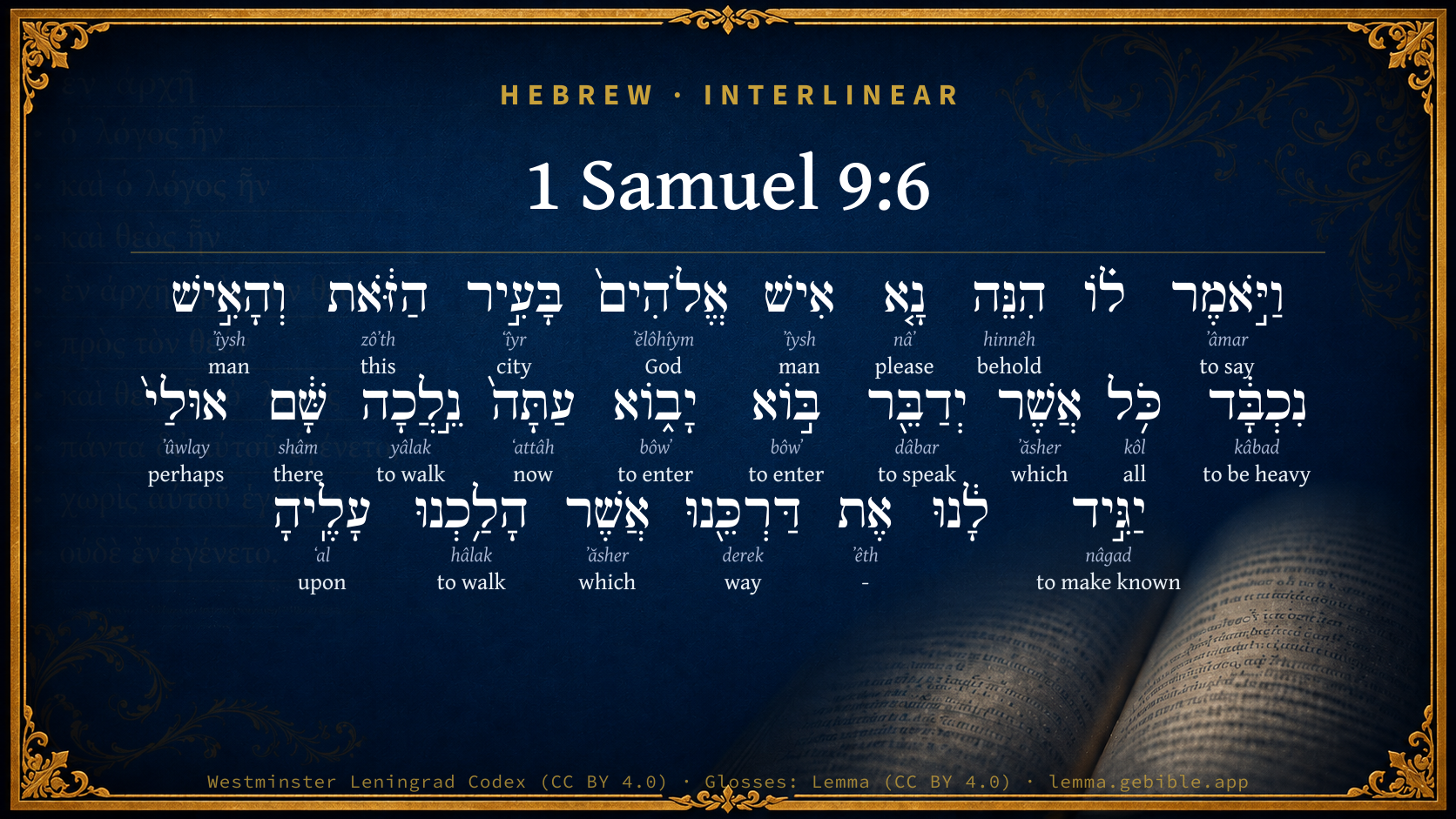
Hebrew (Westminster Leningrad Codex) 1 Samuel 9:6 appears in the Hebrew Old Testament. The text above is from the Westminster Leningrad Codex. Each word links to its Strong’s number, a concise gloss, and parsing drawn from the Open Scriptures Hebrew Bible morphology. Click any word for its full Brown-Driver-Briggs (BDB) entry.
Download image
Cite this verse

1 Samuel 9:6 (World English Bible). Public Domain. Lemma interlinear Bible study tool, https://lemma.gebible.app/v/1-samuel/9/6.

Show BibTeX & RIS
BibTeX
RIS
English Translation
He said to him, See now, there is in this city a man of God, and he is a man who is held in honor; all that he says comes surely to pass: now let us go there; peradventure he can tell us concerning our journey whereon we go.
World English Bible · Public Domain
Download a study sheet

One document with this verse’s original text, its word-by-word gloss line, the meaning frame, cross-references with their text, attributed commentary, and full source and license credits — printable, and it pastes into notes with its structure intact.

This verse Autodidact and up

Study sheet (.html) Plain text (.txt)

A passage Seminary Student

Up to 50 verses in one chapter. A passage sheet keeps up to 6 commentary sources and 12 cross-references per verse, in the order this page ranks them, and says so on the sheet whenever that leaves anything out. Ask for a single verse and you get the Autodidact verse sheet above.

Everything on this page stays free to read, with no account — the sheet is a download of what is already on screen, not access to it.

Want to remove ads? Support Godless Engineer
Compare translations 3

The same verse in 3 English versions, stacked beneath the original-language interlinear above. Click any original word for its lexicon entry.

Each is an independent rendering of the whole verse — the interlinear is not word-aligned to these translations.

Highlighted words mark where these versions differ — a whole-verse word diff, not a word-by-word alignment.

  • World English Bible Public Domain
    He said to him, See now, there is in this city a man of God, and he is a man who is held in honor; all that he says comes surely to pass: now let us go there; peradventure he can tell us concerning our journey whereon we go.
  • King James Version Public Domain
    And he said unto him, Behold now, there is in this city a man of God, and he is an honorable man; all that he saith cometh surely to pass: now let us go thither; peradventure he can show us our way that we should go.
  • unfoldingWord Literal Text CC BY-SA 4.0
    And he said to him, “Behold, please, a man of God in this city, and the man is honored. All that he speaks, coming, it comes. Now let us go there. Perhaps he will declare to us our way on which we have gone.”

unfoldingWord Literal Text — © unfoldingWord, licensed CC BY-SA 4.0. Word-aligned USFM3 via Door43 (git.door43.org/unfoldingWord/en_ult).

Versions to compare (up to 4)

3 of 4 selected

Show all 18 translations

Every available English version of this verse, each an independent rendering of the whole verse.

  • World English Bible Public Domain
    He said to him, See now, there is in this city a man of God, and he is a man who is held in honor; all that he says comes surely to pass: now let us go there; peradventure he can tell us concerning our journey whereon we go.
  • Berean Standard Bible Public Domain
    “Look,” said the servant, “in this city there is a man of God who is highly respected; everything he says surely comes to pass. Let us go there now. Perhaps he will tell us which way to go.”
  • Majority Standard Bible Public Domain
    “Look,” said the servant, “in this city there is a man of God who is highly respected; everything he says surely comes to pass. Let us go there now. Perhaps he will tell us which way to go.”
  • King James Version Public Domain
    And he said unto him, Behold now, there is in this city a man of God, and he is an honorable man; all that he saith cometh surely to pass: now let us go thither; peradventure he can show us our way that we should go.
  • American Standard Version (1901) Public Domain
    And he said unto him, Behold now, there is in this city a man of God, and he is a man that is held in honor; all that he saith cometh surely to pass: now let us go thither; peradventure he can tell us concerning our journey whereon we go.
  • Revised Version (1885) Public Domain
    And he said unto him, Behold now, there is in this city a man of God, and he is a man that is held in honour; all that he saith cometh surely to pass: now let us go thither; peradventure he can tell us concerning our journey whereon we go.
  • Geneva Bible (1599) Public Domain
    And he said vnto him, Behold nowe, in this citie is a man of God, and he is an honorable man: all that he saith commeth to passe: let vs nowe goe thither, if so be that he can shewe vs what way we may goe.
  • Douay-Rheims (1899) Public Domain
    And he said to him: Behold there is a man of God in this city, a famous man: all that he saith, cometh certainly to pass. Now therefore let us go thither, perhaps he may tell us of our way, for which we are come.
  • Young's Literal Translation Public Domain
    And he saith to him, `Lo, I pray thee, a man of God `is' in this city, and the man is honoured; all that he speaketh doth certainly come; now, we go there, it may be he doth declare to us our way on which we have gone.'
  • Literal Standard Version CC BY-SA 4.0
    And he says to him, “Now behold, a man of God [is] in this city, and the man is honored; all that he speaks certainly comes; now, we go there, it may be he declares to us our way on which we have gone.”
  • Unlocked Literal Bible CC BY-SA 4.0
    But the servant said to him, “Listen, there is a man of God in this city. He is a man who is held in honor; everything that he says comes true. Let us go there; maybe he can tell us which way we should go on our journey.”
  • unfoldingWord Literal Text CC BY-SA 4.0
    And he said to him, “Behold, please, a man of God in this city, and the man is honored. All that he speaks, coming, it comes. Now let us go there. Perhaps he will declare to us our way on which we have gone.”
  • Darby Bible Public Domain
    And he said to him, Behold now, a man of God is in this city, and the man is held in honour; all that he says comes surely to pass. Let us now go thither: perhaps he will shew us the way that we should go.
  • World Messianic Bible Public Domain
    The servant said to him, “Behold now, there is a man of God in this city, and he is a man who is held in honor. All that he says surely happens. Now let’s go there. Perhaps he can tell us which way to go.”
  • Webster's Bible Public Domain
    And he said to him, Behold now, there is in this city a man of God, and he is an honorable man; all that he saith cometh surely to pass: now let us go thither; it may be he can show us our way that we should go.
  • Free Bible Version CC BY-SA 4.0
    But the servant replied, “Hold on! There's a man of God here in this town. He's very well thought of, and everything he says comes true. Let's go and see him. Maybe he can tell us which way we should take.”
  • Bible in Basic English Public Domain
    But the servant said to him, See now, in this town there is a man of God, who is highly honoured, and everything he says comes true: let us go there now; it may be that he will give us directions about our journey.
  • JPS Tanakh (1917) Public Domain
    And he said unto him: 'Behold now, there is in this city a man of God, and he is a man that is held in honour; all that he saith cometh surely to pass; now let us go thither; peradventure he can tell us concerning our journey whereon we go.'

Literal Standard Version (2020), Covenant Press — licensed CC BY-SA 4.0. Text via the HelloAO Bible API (eBible.org). Unlocked Literal Bible (unfoldingWord) — licensed CC BY-SA 4.0. Text via the HelloAO Bible API (eBible.org). unfoldingWord Literal Text — © unfoldingWord, licensed CC BY-SA 4.0. Word-aligned USFM3 via Door43 (git.door43.org/unfoldingWord/en_ult). Free Bible Version, Dr. Jonathan Gallagher — licensed CC BY-SA 4.0. Text via the HelloAO Bible API (eBible.org).

Word by word

More ways to search: Search by grammar → Find every occurrence → Compare this word →

Practice this passage: Drill this verse → Learn its vocabulary →

אוּלַי֙
ʼûwlay
H194
“perhaps”
Adverb
Part of Speech
Adverb
Full BDB Definition

Origin: from H176

TWOT: 46

perhaps, peradventure - if peradventure - unless - suppose
  1. וַיֹּ֣אמֶר ʼâmar H559 “and · to say” Conjunction + Verb, Qal, Sequential Imperfect, 3rd Person, Masculine, Singular
  2. הִנֵּה hinnêh H2009 “behold” Particle, Demonstrative
  3. נָ֤א nâʼ H4994 “please” Particle, Exhortation
  4. אִישׁ ʼîysh H376 “man of” Noun, Common, Masculine, Singular, Construct
  5. אֱלֹהִים֙ ʼĕlôhîym H430 “God(s)” Noun, Common, Masculine, Plural, Absolute
  6. בָּעִ֣יר ʻîyr H5892 “in/at the · city” Preposition, Determined + Noun, Common, Feminine, Singular, Absolute
  7. הַזֹּ֔את zôʼth H2063 “the · this” Particle, Definite Article + Pronoun, Demonstrative, Feminine, Singular
  8. וְהָאִ֣ישׁ ʼîysh H376 “and · the · man” Conjunction + Particle, Definite Article + Noun, Common, Masculine, Singular, Absolute
  9. נִכְבָּ֔ד kâbad H3513 “being heavy” Verb, Niphal, Participle Active, Masculine, Singular, Absolute
  10. כֹּ֥ל kôl H3605 “all” Noun, Common, Masculine, Singular, Absolute
  11. אֲשֶׁר ʼăsher H834 “which” Particle, Relative
  12. יְדַבֵּ֖ר dâbar H1696 “to speak” Verb, Piel, Imperfect, 3rd Person, Masculine, Singular
  13. בּ֣וֹא bôwʼ H935 “to enter” Verb, Qal, Infinitive Absolute
  14. יָב֑וֹא bôwʼ H935 “to enter” Verb, Qal, Imperfect, 3rd Person, Masculine, Singular
  15. עַתָּה֙ ʻattâh H6258 “now” Adverb
  16. נֵ֣לֲכָה yâlak H3212 “to walk” Verb, Qal, Cohortative, 1st Person, Common, Plural
  17. שָּׁ֔ם shâm H8033 “there” Adverb
  18. יַגִּ֣יד nâgad H5046 “to make known” Verb, Hiphil, Imperfect, 3rd Person, Masculine, Singular
  19. אֶת ʼêth H853 “-” Particle, Direct Object
  20. דַּרְכֵּ֖נוּ derek H1870 “way · our” Noun, Common, Both, Singular, Construct + Suffix, Personal, 1st Person, Common, Plural
  21. אֲשֶׁר ʼăsher H834 “which” Particle, Relative
  22. הָלַ֥כְנוּ hâlak H1980 “to walk” Verb, Qal, Perfect, 1st Person, Common, Plural
  23. עָלֶֽיהָ ʻal H5921 “upon · her” Preposition + Suffix, Personal, 3rd Person, Feminine, Singular

About this verse

These counts appear in no published source. They are computed here, from the morphology-tagged text and Lemma’s own curated glosses. What Lemma adds →

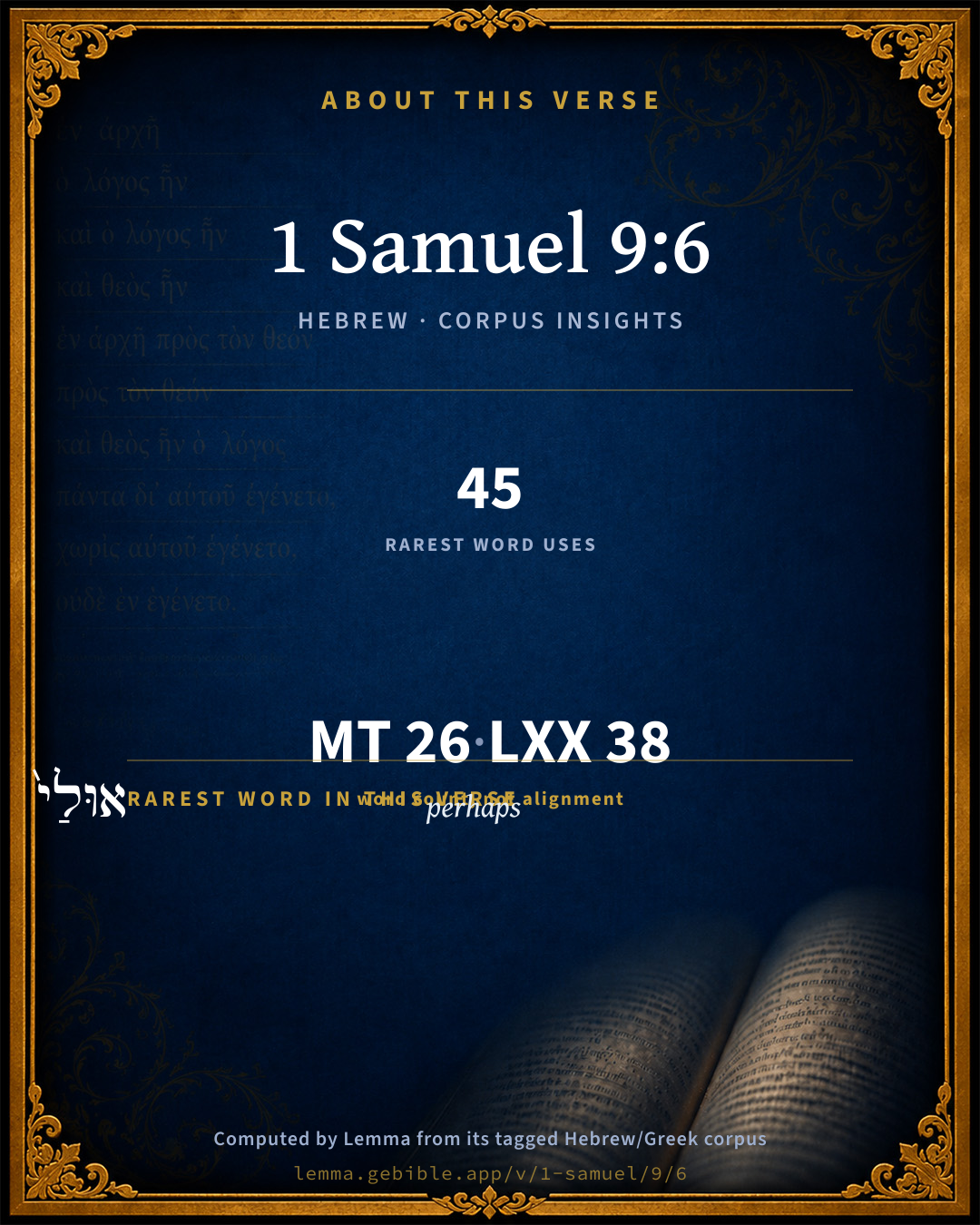
26
words
21
distinct lemmas
Historical
section

Shared distinctive vocabulary

אוּלַי֙ perhaps H194 occurs in 44 verses of the Hebrew Bible. Also found in:

Grammatical profile

  • 8 verbs
  • 6 nouns
  • 1 pronoun
  • 3 prepositions
  • 3 adverbs
  • 5 particles

Verb forms

  • וַיֹּ֣אמֶר Qal · Sequential Imperfect
  • נִכְבָּ֔ד Niphal · Participle Active
  • יְדַבֵּ֖ר Piel · Imperfect
  • בּ֣וֹא Qal · Infinitive Absolute
  • יָב֑וֹא Qal · Imperfect
  • נֵ֣לֲכָה Qal · Cohortative
  • יַגִּ֣יד Hiphil · Imperfect
  • הָלַ֥כְנוּ Qal · Perfect

Repetition

Words recur within this verse — often emphatic in Hebrew:

  • אִישׁ man H376 ×2
  • בּ֣וֹא to enter H935 ×2
  • אֲשֶׁר which H834 ×2

Hebrew & Septuagint length

In English translation the verse runs 49 words from the Hebrew and 53 from the Septuagint (LXX English) — closely comparable.

A rough comparison of the two English renderings, which tokenize alike — not a word-level alignment.

Word counts can differ between the Hebrew and the Greek without any difference in meaning — e.g. the Hebrew direct-object marker אֵת has no separate Greek word, and Greek often adds the article ὁ.

In the original languages it is 26 Hebrew tokens and 38 Greek tokens — but the two are counted differently (Hebrew bundles its prefixes and suffixes into one token; the Greek is in lemma form), so that isn’t a like-for-like length.

Cross-references

11

Topical passages linked to 1 Samuel 9:6 in the Treasury of Scripture Knowledge — connected by theme and wording, ordered by reader-vote popularity; previews shown in the World English Bible.

  • 1 Kings 13:1 Behold, there came a man of God out of Judah by the word of Yahweh to Beth El: and Jeroboam was standing by the altar to burn incense.
  • Deuteronomy 33:1 This is the blessing, with which Moses the man of God blessed the children of Israel before his death.
  • 1 Timothy 6:11 But you, man of God, flee these things, and follow after righteousness, godliness, faith, love, patience, and gentleness.
  • 1 Samuel 2:27 There came a man of God to Eli, and said to him, Thus says Yahweh, Did I reveal myself to the house of your father, when they were in Egypt [in bondage] to Pharaoh's house?
  • 1 Samuel 3:19–20 Samuel grew, and Yahweh was with him, and did let none of his words fall to the ground.
  • 2 Kings 6:6 The man of God said, Where fell it? He shown him the place. He cut down a stick, and cast it in there, and made the iron to swim.
  • Isaiah 44:26 who confirms the word of his servant, and performs the counsel of his messengers; who says of Jerusalem, She shall be inhabited; and of the cities of Judah, They shall be built, and I will raise up the waste places of it;
  • Zechariah 1:5–6 Your fathers, where are they? And the prophets, do they live forever?
  • Matthew 24:35 Heaven and earth will pass away, but my words will not pass away.
  • 1 Thessalonians 2:10 You are witnesses with God, how holy, righteously, and blamelessly we behaved ourselves toward you who believe.
  • 1 Thessalonians 5:13 and to respect and honor them in love for their work's sake. Be at peace among yourselves.

Cross-references courtesy of OpenBible.info (CC BY 4.0).

Hebrew and Greek witnesses Masoretic Hebrew ↔ Greek Septuagint

The same verse in the two great witnesses to the Old Testament, shown verse-for-verse.

These are two independent witnesses, not word-aligned to each other, and the Septuagint is shown in lemma (dictionary) form.

Hebrew 1 Samuel 9:6 Masoretic · Westminster Leningrad Codex

וַיֹּ֣אמֶר ל֗וֹ הִנֵּה נָ֤א אִישׁ אֱלֹהִים֙ בָּעִ֣יר הַזֹּ֔את וְהָאִ֣ישׁ נִכְבָּ֔ד כֹּ֥ל אֲשֶׁר יְדַבֵּ֖ר בּ֣וֹא יָב֑וֹא עַתָּה֙ נֵ֣לֲכָה שָּׁ֔ם אוּלַי֙ יַגִּ֣יד לָ֔נוּ אֶת דַּרְכֵּ֖נוּ אֲשֶׁר הָלַ֥כְנוּ עָלֶֽיהָ

He said to him, See now, there is in this city a man of God, and he is a man who is held in honor; all that he says comes surely to pass: now let us go there; peradventure he can tell us concerning our journey whereon we go.

World English Bible · Public Domain

Greek LXX 1 Samuel 9:6 Septuagint · lemma form

καί εἶπον αὐτός ὁ παιδάριον ἰδού δή ἄνθρωπος ὁ θεός ἐν ὁ πόλις οὗτος καί ὁ ἄνθρωπος ἔνδοξος πᾶς ὅς ἐάν λαλέω παραγίγνομαι παραεἰμί καί νῦν πορεύομαι ὅπως ἀποἀγγέλλω ἐγώ ὁ ὁδός ἐγώ ἐπί ὅς πορεύομαι ἐπί αὐτός

And the young man said to him, Behold now, there is a man of God in this city, and the man is of high repute; all that he shall speak will surely come to pass: now then let us go, that he may tell us our way on which we have set out.

LXX2012 (modern English Septuagint) · Public Domain

On this verse, Haydock's Catholic Bible Commentary discusses the Septuagint’s reading. Read the note in Commentary ↓

Hebrew: Westminster Leningrad Codex (CC BY 4.0). Greek: Septuagint (public domain); English from LXX2012 (modern English Septuagint) (Public Domain). How the Septuagint differs from the Hebrew →

Targum (Aramaic paraphrase)

1

The Targum is the ancient Jewish Aramaic paraphrase of the Hebrew Scriptures — an interpretive translation, not the Hebrew text itself. Onkelos (literal) and Pseudo-Jonathan (expansive) render the Torah, and Jonathan the Prophets. Coverage is partial: where no permissively-licensed English translation exists for a verse, only the Aramaic is shown. This is verse-level text, not a word-by-word alignment to the Hebrew.

  1. Targum Jonathan Prophets (Joshua–Malachi)
    וַאֲמַר לֵיהּ הָא כְעַן נְבִיָא דַייָ בְּקַרְתָּא הָדָא וְגַבְרָא מִתְנַבֵּי קְשׁוֹט כָּל דְאִתְנַבֵּי אִתְקַיְמָא יִתְקַיֵם כְּעַן נֵיזַיל לָנָא תַמָן מָאִים יְחַוֵי לָנָא יַת אָרְחָנָא דַאֲתָנָא עֲלָהּ:

    (no public-domain English translation for this verse)

    Targum Jonathan — Aramaic: “Mikraot Gedolot” (public domain). English: “Sefaria Community Translation” (CC0 1.0 (public-domain dedication)); “London "Chaldee Paraphrase," 1871” (public domain). Text via Sefaria.

Commentary

Notes on 1 Samuel 9:6 from classic Christian and Jewish commentators (each source and its license shown beneath its notes). The classic Christian expositions comment on the surrounding passage and are grouped to its opening verse, so a note may address several verses; the Jewish commentaries on the Tanakh (Rashi and others) are per-verse, so they appear only where the commentator wrote on this verse.

Lemma curates 59 commentaries, every one of them public domain or Creative Commons licensed, each selected and text-cleaned for this edition rather than reprinted as found. About our sources →

Trapp's Complete Commentary

John Trapp

1Sa 9:6 And he said unto him, Behold now, [there is] in this city a man of God, and [he is] an honourable man; all that he saith cometh surely to pass: now let us go thither; peradventure he can shew us our way that we should go.

Ver. 6. A man of God.] A prophet: this title is also given to ministers of the gospel. {2Ti 3:16-17}

And he is an honourable man.] Any relation to God ennobleth, and must be highly esteemed. King Zedekiah is blamed for not humbling himself before Jeremiah the prophet, {2Ch 36:12} who was "precious in God’s sight," and therefore "honourable." {Isa 43:4}

Peradventure he can show us our way.] Tell us whether we shall, and where we may find our lost asses. So low did the high God stoop sometimes to his people’s meanness: to keep them from seeking to sorcerers and idol priests. {1Ki 14:2 2Ki 1:3}

John Trapp, A Commentary or Exposition upon All the Books of the Old and New Testament (1647–1656) — public domain. Text from a community e-Sword module.

The Biblical Illustrator

Joseph S. Exell

1Sa_9:6-10

And he said unto him, Behold now, there is in this city a man of God.

Saul brought to Samuel

Gods Providence is a wonderful scheme; a web of many threads, woven with marvellous skill. The meeting of two convicts in an Egyptian prison is a vital link in the chain of events that makes Joseph governor of Egypt; a young lady coming to bathe in the river preserves the life of Moses, and secures the escape of the Israelites; the thoughtful regard of a father for the comfort of his sons in the army brings David into contact with Goliath, and prepares the way for his elevation to the throne; the beauty of a Hebrew girl fascinating a Persian king saves the whole Hebrew race from massacre and extermination. So in the passage now before us. The straying of some asses from the pastures of a Hebrew farmer brings together the two men, of whom the one was the old ruler, and the other was to be the new ruler of Israel, But of all the actors in the drama, not one ever feels that his freedom is in any way interfered with. All of them are at perfect liberty to follow the course that commends itself to their own minds. Thus wonderfully do the two things go together--Divine ordination and human freedom. How it should be so, it baffles us to explain. But that it is so, must be obvious to every thoughtful mind. It seemed desirable that in the first king of Israel, two classes of qualities should be united, in some degree contradictory to one another. First, he must possess some of the qualities for which the people desire to have a king; while at the same time, from Gods point of view, it is desirable that under him the people should have some taste of the evils which Samuel had said would follow from their choice. It was his servant that knew about, Samuel, and that told Saul of his being in the city, in the land of Zuph (1Sa_9:6). This cannot but strike us as very strange. We should have thought that the name of Samuel would have been as familiar to all the people of Israel as that of Queen Victoria to the people of Great Britain. But Saul does not appear to have heard it, as in any way remarkable. Does not this indicate a family living entirely outside of all religious connections, entirely immersed in secular things, hearing nothing about godly people, and hardly ever even pronouncing their name? It is singular how utterly ignorant worldly men are of what passes in religious circles, if they happen to have no near relative or familiar acquaintance in the religious world to carry the news to them from time to time. And as Saul thus lived outside of all religious circles, so he seems to have been entirely wanting in that great quality which was needed for a king of Israel--loyalty to the Heavenly King. Here it was that the difference between him and Samuel was so great. Loyalty to God and to Gods nation was the very foundation of Samuels life. Anything like self-seeking was unknown to him. It, was this that gave such solidity to Samuels character, and made him so invaluable to his people. In every sphere of life it is a precious quality. But in these high qualities Saul seems to have been altogether wanting. It was not the superficial qualities of Saul that would be a blessing to the nation. It was not a man out of all spiritual sympathy with the living God that would raise the standing of Israel among the kingdoms around, and bring them the submission and respect of foreign kings. The intense and consistent godliness of Samuel was probably the quality that was not popular among the people. In the worldliness of his spirit, Saul was probably more to their liking. Yet it was this unworldly but godly Samuel that had delivered them from the bitter yoke of the Philistines, and it was this handsome but unspiritual Saul that was to bring them again into bondage to their ancient foes. This was the sad lesson to be learned from the reign of Saul. But let us now come to the circumstances that led to the meeting of Saul and Samuel. The asses of Kish had strayed. From this part of the narrative we may derive two great lessons, the one with reference to God, and the other with reference to man.

1. As it regards God, we cannot but see how silently, secretly, often slowly, yet surely, He accomplishes His purposes. There are certain rivers in nature that flow so gently, that when looking at the water only, the eye of the spectator is unable to discern any movement at all. Often the ways of God resemble such riverses Looking at what is going on in common life, it is so ordinary, so absolutely quiet, that you can see no trace whatever of any Divine plan. And yet, all the while, the most insignificant of them is contributing towards the accomplishment of the mighty plans of God. Men may be instruments in Gods hands without knowing it. When Cyrus was moving his armies towards Babylon he little knew that he was accomplishing the Divine purpose for the humbling of the oppressor and the deliverance of His oppressed people. And in all the events of common life, men seem to be so completely their own masters, there seems such a want of any influence from without, that God is liable to slip entirely out of sight. And yet, as we see from the chapter before us, God is really at work.

2. But again, there is a useful lesson in this chapter for directing the conduct of men. You see in what direction the mind of Sauls servant moved for guidance in the day of difficulty. It, was toward the servant of God. And you see likewise how, when Saul and he had determined to consult the man of God, they were providentially guided to him. To us, the way is open to God Himself, without the intervention of any prophet. Let us in every time of trouble seek access to God. (W. G. Blaikie, D. D.)

Saul among the prophets

The threads of our daily life often appear to be either loose and unrelated or hopelessly entangled. At times we seem to have nothing to do with each other. We go on our separate ways, It is only now and then that we find lines touching each other. A man climbs a hill that he may in solitude revel in the delights of the landscape, and, lo, a little child meets him there, and the supposed accident is the turning point in his life. A traveller turns aside that he may drink of the well by the way, and, behold, the stranger who was there before him, and who would have gone in one moment more, becomes the chief joy of his life, the ruler of his fortunes, the sovereign of his destiny. Thus our life is a mystery; we are strangers, yet friends. We live for many years apart, and by-and-by there comes a moment which unites us in holy confidence, giving all mysteries a meaning, and showing all difficulties to be but steps up to heaven. I have been led into this strain of animating, yet tranquillising, reflection by the circumstances in connection with which the text is found. The asses were lost, what then? Who cares? Yet out of this simple circumstance there may arise events which shall startle the most indifferent reader. The asses being lost, Kish commanded his son Saul to take with him a servant, and go in pursuit. The filial spirit never sees anything contemptible in the paternal desire. Men should rule their lives not by the insignificance of the service, but by the sublimity of the one Ruler in whose hands are the laws and destinies of life. Saul might have looked at the object alone; instead of that he looked at his father, in that look we find the secret of his obedience and alacrity. When the disciples went to seek the ass for Jesus Christ, they thought not of the meanness of the duty, but of the dignity of the Master. In this verse there is nothing but the hollow sound of repeated disappointment. It emphatically describes the negative side of life. There are men today who are repeating this experience with most painful faithfulness. Go whither they may they find not the object of their pursuit. They climb the hill of difficulty, and, behold, their errand is lost. Many of us may be said to be within the limits of this dreary verse today. Life is to us hollow, empty, and mocking. The lifting up of our hand doth but bring us weariness, and the putting forth of our strength only adds to the vexation of our spirit Is there not a meaning in all this? Is it possible that God can be taking any man along so painful and barren a road to an end which shall bring elevation and gladness? The road to honour is often long and hard. Men have to endure the discipline of disappointment before they can bear the reward of success. The great advantage of having a man of God in every city! The man of God makes his influence felt for good, and becomes honoured and trusted in matters which are not strictly religious. Two travellers have lost their way, and, behold, they inquire of a man of God! A very beautiful image is this of the position of Samuel. What is the vocation of the man of God? It is to tell other men their way! All men are morally lost; the man of God points out the way of recovery: all men are in intellectual confusion by reason of their moral depravity; the man of God shows the way to the light! As ministers of the Gospel we are appointed to tell men the way. This, too, is the appointment of heads of houses, conductors of educational institutions, and those who mould and lead the sentiment of the times. Saul was a gentleman, every whit! Eastern customs aside altogether, there was a vein of gentlemanliness in the nature of Saul. He was about to ask a favour, but a preliminary question arose in his mind. Absurd indeed is the idea of giving anything to the man of God for his services! George Whitefield, when he had but a cow-heel for dinner, would have the frugal meal set out with as much care as if it had been a banquet. There are two ways of doing everything. It was but little that Saul had to give, yet he gave it of his own free will, and with all the grace of a natural king. We are not to pay mere prices for knowledge and direction in life; we are to give gifts of the heart,--such donations as are inspired by our love, though they may be limited by our poverty. It should be noted that this little arrangement was made before the lost travellers went into the presence of Samuel. It came of the spontaneous motion of their own hearts. The question was not, What dost thou charge? What shall we give thee? But a plan was laid beforehand, and Samuel was not subjected to the indignity of a commercial inquiry. Christian churches might learn a great lesson from this example. Modern gentlemen may learn something from the ancient aristocracy. A wonderful kingdom is the kingdom of God! Though Samuel had before him the future king of Israel, and he himself was about to be deposed from his own supremacy, yet he communicated to Saul intelligence of the lost asses! Doth anything escape the care of God? Doth not God care for oxen? Doth a sparrow fall to the ground without our Fathers notice? If we give the great concerns of our life into the hands of God, nothing that belongs to us shall be accounted unworthy of His notice. A man should inquire what background he has when a voice like Samuels sounds in his ear. Saul was informed that on him was set all the desire of Israel: under such an announcement it was natural and proper that he should look to his antecedents, that, so to speak, he should gather himself up, and take correct measure of his manhood. A word of caution must be spoken here. Inquiry into our antecedents and resources should never be made with a fear of evading duty and difficulty. A very subtle temptation assails us from this side. Spurious modesty may reduce to the uttermost poverty and insufficiency, in order that by so doing it may lure us from paths of difficulty and hard service. When humility is saved from degenerating into fear, it becomes a source of strength. Moses complained that he was a man of slow speech; he desired that God would send His word by some other messenger, because of his incapacity and unworthiness. Jeremiah urged in response to the call of God, that he was but a little child. Saul declared that he was of the smallest of the tribes of Israel, and sought to escape the duty of the hour through a sense of personal inadequacy to fulfil its demands. There is a medium between spurious self-depreciation and presumptuous boastfulness. That medium is reliance upon the sufficiency of God. Whom God calls He also qualifies. Observe, not increased intelligence, not additional personal stature, not any outward sign and proof that he was elected to be king of Israel; God gave him another heart. The question of life is often a question of feeling. What you want is another heart. Your life requires to be sob on fire with the love of God. With the heart man believeth unto righteousness. Son, give me thine heart! Thou wilt be saved because thou hast cast thy whole heart at the feet of the Saviour of the world, who came to teach men the love of God. The cry arose amongst the people, Is Saul also among the prophets? We may, by increasing our devotion, by multiplying our beneficent labours, by courageous service in the kingdom of God, excite a surprise which shall indicate that we are no longer amongst those who live only for this world, whose god is their belly, and who glory in their shame. (J. Parker, D. D.)

The Biblical Illustrator, edited by Joseph S. Exell (c. 1880s–1900s) — public domain. Text from a community e-Sword module.

Joseph Benson's Commentary

1Sa 9:6. A man of God and an honourable man — One of great reputation for his skill and faithfulness. Acquaintance with God and serviceableness to the kingdom of God make men truly honourable. He can show us our way — The course we should take to find the asses. He saith peradventure, because he doubted whether so great a prophet would seek, or God would grant him, a revelation concerning such mean matters; although sometimes God was pleased herein to condescend to his people, to cut off all pretence or occasion of their seeking to heathenish divination.

Joseph Benson's Commentary on the Old and New Testaments (1811–1818) — public domain. Text from a community e-Sword module.

Tyndale Open Study Notes

Tyndale Open Resources

9:6 The phrase man of God was used to describe a prophet (2:27; also Deut 33:1; Josh 14:6; 1 Kgs 13:1-32).

Tyndale Open Study Notes — © Tyndale Open Resources, licensed CC BY-SA 4.0. Text via the HelloAO Bible API.

Jamieson, Fausset & Brown

Robert Jamieson, A. R. Fausset & David Brown

there is in this city a man of God--Ramah was the usual residence of Samuel, but several circumstances, especially the mention of Rachel's sepulchre, which lay in Saul's way homeward [Sa1 10:2], lead to the conclusion that "this city" was not the Ramah where Samuel dwelt.

peradventure he can show us our way that we should go--It seems strange that a dignified prophet should be consulted in such an affair. But it is probable that at the introduction of the prophetic office, the seers had discovered things lost or stolen, and thus their power for higher revelations was gradually established.

Jamieson, Fausset & Brown — Commentary Critical and Explanatory on the Whole Bible (1871) — public domain (CC PDM 1.0). Text via the HelloAO Bible API.

Ellicott's Commentary for English Readers

(6) A man of God.—When Saul determined to give up the search for his father’s asses, he was in the neigh. bourhood of the city of Samuel the seer—“Raman of the Watchers.” The servant points out to him the tower of the then famous residence of the seer and judge, Samuel. “Will you not ask him,” suggests the servant, “about the missing beasts?”—the young countryman, in the simplicity of his heart, thinking the occasion of the loss of his master’s asses a sufficient one to warrant an intrusion upon the prophet-judge of Israel. The relation, however, between Samuel and the people must have been of a very close and friendly nature, else it would never have occurred, even to a simple countryman—as probably then Saul’s servant was—to have sought the advice of one so great as Samuel in such a matter. It says, too, much for the old prophet’s kindly, unselfish disposition that his name was thus loved and honoured, even in the secluded farms of the Land of Promise.

An honourable man.—Better rendered, one held in honour.

A Bible Commentary for English Readers, edited by Charles John Ellicott (1878–1897) — public domain. Text from a community e-Sword module.

The Cambridge Bible for Schools and Colleges

gen. ed. J. J. S. Perowne

6. in this city] Pointing to the town on a hill in front of them.

a man of God] See note on 1Sa_2:27.

he is an honourable man] Lit., the man is highly esteemed.

all that he saith, &c.] Cp. 1Sa_3:19.

peradventure] Derived from per, “by,” and adventura, late Latin for “that which is about to happen,” “chance,” = “perchance,” “perhaps.”

our way that we should go] Rather, our way upon which we have come: i.e. shew us which way to go to attain the object of our journey. Cp. Gen_24:42.

It seems strange that Saul apparently knows nothing about Samuel. But the days of Samuel’s greatest activity were long past, and he had for some time been living in comparative retirement: while “up to this point Saul had been only the shy and retiring youth of the family, employed in the common work of the farm,” and knowing little of the political or religious movements of the time.

The Cambridge Bible for Schools and Colleges (gen. ed. J. J. S. Perowne; Cambridge University Press, 1878–1918) — public domain. Text from a community e-Sword module.

John Gill's Exposition

And he said unto him,.... That is, the servant of Saul:

behold, now, there is in this city a man of God; a prophet of the Lord, as the Targum; such were called men of God, because not only partakers of the grace of God, but of extraordinary gifts, which qualified them for the office of prophets. The city near to which they now were was Ramah, the place where Samuel lived, and he is the man of God here meant:

and he is an honourable man; of great esteem among men for his wisdom and knowledge, integrity and faithfulness, and particularly for his gift of prophecy, being a true prophet of the Lord; so the Targum,"and he is a man that prophesies truth,''and that made him honourable, and gave him great credit:

all that he saith cometh surely to pass; as his prophecies concerning Eli's family, and other things, which were well known to have had their accomplishment, and this had gained him universal esteem, see Sa1 3:19,

now let us go thither; being very near it, within sight of it, insomuch that the servant could point at it, and say "this city", as in the preceding part of the verse:

peradventure he can show us our way that we should go; to find the asses; he was not certain he could or would, but thought it possible and probable he might.

John Gill's Exposition of the Whole Bible (1746–1763) — public domain (CC PDM 1.0). Text via the HelloAO Bible API.

Haydock's Catholic Bible Commentary

Famous. Chaldean, "honourable." Septuagint, "covered with glory." The observations of a servant may often claim attention. Saul seemed to be less acquainted with this extraordinary personage than his servant. (Haydock)

George Leo Haydock (1774–1849), Haydock's Catholic Family Bible and Commentary, 1859 edition — public domain. Excludes Psalms (Douay-Rheims chapter numbering differs from Protestant) and Deuterocanonical books (Catholic canon only).

Matthew Poole's English Annotations

A man of God; a prophet, as that phrase is used, 1Sa 2:27; Jos 14:6; Jdg 13:6.

An honourable man; one of great reputation for his skill and faithfulness.

All that he saith cometh surely to pass; his declaration of things secret or future are always certain, and confirmed by the event.

Our way that we should go; the course we should take to find the asses. He saith

peradventure, because be doubted whether so great a prophet, would seek, or God would grant him, a revelation concerning such mean matters; although sometimes God was pleased herein to condescend to his people, to cut off all pretence or occasion of seeking to witches or heathenish divination. See 1Ki 14:2; 2Ki 1:3.

Matthew Poole's English Annotations on the Holy Bible (1683–1685) — public domain. Text from a community e-Sword/MySword module.

Whedon's Commentary on the Bible

Daniel D. Whedon

6. In this city — The city here referred to could not have been Ramah, Samuel’s home, as most commentators have assumed, for that lay five miles north of Jerusalem, (see note on 1Sa_1:1,) and Saul and his servant were now somewhere in the vicinity of Rachel’s tomb. 1Sa_10:2. What city it was we are nowhere told. But if it was not Samuel’s place of residence, how did Saul’s servant know that Samuel was there? This question we can answer only by conjecture, and the most plausible conjecture is, that this servant had heard on their route, or before they left Gibeah, that Samuel was to be at this city at this time. He seems to have had considerable knowledge of Samuel’s history and character, and would, therefore, naturally inform himself of his movements. See note on 1Sa_9:3. From 1Sa_9:12 we also learn that the prophet’s visit to the place in question was a hasty one, for he had come to the city on that day, and the maidens tell Saul and his servant to hasten if they would see him, implying that if they did not make haste he might depart from the city before they arrived. This place, being not far from Rachel’s tomb, could not have been either of the cities mentioned 1Sa_7:16-17, and regularly visited by Samuel in his yearly circuit. His going aside, therefore, from his usual circuit to bless the sacrifice in this more southern city may have caused special notices of it to be spread in that part of the country, and thus Saul’s servant might have gained his information.

Daniel D. Whedon (gen. ed.), Commentary on the Old and New Testaments (1874–1909) — public domain. Text from a community e-Sword module.

The Pulpit Commentary

In this city. Probably Ramathaim-zophim, i.e. Ramah, Samuel"s dwelling place and property. Confessedly, however, Saul"s route hither and thither in search of lost cattle is very obscure, and it is difficult to reconcile this identification with the statement in 1Sa_10:2, that Rachel"s sepulchre lay on the route between this city and Gibeah of Saul. Nevertheless, Ramah was certainly in the land of Zuph, whence too it took its longer name; (see on 1Sa_1:1) and it is remarkable that Jeremiah (Jer_31:15) describes Rachel"s weeping as being heard in Ramah. It seems extraordinary that Saul should have known nothing of Israel"s chief ruler, and that his servant was acquainted with him only in his lower capacity as a person to be consulted in private difficulties. He describes him, nevertheless, as an honourable man, or, more literally, an honoured man, one held in honour.

The Pulpit Commentary (1880–1919), ed. H.D.M. Spence-Jones & Joseph S. Exell — public domain. Text from a community e-Sword module.

John Wesley's Explanatory Notes

honourable men - One of great reputation for his skill and faithfulness. Acquaintance with God and serviceableness to the kingdom of God, makes men truly honourable. The way - The course we should take to find the asses. He saith, peradventure, because he doubted whether so great a prophet would seek, or God would grant him a Revelation concerning such mean matters: although sometimes God was pleased herein to condescend to his people, to cut off all pretense or occasion of seeking to heathenish divination.

John Wesley, Explanatory Notes Upon the Whole Bible (1754–1765) — public domain. Text via the GEBible commentary corpus.

Rashi

Rabbi Shlomo Yitzchaki (Rashi)

Our road. The story about the donkeys, i.e., what has become of them, for whom we have gone all this way.

Rashi on the Tanakh — English translations: “The Judaica Press complete Tanach with Rashi, translated by A. J. Rosenberg” (CC BY 4.0); “Pentateuch with Rashi's commentary by M. Rosenbaum and A.M. Silbermann, 1929-1934” (public domain); “The Metsudah Tanach series, Lakewood, N.J” (CC BY 4.0); and “The Book of Joshua, Metsudah Publications, 1997” (CC BY 4.0). Text via Sefaria.

Lesson kit

Teaching starters — assembled from the data on this page, not authored interpretation. Every prompt links to the verse data it draws on. Edit before teaching.

1 Samuel, in the Historical, opens this verse with 26 words (21 distinct Hebrew lemmas). Its most distinctive word is ʼûwlay (“perhaps”). A historical commentator’s framing appears above. Read the whole chapter for the surrounding context.

Discussion questions

  1. The word ʼûwlay carries the sense “perhaps.” How does it shape the verse?
  2. How does Genesis 16:2, which shares the word «perhaps», read alongside this verse?
  3. What does the repetition of “man” (2× in this one verse) do in this verse?
  4. The translations on this page render this verse differently — a whole-verse word diff, not a word-by-word alignment. What might account for the different wordings?
  5. «וַיֹּ֣אמֶר» is a Qal Sequential Imperfect verb. How does that grammatical form shape the action described?
  6. Compare how Trapp's Complete Commentary and The Biblical Illustrator read this verse. Where do they agree or differ?

Things to notice

Reading settings

Reading text

Shown beneath each verse's original-language words.

Old Testament
Old Testament edition

Read the OT as the Masoretic Hebrew (MT) or the Greek Septuagint (LXX).

English shown for the Greek Septuagint (in the Hebrew ↔ Greek comparison).

Comparing translations? Open the Compare panel on any verse page to stack up to four side by side.