Deuteronomy 4:28

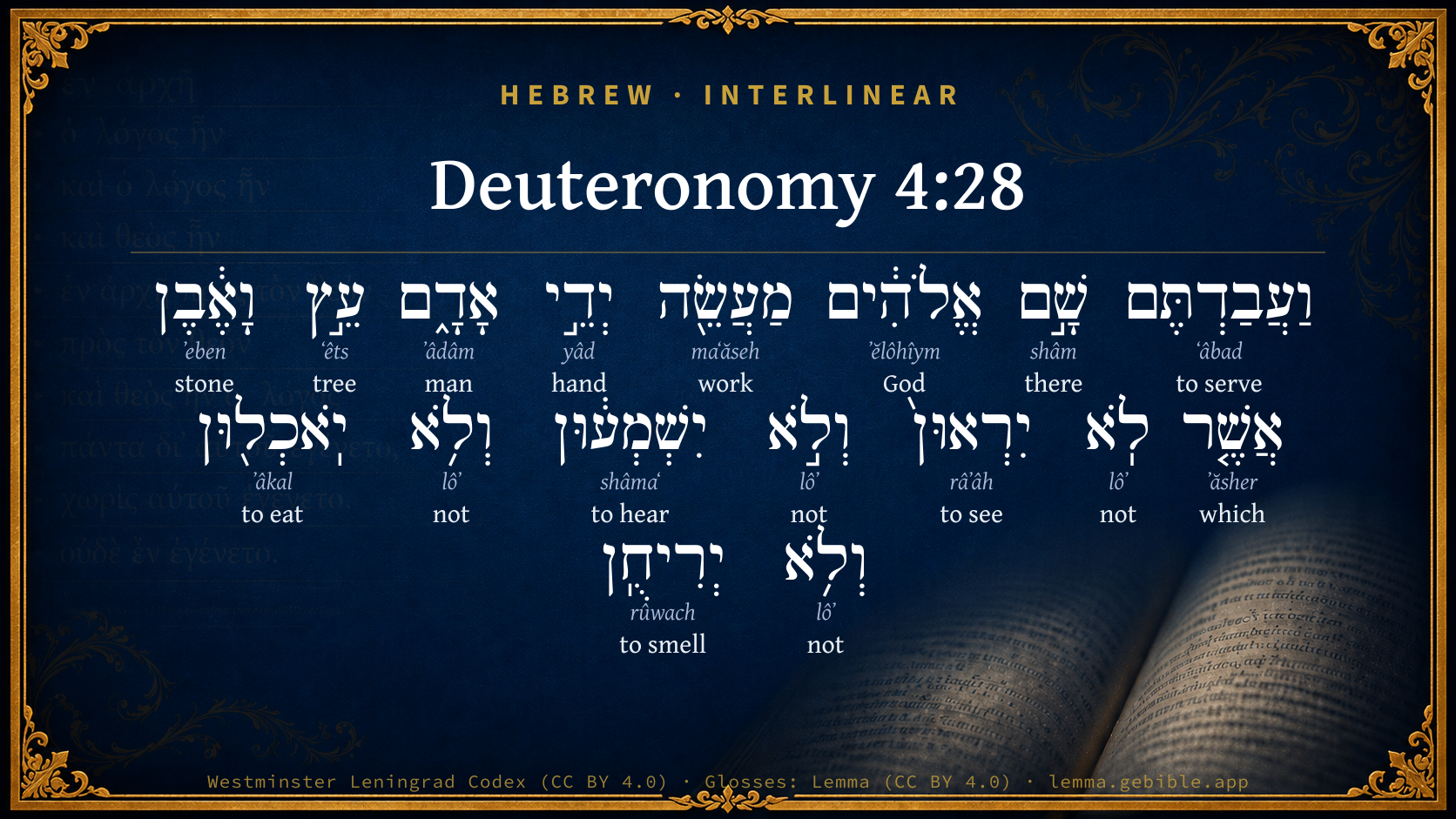
Hebrew (Westminster Leningrad Codex) Deuteronomy 4:28 appears in the Hebrew Old Testament. The text above is from the Westminster Leningrad Codex. Each word links to its Strong’s number, a concise gloss, and parsing drawn from the Open Scriptures Hebrew Bible morphology. Click any word for its full Brown-Driver-Briggs (BDB) entry.
Download image
Cite this verse

Deuteronomy 4:28 (World English Bible). Public Domain. Lemma interlinear Bible study tool, https://lemma.gebible.app/v/deuteronomy/4/28.

Show BibTeX & RIS
BibTeX
RIS
English Translation
There you shall serve gods, the work of men's hands, wood and stone, which neither see, nor hear, nor eat, nor smell.
World English Bible · Public Domain
Download a study sheet

One document with this verse’s original text, its word-by-word gloss line, the meaning frame, cross-references with their text, attributed commentary, and full source and license credits — printable, and it pastes into notes with its structure intact.

This verse Autodidact and up

Study sheet (.html) Plain text (.txt)

A passage Seminary Student

Up to 50 verses in one chapter. A passage sheet keeps up to 6 commentary sources and 12 cross-references per verse, in the order this page ranks them, and says so on the sheet whenever that leaves anything out. Ask for a single verse and you get the Autodidact verse sheet above.

Everything on this page stays free to read, with no account — the sheet is a download of what is already on screen, not access to it.

Want to remove ads? Support Godless Engineer
Compare translations 3

The same verse in 3 English versions, stacked beneath the original-language interlinear above. Click any original word for its lexicon entry.

Each is an independent rendering of the whole verse — the interlinear is not word-aligned to these translations.

Highlighted words mark where these versions differ — a whole-verse word diff, not a word-by-word alignment.

  • World English Bible Public Domain
    There you shall serve gods, the work of men's hands, wood and stone, which neither see, nor hear, nor eat, nor smell.
  • King James Version Public Domain
    And there ye shall serve gods, the work of men's hands, wood and stone, which neither see, nor hear, nor eat, nor smell.
  • unfoldingWord Literal Text CC BY-SA 4.0
    And there you will serve gods, the work of the hands of man, wood and stone, which do not see and do not hear and do not eat and do not smell.

unfoldingWord Literal Text — © unfoldingWord, licensed CC BY-SA 4.0. Word-aligned USFM3 via Door43 (git.door43.org/unfoldingWord/en_ult).

Versions to compare (up to 4)

3 of 4 selected

Show all 18 translations

Every available English version of this verse, each an independent rendering of the whole verse.

  • World English Bible Public Domain
    There you shall serve gods, the work of men's hands, wood and stone, which neither see, nor hear, nor eat, nor smell.
  • Berean Standard Bible Public Domain
    And there you will serve man-made gods of wood and stone, which cannot see or hear or eat or smell.
  • Majority Standard Bible Public Domain
    And there you will serve man-made gods of wood and stone, which cannot see or hear or eat or smell.
  • King James Version Public Domain
    And there ye shall serve gods, the work of men's hands, wood and stone, which neither see, nor hear, nor eat, nor smell.
  • American Standard Version (1901) Public Domain
    And there ye shall serve gods, the work of men's hands, wood and stone, which neither see, nor hear, nor eat, nor smell.
  • Revised Version (1885) Public Domain
    And there ye shall serve gods, the work of men’s hands, wood and stone, which neither see, nor hear, nor eat, nor smell.
  • Geneva Bible (1599) Public Domain
    And there ye shall serue gods, euen ye worke of mans hand, wood, and stone, which neither see, nor heare, nor eate, nor smelll.
  • Douay-Rheims (1899) Public Domain
    And there you shah serve gods, that were framed with men's hands: wood and stone, that neither see, nor hear, nor eat, nor smell.
  • Young's Literal Translation Public Domain
    and ye have served there gods, work of man's hands, wood and stone, which see not, nor hear, nor eat, nor smell.
  • Literal Standard Version CC BY-SA 4.0
    and you have served gods there, work of man’s hands, wood and stone, which do not see, nor hear, nor eat, nor smell.
  • Unlocked Literal Bible CC BY-SA 4.0
    There you will serve other gods, the work of men's hands, wood and stone, which neither see, hear, eat, nor smell.
  • unfoldingWord Literal Text CC BY-SA 4.0
    And there you will serve gods, the work of the hands of man, wood and stone, which do not see and do not hear and do not eat and do not smell.
  • Darby Bible Public Domain
    And ye shall there serve gods, the work of men's hands, wood and stone, which neither see, nor hear, nor eat, nor smell.
  • World Messianic Bible Public Domain
    There you will serve gods, the work of men’s hands, wood and stone, which neither see, nor hear, nor eat, nor smell.
  • Webster's Bible Public Domain
    And there ye shall serve gods, the work of men's hands, wood and stone, which neither see, nor hear, nor eat, nor smell.
  • Free Bible Version CC BY-SA 4.0
    There you will worship gods of wood and stone made by human beings. These idols can't see or hear or eat or smell.
  • Bible in Basic English Public Domain
    There you will be the servants of gods, made by men's hands, of wood and stone, having no power of seeing or hearing or taking food or smelling.
  • JPS Tanakh (1917) Public Domain
    And there ye shall serve gods, the work of men's hands, wood and stone, which neither see, nor hear, nor eat, nor smell.

Literal Standard Version (2020), Covenant Press — licensed CC BY-SA 4.0. Text via the HelloAO Bible API (eBible.org). Unlocked Literal Bible (unfoldingWord) — licensed CC BY-SA 4.0. Text via the HelloAO Bible API (eBible.org). unfoldingWord Literal Text — © unfoldingWord, licensed CC BY-SA 4.0. Word-aligned USFM3 via Door43 (git.door43.org/unfoldingWord/en_ult). Free Bible Version, Dr. Jonathan Gallagher — licensed CC BY-SA 4.0. Text via the HelloAO Bible API (eBible.org).

Word by word

More ways to search: Search by grammar → Find every occurrence → Compare this word →

Practice this passage: Drill this verse → Learn its vocabulary →

יְרִיחֻֽן
rûwach
H7306
“to smell”
Verb, Hiphil, Imperfect, 3rd Person, Masculine, Plural + Suffix, n
Part of Speech
Verb
Stem
Hiphil
Form
Imperfect
Person
3rd Person
Gender
Masculine
Number
Plural
Full BDB Definition

Origin: a primitive root

TWOT: 2131

(Hiphil) to smell, scent, perceive odour, accept - of horse - of delight (metaphorically)
  1. וַעֲבַדְתֶּם ʻâbad H5647 “and · to serve” Conjunction + Verb, Qal, Sequential Perfect, 2nd Person, Masculine, Plural
  2. שָׁ֣ם shâm H8033 “there” Adverb
  3. אֱלֹהִ֔ים ʼĕlôhîym H430 “God(s)” Noun, Common, Masculine, Plural, Absolute
  4. מַעֲשֵׂ֖ה maʻăseh H4639 “work of” Noun, Common, Masculine, Singular, Construct
  5. יְדֵ֣י yâd H3027 “hands of” Noun, Common, Both, Dual, Construct
  6. אָדָ֑ם ʼâdâm H120 “man” Noun, Common, Masculine, Singular, Absolute
  7. עֵ֣ץ ʻêts H6086 “tree” Noun, Common, Masculine, Singular, Absolute
  8. וָאֶ֔בֶן ʼeben H68 “and · stone” Conjunction + Noun, Common, Feminine, Singular, Absolute
  9. אֲשֶׁ֤ר ʼăsher H834 “which” Particle, Relative
  10. לֹֽא lôʼ H3808 “not” Particle, Negative
  11. יִרְאוּן֙ râʼâh H7200 “to see” Verb, Qal, Imperfect, 3rd Person, Masculine, Plural + Suffix, n
  12. וְלֹ֣א lôʼ H3808 “and · not” Conjunction + Particle, Negative
  13. יִשְׁמְע֔וּן shâmaʻ H8085 “to hear” Verb, Qal, Imperfect, 3rd Person, Masculine, Plural + Suffix, n
  14. וְלֹ֥א lôʼ H3808 “and · not” Conjunction + Particle, Negative
  15. יֹֽאכְל֖וּן ʼâkal H398 “to eat” Verb, Qal, Imperfect, 3rd Person, Masculine, Plural + Suffix, n
  16. וְלֹ֥א lôʼ H3808 “and · not” Conjunction + Particle, Negative

About this verse

These counts appear in no published source. They are computed here, from the morphology-tagged text and Lemma’s own curated glosses. What Lemma adds →

17
words
14
distinct lemmas
Pentateuch
section

Notable vocabulary

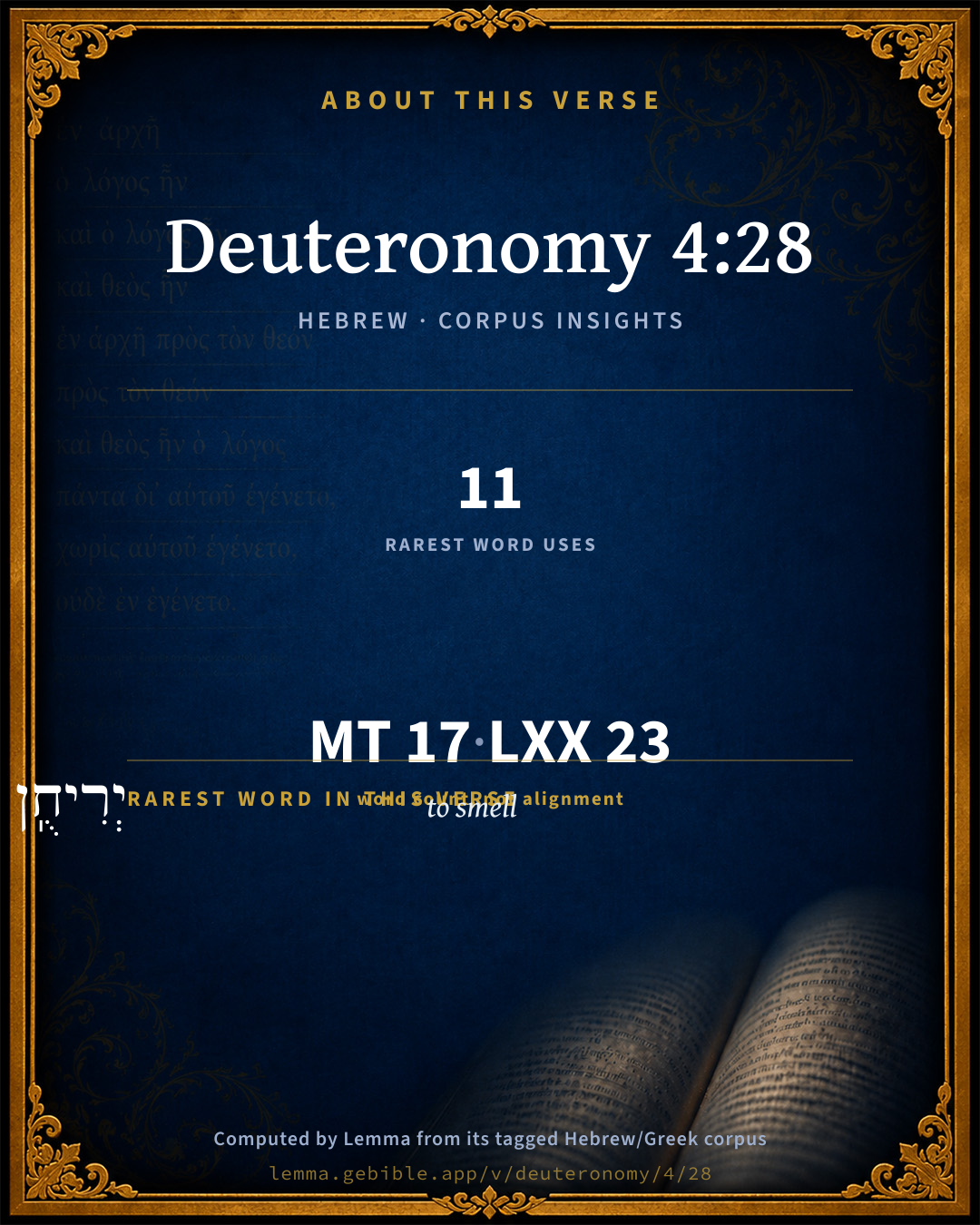
The rarest word here is יְרִיחֻֽן to smell H7306 — appearing just 11 times in the whole Hebrew Bible.

Shared distinctive vocabulary

יְרִיחֻֽן to smell H7306 occurs in 11 verses of the Hebrew Bible. Also found in:

Grammatical profile

  • 5 verbs
  • 6 nouns
  • 1 adverb
  • 5 particles

Verb forms

  • וַעֲבַדְתֶּם Qal · Sequential Perfect
  • יִרְאוּן֙ Qal · Imperfect
  • יִשְׁמְע֔וּן Qal · Imperfect
  • יֹֽאכְל֖וּן Qal · Imperfect
  • יְרִיחֻֽן Hiphil · Imperfect

Repetition

A word recurs within this verse — often emphatic in Hebrew:

Hebrew & Septuagint length

In English translation the verse runs 22 words from the Hebrew and 28 from the Septuagint (LXX English) — closely comparable.

A rough comparison of the two English renderings, which tokenize alike — not a word-level alignment.

Word counts can differ between the Hebrew and the Greek without any difference in meaning — e.g. the Hebrew direct-object marker אֵת has no separate Greek word, and Greek often adds the article ὁ.

In the original languages it is 17 Hebrew tokens and 23 Greek tokens — but the two are counted differently (Hebrew bundles its prefixes and suffixes into one token; the Greek is in lemma form), so that isn’t a like-for-like length.

Cross-references

14

Topical passages linked to Deuteronomy 4:28 in the Treasury of Scripture Knowledge — connected by theme and wording, ordered by reader-vote popularity; previews shown in the World English Bible.

  • Deuteronomy 28:64 Yahweh will scatter you among all peoples, from the one end of the earth even to the other end of the earth; and there you shall serve other gods, which you have not known, you nor your fathers, even wood and stone.
  • Jeremiah 16:13 therefore will I cast you forth out of this land into the land that you have not known, neither you nor your fathers; and there shall you serve other gods day and night; for I will show you no favor.
  • Deuteronomy 28:36 Yahweh will bring you, and your king whom you shall set over you, to a nation that you have not known, you nor your fathers; and there shall you serve other gods, wood and stone.
  • Isaiah 46:7 They bear it on the shoulder, they carry it, and set it in its place, and it stands, from its place it shall not move: yes, one may cry to it, yet it can not answer, nor save him out of his trouble.
  • Ezekiel 20:39 As for you, house of Israel, thus says the Lord Yahweh: Go you, serve everyone his idols, and hereafter also, if you will not listen to me; but my holy name shall you no more profane with your gifts, and with your idols.
  • 1 Samuel 26:19 Now therefore, please let my lord the king hear the words of his servant. If it be Yahweh that has stirred you up against me, let him accept an offering: but if it be the children of men, cursed be they before Yahweh: for they have driven me out this day that I shouldn't cling to Yahweh's inheritance, saying, Go, serve other gods.
  • Psalms 115:4–8 Their idols are silver and gold, The work of men's hands.
  • Psalms 135:15–18 The idols of the nations are silver and gold, The work of men's hands.
  • Isaiah 44:9 Those who fashion an engraved image are all of them vanity; and the things that they delight in shall not profit; and their own witnesses don't see, nor know: that they may be disappointed.
  • Isaiah 45:20 Assemble yourselves and come; draw near together, you who have escaped from the nations: they have no knowledge who carry the wood of their engraved image, and pray to a god that can't save.
  • Jeremiah 10:3 For the customs of the peoples are vanity; for one cuts a tree out of the forest, the work of the hands of the workman with the axe.
  • Jeremiah 10:9 There is silver beaten into plates, which is brought from Tarshish, and gold from Uphaz, the work of the artificer and of the hands of the goldsmith; blue and purple for their clothing; they are all the work of skillful men.
  • Acts 7:42 But God turned, and gave them up to serve the host of the sky, as it is written in the book of the prophets, 'Did you offer to me slain animals and sacrifices Forty years in the wilderness, O house of Israel?
  • Ezekiel 20:32 and that which comes into your mind shall not be at all, in that you say, We will be as the nations, as the families of the countries, to serve wood and stone.

Cross-references courtesy of OpenBible.info (CC BY 4.0).

Hebrew and Greek witnesses Masoretic Hebrew ↔ Greek Septuagint

The same verse in the two great witnesses to the Old Testament, shown verse-for-verse.

These are two independent witnesses, not word-aligned to each other, and the Septuagint is shown in lemma (dictionary) form.

Hebrew Deuteronomy 4:28 Masoretic · Westminster Leningrad Codex

וַעֲבַדְתֶּם שָׁ֣ם אֱלֹהִ֔ים מַעֲשֵׂ֖ה יְדֵ֣י אָדָ֑ם עֵ֣ץ וָאֶ֔בֶן אֲשֶׁ֤ר לֹֽא יִרְאוּן֙ וְלֹ֣א יִשְׁמְע֔וּן וְלֹ֥א יֹֽאכְל֖וּן וְלֹ֥א יְרִיחֻֽן

There you shall serve gods, the work of men's hands, wood and stone, which neither see, nor hear, nor eat, nor smell.

World English Bible · Public Domain

Greek LXX Deuteronomy 4:28 Septuagint · lemma form

καί λατρεύω ἐκεῖ θεός ἕτερος ἔργον χείρ ἄνθρωπος ξύλον καί λίθος ὅς οὐ ὁράω οὐδέ μή ἀκούω οὔτε μή ἐσθίω οὔτε μή ὀσφραίνομαι

And you⌃ shall there serve other gods, the works of the hands of men, wood and stones, which can’t see, nor can they hear, nor eat, nor smell.

LXX2012 (modern English Septuagint) · Public Domain

Hebrew: Westminster Leningrad Codex (CC BY 4.0). Greek: Septuagint (public domain); English from LXX2012 (modern English Septuagint) (Public Domain). How the Septuagint differs from the Hebrew →

Targum (Aramaic paraphrase)

2

The Targum is the ancient Jewish Aramaic paraphrase of the Hebrew Scriptures — an interpretive translation, not the Hebrew text itself. Onkelos (literal) and Pseudo-Jonathan (expansive) render the Torah, and Jonathan the Prophets. Coverage is partial: where no permissively-licensed English translation exists for a verse, only the Aramaic is shown. This is verse-level text, not a word-by-word alignment to the Hebrew.

  1. Targum Onkelos Torah (Genesis–Deuteronomy)
    וְתִפְלְחוּן תַּמָן לְעַמְמַיָא פָלְּחֵי טַעֲוָתָא עֹבַד יְדֵי אֱנָשָׁא אָעָא וְאַבְנָא דִי לָא יֶחֱזוּן וְלָא שָׁמְעִין וְלָא אָכְלִין וְלָא מְרִיחִין

    (no public-domain English translation for this verse)

    Targum Onkelos — Aramaic: “Onkelos Genesis” (public domain); “Onkelos Exodus” (public domain); “Onkelos Leviticus” (public domain); “Onkelos Numbers” (public domain); “Onkelos Deuteronomy” (public domain). English: “Sefaria Community Translation” (CC0 1.0 (public-domain dedication)); “J.W. Etheridge. The Targums of Onkelos and Jonathan Ben Uzziel on the Pentateuch. London: Longmans, Green, 1862” (public domain). Text via Sefaria.

  2. Targum Pseudo-Jonathan Torah (Genesis–Deuteronomy)
    וְתִיתְעוּקוּן לְמִפְלַח תַּמָּן לְפַלְחֵי טַעֲוָותָא עוֹבַד אִידֵיהוֹן דִּבְנֵי נְשָׁא מִן קֵיסָא וְאַבְנָא דְלָא חַמְיָין וְלָא שָׁמְעִין וְלָא אָכְלִין וְלָא מְרִיחִין

    And there will you be constrained to serve the worshippers of idols, the work of men’s hands, of wood and stone, which see not, nor hear, nor eat, nor smell.

    Targum Pseudo-Jonathan — Aramaic: “Targum Jonathan on Genesis” (public domain); “Targum Jonathan on Exodus” (public domain); “Targum Jonathan on Leviticus” (public domain); “Targum Jonathan on Numbers” (public domain); “Targum Jonathan on Deuteronomy” (public domain). English: “The Targum of Jonathan ben Uzziel, trans. J. W. Etheridge, London, 1862” (public domain). Text via Sefaria.

Commentary

Notes on Deuteronomy 4:28 from classic Christian and Jewish commentators (each source and its license shown beneath its notes). The classic Christian expositions comment on the surrounding passage and are grouped to its opening verse, so a note may address several verses; the Jewish commentaries on the Tanakh (Rashi and others) are per-verse, so they appear only where the commentator wrote on this verse.

Lemma curates 59 commentaries, every one of them public domain or Creative Commons licensed, each selected and text-cleaned for this edition rather than reprinted as found. About our sources →

Trapp's Complete Commentary

John Trapp

Deu 4:28 And there ye shall serve gods, the work of men’s hands, wood and stone, which neither see, nor hear, nor eat, nor smell.

Ver. 28. And there ye shall serve gods.] As ye have made a match with mischief, so ye shall have enough of it. Ephraim is joined to idols, &c. See Act 7:42.

John Trapp, A Commentary or Exposition upon All the Books of the Old and New Testament (1647–1656) — public domain. Text from a community e-Sword module.

Joseph Benson's Commentary

Deu 4:28-29. Ye shall serve gods, the work of men’s hands — You shall be compelled by men, and given up by me, to idolatry. So that very thing which was your choice, shall be your punishment: it being just and usual for God to punish one sin by giving men up to another. If from thence thou seek the Lord — Whatever place we are in, we may from thence seek him. There is no part of the earth which has a gulf fixed between it and heaven.

Joseph Benson's Commentary on the Old and New Testaments (1811–1818) — public domain. Text from a community e-Sword module.

Jamieson, Fausset & Brown

Robert Jamieson, A. R. Fausset & David Brown

there ye shall serve gods, the work of men's hands--The compulsory measures of their tyrannical conquerors would force them into idolatry, so that their choice would become their punishment.

Jamieson, Fausset & Brown — Commentary Critical and Explanatory on the Whole Bible (1871) — public domain (CC PDM 1.0). Text via the HelloAO Bible API.

Adam Clarke's Commentary

Verse 28. There ye shall serve gods - wood and stone] This was also true of the Israelites, not only in their captivities, but also in their own land. And it may now be literally the case with the ten tribes who were carried away captive by the Assyrians, and of whose residence no man at present knows any thing with certainty. That they still exist there can be no doubt; but they are now, most probably, so completely incorporated with the idolaters among whom they dwell, as to be no longer distinguish able: yet God can gather them.

Adam Clarke's Commentary on the Bible (1810–1826) — public domain. Text from a community e-Sword/MySword module.

Ellicott's Commentary for English Readers

(28) And there ye shall serve gods, the work of men’s hands.—That is, “you shall be in bondage to them,” being ruled by their worshippers. And so Rashi explains it. Captivity was the means of eradicating idolatry from Israel rather than encouraging it. But the cause of a people and its idols is so constantly identified in the Old Testament, that those who are in bondage to a nation may naturally be described as in bondage to its gods. The gods were even held to be sharers in the captivity of the nation. It is said of Bel and Nebo, in Isa_46:2, “They could not deliver . . . but themselves are gone into captivity”

(29, 30, 31) Comp. Deu_30:1-5 for a more explicit promise and prophecy of the same thing, and see Note on that passage.

A Bible Commentary for English Readers, edited by Charles John Ellicott (1878–1897) — public domain. Text from a community e-Sword module.

The Cambridge Bible for Schools and Colleges

gen. ed. J. J. S. Perowne

28. ye shall serve gods, the work of men’s hands, etc.] The acme of their punishment. They have chosen to serve idols; idols must they serve in a land where the worship of Jehovah is impossible. This scorn of senseless idols, also in Deu_27:15, Deu_28:36; Deu_28:64, Deu_29:17, Deu_31:29, is an essential temper of monotheism, appearing also in Hos_8:6; Hos_13:2; Isa_2:8; Isa_2:20, etc.; Jer_2:8; Jer_10:1-10, and most frequently in Isa_40:19 f., Isa_41:7, Isa_44:9-20, Isa_46:6 f.

The Cambridge Bible for Schools and Colleges (gen. ed. J. J. S. Perowne; Cambridge University Press, 1878–1918) — public domain. Text from a community e-Sword module.

John Gill's Exposition

And there ye shall serve gods, the work of men's hands, wood and stone,.... Idols made by men, cut out of wood and stone; these they should be enticed into the service of, or compelled to serve; which was still more brutish and stupid than to worship the sun, moon, and stars, which were not the works of men's hand, but the glorious works of the eternal God. But since in their captivities they were not subject to idolatry, but were cured of it thereby, another sense of the words is given by some, as by Onkelos and Jonathan, who paraphrase the words of serving the people, that serve idols; but what follows confirms the first sense:

which neither see, nor hear, nor taste, nor smell; senseless things, which have none of the senses of seeing, hearing, and smelling, nor the faculty of eating, which they need not to support life, of which they are destitute; and therefore it must be monstrous stupidity to worship such lifeless, senseless, objects; see Psa 115:4.

John Gill's Exposition of the Whole Bible (1746–1763) — public domain (CC PDM 1.0). Text via the HelloAO Bible API.

Matthew Poole's English Annotations

i.e. Idols. You shall be compelled by men, and given up by me to idolatry. So that very thing which was your choice shall be your punishment; it being just and usual for God to punish one sin by giving them up to another, as is manifest from Rom 1:24,25.

Matthew Poole's English Annotations on the Holy Bible (1683–1685) — public domain. Text from a community e-Sword/MySword module.

John Wesley's Explanatory Notes

Ye shall serve Gods - You shall be compelled by men, and given up by me to idolatry. So that very thing which was your choice, shall be your punishment: it being just and usual for God to punish one sin by giving men up to another.

John Wesley, Explanatory Notes Upon the Whole Bible (1754–1765) — public domain. Text via the GEBible commentary corpus.

Rashi

Rabbi Shlomo Yitzchaki (Rashi)

ועבדתם שם אלהים AND THERE YE SHALL SERVE GODS — Understand this as the Targum does: And there ye shall serve peoples who serve idols, for since you serve those who serve them (idols) it will be as though you serve them.

Rashi on the Tanakh — English translations: “The Judaica Press complete Tanach with Rashi, translated by A. J. Rosenberg” (CC BY 4.0); “Pentateuch with Rashi's commentary by M. Rosenbaum and A.M. Silbermann, 1929-1934” (public domain); “The Metsudah Tanach series, Lakewood, N.J” (CC BY 4.0); and “The Book of Joshua, Metsudah Publications, 1997” (CC BY 4.0). Text via Sefaria.

Ramban (Nachmanides)

Rabbi Moshe ben Nachman (Ramban / Nachmanides)

AND THERE YE SHALL SERVE GODS. “When you serve their worshippers it is as though you serve them [the idols].” This is the language of Rashi. Now I have already explained the secret thereof that he who dwells outside of the Land is as if he worshipped the idols, and the expression, [and there ye shall serve gods] the work of men’s hands indicates that the service begins with those on high and descends to the idols below, as I have mentioned in the section Acharei Moth.

NOR DO THEY EAT, NOR SMELL. The purport thereof is to state that they [the idols] remain inanimate stones as they were to begin with, having no spirit of life at all, not even mortal life, as does man. For at first he said, which neither see, nor hear, meaning that they are not G-d and see not the suffering of their servants, nor hear their prayers, nor save them from their troubles. And then he went back and said that they do not even have the inferior [mortal] life of man. Thus the one who makes them is more honored than they. Or perhaps the sense of the verse is in relation to the honor of the Supreme One, the verse thus stating: “which neither see the suffering of their worshippers, nor hear their prayers, nor eat, since no fire ever comes out from before them and consumes their offerings, nor smell their [offerings’] sweet odors.” Now Scripture adopted the general usage of language, but in fact the idols have none of these senses.

Ramban (Nachmanides) on the Tanakh — English translation: “Commentary on the Torah by Ramban (Nachmanides). Translated and annotated by Charles B. Chavel. New York, Shilo Pub. House, 1971-1976” (CC BY 4.0). Text via Sefaria.

Lesson kit

Teaching starters — assembled from the data on this page, not authored interpretation. Every prompt links to the verse data it draws on. Edit before teaching.

Deuteronomy, in the Pentateuch, opens this verse with 17 words (14 distinct Hebrew lemmas). Its most distinctive word is rûwach (“to smell”). A historical commentator’s framing appears above. Read the whole chapter for the surrounding context.

Discussion questions

  1. How does “to smell” (rûwach) shape what this verse is saying?
  2. How does Genesis 8:21, which shares the word «to smell», read alongside this verse?
  3. What does the repetition of “not” (4× in this one verse) do in this verse?
  4. These translations render this verse differently; the difference is in the English rendering, not the original. What questions does that raise?
  5. «וַעֲבַדְתֶּם» is a Qal Sequential Perfect verb. How does that grammatical form shape the action described?
  6. Compare how Trapp's Complete Commentary and Joseph Benson's Commentary read this verse. Where do they agree or differ?

Things to notice

Reading settings

Reading text

Shown beneath each verse's original-language words.

Old Testament
Old Testament edition

Read the OT as the Masoretic Hebrew (MT) or the Greek Septuagint (LXX).

English shown for the Greek Septuagint (in the Hebrew ↔ Greek comparison).

Comparing translations? Open the Compare panel on any verse page to stack up to four side by side.