Psalms 5:10

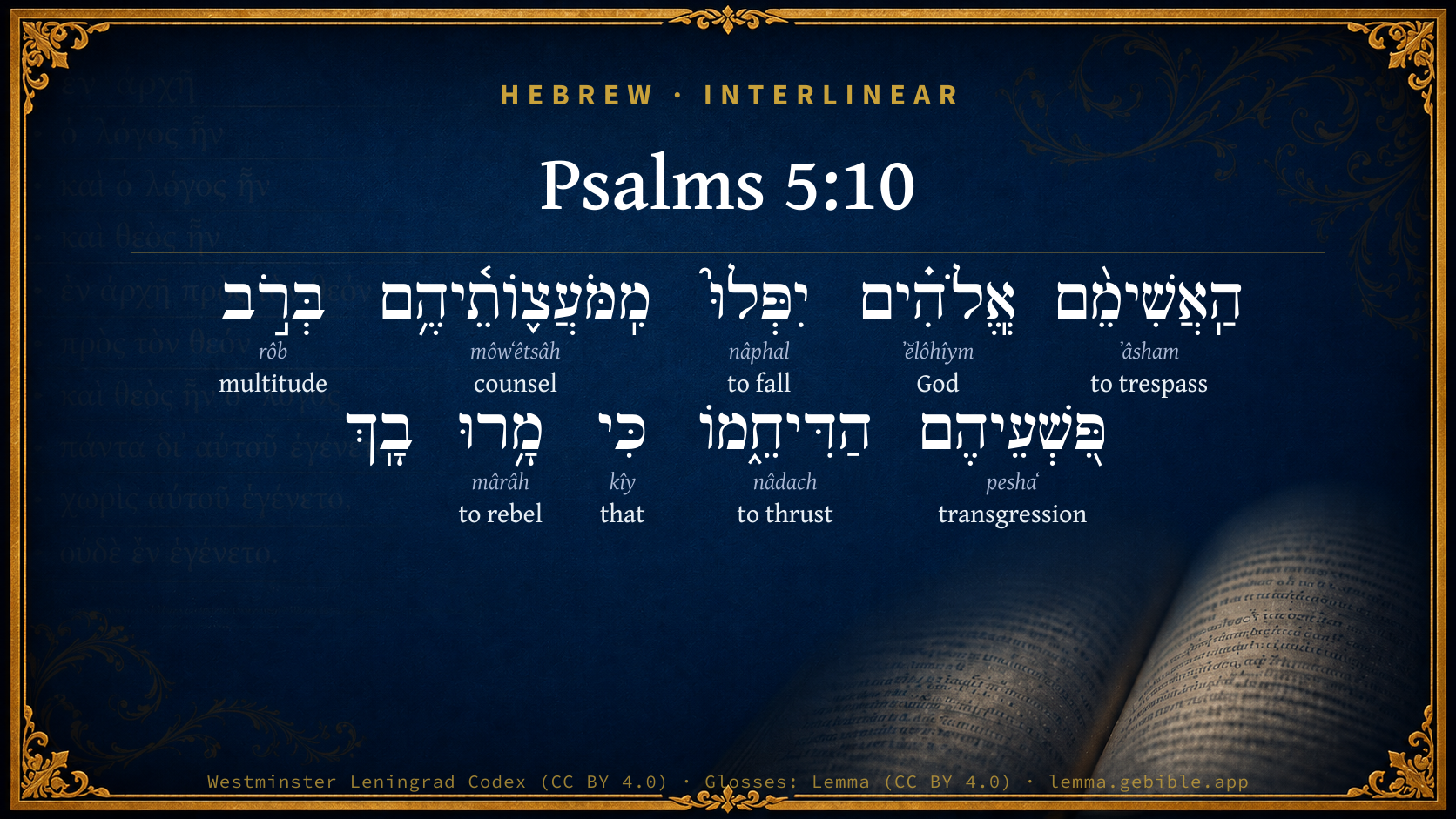
Hebrew (Westminster Leningrad Codex) Psalms 5:10 appears in the Hebrew Old Testament. The text above is from the Westminster Leningrad Codex. Each word links to its Strong’s number, a concise gloss, and parsing drawn from the Open Scriptures Hebrew Bible morphology. Click any word for its full Brown-Driver-Briggs (BDB) entry.
Download image
Cite this verse

Psalms 5:10 (World English Bible). Public Domain. Lemma interlinear Bible study tool, https://lemma.gebible.app/v/psalms/5/10.

Show BibTeX & RIS
BibTeX
RIS
English Translation
Hold them guilty, God. Let them fall by their own counsels; Thrust them out in the multitude of their transgressions, For they have rebelled against you.
World English Bible · Public Domain
Highlights
  • 1 first appearance in the Hebrew Bible
Full analysis ↓
Download a study sheet

One document with this verse’s original text, its word-by-word gloss line, the meaning frame, cross-references with their text, attributed commentary, and full source and license credits — printable, and it pastes into notes with its structure intact.

This verse Autodidact and up

Study sheet (.html) Plain text (.txt)

A passage Seminary Student

Up to 50 verses in one chapter. A passage sheet keeps up to 6 commentary sources and 12 cross-references per verse, in the order this page ranks them, and says so on the sheet whenever that leaves anything out. Ask for a single verse and you get the Autodidact verse sheet above.

Everything on this page stays free to read, with no account — the sheet is a download of what is already on screen, not access to it.

Want to remove ads? Support Godless Engineer
Compare translations 3

The same verse in 3 English versions, stacked beneath the original-language interlinear above. Click any original word for its lexicon entry.

Each is an independent rendering of the whole verse — the interlinear is not word-aligned to these translations.

Highlighted words mark where these versions differ — a whole-verse word diff, not a word-by-word alignment.

  • World English Bible Public Domain
    Hold them guilty, God. Let them fall by their own counsels; Thrust them out in the multitude of their transgressions, For they have rebelled against you.
  • King James Version Public Domain
    Destroy thou them, O God; let them fall by their own counsels; cast them out in the multitude of their transgressions; for they have rebelled against thee.
  • unfoldingWord Literal Text CC BY-SA 4.0
    Make them guilty, God; may they fall due to their schemes! Because of their many transgressions, drive them out, for they rebel against you!

unfoldingWord Literal Text — © unfoldingWord, licensed CC BY-SA 4.0. Word-aligned USFM3 via Door43 (git.door43.org/unfoldingWord/en_ult).

Versions to compare (up to 4)

3 of 4 selected

Show all 18 translations

Every available English version of this verse, each an independent rendering of the whole verse.

  • World English Bible Public Domain
    Hold them guilty, God. Let them fall by their own counsels; Thrust them out in the multitude of their transgressions, For they have rebelled against you.
  • Berean Standard Bible Public Domain
    Declare them guilty, O God; let them fall by their own devices. Drive them out for their many transgressions, for they have rebelled against You.
  • Majority Standard Bible Public Domain
    Declare them guilty, O God; let them fall by their own devices. Drive them out for their many transgressions, for they have rebelled against You.
  • King James Version Public Domain
    Destroy thou them, O God; let them fall by their own counsels; cast them out in the multitude of their transgressions; for they have rebelled against thee.
  • American Standard Version (1901) Public Domain
    Hold them guilty, O God; Let them fall by their own counsels; Thrust them out in the multitude of their transgressions; For they have rebelled against thee.
  • Revised Version (1885) Public Domain
    Hold them guilty, O God; let them fall by their own counsels: thrust them out in the multitude of their transgressions; for they have rebelled against thee.
  • Geneva Bible (1599) Public Domain
    Destroy them, O God: let them fall from their counsels: cast them out for the multitude of their iniquities, because they haue rebelled against thee.
  • Douay-Rheims (1899) Public Domain
    for there is no truth in their mouth; their heart is vain.
  • Young's Literal Translation Public Domain
    Declare them guilty, O God, Let them fall from their own counsels, In the abundance of their transgressions Drive them away, Because they have rebelled against Thee.
  • Literal Standard Version CC BY-SA 4.0
    Declare them guilty, O God, || Let them fall from their own counsels, || In the abundance of their transgressions || Drive them away, || Because they have been rebellious against You.
  • Unlocked Literal Bible CC BY-SA 4.0
    Declare them guilty, God; may their schemes be their downfall! Drive them out for their many transgressions, for they have rebelled against you.
  • unfoldingWord Literal Text CC BY-SA 4.0
    Make them guilty, God; may they fall due to their schemes! Because of their many transgressions, drive them out, for they rebel against you!
  • Darby Bible Public Domain
    Bring guilt upon them, O God; let them fall by their own counsels: drive them out in the multitude of their transgressions, for they have rebelled against thee.
  • World Messianic Bible Public Domain
    Hold them guilty, God. Let them fall by their own counsels. Thrust them out in the multitude of their transgressions, for they have rebelled against you.
  • Webster's Bible Public Domain
    \\5:9\\For there is no faithfulness in their mouth; their inward part is very wickedness; their throat is an open sepulcher; they flatter with their tongue.
  • Free Bible Version CC BY-SA 4.0
    God, condemn them as guilty! Make them fall because of their evil plans. Throw them out because of all their sins, for they have rebelled against you.
  • Bible in Basic English Public Domain
    Send them to destruction, O Lord; let their evil designs be the cause of their fall; let them be forced out by all their sins; because they have gone against your authority.
  • JPS Tanakh (1917) Public Domain
    (5-11) Hold them guilty, O God, let them fall by their own counsels; cast them down in the multitude of their transgressions; for they have rebelled against Thee.

Literal Standard Version (2020), Covenant Press — licensed CC BY-SA 4.0. Text via the HelloAO Bible API (eBible.org). Unlocked Literal Bible (unfoldingWord) — licensed CC BY-SA 4.0. Text via the HelloAO Bible API (eBible.org). unfoldingWord Literal Text — © unfoldingWord, licensed CC BY-SA 4.0. Word-aligned USFM3 via Door43 (git.door43.org/unfoldingWord/en_ult). Free Bible Version, Dr. Jonathan Gallagher — licensed CC BY-SA 4.0. Text via the HelloAO Bible API (eBible.org).

Word by word

More ways to search: Search by grammar → Find every occurrence → Compare this word →

Practice this passage: Drill this verse → Learn its vocabulary →

מִֽמֹּעֲצ֪וֹתֵ֫יהֶ֥ם
môwʻêtsâh
H4156
“from · counsels · their”
Preposition + Noun, Common, Feminine, Plural, Construct + Suffix, Personal, 3rd Person, Masculine, Plural
Part of Speech
Preposition + Noun
Type
Common
Gender
Feminine
Number
Plural
State
Construct
Full BDB Definition

Origin: from H3289

TWOT: 887b

counsel, plan, principal, device
  1. הַֽאֲשִׁימֵ֨ם ʼâsham H816 “trespass · them” Verb, Hiphil, Imperative, 2nd Person, Masculine, Singular + Suffix, Personal, 3rd Person, Masculine, Plural
  2. אֱֽלֹהִ֗ים ʼĕlôhîym H430 “God(s)” Noun, Common, Masculine, Plural, Absolute
  3. יִפְּלוּ֮ nâphal H5307 “to fall” Verb, Qal, Imperfect, 3rd Person, Masculine, Plural
  4. בְּרֹ֣ב rôb H7230 “in/at · multitude of” Preposition + Noun, Common, Both, Singular, Construct
  5. פִּ֭שְׁעֵיהֶם peshaʻ H6588 “transgressions · their” Noun, Common, Masculine, Plural, Construct + Suffix, Personal, 3rd Person, Masculine, Plural
  6. הַדִּיחֵ֑מוֹ nâdach H5080 “thrust · them” Verb, Hiphil, Imperative, 2nd Person, Masculine, Singular + Suffix, Personal, 3rd Person, Masculine, Plural
  7. כִּי kîy H3588 “that” Conjunction
  8. מָ֥רוּ mârâh H4784 “to rebel” Verb, Qal, Perfect, 3rd Person, Common, Plural

About this verse

These counts appear in no published source. They are computed here, from the morphology-tagged text and Lemma’s own curated glosses. What Lemma adds →

10
words
9
distinct lemmas
Wisdom
section

Notable vocabulary

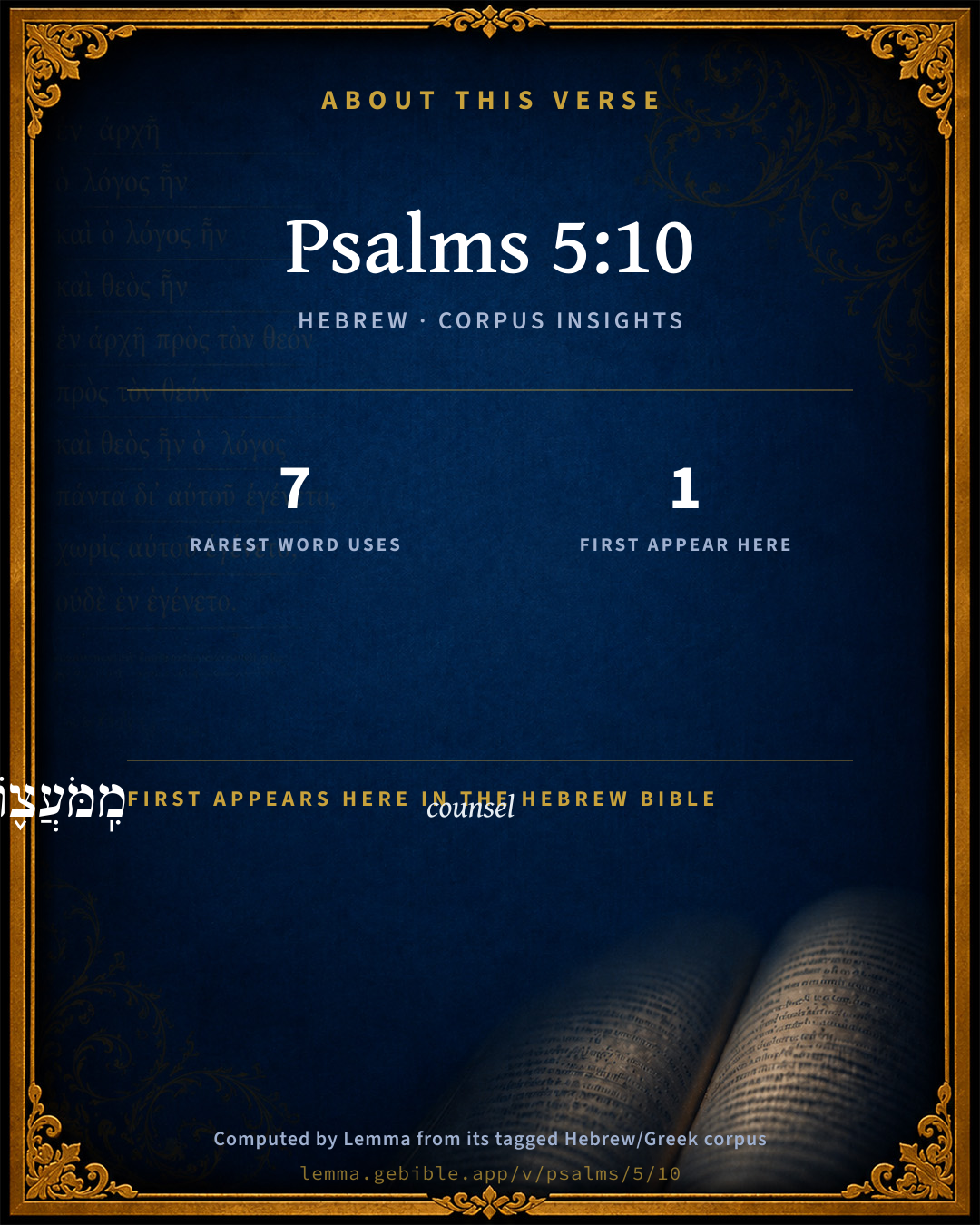
The rarest word here is מִֽמֹּעֲצ֪וֹתֵ֫יהֶ֥ם counsel H4156 — appearing just 7 times in the whole Hebrew Bible.

First appearance in Scripture

This word makes its first canonical appearance in the Hebrew Bible here:

  • מִֽמֹּעֲצ֪וֹתֵ֫יהֶ֥ם counsel H4156

Shared distinctive vocabulary

מִֽמֹּעֲצ֪וֹתֵ֫יהֶ֥ם counsel H4156 occurs in 7 verses of the Hebrew Bible. Also found in:

Grammatical profile

  • 4 verbs
  • 4 nouns
  • 1 preposition
  • 1 conjunction

Verb forms

  • הַֽאֲשִׁימֵ֨ם Hiphil · Imperative
  • יִפְּלוּ֮ Qal · Imperfect
  • הַדִּיחֵ֑מוֹ Hiphil · Imperative
  • מָ֥רוּ Qal · Perfect

Hebrew & Septuagint length

In English translation the verse runs 26 words from the Hebrew and 27 from the Septuagint (LXX English) — closely comparable.

A rough comparison of the two English renderings, which tokenize alike — not a word-level alignment.

Word counts can differ between the Hebrew and the Greek without any difference in meaning — e.g. the Hebrew direct-object marker אֵת has no separate Greek word, and Greek often adds the article ὁ.

Cross-references

41

Topical passages linked to Psalms 5:10 in the Treasury of Scripture Knowledge — connected by theme and wording, ordered by reader-vote popularity; previews shown in the World English Bible.

  • Isaiah 63:10 But they rebelled, and grieved his holy Spirit: therefore he was turned to be their enemy, [and] himself fought against them.
  • 2 Samuel 17:14 Absalom and all the men of Israel said, The counsel of Hushai the Archite is better than the counsel of Ahithophel. For Yahweh had ordained to defeat the good counsel of Ahithophel, to the intent that Yahweh might bring evil on Absalom.
  • Psalms 140:9–10 As for the head of those who surround me, Let the mischief of their own lips cover them.
  • 2 Samuel 15:31 One told David, saying, Ahithophel is among the conspirators with Absalom. David said, Yahweh, please turn the counsel of Ahithophel into foolishness.
  • 2 Samuel 17:23 When Ahithophel saw that his counsel was not followed, he saddled his donkey, and arose, and got him home, to his city, and set his house in order, and hanged himself; and he died, and was buried in the tomb of his father.
  • Psalms 31:18 Let the lying lips be mute, Which speak against the righteous insolently, with pride and contempt.
  • Psalms 71:13 Let my accusers be disappointed and consumed. Let them be covered with disgrace and scorn who want to harm me.
  • 1 Corinthians 3:19 For the wisdom of this world is foolishness with God. For it is written, "He has taken the wise in their craftiness."
  • Psalms 35:1–8 Contend, Yahweh, with those who contend with me. Fight against those who fight against me.
  • Psalms 35:26 Let them be disappointed and confounded together who rejoice at my calamity. Let them be clothed with shame and dishonor who magnify themselves against me.
  • Psalms 55:15 Let death come suddenly on them. Let them go down alive into Sheol. For wickedness is in their dwelling, in the midst of them.
  • Psalms 59:12–13 For the sin of their mouth, and the words of their lips, Let them be caught in their pride, For the curses and lies which they utter.
  • Psalms 68:1–2 Let God arise! Let his enemies be scattered! Let them who hate him also flee before him.
  • Psalms 109:6–20 Set a wicked man over him. Let an adversary stand at his right hand.
  • Psalms 144:6–7 Throw out lightning, and scatter them. Send out your arrows, and rout them.
  • Lamentations 1:5 Her adversaries are become the head, her enemies prosper; For Yahweh has afflicted her for the multitude of her transgressions: Her young children are gone into captivity before the adversary.
  • Hosea 9:7 The days of visitation have come. The days of reckoning have come. Israel will consider the prophet to be a fool, And the man who is inspired to be insane, Because of the abundance of your sins, And because your hostility is great.
  • Romans 3:19–20 Now we know that whatever things the law says, it speaks to those who are under the law, that every mouth may be closed, and all the world may be brought under the judgment of God.
  • Deuteronomy 2:30 But Sihon king of Heshbon would not let us pass by him; for Yahweh your God hardened his spirit, and made his heart obstinate, that he might deliver him into your hand, as at this day.
  • 1 Samuel 25:29 Though men be risen up to pursue you, and to seek your soul, yet the soul of my lord shall be bound in the bundle of life with Yahweh your God; and the souls of your enemies, them shall he sling out, as from the hollow of a sling.
  • 1 Samuel 25:39 When David heard that Nabal was dead, he said, Blessed be Yahweh, who has pleaded the cause of my reproach from the hand of Nabal, and has kept back his servant from evil: and the evil-doing of Nabal has Yahweh returned on his own head. David sent and spoke concerning Abigail, to take her to him as wife.
  • 2 Chronicles 25:16 It happened, as he talked with him, that [the king] said to him, Have we made you of the king's counsel? Stop! Why should you be struck down? Then the prophet stopped, and said, I know that God has determined to destroy you, because you have done this, and have not listened to my counsel.
  • Esther 7:10 So they hanged Haman on the gallows that he had prepared for Mordecai. Then was the king's wrath pacified.
  • Job 5:12–14 He frustrates the devices of the crafty, So that their hands can't perform their enterprise.
  • Psalms 7:9–15 Oh let the wickedness of the wicked come to an end, But establish the righteous; Their minds and hearts are searched by the righteous God.
  • Psalms 9:15–16 The nations have sunk down in the pit that they made; In the net which they hid, their own foot is taken.
  • Psalms 10:15 Break the arm of the wicked. As for the evil man, seek out his wickedness until you find none.
  • Psalms 17:13 Arise, Yahweh, Confront him, cast him down. Deliver my soul from the wicked by your sword;
  • Psalms 21:8–10 Your hand will find out all of your enemies. Your right hand will find out those who hate you.
  • Psalms 28:3–4 Don't draw me away with the wicked, With the workers of iniquity who speak peace with their neighbors, But mischief is in their hearts.
  • Psalms 64:6–8 They plot injustice, saying, "We have made a perfect plan!" Surely man's mind and heart are cunning.
  • Psalms 66:7 He rules by his might forever. His eyes watch the nations. Don't let the rebellious rise up against him. Selah.
  • Psalms 69:22–25 Let their table before them become a snare. May it become a retribution and a trap.
  • Psalms 79:12 Pay back to our neighbors seven times into their bosom Their reproach with which they have reproached you, Lord.
  • Psalms 83:9–18 Do to them as you did to Midian, As to Sisera, as to Jabin, at the river Kishon;
  • Psalms 107:11 Because they rebelled against the words of God, And condemned the counsel of the Most High.
  • Psalms 137:7–9 Remember, Yahweh, against the children of Edom, The day of Jerusalem; Who said, "Raze it! Raze it even to its foundation!"
  • Isaiah 1:2 Hear, heavens, And listen, earth; for Yahweh has spoken: I have nourished and brought up children, And they have rebelled against me.
  • Isaiah 1:20 But if you refuse and rebel, you shall be devoured with the sword; For the mouth of Yahweh has spoken it."
  • Daniel 9:5 we have sinned, and have dealt perversely, and have done wickedly, and have rebelled, even turning aside from your precepts and from your ordinances;
  • Daniel 9:9 To the Lord our God belong mercies and forgiveness; for we have rebelled against him;

Cross-references courtesy of OpenBible.info (CC BY 4.0).

Hebrew and Greek witnesses Masoretic Hebrew ↔ Greek Septuagint

The same verse in the two great witnesses to the Old Testament, shown verse-for-verse.

You’re reading Greek Psalm 5 (Hebrew Psalm 5). The Septuagint counts the superscription, so verse numbers can differ from the Hebrew — chapter-level alignment, not verse-by-verse. Numbering follows Rahlfs.

These are two independent witnesses, not word-aligned to each other, and the Septuagint is shown in lemma (dictionary) form.

Hebrew Psalms 5:10 Masoretic · Westminster Leningrad Codex

הַֽאֲשִׁימֵ֨ם אֱֽלֹהִ֗ים יִפְּלוּ֮ מִֽמֹּעֲצ֪וֹתֵ֫יהֶ֥ם בְּרֹ֣ב פִּ֭שְׁעֵיהֶם הַדִּיחֵ֑מוֹ כִּי מָ֥רוּ בָֽךְ

Hold them guilty, God. Let them fall by their own counsels; Thrust them out in the multitude of their transgressions, For they have rebelled against you.

World English Bible · Public Domain

Greek LXX Greek Psalm 5:10 Septuagint · lemma form

ὅτι οὐ εἰμί ἐν ὁ στόμα αὐτός ἀλήθεια ὁ καρδία αὐτός μάταιος τάφος ἀναοἴγω ὁ λάρυγξ αὐτός ὁ γλῶσσα αὐτός δολιόω

Judge them, O God; let them fail of their counsels: cast them out according to the abundance of their ungodliness; for they have provoked you, O Lord.

LXX2012 (modern English Septuagint) · Public Domain

On this verse, Ellicott's Commentary for English Readers discusses the Septuagint’s reading. Read the note in Commentary ↓

Hebrew: Westminster Leningrad Codex (CC BY 4.0). Greek: Septuagint (public domain); English from LXX2012 (modern English Septuagint) (Public Domain). How the Septuagint differs from the Hebrew →

Commentary

Notes on Psalms 5:10 from classic Christian and Jewish commentators (each source and its license shown beneath its notes). The classic Christian expositions comment on the surrounding passage and are grouped to its opening verse, so a note may address several verses; the Jewish commentaries on the Tanakh (Rashi and others) are per-verse, so they appear only where the commentator wrote on this verse.

Lemma curates 59 commentaries, every one of them public domain or Creative Commons licensed, each selected and text-cleaned for this edition rather than reprinted as found. About our sources →

Trapp's Complete Commentary

John Trapp

Psa 5:10 Destroy thou them, O God; let them fall by their own counsels; cast them out in the multitude of their transgressions; for they have rebelled against thee.

Ver. 10. Destroy thou them, O God] Heb. Condemn them as guilty. They were God’s enemies no less than David’s, and implacable, incorrigible; and hence he so prayeth against them. Est prophetia, non maledictio, saith Austin, Tom. 8, in Enarr. huius precationis.

Let them fall by their own counsels] As it befell Ahithophel, Haman, the gunpowder traitors. Or, let them fall from their own counsels, i.e. nor be able to effect their evil designs, but defeated, frustrated.

Cast them out, &c.] Let those who were once a terror now be a scorn; for they are even ripe for ruin, as having added rebellion to their sin, Job 34:37.

For they have rebelled against thee] And so are more thine enemies than mine, which maketh me so earnest against them, being swallowed up with a zeal for thy glory.

John Trapp, A Commentary or Exposition upon All the Books of the Old and New Testament (1647–1656) — public domain. Text from a community e-Sword module.

Joseph Benson's Commentary

Psa 5:10. Destroy thou them, O God — Hebrew, האשׁימם, haashimem, hold them guilty, that is, condemn and punish them; or, make them desolate, as the word is used Eze 6:6; Joe 1:18. Let them fall by their own counsels — That is, make their counsels, not only unsuccessful against me, but also destructive to themselves. Or, from their counsels, that is, let them fall short of their aims and designs. Or, because of their counsels, which are ungodly and unjust, and so deserve destruction. Cast them out — Of thy land and from among the people, whom they either infect or molest by their wicked courses. For they have rebelled against thee — Against thy authority and declared will, concerning my advancement to the throne, and that of my seed the Messiah, and concerning the enlargement of thy church. It is justly observed by Dr. Horne, Dr. Dodd, and others, concerning these imprecatory passages of the Psalms, that they may all be rendered in the future tense, as indeed they ought to be to obviate objections, and cut off all occasion of offence from those who desire and seek it. “The verse before us would then run thus: ‘Thou wilt destroy them, O God; they shall perish by their own counsels: thou wilt cast them out in the multitude of their transgressions, for they have rebelled against thee.’ Thus rendered, the words contain a prophecy of the infatuation, rejection, and destruction of such as should obstinately persevere in their opposition to the counsels of Heaven, whether relating to David, to Christ, or to the church. The fate of Ahithophel and Absalom, of Judas and the Jews, should warn others not to offend after the same example.”

Joseph Benson's Commentary on the Old and New Testaments (1811–1818) — public domain. Text from a community e-Sword module.

Tyndale Open Study Notes

Tyndale Open Resources

5:10 The psalmist prays for the justice and retribution that God promised against the wicked (1:6)—those who have rebelled against the Lord. • The wicked lay traps to kill (38:12) or deceive (140:4-5).

Tyndale Open Study Notes — © Tyndale Open Resources, licensed CC BY-SA 4.0. Text via the HelloAO Bible API.

Geneva Bible (1599)

Geneva Bible translators

Or, cause them to err.

Let their devices come to nought.

Geneva Bible (1599) marginal notes — public domain. Text via Bolls.life.

Jamieson, Fausset & Brown

Robert Jamieson, A. R. Fausset & David Brown

Destroy--or, "condemn" them to destruction as guilty.

Jamieson, Fausset & Brown — Commentary Critical and Explanatory on the Whole Bible (1871) — public domain (CC PDM 1.0). Text via the HelloAO Bible API.

Adam Clarke's Commentary

Verse 10. Destroy thou them, O God] All these apparently imprecatory declarations should be translated in the future tense, to which they belong; and which shows them to be prophetic. Thou WILT destroy them; thou WILT cast them out, &c.

Adam Clarke's Commentary on the Bible (1810–1826) — public domain. Text from a community e-Sword/MySword module.

John Calvin's Commentaries

10. Cause them to err. As the Hebrew word אשם asam, signifies to cut up or to destroy, as well as to sin, and is taken metaphorically for to err, or be deceived, either of these senses is suitable in this passage; but, as David immediately after subjoins, Let them fall from their counsels, I have no doubt but this first prayer is allied and similar to the second. I therefore join these two clauses together, as the cause and the effect. In the first, he prays that God would deprive them of their understanding, and drive them into error; and in the second, he prays that, as the effect of this, their counsels might come to nought, in other words, that their undertakings might prove unsuccessful. “C’est a dire, ne vienent a bout de leurs enterprises.” — Fr.

John Calvin's Commentaries (1540-1563) — public domain. Text from the Calvin Translation Society English edition (1840s-50s) via the Christian Classics Ethereal Library (ccel.org). Calvin's coverage is partial (roughly two-thirds of the Bible); uncommented books and verses are honest gaps, never fabricated. The 19th-century editor's footnotes and remarks are omitted so the notes are faithfully Calvin's own voice.

Ellicott's Commentary for English Readers

(10) Destroy.—Literally, make or count guilty.

Transgressions.—Literally, revolts, thus being in close synonymous parallelism with the next clause. Or else, as in margin and in ancient versions, LXX., Vulg., and Syriac, “Let them fall from their counsels:” i.e., “let their plots fail.”

On the imprecations in the Psalms see General Introduction, 6.

A Bible Commentary for English Readers, edited by Charles John Ellicott (1878–1897) — public domain. Text from a community e-Sword module.

The Cambridge Bible for Schools and Colleges

gen. ed. J. J. S. Perowne

10. Destroy thou them, O God] R.V., Hold them guilty; punish them; for it is by visible failure and disaster that their condemnation is to be made known.

let them fall by their own counsels] Let their own machinations recoil on their heads and bring them to ruin. Cp. 2Sa_15:31. Better so than as margin, fall from, i.e. fail in, their counsels. Cp. Psa_64:8.

cast them out] As no longer worthy to dwell in the land: or, thrust them down from the position which they occupy. Cp. Psa_62:4; Psa_36:12.

for they have rebelled against thee] Rebellion against the king was in a special way rebellion against Jehovah, whose representative he was. But it may refer quite generally to their defiance of divine authority, and their persecution of God’s servant.

10–12. As he calls to mind their malice he can no longer refrain, but breaks out into urgent prayer that sentence may be passed upon them as guilty of high treason against God; that so, in the triumph of the right, the godly may rejoice in God’s favour and protection. On such prayers see Introduction, p. lxxxviii ff.

The Cambridge Bible for Schools and Colleges (gen. ed. J. J. S. Perowne; Cambridge University Press, 1878–1918) — public domain. Text from a community e-Sword module.

John Gill's Exposition

Destroy thou them, O God,.... Or "make them guilty" (q); that is, make them appear to be guilty, either to themselves, that they may acknowledge their offences, confess their guilt, and ask for pardon; or to others, pronounce them guilty, pass the sentence of condemnation on them: and the Chaldee paraphrase and the Syriac version render it by "condemn them", or hold them guilty; and the Septuagint, Vulgate Latin, Arabic, and Ethiopic versions, "judge" them; treat them as guilty persons, punish them, destroy them, soul and body, with an everlasting destruction;

let them fall by their own counsels; into the pit they have dug for others; as Haman fell by his counsels, and was hanged on the gallows he prepared for Mordecai. And so sometimes a man's own counsel casts him down, and is the cause of his ruin, Job 18:7. Or, "because of their own counsels" (r); which they have taken against the Lord and his Anointed, against his cause and interest, and against his righteous ones, particularly David; meaning their wicked counsels, in which they walked; see Hos 11:6. Or "from their counsels" (s); as the Targum and most versions render it: that is, let their counsels be turned into foolishness, become brutish, be carried headlong, and come to nought. Which had its accomplishment in Ahithophel;

cast them out; either out of their own country, and carry them into captivity; or from the presence of the Lord, from his tabernacle and worship; which David's enemies now enjoyed, and gloried in: or into outer darkness, into a furnace of fire, where there is weeping and wailing, and gnashing of teeth;

in the multitude of their transgressions: when God deals with men in a way of grace, he turns away ungodliness from them, or them from their ungodliness; but when in a way of judgment he suffers them to die in their sins, and so perish: or "for the multitude of their transgressions" (t). The sins of transgressors are many and because of them they are cast out of the sight o God, and will be bid to depart from him hereafter;

for they have rebelled against thee: all sin is a rebellion against God; hence sinners are called rebellious ones. The rebellion of David's subjects against him was a rebellion against God; because it was an attempt to dethrone him, whom God had made king of Israel. The word (u) signifies to embitter, exasperate, and provoke: and such is the nature of sin, it is a bitter thing in itself, and it provokes the eyes of God's glory. Now each of these expressions are to be considered, not so much petitions, as prophecies; and not as imprecations, but as predictions of what would be the portion of wicked men.

(q) "reos fac istos", Junius & Tremellius; so Piscator, Cocceius, Schmidt, Michaelis, Kimchi, and Ainsworth. (r) "propter consilia sua", Piscater; so Tigurine version and Michaelis. (s) "propter consilia sua", Piscater; so Tigurine version and Michaelis. (t) "propter multitudinem", Musculus, Pagninus, Piscator, Gejerus, Michaelis; so Ainsworth. (u) "irritaverunt", V. L. see Ainsworth.

John Gill's Exposition of the Whole Bible (1746–1763) — public domain (CC PDM 1.0). Text via the HelloAO Bible API.

Albert Barnes' Notes on the Bible

Destroy thou them, O God - The word here rendered “destroy” is translated by Prof. Alexander “condemn” - “condemn them; literally, make them guilty; that is, recognize and treat them as such.” The Hebrew word אשׁם 'âsham, means to fail in duty, to transgress, to be guilty; in the Hiphil, the form used here, according to Gesenius, to “punish; and hence, to destroy,” (Lexicon) The idea in the mind of the psalmist seems to have been that he desired, since they were undoubtedly guilty, that God would regard and treat them “as such.” It is not that he wished that God would make them guilty; or that, in itself considered, he desired that they should be found to be so, or that, in itself considered, he wished them to be punished or cut off; but it is that, as they were guilty, and as they were pursuing a course which tended to overthrow the government of the land, and as they were at war with God and with the best interests of the people, God would interpose and stay their progress - that he would show himself to be a righteous and just God. There is no evidence of any private malignity in this prayer, or of any spirit of private revenge. It is a prayer which corresponds with all the efforts, and consequently with all the wishes of every good person, that the violators of law may be arrested and punished. In this, assuredly, there is no wrong.

Let them fall by their own counsels - So as to show that they brought this judgment upon themselves. The wish is, that their plans, which were evil, might come to nought, and tend to their own overthrow. That is, the psalmist did not wish to imbrue his hands in their blood, or to be made the agent in their destruction; but he desired that God would himself interpose, so that their own plans might be made the means of quelling the rebellion. If men are so wicked that they must perish it is desirable that it should be “seen” that they perish by their own guilt and folly.

Cast them out - Expel them; drive them away; let them not be successful in taking possession of the throne, and in overturning the government.

In the multitude of their transgressions - In the abundance of their sins, or as a consequence of the number and the aggravation of their offences. The design of the psalmist is to fix the attention on the “great number” of their sins as a reason why they should not be successful. Such a prayer is not wrong, for it would not be right to pray that sinners “in” the abundance of their sins, or in consequence of the multitude of their sins, should be successful and prosperous. The fact that they are such sinners is, under a righteous administration, a reason why they should “not” be successful, not why they “should be.”

For they have rebelled against thee - This is given as a reason why the psalmist prayed that they should be cut off. It was not that they had wronged him; it was because they had rebelled against God; and it was right, therefore, to hope and to pray that he would interpose and vindicate his government and law. There is no spirit of private revenge manifested here, and nothing said that would encourage or foster such a spirit. All that is said here is but carrying out what every magistrate must feel who executes the laws, and is what he endeavors himself to do; for it is desirable that the wicked - the violators of the law - the enemies of their country - should be arrested and prosecuted. See the general introduction, 6.

Albert Barnes' Notes on the Bible (1834–1885) — public domain. Text from a community e-Sword/MySword module.

Matthew Poole's English Annotations

Destroy thou them, Heb. Hold them guilty, i.e. condemn and punish them. Or, make them to offend, to wit, in their counsels, as it follows; so as they may either be given up to bad and foolish counsels, or fail in the execution of their wise or crafty counsels. Or, make them desolate, as the word is used, Eze 6:6; Joe 1:18.

Let them fall by their own counsels i.e. make their counsels not only unsuccessful against me, but also destructive to themselves. Or, from their &c., i.e. let them fall short of their aims and designs. Or, because of their counsels, which are ungodly and unjust, and so deserve destruction.

Cast them out; out of thy land, and from among thy people, whom they either infect or molest by their wicked courses. In, or for, or because of, as before.

Against thee; against thy authority and declared will concerning my advancement to the throne; which divers Israelites opposed against their own consciences. See 2Sa 3:8-10.

Matthew Poole's English Annotations on the Holy Bible (1683–1685) — public domain. Text from a community e-Sword/MySword module.

Whedon's Commentary on the Bible

Daniel D. Whedon

10. Destroy thou them—Literally, charge them with guilt; that is, visit upon them the consequences of their sin. And so the next line: “Let them fall by [or through] their own counsels.”

Against thee—The enemies of David were the enemies of God, and it was against his purposes that the rebellion was aimed.

Daniel D. Whedon (gen. ed.), Commentary on the Old and New Testaments (1874–1909) — public domain. Text from a community e-Sword module.

The Pulpit Commentary

Destroy thou them, O God; rather, condemn them, or declare them guilty (Kay); krinon autouv (LXX). Let them fall by their own counsels. No condemnation naturally follows punishment. David assumes that God will make his enemies fall; he prays that they may fall from the effect of their own counsels. The fate of Ahithophel (2Sa_17:23) perhaps fulfilled this imprecation. Cast them out in the multitude of their transgressions; Thrust them out (Revised Version); "Thrust them down" (Kay). Punish them at once, in the midst of their many transgressions. For they have rebelled against thee. They have sinned, not against me only, but equally nay, far more against thee.

The Pulpit Commentary (1880–1919), ed. H.D.M. Spence-Jones & Joseph S. Exell — public domain. Text from a community e-Sword module.

John Wesley's Explanatory Notes

Destroy - Condemn and punish them. Cast - Out of thy land, and from among thy people.

John Wesley, Explanatory Notes Upon the Whole Bible (1754–1765) — public domain. Text via the GEBible commentary corpus.

Keil & Delitzsch

C. F. Keil & F. Delitzsch

(Heb.: 5:11-13) The verb אשׁם or אשׁם unites in itself the three closely allied meanings of becoming guilty (e.g., Lev 5:19), of a feeling of guilt (Lev 5:4.), and of expiation (Psa 34:22.); just as the verbal adj. אשׁם also signifies both liable to punishment and expiating, and the substantive אשׁם both the guilt to be expiated and the expiation. The Hiph. האשׁים signifies to cause any one to render the expiation due to his fault, to make him do penance. As an exception God is here, in the midst of the Jehovic Psalms, called אלהים, perhaps not altogether unintentionally as being God the Judge. The מן of ממּעצותיהם (with Gaja by the מן and a transition of the counter-tone Metheg into Galgal, as in Hos 11:6 into Meajla, vid., Psalter ii. 526) is certainly that of the cause in Hos 11:6, but here it is to be explained with Olsh. and Hitz. according to Sir. 14:2, Judith 11:6 (cf. Hos 10:6): may they fall from their own counsels, i.e., founder in the execution of them. Therefore מן in the sense of "down from, away," a sense which the parallel הדּיחמו thrust them away (cf. דּחוּ from דּחה Ps 36:13), presupposes. The ב of בּרב is to be understood according to Joh 8:21, Joh 8:24 "ye shall die ἐν ταῖς ἁμαρτίαις ὑμῶν." The multitude of their transgressions shall remain unforgiven and in this state God is to cast them into hades. The ground of this terrible prayer is set forth by כּי מרוּ בך. The tone of מרוּ, for a well-known reason (cf. e.g., Psa 37:40; 64:11; Psa 72:17) has retreated to the penult. מרה, root מר, prop. to be or hold one's self stiff towards any one, compare Arab. mârr, tmârr, to press and stiffen against one another in wrestling, Arab. mârâ, tmârâ, to struggle against anything, whether with outward or mental and moral opposition. Their obstinacy is not obstinacy against a man, but against God Himself; their sin is, therefore, Satanic and on that account unpardonable. All the prayers of this character are based upon the assumption expressed in Psa 7:13, that those against whom they are directed do not wish for mercy. Accordingly their removal is prayed for. Their removal will make the ecclesia pressa free and therefore joyous. From this point of view the prayer in Psa 5:12 is inspired by the prospect of the result of their removal. The futt. do not express a wish, but a consequence. The division of the verse is, however, incorrect. The rise of the first half of the verse closes with בך (the pausal form by Pazer), its fall is לעולם ירנּנוּ; then the rise begins anew in the second half, extending to בך which ought likewise to be pointed בך, and אהבי שׁמך is its fall. ותסך עלימו (from הסך Hiph. of סכך Psa 91:4) is awkward in this sequence of thoughts. Hupfeld and Hitzig render it: "they shall rejoice for ever whom Thou defendest;" but then it ought not only to be pointed ירנּנוּ, but the ו must also be removed, and yet there is nothing to characterise תסך עלימו as being virtually a subject. On the other hand it does not harmonise with the other consecutive futures. It must therefore, like יפּלוּ, be the optative: "And do Thou defend them, then shall those who love Thy name rejoice in Thee." And then upon this this joy of those who love the name of Jahve (i.e., God in His revelation of Himself in redemption) Ps 69:37; Psa 119:132, is based by כּי־אתּה from a fact of universal experience which is the sum of all His historical self-attestations. עלימו is used instead of עליהם as a graver form of expression, just like הדּיחמו for הדּיחם as an indignant one. The form ויעלצוּ (Ges. 63, 3) is chosen instead of the יעלצוּ found in Psa 25:2; Psa 68:4, in order to assist the rhythm. The futt. are continuative. תּעטרנּוּ, cinges eum, is not a contracted Hiph. according to Sa1 17:25, but Kal as in Sa1 23:26; here it is used like the Piel in Psa 8:6 with a double accusative. The צנּה (from צנן Arab. tsân, med. Waw, Aethiop. צון to hedge round, guard) is a shield of a largest dimensions; larger than מגן Kg1 10:16. (cf. Sa1 17:7, where Goliath has his צנּה borne by a shield-bearer). כּצּנּה "like a shield" is equivalent to: as with a shield (Ges. 118, 3, rem.). The name of God, יהוה, is correctly drawn to the second member of the verse by the accentuation, in order to balance it with the first; and for this reason the first clause does not begin with כי־אתה יהוה here as it does elsewhere (Ps 4:9; Psa 12:8). רצון delight, goodwill, is also a synonym for the divine blessing in Deu 33:23.

Keil & Delitzsch — Biblical Commentary on the Old Testament (1861–1891) — public domain (CC PDM 1.0). Text via the HelloAO Bible API. (Old Testament only.)

J. A. Alexander on Psalms

Joseph Addison Alexander

10. The same reason as before is now assigned for his deliverance from his enemies, viz. because they were the enemies of God, and they were such because they were atrocious sinners. For there is nothing in his mouth, i. e. the mouth of any one of them, or of all concentrated in one ideal person, sure or certain, i. e. true. Their inside, their heart; their real disposition, as distinguished from the outward appearance, (is) mischiefs, injuries, or crimes, consists of nothing else. A grave opened, to receive the victim, (is) their throat, like that of a devouring monster. Or the throat may be mentioned as an organ of speech, as in Psa 149:6; Psa 115:7, and compared with the grave as a receptacle of corruption or a place of destruction. Their tongue they smooth, or make smooth, by hypocrisy or flattery, as the wicked woman is said to make her words smooth, Pro 2:16; Pro 7:5. The Septuagint version of this clause is quoted by Paul (Rom 3:13), with several other passages from the Old Testament, as a strong description of human depravity. The last words are rendered in that version, "with their tongues they have used craft or deceit," an idea really included in the literal translation.

Joseph Addison Alexander, The Psalms Translated and Explained (1850) — public domain. Text from a community e-Sword module.

Rashi

Rabbi Shlomo Yitzchaki (Rashi)

For there is no sincerity in his mouth They appear as friends but they are enemies.

there is malice in their heart Their thoughts are deceitful.

their throat is an open grave to swallow others’ toil, like a grave that swallows up the body.

they make their tongue smooth with words of flattery.

Rashi on the Tanakh — English translations: “The Judaica Press complete Tanach with Rashi, translated by A. J. Rosenberg” (CC BY 4.0); “Pentateuch with Rashi's commentary by M. Rosenbaum and A.M. Silbermann, 1929-1934” (public domain); “The Metsudah Tanach series, Lakewood, N.J” (CC BY 4.0); and “The Book of Joshua, Metsudah Publications, 1997” (CC BY 4.0). Text via Sefaria.

Radak

Rabbi David Kimhi (Radak)

For there is nothing straightforward in his mouth: – That is the reason why he says because of my watchful foes, for they are men of such a kind that there is no straightforwardness in the mouth (even) of one of them, but they make themselves appear to be friends.

Their inward part is very wickedness: – meaning they are devising evil in their heart.

An open sepulchre is their throat; – They make smooth their tongue: – for he who is not on his guard against them and listens to them when they make smooth their tongue and flatter and appear as friends will fall into their pit (sepulchre); and this is the intention of their heart, which is for evil. And he attributes (the uttering of) words to the throat, as (in the passage): “Let the high praises of God be in their throat” (Ps. 149:6), for some letters are pronounced in the throat. Further, all speech has its beginning from the throat, for the voice proceeds from the throat and makes speech possible to the mouth. Moreover, because the throat is open to the inside, which he compares to a sepulchre, he says their throat. And the word נכונה (straightforwardness) is a feminine adjective, but the substantive is wanting, and we must supply (in thought) אמרה (“utterance”) or דברה (“word”); and so “his meat (m.) is fat” [בראה fem., i.e. “a fat thing,” Hab. 1:16]: “like a flock (of ewes) that are shorn” [lit. “of the shorn ones,” הקצובות, Cant. 4:2]; “he answereth roughly” [lit. “rough things,” עזות; Prov. 18:23]; and similar passages.

Radak on the Tanakh — English translations: “Sefaria Community Translation” (CC0 1.0 (public-domain dedication)); “Eliyahu Munk, HaChut Hameshulash” (CC BY 4.0); “Rabbi Mike Feuer, Jerusalem Anthology” (CC BY 4.0); and “R. David Kimhi on the first book of Psalms, Translated by R.G. Finch, London, 1919” (public domain). Text via Sefaria.

Lesson kit

Teaching starters — assembled from the data on this page, not authored interpretation. Every prompt links to the verse data it draws on. Edit before teaching.

Psalms, in the Wisdom, opens this verse with 10 words (9 distinct Hebrew lemmas). Its most distinctive word is môwʻêtsâh (“counsel”). A historical commentator’s framing appears above. Read the whole chapter for the surrounding context.

Discussion questions

  1. The word môwʻêtsâh carries the sense “counsel.” How does it shape the verse?
  2. The word “counsel” first appears here in Scripture. What is being introduced at this debut?
  3. Psalms 81:12 shares the word «counsel» with this verse. How do the two illuminate each other?
  4. These translations render this verse differently. What is at stake in choosing one wording over another?
  5. The verb «הַֽאֲשִׁימֵ֨ם» is Hiphil Imperative. How does its form color the action?
  6. Reading how Trapp's Complete Commentary and Joseph Benson's Commentary read this verse, where do the two commentators agree and where do they part?

Things to notice

  • 1 word makes its first canonical appearance in Scripture here.
  • These translations choose different wording for 21 words in this verse.
  • 9 distinct Hebrew lemmas span 10 words in this verse.

Reading settings

Reading text

Shown beneath each verse's original-language words.

Old Testament
Old Testament edition

Read the OT as the Masoretic Hebrew (MT) or the Greek Septuagint (LXX).

English shown for the Greek Septuagint (in the Hebrew ↔ Greek comparison).

Comparing translations? Open the Compare panel on any verse page to stack up to four side by side.