
1 Samuel 23:7

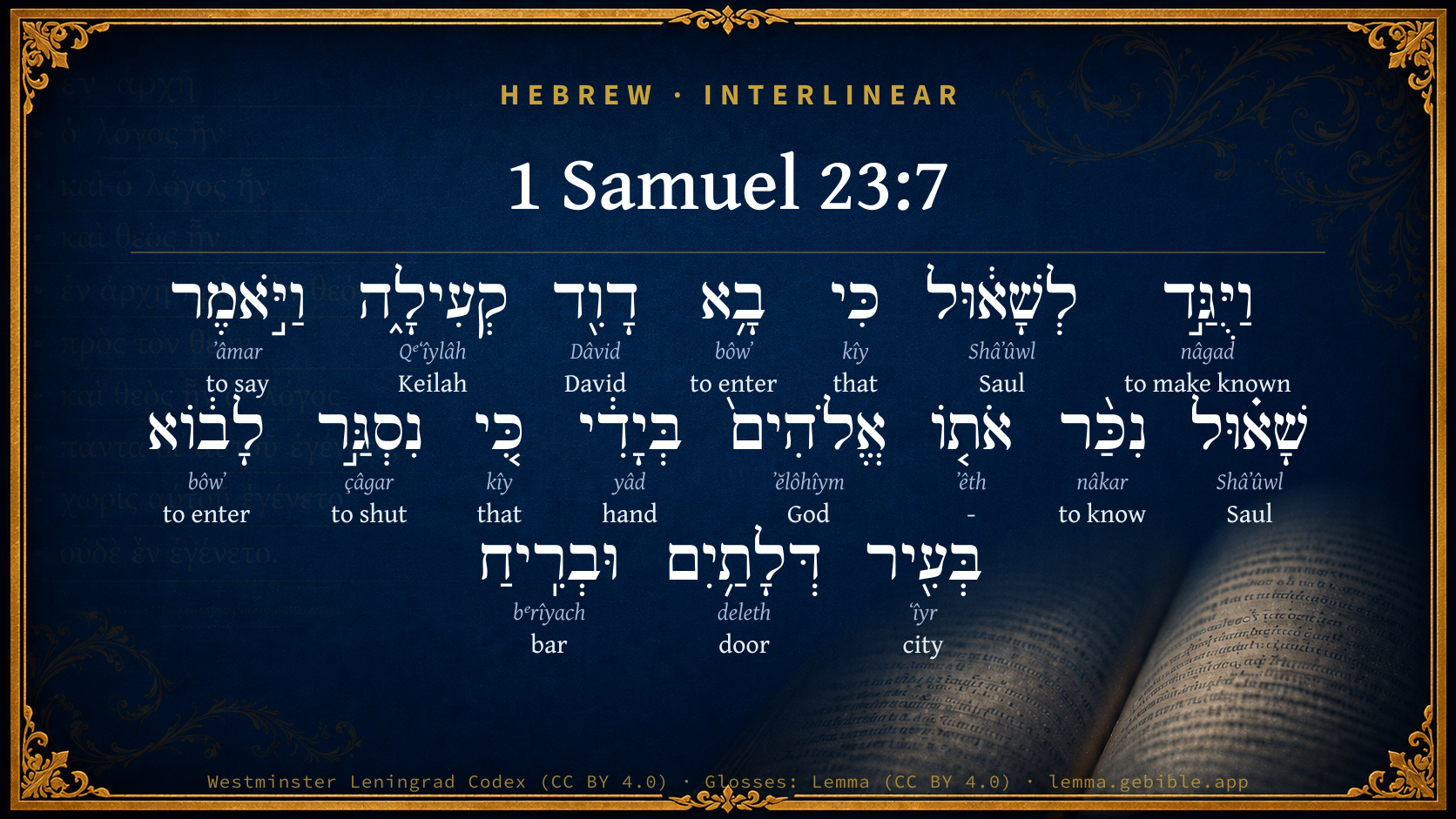
Hebrew (Westminster Leningrad Codex) 1 Samuel 23:7 appears in the Hebrew Old Testament. The text above is from the Westminster Leningrad Codex. Each word links to its Strong’s number, a concise gloss, and parsing drawn from the Open Scriptures Hebrew Bible morphology. Click any word for its full Brown-Driver-Briggs (BDB) entry.
Download image
Cite this verse

1 Samuel 23:7 (World English Bible). Public Domain. Lemma interlinear Bible study tool, https://lemma.gebible.app/v/1-samuel/23/7.

Show BibTeX & RIS
BibTeX
RIS
English Translation
It was told Saul that David was come to Keilah. Saul said, God has delivered him into my hand; for he is shut in, by entering into a town that has gates and bars.
World English Bible · Public Domain
Download a study sheet

One document with this verse’s original text, its word-by-word gloss line, the meaning frame, cross-references with their text, attributed commentary, and full source and license credits — printable, and it pastes into notes with its structure intact.

This verse Autodidact and up

Study sheet (.html) Plain text (.txt)

A passage Seminary Student

Up to 50 verses in one chapter. A passage sheet keeps up to 6 commentary sources and 12 cross-references per verse, in the order this page ranks them, and says so on the sheet whenever that leaves anything out. Ask for a single verse and you get the Autodidact verse sheet above.

Everything on this page stays free to read, with no account — the sheet is a download of what is already on screen, not access to it.

Want to remove ads? Support Godless Engineer
Compare translations 3

The same verse in 3 English versions, stacked beneath the original-language interlinear above. Click any original word for its lexicon entry.

Each is an independent rendering of the whole verse — the interlinear is not word-aligned to these translations.

Highlighted words mark where these versions differ — a whole-verse word diff, not a word-by-word alignment.

  • World English Bible Public Domain
    It was told Saul that David was come to Keilah. Saul said, God has delivered him into my hand; for he is shut in, by entering into a town that has gates and bars.
  • King James Version Public Domain
    And it was told Saul that David was come to Keilah. And Saul said, God hath delivered him into mine hand; for he is shut in, by entering into a town that hath gates and bars.
  • unfoldingWord Literal Text CC BY-SA 4.0
    And it was declared to Saul that David had come to Keilah. And Saul said, “God has delivered him into my hand. For he has enclosed himself by entering into a city of doors and a bar.”

unfoldingWord Literal Text — © unfoldingWord, licensed CC BY-SA 4.0. Word-aligned USFM3 via Door43 (git.door43.org/unfoldingWord/en_ult).

Versions to compare (up to 4)

3 of 4 selected

Show all 18 translations

Every available English version of this verse, each an independent rendering of the whole verse.

  • World English Bible Public Domain
    It was told Saul that David was come to Keilah. Saul said, God has delivered him into my hand; for he is shut in, by entering into a town that has gates and bars.
  • Berean Standard Bible Public Domain
    When Saul was told that David had gone to Keilah, he said, “God has delivered him into my hand, for he has trapped himself by entering a town with gates and bars.”
  • Majority Standard Bible Public Domain
    When Saul was told that David had gone to Keilah, he said, “God has delivered him into my hand, for he has trapped himself by entering a town with gates and bars.”
  • King James Version Public Domain
    And it was told Saul that David was come to Keilah. And Saul said, God hath delivered him into mine hand; for he is shut in, by entering into a town that hath gates and bars.
  • American Standard Version (1901) Public Domain
    And it was told Saul that David was come to Keilah. And Saul said, God hath delivered him into my hand; for he is shut in, by entering into a town that hath gates and bars.
  • Revised Version (1885) Public Domain
    And it was told Saul that David was come to Keilah. And Saul said, God hath delivered him into mine hand; for he is shut in, by entering into a town that hath gates and bars.
  • Geneva Bible (1599) Public Domain
    And it was tolde Saul that Dauid was come to Keilah, and Saul sayd, God hath deliuered him into mine hand: for he is shut in, seeing he is come into a citie that hath gates and barres.
  • Douay-Rheims (1899) Public Domain
    And it was told Saul that David was come to Ceila: and Saul said: The Lord hath delivered him into my hands, and he is shut up, being come into a city, that hath gates and bars.
  • Young's Literal Translation Public Domain
    And it is declared to Saul that David hath come in to Keilah, and Saul saith, `God hath made him known for my hand, for he hath been shut in, to enter into a city of doors and bar.'
  • Literal Standard Version CC BY-SA 4.0
    And it is declared to Saul that David has come to Keilah, and Saul says, “God has made him known for my hand, for he has been shut in, to enter into a city of doors and bar.”
  • Unlocked Literal Bible CC BY-SA 4.0
    Saul was told that David had gone to Keilah. Saul said, “God has given him into my hand. For he is shut in because he has entered a city that has gates and bars.”
  • unfoldingWord Literal Text CC BY-SA 4.0
    And it was declared to Saul that David had come to Keilah. And Saul said, “God has delivered him into my hand. For he has enclosed himself by entering into a city of doors and a bar.”
  • Darby Bible Public Domain
    And it was told Saul that David had come to Keilah. Then Saul said, God has cast him off into my hand; for he is shut in, by entering into a city that has gates and bars.
  • World Messianic Bible Public Domain
    Saul was told that David had come to Keilah. Saul said, “God has delivered him into my hand, for he is shut in by entering into a town that has gates and bars.”
  • Webster's Bible Public Domain
    And it was told to Saul that David had come to Keilah. And Saul said, God hath delivered him into my hand; for he is shut in, by entering into a town that hath gates and bars.
  • Free Bible Version CC BY-SA 4.0
    When Saul found out that David had gone to Keilah, he said, “God has handed him over to me, because he has locked himself inside a town with gates that can be barred shut.”
  • Bible in Basic English Public Domain
    And news was given to Saul that David had come to Keilah. And Saul said, Now God has given him into my hands; for by going into a walled town with locked doors, he has let himself be shut in.
  • JPS Tanakh (1917) Public Domain
    And it was told Saul that David was come to Keilah. And Saul said: 'God hath delivered him into my hand; for he is shut in, by entering into a town that hath gates and bars.'

Literal Standard Version (2020), Covenant Press — licensed CC BY-SA 4.0. Text via the HelloAO Bible API (eBible.org). Unlocked Literal Bible (unfoldingWord) — licensed CC BY-SA 4.0. Text via the HelloAO Bible API (eBible.org). unfoldingWord Literal Text — © unfoldingWord, licensed CC BY-SA 4.0. Word-aligned USFM3 via Door43 (git.door43.org/unfoldingWord/en_ult). Free Bible Version, Dr. Jonathan Gallagher — licensed CC BY-SA 4.0. Text via the HelloAO Bible API (eBible.org).

Word by word

More ways to search: Search by grammar → Find every occurrence → Compare this word →

Practice this passage: Drill this verse → Learn its vocabulary →

קְעִילָ֑ה
Qᵉʻîylâh
H7084
“Keilah”
Noun, Proper
Part of Speech
Noun
Type
Proper
Full BDB Definition

Origin: perhaps from H7049 in the sense of inclosing

TWOT: None

Keilah = "fortress" - a city in the lowlands of Judah northwest of Hebron
  1. וַיֻּגַּ֣ד nâgad H5046 “and · to make known” Conjunction + Verb, Hophal, Sequential Imperfect, 3rd Person, Masculine, Singular
  2. לְשָׁא֔וּל Shâʼûwl H7586 “to/for · Saul” Preposition + Noun, Proper
  3. כִּי kîy H3588 “that” Conjunction
  4. בָ֥א bôwʼ H935 “to enter” Verb, Qal, Perfect, 3rd Person, Masculine, Singular
  5. דָוִ֖ד Dâvid H1732 “David” Noun, Proper
  6. וַיֹּ֣אמֶר ʼâmar H559 “and · to say” Conjunction + Verb, Qal, Sequential Imperfect, 3rd Person, Masculine, Singular
  7. שָׁא֗וּל Shâʼûwl H7586 “Saul” Noun, Proper
  8. נִכַּ֨ר nâkar H5234 “to know” Verb, Piel, Perfect, 3rd Person, Masculine, Singular
  9. אֹת֤וֹ ʼêth H853 “- · him” Particle, Direct Object + Suffix, Personal, 3rd Person, Masculine, Singular
  10. אֱלֹהִים֙ ʼĕlôhîym H430 “God(s)” Noun, Common, Masculine, Plural, Absolute
  11. בְּיָדִ֔י yâd H3027 “in/at · hand · my” Preposition + Noun, Common, Both, Singular, Construct + Suffix, Personal, 1st Person, Common, Singular
  12. כִּ֚י kîy H3588 “that” Conjunction
  13. נִסְגַּ֣ר çâgar H5462 “to shut” Verb, Niphal, Perfect, 3rd Person, Masculine, Singular
  14. לָב֔וֹא bôwʼ H935 “to enter” Preposition + Verb, Qal, Infinitive Construct
  15. בְּעִ֖יר ʻîyr H5892 “in/at · city of” Preposition + Noun, Common, Feminine, Singular, Construct
  16. דְּלָתַ֥יִם deleth H1817 “doors” Noun, Common, Feminine, Dual, Absolute
  17. וּבְרִֽיחַ bᵉrîyach H1280 “and · bar” Conjunction + Noun, Common, Masculine, Singular, Absolute

About this verse

These counts appear in no published source. They are computed here, from the morphology-tagged text and Lemma’s own curated glosses. What Lemma adds →

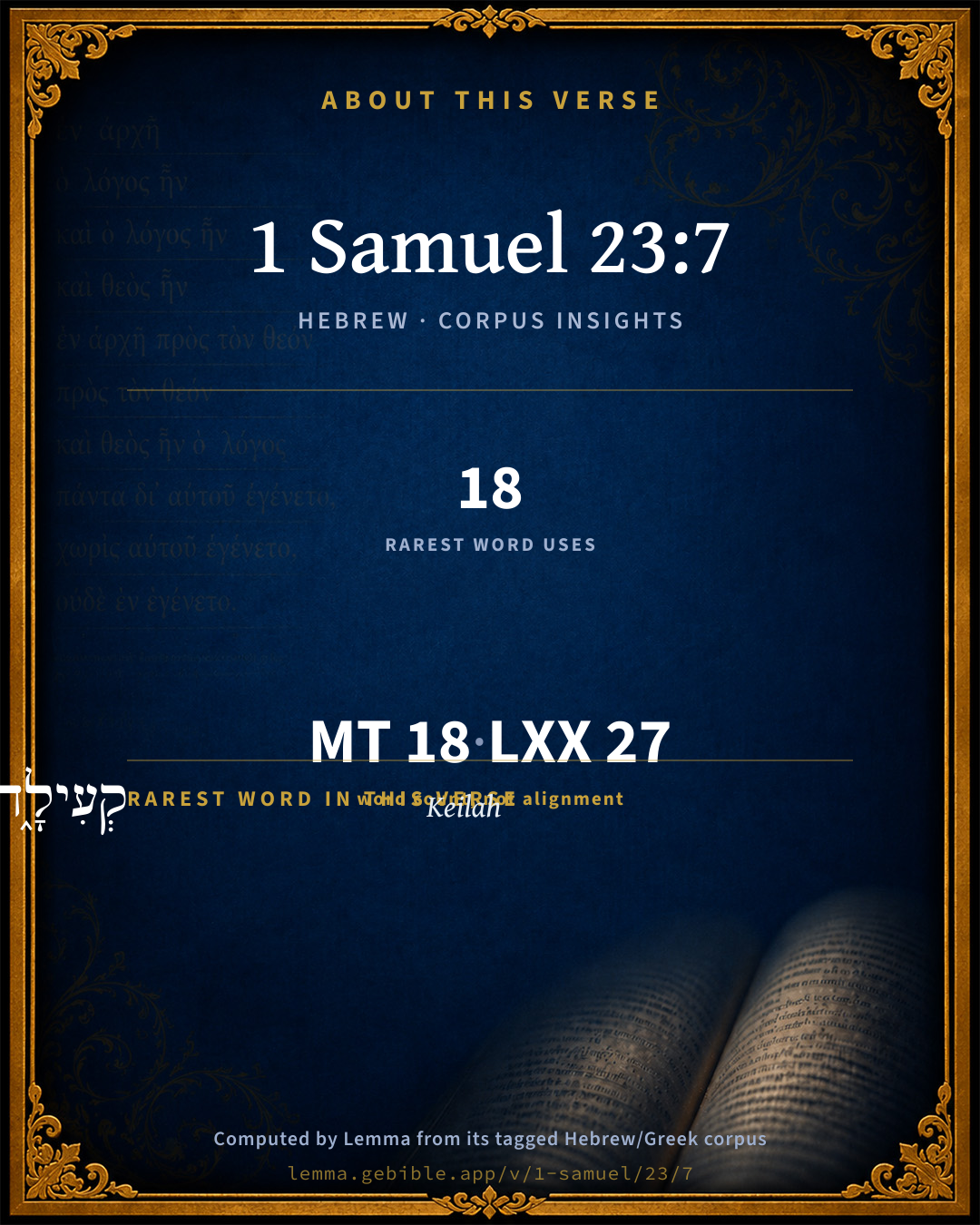
18
words
15
distinct lemmas
Historical
section

Notable vocabulary

The rarest word here is קְעִילָ֑ה Keilah H7084 — appearing just 18 times in the whole Hebrew Bible.

Shared distinctive vocabulary

קְעִילָ֑ה Keilah H7084 occurs in 16 verses of the Hebrew Bible. Also found in:

Grammatical profile

  • 6 verbs
  • 9 nouns
  • 2 conjunctions
  • 1 particle

Verb forms

  • וַיֻּגַּ֣ד Hophal · Sequential Imperfect
  • בָ֥א Qal · Perfect
  • וַיֹּ֣אמֶר Qal · Sequential Imperfect
  • נִכַּ֨ר Piel · Perfect
  • נִסְגַּ֣ר Niphal · Perfect
  • לָב֔וֹא Qal · Infinitive Construct

Repetition

Words recur within this verse — often emphatic in Hebrew:

  • לְשָׁא֔וּל Saul H7586 ×2
  • בָ֥א to enter H935 ×2
  • כִּי that H3588 ×2

Hebrew & Septuagint length

In English translation the verse runs 34 words from the Hebrew and 36 from the Septuagint (LXX English) — closely comparable.

A rough comparison of the two English renderings, which tokenize alike — not a word-level alignment.

Word counts can differ between the Hebrew and the Greek without any difference in meaning — e.g. the Hebrew direct-object marker אֵת has no separate Greek word, and Greek often adds the article ὁ.

In the original languages it is 18 Hebrew tokens and 27 Greek tokens — but the two are counted differently (Hebrew bundles its prefixes and suffixes into one token; the Greek is in lemma form), so that isn’t a like-for-like length.

Cross-references

9

Topical passages linked to 1 Samuel 23:7 in the Treasury of Scripture Knowledge — connected by theme and wording, ordered by reader-vote popularity; previews shown in the World English Bible.

  • 1 Samuel 24:4–6 The men of David said to him, Behold, the day of which Yahweh said to you, Behold, I will deliver your enemy into your hand, and you shall do to him as it shall seem good to you. Then David arose, and cut off the skirt of Saul's robe secretly.
  • 1 Samuel 23:14 David abode in the wilderness in the strongholds, and remained in the hill-country in the wilderness of Ziph. Saul sought him every day, but God didn't deliver him into his hand.
  • 1 Samuel 26:8–9 Then said Abishai to David, God has delivered up your enemy into your hand this day: now therefore please let me strike him with the spear to the earth at one stroke, and I will not strike him the second time.
  • Job 20:5 That the triumphing of the wicked is short, The joy of the godless but for a moment?
  • Psalms 71:10–11 For my enemies talk about me. Those who watch for my soul conspire together,
  • Exodus 14:3 Pharaoh will say of the children of Israel, 'They are entangled in the land. The wilderness has shut them in.'
  • Exodus 15:9 The enemy said, 'I will pursue, I will overtake, I will divide the spoil. My desire shall be satisfied on them. I will draw my sword, my hand shall destroy them.'
  • Judges 16:2–3 [It was told] the Gazites, saying, Samson is come here. They compassed him in, and laid wait for him all night in the gate of the city, and were quiet all the night, saying, [Let be] until morning light, then we will kill him.
  • Luke 19:43–44 For the days will come on you, when your enemies will throw up a barricade against you, surround you, hem you in on every side,

Cross-references courtesy of OpenBible.info (CC BY 4.0).

Hebrew and Greek witnesses Masoretic Hebrew ↔ Greek Septuagint

The same verse in the two great witnesses to the Old Testament, shown verse-for-verse.

These are two independent witnesses, not word-aligned to each other, and the Septuagint is shown in lemma (dictionary) form.

Hebrew 1 Samuel 23:7 Masoretic · Westminster Leningrad Codex

וַיֻּגַּ֣ד לְשָׁא֔וּל כִּי בָ֥א דָוִ֖ד קְעִילָ֑ה וַיֹּ֣אמֶר שָׁא֗וּל נִכַּ֨ר אֹת֤וֹ אֱלֹהִים֙ בְּיָדִ֔י כִּ֚י נִסְגַּ֣ר לָב֔וֹא בְּעִ֖יר דְּלָתַ֥יִם וּבְרִֽיחַ

It was told Saul that David was come to Keilah. Saul said, God has delivered him into my hand; for he is shut in, by entering into a town that has gates and bars.

World English Bible · Public Domain

Greek LXX 1 Samuel 23:7 Septuagint · lemma form

καί ἀποἀγγέλλω ὁ σαούλ ὅτι ἥκω δαυίδ εἰς κεϊλα καί εἶπον σαούλ πιπράσκω αὐτός ὁ θεός εἰς χείρ ἐγώ ὅτι ἀποκλείω εἰςἔρχομαι εἰς πόλις θύρα καί μοχλός

And it was told Saul that David was come to Keila: and Saul said, God has sold him into my hands, for he is shut up, having entered into a city that has gates and bars.

LXX2012 (modern English Septuagint) · Public Domain

On this verse, Ellicott's Commentary for English Readers discusses the Septuagint’s reading. Read the note in Commentary ↓

Hebrew: Westminster Leningrad Codex (CC BY 4.0). Greek: Septuagint (public domain); English from LXX2012 (modern English Septuagint) (Public Domain). How the Septuagint differs from the Hebrew →

Targum (Aramaic paraphrase)

1

The Targum is the ancient Jewish Aramaic paraphrase of the Hebrew Scriptures — an interpretive translation, not the Hebrew text itself. Onkelos (literal) and Pseudo-Jonathan (expansive) render the Torah, and Jonathan the Prophets. Coverage is partial: where no permissively-licensed English translation exists for a verse, only the Aramaic is shown. This is verse-level text, not a word-by-word alignment to the Hebrew.

  1. Targum Jonathan Prophets (Joshua–Malachi)
    וְאִתְחַוָא לְשָׁאוּל אֲרֵי אֲתָא דָוִד לִקְעִילָה וַאֲמַר שָׁאוּל מְסַר יָתֵיהּ יְיָ בִּידִי אֲרֵי אִתְמְסַר לְמֵיעַל בְּקַרְתָּא דְלָהּ דָשִׁין וְעַבְּרִין:

    (no public-domain English translation for this verse)

    Targum Jonathan — Aramaic: “Mikraot Gedolot” (public domain). English: “Sefaria Community Translation” (CC0 1.0 (public-domain dedication)); “London "Chaldee Paraphrase," 1871” (public domain). Text via Sefaria.

Commentary

Notes on 1 Samuel 23:7 from classic Christian and Jewish commentators (each source and its license shown beneath its notes). The classic Christian expositions comment on the surrounding passage and are grouped to its opening verse, so a note may address several verses; the Jewish commentaries on the Tanakh (Rashi and others) are per-verse, so they appear only where the commentator wrote on this verse.

Lemma curates 59 commentaries, every one of them public domain or Creative Commons licensed, each selected and text-cleaned for this edition rather than reprinted as found. About our sources →

Matthew Henry's Commentary

Here is, I. Saul contriving within himself the destruction of David (Sa1 23:7, Sa1 23:8): He heard that he had come to Keilah; and did he not hear what brought him thither? Was it not told him that he had bravely relieved Keilah and delivered it out of the hands of the Philistines? This, one would think, should have put Saul upon considering what honour and dignity should be done to David for this. But, instead of that, he catches at it as an opportunity of doing David a mischief. An ungrateful wretch he was, and for ever unworthy to have any service or kindness done him. Well might David complain of his enemies that they rewarded him evil for good, and that for his love they ere his adversaries, Psa 35:12; Psa 109:4. Christ was used thus basely, Joh 10:32. Now observe, 1. How Saul abused the God of Israel, in making his providence to patronise and give countenance to his malicious designs, and thence promising himself success in them: God hath delivered him into my hand; as if he who was rejected of God were in this instance owned and favoured by him, and David infatuated. He vainly triumphs before the victory, forgetting how often he had had fairer advantages against David than he had now and had yet missed his aim. He impiously connects God with his cause, because he thought he had gained one point. Therefore David prays (Psa 140:8), Grant not, O Lord! the desires of the wicked; further not his wicked device, lest they exalt themselves. We must not think that one smiling providence either justifies an unrighteous cause or secures its success. 2. How Saul abused the Israel of God, in making them the servants of his malice against David. He called all the people together to war, and they must with all speed march to Keilah, pretending to oppose the Philistines, but intending to besiege David and his men, though concealing that design; for it is said (Sa1 23:9) that he secretly practised mischief against him. Miserable is that people whose prince is a tyrant, for, while some are sufferers by his tyranny, others (which is worse) are made servants to it and instruments of it.

II. David consulting with God concerning his own preservation. He knew by the information bought him that Saul was plotting his ruin (Sa1 23:9) and therefore applied to his great protector for direction. No sooner is the ephod brought to him than he makes use of it: Bring hither the ephod. We have the scriptures, those lively oracles, in our hands; let us take advice from them in doubtful cases. "Bring hither the Bible."

1. David's address to God upon this occasion is, (1.) Very solemn and reverent. Twice he calls God the Lord God of Israel, and thrice calls himself his servant, Sa1 23:10, Sa1 23:11. Those that address God must know their distance, and who they are speaking to. (2.) Very particular and express. His representation of the case is so (Sa1 23:10): "Thy servant has certainly heard on good authority" (for he would not call for the ephod upon every idle rumour) "that Saul has a design upon Keilah;" he does not say, "to destroy me," but, "to destroy the city" (as he had lately done the city of Nob) "for my sake." He seems more solicitous for their safety than for his own, and will expose himself any where rather than they shall be brought into trouble by his being among them. Generous souls are thus minded. His queries upon the case are likewise very particular. God allows us to be so in our addresses to him: "Lord, direct me in this matter, about which I am now at a loss." He does indeed invert the due order of his queries, but God in his answer puts him into method. That question should have been put first, and was first answered, "Will Saul come down, as thy servant has heard?" "Yea," says the oracle, "he will come down; he has resolved it, is preparing for it, and will do it, unless he hear that thou hast quitted the town." "Well, but if he do come down will the men of Keilah stand by me in holding the city against him, or will they open to him the gates, and deliver me into his hand?" If he had asked the men (the magistrates or elders) of Keilah themselves what they would do in that case, they could not have told him, not knowing their own minds, nor what they should do when it came to the trial, much less which way the superior vote of their council would carry it; or they might have told him they would protect him, and yet afterwards have betrayed him; but God could tell him infallibly: "When Saul besieges their city, and demands of them that they surrender thee into his hands, how fond soever they now seem of thee, as their saviour, they will deliver thee up rather than stand the shock of Saul's fury." Note, [1.] God knows all men better than they know themselves, knows their length, their strength, what is in them, and what they will do if they come into such and such circumstances. [2.] He therefore knows not only what will be, but what would be if it were not prevented; and therefore knows how to deliver the godly out of temptation, and how to render to every man according to his works.

2. David, having thus far notice given him of his danger, quitted Keilah, Sa1 23:13. His followers had now increased in number to 600; with these he went out, not knowing whither he went, but resolving to follow Providence and put himself under its protection. This broke Saul's measures. He thought God had delivered David into his hand, but it proved that God delivered him out of his hand, as a bird out of the snare of the fowler. When Saul heard that David had escaped from Keilah, he forbore to go forth with the body of the army, as he intended (Sa1 23:8), and resolved to take only his own guards, and go in quest of his people's enemies and turn their counsels head-long.

Matthew Henry's Commentary on the Whole Bible (1708–1710) — public domain (CC PDM 1.0). Text via the HelloAO Bible API.

Jamieson, Fausset & Brown

Robert Jamieson, A. R. Fausset & David Brown

SAUL'S COMING, AND TREACHERY OF THE KEILITES. (Sa1 23:7-13)

it was told Saul that David was come to Keilah--Saul imagined himself now certain of his victim, who would be hemmed within a fortified town. The wish was father to the thought. How wonderfully slow and unwilling to be convinced by all his experience, that the special protection of Providence shielded David from all his snares!

Jamieson, Fausset & Brown — Commentary Critical and Explanatory on the Whole Bible (1871) — public domain (CC PDM 1.0). Text via the HelloAO Bible API.

Trapp's Complete Commentary

John Trapp

1Sa 23:7 And it was told Saul that David was come to Keilah. And Saul said, God hath delivered him into mine hand; for he is shut in, by entering into a town that hath gates and bars.

Ver. 7. God hath delivered him into mine hands.] Thus this "hypocrite flattereth himself in his own eyes, until his iniquity be found to be hateful," {Psa 36:2} and although he standeth in a posture of distance and defiance against God, yet he talketh very confidently of him, as if on his side. So did Rabshakeh, and the Pharisees: and so do the Popish persecutors, beginning their processes against the martyrs with, "In the name of God, Amen," and taking for their posy these words of the psalmist, "Our help is in the name of the Lord." "Thou art near in their mouth," saith the prophet concerning such, "but far from their reins." {Jer 12:2} They are right blackamoors, white nowhere but in the teeth.

John Trapp, A Commentary or Exposition upon All the Books of the Old and New Testament (1647–1656) — public domain. Text from a community e-Sword module.

Joseph Benson's Commentary

1Sa 23:7. Saul said, God hath delivered him into my hand — David, who judged of other men’s generosity by his own, hoped he should be protected in Keilah; and Saul, who judged in the same manner of their baseness, believed he should not; and therefore he rejoiced upon receiving the news of David’s being shut up there, persuaded he should now get possession of his person. But it was strange he should imagine that God had taken measures to bring an innocent and pious man into his power, who was a contemner of God, a breaker of his commandments, and one that trampled on all laws, human and divine.

Joseph Benson's Commentary on the Old and New Testaments (1811–1818) — public domain. Text from a community e-Sword module.

The Preacher's Complete Homiletical Commentary

Joseph S. Exell (gen. ed.)

CRITICAL AND EXPOSITORY NOTES

1Sa_23:9-12. “It is evident from these verses that when the will of God was sought through the Urim and Thummim, the person making the inquiry placed the matter before God in prayer, and received an answer—but always to one particular question. For when David had asked the two questions given in 1Sa_22:11, he received the answer to the second question only, and had to ask the first again.” (Keil.)

MAIN HOMILETICS OF THE PARAGRAPH—1Sa_23:7-12

SAUL MARCHES AGAINST KEILAH TO SEIZE DAVID

I. Men often put a false interpretation upon circumstances. Saul never made a greater mistake than when he said of David in Keilah, “God hath delivered him into mine hand.” If this was indeed his belief, it shows us how very greatly men may err in their interpretation of the events of Providence, and how far they may be from a right conception of the light in which God regards both their character and their actions. It seems impossible that Saul could either have misunderstood or forgotten the word of the Lord delivered to him by Samuel; and yet he here speaks as though his pursuit of David was undertaken with the Divine approval, and puts an entirely false meaning upon his present position. When men misinterpret human language, they do so either through ignorance or wilfulness. A man who is but imperfectly acquainted with a language may put a false construction on words spoken or written, and so come to a false conclusion as to the intention of the speaker or writer. So sometimes men, through ignorance, misread God’s providential dealings. Job’s friends entirely misinterpreted the circumstances in which they found the patriarch, concluding that his afflictions were to punish his sin when they were to develop and strengthen his godliness; and other men, who have had no revelation from God, have often doubtless erred in like manner. But by far the most destructive and the greater number of such misinterpretations arise not from ignorance but from wilfulness, as was certainly the case with Saul at this time. Such a wilful mistake was made by the Egyptian host at the Red Sea, when they said of Israel “They are entangled in the land, the wilderness hath shut them in.” The miracles of judgment which had just been wrought in the land of Egypt spoke concerning the character and purposes of the Lord God of the Hebrews in language which could only be wilfully misinterpreted, and hence they had only themselves to blame for their destruction. But such misreadings of God’s providential dealings have not been confined to Old Testament times. We need not wonder that they have been abundant in the history of the Christian Church, when we remember how men misinterpreted the death of Him who founded it, and concluded, when they saw Him hanging upon the cross, that “Himself He could not save.”

II. For a good man in such circumstances there is always a final court of appeal. A child when misjudged or perplexed goes to his father for a verdict or an explanation concerning that which troubles him. To his young mind the wisdom and the goodness resident in his parent constitute him the judge in all disputes, and the one who can solve all difficulties. Every good man thus instinctively turns to God when a wrong interpretation is put either upon his character or his circumstance, or upon both. Conscious of his own sincerity, and fully persuaded, even in the midst of his perplexities, of the wisdom and righteousness of his Heavenly Father, he looks heavenward for help and guidance when every human support fails him. Even Job, amid the terrible storm of afflictions which drew from him many expressions of impatience, and some which seem to impugn the justice of the Most High, ever and anon turns from the charges and expostulations of his mistaken human friends to Him whom he feels in his inmost soul is the final court of appeal, and the only Judge to whom he can safely commit his cause. So David here, perplexed no doubt by the providence which seemed to grow darker at every step, and pained at the ingratitude of the men upon whose gratitude and friendship he must surely have counted, turns again and again to his Father in heaven, and by his appeals and inquiries shows that, although the waves and the billows of adversity are all around him, his faith has not lost her hold, and that he can still hear the “voice of the Lord upon the waters,” and see Him “sitting on the flood” (Psalms 29).

OUTLINES AND SUGGESTIVE COMMENTS

The men of Keilah were neither chivalrous nor grateful. They regarded their own interests as supreme. Like many in our own day, they might profess to aim after the greatest happiness of the greatest number, but when you came to analyse their views, you would find that with them, to use the words of Joseph Hume, “the greatest number was number one!” It was not for their advantage to serve David, and they did not serve him; and I am free to say that all my observation and experience convince me that a large proportion of the present generation would have done as they were willing to do. Of course that does not excuse them, but it should make us cautious as to what we say in their condemnation, lest, haply, we may some day be judged out of our own mouths. Gratitude, chivalry, enthusiasm for the cause of the wronged—what are these words in the mouths of many to-day but words? they sound well, and they are very fine so long as they cost nothing; but let adherence to them put property or life in peril, and too many would cling to the property and the life, and let the others go. Ye who condemn the inhabitants of Keilah because they were willing to betray David, how long would you show gratitude at the risk of the loss of all things? It was a disgrace to them that they would not stand by him who had delivered them; but is it anything less to us, when we allow our worldly interests to blind us to the obligations under which we lie to those who befriended us in our time of need? Is it anything less to us when, for the sake of fashion, or fortune, or fame, we turn our backs upon the Christ, who has borne the agony of Gethsemane and Calvary on our behalf? Idolatry of self is as hideous now as it was in David’s time. Let those who are guilty of it, therefore, look here, and, in the pitiful poltroonery of the men of Keilah they will see how mean and contemptible they look.—Dr. W. M. Taylor.

1Sa_23:12. Here is a second inquiry. God loveth to be often sought unto by His praying people (Luk_18:1), and therefore answereth them by degrees, that He may frequently hear from them. Thus the cloud empties not itself at a sudden burst, but dissolved upon the earth drop after drop. Trapp.

Whereas the Lord answereth, that Saul would come down to Keilah, and that the men of Keilah would deliver David into Saul’s hands, and yet neither of these came to pass; hence it cannot be inferred that the predictions of the Lord are uncertain, for the Lord’s answer is here to be understood conditionally.… A difference is here to be made between the prescience of God and the predestination: for the Lord as well seeth what shall be done as what is likely to be done in respect of the second causes; but His decree of predestination is only of those things which shall most certainly be effected.—Willet.

The origin of the thirty-first Psalm is to be traced to this period of wandering, although there is nothing contained in the title of it which authorises this supposition. We meet, however, with many passages in the psalm which quite correspond with the circumstances in which David was then placed. The singer begins with the humble but confiding prayer that God would never let him be put to shame (he was so at that time, when the citizens of Keilah would no longer suffer him to dwell amongst them); but that he would deliver him (the guiltless outlaw) in his righteousness. He prays that the Lord would bow down His ear to him, and deliver him speedily, and be a strong rock to him, and a protecting fortress. The imagery here is plainly suggested by the wild scenes of nature which surrounded the singer. He prays that, for his name’s sake, the Lord would lead him and graciously be near him in the pathless and inhospitable wilderness, and that he would guard his feet from the net which they had laid on all sides to catch him. “Into thine hand,” he coutinues, “I commit my spirit: thou hast redeemed me, O Lord God of truth,” namely, from the violence to which they would surrender me. Moreover, David speaks of himself as one who was forsaken by all the world, and was covered with unmerited reproaches and slanders. He was even guilty of high treason, and had placed himself in opposition to the greatest part of the people, because he was the object of the king’s displeasure. Yet he is far from speaking of himself as free from all guilt. He feels himself as a poor sinner before God, and, with a sigh, gives utterance to the prayer, “Have mercy upon me, O Lord.” Nevertheless he trusted in His mercy whom he confidently called his God; and, after giving praise to the Lord for all the wonderful goodness and the help which he had hitherto vouchsafed to him “in his flight,” he concludes with this call to his brethren in the faith: “O love the Lord, all ye his saints: for the Lord preserveth the faithful, and plentifully rewardeth the proud doer. Be of good courage, and He shall strengthen your heart, all ye that hope in the Lord.”—Krummacher.

The Preacher's Complete Homiletical Commentary (gen. ed. Joseph S. Exell; Funk & Wagnalls, c. 1892) — public domain (pre-1929). A full-Bible homiletical/sermon-outline anthology covering 65 of 66 books (2 John is absent from the source module). Text from a community e-Sword module.

Tyndale Open Study Notes

Tyndale Open Resources

23:7 God has handed him over to me: To the contrary, see 23:14.

Tyndale Open Study Notes — © Tyndale Open Resources, licensed CC BY-SA 4.0. Text via the HelloAO Bible API.

Ellicott's Commentary for English Readers

(7) God hath delivered him into mine hand.—There was little chance, Saul knew, of his being able to capture or slay his foe when he was roaming at large through the desert and forests which lay to the south of Palestine, and which stretched far southward beyond the reach of any armed force that he could collect; but there was a hope of being able to compass his enemy’s destruction, either through treachery or a hand-to-hand encounter, in a confined space like a city with bars and gates, such as Keilah. Saul and his counsellors knew too well whom they had to deal with in the case of the citizens of that faithless, thankless city. It is strange, after all that had passed, that Saul could delude himself that his cause was the cause of God, and that David was the reprobate and rejected. The Hebrew word here is remarkable: God hath “repudiated or rejected him.” The LXX. renders “sold him” (into my hands).

A Bible Commentary for English Readers, edited by Charles John Ellicott (1878–1897) — public domain. Text from a community e-Sword module.

The Cambridge Bible for Schools and Colleges

gen. ed. J. J. S. Perowne

7–15. The treachery of the Keilites

7. hath delivered him] Lit. hath rejected him and delivered him. So blind was Saul as to imagine that it was not himself but David whom God had rejected. The Sept. reads “sold.”

a town, &c.] A city. It may have been one of the old Canaanite fortresses (see on Jos_11:13), or have been fortified as an outpost against the Philistines.

The Cambridge Bible for Schools and Colleges (gen. ed. J. J. S. Perowne; Cambridge University Press, 1878–1918) — public domain. Text from a community e-Sword module.

John Gill's Exposition

And it was told Saul that David was come to Keilah,.... No doubt it was told him what he came thither for, to relieve it, and deliver it out of the hands of the Philistines, and what success he had; which one would have thought would have reconciled his mind to him, and made him think well of them; but instead of that, it only led him to contrive mischief against him:

and Saul said, God hath delivered him into mine hand; as if the success he had given to David was against, him, and in favour of Saul:

for he is shut in, by entering into a town that hath gates and bars; while he betook himself to caves, and fields, and woods, he had no great hopes of finding him out, and coming up with him, and seizing him; but now he had got into a fortified place, enclosed with walls, and that had gates to it, kept bolted and barred; when he brought his army against it, and surrounded it, he imagined he would not be able to get out, and escape his hands.

John Gill's Exposition of the Whole Bible (1746–1763) — public domain (CC PDM 1.0). Text via the HelloAO Bible API.

Haydock's Catholic Bible Commentary

Bars. This was what David’s men apprehended. Saul thinks this is a fit opportunity for taking them all prisoners; and he supposes that God was on his side, though, after his repeated crimes, he had little reason to flatter himself with hopes of this nature. The wicked, however, easily delude themselves. (Haydock)

George Leo Haydock (1774–1849), Haydock's Catholic Family Bible and Commentary, 1859 edition — public domain. Excludes Psalms (Douay-Rheims chapter numbering differs from Protestant) and Deuterocanonical books (Catholic canon only).

Matthew Poole's English Annotations

He easily believed what he greedily desired, though his own experience had oft showed him how strangely God had delivered him out of his hands, and what a singular care God had over him.

For he is shut in, by entering into a town that hath gates and bars; so that which he chose for his safety will be his certain ruin.

Matthew Poole's English Annotations on the Holy Bible (1683–1685) — public domain. Text from a community e-Sword/MySword module.

The Pulpit Commentary

Vers. 7, 8. It was well nigh a hopeless matter to hunt David as long as he remained on the borders of the desert of Judah, but once shut up in a town his capture was inevitable. When Saul, therefore, heard that David was at Keilah, he said, God hath delivered him into my hand. The Syriac, Chaldee, and Vulgate translate in the same way, probably as the nearest equivalent to the Hebrew, while the Septuagint has a different readingsold. The Hebrew phrase is a very strong one; literally, "God hath ignored him," hath treated him as a stranger, and so let, him fall "into my hand." Possibly Saul s metaphor was taken from the popular language, and no attempt should be made to get rid of unusual expressions, as if they were false readings. By entering into a town that hath gates and bars. Either the people of a walled town would give up David rather than expose themselves to the horrors of a siege, (2Sa_20:21, 2Sa_20:22) or, if they stood by him, its capture would be a mere matter of time. David, it seems, would have run the risk, but happily was prevented.

The Pulpit Commentary (1880–1919), ed. H.D.M. Spence-Jones & Joseph S. Exell — public domain. Text from a community e-Sword module.

unfoldingWord translationNotes

Door43 World Missions Community

Saul was told

This can be translated in active form. AT: "Someone told Saul" or "They told Saul" (See: Active or Passive)

summoned

officially called. The reader should understand that Saul probably told his officials to gather the soldiers. He did not call with a loud voice to get them to come.

all his forces

"all his soldiers"

translationWords

Saul (OT)

David

God

hand

gate

Abiathar

priest

ephod

unfoldingWord translationNotes — © Distant Shores Media and the Door43 World Missions Community, licensed CC BY-SA 4.0. Source: git.door43.org/Door43/en_tn.

Rashi

Rabbi Shlomo Yitzchaki (Rashi)

s God has given him into my hand. Meaning, delivered, and similarly, "And do not look on, on the day of your brother, on the day of his being delivered [נכרו]." This is the conjugation of the strong [verbs e.g., Pi'el], as in, "He destroyed and broke her bars." If he desired to speak in the conjugation of the weak [verbs e.g., Kal], it would have been punctuated thus: נָכַר.

For he has been shut in by entering a city that has doors and a bolt. He will rely on that, and will not care to flee from it.

Rashi on the Tanakh — English translations: “The Judaica Press complete Tanach with Rashi, translated by A. J. Rosenberg” (CC BY 4.0); “Pentateuch with Rashi's commentary by M. Rosenbaum and A.M. Silbermann, 1929-1934” (public domain); “The Metsudah Tanach series, Lakewood, N.J” (CC BY 4.0); and “The Book of Joshua, Metsudah Publications, 1997” (CC BY 4.0). Text via Sefaria.

Lesson kit

Teaching starters — assembled from the data on this page, not authored interpretation. Every prompt links to the verse data it draws on. Edit before teaching.

1 Samuel, in the Historical, opens this verse with 18 words (15 distinct Hebrew lemmas). Its most distinctive word is Qᵉʻîylâh (“Keilah”). A historical commentator’s framing appears above. Read the whole chapter for the surrounding context.

Discussion questions

  1. The word Qᵉʻîylâh carries the sense “Keilah.” How does it shape the verse?
  2. Joshua 15:44 shares the word «Keilah» with this verse. How do the two illuminate each other?
  3. “Saul” occurs 2× in this one verse. What is the effect of the repetition?
  4. The translations on this page render this verse differently — a whole-verse word diff, not a word-by-word alignment. What might account for the different wordings?
  5. The verb «וַיֻּגַּ֣ד» is Hophal Sequential Imperfect. How does its form color the action?
  6. Reading how Matthew Henry's Commentary and Jamieson, Fausset & Brown read this verse, where do the two commentators agree and where do they part?

Things to notice

Reading settings

Reading text

Shown beneath each verse's original-language words.

Old Testament
Old Testament edition

Read the OT as the Masoretic Hebrew (MT) or the Greek Septuagint (LXX).

English shown for the Greek Septuagint (in the Hebrew ↔ Greek comparison).

Comparing translations? Open the Compare panel on any verse page to stack up to four side by side.