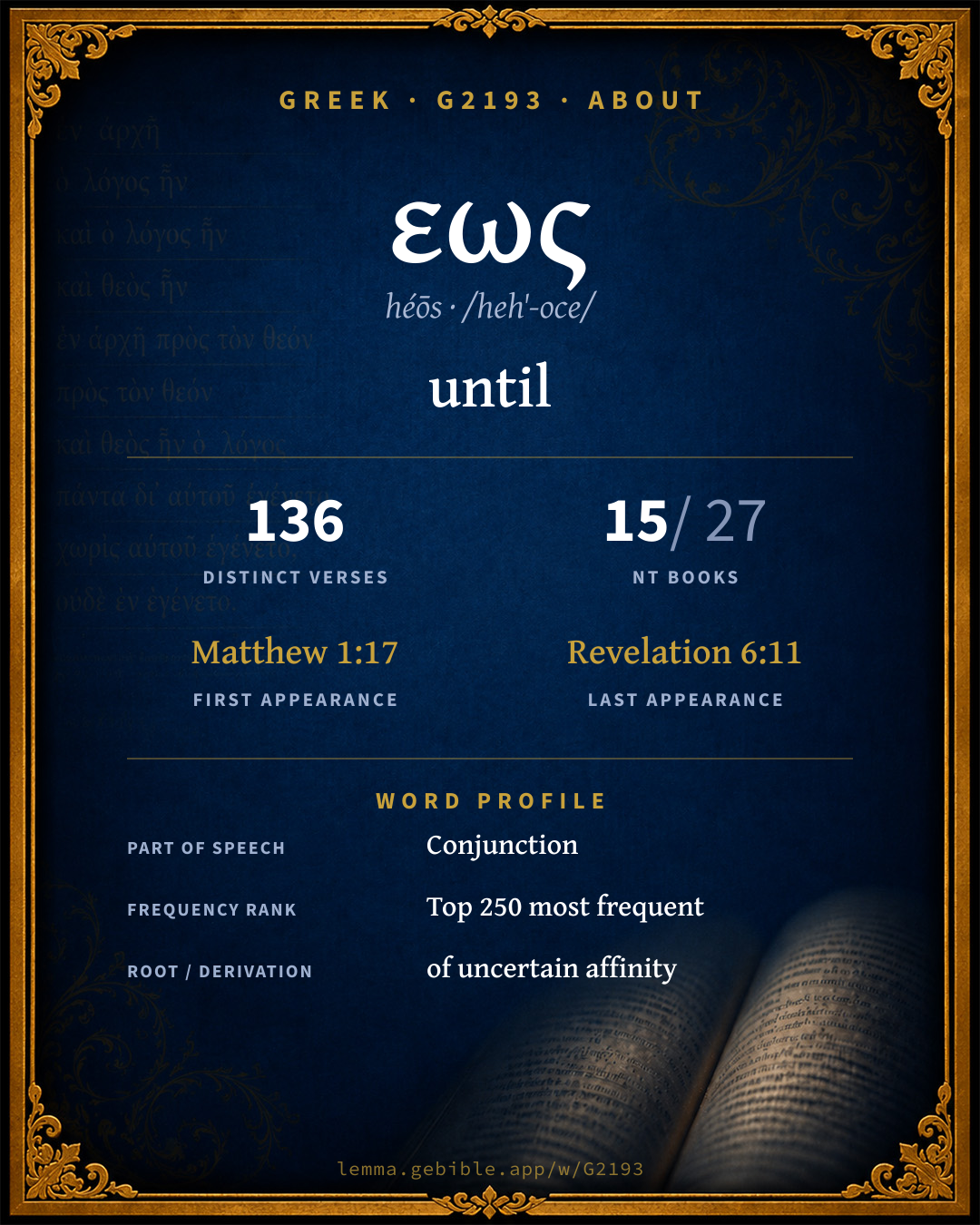
ἕως
until
Full lexicon entry — Thayer's Greek Lexicon
From Thayer's Greek Lexicon
Where this word appears
Grammar key — what these labels mean
Part of speech
- Adverb
- A word that modifies a verb, adjective, or other adverb.
Every verse where G2193 appears — 136 distinct verses across 15 books. Click any verse to open its interlinear word-by-word view. Verse text shown in the World English Bible for context — . Each verse’s Greek form is shown with its reference; the English is not keyword-highlighted, since the data carries no word-level English alignment. Use “Compare translations” on any verse to read it across multiple English versions. This concordance covers the Greek New Testament; Septuagint (Greek Old Testament) occurrences of this word are not indexed here.
Matthew 42 verses
- Matthew 1:17 ἕως ἕως ἕως adv adv adv So all the generations from Abraham to David are fourteen generations; from David to the exile to Babylon fourteen generations; and from the carrying away to Babylon to the Christ, fourteen generations.
- Matthew 1:25 ἕως adv and didn't know her sexually until she had brought forth her firstborn son. He named him Jesus.
- Matthew 2:9 ἕως adv They, having heard the king, went their way; and behold, the star, which they saw in the east, went before them, until it came and stood over where the young child was.
- Matthew 2:13 ἕως adv Now when they had departed, behold, an angel of the Lord appeared to Joseph in a dream, saying, "Arise and take the young child and his mother, and flee into Egypt, and stay there until I tell you, for Herod will seek the young child to destroy him."
- Matthew 2:15 ἕως adv and was there until the death of Herod; that it might be fulfilled which was spoken by the Lord through the prophet, saying, "Out of Egypt I called my son."
- Matthew 5:18 ἕως ἕως adv adv For most assuredly, I tell you, until heaven and earth pass away, not even one smallest letter or one tiny pen stroke shall in any way pass away from the law, until all things are accomplished.
- Matthew 5:25 ἕως adv Agree with your adversary quickly, while you are with him in the way; lest perhaps the prosecutor deliver you to the judge, and the judge deliver you to the officer, and you be cast into prison.
- Matthew 5:26 ἕως adv Most assuredly I tell you, you shall by no means get out of there, until you have paid the last penny.
- Matthew 10:11 ἕως adv Into whatever city or village you enter, find out who in it is worthy; and stay there until you go on.
- Matthew 10:23 ἕως adv But when they persecute you in this city, flee into the next, for most assuredly I tell you, you will not have gone through the cities of Israel, until the Son of Man has come.
- Matthew 11:12 ἕως adv From the days of John the Baptizer until now, the Kingdom of Heaven suffers violence, and the violent take it by force.
- Matthew 11:13 ἕως adv For all the prophets and the law prophesied until John.
- Matthew 11:23 ἕως ἕως adv adv You, Capernaum, who are exalted to Heaven, you will go down to Hades. For if the mighty works had been done in Sodom which were done in you, it would have remained until this day.
- Matthew 12:20 ἕως adv He won't break a bruised reed. He won't quench a smoking flax, Until he leads justice to victory.
- Matthew 13:33 ἕως adv He spoke another parable to them. "The Kingdom of Heaven is like yeast, which a woman took, and hid in three measures of meal, until it was all leavened."
- Matthew 14:22 ἕως adv Immediately Jesus made the disciples get into the boat, and to go ahead of him to the other side, while he sent the multitudes away.
- Matthew 16:28 ἕως adv Most assuredly I tell you, there are some standing here who will in no way taste of death, until they see the Son of Man coming in his Kingdom."
- Matthew 17:9 ἕως adv As they were coming down from the mountain, Jesus commanded them, saying, "Don't tell anyone what you saw, until the Son of Man has risen from the dead."
- Matthew 17:17 ἕως ἕως adv adv Jesus answered, "Faithless and perverse generation! How long will I be with you? How long will I bear with you? Bring him here to me."
- Matthew 18:21 ἕως adv Then Peter came and said to him, "Lord, how often shall my brother sin against me, and I forgive him? Until seven times?"
- Matthew 18:22 ἕως ἕως adv adv Jesus said to him, "I don't tell you until seven times, but, until seventy times seven.
- Matthew 18:30 ἕως adv He would not, but went and cast him into prison, until he should pay back that which was due.
- Matthew 18:34 ἕως adv His lord was angry, and delivered him to the tormentors, until he should pay all that was due to him.
- Matthew 20:8 ἕως adv When evening had come, the lord of the vineyard said to his steward, 'Call the laborers and pay them their wages, beginning from the last to the first.'
- Matthew 22:26 ἕως adv In like manner the second also, and the third, to the seventh.
- Matthew 22:44 ἕως adv 'The Lord said to my Lord, Sit on my right hand, Until I make your enemies a footstool for your feet?'
- Matthew 23:35 ἕως adv that on you may come all the righteous blood shed on the earth, from the blood of righteous Abel to the blood of Zachariah son of Barachiah, whom you killed between the sanctuary and the altar.
- Matthew 23:39 ἕως adv For I tell you, you will not see me from now on, until you say, 'Blessed is he who comes in the name of the Lord!'"
- Matthew 24:21 ἕως adv for then there will be great oppression, such as has not been from the beginning of the world until now, no, nor ever will be.
- Matthew 24:27 ἕως adv For as the lightning comes forth from the east, and is seen even to the west, so will be the coming of the Son of Man.
- Matthew 24:31 ἕως adv He will send out his angels with a great sound of a trumpet, and they will gather together his chosen ones from the four winds, from one end of the sky to the other.
- Matthew 24:34 ἕως adv Most assuredly I tell you, this generation will not pass away, until all these things are accomplished.
- Matthew 24:39 ἕως adv and they didn't know until the flood came, and took them all away, so will be the coming of the Son of Man.
- Matthew 26:29 ἕως adv But I tell you that I will not drink of this fruit of the vine from now on, until that day when I drink it anew with you in my Father's Kingdom."
- Matthew 26:36 ἕως adv Then Jesus came with them to a place called Gethsemane, and said to his disciples, "Sit here, while I go there and pray."
- Matthew 26:38 ἕως adv Then he said to them, "My soul is exceedingly sorrowful, even to death. Stay here, and watch with me."
- Matthew 26:58 ἕως adv But Peter followed him from a distance, to the court of the high priest, and entered in and sat with the officers, to see the end.
- Matthew 27:8 ἕως adv Therefore that field was called "The Field of Blood" to this day.
- Matthew 27:45 ἕως adv Now from the sixth hour there was darkness over all the land until the ninth hour.
- Matthew 27:51 ἕως adv Behold, the veil of the temple was torn in two from the top to the bottom. The earth quaked and the rocks were split.
- Matthew 27:64 ἕως adv Command therefore that the tomb be made secure until the third day, lest perhaps his disciples come at night and steal him away, and tell the people, 'He is risen from the dead;' and the last deception will be worse than the first."
- Matthew 28:20 ἕως adv teaching them to observe all things that I commanded you. Behold, I am with you always, even to the end of the age." Amen.
Mark 14 verses
- Mark 6:10 ἕως adv He said to them, "Wherever you enter into a house, stay there until you depart from there.
- Mark 6:23 ἕως adv He swore to her, "Whatever you shall ask of me, I will give you, up to half of my kingdom."
- Mark 6:45 ἕως adv Immediately he made his disciples get into the boat, and to go ahead to the other side, to Bethsaida, while he himself sent the multitude away.
- Mark 9:1 ἕως adv He said to them, "Most assuredly I tell you, there are some standing here who will in no way taste death until they see the Kingdom of God come with power."
- Mark 9:19 ἕως ἕως adv adv He answered him, "Unbelieving generation, how long shall I be with you? How long shall I bear with you? Bring him to me."
- Mark 12:36 ἕως adv For David himself said in the Holy Spirit, 'The Lord said to my Lord, Sit at my right hand, Until I make your enemies the footstool of your feet.'
- Mark 13:19 ἕως adv For in those days there will be oppression, such as there has not been the like from the beginning of the creation which God created until now, and never will be.
- Mark 13:27 ἕως adv Then he will send out his angels, and will gather together his chosen ones from the four winds, from the ends of the earth to the ends of the sky.
- Mark 14:25 ἕως adv Most assuredly I tell you, I will no more drink of the fruit of the vine, until that day when I drink it anew in the Kingdom of God."
- Mark 14:32 ἕως adv They came to a place which was named Gethsemane. He said to his disciples, "Sit here, while I pray."
- Mark 14:34 ἕως adv He said to them, "My soul is exceedingly sorrowful, even to death. Stay here, and watch."
- Mark 14:54 ἕως adv Peter had followed him from a distance, until he came into the court of the high priest. He was sitting with the officers, and warming himself in the light of the fire.
- Mark 15:33 ἕως adv When the sixth hour had come, there was darkness over the whole land until the ninth hour.
- Mark 15:38 ἕως adv The veil of the temple was torn in two from the top to the bottom.
Luke 27 verses
- Luke 1:80 ἕως adv The child was growing, and becoming strong in spirit, and was in the desert until the day of his public appearance to Israel.
- Luke 2:15 ἕως adv It happened, when the angels went away from them into the sky, that the shepherds said one to another, "Let's go to Bethlehem, now, and see this thing that has happened, which the Lord has made known to us."
- Luke 2:37 ἕως adv and she had been a widow for about eighty-four years), who didn't depart from the temple, worshipping with fastings and petitions night and day.
- Luke 4:29 ἕως adv They rose up, threw him out of the city, and led him to the brow of the hill that their city was built on, that they might throw him off the cliff.
- Luke 4:42 ἕως adv When it was day, he departed and went into an uninhabited place, and the multitudes looked for him, and came to him, and held on to him, so that he wouldn't go away from them.
- Luke 9:27 ἕως adv But I tell you the truth: There are some of those who stand here, who will in no way taste of death, until they see the Kingdom of God."
- Luke 9:41 ἕως adv Jesus answered, "Faithless and perverse generation, how long shall I be with you and bear with you? Bring your son here."
- Luke 10:15 ἕως ἕως adv adv You, Capernaum, who are exalted to heaven, will be brought down to Hades.
- Luke 11:51 ἕως adv from the blood of Abel to the blood of Zachariah, who perished between the altar and the sanctuary.' Yes, I tell you, it will be required of this generation.
- Luke 12:50 ἕως adv But I have a baptism to be baptized with, and how distressed I am until it is accomplished!
- Luke 12:59 ἕως adv I tell you, you will by no means get out of there, until you have paid the very last penny."
- Luke 13:8 ἕως adv He answered, 'Lord, leave it alone this year also, until I dig around it, and fertilize it.
- Luke 13:21 ἕως adv It is like yeast, which a woman took and hid in three measures of flour, until it was all leavened."
- Luke 13:35 ἕως adv Behold, your house is left to you desolate. I tell you, you will not see me, until you say, 'Blessed is he who comes in the name of the Lord!'"
- Luke 15:4 ἕως adv "Which of you men, if you had one hundred sheep, and lost one of them, wouldn't leave the ninety-nine in the wilderness, and go after the one that was lost, until he found it?
- Luke 15:8 ἕως adv Or what woman, if she had ten drachma coins, if she lost one drachma coin, wouldn't light a lamp, sweep the house, and seek diligently until she found it?
- Luke 17:8 ἕως adv and will not rather tell him, 'Prepare my supper, clothe yourself properly, and serve me, while I eat and drink. Afterward you shall eat and drink'?
- Luke 20:43 ἕως adv Until I make your enemies the footstool of your feet."'
- Luke 21:32 ἕως adv Most assuredly I tell you, this generation will not pass away until all things are accomplished.
- Luke 22:16 ἕως adv for I tell you, I will no longer by any means eat of it until it is fulfilled in the Kingdom of God."
- Luke 22:18 ἕως adv for I tell you, I will not drink at all again from the fruit of the vine, until the Kingdom of God comes."
- Luke 22:34 ἕως adv He said, "I tell you, Peter, the rooster will by no means crow today until you deny that you know me three times."
- Luke 22:51 ἕως adv But Jesus answered, "Let me at least do this"--and he touched his ear, and healed him.
- Luke 23:5 ἕως adv But they insisted, saying, "He stirs up the people, teaching throughout all Judea, beginning from Galilee even to this place."
- Luke 23:44 ἕως adv It was now about the sixth hour, and darkness came over the whole land until the ninth hour.
- Luke 24:49 ἕως adv Behold, I send forth the promise of my Father on you. But wait in the city of Jerusalem until you are clothed with power from on high."
- Luke 24:50 ἕως adv He led them out as far as Bethany, and he lifted up his hands, and blessed them.
John 11 verses
- John 2:7 ἕως adv Jesus said to them, "Fill the water pots with water." They filled them up to the brim.
- John 2:10 ἕως adv and said to him, "Everyone serves the good wine first, and when the guests have drunk freely, then that which is worse. You have kept the good wine until now!"
- John 5:17 ἕως adv But Jesus answered them, "My Father is still working, so I am working, too."
- John 8:9 ἕως adv They, when they heard it, being convicted by their conscience, went out one by one, beginning from the oldest, even to the last. Jesus was left alone with the woman where she was, in the middle.
- John 9:4 ἕως adv I must work the works of him who sent me, while it is day. The night is coming, when no one can work.
- John 9:18 ἕως adv The Jews therefore did not believe concerning him, that he had been blind, and had received his sight, until they called the parents of him who had received his sight,
- John 10:24 ἕως adv The Jews therefore came around him and said to him, "How long will you hold us in suspense? If you are the Christ, tell us plainly."
- John 13:38 ἕως adv Jesus answered him, "Will you lay down your life for me? Most assuredly I tell you, the rooster won't crow until you have denied me three times.
- John 16:24 ἕως adv Until now, you have asked nothing in my name. Ask, and you will receive, that your joy may be made full.
- John 21:22 ἕως adv Jesus said to him, "If I desire that he stay until I come, what is that to you? You follow me."
- John 21:23 ἕως adv This saying therefore went out among the brothers, that this disciple wouldn't die. Yet Jesus didn't say to him that he wouldn't die, but, "If I desire that he stay until I come, what is that to you?"
Acts 21 verses
- Acts 1:8 ἕως adv But you will receive power when the Holy Spirit has come upon you. You will be witnesses to me in Jerusalem, in all Judea and Samaria, and to the uttermost parts of the earth."
- Acts 2:35 ἕως adv Until I make your enemies a footstool for your feet."'
- Acts 7:45 ἕως adv which also our fathers, in their turn, brought in with Joshua when they entered into the possession of the nations, whom God drove out before the face of our fathers, to the days of David,
- Acts 8:10 ἕως adv to whom they all listened, from the least to the greatest, saying, "This man is that great power of God."
- Acts 8:40 ἕως adv But Philip was found at Azotus. Passing through, he preached the Gospel to all the cities, until he came to Caesarea.
- Acts 9:38 ἕως adv As Lydda was near Joppa, the disciples, hearing that Peter was there, sent two men to him, imploring him not to delay in coming to them.
- Acts 11:19 ἕως adv They therefore who were scattered abroad by the oppression that arose about Stephen traveled as far as Phoenicia, Cyprus, and Antioch, speaking the word to no one except to Jews only.
- Acts 11:22 ἕως adv The report concerning them came to the ears of the assembly which was in Jerusalem. They sent out Barnabas to go as far as Antioch,
- Acts 13:20 ἕως adv After these things he gave them judges until Samuel the prophet.
- Acts 13:47 ἕως adv For so has the Lord commanded us, saying, 'I have set you as a light for the Gentiles, That you should bring salvation to the uttermost parts of the earth.'"
- Acts 17:14 ἕως adv Then the brothers immediately sent out Paul to go as far as to the sea, and Silas and Timothy still stayed there.
- Acts 17:15 ἕως adv But those who escorted Paul brought him as far as Athens. Receiving a commandment to Silas and Timothy that they should come to him very quickly, they departed.
- Acts 21:5 ἕως adv When it happened that we had accomplished the days, we departed and went on our journey. They all, with wives and children, brought us on our way until we were out of the city. Kneeling down on the beach, we prayed.
- Acts 21:26 ἕως adv Then Paul took the men, and the next day, purified himself and went with them into the temple, declaring the fulfillment of the days of purification, until the offering was offered for every one of them.
- Acts 23:12 ἕως adv When it was day, some of the Jews banded together, and bound themselves under a curse, saying that they would neither eat nor drink until they had killed Paul.
- Acts 23:14 ἕως adv They came to the chief priests and the elders, and said, "We have bound ourselves under a great curse, to taste nothing until we have killed Paul.
- Acts 23:21 ἕως adv Therefore don't yield to them, for more than forty men lie in wait for him, who have bound themselves under a curse neither to eat nor to drink until they have killed him. Now they are ready, looking for the promise from you."
- Acts 23:23 ἕως adv He called to himself two of the centurions, and said, "Prepare two hundred soldiers to go as far as Caesarea, with seventy horsemen, and two hundred men armed with spears, at the third hour of the night."
- Acts 25:21 ἕως adv But when Paul had appealed to be kept for the decision of the emperor, I commanded him to be kept until I could send him to Caesar."
- Acts 26:11 ἕως adv Punishing them often in all the synagogues, I tried to make them blaspheme. Being exceedingly enraged against them, I persecuted them even to foreign cities.
- Acts 28:23 ἕως adv When they had appointed him a day, many people came to him at his lodging. He explained to them, testifying about the Kingdom of God, and persuading them concerning Jesus, both from the law of Moses and from the prophets, from morning until evening.
Romans 2 verses
- Romans 3:12 ἕως adv They have all turned aside. They have together become unprofitable. There is no one who does good, No, not, so much as one."
- Romans 11:8 ἕως adv According as it is written, "God gave them a spirit of stupor, eyes that they should not see, and ears that they should not hear, to this very day."
1 Corinthians 6 verses
- 1 Corinthians 1:8 ἕως adv who will also confirm you until the end, blameless in the day of our Lord Jesus Christ.
- 1 Corinthians 4:5 ἕως adv Therefore judge nothing before the time, until the Lord comes, who will both bring to light the hidden things of darkness, and reveal the counsels of the hearts. Then each man will get his praise from God.
- 1 Corinthians 4:13 ἕως adv Being defamed, we entreat. We are made as the filth of the world, the dirt wiped off by all, even until now.
- 1 Corinthians 8:7 ἕως adv However, that knowledge isn't in all men. But some, with consciousness of the idol until now, eat as of a thing sacrificed to an idol, and their conscience, being weak, is defiled.
- 1 Corinthians 15:6 ἕως adv Then he appeared to over five hundred brothers at once, most of whom remain until now, but some have also fallen asleep.
- 1 Corinthians 16:8 ἕως adv But I will stay at Ephesus until Pentecost,
2 Corinthians 3 verses
- 2 Corinthians 1:13 ἕως adv For we write no other things to you, than what you read or even acknowledge, and I hope you will acknowledge to the end;
- 2 Corinthians 3:15 ἕως adv But to this day, when Moses is read, a veil lies on their heart.
- 2 Corinthians 12:2 ἕως adv I know a man in Christ, fourteen years ago (whether in the body, I don't know, or whether out of the body, I don't know; God knows), such a one caught up into the third heaven.
2 Thessalonians 1 verse
1 Timothy 1 verse
Hebrews 3 verses
- Hebrews 1:13 ἕως adv But of which of the angels has he said at any time, "Sit at my right hand, Until I make your enemies the footstool of your feet?"
- Hebrews 8:11 ἕως adv They will not teach every man his fellow citizen, Every man his brother, saying, 'Know the Lord,' For all will know me, From the least of them to the greatest of them.
- Hebrews 10:13 ἕως adv from that time waiting until his enemies are made the footstool of his feet.
James 1 verse
2 Peter 1 verse
1 John 1 verse
Revelation 2 verses
- Revelation 6:10 ἕως adv They cried with a loud voice, saying, "How long, Master, the holy and true, until you judge and avenge our blood on those who dwell on the earth?"
- Revelation 6:11 ἕως adv A long white robe was given to each of them. They were told that they should rest yet for a while, until their fellow servants and their brothers, who would also be killed even as they were, should complete their course.
About this entry
At a glance — auto-summarized from this page’s data, not written by a person. Every figure links to its source below. This summary describes the numbers; it doesn’t interpret them.
εως — transliterated héōs — is a Greek conjunction carrying the sense “until.” Debuting at Matthew 1:17, it then recurs through the corpus. Spanning 136 verses in 15 books, it ranks among the common words of the Greek New Testament. Its uses concentrate in Matthew (31% of all occurrences). Each statement above links to its evidence; the full detail follows below.
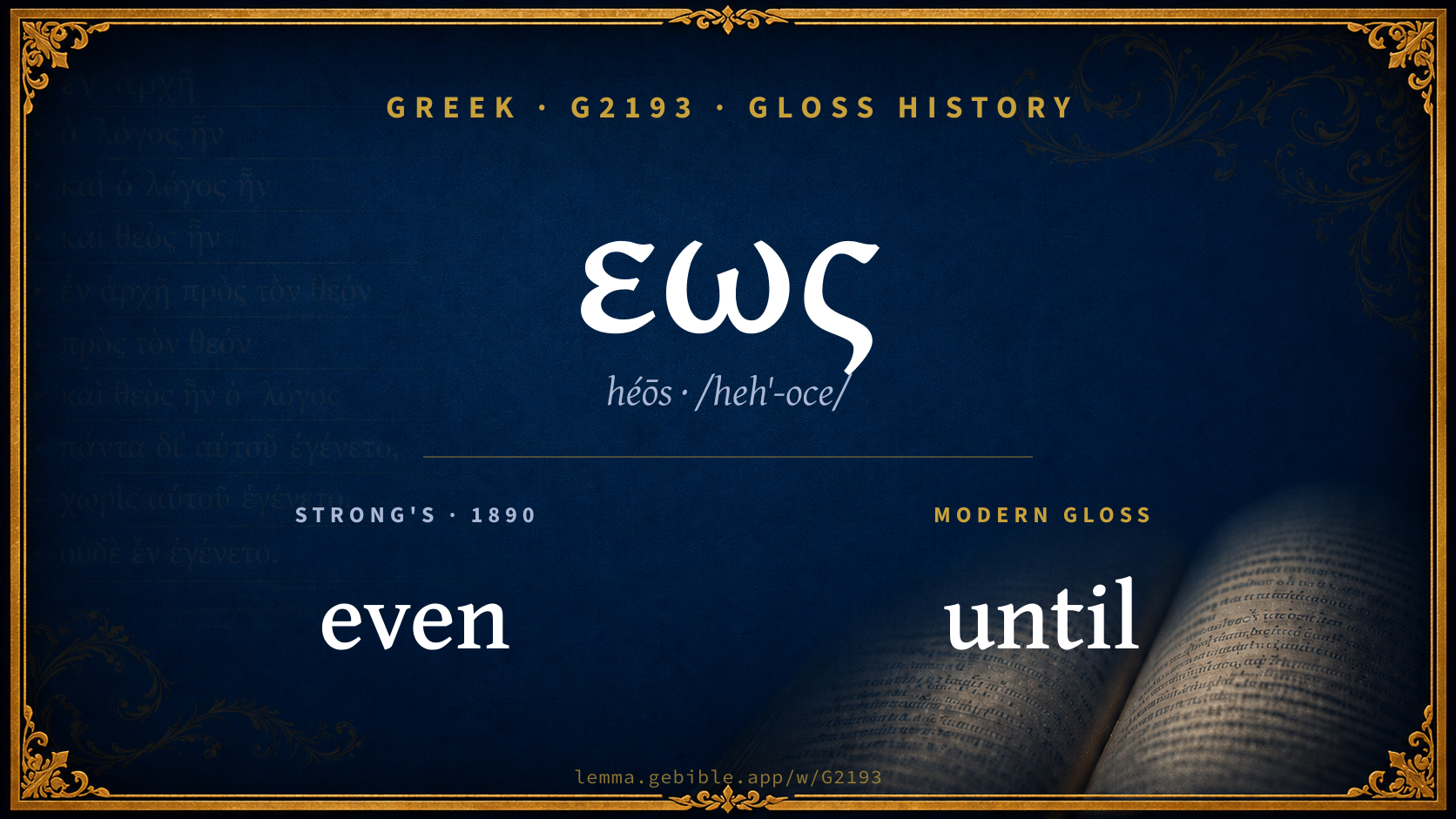
Gloss history
Strong's 1890 vs modern scholarship
About this word
Strong's G2193 catalogs a Greek word from the Greek New Testament.
These counts are not copied from any lexicon or concordance. They are computed here, from the morphology-tagged Greek New Testament. What Lemma adds →
- 136
- distinct verses
- The word appears in 136 distinct verses.
- 15 / 27
- NT books
- The word appears in 15 of 27 New Testament books.
- #112
- by frequency
- Top 250 most frequent Greek words (rank 112 of 5,347 Greek words by occurrence).
View all 136 occurrences in the concordance →
By section of the New Testament
By traditional corpus
Conventional, traditional groupings — biblical authorship is debated, so this is a traditional corpus grouping, not an authorship claim. Some books belong to more than one corpus (Luke is in both the Gospels and the Lukan corpus, and so on), so these shares overlap and need not total 100%. Each figure is a share of the word’s 136 distinct verses.
- Gospels 94 verses · 69%
- Lukan (Luke–Acts) 48 verses · 35%
- Johannine 14 verses · 10%
- Pauline corpus 13 verses · 10%
- Hebrews 3 verses · 2%
- General (Catholic) Epistles 3 verses · 2%
- Revelation 2 verses · 1%
How translations render this word
Counts come from each version’s own published word-to-Strong’s tagging or interlinear alignment — an approximate guide to how each version renders this word, not a word-level alignment the data otherwise carries. Because each total is that version’s own tagged count, the per-version totals vary from one another and need not match the appearance or distinct-verse counts above. These counts may also differ from a printed concordance because Lemma counts each distinctly tagged rendering and does not collapse phrase taggings into a single head-word total. This is a fixed set of word-tagged versions (KJV, ASV, BSB, ULT) and does not change with the reading translation you choose elsewhere. Each version’s license is shown beside its name below (and on Sources).
- King James Version: Till 38×, Until 32×, Unto 30×
- American Standard Version: Until 36×, Unto 31×, Till 29×
- Berean Standard Bible: Until 65×, To 32×, While 7×
- unfoldingWord Literal Text: Until 88×, To 21×, Far as 14×
King James Version Public Domain
Renders G2193 across 142 tagged occurrences — most commonly:
Plus 5 renderings that appear only once — usually multi-word phrases or single function words the recovered tagging swept in, not distinct renderings. Not rendered by a distinct English word in 6 further occurrences.
American Standard Version Public Domain
Renders G2193 across 131 tagged occurrences — most commonly:
Plus 12 renderings that appear only once — usually multi-word phrases or single function words the recovered tagging swept in, not distinct renderings.
Berean Standard Bible Public Domain
Renders G2193 across 133 tagged occurrences — most commonly:
Plus 14 renderings that appear only once — usually multi-word phrases or single function words the recovered tagging swept in, not distinct renderings. Not rendered by a distinct English word in 12 further occurrences.
unfoldingWord Literal Text CC BY-SA 4.0
Renders G2193 across 145 tagged occurrences — most commonly:
Plus 4 renderings that appear only once — usually multi-word phrases or single function words the recovered tagging swept in, not distinct renderings.
Senses in Thayer's
The 1 sense Thayer's distinguishes for this word, in lexicon order (not ranked by frequency or importance). The full entry — with sub-senses — is in the Lexicon Entry tab.
- till, until
Word origin
Origin: of uncertain affinity
Of uncertain affinity; a conjugation preposition and adverb of continuance until (of time and place): - even (until unto) (as) far (as) how long (un-) til (-l) (hither- un- up) to while (-s).
— Strong’s Exhaustive Concordance (1890), public domain.
Septuagint usage
The same Greek word εως appears 1,235 times in the Greek Old Testament (Septuagint), across 1,090 verses in 36 books.
- 1,235
- LXX occurrences
- Tagged occurrences of this Greek word in the Septuagint.
- 1,090
- verses
- Distinct Septuagint verses containing this word.
- 36 / 39
- OT books
- The word appears in 36 of the 39 Old Testament books.
Sample Septuagint occurrences
- Genesis 3:19 ἕως
- Exodus 2:16 ἕως
- Leviticus 6:2 ἕως
- Numbers 3:13 ἕως
- Deuteronomy 1:2 ἕως
- Joshua 1:4 ἕως
- Judges 1:21 ἕως
- Ruth 1:13 ἕως
- 1 Samuel 1:11 ἕως
- 2 Samuel 1:12 ἕως
- 1 Kings 1:4 ἕως
- 2 Kings 2:2 ἕως
Septuagint occurrences (same lexeme)
Every verse where the same Strong’s number (G2193) appears in the Greek Septuagint — showing the first 50 of 1,090. Verse text shown in the World English Bible for context; the Greek form is the matched word — the English is not keyword-highlighted.
- Genesis 3:19 ἕως By the sweat of your face will you eat bread until you return to the ground, for out of it you were taken. For you are dust, and to dust you shall return."
- Genesis 6:7 ἕως Yahweh said, "I will destroy man whom I have created from the surface of the ground; man, along with animals, creeping things, and birds of the sky; for I am sorry that I have made them."
- Genesis 7:23 ἕως Every living thing was destroyed that was on the surface of the ground, including man, cattle, creeping things, and birds of the sky. They were destroyed from the earth. Only Noah was left, and those who were with him in the ark.
- Genesis 8:5 ἕως The waters receded continually until the tenth month. In the tenth month, on the first day of the month, the tops of the mountains were seen.
- Genesis 8:7 ἕως and he sent forth a raven. It went back and forth, until the waters were dried up from off the earth.
- Genesis 8:17 ἕως Bring forth with you every living thing that is with you of all flesh, including birds, cattle, and every creeping thing that creeps on the earth; that they may breed abundantly in the earth, and be fruitful, and multiply on the earth."
- Genesis 10:19 ἕως The border of the Canaanites was from Sidon, as you go toward Gerar, to Gaza; as you go toward Sodom, Gomorrah, Admah, and Zeboiim, to Lasha.
- Genesis 10:30 ἕως Their dwelling was from Mesha, as you go toward Sephar, the mountain of the east.
- Genesis 11:4 ἕως They said, "Come, let's build us a city, and a tower, whose top reaches to the sky, and let's make us a name; lest we be scattered abroad on the surface of the whole earth."
- Genesis 11:31 ἕως Terah took Abram his son, Lot the son of Haran, his son's son, and Sarai his daughter-in-law, his son Abram's wife. They went forth from Ur of the Chaldees, to go into the land of Canaan. They came to Haran, and lived there.
- Genesis 12:6 ἕως Abram passed through the land to the place of Shechem, to the oak of Moreh. The Canaanite was then in the land.
- Genesis 13:3 ἕως He went on his journeys from the South even to Bethel, to the place where his tent had been at the beginning, between Bethel and Ai,
- Genesis 13:10 ἕως Lot lifted up his eyes, and saw all the plain of the Jordan, that it was well watered every where, before Yahweh destroyed Sodom and Gomorrah, like the garden of Yahweh, like the land of Egypt, as you go to Zoar.
- Genesis 13:15 ἕως for all the land which you see, I will give to you, and to your offspring forever.
- Genesis 14:6 ἕως and the Horites in their Mount Seir, to Elparan, which is by the wilderness.
- Genesis 14:14 ἕως When Abram heard that his relative was taken captive, he led forth his trained men, born in his house, three hundred and eighteen, and pursued as far as Dan.
- Genesis 14:15 ἕως He divided himself against them by night, he and his servants, and struck them, and pursued them to Hobah, which is on the left hand of Damascus.
- Genesis 14:23 ἕως that I will not take a thread nor a shoe-latchet nor anything that is yours, lest you should say, 'I have made Abram rich.'
- Genesis 15:16 ἕως In the fourth generation they will come here again, for the iniquity of the Amorite is not yet full."
- Genesis 15:18 ἕως In that day Yahweh made a covenant with Abram, saying, "To your seed have I given this land, from the river of Egypt to the great river, the river Euphrates:
- Genesis 18:12 ἕως Sarah laughed within herself, saying, "After I have grown old will I have pleasure, my lord being old also?"
- Genesis 19:4 ἕως But before they lay down, the men of the city, the men of Sodom, surrounded the house, both young and old, all the people from every quarter.
- Genesis 19:11 ἕως They struck the men who were at the door of the house with blindness, both small and great, so that they wearied themselves to find the door.
- Genesis 19:22 ἕως Hurry, escape there, for I can't do anything until you get there." Therefore the name of the city was called Zoar.
- Genesis 19:37 ἕως The firstborn bore a son, and named him Moab. The same is the father of the Moabites to this day.
- Genesis 19:38 ἕως The younger also bore a son, and called his name Ben Ammi. The same is the father of the children of Ammon to this day.
- Genesis 22:5 ἕως Abraham said to his young men, "Stay here with the donkey. The boy and I will go yonder. We will worship, and come back to you.
- Genesis 24:14 ἕως Let it happen, that the young lady to whom I will say, 'Please let down your pitcher, that I may drink.' She will say, 'Drink, and I will also give your camels a drink.' Let the same be she who you have appointed for your servant Isaac. Thereby will I know that you have shown kindness to my master."
- Genesis 24:19 ἕως When she had done giving him drink, she said, "I will also draw for your camels, until they have done drinking."
- Genesis 24:33 ἕως Food was set before him to eat. But he said, "I will not eat until I have told my message." He said, "Speak on."
- Genesis 25:18 ἕως They lived from Havilah to Shur that is before Egypt, as you go toward Assyria. He lived opposite all his relatives.
- Genesis 26:13 ἕως The man grew great, and grew more and more until he became very great.
- Genesis 26:33 ἕως He called it Shibah. Therefore the name of the city is Beersheba to this day.
- Genesis 27:44 ἕως Stay with him a few days, until your brother's fury turns away;
- Genesis 28:15 ἕως Behold, I am with you, and will keep you, wherever you go, and will bring you again into this land. For I will not leave you, until I have done that which I have spoken of to you."
- Genesis 29:8 ἕως They said, "We can't, until all the flocks are gathered together, and they roll the stone from the well's mouth. Then we water the sheep."
- Genesis 32:5 ἕως I have oxen, donkeys, flocks, men-servants, and maid-servants. I have sent to tell my lord, that I may find favor in your sight.'"
- Genesis 32:25 ἕως When he saw that he didn't prevail against him, he touched the hollow of his thigh, and the hollow of Jacob's thigh was strained, as he wrestled.
- Genesis 32:33 ἕως
- Genesis 33:3 ἕως He himself passed over in front of them, and bowed himself to the ground seven times, until he came near to his brother.
- Genesis 33:14 ἕως Please let my lord pass over before his servant: and I will lead on gently, according to the pace of the cattle that are before me and according to the pace of the children, until I come to my lord to Seir."
- Genesis 34:5 ἕως Now Jacob heard that he had defiled Dinah, his daughter; and his sons were with his cattle in the field. Jacob held his peace until they came.
- Genesis 35:4 ἕως They gave to Jacob all the foreign gods which were in their hands, and the rings which were in their ears; and Jacob hid them under the oak which was by Shechem.
- Genesis 35:20 ἕως Jacob set up a pillar on her grave. The same is the Pillar of Rachel's grave to this day.
- Genesis 38:1 ἕως It happened at that time, that Judah went down from his brothers, and visited a certain Adullamite, whose name was Hirah.
- Genesis 38:11 ἕως Then Judah said to Tamar, his daughter-in-law, "Remain a widow in your father's house, until Shelah, my son, is grown up;" for he said, "Lest he also die, like his brothers." Tamar went and lived in her father's house.
- Genesis 38:17 ἕως He said, "I will send you a kid of the goats from the flock." She said, "Will you give me a pledge, until you send it?"
- Genesis 39:16 ἕως She laid up his garment by her, until his master came home.
- Genesis 41:49 ἕως Joseph laid up grain as the sand of the sea, very much, until he stopped counting, for it was without number.
- Genesis 42:16 ἕως Send one of you, and let him get your brother, and you shall be bound, that your words may be tested, whether there is truth in you, or else by the life of Pharaoh surely you are spies."
These are occurrences of the same Greek lexeme (G2193) in the Septuagint — not a translation of any one Hebrew word. The store carries no word-level Hebrew↔Greek alignment, so no Hebrew original is asserted here. Counts come from the recovered LXX Strong's tagging — high-frequency vocabulary is well covered, while rare or late forms may be untagged — so they reflect tagged occurrences and may slightly undercount.