1 John 2:9

Greek (Tischendorf 8th ed.) 1 John 2:9 appears in the Greek New Testament. The text above is from the Tischendorf 8th edition. Each word links to its Strong’s number and a concise gloss. Click any word for its full Thayer’s Greek Lexicon entry.
Download image
Cite this verse

1 John 2:9 (World English Bible). Public Domain. Lemma interlinear Bible study tool, https://lemma.gebible.app/v/1-john/2/9.

Show BibTeX & RIS
BibTeX
RIS
English Translation
He who says he is in the light and hates his brother, is in the darkness even until now.
World English Bible · Public Domain
Download a study sheet

One document with this verse’s original text, its word-by-word gloss line, the meaning frame, cross-references with their text, attributed commentary, and full source and license credits — printable, and it pastes into notes with its structure intact.

This verse Autodidact and up

Study sheet (.html) Plain text (.txt)

A passage Seminary Student

Up to 50 verses in one chapter. A passage sheet keeps up to 6 commentary sources and 12 cross-references per verse, in the order this page ranks them, and says so on the sheet whenever that leaves anything out. Ask for a single verse and you get the Autodidact verse sheet above.

Everything on this page stays free to read, with no account — the sheet is a download of what is already on screen, not access to it.

Want to remove ads? Support Godless Engineer
Compare translations 3

The same verse in 3 English versions, stacked beneath the original-language interlinear above. Click any original word for its lexicon entry.

Each is an independent rendering of the whole verse — the interlinear is not word-aligned to these translations.

Highlighted words mark where these versions differ — a whole-verse word diff, not a word-by-word alignment.

  • World English Bible Public Domain
    He who says he is in the light and hates his brother, is in the darkness even until now.
  • King James Version Public Domain
    He that saith he is in the light, and hateth his brother, is in darkness even until now.
  • unfoldingWord Literal Text CC BY-SA 4.0
    The one saying he is in the light and hating his brother is in the darkness until now.

unfoldingWord Literal Text — © unfoldingWord, licensed CC BY-SA 4.0. Word-aligned USFM3 via Door43 (git.door43.org/unfoldingWord/en_ult).

Versions to compare (up to 4)

3 of 4 selected

Show all 19 translations

Every available English version of this verse, each an independent rendering of the whole verse.

  • World English Bible Public Domain
    He who says he is in the light and hates his brother, is in the darkness even until now.
  • Berean Standard Bible Public Domain
    If anyone claims to be in the light but hates his brother, he is still in the darkness.
  • Majority Standard Bible Public Domain
    If anyone claims to be in the light but hates his brother, he is still in the darkness.
  • King James Version Public Domain
    He that saith he is in the light, and hateth his brother, is in darkness even until now.
  • American Standard Version (1901) Public Domain
    He that saith he is in the light and hateth his brother, is in the darkness even until now.
  • Revised Version (1885) Public Domain
    He that saith he is in the light, and hateth his brother, is in the darkness even until now.
  • Geneva Bible (1599) Public Domain
    He that saith that hee is in that light, and hateth his brother, is in darkenes, vntill this time.
  • Douay-Rheims (1899) Public Domain
    He that saith he is in the light, and hateth his brother, is in darkness even until now.
  • Young's Literal Translation Public Domain
    he who is saying, in the light he is, and his brother is hating, in the darkness he is till now;
  • Literal Standard Version CC BY-SA 4.0
    he who is saying he is in the light, and is hating his brother, he is in the darkness until now;
  • Unlocked Literal Bible CC BY-SA 4.0
    The one who says that he is in the light and hates his brother is in the darkness until now.
  • unfoldingWord Literal Text CC BY-SA 4.0
    The one saying he is in the light and hating his brother is in the darkness until now.
  • Darby Bible Public Domain
    He who says he is in the light, and hates his brother, is in the darkness until now.
  • World Messianic Bible Public Domain
    He who says he is in the light and hates his brother is in the darkness even until now.
  • Webster's Bible Public Domain
    He that saith he is in the light, and hateth his brother, is in darkness even until now.
  • Free Bible Version CC BY-SA 4.0
    Those who say they live in the light but hate a fellow Christian still have the darkness inside them.
  • Bible in Basic English Public Domain
    He who says that he is in the light, and has hate in his heart for his brother, is still in the dark.
  • Text-Critical English NT CC BY 4.0
    Whoever says he is in the light but hates his brother is still in the darkness.
  • Tyndale New Testament (1534) Public Domain
    He that sayth how that he is in the light and yet hateth his brother is in darknes even vntyll this tyme.

Literal Standard Version (2020), Covenant Press — licensed CC BY-SA 4.0. Text via the HelloAO Bible API (eBible.org). Unlocked Literal Bible (unfoldingWord) — licensed CC BY-SA 4.0. Text via the HelloAO Bible API (eBible.org). unfoldingWord Literal Text — © unfoldingWord, licensed CC BY-SA 4.0. Word-aligned USFM3 via Door43 (git.door43.org/unfoldingWord/en_ult). Free Bible Version, Dr. Jonathan Gallagher — licensed CC BY-SA 4.0. Text via the HelloAO Bible API (eBible.org).

Word by word

More ways to search: Search by grammar → Find every occurrence → Compare this word →

Practice this passage: Drill this verse → Learn its vocabulary →

σκοτίᾳ
skotía
G4653
“darkness”
Noun, Dative, Singular, Feminine
Part of Speech
Noun
Case
Dative
Number
Singular
Gender
Feminine
Full Thayer's Definition

Origin: from G4655

TDNT: 14:03,1

1. darkness 2. the darkness due to want of light 3. metaph. used of ignorance of divine things, and its associated wickedness, and the resultant misery in hell
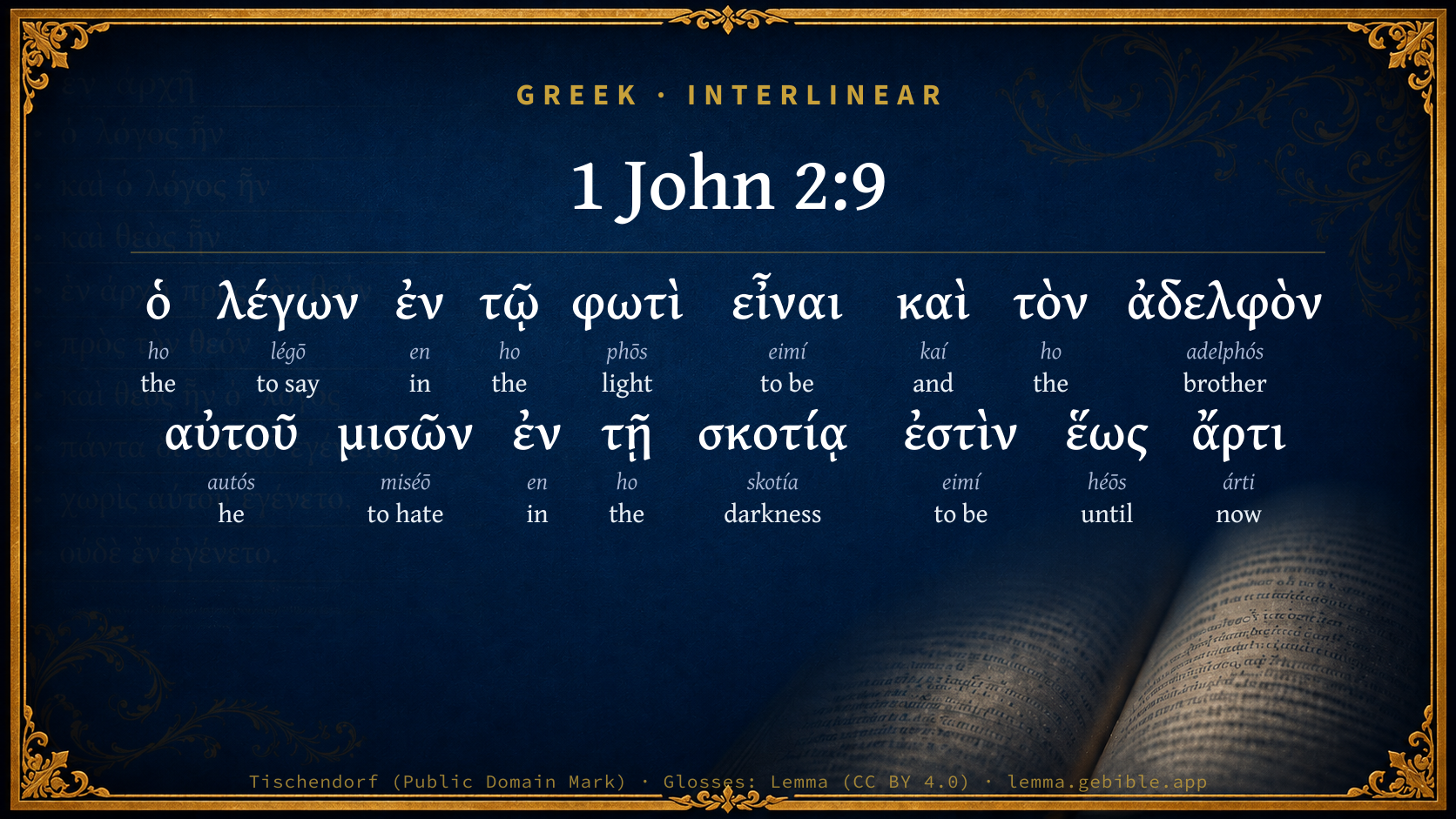
  1. ὁ ho G3588 “the” Article, Nominative, Singular, Masculine
  2. λέγων légō G3004 “to say” Verb, Present, Active, Participle, Nominative, Singular, Masculine
  3. ἐν en G1722 “in” Preposition
  4. τῷ ho G3588 “the” Article, Dative, Singular, Neuter
  5. φωτὶ phōs G5457 “light” Noun, Dative, Singular, Neuter
  6. εἶναι eimí G1510 “to be” Verb, Present, Active, Infinitive
  7. καὶ kaí G2532 “and” Conjunction
  8. τὸν ho G3588 “the” Article, Accusative, Singular, Masculine
  9. ἀδελφὸν adelphós G80 “brother” Noun, Accusative, Singular, Masculine
  10. αὐτοῦ autós G846 “he” Personal pronoun, Genitive, Singular, Masculine
  11. μισῶν miséō G3404 “to hate” Verb, Present, Active, Participle, Nominative, Singular, Masculine
  12. ἐν en G1722 “in” Preposition
  13. τῇ ho G3588 “the” Article, Dative, Singular, Feminine
  14. ἐστὶν eimí G1510 “to be” Verb, Present, Active, Indicative, 3rd person, Singular
  15. ἕως héōs G2193 “until” Adverb
  16. ἄρτι árti G737 “now” Adverb

About this verse

These counts appear in no published source. They are computed here, from the morphology-tagged text and Lemma’s own curated glosses. What Lemma adds →

17
words
12
distinct lemmas
General Epistles
section

Notable vocabulary

The rarest word here is σκοτίᾳ darkness G4653 — appearing just 16 times in the whole Greek New Testament.

Shared distinctive vocabulary

σκοτίᾳ darkness G4653 occurs in 12 verses of the Greek New Testament. Also found in:

Repetition

Words recur within this verse:

Cross-references

10

Topical passages linked to 1 John 2:9 in the Treasury of Scripture Knowledge — connected by theme and wording, ordered by reader-vote popularity; previews shown in the World English Bible.

  • 1 John 4:20 If a man says, "I love God," and hates his brother, he is a liar; for he who doesn't love his brother whom he has seen, how can he love God whom he has not seen?
  • 1 John 2:11 But he who hates his brother is in the darkness, and walks in the darkness, and doesn't know where he is going, because the darkness has blinded his eyes.
  • 1 John 3:13–17 Don't be surprised, my brothers, if the world hates you.
  • Psalms 82:5 They don't know, neither do they understand. They walk back and forth in darkness. All the foundations of the earth are shaken.
  • 1 Corinthians 13:1–3 If I speak with the languages of men and of angels, but don't have love, I have become sounding brass, or a clanging cymbal.
  • 2 Peter 1:9 For he who lacks these things is blind, seeing only what is near, having forgotten the cleansing from his old sins.
  • 1 John 2:4 One who says, "I know him," and doesn't keep his commandments, is a liar, and the truth isn't in him.
  • 1 John 1:6 If we say that we have fellowship with him and walk in the darkness, we lie, and don't tell the truth.
  • John 9:41 Jesus said to them, "If you were blind, you would have no sin; but now you say, 'We see.' Therefore your sin remains.
  • Romans 2:18–21 and know his will, and approve the things that are excellent, being instructed out of the law,

Cross-references courtesy of OpenBible.info (CC BY 4.0).

Commentary

Notes on 1 John 2:9 from classic Christian and Jewish commentators (each source and its license shown beneath its notes). The classic Christian expositions comment on the surrounding passage and are grouped to its opening verse, so a note may address several verses; the Jewish commentaries on the Tanakh (Rashi and others) are per-verse, so they appear only where the commentator wrote on this verse.

Lemma curates 59 commentaries, every one of them public domain or Creative Commons licensed, each selected and text-cleaned for this edition rather than reprinted as found. About our sources →

Ellicott's Commentary for English Readers

(6) Here (1Jn_2:9-11) is the chief way in which the old commandment, the new commandment, the word from the beginning, the walk in light would be manifested: brotherly love towards those with whom we have fellowship in Jesus Christ, God’s Son. And as He, by being the propitiation for the sins of the whole world, had declared the universality of God’s family and kingdom, so the sympathy of believers would extend in different degrees as far as the whole human race; to those first who were conscious of the same hopes as themselves; to those next who might be brought to share them; to those, perhaps, in a less degree, who in every nation feared God and worked righteousness without knowing the Saviour personally; and so on, finally, to all who did not wilfully excommunicate themselves. But the brotherly love would be chiefly amongst Christian friends, else it would be diffused into nothingness.

(9) He that saith . . .—The whole history of religious rancour has been a deplorable illustration of these words. Controversy for principles honestly and reasonably held is one thing: prejudice, spite, private censures and condemnations, harsh words, suspicions, jealousies, misunderstandings and misrepresentations are the chief props of the kingdom of darkness among Christian churches and nations. (Comp. Joh_13:34; Joh_15:12; 1Co_13:2; 1Pe_1:22; 2Pe_1:7-9.)

Hateth means not merely the absence of love, but the presence, in ever so small a degree, of dislike or any of the feelings already described, or those kindred to them.

(10) He that loveth.—From the associations connected with love in poetry and romance this saying sounds strange. But all such love is tinged with passion, and the desire of satisfying some personal lack; this is the pure disinterested seeking for another’s welfare, of which Christ was the great example. It is that which the modern scientific non-Christian world is trying to make its religion; but without the Christian motive, and cultivated for its own sake instead of by the working of the Spirit of God, it seems artificial and powerless.

Occasion of stumbling.—Stumbling - blok. (Comp. Isa_8:14; Isa_28:16; Psa_119:165; Joh_11:9-10; Rom_9:33; Rom_14:13; 1Co_1:23; 1Pe_2:7.) When love such as Christ’s is the ruling principle of life, then the stumbling-blocks of human nature are removed—such as impurity, pride, selfishness, anger, envy, suspicion, unsympathetic coldness, censoriousness.

(11) But he that hateth.—1Jn_2:10 was an antithesis to 1Jn_2:9; 1Jn_2:11 is, after St. John’s manner, an antithesis again to 1Jn_2:10, putting the matter of 1Jn_2:9 more strongly and fully, and forcibly concluding the section which describes the walk in the light.

Walketh in darkness.—This describes the acts of the man whose selfishness or other sins interfere with his love. Such are all insisting upon class distinctions; all ambitions, political, social, or personal; everything that savours of shrinking from “in honour preferring one another.”

Knoweth not whither he goeth.—This refers to the “occasion of stumbling” in 1Jn_2:10. He is sure to stumble; is like a blind man groping his way among pitfalls; has all the snares of human nature within him. (Comp. Isa_6:9 et seq.; Mat_13:14 et seq.; Joh_12:40; Act_28:26; 2Co_4:4.)

Hath blinded.—Just as it is we ourselves who make the gate strait and the way narrow, so it is our own fault if the darkness settles down on our eyes.

A Bible Commentary for English Readers, edited by Charles John Ellicott (1878–1897) — public domain. Text from a community e-Sword module.

The Cambridge Bible for Schools and Colleges

gen. ed. J. J. S. Perowne

9. For the fifth time the Apostle indicates a possible inconsistency of a very gross kind between profession and conduct (1Jn_1:6; 1Jn_1:8; 1Jn_1:10, 1Jn_2:4). We shall have a sixth in 1Jn_4:20. In most of these passages he is aiming at some of the Gnostic teaching already prevalent. And this introduces a fresh pair of contrasts. We have had light and darkness, truth and falsehood; we now have love and hate.

his brother] Does this mean ‘his fellow-Christian’ or ‘his fellow-man’, whether Christian or not? The common meaning in N.T. is the former; and though there are passages where ‘brother’ seems to have the wider signification, e.g. Mat_5:22; Luk_6:41; Jas_4:11, yet even here the spiritual bond of brotherhood is perhaps in the background. In S. John’s writings, where it does not mean actual relationship, it seems generally if not universally to mean ‘Christians’: not that other members of the human race are excluded, but they are not under consideration. Just as in the allegories of the Fold and of the Good Shepherd, nothing is said about goats, and in that of the Vine nothing is said about the branches of other trees; so here in the great family of the Father nothing is said about those who do not know Him. They are not shut out, but they are not definitely included. In this Epistle this passage, 1Jn_3:10; 1Jn_3:14-17 and 1Jn_4:20-21, are somewhat open to doubt: but 1Jn_5:1-2 seems very distinctly in favour of the more limited meaning; and in 1Jn_5:16 the sinning ‘brother’ is certainly a fellow-Christian. In 2 John the word does not occur: 3Jn_1:3; 3Jn_1:5; 3Jn_1:10 confirm the view here taken. In the Gospel the word is generally used of actual relationship: but in the two passages where it is used otherwise it means Christians: in Joh_20:17, Christ speaks of the disciples as ‘My brethren’, and in Joh_21:23, Christians are called ‘the brethren’. In the Apocalypse, omitting Rev_22:9 as doubtful, all the passages where the word occurs require the meaning ‘Christian’ (1Jn_1:9, Joh_6:11, Joh_12:10, Joh_19:10). Note that throughout this Epistle the singular is used; ‘his brother’, not ‘his brethren’.

is in darkness even until now] Or, as in 1Jn_1:6, in order to bring out the full contrast with the light, is in the darkness. ‘Even until now’, i.e. in spite of the light which ‘is already shining’, and of which he has so little real experience that he believes light and hatred to be compatible. Years before this S. Paul had declared (1Co_13:2), ‘If I have the gift of prophecy, and know all mysteries and all knowledge, … but have not love, I am nothing.’ The light in a man is darkness until it is warmed by love. The convert from heathendom who professes Christianity and hates his brother, says S. Augustine, is in darkness even until now. “There is no need to expound; but to rejoice if it be not so, to bewail, if it be.” The word for ‘now’ (ἄρτι) is specially frequent in S. John’s Gospel: it indicates the present moment not absolutely, but in relation to the past or the future. The peculiar combination, ‘even until now’ (ἕως ἄρτι) occurs Joh_2:10; Joh_5:17; Joh_16:24; Mat_11:12; 1Co_4:13; 1Co_8:7; 1Co_15:6, a fact much obscured in A.V. by the variety of renderings; ‘until now’, ‘hitherto’, ‘unto this day’, ‘unto this hour’, ‘unto this present’.

9–11. The form of these three verses is similar to that of 1Jn_2:3-5, and still more so to 1Jn_1:8-10. In each of these three triplets a case is placed between two statements of the opposite to it; confession of sin, obedience, and love, between two statements of denial of sin, disobedience, and hate. But in none of the triplets do we go from one opposite to the other and back again: in each case the side from which we start is restated in such a way as to constitute a distinct advance upon the original position. There is no weak tautology or barren see-saw. The emphasis grows and is marked by the increase in the predicates. In 1Jn_2:9 we have one; ‘is in darkness even until now’; in 1Jn_2:10, two; ‘abideth in the light, and there is none, &c.’; in 1Jn_2:11, three; ‘is in the darkness, and walketh &c., and knoweth not &c.’.

The Cambridge Bible for Schools and Colleges (gen. ed. J. J. S. Perowne; Cambridge University Press, 1878–1918) — public domain. Text from a community e-Sword module.

The Biblical Illustrator

Joseph S. Exell

1Jn_2:9-11

He that … hateth his brother is in darkness

Brotherly love a test and means of being and abiding with guileless spirit in the light instead of walking in darkness

I.

Brotherly love consists in this--that they in whom, as in Christ, this thing is true, that the darkness is passing and the true light is shining, recognise one another as, in that character and on that account, brethren. For, first, in Christ, our position with reference to that darkness is changed from what it naturally is. It is reversed. The terrible flood is not now carrying us away; we stem it holding Him--He holding us. We see it passing. Now all is changed. By grace in Christ I am in a new way. As I feebly open my heavy eyes in the upper atmosphere I am now beginning to breathe, what bright warm beam is that which lightens up the face of Him in whose arms I am, and lightens up my heart as I look and gaze on Him and cling and grow to Him? It is the Father loving me as He loveth Him. It is the darkness passing and the true light now shining. Then, as the first confused and rapturous joy of my own narrow escape becomes collected and calm, I look around. And I see Him--for He multiplies Himself and is everywhere--I see Him doing the same kind office to one, and another, and another still, that He is doing to me, I see Him embracing them because He loved them and gave Himself for them. Shall I not hail them as my brethren? Can I hate, or refuse to love, one who is my brother on such a footing as that?

II. Hence it is that the existence of this brotherly love is a fitting test of our being in the light. At all events, the absence of it is conclusive proof that we are not. Light is in itself--in its very nature and bare shining--a great extinguisher of hatred, especially of hatred among those who should be brethren. It is in the darkness that mistakes occur and misunderstandings arise. It is in the darkness that injuries are brooded over and angry passions nursed. If you, brother, and I, are at variance, it is almost certain to be because there is some darkness about us that hinders us from seeing one another clearly. Hence we imagine evil of one another and impute evil to one another. Let in the light. Let us see one another clearly. Differences between us may still remain; our views of many things may be wide as the poles asunder. But we see that we are men of like passions and like affections with one another. The light shows us that we are true brethren in spite of all.

III. The exercise of brotherly love is fitted to be the means of our continuing in the light, So as to avoid the risk of falling (1Jn_2:10). Two benefits are here. First, positively, by means of brotherly love we abide in the light. The law of action and reaction is here very noticeable. Being in the light begets brotherly love, and brotherly love secures abiding in the light. For this brotherly love is simply love to the true light, as I see it shining in my brother as it shines in Christ. And such love to the true light, wherever and in whomsoever it is seen shining as it shines in Christ, must needs cause me to grow up more and more into the true light myself; to grow up into Christ and God in Christ. Secondly, there is none occasion of stumbling in Him. This is a negative advantage; but it is great. Saved yourselves by grace, gratuitous and rich and full; loved with an everlasting love; grasped in the arms, in the bosom, of Him in whom and in you, as now one, the darkness is passing and the true light is now shining--your spirit is free, your heart enlarged. Being loved, you love. The scales of selfishness fall from off your eyes. Christ sends you to His brethren: Go tell My brethren. And as you go to them with Christs message and on Christs errand, and make them more and more your brethren as they are His, you clearly see your way. He makes it clear. And you walk at liberty when you have respect to all His commandments, loving your brother, and so abiding in the light. (R. S. Candlish, D. D.)

He that loveth his brother abideth in the light--

Moral darkness

Note the solemn and picturesque eloquence of the accessional parallelism in this verse. The inner condition of him who hates his brother--is in darkness; the outward life--walketh in darkness (Psa_82:5; Ecc_2:14). He has lost his point of orientation--he knoweth not whither he goeth, to what unsurmised guilt and punishment. Something follows, worse than darkness above--the darkness has not only blinded him, but blinded his very eyes once for all. He has lost the very faculty of sight! Could the apostle have thought of creatures who, in dark caverns, not only lose the faculty of sight, but have the visive organs atrophied? Tennyson has presentedthe same image, applying it, however, not to sin, but to sorrow--

But the night has crept into my heart,

And begun to darken my eyes.

(Abp. Wm. Alexander.)

Hatred causes stumbling

He who hates his brother stumbles against himself and everything within and without; he who loves has an unimpeded path. (A. J. Bechtel.)

The Biblical Illustrator, edited by Joseph S. Exell (c. 1880s–1900s) — public domain. Text from a community e-Sword module.

Joseph Benson's Commentary

1Jn 2:9-11. He that saith he is in the light — In Christ; united to him, and truly enlightened by the gospel and the grace of God; and yet hateth his brother — (The very name shows the love due to him;) is in darkness until now — Void of Christ, and of all true light. He that loveth his brother — See 1Jn 3:14; abideth in the light — Thereby shows that he possesses the saving knowledge of God and of Christ, and that he is truly enlightened with the doctrine of the gospel. And there is none occasion of stumbling in him — He walks so as neither to give nor take offence. The apostle alludes here to Christ’s words, (Joh 11:9,) If any one walk in the day he doth not stumble, &c. By expelling ill-will, pride, anger, immoderate selfishness, and all other evil passions, which are occasions of sin, love removes every stumbling-block lying in our way, and enables us to do our duty to our brethren in Christ, or to mankind in general, with ease and pleasure. But he that hateth his brother — And he must hate if he does not love him; there is no medium; is in darkness — In a state of spiritual blindness, of sin, perplexity, and entanglement. For his malevolence blinds his reason to such a degree that he does not see what is right, and it extinguishes every virtuous inclination which would lead him to practise what in right, and puts him wholly under the power of bad passions; so that, in this darkness, he is in danger not only of stumbling, but of destroying himself; not knowing whither he goeth — Whether to heaven or hell, or how near he is to destruction; while he that loves his brother has a free, disencumbered journey.

Joseph Benson's Commentary on the Old and New Testaments (1811–1818) — public domain. Text from a community e-Sword module.

Whedon's Commentary on the Bible

Daniel D. Whedon

9. The 1Jn_2:9-11 are a resumption of the thread of thought from 1Jn_2:6, after the parenthetic 7, 8.

In the light—Namely, the true light of the last verse, Jesus the propitiator. It is under the imagery of light and darkness, now, (in 9-11,) that the antithesis between the Christian and the errorist is presented. The light is the emblem of truth and purity blended in one; the darkness is the unity of error and sin.

Hateth his brother—His brother, in the various degrees in which that title can be applied to his fellow-man. Love of various degrees and kinds is due to the brother in each sense, as fellow-believer, as child of the same human parent, as child of the same all-Father. As John is expounding the fellowship of the believer with Christ and God, it is in the first sense that the word brother is here primarily used.

In darkness—Destitute of the divine light and love. He is spiritually dark and cold.

Until now—How much soever he may have professed to be in the light.

10, 11, restate strongly the antithesis between fraternal love and hatred, presenting it as the prominent test of our moral condition.

Daniel D. Whedon (gen. ed.), Commentary on the Old and New Testaments (1874–1909) — public domain. Text from a community e-Sword module.

Tyndale Open Study Notes

Tyndale Open Resources

2:9-11 Another indication of truly knowing Christ is one’s treatment of other Christians. John is again pointing to those who claim to be spiritually enlightened but separate themselves from other Christians with an attitude of superiority. John defines such an attitude as hatred.

2:9 a fellow believer: Literally his brother. The Greek word adelphos (also in 2:11) is a generic term often used to refer to both male and female members of the same family.

Tyndale Open Study Notes — © Tyndale Open Resources, licensed CC BY-SA 4.0. Text via the HelloAO Bible API.

Bengel's Gnomon

Johann Albrecht Bengel

1Jn 2:9. Ἐν τῷ φωτὶ, in the light) as it were in his own element. Thus in, 1Jn 2:11.—ἀδελφὸν, a brother) a believer: 3Jn 1:3; 3Jn 1:5; 3Jn 1:10. The very title contains the cause of love.

Bengel's Gnomon of the New Testament — English translation (T&T Clark, Edinburgh, 1860) — public domain. Text from a community e-Sword module.

Meyer's Critical & Exegetical Commentary

Heinrich August Wilhelm Meyer

1Jn_2:9-11. Further definition of the life of light as life in love.1Jn_2:9. ὁ λέγων] the same form as in 1Jn_2:4, to which the structure of the whole verse is very similar. ἐν τῷ φωτὶ εἶναι] stands in close relation to what immediately precedes; although he alone is in the light who lives in fellowship with Christ, and belongs to the church of Christ, yet τὸ φῶς describes neither Christ Himself (Spener, etc.) nor the church, as the sphere within which the light has operated as illuminating power (Ebrard). Chap. 1Jn_1:6-7 may be compared.

In contrast with teal καὶ τὸν ἀδελφὸν αὐτοῦ μισῶν is 1Jn_2:10, ὁ ἀγαπῶν ἀδ. αὐτοῦ, in which the apostle states the substance of the τηρεῖν τὸν λόγον τοῦ Θεοῦ after the example of Christ. As φῶς and σκοτία, so μισεῖν τ. ἀδ. and ἀγαπᾶν τ. ἀδ. exclude each other; they are tendencies diametrically opposed to one another; human action belongs either to the one or to the other; that which does not belong to the sphere of the one falls into that of the other; Bengel: ubi non est amor, odium est: cor non est vacuum. Here also John speaks absolutely, without taking into consideration the imperfect state of the Christian, as is seen in the hesitations between love and hatred.

τὸν ἀδελφόν Grotius interprets: sive Judaeum, sive aliegenam; fratres omnes in Adamo sumus; similarly Calov, J. Lange, etc.; by far the greatest number of commentators understand thereby fellow-Christians. Apart from its exact meaning and the wider meaning = brethren of the same nation (Act_23:1; Heb_7:5), ἀδελφός is used in the N. T. generally, in Acts and in the Pauline Epistles always, to denote Christians; but in many passages it is also = ὁ πλησίον or ὁ ἕτερος; thus in Mat_5:22 ff; Mat_7:3 ff; Mat_18:35; Luk_6:41 ff.; Jam_4:11-12 (in Mat_5:47 it describes our friendly neighbour). In the Gospel of John it is only used in the sense of relationship, except in chap. Joh_20:17, where Christ calls His μαθηταί οἱ ἀδελφοί μου, and in Joh_21:23, where οἱ ἀδ. is a name of Christians. If, therefore, according to the usus loquendi of the N. T., ὁ ἀδελφός may certainly be = ὁ πλησίον, yet in the Epistles of John, according to chap. 1Jn_3:11 (comp. Gospel of Joh_13:34; Joh_15:12; besides, especially with chap. 1Jn_3:16, comp. Gospel of Joh_15:13; there: ὑπὲρ τῶν ἀδελφῶν τὰς ψυχὰς τιθέναι; here: ὑπὲρ τῶν φίλων αὐτοῦ), and according to chap. 1Jn_5:1 (where the ἀδ. is specifically called a γεγεννημένος ἐκ τοῦ Θεοῦ), we must understand by it the Christian brother; so that John, therefore, is speaking, not of the general love towards men, but of the special relationship of Christians to one another; comp. the distinction in 2Pe_1:7; Gal_6:10.

ἕως ἄρτι] until now, refers back to ἤδη, 1Jn_2:9; the meaning is: although the darkness is already shining, such an one is nevertheless still (adhuc) in darkness; on this peculiarly N. T. expression, see Winer, p. 418, VII. p. 439; A. Buttmann, p. 275; there is no reason for supplying even if he were a long time a Christian (Ewald). With the ἐν τ. σκ. ἐστίν is contrasted, 1Jn_2:10 : ἐν τῷ φωτὶ μένει; see on this 1Jn_2:6.[117] That the exercise of brotherly love is itself a means of strengthening the new life (Ebrard), is not contained in the idea μένει. Even if the idea of 1Jn_2:10in relation to that of the 9th verseis brought out more distinctly by ΜΈΝΕΙ, this is much more done by the words: ΚΑῚ ΣΚΆΝΔΑΛΟΝ ἘΝ ΑὐΤῷ ΟὐΚ ἜΣΤΙΝ. ΣΚΆΝΔΑΛΟΝ appears in the N. T. only in the ethical signification = offence, i.e. that which entices and tempts to sin; in the case of ἐν αὐτῷ, the preposition ἘΝ is generally either left unnoticed by the commentators (Grotius says, appealing to Psalms 119 : est metonymia et ἘΝ abundat. Sensus: ille non impingit) or changed in meaning; de Wette: in his case (for him) there is no stumbling; comp. Joh_11:9 ff.; similarly Baumgarten-Crusius, Neander, etc.; Lücke even says: ἐν αὐτῷ can here only signify the outer circle of life, because the ΣΚΆΝΔΑΛΑ for the Christian lie in the world, and not in him; with him Sander agrees. For such changes there is no ground, since in the usage of the word the figure (the snare, or rather the wood that falls in the snare) has quite given place to the thing, and it is therefore unnecessary to say, with Düsterdieck, that in the expression ἘΝ ΑὐΤῷ the thing itself penetrates into the otherwise figurative form of speech; the offence may be outside a man, but it may be in him also; comp. Mat_5:29-30. The preposition ἐν is here to be retained in its proper meaning (Düsterdieck, Ewald, Braune). The sense is: In him who loves his brother and thus remains in the light, there is nothing which entices him to sin. Some commentators refer ΣΚΆΝΔΑΛΟΝ to the temptation of others to sinning; so Vatablus: nemini offendiculo est; Johannsen: he gives no offence; Ebrard: there is nothing in them by which they would give offence to the brethren, etc.; but in the context there is no reference to the influence which the Christian exercises upon others, and if John had had this relationship in his mind, he would certainly have expressed it;[118] this is decisive also against Braune, who would retain both references. Paulus quite unwarrantably refers ἘΝ ΑὐΤῷ to ΤῸ ΦΏς: in that light nothing is a stumbling-block.

The beginning of the 11th verse repeatsin a form antithetical to 1Jn_2:10that which was said in 1Jn_2:9; but with further continuation of the ἘΝ Τῇ ΣΚΟΤΊᾼ ἘΣΤΊΝ.

The first subordinate clause runs: ΚΑῚ ἘΝ Τῇ ΣΚΟΤΊᾼ ΠΕΡΙΠΑΤΕῖ. The difference of the two clauses does not consist in this, that the representation passes over from the less figurative (ἘΣΤΊ) to the more figurative (ΠΕΡΙΠΑΤΕῖ) (Lücke); for, on the one hand, ΠΕΡΙΠΑΤΕῖΝ is so often used of the ethical relationship of man, that it is scarcely any longer found as a figurative expression; and, on the other hand, the connection by ΚΑΊ shows that there is a difference of idea between the two expressions; this has been correctly thus described by Grotius: priori membro affectus (or better: habitus, Sander), altero actus denotatur (similarly de Wette, Baumgarten-Crusius, Braune). Both: the being (the condition) and the doing (the result) of the unloving one belong to darkness; comp. Gal_5:25. The second subordinate clause: ΚΑῚ ΟὐΚ ΟἾΔΕ ΠΟῦ ὙΠΆΓΕΙ, is closely connected with ΠΕΡΙΠΑΤΕῖ; ΠΟῦ, properly a particle of rest, is in the N. T. frequently connected with verbs of motion; comp. Joh_7:35; Joh_20:2; Joh_20:13; Heb_11:8; in the Gospel of John especially, as here, with ὙΠΆΓΕΙΝ; see Joh_3:8; Joh_8:14, etc.; in Joh_12:35 it runs exactly as here: Ὁ ΠΕΡΙΠΑΤῶΝ ἘΝ Τῇ ΣΚΟΤΊᾼ ΟὐΚ ΟἾΔΕ ΠΟῦ ὙΠΆΓΕΙ. The translation: where he is going, is false, for ὙΠΆΓΕΙΝ is not: to go, but: to go to. To the unloving one, the goal whither he is going on his dark way, and therefore the direction of his way, is unknown. By this goal it is not exactly the final goal, i.e. condemnation (Cyprian: it nescius in gehennam, ignarus et caecus praecipitatur in poenam), that is to be thought of, for the subject according to the context is not punishment; but by the figurative expression the apostle wants to bring out that the unloving one, not knowing whither, follows the impulse of his own selfish desire: he does not know what he is doing, and whither it tends. As a confirmation of this last idea, the apostle further adds: ὅτι ἡ σκοτία ἐτύφλωσε τοὺς ὀφθαλμοὺς αὐτοῦ; τυφλοῦν does not mean to darken, but to make blind, to blind; this idea is to be retained, and is not, with Lücke and others, to be enfeebled by an interpolated tamquam, as (in the darkness they are as if blind), by which the clause loses its meaning; the apostle wants to bring out that, inasmuch as the unloving one walks in the darkness, the sight of his eyes is taken from him by this darkness, so that he does not know, etc. He who lives in sin is blinded by sin, and therefore does not know whither his sin is leading him; comp. Joh_12:40 and 2Co_4:4.

[117] Köstlin incorrectly finds the reason why he who loves his brother remains in the light, in this, that the Christian life of the individual requires for its own existence the support of all others. Of such a support the apostle is not speaking here at all, but the truth of his statement lies rather in this, that love and light are essentially connected with one another.

[118] When Ebrard finds no obstacle in the thought that he who loves his brother does not by any act give offence to others, he should find no obstacle in the thought that there is nothing in him which becomes an offence to himself.

Meyer — Critical and Exegetical Commentary on the New Testament — English translation by Peter Christie, edited by Frederick Crombie (T&T Clark, 1880) — public domain. Text from a community e-Sword module.

Expositor's Greek Testament

ed. W. Robertson Nicoll

1Jn 2:9 . He says and perhaps thinks he is in the light, but he has never seen the light; it has never shone on him. ἀδελφόν , on the lips of Jesus a fellow-man ( cf. Mat 5:45 ; Luk 15:30 ; Luk 15:32 ), in the apostolic writings a fellow-Christian ( cf. 1Jn 2:1-2 ; 1Jn 2:16 ) one of the apostolic narrowings of the Lord’s teaching. Cf. “neighbour” with the Rabbis, a fellow-Jew; with Jesus, a fellow-man ( cf. Luk 10:25-37 ). There is no contradiction between this passage and Luk 14:26 . The best commentary on the latter is Joh 12:25 .

The Expositor's Greek Testament, edited by W. Robertson Nicoll (1897–1910) — public domain. Text from a community e-Sword module.

Cambridge Greek Testament for Schools and Colleges

9–11. The form of these three verses is similar to that of 1Jn 2:3-5, and still more so to 1Jn 1:8-10. In each of these three triplets a case is placed between two statements of the opposite to it; confession of sin, obedience, and love, between two statements of denial of sin, disobedience, and hate. But in none of the triplets do we go from one opposite to the other and back again: in each case the side from which we start is restated in such a way as to constitute a distinct advance upon the original position. There is no weak tautology or barren see-saw. The emphasis grows and is marked by the increase in the predicates. In 1Jn 2:9 we have one predicate: ἐν τῇ σκοτίᾳ ἐστὶν ἕως ἄρτι: in 1Jn 2:10 we have two; ἐν τῷ φωτὶ μένει, καὶ σκάνδαλον οὐκ ἔστιν ἐν αὐτῷ: in 1Jn 2:11, three; ἐν τῇ σκ. ἐστίν, καὶ ἐν τῇ σκ. π., καὶ οὐκ οἶδεν ποῦ ὑπάγει. The Sinaiticus spoils this climax by making the predicate in 1Jn 2:9 to be twofold; ψεύστης ἐστὶν καὶ ἐν σκ. κ.τ.λ. This reading is wrongly ascribed to Cyprian (Test. adv. Jud. iii. 3).

9. For the fifth time the Apostle indicates a possible inconsistency of a very gross kind between profession and conduct (1Jn 1:6; 1Jn 1:8; 1Jn 1:10; 1Jn 2:4). We shall have a sixth in 1Jn 4:20. In most of these passages he is aiming at some of the Gnostic teaching already prevalent. And this introduces a fresh pair of contrasts. We have had light and darkness, truth and falsehood; we now have love and hate.

τὸν ἀδελφὸν αὐτοῦ. Ipsa appellatio amoris causam continet (Bengel). Does this mean ‘his fellow-Christian’ or ‘his fellow-man,’ whether Christian or not? The common meaning in N.T. is the former; and though there are passages where ἀδελφός seems to have the wider signification, e.g. Mat 5:22; Luk 6:41; Jas 4:11, yet even here the spiritual bond of brotherhood is perhaps in the background. In S. John’s writings, where it does not mean actual relationship, it seems generally if not universally to mean ‘Christians’: not that other members of the human race are excluded, but they are not under consideration. Just as in the allegories of the Fold and of the Good Shepherd, nothing is said about goats, and in that of the Vine nothing is said about the branches of other trees; so here in the great family of the Father nothing is said about those who do not know Him. They are not shut out, but they are not definitely included. In this Epistle this passage, 1Jn 3:10; 1Jn 3:14-17, and 1Jn 4:20-21 are somewhat open to doubt: but 1Jn 5:1-2 seems very distinctly in favour of the more limited meaning; and in 1Jn 5:16 the sinning ‘brother’ is certainly a fellow-Christian. In 2 John the word does not occur: 3Jn 1:3; 3Jn 1:5; 3Jn 1:10 confirm the view here taken. In the Gospel the word is generally used of actual relationship: but in the two passages where it is used otherwise it means Christians: in Joh 20:17 Christ speaks of the disciples as τοὺς ἀδελφούς μου, and in Joh 21:23 Christians are called τοὺς ἀδελφούς (see note). In the Apocalypse, omitting Rev 22:9 as doubtful, all the passages where the word occurs require the meaning ‘Christian’ (Joh 1:9; Joh 6:11; Joh 12:10; Joh 19:10). Note that throughout this Epistle the singular is used; τὸν ἀδελφὸν αὐτοῦ, not τοὺς ἀδελφοὺς αὐτοῦ.

ἐν τῇ σκοτίᾳ ἐστὶν ἕως ἄρτι. Is in the darkness, to bring out the full contrast with the light, as in 1Jn 1:6: even until now, i.e. in spite of the light which ‘is already shining,’ and of which he has so little real experience that he believes light and hatred to be compatible. Years before this S. Paul had declared (1Co 13:2), ‘If I have the gift of prophecy, and know all mysteries and all knowledge … but have not love, I am nothing.’ “Fictitious sanctity dazzles the eyes of almost all men, while love is neglected, or at least driven into the farthest corner” (Calvin). The light in a man is darkness until it is warmed by love. The convert from heathendom who professes Christianity and hates his brother, says S. Augustine, is in darkness even until now. “There is no need to expound; but to rejoice, if it be not so, to bewail, if it be.” Ἄρτι is specially frequent in S. John’s Gospel: it indicates the present moment not absolutely, but in relation to the past or the future. The peculiar combination ἕως ἄρτι occurs Joh 2:10; Joh 5:17; Joh 16:24; Mat 11:12; 1Co 4:13; 1Co 8:7; 1Co 15:6; a fact much obscured in A.V. by the variety of renderings; ‘until now,’ ‘hitherto,’ ‘unto this day,’ ‘unto this hour,’ ‘unto this present.’

Cambridge Greek Testament for Schools and Colleges (Cambridge University Press, 1896; 21 vols, various authors incl. Carr, Maclear, Plummer, Farrar, Lumby, Moule, M. R. James, Simcox) — public domain. Text from a community e-Sword module.

Geneva Bible (1599)

Geneva Bible translators

Now he cometh to the second Table, that is, to charity one towards another, and denieth that that man hath true light in him, or is indeed regenerate and the son of God, which hateth his brother: and such an one wandereth miserably in darkness, brag he of never so great knowledge of God, for that wittingly and willingly he casteth himself headlong into hell.

Geneva Bible (1599) marginal notes — public domain. Text via Bolls.life.

Jamieson, Fausset & Brown

Robert Jamieson, A. R. Fausset & David Brown

There is no mean between light and darkness, love and hatred, life and death, God and the world: wherever spiritual life is, however weak, there darkness and death no longer reign, and love supplants hatred; and Luk 9:50 holds good: wherever life is not, there death, darkness, the flesh, the world, and hatred, however glossed over and hidden from man's observation, prevail; and Luk 11:23 holds good. "Where love is not, there hatred is; for the heart cannot remain a void" [BENGEL].

in the light--as his proper element.

his brother--his neighbor, and especially those of the Christian brotherhood. The very title "brother" is a reason why love should be exercised.

even until now--notwithstanding that "the true light already has begun to shine" (Jo1 2:8).

Jamieson, Fausset & Brown — Commentary Critical and Explanatory on the Whole Bible (1871) — public domain (CC PDM 1.0). Text via the HelloAO Bible API.

Adam Clarke's Commentary

Verse 9. He that saith he is in the light] He that professes to be a convert to Christianity, even in the lowest degree; and hateth his brother-not only does not love him, but wills and does him evil, as the Jews did the Gentiles; is in darkness-has received no saving knowledge of the truth; and, whatever he may pretend, is in heathen ignorance, or even worse than heathen ignorance, to the present time, notwithstanding the clear shining of the light of the Gospel.

Adam Clarke's Commentary on the Bible (1810–1826) — public domain. Text from a community e-Sword/MySword module.

John Calvin's Commentaries

9 He that saith he is in the light He pursues the same metaphor. He said that love is the only true rule according to which our life is to be formed; he said that this rule or law is presented to us in the Gospel; he said, lastly, that it is there as the meridian light, which ought to be continually looked on. Now, on the other hand, he concludes that all are blind and walk in darkness who are strangers to love. But that he mentioned before the love of God and now the love of the brethren, involves no more contrariety than there is between the effect and its cause. Besides, these are so connected together that they cannot be separated.

John Calvin's Commentaries (1540-1563) — public domain. Text from the Calvin Translation Society English edition (1840s-50s) via the Christian Classics Ethereal Library (ccel.org). Calvin's coverage is partial (roughly two-thirds of the Bible); uncommented books and verses are honest gaps, never fabricated. The 19th-century editor's footnotes and remarks are omitted so the notes are faithfully Calvin's own voice.

John Gill's Exposition

He that saith he is in the light,.... Is in Christ the light, or has the true knowledge of the light of the Gospel, or is illuminated by the Spirit of God; for persons may profess to be enlightened ones, and not be so: wherefore the apostle does not say, he that is in the light, but he that says he is,

and hateth his brother; who is so either by creation, as all men are brethren, having one Father, that has made them, and brought them up; or by regeneration, being born of God the Father, and in the same family and household of faith; and so regards such who are in a spiritual relation, whom to hate internally, or not to love, is inconsistent with being in the light, or having faith, which is always naturally and necessarily accompanied with the heat of love; for as light and heat, so faith and love go together: wherefore, let a man's profession of light be what it will, if love to his brother is wanting, he

is in darkness even until now; he is in a state of nature and unregeneracy, which is a state of darkness and ignorance; he is under the power of darkness, and in the kingdom of Satan; who is the ruler of the darkness of this world; he ever was so from his birth; he never was called nor delivered out of it, but is still in it to this moment, and so remains. This seems to be very much levelled against the Jews, who make hatred of the brother in some cases lawful: for they say (d),

"if one man observes sin in another, and reproves him for it, and he does not receive his reproof, , "it is lawful to hate him";''

See Gill on Mat 5:43.

(d) Moses Kotsensis Mitzvot Tora, pr. neg. 5.

John Gill's Exposition of the Whole Bible (1746–1763) — public domain (CC PDM 1.0). Text via the HelloAO Bible API.

Trapp's Complete Commentary

John Trapp

9 He that saith he is in the light, and hateth his brother, is in darkness even until now.

Ver. 9. And hateth, his brother] As Paul presseth faith, and Peter hope, so John love, those three cardinal virtues, 1Co 13:13. {See Trapp on "1Jn 2:5"}

Is in darkness] Yea, in the prince of darkness, who acteth and agitateth him, as he did Cain. Holy Greenham often prayed, that he might keep up his young zeal with his old discretion.

John Trapp, A Commentary or Exposition upon All the Books of the Old and New Testament (1647–1656) — public domain. Text from a community e-Sword module.

Albert Barnes' Notes on the Bible

He that saith he is in the light - That he has true religion, or is a Christian. See 1Jo 1:7.

And hateth his brother - The word “brother” seems here to refer to those who professed the same religion. The word is indeed sometimes used in a larger sense, but the reference here appears to be to that which is properly brotherly love among Christians. Compare Lucke, in loc.

Is in darkness even until now - That is, he cannot have true religion unless he has love to the brethren. The command to love one another was one of the most solemn and earnest which Christ ever enjoined, Joh 15:17; he made it the special badge of discipleship, or that by which his followers were to be everywhere known, Joh 13:35; and it is, therefore, impossible to have any true religion without love to those who are sincerely and truly his followers. If a man has not that, he is in deep darkness, whatever else he may have, on the whole subject of religion. Compare the notes at 1Th 4:9.

Albert Barnes' Notes on the Bible (1834–1885) — public domain. Text from a community e-Sword/MySword module.

Matthew Poole's English Annotations

To be in the light, signifies to be under the transforming, governing power of it, as the phrases import of being in the flesh, and in the Spirit, Rom 8:9, being expounded by walking after the flesh, and after the Spirit, 1Jo 2:1. He therefore that

hateth his brother, a thing so contrary to the design of the gospel, whatever he pretends,

is still in darkness, under the power of the unregenerate principle of impure and malignant darkness: the gospel hath done him no good, is to him but an impotent and ineffectual light, in the midst whereof, by stiff winking, and an obstinate resistance, an exclusion of that pure and holy light, he creates to himself a dark and a hellish night.

Matthew Poole's English Annotations on the Holy Bible (1683–1685) — public domain. Text from a community e-Sword/MySword module.

The Pulpit Commentary

Vers. 9-11. Walking in the light excludes all hatred towards brethren, for such hatred is a form of darkness. These verses set forth in a variety of forms the affinity between love and light, hatred and darkness, and the consequent incompatibility between hatred and light. "Hate" misein is not to be watered down into "neglect" or "fail to love." St. John knows nothing of such compromises. Love is love, and hate is hate, and between the two there is no neutral ground, any more than between life and death, or between Christ and antichrist. "He that is not with me is against me." "Love is the moral counterpart of intellectual light. It is a modern fashion to represent these two tempers as necessarily opposed. But St. John is at once earnestly dogmatic and earnestly philanthropic; for the Incarnation has taught him both the preciousness of man and the preciousness of truth" (Liddon).

He that saith. For the fifth time St. John points out a glaring inconsistency which is possible between profession and fact (ejan ei]pmen,gwn; 1Jn_1:6, 1Jn_1:8, 1Jn_1:10; oJ le 1Jn_2:4:9) cf. 1Jn_4:20. In all these passages the case is put hypothetically; but in some of the Gnostic teaching of the age this inconsistency existed beyond a doubt. Is in darkness even until now. His supposing that hatred is compatible with light proves the darkness in which he is. Nay, more, it shows that, in spite of his having nominally entered the company of the children of light, he has really never left the darkness. "If ye loved only your brethren, ye would not yet be perfect; but if ye hate your brethren, what are ye? where are ye?" (St. Augustine)

Vers. 9-11.

Living in light and love.

that saith he is in the light, and hateth his brother," etc. Our text teaches

I THAT THE EXERCISE OF BROTHERLY LOVE IS AN EVIDENCE OF THE CHRISTIAN LIFE. "He that loveth his brother abideth in the light." To be "in the light" and to "abide in the light" is to live a true Christian life, a life in harmony with the light of God. By the "brother" we are to understand here neither our fellow-man nor our neighbour, but the members of the Christian community, those who by profession are Christian brethren. We say, "by profession," because it is clear that in verses 9 and 11 persons are spoken of who are professedly but not really Christians. We show that we are in the light by our affection for those who are in the light. "God is Light" and "God is Love;" if we are sharers in his light we shall also be sharers in his love. "A new commandment I give unto you, that ye love one another; even as I have loved you, that ye also love one another. By this shall all men know that ye are my disciples, if ye have love one to another". (Joh_13:34, Joh_13:35) "In this one thing," says Stier, "and in no other, is discipleship approved. It is not knowledge which avails, not a so-called faith, even though, like that of Judas, before the devil entered him, it could cast out devils and remove mountains; rather is this knowledge and this genuine faith known by this love. As little avails the confession of my Name, or of all the truth concerning my Person and my kingdom. Where this walking in the truth is not found, the confession becomes an all the more frightful lie. As the disciples of the Pharisees were known by their phylacteries, and as the disciples of John were known by their fasting, and every school by its shibboleth the mark of the disciples of Christ is to be love. And that a genuine love, as Christ loveth.

II THE EXERCISE OF BROTHERLY LOVE PROMISES THE STABILITY OF THE CHRISTIAN LIFE. "He that loveth his brother abideth in the light." Love is an expression of faith; it also increases and invigorates faith. The outgoing of the heart in holy affection to the Christian brotherhood strengthens the new life within the heart. Pure affection for others augments the wealth of our being. "The heart grows rich in giving." The exercise of brotherly love promotes the sanctity and strength of the entire Christian life, the susceptibility of the soul to Divine influences, its firmness in holy principles, and fidelity and facility in Christian practices.

III THE EXERCISE OF BROTHERLY LOVE PROMOTES THE SECURITY OF THE CHRISTIAN LIFE. "There is none occasion of stumbling in him.

1. Brotherly love will give no occasion of stumbling to others. Love will keep us from doing any wrong to others, from giving any cause of offence to others, or from doing anything whereby they may be led astray from the path of rectitude or caused to stumble in that path. "Love worketh no ill to his neighbour.

2. Brotherly love will preserve us from stumbling ourselves. Love is not quick to take offence. Love is forbearing, patient, humble; and humility walks peacefully and safely where pride painfully stumbles and falls. "Love suffereth long, and is kind; love envieth not; love vaunteth not itself," etc. (1Co_13:4-7)

IV THE ABSENCE OF BROTHERLY LOVE IS AN EVIDENCE OF A LIFE OF SIN, NOTWITHSTANDING A PROFESSION OF LIFE IN THE LIGHT. "He that saith he is in the light, and hateth his brother, is in the darkness even until now He that hateth his brother is in the darkness," etc. St. John mentions no middle condition between love of the brethren and hatred of them. As Dusterdieck says, "On the one side is God, on the other the world: here is life, there is death: (1Jn_3:14) here love, there hate, i.e., murder; (1Jn_3:15) there is no medium. In the space between, is nothing. Life may as yet be merely elementary and fragmentary, love may be as yet weak and poor; but still, life in God and its necessary demonstration in love, is present really and truly, and the Word of our Lord is true, "He that is not against me is with me": (Luk_9:50) and on the other side, the life according to the flesh, the attachment to the world, and the necessary action of this selfishness by means of hatred, may be much hidden, may be craftily covered and with splendid outer surface; but in the secret depth of the man, there, where spring the real fountains of his moral life, is not God but the world; the man is yet in death, and can consequently love nothing but himself and must hate his brother, and then that other Word of the Lord is true, "He that is not for me is against me". (Luk_11:23) For a man can only be either for or against Christ, and consequently can only have either love or hate towards his brother." Mark the characteristics of this life from which brotherly love is absent, as they are here sketched.

1. Darkness of moral condition. He "is in the darkness in it as the element of his moral life.

2. Darkness of moral action He "walketh in the darkness." His course of life and conduct is in keeping with the gloom of error and sin.

3. Darkness as to destination. He "knoweth not whither he goeth." He knows neither the way he is walking in nor the end to which it leads.

4. Darkness of the spiritual being. "The darkness hath blinded his eyes." Persons who have long been imprisoned in darkness have frequently lost their physical vision. So here it is said that the moral darkness in which the sinner dwells has destroyed his spiritual vision; and he walks on in moral night, imagining that he is walking in the light of day cf.. W.J. (Joh_9:41)

The Pulpit Commentary (1880–1919), ed. H.D.M. Spence-Jones & Joseph S. Exell — public domain. Text from a community e-Sword module.

John Wesley's Explanatory Notes

He that saith he is in the light - In Christ, united to him. And hateth his brother - The very name shows the love due to him. Is in darkness until now - Void of Christ, and of all true light.

John Wesley, Explanatory Notes Upon the Whole Bible (1754–1765) — public domain. Text via the GEBible commentary corpus.

Burkitt's Expository Notes on the New Testament

William Burkitt

Two things are here to be considered, namely, the grace and duty proposed and enforced, and the sin or vice specified and opposed.

Observe, 1. The grace proposed, or the duty recommended, namely, the love of our brother: He that loveth his brother abideth in the light, and there is no occasion of stumbling in him.

Where note, 1. The nature of brotherly love; it is a gracious propensity of heart, which a Christian bears, for Christ’s sake, to his neighbour, whereby he wills, and, to his power, procures all good for him; or it is that brotherly affection which every true Christian chiefly bears to all his fellow-members in Christ, for grace sake.

Note, 2. The benefits attending the practice of this grace and duty.

1. His condition is happy, he abideth in the light: that is, he is in a state of grace. Charity is an evident demonstration of sanctity; and accordingly St. Paul, Gal 5:1 reckoning up the fruits of the spirit, placeth love in the front of them.

2. His conversation is holy, there is no occasion of stumbling in him; that is, he walketh inoffensively in a state of grace, and neither stumbleth himself, neither is there occasion given by him that others should stumble, or be drawn into any sin.

Observe, 2. The sin specified, and the vice opposed, namely, hating of our brother: He that hateth his brother is in darkness, and walketh in darkness.

Where note, 1. It is not any hurting, but hating our brother, that is forbidden, and that this hatred is not only forbidden whilst he is our friend, but when he becomes our enemy. To hate a friend is unhuman; to hate an enemy is unchristian. And further, it must be noted, that whatever falls short of the duty of loving, cometh within the compass of hating our brother: from every departure from love is a degree of hatred.

Note, 2. The dismal character given of those persons who hate their brother; they are described by their wicked disposition; they are in darkness: by their vicious conversation; they walk in darkness: by their miserable condition; they know not whither they go, because that darkness hath blinded their eyes.

From the whole learn, That we must love all, in the various measures and degrees, according to which God appeareth in them: That is, we must love all men, as men, above the brutes; and we must love all professed Christians, above all other men; and we must love real Christians, especially such of them as are eminent for wisdom, goodness, and usefulness, above all other Christians. The light of knowledge and the heat of love must be inseparable.

William Burkitt's Expository Notes on the New Testament (1700–1703) — public domain. Text from a community e-Sword module.

Godbey's Commentary on the New Testament

William B. Godbey

9-11. These verses follow a legitimate sequence from the definition of divine law in contradistinction to human. God loves His enemies enough to die for them. So do you when you have His nature unencumbered with depravity.

William B. Godbey, Commentary on the New Testament (1896–1900) — public domain. Text from a community e-Sword module.

The People's New Testament

B. W. Johnson

9. He that saith he is the light. If one hates his brother he demonstrates that he is in darkness.

B. W. Johnson's The People's New Testament with Notes (1889–1891) — public domain. Electronic text from the Christian Classics Ethereal Library (CCEL) ThML edition.

unfoldingWord translationNotes

Door43 World Missions Community

General Information:

Here the word "brother" refers to a fellow Christian.

The one who says

"Anyone who says" or "Someone who claims." This does not refer to a specific person.

he is in the light

Here to be "in the light" is a metaphor for doing what is right. AT: "he does what is right" (See: Metaphor)

is in the darkness

Here to be "in the darkness" is a metaphor for doing what is evil. AT: "does what is evil" (See: Metaphor)

there is no occasion for stumbling in him

"nothing will cause him to stumble." The word "stumbling" is a metaphor that means to fail spiritually or morally. AT: "nothing will cause him to sin" or "he will not fail to do what is pleasing to God" (See: Metaphor)

is in the darkness and walks in the darkness

Here "walk" is a metaphor for how a person lives or behaves. Here to be "in the darkness" and "walks in the darkness" mean the same thing. This brings attention to how evil it is to hate a fellow believer. AT: "does what is evil" (See: Metaphor and Parallelism)

he does not know where he is going

This is a metaphor for the believer who is not living as a Christian should be living. AT: "he does not know what he should do" (See: Metaphor)

the darkness has blinded his eyes

"the darkness has made him unable to see." Darkness is a metaphor for sin or evil. AT: "sin has made it impossible for him to understand the truth" (See: Metaphor)

translationWords

light

brother

darkness

love

walk

unfoldingWord translationNotes — © Distant Shores Media and the Door43 World Missions Community, licensed CC BY-SA 4.0. Source: git.door43.org/Door43/en_tn.

Vincent's Word Studies in the New Testament

Marvin R. Vincent

Hateth [μισων] . The sharp issue is maintained here as in Christ 's words, "He that is not with me is against me" (Luk 11:23). Men fall into two classes, those who are in fellowship with God, and therefore walk in light and love, and those who are not in fellowship with God, and therefore walk in darkness and hatred. "A direct opposition," says Bengel; where love is not, there is hatred. "The heart is not empty." See Joh 3:20; Joh 7:7; Joh 14:18 sqq.; Joh 17:14. The word hate is opposed both to the love of natural affection [φιλειν] , and to the more discriminating sentiment - love founded on a just estimate [αγαπαν] . For the former see Joh 12:25; Joh 14:18, 19; compare Luk 14:26. For the latter, 1Jo 3:14, 15; 1Jo 4:20, Mt 5:43; Mt 6:24; Eph 5:28, 29. "In the former case, hatred, which may become a moral duty, involves the subjection of an instinct. In the latter case it expresses a general determination of character" (Westcott).

His brother [τον αδελφον] . His fellow - Christian. The singular, brother, is characteristic of this Epistle. See vv. 10, 11; 1Joh 3:10, 15, 17; Joh 4:20, 21; Joh 5:16. Christians are called in the New Testament, Christians (Act 11:26; Act 26:28; 1Pe 4:16), mainly by those outside of the Christian circle. Disciples, applied to all followers of Christ (Joh 2:11; Joh 6:61) and strictly to the twelve (Joh 13:5 sqq.). In Act 19:1, to those who had received only John's baptism. Not found in John's Epistles nor in Revelation. Brethren. The first title given to the body of believers after the Ascension (Act 1:15, where the true reading is aJudelfwn brethren, for maqhtwn disciples). See Act 9:30; Act 10:23; Act 11:29; 1Th 4:10; 1Th 5:26; 1Jo 3:14; 3Jo 1:5, 10; Joh 21:23. Peter has hJ aJudelfothv the brotherhood (1Pe 2:17; 1Pe 5:9). The believers. Under three forms : The believers (oiJ pistoi; Act 10:45; 1Ti 4:12); they that believe (oiJ pisteuontev; 1Pe 2:7; 1Th 1:7; Eph 1:19); they that believed (oiJ pisteusantev; Act 2:44; Act 4:32; Heb 4:3). The saints [οι αγιοι] ; characteristic of Paul and Revelation. Four times in the Act 13:32, 41; Act 26:10), and once in Jude 1:3. Also Heb 6:10; Heb 13:24. In Paul, 1Co 6:1; 1Co 14:33; Eph 1:1, 15, etc. In Rev 5:8; Rev 8:3, 4; Rev 11:18, etc.

Until now [εως αρτι] . Though the light has been increasing, and though he may claim that he has been in the light from the first. The phrase occurs in Joh 2:10; Joh 5:17; Joh 26:24; and is used by Paul, 1Co 4:13; 1Co 8:7; 1Co 15:6.

Marvin R. Vincent, Word Studies in the New Testament (1887–1900) — public domain. Text from a community e-Sword/MySword module.

Lesson kit

Teaching starters — assembled from the data on this page, not authored interpretation. Every prompt links to the verse data it draws on. Edit before teaching.

1 John, in the General Epistles, opens this verse with 17 words (12 distinct Greek lemmas). Its most distinctive word is skotía (“darkness”). A historical commentator’s framing appears above. Read the whole chapter for the surrounding context.

Discussion questions

  1. How does “darkness” (skotía) shape what this verse is saying?
  2. How does Matthew 10:27, which shares the word «darkness», read alongside this verse?
  3. What does the repetition of “to be” (2× in this one verse) do in this verse?
  4. These translations render this verse differently. What is at stake in choosing one wording over another?
  5. Compare how Ellicott's Commentary for English Readers and The Cambridge Bible for Schools and Colleges read this verse. Where do they agree or differ?

Things to notice

  • These translations choose different wording for 8 words in this verse.
  • “to be” occurs 2× in this single verse.
  • 12 distinct Greek lemmas span 17 words in this verse.

Reading settings

Reading text

Shown beneath each verse's original-language words.

Old Testament
Old Testament edition

Read the OT as the Masoretic Hebrew (MT) or the Greek Septuagint (LXX).

English shown for the Greek Septuagint (in the Hebrew ↔ Greek comparison).

Comparing translations? Open the Compare panel on any verse page to stack up to four side by side.