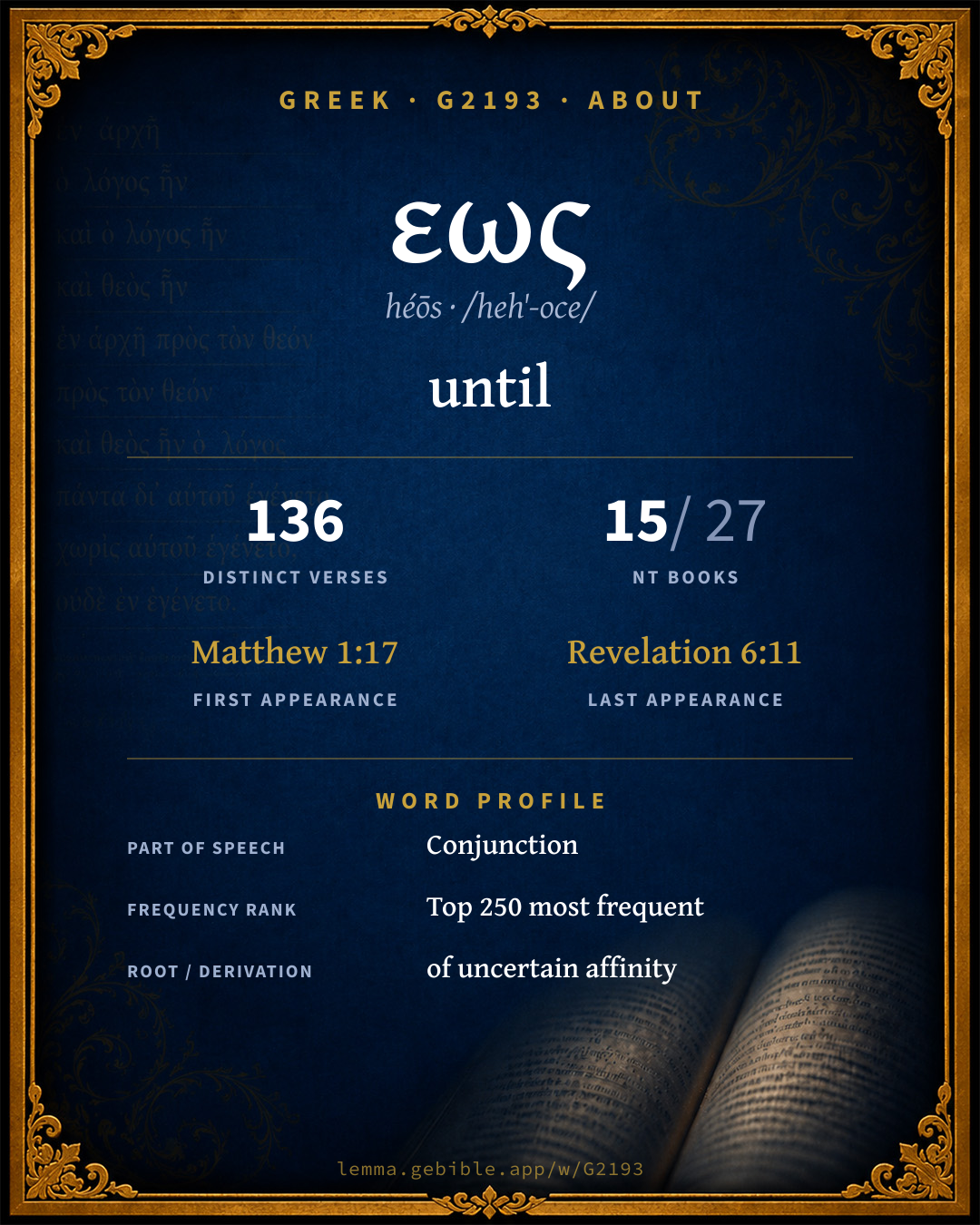
ἕως
until
Full lexicon entry — Thayer's Greek Lexicon
From Thayer's Greek Lexicon
Where this word appears
Grammar key — what these labels mean
Part of speech
- Adverb
- A word that modifies a verb, adjective, or other adverb.
Every verse where G2193 appears in the Book of 2 Peter — 1 distinct verse. Click any verse to open its interlinear word-by-word view. Verse text shown in the World English Bible for context — . Each verse’s Greek form is shown with its reference; the English is not keyword-highlighted, since the data carries no word-level English alignment. Use “Compare translations” on any verse to read it across multiple English versions. This concordance covers the Greek New Testament; Septuagint (Greek Old Testament) occurrences of this word are not indexed here.
2 Peter
About this entry
At a glance — auto-summarized from this page’s data, not written by a person. Every figure links to its source below. This summary describes the numbers; it doesn’t interpret them.
εως — transliterated héōs — is a Greek conjunction carrying the sense “until.” Debuting at Matthew 1:17, it then recurs through the corpus. Spanning 136 verses in 15 books, it ranks among the common words of the Greek New Testament. Its uses concentrate in Matthew (31% of all occurrences). Each statement above links to its evidence; the full detail follows below.
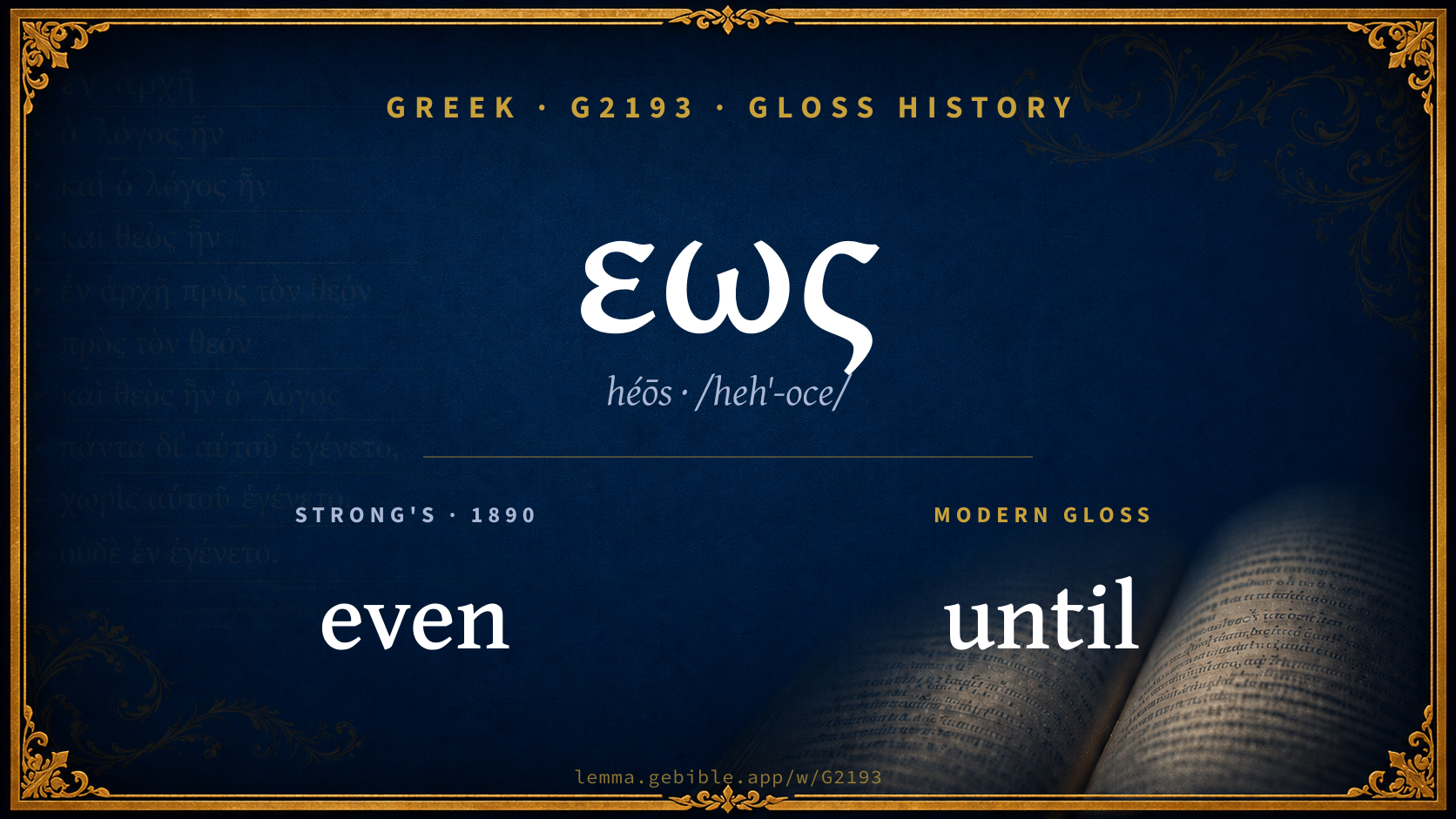
Gloss history
Strong's 1890 vs modern scholarship
About this word
Strong's G2193 catalogs a Greek word from the Greek New Testament.
These counts are not copied from any lexicon or concordance. They are computed here, from the morphology-tagged Greek New Testament. What Lemma adds →
- 136
- distinct verses
- The word appears in 136 distinct verses.
- 15 / 27
- NT books
- The word appears in 15 of 27 New Testament books.
- #112
- by frequency
- Top 250 most frequent Greek words (rank 112 of 5,347 Greek words by occurrence).
View all 136 occurrences in the concordance →
By section of the New Testament
By traditional corpus
Conventional, traditional groupings — biblical authorship is debated, so this is a traditional corpus grouping, not an authorship claim. Some books belong to more than one corpus (Luke is in both the Gospels and the Lukan corpus, and so on), so these shares overlap and need not total 100%. Each figure is a share of the word’s 136 distinct verses.
- Gospels 94 verses · 69%
- Lukan (Luke–Acts) 48 verses · 35%
- Johannine 14 verses · 10%
- Pauline corpus 13 verses · 10%
- Hebrews 3 verses · 2%
- General (Catholic) Epistles 3 verses · 2%
- Revelation 2 verses · 1%
How translations render this word
Counts come from each version’s own published word-to-Strong’s tagging or interlinear alignment — an approximate guide to how each version renders this word, not a word-level alignment the data otherwise carries. Because each total is that version’s own tagged count, the per-version totals vary from one another and need not match the appearance or distinct-verse counts above. These counts may also differ from a printed concordance because Lemma counts each distinctly tagged rendering and does not collapse phrase taggings into a single head-word total. This is a fixed set of word-tagged versions (KJV, ASV, BSB, ULT) and does not change with the reading translation you choose elsewhere. Each version’s license is shown beside its name below (and on Sources).
- King James Version: Till 38×, Until 32×, Unto 30×
- American Standard Version: Until 36×, Unto 31×, Till 29×
- Berean Standard Bible: Until 65×, To 32×, While 7×
- unfoldingWord Literal Text: Until 88×, To 21×, Far as 14×
King James Version Public Domain
Renders G2193 across 142 tagged occurrences — most commonly:
Plus 5 renderings that appear only once — usually multi-word phrases or single function words the recovered tagging swept in, not distinct renderings. Not rendered by a distinct English word in 6 further occurrences.
American Standard Version Public Domain
Renders G2193 across 131 tagged occurrences — most commonly:
Plus 12 renderings that appear only once — usually multi-word phrases or single function words the recovered tagging swept in, not distinct renderings.
Berean Standard Bible Public Domain
Renders G2193 across 133 tagged occurrences — most commonly:
Plus 14 renderings that appear only once — usually multi-word phrases or single function words the recovered tagging swept in, not distinct renderings. Not rendered by a distinct English word in 12 further occurrences.
unfoldingWord Literal Text CC BY-SA 4.0
Renders G2193 across 145 tagged occurrences — most commonly:
Plus 4 renderings that appear only once — usually multi-word phrases or single function words the recovered tagging swept in, not distinct renderings.
Senses in Thayer's
The 1 sense Thayer's distinguishes for this word, in lexicon order (not ranked by frequency or importance). The full entry — with sub-senses — is in the Lexicon Entry tab.
- till, until
Word origin
Origin: of uncertain affinity
Of uncertain affinity; a conjugation preposition and adverb of continuance until (of time and place): - even (until unto) (as) far (as) how long (un-) til (-l) (hither- un- up) to while (-s).
— Strong’s Exhaustive Concordance (1890), public domain.
Septuagint usage
The same Greek word εως appears 1,235 times in the Greek Old Testament (Septuagint), across 1,090 verses in 36 books.
- 1,235
- LXX occurrences
- Tagged occurrences of this Greek word in the Septuagint.
- 1,090
- verses
- Distinct Septuagint verses containing this word.
- 36 / 39
- OT books
- The word appears in 36 of the 39 Old Testament books.
Sample Septuagint occurrences
- Genesis 3:19 ἕως
- Exodus 2:16 ἕως
- Leviticus 6:2 ἕως
- Numbers 3:13 ἕως
- Deuteronomy 1:2 ἕως
- Joshua 1:4 ἕως
- Judges 1:21 ἕως
- Ruth 1:13 ἕως
- 1 Samuel 1:11 ἕως
- 2 Samuel 1:12 ἕως
- 1 Kings 1:4 ἕως
- 2 Kings 2:2 ἕως
Septuagint occurrences (same lexeme)
Every verse where the same Strong’s number (G2193) appears in the Greek Septuagint — showing the first 50 of 1,090. Verse text shown in the World English Bible for context; the Greek form is the matched word — the English is not keyword-highlighted.
- Genesis 3:19 ἕως By the sweat of your face will you eat bread until you return to the ground, for out of it you were taken. For you are dust, and to dust you shall return."
- Genesis 6:7 ἕως Yahweh said, "I will destroy man whom I have created from the surface of the ground; man, along with animals, creeping things, and birds of the sky; for I am sorry that I have made them."
- Genesis 7:23 ἕως Every living thing was destroyed that was on the surface of the ground, including man, cattle, creeping things, and birds of the sky. They were destroyed from the earth. Only Noah was left, and those who were with him in the ark.
- Genesis 8:5 ἕως The waters receded continually until the tenth month. In the tenth month, on the first day of the month, the tops of the mountains were seen.
- Genesis 8:7 ἕως and he sent forth a raven. It went back and forth, until the waters were dried up from off the earth.
- Genesis 8:17 ἕως Bring forth with you every living thing that is with you of all flesh, including birds, cattle, and every creeping thing that creeps on the earth; that they may breed abundantly in the earth, and be fruitful, and multiply on the earth."
- Genesis 10:19 ἕως The border of the Canaanites was from Sidon, as you go toward Gerar, to Gaza; as you go toward Sodom, Gomorrah, Admah, and Zeboiim, to Lasha.
- Genesis 10:30 ἕως Their dwelling was from Mesha, as you go toward Sephar, the mountain of the east.
- Genesis 11:4 ἕως They said, "Come, let's build us a city, and a tower, whose top reaches to the sky, and let's make us a name; lest we be scattered abroad on the surface of the whole earth."
- Genesis 11:31 ἕως Terah took Abram his son, Lot the son of Haran, his son's son, and Sarai his daughter-in-law, his son Abram's wife. They went forth from Ur of the Chaldees, to go into the land of Canaan. They came to Haran, and lived there.
- Genesis 12:6 ἕως Abram passed through the land to the place of Shechem, to the oak of Moreh. The Canaanite was then in the land.
- Genesis 13:3 ἕως He went on his journeys from the South even to Bethel, to the place where his tent had been at the beginning, between Bethel and Ai,
- Genesis 13:10 ἕως Lot lifted up his eyes, and saw all the plain of the Jordan, that it was well watered every where, before Yahweh destroyed Sodom and Gomorrah, like the garden of Yahweh, like the land of Egypt, as you go to Zoar.
- Genesis 13:15 ἕως for all the land which you see, I will give to you, and to your offspring forever.
- Genesis 14:6 ἕως and the Horites in their Mount Seir, to Elparan, which is by the wilderness.
- Genesis 14:14 ἕως When Abram heard that his relative was taken captive, he led forth his trained men, born in his house, three hundred and eighteen, and pursued as far as Dan.
- Genesis 14:15 ἕως He divided himself against them by night, he and his servants, and struck them, and pursued them to Hobah, which is on the left hand of Damascus.
- Genesis 14:23 ἕως that I will not take a thread nor a shoe-latchet nor anything that is yours, lest you should say, 'I have made Abram rich.'
- Genesis 15:16 ἕως In the fourth generation they will come here again, for the iniquity of the Amorite is not yet full."
- Genesis 15:18 ἕως In that day Yahweh made a covenant with Abram, saying, "To your seed have I given this land, from the river of Egypt to the great river, the river Euphrates:
- Genesis 18:12 ἕως Sarah laughed within herself, saying, "After I have grown old will I have pleasure, my lord being old also?"
- Genesis 19:4 ἕως But before they lay down, the men of the city, the men of Sodom, surrounded the house, both young and old, all the people from every quarter.
- Genesis 19:11 ἕως They struck the men who were at the door of the house with blindness, both small and great, so that they wearied themselves to find the door.
- Genesis 19:22 ἕως Hurry, escape there, for I can't do anything until you get there." Therefore the name of the city was called Zoar.
- Genesis 19:37 ἕως The firstborn bore a son, and named him Moab. The same is the father of the Moabites to this day.
- Genesis 19:38 ἕως The younger also bore a son, and called his name Ben Ammi. The same is the father of the children of Ammon to this day.
- Genesis 22:5 ἕως Abraham said to his young men, "Stay here with the donkey. The boy and I will go yonder. We will worship, and come back to you.
- Genesis 24:14 ἕως Let it happen, that the young lady to whom I will say, 'Please let down your pitcher, that I may drink.' She will say, 'Drink, and I will also give your camels a drink.' Let the same be she who you have appointed for your servant Isaac. Thereby will I know that you have shown kindness to my master."
- Genesis 24:19 ἕως When she had done giving him drink, she said, "I will also draw for your camels, until they have done drinking."
- Genesis 24:33 ἕως Food was set before him to eat. But he said, "I will not eat until I have told my message." He said, "Speak on."
- Genesis 25:18 ἕως They lived from Havilah to Shur that is before Egypt, as you go toward Assyria. He lived opposite all his relatives.
- Genesis 26:13 ἕως The man grew great, and grew more and more until he became very great.
- Genesis 26:33 ἕως He called it Shibah. Therefore the name of the city is Beersheba to this day.
- Genesis 27:44 ἕως Stay with him a few days, until your brother's fury turns away;
- Genesis 28:15 ἕως Behold, I am with you, and will keep you, wherever you go, and will bring you again into this land. For I will not leave you, until I have done that which I have spoken of to you."
- Genesis 29:8 ἕως They said, "We can't, until all the flocks are gathered together, and they roll the stone from the well's mouth. Then we water the sheep."
- Genesis 32:5 ἕως I have oxen, donkeys, flocks, men-servants, and maid-servants. I have sent to tell my lord, that I may find favor in your sight.'"
- Genesis 32:25 ἕως When he saw that he didn't prevail against him, he touched the hollow of his thigh, and the hollow of Jacob's thigh was strained, as he wrestled.
- Genesis 32:33 ἕως
- Genesis 33:3 ἕως He himself passed over in front of them, and bowed himself to the ground seven times, until he came near to his brother.
- Genesis 33:14 ἕως Please let my lord pass over before his servant: and I will lead on gently, according to the pace of the cattle that are before me and according to the pace of the children, until I come to my lord to Seir."
- Genesis 34:5 ἕως Now Jacob heard that he had defiled Dinah, his daughter; and his sons were with his cattle in the field. Jacob held his peace until they came.
- Genesis 35:4 ἕως They gave to Jacob all the foreign gods which were in their hands, and the rings which were in their ears; and Jacob hid them under the oak which was by Shechem.
- Genesis 35:20 ἕως Jacob set up a pillar on her grave. The same is the Pillar of Rachel's grave to this day.
- Genesis 38:1 ἕως It happened at that time, that Judah went down from his brothers, and visited a certain Adullamite, whose name was Hirah.
- Genesis 38:11 ἕως Then Judah said to Tamar, his daughter-in-law, "Remain a widow in your father's house, until Shelah, my son, is grown up;" for he said, "Lest he also die, like his brothers." Tamar went and lived in her father's house.
- Genesis 38:17 ἕως He said, "I will send you a kid of the goats from the flock." She said, "Will you give me a pledge, until you send it?"
- Genesis 39:16 ἕως She laid up his garment by her, until his master came home.
- Genesis 41:49 ἕως Joseph laid up grain as the sand of the sea, very much, until he stopped counting, for it was without number.
- Genesis 42:16 ἕως Send one of you, and let him get your brother, and you shall be bound, that your words may be tested, whether there is truth in you, or else by the life of Pharaoh surely you are spies."
These are occurrences of the same Greek lexeme (G2193) in the Septuagint — not a translation of any one Hebrew word. The store carries no word-level Hebrew↔Greek alignment, so no Hebrew original is asserted here. Counts come from the recovered LXX Strong's tagging — high-frequency vocabulary is well covered, while rare or late forms may be untagged — so they reflect tagged occurrences and may slightly undercount.