
1 Corinthians 4:13

Greek (Tischendorf 8th ed.) 1 Corinthians 4:13 appears in the Greek New Testament. The text above is from the Tischendorf 8th edition. Each word links to its Strong’s number and a concise gloss. Click any word for its full Thayer’s Greek Lexicon entry.
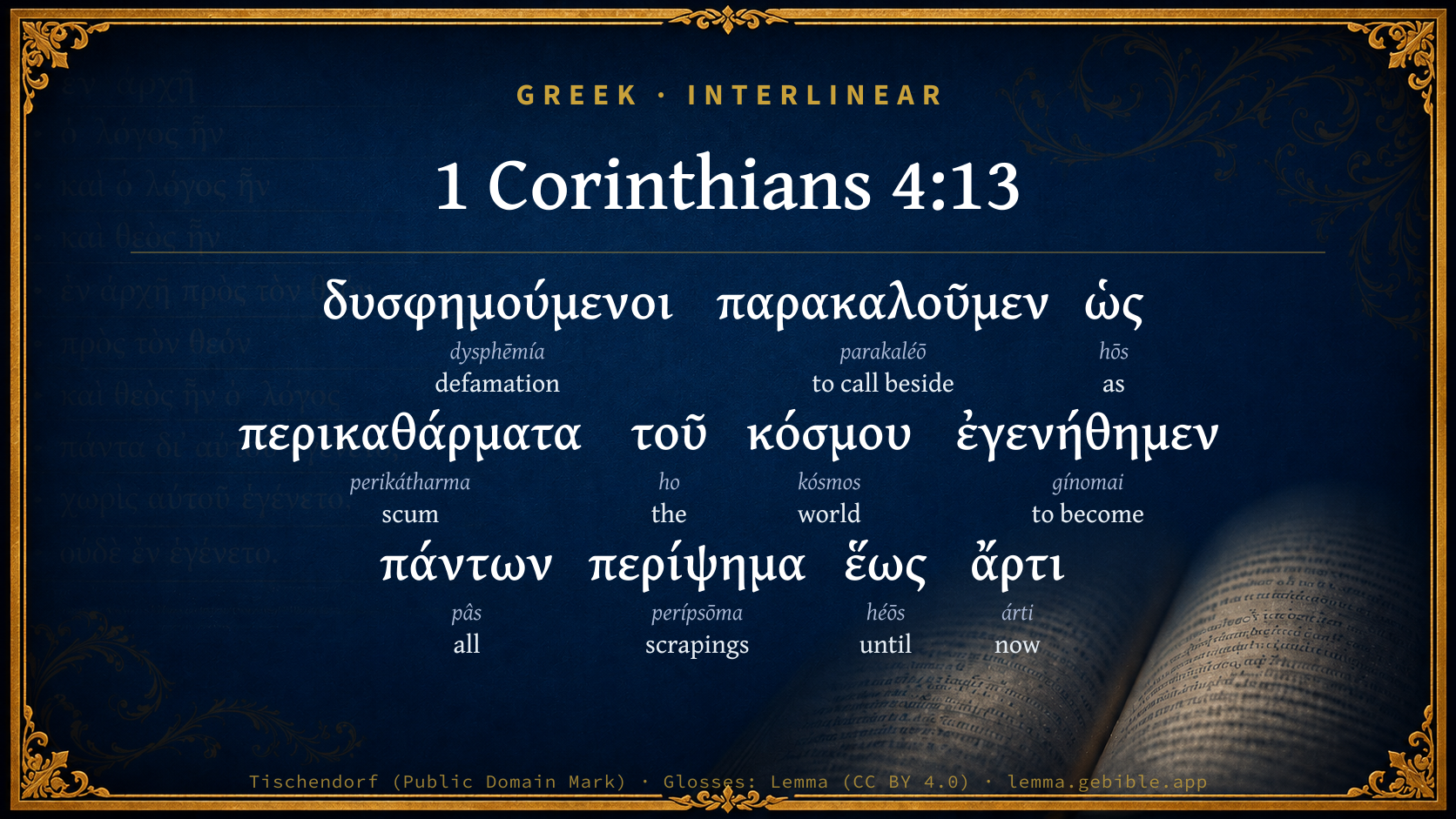
Download image
Cite this verse

1 Corinthians 4:13 (World English Bible). Public Domain. Lemma interlinear Bible study tool, https://lemma.gebible.app/v/1-corinthians/4/13.

Show BibTeX & RIS
BibTeX
RIS
English Translation
Being defamed, we entreat. We are made as the filth of the world, the dirt wiped off by all, even until now.
World English Bible · Public Domain
Highlights
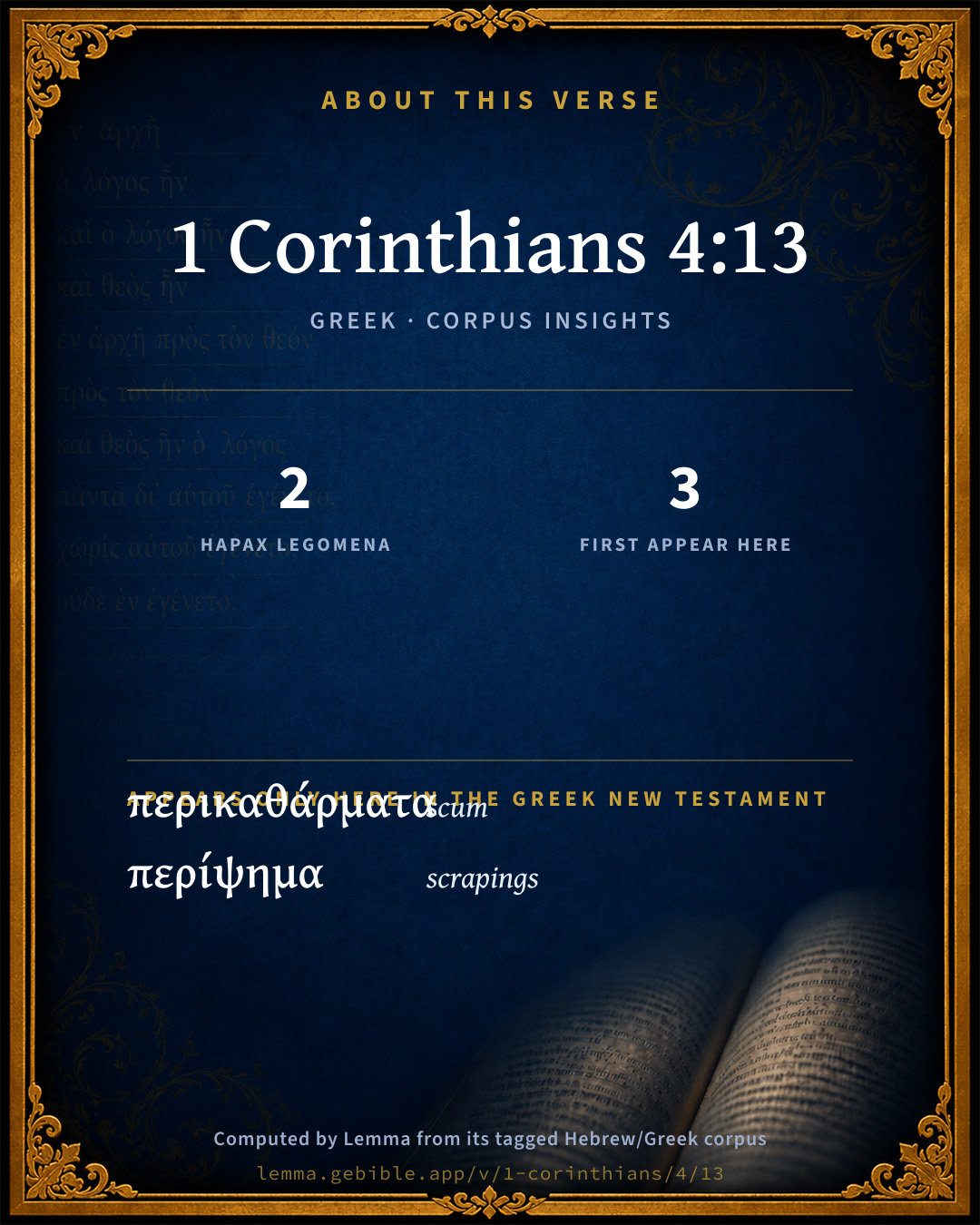
  • 2 hapax legomena — only here in the Greek New Testament
  • 3 first appearances in the Greek New Testament
Full analysis ↓
Download a study sheet

One document with this verse’s original text, its word-by-word gloss line, the meaning frame, cross-references with their text, attributed commentary, and full source and license credits — printable, and it pastes into notes with its structure intact.

This verse Autodidact and up

Study sheet (.html) Plain text (.txt)

A passage Seminary Student

Up to 50 verses in one chapter. A passage sheet keeps up to 6 commentary sources and 12 cross-references per verse, in the order this page ranks them, and says so on the sheet whenever that leaves anything out. Ask for a single verse and you get the Autodidact verse sheet above.

Everything on this page stays free to read, with no account — the sheet is a download of what is already on screen, not access to it.

Want to remove ads? Support Godless Engineer
Compare translations 3

The same verse in 3 English versions, stacked beneath the original-language interlinear above. Click any original word for its lexicon entry.

Each is an independent rendering of the whole verse — the interlinear is not word-aligned to these translations.

Highlighted words mark where these versions differ — a whole-verse word diff, not a word-by-word alignment.

  • World English Bible Public Domain
    Being defamed, we entreat. We are made as the filth of the world, the dirt wiped off by all, even until now.
  • King James Version Public Domain
    Being defamed, we intreat: we are made as the filth of the world, and are the offscouring of all things unto this day.
  • unfoldingWord Literal Text CC BY-SA 4.0
    being slandered, we comfort. We have become as the scum of the world, the refuse of all things, even until now.

unfoldingWord Literal Text — © unfoldingWord, licensed CC BY-SA 4.0. Word-aligned USFM3 via Door43 (git.door43.org/unfoldingWord/en_ult).

Versions to compare (up to 4)

3 of 4 selected

Show all 19 translations

Every available English version of this verse, each an independent rendering of the whole verse.

  • World English Bible Public Domain
    Being defamed, we entreat. We are made as the filth of the world, the dirt wiped off by all, even until now.
  • Berean Standard Bible Public Domain
    when we are slandered, we answer gently. Up to this moment we have become the scum of the earth, the refuse of the world.
  • Majority Standard Bible Public Domain
    when we are slandered, we answer gently. Up to this moment we have become the scum of the earth, the refuse of the world.
  • King James Version Public Domain
    Being defamed, we intreat: we are made as the filth of the world, and are the offscouring of all things unto this day.
  • American Standard Version (1901) Public Domain
    being defamed, we entreat: we are made as the filth of the world, the offscouring of all things, even until now.
  • Revised Version (1885) Public Domain
    being defamed, we entreat: we are made as the filth of the world, the offscouring of all things, even until now.
  • Geneva Bible (1599) Public Domain
    We are euill spoken of, and we pray: we are made as the filth of the world, the offskowring of all things, vnto this time.
  • Douay-Rheims (1899) Public Domain
    We are blasphemed, and we entreat; we are made as the refuse of this world, the offscouring of all even until now.
  • Young's Literal Translation Public Domain
    being spoken evil of, we entreat; as filth of the world we did become -- of all things an offscouring -- till now.
  • Literal Standard Version CC BY-SA 4.0
    being spoken evil of, we plead; we became as filth of the world—of all things an outcast—until now.
  • Unlocked Literal Bible CC BY-SA 4.0
    When we are slandered, we speak with kindness. We have become, and are still considered to be, the refuse of the world and the filthiest of all things.
  • unfoldingWord Literal Text CC BY-SA 4.0
    being slandered, we comfort. We have become as the scum of the world, the refuse of all things, even until now.
  • Darby Bible Public Domain
    insulted, we entreat: we are become as [the] offscouring of the world, [the] refuse of all, until now.
  • World Messianic Bible Public Domain
    Being defamed, we entreat. We are made as the filth of the world, the dirt wiped off by all, even until now.
  • Webster's Bible Public Domain
    Being defamed, we entreat: we are made as the filth of the world, the offscouring of all things to this day.
  • Free Bible Version CC BY-SA 4.0
    When they insult us, we respond with kindness. Even now we are treated like dirt, the worst trash in the whole world.
  • Bible in Basic English Public Domain
    When evil things are said about us we give gentle answers: we are made as the unclean things of the world, as that for which no one has any use, even till now.
  • Text-Critical English NT CC BY 4.0
    when we are slandered, we encourage. We have become like the refuse of the world, the scum of all things, even to this present time.
  • Tyndale New Testament (1534) Public Domain
    We are evyll spoken of and we praye. We are made as it were the filthynes of the worlde the ofscowringe of all thinges even vnto this tyme.

Literal Standard Version (2020), Covenant Press — licensed CC BY-SA 4.0. Text via the HelloAO Bible API (eBible.org). Unlocked Literal Bible (unfoldingWord) — licensed CC BY-SA 4.0. Text via the HelloAO Bible API (eBible.org). unfoldingWord Literal Text — © unfoldingWord, licensed CC BY-SA 4.0. Word-aligned USFM3 via Door43 (git.door43.org/unfoldingWord/en_ult). Free Bible Version, Dr. Jonathan Gallagher — licensed CC BY-SA 4.0. Text via the HelloAO Bible API (eBible.org).

Word by word

More ways to search: Search by grammar → Find every occurrence → Compare this word →

Practice this passage: Drill this verse → Learn its vocabulary →

περικαθάρματα
perikátharma
G4027
“scum”
Noun, Nominative, Plural, Neuter
Part of Speech
Noun
Case
Nominative
Number
Plural
Gender
Neuter
Full Thayer's Definition

Origin: from a compound of G4012 and G2508

TDNT: 10:10,4

1. off scouring, refuse 2. metaph. a. the most abject and despicable men b. the price of expiation or redemption, because the Greeks used to apply the term "katharmata" to victims sacrificed to make expiation for the people, and even to criminals who were maintained at the public expense, that on the outbreak of a pestilence or other calamity they might be offered as sacrifices to make expiation for the state
  1. δυσφημούμενοι dysphēmía G1426 “defamation” Verb, Present, Passive, Participle, Nominative, Plural, Masculine
  2. παρακαλοῦμεν parakaléō G3870 “to call beside” Verb, Present, Active, Indicative, 1st person, Plural
  3. ὡς hōs G5613 “as” Adverb
  4. τοῦ ho G3588 “the” Article, Genitive, Singular, Masculine
  5. κόσμου kósmos G2889 “world” Noun, Genitive, Singular, Masculine
  6. ἐγενήθημεν gínomai G1096 “to become” Verb, Aorist, Passive deponent, Indicative, 1st person, Plural
  7. πάντων pâs G3956 “all” Adjective, Genitive, Plural, Neuter
  8. περίψημα perípsōma G4067 “scrapings” Noun, Nominative, Singular, Neuter
  9. ἕως héōs G2193 “until” Adverb
  10. ἄρτι árti G737 “now” Adverb

About this verse

These counts appear in no published source. They are computed here, from the morphology-tagged text and Lemma’s own curated glosses. What Lemma adds →

11
words
11
distinct lemmas
Pauline Epistles
section

Notable vocabulary

2 hapax legomena — words that appear only here in the entire Greek New Testament:

  • περικαθάρματα scum G4027
  • περίψημα scrapings G4067

First appearance in Scripture

These words make their first canonical appearance in the Greek New Testament here:

  • δυσφημούμενοι defamation G1426
  • περικαθάρματα scum G4027
  • περίψημα scrapings G4067

Shared distinctive vocabulary

δυσφημούμενοι defamation G1426 occurs in 2 verses of the Greek New Testament. Also found in:
Cross-references

2

Topical passages linked to 1 Corinthians 4:13 in the Treasury of Scripture Knowledge — connected by theme and wording, ordered by reader-vote popularity; previews shown in the World English Bible.

  • Lamentations 3:45 You have made us an off-scouring and refuse in the midst of the peoples.
  • Acts 22:22 They listened to him until he said that; then they lifted up their voice, and said, "Rid the earth of this fellow, for he isn't fit to live!"

Cross-references courtesy of OpenBible.info (CC BY 4.0).

Commentary

Notes on 1 Corinthians 4:13 from classic Christian and Jewish commentators (each source and its license shown beneath its notes). The classic Christian expositions comment on the surrounding passage and are grouped to its opening verse, so a note may address several verses; the Jewish commentaries on the Tanakh (Rashi and others) are per-verse, so they appear only where the commentator wrote on this verse.

Lemma curates 59 commentaries, every one of them public domain or Creative Commons licensed, each selected and text-cleaned for this edition rather than reprinted as found. About our sources →

Bengel's Gnomon

Johann Albrecht Bengel

1Co 4:13. Περικαθάρματα περίψημα) both words are used for filth, by which not only men utterly outcast, but those devoted as an expiation for others, are denoted. כפר, περικάθαρμα δικαίου, ἄνομος, the wicked shall be a ransom for the upright, Pro 21:18. τὸ ἀργύριον περίψημα τοῦ παιδίον ἡμῶν γένοιτο, let money be as refuse in respect of our child, Tobit 5 :(18)26: add Jer 22:28, where עצב נכזה has been translated by some περίψημα φαῦλον, vile offscourings, Hesychius: περίψημα, περικατάμαγμα, ἀντίλυτρα, ἀντίψυχα, ἤ ὑπὸ τὰ ἴχνη πάντων. περίψημα in Eustathius is, σπόγγισμά τι, something wiped away with a sponge, and therefore more subtle [smaller and less perceptible] than λῦμα; the latter word, λῦμα, is a less forcible term than κάθαρμα, the meaning of which the περὶ strengthens. Wherefore Paul calls himself and the apostles περικαθάρματα τοῦ κόσμου—περίψημα, the offscouring not only of a persecuting world, but of all men [Engl. Vers. “of all things”], although they do not persecute us; the world hates us; all men despise us.—ἕως ἄρτι, until now) an epanalepsis [a repetition of the same words in the beginning of a preceding member and in the end of the following member of a sentence. end.], comp. 1Co 4:11, at the beginning.

Bengel's Gnomon of the New Testament — English translation (T&T Clark, Edinburgh, 1860) — public domain. Text from a community e-Sword module.

Hodge's Commentary on Romans, Ephesians & First Corinthians

Charles Hodge

1Co_4:12, 1Co_4:13

And labor, working with our own hands. Being reviled, we bless; being persecuted, we suffer it; being defamed, we entreat: we are made as the filth of the world, (and are) the off-scouring of all things unto this day.

Working with our own hands. The apostle, in a subsequent chapter, proves at length his right, and that of other ministers to an adequate support from the church. But he did not avail himself of that right in Corinth, 1Co_9:15.

Being reviled. (λοιδορούμενοι), being railed at, or made the object of scurrility. We bless, i.e. we speak well of, or implore good upon. We return abuse with kind words, or, with good wishes and prayers. Being persecuted. As the former term refers to injurious words, this refers to injurious acts. We suffer it, i.e. we patiently submit to it without resistance or complaint. Being defamed, i.e. having evil deeds or motives ascribed to us. We entreat (παρακαλοῦμεν), we exhort. That is, we endeavor to meet with kindness such injurious imputations, instead of repelling them with anger and indignation. In all this the apostle followed the example of his divine master, who when he was reviled, reviled not again; when he suffered, he threatened not, but committed himself to him who judgeth righteously, 1Pe_2:23.

We are made as the filth of the earth, or rather of the world (κόσμου). That is, we are regarded as the filthiest of mankind. And the off-scouring of all things, or of all men. That is, as the refuse of society. The words (περικάθαρμα and περίψημα) rendered filth and off-scouring, signify, the former, what is carried off by rinsing and the latter, what is scraped off. They both express the general idea of refuse. This is all the context demands or suggests. The apostle sums up all he had previously said, by saying, We are regarded as the dregs or refuse of the world. As both of these words, however, and especially the former, are used of victims chosen from the lowest class of the people, who in times of calamity were offered in sacrifice to the gods, it is very generally assumed that Paul here refers to that custom; and means to say that he was regarded as one of those who were considered only fit to be put to death for the good of others. This brings out the same idea in a different form. It is not probable, however, that any such allusion is here intended; because the custom was not so common as to be familiar to his readers generally, and because the word commonly used for such sacrifices was not, περικάθαρμα, which Paul uses, but κάθαρμα. In Pro_21:18 however, it is said, The wicked is a ransom (περικάθαρμα) for the righteous. Paul certainly did not consider himself or his sufferings as a propitiation for other men. The point of comparison, if there be any allusion to the custom in question, is to the vileness of such victims, which were always chosen from the worthless and despised. This and other passages of Pauls writings (comp. 2Co_11:23-27 present in a very strong light the indignities and sufferings which he endured in the service of Christ, and may well put us to shame, as well as the self-satisfied and self-indulgent Corinthians. What are we doing for him for whom Paul did and suffered so much?

Charles Hodge — Commentary on Romans (1835), First Corinthians (1857), and Ephesians (1856) — public domain. Text from a community e-Sword module.

Geneva Bible (1599)

Geneva Bible translators

Such as by sweeping is gathered together.

Geneva Bible (1599) marginal notes — public domain. Text via Bolls.life.

Jamieson, Fausset & Brown

Robert Jamieson, A. R. Fausset & David Brown

defamed, we entreat--namely, God for our defamers, as Christ enjoined (Mat 5:10, Mat 5:44) [GROTIUS]. We reply gently [ESTIUS].

filth--"the refuse" [CONYBEARE and HOWSON], the sweepings or rubbish thrown out after a cleaning.

of all things--not of the "World" only.

Jamieson, Fausset & Brown — Commentary Critical and Explanatory on the Whole Bible (1871) — public domain (CC PDM 1.0). Text via the HelloAO Bible API.

Adam Clarke's Commentary

Verse 13. Being defamed] βλασφημουμενοι, Being blasphemed. I have already remarked that βλασφημειν signifies to speak injuriously, and may have reference either to God or to man. GOD is blasphemed when his attributes, doctrines, providence, or grace, are treated contemptuously, or any thing said of him that is contrary to his holiness, justice, goodness, or truth. Man is blasphemed when any thing injurious is spoken of his person, character, conduct, c. Blaspheming against men is any thing by which they are injured in their persons, characters, or property.

We are made as the filth of the earth-the offscouring of all things] The Greek word which we render filth, is περικαθαρματα, a purgation, or lustrative sacrifice that which we translate offscouring is περιψημα, a redemption sacrifice. To understand the full force of these words, as applied by the apostle in this place, we must observe that he alludes to certain customs among the heathens, who, in the time of some public calamity, chose out some unhappy men of the most abject and despicable character to be a public expiation for them; these they maintained a whole year at the public expense; and then they led them out, crowned with flowers, as was customary in sacrifices; and, having heaped all the curses of the country upon their heads, and whipped them seven times, they burned them alive, and afterwards their ashes were thrown into the sea, while the people said these words: περιψημαἡμων γινου, be thou our propitiation. Sometimes the person thus chosen was thrown into the sea as a sacrifice to Neptune, the people saying the words as before. Hence Origen says that our Lord, in giving up himself as a propitiation for our sins, was much more than his apostles-περικαθαρματα του κοσμου, παντων περιψημα, the lustration of the world, and the peculiar sacrifice for all men. The apostle, therefore, means that he and his fellows were treated like those wretched beings who were judged to be fit for nothing but to be expiatory victims to the infernal gods, for the safety and redemption of others. Our words filth and offscouring, convey no legitimate sense of the original. See several useful remarks upon these terms in Pearce, Whitby, and Parkhurst.

Adam Clarke's Commentary on the Bible (1810–1826) — public domain. Text from a community e-Sword/MySword module.

John Calvin's Commentaries

13. As the execrations of the world. He makes use of two terms, the former of which denotes a man who, by public execrations, is devoted, with the view to the cleansing of a city, for such persons, on the ground of their cleansing the rest of the people, by receiving in themselves whatever there is in the city of crimes, and heinous offense, are called by the Greeks sometimes καθαρμοι, but more frequently καθάρματα. Paul, in adding the preposition περὶ (around) seems to have had an eye to the expiatory rite itself, inasmuch as those unhappy men who were devoted to execrations were led round through the streets, that they might carry away with them whatever there was of evil in any corner, that the cleansing might be the more complete. The plural number might seem to imply that he speaks not of himself exclusively, but also of the others who were his associates, and who were not less held in contempt by the Corinthians. There is, however, no urgent reason for regarding what he says as extending to more than himself. The other term — περίψημα, (offscouring,) denotes filings or scrapings of any kind, and also the sweepings that are cleared away with a brush. As to both terms consult the annotations of Budaeus.

In so far as concerns the meaning of the passage before us, Paul, with the view of expressing his extreme degradation, says that he is held in abomination by the whole world, like a man set apart for expiation, and that, like offscourings, he is nauseous to all. At the same time he does not mean to say by the former comparison that he is all expiatory victim for sins, but simply means, that in respect of disgrace and reproaches he differs nothing from the man on whom the execrations of all are heaped up.

John Calvin's Commentaries (1540-1563) — public domain. Text from the Calvin Translation Society English edition (1840s-50s) via the Christian Classics Ethereal Library (ccel.org). Calvin's coverage is partial (roughly two-thirds of the Bible); uncommented books and verses are honest gaps, never fabricated. The 19th-century editor's footnotes and remarks are omitted so the notes are faithfully Calvin's own voice.

Ellicott's Commentary for English Readers

(13) The filth of the world.—The word here used for “filth” occurs only in one other passage in the LXX. Pro_21:18, where it has the idea of an additional expiatory sacrifice. Perhaps the word is used here by the Apostle to include that idea in the sufferings, the description of which here reaches a climax. It is not only that we are the filth and off scouring of all men, but we are so for the sake of others.

A Bible Commentary for English Readers, edited by Charles John Ellicott (1878–1897) — public domain. Text from a community e-Sword module.

The Cambridge Bible for Schools and Colleges

gen. ed. J. J. S. Perowne

13. we are made as the filth of the world] The word here translated filth means (1) that which is removed by cleansing and (2) an expiatory sacrifice, one who is delivered up to destruction, like Jonah, to save others as guilty as himself. St Paul does not assert that he is such a sacrifice, but that he is like one, because by his sorrows and sufferings many souls are brought to Christ. Cf. Col_1:24, and Bp Wordsworth in loc.

and are the offscouring] Literally, as the offscouring. This word in the original is derived from a verb signifying to rub, scrape, shave. It has similar significations to the preceding: (1) that which is removed by rubbing, (2) a sacrifice for the benefit of others. Suidas in his Lexicon states that it was a custom among the Greeks in times of calamity to cast a victim into the sea as a sacrifice to appease Poseidon, the god of the sea, with the words, “Be thou our offscouring.” In virtue of the humiliations and distresses endured by St Paul, he represents himself as becoming the refuse of mankind, in order that by this means he may bring blessings innumerable within their reach. So Tob_5:18, “Let the money be sacrificed as nought for the sake of the child;” and Ignatius (to the Ephesians, ch. 8), “I am your offscouring,” i.e. I am undergoing these afflictions for your sakes, and similarly in the Epistle attributed to St Barnabas (ch. 6), in all which places the same word is used.

of all things] Better, of all men.

The Cambridge Bible for Schools and Colleges (gen. ed. J. J. S. Perowne; Cambridge University Press, 1878–1918) — public domain. Text from a community e-Sword module.

John Gill's Exposition

Being defamed, we entreat,.... Being blasphemed, as the word signifies, being evil spoken of, our good name taken away, and characters hurt; we entreat or pray to God for them, that he would convince them of their evil, give them repentance unto life, and remission of their sins, according to Christ's direction, Mat 5:44 and in imitation of his example, Luk 23:34 or we entreat them; so the Syriac version reads it, , "we beseech them": not to blaspheme and speak evil of us, since it will be to their own hurt; we give them smooth words, and soft language, not rendering railing for railing, or reviling for reviling:

we are made as the filth of the world, and the offscouring of all things unto this day; referring, as some think, to Lam 3:45 or to the lustrations and expiations among the Heathens, who when any calamity was upon them, particularly a plague among them, used to take one of the refuse of the people, and sacrifice him by way of expiation; or any living creature, as a sheep which with imprecations they cast into a river, or into the sea, fancying it carried away all the contagion along with it; hence, by way of reproach, such that were under disgrace, and were ejected, and exiled, were called "purgations"; the refuse of the people, by which the rest were purged (u) or the reference is to any dirt, or filth in common, swept out of houses, and trodden under foot; and so expresses the mean and abject condition of the apostles, and with what disdain and contempt they were treated in the world: all which shows that they were far from reigning as kings; and whilst this was their case, who were at the head of the interest of Christ, it must be a vain conceit of the Corinthians, that they reigned as kings without them.

(u) Vid. Turnebi Adversaria, l. 19. c. 22. & 26. 7. & 27. 16.

John Gill's Exposition of the Whole Bible (1746–1763) — public domain (CC PDM 1.0). Text via the HelloAO Bible API.

Trapp's Complete Commentary

John Trapp

13 Being defamed, we intreat: we are made as the filth of the world, and are the offscouring of all things unto this day.

Ver. 13. Being defamed, we entreat] Though Luther call me devil, saith Calvin, yet I will honour him as a servant of God.

We are made as the filth of the world] q.d. The filth of filth; for the whole world lies in wickedness, as a foul sloven in a slough, or as a carrion in the slime of it. The word περικαθαρματα signifies, the sweepings of the world, or the dirt scraped off the pavement thereof.

And the offscouring of all things] Detersorium, sordes, purgamenta, reiectamenta. Piaculares et abominabiles, saith Paraeus. The word signifies the dung cart, saith Mr Burroughs, that goes through the city, into which every one brings and casts his filth. Every one had some filth to cast upon Paul and the apostles. Constantine, a citizen of Rhoan, with three others, being for defence of the gospel condemned to be burned, were put into a dung cart, who thereat rejoicing, said that they were reputed here the excrements of the world, but yet their death was a sweet odour unto God. Budaeus is of the opinion that the apostle here alludeth to those expiations in use among the heathen, performed in this manner. Certain condemned persons were brought forth with garlands upon their heads in manner of sacrifices; these they would tumble from some steep places into the sea, offering them up to Neptune with this form of words, περιψημα ημων γενου, "Be thou a propitiation for us." (Bud. Pandec.) So for the removal of the pestilence they sacrificed certain men to their gods: these they called καθαρματα, filth, loading them with revilings and cursings. (Suidas in περιψημι.)

John Trapp, A Commentary or Exposition upon All the Books of the Old and New Testament (1647–1656) — public domain. Text from a community e-Sword module.

Albert Barnes' Notes on the Bible

Being defamed - Greek, Blasphemed, that is, spoken of and to, in a harsh, abusive, and reproachful manner. The original and proper meaning of the word is to speak in a reproachful manner of anyone, whether of God or man. It is usually applied to God, but it may also be used of people.

We entreat - Either God in their behalf, praying him to forgive them, or we entreat them to turn from their sins, and become converted to God. Probably the latter is the sense. They besought them to examine more candidly their claims instead of reviling them; and to save their souls by embracing the gospel instead of destroying them by rejecting it with contempt and scorn.

We are made - We became; we are so regarded or esteemed. The word here does not imply that there was any positive agency in making them such, but simply that they were in fact so regarded.

As the filth of the earth - It would not be possible to employ stronger expressions to denote the contempt and scorn with which they were everywhere regarded. The word “filth” περικαθάρματα perikatharmata occurs nowhere else in the New Testament. It properly denotes filth, or that which is collected by sweeping a house, or that which is collected and cast away by purifying or cleansing anything; hence, any vile, worthless, and contemptible object. Among the Greeks the word was used to denote the victims which were offered to expiate crimes, and particularly men of ignoble rank, and of a worthless and wicked character, who were kept to be offered to the gods in a time of pestilence, to appease their anger, and to purify the nation. Bretschneider and Schleusner. Hence, it was applied by them to people of the most vile, abject, and worthless character. But it is not certain that Paul had any reference to that sense of the word. The whole force of the expression may be met by the supposition that he uses it in the sense of that filth or dirt which is collected by the process of cleansing or scouring anything, as being vile, contemptible, worthless. So the apostles were regarded. And by the use of the word “world” here, he meant to say that they were regarded as the most vile and worthless men which the whole world could furnish; not only the refuse of Judea, but of all the nations of the earth. As if he had said “more vile and worthless people could not be found on the face of the earth.”

And are the off-scouring of all things - This word (περίψημα peripsēma) occurs no where else in the New Testament. It does not differ materially from the word rendered “filth.” It denotes that which is rubbed off by scouring or cleaning anything; and hence, anything vile or worthless; or a vile and worthless man. This term was also applied to vile and worthless people who were sacrificed or thrown into the sea as an expiatory offering, as it were to purify the people. Suidas remarks that; they said to such a man, “be then our περίψημα peripsēma,” our redemption, and then flung him into the sea as a sacrifice to Neptune. See Whitby, Calvin, Doddridge.

Unto this day - Continually. We have been constantly so regarded. See 1Co 4:11.

Albert Barnes' Notes on the Bible (1834–1885) — public domain. Text from a community e-Sword/MySword module.

Matthew Poole's English Annotations

Being defamed, we entreat: we are blasphemed, Gr. that is, spoken evil of, which is the same with defamed in our language, men speak all manner of evil of us to take away our reputation; but we entreat God for them: the word signifieth to exhort, entreat, comfort, we exercise ourselves in all pious and charitable offices toward them, who are most uncharitable toward us.

We are made as the filth of the earth, and are the offscouring of all things unto this day: here are two words used, which signify the most vile, abject, contemptible things in the world, excrements, sweepings of houses. The apostle by these two words signifies, that no persons could be more base, vile, and contemptible than they were, nothing more despised, or in less esteem: he speaketh not this as complaining, or in any discontent at what he saw was the will of God concerning them; but to show them the difference betwixt the apostles, and them and their teachers, and possibly reflecting upon them, as being in some degree guilty of this scorn and contempt of them, or at least, more than they ought, neglecting them under these mean and afflictive circumstances.

Matthew Poole's English Annotations on the Holy Bible (1683–1685) — public domain. Text from a community e-Sword/MySword module.

Whedon's Commentary on the Bible

Daniel D. Whedon

13. Filth… offscouring—Washings, scrapings. The former word refers to matter or things washed off by water in cleansing the object; the latter signifies matter rubbed off by scraping or friction. Hence both terms are figuratively used to designate worthless persons. But as it was customary among the pagans in time of any great calamity (as plague or defeat) to put to death some worthless person as a sacrifice to the gods to avert the evil, so both these words came to be used to signify a sacrificial victim.

Daniel D. Whedon (gen. ed.), Commentary on the Old and New Testaments (1874–1909) — public domain. Text from a community e-Sword module.

The Pulpit Commentary

Being defamed, we entreat. The expression "we entreat" is very general. It may mean "we entreat men not to speak thus injuriously of us" (Calvin); or "we exhort them to do right." As the filth of the world. The Greek word katharmata has a technical sense, in which it means "men devoted to death for purposes of expiation" (homines piaculares). The word perikatharnmta has the sense of "sin offerings" in. Pro_21:18 RAPC Tob 5:18. It is, however, doubtful whether this meaning of the word could have been at all familiar to Greek readers, and it is only in a very general and distantly metaphorical sense that the sufferings of God"s saints can be regarded as, in any sense of the word, vicarious. It is better, therefore, here to retain the sense of "refuse". (purgamenta, things vile and worthless) The offscouring of all things; perhaps rather, of all men. The word peripsema means "a thing scraped off," and this word also was used in expiatory human sacrifices, where the formula used to victims thus flung into the sea, in times of plague or famine, was, "Become our peripsema ("Schol. on Ar.;" Plut., 456). Thus in Tobit (v. 18), Anna the wife of Tobias says, "Let the money be used as a peripsema for the child;" and Ignatius uses the phrase, "I am your peripsema. From this and the similar phrase in the Letter of Barnabas," I am the peripsema of your love," it seems to have become a current expression of tenderness among Christians, "I am your peripsema. But in this case also it may be doubted whether the sacrificial idea was present in the apostle"s mind. He is thinking of scenes which he had already faced and would have to face hereafter, when mobs shouted against him that lie was "a pestilent fellow" (Act_24:5) and not fit to live. (Act_22:22)

The Pulpit Commentary (1880–1919), ed. H.D.M. Spence-Jones & Joseph S. Exell — public domain. Text from a community e-Sword module.

John Wesley's Explanatory Notes

We are made as the filth of the world, and offscouring of all things - Such were those poor wretches among the heathens, who were taken from the dregs of the people, to be offered as expiatory sacrifices to the infernal gods. They were loaded with curses, affronts, and injuries, all the way they went to the altars; and when the ashes of those unhappy men were thrown into the sea, these very names were given them in the ceremony.

John Wesley, Explanatory Notes Upon the Whole Bible (1754–1765) — public domain. Text via the GEBible commentary corpus.

Scofield Reference Notes

C. I. Scofield

world

kosmos = mankind. (See Scofield "Mat 4:8").

The Scofield Reference Bible (1917 edition), notes by C. I. Scofield — public domain. Text from a community e-Sword module.

Godbey's Commentary on the New Testament

William B. Godbey

13. “Being scandalized, we entreat;” i. e., when they tell the most infamous lies on us, covering us with the blackest disgrace, we simply plead with them to turn to our Savior, the sinner’s Friend. “Who became as the offscouring of the world, the refuse of all things to this day.” We see here Paul and his comrades ranked in popular estimation at the very bottom of society, without money, reputation, social standing, influence or friends. Jesus came down to the bottom that He might put His shoulder under the lowest and lift them up. The apostles were like Him. This was necessary to effect an eternal divorce from the world, with its power. “That the excellency may be of God and not of man.” How hard it is to get there and stay! Where is the church that would succumb to it?

“Moreover, the Son of man having come, shall he find faith on the earth” (Luk 18:8.)

Lord, help us to accept the situation and be like Thee and Paul.

William B. Godbey, Commentary on the New Testament (1896–1900) — public domain. Text from a community e-Sword module.

McGarvey & Pendleton's Commentaries

J. W. McGarvey

being defamed, we entreat [ Mat_5:44 ]: we are made as the filth of the world, the offscouring of all things, even until now . ["Filth" indicates either rubbish swept up, or such foulness as is cleansed by washing. "Offscouring" indicates dirt removed by scraping or scouring. Each neighborhood to which the apostles came hastened to be cleansed of their presence.]

J. W. McGarvey (with Philip Y. Pendleton), Commentaries on the New Testament (The Fourfold Gospel, 1914; Acts; and the epistles) — public domain. Text from a community e-Sword/MySword module.

The People's New Testament

B. W. Johnson

13. Are made as the filth of the world. Are accounted by the world as its very sweepings, as scum, as refuse utterly worthless and repulsive. Such passages, which are not overdrawn, show the greatness of faith, the devotion, the heroism of and the debt we owe to such men as Paul.

B. W. Johnson's The People's New Testament with Notes (1889–1891) — public domain. Electronic text from the Christian Classics Ethereal Library (CCEL) ThML edition.

Cambridge Greek Testament for Schools and Colleges

13. περικαθάρματα. The word means (1) that which is removed by cleansing, (2) that which is cast away to make something else clean, and hence (3) an expiation. κάθαρμα and καθαρμός are more often used in this sense in earlier Greek, as in Herod. VII. 197 διότι καθρμὸν τῆς χώρης ποιευμένων Ἀχαιῶυ ἐκ θεοπροπίου Ἀθάμαντα τὸν Αἰόλου, καὶ μελλόντων μιν θύειν. See also Pro 21:18 (LXX.), περικάθαρμα (Heb. copher) δὲ δικαίου ἄνομος, καὶ ἀντὶ εὐθέων ἀσύνθετος. The expiatory sense must not be pressed here. St Paul seems simply to mean that he suffers ignominy in order that the Corinthians may escape it.

ἐγενήθημεν. We became or were made, i.e. from our being called as Apostles onward.

πἀντων. Of all men, rather than with the English versions, ‘of all things.’

περίψημα. The precise synonym of περικάθαρμα, according to the laws of Hebrew parallelism, here introduced to emphasize St Paul’s meaning. ψάω signifies to rub or wipe περίψημα is therefore something wiped off. The patriarch Photius gives an elaborate explanation of the phrase. He says, τὸ παλαιὸν ἐπειδάν τινων ἄνωθεν μηνιμάτων εἰς πείραν ἐνέπιπτον, καὶ ποινὰς αὐτοὺς τῶν τετολμημένων ἀπαιτεῖσθαι συνήσθοντο, ἀθρόοι περιστάντες τὸ ὁμόφυλον ἑνί τινι αὐτῶν, ὅς ἔμελλεν ἢ κλήρῳ ἀφορισθείς, ἢ τῷ προθύμῳ τῆς γνώμης ἑκούσιος ὑπὲρ πάντων προθύεσθαι, καὶ καθάρσιον αὐτῶν γένεσθαι· τοῦτον χερσὶ περιψῶντες καὶ ἐφαψάμενοι, Περίψημα ἡμῶν, ἔλεγον, γενοῦ. Ex Amphilochianis Quaestionibus, 155. He explains it by καθάρσιον and ἱερεῖον, one who delivered himself up to all kinds of indignities, like his Master, for those to whom he was sent. Suidas (s. v.) adds that the victim was cast into the sea as a sacrifice to Poseidon, with the words quoted by Photius. See also Tob 5:18, ἀργύριον τῷ ἀργυρίῳ μὴ φθάσαι, ἀλλὰ περίψημα τοῦ παιδίου ἡμῶν γένοιτο. And Ignat. Ep. to Eph. ch. 8 (with which compare Barnabas Epist. ch. 6), περίψημα ὑμῶν, καὶ ἁγνίζομαι ὑπὲρ ὑμῶν Ἐφεσίων.

Cambridge Greek Testament for Schools and Colleges (Cambridge University Press, 1896; 21 vols, various authors incl. Carr, Maclear, Plummer, Farrar, Lumby, Moule, M. R. James, Simcox) — public domain. Text from a community e-Sword module.

Alford’s Greek Testament

Henry Alford

13.] παρακ., ἀντὶ τοῦ, πραοτέροις λόγοις κ. μαλακτικοῖς ἀμειβόμεθα. Theophyl.

ὡς περικαθάρματα] A climax of disgrace and contempt, summing up the foregoing particulars. We are become as it were the refuse of the world. περικ. from περικαθαίρω, that which is removed by a thorough purification, the offal or refuse. So Ammonius (in Wetst.): καθάρματα, τὰ μετὰ τὸ καθαρθῆναι ἀποῤῥιπτόμενα:—Theophylact, ὅταν ῥυπυρόν τι ἀποσπογγίσῃ τις, περικάθαρμα λέγεται τὸ ἀποσπόγγισμα ἐκεῖνον: and similarly Œcum. Wetst. gives many examples of the metaphorical usage of the term κάθαρμα as a reproach, from Demosth., Aristoph., Lucian, al., and of purgamentum in Latin. περικαθάρματα is found in Arrian, Epict. iii. 22, Πρίαμος, ὁ νῦν γεννήσας περικαθάρματα.

But Luther and very many Commentators suppose the word to imply piacula, as Schol., Aristoph. Plut. 454 (Wetst.), καθάρματα ἐλέγοντο οἱ ἐπὶ καθάρσει λοιμοῦ τινος ἤ τινος ἑτέρας νόσου θυόμενοι τοῖς θεοῖς, τοῦτο δὲ τὸ ἔθος καὶ παρὰ Ῥωμαίοις ἐπεκράτησε. Meyer well remarks that περικαθάρματα will hardly bear this meaning, and that περίψημα in the sing. would not suit it. Still we may remark, with Stanley, that περικάθαρμα is so used in ref. Prov., and περίψημα in ref. Tobit: and that Suidas says, περίψημα.…, οὕτως ἐπέλεγον τῷ κατʼ ἐνιαυτὸν συνέχοντι τῶν κακῶν Περίψημα ἡμῶν γένου· ἤτοι, σωτηρία καὶ ἀπολύτρωσις· καὶ οὕτως ἐνέβαλον τῇ θαλάσσῃ ὡσανεὶ τῷ Ποσειδῶνι θυσίαν ἀποτίννυντες.

περίψ.] much the same as περικαθάρματα,—but the expression is more contemptuous:—the individual περικαθάρματα are generalized into one περίψημα, the τοῦ κόσμου is even further extended to πάντων,—see ch. 3:22.

Henry Alford, The Greek Testament (1849–1861) — public domain. Text from a community e-Sword module.

International Critical Commentary

13. δυσφημούμενοι. In 1 Mac. 7:41 the verb is used of the insults of Rabshakeh as the envoy of Sennacherib, but it is not found elsewhere in N.T.

παρακαλοῦμεν. ‘We deprecate,’ obsecramur (Vulg.). The verb is very frequent in N.T., with many shades of meaning, radiating from the idea of ‘calling to one’s side’ in order to speak privately, to gain support. Hence such meanings as ‘exhort.’ ‘entreat,’ ‘instruct,’ ‘comfort.’ ‘Exhort’ is certainly not the meaning here, as if insulting language was requited with a sermon; yet Origen and Basil seem to take it so. To give the soft answer that turns away wrath (Pro 15:1) may be right, but it is not a common meaning of παρακαλεῖν. Tyndale and other early versions have ‘we pray,’ which again is not the meaning, if ‘pray’ means ‘pray to God.’*

ὡς περικαθάρματα. The uncompounded κάθαρμα is more common in both the senses which the two forms of the word have in common. These are (1) ‘sweepings,’ rubbish, and, (2) as in Pro 21:18, ‘scapegoats,’ i.e. victims, piacula, lustramina, used as expiationis pretium, to avert the wrath of the gods. At Athens, in times of plague or similar visitations, certain outcasts were flung into the sea with the formula, περίψημα ἡμῶν γένου (Suidas), to expiate the pollution of the community. These were worthless persons, and hence the close connexion between the two meanings. Demosthenes, in the De Corona, addresses Aeschines, ὦ κάθαρμα, as a term of the deepest insult. It is not quite certain which of the two meanings is right here; nor does the coupling with περίψημα settle the matter, for that word also is used in two similar senses. Godet distinguishes the two words by saying that περικαθάρματα are the dust that is swept up from a floor and περίψημα the dirt that is rubbed or scraped off an object. Neither word occurs elsewhere in N.T. On the whole, it is probable that neither word has here the meaning of ‘scapegoat’ or ‘ransom’ (ἁπολύτρωσις): and in Tobit 5:18 περίψημα is probably ‘refuse’ (AV., RV.). See Lightfoot on περίψημα (Ign. Eph. 8), and Heinichen on Eus. HE. VII. xxii. 7, Melet. XV. p. 710, who shows that in the third century περίψημά σου had become a term of formal compliment, ‘your humble and devoted servant.’ See Ep. Barn. 4, 6.

τοῦ κόσμου … πάντων. Whatever the meaning of the two words, these genitives give them the widest sweep, and πάντων is neuter (AV., RV.), unless the meaning of ‘scapegoat’ is given to περίψημα.†

δυσφημούμενοι(א* A C P 17) rather than βλασφημούμενοι (א B D E F G L). The internal evidence turns the scale. It is more probable that the unusual δυσφ. would be changed to the common βλασφ. than vice versa.

International Critical Commentary — older volumes (1896–1929), various authors — public domain. Text from a community e-Sword module.

Vincent's Word Studies in the New Testament

Marvin R. Vincent

Defamed [δυσφημουμενοι] . Publicly slandered; while reviled refers to personal abuse.

Intreat [παρακαλουμεν] . See on consolation, Luk 6:24, and comfort, Act 9:31. The sense is, we strive to appease by entreaty.

Filth - offscouring [περικαθαρματα - περιψημα] . The former word is from perikaqairw to cleanse all round. Hence that which is thrown off in cleansing; refuse. Kaqarma the refuse of a sacrifice. So Aeschylus. Electra says : "Should I, like one who has carried away refuse [καθαρμαθ] from a purification, after tossing away the urn, go back again with unturned eyes ?" (" Choephoroe, "90). In Pro 21:18, Sept., it occurs in the sense of ransom. Some find an allusion here to an ancient Athenian custom of throwing certain worthless persons into the sea in case of plague or famine, saying Be our offscouring! These persons were called perikaqarmata offscourings, or periyhmata scrapings, in the belief that they would wipe away the nation 's guilt. Ignatius says to the Ephesians, periyhma uJmwn I am your offscouring. The sense is twofold : I am as the meanest among you; and I devote my life for you. In the middle of the third century, periyhma sou had become a common expression of formal compliment : your humble servant. See Lightfoot," Apostolic Fathers, "on Ignatius to the Ephesians, 8." Compare Lam 3:45, and Tobit 5 18. Periyhma that which is scraped or scoured off. Both words only here in the New Testament.

This tremendous piece of irony justifies the numerous allusions which have been made to Paul 's vehemence and severity. Thus Dante, in his vision of the Earthly Paradise, pictures Paul :

" Two old men I beheld, unlike in habit, But like in gait, each dignified and grave.

One (Luke) showed himself as one of the disciples Of that supreme Hippocrates whom Nature Made for the animals she holds most dear, Contrary care the other (Paul) manifested, With sword so shining and so sharp, it caused Terror to me on this side of the river. "" Purgatorio," 29, 134 - 141.

"His words, indeed, seem to be those of a simple, and, as it were, an innocent and rustic man, who knows neither how to frame nor to avoid wiles; but whithersoever you look, there are thunderbolts" (Jerome). "Paul thunders, lightens, utters pure flames" (Erasmus). See a collection of quotations in Farrar's "Life and Work of St. Paul," 1, 619. 86

Marvin R. Vincent, Word Studies in the New Testament (1887–1900) — public domain. Text from a community e-Sword/MySword module.

Lesson kit

Teaching starters — assembled from the data on this page, not authored interpretation. Every prompt links to the verse data it draws on. Edit before teaching.

1 Corinthians, in the Pauline Epistles, opens this verse with 11 words (11 distinct Greek lemmas). Its most distinctive word is perikátharma (“scum”). A historical commentator’s framing appears above. Read the whole chapter for the surrounding context.

Discussion questions

  1. The word perikátharma carries the sense “scum.” How does it shape the verse?
  2. 2 words here appear nowhere else in the Greek New Testament. Why might the author reach for such rare wording?
  3. 3 words make their first appearance in Scripture here. What does this debut establish?
  4. How does 2 Corinthians 6:8, which shares the word «defamation», read alongside this verse?
  5. The translations on this page render this verse differently — a whole-verse word diff, not a word-by-word alignment. What might account for the different wordings?
  6. Compare how Bengel's Gnomon and Hodge's Commentary on Romans, Ephesians & First Corinthians read this verse. Where do they agree or differ?

Things to notice

  • 2 words in this verse appear nowhere else in the Greek New Testament.
  • 3 words make their first canonical appearance in Scripture here.
  • These translations choose different wording for 20 words in this verse.
  • 11 distinct Greek lemmas span 11 words in this verse.

Reading settings

Reading text

Shown beneath each verse's original-language words.

Old Testament
Old Testament edition

Read the OT as the Masoretic Hebrew (MT) or the Greek Septuagint (LXX).

English shown for the Greek Septuagint (in the Hebrew ↔ Greek comparison).

Comparing translations? Open the Compare panel on any verse page to stack up to four side by side.