
2 Corinthians 1:13

Greek (Tischendorf 8th ed.) 2 Corinthians 1:13 appears in the Greek New Testament. The text above is from the Tischendorf 8th edition. Each word links to its Strong’s number and a concise gloss. Click any word for its full Thayer’s Greek Lexicon entry.
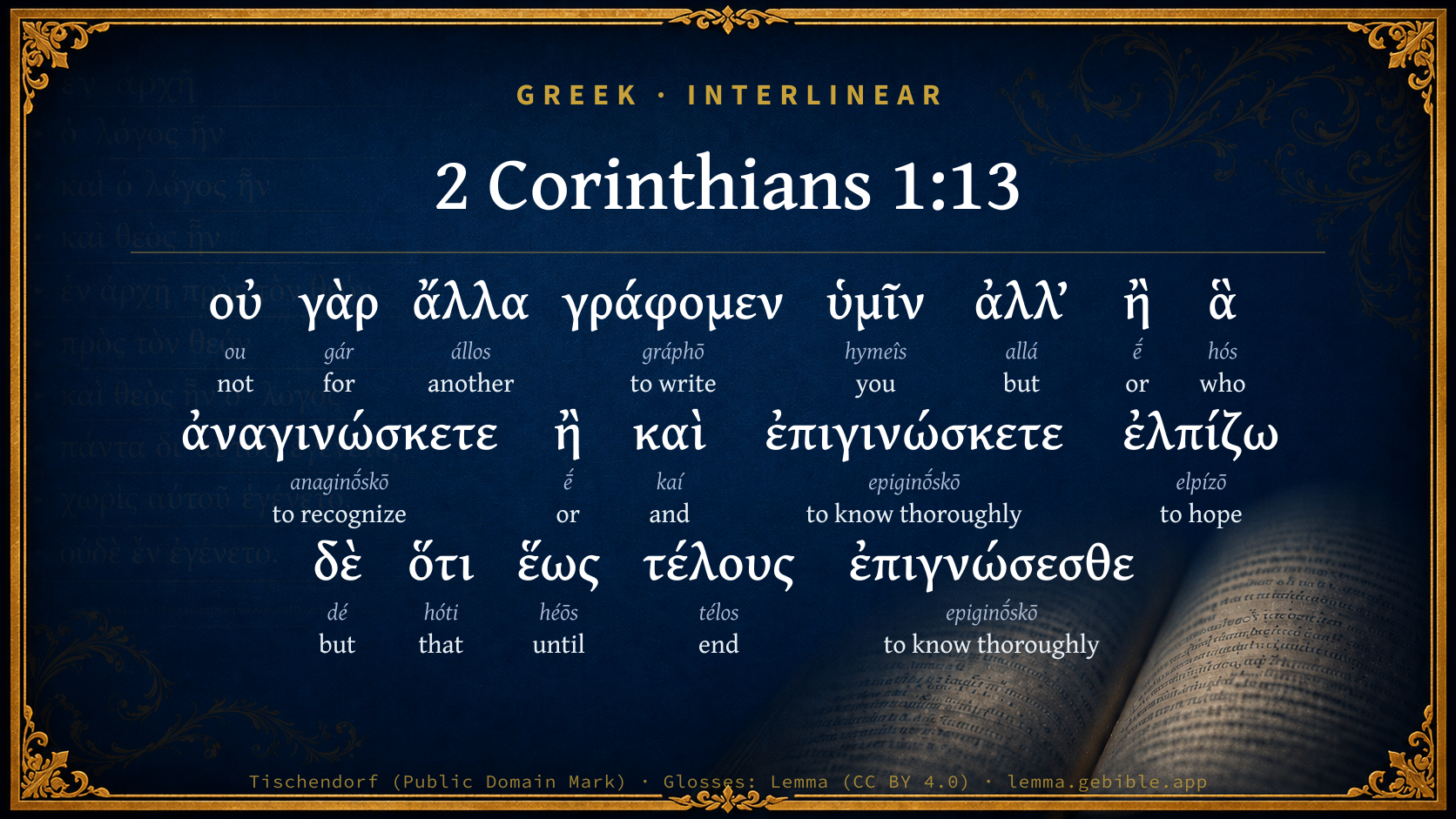
Download image
Cite this verse

2 Corinthians 1:13 (World English Bible). Public Domain. Lemma interlinear Bible study tool, https://lemma.gebible.app/v/2-corinthians/1/13.

Show BibTeX & RIS
BibTeX
RIS
English Translation
For we write no other things to you, than what you read or even acknowledge, and I hope you will acknowledge to the end;
World English Bible · Public Domain
Download a study sheet

One document with this verse’s original text, its word-by-word gloss line, the meaning frame, cross-references with their text, attributed commentary, and full source and license credits — printable, and it pastes into notes with its structure intact.

This verse Autodidact and up

Study sheet (.html) Plain text (.txt)

A passage Seminary Student

Up to 50 verses in one chapter. A passage sheet keeps up to 6 commentary sources and 12 cross-references per verse, in the order this page ranks them, and says so on the sheet whenever that leaves anything out. Ask for a single verse and you get the Autodidact verse sheet above.

Everything on this page stays free to read, with no account — the sheet is a download of what is already on screen, not access to it.

Want to remove ads? Support Godless Engineer
Compare translations 3

The same verse in 3 English versions, stacked beneath the original-language interlinear above. Click any original word for its lexicon entry.

Each is an independent rendering of the whole verse — the interlinear is not word-aligned to these translations.

Highlighted words mark where these versions differ — a whole-verse word diff, not a word-by-word alignment.

  • World English Bible Public Domain
    For we write no other things to you, than what you read or even acknowledge, and I hope you will acknowledge to the end;
  • King James Version Public Domain
    For we write none other things unto you, than what ye read or acknowledge; and I trust ye shall acknowledge even to the end;
  • unfoldingWord Literal Text CC BY-SA 4.0
    For we write no other to you but than what you read or also understand, but I hope that you will understand to the end—

unfoldingWord Literal Text — © unfoldingWord, licensed CC BY-SA 4.0. Word-aligned USFM3 via Door43 (git.door43.org/unfoldingWord/en_ult).

Versions to compare (up to 4)

3 of 4 selected

Show all 19 translations

Every available English version of this verse, each an independent rendering of the whole verse.

  • World English Bible Public Domain
    For we write no other things to you, than what you read or even acknowledge, and I hope you will acknowledge to the end;
  • Berean Standard Bible Public Domain
    For we do not write you anything that is beyond your ability to read and understand. And I hope that you will understand us completely,
  • Majority Standard Bible Public Domain
    For we do not write you anything that is beyond your ability to read and understand. And I hope that you will understand us completely,
  • King James Version Public Domain
    For we write none other things unto you, than what ye read or acknowledge; and I trust ye shall acknowledge even to the end;
  • American Standard Version (1901) Public Domain
    For we write no other things unto you, than what ye read or even acknowledge, and I hope ye will acknowledge unto the end:
  • Revised Version (1885) Public Domain
    For we write none other things unto you, than what ye read or even acknowledge, and I hope ye will acknowledge unto the end:
  • Geneva Bible (1599) Public Domain
    For wee write none other thinges vnto you, then that ye reade or els that ye acknowledge, and I trust ye shall acknowledge vnto ye end.
  • Douay-Rheims (1899) Public Domain
    For we write no other things to you than what you have read and known. And I hope that you shall know unto the end:
  • Young's Literal Translation Public Domain
    for no other things do we write to you, but what ye either do read or also acknowledge, and I hope that also unto the end ye shall acknowledge,
  • Literal Standard Version CC BY-SA 4.0
    for no other things do we write to you, but what you either read or also acknowledge, and I hope that you will also acknowledge to the end,
  • Unlocked Literal Bible CC BY-SA 4.0
    We write to you nothing that you cannot read and understand. I expect that,
  • unfoldingWord Literal Text CC BY-SA 4.0
    For we write no other to you but than what you read or also understand, but I hope that you will understand to the end—
  • Darby Bible Public Domain
    For we do not write other things to you but what ye well know and recognise; and I hope that ye will recognise to the end,
  • World Messianic Bible Public Domain
    For we write no other things to you than what you read or even acknowledge, and I hope you will acknowledge to the end—
  • Webster's Bible Public Domain
    For we write no other things to you, than what ye read or acknowledge; and I trust ye will acknowledge even to the end;
  • Free Bible Version CC BY-SA 4.0
    For we are not writing anything complicated that you can't read and understand. I hope you'll understand in the end,
  • Bible in Basic English Public Domain
    For in our letters we say no other things to you, but those which you are reading, and to which you give agreement, and, it is my hope, will go on doing so to the end:
  • Text-Critical English NT CC BY 4.0
    For we are not writing anything to you other than what you can read and understand. And I hope that you will understand completely—
  • Tyndale New Testament (1534) Public Domain
    We write no nother thinges vnto you then that ye reade and also knowe. Yee and I trust ye shall fynde vs vnto the ende

Literal Standard Version (2020), Covenant Press — licensed CC BY-SA 4.0. Text via the HelloAO Bible API (eBible.org). Unlocked Literal Bible (unfoldingWord) — licensed CC BY-SA 4.0. Text via the HelloAO Bible API (eBible.org). unfoldingWord Literal Text — © unfoldingWord, licensed CC BY-SA 4.0. Word-aligned USFM3 via Door43 (git.door43.org/unfoldingWord/en_ult). Free Bible Version, Dr. Jonathan Gallagher — licensed CC BY-SA 4.0. Text via the HelloAO Bible API (eBible.org).

Word by word

More ways to search: Search by grammar → Find every occurrence → Compare this word →

Practice this passage: Drill this verse → Learn its vocabulary →

ἐλπίζω
elpízō
G1679
“to hope”
Verb, Present, Active, Indicative, 1st person, Singular
Part of Speech
Verb
Tense
Present
Voice
Active
Mood
Indicative
Person
1st person
Number
Singular
Full Thayer's Definition

Origin: from G1680

TDNT: 10:37,2

1. to hope a. in a religious sense, to wait for salvation with joy and full confidence 2. hopefully to trust in
  1. οὐ ou G3756 “not” Particle, Negative
  2. γὰρ gár G1063 “for” Conjunction
  3. ἄλλα állos G243 “another” Adjective, Accusative, Plural, Neuter
  4. γράφομεν gráphō G1125 “to write” Verb, Present, Active, Indicative, 1st person, Plural
  5. ὑμῖν hymeîs G5210 “you” Personal pronoun, 2nd person, Dative, Plural
  6. ἀλλ’ allá G235 “but” Conjunction
  7. ἢ ḗ G2228 “or” Particle
  8. ἃ hós G3739 “who” Relative pronoun, Accusative, Plural, Neuter
  9. ἀναγινώσκετε anaginṓskō G314 “to recognize” Verb, Present, Active, Indicative, 2nd person, Plural
  10. ἢ ḗ G2228 “or” Particle
  11. καὶ kaí G2532 “and” Conjunction
  12. ἐπιγινώσκετε epiginṓskō G1921 “to know thoroughly” Verb, Present, Active, Indicative, 2nd person, Plural
  13. δὲ dé G1161 “but” Conjunction
  14. ὅτι hóti G3754 “that” Conjunction
  15. ἕως héōs G2193 “until” Adverb
  16. τέλους télos G5056 “end” Noun, Genitive, Singular, Neuter
  17. ἐπιγνώσεσθε epiginṓskō G1921 “to know thoroughly” Verb, Future, Middle deponent, Indicative, 2nd person, Plural

About this verse

These counts appear in no published source. They are computed here, from the morphology-tagged text and Lemma’s own curated glosses. What Lemma adds →

18
words
16
distinct lemmas
Pauline Epistles
section

Shared distinctive vocabulary

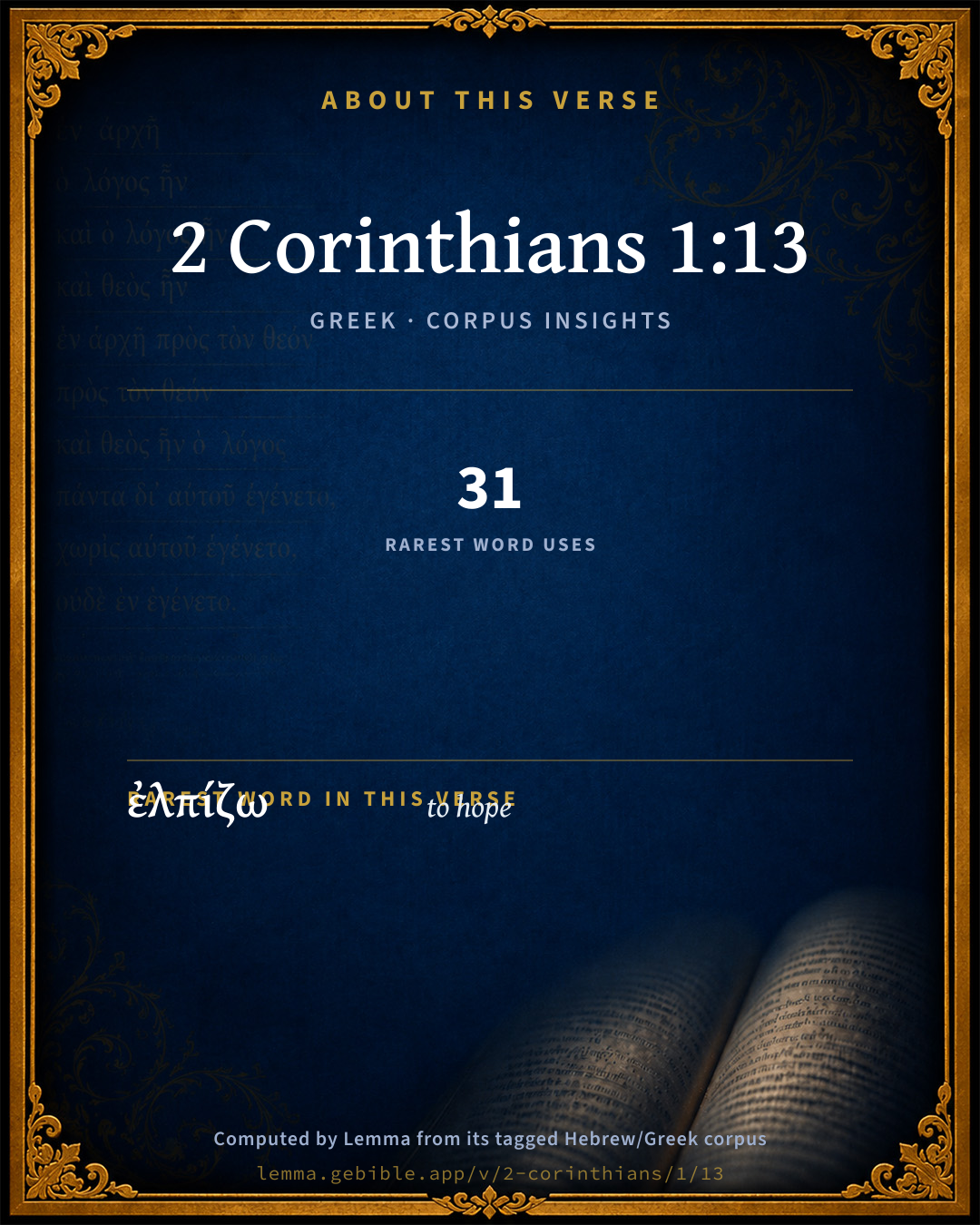
ἐλπίζω to hope G1679 occurs in 31 verses of the Greek New Testament. Also found in:
Repetition

Words recur within this verse:

  • ἐπιγινώσκετε to know thoroughly G1921 ×2
  • ἢ or G2228 ×2

Cross-references

4

Topical passages linked to 2 Corinthians 1:13 in the Treasury of Scripture Knowledge — connected by theme and wording, ordered by reader-vote popularity; previews shown in the World English Bible.

  • 2 Corinthians 4:2 But we have renounced the hidden things of shame, not walking in craftiness, nor handling the word of God deceitfully; but by the manifestation of the truth commending ourselves to every man's conscience in the sight of God.
  • Philemon 1:6 that the fellowship of your faith may become effective, in the knowledge of every good thing which is in us in Christ Jesus.
  • 2 Corinthians 13:6 But I hope that you will know that we aren't disqualified.
  • 2 Corinthians 5:11 Knowing therefore the fear of the Lord, we persuade men, but we are revealed to God; and I hope that we are revealed also in your consciences.

Cross-references courtesy of OpenBible.info (CC BY 4.0).

Commentary

Notes on 2 Corinthians 1:13 from classic Christian and Jewish commentators (each source and its license shown beneath its notes). The classic Christian expositions comment on the surrounding passage and are grouped to its opening verse, so a note may address several verses; the Jewish commentaries on the Tanakh (Rashi and others) are per-verse, so they appear only where the commentator wrote on this verse.

Lemma curates 59 commentaries, every one of them public domain or Creative Commons licensed, each selected and text-cleaned for this edition rather than reprinted as found. About our sources →

Bengel's Gnomon

Johann Albrecht Bengel

2Co 1:13. Ἄλλα) other things, contrary.—γράφομεν, we write) in this epistle. He appeals to a present thing.—ἀναγινώσκετε, ye read) in the former epistle.—ἢ καὶ, or even) ἐπίγνωσις is more than ἀνάγνωσις.—ἓως τέλους, even unto the end) of my course, comp. 2Co 1:14, at the end, and 1Co 4:5: whence it is evident that regard to the day of the Lord is not excluded.

Bengel's Gnomon of the New Testament — English translation (T&T Clark, Edinburgh, 1860) — public domain. Text from a community e-Sword module.

Meyer's Critical & Exegetical Commentary

Heinrich August Wilhelm Meyer

2Co_1:13 f. In order to vindicate the apparently vainglorious (2Co_1:10) περισσ. δὲ πρ. ὑμᾶς (2Co_1:12), in so far as it might be suspected as not honourably meant, he asserts his candour in writing, which must have been assailed by his opponents (comp. 2Co_10:10), who probably maintained, His letters to us are not the expression of his genuine inmost opinion!

For Znothing else do we write to you than what you (in our letters) read or also understand; i.e. in our letters to you we do not hide or disguise our genuine opinion, but it agrees exactly with what the reading of the same, or your acquaintance with our mode of thinking and character, says to you. Comp. Theodoret. On γράφειν in its reference to the sense of what is written, comp. 1Co_5:11. According to de Wette, the sense amounts to the thought: I cannot do otherwise, I must write thus. But Paul is making an appeal to the readers.

ἀλλʼ ἤ] praeterquam, nisi. For examples in which the previous negative sentence has also ἄλλος, see Hartung, Partikell. II. p. 45; Heindorf, ad Prot. p. 354 B; Klotz, ad Devar. p. 36 f.; Baeumlein, Partik. p. 5. The mode of expression depends on a blending of the two constructions

οὐκ ἄλλα … ἀλλά and οὐκ ἄλλα … ἤ; Stallbaum, ad Plat. Phaed. p. 81 B; Kühner, II. p. 438.

ἃ ἀναγινώσκετε, ἢ κ. ἐπιν.] This latter ἤ is in no connection with the former, in which case it could not but have stood a ἃ ἢ ἀναγ., ἢ καὶ ἐπιγ. This in opposition to Fritzsches way of taking it: neque enim alia ad vos perscribimus, quam aut ea … aut ea, quae, etc. ἀναγινώσκειν is to read, as it is usually in the Attic authors, and always in the N. T., not to understand, as Calvin, Estius, Storr,[129] following the Peshito, wish to take it, though it has this meaning often in classical Greek (Hom. Il. xiii. 734, Od. xxi. 205, xxii. 206; Xen. Anab. v. 8. 6; Pind. Isthm. ii. 35; Herodian, vii. 7; comp. also Prayer of Manass. 12).

ἢ καὶ ἐπιγιν.] or also (without communication by letter) understand. Wetstein imports arbitrarily: vel si alicubi haereat, post secundam aut tertiam lectionem, attento animo factam, sit intellecturus. Rückert: and doubtless also understand. Quite against ἢ καί, which stands also opposed to the view of Hofmann: Paul wishes to say that he does not write in such a way, that they might understand something else than he means in his words. In this case we should have had καί only, since ἢ καί points to something else than to the reading, with which what he has written agrees.

The assimilation of the expressions ἀναγιν. and ἐπιγιν. (comp. 2Co_3:2) cannot be imitated in German, but in Latin approximately: legitis aut etiam intelligitis. Comp. on Act_8:30; Plat. Ep. II. p. 312 D.

ἐλπίζω δὲ κ.τ.λ.] The object to ἐπιγνώσεσθε is ὅτι καύχημα ὑμῶν ἐσμεν κ.τ.λ., and καθὼς καὶ ἐπεγν. ἡμ. ἀπὸ μέρ. is an inserted clause: I hope, however, that you will understand even to the end,as you have understood us in part,that we are your boast, etc. We might also consider on ὅτι καύχημα κ.τ.λ. as a nearer object to ἐπέγνωτε ὑμᾶς (Estius, Rosenmüller, Billroth, Rückert, de Wette); but, since in this way ἐπιγνώσεσθε remains without an object (Billroth supplies: that I think the same as I write; comp. Rückert; Osiander: all my doing and suffering in its purity), the above mode of connection is easier and simpler. Ambrosiaster, Luther, Grotius, and others, also Olshausen (Osiander doubtfully), take ὅτι as for, stating the ground for καθὼς κ. ἐπέγν. ἡμ. ἀπὸ μέρ. But in that case the accurate, logical connection is still more wanting, since from the general καύχημα ὑμῶν ἐσμεν κ.τ.λ. no inference to the ἐπέγνωτε ἡμᾶς restricted by ἀπὸ μέρους is warranted; the reason assigned would not be suitable to ἀπὸ μέρους. The connection which runs on simply is unnecessarily broken up by Ewald holding 2Co_1:13 and 2Co_1:14 on to μέρους as a parenthesis, so that ὅτι, 2Co_1:14 (that), joins on again to 2Co_1:12.

ἕως τέλους] does not mean till my death (Hofmann), but till the end, i.e. till the ceasing of this world, till the Parousia. Comp. 1Co_1:8; 1Co_15:51 f.; Heb_3:6.2Co_1:14. καθὼς κ. ἐπέγν. ἡμᾶς compares the future, regarding which Paul hopes, with the past, regarding which he knows. And therefore he adds a limitation in keeping with the truth, ἀπὸ μέρους (comp. Rom_11:25); for not all the Corinthians had thus understood him. Hofmann, quite against the usage of the language, takes ἀπὸ μέρους of time, inasmuch as the apostles intercourse with them up to the present was only a part of what he had to live with them. In that case Paul would have written ἕως ἄρτι in contrast to ἕως τέλους. Calvin, Estius, and Emmerling refer it to the degree of knowledge, quodammodo (comp. 2Co_2:5), with which Paul reproaches the readers, ὡς μὴ παντελῶς ἀπωσαμένους τὰς κατʼ αὐτοῦ γεγενημένας δια βολάς, Theodoret. But a purpose of reproach is quite foreign to the connection; and certainly the readers to whom ἐπέγνωτε applies had not only understood him quodammodo, but wholly and decidedly, that, etc. Billroth thinks that Paul wishes to mark his cordial love, which till now he could only have shown them in part. Comp. Chrysostom, according to whom ἀπὸ μέ ρους is added from modesty; also Theophylact, according to whom Paul is thinking of the imperfect exhibition of his virtue. But how could the readers conjecture this!

ὅτι καύχημα κ.τ.λ.] that we redound for glory (i.e. for the object of καυχᾶσθαι) to you, even as you to us on the day of the Parousia. It will be to your honour on that day that you have had us as teachers, and it will be to our honour that we have had you as disciples. Comp. 1Th_2:19 f.; Php_2:16. With how much winning tact the addition κάθαπερ κ. ὑμεῖς ἡμῶν suppresses all appearance of self-exaltation! ὡς μαθηταῖς ὁμοτίμοις διαλεγόμενος οὕτως ἐξισάζει τὸν λόγον, Chrysosto.

ἐν τῇ ἡμέρᾳ τ. κυρ. Ἰησοῦ] belongs to the whole ὅτι καύχημα … ὑμεῖς ἡμῶν, not, as Rückert arbitrarily thinks, to καθάπερ κ. ὑμ. ἡμῶν merely (so Grotius, Calovius, and others); nor yet, as Hofmann would have it, primarily to καύχ. ὑμῶν ἐσμεν.

[129] Calvin thinks ἀναγιν. and ἐπιγιν. are distinguished as agnoscere and recognoscere. So, on the whole, Storr also. But Estius makes the difference: et recognoscitis antiqua, et insuper etiam cognoscitis recentia.

Meyer — Critical and Exegetical Commentary on the New Testament — English translation by Peter Christie, edited by Frederick Crombie (T&T Clark, 1880) — public domain. Text from a community e-Sword module.

Expositor's Greek Testament

ed. W. Robertson Nicoll

2Co 1:13 . οὐ γὰρ ἄλλα κ . τ . λ .: for we write none other things unto you than what ye read ( ἀναγινώσκειν always means “to read” in St. Paul’s Epp. and throughout the N.T.) or even acknowledge; i.e. , there is no hidden meaning in his letters; he means what he says, as to which doubts seem to have been prevalent at Corinth (chap. 2Co 10:10-11 ). The play upon words ἀναγινώσκετε … ἐπιγινώσκετε cannot be reproduced in English. St. Paul is fond of such paronomasia; see, e.g. , γινωσκομένη … ἀναγινωσκομένη , chap. 2Co 3:2 ; φρονεῖν , ὑπερφρονεῖν , σωφρονεῖν , Rom 12:3 ; συνκρίνω , ἀνκρίνω , 1Co 2:13-14 ; ἐργαζόμενοι … περιεργαζόμενοι , 2Th 3:11 ; cf. for other illustrations 1Co 7:31 ; 1Co 11:31 ; 1Co 12:2 , Phi 3:2 , Eph 5:15 , and chaps 2Co 4:8 , 2Co 10:12 below. ἀλλʼ ἤ is equivalent to “except”; cf. Job 6:5 , Isa 42:19 . ἐλπίζω δὲ ὅτι κ . τ . λ .: and I hope that ye will acknowledge unto the end, sc. , unto the day of the Lord’s appearing (as in 1Co 1:8 ), when the secrets of all hearts shall be revealed.

The Expositor's Greek Testament, edited by W. Robertson Nicoll (1897–1910) — public domain. Text from a community e-Sword module.

Geneva Bible (1599)

Geneva Bible translators

Perfectly.

He saith he writeth barely and simply: for he that writeth in colored sort, is rightly said to write otherwise than we read: and this he saith the Corinthians shall know and like of very well.

Geneva Bible (1599) marginal notes — public domain. Text via Bolls.life.

Jamieson, Fausset & Brown

Robert Jamieson, A. R. Fausset & David Brown

We write none other things (in this Epistle) than what ye read (in my former Epistle [BENGEL]; present, because the Epistle continued still to be read in the Church as an apostolic rule). CONYBEARE and HOWSON think Paul had been suspected of writing privately to some individuals in the Church in a different strain from that of his public letters; and translates, "I write nothing else to you but what ye read openly (the Greek meaning, 'ye read aloud,' namely, when Paul's Epistles were publicly read in the congregation, Th1 5:27); yea, and what you acknowledge inwardly."

or acknowledge--Greek, "or even acknowledge." The Greek for "read" and for "acknowledge" are words kindred in sound and root. I would translate, "None other things than what ye know by reading (by comparing my former Epistle with my present Epistle), or even know as a matter of fact (namely, the consistency of my acts with my words)."

even to the end--of my life. Not excluding reference to the day of the Lord (end of Co2 1:14; Co1 4:5).

Jamieson, Fausset & Brown — Commentary Critical and Explanatory on the Whole Bible (1871) — public domain (CC PDM 1.0). Text via the HelloAO Bible API.

Adam Clarke's Commentary

Verse 13. Than what ye read] Viz. In the first epistle which he had sent them.

Or acknowledge] To be the truth of God; and which he hoped they would continue to acknowledge, and not permit themselves to be turned aside from the hope of the Gospel.

Adam Clarke's Commentary on the Bible (1810–1826) — public domain. Text from a community e-Sword/MySword module.

John Calvin's Commentaries

13. For we write no other things Here he indirectly reproves the false apostles, who recommended themselves by immoderate boastings, while they had little or no ground for it; and at the same time he obviates calumnies, in order that no one may object, that he claims for himself more than is his due. He says, therefore, that he does not in words boast of anything that he is not prepared to make good by deeds, and that, too, from the testimony of the Corinthians.

The ambiguity, however, of the words, has given occasion for this passage being misinterpreted. Αναγινώσκειν, among the Greeks, signifies sometimes to read, and at other times to recognize. Επιγινώσκειν sometimes signifies to discover, while at other times it means what the Latins properly express by the verb agnoscere, to own, as among lawyers the phrase is used to own a child, as Budaeus also has observed. In this way ἐπιγινώσκειν means more than ἀναγινώσκειν For we say that a person recognises a thing, that is, that being silently convinced of it in his judgment, he perceives it to be true, while at the same time he does not acknowledge it, or, in other words, cordially intimate his assent to it.

Let us now examine Paul’s words. Some read thus — We write no other things than what ye read and acknowledge, which it is very manifest is exceedingly lifeless, not to say senseless. For as to Ambrose’s qualifying the statement in this way — You not only read, but also acknowledge, there is no one that does not perceive that it is quite foreign to the import of the words. And the meaning that I have stated is plain, and hangs together naturally, and, up to this point, there is nothing to prevent readers from understanding it, were it not that they have had their eyes shut, from being misled by the different meanings of the word. The sum is this — that Paul declares, that he brings forward no other things than what were known and perceived by the Corinthians — nay more, things as to which they would bear him witness. The first term employed is recognoscere, (to recognize,) which is applicable, when persons are convinced from experience that matters are so. The second is agnoscere, (to acknowledge,) meaning that they give their assent to the truth.

And, I hope, will acknowledge even to the end. As the Corinthians had not yet perfectly returned to a sound mind, so as to be prepared to weigh his fidelity in a just and even balance, but at the same time had begun to abate somewhat of their perverse and malignant judgment respecting him, he intimates, that he hopes better as to the future. “You have already,” says he, “to some extent acknowledged me. I hope that you will acknowledge more and more what I have been among you, and in what manner I have conducted myself.” From this it appears more clearly what he meant by the word ἐπιγινώσκειν. (acknowledge ) Now this relates to a season of repentance, for they had at the beginning acknowledged him fully and thoroughly; afterwards their right judgment had been beclouded by unfair statements, but they had at length begun to return in part to a sound mind.

John Calvin's Commentaries (1540-1563) — public domain. Text from the Calvin Translation Society English edition (1840s-50s) via the Christian Classics Ethereal Library (ccel.org). Calvin's coverage is partial (roughly two-thirds of the Bible); uncommented books and verses are honest gaps, never fabricated. The 19th-century editor's footnotes and remarks are omitted so the notes are faithfully Calvin's own voice.

Ellicott's Commentary for English Readers

(13) For we write none other things . . .—The Greek presents a play on the two words “read” (ana-ginoskein) and “acknowledge,” or “know fully” (epiginoskein), which it is impossible to reproduce in English. It is as though he said: “I have no hidden meaning in what I write and you read. What you read you read aright in its plain and simple sense. I hope” (the very hope implies that it had been otherwise) “that the more you know me the more will you so read me and judge me even to the end, the great day when the Lord shall come and all things shall be made plain.” (Comp. 1Co_4:3-5.) Possibly, however, the words “even to the end” may be merely equivalent to “completely.” (See Note on Joh_13:1.)

A Bible Commentary for English Readers, edited by Charles John Ellicott (1878–1897) — public domain. Text from a community e-Sword module.

The Cambridge Bible for Schools and Colleges

gen. ed. J. J. S. Perowne

13. For we write none other things unto yon] i.e. for we are not writing to you about anything with which you have not had the opportunity of being fully acquainted.

than what you read or acknowledge] It is impossible to give the full sense of this passage in English. In the first place there is the play upon ἀναγινώσκετε and ἐπιγινώσκετε, after a fashion usual with St Paul, and next there is the fact that ἀναγινώσκω has a double meaning, to recognize, know accurately (as in Xen. Anab. v. viii. 6), and to read. The word translated ‘acknowledge’ signifies to know thoroughly either (1) by examination, comparison, reasoning, or (2) by intuition. Here the former idea is predominant.

The Cambridge Bible for Schools and Colleges (gen. ed. J. J. S. Perowne; Cambridge University Press, 1878–1918) — public domain. Text from a community e-Sword module.

John Gill's Exposition

For we write none other things to you,.... The things we write unto you concerning our conduct; and behaviour, are no other

than what you read; not in our letters to you, but in our lives and conversations, when we were among you, and which you must own and acknowledge to be just and right; we can appeal to you, that what we say, and are obliged to say of ourselves, in our own defence, is what, upon a recollection, you will easily remember to have seen and observed:

and I trust; or "hope", through the grace of God, we shall be enabled so to walk, as that

you shall acknowledge even to the end; that our conversations are as become the Gospel of Christ, and are clear of that hypocrisy and deceit our adversaries would insinuate concerning us.

John Gill's Exposition of the Whole Bible (1746–1763) — public domain (CC PDM 1.0). Text via the HelloAO Bible API.

Trapp's Complete Commentary

John Trapp

13 For we write none other things unto you, than what ye read or acknowledge; and I trust ye shall acknowledge even to the end;

Ver. 13. Than what ye read, &c.] Or, than what you can both recognize and approve of; for you have known me through and through.

John Trapp, A Commentary or Exposition upon All the Books of the Old and New Testament (1647–1656) — public domain. Text from a community e-Sword module.

Albert Barnes' Notes on the Bible

For we write none other things ... - There has been much variety in the interpretation of this passage; and much difficulty felt in determining what it means. The sense seems to me to be this. Paul had just declared that he had been actuated by pure intentions and by entire sincerity, and had in all things been influenced by the grace of God. This he had shown everywhere, but more particularly among them at Corinth. That they fully knew. In making this affirmation they had full evidence from what they had known of him in former times that such had been his course of life; and he trusted that they would be able to acknowledge the same thing to the end, and that they would never have any occasion to form a different opinion of him. It will be recollected that it is probable that some at Corinth had charged him with insincerity; and some had accused him of fickleness in having promised to come to Corinth and then changing his mind, or had charged him with never having intended to come to them.

His object in this verse is to refute such slanders, and he says, therefore, that all that he affirmed in his writings about the sincerity and simplicity of his aims, were such as they knew from their past acquaintance with him to be true; and that they knew that he was a man who would keep his promises. It is an instance of a minister who was able to appeal to the people among whom he had lived and labored in regard to the general sincerity and uprightness of his character - such an appeal as every minister ought to be able to make to refute all slanders; and such as he will be able to make successfully, if his life, like that of Paul, is such as to warrant it. Such seems to me to be the sense of the passage. Beza, however, renders it,” I write no other things than what ye read, or may understand,” and so Rosenmuller, Wetstein, Macknight, and some others interpret it; and they explain it as meaning, “I write nothing secretly, nothing ambiguously, but I express myself clearly, openly, plainly, so that I may be read and understood by all.”

Macknight supposes that they had charged him with using ambiguous language, that he might afterward interpret it to suit his own purpose. The objection to this is, that Paul never adverts to the obscurity or perspicuity of his own language. It was his conduct that was the main subject on which he was writing, and the connection seems to demand that we understand him as affirming that they had abundant evidence that what he affirmed of his simplicity of aim, and integrity of life, was true. Than what ye read (ἀναγινώσκετε anaginōskete). This word properly means to know accurately; to distinguish; and in the New Testament usually to know by reading. Doddridge remarks, that the word is ambiguous, and may signify either to acknowledge, to know, or to read. He regards it as used here in the sense of knowing. It is probably used here in the sense of knowing accurately, or surely; of recognizing from their former acquaintance with him. They would see that the sentiments which he now expressed were such as accorded with his character and uniform course of life. “Or acknowledge” (ἐπιγινώσκετε epiginōskete). The preposition ἐπί epi in composition here is intensive, and the word denotes to know fully; to receive full knowledge of; to know well; or to recognize. It here means that they would fully recognize, or know entirely to their satisfaction, that the sentiments which he here expressed were such as accorded with his general manner of life. From what they knew of him, they could not but admit that he had been influenced by the principles stated.

And I trust ye shall acknowledge - I trust that my conduct will be such as to convince you always that I am actuated by such principles. I trust you will never witness any departure from them - the language of a man of settled principle, and of fixed aims and honesty of life. An honest man can always use such language respecting himself.

Even to the end - To the end of life; always. “We trust that you will never have occasion to think dishonorably of us; or to reflect on any inconsistency in our behavior” - Doddridge.

Albert Barnes' Notes on the Bible (1834–1885) — public domain. Text from a community e-Sword/MySword module.

Haydock's Catholic Bible Commentary

What you have read, in my former letter, or letters, and known by my preaching: this he says, to clear himself from the accusation of his adversaries, that his words, preaching, and promises were not to be regarded, saying different things at different times, and promising to come to them, which he had not done. (Witham)

George Leo Haydock (1774–1849), Haydock's Catholic Family Bible and Commentary, 1859 edition — public domain. Excludes Psalms (Douay-Rheims chapter numbering differs from Protestant) and Deuterocanonical books (Catholic canon only).

Matthew Poole's English Annotations

I do not tell you stories; the things which I write, and which you read, either in my Epistles to you, or to other churches of Christ, are what you know, must own and acknowledge, to be truth; and I hope you shall acknowledge them to be so to the end both of my life and yours.

Matthew Poole's English Annotations on the Holy Bible (1683–1685) — public domain. Text from a community e-Sword/MySword module.

Whedon's Commentary on the Bible

Daniel D. Whedon

13. Write none other… than what ye read—There is no lurking design, no concealed subsense in his words. They mean what they say, just as they are read by his Corinthians.

Or acknowledge—Knowing beforehand that they are truth.

Shall acknowledge—As there is no hypocrisy, so there will be no apostasy.

Daniel D. Whedon (gen. ed.), Commentary on the Old and New Testaments (1874–1909) — public domain. Text from a community e-Sword module.

The Pulpit Commentary

For we write none other things unto you, etc. Remarks like these obviously presuppose that the conduct and character of St. Paul had been misrepresented and calumniated. The perpetual recurrence to a strain of self-defence would have been needless if some one probably Titus had not told St. Paul that his opponents accused him of insincerity. Here, therefore, he tells them that he is opening out his very heart towards them. What he had to say to them and of them was here set forth without any subterfuges or arrieres pensees. He had nothing esoteric which differed from exoteric teaching. It is a melancholy thought that even such a one as Paul was reduced to the sad necessity of defending himself against such charges as that he intrigued with individual members of his Churches, wrote private letters or sent secret messages which differed in tone from those which were read in the public assembly. Or acknowledge; rather, or even fully know; i.e. from other sources. The paronomasia of the original cannot be preserved in English, but in Latin would be "Quae legitis aut etiam inteltigitis." And I trust even to the end; rather, but I hope that, even unto the end, ye will fully know even as ye fully knew us in part that we are your subject of boast. After telling them that they have in this letter his genuine and inmost thoughts, he adds that "even as some of them (for this seem to be implied by the "in part") already knew well that the mutual relations between him and them were something wherein to glory, he hopes that they will appreciate this fact, even to the end." He knows that some honour him; he hopes that all will do so; but he can only express this as a hope, for he is aware that there are calumnies abroad respecting him, so that he cannot feel sure of their unbroken allegiance. Such seems to be the meaning; but the state of mind in which St. Paul wrote has evidently troubled his style, and his expressions are less lucid and more difficult to unravel in this Epistle than in any other. To the end. The expression is quite general, like our "to the last." He does not seem definitely to imply either to the end of his life or to the coming of Christ, which they regarded as the end of all things, as in 1Co_1:8 1Co_15:24; Heb_3:6.

The Pulpit Commentary (1880–1919), ed. H.D.M. Spence-Jones & Joseph S. Exell — public domain. Text from a community e-Sword module.

Burkitt's Expository Notes on the New Testament

William Burkitt

The apostle having asserted his own sincerity and upright conversation in the former verse, he doth in this verse make his appeal to the consciences of the Corinthians for his justification. It is a good demonstration of our uprightness, when we can not only appeal to God as touching our sincerity, but dare appeal to the consciences of men; for if through prejudice they will not with their mouths vouch for our integrity, yet secretly with their conscience they cannot but bear witness to it.

Observe, 2. The apostle’s having declared that he had his testimonials not only from his own conscience, but from theirs also; he adds, that he trusted this would hold and continue even to the end, that is, to the end both of his and their lives.

As if the apostle had said, "My conversation hath hitherto been acknowledged by you to be sincere and upright; and I hope, as you shall never see it otherwise by me, so you will persevere and continue in your good opinion and right judgment concerning me to the end of your and my life."

William Burkitt's Expository Notes on the New Testament (1700–1703) — public domain. Text from a community e-Sword module.

McGarvey & Pendleton's Commentaries

J. W. McGarvey

For we write no other things unto you, than what ye read [literally, read aloud] or even acknowledge, and I hope ye will acknowledge unto the end:

J. W. McGarvey (with Philip Y. Pendleton), Commentaries on the New Testament (The Fourfold Gospel, 1914; Acts; and the epistles) — public domain. Text from a community e-Sword/MySword module.

The People's New Testament

B. W. Johnson

13. For we write none other things. The charge seems to have been that he was ambiguous in what he wrote (verse 17). Hence he insists that he writes plainly, and that they read, understand, and accept what he writes.

B. W. Johnson's The People's New Testament with Notes (1889–1891) — public domain. Electronic text from the Christian Classics Ethereal Library (CCEL) ThML edition.

Cambridge Greek Testament for Schools and Colleges

13. οὐ γὰρ ἄλλα γράφομεν. ‘Do not say, Ah, but your letters are not sincere, for I write nothing that is inconsistent with what you read in my other letters, or with your experience of my life and conduct.’ The present, γράφομεν, does not refer to this letter exclusively, and perhaps does not include it. He is appealing to what they already know of him. ‘My letters are consistent with one another and with my behaviour, as you have known it in the past, and (I hope) as you will know it to the end.’ The Corinthians had previously received three letters from him, the lost letter of 1Co 5:9, 1 Corinthians, and a third letter, very severe in tone, which is either lost or preserved in part in 10–13. So they had enough of his written words to judge him by. See on 2Co 1:23, 2Co 2:3; 2Co 2:9.

ἀλλʼ ἣ ἃ ἀναγινώσκετε ἣ καὶ ἐπιγινώσκετε. Than what you read or even acknowledge. Note the present tense: ‘my meaning lies on the surface. You read it at once; you read it and you recognize it.’ For the characteristic play upon words comp. 2Co 3:2, 2Co 4:8, 2Co 6:10, 2Co 7:10, 2Co 10:6; 2Co 10:12. In classical Greek ἀναγινώσκετε might mean ‘recognize, admit’; and it has been proposed to go back to that meaning here: ‘we write none other things than what ye recognize or even acknowledge,’ or (imitating the play on words) ‘than those things to which ye assent and even consent.’ And it is proposed to adopt a similar rendering in 2Co 3:2. But ἀναγινώσκειν occurs more than thirty times in the N.T., and seems always to mean ‘read’ (Eph 3:4; Col 4:16; 1Th 5:27, &c.). In this Epistle it must mean ‘read’ in 2Co 3:15, and almost certainly in 2Co 3:2. It is safer to retain the usual N.T. meaning here, as Chrysostom does. Indeed the use of the word in connexion with the recipients of a letter, in contrast to the writer, seems to be decisive.

There is perhaps a mixture of constructions in ἀλλʼ ἤ, between οὐκ ἄλλα ἤ and οὐκ ἄλλα, ἀλλά: comp. Luk 12:51; Job 6:5; Sir 37:12; Sir 44:10. It is common in classical Greek, and Hdt. I. 49. 1 and IX. 8, 3 seem to show the origin of it. See Winer, p. 552, Stallbaum on Phaedo 81 B.

ἐλπίξω. He is not quite confident: I hope you will acknowledge to the end. ‘Even to the end’ (A.V.) is from the false reading καὶ ἕως τέλους (D3KLMP). As in 1Co 1:8, ‘to the end’ means to the end of the world. The expectation of Christ’s speedy return was then so vivid that the difference between ‘till I die’ and ‘until the day of the Lord Jesus’ was not great.

Cambridge Greek Testament for Schools and Colleges (Cambridge University Press, 1896; 21 vols, various authors incl. Carr, Maclear, Plummer, Farrar, Lumby, Moule, M. R. James, Simcox) — public domain. Text from a community e-Sword module.

International Critical Commentary

13. οὐ γὰρ ἄλλα γράφομεν. He justifies the περισσοτέρως πρὸς ὑμᾶς by answering a charge which has been made against him, that he writes shuffling letters, in which one has to read between the lines in order to see that what he seems to say is not what he really means. ‘The testimony of my conscience, that I am sincere in my dealings with you is true, for I never write anything but what you see the meaning of, or even accept the meaning of, from what you know of me.’ His letters are always consistent in themselves, and with one another, and with his conduct, of which the Corinthians have large experience. There are no reserves and no cunningly contrived phrases. Some commentators, however, confine γράφαμεν to the present letter; ‘I am not writing now anything different from the things which you read in my previous letters.’ That is an unnecessary restriction. At this time St Paul had sent the Corinthians at least three letters,—the one mentioned in 1Co 5:9, I Corinthians, and a severe letter, of which the greater part probably survives in 2 Cor. 10-13. This correspondence, added to their personal experience of him, gave them sufficient means of judging whether the claim made in v. 12 was just, especially the ‘more abundantly to you-ward.’

It is impossible to reproduce in English the play upon words in ἃ ἀναγινώσκετε ἤ καὶ ἐπιγινώσκετε, ‘that which you read, or even recognize as true.’ ‘Assent to, or even consent to,’ is perhaps the nearest approach that can be made, but it is not satisfactory. Quae legitis aut etiam intelligitis is better, but it is not found in any Latin version.*We have legitis et congnoscitis (some MSS.), legistis et cognoscitis (Am. Ambrst.), legistis et cognovistis (Vulg.-Clem.). St Paul is fond of playing upon words in various ways, by alliteration, by bringing together words compounded with different prepositions, by interchanging simple and compound words, and so forth; 3:2, 4:8, 6:10, 7:4, 10, 8:22, 9:8, 10:6, 12; 1Co 4:3, 1Co 6:1-6, 1Co 7:31, 1Co 11:29-32, etc. See on 1Co 2:15.

There can be little doubt that both here and in 3:2 ἀναγινώσκειν means ‘read,’ although in both places ‘recognize,’ which is its frequent meaning in class. Grk., makes sense. The verb is very common both in LXX and N.T., and its dominant meaning is ‘read,’ often in the sense of ‘read aloud’ (3:15), which is its almost universal sense in class. Grk., when the verb is used of reading. In 3:15 it certainly means ‘read,’ and hardly less certainly it has this meaning here and in 3:2; its position between γράφομεν and ἐπιγινώσκετε is almost conclusive here. And it may mean ‘read aloud,’ ‘read publicly,’ so that all knew what he said. In papyri it is found in both senses ‘read’ and ‘read aloud.’

This is the only passage in which St Paul uses the 1st pers. plur. of his letters: elsewhere he has either γράφω (13:10; 1Co 4:14, 1Co 4:14:37; Gal 1:20; 2Th 3:17; 1Ti 3:14) or ἔγραψα (2:3, 4, 9, 7:12; 1Co 5:9; Gal 6:11; Phm 1:19, Phm 1:21). The γράφομεν probably covers all his correspondence with the Corinthians, and perhaps the plur. indicates that in all his letters to them some one else was associated with him in writing. This would be some guarantee for his sincerity.

ἓως τέλους Cf. 1Co 1:8. In the Gospels we have εἰς τέλος, as in 1Th 2:16; in Heb. μέχρι or ἄχρι τέλους. In such expressions there is some vagueness. ‘To the end of the world’ and ‘to the end of your lives’ would for the Apostle and the Corinthians mean much the same. Cf. ἀπʼ ἀρχῆς, ἐξ ἀρχῆς.

ἀλλʼ ἢ ἅ may be safely adopted as the right reading. B F G omit ἀλλʼ A 17 omit ἢ ἅ Goth. Arm. omit ἥ D* omits ἃ. The somewhat mixed construction (see on Luk 12:51) has caused confusion, but the meaning is clear, and the construction is classical. Winer, p. 552; Blass, § 77. 13; ἓως τέλους (א A B C D* E F G, Latt. Copt. Goth. Arm.) rather than ἕως καί τέλους (D3 K L M P). AV follows the latter, ‘even to the end.’ The punctuation is doubtful, and editors differ considerably: place a comma after ἐπιγινώσκετε and a colon after ἐπιγνώσεσθε. It is a drastic remedy for the uncertainty as to the connexion of the clauses to cut out all that any text omits and even more, so as to read ού γὰρ ἀλλὰ γράφομεν ὑμῖν ἢ ἃ γινώσκετε· ἐλπίζω δὲ κ.τ.λ. So Baljon and others.

International Critical Commentary — older volumes (1896–1929), various authors — public domain. Text from a community e-Sword module.

Vincent's Word Studies in the New Testament

Marvin R. Vincent

Read - acknowledge [αναγινωσκετε - επιγινωσκετε] . The word - play cannot be reproduced in English.

Marvin R. Vincent, Word Studies in the New Testament (1887–1900) — public domain. Text from a community e-Sword/MySword module.

Lesson kit

Teaching starters — assembled from the data on this page, not authored interpretation. Every prompt links to the verse data it draws on. Edit before teaching.

2 Corinthians, in the Pauline Epistles, opens this verse with 18 words (16 distinct Greek lemmas). Its most distinctive word is elpízō (“to hope”). A historical commentator’s framing appears above. Read the whole chapter for the surrounding context.

Discussion questions

  1. The word elpízō carries the sense “to hope.” How does it shape the verse?
  2. How does Matthew 12:21, which shares the word «to hope», read alongside this verse?
  3. What does the repetition of “to know thoroughly” (2× in this one verse) do in this verse?
  4. The translations on this page render this verse differently — a whole-verse word diff, not a word-by-word alignment. What might account for the different wordings?
  5. Compare how Bengel's Gnomon and Meyer's Critical & Exegetical Commentary read this verse. Where do they agree or differ?

Things to notice

  • These translations choose different wording for 10 words in this verse.
  • “to know thoroughly” occurs 2× in this single verse.
  • 16 distinct Greek lemmas span 18 words in this verse.

Reading settings

Reading text

Shown beneath each verse's original-language words.

Old Testament
Old Testament edition

Read the OT as the Masoretic Hebrew (MT) or the Greek Septuagint (LXX).

English shown for the Greek Septuagint (in the Hebrew ↔ Greek comparison).

Comparing translations? Open the Compare panel on any verse page to stack up to four side by side.