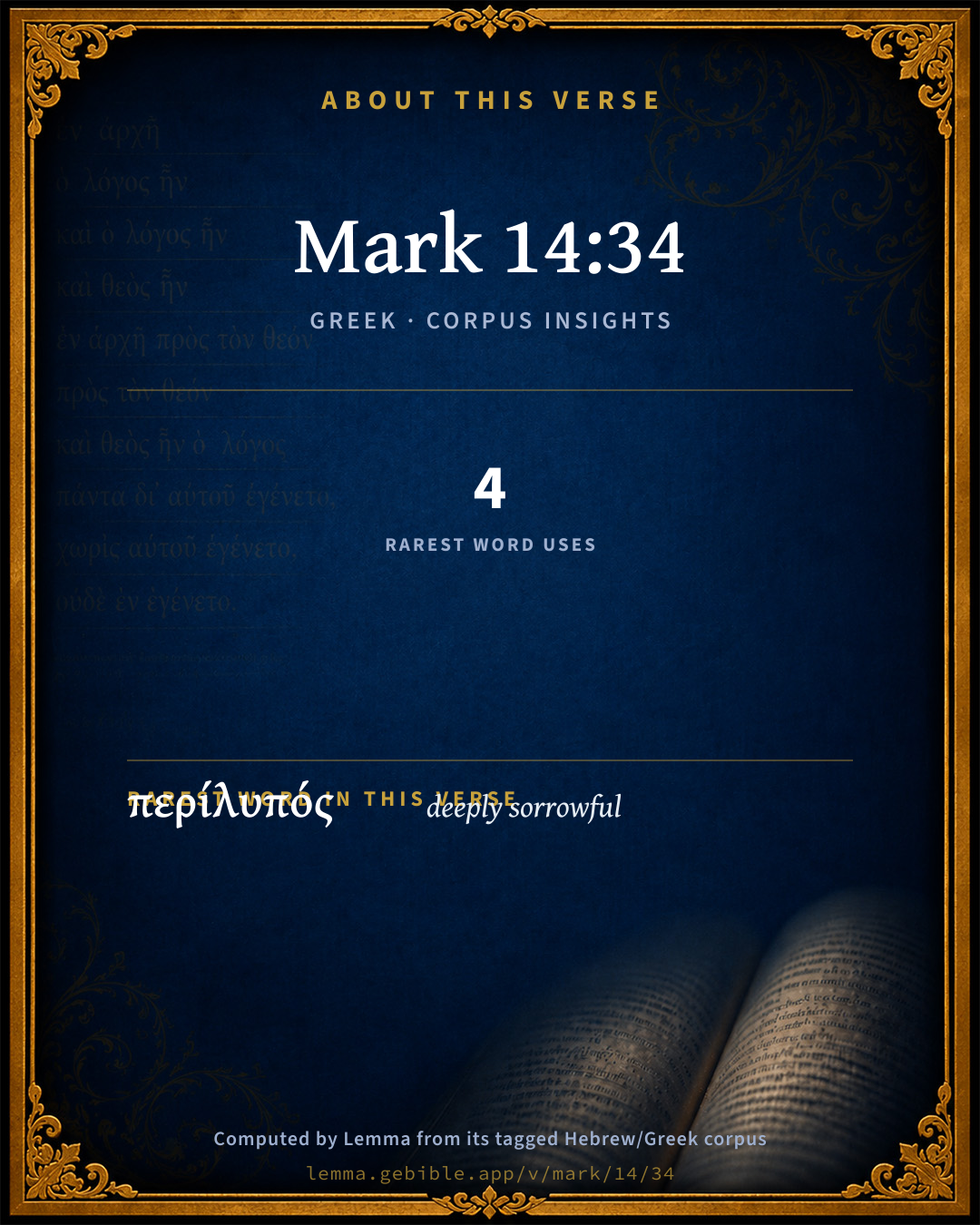
Mark 14:34

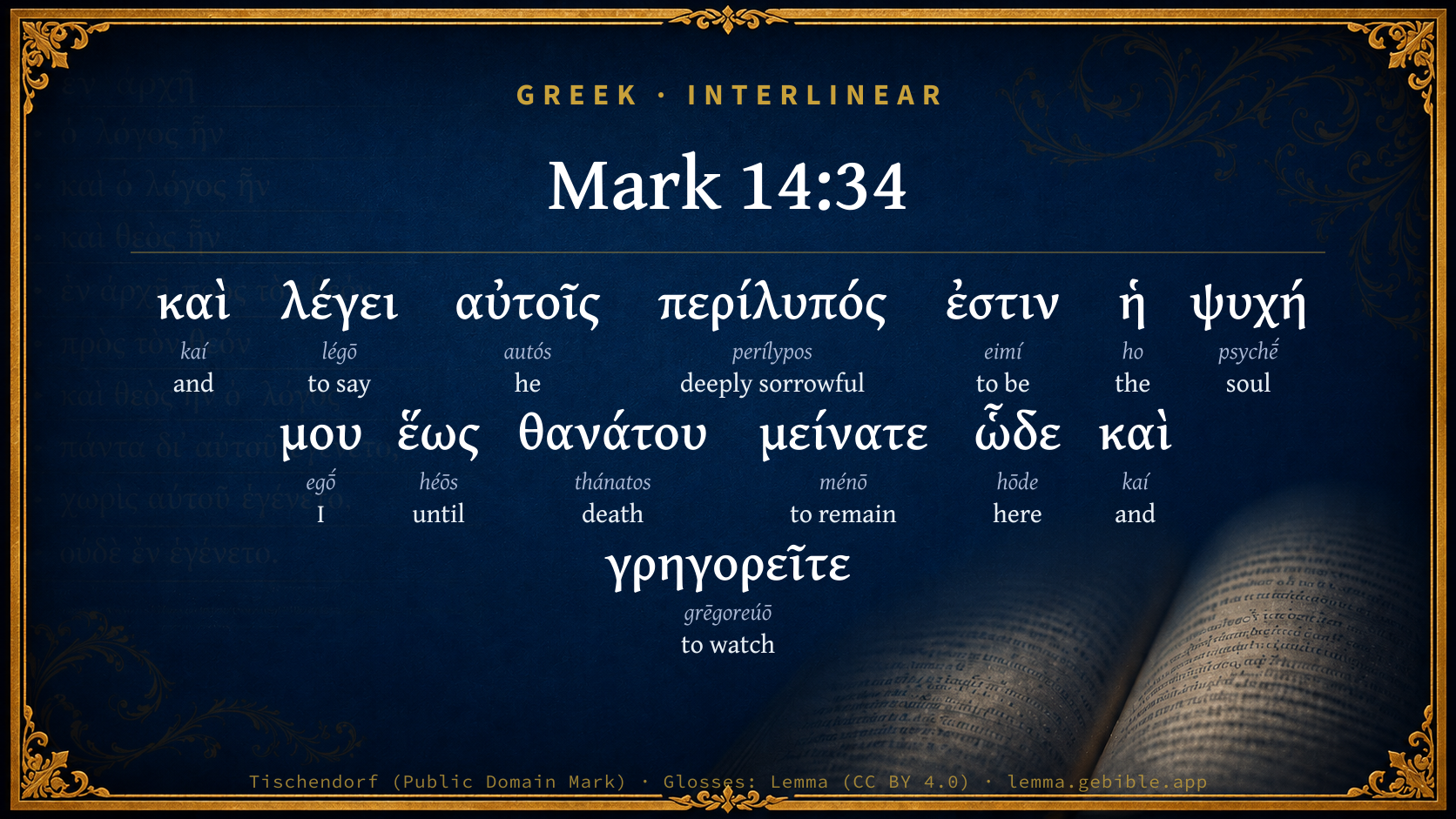
Greek (Tischendorf 8th ed.) Mark 14:34 appears in the Greek New Testament. The text above is from the Tischendorf 8th edition. Each word links to its Strong’s number and a concise gloss. Click any word for its full Thayer’s Greek Lexicon entry.
Download image
Cite this verse

Mark 14:34 (World English Bible). Public Domain. Lemma interlinear Bible study tool, https://lemma.gebible.app/v/mark/14/34.

Show BibTeX & RIS
BibTeX
RIS
English Translation
He said to them, "My soul is exceedingly sorrowful, even to death. Stay here, and watch."
World English Bible · Public Domain
Download a study sheet

One document with this verse’s original text, its word-by-word gloss line, the meaning frame, cross-references with their text, attributed commentary, and full source and license credits — printable, and it pastes into notes with its structure intact.

This verse Autodidact and up

Study sheet (.html) Plain text (.txt)

A passage Seminary Student

Up to 50 verses in one chapter. A passage sheet keeps up to 6 commentary sources and 12 cross-references per verse, in the order this page ranks them, and says so on the sheet whenever that leaves anything out. Ask for a single verse and you get the Autodidact verse sheet above.

Everything on this page stays free to read, with no account — the sheet is a download of what is already on screen, not access to it.

Want to remove ads? Support Godless Engineer
Compare translations 3

The same verse in 3 English versions, stacked beneath the original-language interlinear above. Click any original word for its lexicon entry.

Each is an independent rendering of the whole verse — the interlinear is not word-aligned to these translations.

Highlighted words mark where these versions differ — a whole-verse word diff, not a word-by-word alignment.

  • World English Bible Public Domain
    He said to them, "My soul is exceedingly sorrowful, even to death. Stay here, and watch."
  • King James Version Public Domain
    And saith unto them, My soul is exceeding sorrowful unto death: tarry ye here, and watch.
  • unfoldingWord Literal Text CC BY-SA 4.0
    And he says to them, “My soul is very grieved, to death. Remain here and be alert.”

unfoldingWord Literal Text — © unfoldingWord, licensed CC BY-SA 4.0. Word-aligned USFM3 via Door43 (git.door43.org/unfoldingWord/en_ult).

Versions to compare (up to 4)

3 of 4 selected

Show all 19 translations

Every available English version of this verse, each an independent rendering of the whole verse.

  • World English Bible Public Domain
    He said to them, "My soul is exceedingly sorrowful, even to death. Stay here, and watch."
  • Berean Standard Bible Public Domain
    Then He said to them, “My soul is consumed with sorrow to the point of death. Stay here and keep watch.”
  • Majority Standard Bible Public Domain
    Then He said to them, “My soul is consumed with sorrow to the point of death. Stay here and keep watch.”
  • King James Version Public Domain
    And saith unto them, My soul is exceeding sorrowful unto death: tarry ye here, and watch.
  • American Standard Version (1901) Public Domain
    And he saith unto them, My soul is exceeding sorrowful even unto death: abide ye here, and watch.
  • Revised Version (1885) Public Domain
    And he saith unto them, My soul is exceeding sorrowful even unto death: abide ye here, and watch.
  • Geneva Bible (1599) Public Domain
    And saide vnto them, My soule is very heauie, euen vnto the death: tarie here, and watch.
  • Douay-Rheims (1899) Public Domain
    And he saith to them: My soul is sorrowful even unto death; stay you here, and watch.
  • Young's Literal Translation Public Domain
    and he saith to them, `Exceeding sorrowful is my soul -- to death; remain here, and watch.'
  • Literal Standard Version CC BY-SA 4.0
    and He says to them, “My soul is exceedingly sorrowful—to death; remain here, and watch.”
  • Unlocked Literal Bible CC BY-SA 4.0
    He said to them, “My soul is deeply grieved, even to the point of death. Remain here and watch.”
  • unfoldingWord Literal Text CC BY-SA 4.0
    And he says to them, “My soul is very grieved, to death. Remain here and be alert.”
  • Darby Bible Public Domain
    And he says to them, My soul is full of grief even unto death; abide here and watch.
  • World Messianic Bible Public Domain
    He said to them, “My soul is exceedingly sorrowful, even to death. Stay here and watch.”
  • Webster's Bible Public Domain
    And saith to them, My soul is exceeding sorrowful to death: tarry ye here, and watch.
  • Free Bible Version CC BY-SA 4.0
    Jesus told them, “My agony is so painful it feels like I'm dying. Please, remain here and stay awake.”
  • Bible in Basic English Public Domain
    And he said to them, My soul is very sad, even to death: be here a little time, and keep watch.
  • Text-Critical English NT CC BY 4.0
    He said to them, “My soul is very sorrowful, even to the point of death; stay here and keep watch.”
  • Tyndale New Testament (1534) Public Domain
    and sayde vnto the: My soule is very hevy even vnto the deeth tary here and watche.

Literal Standard Version (2020), Covenant Press — licensed CC BY-SA 4.0. Text via the HelloAO Bible API (eBible.org). Unlocked Literal Bible (unfoldingWord) — licensed CC BY-SA 4.0. Text via the HelloAO Bible API (eBible.org). unfoldingWord Literal Text — © unfoldingWord, licensed CC BY-SA 4.0. Word-aligned USFM3 via Door43 (git.door43.org/unfoldingWord/en_ult). Free Bible Version, Dr. Jonathan Gallagher — licensed CC BY-SA 4.0. Text via the HelloAO Bible API (eBible.org).

Word by word

More ways to search: Search by grammar → Find every occurrence → Compare this word →

Practice this passage: Drill this verse → Learn its vocabulary →

περίλυπός
perílypos
G4036
“deeply sorrowful”
Adjective, Nominative, Singular, Feminine
Part of Speech
Adjective
Case
Nominative
Number
Singular
Gender
Feminine
Full Thayer's Definition

Origin: from G4012 and G3077

TDNT: 09:23,5

1. very sad, exceedingly sorrowful 2. overcome with sorrow so much as to cause one's death
  1. καὶ kaí G2532 “and” Conjunction
  2. λέγει légō G3004 “to say” Verb, Present, Active, Indicative, 3rd person, Singular
  3. αὐτοῖς autós G846 “he” Personal pronoun, Dative, Plural, Masculine
  4. ἐστιν eimí G1510 “to be” Verb, Present, Active, Indicative, 3rd person, Singular
  5. ἡ ho G3588 “the” Article, Nominative, Singular, Feminine
  6. ψυχή psychḗ G5590 “soul” Noun, Nominative, Singular, Feminine
  7. μου egṓ G1473 “I” Personal pronoun, 1st person, Genitive, Singular
  8. ἕως héōs G2193 “until” Adverb
  9. θανάτου thánatos G2288 “death” Noun, Genitive, Singular, Masculine
  10. μείνατε ménō G3306 “to remain” Verb, Aorist, Active, Imperative, 2nd person, Plural
  11. ὧδε hōde G5602 “here” Adverb
  12. καὶ kaí G2532 “and” Conjunction
  13. γρηγορεῖτε grēgoreúō G1127 “to watch” Verb, Present, Active, Imperative, 2nd person, Plural

About this verse

These counts appear in no published source. They are computed here, from the morphology-tagged text and Lemma’s own curated glosses. What Lemma adds →

14
words
13
distinct lemmas
Gospels
section

Notable vocabulary

The rarest word here is περίλυπός deeply sorrowful G4036 — appearing just 4 times in the whole Greek New Testament.

Shared distinctive vocabulary

περίλυπός deeply sorrowful G4036 occurs in 4 verses of the Greek New Testament. Also found in:

Repetition

A word recurs within this verse:

Cross-references

9

Topical passages linked to Mark 14:34 in the Treasury of Scripture Knowledge — connected by theme and wording, ordered by reader-vote popularity; previews shown in the World English Bible.

  • John 12:27 "Now my soul is troubled. What shall I say? 'Father, save me from this time?' But for this cause I came to this time.
  • Mark 13:35–37 Watch therefore, for you don't know when the lord of the house is coming, whether at evening, or at midnight, or when the rooster crows, or in the morning;
  • 1 Peter 5:8 Be sober and self-controlled. Be watchful. Your adversary the devil, walks around like a roaring lion, seeking whom he may devour.
  • Isaiah 53:3–4 He was despised, and rejected by men; a man of suffering, and acquainted with disease: and as one from whom men hide their face he was despised; and we didn't respect him.
  • Isaiah 53:12 Therefore will I divide him a portion with the great, and he shall divide the spoil with the strong; because he poured out his soul to death, and was numbered with the transgressors: yet he bore the sin of many, and made intercession for the transgressors.
  • Lamentations 1:12 Is it nothing to you, all you who pass by? Look, and see if there be any sorrow like my sorrow, which is brought on me, With which Yahweh has afflicted [me] in the day of his fierce anger.
  • Mark 14:37–38 He came and found them sleeping, and said to Peter, "Simon, are you sleeping? Couldn't you watch one hour?
  • Ephesians 6:18–19 with all prayer and requests, praying at all times in the Spirit, and being watchful to this end in all perseverance and requests for all the saints:
  • 1 Peter 4:7 But the end of all things is near. Therefore be of sound mind, self-controlled, and sober in prayer.

Cross-references courtesy of OpenBible.info (CC BY 4.0).

Commentary

Notes on Mark 14:34 from classic Christian and Jewish commentators (each source and its license shown beneath its notes). The classic Christian expositions comment on the surrounding passage and are grouped to its opening verse, so a note may address several verses; the Jewish commentaries on the Tanakh (Rashi and others) are per-verse, so they appear only where the commentator wrote on this verse.

Lemma curates 59 commentaries, every one of them public domain or Creative Commons licensed, each selected and text-cleaned for this edition rather than reprinted as found. About our sources →

The Expositor's Bible

CHAPTER 14:34-42 (Mar_14:34-42)

THE AGONY

"And He saith unto them, My soul is exceeding sorrowful even unto death: abide ye here, and watch. And He went forward a little, and fell on the ground, and prayed that, if it were possible, the hour might pass away from Him. And He said, Abba, Father, all things are possible unto Thee: remove this cup from Me: howbeit not what I will, but what Thou wilt. And He cometh, and findeth them sleeping, and saith unto Peter, Simon, sleepest thou? couldest thou not watch one hour? Watch and pray, that ye enter not into temptation: the spirit indeed is willing, but the flesh is weak. And again He went away, and prayed, saying the same words. And again He came, and found them sleeping, for their eyes were very heavy; and they wist not what to answer Him. And He cometh the third time, and saith unto them, Sleep on now, and take your rest: it is enough; the hour is come; behold, the Son of man is betrayed into the hands of sinners. Arise, let us be going: behold, he that betrayeth Me is at hand." Mar_14:34-42 (R.V.)

SKEPTICS and believers have both remarked that St. John, the only Evangelist who was said to have been present, gives no account of the Agony.

It is urged by the former, that the serene composure of the discourse in his Gospel leaves no room for subsequent mental conflict and recoil from suffering, which are inconsistent besides with his conception of a Divine man, too exalted to be the subject of such emotions.

But do not the others know of composure which bore to speak of His Body as broken bread, and seeing in the cup the likeness of His Blood shed, gave it to be the food of His Church for ever?

Was the resignation less serene which spoke of the smiting of the Shepherd, and yet of His leading back the flock to Galilee? If the narrative was rejected as inconsistent with the calmness of Jesus in the fourth Gospel, it should equally have repelled the authors of the other three.

We may grant that emotion, agitation, is inconsistent with unbelieving conceptions of the Christ of the fourth Gospel. But this only proves how false those conceptions are. For the emotion, the agitation, is already there. At the grave of Lazarus the word which tells that when He groaned in spirit He was troubled, describes one's distress in the presence of some palpable opposing force (Joh_11:34). There was, however, a much closer approach to His emotion in the garden, when the Greek world first approached Him. Then He contrasted its pursuit of self-culture with His own doctrine of self-sacrifice, declaring that even a grain of wheat must either die or abide by itself alone. To Jesus that doctrine was no smooth, easily announced theory, and so He adds, "Now is My soul troubled, and what shall I say? Father, save Me from this hour. But for this cause came I unto this hour:" (Joh_12:27).

Such is the Jesus of the fourth Gospel, by no means that of its modern analysts. Nor is enough said, when we remind them that the Speaker of these words was capable of suffering; we must add that profound agitation at the last was inevitable, for One so resolute in coming to this hour, yet so keenly sensitive of its dread.

The truth is that the silence of St. John is quite in his manner. It is so that he passes by the Sacraments, as being familiar to his readers, already instructed in the gospel story. But he gives previous discourses in which the same doctrine is expressed which was embodied in each Sacrament, -- the declaration that Nicodemus must be born of water, and that the Jews must eat His flesh and drink His blood. It is thus that instead of the agony, he records that earlier agitation. And this threefold recurrence of the same expedient is almost incredible except by design. St. John was therefore not forgetful of Gethsemane.

A coarser infidelity has much to say about the shrinking of our Lord from death. Such weakness is pronounced unworthy, and the bearing of multitudes of brave men and even of Christian martyrs, unmoved in the flames, is contrasted with the strong crying and tears of Jesus.

It would suffice to answer that Jesus also failed not when the trial came, but before Pontius Pilate witnessed a good confession, and won upon the cross the adoration of a fellow-sufferer and the confession of a Roman soldier. It is more than enough to answer that His story, so far from relaxing the nerve of human fortitude, has made those who love Him stronger to endure tortures than were emperors and inquisitors to invent them. What men call His weakness has inspired ages with fortitude. Moreover, the censure which such critics, much at ease, pronounce on Jesus expecting crucifixion, arises entirely from the magnificent and unique standard by which they try Him; for who is so hard-hearted as to think less of the valor of the martyrs because it was bought by many a lonely and intense conflict with the flesh?

For us, we accept the standard; we deny that Jesus in the garden came short of absolute perfection; but we call attention to the fact that much is conceded to us, when a criticism is ruthlessly applied to our Lord which would excite indignation and contempt if brought to bear on the silent sufferings of any hero or martyr but Himself.

Perfection is exactly what complicates the problem here.

Conscious of our own weakness, we not only justify but enjoin upon ourselves every means of attaining as much nobility as we may. We "steel ourselves to bear," and therefore we are led to expect the same of Jesus. We aim at some measure of what, in its lowest stage, is callous insensibility. Now that word is negative; it asserts the absence of paralysis of a faculty, not its fullness and activity. Thus we attain victory by a double process; in part by resolutely turning our mind away, and only in part by its ascendancy over appreciated distress. We administer anodynes to the soul. But Jesus, when He had tasted thereof, would not drink. The horrors which were closing around Him were perfectly apprehended, that they might perfectly be overcome.

Thus suffering, He became an example for gentle womanhood, and tender childhood, as well as man boastful of his stoicism. Moreover, He introduced into the world a new type of virtue, much softer and more emotional than that of the sages. The stoic, to whom pain is no evil, and the Indian laughing and singing at the stake, are partly actors and partly perversions of humanity. But the good Shepherd is also, for His gentleness, a lamb. And it is His influence which has opened our eyes to see a charm unknown before, in the sensibility of our sister and wife and child. Therefore, since the perfection of manhood means neither the ignoring of pain nor the denying of it, but the union of absolute recognition with absolute mastery of its fearfulness, Jesus, on the approach of agony and shame, and who shall say what besides, yields Himself beforehand to the full contemplation of His lot. He does so, while neither excited by the trial, nor driven to bay by the scoffs of His murderers, but in solitude, in the dark, with stealthy footsteps approaching through the gloom.

And ever since, all who went farthest down into the dread Valley, and on whom the shadow of death lay heaviest, found there the footsteps of its Conqueror. It must be added that we cannot measure the keenness of the sensibility thus exposed to torture. A physical organization and a spiritual nature fresh from the creative hand, undegraded by the transmitted heritage of ages of artificial, diseased and sinful habit, unblunted by one deviation from natural ways, undrugged by one excess, was surely capable of a range of feeling as vast in anguish as in delight.

The skeptic supposes that a torrent of emotion swept our Savior off His feet. The only narratives he can go upon give quite the opposite impression. He is seen to fathom all that depth of misery, He allows the voice of nature to utter all the bitter earnestness of its reluctance, yet He never loses self-control, nor wavers in loyalty to His Father, nor renounces His submission to the Father's will. Nothing in the scene is more astonishing than its combination of emotion with self-government. Time after time He pauses, gently and lovingly admonishes others, and calmly returns to His intense and anxious vigil.

Thus He has won the only perfect victory. With a nature so responsive to emotion He has not refused to feel, nor abstracted His soul from suffering, nor silenced the flesh by such an effort as when we shut our ears against a discord. Jesus sees all, confesses that He would fain escape, but resigns Himself to God.

In the face of all asceticisms, as of all stoicisms, Gethsemane is the eternal protest that every part of human nature is entitled to be heard, provided that the spirit retains the arbitration over all.

Hitherto nothing has been assumed which a reasonable skeptic can deny. Nor should such a reader fail to observe the astonishing revelation of character in the narrative, its gentle pathos, its intensity beyond what commonly belongs to gentleness, its affection, its mastery over the disciples, its filial submission. Even the rich imaginative way of thinking which invented the parables and sacrament, is in the word "this cup."

But if the story of Gethsemane can be vindicated from such a point of view, what shall be said when it is viewed as the Church regards it? Both testaments declare that the sufferings of the Messiah were supernatural. In the Old Testament it was pleasing to the Father to bruise Him. The terrible cry of Jesus to a God who had forsaken Him is conclusive evidence from the New Testament. And if we ask what such a cry may mean, we find that He is a curse for us, and made to be sin for us, Who knew no sin.

If the older theology drew incredible conclusions from such words, that is no reason why we should ignore them. It is incredible that God was angry with His Son, or that in any sense the Omniscient One confused the Savior with the sinful world. It is incredible that Jesus ever endured estrangement as of lost souls from the One Whom in Gethsemane He called Abba Father, and in the hour of utter darkness, My God, and into whose Fatherly hands He committed His Spirit. Yet it is clear that He is being treated otherwise than a sinless Being, as such, ought to expect. His natural stand-place is exchanged for ours. And as our exceeding misery, and the bitter curse of all our sin fell on Him, Who bore it away by bearing it, our pollution surely affected His purity as keenly as our stripes tried His sensibility. He shuddered as well as agonized. The deep waters in which He sank were defiled as well as cold. Only this can explain the agony and bloody sweat. And as we, for whom He endured it, think of this, we can only be silent and adore.

Once more, Jesus returns to His disciples, but no longer to look for sympathy, or to bid them watch and pray. The time for such warnings is now past: the crisis, "the hour" is come, and His speech is sad and solemn. "Sleep on now and take your rest, it is enough." Had the sentence stopped there, none would ever have proposed to treat it as a question, "Do ye now sleep on and take your rest?" It would plainly have meant, "Since ye refuse My counsel and will none on My reproof, I strive no further to arouse the torpid will, the inert conscience, the inadequate affection. Your resistance prevails against My warning."

But critics fail to reconcile this with what follows, "Arise, let us be going." They fail through supposing that words of intense emotion must be interpreted like a syllogism or a lawyer's parchment.

"For My part, sleep on; but your sleep is now to be rudely broken: take your rest so far as respect for your Master would have kept you watchful; but the traitor is at hand to break such repose, let him not find you ignobly slumbering. Arise, he is at hand that doth betray Me.'"

This is not sarcasm, which taunts and wounds. But there is a lofty and profound irony in the contrast between their attitude and their circumstances, their sleep and the eagerness of the traitor.

And so they lost the most noble opportunity ever given to mortals, not through blank indifference nor unbelief, but by allowing the flesh to overcome the spirit. And thus do multitudes lose heaven, sleeping until the golden hours are gone, and He who said, "Sleep on now," says, "He that is unrighteous, let him be unrighteous still."

Remembering that defilement was far more urgent than pain in our Savior's agony, how sad is the meaning of the words, "the Son of man is betrayed into the hands of sinners," and even of "the sinners," the representatives of all the evil from which He had kept Himself unspotted.

The one perfect flower of humanity is thrown by treachery into the polluted and polluting grasp of wickedness in its many forms; the traitor delivers Him to hirelings; the hirelings to hypocrites; the hypocrites to an unjust and skeptical pagan judge; the judge to his brutal soldiery; who expose him to all that malice can wreak upon the most sensitive organization, or ingratitude upon the most tender heart.

At every stage an outrage. Every outrage an appeal to the indignation of Him who held them in the hollow of His hand. Surely it may well be said, Consider Him who endured such contradiction; and endured it from sinners against Himself.

William Robertson Nicoll, ed., The Expositor's Bible (London: Hodder & Stoughton, 1887–1910) — public domain. 65 of 66 books (1 Corinthians is not separately keyed, as that volume carries no machine-parseable verse references); section-level commentary keyed to the opening verse. Introductory and overview sections not keyed to a specific passage are excluded.

The Cambridge Bible for Schools and Colleges

gen. ed. J. J. S. Perowne

34. My soul is exceeding sorrowful] Here again we have a remarkable word. We met with it before (ch. Mar_6:26), where “Herod is said to have been “exceeding sorry” at the request for the Baptist’s head; St Luke also uses the word (Luk_18:23-24) to describe how the rich young ruler was “very sorrowful,” when he was bidden to sacrifice his wealth. It points here to a depth of anguish and sorrow, and we may believe that he, who at the first temptation had left the Saviour “for a season” (Luk_4:13), had now returned, and whereas before he had brought “to bear against the Lord all things pleasant and flattering, if so he might by aid of these entice or seduce Him from His obedience, so now he thought with other engines to overcome His constancy, and tried Him with all painful things, as before with all pleasurable, hoping to terrify, if it might be, from His allegiance to the truth, Him whom manifestly He could not allure.” Trench’s Studies, pp. 55, 56, and above, Mar_1:12.

and watch] “with Me” adds St Matthew (Mat_26:38). Perfect man, “of a reasonable soul and human flesh subsisting,” He yearned, in this awful hour, for human sympathy. It is almost the only personal request He is ever recorded to have made. It was but “a cup of cold water” that He craved. But it was denied Him! Very Man, He leaned upon the men He loved, and they failed Him! He trod the winepress alone; and of the people there was none with him (Isa_63:3).

The Cambridge Bible for Schools and Colleges (gen. ed. J. J. S. Perowne; Cambridge University Press, 1878–1918) — public domain. Text from a community e-Sword module.

John Gill's Exposition

And he went forward a little,.... About a stone's cast, Luk 22:41,

and fell on the ground, and prayed; he fell on his face to the ground, which was a praying posture. One of the Jewish canons concerning it, is this (a):

"worshipping, how is it done? after a man has lifted up his head; he bows it five times, he sits upon the ground, and "falls upon his face", "to the ground", and supplicates with whatsoever supplication he pleases: worshipping, or bowing, is the stretching out of hands and feet, until a man is found cast upon his face to the ground.''

See Gill on Mat 26:39. The supplication Christ made in this posture was,

that, it were possible, the hour might pass from him; the time fixed and agreed upon for his sufferings and death; that is, that it might pass without his enduring them, if there was any possibility of excusing him, and of his people's being saved without them; See Gill on Mat 26:39.

(a) Maimon. Hilch. Tephilla, c. 5. sect. 13.

John Gill's Exposition of the Whole Bible (1746–1763) — public domain (CC PDM 1.0). Text via the HelloAO Bible API.

The Pulpit Commentary

None but he who bore those sorrows can know what they were. It was not the apprehension of the bodily torments and the bitter death that awaited him, all foreknown by him. It was the inconceivable agony of the weight of the sins of men. The Lord was thus laying "upon him the iniquity of us all." This, and this alone, can explain it. My soul is exceeding sorrowful even unto death. Every word carries the emphasis of an overwhelming grief. It was then that "the deep waters came in," even unto his soul. "What," says Cornelius a Lapide, "must have been the voice, the countenance, the expression, as he uttered those awful words!"

The Pulpit Commentary (1880–1919), ed. H.D.M. Spence-Jones & Joseph S. Exell — public domain. Text from a community e-Sword module.

Cambridge Greek Testament for Schools and Colleges

34. Περίλυπός ἐστιν ἡ ψυχή μου. The reality of Christ’s humanity is again evident; it shrinks from the Cross. Mention of His ψυχή is rare, and that fact may warn us not to be curious in attempting to pry into “the Self-consciousness” of Christ. We know very little about it. See on Joh 11:33; Joh 12:27.

ἕως θανάτου. Cf. 1Ki 19:4; Jon 4:9.

μείνατε ὧδε καὶ γρηγορεῖτε. The change of tense is intelligible. They were at once to cease from accompanying Him, and were to continue to be watchful. Once more they were selected as witnesses. They had seen Him wresting a victim from death; they had seen Him in the glory of the Transfiguration; and now they were to see Him in the humiliation of His Agony. Syr-Sin. omits the charge. Mt. adds μετʼ ἐμοῦ.

Cambridge Greek Testament for Schools and Colleges (Cambridge University Press, 1896; 21 vols, various authors incl. Carr, Maclear, Plummer, Farrar, Lumby, Moule, M. R. James, Simcox) — public domain. Text from a community e-Sword module.

International Critical Commentary

34. ἐκθαμβεῖσθαι καὶ ἀδημονεῖν—to be utterly amazed and troubled. One derivation makes ἀδημονεῖν from ἄδημος, homesick, and the other from ἀδεῖν, to be sated. Either derivation makes it very expressive. The strong statement of his amazement opens before us a curious problem. His fate, as he comes to face it, is not only troubling, but amazing. His rejection by men, their fierce hatred of him, his isolation of spirit, even among his own—all these things coming to the Son of Man, the lover of his kind, whose whole life was wrought by love into the fibre and tissue of the common human life, and was individual in no sense—amazed him utterly. περίλυπος—encompassed by grief. ἕως θανάτου—unto death. My sorrow is killing me, is the thought; it is crushing the life out of me. καὶ γρηγορεῖτε—and watch. It is possible to take these words in a merely external sense. He knew that his enemies were at hand, and he might want some one to be on the watch for them. But it seems more probable that, as Mt. puts it (26:38), he wanted them to watch with him, to share his vigil, not against human foes, but against the flood of woes overwhelming his soul. If possible, he would have companionship in his extreme hour. See also v. 38.

International Critical Commentary — older volumes (1896–1929), various authors — public domain. Text from a community e-Sword module.

Lesson kit

Teaching starters — assembled from the data on this page, not authored interpretation. Every prompt links to the verse data it draws on. Edit before teaching.

Mark, in the Gospels, opens this verse with 14 words (13 distinct Greek lemmas). Its most distinctive word is perílypos (“deeply sorrowful”). A historical commentator’s framing appears above. Read the whole chapter for the surrounding context.

Discussion questions

  1. What does “deeply sorrowful” (perílypos) contribute to the verse as a whole?
  2. How does Matthew 26:38, which shares the word «deeply sorrowful», read alongside this verse?
  3. What does the repetition of “and” (2× in this one verse) do in this verse?
  4. These translations render this verse differently. What is at stake in choosing one wording over another?
  5. Compare how The Expositor's Bible and The Cambridge Bible for Schools and Colleges read this verse. Where do they agree or differ?

Things to notice

Reading settings

Reading text

Shown beneath each verse's original-language words.

Old Testament
Old Testament edition

Read the OT as the Masoretic Hebrew (MT) or the Greek Septuagint (LXX).

English shown for the Greek Septuagint (in the Hebrew ↔ Greek comparison).

Comparing translations? Open the Compare panel on any verse page to stack up to four side by side.