
Acts 26:11

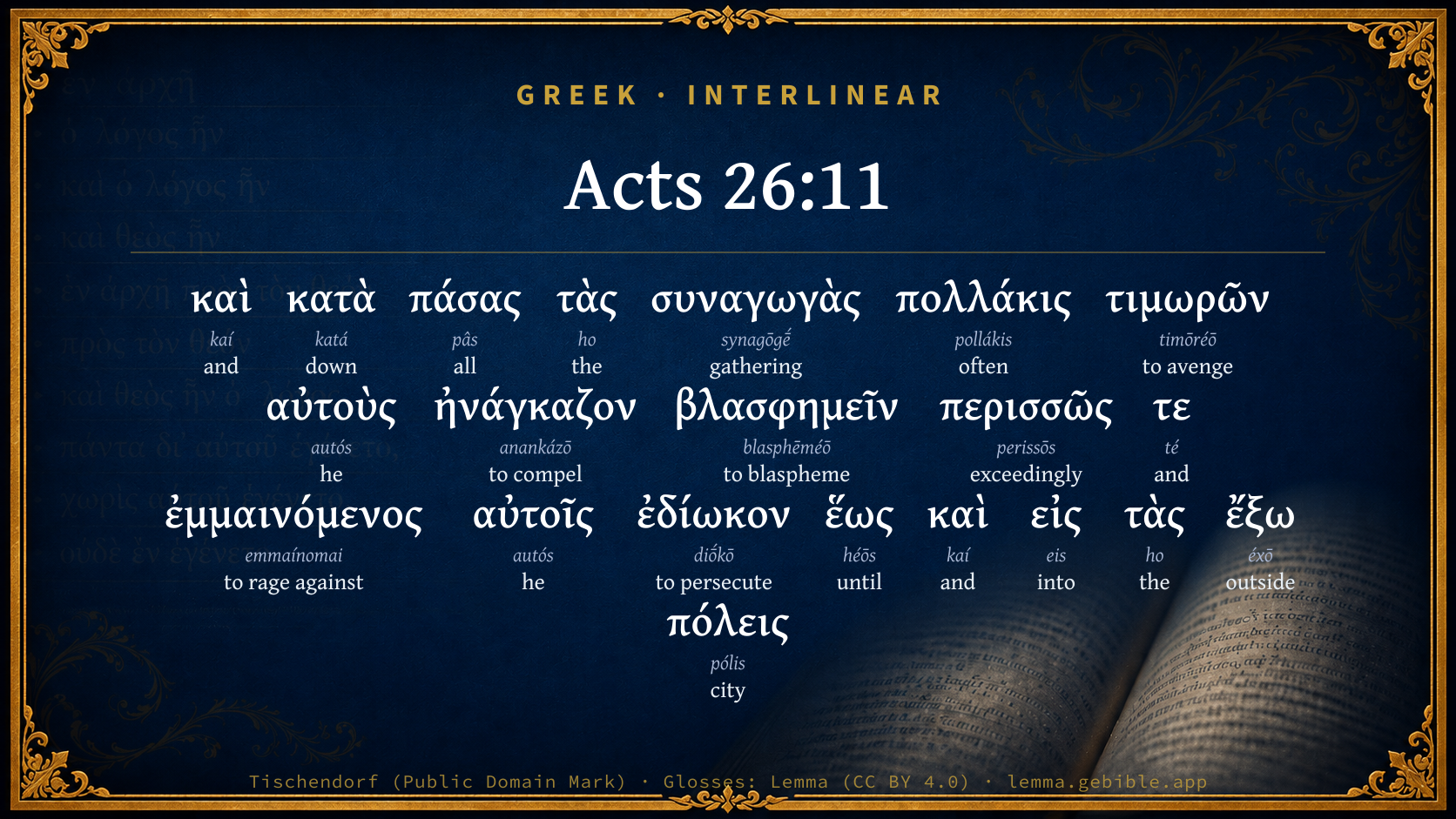
Greek (Tischendorf 8th ed.) Acts 26:11 appears in the Greek New Testament. The text above is from the Tischendorf 8th edition. Each word links to its Strong’s number and a concise gloss. Click any word for its full Thayer’s Greek Lexicon entry.
Download image
Cite this verse

Acts 26:11 (World English Bible). Public Domain. Lemma interlinear Bible study tool, https://lemma.gebible.app/v/acts/26/11.

Show BibTeX & RIS
BibTeX
RIS
English Translation
Punishing them often in all the synagogues, I tried to make them blaspheme. Being exceedingly enraged against them, I persecuted them even to foreign cities.
World English Bible · Public Domain
Highlights
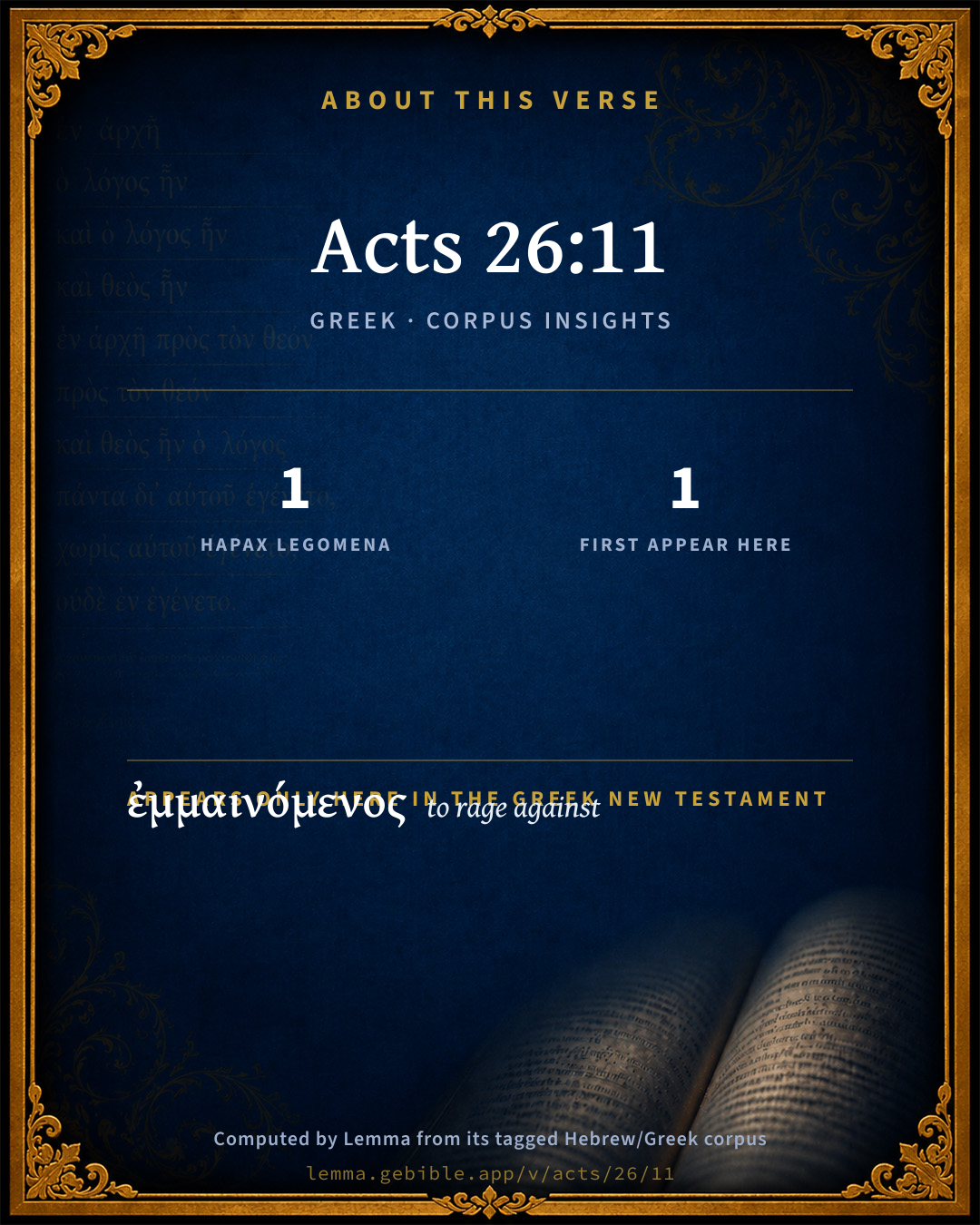
  • 1 hapax legomenon — only here in the Greek New Testament
  • 1 first appearance in the Greek New Testament
Full analysis ↓
Download a study sheet

One document with this verse’s original text, its word-by-word gloss line, the meaning frame, cross-references with their text, attributed commentary, and full source and license credits — printable, and it pastes into notes with its structure intact.

This verse Autodidact and up

Study sheet (.html) Plain text (.txt)

A passage Seminary Student

Up to 50 verses in one chapter. A passage sheet keeps up to 6 commentary sources and 12 cross-references per verse, in the order this page ranks them, and says so on the sheet whenever that leaves anything out. Ask for a single verse and you get the Autodidact verse sheet above.

Everything on this page stays free to read, with no account — the sheet is a download of what is already on screen, not access to it.

Want to remove ads? Support Godless Engineer
Compare translations 3

The same verse in 3 English versions, stacked beneath the original-language interlinear above. Click any original word for its lexicon entry.

Each is an independent rendering of the whole verse — the interlinear is not word-aligned to these translations.

Highlighted words mark where these versions differ — a whole-verse word diff, not a word-by-word alignment.

  • World English Bible Public Domain
    Punishing them often in all the synagogues, I tried to make them blaspheme. Being exceedingly enraged against them, I persecuted them even to foreign cities.
  • King James Version Public Domain
    And I punished them oft in every synagogue, and compelled them to blaspheme; and being exceedingly mad against them, I persecuted them even unto strange cities.
  • unfoldingWord Literal Text CC BY-SA 4.0
    And often punishing them in all the synagogues, I forced them to blaspheme, and being greatly enraged against them, I persecuted them even as far as to other cities,

unfoldingWord Literal Text — © unfoldingWord, licensed CC BY-SA 4.0. Word-aligned USFM3 via Door43 (git.door43.org/unfoldingWord/en_ult).

Versions to compare (up to 4)

3 of 4 selected

Show all 19 translations

Every available English version of this verse, each an independent rendering of the whole verse.

  • World English Bible Public Domain
    Punishing them often in all the synagogues, I tried to make them blaspheme. Being exceedingly enraged against them, I persecuted them even to foreign cities.
  • Berean Standard Bible Public Domain
    I frequently had them punished in the synagogues, and I tried to make them blaspheme. In my raging fury against them, I even went to foreign cities to persecute them.
  • Majority Standard Bible Public Domain
    I frequently had them punished in the synagogues, and I tried to make them blaspheme. In my raging fury against them, I even went to foreign cities to persecute them.
  • King James Version Public Domain
    And I punished them oft in every synagogue, and compelled them to blaspheme; and being exceedingly mad against them, I persecuted them even unto strange cities.
  • American Standard Version (1901) Public Domain
    And punishing them oftentimes in all the synagogues, I strove to make them blaspheme; and being exceedingly mad against them, I persecuted them even unto foreign cities.
  • Revised Version (1885) Public Domain
    And punishing them oftentimes in all the synagogues, I strove to make them blaspheme; and being exceedingly mad against them, I persecuted them even unto foreign cities.
  • Geneva Bible (1599) Public Domain
    And I punished them throughout all the Synagogues, and compelled them to blaspheme, and being more mad against them, I persecuted them, euen vnto strange cities.
  • Douay-Rheims (1899) Public Domain
    And oftentimes punishing them, in every synagogue, I compelled them to blaspheme: and being yet more mad against them, I persecuted them even unto foreign cities.
  • Young's Literal Translation Public Domain
    and in every synagogue, often punishing them, I was constraining `them' to speak evil, being also exceedingly mad against them, I was also persecuting `them' even unto strange cities.
  • Literal Standard Version CC BY-SA 4.0
    and in every synagogue, often punishing them, I was constraining [them] to speak evil, being also exceedingly mad against them, I was also persecuting [them] even to strange cities.
  • Unlocked Literal Bible CC BY-SA 4.0
    I punished them many times in all the synagogues and I tried to force them to blaspheme. I was furiously enraged against them and I persecuted them even to foreign cities.
  • unfoldingWord Literal Text CC BY-SA 4.0
    And often punishing them in all the synagogues, I forced them to blaspheme, and being greatly enraged against them, I persecuted them even as far as to other cities,
  • Darby Bible Public Domain
    And often punishing them in all the synagogues, I compelled them to blaspheme. And, being exceedingly furious against them, I persecuted them even to cities out [of our own land].
  • World Messianic Bible Public Domain
    Punishing them often in all the synagogues, I tried to make them blaspheme. Being exceedingly enraged against them, I persecuted them even to foreign cities.
  • Webster's Bible Public Domain
    And I punished them often in every synagogue, and compelled them to blaspheme; and being exceedingly enraged against them, I persecuted them even to foreign cities.
  • Free Bible Version CC BY-SA 4.0
    I had them punished in all the synagogues, trying to make them recant. I was so furiously opposed to them that I went to cities outside our country to persecute them.
  • Bible in Basic English Public Domain
    And I gave them punishment frequently, in all the Synagogues, forcing them to say things against God; and burning with passion against them, I went after them even into far-away towns.
  • Text-Critical English NT CC BY 4.0
    I also punished them often in all the synagogues and tried to force them to blaspheme. And being furiously enraged against them, I pursued them even to foreign cities.
  • Tyndale New Testament (1534) Public Domain
    And I punysshed them ofte in every synagoge and compelled them to blaspheme: and was yet more mad apon them and persecuted the even vnto straunge cities.

Literal Standard Version (2020), Covenant Press — licensed CC BY-SA 4.0. Text via the HelloAO Bible API (eBible.org). Unlocked Literal Bible (unfoldingWord) — licensed CC BY-SA 4.0. Text via the HelloAO Bible API (eBible.org). unfoldingWord Literal Text — © unfoldingWord, licensed CC BY-SA 4.0. Word-aligned USFM3 via Door43 (git.door43.org/unfoldingWord/en_ult). Free Bible Version, Dr. Jonathan Gallagher — licensed CC BY-SA 4.0. Text via the HelloAO Bible API (eBible.org).

Word by word

More ways to search: Search by grammar → Find every occurrence → Compare this word →

Practice this passage: Drill this verse → Learn its vocabulary →

ἐμμαινόμενος
emmaínomai
G1693
“to rage against”
Verb, Present, Middle or Passive deponent, Participle, Nominative, Singular, Masculine
Part of Speech
Verb
Tense
Present
Voice
Middle or Passive deponent
Mood
Participle
Case
Nominative
Number
Singular
Gender
Masculine
Full Thayer's Definition

Origin: from G1722 and G3105

TDNT: None

1. to rage against one
  1. καὶ kaí G2532 “and” Conjunction
  2. κατὰ katá G2596 “down” Preposition
  3. πάσας pâs G3956 “all” Adjective, Accusative, Plural, Feminine
  4. τὰς ho G3588 “the” Article, Accusative, Plural, Feminine
  5. συναγωγὰς synagōgḗ G4864 “gathering” Noun, Accusative, Plural, Feminine
  6. πολλάκις pollákis G4178 “often” Adverb
  7. τιμωρῶν timōréō G5097 “to avenge” Verb, Present, Active, Participle, Nominative, Singular, Masculine
  8. αὐτοὺς autós G846 “he” Personal pronoun, Accusative, Plural, Masculine
  9. ἠνάγκαζον anankázō G315 “to compel” Verb, Imperfect, Active, Indicative, 1st person, Singular
  10. βλασφημεῖν blasphēméō G987 “to blaspheme” Verb, Present, Active, Infinitive
  11. περισσῶς perissōs G4057 “exceedingly” Adverb
  12. τε té G5037 “and” Particle
  13. αὐτοῖς autós G846 “he” Personal pronoun, Dative, Plural, Masculine
  14. ἐδίωκον diṓkō G1377 “to persecute” Verb, Imperfect, Active, Indicative, 1st person, Singular
  15. ἕως héōs G2193 “until” Adverb
  16. καὶ kaí G2532 “and” Conjunction
  17. εἰς eis G1519 “into” Preposition
  18. τὰς ho G3588 “the” Article, Accusative, Plural, Feminine
  19. ἔξω éxō G1854 “outside” Adverb
  20. πόλεις pólis G4172 “city” Noun, Accusative, Plural, Feminine

About this verse

These counts appear in no published source. They are computed here, from the morphology-tagged text and Lemma’s own curated glosses. What Lemma adds →

21
words
18
distinct lemmas
Acts
section

Notable vocabulary

1 hapax legomenon — a word that appears only here in the entire Greek New Testament:

  • ἐμμαινόμενος to rage against G1693

First appearance in Scripture

This word makes its first canonical appearance in the Greek New Testament here:

  • ἐμμαινόμενος to rage against G1693

Shared distinctive vocabulary

τιμωρῶν to avenge G5097 occurs in 2 verses of the Greek New Testament. Also found in:
Repetition

Words recur within this verse:

  • καὶ and G2532 ×2
  • τὰς the G3588 ×2
  • αὐτοὺς he G846 ×2

Cross-references

16

Topical passages linked to Acts 26:11 in the Treasury of Scripture Knowledge — connected by theme and wording, ordered by reader-vote popularity; previews shown in the World English Bible.

  • Matthew 10:17 But beware of men: for they will deliver you up to councils, and in their synagogues they will scourge you.
  • Acts 13:45 But when the Jews saw the multitudes, they were filled with jealousy, and contradicted the things which were spoken by Paul, and blasphemed.
  • Acts 22:19 I said, 'Lord, they themselves know that I imprisoned and beat in every synagogue those who believed in you.
  • Acts 9:1 But Saul, still breathing threats and slaughter against the disciples of the Lord, went to the high priest,
  • Acts 22:5 As also the high priest and all the council of the elders testify, from whom also I received letters to the brothers, and traveled to Damascus to bring them also who were there to Jerusalem in bonds to be punished.
  • Ecclesiastes 9:3 This is an evil in all that is done under the sun, that there is one event to all: yes also, the heart of the sons of men is full of evil, and madness is in their heart while they live, and after that they go to the dead.
  • Mark 3:28 Most assuredly I tell you, all of the children of men's sins will be forgiven them, including their blasphemies with which they may blaspheme;
  • Mark 13:9 But watch yourselves, for they will deliver you up to councils. You will be beaten in synagogues. You will stand before rulers and kings for my sake, for a testimony to them.
  • Luke 6:11 But they were filled with rage, and talked with one another about what they might do to Jesus.
  • Luke 15:17 But when he came to himself he said, 'How many hired servants of my father's have bread enough to spare, and I'm dying with hunger!
  • Luke 21:12 But before all these things, they will lay their hands on you and will persecute you, delivering you up to synagogues and prisons, bringing you before kings and governors for my name's sake.
  • Acts 18:6 When they opposed him and blasphemed, he shook out his clothing and said to them, "Your blood be on your own heads! I am clean. From now on, I will go to the Gentiles!"
  • Acts 26:24–25 As he thus made his defense, Festus said with a loud voice, "Paul, you are crazy! Your great learning is driving you insane!"
  • Hebrews 10:28–29 A man who disregards Moses' law dies without compassion on the word of two or three witnesses.
  • James 2:7 Don't they blaspheme the honorable name by which you are called?
  • 2 Peter 2:16 but he was rebuked for his own disobedience. A mute donkey spoke with man's voice and stopped the madness of the prophet.

Cross-references courtesy of OpenBible.info (CC BY 4.0).

Commentary

Notes on Acts 26:11 from classic Christian and Jewish commentators (each source and its license shown beneath its notes). The classic Christian expositions comment on the surrounding passage and are grouped to its opening verse, so a note may address several verses; the Jewish commentaries on the Tanakh (Rashi and others) are per-verse, so they appear only where the commentator wrote on this verse.

Lemma curates 59 commentaries, every one of them public domain or Creative Commons licensed, each selected and text-cleaned for this edition rather than reprinted as found. About our sources →

Bengel's Gnomon

Johann Albrecht Bengel

Act 26:11. Συναγωνάς, synagogues) of Jerusalem.—ἠνάγκαζον βλασφημεῖν, I compelled them to blaspheme) This was the saddest of all. Repent, ye enemies of the Gospel. If Franc. Spira, to whom force was applied, paid so dearly for his sin, what then will become of those who apply the force (exercise compulsion), and yet do not repent with Saul.

Bengel's Gnomon of the New Testament — English translation (T&T Clark, Edinburgh, 1860) — public domain. Text from a community e-Sword module.

Meyer's Critical & Exegetical Commentary

Heinrich August Wilhelm Meyer

Act_26:11-13. Κατὰ πάσας τ. συναγ.] throughout all the synagogues (in Jerusalem), going from one to another and searching out the Christians in all; comp. Act_22:19.

τιμωρῶν αὐτούς] taking vengeance on them, dragging them to punishment, Soph. O. R. 107. 140; Polyb. ii. 56. 15. Comp. Act_22:5, and Wetstein in loc. The middle is more usual.

βλασφημεῖν] namely, τὸν Ἰησοῦν, which is obvious of itself, as the object of the specific reverence of Christians (Jam_2:7). Comp. Plin. Ep. x. 97; Suicer, Thes. I. p. 697. Whether and how far this ἠνάγκαζ. βλασφ. was actually successful, cannot be determined.

ἕως καὶ εἰς τὰς ἔξω πόλεις] till even unto the extraneous cities (outside of Palestine). By this remark the following narrative has the way significantly prepared for it.

ἐν οἷς] in which affairs of persecution. Comp. Act_24:18.

μετʼ ἐξουσ. κ. ἐπιτρ.] with power and plenary authority (Polyb. iii. 15. 7; 2Ma_13:14). Paulus erat commissarius, Bengel.

ἡμέρας μέσας] At noon, μεσημβρίας (comp. Act_22:6), genitive of the definition of time, Bernhardy, p. 145. On the non-classical Greek expression μέση ἡμέρα, see Lobeck, ad Phryn. p. 55 f.

κατὰ τὴν ὁδόν] along the way, Act_25:3, Act_8:36.

ὑπὲρ τ. λαμπρ. τ. ἡλίου] surpassing the brightness of the sun. See Winer, p. 376 [E. T. 502].

Meyer — Critical and Exegetical Commentary on the New Testament — English translation by Peter Christie, edited by Frederick Crombie (T&T Clark, 1880) — public domain. Text from a community e-Sword module.

Expositor's Greek Testament

ed. W. Robertson Nicoll

Act 26:11 . τιμωρῶν ( cf. Act 22:5 ), more usually in the middle voice in this sense, although the active is so used sometimes in classical Greek, Soph., O. T. , 107, 140, Polyb., ii., 56, 15. For ecclesiastial censures and punishments see Edersheim, History of the Jewish Nation , p. 374, cf. Mat 10:17 ; Mat 23:34 . ἠνάγκαζον : “I strove to make them blaspheme,” R.V., all other E.V [400] render “I compelled them to blaspheme,” but the imperfect leaves it quite doubtful as to whether the persecutor succeeded in his attempts or not. The imperfect may thus be regarded as conative, Burton, p. 12, cf. Luk 1:59 , Mat 3:14 . Blass points out that it may have the force of repeated action ( cf. ἐδίωκον ), but even if so, it does not say that the compulsion was effectual, Gram. , p. 186. See further Page, in loco , for the rendering of R.V., which he regards as correct. A striking parallel may be adduced from Pliny’s Letter to Trajan, x., 97, where the Christians are urged to call upon the gods, to worship the emperor, and to blaspheme Christ, “quorum nihil cogi posse dicuntur qui sunt revera Christiani,” cf. Polycarp, Martyr. , ix., 2, 3. βλασφημεῖν , i.e. , Jesus, “maledicere Christo,” Pliny, u. s. , Jas 2:7 ; cf. 1Ti 1:13 with this passage, and Paul’s later reflections on his conduct. ἕως καὶ εἰς τὰς ἔξω π .: “even unto foreign cities,” R.V., so that other cities besides Damascus had been included in the persecution, or would have been included if Saul’s attempt had been successful. ἐδίωκον : “I set about persecuting them”. The imperfect ἐδίωκ . may however denote repeated action, and may indicate that Saul had already visited other foreign cities. Weiss regards the τε as connecting the two imperfects de conatu together the latter imperfect being regarded as a continuation of the former, in case the victims sought to save themselves by flight. ἐμμαιν .: only in Josephus once, Ant. , xvii., 6, 5, but ἐμμανής in Wis 14:23 , and in classical Greek, so also ἐκμαίνεσθαι .

[400] English Version.

The Expositor's Greek Testament, edited by W. Robertson Nicoll (1897–1910) — public domain. Text from a community e-Sword module.

Geneva Bible (1599)

Geneva Bible translators

By extreme punishment.

Geneva Bible (1599) marginal notes — public domain. Text via Bolls.life.

Adam Clarke's Commentary

Verse 11. Being exceedingly mad against them] Only a madman will persecute another because of his differing from him in religious opinion; and the fiercest persecutor is he who should be deemed the most furious madman.

Unto strange cities.] Places out of the jurisdiction of the Jews, such as Damascus, which he immediately mentions.

Adam Clarke's Commentary on the Bible (1810–1826) — public domain. Text from a community e-Sword/MySword module.

Ellicott's Commentary for English Readers

(11) Compelled them to blaspheme.—The verb is in the imperfect tense, which may express either continued or incomplete action. It does not follow, therefore, that any of the believers yielded to the pressure; and the words may be paraphrased, I went on trying to compel them.

Being exceedingly mad against them.—The words express, with a wonderful vividness, St. Paul’s retrospective analysis of his former state. It was not only that he acted in ignorance (1Ti_1:13), he might plead also the temporary insanity of fanaticism.

Even unto strange cities.—The words show that the mission to Damascus was not a solitary instance, and the persecution may well have raged in the regions of Samaria and Galilee through which the Apostle passed. (See Note on Act_9:3.)

A Bible Commentary for English Readers, edited by Charles John Ellicott (1878–1897) — public domain. Text from a community e-Sword module.

The Cambridge Bible for Schools and Colleges

gen. ed. J. J. S. Perowne

11. And I punished them oft in every synagogue] The Gk. continues with a participial construction, represented in Rev. Ver. “and punishing … in all the synagogues.” This closer representation of the original seems to add strength to the description of Saul’s former zeal as a persecutor. Of the synagogues as places where offenders were accused and punished, cp. Mat_10:17; Mat_23:34; Mar_13:9; Luk_12:11; Luk_21:12.

and compelled them to blaspheme] Rev. Ver. “I strove to make them blaspheme.” The verb is that which is frequently rendered “constrain” or “compel,” but being in the imperfect tense, it seems to signify that the attempt was repeated often, and needed to be so, for it was not in some cases successful. Saul kept on with his constraint. “To blaspheme,” i.e. the name of Jesus into which they had been baptized. They were to be forced to renounce the belief in the divinity of Jesus. Cp. on blasphemy of the divine Name, Lev_24:11-16.

even unto strange [R. V. foreign] cities] That is, cities outside the country of the Jews proper. So that, as it appears, Damascus was but one among several cities to which Saul had gone on his errand of punishment.

The Cambridge Bible for Schools and Colleges (gen. ed. J. J. S. Perowne; Cambridge University Press, 1878–1918) — public domain. Text from a community e-Sword module.

John Gill's Exposition

And I punished them oft in every synagogue,.... In Jerusalem, where there were many; See Gill on Act 24:12; by beating and scourging them there, as the manner was; see Mat 10:17.

and compelled them to blaspheme; the Lord Jesus Christ, both to deny him to be the Messiah, and to call him accursed; as the Jews and Heathens obliged some professors of Christianity to do, who were only nominal ones, and had not grace and strength to stand against their threatenings, and to endure their persecutions:

and being exceeding mad against them; full of malice, envy, and hatred:

I persecuted them even to strange cities; particularly Damascus; and of his journey thither, he gives an account in the following verse; or through the violence of his persecution he obliged them to fly to strange cities, where they were foreigners and strangers; though he himself might not follow them there, since we do not read of his going anywhere but to Damascus; whereas they that were scattered by the persecution, in which he was concerned, travelled as far as Phenice, Cyprus, and Antioch, Act 9:19. The phrase may be rendered, "even to cities without"; i.e. without the land of Israel: frequent mention is made in Jewish writings of such and such cities being , "without the land".

John Gill's Exposition of the Whole Bible (1746–1763) — public domain (CC PDM 1.0). Text via the HelloAO Bible API.

Trapp's Complete Commentary

John Trapp

11 And I punished them oft in every synagogue, and compelled them to blaspheme; and being exceedingly mad against them, I persecuted them even unto strange cities.

Ver. 11. Compelled them to blaspheme] So the ancient persecutors compelled many not only to renounce their religion, but to curse Christ. (Plin. Epist. ad Trajan.) When the Emperor Heraclius sent ambassadors to Chosroes, king of Persia, to desire peace of him, he received this threatening answer: I will not spare you, till I have made you curse your crucified God, and adore the sun. He was afterwards (like another Sennacherib) deposed and murdered by his son Siroes.

And being exceedingly mad, I persecuted] He was not then so mad in persecuting, but when God turned the stream, he was judged by some as mad in preaching, 2Co 5:13, and pressing toward tbe high prize which he persecuted (that is, his word, διωκω, Php 3:14) with as much eagerness as ever he had done God’s poor saints and servants.

John Trapp, A Commentary or Exposition upon All the Books of the Old and New Testament (1647–1656) — public domain. Text from a community e-Sword module.

Albert Barnes' Notes on the Bible

And I punished them oft ... - See Act 22:19.

And compelled them to blaspheme - To blaspheme the name of Jesus by denying that he was the Messiah, and by admitting that he was an impostor. This was the object which they had in view in the persecution. It was not to make them blaspheme or reproach God, but to deny that Jesus was the Messiah, and to reproach him as a deceiver and an impostor. It is not necessarily implied in the expression, “and compelled them to blaspheme,” that he succeeded in doing it, but that he endeavored to make them apostatize from the Christian religion and deny the Lord Jesus. It is certainly not impossible that a few might thus have been induced by the authority of the Sanhedrin and by the threats of Paul to do it, but it is certain that the great mass of Christians adhered firmly to their belief that Jesus was the Messiah.

And being exceedingly mad - Nothing could more forcibly express his violence against the Christians. He raged like a madman; he was so ignorant that he laid aside all appearance of reason; with the fury and violence of a maniac, he endeavored to exterminate them from the earth. None but a madman will persecute people on account of their religious opinions; and all persecutions have been conducted like this, with the violence, the fury, and the ungovernable temper of maniacs.

Unto strange cities - Unto foreign cities; cities out of Judea. The principal instance of this was his going to Damascus; but there is no evidence that he did not intend also to visit other cities out of Judea and bring the Christians there, of he found any, to Jerusalem.

Albert Barnes' Notes on the Bible (1834–1885) — public domain. Text from a community e-Sword/MySword module.

Matthew Poole's English Annotations

Paul confesses that he compelled them to blaspheme, either:

1. By the torments he made them to be put unto; or:

2. By his own example; for he confessed that he had been a blasphemer himself, 1Ti 1:13.

This blasphemy was either:

1. Denying of Christ to be the Messiah; or:

2. Cursing or execrating of Christ, and acknowledging that he was justly condemned.

I persecuted them even unto strange cities; drove them out of Jerusalem and Judea; and, according to what Paul then believed, he drave them from the worship of the true God, and said in effect, as David’s adversaries when they expelled him from Jerusalem, Go, and serve other gods, 1Sa 26:19.

Matthew Poole's English Annotations on the Holy Bible (1683–1685) — public domain. Text from a community e-Sword/MySword module.

Whedon's Commentary on the Bible

Daniel D. Whedon

11. Every synagogue—Not absolutely every, but any one where the occasion offered. Synagogues were the places in which not only the sentence was pronounced, but the penalty was inflicted in order to maintain both the sanctity of the infliction, and to deter the spectators from like sin.

Compelled them—Greek, was compelling them, indicating a continuity of the practice. Compelling, or rather constraining, whether with successful result or not.

To blaspheme—To utter some imprecation on the sacred name or person of Jesus. The pagan persecutions of the martyrs were of the same atrocious character. Thus even the accomplished pagan philosopher Pliny wrote to the emperor: “They were required by my command to address the gods, and supplicate thy statue with incense and wine, and, besides, curse Christ, none of which, it is said, could those who were in fact Christians be constrained to do.”

11. Strange cities—Damascus; the plural again for the singular.

Daniel D. Whedon (gen. ed.), Commentary on the Old and New Testaments (1874–1909) — public domain. Text from a community e-Sword module.

The Pulpit Commentary

Punishing them oftentimes in all the synagogues, I strove to make them blaspheme for I punished them oft in every synagogue, and compelled them to blaspheme, A.V.; foreign for strange, A.V.. In all the synagogues. Those in Jerusalem, as the contrast of the foreign cities shows. (For the facts, see (Act_8:1, Act_8:3) I strove, etc. The "compelled" of the A.V. is the natural rendering of hjnagkazon (Mat_14:22; Luk_14:23; Act_28:19, etc.) but it does not necessarily follow that the compulsion was successful. It might be in some cases, and not in others. Pliny, in his letter to Trajan, says that those who were accused of being Christians cleared themselves by calling upon the gods, offering to the image of the emperor, and cursing Christ, none of which things, it is said, true Christians ("qui sunt revera Christiani") can be compelled to do ("Epist.," 10, 95, quoted by Kuinoel). Mad against them; ejmmainomenov aujtoiv, only here; but the adjective ejmmanhv, frantic, is not uncommon in classical writers.

The reckless rushing to assume the moral responsibilities of others an exceeding madness.

We are to understand this extraordinary verse to reveal rather what Paul confesses it was in his heart to do, and in the nature of his own actions to cause others to do, than what he succeeded in doing, in all respects. The two or three touches give us a wonderfully and strangely vivid picture. And suggest, not so much for Paul who confessed and forsook his evil way, but for many others who do neither the one nor the other, how suicidal their course, when, uncontent with the weight of their own responsibilities, they would presume to tamper with the conscience of others, and lade themselves with some share in all that is most dread of the moral nature of their fellows. Let us notice that those who will forcibly seek to interfere with the moral and religious convictions of others do

I RUN THE GREAT RISK OF INFLUENCING OTHERS TO SIN AGAINST THEIR OWN CONSCIENCE.

II PRESUME TO SUPPOSE THEIR OWN CONSCIENCE TO BE THE ABSOLUTELY SAFE STANDARD.

III EXPOSE THEMSELVES, ON NO GREATER WARRANT, TO STAYING A GOOD WORK THAT OTHERWISE WAS GROWING IN THE HEART OF ANOTHER.

IV VERY POSSIBLY AVAIL TO MAKE PRONOUNCED BLASPHEMERS, BACKSLIDERS, APOSTATES.

V BECOME AT LEAST STUMBLING-BLOCKS TO OTHERS, AND CAUSES OF LOSS AND PERHAPS OF INFINITE MENTAL PAIN AND DISASTROUS CONFLICT TO THEM. Against every one of these courted responsibilities Christ"s own clearest warnings are offered, and his calmest, most solemn judgments pronounced upon those who taught them. B.

The Pulpit Commentary (1880–1919), ed. H.D.M. Spence-Jones & Joseph S. Exell — public domain. Text from a community e-Sword module.

John Wesley's Explanatory Notes

I compelled them - That is, some of them; to blaspheme - This is the most dreadful of all! Repent, ye enemies of the Gospel. If Spira, who was compelled, suffered so terribly, what will become of those who compel, like Saul, but do not repent like him.

John Wesley, Explanatory Notes Upon the Whole Bible (1754–1765) — public domain. Text via the GEBible commentary corpus.

McGarvey & Pendleton's Commentaries

J. W. McGarvey

See notes on verse 9

J. W. McGarvey (with Philip Y. Pendleton), Commentaries on the New Testament (The Fourfold Gospel, 1914; Acts; and the epistles) — public domain. Text from a community e-Sword/MySword module.

Cambridge Greek Testament for Schools and Colleges

11. καὶ κατὰ πάσας τὰς συναγωγὰς πολλάκις τιμωρῶν αὐτούς, and punishing them often in all the synagogues. This shews how zealous Saul’s labours against the Way had been. Of the synagogues as places where offenders were accused and punished, cf. Mat 10:17; Mat 23:34; Mar 13:9; Luk 12:11; Luk 21:12.

ἠνάγκαξον βλασφημεῖν, I strove to make them blaspheme. ἀναγκάζω is frequently rendered ‘constrain’ or ‘compel,’ but being here in the imperfect tense, it seems to indicate that the attempt was repeated often, and needed to be so, for it was not in some cases successful. Saul kept on with his constraint. βλασφημεῖν, i e. the name of Jesus, into which they had been baptized. They were to be forced to renounce the belief in the divinity of Jesus. Cf. on blasphemy of the Divine Name, Lev 24:11-16.

ἕως καὶ εἰς τὰς ἔξω πολεις, even unto foreign cities, that is, cities outside the country of the Jews proper. So that, as it appears, Damascus was but one among several cities to which Saul had gone on his errand of punishment.

Cf. ὁ ἔξω ἄνθρωπος, 2Co 4:16.

Cambridge Greek Testament for Schools and Colleges (Cambridge University Press, 1896; 21 vols, various authors incl. Carr, Maclear, Plummer, Farrar, Lumby, Moule, M. R. James, Simcox) — public domain. Text from a community e-Sword module.

Alford’s Greek Testament

Henry Alford

11.] This is the διωγμὸς μέγας of ch. 8:1. We are surprised here by the unexpected word ἁγίων, which it might have been thought he would have rather in this presence avoided. But, as Stier remarks, it belongs to the more confident tone of this speech, which he delivers, not as a prisoner defending himself, but as one being heard before those who were his audience, not his Judges. κατήνεγκα ψῆφον can hardly be taken figuratively, as many Commentators, trying to escape from the inference that the νεανίας Saul was a member of the Sanhedrim; but must be understood as testifying to this very fact, however strange it may seem. He can hardly have been less than thirty when sent on his errand of persecution to Damascus. The genitive is supposed by Elsner and Kypke to be dependent on κατήνεγκα; but this is harsh, and it is better to take (as most Commentators, and Meyer, and De W.) it as absolute, and κατήνεγκα as local, ‘detuli sententiam:’ when their deaths were being compassed, I gave in my vote (scil, against them, as in ref.). On the fact, cf. συνευδοκῶν τῇ ἀναιρέσει αὐτοῦ, ch. 8:1.

11. τιμωρῶν] viz. by scourging; compare Mat 10:17. ἠνάγκαζον does not imply that any did blaspheme (Christ: so Pliny, Ep. n. 97, speaks of ordering the Bithynian Christians ‘maledicere Christo,’ and adds, ‘quorum nihil cogi posse dicuntur qui sunt revera Christiani’): the imperf. only relates the attempt. The persecuting the Christians even to foreign cities, forms the transition to the narrative following.

Henry Alford, The Greek Testament (1849–1861) — public domain. Text from a community e-Sword module.

Lesson kit

Teaching starters — assembled from the data on this page, not authored interpretation. Every prompt links to the verse data it draws on. Edit before teaching.

Acts, in the Acts, opens this verse with 21 words (18 distinct Greek lemmas). Its most distinctive word is emmaínomai (“to rage against”). A historical commentator’s framing appears above. Read the whole chapter for the surrounding context.

Discussion questions

  1. What does “to rage against” (emmaínomai) contribute to the verse as a whole?
  2. 1 word here appears nowhere else in the Greek New Testament. Why might the author reach for such rare wording?
  3. This is the first place “to rage against” appears in Scripture (first appears here). What does its debut here establish?
  4. How does Acts 22:5, which shares the word «to avenge», read alongside this verse?
  5. What does the repetition of “and” (2× in this one verse) do in this verse?
  6. These translations render this verse differently; the difference is in the English rendering, not the original. What questions does that raise?
  7. Compare how Bengel's Gnomon and Meyer's Critical & Exegetical Commentary read this verse. Where do they agree or differ?

Things to notice

  • 1 word in this verse appears nowhere else in the Greek New Testament.
  • 1 word makes its first canonical appearance in Scripture here.
  • These translations choose different wording for 20 words in this verse.
  • “and” occurs 2× in this single verse.
  • 18 distinct Greek lemmas span 21 words in this verse.

Reading settings

Reading text

Shown beneath each verse's original-language words.

Old Testament
Old Testament edition

Read the OT as the Masoretic Hebrew (MT) or the Greek Septuagint (LXX).

English shown for the Greek Septuagint (in the Hebrew ↔ Greek comparison).

Comparing translations? Open the Compare panel on any verse page to stack up to four side by side.