
2 Peter 1:19

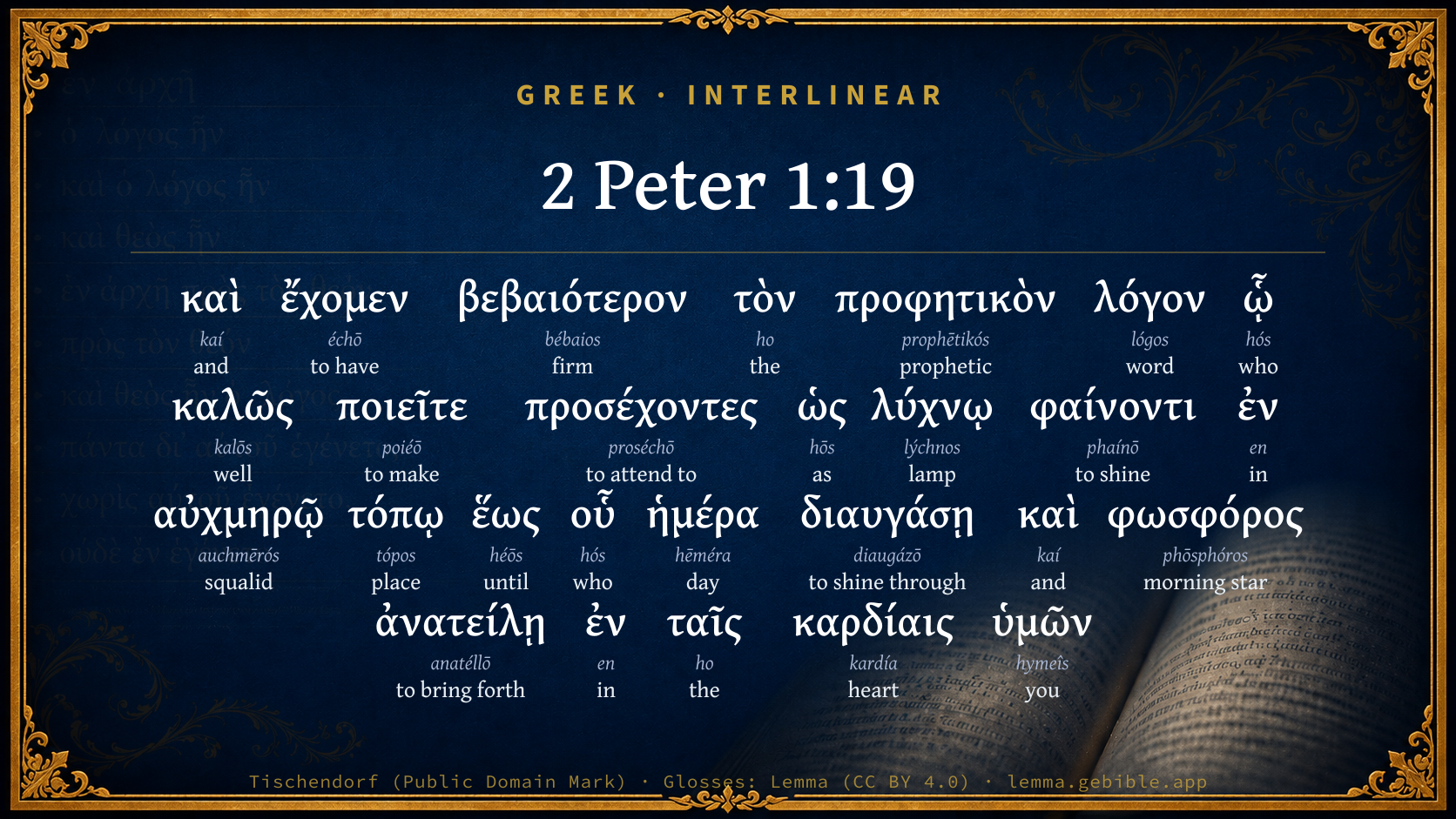
Greek (Tischendorf 8th ed.) 2 Peter 1:19 appears in the Greek New Testament. The text above is from the Tischendorf 8th edition. Each word links to its Strong’s number and a concise gloss. Click any word for its full Thayer’s Greek Lexicon entry.
Download image
Cite this verse

2 Peter 1:19 (World English Bible). Public Domain. Lemma interlinear Bible study tool, https://lemma.gebible.app/v/2-peter/1/19.

Show BibTeX & RIS
BibTeX
RIS
English Translation
We have the more sure word of prophecy; whereunto you do well that you take heed, as to a lamp shining in a dark place, until the day dawns, and the day star arises in your hearts:
World English Bible · Public Domain
Highlights
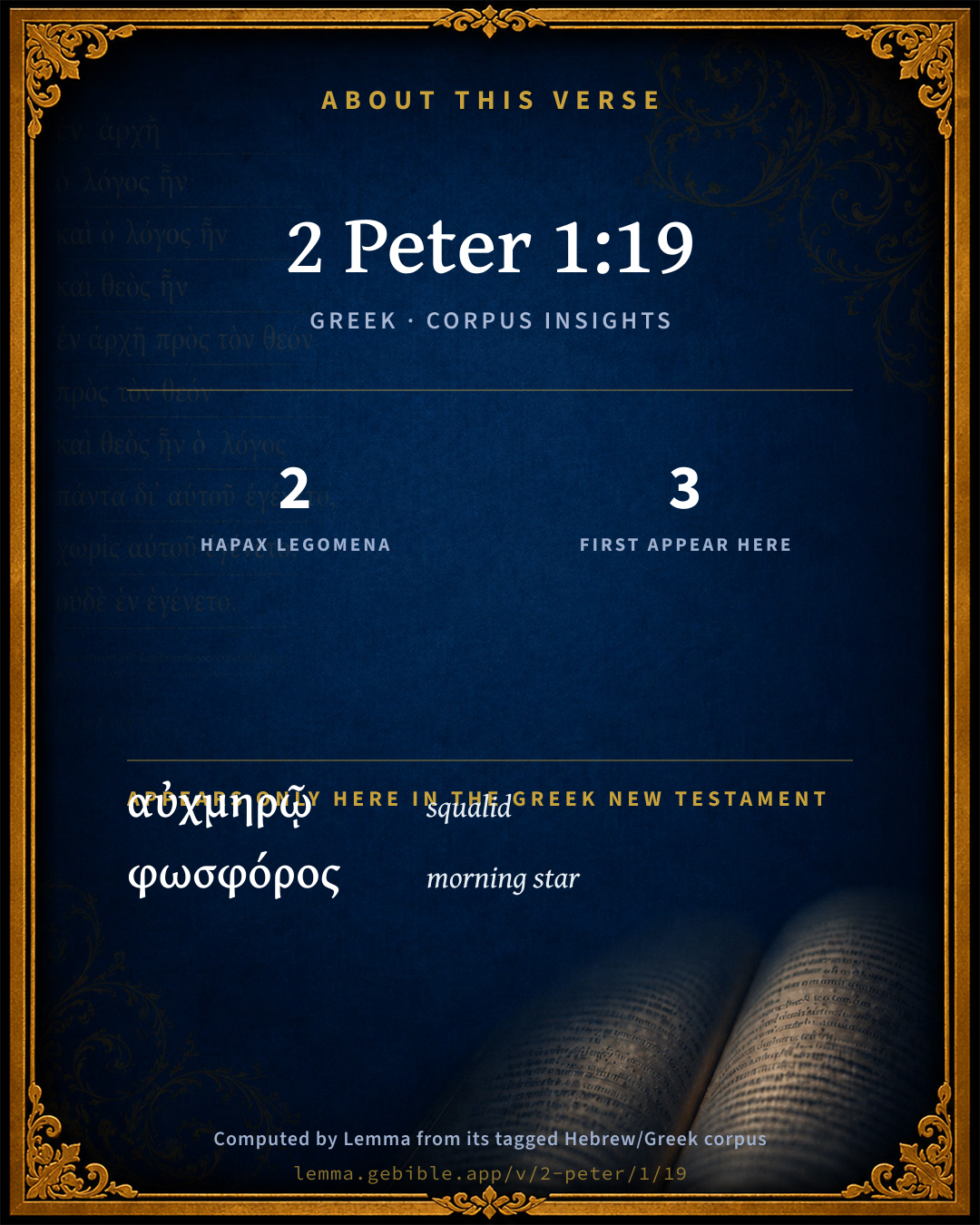
  • 2 hapax legomena — only here in the Greek New Testament
  • 3 first appearances in the Greek New Testament
Full analysis ↓
Download a study sheet

One document with this verse’s original text, its word-by-word gloss line, the meaning frame, cross-references with their text, attributed commentary, and full source and license credits — printable, and it pastes into notes with its structure intact.

This verse Autodidact and up

Study sheet (.html) Plain text (.txt)

A passage Seminary Student

Up to 50 verses in one chapter. A passage sheet keeps up to 6 commentary sources and 12 cross-references per verse, in the order this page ranks them, and says so on the sheet whenever that leaves anything out. Ask for a single verse and you get the Autodidact verse sheet above.

Everything on this page stays free to read, with no account — the sheet is a download of what is already on screen, not access to it.

Want to remove ads? Support Godless Engineer
Compare translations 3

The same verse in 3 English versions, stacked beneath the original-language interlinear above. Click any original word for its lexicon entry.

Each is an independent rendering of the whole verse — the interlinear is not word-aligned to these translations.

Highlighted words mark where these versions differ — a whole-verse word diff, not a word-by-word alignment.

  • World English Bible Public Domain
    We have the more sure word of prophecy; whereunto you do well that you take heed, as to a lamp shining in a dark place, until the day dawns, and the day star arises in your hearts:
  • King James Version Public Domain
    We have also a more sure word of prophecy; whereunto ye do well that ye take heed, as unto a light that shineth in a dark place, until the day dawn, and the day star arise in your hearts:
  • unfoldingWord Literal Text CC BY-SA 4.0
    And we have the very certain prophetic word, to which you do well to pay attention, as to a lamp shining in a dark place, until the day might dawn and the morning star might rise in your hearts,

unfoldingWord Literal Text — © unfoldingWord, licensed CC BY-SA 4.0. Word-aligned USFM3 via Door43 (git.door43.org/unfoldingWord/en_ult).

Versions to compare (up to 4)

3 of 4 selected

Show all 19 translations

Every available English version of this verse, each an independent rendering of the whole verse.

  • World English Bible Public Domain
    We have the more sure word of prophecy; whereunto you do well that you take heed, as to a lamp shining in a dark place, until the day dawns, and the day star arises in your hearts:
  • Berean Standard Bible Public Domain
    We also have the word of the prophets as confirmed beyond doubt. And you will do well to pay attention to it, as to a lamp shining in a dark place, until the day dawns and the morning star rises in your hearts.
  • Majority Standard Bible Public Domain
    We also have the word of the prophets as confirmed beyond doubt. And you will do well to pay attention to it, as to a lamp shining in a dark place, until the day dawns and the morning star rises in your hearts.
  • King James Version Public Domain
    We have also a more sure word of prophecy; whereunto ye do well that ye take heed, as unto a light that shineth in a dark place, until the day dawn, and the day star arise in your hearts:
  • American Standard Version (1901) Public Domain
    And we have the word of prophecy `made' more sure; whereunto ye do well that ye take heed, as unto a lamp shining in a dark place, until the day dawn, and the day-star arise in your hearts:
  • Revised Version (1885) Public Domain
    And we have the word of prophecy made more sure; whereunto ye do well that ye take heed, as unto a lamp shining in a dark place, until the day dawn, and the day-star arise in your hearts:
  • Geneva Bible (1599) Public Domain
    We haue also a most sure worde of the Prophets, to the which ye doe well that yee take heede, as vnto a light that shineth in a darke place, vntill the day dawne, and the day starre arise in your hearts.
  • Douay-Rheims (1899) Public Domain
    And we have the more firm prophetical word: whereunto you do well to attend, as to a light that shineth in a dark place, until the day dawn, and the day star arise in your hearts:
  • Young's Literal Translation Public Domain
    And we have more firm the prophetic word, to which we do well giving heed, as to a lamp shining in a dark place, till day may dawn, and a morning star may arise -- in your hearts;
  • Literal Standard Version CC BY-SA 4.0
    And we have a more firm prophetic word, to which we do well giving heed, as to a lamp shining in a dark place, until day may dawn, and [the] morning star may arise in your hearts;
  • Unlocked Literal Bible CC BY-SA 4.0
    For we have this prophetic word made more sure, and you do well to pay attention to it, as to a lamp shining in a dark place, until the day dawns and the morning star rises in your hearts.
  • unfoldingWord Literal Text CC BY-SA 4.0
    And we have the very certain prophetic word, to which you do well to pay attention, as to a lamp shining in a dark place, until the day might dawn and the morning star might rise in your hearts,
  • Darby Bible Public Domain
    And we have the prophetic word [made] surer, to which ye do well taking heed (as to a lamp shining in an obscure place) until [the] day dawn and [the] morning star arise in your hearts;
  • World Messianic Bible Public Domain
    We have the more sure word of prophecy; and you do well that you heed it as to a lamp shining in a dark place, until the day dawns and the morning star arises in your hearts,
  • Webster's Bible Public Domain
    We have also a more sure word of prophecy; to which ye do well that ye take heed, as to a light that shineth in a dark place, until the day dawn, and the day-star arise in your hearts:
  • Free Bible Version CC BY-SA 4.0
    We also have the confirming word of prophecy that's absolutely trustworthy, and you will benefit from paying close attention to it. It's like a lamp that shines in a dark place until the day dawns, and the morning star shines to illuminate your minds.
  • Bible in Basic English Public Domain
    And so the words of the prophets are made more certain; and it is well for you to give attention to them as to a light shining in a dark place, till the dawn comes and the morning star is seen in your hearts;
  • Text-Critical English NT CC BY 4.0
    So we have the prophetic word more fully confirmed. You will do well to pay attention to it, as to a lamp shining in a dark place, until the day dawns and the morning star rises in your hearts.
  • Tyndale New Testament (1534) Public Domain
    We have also a right sure worde of prophesye wher vnto yf ye take hede as vnto a lyght that shyneth in a darke place ye do wel vntill the daye dawne and the daye starre aryse in youre hertes.

Literal Standard Version (2020), Covenant Press — licensed CC BY-SA 4.0. Text via the HelloAO Bible API (eBible.org). Unlocked Literal Bible (unfoldingWord) — licensed CC BY-SA 4.0. Text via the HelloAO Bible API (eBible.org). unfoldingWord Literal Text — © unfoldingWord, licensed CC BY-SA 4.0. Word-aligned USFM3 via Door43 (git.door43.org/unfoldingWord/en_ult). Free Bible Version, Dr. Jonathan Gallagher — licensed CC BY-SA 4.0. Text via the HelloAO Bible API (eBible.org).

Word by word

More ways to search: Search by grammar → Find every occurrence → Compare this word →

Practice this passage: Drill this verse → Learn its vocabulary →

αὐχμηρῷ
auchmērós
G850
“squalid”
Adjective, Dative, Singular, Masculine
Part of Speech
Adjective
Case
Dative
Number
Singular
Gender
Masculine
Full Thayer's Definition

Origin: from auchmos [probably from a base akin to that of G109 ] (dust, as dried by wind)

TDNT: None

1. squalid, dirty a. since dirty things are destitute of brightness: dark
  1. καὶ kaí G2532 “and” Conjunction
  2. ἔχομεν échō G2192 “to have” Verb, Present, Active, Indicative, 1st person, Plural
  3. βεβαιότερον bébaios G949 “firm” Adjective, Accusative, Singular, Masculine, Comparative
  4. τὸν ho G3588 “the” Article, Accusative, Singular, Masculine
  5. προφητικὸν prophētikós G4397 “prophetic” Adjective, Accusative, Singular, Masculine
  6. λόγον lógos G3056 “word” Noun, Accusative, Singular, Masculine
  7. ᾧ hós G3739 “who” Relative pronoun, Dative, Singular, Masculine
  8. καλῶς kalōs G2573 “well” Adverb
  9. ποιεῖτε poiéō G4160 “to make” Verb, Present, Active, Indicative, 2nd person, Plural
  10. προσέχοντες proséchō G4337 “to attend to” Verb, Present, Active, Participle, Nominative, Plural, Masculine
  11. ὡς hōs G5613 “as” Adverb
  12. λύχνῳ lýchnos G3088 “lamp” Noun, Dative, Singular, Masculine
  13. φαίνοντι phaínō G5316 “to shine” Verb, Present, Middle or Passive, Participle, Dative, Singular, Masculine
  14. ἐν en G1722 “in” Preposition
  15. τόπῳ tópos G5117 “place” Noun, Dative, Singular, Masculine
  16. ἕως héōs G2193 “until” Adverb
  17. οὗ hós G3739 “who” Relative pronoun, Genitive, Singular, Masculine
  18. ἡμέρα hēméra G2250 “day” Noun, Nominative, Singular, Feminine
  19. διαυγάσῃ diaugázō G1306 “to shine through” Verb, Aorist, Active, Subjunctive, 3rd person, Singular
  20. καὶ kaí G2532 “and” Conjunction
  21. φωσφόρος phōsphóros G5459 “morning star” Adjective, Nominative, Singular, Masculine
  22. ἀνατείλῃ anatéllō G393 “to bring forth” Verb, Aorist, Active, Subjunctive, 3rd person, Singular
  23. ἐν en G1722 “in” Preposition
  24. ταῖς ho G3588 “the” Article, Dative, Plural, Feminine
  25. καρδίαις kardía G2588 “heart” Noun, Dative, Plural, Feminine
  26. ὑμῶν hymeîs G5210 “you” Personal pronoun, 2nd person, Genitive, Plural

About this verse

These counts appear in no published source. They are computed here, from the morphology-tagged text and Lemma’s own curated glosses. What Lemma adds →

27
words
23
distinct lemmas
General Epistles
section

Notable vocabulary

2 hapax legomena — words that appear only here in the entire Greek New Testament:

  • αὐχμηρῷ squalid G850
  • φωσφόρος morning star G5459

First appearance in Scripture

These words make their first canonical appearance in the Greek New Testament here:

  • αὐχμηρῷ squalid G850
  • διαυγάσῃ to shine through G1306
  • φωσφόρος morning star G5459

Shared distinctive vocabulary

προφητικὸν prophetic G4397 occurs in 2 verses of the Greek New Testament. Also found in:
Repetition

Words recur within this verse:

Cross-references

25

Topical passages linked to 2 Peter 1:19 in the Treasury of Scripture Knowledge — connected by theme and wording, ordered by reader-vote popularity; previews shown in the World English Bible.

  • Psalms 119:105 Your word is a lamp to my feet, And a light for my path.
  • Isaiah 9:2 The people who walked in darkness have seen a great light: those who lived in the land of the shadow of death, on them has the light shined.
  • Revelation 22:16 I, Jesus, have sent my angel to testify these things to you for the assemblies. I am the root and the offspring of David; the Bright and Morning Star."
  • John 5:39 "You search the Scriptures, because you think that in them you have eternal life; and these are they which testify about me.
  • Isaiah 8:20 To the law and to the testimony! if they don't speak according to this word, surely there is no morning for them.
  • John 1:7–9 The same came as a witness, that he might testify about the light, that all might believe through him.
  • 2 Corinthians 4:4–6 in whom the god of this world has blinded the minds of the unbelieving, that the light of the Gospel of the glory of Christ, who is the image of God, should not dawn on them.
  • Proverbs 6:23 For the commandment is a lamp, And the law is light. Reproofs of instruction are the way of life,
  • Revelation 2:28 and I will give him the morning star.
  • Psalms 19:7–9 Yahweh's law is perfect, restoring the soul. Yahweh's testimony is sure, making wise the simple.
  • Luke 1:78–79 Because of the tender mercy of our God, Whereby the dawn from on high will visit us,
  • Isaiah 60:1–2 Arise, shine; for your light is come, and the glory of Yahweh is risen on you.
  • Matthew 4:16 The people who sat in darkness saw a great light, To those who sat in the region and shadow of death, To them light has dawned."
  • John 5:35 He was the burning and shining lamp, and you were willing to rejoice for a while in his light.
  • John 8:12 Again, therefore, Jesus spoke to them, saying, "I am the light of the world. He who follows me will not walk in the darkness, but will have the light of life."
  • Ephesians 5:7–8 Therefore don't be partakers with them.
  • 1 Peter 1:10 Concerning this salvation, the prophets sought and searched diligently, who prophesied of the grace that would come to you,
  • 1 John 5:10 He who believes in the Son of God has the testimony in himself. He who doesn't believe God has made him a liar, because he has not believed in the testimony that God has given concerning his Son.
  • Isaiah 41:21–23 Produce your cause, says Yahweh; bring forth your strong reasons, says the King of Jacob.
  • Acts 15:29 that you abstain from things sacrificed to idols, from blood, from things strangled, and from sexual immorality, from which if you keep yourselves, it will be well with you. Farewell."
  • Acts 17:11 Now these were more noble than those in Thessalonica, in that they received the word with all readiness of the mind, examining the Scriptures daily to see whether these things were so.
  • James 2:8 However, if you fulfill the royal law, according to the Scripture, "You shall love your neighbor as yourself," you do well.
  • Luke 16:29–31 "But Abraham said to him, 'They have Moses and the prophets. Let them listen to them.'
  • 3 John 1:6 They have testified about your love before the assembly. You will do well to send them forward on their journey in a manner worthy of God,
  • Isaiah 41:26 Who has declared it from the beginning, that we may know? and before, that we may say, [He is] right? yes, there is none who declares, yes, there is none who shows, yes, there is none who hears your words.

Cross-references courtesy of OpenBible.info (CC BY 4.0).

Commentary

Notes on 2 Peter 1:19 from classic Christian and Jewish commentators (each source and its license shown beneath its notes). The classic Christian expositions comment on the surrounding passage and are grouped to its opening verse, so a note may address several verses; the Jewish commentaries on the Tanakh (Rashi and others) are per-verse, so they appear only where the commentator wrote on this verse.

Lemma curates 59 commentaries, every one of them public domain or Creative Commons licensed, each selected and text-cleaned for this edition rather than reprinted as found. About our sources →

The Biblical Illustrator

Joseph S. Exell

2Pe_1:19-21

A light that shineth in a dark place.

The Word of God a light shining in a dark place

I. In showing the correctness of this description, I would begin with reminding you that by the dark place we must understand this world in relation to its spiritual condition. But in the midst of all this darkness a light has still been shining, and that light is the Word of God.

II. To illustrate it by a reference to facts. Has it not uniformly come to pass that true religion has flourished or decayed in exact proportion to the degree in which the Bible has been disseminated or suppressed?

1. In practically applying the subject, the first inference which I shall deduce from it is that suggested by St. Peter himself in the text--seeing that there is such a light shining in a dark place, ye will do well that ye take heed to it. Bear in mind the purpose for which it was vouchsafed: not to gratify a vain curiosity, not to puff up with fleshly wisdom, but to make wise unto salvation, to enlighten, convert, and purify the soul. Bear in mind that it is not enough to live under the light; you must also walk in the light. It is not enough that the light is around you; it must be also in you. You may have your understanding enlightened with Scriptural truths, and yet your heart may be a dark place.

2. Seeing that there is such a light shining in a dark place, ye will do well to aid the diffusion of it. Having taken heed to it yourselves, let it be your care to extend the blessing of it to others. Can you, indeed, do otherwise? (E. Cooper, M. A.)

Unfulfilled prophecy a light provided for the Church of Christ

I. State some of the uses of unfulfilled prophecy.

1. One use, of course, is to prove the truth and faithfulness of Gods Word, establishing by implication His foreknowledge.

2. Another use of unfulfilled prophecy is guidance and direction.

3. Unfulfilled prophecy is also for warning both to the Church and to sinners--to the Church, that they may be found ready, with their loins girt, overcoming the evil, and waiting for the glory; to the world, that they may have opportunity to escape, or, if they refuse, be left without excuse in the rejection of the truth.

4. Hope is specially strengthened and sustained through the communication of what is to come.

5. Among many other uses of unfulfilled prophecy is the answer which it affords to the questionings of infidelity.

II. The principles on which prophetical language and its statements should be interpreted. To the question, How can we certainly discover the right way of interpreting unfulfilled prophecy, we answer at once, By observing how God has interpreted prophecy in what has been fulfilled already.

III. Let us now proceed to discuss in a few words the one pre-eminently great event of unfulfilled prophecy--the second coming of the Lord Jesus Christ. This is the great focus of prophetic light, and all other events and circumstances are gathered in beautiful symmetry around it.

IV. The events which we believe will be connected with the advent. (C. J. Goodhart, M. A.)

Scripture light the most sure light

I. It is possible that a good man may be in the dark. Was not David in the dark (2Sa_22:29)? Was not Job in the dark (Job_19:8)? A good man may live and dwell in a place or town where no means of grace are; in a poor, dark, and ignorant corner of the world. Did not Job dwell in the land of Uz? As a good man may be offended and stumbled, so he may stumble into some mistakes and errors; erroneous times are dark times: every error is darkness, as truth is light. Ye see how it is in a room where there are many pictures; though ye see some of them presently, yet others have a silken curtain drawn before them, which ye see not immediately: so here, though God do reveal much unto you, yet there is a silken curtain that is still drawn before some truths, and therefore even a good man may be much mistaken. And if a good man may be under some temptation and sin, then he may be in the dark.

II. Though a good man may be in the dark, yet he hath scripture light to walk by. God hath not left him comfortless, and without light, in obscure darkness. But have not even wicked men this light also of the Scripture, to walk by in their darkness? I answer, They have it as a blind man hath the sun. And though a wicked man doth hear and may read the Scripture, and know many truths which are therein contained, yet he doth not know the greatness of them. But may not a good mans eyes be held from this Scripture light? When he is converted, then are his eyes said to be opened, then is he anointed with the unction of the Holy One, and doth know all things necessary unto his salvation. He doth not shut his own eyes against any Scripture light. He knows more than he is able to utter and he feels more than he can speak. And though some Scripture truths may be hidden from him sometimes, yet he hath his intervals of sight. And though a good man may be in the dark, yet God doth not leave him so.

III. This scripture light is the most excellent, safe, and sure light: it is the light of lights; the most excellent light of all under God in Christ. For--

1. It is a true light. There is God seen especially, and Christ seen; there also you see yourself and your own dirty face; there also you see the creatures that are in the room with you, and their emptiness; the emptiness of men, and of all comforts and relations.

2. As it is a true light, so it is an admirable and wonderful light. In other knowledges, the more ye know, the less ye admire; but in Scripture knowledge, the more light ye have, and the more ye know, the more you will lift up your hands and admire, at your own ignorance and Gods grace.

3. As it is an admirable light, so it is a safe and sure light. Other false lights do lead men into fens and bogs; but we have a more sure and safe light, and the more of it falls upon your eye, the more is your eye preserved.

4. As it is a safe and sure light, so it is a pleasant and satisfying light. Light is pleasant to the eye, and the eye ordinarily is not satisfied with seeing: but this is that light which doth bring men to rest; for when a man knows what shall be his portion for ever, then his heart is at rest, and not before.

5. As it is a pleasant, satisfying light, so it is a full and sufficient light, able to make the man of God perfect unto salvation. What state can you be in, but the Scripture will find a commandment for your rule, and a promise for your assistance and reward?

6. As it is a full and sufficient light, so it is a clear light, a light that shineth; it hath no thief in it, as many lights and candles have: not that there are no hard things therein, and difficulties. Yet what truth is in all the Scripture, which is necessary to salvation, but doth lie plain and clear? (Deu_30:11-14; Rom_10:6).

7. As it is a clear light, so it is the best light in the world, the most excellent light, a light beyond all other things which do pretend to light.

(1) Wherein doth this Scripture light exceed or go beyond revelations or visions, and the light thereof?

(a) This Scripture light, as you have seen, is a full light, a light which did shine forth at once in and by Jesus Christ. Revelations and visions are more particular; though God did sometimes speak in that way and manner, yet then He spake drop by drop; but now He hath, in these last days, spoken His full mind by His Son. These were but as the apples which did fall from the tree of wisdom; but in the gospel and Scripture, ye have the whole tree itself.

(b) Scripture light is the highest light; Scripture dispensation the highest dispensation: the dispensation of visions and revelations was of a lower rank.

(c) This Scripture light is a more sure and certain light: for if God should now speak unto you by visions, or visional revelations, how would you know that this were the voice of God, and not a delusion of Satan?

(d) There is no danger in tending upon and taking heed to this Scripture light. But if men do attend to revelations and visions, how easily may they be drawn to despise the Scripture, and such as do wait thereon!

(e) Why but, you will say, may not God speak by extraordinary visions and revelations, in these days of ours? Though God may thus speak to some of His servants, yet if I have an itching desire after visions and revelations it is ill.

(2) As for dreams and voices, the Scripture or the written Word of God, is more excellent than those; and the light of Scripture is the best light in compare with any light that may come from them.

(3) As for impressions made upon the soul, whether by a particular word or without it; the Scripture, or the written Word of God, is more sure than those; and the light thereof the best and most excellent light in comparison with the light of impressions. If I do make an impression the certain judge of doctrines, then am I much deceived.

(4) As for that light and law of grace which is in the saints, the light of the Scripture is beyond and more excellent than that. The light and law within us here is imperfect, for we see but in part, and know in part (1Co_13:9); but the Word of God written, the Scripture and the light thereof, is perfect (Psa_19:1-14.). The law of grace within, and the light within, is not able to convince others. Though experience be a great help to our faith, yet, take it alone, abstracted from the Word, and it cannot heal our unbelief. But though experience be the parent of hope, yet it is not the ground of our faith; it is an help unto faith, but not the first ground of our faith.

(6) As for Divine providence, the Scripture is a more sure light than it. For God doth sometimes try us by His providence. So He led the children of Israel in the wilderness forty years to try them, and to know what they would do, and to humble them. But the Scripture is the rule of our doing, and therefore a more safe and sure light to walk by. And if the providence of God extendeth unto all our actions, good and evil, and to evil as well as unto what is good, then there is no certain rule or judgment to be made up from thence.

(7) As for human reason and the light thereof, Scripture light is more excellent than it. For though human reason be a beam of Divine wisdom, yet if it be not enlightened with a higher light of the gospel, it cannot reach unto the things of God as it should. And as mere human reason cannot make a sufficient discovery of sin, so it cannot strengthen against sin and temptation: temptations answered by reason will return again; it cannot convert the soul. But the Word of the Lord is perfect, converting the soul. Though the light of reason be good, yet it is not a saving light. It is revelation light from the gospel that doth bring to heaven: mere human reason cannot do it. Is there then no use of reason and of the light thereof? Yea, much, not only in civil things but in the things of God, comparing spiritual things with spiritual.

IV. As Scripture light is the most excellent light, the best and most sure light, so it is our duty, the duty of all the saints and people of God, to take heed thereunto, and that especially in their dark times and places. Yet further, ye shall do well that ye take heed thereunto, for the doctrine of the gospel written is--

1. The Word of the Son of God. The more excellent the person is that speaks unto you, the more diligently ye will take heed unto what he saith.

2. As the Scripture is the Word of the Son, so it is the only rule of our lives. Now that which is the only rule of our lives, we are in special manner to take heed unto.

3. As the Scripture and the Word of God written is the only rule, so it is that salt which doth season all your enjoyments. It is the rule and measure of your worship; for if you do not worship according to the appointments of God in His written Word, your worship is but idolatry and superstition. It is the great relief of your souls in time of temptation. It is that which sanctifieth all your outward comforts, even amongst the creatures (1Ti_4:4). And shall the Word of God written be such a blessed treasure, and shall we not take heed thereunto?

4. As it is the salt of all your comforts, so it is, and shall be, your judge at the great day. But the text saith, That we shall do well to take heed thereunto, until the day dawn, and day-star arise in our hearts: but the day hath dawned on me, and the day-star hath arisen in my heart; and therefore now, what need I take heed to the Scripture or the written Word any longer? I answer, Yea, still you have need to do it: for did not the day dawn and the day-star arise on the hearts of the apostles and Christians in their days, according to your sense and meaning? yet they still attended on the written Word of God. But why are the saints and people of God to take heed unto the Scripture and the written Word of God especially in their dark times and seasons? I answer, Because they are then in most danger of stumbling and falling: he that walketh in the dark, stumbleth; and who is not then apt to fall? But by taking heed to this sure light, they shall be kept from the power of their darkness. What must we do, that we may take heed and attend unto Scripture? Ye must do three things--

I. Ye must attend to know and understand it.

II. Ye must attend to keep it. And--

III. Ye must attend to walk by the same. And--

I. For your knowledge in and understanding of the Scripture, and the written Word of God, ye must--

1. Observe, keep, and hold fast the letter of it; for though the letter of the Scripture be not the Word alone, yet the letter with the true sense and meaning of it, is the Word.

2. If you would have the true knowledge, and understand the Scripture, and so behold this great light in its full glory and brightness, you must diligently inquire into the true sense and meaning of it, for the true sense and meaning is the soul thereof.

II. But secondly, and more practically: if you would so understand the Scripture, that you may take heed thereunto, as to a light shining in your dark state, then--You must go to God for the Spirit; for without it ye cannot understand the mind of God in the Scripture: no man knows the mind of Paul but by the spirit of Paul; nor the mind of Peter but by the spirit of Peter; no man knows the mind of Christ but by the Spirit of Christ: stand therefore under gospel dispensations, where the Spirit breathes. Take heed of a worldly, fleshly mind; fleshly sins do exceedingly blind the mind from the things of God, and a worldly mind cannot savour them. Yet take heed that you be not too indulgent to your own condition, disposition, or opinion. It is a good speech of Hilary: He is the best interpreter of Scripture that doth rather bring his sense from the Scripture than carry his sense to the Scripture. If you do desire so to understand the Scripture, as it may be a light to all your paths; then be sure that you put nothing else in commission with it for your rule. It is with the Scripture in this respect, as with God, Christ, and the Spirit; if you come to God for help, yet if you join another god in commission with Him, He will not give down His help. And so here: though you come, and tend, and wait upon God in the Scripture, yet if there be anything else which you do make your joint rule with the Scripture, any light within you, or precept of man without you, it will not give down its light to you, but you will be left in the dark.

III. Yet one thing more. If you would take heed to the Scripture, you must so heed the same, as you may walk thereby. Therefore prize it much: who takes heed to that which he does not prize? Therefore, also, get your heart affected with love to every truth which you know; for because men receive not the truth in the love thereof, therefore God doth give them up to strong delusions: men take heed unto what they love. And therefore that you may heed it so as to walk thereby, let it be your continual companion, going where you go; if you go into the fields, oh! let the Word go with you; if into your calling, oh! let the Scripture and the written Word of God be with you. Thus shall you take heed unto it, as to a light shining in a dark place. (W. Bridge, M. A.)

Until the day dawn.

The dawn of day

The words admit of two rather different meanings. They may refer to the light which sometimes breaks upon the heart after prayer or meditation. I would suppose that you are a real inquirer after truth. You have been searching for it long and earnestly, but the dark places in the Bible--those dark places which underlie all great truths--and the dark places in your own heart are many. You cannot see any light. Least of all can you see that you have yourself any part or lot in the matter. The day cometh and also the night, for the night is as much a part of the coming as the day. It will come in its own appointed time, and not a moment sooner. The days dawn will arise exact to its moment. Or it may be thus. You have lost the light which you once enjoyed. Something has come between your soul and God, and now all is dark. What shall you do? Pray on, repent on, confess on, plead on a little longer. It only wants your perseverance until the day dawn. Or perhaps you say, I have never known any of the rapturous views which some speak of. It is not given to everybody in the same degree, but to each as he needs it, or as he can bear it. The nights are as needful as the days to all the processes of nature. A brightened day of Christian experience may be yet waiting for you. Do not let hope, or faith, or courage fail until it dawn. Meanwhile, that until is a very important part of the blessing. Many a good thing has lost all its goodness simply because it came too soon. Do not hurry on the morning. God knows best how long your night shall be. But there is another interpretation which belongs to the text with equal or greater appropriateness. The day. The day of all days for this world is the Advent of Christ. That day which will throw over this earth a light never seen before, and clothe it with the most brilliant splendour. Of the exact period of that days dawn we have been most wisely and mercifully kept in ignorance. Is, then, this life all night? Why speak of the day dawning as if it is all now so very dark? It is all comparative. This life is a very happy life; this world is a beautiful world; but we all find that colour changes its hue under contrast. To-morrows exceeding joy may make a bright yesterday look dull, however pleasant it was. And when Jesus comes with His glory, and the heavens are new, and the earth is new, all that is now the holiest, and loveliest and best--tainted as it all is with sin and change and sorrow--it will all look like a shadow. Still it is not to disparage the present, but to exalt the future, that we are told to wait until the day dawn. To all the mysteries of our world and being, to the chaos of our thoughts, to the dark things within and around us on every side, the key, the true solution is until the day dawn. Bear that key with you, and it will unlock the whole year. Expect and be always looking for more and more light, till one by one the shadows flee away, and the whole orb of truth rises in his majesty, and the day dawn. (J. Vaughan, M. A.)

The daystar arise.--

The rising of the day-star

There is a difference between the dawn and the day-star. The light of the dawn is general; the daystar gives the thought a focus and fixes it to one spot. The dawn is to the whole world; the day-star arises in our hearts. What the day-star is, is left without a shadow of a doubt. For Christ has singled it out as the last title which He claims in the whole Bible. I am the bright and morning star. As the morning star He comes to us in the night of waiting, doubt, and sorrow. The day-star is the morning close at hand. The dawn is the day begun. Yet they can never be divided. The dawn must soon be full day, and the day-star loses itself in the risen sun. Now trace, for a moment, the connection which lies in the allegory--between the dawn and the day-star. I will give one or two instances. You have been reading your Bible, and searching into some of the deep things there. You are a sincere inquirer after truth, but for a while it is all dark; and when it is the darkest, just before the light is going to break, a thought comes into your mind; it gives you a fresh view of the whole subject; it gets clearer and clearer; it spreads like the dawn over the hills; in another bound it unveils itself to you. Why? Whence comes this dawn? Is it from the head, or is it from the heart? Certainly from the heart. There is Christ in it. The daystar is in that dawn. You feel it. The day dawned when the day-star arose in your heart. And so Christ made the night of your ignorance turn into the day of your joy. I will take it thus. Some sin has gradually darkened your mind. It throws its deep shadow over everything. You cannot find forgiveness, and your whole life is wrapped in gloom. The night of your life becomes thicker and thicker. You pray; there is no answer. You repent; but there is no peace. When almost suddenly--as it seems to you--a hope seems to spring up, things begin to look brighter, despair ceases, praise and hope find their way to your thoughts. There is a dawn! But whence? Christ and His tender love has come nearer to you. He reveals Himself to you as your complete and all-sufficient Saviour. All is changed. Why? The day-star has risen in your heart. Or see what shall be presently. The second Advent of Christ is breaking upon this earth. A new day shall burst. This is wonderful. Are you frightened at the solemnities of that hour--the convulsions of nature--the rolling of the heavens up into a scroll--the sight of God! Do they appal you? No. You are calm; you rejoice. Why? For the day-star is there, and long before, He has been the day dawn in your soul. He is yours. You know Him. He has risen in your heart, and now has come the noontime of your joy! Now let us observe a little more concerning the day-star. And first I notice that it ariseth of its own free action, of the very necessity of its being; in its very nature it ariseth. It must arise. We do not make the day-star arise; neither do we make Jesus come into our poor dark hearts. He does it of His own free grace and favour. He comes of His own necessity. Such is His love He cannot but choose to come. He arises in your heart. The expression shows that it is gradual. He arises. He goes higher and higher. The light gets stronger, and we see Him more and more. And where the days are His, we know that there will be day--perfect day. The great question for every one of us is, Is that day-star yet arisen in my heart? If not, why? Are you wilfully hindering it? Are you turning away from it? (J. Vaughan, M. A.)

Christmas, or the two risings of the Day-star

(Luk_1:78-79; 2Pe_1:19):--Christ has two incarnations--the one outside of man, the other inside; two births--the one in the manger, the other in the soul.

I. His objective birth or rising. The day-spring from on high, etc. This day-star arose in Bethlehem. First, the origin of this rising. Through the tender mercy of our God. Gods sovereign, compassionate, boundless love was the cause. Secondly, the purpose of this rising. To give light to them that sit in darkness. This was the condition of the world--in moral night, ignorant, polluted, miserable.

II. His subjective birth or rising. The day-star arise in your hearts. Christ is in His disciples

(1) as the dominant object of affection,

(2) as the dominant theme of thought,

(3) as the dominant motive of action.

III. His objective and subjective rising compared. Both agree in this. They are from the tender mercy of our God. But the following are points of difference: First, the objective rising exists independently of the subjective; but not the subjective without the objective. In other words, unless Christ had been born in the manger He would never have been born by faith in the human soul. Secondly, the objective rising may become a curse, the subjective never. The man who does not receive Christ into the heart, but continues to reject Him, is injured immensely by the fact of His outward revelation. Thirdly, the objective rising is independent of human choice or effort, but not the subjective. Fourthly, the objective rising is not a matter of consciousness; the subjective is. That Christ came into the world can only be proved by logic and dealing with known facts; consciousness, the strongest and ultimate proof, can yield no testimony to the fact. But the subjective rising is a matter of consciousness. Conclusion: Learn--first, what personal Christianity is; secondly, what the duty of the preacher is. Try to get Christ, and not creeds, into human souls. (Homilist.)

The Biblical Illustrator, edited by Joseph S. Exell (c. 1880s–1900s) — public domain. Text from a community e-Sword module.

Joseph Benson's Commentary

2Pe 1:19. We have also — Peter speaks here in the name of all Christians, a more sure word — Than that voice from heaven, or any particular revelation, not in itself, but more satisfactory to us, as being less liable to be mistaken; of prophecy — He means the prophecies of the Old Testament concerning the Messiah, which, one being consistent with another, and connected together, might properly be represented as one and the same word of prophecy. Some are of opinion that the apostle intended no comparison in this place, but that the comparative is used for the positive, and that his words were only intended to signify a very sure word of prophecy, or prophetical word; and it is certain that there are many instances in the New Testament of a similar kind, in which, though the comparative degree is used, the positive or superlative is evidently intended. Others assert, with much truth and propriety, that the series of prophecies contained in the Old Testament concerning Christ, when explained in the light of the New Testament, is a much clearer proof of Jesus being the Messiah, than any single miraculous fact, such as Christ’s transfiguration was. Whereunto — Unto which chain of prophecy concerning the conception and birth, the character, doctrine, miracles, sufferings, death, resurrection, ascension, and exaltation of the Messiah, with the erection and establishment, the extent, prosperity, and duration of his kingdom, and his second coming to raise the dead, and judge the world in righteousness — all evidently accomplished in Jesus of Nazareth, ye do well to take heed — In order that your faith, instead of being shaken by the objections of the enemies of the gospel, may be more fully confirmed; even as unto a light — Λυχνω, a lamp, that shineth in a dark place — The whole world anciently was indeed a dark place with respect to the knowledge of divine things, except that little spot, Judea, where this light shone; until the day should dawn — Till the full light of the gospel should break through the darkness. As is the difference between the light of a lamp and that of the day, such is that between the light of the Old Testament and that of the New. Or the apostle meant by these words, that those to whom he wrote should attend to these prophecies concerning the Messiah, and compare them with the facts attested by the apostles and evangelists concerning Jesus of Nazareth, till their minds should be more fully enlightened by the word and Spirit of God; and the day-star should arise in their hearts. — Till the Lord Jesus, the bright and morning star, (Rev 22:16,) should be more fully revealed in them. Or “till the Holy Spirit should discover to their souls the glory and excellence of the gospel, and by his sanctifying and comforting influences give them the dawning of heaven in their hearts; and till the knowledge of Christ, and the experience of his power, truth, and love, had formed within them an assurance and anticipation of the light, holiness, and felicity of the saints in the presence of their glorified Saviour, even as the morning-star preceded and ushered in the rising sun and the perfect day.” — Scott. Who adds, that nothing can be more manifest than that the day-dawn and day-star are spoken of as arising in the hearts of true Christians, and that no external evidence of the divine origin of Christianity is meant, nor even that internal evidence of the divine inspiration of the Scriptures which they contain in themselves, arising from the excellence of their doctrines, precepts, promises, &c. But the expressions must mean what is internal in our own experience. “The unnatural and far-fetched interpretations of those who oppose this conclusion, serve only to confirm the author in his judgment. This inward demonstration of the truth of Christianity would render the external evidences less necessary to those who enjoyed it; as they could no longer doubt of it when they saw the glory, and tasted the comfort of it, and experienced the truth and power of it in their hearts, and manifested it in their conduct.”

Joseph Benson's Commentary on the Old and New Testaments (1811–1818) — public domain. Text from a community e-Sword module.

Whedon's Commentary on the Bible

Daniel D. Whedon

6. And by more sure spirit-moved prophecy, 2Pe_1:19-21.

19. The connection with the preceding, as the και, also, shows, is very close.

A more sure word—It is incredible that St. Peter meant to say, as he is commonly understood, that the testimony of prophecy to Christ is more sure than his own, just given, of God’s uttered words, or than that of miracles, like raising the dead; and his Greek, better translated, really says, And we have more sure the prophetic word, namely, respecting Christ’s character and glory, than we had it before the transfiguration. That word or doctrine, pronounced him “Mine elect, in whom my soul delighteth,” (Isa_42:1;) the audible words of God confirmed it; as did the scene on the mount the loftiest Old Testament description of him. Or, more generally, its predictions of him, (not prophecy generally,) summarized by St. Peter as “the sufferings of Christ and the glory that should follow,” (1Pe_1:11,) are confirmed by their fulfilment. Bloomfield quotes from Rosenmuller, “The prophecies had always a great authority with us; but now they have a far greater, since we see events so aptly corresponding to the predictions.” And thus, assured faith more firmly holds those of his kingdom and glory not yet fulfilled.

Whereunto… take heed—In giving attention to the prophetic doctrine concerning Christ, ye do well, comparing it with the historic facts of his birth, life, character, death, resurrection, and exaltation, thus increasing in “the knowledge of our Lord Jesus Christ.” 2Pe_1:2; 2Pe_1:8.

As unto a light—A lamp glimmering in a dark dismal place, and necessary until the day dawn, dispelling the darkness.

The daystar—Phosphorus, the morning star, the forerunner of the sun. The prophecies of Christ were intended to give a degree of light to benighted minds; feeble, indeed, as compared with that received from the evangelists: but their fulfilment shows clearly both the truth, and the way to happiness. To this light they were to take heed. There seems to be here no reference to the second coming of our Lord, as even Alford admits.

Daniel D. Whedon (gen. ed.), Commentary on the Old and New Testaments (1874–1909) — public domain. Text from a community e-Sword module.

The Expositor's Bible

Chapter 22

THE LAMP SHINING IN A DARK PLACE

2Pe_1:19-21

THE rendering of the first words in this passage must be reckoned among the distinct improvements of the Revised Version. As the translation stands in the Authorized Version, "We have also a more sure word of prophecy," it conveys a sense which many must have found perplexing. The Apostle had just dwelt on the confirmation of faith, both for himself and those to whom he preached, which was ministered by the vision of the glory of Jesus and by the proclamation of His Divinity by Gods voice from heaven. Could any prophetic message vie in his estimate with the assurance of such a revelation? Now what St. Peter meant is made clear. "And we have the word of prophecy made more sure"-more sure because we have received the confirmation of all that the prophets spake dimly and in figure. The Apostle and the rest of the Jewish people had been trained in the ancient Scriptures, and gathered from them, some more and some less, light concerning Gods scheme of salvation. There were, however, but few who had attained a true insight into what was revealed. They had dwelt, as a rule, too exclusively on all that spake of the glory of the promised Redeemer and of His coming to reign and to conquer. That there should be suffering in His life, they had put out of sight, though the prophets had foretold it; and so when Christ spake of His crucifixion, soon to come to pass in Jerusalem, St. Peter exclaimed-and he had the feelings of his nation with him-"That be far from Thee." The voice on the holy mount and the words of Moses and Elias had opened their eyes to the full drift of prophetic revelation; and by the illumination of that scene of glory, where yet the lot of suffering was contemplated as near at hand, there had been given to them a grasp of the whole scope of prophecy, and their partial and distorted conception of the work of Christ was banished forever.

"Whereunto ye do well that ye take heed." The idea of a volume of New Testament Scriptures had not entered St. Peters mind. He knows that St. Pauls letters {2Pe_3:15-16} are read by some, who do not all profit by the privilege; and his own letters he intends to be an abiding admonition to the Churches. The need, too, of a record of Christs life and works, a gospel, must have begun to be felt. But yet he points the converts to the ancient records of Israel as a guide to direct their lives. They had heard the Gospel story from the lips of himself and others. Thus they had the key to unlock what hitherto had seemed hard to understand, and could study their prophetic volume with a new and perfect light. This he means by "ye do well." Ye go to the true source of guidance, drink of the fountain of true wisdom, and gain strength and refreshment-when it is much needed. Duly to take heed of these records is to search out their lessons and labor after that deeper sense which is enshrined beneath the word. Given as they were at various times and in various fashions, and given to point on to Gods purposes in the future, these Scriptures must needs have been dark to those who first received them, nor could the men whom God chose to deliver them have been fully conscious of all they were meant to declare as the ages rolled on and brought their fulfillment nearer. Nor are they all luminous even yet, but they grow ever more so to those who take heed.

"As unto a lamp shining in a dark place." Spite of all the light we can compass, the world will always be in one sense a dark place. It is a world of beauty, full of the tokens of Gods handiwork, the indications of His love. But evil has also made an entrance: and the trail of the serpent is evident in the sorrow, the disease, the wickedness, that abound on every side. And problems continually present themselves which even to the saints are hard to be solved. Many a psalm records the conflict which has to be passed through ere Gods ways can be reconciled to men. We must go into His house, draw near to Him, feel to the full His Fatherhood, ere our hearts can be contented. Nay, the disquiet breaks out again and again. So God, in His mercy, has provided His lamp for those who will use it; and to those who take heed it furnishes ever-new light. The history, the prophecy, the devotion, the allegory, of the holy volume are all full of illustrations of the firm purpose of redemption, of the eternal, unchanging love of Jehovah, thwarted only by the perverseness of those whom He is longing to save from their sins. And to call Gods revelation in His word a lamp is a striking and instructive figure. It is something which you can take with you, and carry into the dark places whither your lot may send you, and use its light just where and when you need it. But its light must be fed by the constant oil of diligent study, or its usefulness will not be found to the full.

And the truth is the same if we apply the lesson to nations and Churches as it is for individuals. The records were given to a nation chosen to keep the knowledge of God alive in the world. The word spoken did not profit, as it was meant to do, because it was not mixed with faith in them that heard it. And there is the same faith needed still. The light of a lamp in a dark place shines but a little way; but by the rays of the Divine lamp men are to walk, in faith that the steps beyond will become clear in their turn. And thus alone will the problems of life be really solved, the religious contentions, the social difficulties, the trials of family life, the individual doubts and fears: all are elements of darkness; all need to be illumined by the lamp which God has provided. Oh that men would burnish it by diligent heed, and keep its radiance at the full by constant seeking thereunto!

"Until the day dawn, and the day-star arise" in your hearts. They day has begun to dawn for those who will lift up their hearts to its breaking. The day-star from on high hath visited the earth in the person of Christ, but the full day will not be till He returns again. Yet His coming into the world was meant to lighten every man, and to win all men to walk in His light. "I, if I be lifted up, will draw all men unto Me," is His own promise. And in that decease of which He spake with Moses and Elijah. He has been lifted up. But He has left it to them that love Him to lift Him up constantly before the eyes of men, to exalt Him by their lives; and our lax performances make the progress of His drawing all men, to halt. We fail to make due use of the lamp which He has put ready to our hand, and which only needs to be grasped. The perfect day will not come to us in this life, but He gives to His faithful ones glimpses of the dawn. They learn the presence of the Sun of righteousness, though as yet they see Him only through the mists and darkness of life; and they are cheered with the certainty of the coming day. And the day-star of the Spirit is kindled in the hearts of those who ask Him to dwell there; and they are led forward into greater and greater truth, into richer and fuller light. And for the same end the Spirit is promised to the Church of Christ: that she may be enabled, having used the lamp first given with all faithfulness, to open to men the ways of God more fully, and, amid the changes of times and varying vicissitudes and needs of men and nations, to prove that the only satisfaction to the soul is the increasing knowledge of the oneness of Gods purpose and eternity of His love. To such a power she will be helped by giving heed to the lamp in every dark place and seeking in its light the elucidation of all hard questions.

"Knowing this first, that no prophecy of Scripture is of private interpretation." The Greek words need to be taken account of before we can gather the true meaning of this clause. That which is translated "is" is much more frequently rendered "comes to pass," and bears the sense of "arises," "has its origin." "Interpretation" is the translation of a word which occurs here only in the-New Testament, and implies the "loosing" of what is complicated, the "clearing" of what is obscure. The lesson which the Apostle would give relates to the right appreciation of the Old Testament Scriptures, which contain the prophecy which he has called above "the lamp in a dark place." He intends to say something which may incline men to follow its guidance. The prophetic writings furnish us with illustrations how the problems which arose in the lives of the men of old time, both about events around them and also about the dispensations of Divine providence, found their solution. Thus they furnish rules and principles for time to come; and that men may be induced to confide in their guidance is the object of St. Peters words. He bids the converts know that these unravellings and clearings of the ways of God are not mens private interpretation of what they beheld. This was not the manner in which they came to be known. They are not evolved out of human consciousness, pondering on the facts of life and the ways of God, nor are they the individual exposition of those whom God employed as His prophets. They are messages and lessons which came from one and the same impelling power, from one and the same illuminating influence, even from God Himself, and so are uniform in spirit and teaching from first to last; and He from whom and through whom they are given can say by the mouth of the last of the prophetic body, "I am Jehovah; I change not." {Mal_3:6}

Although the Apostle uses in this Epistle the word "Scriptures" {2Pe_3:16} for the writings of New Testament teachers, it is not likely that he in mind included them among the prophetic Scriptures of which he here speaks. We, knowing the flood of light which the Gospels and Epistles pour upon the Old Testament, can now apply his words to them, fully perceiving that they are a true continuation of the Divine enlightenment, another spring from the same heavenly fountain.

Those who would explain "interpretation" as the judgment which men now exercise in the study and application of the words of Scripture forget the force of the verb (γινεται) "comes to pass," and that the Apostle is exalting the source and origin of the words of prophecy, that he may the more enforce his lesson, "Ye do well to take heed to them."

"For no prophecy ever came by the will of man." Prophecy makes known what never could have entered into the mind or understanding of men, nor were the prophetic words that have come down to us written because men wished to publish views and imaginations of their own. Man is not the source of prophecy. That lay above and beyond the human penmen. Nay, men could not, had they so willed, have spoken of the things there written for the enlightenment of the ages. These are deep things, belonging to the foreknowledge of God alone, by whom His Son was foreknown as the Lamb without spot before the foundation of the world. Of this the book of prophecy tells from first to last: of the seed of the woman to bruise the serpents head; of the family from which a seed should come in whom all the earth should be blessed; of the rod to spring from the stem of Jesse; of the king who was to rule in righteousness; of the time when the kingdom of the Lords house should be established on the top of the mountains, and all nations should flow into it: of the day when all men should know the Lord, from the least to the greatest, when the earth should be full of the knowledge of the Lord as the waters cover the sea. Such tidings came not into the thoughts of men except as they were put there from the Lord; and they tell of things yet to come that are beyond the grasp of men unless they be spiritually-minded and enlightened. For not only are the prophetic Scriptures Gods special gift: the insight into their full meaning comes also from Him. Beyond the physical sense it is true, "The hearing ear and the seeing eye, the Lord is the Maker of them both". {Pro_20:12}

"But men spake from God, being moved by the Holy Ghost." The Authorized Version translates a text which had, "Holy men of God spake as they were moved by the Holy Ghost." And this repetition of an adjective is after St. Peters manner, though the oldest manuscripts do not support it here. Compare the thrice-repeated "righteous" in the notice of Lot in the next chapter. {2Pe_2:7-8} And the Authorized Version describes most truly the agents whom God chooses. He will have none but holy men to be the heralds of His truth. A Caiaphas may be constrained to utter His counsels, but as His prophets God takes the holy among men. These can grasp more of His teaching, and we receive more than we should through other channels. By their zeal for holiness they are brought nearer unto God, and made more receptive of the teaching of the Spirit, who Himself is holy. But "men spake from God" conveys a true idea of prophecy. Even one who was not holy could feel that the power given to him was not his own, nor could he speak after this own will. "What the Lord saith unto me, that must I speak," was the confession of Balaam, though his greed for gain prompted him to the opposite. And there are many expressions in the Old Testament which bear witness to the effective operation of Gods power, as when we read of the Spirit of the Lord coming mightily upon those whom He had chosen to do His bidding. And the same lesson is to be found in St. Peters words here. "Being moved" is literally "being carried." An impulse was given to them, and a power which was above their own. This is betokened, too, when the Old Testament prophets tell how the Spirit of the Lord carried them to this place or that, where a revelation was to be imparted which they should publish in His name. Thus were they moved by the Holy Ghost, and thus were they able to speak from God.

Such is St. Peters lesson on the nature and office of prophecy. It is an illumination to which men could not have attained by any wisdom of their own, nay, could not have framed the wish to attain unto it. For it lay hid among Gods mysteries. It is imparted from the holy God to holy men, as His mediators to the less spiritual in the world; it has received abundant confirmation through the incarnation of the Son of God, but yet it has many a lesson for mankind to ponder and seek to comprehend. It is their wisdom who follow its guidance and bear it with them as a lamp amid the dispensations of Providence, which still are not all clear, and amid the darkness which will often surround them while they live here. That men may be prompted to its use, God is a God that hideth Himself, yet through it He will lead those who follow its light along the road to immortality.

William Robertson Nicoll, ed., The Expositor's Bible (London: Hodder & Stoughton, 1887–1910) — public domain. 65 of 66 books (1 Corinthians is not separately keyed, as that volume carries no machine-parseable verse references); section-level commentary keyed to the opening verse. Introductory and overview sections not keyed to a specific passage are excluded.

Tyndale Open Study Notes

Tyndale Open Resources

1:19 The word Day is capitalized because it is shorthand for the day of the Lord, the time when God intervenes in history to save his people and judge his enemies (see Isa 13:4-12; Joel 2:1-32; Zeph 2:1-3). The first coming of Christ inaugurated the day of the Lord’s salvation for his people. A future day of the Lord’s judgment on his enemies is yet to come. • Christ the Morning Star: The planet Venus, known as the “morning star,” often appears above the eastern horizon just before dawn. Peter reverses the order of natural events: The dawning of the day of the Lord leads to the Morning Star’s shining in the hearts of believers.

Tyndale Open Study Notes — © Tyndale Open Resources, licensed CC BY-SA 4.0. Text via the HelloAO Bible API.

Bengel's Gnomon

Johann Albrecht Bengel

2Pe 1:19. Ἔχομεν βεβαιότερον, we have a more firm) He does not say, more clear, but more firm. Wherefore it is here unnecessary to inquire [or discuss] concerning the difference in the clearness of prophecy before and after its fulfilment. But, undoubtedly, the word of prophecy becomes more firm from its fulfilment: Rom 15:8. For the same reason the word spoken by prophets is not more firm than that spoken by apostles, either in itself or in relation to those to whom Peter writes: 2Pe 1:12; 2Pe 1:16.[3] Even the word of prophecy was always firm of itself; but it became more firm, I will not say in the minds of the apostles, but at all events in the minds of their hearers (in whose name he says, we, not ye have), to whom the apostles were demonstrating the complete fulfilment which had already taken place in Jesus Christ, and were, moreover, drawing inferences from this as to its future fulfilment. The day when it dawns upon, you, confirms the fact that you saw correctly, however indistinctly, the objects which you had already seen more faintly by the light of a lamp. See note on 2Pe 1:20, does not become.—τὸν προφητικὸν λόγον, the word of prophecy) The words of Moses, of Isaiah, and of all the prophets, make up one word, in every way consistent with itself. For Peter does not now bring forward individual sayings, but he embraces their whole testimony, as now laid open. Comp. Act 10:43. Moses, too, had been with them on the mount.—καλῶς, well) Peter does not upbraid them for their dulness, in still attaching greater credit to the prophets than to himself and the rest of the apostles. Every one ought to praise that which is the support of his own faith, on which he especially rests. He calls them, however, to further objects.—προσέχοντες ὡς, taking heed as) The light of the day does not take away the beholding and looking upon the lamp, but yet it overpowers it. By the greater light, the lesser one is both acknowledged to be lesser, and is strengthened: by the lesser light, the excellence of the greater one is shown. [Grateful remembrance of it is inculcated; comp. ch. 2Pe 3:2.—V. g.]—λύχνῳ, a lamp) which is used in the night. [But the lamp of prophecy even still benefits those now walking in the day.—V. g.]—φαίνοντι) which was shining, [but Engl. Vers., present, “that shineth.”] It is imperfect (as ὄντες, when we were, 2Pe 1:18); for there follows, until the day should dawn, etc., with the same force of time, not in the present, διαυγάζῃ, ἀνατέλλῃ, (may) dawn, rise.—αὐχμηρῷ, dark) where there is neither water nor light.—τόπῳ, place) Such a place is our heart.—ἕως οὗ, until) The use of Scripture is not altogether taken away in the case of the enlightened, especially in convincing others, as we learn from the example of Peter himself. Comp. until,[4] Mat 1:25. And yet the enlightened now possess that very thing of which the prophets testify. Wherefore John, for instance, in his first Epistle, while he writes to such persons, and so often reminds us that he writes, never appeals to the prophetic, It is written; he only adduces the testimony of the apostles: for the darkness was past, and the true light was now shining; 1Jn 2:8. And so you may find that the phrase, It is written, is of much more frequent occurrence in the older books of the New Testament, than in those which were written afterwards.—ἡμέρα, the day) The full light of the New Testament. See how the light of a lamp differs from that of the day! just so does the light of the Old Testament differ from that of the New. See the first Epistle of Joh 2:8.—διαυγάσῃ, should dawn) Having burst through the darkness.—φωσφόρος, the morning star) Jesus Christ: Rev 22:16.

[3] Nor is even the word of the prophets preferred either to the seeing or to the hearing of the apostles. The “day,” in fact, is what prevails in the New Testament: and a choice beam of the day itself was the seeing and hearing on the holy mountain: so far is it from being the case, that the palm must he given to the “lamp.”—V. g.

[4] Including the time fixed on as the limit. So here until does not exclude the time being, when the day was shining.—E.

Bengel's Gnomon of the New Testament — English translation (T&T Clark, Edinburgh, 1860) — public domain. Text from a community e-Sword module.

Meyer's Critical & Exegetical Commentary

Heinrich August Wilhelm Meyer

2Pe_1:19. καὶ ἔχομεν βεβαιότερον τὸν προφητικὸν λόγον] and we have as one more stable (surer) the word of prophecy. The second testimony for the glory of Christ in His second coming is the word of prophecy. This Luther understands to mean the gospel; Griesbach: New Testament prophecies; Erasmus: the heavenly testimony mentioned in 2Pe_1:18. But the connection with what follows shows that it is the Old Testament promises which are here meant. On the singular Bengel rightly says: Mosis, Esaiae et omnium prophetarum sermones unum sermonem sibi undequaque constantem faciunt; non jam singularia dicta Petrus profert, sed universum eorum testimonium complectitur; only that here reference is made specially to the promise with regard to the δύναμις καὶ παρουσία of Christ.

The expression προφητικός, besides here, only in Rom_16:26 : γραφαὶ προφητικαί.

The article τόν marks this as a definite prophecy, well known to the readers. With regard to it the author says: ἔχομεν βεβαιότερον; for the force of βέβαιος, cf. especially Rom_4:16; Heb_2:2; Heb_2:9; Heb_2:17; 2Co_1:6. βεβαιότερον is neither to be connected directly with the object, nor is the comparative to be taken as synonymous with the positive or with the superlative. Luther trebly inaccurate: we have α stable prophetic word.

How then is the comparative to be explained? Oecumenius says by the relation in which the fulfilment stands to the promise, in this sense, that the truth of the latter is confirmed by the former, and that accordingly the prophetic word has now become more sure and stable than it was formerly (thus, too, Fronmüller). But the promise here in question still awaits its fulfilment. De Wettes view is more suitable. According to it, the comparative is put with reference to the event mentioned in 2Pe_1:17-18, so that the thought would be: and the prophetic word is more stable to us (now) from the fact that we saw and heard that (thus, too, Schmidt, II. p. 213, Brückner, Dietlein, Schott[51]). Wiesinger combines this view with that of Oecumenius. There are objections to this view; de Wette himself raises them: (1) That any more precise allusion to this sense by a ΝῦΝ or an ἘΚ ΤΟΎΤΟΥ is wanting; (2) That in what follows the thought stated is neither held fast nor developed. These, however, are easily removed, when it is considered that there is no intention here of giving prominence to the point of time, and that in what follows the reference is precisely to the prophetic word confirmed by the above-mentioned fact; cf. Brückner. It is incorrect to take the comparative here as implying that the word of prophecy is placed higher than something else, for this could only be that event mentioned in 2Pe_1:16-17.[52] But the very stress laid on it and on the ἐπόπται γενηθέντες τῆς ἐκείνου μεγαλειότητος, is opposed to this view. How inappropriate would it be, if in comparison with it the word of prophecy should be brought prominently forward as more stable and sure! The nominative to ἔχομεν is not the apostles generally (against Hofmann), hardly either can it be Peter and his readers; but, as the close connection of this verse with what precedes shows, the subject to ἔχομεν is no other than that to ἠκούσαμεν. The author does not, indeed, here appeal to any of Christs own prophecies of His second coming. But this is to be explained, not by assuming that these were unknown to him, nor because the rapid succession of the advent on the destruction of Jerusalem, foretold in them, had not taken place (de Wette), but simply because the writers aim here was to point to the testimonies regarding Christ and what related to Him (and thus not to those of Christ Himself) (thus, too, Brückner).

ᾧ καλῶς ποιεῖτε προσέχοντες] whereunto to take heed, ye do well, as Heb_2:1 : to give heed to something with a believing heart. The searching into the word of prophecy is only the consequence of this. The same construction of καλ. ποιεῖν cum Part. Act_10:33; Php_4:14; 3Jn_1:6 (Joseph. Ant. xi. 6. 12: οἷς [γράμμασι Ἀμάνου] ποιήσατε καλῶς μὴ προσέχοντες).

ὡς λύχνῳ φαίνοντι ἐν αὐχμηρῳ τόπῳ] The comparative particle ὡς points to the nature and significance of the λόγος προφ.; it is in the sphere of spiritual life, the same as a λύχνος in outward world of sense.

φαίνοντι, not: qui lucebat (Bengel); it is rather the present, an attribute of λύχνῳ. αὐχμηρός (ἅπ. λεγ.), literally: parched, dry, then: dirty, dingy (opposed to λαμπρός, Arist. de colorib.[53]) It is used with the latter meaning here. ΑὐΧΜΗΡῸς ΤΌΠΟς has indeed been explained as a desert, or a place overrun with wild scraggy wood (Hofmann); but this would make sense only if the idea of darkness or night were added in thought (as by Steinfass), for which, however, there is still no warrant.

ἝΩς ΟὟ ἩΜΈΡΑ ΔΙΑΥΓΆΣῌ] ἝΩς ΟὟ (generally construed with ἌΝ), c. conj. aorist, expresses the duration of the act until the arrival of a future event which is looked upon as possible; that is: until the day breaks, etc., not until the day shall have dawned (de Wette), cf. Mat_10:11; Mat_10:23; Mat_10:39 ff. Some commentators (Bengel, etc., Schott too, and Hofmann) join ἕως οὗ with ΦΑΊΝΟΝΤΙ; incorrectly; it belongs rather to ΠΡΟΣΈΧΟΝΤΕς, which in the context has the accent. Taken with ΦΑΊΝΟΝΤΙ it would be a somewhat superfluous adjunct, if it be not at the same time applied, according to the thought, to ΠΡΟΣΈΧΟΝΤΕς, as is done by Dietlein, though without any linguistic justification.

ΔΙΑΥΓΆΖΕΙΝ, ἍΠ. ΛΕΓ., used frequently in the classics of the break of day, when the light shines through the darkness; Polyb. iii. 104: ἅμα τῷ διαυγάζειν.

καὶ φωσφόρος ἀνατείλῃ] ΦΩΣΦΌΡΟς, ἍΠ. ΛΕΓ., is not meant to designate the sun (Hesychius, Knapp, etc.), but the morning star; many interpreters (Besser, etc.) incorrectly understand by it Christ. The adjunct ΚΑῚ ΦΩΣΦΌΡΟς ἈΝΑΤΕΊΛῌ serves only further to complete the picturethat of the morning which precedes the full day.

ἘΝ ΤΑῖς ΚΑΡΔΊΑΙς ὙΜῶΝ] belongs not to ΠΡΟΣΈΧΟΝΤΕς (Schott), far removed from it, to which it would form a somewhat dragging supplement; nor is it to be taken with the subsequent ΤΟῦΤΟ ΠΡῶΤΟΝ ΓΙΝΏΣΚΟΝΤΕς (Hofmann). For, on the one hand, the observation that the reference here is to a heart knowledge, would have a meaning only if ΓΙΝΏΣΚΟΝΤΕς contained an exhortation to such knowledge; and, on the other, the position of the words is opposed to this connection. Consequently ἘΝ ΤΑῖς ΚΑΡΔΊΑΙς can be joined only with the clause immediately preceding, ἝΩς ΟὟ Κ.Τ.Λ. (de Wette-Brückner, Wiesinger, Fronmüller). As to the reference of the figure, commentators are much divided among themselves. De Wette understands ΑὐΧΜΗΡῸς ΤΌΠΟς of the time previous to Christianity, which still continues for those who were not in the faith, and to whom the readers belonged. But opposed to this is the fact that in 2Pe_1:1; 2Pe_1:12, the author speaks of his readers as believing Christians. Gerhard (with whom Brückner formerly concurred) takes the reference to be to the former condition of the readers, when as yet they did not believe. Against this, however, is the present ᾯ ΚΑΛῶς ΠΟΙΕῖΤΕ ΠΡΟΣΈΧ. The only adequate meaning to attach to ΤΌΠΟς ΑὐΧΜ. is: the world in its present condition (Wiesinger, Brückner, in the 3d ed. of de Wettes Commentary). The world is the dark place which is illumined only by the light of the divine (more precisely: the prophetic) word; therefore the Christians do well to give heed to this word, since otherwise they would be in darkness. In taking exception to this view, Hofmann says that it is a mistake to identify the place where the light shines with that where those are, for whom it is lit up. In his view the meaning should be, that to him who looks into the final future, to which the prophetic word points, this word will perform a service similar to that of a light in a … pathless region at night,this service, namely, that the believer does not stand helplessly before the future, which lies before us like a confusion which is enveloped in night. But against this explanation it must be urged, that the figure employed by Peter would be appropriate only if the place in which the λύχνος shines were compared with that in which the believers are, and that the reference to the uncertain future is purely imported.

The words: ἝΩς ΟὟ Κ.Τ.Λ., show that for the believer another condition of matters will commence. The time when the day dawns in the hearts of the Christians, and the morning star arises, and when consequently they can do without the light, has been variously determined. According to Dorner, it is a time within the development of the Christian life in the individual; that time, namely, when what is matter of history shall become living knowledge, influencing entirely the whole life (Lehre v. d. Pers. Christi, 2 ed. part I. p. 104). But such a separation of the development of the Christian life of his readers into two periods can the less be assumed here, that the author would thus accuse them of still possessing a purely outward Christianity, and it can hardly be supposed that he should have considered the word of prophecy as unnecessary for the advanced Christian. Early commentators already correctly applied the words to the Parousia. It is erroneous, however, to understand them of that event itself, for with the advent the morning passes into the perfect day. The point of time which Peter has in view is that immediately preceding the second coming, the time when the σημεῖον of the Son of man appears (Mat_24:30), when believers are to lift up their heads because their ἈΠΟΛΎΤΡΩΣΙς draweth nigh (Luk_21:28), when accordingly the morning star which ushers in the day shall arise in their hearts; similarly Wiesinger and Brückner.[54]

[51] Hofmann, too, interprets thus, only that he looks upon the fact, by which the word of prophecy is made more sure, not as being Christs transfiguration, with the divine testimony, but His resurrection and ascension.

[52] Steinfass, indeed, thinks that the μῦθοι are referred to; Gerhard has already proved the incorrectness of this assumption.

[53] Hofmanns entirely unwarranted assertion: It is in vain to appeal to the fact, that in Aristotle αὐχμηρός occurs as antithesis to λαμπρός; the antithesis to λαμπρόν there is ἀλαμπές; on the other hand, αὐχμηρός, in its original meaning of dry, is antithetical to στίλβον; is contradicted by the passage itself to which he appeals, and which runs thus: ποιεῖ δὲ διαφορὰν καὶ τὸ λαμπρὸν ἢ στίλβον εἶναι τὸ μιγνύμενον ἢ ποὐναντίον αὐχμηρὸν καὶ ἀλαμπές (Arist.: περὶ χρωμάτων; Becker, II. 793); and how should στίλβος mean wet?

[54] The difficulty of this verse is not diminished by the connection of the words ἐν τ. καρδ. ὑμ. with προσέχ., and of ἕως οὗ ἡ ἡμέρα κ.τ.λ. with φαίνοντι (Schott), since, if these words ἕως οὗ are not to be almost meaningless, the question remains, what that morning is to which they refer. Schott, indeed, passes lightly over this difficulty by saying: It is left to the reader to transfer this metaphor correctly to the dawn of the future day of perfect consummation.

Meyer — Critical and Exegetical Commentary on the New Testament — English translation by Peter Christie, edited by Frederick Crombie (T&T Clark, 1880) — public domain. Text from a community e-Sword module.

Expositor's Greek Testament

ed. W. Robertson Nicoll

2Pe 1:19-21 . The Transfiguration confirms Prophecy . “Thus we have still further confirmation of the words of the prophets, a fact to which you would do well to give heed, as to a lamp shining in a murky place, meant to serve until the Day break and the Day-Star arise in your hearts. Recognise, above all, this truth, that no prophecy is restricted to the particular interpretation of one generation. No prophecy was ever borne through the instrumentality of man’s will, but men spoke, direct from God, impelled by the Holy Spirit.”

2Pe 1:19 . βεβαιότερον -g0- . Originally a legal term. See note 2Pe 1:10 ; cf. Phi 1:7 , 2Co 1:21 . τὸν προφητικὸν λόγον , i.e. all in the O.T. scriptures that points to the Coming of the Messiah. The prophecy is now supported by its partial fulfilment in the Transfiguration. ᾧ καλῶς ποιεῖτε προσέχοντες . “to which ye do well to take heed”. “ καλ . ποιήσεις c. a or. part. is the normal way of saying ‘please’ in the papyri, and is classical” (Moulton Proleg. p. 228). ὡς λύχνῳ … καρδ . ὑμῶν . Spitta would eliminate the words ἕως οὑ … ἀνατείλῃ as a gloss founded on Psa 119:105 ; Psa 119:4 Esdras 12:42. αὐχμηρῷ τόπῳ , properly =“dry” or “parched”: then “squalid” or “rough”. Here it means “murky”. In Aristot. de Color . 3 τὸ αὐχμηρόν is opposed to τὸ λαμπρόν . φωσφόρος . “Morning-star.” Not found elsewhere in Biblical Greek. The LXX word is ἑωσφόρος . In the poets, the word is always applied to Venus (Cicero, Nat. Deorum , 2, 20).

This verse has been much discussed. It may be well to mention three grammatical points that emerge. (1) The reference of ᾧ . It is simplest to understand it as referring to the content of the preceding clause , and not to τὸν προφ · λόγον alone, viz. the fact that the προφ · λογ . is now βεβ . on account of the Transfiguration. (2) ἕως οὗ κ . τ . λ . is to be taken with φαίνοντι , not with προσέχοντες . (3) ἐν τ . κ . ὑμῶν is connected with ἀνατείλῃ alone, and not with διαυγάσῃ . With these presuppositions we may briefly consider the two leading interpretations.

1. Mayor may be taken as representative of the view that the verse is wholly an exhortation to “search the Scriptures”. There are three stages: the prophetic lamp ( τὸν προφ … τόπῳ ); the Gospel dawn ( ἡμέρα διαυγ .); the inner light of the spirit ( φωσφόρος … ὑμῶν .). “The lower degree of faith in the written word will be followed by divine insight”. He compares Euth. Zig. ὁ προφητικὸς λόγος τοὺς ἐν ἀγνοίᾳ φωταγωγεῖ ἕως καθαρὸν ὑμῖν τὸ φῶς τοῦ εὐαγγελίου διαφανῇ καὶ ὁ νοητὸς ἑωσφόρος , τουτέστι Χριστός , ἐν ταῖς καρδίαις ὑμῶν ἀνατείλῃ . ( cf. Huther. Alford). The objection to this view is that it seems to ignore the place given to the Transfiguration as a religious fact for writer and readers alike ( ἔχομεν ).

2. Another and more probable view naturally takes ἕως οὗ … ὑμῶν as referring to the Second Advent. This preserves the usual meaning of ἡμέρα in the Epistle, and it also gives point to the striking sequence of metaphors. The λύχνῳ φαίνοντι is the confirmation of the prophetic word by the Transfiguration which the writer has given them ( cf. 2Pe 1:16 ); and this is made all the more probable if we take the reference suggested for ᾧ in (1) above. The αὐχμ . τόπῳ would be the world in which they live ( cf. Psa 119:105 ). This lamp is meant to serve until the glorious appearing. One objection to the eschatological interpretation of ἕως οὗ κ . τ . λ . is the phrase ἐν ταῖς καρδίαις ὑμῶν which implies an inward Coming. This is largely repelled if we accept its grammatical connection with ἀνατείλῃ alone ((3) above). “The Morning-Star arises in their hearts, when the σημεῖα of the approaching Day are manifest to Christians. The fulfilment of their hope is at the door: the Lord is at hand” (von Soden). See note on 2Pe 1:9 .

The Expositor's Greek Testament, edited by W. Robertson Nicoll (1897–1910) — public domain. Text from a community e-Sword module.

Geneva Bible (1599)

Geneva Bible translators

A more full and open knowledge than was under the shadows of the Law.

That clearer doctrine of the Gospel.

The truth of the Gospel is hereby also manifest, in that it agreeth wholly with the foretellings of the Prophets.

The doctrine of the Apostles doth not shut out the doctrine of the Prophets, for they confirm each other by each other’s testimonies, but the Prophets were as candles which gave light unto the blind, until the brightness of the Gospel began to shine.

Geneva Bible (1599) marginal notes — public domain. Text via Bolls.life.

Matthew Henry's Commentary

In these words the apostle lays down another argument to prove the truth and reality of the gospel, and intimates that this second proof is more strong and convincing than the former, and more unanswerably makes out that the doctrine of the power and coming of our Lord Jesus Christ is not a mere fable or cunning contrivance of men, but the wise and wonderful counsel of the holy and gracious God. For this is foretold by the prophets and penmen of the Old Testament, who spoke and wrote under the influence and according to the direction of the Spirit of God. Here note,

I. The description that is given of the scriptures of the Old Testament: they are called a more sure word of prophecy. 1. It is a prophetical declaration of the power and coming, the Godhead and incarnation, of our Saviour, which we have in the Old Testament. It is there foretold that the seed of the woman shall bruise the serpent's head. His power to destroy the devil and his works, and his being made of a woman, are there foretold; and the great and awful Old Testament name of God, Jehovah (as read by some), signifies only He will be; and that name of God (Exo 3:14) is rendered by many, I will be that I will be; and, thus understood, they point at God's being incarnate in order to the redemption and salvation of his people as what was to come. But the New Testament is a history of that whereof the Old Testament is a prophecy. All the prophets and the law prophesied until John, Mat 11:13. And the evangelists and the apostles have written the history of what was before delivered as prophecy. Now the accomplishment of the Old Testament by the New, and the agreeableness of the New Testament to the Old, are a full demonstration of the truth of both. Read the Old Testament as a prophecy of Christ, and with diligence and thankfulness use the New as the best exposition of the Old. 2. The Old Testament is a more sure word of prophecy. It is so to the Jews who received it as the oracles of God. Following prophets confirmed what had been delivered by those who went before, and these prophecies had been written by the express command, and preserved by the special care, and many of them fulfilled by the wonderful providence of God, and therefore were more certain to those who had all along received and read the scriptures than the apostle's account of this voice from heaven. Moses and the prophets more powerfully persuade than even miracles themselves, Luk 16:31. How firm and sure should our faith be, who have such a firm and sure word to rest upon! All the prophecies of the Old Testament are more sure and certain to us who have the history of the most exact and minute accomplishment of them.

II. The encouragement the apostle gives us to search the scriptures. He tells us, We do well if we take heed to them; that is, apply our minds to understand the sense, and our hearts to believe the truth, of this sure word, yea, bend ourselves to it, that we may be moulded and fashioned by it. The word is that form of doctrine into which we must be cast (Rom 6:17), that formulary of knowledge (Rom 2:20) by which we are to regulate our thoughts and sentiments, our words and confessions, our whole life and conversation. If we thus apply ourselves to the word of God, we certainly do well in all respects, what is pleasing to God and profitable to ourselves; and this indeed is but paying that regard which is due to the oracles of God. But, in order to this giving heed to the word, the apostle suggests some things that are of singular use to those who would attend to the scriptures to any good purpose. 1. They must account and use the scripture as a light which God hath sent into and set up in the world, to dispel that darkness which is upon the face of the whole earth. The word is a lamp to the feet of those who use it aright; this discovers the way wherein men ought to walk; this is the means whereby we come to know the way of life. 2. They must acknowledge their own darkness. This world is a place of error and ignorance, and every man in the world is naturally without that knowledge which is necessary in order to attain eternal life. 3. If ever men are made wise to salvation, it is by the shining of the word of God into their hearts. Natural notions of God are not sufficient for fallen man, who does at best actually know a great deal less, and yet does absolutely need to know a great deal more, of God than Adam did while he continued innocent. 4. When the light of the scripture is darted into the blind mind and dark understanding by the Holy Spirit of God, then the spiritual day dawns and the day-star arises in that soul. This enlightening of a dark benighted mind is like the day-break that improves and advances, spreads and diffuses itself through the whole soul, till it makes perfect day, Pro 4:18. It is a growing knowledge; those who are this way enlightened never think they know enough, till they come to know as they are known. To give heed to this light must needs be the interest and duty of all; and all who do truth come to this light, while evil-doers keep at a distance from it.

III. The apostle lays down one thing as previously necessary in order to our giving heed to, and getting good by, the scriptures, and that is the knowing that all prophecy is of divine origin. Now this important truth he not only asserts, but proves. 1. Observe, No scripture prophecy is of private interpretation (or a man's own proper opinion, an explication of his own mind), but the revelation of the mind of God. This was the difference between the prophets of the Lord and the false prophets who have been in the world. The prophets of the Lord did not speak nor do any thing of their own mind, as Moses, the chief of them, says expressly (Num 16:28), I have not done any of the works (nor delivered any of the statutes and ordinances) of my own mind. But false prophets speak a vision of their own heart, not out of the mouth of the Lord, Jer 23:16. The prophets and penmen of the scripture spoke and wrote what was the mind of God; and though, when under the influence and guidance of the Spirit, it may well be supposed that they were willing to reveal and record such thing, yet it is because God would have them spoken and written. But though the scripture be not the effusion of man's own private opinion or inclination, but the revelation of the mind and will of God, yet every private man ought to search it, and come to understand the sense and meaning thereof. 2. This important truth of the divine origin of the scriptures (that what is contained in them is the mind of God and not of man) is to be known and owned by all who will give heed to the sure word of prophecy. That the scriptures are the word of God is not only an article of the true Christian's faith, but also a matter of science or knowledge. As a man not barely believes, but knows assuredly that that very person is his particular friend in whom he sees all the proper, peculiar, distinguishing marks and characters of his friend, so the Christian knows that book to be the word of God in and upon which he sees all the proper marks and characters of a divinely inspired book. He tastes a sweetness, and feels a power, and sees a glory, in it truly divine. 3. The divinity of the scriptures must be known and acknowledged in the first place, before men can profitably use them, before they can give good heed to them. To call off our minds from all other writings, and apply them in a peculiar manner to these as the only certain and infallible rule, necessarily requires our being fully persuaded that these are divinely inspired, and contain what is truly the mind and will of God.

IV. Seeing it is so absolutely necessary that persons be fully persuaded of the scripture's divine origin, the apostle (Pe2 1:21) tells us how the Old Testament came to be compiled, and that, 1. Negatively: It came not by the will of man. Neither the things themselves that are recorded, and make up the several parts of the Old Testament, are the opinions of men, nor was the will of any of the prophets or penmen of the scriptures the rule or reason why any of those things were written which make up the canon of the scripture. 2. Affirmatively: Holy men of God spoke as they were moved by the Holy Ghost. Observe, (1.) They were holy men of God who were employed about that book which we receive as the word of God. If Balaam and Caiaphas, and others who were destitute of holiness, had any thing of the spirit of prophecy, upon occasion, yet such persons were not employed to write any part of the scriptures for the use of the church of God. All the penmen of the scriptures were holy men of God. (2.) These holy men were moved by the Holy Ghost in what they delivered as the mind and will of God. The Holy Ghost is the supreme agent, the holy men are but instruments. [1.] The Holy Ghost inspired and dictated to them what they were to deliver of the mind of God. [2.] He powerfully excited and effectually engaged them to speak (and write) what he had put into their mouths. [3.] He so wisely and carefully assisted and directed them in the delivery of what they had received from him that they were effectually secured from any the least mistake in expressing what they revealed; so that the very words of scripture are to be accounted the words of the Holy Ghost, and all the plainness and simplicity, all the power and virtue, all the elegance and propriety, of the very words and expressions are to be regarded by us as proceeding from God. Mix faith therefore with what you find in the scriptures; esteem and reverence your Bible as a book written by holy men, inspired, influenced, and assisted by the Holy Ghost.

Matthew Henry's Commentary on the Whole Bible (1708–1710) — public domain (CC PDM 1.0). Text via the HelloAO Bible API.

Jamieson, Fausset & Brown

Robert Jamieson, A. R. Fausset & David Brown

We--all believers.

a more sure--rather as Greek, "we have the word of prophecy more sure (confirmed)." Previously we knew its sureness by faith, but, through that visible specimen of its hereafter entire fulfilment, assurance is made doubly sure. Prophecy assures us that Christ's sufferings, now past, are to be followed by Christ's glory, still future: the Transfiguration gives us a pledge to make our faith still stronger, that "the day" of His glory will "dawn" ere long. He does not mean to say that "the word of prophecy," or Scripture, is surer than the voice of God heard at the Transfiguration, as English Version; for this is plainly not the fact. The fulfilment of prophecy so far in Christ's history makes us the surer of what is yet to be fulfilled, His consummated glory. The word was the "lamp (Greek for 'light') heeded" by Old Testament believers, until a gleam of the "day dawn" was given at Christ's first coming, and especially in His Transfiguration. So the word is a lamp to us still, until "the day" burst forth fully at the second coming of "the Sun of righteousness." The day, when it dawns upon you, makes sure the fact that you saw correctly, though indistinctly, the objects revealed by the lamp.

whereunto--to which word of prophecy, primarily the Old Testament in Peter's day; but now also in our day the New Testament, which, though brighter than the Old Testament (compare Jo1 2:8, end), is but a lamp even still as compared with the brightness of the eternal day (compare Pe2 3:2). Oral teachings and traditions of ministers are to be tested by the written word (Act 17:11).

dark--The Greek implies squalid, having neither water nor light: such spiritually is the world without, and the smaller world (microcosm) within, the heart in its natural state. Compare the "dry places" Luk 11:24 (namely, unwatered by the Spirit), through which the unclean spirit goeth.

dawn--bursting through the darkness.

day star--Greek, the morning star," as Rev 22:16. The Lord Jesus.

in your hearts--Christ's arising in the heart by His Spirit giving full assurance, creates spiritually full day in the heart, the means to which is prayerfully giving heed to the word. This is associated with the coming of the day of the Lord, as being the earnest of it. Indeed, even our hearts shall not fully realize Christ in all His unspeakable glory and felt presence, until He shall come (Mal 4:2). Isa 66:14-15, "When you see this, your heart shall rejoice . . . For, behold, the Lord will come." However, TREGELLES' punctuation is best, "whereunto ye do well to take heed (as unto a light shining in a dark place, until the day have dawned and the morning star arisen) in your hearts." For the day has already dawned in the heart of believers; what they wait for is its visible manifestation at Christ's coming.

Jamieson, Fausset & Brown — Commentary Critical and Explanatory on the Whole Bible (1871) — public domain (CC PDM 1.0). Text via the HelloAO Bible API.

Adam Clarke's Commentary

Verse 19. We have also a more sure word of prophecy] εχομεν βεβαιοτεροντονπροφητικονλογον. We have the prophetic doctrine more firm or more confirmed; for in this sense the word βεβαιοω is used in several places in the New Testament. See 1Cor 1:6: Even as the testimony of Christ εβεβαιωθη, was CONFIRMED, among you. 2Pet 1:2; 2Cor 1:21: Now he which stablisheth us, οδεβεβαιωνημας, who CONFIRMETH US. Col 2:7: Rooted and built up in him, and established in the faith, βεβαιουμενοι, CONFIRMED in the faith. Heb 2:3: How shall we escape if we neglect so great salvation ητιςεβεβαιωτη, which was CONFIRMED to us. Heb 6:16: And an oath, ειςβεβαιωσιν, for CONFIRMATION. This is the literal sense of the passage in question; and this sense removes that ambiguity from the text which has given rise to so many different interpretations. Taken according to the common translation, it seems to say that prophecy is a surer evidence of Divine revelation than miracles; and so it has been understood. The meaning of the apostle appears to be this: The law and the prophets have spoken concerning Jesus Christ, and Isaiah has particularly pointed him out in these words: Behold my servant whom I uphold, my CHOSEN IN WHOM MY SOUL DELIGHTETH; I have put my Spirit upon him, and he shall bring forth judgment to the Gentiles; to open the blind eyes, to bring out the prisoners from the prison, and THEM THAT SIT IN DARKNESS out of the prison house, Isa 42:1; Isa 42:7. Now both at his baptism, Mt 3:17, and at his transfiguration, Jesus Christ was declared to be this chosen person, God's only Son, the beloved One in WHOM HE DELIGHTED. The voice, therefore, from heaven, and the miraculous transfiguration of his person, have confirmed the prophetic doctrine concerning him. And to this doctrine, thus confirmed, ye do well to take heed; for it is that light that shines in the dark place-in the Gentile world, as well as among the Jews; giving light to them that sit in darkness, and bringing the prisoners out of the prison house: and this ye must continue to do till the day of his second, last, and most glorious appearing to judge the world comes; and the day star, φωσφορος, this light-bringer, arise in your hearts-manifest himself to your eternal consolation. Or perhaps the latter clause of the verse might be thus understood: The prophecies concerning Jesus, which have been so signally confirmed to us on the holy mount, have always been as a light shining in a dark place, from the time of their delivery to the time in which the bright day of Gospel light and salvation dawned forth, and the Son of righteousness has arisen in our souls, with healing in his rays. And to this all who waited for Christ's appearing have taken heed. The word φωσφορος, phosphorus, generally signified the planet Venus, when she is the morning star; and thus she is called in most European nations.

Adam Clarke's Commentary on the Bible (1810–1826) — public domain. Text from a community e-Sword/MySword module.

John Calvin's Commentaries

19. We have also. He now shews that the truth of the gospel is founded on the oracles of the prophets, lest they who embraced it should hesitate to devote themselves wholly to Christ: for they who waver cannot be otherwise than remiss in their minds. But when he says, “We have,” he refers to himself and other teachers, as well as to their disciples. The apostles had the prophets as the patrons of their doctrine; the faithful also sought from them a confirmation of the gospel. I am the more disposed to take this view, because he speaks of the whole Church, and makes himself one among others. At the same time, he refers more especially to the Jews, who were well acquainted with the doctrine of the prophets. And hence, as I think, he calls their word more sure or firmer

For they who take the comparative for a positive, that is, “more sure,” for “sure,” do not sufficiently consider the whole context. The sense also is a forced one, when it is said to be “more sure,” because God really completed what he had promised concerning his Son. For the truth of the gospel is here simply proved by a twofold testimony, — that Christ had been highly approved by the solemn declaration of God, and, then, that all the prophecies of the prophets confirmed the same thing. But it appears at first sight strange, that the word of the prophets should be said to be more sure or firmer than the voice which came from the holy mouth of God himself; for, first, the authority of God's word is the same from the beginning; and, secondly, it was more confirmed than previously by the coming of Christ. But the solution of this knot is not difficult: for here the Apostle had a regard to his own nation, who were acquainted with the prophets, and their doctrine was received without any dispute. As, then, it was not doubted by the Jews but that all the things which the prophets had taught, came from the Lord, it is no wonder that Peter said that their word was more sure. Antiquity also gains some reverence. There are, besides, some other circumstances which ought to be noticed; particularly, that no suspicion could be entertained as to those prophecies in which the kingdom of Christ had so long before been predicted.

The question, then, is not here, whether the prophets deserve more credit than the gospel; but Peter regarded only this, to shew how much deference the Jews paid to those who counted the prophets as God's faithful ministers, and had been brought up from childhood in their school.

Whereunto ye do well. This passage is, indeed, attended with some more difficulty; for it may be asked, what is the day which Peter mentions? To some it seems to be the clear knowledge of Christ, when men fully acquiesce in the gospel; and the darkness they explain as existing, when they, as yet, hesitate in suspense, and the doctrine of the gospel is not received as indubitable; as though Peter praised those Jews who were searching for Christ in the Law and the Prophets, and were advancing, as by this preceding light towards Christ, the Sun of righteousness, as they were praised by Luke, who, having heard Paul preaching, searched the Scripture to know whether what he said was true. (Acts 17:11)

But in this view there is, first, an inconsistency, because it thus seems that the use of the prophecies is confined to a short time, as though they would be superfluous when the gospel-light is seen. Were one to object and say, that this does not necessarily follow, because until does not always denote the end. To this I say, that in commands it cannot be otherwise taken: “Walk until you finish your course;” “Fight until you conquer.” In such expressions we doubtless see that a certain time is specified. But were I to concede this point, that the reading of the prophets is not thus wholly cast aside; yet every one must see how frigid is this commendation, that the prophets are useful until Christ is revealed to us; for their teaching is necessary to us until the end of life. Secondly, we must bear in mind who they were whom Peter addressed; for he was not instructing the ignorant and novices, who were as yet in the first rudiments; but even those respecting whom he had before testified, that they had obtained the same precious faith, and were confirmed in the present truth. Surely the gross darkness of ignorance could not have been ascribed to such people. I know what some allege, that all had not made the same progress, and that here beginners who were as yet seeking Christ, are admonished.

But as it is evident from the context, that the words were addressed to the same persons, the passage must necessarily be applied to the faithful who had already known Christ, and had become partakers of the true light. I therefore extend this darkness, mentioned by Peter, to the whole course of life, and the day, I consider will then shine on us when we shall see face to face, what we now see through a glass darkly. Christ, the Sun of righteousness, indeed, shines forth in the gospel; but the darkness of death will always, in part, possess our minds, until we shall be brought out of the prison of the flesh, and be translated into heaven. This, then, will be the brightness of day, when no clouds or mists of ignorance shall intercept the bright shining of the Sun.

And doubtless we are so far from a perfect day, as our faith is from perfection. It is, therefore, no wonder that the state of the present life is called darkness, since we are far distant from that knowledge to which the gospel invites us.

In short, Peter reminds us that as long as we sojourn in this world, we have need of the doctrine of the prophets as a guiding light; which being extinguished, we can do nothing else but wander in darkness; for he does not disjoin the prophecies from the gospel, when he teaches us that they shine to shew us the way. His object only was to teach us that the whole course of our life ought to be guided by God's word; for otherwise we must be involved on every side in the darkness of ignorance; and the Lord does not shine on us, except when we take his word as our light.

But he does not use the comparison, light, or lamp, to intimate that the light is small and sparing, but to make these two things to correspond,--that we are without light, and can no more keep on the right way than those who go astray in a dark night; and that the Lord brings a remedy for this evil, when he lights a torch to guide us in the midst of darkness.

What he immediately adds respecting the day star does not however seem altogether suitable to this explanation; for the real knowledge, to which we are advancing through life, cannot be called the beginning of the day. To this I reply, that different parts of the day are compared together, but the whole day in all its parts is set in opposition to that darkness, which would wholly overspread all our faculties, were not the Lord to come to our help by the light of his word.

This is a remarkable passage: we learn from it how God guides us. The Papists have ever and anon in their mouth, that the Church cannot err. Though the word is neglected, they yet imagine that it is guided by the Spirit. But Peter, on the contrary, intimates that all are immersed in darkness who do not attend to the light of the word. Therefore, except thou art resolved wilfully to cast thyself into a labyrinth, especially beware of departing even in the least thing from the rule and direction of the word. Nay, the Church cannot follow God as its guide, except it observes what the word prescribes.

In this passage Peter also condemns all the wisdom of men, in order that we may learn humbly to seek, otherwise than by our own understanding, the true way of knowledge; for without the word nothing is left for men but darkness.

It further deserves to be noticed, that he pronounces on the clearness of Scripture; for what is said would be a false eulogy, were not the Scripture fit and suitable to shew to us with certainty the right way. Whosoever, then, will open his eyes through the obedience of faith, shall by experience know that the Scripture has not been in vain called a light. It is, indeed, obscure to the unbelieving; but they who are given up to destruction are wilfully blind. Execrable, therefore, is the blasphemy of the Papists, who pretend that the light of Scripture does nothing but dazzle the eyes, in order to keep the simple from reading it. But it is no wonder that proud men, inflated with the wind of false confidence, do not see that light with which the Lord favors only little children and the humble. With a similar eulogy David commends the law of God in Psalms 19 and 119.

John Calvin's Commentaries (1540-1563) — public domain. Text from the Calvin Translation Society English edition (1840s-50s) via the Christian Classics Ethereal Library (ccel.org). Calvin's coverage is partial (roughly two-thirds of the Bible); uncommented books and verses are honest gaps, never fabricated. The 19th-century editor's footnotes and remarks are omitted so the notes are faithfully Calvin's own voice.

Ellicott's Commentary for English Readers

(19) We have also a more sure word of prophecy.—Rather, And we have the prophetic word more sure (so Rheims alone); or, And we have, as something more sure, the prophetic word, as a second proof of the truth of my teaching respecting Christ’s coming. The expression, “the prophetic word,” occurs nowhere else in the New Testament. “The Scripture” given below (Note on 2Pe_3:4), as quoted by Clement of Rome, is quoted again in the so-called Second Epistle of Clement (chap. 11) as “the prophetic word.” The quotation in both cases is probably from some uncanonical book of prophecies. Here the expression means the whole body of prophecy respecting the subject in hand; but the meaning of the whole sentence is not quite clear. It may mean (i.) that the Transfiguration has made prophecies more sure, for we who were there have thus witnessed their fulfilment. In this case, however, we should have expected something more than “and” to introduce the statement, such as “and hence,” “and thus,” “whereby,” &c. Or it may mean (ii.) that in the prophetic word we have something more sure than the voice from heaven. Here a simple “and” is natural enough; and the word of prophecy is suitably compared with the voice from heaven. But how can the word of prophets be more sure than the voice of God? In itself it cannot be so; but it may be so regarded (1) in reference to those who did not hear, but only heard of, the voice from heaven; (2) in reference to the subject in hand. (1) For the readers of this Epistle the many utterances of a long line of prophets, expounded by a school of teachers only second to the prophets themselves, might easily be “more sure” evidence than the narrative of a single writer; and “if they heard not Moses and the prophets, neither would they be persuaded” by the report of a voice from heaven. (2) The Transfiguration, though an earnest of Christ’s future glory, was not so clear a promise of it as the express words of prophecy. If this latter interpretation be right, we have another mark of authenticity. A forger would be likely to magnify his own advantage in hearing the voice from heaven over the ordinary proofs open to every one. In any case, the coincidence with 1Pe_1:10-12 must not be overlooked. (Comp. also St. Peter’s speech, Act_3:20-21).

Whereunto ye do well that ye take heed.—Or, and ye do well in giving heed to it—a gentle mode of exhortation, by assuming that the thing urged is being done. The exhortation is quite in harmony with 1Pe_1:10. We have a similar construction in 2Pe_2:10, “Do not tremble in speaking evil.”

A light that shineth.—Better, a lamp that shineth. Prophecy, like the Baptist, is a “lamp that is lighted and shineth,” preparatory to the Light. (See Note on Joh_5:35.) Theophilus, Bishop of Antioch, circ. A.D. 170, has (Autolycus II. xiii.) “His word, shining as a lamp in a chamber;” too slight a parallel to this passage to be relied upon as evidence that Theophilus knew our Epistle. (See below, second Note on 2Pe_1:21.)

In a dark place.—This translation is somewhat doubtful. The word rendered “dark” occurs here only in the New Testament, and its usual meaning is “dry.” From “dry” we pass easily through “rough” to “dirty,” meanings which the word has elsewhere (comp. the Latin squalidus); but the passage from “dirty” to “dark” is less easy, and there is lack of authority for it. “In a waste place” would perhaps be safer; and the image would then be that prophecy is like camp-fires in the desert, which may keep one from going utterly astray, till sunrise frees one from difficulty. The “waste place” is either the wilderness of this world or the tangled life of the imperfect Christian.

Until the day dawn.—Literally, until the day beam through the gloom. Here, again, the meaning may be two-fold: (1) Christ’s return in glory to illumine the wilderness of this world, to clear off its obscurities, and show the way through its mazes; or (2) the clearer vision of the purified Christian, whose eye is single and his whole body full of light. (Comp. 1Jn_2:8.) No comma at dawn; “in your hearts” belongs to both “dawn” and “arise,” if to either.

And the day star arise.—An amplification of “until the day dawn.” “Day star” occurs nowhere else in the New Testament. Christ calls Himself “the bright morning star” (Rev_22:16).

In your hearts.—It is difficult to determine to what these words belong. The Greek admits of three constructions: (1) with “take heed “; (2) with “dawn” and “arise”; (3) with “knowing this first.” The last is not probable. Perhaps “and ye do well in giving heed to it in your hearts” is best—i.e., let it influence your lives, not receive a mere intellectual attention.

A Bible Commentary for English Readers, edited by Charles John Ellicott (1878–1897) — public domain. Text from a community e-Sword module.

The Cambridge Bible for Schools and Colleges

gen. ed. J. J. S. Perowne

19. We have also a more sure word of prophecy] Better, And we have yet more steadfast the prophetic word. The force of the comparative must have its full significance. The “prophetic word” was for the Apostle, taught as he had been in his Master’s school of prophetic interpretation, and himself possessing the prophetic gift, a witness of yet greater force than the voice from heaven and the glory of which he had been an eye-witness. He uses the term in its widest sense, embracing the written prophecies of the Old Testament and the spoken or written prophecies of the New. It is a suggestive fact that the Second Epistle ascribed (though probably wrongly) to Clement of Rome, contains what is given as a quotation from “the prophetic word” (chap. xi), and that that quotation presents a striking parallel to the language of St James on the one hand, and to that of this Epistle on the other. “If we are not servants to the Gospel of God because we believe not the promise, wretched are we. For the prophetic word saith, Wretched are the double-minded, those who doubt in their heart (Jas_1:8); who say, All these things we heard in the days of our fathers, but we, waiting day by day, have seen none of these things” (2Pe_3:4). Was the Apostle referring to a “prophetic word” such as this, which was then actually extant, and was to him and others as the sheet-anchor of their faith? The words quoted by the pseudo-Clement prove the existence of such a document, as held in high authority, and, though the book itself is lost, there is nothing improbable in the thought that the Apostle should refer to it, and the continuous guidance of the Spirit of which it was the token, as confirming all his previous belief, and assuring him that he had not followed cunningly-devised fables nor been the victim of an illusion. In any case we must think of him as referring to the continuous exercise of the prophetic gift, the power to speak words which came to the souls of men as a message from God, which had been given to himself and others. We can scarcely fail to note the identity of thought with that expressed in the Apostle’s speech in Act_2:16-21.

whereunto ye do well that ye take heed, as unto a light that shineth in a dark place] Better, as to a torch shining in a gloomy place. It may be noted (1) that the “torch shining” is precisely the term applied by our Lord (“the burning and the shining light,” Joh_5:35) to John the Baptist as the last in the long line of the prophets of the older covenant; and (2) that the Greek word for “dark” or “gloomy” (not found elsewhere in the New Testament) is applied strictly to the squalor and gloom of a dungeon. Interpreting the word, we find in the “gloomy place” the world in which the lot of the disciples was as yet cast. For them the “prophetic word,” written or spoken, was as a torch casting its beams athwart the murky air, preparing the way for a radiance yet brighter than its own.

until the day dawn, and the day star arise in your hearts] The imagery reminds us of that of Rom_13:12 (“the night is far spent, the day is at hand”), but with a very marked and manifest difference. In St Paul’s thoughts the “day” is identical with the coming of the Lord, as an objective fact; the close of the world’s “night” of ignorance and darkness. Here the addition of the words “and the day star arise in your hearts” fixes its meaning as, in some sense, subjective. The words point accordingly to a direct manifestation of Christ to the soul of the believer as being higher than the “prophetic word,” as that, in its turn, had been higher than the attestation of the visible glory and the voice from heaven. So understood, the passage presents an interesting parallelism with the “marvellous light” of 1Pe_2:9, as also with the “day-spring from on high” of Luk_1:78. The word for “day star,” the morning star (literally, Lucifer, the light-bearer), the star that precedes and accompanies the rising of the sun, is not found elsewhere in the New Testament or in the LXX., but it is identical in meaning with the “bright and morning star” of Rev_2:28; Rev_22:16, and the use of the same image by the two Apostles indicates that it had come to be recognised as a symbolic name of the Lord Jesus as manifested to the souls of His people.

The Cambridge Bible for Schools and Colleges (gen. ed. J. J. S. Perowne; Cambridge University Press, 1878–1918) — public domain. Text from a community e-Sword module.

John Gill's Exposition

Though this word of prophecy is generally understood of the writings and prophecies of the Old Testament concerning Christ, yet different ways are taken to fix the comparison: some think the sense is, that they are more sure than the cunningly devised fables, Pe2 1:16 but as these have no certainty nor authority in them, but are entirely to be rejected, the apostle would never put the sacred writings in comparison with them: and it is most clear, that the comparison lies between this word of prophecy, and the testimony of the apostles, who were eye and ear witnesses of the majesty and glory of Christ; but how prophecy should be a surer evidence of Christ, and the Gospel, than such a testimony, is difficult to understand; and is a sense which all agree to reject, by different methods: some think that a comparative is used for a positive, and that the meaning is, that besides the testimony of the apostles, prophecy is a very sure evidence; and this is countenanced by the Syriac version, which renders it, "and we have also a firm", or "true word of prophecy"; to which the Arabic agrees, "and we have a word of prophecy very true": others choose to retain the comparison, and which indeed ought not to be thrown out; but these are divided about it; some are of opinion that it is to be understood of the Jews to whom the apostle writes, and he himself was one, and the sense to be this; not that prophecy in itself was surer than an apostolical testimony, but that it was surer to the Jews, and more valid with them, who had been trained up in, and long used to the prophetic writings; and who had a greater esteem for the prophets of the Old Testament than for the apostles of the New; but it is scarcely credible that the apostle, who had been an eye and ear witness in the holy mount, would put himself in among them, and say, "we have", &c. for whatever prophecy was to them, it could not be surer to him than what he had seen with his eyes, and heard with his ears. Others suppose that the meaning is, that prophecy was "now" surer to the Christians than it was "before", it being confirmed and established by facts and events, and also by miracles, and even by the attestation of this voice heard on the mount, and by the majesty of Christ seen there; but if this had been the sense of the apostle, he would have used these words, "now" and "before"; and besides, this puts the comparison quite out of its place, which manifestly stands between former prophecy, and the present testimony of the apostles: but the truth of the matter is, that this word of prophecy is not to be understood of the prophetic writings of the Old Testament; for though these are the word of God, and do testify of Christ, and are to be taken heed, and attended to, as proofs and evidence of Gospel truths, and are a light to direct and guide in matters both of faith and practice, yet they are not the only light, and are far from being the clearest, and what are only to be attended to; for the Gospel that came by Christ, and is preached by his apostles, and is contained in the writings of the New Testament, is a much clearer light, and at least equally to be attended to: nor are the prophecies of the Old Testament, which particularly relate to Christ, designed; there are many of this kind, which, put together, may very well be called the word of prophecy, and which were to the Jews a light in a dark place, until Christ came in the flesh; and though they are to be attended to, and compared with facts, to show the truth of the divine revelation, yet they are not a surer evidence, nor so sure an evidence, as the evangelical testimony is, which is of facts, and these supported by miracles; for now the dayspring from on high hath visited us, and Christ, the bright and morning star, has appeared: but the word of prophecy, concerning Christ's second coming, is here intended, whether it lies in the words of the prophets of the Old Testament, as in Psa 96:13 or in the words of Christ, Mat 16:27, which latter is most likely. The Ethiopic version understands this of some particular prophecy, and as if the words were a citation of some prophet, rendering the words thus, "and we have a voice more ancient than this of a prophet, saying, ye do well who take heed", &c. Sir Isaac Newton is of opinion, that the apostle refers to the book of the Revelation of St. John, which would not be unlikely, could it be proved that it was then written. Now this prophecy or prediction, concerning Christ's coming again with power and great glory, was a surer evidence of it than what the apostles saw with their eyes, and heard with their ears upon the mount; nothing was surer to them, nor could anything make it surer to them, that he was honoured and glorified, than what they saw and heard: but then this did not so certainly prove that he would hereafter be glorified, or come again in glory. What they saw and heard was a presumptive proof that it "might" be so, and was a confirming pledge and evidence to them that so it "would" be, and was a glorious representation of it; but Christ's prophecy or prediction, that so it "should" be, more strongly ascertained it, since he said it, to whom all things were known from the beginning, and whose counsel shall stand, and not one word of his shall ever fail.

Whereunto ye do well, that ye take heed as unto a light that shineth in a dark place, until the day dawn, and the day star arise in your hearts. The prophecy concerning Christ's second coming is as "as a light"; it is a revelation of that which was in the dark, lay hid as a secret and mystery in the heart of God; and which could not be known by men, had it not been foretold by God; and it is made as prophecy in all other cases is, by throwing light, as to this affair, into the mind of him, or them, to whom it is revealed; and is a light to them to whom it is delivered, and which they should attend unto, as to a lamp or torch to guide and direct them; though in some sense it is but a feeble one, and is as a light "that shineth in a dark place"; meaning not the world, which is a place of darkness, ignorance, and error; nor merely the state of the saints in general in this life, who, at most and best, see but through a glass darkly; but has a particular respect to the darkness which attends the saints, concerning the second coming of Christ, and which will especially attend them a little before that time. Prophecy holds out clearly that Christ will come again; that he will come in great glory, in his Father's, and in his own, and in the glory of his angels, and with great power, to raise the dead, and judge mankind; and though it gives hints, that, upon this, the saints shall be with Christ in the air, on earth, and in heaven; and that there will be new heavens, and a new earth; and that the saints shall reign here with Christ a thousand years, after which the Gog and Magog army will attack them without success; yet these are not so clear, as for saints to be agreed in the sense of them; and much more are they in the dark about the time of his coming. Now prophecy is the surest evidence and best light the saints have concerning this matter, "until the day dawn"; not the Gospel day, so much spoken of by the prophets, that had dawned already; rather a more clear knowledge of Christ, and Gospel truths, which will be in the spiritual kingdom and reign of Christ hereafter; or else the latter day glory, at the personal coming of Christ, when the light of the moon shall be as that of the sun, and that of the sun shall be sevenfold as the light of seven days; yea, when there will be no need of sun or moon, but Christ shall be come, and be the light of his people; see Isa 30:26 after which will follow the everlasting day of glory, when all darkness will be gone, and saints shall see face to face, and know as they are known:

and the day star arise in your hearts; or "the sun", as the Syriac version renders it; not Christ, the morning star, the dayspring from on high, and the sun of righteousness, who was already risen upon them; nor the grace of God implanted in their hearts, by which they were already called out of darkness, and made light in the Lord; but as the day star is the bringer of light, as the word used signifies, or the forerunner of the day, so it here intends the immediate signs and forerunners of the coming of Christ; which when observed in their hearts, and by their understandings, as being come to pass, they may lift up their heads with joy, because their redemption draws near, Luk 21:28 and so the Ethiopic here renders it, "and redemption, arise for you in your hearts". Now till this time the sure word of prophecy concerning Christ's second coming is to be "taken heed unto", as a lamp, light, and torch, to direct us to it, to encourage us to love it, long for it, and hasten to it: and in so doing we shall "do well"; it will be well for the glory of God and Christ, this being setting our seals to them as true; and well for ourselves to keep up our faith, hope, and expectation of it, unmoved.

John Gill's Exposition of the Whole Bible (1746–1763) — public domain (CC PDM 1.0). Text via the HelloAO Bible API.

Trapp's Complete Commentary

John Trapp

19 We have also a more sure word of prophecy; whereunto ye do well that ye take heed, as unto a light that shineth in a dark place, until the day dawn, and the day star arise in your hearts:

Ver. 19. A more sure word] The authority of the Scriptures is greater than an angel’s voice, of equal command to God’s audible and immediate voice, and of greater perspicuity and certainty to us; for besides inspiration, it is both written and sealed.

As unto a light] As the governor of a ship hath his hand on the stern, his eye on the pole star; so should we on Christ the day star, Rev 2:28; Rev 22:12.

Until the day dawn] Till there be a more full gospel light.

And the day star] Christ the star of Jacob, the bright morning star, Rev 22:16, the Sun of righteousness, Mal 4:2;

John Trapp, A Commentary or Exposition upon All the Books of the Old and New Testament (1647–1656) — public domain. Text from a community e-Sword module.

Albert Barnes' Notes on the Bible

We have also a more sure word of prophecy - That is, a prophecy pertaining to the coming of the Lord Jesus; for that is the point under discussion. There has been considerable diversity of opinion in regard to the meaning of this passage. Some have supposed that the apostle, when he says, “a more sure word,” did not intend to make any comparison between the miracle of the transfiguration and prophecy, but that he meant to say merely that the word of prophecy was very sure, and could certainly be relied on. Others have supposed that the meaning is, that the prophecies which foretold his coming into the world having been confirmed by the fact of his advent, are rendered more sure and undoubted than when they were uttered, and may now be confidently appealed to. So Rosenmuller, Benson, Macknight, Clarke, Wetstein, and Grotius. Luther renders it, “we have a firm prophetic word;” omitting the comparison.

A literal translation of the passage would be,” and we have the prophetic word more firm.” If a comparison is intended, it may be either that the prophecy was more sure than the fables referred to in 2Pe 1:16; or than the miracle of the transfiguration; or than the word which was heard in the holy mount; or than the prophecies even in the time when they were first spoken. If such a comparison was designed, the most obvious of these interpretations would be, that the prophecy was more certain proof than was furnished in the mount of transfiguration. But it seems probable that no comparison was intended, and that the thing on which Peter intended to fix the eye was not that the prophecy was a better evidence respecting the advent of the Messiah than other evidences, but that it was a strong proof which demanded their particular attention, as being of a firm and decided character. There can be no doubt that the apostle refers here to what is contained in the Old Testament; for, in 2Pe 1:21, he speaks of the prophecy as that which was spoken “in old time, by men that were moved by the Holy Ghost.” The point to which the prophecies related, and to which Peter referred, was the great doctrine respecting the coming of the Messiah, embracing perhaps all that pertained to his work, or all that he designed to do by his advent.

They had had one illustrious proof respecting his advent as a glorious Saviour by his transfiguration on the mount; and the apostle here says that the prophecies abounded with truths on these points, and that they ought to give earnest heed to the disclosures which they made, and to compare them diligently with facts as they occurred, that they might be confirmed more and more in the truth. If, however, as the more obvious sense of this passage seems to be, and as many suppose to be the correct interpretation (see Doddridge, in loc., and Professor Stuart, on the Canon of the Old Testament, p. 329), it means that the prophecy was more sure, more steadfast, more to be depended on than even what the three disciples had seen and heard in the mount of transfiguration, this may be regarded as true in the following respects:

(1) The prophecies are numerous, and by their number they furnish a stronger proof than could be afforded by a single manifestation. however clear and glorious.

(2) They were “recorded,” and might be the subject of careful comparison with the events as they occurred.

(3) They were written long beforehand, and it could not be urged that the testimony which the prophets bore was owing to any illusion on their minds, or to any agreement among the different writers to impose on the world. Though Peter regarded the testimony which he and James and John bore to the glory of the Saviour, from what they saw on the holy mount, as strong and clear confirmation that he was the Son of God, yet he could not but be aware that it might be suggested by a caviller that they might have agreed to impose on others, or that they might have been dazzled and deceived by some natural phenomenon occurring there. Compare Kuinoel on Mat 17:1, following.

(4) Even supposing that there was a miracle in the case, the evidence of the prophecies, embracing many points in the same general subject, and extending through a long series of years, would be more satisfactory than any single miracle whatever. See Doddridge, in loc. The general meaning is, that the fact that he had come as the Messiah was disclosed in the mount by such a manifestation of his glory, and of what he would be, that they who saw it could not doubt it; the same thing the apostle says was more fully shown also in the prophecies, and these prophecies demanded their close and prolonged attention.

Whereunto ye do well that ye take heed - They are worthy of your study, of your close and careful investigation. There is perhaps no study more worthy of the attention of Christians than that of the prophecies.

As unto a light that shineth in a dark place - That is, the prophecies resemble a candle, lamp, or torch, in a dark room, or in an obscure road at night. They make objects distinct which were before unseen; they enable us to behold many things which would be otherwise invisible. The object of the apostle in this representation seems to have been, to state that the prophecies do not give a perfect light, or that they do not remove all obscurity, but that they shed some light on objects which would otherwise be entirely dark, and that the light which they furnished was so valuable that we ought by all means to endeavor to avail ourselves of it. Until the day shall dawn, and we shall see objects by the clear light of the sun, they are to be our guide. A lamp is of great value in a dark night, though it may not disclose objects so clearly as the light of the sun. But it may be a safe and sure guide; and a man who has to travel in dark and dangerous places, does well to “take heed” to his lamp.

Until the day dawn - Until you have the clearer light which shall result from the dawning of the day. The reference here is to the morning light as compared with a lamp; and the meaning is, that we should attend to the light furnished by the prophecies until the truth shall be rendered more distinct by the events as they shall actually be disclosed - until the brighter light which shall be shed on all things by the glory of the second advent of the Saviour, and the clearing up of what is now obscure in the splendors of the heavenly world. The point of comparison is between the necessary obscurity of prophecy, and the clearness of events when they actually occur - a difference like that which is observable in the objects around us when seen by the shining of the lamp and by the light of the sun. The apostle directs the mind onward to a period when all shall be clear - to that glorious time when the Saviour shall return to receive his people to himself in that heaven where all shall be light. Compare Rev 21:23-25; Rev 22:5. Meantime we should avail ourselves of all the light which we have, and should apply ourselves diligently to the study of the prophecies of the Old Testament which are still unfulfilled, and of those in the New Testament which direct the mind onward to brighter and more glorious scenes than this world has yet witnessed. In our darkness they are a cheering lamp to guide our feet, till that illustrious day shall dawn. Compare the notes at 1Co 13:9-10.

And the day-star - The morning star - the bright star that at certain periods of the year leads on the day, and which is a pledge that the morning is about to dawn. Compare Rev 2:28; Rev 22:16.

Arise in your hearts - on your hearts; that is, sheds its beams on your hearts. Until you see the indications of that approaching day in which all is light. The period referred to here by the approaching day that is to diffuse this light, is when the Saviour shall return in the full revelation of his glory - the splendor of his kingdom. Then all will be clear. Until that time, we should search the prophetic records, and strengthen our faith, and comfort our hearts, by the predictions of the future glory of his reign. Whether this refers, as some suppose, to his reign on earth, either personally or by the principles of his religion universally prevailing, or, as others suppose, to the brighter revelations of heaven when he shall come to receive his people to himself, it is equally clear that a brighter time than any that has yet occurred is to dawn on our race, and equally true that we should regard the prophecies, as we do the morning star, as the cheering harbinger of day.

Albert Barnes' Notes on the Bible (1834–1885) — public domain. Text from a community e-Sword/MySword module.

Haydock's Catholic Bible Commentary

And we have the surer word of prophecy, or to make our testimonies and preaching of Christ more firm. The revelations of God made to the prophets, and contained in the holy Scriptures, give us of all others the greatest assurance. Though the mysteries in themselves remain obscure and incomprehensible, the motive of our belief is divine authority. (Witham) --- If our testimony be suspicious, we have what you will certainly allow, the testimony of the prophets: attend then to the prophets as to a lamp that illuminates a dark place, till the bright day of a more lively faith begins to illumine you, and the day-star arises in your heart: till this faith, which is like the day-star, give you a perfect knowledge of Jesus Christ. It is by the divine oracles you will acquire this knowledge, provided you peruse them with proper dispositions.

George Leo Haydock (1774–1849), Haydock's Catholic Family Bible and Commentary, 1859 edition — public domain. Excludes Psalms (Douay-Rheims chapter numbering differs from Protestant) and Deuterocanonical books (Catholic canon only).

Matthew Poole's English Annotations

Peter having proved the certainty of the evangelical doctrine, by their testimony that had seen Christ’s glory in his transfiguration, and heard the Father’s testimony of him, now proves the same by the testimony of the prophets under the Old Testament, and calls the

word of prophecy a more sure word, comparing it either:

1. With the voice from heaven, than which he calls the word of prophecy more firm or sure, not in respect of truth, (which was equal in both), but in respect of the manner of its revelation; the voice from heaven being transient, and heard only by three apostles; whereas the word of prophecy was not only received by the prophets from God, but by his command committed to writing, confirmed by a succession of their fellow prophets in their several generations, and approved by Christ himself, and by him preferred before miracles themselves, Luk 16:29,31. Or:

2. With the testimony of Peter and the other two apostles concerning that voice which came to Christ, than which testimony the word of prophecy is said to be more sure; not simply and in itself, but in respect of those to whom the apostle wrote; it was more firm in their minds who had received it; or, more sure as to them that were Jews, and had so fully entertained the writings of the prophets, and had them in so great veneration, being confirmed by the consent of so many ages; whereas the testimony of these apostles did not so fully appear to them to be Divine, as not being heretofore expressed in Scripture.

Whereunto ye do well that ye take heed; i.e. that ye search and study it, subject your consciences to the power of it, and order your conversations according to it.

A light; or, lamp, to which the word is often compared, Psa 119:105; Pro 6:23; because, as a lamp or candle lighted dispels the darkness, and gives light to those that are in the house or room where it is; so the word gives light to all that are in God’s house, as the church is called, 1Ti 3:15.

A dark place; or, dirty, squalid, because places that have no light are usually filthy; the dirt which is not seen is not removed.

Until the day dawn, and the day star arise in your hearts; either,

1. The last day, called the day by way of excellency, because when it once begins it will never end, and will be all light without any darkness: and then what is said of the word of prophecy is to be understood of the whole Scripture; and the sense is, that whereas the whole time of this life is but a kind of night of error and ignorance, God hath set up his candle, given us the light of the Scripture to guide us and lead us, till we come to the glorious light of the future life, in which we shall have no need of the light of the Scripture to direct us, but shall see God as he is, and face to face, 1Co 13:12. According to this exposition, the dawning of the day, and the day-star arising, do not signify different parts of the same day, but rather the whole day, as opposed to that darkness which would totally overspread us, were it not for the light the word affords us: our minds of themselves are dark, in them the light of the word shines, and dispels the darkness by degrees, according as the Spirit gives us more understanding of it; but yet the darkness will not be wholly removed, till the day of eternal life dawn upon us, and the day-star of the perfect knowledge of God in the beatifical vision arise in our hearts. Or:

2. By the day dawning, and the day-star arising, may be understood a more full, clear, and explicit knowledge of Christ, and the mysteries of the gospel; and then this relates particularly to the prophecies of The Old Testament; and, as Paul calls the times of the Old Testament a night, Rom 13:12, as being a time of darkness and shadows, in comparison of the light and knowledge of Christ under the New Testament; so Peter here compares the writings of the prophets to a candle, which gives some, but less light, and the preaching of the gospel to the dawning day, and day-star arising; and commends these Christian Jews to whom he wrote, for making use of and attending to even this lesser light, till they attained to greater degrees of illumination, and the day-star of a more full and clear knowledge of Christ, as revealed in the gospel, did arise in their hearts. This exposition is favoured by Act 17:11; they there, and so the Jewish converts here, did search the Scriptures, to see if the things spoken by the apostles did agree with what was before written by the prophets; and as they there, so these here, are commended for their diligence in so doing, and intimation given them, that they must attend to the light of the Old Testament prophecies, till they were thereby led into a greater knowledge and understanding of the gospel revelation.

Matthew Poole's English Annotations on the Holy Bible (1683–1685) — public domain. Text from a community e-Sword/MySword module.

The Pulpit Commentary

We have also a more sure word of prophecy; rather, as in the Revised Version, and we have the word of prophecy made more sure; or, we hare the word of prophecy more sure (than the testimony of the heavenly voice). The rendering of the Authorized Version is ungrammatical; we must adopt one of the other modes of representing the original. The second seems to be preferred by most commentators. Thus Archdeacon Farrar, translating the passage, "And still stronger is the surety we have in the prophetic word," adds in a note, "Why more sure? Because wider in its range, and more varied, and coming from many, and bringing a more intense personal conviction than the testimony to a single fact." But when St. Peter applied the epithet "surer" (bebaioteron) to the word of prophecy, does he mean in his own estimate of it, or in that of others? If he is speaking of himself, it is surely inconceivable that any possible testimony to the truth of the power and coming of the Lord Jesus Christ could be comparable with the commanding authority of the Divine voice which he himself had heard borne from heaven, and the transcendent glory which he himself had seen flashing from the Saviour"s human form and bathing it in an aureole of celestial light. That heavenly voice had made the deepest possible impression on the apostles. "They fell on their faces," as Moses had done under the like circumstances, recognizing it as the voice of God. Peter had said, "Lord, it is good for us to be here;" and evidently all through his life he felt that it was good for him to dwell in solemn thought on the treasured memories of that august revelation. No written testimony could be "surer" to St. Peter than that voice from heaven. But is he rather thinking of the confirmation of the faith of his readers? He is still using the first person plural, as in verses 16 and 18; in this verse, indeed, he passes to the second; hut the retaining of the first person in the first clause of the verse shows that, if he is not still speaking of apostles only, he at least includes himself among those who have the word of prophecy; and to him certainly the testimony of that word, though sacred and precious, could not be "surer" than the testimony of the heavenly voice. To Jewish Christians the evidence of the prophets of the Old Testament was of supreme importance. Nathanael, the "Israelite indeed," was drawn to the Lord by the assurance that, "We have found him of whom Moses in the Law, and the prophets, did write." The Lord himself insisted again and again upon the testimony of the prophets; so did his apostles after him. Still, it seems difficult to understand that, even to Jewish Christians, the testimony of the prophets, however sacred and weighty, could be surer than that of those apostles who made known the power and coming of our Lord Jesus Christ, having been eye-witnesses of his majesty; while to Gentile Christians the testimony of those apostles of the Lamb who declared "what they had heard, what they had seen with their eyes, what their hands had handled, of the Word of life," must have had greater power to convince than the predictions of the Hebrew prophets, though these predictions, fulfilled as they were in the Lord Jesus, furnish subsidiary evidence of exceeding value. On the whole, the more probable meaning of St. Peter seems to be that the word of prophecy was made more sure to himself, and, through his teaching, to others by the overwhelming testimony of the voice from heaven and the glory of the Transfiguration. He had become a disciple long before. His brother Andrew had first told him that Jesus was the Messiah; he himself, a week before the Transfiguration, had confessed him solemnly to be "the Christ, the Son of the living God? But the Transfiguration deepened that faith into the most intense conviction; it made the word of prophecy which spoke of Christ surer and more certain. It is not without interest that the writer of the so-called "Second Epistle of Clement" quotes (chapter 11) from "the prophetic word" (profhtikogov), passages which resemble Jam_1:8 and 2Pe_3:4. Whereunto ye do well that ye take heed, as unto a light that shineth in a dark place. There is a parallel to the first clause of this in Josephus, "Ant.," 11:6, 12; to the second in RAPC 2Est 12:42. The word rendered "light" is rather a lamp or torch; our Lord uses it of John the Baptist. (Joh_5:35) The word translated "dark" (aujcmhrov) is found only here in the New Testament; it means "dry, parched, and so squalid, desert;" there seems to be no sufficient authority for the rendering "dark." God"s Word is a lamp unto our feet, and a light unto our path; the word of prophecy guides us to Christ. Until the day dawn, and the day-star arise in your hearts; literally, until day dawn through; i.e., " through the gloom." There is no article. The word for "day-star" (fwsforov, lucifer, light-bringer) is found in no other place of the New Testament; but comp. Rev_2:28 Rev_22:16. St. Peter seems to mean that the prophetic word, rendered more sure to the apostles by the voice from heaven, and to Christians generally by apostolic witness, shines like a guiding lamp, till the fuller light of day dawns upon the soul, as the believer, led by the prophetic word, realizes the personal knowledge of the Lord, and he manifests himself according to his blessed promises to the heart that longs for his sacred presence. He is the Bright and Morning Star, the Day-star, the Light-bringer; for he is the Light of the world he brings the light, the full light of day. The prophetic word is precious; it sheds light upon the surrounding darkness the darkness of ignorance, the darkness of the heart that knows not Christ; but its light is as the light of a torch or a lamp, compared with the pervading daylight which the felt presence of Christ sheds into those hearts into which God hath shined to give the light of the knowledge of the glory of God in the face of Jesus Christ. (comp. 1Pe_2:9; Luk_1:78) Some understand "day" here of the great day of the Lord. Against this interpretation is the absence of the article, and the fact that the last words of the verse seem to give a subjective meaning to the passage.

The lamp and the dawn.

Notwithstanding Peter"s personal acquaintance with the Lord Jesus, and the abundant evidence which had come before him, during Christ"s ministry, of his Master"s duty and authority, Peter was far from disparaging the value of those attestations to the authority and sway of the Messiah-Prince to be found in the Scriptures of the Old Testament.

I THE NIGHT OF TIME. The world is, apart from special illumination from above, a dark place. The human race, in this condition of being, are like wanderers in midnight gloom. Ignorance of what it most concerns us to know, sinful habits which cloud the reason and even corrupt the conscience, hopelessness as to the future beyond this brief mortal existence, such are the elements of moral darkness. The gloom is not unrelieved, but it is real and undeniable.

II THE LAMP OF REVELATION. The darkness of man"s moral condition has been to some extent dispelled and scattered by the light which God himself has kindled in the minds of holy and devout men, and which they have shed upon their fellow-mortals" path. In them has been verified the grand saying of the poet

Heaven doth with us, as we with torches do, Not light them for themselves.

The prophets, whose writings form a large part of the sacred volume, have rendered a service to humanity which in our day is inadequately acknowledged. Certainly they have introduced into human thinking and literature many of our sublimest conceptions of God, of morality, of society. And certainly they have done much to sustain the faith of men in a Divine rule, and to inspire the hope of men in a glorious future for the moral universe. Not only did they reveal the coming of the King whose way to empire should be through suffering and death; they revealed the prospect of a kingdom which has yet to be realized, and which is to secure the highest welfare of man and to exhibit the eternal glory of God.

III THE DAYBREAK OF CHRIST"S KINGDOM. The lamp is well enough for the night; but how welcome and how precious to the watcher or the traveler is the break of day! The day-star, the light-bringer, shines with rays of lustrous promise. Then the gray dawn appears in the east, and reddens as the sunrise approaches. Soon the sun rises in his strength and floods the world with light. The process is a picture of what happens in the spiritual history of humanity.

1. What the day is deserves to be considered. It is the day of knowledge, of holiness, of "hope. Through the shining of the Sun of Righteousness, they who sometime were darkness are now light in the Lord.

2. Where the day shines is also matter of great interest. To St. Peter the glory of noontide splendour was still in the future. Certain it is that the kingdom of Christ, like the path of the just, "shineth more and more unto the perfect day." What we have hitherto seen has been the beauty and the promise of the morning. The full noontide splendour has yet to be revealed. But in indulging bright hopes for the world, for the destiny of our redeemed and regenerated humanity, let us not lose sight of the internal, the spiritual, the personal experience of enlightenment. St. Peter"s hope was that "in your hearts" this day should dawn, and this day-star arise. We have to look not only without, but within. If the heart be dark as a cavern secluded in forest depths from every ray of the sun in heaven, of what avail for us is it that the world is bathed in spiritual luster?

APPLICATION.

1. Take heed to the lamp of prophecy, which does not cease to shine, andwhich is needed by every traveler through the night of time, to direct his feet into the paths of safety, wisdom, and peace.

2. Hail the promise of the morning, and look forward to the spiritual andperfect day. Of times and seasons we know but little; but this we know Lord is at hand;" "The morning cometh." "Lift up, then, your heads, for your redemption draweth nigh. J.R.T.

Vers. 19-21.

Certainty about Christ the result of giving heed to the Divine Word.

Some to whom the apostle writes might object, that, if personal intercourse be the ground of certainty concerning Christ, Peter may well be certain; but what of them who have had no such personal intercourse? The apostle deals with that in the passage before us. Earnestness about spiritual things due to certainty about Christ is followed here by certainty about Christ the result of giving heed to the Divine Word.

I PERSONAL POSSESSION OF CHRIST IS THE GREAT PROOF OF SPIRITUAL REALITIES. How are we to know that Christ is, that he is the Saviour, the Way to the Father? We have testimony, the testimony of this book, the testimony of those who have come under his saving power, the testimony of what we have seen of the effect of his religion on the world. And we should deem that sufficient in any other matter. But so great arc the issues of this, that the soul suggests to itself that in this evidence there may be a flaw; that in spite of it, Jesus and what he can do may be a figment, and it craves evidence which never can be questioned, that it may cast itself on him without a fear. That seems an impossible thing to ask, but it is not it can be granted. There is a witness to Jesus which no reasoning can shake. "He that believeth on the Son of God hath the witness in himself.

1. To possess Christ is to know that he is. I have him, therefore I know he is; he has wrought his work on me, therefore I know what he can do.

2. To possess Christ is to possess the Revealer. If he dwells within us, the soul becomes a temple where he unveils his face and reveals his glory.

3. To possess Christ is to have that which throws light on spiritual things. We never see Divine love clearly till then, nor the sinfulness of sin, nor the beauty of holiness, nor the sweetness of the will of God, nor the meaning of redemption. Let us not wonder if we are dark till then; it must be dark "until the day dawn, and the Day-star arise in our hearts.

II THE WAY TO POSSESS CHRIST IS BY GIVING HEED TO THE DIVINE WORD. The Day-star had arisen in the hearts of many to whom the apostle wrote. But what of those who would read this letter of whom that was not true what could they do? For them the morning had not yet come; but they have a Lamp Word of prophecy made more sure as a lamp that shineth in a dark place." Let them take heed to that, and it will bring them to the dawn. "More sure:" more sure than what? The Revised Version shows how it ought to read. The Word of prophecy made "more sure" because it had been fulfilled. Many of the predictions in the Old Testament about Christ were vague and mysterious, but now that they had been fulfilled in Jesus of Nazareth, their meaning and truth were apparent; they could now be read and pondered with a confidence not possible before.

1. Scripture is the revelation of Christ. He is not to be found in nature, though he is there, and gleams of his glory appear therein on every side; but they are only gleams, not himself. He is not to be known by imagination; he is far beyond man"s thought, and to fashion a Christ for

2. ourselves, according to what we think ought to be, is to bow before a god of our own creation. Nor is he to be known by our highest spiritual experiences apart from Scripture. For though it is in communion he makes himself known to us, even that is through the medium of Scripture, and in harmony with what Scripture teaches. We cannot know Christ till we come to Scripture.

3. To "give heed" to Scripture is to obey and trust him who is revealed therein. But before we can trust ourselves to Scripture, we must have reasonable evidence that it is trustworthy. We must know on what intelligible ground these books, written by so many writers, are rightly regarded as the Word of God. Well, the Old Testament is as it was in the time of our Lord. He recognized it as the Divine Word, made it the ground of his teaching, declared it the final authority, that "the Scripture cannot be broken." The principle which determines the New Testament is equally simple. Christ said that he had more to say than he said whilst he was with his servants, and that the Spirit of truth should come to guide them into all truth; that Spirit came, and under his instructions the apostles wrote many things. Those books, then, which can be proved to have been written by them, or to have had their sanction, all such books (but only those) are brought together to form the New Testament, the apostles being the duly authenticated messengers of Christ, of whom he said, "He that heareth you heareth me." The sacred writers impressed their peculiarities on their several productions, but behind them all there was the Divine Mind directing. Sometimes it was only necessary that they should be guarded from error in relating facts with which they were familiar; sometimes they were instructed to write what they could not fully understand things far above them, demanding direct illumination; but in any case they were subject to the control and teaching of the Holy Ghost. There is a marvelous unity in the Bible, which shows it to be the product of one Mind; and a marvelous power by which it carries regeneration with it, which shows it to be the work of him who only can re-create.

1. To obey and trust Christ as here revealed is to come to know him perfectly. Christ has promised to make himself known to the obedient. He says, "If a man love me, he will keep my words: and we will come unto him, and make our abode with him.

III THE DIVINE WORD ONLY YIELDS ITS SECRETS TO DIVINE INSPIRATION". "No prophecy of the Scripture is of any private literally, "one"s own" interpretation." Do not go to Scripture attempting to understand it by your own power; make use of it if you are in the dark, but remember beforehand that, as the Holy Ghost inspired men to write it, he must inspire you to understand it.

1. That explains why human learning and an unteachable spirit cannot understand Scripture. "The natural man receiveth not the things of the Spirit of God they are spiritually discerned.

2. And this suggests the kind of inspiration possible to us now. God inspires his people still, not indeed to write Scripture, but to understand and obey it. Had he intended to inspire all as he inspired the writers of Scripture, why should he have inspired them to write? Clearly that inspiration was to cease.

3. But then this just casts us in prayer for spiritual knowledge on the Holy Ghost. This book is the instrument of the Spirit of God; apart from him it can teach us nothing. Then before we search it, let us bow our heads reverently and say, "Lord, open thou mine eyes, that I may behold wondrous things out of thy Law. C.N.

The Pulpit Commentary (1880–1919), ed. H.D.M. Spence-Jones & Joseph S. Exell — public domain. Text from a community e-Sword module.

John Wesley's Explanatory Notes

And we - St. Peter here speaks in the name of all Christians. Have the word of prophecy - The words of Moses, Isaiah, and all the prophets, are one and the same word, every way consistent with itself. St. Peter does not cite any particular passage, but speaks of their entire testimony. More confirmed - By that display of his glorious majesty. To which word ye do well that ye take heed, as to a lamp which shone in a dark place - Wherein there was neither light nor window. Such anciently was the whole world, except that little spot where this lamp shone. Till the day should dawn - Till the full light of the gospel should break through the darkness. As is the difference between the light of a lamp and that of the day, such is that between the light of the Old Testament and of the New. And the morning star - Jesus Christ, Rev. xxii, 16. Arise in your hearts - Be revealed in you.

John Wesley, Explanatory Notes Upon the Whole Bible (1754–1765) — public domain. Text via the GEBible commentary corpus.

Scofield Reference Notes

C. I. Scofield

whereunto

That is, made more sure by fulfilment in part. Fulfilled prophecy is a proof of inspiration because the Scripture predictions of future events were uttered so long before the events transpired that no merely human sagacity or foresight could have anticipated them, and these predictions are so detailed, minute, and specific, as to exclude the possibility that they were mere fortunate guesses. Hundreds of predictions concerning Israel, the land of Canaan, Babylon, Assyria, Egypt, and numerous personages--so ancient, so singular, so seemingly improbable, as well as so detailed and definite that no mortal could have anticipated them--have been fulfilled by the elements, and by men who were ignorant of them, or who utterly disbelieved them, or who struggled with frantic desperation to avoid their fulfilment. It is certain, therefore, that the Scriptures which contain them are inspired. "Prophecy came not in olden time by the will of man; but holy men of God spake as they were moved by the Holy Ghost" 2Pe 1:21.

a more sure Or, the word of prophecy made more sure.

dark place Or, squalid place. Psa 119:105; Joh 1:4; Joh 1:9.

The Scofield Reference Bible (1917 edition), notes by C. I. Scofield — public domain. Text from a community e-Sword module.

Kretzmann's Popular Commentary

Paul E. Kretzmann

The sure word of prophecy:

v. 19. We have also a more sure Word of Prophecy, whereunto ye do well that ye take heed, as unto a light that shineth in a dark place, until the day dawn and the Day-Star arise in your hearts;

v. 20. knowing this first, that no prophecy of the Scripture is of any private interpretation.

v. 21 for The prophecy came not in old time by the will of man; but holy men of God spake as they were moved by the Holy Ghost.

One reason for the acceptance of the doctrine as taught by him St. Peter has given. But in this paragraph he speaks with even greater emphasis: And we have the prophetic Word as a more sure one, to which giving heed you do well as to a lamp that shines in a dark place, until day break and the morning-star arise in pour hearts. He is speaking of the Word of Prophecy as it was known to the Christians, as the Jews had for centuries used it in their public worship, the writings of the Old Testament. This Word was not truer, but it was more certain, so far as the readers were concerned, than the doctrine taught by the apostles. There was no question, neither among Jewish Christians nor among converts from the heathen, that the Old Testament prophecies, all the canonical books of the Old Testament, were God’s Word. What Peter wants to impress upon them all is this, that the Gospel as taught by him and his fellow apostles was not only confirmed by the testimony of God from heaven, but also by all the prophecies of old. The written Word was like a burning lamp that shed its light far abroad, even in places which were dark and obscure. Therefore the Christians were doing the right and proper thing in giving heed to this light. In comparison with the time when the full glory of God will be revealed, the day at the end of time, the present days and the age in which we are living in the world’ are dark indeed. Until the coming of that day, until the true and everlasting Morning Star will arise in eternity, until all our hopes will be fulfill led, me must take heed to the written Word. In yonder world, of course, where we shall walk in the light of God’s countenance and see the true Morning Star, Jesus Christ, face to face, we shall no longer need the written Word of the Gospel.

The apostle writes in conclusion: Understanding this at the outset, that no prophecy of Scripture is dependent upon private interpretation; for never was a prophecy brought forth by the will of a man, but, moved by the Holy Ghost, men spoke from God. Here is another reason for calling the written Word sure or certain. We should understand and know from the very beginning, and not permit any wisdom on the part of men to change our persuasion, that not a single prophecy depends upon private interpretation; the words are neither the prophets’ own ideas or philosophies, nor can any person take the prophecy and interpret it to suit his own fancy. It is the Word as inspired by the Holy Ghost, and to meddle with it in any manner is a sacrilege, is blasphemy. Never was a real prophecy brought forth by the will of man; not one of the many hundreds of passages in the Old Testament that reveal the future is a mere man’s conjecture. The prophets whose recorded sayings are preserved for us in the canonical writings of the Old Testament were inspired by the Holy Ghost. And they did not only receive the incentive to write from the Spirit, the choice of words being left to them, but their words, what they spoke, were from God. The prophets followed the leadership, the inspiration of the Holy Ghost, and thus the prophecy of the Old Testament came into being. Incidentally, this was not a mechanical inspiration, but the Holy Ghost accommodated Himself to the intelligence and knowledge, to all the intellectual accomplishments of the writers whom He employed, the result being a book which is as diversified in style as it is interesting and edifying in content. Note: The lesson of this passage, namely, that the Old Testament writings are the inspired Ward of God and that Scripture may be interpreted only by Scripture in order to make any claim for absolute acceptance, must be heeded and followed by all true Christians until the end of time.

After the address and salutation the apostle points out some of the obligations imposed upon the believers by the rich promises of God, and then speaks at length of the reliability of the Gospel-message and of the Old Testament prophecy as the inspired Word of God.

Paul E. Kretzmann, Popular Commentary of the Bible (1921–1924) — public domain. Text from a community e-Sword module.

Burkitt's Expository Notes on the New Testament

William Burkitt

Observe here, That the Scriptures, or written word of God, are a more sure word to us than any voice from heaven, or revelation whatsoever; not that there was any uncertainty in the Lord’s voice uttered from heaven at Christ’s transfiguration, but because that transient voice was heard only by three, and might be mistaken or forgotten; whereas the Holy Scriptures are a standing and authentic record, and a most sure ground for faith to build upon; and accordingly our apostle tells them, they should do well to attend unto the written word, that is, the Scriptures of the Old Testament, as unto a light that shined in that dark time, until, by considering those ancient prophecies, and comparing them with what Christ hath done and suffered, they might find the day dawning upon them, and the morning star, the Holy Spirit, arising in their hearts, so enlightening and convincing them, that no more doubts or scruples should be left in them, concerning this great truth, attested by a voice from heaven, and confirmed by the writings of the prophets, namely, that Jesus is the true and promised Messias, and really the Son of God.

Learn hence, That the written word of God is a surer word, more to be depended and relied upon than any voice from heaven, though attested by the greatest and most eminent apostle, and consequently to be more heeded and regarded by us; nay, farther, the sanctifying operation of the Holy Spirit in and upon the hearts and lives of sincere and serious Christians is a more certain and indubitable evidence of their salvation, than if an angel should come from heaven on purpose to tell them that they should certainly come thither; for the testimony of an angel, at the highest, is but the testimony of a creature; but the testimony of the sanctifying Spirit is the testimony of God himself; it is therefore the sure word that we are to attend unto; and that revelation of God’s will, being final, is and ought to be attneded to, before any pretended or real revelations whatsoever: We have a more sure word of prophecy; whereunto ye do well that ye take heed, &c.

William Burkitt's Expository Notes on the New Testament (1700–1703) — public domain. Text from a community e-Sword module.

The People's New Testament

B. W. Johnson

19–21. We have also a more sure word of prophecy. Prophecy was a sure word, but when fulfilled in Christ and the gospel it seemed more sure. No class of evidence had more power with Jews than to show them that Jesus was the Christ of whom the prophets spoke. Whereunto. To prophecy. Take heed. Heed its predictions and statements concerning Christ. As unto a lamp. It was a lamp shining in the darkness of the past and giving some light before the day star arose. The day dawn. The full light of the New Testament. The day star. Christ. See Rev. 22:16.

B. W. Johnson's The People's New Testament with Notes (1889–1891) — public domain. Electronic text from the Christian Classics Ethereal Library (CCEL) ThML edition.

unfoldingWord translationNotes

Door43 World Missions Community

General Information:

Peter begins to warn the believers about false teachers.

For we have this prophetic word made more sure

The things that Peter and the other apostles saw, which he described in the previous verses, confirm what the prophets spoke. This can be stated in active form. AT: "For the things that we saw make this prophetic message more sure" (See: Assumed Knowledge and Implicit Information and Active or Passive)

For we have

Here the word "we" refers to all believers, including Peter and his readers. (See: Inclusive "We")

this prophetic word made

This refers to the Old Testament. AT: "the scriptures, which the prophets spoke, made" (See: Assumed Knowledge and Implicit Information)

you do well to pay attention to it

Peter instructs the believers to pay close attention to the prophetic message.

as to a lamp shining in a dark place, until the day dawns

Peter compares the prophetic word to a lamp that gives light in the dark until light comes in the morning. The coming of morning is a reference to Christ's coming. (See: Simile)

the morning star rises in your hearts

Peter speaks of Christ as the "morning star," which indicates that daybreak and the end of darkness is near. Christ will bring light into the hearts of believers, ending all doubt and bringing full understanding of who he is. Here "hearts" is a metonym for people's minds. AT: "Christ shines his light into your hearts like the morning star shines its light into the world" (See: Metaphor and Metonymy)

the morning star

The "morning star" refers to the planet Venus, which sometimes rises just before the sun and indicates that daybreak is near.

Above all, you must understand

"Most importantly, you must understand"

no prophecy comes from someone's own interpretation

Possible meanings are 1) the prophets did not make their prophecies on their own or 2) people must rely on the Holy Spirit to understand the prophecies or 3) people must interpret the prophecies with the help of the entire Christian community of believers.

men spoke from God when they were carried along by the Holy Spirit

Peter speaks of the Holy Spirit helping the prophets to write what God wanted them to write as if the Holy Spirit was carrying them from one place to another. AT: "men spoke from God as the Holy Spirit directed them" (See: Metaphor)

translationWords

prophet

word

word

lamp

heart

Holy Spirit

God

unfoldingWord translationNotes — © Distant Shores Media and the Door43 World Missions Community, licensed CC BY-SA 4.0. Source: git.door43.org/Door43/en_tn.

Cambridge Greek Testament for Schools and Colleges

19. καὶ ἔχομεν. It is best to connect this sentence with the preceding. “The vision and the voice confirmed, and still confirm to us the authority of the prophets.” Other commentators make these words the starting-point of a new topic. “We Apostles had the evidence of the vision: you have what is better, because more permanent—the evidence of Scripture.”

It is worth noting that both in Peter’s speeches in the Acts (Act 2:3) and also in the fragments of the apocryphal but early Preaching of Peter, great stress is laid on the evidence of prophecy; so also in 1Pe 1:10-12.

ᾧ καλῶς ποιεῖτε προσέχοντες. Josephus Ant. xi. 6. 12 again has the same phrase, οἷς ποιήσετε καλῶς μὴ προσέχοντες.

λύχνῳ φαίνοντι ἐν αὐχμηρῷ τόπῳ. There are two good instances of a similar phrase applied to an individual prophet. Our Lord says of John Baptist (Joh 5:35), He was ὁ λύχνος ὁ καιόμενος καὶ φαίνων: and in 4 Esdras (2 Esdras of our Apocrypha) 2Es 12:42 the people say to Esdras, “(thou alone hast survived of all the prophets) sicut lucerna in loco obscuro” (we no longer possess the book in Greek).

αὐχμηρῷ. The meaning, dark or dusky, which is undoubted here, is not the original one; the word properly means dry and parched. The Apocalypse of Peter has our phrase, clearly in the sense of dark: “I saw a τόπον … αὐχμηρότατον, and those in it had their vesture dark, σκοτεινόν … κατὰ τὸν ἀέρα τοῦ τόπου.”

ἕως οὗ ἡμέρα διαυγάσῃ, etc. Compare the refrain in the Song of Solomon, “Until the day break and the shadows flee away.”

φωσφόρος ἀνατείλῃ. Mal 4:2 speaks of the Sun of righteousness arising: in the Benedictus, Luk 1:79, the Christ is ἀνατολὴ ἐξ ὔψους: the ancient hymn quoted in Eph 5:14 says, ἐπιφαύσει σοι ὁ Χριστός. These passages (except the last) point to the Second Coming as being meant by the dawn of day. But the words in your hearts make us think of the expression of our Lord, “the Kingdom of God is within you.” The writer is addressing people who, though Christians, have not necessarily attained to the fullest understanding of the Gospel. The language should not be so pressed as to imply that it had not even dawned upon them as yet. The study of Scripture will be a help to them until God fully enlightens their hearts.

Cambridge Greek Testament for Schools and Colleges (Cambridge University Press, 1896; 21 vols, various authors incl. Carr, Maclear, Plummer, Farrar, Lumby, Moule, M. R. James, Simcox) — public domain. Text from a community e-Sword module.

Alford’s Greek Testament

Henry Alford

19-21.] The same—i. e. the certainty of the coming of Christ, before spoken of,—is further confirmed by reference to O. T. prophecy.

19.] And we have more sure the prophetic word (first, for the construction: βεβαιότερον is predicative after ἔχομεν: ‘we have more sure:’ either in the sense of, a. we hold faster, making βεβαιότερον quasi-adverbial: or, b. we possess, more secure.… Of these, the latter (see below) is the only one which suits the interpretation of the comparative which we prefer. And thus a double explanation is possible: 1. that the comparative alludes to what has gone before as its reason, as if it had been said διὸ ἔχομεν βεβαιότερον, or καὶ νῦν ἔχ.… or καὶ ἐκ τούτου ἔχ.: i. e. ‘on account of this voice from heaven which we heard, we have firmer hold of, or esteem (possess) more sure, the prophetic word, as now having in our own ears begun its fulfilment.’ So Œc., ἐπεὶ δὲ διὰ τῶν πραγμάτων ἔγνωμεν διὰ τὴς πείρας τὰ ὑπὸ τῶν προφητῶν προκατηγγελμένα, βεβαιότεραν κρίνομέν φησι διὰ τούτων τὴν προφητείαν αὐτῶν: the scholia, Grot., Bengel (“firmior fit sermo propheticus ex implemento”), al., and hesitatingly, De Wette. The great objection to such a view is, the omission of any such connecting particles as those above supplied. It is true the Apostle may have omitted them: but even supposing that, it is further against the view, that if such be the force of the comparative, the thought is not at all followed up in the ensuing verses. We come then to the other possible force of the comparative: 2. that it is used as comparing the prophetic word with something which has been mentioned before, as being firmer, more secure than that other. And if so, what is that other? The most obvious answer is, the voice from heaven: and this is at first sight confirmed by the consideration that one word would thus be compared with another, the φωνή with the λόγος. But then comes in the great difficulty, How could the Apostle designate the written word of God, inspired into and transmitted through men, as something firmer, more secure, than the uttered voice of God Himself? And our reply must be, that only in one sense of βεβαιότερος can this be so, viz. as being of wider and larger reference, embracing not only a single testimony to Christ as that divine voice did, but τὰ εἰς χριστὸν παθήματα, κ. τὰς μετὰ ταῦτα δόξας: as presenting a broader basis for the Christian’s trust, and not only one fact, however important. This is a modification of Huther’s view, which takes the comparison to be, that the testimony of the Transfiguration presented only the glory of Christ in the days of His flesh, whereas the prophetic word substantiates His future glory also. But this is insufficient, or rather is not strictly correct: for the Apostle clearly does regard the voice at the Transfiguration as a pledge of Christ’s future glory. Either of these is better than Calvin’s view:—“non difficilis est hujusmodi solutio, quia hic respectum habet gentis suæ Apostolus: … quum apud Judæos indubium esset, a Domino profectum quicquid Prophetæ docuerant, non mirum est si dicat Petrus, firmiorem esse eorum sermonem: jam vetustas quoque ipsa semper aliquid reverentiæ secum trahit.” Bede’ view is worth quoting: “si enim quispiam (inquit) nostro testimonio discredendum putaverit, quod in secreto gloriam Redemptoris nostri conspeximus divinam, quod vocem Patris ad eum factam audierimus, certe sermoni prophetico nemo contradicere, nullus de hoc ambigere audebit, quem divinis Scripturis jam olim insertum omnes verum esse testantur.” And so nearly, Estius. But in this case we should have expected ἔχομεν δὲ καὶ.… A modification of this view is found in Augustine, in Joan. Tract. xxxv. 8, vol. iii. pt. ii., “quia nos non ibi fuimus, et istam vocem de cœlo tunc non audivimus, ait ad nos ipse Petrus, Et habemus certiorem propheticum sermonem. Non audistis vocem de cœlo delatam, sed certiorem habetis propheticum sermonem” (see the same more fully expanded in his Serm. de Scripturis xliii. (xxvii.) 3, 4 (5), vol. v. p. 256). But then we should have expected ἔχετε. Of course, all attempts to shelve the comparative by making it into a positive (Wir haben ein festes prophetisches Wort, Luth.), or a superlative (“habemus firmissimum sermonem propheticum,” Beza), are out of the question. τὸν λόγον προφητικόν cannot be as Sherlock, Griesb., N. T. prophecies,—nor as Benson, al., O. and N. T. prophecies combined, on account of the subsequent expression in ch. 2:1, which confines it to O. T. times), to which ye do well in paying attention (cf. Joseph. in reff. προσέχοντες, sc. τὸν νοῦν, gives the idea of adherence, not merely of notice: compare Heb 2:1), as to a candle (the figure is taken from the lighting of a candle at night, and the imagery is as in Rom 13:12, ἡ νύξ προέκοψεν, ἡ δὲ ἡμέρα ἤγγικεν) shining in a dark place (αὐχμηρὸς (αὔω), lit. dry, arid: hence neglected, dirty, dark: “Aristoteles de coloribus opponit τὸ στίλβον κ. λαμπρὸν τῷ αὐχμηρῷ καὶ ἀλαμπεῖ.” Wetst. (which seems to answer Kypke, who questions if the sense “dark” can be proved except from Suidas and the grammarians). Suidas gives αὐχμηρόν, στυγνόν, ἤ σκοτεινόν: and so Hesych., ξηρόν, σκοτῶδες) until day shall dawn (aor. in the sense of ‘futurus exactus:’ the fact involved in the διαυγάσαι coming in upon and putting an end to the state indicated by the pres. participles above. The ἕως οὗ belongs more naturally to προσέχοντες than to φαίνοντι, because that which follows ἕως οὗ relates to the readers, not to the word of prophecy. For διαυγάζειν in the sense of dawning, see ref. Polyb. Plut. moral., p. 893 e, uses it of lightning, τῇ πληγῇ καὶ τῷ σχισμῷ διαυγάζει) and the morning-star shall rise in your hearts (it is said by the Commentators quoting from one another, that φωσφόρος is taken by Hesych. for the sun. But he merely says, φωσφόρος, φωτοδότης, λαμπρὸς ἀστήρ. And as there is no precedent, so also is there no occasion, for thus understanding it here. The dawn of the day is accompanied by the rising of the morning-star. It is not quite clear, what time is here pointed out by the ἕως οὗ. Gerhard says, “Petrus h. l. docet, scripta prophetica lucem quandam tenuem tempore V. T. exhibuisse, donec per verbum evangelii et operationem Spiritus sancti uberior, clarior et perfectior lux divinæ notitiæ in N. T. fuerit secuta.” But it is entirely against this view, that the pres. ᾧ καλῶς ποιεῖτε προσέχοντες makes it necessary, as indeed does the whole context, that the time spoken of, which the ἕως οὗ is to put an end to, should be present. De Wette modifies this last view by saying, that this O. T. darkness of the pre-Christian time still endures for those who have not yet embraced the Christian faith. But this would make the readers, who are said, ver. 12, to be ἐστηριγμένοι ἐν τῇ παρούσῃ ἀληθείᾳ, to be still unconverted to Christianity. Bede, Calvin, al., understand it of the glorious day which is to come when the Lord shall be manifested. So Bede: “ad lucernam noctarnam pertinet quod ‘filii Dei sumus et nondum apparuit quid erimus.’ Et in comparatione quidem impiorum, dies sumus, Paulo dicente, Fuistis aliquando tenebræ, nunc autem lux in Domino. Sed si comparemur illi vitæ in qua futuri sumus, adhuc nox sumus, et lucerna indigemus.” So Calvin, “Ego hanc caliginem ad totum vitæ stadium extendo, ac diem tunc nobis illucere interpreter, quum facie ad faciem videbimus quod nunc cernimus per speculum et ænigmate:” so Dietlein, al. Others, as Grot., al., De Wette, Huther, think that some state in the readers themselves is pointed at, which is to supervene upon their present less perfect state: Grot. interpreting it of their attainment of the gift of prophecy: De Wette of their arriving at full conviction of the certainty of the coming of Christ: Huther, much the same, adding, “The writer distinguishes between two degrees of the Christian life: in the first, faith rests upon outward evidences, in the second, on inward revelations of the Spirit: in the first, each detail is believed separately as such: in the second, each is recognized as a necessary part of the whole. And hence the being in the former is naturally called a walking ἐν τόπῳ αὐχμηρῷ, in the light of a λύχνος, while the being in the latter is a walking in the light of the morning.” And this latter I believe to be nearly the true account. That which refers the words to the time of the Lord’s coming is objectionable, because thus, 1. the time of the Christian’s walk here, in which he is said to be light in the Lord, would, not comparatively (as Bede above), but absolutely, be described as a walking in darkness by the slender light of O. T. prophecy: 2. the morning-star arising in men’s hearts is not a description which can apply to the Lord’s coming. So that, whatever apparent analogy there may be with the comparison used in Rom 13:11 ff., the matters treated of seem to be different. At the same time it may well be, that the Apostle should have mingled both ideas together as he wrote the words; seeing that even in our hearts the fulness of the spiritual day will not have arisen, until that time when we see face to face, and know even as God knew us):

Henry Alford, The Greek Testament (1849–1861) — public domain. Text from a community e-Sword module.

Vincent's Word Studies in the New Testament

Marvin R. Vincent

We have also a more sure word of prophecy [και εχομεν βεβαιοτερον τον προφητικον λογον] . The A. V. is wrong, since more sure is used predicatively, and word has the definite article. We may explain either (a) as Rev., we have the word of prophecy made more sure, i e., we are better certified than before as to the prophetic word by reason of this voice; or (b) we have the word of prophecy as a surer confirmation of God 's truth than what we ourselves saw, i e., Old - Testament testimony is more convincing than even the voice heard at the transfiguration.

The latter seems to accord better with the words which follow. "To appreciate this we must put ourselves somewhat in the place of those for whom St. Peter wrote. The New Testament, as we have it, was to them non - existent. Therefore we can readily understand how the long line of prophetic scriptures, fulfilled in so many ways in the life of Jesus, would be a mightier form of evidence than the narrative of one single event in Peter's life" (Lumby). "Peter knew a sounder basis for faith than that of signs and wonders. He had seen our Lord Jesus Christ receive honor and glory from God the Father in the holy mount; he had been dazzled and carried out of himself by visions and voices from heaven; but, nevertheless, even when his memory and heart are throbbing with recollections of that sublime scene, he says, 'we have something surer still in the prophetic word. '... It was not the miracles of Christ by which he came to know Jesus, but the word of Christ as interpreted by the spirit of Christ" (Samuel Cox).

Unto a light [λυχνω] . More correctly, as Rev., a lamp.

In a dark place [εν αυχμηρω τοπω] . A peculiar expression. Lit., a dry place. Only here in New Testament. Rev. gives squalid, in margin. Aristotle opposes it to bright or glistering. It is a subtle association of the idea of darkness with squalor, dryness, and general neglect.

Dawn [διαυγαση] . Only here in New Testament. Compare the different word in Mt 28:1, and Luk 23:54, ejpifwskw. The verb is compounded of dia, through, and aujgh, sunlight, thus carrying the picture of light breaking through the gloom.

The day - star [φωσφορος] . Of which our word phosphorus is a transcript. Lit., light - bearer, like Lucifer, from lux, light, and fero, to bear. See Aeschylus, "Agamemnon," 245.

Marvin R. Vincent, Word Studies in the New Testament (1887–1900) — public domain. Text from a community e-Sword/MySword module.

Lesson kit

Teaching starters — assembled from the data on this page, not authored interpretation. Every prompt links to the verse data it draws on. Edit before teaching.

2 Peter, in the General Epistles, opens this verse with 27 words (23 distinct Greek lemmas). Its most distinctive word is auchmērós (“squalid”). A historical commentator’s framing appears above. Read the whole chapter for the surrounding context.

Discussion questions

  1. The word auchmērós carries the sense “squalid.” How does it shape the verse?
  2. 2 words here appear nowhere else in the Greek New Testament. Why might the author reach for such rare wording?
  3. 3 words make their first appearance in Scripture here. What does this debut establish?
  4. How does Romans 16:26, which shares the word «prophetic», read alongside this verse?
  5. What does the repetition of “and” (2× in this one verse) do in this verse?
  6. These translations render this verse differently. What is at stake in choosing one wording over another?
  7. Compare how The Biblical Illustrator and Joseph Benson's Commentary read this verse. Where do they agree or differ?

Things to notice

  • 2 words in this verse appear nowhere else in the Greek New Testament.
  • 3 words make their first canonical appearance in Scripture here.
  • These translations choose different wording for 25 words in this verse.
  • “and” occurs 2× in this single verse.
  • 23 distinct Greek lemmas span 27 words in this verse.

Reading settings

Reading text

Shown beneath each verse's original-language words.

Old Testament
Old Testament edition

Read the OT as the Masoretic Hebrew (MT) or the Greek Septuagint (LXX).

English shown for the Greek Septuagint (in the Hebrew ↔ Greek comparison).

Comparing translations? Open the Compare panel on any verse page to stack up to four side by side.