
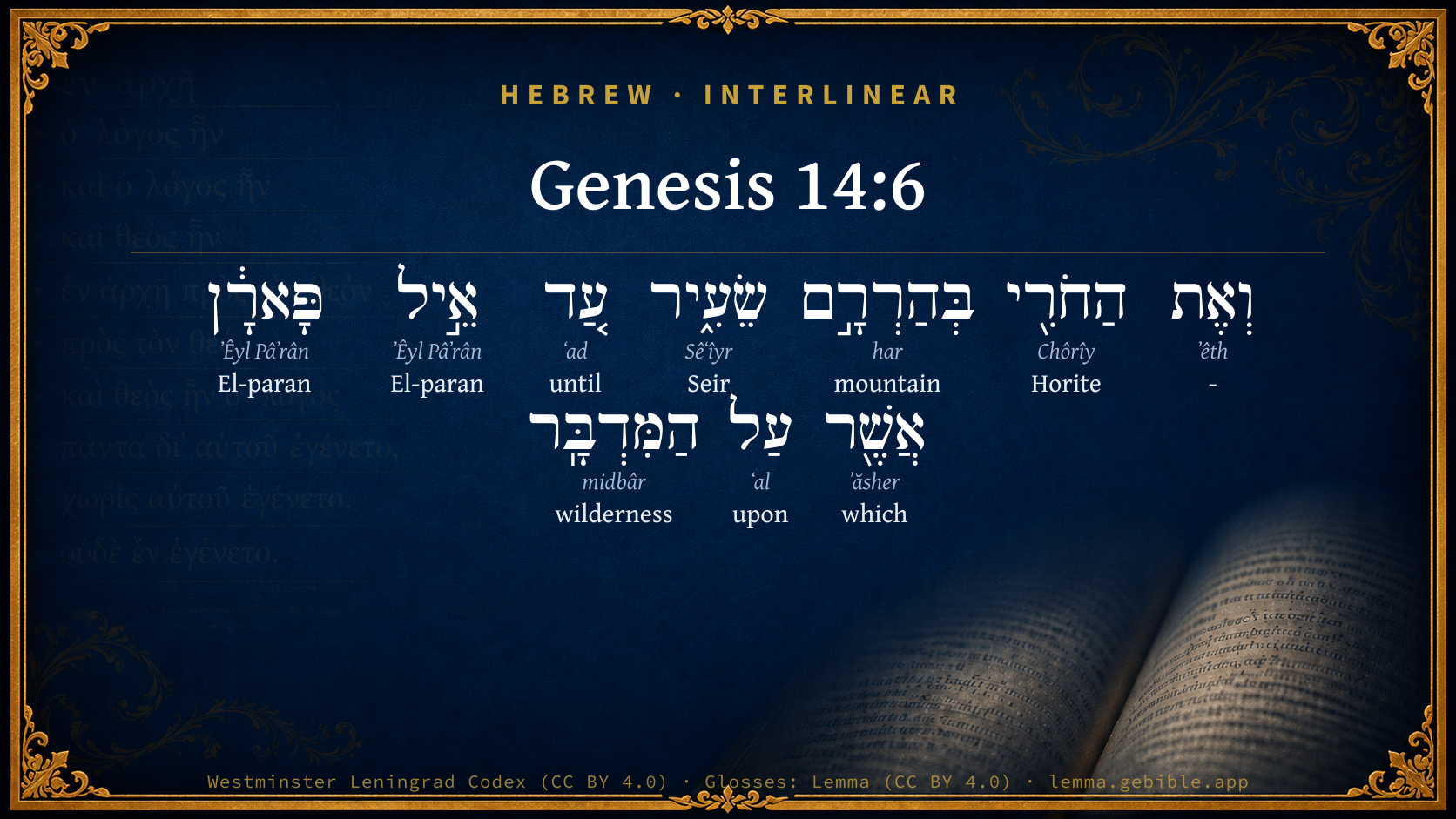
Genesis 14:6

Hebrew (Westminster Leningrad Codex) Genesis 14:6 appears in the Hebrew Old Testament. The text above is from the Westminster Leningrad Codex. Each word links to its Strong’s number, a concise gloss, and parsing drawn from the Open Scriptures Hebrew Bible morphology. Click any word for its full Brown-Driver-Briggs (BDB) entry.
Download image
Cite this verse

Genesis 14:6 (World English Bible). Public Domain. Lemma interlinear Bible study tool, https://lemma.gebible.app/v/genesis/14/6.

Show BibTeX & RIS
BibTeX
RIS
English Translation
and the Horites in their Mount Seir, to Elparan, which is by the wilderness.
World English Bible · Public Domain
Highlights
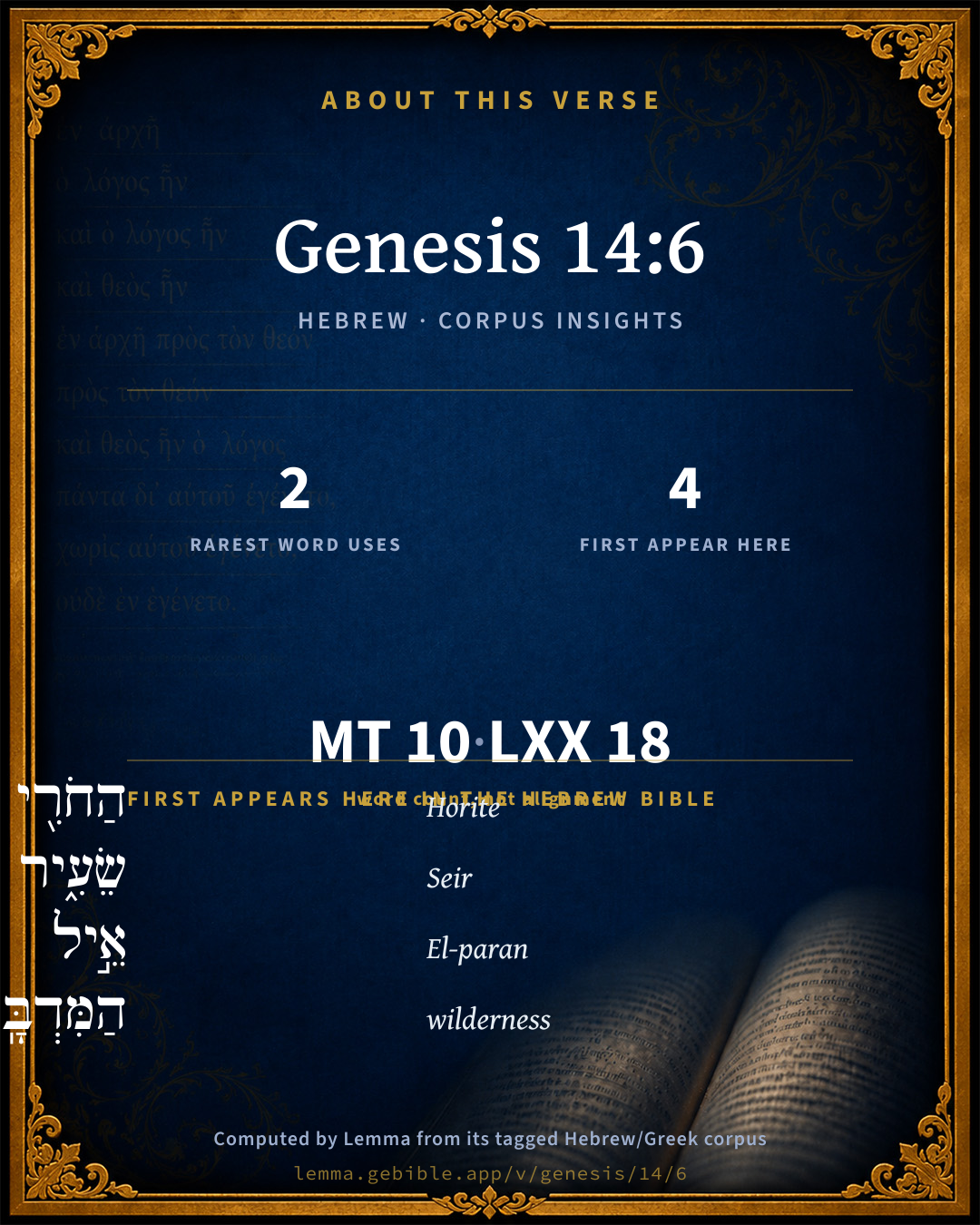
  • 4 first appearances in the Hebrew Bible
Full analysis ↓
Download a study sheet

One document with this verse’s original text, its word-by-word gloss line, the meaning frame, cross-references with their text, attributed commentary, and full source and license credits — printable, and it pastes into notes with its structure intact.

This verse Autodidact and up

Study sheet (.html) Plain text (.txt)

A passage Seminary Student

Up to 50 verses in one chapter. A passage sheet keeps up to 6 commentary sources and 12 cross-references per verse, in the order this page ranks them, and says so on the sheet whenever that leaves anything out. Ask for a single verse and you get the Autodidact verse sheet above.

Everything on this page stays free to read, with no account — the sheet is a download of what is already on screen, not access to it.

Want to remove ads? Support Godless Engineer
Compare translations 3

The same verse in 3 English versions, stacked beneath the original-language interlinear above. Click any original word for its lexicon entry.

Each is an independent rendering of the whole verse — the interlinear is not word-aligned to these translations.

Highlighted words mark where these versions differ — a whole-verse word diff, not a word-by-word alignment.

  • World English Bible Public Domain
    and the Horites in their Mount Seir, to Elparan, which is by the wilderness.
  • King James Version Public Domain
    And the Horites in their mount Seir, unto Elparan, which is by the wilderness.
  • unfoldingWord Literal Text CC BY-SA 4.0
    and the Horites in their hill country of Seir as far as El Paran, which by the wilderness.

unfoldingWord Literal Text — © unfoldingWord, licensed CC BY-SA 4.0. Word-aligned USFM3 via Door43 (git.door43.org/unfoldingWord/en_ult).

Versions to compare (up to 4)

3 of 4 selected

Show all 18 translations

Every available English version of this verse, each an independent rendering of the whole verse.

  • World English Bible Public Domain
    and the Horites in their Mount Seir, to Elparan, which is by the wilderness.
  • Berean Standard Bible Public Domain
    and the Horites in the area of Mount Seir, as far as El-paran, which is near the desert.
  • Majority Standard Bible Public Domain
    and the Horites in the area of Mount Seir, as far as El-paran, which is near the desert.
  • King James Version Public Domain
    And the Horites in their mount Seir, unto Elparan, which is by the wilderness.
  • American Standard Version (1901) Public Domain
    and the Horites in their mount Seir, unto Elparan, which is by the wilderness.
  • Revised Version (1885) Public Domain
    and the Horites in their mount Seir, unto El-paran, which is by the wilderness.
  • Geneva Bible (1599) Public Domain
    And the Horites in their mount Seir, vnto the plaine of Paran, which is by the wildernesse.
  • Douay-Rheims (1899) Public Domain
    And the Chorreans in the mountains of Seir, even to the plains of Pharan, which is in the wilderness.
  • Young's Literal Translation Public Domain
    and the Horites in their mount Seir, unto El-Paran, which `is' by the wilderness;
  • Literal Standard Version CC BY-SA 4.0
    and the Horites in their Mount Seir, to El-Paran, which [is] by the wilderness;
  • Unlocked Literal Bible CC BY-SA 4.0
    and the Horites in their hill country of Seir, as far as El Paran, which is near the desert.
  • unfoldingWord Literal Text CC BY-SA 4.0
    and the Horites in their hill country of Seir as far as El Paran, which by the wilderness.
  • Darby Bible Public Domain
    and the Horites on their mount Seir, to El-Paran, which is by the wilderness.
  • World Messianic Bible Public Domain
    and the Horites in their Mount Seir, to El Paran, which is by the wilderness.
  • Webster's Bible Public Domain
    And the Horites in their mount Seir, to El-paran, which is by the wilderness.
  • Free Bible Version CC BY-SA 4.0
    and the Horites in their hill country of Seir, all the way to El-paran, near the desert.
  • Bible in Basic English Public Domain
    And the Horites in their mountain Seir, driving them as far as El-paran, which is near the waste land.
  • JPS Tanakh (1917) Public Domain
    and the Horites in their mount Seir, unto El-paran, which is by the wilderness.

Literal Standard Version (2020), Covenant Press — licensed CC BY-SA 4.0. Text via the HelloAO Bible API (eBible.org). Unlocked Literal Bible (unfoldingWord) — licensed CC BY-SA 4.0. Text via the HelloAO Bible API (eBible.org). unfoldingWord Literal Text — © unfoldingWord, licensed CC BY-SA 4.0. Word-aligned USFM3 via Door43 (git.door43.org/unfoldingWord/en_ult). Free Bible Version, Dr. Jonathan Gallagher — licensed CC BY-SA 4.0. Text via the HelloAO Bible API (eBible.org).

Word by word

More ways to search: Search by grammar → Find every occurrence → Compare this word →

Practice this passage: Drill this verse → Learn its vocabulary →

About this verse

These counts appear in no published source. They are computed here, from the morphology-tagged text and Lemma’s own curated glosses. What Lemma adds →

10
words
9
distinct lemmas
Pentateuch
section

Notable vocabulary

The rarest word here is אֵ֣יל El-paran H364 — appearing just 2 times in the whole Hebrew Bible.

First appearance in Scripture

These words make their first canonical appearance in the Hebrew Bible here:

  • הַחֹרִ֖י Horite H2752
  • שֵׂעִ֑יר Seir H8165
  • אֵ֣יל El-paran H364
  • הַמִּדְבָּֽר wilderness H4057

Grammatical profile

  • 6 nouns
  • 2 prepositions
  • 2 particles

Repetition

A word recurs within this verse — often emphatic in Hebrew:

  • אֵ֣יל El-paran H364 ×2

Hebrew & Septuagint length

In English translation the verse runs 14 words from the Hebrew and 19 from the Septuagint (LXX English) — closely comparable.

A rough comparison of the two English renderings, which tokenize alike — not a word-level alignment.

Word counts can differ between the Hebrew and the Greek without any difference in meaning — e.g. the Hebrew direct-object marker אֵת has no separate Greek word, and Greek often adds the article ὁ.

In the original languages it is 10 Hebrew tokens and 18 Greek tokens — but the two are counted differently (Hebrew bundles its prefixes and suffixes into one token; the Greek is in lemma form), so that isn’t a like-for-like length.

Cross-references

11

Topical passages linked to Genesis 14:6 in the Treasury of Scripture Knowledge — connected by theme and wording, ordered by reader-vote popularity; previews shown in the World English Bible.

  • Deuteronomy 2:22 as he did for the children of Esau, who dwell in Seir, when he destroyed the Horites from before them; and they succeeded them, and lived in their place even to this day:
  • Genesis 21:21 He lived in the wilderness of Paran. His mother took a wife for him out of the land of Egypt.
  • Deuteronomy 2:12 The Horites also lived in Seir before, but the children of Esau succeeded them; and they destroyed them from before them, and lived in their place; as Israel did to the land of his possession, which Yahweh gave to them.)
  • Numbers 12:16 Afterward the people traveled from Hazeroth, and encamped in the wilderness of Paran.
  • Numbers 13:3 Moses sent them from the wilderness of Paran according to the commandment of Yahweh: all of them men who were heads of the children of Israel.
  • Genesis 16:7 The angel of Yahweh found her by a fountain of water in the wilderness, by the fountain in the way to Shur.
  • Genesis 36:8 Esau lived in the hill country of Seir. Esau is Edom.
  • Genesis 36:20–30 These are the sons of Seir the Horite, the inhabitants of the land: Lotan, Shobal, Zibeon, Anah,
  • Numbers 10:12 The children of Israel set forward according to their journeys out of the wilderness of Sinai; and the cloud abode in the wilderness of Paran.
  • 1 Chronicles 1:38–42 The sons of Seir: Lotan, and Shobal, and Zibeon, and Anah, and Dishon, and Ezer, and Dishan.
  • Habakkuk 3:3 God came from Teman, The Holy One from Mount Paran. Selah. His glory covered the heavens, And his praise filled the earth.

Cross-references courtesy of OpenBible.info (CC BY 4.0).

Hebrew and Greek witnesses Masoretic Hebrew ↔ Greek Septuagint

The same verse in the two great witnesses to the Old Testament, shown verse-for-verse.

These are two independent witnesses, not word-aligned to each other, and the Septuagint is shown in lemma (dictionary) form.

Hebrew Genesis 14:6 Masoretic · Westminster Leningrad Codex

וְאֶת הַחֹרִ֖י בְּהַרְרָ֣ם שֵׂעִ֑יר עַ֚ד אֵ֣יל פָּארָ֔ן אֲשֶׁ֖ר עַל הַמִּדְבָּֽר

and the Horites in their Mount Seir, to Elparan, which is by the wilderness.

World English Bible · Public Domain

Greek LXX Genesis 14:6 Septuagint · lemma form

καί ὁ χορραῖος ὁ ἐν ὁ ὄρος σηιρ ἕως ὁ τερέβινθος ὁ φαραν ὅς εἰμί ἐν ὁ ἔρημος

And the Chorrhaeans in the mountains of Seir, to the turpentine tree of Pharan, which is in the desert.

LXX2012 (modern English Septuagint) · Public Domain

Hebrew: Westminster Leningrad Codex (CC BY 4.0). Greek: Septuagint (public domain); English from LXX2012 (modern English Septuagint) (Public Domain). How the Septuagint differs from the Hebrew →

Targum (Aramaic paraphrase)

2

The Targum is the ancient Jewish Aramaic paraphrase of the Hebrew Scriptures — an interpretive translation, not the Hebrew text itself. Onkelos (literal) and Pseudo-Jonathan (expansive) render the Torah, and Jonathan the Prophets. Coverage is partial: where no permissively-licensed English translation exists for a verse, only the Aramaic is shown. This is verse-level text, not a word-by-word alignment to the Hebrew.

  1. Targum Onkelos Torah (Genesis–Deuteronomy)
    וְיָת חוֹרָאֵי דִי בְּטוּרְהוֹן דְשֵׂעִיר עַד מֵישַׁר פָּארָן דִסְמִיךְ עַל מַדְבְּרָא

    and the Horaee who were in the mountain of Seir, unto the plain of Paran which lieth upon the desert.

    Targum Onkelos — Aramaic: “Onkelos Genesis” (public domain); “Onkelos Exodus” (public domain); “Onkelos Leviticus” (public domain); “Onkelos Numbers” (public domain); “Onkelos Deuteronomy” (public domain). English: “Sefaria Community Translation” (CC0 1.0 (public-domain dedication)); “J.W. Etheridge. The Targums of Onkelos and Jonathan Ben Uzziel on the Pentateuch. London: Longmans, Green, 1862” (public domain). Text via Sefaria.

  2. Targum Pseudo-Jonathan Torah (Genesis–Deuteronomy)
    וְיַת חוֹרָאֵי דִבְטַוְורַיָא רָמַיָא דִגְבָלָא עַד מֵישַׁר פָּארָן דִסְמִיךְ לִצְטַר מַדְבְּרָא

    and the Choraee (dwellers in caverns) who were in the high mountains of Gebala, unto the valley of Pharan, which was nigh upon the edge of the desert.

    Targum Pseudo-Jonathan — Aramaic: “Targum Jonathan on Genesis” (public domain); “Targum Jonathan on Exodus” (public domain); “Targum Jonathan on Leviticus” (public domain); “Targum Jonathan on Numbers” (public domain); “Targum Jonathan on Deuteronomy” (public domain). English: “The Targum of Jonathan ben Uzziel, trans. J. W. Etheridge, London, 1862” (public domain). Text via Sefaria.

Commentary

Notes on Genesis 14:6 from classic Christian and Jewish commentators (each source and its license shown beneath its notes). The classic Christian expositions comment on the surrounding passage and are grouped to its opening verse, so a note may address several verses; the Jewish commentaries on the Tanakh (Rashi and others) are per-verse, so they appear only where the commentator wrote on this verse.

Lemma curates 59 commentaries, every one of them public domain or Creative Commons licensed, each selected and text-cleaned for this edition rather than reprinted as found. About our sources →

Trapp's Complete Commentary

John Trapp

Gen 14:6 And the Horites in their mount Seir, unto Elparan, which [is] by the wilderness.

Ver. 6. And the Horites in their mount Seir.] Their Seir could not secure them, when once they fell into the hands of these Ardeliones, {Eze 21:31} burning or "brutish men," skilful to destroy.

John Trapp, A Commentary or Exposition upon All the Books of the Old and New Testament (1647–1656) — public domain. Text from a community e-Sword module.

Adam Clarke's Commentary

Verse 6. The Horites] A people that dwelt in Mount Seir, till Esau and his sons drove them thence; De 2:22.

El-paran] The plain or oak of Paran, which was a city in the wilderness of Paran; Ge 21:21.

Adam Clarke's Commentary on the Bible (1810–1826) — public domain. Text from a community e-Sword/MySword module.

The Cambridge Bible for Schools and Colleges

gen. ed. J. J. S. Perowne

6. the Horites] Mentioned also in Gen_36:20-21; Gen_36:30, and in Deu_2:12; Deu_2:22, where they are described as having been dispossessed of the country of Seir, the hill country between the Dead Sea and the Gulf of Elath, by the Edomites. They have been thought to represent primitive “cave-dwellers,” of whom traces have been discovered by Macalister at Gezer.

unto El-paran] Generally identified with the town of Elath, the well-known port at the head of the Gulf of Akabah; which is sometimes called the “Aelanitic Gulf” from the name Ailana given to Elath in classical writings. The town may have derived its name from great palm trees in the neighbourhood (El = “a great tree”).

the wilderness] The Wilderness of Paran (cf. Gen_21:21) between the Gulf of Akabah and the borders of Egypt.

The Cambridge Bible for Schools and Colleges (gen. ed. J. J. S. Perowne; Cambridge University Press, 1878–1918) — public domain. Text from a community e-Sword module.

John Gill's Exposition

And the Horites in their Mount Seir,.... Or the Horim who dwelt in Mount Seir, so called from Seir the Horite, who continued here till they were drove out by the sons of Esau or Edom, from whom their country was afterwards called Edom or Idumea, see Gen 36:20 Deu 2:12,

unto Elparan, which is by the wilderness; so far these Horites inhabited, and the four kings smote all they met with unto this place, which was either the plain or oak of Paran, near a wilderness of the same name; the wilderness of Arabia, through which the Israelites travelled forty years, in their way to Canaan.

John Gill's Exposition of the Whole Bible (1746–1763) — public domain (CC PDM 1.0). Text via the HelloAO Bible API.

Haydock's Catholic Bible Commentary

Chorreans, or Horreans, who dwelt in one part of that extensive range of mountains, which took their name from Seir; perhaps about mount Hor, where Aaron died. (Calmet) --- These also were auxiliaries of the five kings, and hence experienced the fury of the four confederates; who cut off all their opponents, before they made their grand attack upon Sodom. (Haydock)

George Leo Haydock (1774–1849), Haydock's Catholic Family Bible and Commentary, 1859 edition — public domain. Excludes Psalms (Douay-Rheims chapter numbering differs from Protestant) and Deuterocanonical books (Catholic canon only).

Matthew Poole's English Annotations

The Horites, the ancient inhabitants of Seir, of whom see Gen 36:20; Deu 2:12. El signifies a plain, and Paran is the name of a known city and mountain. See Num 13:3; Deu 33:2; 1Sa 25:1, &c.

Matthew Poole's English Annotations on the Holy Bible (1683–1685) — public domain. Text from a community e-Sword/MySword module.

Whedon's Commentary on the Bible

Daniel D. Whedon

6. The Horites in their mount Seir were the original settlers of the wild and mountainous country south of the Dead Sea, and were, as the name denotes, “cave dwellers.” Mt. Hor perhaps derived its name from these ancient people, whose excavated dwellings in the rocks abound in all that region, especially in Petra. They were succeeded in later times by the descendants of Esau. Deu_2:12. El-paran, or the oak of Paran, was probably some notable landmark (an ancient oak) on the border of the great wilderness of Paran, the modern desert et-Tih. This wilderness embraced the great central region of the Sinaitic peninsula north of the Sinai mountains.

It appears from this account, that the whole country east of the Jordan from Damascus on the north to the Paran wilderness on the south was, in Abram’s time, occupied by a gigantic race all belonging to the same stock, and distributed in the order here indicated: The Rephaim on the north in the region afterward known as Bashan; the Zuzim next, centring at or near the modern Amman; the Emim next, south of these and directly east of the Dead Sea; and the Horites in the mountains of Seir.

Daniel D. Whedon (gen. ed.), Commentary on the Old and New Testaments (1874–1909) — public domain. Text from a community e-Sword module.

The Pulpit Commentary

And the Horites. Literally, dwelling in caves; from char, a cave. In their mount Seir. Literally, wooded (Gesenius); hairy (Furst); rugged (Lange); probably with reference to the thick brushwood and forests that grew upon its sides. The cave men of Seir were the earlier inhabitants of the region lying between the Dead Sea and the Gulf of Elam, afterwards taken possession of by the Edomites (Deu_2:12; Jer_49:16; Oba_1:3, Oba_1:4) Unto El-paran Ie. the oak or terebinth of Paran. Which is by the wilderness. Between the land of Edom and the fertile country of Egypt, and to the southward of Palestine, identified as the plateau of the Tih, across which the Israel-itish march lay from Sinai (Stanley, "Sinai and Palestine," p. 92).

The Pulpit Commentary (1880–1919), ed. H.D.M. Spence-Jones & Joseph S. Exell — public domain. Text from a community e-Sword module.

Rashi

Rabbi Shlomo Yitzchaki (Rashi)

בהררם means IN THEIR MOUNT (i. e.הרר is a form of הר — really an earlier form — with pronominal suffix ָ מ;cf. הררי קדש etc.)

איל פארן EL-PARAN — As it is translated in the Targum: Plain of Paran. But I hold that איל does not signify a plain in general but that the lowland of Paran bore the name of El, and that of Mamre was named Elone; that of the Jordan was called Kikkar, whilst that of Shittim was called Abel — Abel-Shittim — and so, too, the lowland of [Baal] Gad was named Baal. All these are translated in the Targum by מישור, but each really had its own particular name.

על המדבר BY THE WILDERNESS — next to the wilderness; a similar use of על is (Numbers 2:20) “and next unto him (עליו) shall be the tribe of Manasseh’’.

Rashi on the Tanakh — English translations: “The Judaica Press complete Tanach with Rashi, translated by A. J. Rosenberg” (CC BY 4.0); “Pentateuch with Rashi's commentary by M. Rosenbaum and A.M. Silbermann, 1929-1934” (public domain); “The Metsudah Tanach series, Lakewood, N.J” (CC BY 4.0); and “The Book of Joshua, Metsudah Publications, 1997” (CC BY 4.0). Text via Sefaria.

Ramban (Nachmanides)

Rabbi Moshe ben Nachman (Ramban / Nachmanides)

‘EIL PARAN.’ It is translated in the Targum as “Plain of Paran.” But I say that the word eil does not signify a plain. Rather, the lowland of Paran was called Eil, that of Mamre was named Eilonei, that of the Jordan was called Kikar, and that of Shittim was Abel. All these are translated in the Targum as meishra (plain), but each really had its own particular name. Thus the language of Rashi.But if it were so, and Kikar are the proper names of these places. Onkelos would have mentioned them in his Targum by their name — i.e., “Eila of Paran,” “Eilonei of Mamre,” — as is his custom with names. Besides, who told him whether these many places were all plains or high mountains [if Eil, Eilonei and Kikar were but proper names of these places]? Again, Mamre is the name of a person — as it is written, brother of Eshcol, and brother of Aner, and they were confederate with Abram — and that place was his, just as it says, ‘Eilonei’ Mamre the Amorite, Ramban’s intent is to argue that since Mamre is the name of an individual, the word Eilonei could not be a proper name since two names cannot be in the constructive state. as I have explained. Rather, Eil paran means a place of terebinths, as it is said, For they shall be ashamed ‘me’eilim’ (of the terebinths) which ye have desired; eilonei is a place of oaks, as it is said, As a terebinth, ‘veka’alon’ (and as an oak), 6:13. Of the ‘alonim’ (oaks) of Bashan. It was customary among them that these terebinths and oaks be planted in the plains before the cities which serve them as “an open land.” And so did Onkelos translate alon bachuth as “the plain of Bechuta.” There the word alon is surely not a proper noun of the location but only the name of the species of tree planted there, as is made explicit [in the same verse: and she was buried] …under the ‘alon.’ Onkelos’ intent, however, is to convey the sense of the expression and not to merely translate the words.Now the Targum Yerushalmi says with respect to both eil Paran and eilonei Mamre that they mean the plain of Paran and Mamre as Onkelos said, but in the case of alon bachuth, he [Targum Yerushalmi] says it is the nut-tree of Bachut for he considers alon bachuth to be the name of a tree and not a place. Onkelos, however, thought that alon bachuth is the name of a place, so called because there were many oak trees there, just as Eilonei Mamre [is the name of a place]. It is for that reason that Scripture there uses the word ha’alon.. See Note 129 above. Ramban’s intent is to say that since the word alon appears there with the definite article, (namely, ha-alon), it could not be a proper noun since the definite article is never attached to a proper noun. Hence in the end of the verse, which reads, And he called its name ‘alon bachuth,’ the word alon is also not a name designating a particular tree but a descriptive noun referring to a place containing many oaks. Hence Onkelos translates alon Bachuth as “the plain of Bechuta.” According to Targum Yerushalmi, who takes alon bachuth to be the name of a particular kind of tree, the verse should have read, “And she was buried below Beth-el under alon,” not ha-alon. Thus according to Onkelos they are all and alon bachuth. Hence in all these cases Onkelos translated “the plain of Paran… Mamre… Bechuta” as meaning a plain containing oak trees. Onkelos does this in keeping with his general method of conveying the intent of the verse rather than its strict translation since eil, eilonei and alon, strictly speaking, mean particular kinds of trees. Onkelos however felt free to say “the plain of Paran… Mamre… Bachuth” for his intent is but to convey the general meaning. Ramban continues to point that out in kikar hayarden, (13:11), where Onkelos said, “the plain of the Jordan,” that is indeed the exact translation of the word kikar. descriptive nouns.But kikar hayarden is indeed the actual word for a plain, for kikar in the Sacred Language is the name for the place where the natural streams of rivers overflow. It is for this reason that the messenger who came to rescue Lot said, Stay not in all ‘hakikar’ (the plain; escape to the mountain. Of similar usage are the expressions, Kar nirchav (wide pasture); ‘Karim’ (the meadows) are clothed with flocks; the valleys also are covered over with corn. Sometimes Scripture doubles the first letter of the word kar (meadow), making it kikar, and at other times Scripture discards the double form, as in, bath ayin (the apple of the eye)., 17:8. The double letter form of the word would be babath ayin, with a double beth. There are many other such cases.Swift couriers are also called by this name kar, as in ‘lakari velaratzim;’. According to Ramban its meaning is: of the couriers and the dispatchers. The captains over hundreds and ‘hakari.’, Verse 19. Here too the usual translation is: the Carites. According to Ramban it means: the couriers. The word bakirkaroth is also of the same root. It is the name for speedy camels such as “the flying camel” mentioned in the Talmud. The word mecharkar,. containing the double use of kar, is a derivative of this word.Abel Hashittim, and also Abel Mecholah, they translated to mean the plain of Shittim and Mecholah. It is [called Abel, which in Hebrew means “mourning”], because it is a desolate place, without plantings or structures for the word abel is, to them, an expression of destruction and waste, as in the verses: ‘Vaya’avel’ (And He made to mourn) the rampart and the wall; The new wine ‘aval’ (faileth), the vine fadeth.

Ramban (Nachmanides) on the Tanakh — English translation: “Commentary on the Torah by Ramban (Nachmanides). Translated and annotated by Charles B. Chavel. New York, Shilo Pub. House, 1971-1976” (CC BY 4.0). Text via Sefaria.

Radak

Rabbi David Kimhi (Radak)

ואת החרי בהררם שעיר, they also defeated the Chori on the mountain on which these people lived. We know that the area was mountainous from Genesis 36,20. בהררם, the name of the place without the pronoun-suffix is הרר, with a vowel pattern similar to ארץ and גפן. If the word הררם were a derivative from a root in the piel mode, itself a noun in its own right, as some commentators claim, (including Ibn Ezra), the letter ה would have had to have the vowel kametz and not patach, as it does. Onkelos, in rendering it as דבטוריא דשעיר “in the mountains of Se-ir” also understands it as did Ibn Ezra. איל פארן means, as the Targum renders it, “the plain of Paran.” The words על המדבר mean the same as if the Torah had written סמוך למדבר, adjoining the desert. A similar construction is found in Numbers 2,20 ועליו מטה מנשה, “next to him the tribe of Menashe.”

Radak on the Tanakh — English translations: “Sefaria Community Translation” (CC0 1.0 (public-domain dedication)); “Eliyahu Munk, HaChut Hameshulash” (CC BY 4.0); “Rabbi Mike Feuer, Jerusalem Anthology” (CC BY 4.0); and “R. David Kimhi on the first book of Psalms, Translated by R.G. Finch, London, 1919” (public domain). Text via Sefaria.

Lesson kit

Teaching starters — assembled from the data on this page, not authored interpretation. Every prompt links to the verse data it draws on. Edit before teaching.

Genesis, in the Pentateuch, opens this verse with 10 words (9 distinct Hebrew lemmas). Its most distinctive word is ʼÊyl Pâʼrân (“El-paran”). A historical commentator’s framing appears above. Read the whole chapter for the surrounding context.

Discussion questions

  1. What does “El-paran” (ʼÊyl Pâʼrân) contribute to the verse as a whole?
  2. 4 words make their first appearance in Scripture here. What does this debut establish?
  3. How does Deuteronomy 2:22, which shares this passage’s theme, read alongside this verse?
  4. What does the repetition of “El-paran” (2× in this one verse) do in this verse?
  5. These translations render this verse differently; the difference is in the English rendering, not the original. What questions does that raise?
  6. Compare how Trapp's Complete Commentary and Adam Clarke's Commentary read this verse. Where do they agree or differ?

Things to notice

Reading settings

Reading text

Shown beneath each verse's original-language words.

Old Testament
Old Testament edition

Read the OT as the Masoretic Hebrew (MT) or the Greek Septuagint (LXX).

English shown for the Greek Septuagint (in the Hebrew ↔ Greek comparison).

Comparing translations? Open the Compare panel on any verse page to stack up to four side by side.