
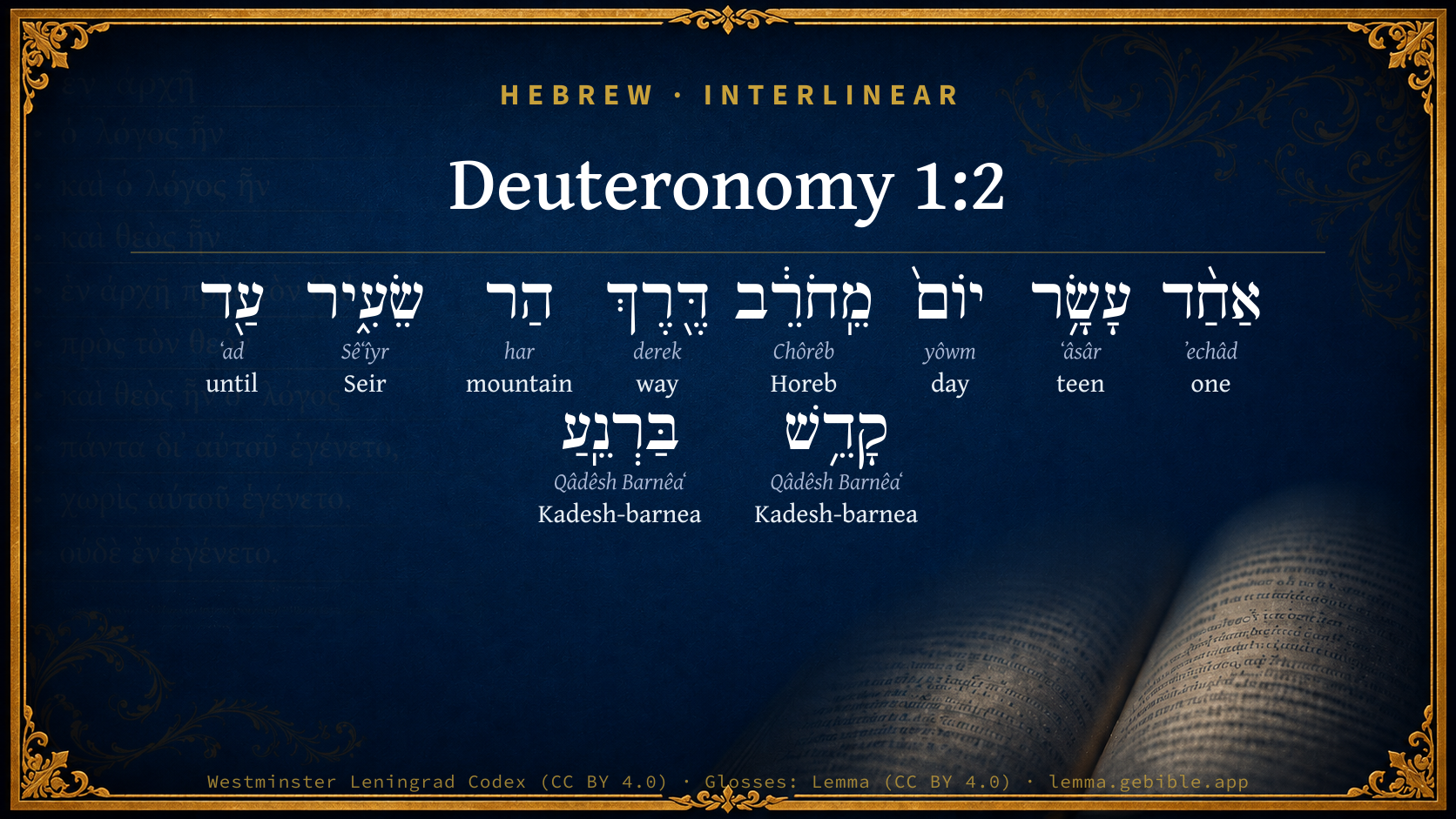
Deuteronomy 1:2

Hebrew (Westminster Leningrad Codex) Deuteronomy 1:2 appears in the Hebrew Old Testament. The text above is from the Westminster Leningrad Codex. Each word links to its Strong’s number, a concise gloss, and parsing drawn from the Open Scriptures Hebrew Bible morphology. Click any word for its full Brown-Driver-Briggs (BDB) entry.
Download image
Cite this verse

Deuteronomy 1:2 (World English Bible). Public Domain. Lemma interlinear Bible study tool, https://lemma.gebible.app/v/deuteronomy/1/2.

Show BibTeX & RIS
BibTeX
RIS
English Translation
It is eleven days' [journey] from Horeb by the way of Mount Seir to Kadesh-barnea.
World English Bible · Public Domain
Download a study sheet

One document with this verse’s original text, its word-by-word gloss line, the meaning frame, cross-references with their text, attributed commentary, and full source and license credits — printable, and it pastes into notes with its structure intact.

This verse Autodidact and up

Study sheet (.html) Plain text (.txt)

A passage Seminary Student

Up to 50 verses in one chapter. A passage sheet keeps up to 6 commentary sources and 12 cross-references per verse, in the order this page ranks them, and says so on the sheet whenever that leaves anything out. Ask for a single verse and you get the Autodidact verse sheet above.

Everything on this page stays free to read, with no account — the sheet is a download of what is already on screen, not access to it.

Want to remove ads? Support Godless Engineer
Compare translations 3

The same verse in 3 English versions, stacked beneath the original-language interlinear above. Click any original word for its lexicon entry.

Each is an independent rendering of the whole verse — the interlinear is not word-aligned to these translations.

Highlighted words mark where these versions differ — a whole-verse word diff, not a word-by-word alignment.

  • World English Bible Public Domain
    It is eleven days' [journey] from Horeb by the way of Mount Seir to Kadesh-barnea.
  • King James Version Public Domain
    (There are eleven days' journey from Horeb by the way of mount Seir unto Kadeshbarnea.)
  • unfoldingWord Literal Text CC BY-SA 4.0
    ( 11 days from Horeb by the way of Mount Seir to Kadesh Barnea.)

unfoldingWord Literal Text — © unfoldingWord, licensed CC BY-SA 4.0. Word-aligned USFM3 via Door43 (git.door43.org/unfoldingWord/en_ult).

Versions to compare (up to 4)

3 of 4 selected

Show all 18 translations

Every available English version of this verse, each an independent rendering of the whole verse.

  • World English Bible Public Domain
    It is eleven days' [journey] from Horeb by the way of Mount Seir to Kadesh-barnea.
  • Berean Standard Bible Public Domain
    It is an eleven-day journey from Horeb to Kadesh-barnea by way of Mount Seir.
  • Majority Standard Bible Public Domain
    It is an eleven-day journey from Horeb to Kadesh-barnea by way of Mount Seir.
  • King James Version Public Domain
    (There are eleven days' journey from Horeb by the way of mount Seir unto Kadeshbarnea.)
  • American Standard Version (1901) Public Domain
    It is eleven days' `journey' from Horeb by the way of mount Seir unto Kadesh-barnea.
  • Revised Version (1885) Public Domain
    It is eleven days’ journey from Horeb by the way of mount Seir unto Kadesh-barnea.
  • Geneva Bible (1599) Public Domain
    There are eleuen dayes iourney from Horeb vnto Kadesh-barnea, by the way of mout Seir.
  • Douay-Rheims (1899) Public Domain
    Eleven days' journey from Horeb by the way of Mount Seir to Cadesbarne.
  • Young's Literal Translation Public Domain
    eleven days' from Horeb, the way of mount Seir, unto Kadesh-Barnea.
  • Literal Standard Version CC BY-SA 4.0
    [It takes] eleven days [to go] from Horeb, the way of Mount Seir, to Kadesh-Barnea.
  • Unlocked Literal Bible CC BY-SA 4.0
    It is eleven days' journey from Horeb by the way of Mount Seir to Kadesh Barnea.
  • unfoldingWord Literal Text CC BY-SA 4.0
    ( 11 days from Horeb by the way of Mount Seir to Kadesh Barnea.)
  • Darby Bible Public Domain
    There are eleven days' journey from Horeb by the way of mount Seir to Kadesh-barnea.
  • World Messianic Bible Public Domain
    It is eleven days’ journey from Horeb by the way of Mount Seir to Kadesh Barnea.
  • Webster's Bible Public Domain
    (There are eleven days journey from Horeb by the way of mount Seir to Kadesh-barnea.)
  • Free Bible Version CC BY-SA 4.0
    (It takes eleven days to go from Horeb to Kadesh-barnea by the road that passes Mount Seir.)
  • Bible in Basic English Public Domain
    It is eleven days' journey from Horeb by the way of Mount Seir to Kadesh-barnea.
  • JPS Tanakh (1917) Public Domain
    It is eleven days journey from Horeb unto Kadesh-barnea by the way of mount Seir.

Literal Standard Version (2020), Covenant Press — licensed CC BY-SA 4.0. Text via the HelloAO Bible API (eBible.org). Unlocked Literal Bible (unfoldingWord) — licensed CC BY-SA 4.0. Text via the HelloAO Bible API (eBible.org). unfoldingWord Literal Text — © unfoldingWord, licensed CC BY-SA 4.0. Word-aligned USFM3 via Door43 (git.door43.org/unfoldingWord/en_ult). Free Bible Version, Dr. Jonathan Gallagher — licensed CC BY-SA 4.0. Text via the HelloAO Bible API (eBible.org).

Word by word

More ways to search: Search by grammar → Find every occurrence → Compare this word →

Practice this passage: Drill this verse → Learn its vocabulary →

About this verse

These counts appear in no published source. They are computed here, from the morphology-tagged text and Lemma’s own curated glosses. What Lemma adds →

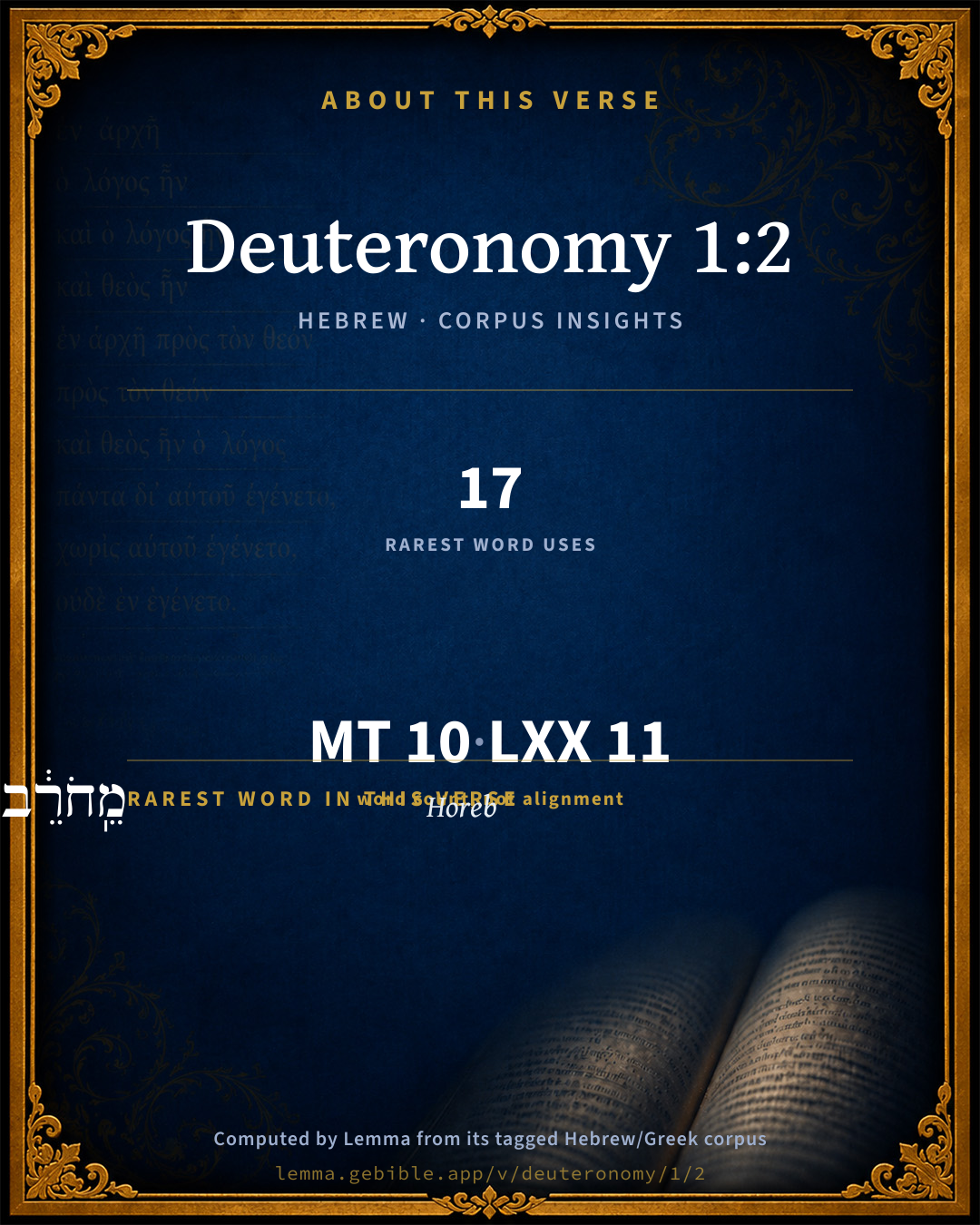
10
words
9
distinct lemmas
Pentateuch
section

Notable vocabulary

The rarest word here is מֵֽחֹרֵ֔ב Horeb H2722 — appearing just 17 times in the whole Hebrew Bible.

Shared distinctive vocabulary

מֵֽחֹרֵ֔ב Horeb H2722 occurs in 17 verses of the Hebrew Bible. Also found in:

Grammatical profile

  • 7 nouns
  • 2 adjectives
  • 1 preposition

Repetition

A word recurs within this verse — often emphatic in Hebrew:

  • קָדֵ֥שׁ Kadesh-barnea H6947 ×2

Hebrew & Septuagint length

In English translation the verse runs 15 words from the Hebrew and 17 from the Septuagint (LXX English) — closely comparable.

A rough comparison of the two English renderings, which tokenize alike — not a word-level alignment.

Word counts can differ between the Hebrew and the Greek without any difference in meaning — e.g. the Hebrew direct-object marker אֵת has no separate Greek word, and Greek often adds the article ὁ.

In the original languages it is 10 Hebrew tokens and 11 Greek tokens — but the two are counted differently (Hebrew bundles its prefixes and suffixes into one token; the Greek is in lemma form), so that isn’t a like-for-like length.

Cross-references

11

Topical passages linked to Deuteronomy 1:2 in the Treasury of Scripture Knowledge — connected by theme and wording, ordered by reader-vote popularity; previews shown in the World English Bible.

  • Numbers 13:26 They went and came to Moses, and to Aaron, and to all the congregation of the children of Israel, to the wilderness of Paran, to Kadesh; and brought back word to them, and to all the congregation, and shown them the fruit of the land.
  • Numbers 32:8 Thus did your fathers, when I sent them from Kadesh-barnea to see the land.
  • Deuteronomy 9:23 When Yahweh sent you from Kadesh-barnea, saying, Go up and possess the land which I have given you; then you rebelled against the commandment of Yahweh your God, and you didn't believe him, nor listen to his voice.
  • Exodus 3:1 Now Moses was keeping the flock of Jethro, his father-in-law, the priest of Midian, and he led the flock to the back of the wilderness, and came to God's mountain, to Horeb.
  • Leviticus 2:14 "'If you offer a meal offering of first fruits to Yahweh, you shall offer for the meal offering of your first fruits grain in the ear parched with fire, bruised grain of the fresh ear.
  • Leviticus 9:23 Moses and Aaron went into the Tent of Meeting, and came out, and blessed the people: and the glory of Yahweh appeared to all the people.
  • Numbers 20:17–21 Please let us pass through your land: we will not pass through field or through vineyard, neither will we drink of the water of the wells: we will go along the king's highway; we will not turn aside to the right hand nor to the left, until we have passed your border.
  • Deuteronomy 1:44 The Amorites, who lived in that hill-country, came out against you, and chased you, as bees do, and beat you down in Seir, even to Hormah.
  • Deuteronomy 2:4 Command you the people, saying, You are to pass through the border of your brothers the children of Esau, who dwell in Seir; and they will be afraid of you: take good heed to yourselves therefore;
  • Deuteronomy 2:8 So we passed by from our brothers the children of Esau, who dwell in Seir, from the way of the Arabah from Elath and from Ezion Geber. We turned and passed by the way of the wilderness of Moab.
  • Joshua 14:6 Then the children of Judah drew near to Joshua in Gilgal: and Caleb the son of Jephunneh the Kenizzite said to him, You know the thing that Yahweh spoke to Moses the man of God concerning me and concerning you in Kadesh-barnea.

Cross-references courtesy of OpenBible.info (CC BY 4.0).

Hebrew and Greek witnesses Masoretic Hebrew ↔ Greek Septuagint

The same verse in the two great witnesses to the Old Testament, shown verse-for-verse.

These are two independent witnesses, not word-aligned to each other, and the Septuagint is shown in lemma (dictionary) form.

Hebrew Deuteronomy 1:2 Masoretic · Westminster Leningrad Codex

אַחַ֨ד עָשָׂ֥ר יוֹם֙ מֵֽחֹרֵ֔ב דֶּ֖רֶךְ הַר שֵׂעִ֑יר עַ֖ד קָדֵ֥שׁ בַּרְנֵֽעַ

It is eleven days' [journey] from Horeb by the way of Mount Seir to Kadesh-barnea.

World English Bible · Public Domain

Greek LXX Deuteronomy 1:2 Septuagint · lemma form

ἕνδεκα ἡμέρα ἐν χωρηβ ὁδός ἐπί ὄρος σηιρ ἕως καδης βαρνη

It is a journey of eleven days from Choreb to mount Seir as far as Cades Barne.

LXX2012 (modern English Septuagint) · Public Domain

Hebrew: Westminster Leningrad Codex (CC BY 4.0). Greek: Septuagint (public domain); English from LXX2012 (modern English Septuagint) (Public Domain). How the Septuagint differs from the Hebrew →

Targum (Aramaic paraphrase)

2

The Targum is the ancient Jewish Aramaic paraphrase of the Hebrew Scriptures — an interpretive translation, not the Hebrew text itself. Onkelos (literal) and Pseudo-Jonathan (expansive) render the Torah, and Jonathan the Prophets. Coverage is partial: where no permissively-licensed English translation exists for a verse, only the Aramaic is shown. This is verse-level text, not a word-by-word alignment to the Hebrew.

  1. Targum Onkelos Torah (Genesis–Deuteronomy)
    מַהֲלַךְ חָד עֲשַׂר יוֹמִין מֵחוֹרֵב אוֹרַח טּוּרָא דְשֵׂעִיר עַד רְקַם גֵיאָה

    (no public-domain English translation for this verse)

    Targum Onkelos — Aramaic: “Onkelos Genesis” (public domain); “Onkelos Exodus” (public domain); “Onkelos Leviticus” (public domain); “Onkelos Numbers” (public domain); “Onkelos Deuteronomy” (public domain). English: “Sefaria Community Translation” (CC0 1.0 (public-domain dedication)); “J.W. Etheridge. The Targums of Onkelos and Jonathan Ben Uzziel on the Pentateuch. London: Longmans, Green, 1862” (public domain). Text via Sefaria.

  2. Targum Pseudo-Jonathan Torah (Genesis–Deuteronomy)
    מַהֲלַךְ חַדְסַר יוֹמִין מֵחוֹרֵב מֵאוֹרַח טַוְורָא דְגַבְלָא עַד רְקַם גֵּיאָה וְעַל דִּי סְטִיתוּן וְאַרְגַּזְתּוּן קֳדָם יְיָ אִיתְחַרְתּוּן אַרְבְּעִין שְׁנִין

    It is a journey of eleven days (only) from Horeb by the way of Mount Gebal unto Rekem Giah; but because you declined and provoked the Lord to displeasure, you have been retarded forty years.

    Targum Pseudo-Jonathan — Aramaic: “Targum Jonathan on Genesis” (public domain); “Targum Jonathan on Exodus” (public domain); “Targum Jonathan on Leviticus” (public domain); “Targum Jonathan on Numbers” (public domain); “Targum Jonathan on Deuteronomy” (public domain). English: “The Targum of Jonathan ben Uzziel, trans. J. W. Etheridge, London, 1862” (public domain). Text via Sefaria.

Commentary

Notes on Deuteronomy 1:2 from classic Christian and Jewish commentators (each source and its license shown beneath its notes). The classic Christian expositions comment on the surrounding passage and are grouped to its opening verse, so a note may address several verses; the Jewish commentaries on the Tanakh (Rashi and others) are per-verse, so they appear only where the commentator wrote on this verse.

Lemma curates 59 commentaries, every one of them public domain or Creative Commons licensed, each selected and text-cleaned for this edition rather than reprinted as found. About our sources →

Trapp's Complete Commentary

John Trapp

Deu 1:2 ([There are] eleven days’ [journey] from Horeb by the way of mount Seir unto Kadeshbarnea.)

Ver. 2. There are eleven days’journey.] So many days’ march for a foot army. But Philo the Jew saith a horseman might despatch it in three days. {a}

{a} Triduo confici potuit.

John Trapp, A Commentary or Exposition upon All the Books of the Old and New Testament (1647–1656) — public domain. Text from a community e-Sword module.

Joseph Benson's Commentary

Deu 1:2. There are eleven days’ journey — This is added, to show that the reason why the Israelites in so many years were advanced no farther from Horeb than to these plains, was not the distance of the places, but because of their rebellions. Kadesh-barnea — Which was not far from the borders of Canaan.

Joseph Benson's Commentary on the Old and New Testaments (1811–1818) — public domain. Text from a community e-Sword module.

Tyndale Open Study Notes

Tyndale Open Resources

1:2 The distance from Mount Sinai in the southern part of the Sinai Peninsula to Kadesh-barnea (see study note on 1:19) in the north is only 150 miles. Even the massive Hebrew population could easily have covered this distance in eleven days had they proceeded without detour or interruption. Their rebellion against the Lord resulted in a 38-year delay and a circuitous route (2:14; Num 14:34). • Mount Sinai: Hebrew Horeb, the name consistently used in Deuteronomy for the sacred mountain where the covenant was given. Its likely connection to a word meaning “drought” or “devastation” suggests the conditions the people of Israel had to face. • The way of Mount Seir was the route from Mount Sinai to Mount Seir. Seir, another name for Edom, was located east-southeast of the Dead Sea. The ordinary route took travelers through the Arabah north from the Gulf of Aqaba and then west to Kadesh-barnea, sixty miles southwest of the Dead Sea.

Tyndale Open Study Notes — © Tyndale Open Resources, licensed CC BY-SA 4.0. Text via the HelloAO Bible API.

Geneva Bible (1599)

Geneva Bible translators

In Horeb, or Sinai, forty years before this the Law was given: but because all that were then of age and judgment were now dead, Moses repeateth the same to the youth which either then were not born, or had not judgment.

Geneva Bible (1599) marginal notes — public domain. Text via Bolls.life.

Jamieson, Fausset & Brown

Robert Jamieson, A. R. Fausset & David Brown

There are eleven days' journey from Horeb--Distances are computed in the East still by the hours or days occupiesd by the journey. A day's journey on foot is about twenty miles--on camels, at the rate of three miles an hour, thirty miles--and by caravans, about twenty-five miles. But the Israelites, with children and flocks, would move at a slow rate. The length of the Ghor from Ezion-geber to Kadesh is a hundred miles. The days here mentioned were not necessarily successive days [ROBINSON], for the journey can be made in a much shorter period. But this mention of the time was made to show that the great number of years spent in travelling from Horeb to the plain of Moab was not owing to the length of the way, but to a very different cause; namely, banishment for their apostasy and frequent rebellions.

mount Seir--the mountainous country of Edom.

Jamieson, Fausset & Brown — Commentary Critical and Explanatory on the Whole Bible (1871) — public domain (CC PDM 1.0). Text via the HelloAO Bible API.

Adam Clarke's Commentary

Verse 2. There are eleven days' journey] The Israelites were eleven days in going from Horeb to Kadesh-barnea, where they were near the verge of the promised land; after which they were thirty-eight years wandering up and down in the vicinity of this place, not being permitted, because of their rebellions, to enter into the promised rest, though they were the whole of that time within a few miles of the land of Canaan!

Adam Clarke's Commentary on the Bible (1810–1826) — public domain. Text from a community e-Sword/MySword module.

Ellicott's Commentary for English Readers

(2) Eleven days’ journey from Horeb . . .—In our English Version this verse forms a separate sentence; but there seems nothing to prevent our taking it as completing the first verse. The route between Paran on the one side and the line from Tophel to Hazeroth on the other is still further defined as “a distance of eleven days’ journey from Horeb in the direction of Mount Seir, reaching to Kadesh-barnea.” The position of this last place is not yet determined with certainty. But the requirements of the text seem, upon the whole, to demand that it should be placed high up in the wilderness of Paran, not far from the border of the wilderness of Zin. It must be close to some passage out of the wilderness of Zin into the Negeb, or south of Judah.

Kadesh-barnea.—In the regular narrative of the exodus we read of the place to which the twelve spies returned as Kadesh (Num_13:26), and of the place at which the period of unrecorded wandering closed (Num_20:1), in the first month of the fortieth year, as Kadesh. The name Kadesh-barnea first appears in Moses’ speech (Num_32:8), where he refers to the sending of the twelve spies. And with the exception of three places where the name is used in describing boundaries, Kadesh -harnea is always found in speeches. This first chapter of Deuteronomy is the only one which contains the name both with and without the appendage -barnea, which connects it with the wanderings of Israel (Deu_1:32). Upon the whole, it seems most likely that only one place or district is intended by the name.

We have now obtained the following view of this first short introduction to the Book of Deuteronomy. It consists of words spoken (in the first instance) to all Israel on their march from Sinai to Kadesh-barnea. But the following verses show that the Law was further “declared” to Israel in the plains of Moab, at the close of the fortieth year of the exodus and of Moses’ life. It does not seem possible for us to separate entirely what was spoken earlier from what was declared later. In several places we have the record of words spoken: for example, in this very chapter (Deu_1:9; Deu_1:16; Deu_1:18; Deu_1:20; Deu_1:29; Deu_1:43), and Deu_5:5, &c. And the very name Deuteronomy implies the repetition of a law previously given. Further, the exhortations contained in this book are all enforced by the immediate prospect of going over Jordan and entering the promised land. But when Israel marched from Sinai to Kadesh-barnea, it was with this very same prospect full in view. It does not appear, by what Moses “said” at that time (Deu_1:20), that he had any thought of their turning away from the enterprise. But if so, what supposition is more natural than this—that he delivered the same kind of exhortations in the course of that earlier journey which he afterwards delivered in the plains of Moab? And although the distance is but eleven days’ march, the Israelites spent something like three months on the way, and in waiting for the spies to return from Canaan.

We conclude, then, that the first two verses of Deuteronomy are an editorial introduction, stating that the substance of this book was first delivered to Israel by Moses between Sinai and Kadesh-barnea. The further introduction which follows (in Deu_1:3-5) shows the words to have been re-delivered in the plains of Moab, and preserved in their later rather than their earlier form. But it is also possible that the two first verses of Deuteronomy are an introduction to the first discourse above. (See Note on Deu_4:44.)

Is it possible to advance a step further, and conjecture with any degree of probability to what hand we owe the first two verses of the book? The expression “on the other side Jordan” (which some take to be a technical term) seems strictly to mean on the opposite side to the writer. The writer must also have been acquainted with the places mentioned (three of which are not named in the previous books); he could not have drawn his knowledge from the earlier part of the Pentateuch. And so entirely has the geography of Deu_1:1 been lost by tradition, that all the Targums and Jewish commentators agree in spiritualising the passage, and say, “these are the words of reproof which Moses.spake to all Israel in respect of their behaviour at these various places.” Laban points to their murmuring at the white manna. Dizahab to the golden calf, and so on. Even Rashi, usually a most literal commentator, says, “Moses has enumerated the places where they wrought provocation before the PLACE “—a Rabbinical name for Jehovah: for “the whole world is His place, though His place is more than the whole world.” This introduction to Deuteronomy seems the work of one who had known the wilderness, and yet wrote from Palestine. Joshua, the next writer to Moses, and possibly also his amanuensis, may have prefixed it to the book. If he did not, it is wholly impossible to say who did.

A Bible Commentary for English Readers, edited by Charles John Ellicott (1878–1897) — public domain. Text from a community e-Sword module.

The Cambridge Bible for Schools and Colleges

gen. ed. J. J. S. Perowne

2. It is eleven days’, etc.] The distance from the accepted position of Ḥoreb-Sinai to that of Ḳadesh, ‘Ain Ḳudeis, is ‘10 or 11 days of common camel-riding’ (C. Trumbull K. B. 71, 215): caravans with children and flocks, like Israel’s, would of course take longer.

Horeb] Always in E, and Deut., as in 1 Kings 19 and Malachi, the name of the Mt of the Lawgiving, for which J and P have Sinai. The attempt has been made to interpret the two names as of different sites; but the Biblical evidence for their identity is clear; as even so early a scholar as Jerome perceived (Onom. Sacr. ed. Lagarde, 146). This matter as well as the questions of the position of Sinai-Ḥoreb (as between Jebel Musa and Jebel Serbal and between the Sinaitic Peninsula as a whole and the E. coast of the Gulf of ‘Aḳabah or Mt Se‘îr or the neighbourhood of Ḳadesh) has already been exhaustively discussed in this series (Driver, Exod. pp. 18, 177–191). It is, therefore, unnecessary to say anything more here; except to recall that the question as between the Sinaitic Peninsula and some site farther N. appears to have been open in the time of the Crusades and of the Moslem geographers in the 14th century. Abu-l Fida c. 1321: ‘the position of Tur Sinâ is the subject of discussion. Some say it is the mountain near Ailah (at the head of the Gulf of ‘Aḳabah) and others that it is a mountain in Syria’ (quoted by G. le Strange, Palestine under the Moslems, 72 f.). The Chronicle d’Ernoui et Bernard le Trésorier says, ‘Cel Mons Synai est entre le Mer Rouge et leCrac (Kerak).’ See further ZDPV xxxvii. 190 ff.

by the way of mount Seir] Se‘îr, the territory of Edom, lay W. as well as E. of the (Deu_1:44; cp. C. Trumbull K. B. 84 ff.; Buhl, Gesch. der Edomiter, 22 ff.); but Mt Se‘îr is in Dt (Deu_2:1) and elsewhere (e.g. Gen_14:6) the range E. of the ‘Arabah. Thus the way of Mt Se‘îr would be the most easterly of the roads from the Sinai Peninsula to Ḳadesh, which passes through the ‘Arabah. Further see Dillm.

Kadesh-barnea] This form is peculiar to D, deuteronomic passages and P; elsewhere Ḳadesh stands alone: and we have besides ‘En-Mishpaṭ, Well of Judgement (Gen_14:7), and Meribath-ḳadesh (see on Deu_33:2). The accepted site, visited first by Seetzen in 1807, then by Rowlands in 1842 (Williams, Holy City, i. 464 ff.), and described and argued for by Trumbull (Kad. Barn.), is the neighbourhood of the ‘Ain Ḳudeis (Seetzen’s and Rowlands’ spelling, confirmed by Musil) about 80 km. S.S.W. of Be’er-sheba‘, but the name must have covered the still more fertile ‘Ain Ḳadeyrât and the ‘A. Ḳaseymeh. Musil, who visited ‘Ain Ḳudeis thrice, doubts its identity with Ḳadesh (Edom i. 212), and suggests a site farther N.; yet he admits there the most fertile landscapes in all the region, describes the wâdies as either cultivated or full of relics of ancient cultivation, and even reports one more fertile than the plain about Gaza. See also PEFQ, 1914, 64 ff.; ZDPV, 1914, 7 ff. Barnea‘ has been explained as ‘son’ or ‘desert, of wandering.’ But it may belong to the number of non-Semitic names found in this region (e.g. Gharandel). To a hill S.E. of ‘Ain Ḳudeis, there is still attached the name Forni, which appears to be an echo of Barnea‘: the letter ‘ayin is sometimes dropped in mod. Arabic.

The whole fragment, 1b and 2, thus obviously out of place where it stands, may have been originally a note to Deu_1:19, which its details, so far as they are clear, suit.

The Cambridge Bible for Schools and Colleges (gen. ed. J. J. S. Perowne; Cambridge University Press, 1878–1918) — public domain. Text from a community e-Sword module.

John Gill's Exposition

There are eleven days' journey from Horeb, by the way of Mount Seir, to Kadeshbarnea. Not that the Israelites came thither in eleven days from Horeb, for they stayed by the way at Kibrothhattaavah, a whole month at least, and seven days at Hazeroth; but the sense is, that this was the computed distance between the two places; it was what was reckoned a man might walk in eleven days; and if we reckon a day's journey twenty miles, of which See Gill on Jon 3:3, the distance must be two hundred and twenty miles. But Dr. Shaw (e) allows but ten miles for a day's journey, and then it was no more than one hundred and ten, and indeed a camp cannot be thought to move faster; but not the day's journey of a camp, but of a man, seems to be intended, who may very well walk twenty miles a day for eleven days running; but it seems more strange that another learned traveller (f) should place Kadeshbarnea at eight hours, or ninety miles distance only from Mount Sinai. Moses computes not the time that elapsed between those two places, including their stations, but only the time of travelling; and yet Jarchi says, though it was eleven days' journey according to common computation, the Israelites performed it in three days; for he observes that they set out from Horeb on the twentieth of Ijar, and on the twenty ninth of Sivan the spies were sent out from Kadeshbarnea; and if you take from hence the whole month they were at one place, and the seven days at another, there will be but three days left for them to travel in. And he adds, that the Shechinah, or divine Majesty, pushed them forward, to hasten their going into the land; but they corrupting themselves, he turned them about Mount Seir forty years. It is not easy to say for what reason these words are expressed, unless it be to show in how short a time the Israelites might have been in the land of Canaan, in a few days' journey from Horeb, had it not been for their murmurings and unbelief, for which they were turned into the wilderness again, and travelled about for the space of thirty eight years afterwards. Aben Ezra is of opinion, that the eleven days, for the word "journey" is not in the text, are to be connected with the preceding words; and that the sense is, that Moses spake these words in the above places, in the eleven days they went from Horeb to Kadesh.

(e) De loc. Heb. fol. 92. I. (f) Pococke's Description of the East, vol. 1. p. 157.

John Gill's Exposition of the Whole Bible (1746–1763) — public domain (CC PDM 1.0). Text via the HelloAO Bible API.

Haydock's Catholic Bible Commentary

Cades-barne. All the distance between Horeb and the Jordan, by Mount Seir, on the road to Cades-barne, might have been traveled in eleven days’ time, being about 300 miles; or the Hebrews were so long in going thither, Numbers xxxiii. 17. (Calmet) --- It was to punish the Israelites for their frequent rebellions, that they were condemned to wander in that wilderness for forty years. (Du Hamel) --- They might have entered the promised land when they first came to Cades-barne, from Mount Horeb, (Numbers xiii. 1, 27,) which, even by the circuitous road of Mount Seir, would not have taken them above eleven days. He mentions this to remind them of their folly. Perhaps all the aforesaid places may have been between Horeb and Cades-barne, as Bonfrere maintains that Laban was in the neighbourhood of Sinai, where Moses first received the law which he is now going to explain. His discourse turns upon the chief occurrences of the forty years’ journey; and hence, these are the words, (ver. 1,) may refer not only to what he was going to say, but also to the commands which he had already notified to the Israelites, from the passage of the Red Sea till the station Abelsetim, upon the banks of the Jordan, Numbers xxxvi. 13. (Haydock) --- Deuteronomy contains a recapitulation of the law, and therefore it was to be read aloud to all the people on the feast of tabernacles, every seventh year; and the new kings, or rulers of the Hebrews, were commanded to transcribe it, and every day read some part for the rule of their conduct, chap. xvii. 18., and xxxi. 10. (Tirinus)

George Leo Haydock (1774–1849), Haydock's Catholic Family Bible and Commentary, 1859 edition — public domain. Excludes Psalms (Douay-Rheims chapter numbering differs from Protestant) and Deuterocanonical books (Catholic canon only).

Matthew Poole's English Annotations

This is added to show that the reason why the Israelites in so many years were advanced no further from Horeb than to these plains, was not the great distance of the places or length of the way, which was but a journey of eleven days at most, but because of their rebellions, as is mentioned before and repeated in this book.

Horeb, or

Sinai, the place where the law was given, which is promiscuously called by both those names.

Mount Seir, or Mount Edom, i.e. the mountainous country of Seir, which was first possessed by the Horims, and afterwards by the Edomites, Deu 2:12.

Kadesh-barnea was not far from the borders of Canaan. See Gen 16:14; Num 13:26.

Matthew Poole's English Annotations on the Holy Bible (1683–1685) — public domain. Text from a community e-Sword/MySword module.

The Pulpit Commentary

Horeb. The name generally given to Sinai in Deuteronomy (see introduction, Sinai, however, occurs in Deu_33:2 of this book. By the way of mount Seir, i.e. by the way that leads to Mount Seir; just as in Deu_2:1, "the way of the Red sea" is the way that leads to that sea. (see also Num_14:25) Mount is here, as often elsewhere, for mountain range. The mountain range here referred to seems to have been, not that on the east of the "Arabah, but what is in vers. 6 and 19 called "the mountain of the Amorites," "the Seir by Hormah" of ver. 44, i e. the southern part of what was afterwards called the mountains of Judah. According to ver. 19, the Israelites, when they left Horeb, passed through the wilderness along the way that led to the mountains of the Amorites, and came to Kadesh-barnea. Kadesh must, therefore, be looked for, not on the eastern side of the "Arabah, but somewhere in the wilderness of Zin. It has been identified with the place now known as "Ain Kudes, near the northern extremity of Jebel Halal, and to the east of that hill; but this is far from being certain. Moses reminds the Israelites that the distance between Horeb and Kadesh is eleven daysi.e. , about one hundred and sixty-five miles, the day"s journey being reckoned at fifteen miles not to give them a piece of information, but rather to suggest to them how, in consequence of rebellion, a journey which might have been so easily accomplished, had been protracted through many wearisome years.

The might-have-beens of life.

In its present setting this brief geographical note was, doubtless, meant to suggest the lesson of the evil results of disobedience. "Eleven days" journey," yet the fortieth year still saw them in the wilderness. We learn:

1. Sin turns short ways into long ones.

2. Sin entails on the transgressor needless trouble and sorrow.

3. Sin fills life with fruitless regrets.

4. Sin delays fulfillment of God"s promises.

The path of obedience is in the end the shortest, easiest, safest, and happiest. J.O.

The Pulpit Commentary (1880–1919), ed. H.D.M. Spence-Jones & Joseph S. Exell — public domain. Text from a community e-Sword module.

John Wesley's Explanatory Notes

There are eleven days journey - This is added to shew that the reason why the Israelites, in so many years were advanced no farther from Horeb, than to these plains, was not the distance of the places but because of their rebellions. Kadesh-barnea - Which was not far from the borders of Canaan.

John Wesley, Explanatory Notes Upon the Whole Bible (1754–1765) — public domain. Text via the GEBible commentary corpus.

Scofield Reference Notes

C. I. Scofield

eleven days

Prolonged by one act of unbelief to forty years. (See Scofield "Num 14:23").

The Scofield Reference Bible (1917 edition), notes by C. I. Scofield — public domain. Text from a community e-Sword module.

Rashi

Rabbi Shlomo Yitzchaki (Rashi)

אחד עשר יום מחרב ELEVEN DAYS JOURNEY FROM HOREB — Moses said to them: “See what you brought about! There is no route from Horeb to Kadesh-Barnea as short as the way through Mount Seir, and even that is a journey of eleven days. You, however, traversed it in three days!” — for you see that they journeyed from Horeb on the twentieth of Eyar, as it is said, (Numbers 10:11—12) “And it came to pass in the second year, in the second month, on the twentieth of the month, [the cloud went up and the children of Israel journeyed out of the desert of Sinai” (which is Horeb)] and on the twenty-ninth of Sivan they sent out the spies from Kadesh Barnea, (an interval of 40 days; cf. Taanit 29a); deduct from these the thirty days they spent at Kibroth Hataavah, where they ate the flesh “a month of days”, and seven days they spent at Hazeroth for Miriam to be shut up there as a leper, it follows that in three days they traversed all that way. — To such an extent did the Shechinah exert itself to hasten your coming to the land of Canaan, but because you became degenerate, He made you travel round about Mount Seir for forty years (Sifrei Devarim 2:2).

Rashi on the Tanakh — English translations: “The Judaica Press complete Tanach with Rashi, translated by A. J. Rosenberg” (CC BY 4.0); “Pentateuch with Rashi's commentary by M. Rosenbaum and A.M. Silbermann, 1929-1934” (public domain); “The Metsudah Tanach series, Lakewood, N.J” (CC BY 4.0); and “The Book of Joshua, Metsudah Publications, 1997” (CC BY 4.0). Text via Sefaria.

Ramban (Nachmanides)

Rabbi Moshe ben Nachman (Ramban / Nachmanides)

IT IS ELEVEN DAYS’ JOURNEY BY THE WAY OF SEIR UNTO KADESH-BARNEA. The meaning thereof is that Scripture informs us of the vastness of the wilderness, that from Horeb, which they left, to Kadesh-barnea is a journey of only eleven days, since by way of Mount Seir it is near. Kadesh-barnea is at the end of the wilderness at the border of the hill-country of the Amorites which is the inheritance of Israel. There are the lands of Sihon and Og where Moses explained the Torah in the valley over against Beth-peor. Afterwards Scripture says, they went by way of the mountain of the Amorites all that great and fearful wilderness, and, following that, it narrates that in Kadesh-barnea, which is at the boundary of their inheritance, they requested spies [to see the Land]. As a result, their journey was disrupted and they went [into the wilderness] toward the Red Sea — backward and not forward — until the completion of forty years. And because Israel was presently not in the wilderness, since they had already entered the land of Moab, earlier mentioned [i.e., the part which they took from Sihon and Og], Onkelos interpreted the expression in the wilderness, in the plain [These are the words which Moses spoke unto all Israel beyond the Jordan ‘in the wilderness, in the plain’] as being allusions to reproof [thus rendering: he reproved them “on account of that which they provoked Him in the wilderness, etc.”]. Moreover, why should Scripture mention all these places [in the wilderness, in the plain, over against Suph, between Paran and Tophel, and Laban, and Hazeroth, and Dizahab] and specify signs and borders more than [the law requires] in selling a field! [Therefore these place-names were interpreted by Onkelos as being allusions to certain deeds about which Moses reproved them.] And the sense of the Scripture according to Onkelos’ opinion is: “These are the words which Moses spoke unto all Israel beyond the Jordan; he spoke of [that which they did] in the wilderness, in the plain, and over against Suph, between Paran and Tophel, and Laban, and Hazeroth, and Di-zahab, and the eleven days’ journey from Horeb,” because he mentioned to them all that they had done in these places. Afterwards Scripture states that there, beyond the previously mentioned Jordan, Moses wanted to explain the Torah after he reproved them, and he spoke and said, The Eternal our G-d spoke unto us in Horeb, saying. And so it is interpreted in the Sifre 1. according to the opinion of Rabbi Yehudah. Rabbi Yosei ben Durmaskis, however, holds that they were actual places called by these names.

Ramban (Nachmanides) on the Tanakh — English translation: “Commentary on the Torah by Ramban (Nachmanides). Translated and annotated by Charles B. Chavel. New York, Shilo Pub. House, 1971-1976” (CC BY 4.0). Text via Sefaria.

Lesson kit

Teaching starters — assembled from the data on this page, not authored interpretation. Every prompt links to the verse data it draws on. Edit before teaching.

Deuteronomy, in the Pentateuch, opens this verse with 10 words (9 distinct Hebrew lemmas). Its most distinctive word is Chôrêb (“Horeb”). A historical commentator’s framing appears above. Read the whole chapter for the surrounding context.

Discussion questions

  1. The word Chôrêb carries the sense “Horeb.” How does it shape the verse?
  2. Exodus 3:1 shares the word «Horeb» with this verse. How do the two illuminate each other?
  3. “Kadesh-barnea” occurs 2× in this one verse. What is the effect of the repetition?
  4. These translations render this verse differently; the difference is in the English rendering, not the original. What questions does that raise?
  5. Reading how Trapp's Complete Commentary and Joseph Benson's Commentary read this verse, where do the two commentators agree and where do they part?

Things to notice

Reading settings

Reading text

Shown beneath each verse's original-language words.

Old Testament
Old Testament edition

Read the OT as the Masoretic Hebrew (MT) or the Greek Septuagint (LXX).

English shown for the Greek Septuagint (in the Hebrew ↔ Greek comparison).

Comparing translations? Open the Compare panel on any verse page to stack up to four side by side.