

Luke 23:5
Greek (Tischendorf 8th ed.) Luke 23:5 appears in the Greek New Testament. The text above is from the Tischendorf 8th edition. Each word links to its Strong’s number and a concise gloss. Click any word for its full Thayer’s Greek Lexicon entry.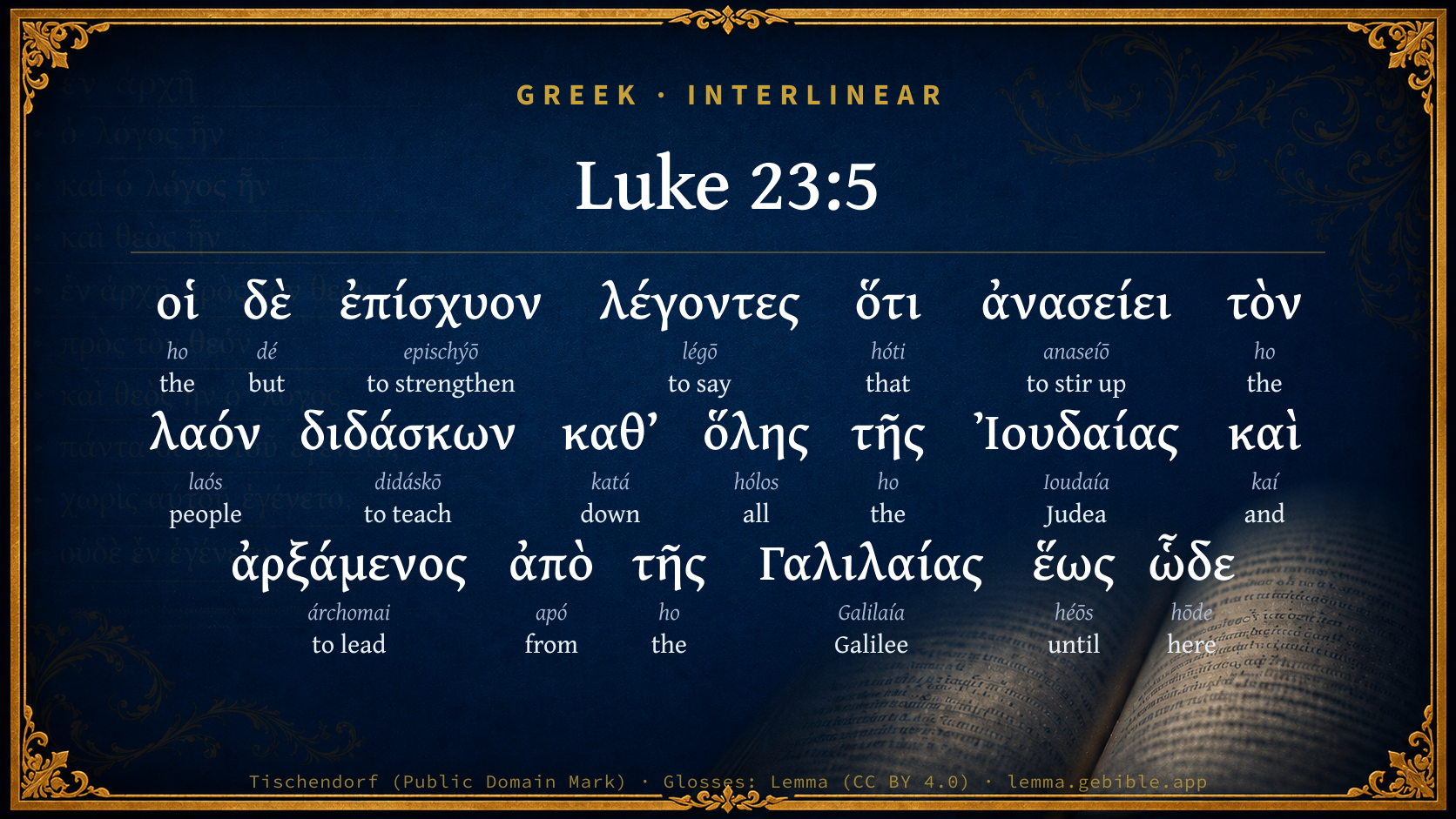
But they insisted, saying, "He stirs up the people, teaching throughout all Judea, beginning from Galilee even to this place."
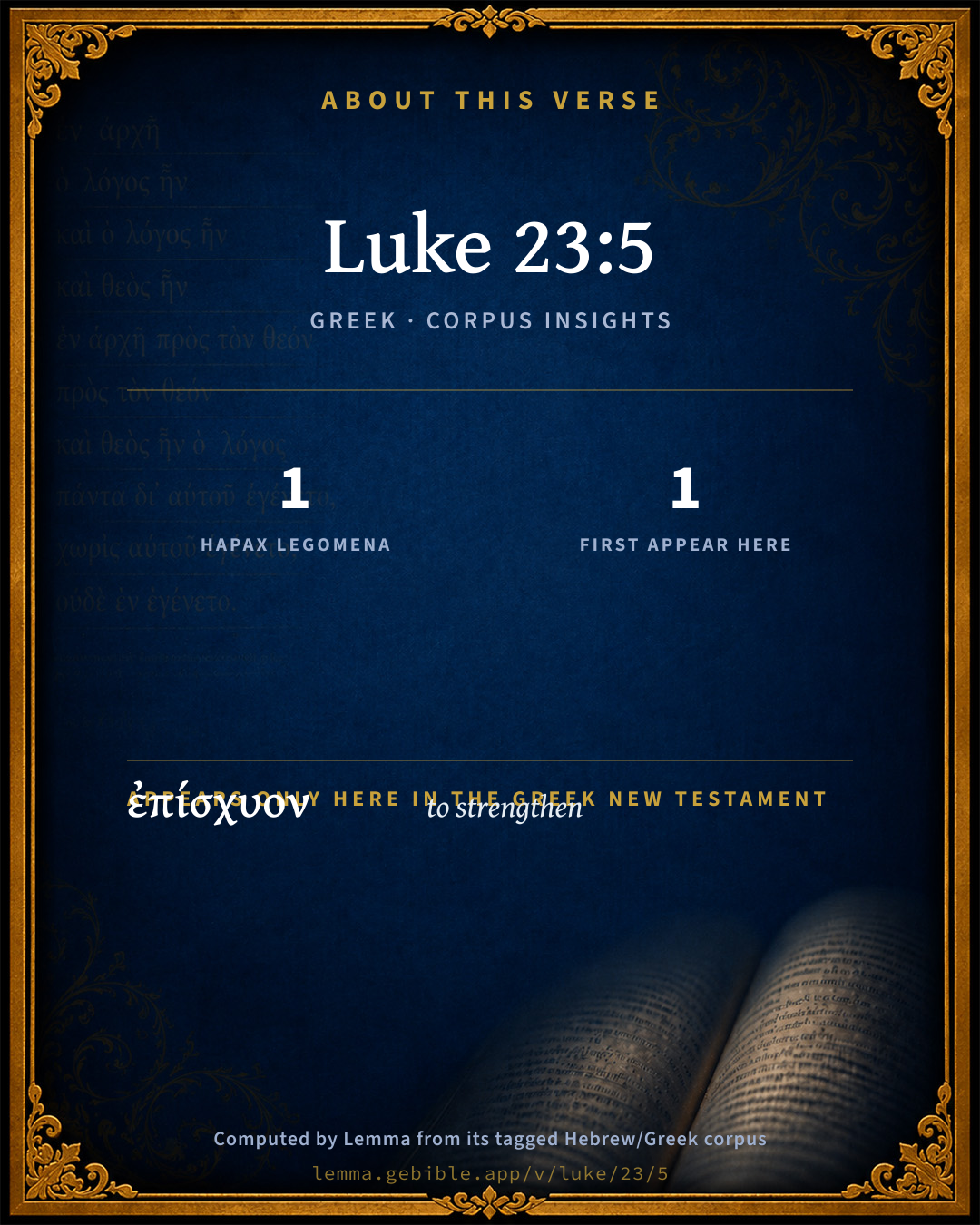
- 1 hapax legomenon — only here in the Greek New Testament
- 1 first appearance in the Greek New Testament
Download a study sheet
One document with this verse’s original text, its word-by-word gloss line, the meaning frame, cross-references with their text, attributed commentary, and full source and license credits — printable, and it pastes into notes with its structure intact.
This verse Autodidact and up
A passage Seminary Student
Up to 50 verses in one chapter. A passage sheet keeps up to 6 commentary sources and 12 cross-references per verse, in the order this page ranks them, and says so on the sheet whenever that leaves anything out. Ask for a single verse and you get the Autodidact verse sheet above.
Everything on this page stays free to read, with no account — the sheet is a download of what is already on screen, not access to it.
Compare translations 3
The same verse in 3 English versions, stacked beneath the original-language interlinear above. Click any original word for its lexicon entry.
Each is an independent rendering of the whole verse — the interlinear is not word-aligned to these translations.
Highlighted words mark where these versions differ — a whole-verse word diff, not a word-by-word alignment.
-
World English Bible Public Domain
But they insisted, saying, "He stirs up the people, teaching throughout all Judea, beginning from Galilee even to this place."
-
King James Version Public Domain
And they were the more fierce, saying, He stirreth up the people, teaching throughout all Jewry, beginning from Galilee to this place.
-
unfoldingWord Literal Text CC BY-SA 4.0
But they were insisting, saying, “He stirs up the people, teaching throughout all Judea, indeed, beginning from Galilee as far as here.”
unfoldingWord Literal Text — © unfoldingWord, licensed CC BY-SA 4.0. Word-aligned USFM3 via Door43 (git.door43.org/unfoldingWord/en_ult).
Show all 19 translations
Every available English version of this verse, each an independent rendering of the whole verse.
-
World English Bible Public Domain
But they insisted, saying, "He stirs up the people, teaching throughout all Judea, beginning from Galilee even to this place."
-
Berean Standard Bible Public Domain
But they kept insisting, “He stirs up the people all over Judea with His teaching. He began in Galilee and has come all the way here.”
-
Majority Standard Bible Public Domain
But they kept insisting, “He stirs up the people all over Judea with His teaching. He began in Galilee and has come all the way here.”
-
King James Version Public Domain
And they were the more fierce, saying, He stirreth up the people, teaching throughout all Jewry, beginning from Galilee to this place.
-
American Standard Version (1901) Public Domain
But they were the more urgent, saying, He stirreth up the people, teaching throughout all Judaea, and beginning from Galilee even unto this place.
-
Revised Version (1885) Public Domain
But they were the more urgent, saying, He stirreth up the people, teaching throughout all Judaea, and beginning from Galilee even unto this place.
-
Geneva Bible (1599) Public Domain
But they were the more fierce, saying, He moueth the people, teaching throughout all Iudea, beginning at Galile, euen to this place.
-
Douay-Rheims (1899) Public Domain
But they were more earnest, saying: He stirreth up the people, teaching throughout all Judea, beginning from Galilee to this place.
-
Young's Literal Translation Public Domain
and they were the more urgent, saying -- `He doth stir up the people, teaching throughout the whole of Judea -- having begun from Galilee -- unto this place.'
-
Literal Standard Version CC BY-SA 4.0
and they were the more urgent, saying, “He stirs up the people, teaching throughout the whole of Judea—having begun from Galilee—to this place.”
-
Unlocked Literal Bible CC BY-SA 4.0
But they were insisting, saying, “He stirs up the people, teaching throughout all Judea, beginning from Galilee even to this place.”
-
unfoldingWord Literal Text CC BY-SA 4.0
But they were insisting, saying, “He stirs up the people, teaching throughout all Judea, indeed, beginning from Galilee as far as here.”
-
Darby Bible Public Domain
But they insisted, saying, He stirs up the people, teaching throughout all Judaea, beginning from Galilee even on to here.
-
World Messianic Bible Public Domain
But they insisted, saying, “He stirs up the people, teaching throughout all Judea, beginning from Galilee even to this place.”
-
Webster's Bible Public Domain
And they were the more fierce, saying, He stirreth up the people, teaching throughout all Judea, beginning from Galilee to this place.
-
Free Bible Version CC BY-SA 4.0
But they insisted, saying, “He is inciting rebellion all over Judea with his teachings, from Galilee to right here in Jerusalem.”
-
Bible in Basic English Public Domain
But they became more violent than before, saying, He has made trouble among the people, teaching through all Judaea from Galilee to this place.
-
Text-Critical English NT CC BY 4.0
But they kept insisting, “He stirs up the people, teaching throughout all Judea. He started in Galilee and has come all the way here.”
-
Tyndale New Testament (1534) Public Domain
And they were the moore fearce sayinge. He moveth the people teachynge thorowout all Iewry and beganne at Galile even to this place.
Literal Standard Version (2020), Covenant Press — licensed CC BY-SA 4.0. Text via the HelloAO Bible API (eBible.org). Unlocked Literal Bible (unfoldingWord) — licensed CC BY-SA 4.0. Text via the HelloAO Bible API (eBible.org). unfoldingWord Literal Text — © unfoldingWord, licensed CC BY-SA 4.0. Word-aligned USFM3 via Door43 (git.door43.org/unfoldingWord/en_ult). Free Bible Version, Dr. Jonathan Gallagher — licensed CC BY-SA 4.0. Text via the HelloAO Bible API (eBible.org).
Word by word
More ways to search: Search by grammar → Find every occurrence → Compare this word →
Practice this passage: Drill this verse → Learn its vocabulary →
- Appears 1× in the Greek New Testament
- First appears here
- Part of Speech
- Verb
- Tense
- Imperfect
- Voice
- Active
- Mood
- Indicative
- Person
- 3rd person
- Number
- Plural
Full Thayer's Definition
- οἱ ho G3588 “the” Article, Nominative, Plural, Masculine
- δὲ dé G1161 “but” Conjunction
- ἐπίσχυον epischýō G2001 “to strengthen” Verb, Imperfect, Active, Indicative, 3rd person, Plural
- λέγοντες légō G3004 “to say” Verb, Present, Active, Participle, Nominative, Plural, Masculine
- ὅτι hóti G3754 “that” Conjunction
- ἀνασείει anaseíō G383 “to stir up” Verb, Present, Active, Indicative, 3rd person, Singular
- τὸν ho G3588 “the” Article, Accusative, Singular, Masculine
- λαόν laós G2992 “people” Noun, Accusative, Singular, Masculine
- διδάσκων didáskō G1321 “to teach” Verb, Present, Active, Participle, Nominative, Singular, Masculine
- καθ’ katá G2596 “down” Preposition
- ὅλης hólos G3650 “all” Adjective, Genitive, Singular, Feminine
- τῆς ho G3588 “the” Article, Genitive, Singular, Feminine
- Ἰουδαίας Ioudaía G2449 “Judea” Noun, Genitive, Singular, Feminine
- καὶ kaí G2532 “and” Conjunction
- ἀρξάμενος árchomai G756 “to lead” Verb, Aorist, Middle, Participle, Nominative, Singular, Masculine
- ἀπὸ apó G575 “from” Preposition
- τῆς ho G3588 “the” Article, Genitive, Singular, Feminine
- Γαλιλαίας Galilaía G1056 “Galilee” Noun, Genitive, Singular, Feminine
- ἕως héōs G2193 “until” Adverb
- ὧδε hōde G5602 “here” Adverb
About this verse
These counts appear in no published source. They are computed here, from the morphology-tagged text and Lemma’s own curated glosses. What Lemma adds →
- 20
- words
- 17
- distinct lemmas
- Gospels
- section
Notable vocabulary
1 hapax legomenon — a word that appears only here in the entire Greek New Testament:
- ἐπίσχυον to strengthen G2001
First appearance in Scripture
This word makes its first canonical appearance in the Greek New Testament here:
- ἐπίσχυον to strengthen G2001
Shared distinctive vocabulary
ἀνασείει to stir up G383 occurs in 2 verses of the Greek New Testament. Also found in:
Repetition
A word recurs within this verse:
- οἱ the G3588 ×4
Cross-references
21Topical passages linked to Luke 23:5 in the Treasury of Scripture Knowledge — connected by theme and wording, ordered by reader-vote popularity; previews shown in the World English Bible.
- Mark 1:14 Now after John was taken into custody, Jesus came into Galilee, preaching the Gospel of the Kingdom of God,
- John 1:43 On the next day, he was determined to go out into Galilee, and he found Philip. Jesus said to him, "Follow me."
- John 2:11 This beginning of his signs Jesus did in Cana of Galilee, and revealed his glory; and his disciples believed in him.
- Matthew 4:23 Jesus went about in all Galilee, teaching in their synagogues, preaching the Gospel of the Kingdom, and healing every disease and every sickness among the people.
- Psalms 22:12–13 Many bulls have surrounded me. Strong bulls of Bashan have encircled me.
- Psalms 22:16 For dogs have surrounded me. A company of evil-doers have enclosed me. They pierced my hands and my feet.
- Psalms 57:4 My soul is among lions. I lie among those who are set on fire, Even the sons of men, whose teeth are spears and arrows, And their tongue a sharp sword.
- Psalms 69:4 Those who hate me without a cause are more than the hairs of my head. Those who want to cut me off, being my enemies wrongfully, are mighty. I have to restore what I didn't take away.
- Matthew 4:12–16 Now when Jesus heard that John was delivered up, he withdrew into Galilee.
- Matthew 27:24 So when Pilate saw that nothing was being gained, but rather that a disturbance was starting, he took water, and washed his hands before the multitude, saying, "I am innocent of the blood of this righteous person. You see to it."
- Luke 4:14–15 Jesus returned in the power of the Spirit into Galilee, and news about him spread through all the surrounding area.
- Luke 11:53 As he said these things to them, the scribes and the Pharisees began to be terribly angry, and to draw many things out of him;
- Luke 23:23 But they were urgent with loud voices, asking that he might be crucified. Their voices and the voices of the chief priests prevailed.
- John 7:41 Others said, "This is the Christ." But some said, "What, does the Christ come out of Galilee?
- John 7:52 They answered him, "Are you also from Galilee? Search, and see that no prophet has arisen out of Galilee."
- John 19:15 They cried out, "Away with him! Away with him! Crucify him!" Pilate said to them, "Shall I crucify your King?" The chief priests answered, "We have no king but Caesar!"
- Acts 5:33 But they, when they heard this, were cut to the heart, and determined to kill them.
- Acts 7:54 Now when they heard these things, they were cut to the heart, and they gnashed at him with their teeth.
- Acts 7:57 But they cried out with a loud voice, and stopped their ears, and rushed at him with one accord.
- Acts 10:37 that spoken word you yourselves know, which was proclaimed throughout all Judea, beginning from Galilee, after the baptism which John preached;
- Acts 23:10 When a great argument arose, the commanding officer, fearing that Paul would be torn in pieces by them, commanded the soldiers to go down and take him by force from among them, and bring him into the barracks.
Cross-references courtesy of OpenBible.info (CC BY 4.0).
Lesson kit
Teaching starters — assembled from the data on this page, not authored interpretation. Every prompt links to the verse data it draws on. Edit before teaching.
Luke, in the Gospels, opens this verse with 20 words (17 distinct Greek lemmas). Its most distinctive word is epischýō (“to strengthen”). A historical commentator’s framing appears above. Read the whole chapter for the surrounding context.
Discussion questions
- What does “to strengthen” (epischýō) contribute to the verse as a whole?
- 1 word here appears nowhere else in the Greek New Testament. Why might the author reach for such rare wording?
- This is the first place “to strengthen” appears in Scripture (first appears here). What does its debut here establish?
- How does Mark 15:11, which shares the word «to stir up», read alongside this verse?
- What does the repetition of “the” (4× in this one verse) do in this verse?
- The translations on this page render this verse differently — a whole-verse word diff, not a word-by-word alignment. What might account for the different wordings?
- Compare how Lange's Commentary on the Holy Scriptures and Tyndale Open Study Notes read this verse. Where do they agree or differ?
Things to notice
- 1 word in this verse appears nowhere else in the Greek New Testament.
- 1 word makes its first canonical appearance in Scripture here.
- These translations choose different wording for 13 words in this verse.
- “the” occurs 4× in this single verse.
- 17 distinct Greek lemmas span 20 words in this verse.
Commentary
Notes on Luke 23:5 from classic Christian and Jewish commentators (each source and its license shown beneath its notes). The classic Christian expositions comment on the surrounding passage and are grouped to its opening verse, so a note may address several verses; the Jewish commentaries on the Tanakh (Rashi and others) are per-verse, so they appear only where the commentator wrote on this verse.
Lemma curates 59 commentaries, every one of them public domain or Creative Commons licensed, each selected and text-cleaned for this edition rather than reprinted as found. About our sources →
Lange's Commentary on the Holy Scriptures
Lange's Commentary on the Holy Scriptures (Critical, Doctrinal, and Homiletical), ed. John Peter Lange, English translation edited by Philip Schaff (1864–1880) — public domain. Text from a community e-Sword module.
Tyndale Open Study Notes
Tyndale Open Resources
Tyndale Open Study Notes — © Tyndale Open Resources, licensed CC BY-SA 4.0. Text via the HelloAO Bible API.
Bengel's Gnomon
Johann Albrecht Bengel
Bengel's Gnomon of the New Testament — English translation (T&T Clark, Edinburgh, 1860) — public domain. Text from a community e-Sword module.
Expositor's Greek Testament
ed. W. Robertson Nicoll
The Expositor's Greek Testament, edited by W. Robertson Nicoll (1897–1910) — public domain. Text from a community e-Sword module.
Adam Clarke's Commentary
Adam Clarke's Commentary on the Bible (1810–1826) — public domain. Text from a community e-Sword/MySword module.
Ellicott's Commentary for English Readers
A Bible Commentary for English Readers, edited by Charles John Ellicott (1878–1897) — public domain. Text from a community e-Sword module.
The Cambridge Bible for Schools and Colleges
gen. ed. J. J. S. Perowne
The Cambridge Bible for Schools and Colleges (gen. ed. J. J. S. Perowne; Cambridge University Press, 1878–1918) — public domain. Text from a community e-Sword module.
John Gill's Exposition
John Gill's Exposition of the Whole Bible (1746–1763) — public domain (CC PDM 1.0). Text via the HelloAO Bible API.
Trapp's Complete Commentary
John Trapp
John Trapp, A Commentary or Exposition upon All the Books of the Old and New Testament (1647–1656) — public domain. Text from a community e-Sword module.
Albert Barnes' Notes on the Bible
Albert Barnes' Notes on the Bible (1834–1885) — public domain. Text from a community e-Sword/MySword module.
Whedon's Commentary on the Bible
Daniel D. Whedon
Daniel D. Whedon (gen. ed.), Commentary on the Old and New Testaments (1874–1909) — public domain. Text from a community e-Sword module.
The Pulpit Commentary
The Pulpit Commentary (1880–1919), ed. H.D.M. Spence-Jones & Joseph S. Exell — public domain. Text from a community e-Sword module.
John Wesley's Explanatory Notes
John Wesley, Explanatory Notes Upon the Whole Bible (1754–1765) — public domain. Text via the GEBible commentary corpus.
Cambridge Greek Testament for Schools and Colleges
Cambridge Greek Testament for Schools and Colleges (Cambridge University Press, 1896; 21 vols, various authors incl. Carr, Maclear, Plummer, Farrar, Lumby, Moule, M. R. James, Simcox) — public domain. Text from a community e-Sword module.
Alford’s Greek Testament
Henry Alford
Henry Alford, The Greek Testament (1849–1861) — public domain. Text from a community e-Sword module.
International Critical Commentary
International Critical Commentary — older volumes (1896–1929), various authors — public domain. Text from a community e-Sword module.
Vincent's Word Studies in the New Testament
Marvin R. Vincent
Marvin R. Vincent, Word Studies in the New Testament (1887–1900) — public domain. Text from a community e-Sword/MySword module.