
2 Corinthians 3:15

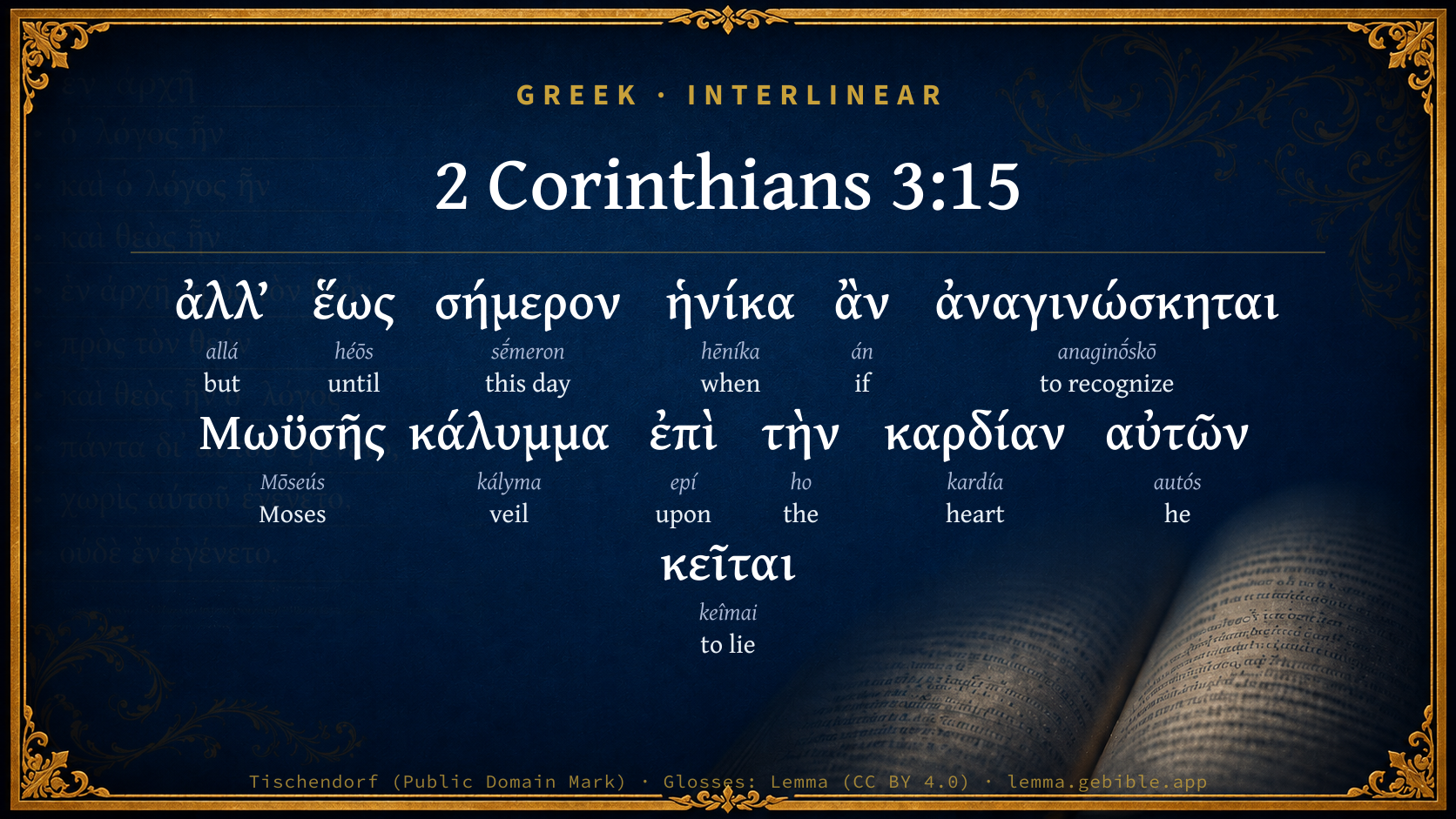
Greek (Tischendorf 8th ed.) 2 Corinthians 3:15 appears in the Greek New Testament. The text above is from the Tischendorf 8th edition. Each word links to its Strong’s number and a concise gloss. Click any word for its full Thayer’s Greek Lexicon entry.
Download image
Cite this verse

2 Corinthians 3:15 (World English Bible). Public Domain. Lemma interlinear Bible study tool, https://lemma.gebible.app/v/2-corinthians/3/15.

Show BibTeX & RIS
BibTeX
RIS
English Translation
But to this day, when Moses is read, a veil lies on their heart.
World English Bible · Public Domain
Highlights
  • 1 first appearance in the Greek New Testament
Full analysis ↓
Download a study sheet

One document with this verse’s original text, its word-by-word gloss line, the meaning frame, cross-references with their text, attributed commentary, and full source and license credits — printable, and it pastes into notes with its structure intact.

This verse Autodidact and up

Study sheet (.html) Plain text (.txt)

A passage Seminary Student

Up to 50 verses in one chapter. A passage sheet keeps up to 6 commentary sources and 12 cross-references per verse, in the order this page ranks them, and says so on the sheet whenever that leaves anything out. Ask for a single verse and you get the Autodidact verse sheet above.

Everything on this page stays free to read, with no account — the sheet is a download of what is already on screen, not access to it.

Want to remove ads? Support Godless Engineer
Compare translations 3

The same verse in 3 English versions, stacked beneath the original-language interlinear above. Click any original word for its lexicon entry.

Each is an independent rendering of the whole verse — the interlinear is not word-aligned to these translations.

Highlighted words mark where these versions differ — a whole-verse word diff, not a word-by-word alignment.

  • World English Bible Public Domain
    But to this day, when Moses is read, a veil lies on their heart.
  • King James Version Public Domain
    But even unto this day, when Moses is read, the vail is upon their heart.
  • unfoldingWord Literal Text CC BY-SA 4.0
    But until today, whenever Moses is read, a veil lies over their heart,

unfoldingWord Literal Text — © unfoldingWord, licensed CC BY-SA 4.0. Word-aligned USFM3 via Door43 (git.door43.org/unfoldingWord/en_ult).

Versions to compare (up to 4)

3 of 4 selected

Show all 19 translations

Every available English version of this verse, each an independent rendering of the whole verse.

  • World English Bible Public Domain
    But to this day, when Moses is read, a veil lies on their heart.
  • Berean Standard Bible Public Domain
    And even to this day when Moses is read, a veil covers their hearts.
  • Majority Standard Bible Public Domain
    And even to this day when Moses is read, a veil covers their hearts.
  • King James Version Public Domain
    But even unto this day, when Moses is read, the vail is upon their heart.
  • American Standard Version (1901) Public Domain
    But unto this day, whensoever Moses is read, a veil lieth upon their heart.
  • Revised Version (1885) Public Domain
    But unto this day, whensoever Moses is read, a veil lieth upon their heart.
  • Geneva Bible (1599) Public Domain
    But euen vnto this day, whe Moses is read, the vaile is laid ouer their hearts.
  • Douay-Rheims (1899) Public Domain
    But even until this day, when Moses is read, the veil is upon their heart.
  • Young's Literal Translation Public Domain
    but till to-day, when Moses is read, a vail upon their heart doth lie,
  • Literal Standard Version CC BY-SA 4.0
    but until today, when Moses is read, a veil lies on their heart,
  • Unlocked Literal Bible CC BY-SA 4.0
    But even today, whenever Moses is read, a veil covers their hearts.
  • unfoldingWord Literal Text CC BY-SA 4.0
    But until today, whenever Moses is read, a veil lies over their heart,
  • Darby Bible Public Domain
    But unto this day, when Moses is read, the veil lies upon their heart.
  • World Messianic Bible Public Domain
    But to this day, when Moses is read, a veil lies on their heart.
  • Webster's Bible Public Domain
    But even to this day, when Moses is read, the vail is upon their heart.
  • Free Bible Version CC BY-SA 4.0
    Even today, whenever the books of Moses are read, a veil covers their minds.
  • Bible in Basic English Public Domain
    But to this day, at the reading of the law of Moses, a veil is over their heart.
  • Text-Critical English NT CC BY 4.0
    But to this day, when Moses is read, a veil lies over their hearts.
  • Tyndale New Testament (1534) Public Domain
    But even vnto this daye when Moses is redde the vayle hangeth before their hertes.

Literal Standard Version (2020), Covenant Press — licensed CC BY-SA 4.0. Text via the HelloAO Bible API (eBible.org). Unlocked Literal Bible (unfoldingWord) — licensed CC BY-SA 4.0. Text via the HelloAO Bible API (eBible.org). unfoldingWord Literal Text — © unfoldingWord, licensed CC BY-SA 4.0. Word-aligned USFM3 via Door43 (git.door43.org/unfoldingWord/en_ult). Free Bible Version, Dr. Jonathan Gallagher — licensed CC BY-SA 4.0. Text via the HelloAO Bible API (eBible.org).

Word by word

More ways to search: Search by grammar → Find every occurrence → Compare this word →

Practice this passage: Drill this verse → Learn its vocabulary →

About this verse

These counts appear in no published source. They are computed here, from the morphology-tagged text and Lemma’s own curated glosses. What Lemma adds →

13
words
13
distinct lemmas
Pauline Epistles
section

Notable vocabulary

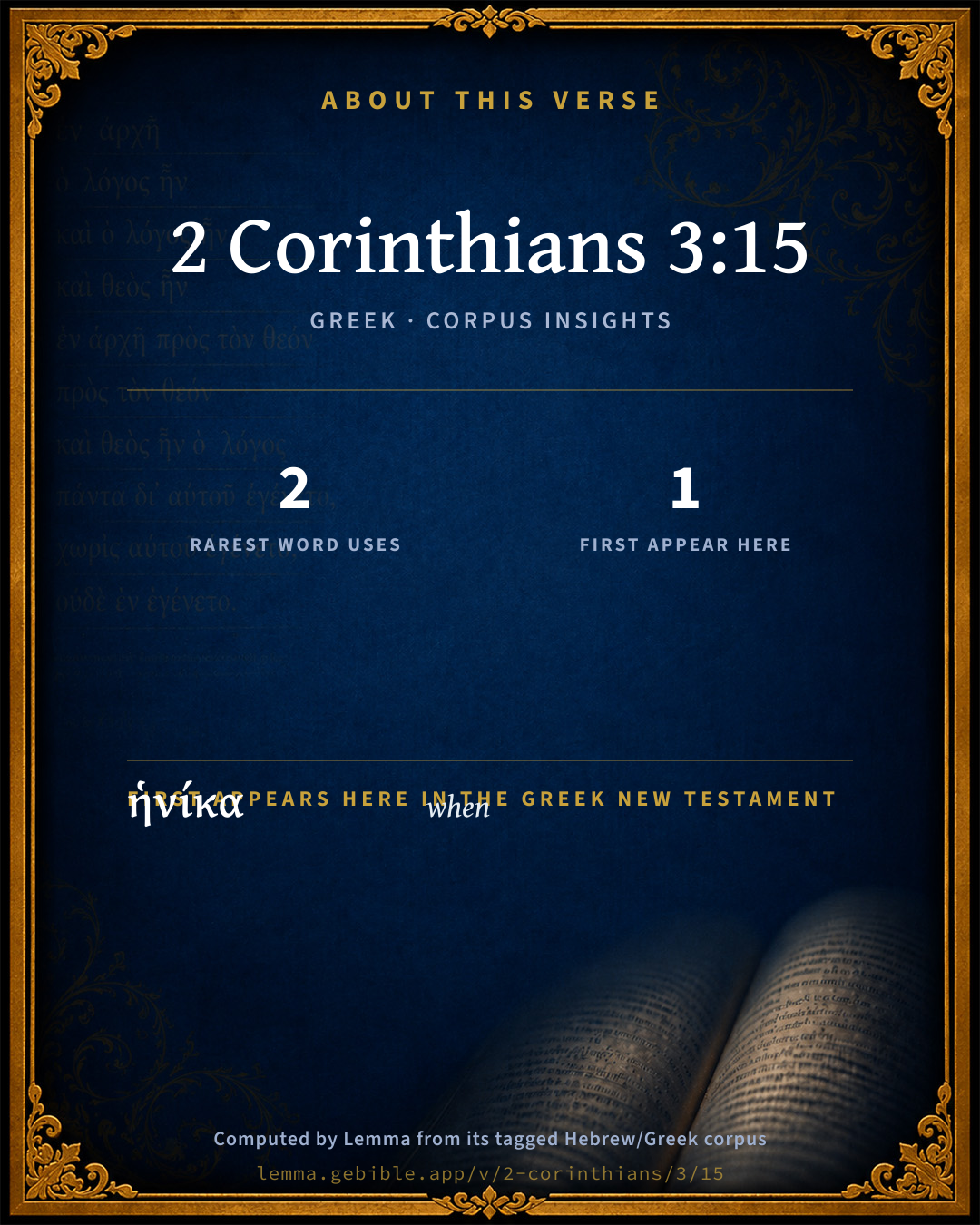
The rarest word here is ἡνίκα when G2259 — appearing just 2 times in the whole Greek New Testament.

First appearance in Scripture

This word makes its first canonical appearance in the Greek New Testament here:

Shared distinctive vocabulary

ἡνίκα when G2259 occurs in 2 verses of the Greek New Testament. Also found in:
Cross-references

1

Topical passages linked to 2 Corinthians 3:15 in the Treasury of Scripture Knowledge — connected by theme and wording, ordered by reader-vote popularity; previews shown in the World English Bible.

  • Acts 13:27–29 For those who dwell in Jerusalem, and their rulers, because they didn't know him, nor the voices of the prophets which are read every Sabbath, fulfilled them by condemning him.

Cross-references courtesy of OpenBible.info (CC BY 4.0).

Commentary

Notes on 2 Corinthians 3:15 from classic Christian and Jewish commentators (each source and its license shown beneath its notes). The classic Christian expositions comment on the surrounding passage and are grouped to its opening verse, so a note may address several verses; the Jewish commentaries on the Tanakh (Rashi and others) are per-verse, so they appear only where the commentator wrote on this verse.

Lemma curates 59 commentaries, every one of them public domain or Creative Commons licensed, each selected and text-cleaned for this edition rather than reprinted as found. About our sources →

Bengel's Gnomon

Johann Albrecht Bengel

2Co 3:15. Ἀλλʼ ἓως, but until) But is opposed to the phrase is not taken away.—ἡνίκα) This is the only place, in which Paul uses this adverb. It seems to have readily occurred from his recent reading of the LXX., Exo 34:33.—ἀναγινώσκεται Μωϋσῆς, Moses is read) and that too, studiously, without seeing Christ therein. The antithesis follows, but when it shall have turned to the Lord.

Bengel's Gnomon of the New Testament — English translation (T&T Clark, Edinburgh, 1860) — public domain. Text from a community e-Sword module.

Meyer's Critical & Exegetical Commentary

Heinrich August Wilhelm Meyer

2Co_3:15. Ἀλλʼ] opposite of the μὴ ἀνακαλ., ὅτι ἐν Χ. καταργ., but no longer connected with γάρ, 2Co_3:14 (Hofmann), since the apostle does not again mean the particular veil (that of Moses) to which the confirmatory clause introduced with γάρ, 2Co_3:14, referred. It is not disclosed, that, etc.; till to-day, on the contrary, there lies a veil, etc.; till to-day, whenever (ἄν, in whatsoever case) Moses is publicly read, their insight (comp. previously ἐπωρώθη, etc.) is hindered and prevented. The figurative expression does not again represent the veil of Moses, for otherwise τὸ κάλυμμα must necessarily (in opposition to Hofmann) have been used, but generally a veil, and that one placed over (ἐπί with acc.) the heart (here regarded as the centre of the practical intelligence, comp. 2Co_4:6; Rom_1:21; and see on Eph_1:18; Krumm, de not. psych. P. p. 50; Delitzsch, Psychol, p. 248 f.; Hahn, Theol. d. N. T. I. p. 460) of the hearers. The impersonal μὴ ἀνακαλυπτόμ. of 2Co_3:14 induced the apostle very naturally and with logical suitableness, not to use again in the contrast of 2Co_3:15, with its emphatic stress laid on the point ἕως σήμερον, that historical image of the veil of Moses, but to express the conception generally of a veil hindering perception (lying on the heart). The same thing, therefore, is expressed in two forms of one figure; the first form gives the figure historically (the veil of Moses on the ἀνάγνωσις τ. παλ. διαθ.); the second form, apart from that historical reference, gives it as moulded by the apostles own vivid imagination (a veil upon the heart at the public reading). Fritzsche (comp. Al. Morus in Wolf) assumes that Paul imagines to himself two veils, one on the public reading of the Old Covenant, the other on the hearers own hearts, by which he wishes to mark the high degree of their inaptitude for perceiving. But, in order to be understood, and in keeping with a state of things so peculiar, he must have brought this out definitely and emphatically, and have at least written in 2Co_3:15 : Ἀλλʼ … Μωϋσῆς, καὶ ἐπὶ τὴν καρδίαν αὐτῶν κάλυμμα κεῖται.

ἡνίκα] at the hour when, quando, after Hom. Od. 22:198 frequent in the classic writers, but in the N. T. only here and at 2Co_3:16. Often used in the Apocrypha and the LXX. also at Exo_34:34; and perhaps the word was suggested by the recollection of this passage.

On ἀναγινώσκ. Μωϋσ. comp. Act_15:21.

Meyer — Critical and Exegetical Commentary on the New Testament — English translation by Peter Christie, edited by Frederick Crombie (T&T Clark, 1880) — public domain. Text from a community e-Sword module.

Expositor's Greek Testament

ed. W. Robertson Nicoll

2Co 3:15 . ἀλλʼ ἕως σήμερον κ . τ . λ .: but unto this day, whensoever Moses ( sc. , the Law; cf. Act 15:21 ) is read, a veil lieth upon their heart . It will be observed that the image has been changed as the application of Exo 34:29 ff. proceeds: in that history the veil was upon the face of Moses ; here it is upon the heart of the people , as God speaks to them through the medium of the Law (see above on 2Co 3:2 for a similar change in the application of the metaphor suggested by the word ἐπιστολή ).

The Expositor's Greek Testament, edited by W. Robertson Nicoll (1897–1910) — public domain. Text from a community e-Sword module.

Cambridge Greek Testament for Schools and Colleges

15. ἡνίκα ἂν ἀναγινώσκηται (אABC) rather than ἡνίκα ἀναγινώσκεται (FGKL) or ἡνίκα ἀναγινώσκηται (DP). The ἄν was lost in ἀναγιν.

15. ἀλλʼ ἕως σήμερον ἡνίκα ἄν. See critical note. But unto this day, whensoever Moses is read, a veil (see on 2Co 2:16) lies upon their heart. The ἀλλά marks the opposition to μὴ ἀνακαλυπτόμενον: but, so far from this revelation having been recognized by them, a veil is over their heart. A revelation is the uncovering of a truth: they kept their powers of receiving truth covered. It is because κάλυμμα here has not the same meaning as before that he does not say τὸ κάλυμμα, which would have signified the veil of Moses concealing the vanishing of the glory. By κάλυμμα, here balances ‘a veil,’ he means their insensibility to the truth, much the same as the πώρωσις. For ἕως with an adv. comp. Mat 17:17; Mat 18:21; ἕως ἄρτι is frequent; 1Co 4:13; 1Co 8:7; 1Co 15:6. Here only (2Co 3:15-16) is ἡνίκα found in the N.T., but in the LXX. it is frequent.

Cambridge Greek Testament for Schools and Colleges (Cambridge University Press, 1896; 21 vols, various authors incl. Carr, Maclear, Plummer, Farrar, Lumby, Moule, M. R. James, Simcox) — public domain. Text from a community e-Sword module.

Jamieson, Fausset & Brown

Robert Jamieson, A. R. Fausset & David Brown

the veil is--rather, "a veil lieth upon their heart" (their understanding, affected by the corrupt will, Joh 8:43; Co1 2:14). The Tallith was worn in the synagogue by every worshipper, and to this veil hanging over the breast there may be an indirect allusion here (see on Co1 11:4): the apostle making it symbolize the spiritual veil on their heart.

Jamieson, Fausset & Brown — Commentary Critical and Explanatory on the Whole Bible (1871) — public domain (CC PDM 1.0). Text via the HelloAO Bible API.

Ellicott's Commentary for English Readers

(15) Even unto this day, when Moses is read . . .—The mention of Moses is decisive as to the meaning of the “Old Testament,” or covenant, in the previous verse. When he, as being read, speaks to the people now, St. Paul reasons, there is still a veil between him and them; but it is, to use modern phrase, subjective and not objective—on their heart, and not over his face. It has been suggested that there may be a reference to the Tallith, or four-cornered veil which was worn by the Jews in their synagogues when they prayed or listened to the Law, as a symbol of reverence, like that of the seraphim in Isa_6:2, who covered their faces with their wings. It is, however, doubtful whether the use of the Tallith goes back so far; and even if its antiquity were proved, it has to be remembered that though it covered the head and ears—the symbol, perhaps, of seclusion—it did not cover the face.

A Bible Commentary for English Readers, edited by Charles John Ellicott (1878–1897) — public domain. Text from a community e-Sword module.

The Cambridge Bible for Schools and Colleges

gen. ed. J. J. S. Perowne

15. the vail is upon their heart] Literally, a veil lieth on their heart. Not upon their head. It was moral, not intellectual blindness which caused their unbelief. See Act_6:13-14; Act_7:51; Act_22:18; Act_22:21-22. We may remark on the change of figure here (see note on 2Co_3:13). The veil is no longer upon Moses’ face, but upon the Jewish heart.

The Cambridge Bible for Schools and Colleges (gen. ed. J. J. S. Perowne; Cambridge University Press, 1878–1918) — public domain. Text from a community e-Sword module.

John Gill's Exposition

But even unto this day, when Moses is read,.... These words are an explanation of the former, and show that by the Old Testament is designed, more especially, Moses, or the writings of Moses; which were frequently read, and preached upon in the Jewish synagogues; see Act 13:15 and that by "the veil untaken away", is meant,

the veil upon their heart; that is, the veil of blindness, ignorance of Christ, and the Gospel; of the prophecies of the Old Testament, and even of the law itself, its nature, use, and end; preferring the traditions of their fathers, before the written law of Moses.

John Gill's Exposition of the Whole Bible (1746–1763) — public domain (CC PDM 1.0). Text via the HelloAO Bible API.

Trapp's Complete Commentary

John Trapp

15 But even unto this day, when Moses is read, the vail is upon their heart.

Ver. 15. The vail is upon their hearts] By a malicious and voluntary hardening, they curse Christ and his worshippers in their daily devotions, and call Evangelium Avengillaion the gospel a volume of vanity or iniquity. (Elias in Thisb.)

John Trapp, A Commentary or Exposition upon All the Books of the Old and New Testament (1647–1656) — public domain. Text from a community e-Sword module.

Albert Barnes' Notes on the Bible

But even unto this day - To the time when Paul wrote this Epistle, about 30 years after Christ was put to death. But it is still as true as it was in the time of Paul; and the character and conduct of the Jews now so entirely accords with the description which he gives of them in his time, as to show that he drew from nature, and as to constitute one of the strong incidental proofs that the account in the New Testament is true. Of no other people on earth, probably, would a description be accurate eighteen hundred years after it was made.

When Moses is read - When the five books of Moses are read, as they were regularly and constantly in their synagogues; see the note on Luk 4:16.

The vail is upon their heart - They do not see the true meaning and beauty of their own Scriptures - a description as applicable to the Jews now as it was to those in the time of Paul.

Albert Barnes' Notes on the Bible (1834–1885) — public domain. Text from a community e-Sword/MySword module.

Matthew Poole's English Annotations

The veil, mystically signified by the veil upon Moses’s face, which hindereth them from seeing or discerning the Messiah to be come. But why doth he say,

when Moses, that is, the books of Moses, or rather of the Old Testament, are read? Possibly he thereby hinteth, that it was their duty, when in the synagogues they heard the chapters of the Old Testament read, which contain the types and prophecies of Christ, they ought to have looked through those veils, and have considered Christ as the end of those things; so the law, as a schoolmaster, should have led them to Christ: but it was quite otherwise. When they heard those portions of the Old Testament read, through the veil upon their hearts, they could not see through the veil of those types, prophecies, and ritual performances, but rested in them as things in the performance of which they laid their righteousness. Or, if they before had some little convictions upon their spirits, yet when they again came into the synagogues, and heard the law read, the veil again appeared over their hearts, so as they could not see Christ.

Matthew Poole's English Annotations on the Holy Bible (1683–1685) — public domain. Text from a community e-Sword/MySword module.

Whedon's Commentary on the Bible

Daniel D. Whedon

15. When Moses, instead of being now personally seen, is read in his record, the vail is upon their heart; so that they can neither feel nor see that the glory has evanesced from the face of the old covenant.

Daniel D. Whedon (gen. ed.), Commentary on the Old and New Testaments (1874–1909) — public domain. Text from a community e-Sword module.

The Pulpit Commentary

When Moses is read. (Act_15:21) The veil; rather, a veil; a veil of moral obstinacy, which prevents them from seeing the disappearance of the old covenant, as effectually as the veil on the face of Moses prevented them from seeing (as St. Paul viewed the matter) the disappearance of the transitory lustre on the face of Moses.

Vers. 15, 16.

The veil.

The historical incident in this passage makes way for the allegorical representation. When Moses came down from the mount he veiled his face that the people might not see his features and might not witness the fading of his celestial glory. And Paul affirms that a similar veil conceals the countenance of the great prophet and lawgiver when his writings are publicly read in the hearing of his countrymen. In many ways the Pentateuch is a witness to the Messiah, even Jesus. But over the Pentateuch, as read, there rests a veil which hinders the Jews from penetrating to the spiritual, the prophetic, meaning of the inspired writer. Moses testified of Christ; but to the unenlightened the writings of Moses prevent any perception, any vision, of the Divine Lord. A similar veil keeps many from apprehending the truth which is so near them.

I IN WHAT DOES THE VEIL CONSIST? Especially in prejudice and in unbelief. As the Israelites were so persuaded of the incomparable excellence of the Mosaic Law that they could not discern the higher revelation to which that Law was designed to lead, so oftentimes men"s minds are so preoccupied with their own notions of religion, of righteousness, etc., that they are not prepared to give heed to the Divine manifestation and appeal.

II WHAT DOES THE VEIL HIDE? The covering referred to in the context hid the face of the lawgiver; but the veil of error and of unbelief conceals the countenance of Christ, the revelation of Divine attributes, purposes, and promises. What it would be most for our interests to behold we may, by our sin and folly, obscure from our own view. See what we may, if we behold not the light of God"s glory in the face of Jesus Christ we forfeit the highest privileges of which we are capable.

III HOW IS THE VEIL REMOVED? The answer is very simple, "When it shall turn to the Lord." That is to say, the obstacle to spiritual vision lies with ourselves and not with Heaven. Repentance, or the turning of the heart away from sin, is the condition of true enlightenment, Whilst the mind is occupied with itself and its own inclinations and fancies, the spiritual glory of the Saviour is not discernible. It only needs that, under the guidance of the Spirit of God, the mind should look away from self to Christ, in order that at once the scales should fall from the eyes of the beholder, and the veil should drop from the face of the Redeemer, and a true revelation should take place.

IV WHAT DOES THE REMOVAL OF THE VEIL EFFECT?

1. The transitory character of preparatory dispensations is clearlydiscerned; the veil being dropped, it is seen that the glory of the older covenant has gone.

2. The true glory of Christ and of Christianity is made manifest; the newcovenant appears in all its splendour, unfading and eternal. T.

The veil on the heart.

The veil which Moses put on his face (Exo_34:33) obscured its brightness. The apostle seizes upon the event, so familiar to readers of Jewish history, to illustrate moral blindness, and. especially the moral blindness of Jews in his own day. As moral blindness is subjective, he speaks of the veil, not upon those things which are obscured, as in the case of the face of Moses, but as upon the heart. Upon the heart, because in spiritual matters the inability does not spring from the head, but from the heart. This veil upon the heart

I OBSCURES THE GLORY OF THE OLD DISPENSATION. It did so to Jews in Paul"s day; it does so to Jews now. The true glory of the old covenant lay in its foreshadowing of the new. It was a covenant of types and shadows. Underlying its legality was a deep spiritualits. The Law condemned, and only condemned, but the "Law" was not the whole of the old covenant. Associated with the Law was the embryo of the gospel. And unveiled hearts looked through condemnation and shadow and type to the delivering Messiah, by whom men could be justified by faith and not by works. But the veil upon the heart caused the Jew to regard the old covenant as complete in itself, and to disregard the deeper spiritual meanings of its provisions. From him its true glory was thus hidden. A rigid system became much more rigid. The wings of a dispensation rising to something higher were clipped. A hard, narrow creed was substituted for an expansive and noble theology.

II HIDES CHRIST. It did so when Christ came. When the Messiah appeared, veiled hearts failed to recognize him. The Jews would have welcomed a Messiah who came to continue Judaism as Judaism was understood by them. But the development of Judaism into Christianity, the fruition of the old covenant in the new, had no charms for them; on the contrary, it was obnoxious to them in the highest degree, as spirituality is ever to a carnal nature. In the Christ they could not see the Christ. He was not their Christ, and by facile logic was thus demonstrated to be no Christ at all. "Their minds were blinded" (ver. 14). From many today Christ is thus hidden. To them "a root out of a dry ground" is as beautiful as he. They think the fault is in him, but it is in themselves. False conceptions of the objects, duties, and pleasures of life possess them, and are the coloured media through which Christ is looked at. They see a darkened, shorn, maimed Christ; the true Christ is hidden from them.

III CAUSES MEN TO REST IN SELF-RIGHTEOUSNESS. This was the only way of justification which was apparent to the Jew upon whose heart the veil rested. The veil shut out all, except legalism. So with many now. It is their righteousness, not the righteousness of Christ, to which they look. They seek to save themselves, not to be saved by another. Each is a Messiah to himself. But poor rest is secured. The voices of old. sins make themselves heard, and to their clamour no satisfactory response is forthcoming. Present power to do right is found lacking. This is not to be wondered at, seeing that the Source of all true spiritual power has been abandoned. Piety becomes either a vague dream of the future or a dismal formality of the present.

IV KEEPS MEN UNDER CONDEMNATION. The Law of God condemns, and if only the bare Law is seen there is no deliverance. self-righteousness, if attained to in perfection, would not cancel past sentences on sin. But self-righteousness practically is ever self-unrighteousness, and, instead of atoning for sin, continuously increases it. The most moral man has but the cheerless vision of a broken Law imperiously demanding its penalties.

V THE VEIL IS REMOVED AS WE TURN TO THE LORD. (Ver. 16.) When the Jew, led by the Spirit, believed on Christ, the veil, which had obscured his vision of the old covenant, and which had thus perverted his being and life, was removed. He saw then the true significance of the old economy, and perceived that Christ, in his own person and work, constituted the very fulfilment of the Law. Old things passed away, all things became new. The veil is destroyed forever as we come to Christ. The apostle has, no doubt, in his mind the action of Moses: "When Moses went in before the Lord to speak with him, he took the veil off". (Exo_34:34) Our turning to the Lord is a sign that the veil is rent in twain like the veil of the temple, and as we reach the Lord and are taught by the Divine Spirit, the veil vanishes, obscurity gives place to brightness, and we marvel that we ever could have been as we once were. When Moses came out from the presence of the Lord he again assumed the veil, but he is not here an example to us; for we are not to come out again, but to abide with Christ, to be "forever with the Lord. H.

The Pulpit Commentary (1880–1919), ed. H.D.M. Spence-Jones & Joseph S. Exell — public domain. Text from a community e-Sword module.

McGarvey & Pendleton's Commentaries

J. W. McGarvey

But unto this day, whensoever Moses is read, a veil lieth upon their heart .

J. W. McGarvey (with Philip Y. Pendleton), Commentaries on the New Testament (The Fourfold Gospel, 1914; Acts; and the epistles) — public domain. Text from a community e-Sword/MySword module.

The People's New Testament

B. W. Johnson

15. When Moses is read, etc. The law, or Old Testament. They read it in their synagogues, but do not understand it. The trouble, too, is in their heart. They are blinded by their prejudices.

B. W. Johnson's The People's New Testament with Notes (1889–1891) — public domain. Electronic text from the Christian Classics Ethereal Library (CCEL) ThML edition.

Alford’s Greek Testament

Henry Alford

15.] But (reassertion of μὴ ἀνακαλυπτόμενον, with a view to the next clause) to this day, whenever Moses is read, a vail lies upon their heart (understanding. κεῖται ἐπί w. acc.,—pregn., involving the being laid on, and remaining there).

Henry Alford, The Greek Testament (1849–1861) — public domain. Text from a community e-Sword module.

International Critical Commentary

15. The metaphor of the veil is changed in a way somewhat similar to that in which the metaphor of the epistle is changed in vv. 1-3. Previously, the veil was something external to themselves which hid from them the truth that the dispensation of the Law was temporary and vanishing. Now it is something within them which keeps them from recognizing and welcoming the truth, viz. their prejudice in favour of the old dispensation; see on Luk 5:39. It is probably because of this change of meaning that κάλυμμα has no article; ‘the veil’ would mean ‘veil’ in the same sense as before, and AV obscures the sense by inserting the definite article. In v. 16, τὸ κάλυμμα means the veil mentioned in v. 15.

ἀλλʼ ἕως σήμερον ἡνίκα ἂν ἀναγινώσηται. ‘But unto this day, whenever Moses is read, a veil lies upon their heart.’ The ἀλλά refers to μὴ ἀνακαλυπτόμενον, ‘not lifted up, but (so far from that) a veil lies on their heart.’ ‘Heart,’ as often in Scripture, and especially in Paul, is the seat of the intelligence (4:6; 1Co 2:9; Rom 10:6, Rom 10:8, Rom 10:10; Php 4:7) as well as of the affections. Therefore it is beside the mark to say that the veil is said to be on the heart and not on the head, because “it was moral and not intellectual blindness which caused their unbelief.” If any contrast is implied in ἐπὶ τ. καρδίαν αὐτῶν, it is to the effect that the existing veil does not lie on the head of Moses, hiding the vanishing of the glory of the Law, but on the hearts of his people, hiding the dawn of the glory of the Gospel. We might have expected τῇ καρδίᾳ, but ἐπί with acc. usurps the place of ἐπί with dat., not only where motion previous to rest may be implied (Mar 2:14, Mar 4:38, etc.), but where there has been no previous motion (Mar 8:2; Luk 1:33; etc.). Blass, § 43. 1. With ἕως σήμερον (Ecclus. 47:7) comp. ἕως ἄρτι (1Co 4:13, 1Co 8:7, 1Co 15:6).

ἡνίκα ἄν with א A B C (17 has ἐάν): D F E G K L P omit ἄν. ἀναγινώσκηται (א A B C D E P) rather than ἀναγινώσκεται (F G K L).

There is no sufficient reason for suspecting with Heinrici that the verse is a gloss. The ἠνίκα in v. 16 looks like a reference to ἡνίκα here.

International Critical Commentary — older volumes (1896–1929), various authors — public domain. Text from a community e-Sword module.

Lesson kit

Teaching starters — assembled from the data on this page, not authored interpretation. Every prompt links to the verse data it draws on. Edit before teaching.

2 Corinthians, in the Pauline Epistles, opens this verse with 13 words (13 distinct Greek lemmas). Its most distinctive word is hēníka (“when”). A historical commentator’s framing appears above. Read the whole chapter for the surrounding context.

Discussion questions

  1. The word hēníka carries the sense “when.” How does it shape the verse?
  2. This is the first place “when” appears in Scripture (first appears here). What does its debut here establish?
  3. How does 2 Corinthians 3:16, which shares the word «when», read alongside this verse?
  4. These translations render this verse differently. What is at stake in choosing one wording over another?
  5. Compare how Bengel's Gnomon and Meyer's Critical & Exegetical Commentary read this verse. Where do they agree or differ?

Things to notice

  • 1 word makes its first canonical appearance in Scripture here.
  • These translations choose different wording for 11 words in this verse.
  • 13 distinct Greek lemmas span 13 words in this verse.

Reading settings

Reading text

Shown beneath each verse's original-language words.

Old Testament
Old Testament edition

Read the OT as the Masoretic Hebrew (MT) or the Greek Septuagint (LXX).

English shown for the Greek Septuagint (in the Hebrew ↔ Greek comparison).

Comparing translations? Open the Compare panel on any verse page to stack up to four side by side.