Revelation 6:11

Greek (Tischendorf 8th ed.) Revelation 6:11 appears in the Greek New Testament. The text above is from the Tischendorf 8th edition. Each word links to its Strong’s number and a concise gloss. Click any word for its full Thayer’s Greek Lexicon entry.
Download image
Cite this verse

Revelation 6:11 (World English Bible). Public Domain. Lemma interlinear Bible study tool, https://lemma.gebible.app/v/revelation/6/11.

Show BibTeX & RIS
BibTeX
RIS
English Translation
A long white robe was given to each of them. They were told that they should rest yet for a while, until their fellow servants and their brothers, who would also be killed even as they were, should complete their course.
World English Bible · Public Domain
Download a study sheet

One document with this verse’s original text, its word-by-word gloss line, the meaning frame, cross-references with their text, attributed commentary, and full source and license credits — printable, and it pastes into notes with its structure intact.

This verse Autodidact and up

Study sheet (.html) Plain text (.txt)

A passage Seminary Student

Up to 50 verses in one chapter. A passage sheet keeps up to 6 commentary sources and 12 cross-references per verse, in the order this page ranks them, and says so on the sheet whenever that leaves anything out. Ask for a single verse and you get the Autodidact verse sheet above.

Everything on this page stays free to read, with no account — the sheet is a download of what is already on screen, not access to it.

Want to remove ads? Support Godless Engineer
Compare translations 3

The same verse in 3 English versions, stacked beneath the original-language interlinear above. Click any original word for its lexicon entry.

Each is an independent rendering of the whole verse — the interlinear is not word-aligned to these translations.

Highlighted words mark where these versions differ — a whole-verse word diff, not a word-by-word alignment.

  • World English Bible Public Domain
    A long white robe was given to each of them. They were told that they should rest yet for a while, until their fellow servants and their brothers, who would also be killed even as they were, should complete their course.
  • King James Version Public Domain
    And white robes were given unto every one of them; and it was said unto them, that they should rest yet for a little season, until their fellowservants also and their brethren, that should be killed as they were, should be fulfilled.
  • unfoldingWord Literal Text CC BY-SA 4.0
    And a white robe was given to each of them, and it was said to them that they should wait yet a little time until should be completed both their fellow servants and their brothers were going to be killed as they also.

unfoldingWord Literal Text — © unfoldingWord, licensed CC BY-SA 4.0. Word-aligned USFM3 via Door43 (git.door43.org/unfoldingWord/en_ult).

Versions to compare (up to 4)

3 of 4 selected

Show all 19 translations

Every available English version of this verse, each an independent rendering of the whole verse.

  • World English Bible Public Domain
    A long white robe was given to each of them. They were told that they should rest yet for a while, until their fellow servants and their brothers, who would also be killed even as they were, should complete their course.
  • Berean Standard Bible Public Domain
    Then each of them was given a white robe and told to rest a little while longer, until the full number of their fellow servants, their brothers, were killed, just as they had been killed.
  • Majority Standard Bible Public Domain
    Then each of them was given a white robe and told to rest a little while longer until the full number of their fellow servants, their brothers, were killed, just as they had been killed.
  • King James Version Public Domain
    And white robes were given unto every one of them; and it was said unto them, that they should rest yet for a little season, until their fellowservants also and their brethren, that should be killed as they were, should be fulfilled.
  • American Standard Version (1901) Public Domain
    And there was given them to each one a white robe; and it was said unto them, that they should rest yet for a little time, until their fellow-servants also and their brethren, who should be killed even as they were, should have fulfilled `their course'.
  • Revised Version (1885) Public Domain
    And there was given them to each one a white robe; and it was said unto them, that they should rest yet for a little time, until their fellow-servants also and their brethren, which should be killed even as they were, should be fulfilled.
  • Geneva Bible (1599) Public Domain
    And long white robes were giuen vnto euery one, and it was saide vnto them, that they shoulde rest for a litle season vntill their fellow seruants, and their brethren that shoulde bee killed euen as they were, were fulfilled.
  • Douay-Rheims (1899) Public Domain
    And white robes were given to every one of them one; and it was said to them, that they should rest for a little time, till their fellow servants, and their brethren, who are to be slain, even as they, should be filled up.
  • Young's Literal Translation Public Domain
    and there was given to each one white robes, and it was said to them that they may rest themselves yet a little time, till may be fulfilled also their fellow-servants and their brethren, who are about to be killed -- even as they.
  • Literal Standard Version CC BY-SA 4.0
    And there was given to each one a white robe, and it was said to them that they may rest themselves yet a short time, until may also be fulfilled their fellow-servants and their brothers, who are about to be killed—even as they.
  • Unlocked Literal Bible CC BY-SA 4.0
    Then each of them was given a white robe, and they were told that they should wait a little longer until the full number of their fellow servants and their brothers and sisters was reached who were to be killed, just as they had been killed.
  • unfoldingWord Literal Text CC BY-SA 4.0
    And a white robe was given to each of them, and it was said to them that they should wait yet a little time until should be completed both their fellow servants and their brothers were going to be killed as they also.
  • Darby Bible Public Domain
    And there was given to them, to each one a white robe; and it was said to them that they should rest yet a little while, until both their fellow-bondmen and their brethren, who were about to be killed as they, should be fulfilled.
  • World Messianic Bible Public Domain
    A long white robe was given to each of them. They were told that they should rest yet for a while, until their fellow servants and their brothers, who would also be killed even as they were, should complete their course.
  • Webster's Bible Public Domain
    And white robes were given to every one of them; and it was said to them, that they should rest yet for a little season, until their fellow-servants also and their brethren, that should be killed as they were, should be fulfilled.
  • Free Bible Version CC BY-SA 4.0
    Each one of them was given a white robe, and they were told to wait for a little longer until their number was complete—their fellow-believers and brothers who would be killed like them.
  • Bible in Basic English Public Domain
    And there was given to every one a white robe, and they were ordered to take their rest for a little time, till the number was complete of the other servants, their brothers, who would be put to death, even as they had been.
  • Text-Critical English NT CC BY 4.0
    They were each given a white robe and told to rest a while longer, until their fellow servants and their brothers, who were about to be killed just as they had been, should complete their course.
  • Tyndale New Testament (1534) Public Domain
    And longe whyte garmentes were geven vnto every one of them. And it was sayde vnto them that they shulde reste for a lyttle season vntyll the nomber of their felowes and brethren and of them that shulde be kylled as they were were fulfylled.

Literal Standard Version (2020), Covenant Press — licensed CC BY-SA 4.0. Text via the HelloAO Bible API (eBible.org). Unlocked Literal Bible (unfoldingWord) — licensed CC BY-SA 4.0. Text via the HelloAO Bible API (eBible.org). unfoldingWord Literal Text — © unfoldingWord, licensed CC BY-SA 4.0. Word-aligned USFM3 via Door43 (git.door43.org/unfoldingWord/en_ult). Free Bible Version, Dr. Jonathan Gallagher — licensed CC BY-SA 4.0. Text via the HelloAO Bible API (eBible.org).

Word by word

More ways to search: Search by grammar → Find every occurrence → Compare this word →

Practice this passage: Drill this verse → Learn its vocabulary →

μικρόν
mikrón
G3397
“small”
Adjective, Accusative, Singular, Masculine
Part of Speech
Adjective
Case
Accusative
Number
Singular
Gender
Masculine
Full Thayer's Definition

Origin: masculine or neuter singular of G3398 (as noun)

TDNT: None

1. small, little a. of size: of stature, of length b. of space c. of age: less by birth, younger d. of time: short, brief, a little while, how little! e. of quantity: i.e. number, amount f. of rank or influence When translated "a little while", the Greek emphasises theshortness of the time interval, "oh how little". This phrase usedoften in the NT of the return of Christ.
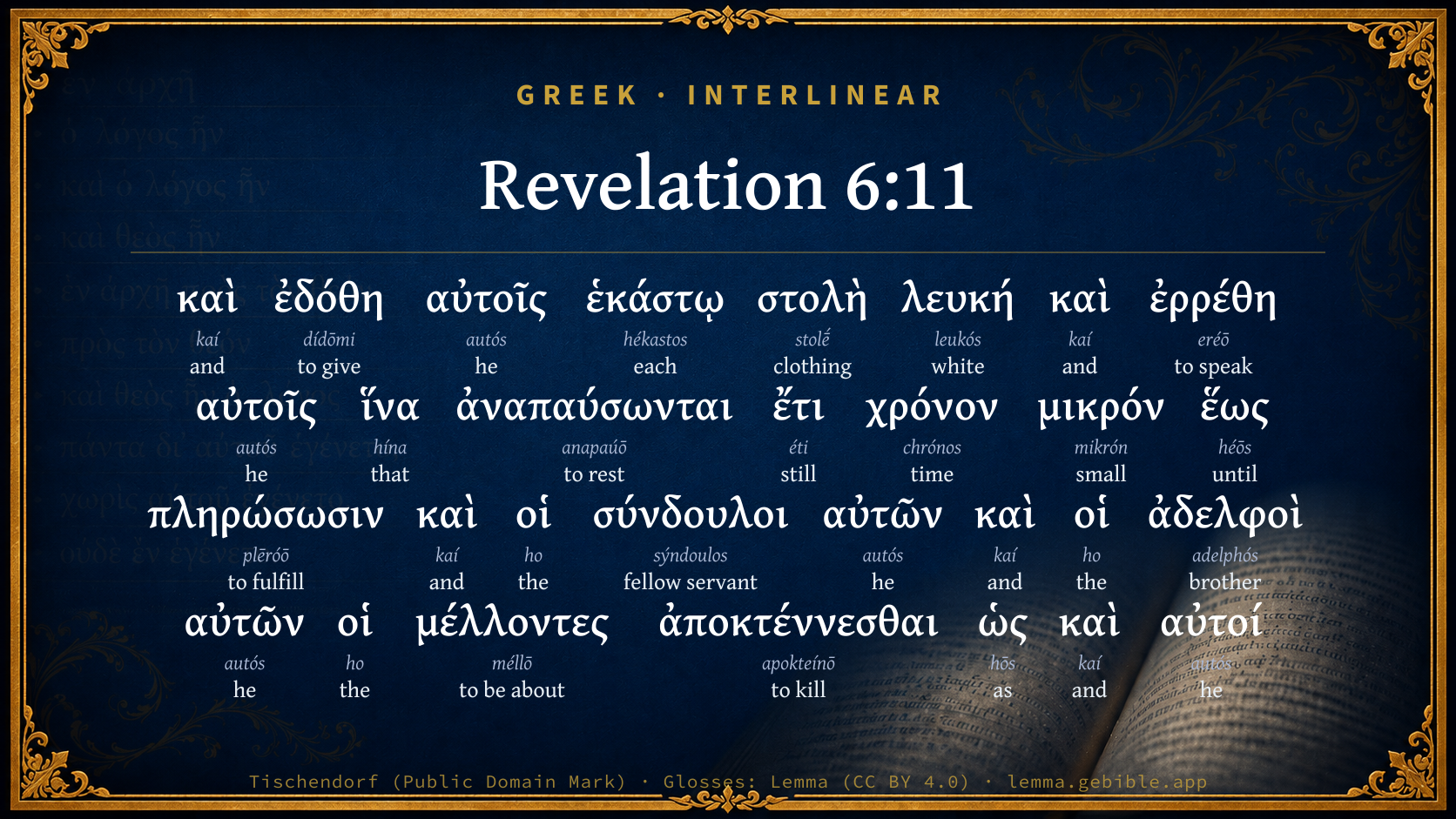
  1. καὶ kaí G2532 “and” Conjunction
  2. ἐδόθη dídōmi G1325 “to give” Verb, Aorist, Passive, Indicative, 3rd person, Singular
  3. αὐτοῖς autós G846 “he” Personal pronoun, Dative, Plural, Masculine
  4. ἑκάστῳ hékastos G1538 “each” Adjective, Dative, Singular, Masculine
  5. στολὴ stolḗ G4749 “clothing” Noun, Nominative, Singular, Feminine
  6. λευκή leukós G3022 “white” Adjective, Nominative, Singular, Feminine
  7. καὶ kaí G2532 “and” Conjunction
  8. ἐρρέθη eréō G2046 “to speak” Verb, Aorist, Passive, Indicative, 3rd person, Singular
  9. αὐτοῖς autós G846 “he” Personal pronoun, Dative, Plural, Masculine
  10. ἵνα hína G2443 “that” Conjunction
  11. ἀναπαύσωνται anapaúō G373 “to rest” Verb, Aorist, Middle, Subjunctive, 3rd person, Plural
  12. ἔτι éti G2089 “still” Adverb
  13. χρόνον chrónos G5550 “time” Noun, Accusative, Singular, Masculine
  14. ἕως héōs G2193 “until” Adverb
  15. πληρώσωσιν plēróō G4137 “to fulfill” Verb, Aorist, Active, Subjunctive, 3rd person, Plural
  16. καὶ kaí G2532 “and” Conjunction
  17. οἱ ho G3588 “the” Article, Nominative, Plural, Masculine
  18. σύνδουλοι sýndoulos G4889 “fellow servant” Noun, Nominative, Plural, Masculine
  19. αὐτῶν autós G846 “he” Personal pronoun, Genitive, Plural, Masculine
  20. καὶ kaí G2532 “and” Conjunction
  21. οἱ ho G3588 “the” Article, Nominative, Plural, Masculine
  22. ἀδελφοὶ adelphós G80 “brother” Noun, Nominative, Plural, Masculine
  23. αὐτῶν autós G846 “he” Personal pronoun, Genitive, Plural, Masculine
  24. οἱ ho G3588 “the” Article, Nominative, Plural, Masculine
  25. μέλλοντες méllō G3195 “to be about” Verb, Present, Active, Participle, Nominative, Plural, Masculine
  26. ἀποκτέννεσθαι apokteínō G615 “to kill” Verb, Present, Passive, Infinitive
  27. ὡς hōs G5613 “as” Adverb
  28. καὶ kaí G2532 “and” Conjunction
  29. αὐτοί autós G846 “he” Personal pronoun, Nominative, Plural, Masculine

About this verse

These counts appear in no published source. They are computed here, from the morphology-tagged text and Lemma’s own curated glosses. What Lemma adds →

30
words
20
distinct lemmas
Revelation
section

Notable vocabulary

The rarest word here is μικρόν small G3397 — appearing just 4 times in the whole Greek New Testament.

Shared distinctive vocabulary

μικρόν small G3397 occurs in 4 verses of the Greek New Testament. Also found in:

Repetition

Words recur within this verse:

  • καὶ and G2532 ×5
  • αὐτοῖς he G846 ×5
  • οἱ the G3588 ×3

Cross-references

8

Topical passages linked to Revelation 6:11 in the Treasury of Scripture Knowledge — connected by theme and wording, ordered by reader-vote popularity; previews shown in the World English Bible.

  • Revelation 7:9 After these things I looked, and behold, a great multitude, which no man could number, out of every nation and of all tribes, peoples, and languages, standing before the throne and before the Lamb, dressed in white robes, with palm branches in their hands.
  • Revelation 14:13 I heard the voice from heaven saying, "Write, 'Blessed are the dead who die in the Lord from now on.'" "Yes," says the Spirit, "that they may rest from their labors; for their works follow with them."
  • Revelation 3:4–5 Nevertheless you have a few names in Sardis that did not defile their garments. They will walk with me in white, for they are worthy.
  • Revelation 7:14 I told him, "My lord, you know." He said to me, "These are those who came out of the great tribulation. They washed their robes, and made them white in the Lamb's blood.
  • Hebrews 11:40 God having provided some better thing concerning us, so that apart from us they should not be made perfect.
  • Isaiah 26:20–21 Come, my people, enter you into your chambers, and shut your doors about you: hide yourself for a little moment, until the indignation be past.
  • Daniel 12:13 But go you your way until the end be; for you shall rest, and shall stand in your lot, at the end of the days.
  • John 16:2 They will put you out of the synagogues. Yes, the time comes that whoever kills you will think that he offers service to God.

Cross-references courtesy of OpenBible.info (CC BY 4.0).

Where the printed editions differ

2 variants

Places in this verse where the major printed Greek editions disagree on the wording in a way that affects the translation — a comparison of editions, not a manuscript-by-manuscript collation. The editions are the modern critical texts (Nestlé-Aland 28/27, SBL, Westcott-Hort, Tregelles, Tyndale House) and the traditional texts behind the KJV (the Textus Receptus and the Byzantine/Majority text). It is not a claim about which reading is original.

  1. Different wording
    στολὴ

    “a robe”

    In NA28NA27TynSBLWHTregByz Not in TR

    στολαὶ (stolai) 'robes' occurs in traditional manuscripts (TR) instead of στολὴ (stolē) 'a robe' in older manuscripts (NA28+NA27+Tyn+SBL+WH+Treg+Byz)

  2. Extra text
    καὶ

    “and”

    In Byz Not in NA28NA27TynSBLWHTregTR

    καὶ (kai) 'and' is only in a few manuscripts (Byz)

Textual data: Translators Amalgamated Greek New Testament (STEPBible TAGNT) · CC BY 4.0.

Commentary

Notes on Revelation 6:11 from classic Christian and Jewish commentators (each source and its license shown beneath its notes). The classic Christian expositions comment on the surrounding passage and are grouped to its opening verse, so a note may address several verses; the Jewish commentaries on the Tanakh (Rashi and others) are per-verse, so they appear only where the commentator wrote on this verse.

Lemma curates 59 commentaries, every one of them public domain or Creative Commons licensed, each selected and text-cleaned for this edition rather than reprinted as found. About our sources →

Joseph Benson's Commentary

Rev 6:11. And white robes were given unto every one of them — As a token of their justification, and favourable acceptance with God; of their victory and triumph over death, their joy and glory. And it was said unto them, that they should rest — That is, wait; yet for a little season — Though, in the mean time, their blood remained unrevenged; until their fellow-servants also, and their brethren, that should be killed for the defence of the gospel, as they had been, should be fulfilled — That is, should have finished their testimony; or till the number of the martyrs should be completed, according to the intention of Divine Providence, in letting persecutors go on a while, until they should have filled up the measure of their iniquities, when the martyrs should receive their full reward, as we shall see hereafter. Lowman observes here, very well, that “this representation seems much to favour the immediate happiness of departed saints, and hardly to consist with that uncomfortable opinion, the insensible state of departed souls, till after the resurrection.” There were other persecutions before, but this was by far the most considerable, the tenth and last general persecution, which was begun by Dioclesian, and continued by others, and lasted longer, and extended farther, and was sharper and more bloody, than any or all preceding; and therefore this was particularly predicted. Eusebius and Lactantius, who were two eye- witnesses, have written large accounts of it. Orosius asserts that this persecution was longer and more cruel than all the past; for it raged incessantly for ten years, by burning the churches, proscribing the innocent, and slaying the martyrs. Sulpicius Severus, too, describes it as the most bitter persecution, which for ten years together depopulated the people of God; at which time all the world almost was stained with the sacred blood of the martyrs, and was never more exhausted by any wars. So that this became a memorable era to the Christians, under the name of the era of Dioclesian, or, as it is otherwise called, the era of martyrs.

Joseph Benson's Commentary on the Old and New Testaments (1811–1818) — public domain. Text from a community e-Sword module.

Tyndale Open Study Notes

Tyndale Open Resources

6:11 A white robe is symbolic of the martyrs’ victory and of God’s full acceptance. • they were told to rest: Death is a state of rest (cp. John 11:11-12) in which martyrs await God’s justice. • the full number: Only God knows how many Christians will be martyred before the end. In his sovereignty, God will fulfill his purposes through his children who are martyred and will vindicate them at the appropriate time. • brothers and sisters: Greek adelphoi; this term refers to people, both male and female, who are members of the same family.

Tyndale Open Study Notes — © Tyndale Open Resources, licensed CC BY-SA 4.0. Text via the HelloAO Bible API.

Bengel's Gnomon

Johann Albrecht Bengel

Rev 6:11. Αὐτοῖς ἑκάστῳ[75]) You may with reason doubt, says Wolf, whether John wrote αὐτοῖς ἑκάστῳ. But he wrote ὑμῖν ἑκάστῳ, ch. Rev 2:23; and so Luke, ch. Rev 2:3, and Act 2:8, πάντες, ἕκαστος· ἡμεῖς, ἕκαστος: Paul, Eph 5:33, ὑμεῖς ἕκαστος. The very expression, αὐτοῖς ἑκάστῳ, occurs, Sir 17:14. They who have not admitted the joining together of the plural and singular number, have made various changes: some of them have omitted ἑκάστῳ, Mill incorrectly giving his assent, Proleg. § 1003.[76]—χρόνον) Others, ΧΡΌΝΟΝ ΜΙΚΡΌΝ; and Wolf defends that reading. He says, John uses the same phrase below, ch. Rev 20:3. From that place, in fact, some have introduced the adjective into this: for the copyists everywhere delighted to insert adjectives, lest the style should appear too abrupt. Whence also Augustine, in his second book against Gaudentius, c. 19, uses it more than once; and Jerome, in his treatise on the Perfect Man, thus has it. But this χρόνος, which is the subject of ch. Rev 6:11, ends by a long interval before the beginning of the little season (μικροῦ χρόνου), which is the subject of ch. Rev 20:3. Wolf subjoins: It certainly might have done much towards the arousing of those souls, if they understood that the delay of the Divine judgments would only be for a short time. It was this indeed which induced the African writers to add μικρὸν,[77] as a solace to the martyrs (comp. Coll. Antithet. of Antonius, p. 909, on precipitate hope); although in cases where the delay is in reality not short, they who affirm that it is short, cause an arousing which is not lasting. The best consolation is in the truth itself, which, in the meantime, by the form of speech in which it is veiled, softens down the more unfavourable points which are from time to time mingled with those more joyful, as the long-continued delay in this passage. As to criticism, I have nothing here to add to the Apparatus, except the explanation of Apringius, which is as follows: But because the everlasting recompense of the saints and the damnation of the wicked is about to come at the last time, it was said to them that they should wait, and for the comfort of the body, etc. He makes no remark respecting the shortness of the time. Χρόνον is used absolutely, as ἐπὶ χρόνον, without an epithet, Luk 18:4; on which passage E. Schmid remarks, that χρόνον is frequently used absolutely also by Homer. But it is used also, Act 19:22, and Isa 27:11 in the Septuagint. Χρόνον is the reading which is supported by the most ancient, the most numerous, and best authorities, short, natural, without any adulteration, and, as the interpretation now demonstrates from the structure of the whole book, necessarily true. D. Lange places a short time from the crying of the souls to the time of judgment and vengeance, Comm. Apoc. f. 81, and everywhere. This is one of those passages, in which the labour spent by this illustrious man upon the Apocalypse would have produced greater fruits, if he had more thoroughly weighed the arguments for the true reading. The prophecy refuses shortness as applied to this time. Its subject extends itself from the time of John through the ages of the world which still remain, and which are not much fewer than those which have passed, by a continuous thread to the end of the world: and yet it shuts up many things into periods of times of considerable length, which are definitely expressed in their proper places: all other things are done ἐν τάχει, quickly. Therefore the Lamb immediately, and in rapid succession, opens the seven seals, the fifth of which contains the souls crying out. This cry, this complaint, long afterwards, IN THE SAME WORDS, is transposed into a song, ch. Rev 19:2; then at length, namely, when the judgment of the saints and apostles shall be passed upon Babylon or Rome, ch. Rev 18:20. Therefore two classes of martyrs are pointed out: the one under heathen Rome; the other under papal Rome. The former arc ordered to take their rest until the latter are added to them: the age of John already had the former; the thirteenth century bore the first-fruits of the latter. To the former, therefore, while they were expecting the latter, there was not μικρὸς χρόνος, but truly χρόνος. As καιρὸς has a special meaning in this book, ch. Rev 12:12; Rev 12:14, so also has χρόνος, which even in Latin we call chronos (derivatives of which word are not unknown to the Latins), that the time καιρὸς may not be confounded with it. Chronus has 11111/9 years, as we show in its proper place; and this Chronus flowed on from the year 98 to 1209, or from the first year of Trajan to the Crusade stirred up against the Waldenses by the zeal of Innocent III. Before this the Pope had never been a bloodthirsty persecutor: afterwards he never ceased to be such. To this Chronus is opposed No longer—a Chronus, ch. Rev 10:6, whence there is a beautiful antithesis between the two passages, χρόνον ἔτι, χρόνος οὐκέτι. The expression Non—Chronus itself includes times of sufficient length, expressed, ch. 11 and 12 and 13, and yet a Chronus exceeds a Non—Chronus in length. How correctly these things are spoken, however paradoxical they are, the truth will bring to light, but after a time. I will here make a remark, which applies to all passages which have any indication of time. The times are not entirely determined from facts, much less are facts from times: but they afford mutual aid to each other, so that the event may be definitely distinguished.—ἕως, until) A Chronus is placed between this answer and the beginning πληρωσέως, of the fulfilment, as there were four kings of Persia between the prophecy and the destruction of the fourth King: Dan 11:3. After a Chronus, “brethren” are to be added, by the continual slaughter of whom, accomplished under the fury of the beast, the promise is fulfilled. The Chronus extends to the times of the beast; when these are elapsed, the judgment takes place.—πληρωθῶσι) Comp. Al. Lat. most suitably have this passive form: many, with Andreas of Cæsarea, have the neuter πληρώσωσι.[78] Erasmus alone has the middle form, πληρώσονται (although the construction required the subjunctive); and, in what manner he proceeded in revising the Apocalypse, I have shown in the Apparatus, Fund. Cris. § xvii. But since that discussion is not specially suited to any particular text, I greatly fear, lest many readers should pass it by, and consequently, in particular passages of the text to which it ought to be applied, should be the less prepared to judge. Wherefore I have considered it my duty, in these annotations also, to put forward some of the strong points of my argument. I will here speak what is suitable for the subject.

[75] AC read αὐτοῖς ἑκάστῳ: so Cypr. 310. Rec. Text, with h, ἑκάστοις. B, αὐτοῖς: “eis singulæ stolæ,” Cypr. 254 and Vulg.—E.

[76] στολὴ λευκὴ, a white robe) So also ch. Rev 7:9.—V. g.

[77] B is the oldest authority for the omission of μικρόν: so Tisch. But AC Vulg. h, Cypr. support it; so Lachm.—E.

[78] AC read πληρωθῶσιν: Vulg. “impleantur.” But B, πληρώσωσιν: Rec. Text, πληρώσονται.—E.

I.) Erasmus had only one manuscript on the Apocalypse, the Reuchlinian.

II.) The Reuchlinian copy was the commentary of Andreas of Cæsarea upon the Apocalypse, and this had τὸ κείμενον, or the text inserted amidst the commentary.

III.) Erasmus wonderfully extols the antiquity of this manuscript. undoubtedly had a good text, and that in some places of singular gcellence; but that it was likewise mutilated, is understood from his, that Erasmus was both ignorant of the author of the commentry, and supplied a part of chapter 22 from Latin editions. He imself acknowledges the former point in his Annotations upon the New Testament, and the latter in his Epistles.

IV.) The edition of Erasmus is often so different from the Comslutensian edition, and from all the MSS., especially those which have been duly collated, and from all the versions and fathers whose pinions are on record, and from the remaining copies of Andreas himself, that it agrees with the Latin MSS., and those of an inferior character, and which are refuted by the Latin MSS. of a better class, sometimes also with Ticonius, or his faulty edition; and it Introduces into the text Greek words which are at variance with the usage of the Greek language.

V.) Not a few of such passages occur to us while we make these remarks; and in such passages, there is no doubt that the Renchnian MS. was worn out by its antiquity, and that Erasmus patched up its deficiency from Latin copies. In this passage, therefore, Erasmus has given πληρώσονται from the Latin compleantur, and he as easily laid hold of the middle voice, answering to the nearest verb ναπαύσωνται. As often as anything of this kind occurs to Erasmus, his revision has not even the weight of a single MS.; nor do any renturies of subsequent editions make his conjecture better, in opposition to all the MSS. I sometimes speak τολμηρότερον, more holdly and confidently, not indeed through want of modesty, but that they may be excited to perceive the truth, who too superstiously defend the particular edition, whatever it is, to which they have once been accustomed. Πληρωθῶσι is used in this passage with reference to the completing of the number of the martyrs.

Bengel's Gnomon of the New Testament — English translation (T&T Clark, Edinburgh, 1860) — public domain. Text from a community e-Sword module.

Expositor's Greek Testament

ed. W. Robertson Nicoll

Rev 6:11 . The white robe assigned each (Blass, § 32, 4) of these martyr-spirits as a pledge of future and final glory (Rev 7:9 ) and a consoling proof that no judgment awaited them (Rev 20:4-6 ), is a favourite gift in the Jewish heaven ( cf. Enoch lxii. 15 f., and Asc. Isa. ix. 24 f.). The intermediate state was a much debated question in apocalyptic literature, and early Christian thought fluctuates between the idea of a provisional degree of bliss (as here and, e.g. , Clem. Rom. i. 3, “those who by God’s grace have been perfected in love possess the place of the pious, and they shall be manifested at the visitation of God’s kingdom”) and a direct, full entrance into heavenly privileges especially, though neither uniformly nor exclusively, reserved for martyrs (Clem. Rom. v, Polyk. ad Phil. ix. 2, Heb 12:23 , etc.); cf. Titius, 44 46. A cognate idea is reproduced in Asc. Isa 9:6 f., where in the seventh heaven Abel, Enoch and the Jewish saints appear all clothed “in the garments of the upper world” ( i.e. , in their resurrection-bodies) but not yet in full possession of their privileges, not yet seated on their thrones or wearing their crowns of glory. These are not theirs, till Christ descends to earth and ascends to heaven again. “And they were told to rest (or wait quietly) for a little while yet,” as they had been doing till the successive shocks of providence stirred them to an outburst of eager and reproachful anticipation. To rest implies to cease crying for vengeance ( cf. Rev 4:8 ). Gfrörer (2:50) cites a rabbinic tradition that the messiah would not come until all souls in גוּף (an intermediate resting-place of the departed?) were clothed with bodies. ἕως κ . τ . λ ., this is closely and curiously reproduced, not so much from ideas preserved in the contemporary Apoc. Bar. xxiii. 4, 5 (where the end of the world comes when the predestined number of human beings is completed) as from the religious tradition also used in Clem. Rom. ii, lix, Justin ( Apol. 1:45), and the contemporary 4th Esdras (4:36 f., quoniam in statera ponderauit saecula et mensura mensurauit tempora et non commouit nec excitauit, usquedum impleatur praedicta mensura … quando impletus fuerit numerus similium uobis) which thinks not of mankind but of the righteous ( cf. Apoc. Bar. xxx. 2, and Heb 11:40 ). The atmosphere of this belief goes back to the first century B.C., as in Enoch (xlvii, cf. 9:22.) “and the hearts of the holy were filled with joy that the number of righteousness had drawn nigh, and the prayer of the righteous was heard, and the blood of the righteous required, before the Lord of Spirits” ( cf. below, ch. Rev 11:15 f.). The thought is repeated in Ep. Lugd. from this passage (“day by day those who were worthy were seized, filling up their number, so that all the zealous people and those through whom our affairs here had been especially established, were collected out of both churches”). It had been already developed otherwise in 4th Esdras 4:35 f., where the seer’s impatience for the end is rebuked and God’s greater eagerness asserted. “Did not the souls of the righteous question thus in their chambers, saying, ‘How long are we still to stay here? et quando ueniet fructus areae mercedis nostrae?’ And the archangel Jeremiel answered them and said, ‘When the number of your fellows is complete’.” Substituting martyrs for the righteous, the author of our Apocalypse has exploited the idea thus familiar to him as a devout Jew; his first four visions come mainly through Zechariah; for the next he adapts this later post-exilic notion. The Neronic victims and their fellows occupied in his mind the place filled by the early Jewish saints in the reverent regard of contemporary Jews. As Renan notices (317 f.), this thirst for vengeance was in the air after Nero’s death, shared even by Romans; one legend (Suet. Nero , xlviii., Dio Cass. lxiii. 28) told how, as Nero fled to his last retreat, during a thunderpeal the souls of his victims burst from the earth and flung themselves upon him. As the safety of the physical universe rested on the safety of the righteous, according to the Jewish notion, so any massacres of the latter at once affected the stability of the world. Hence the sequence of Rev 6:11-12 f. There is no hint that these physical aberrations were temporary. Yet the following catastrophes (7 f.) plainly presuppose a universe in its original and normal condition. It depends upon the theory adopted of the book whether this points merely to such discrepancies as are not unfamiliar in literature (especially imaginative literature), or to recapitulation, or to the presence of different sources.

The Expositor's Greek Testament, edited by W. Robertson Nicoll (1897–1910) — public domain. Text from a community e-Sword module.

Geneva Bible (1599)

Geneva Bible translators

As before 3:4.

Until their number be fulfilled.

Geneva Bible (1599) marginal notes — public domain. Text via Bolls.life.

Jamieson, Fausset & Brown

Robert Jamieson, A. R. Fausset & David Brown

white robes--The three oldest manuscripts, A, B, C, read, "A white robe was given."

every one of--One oldest manuscript, B, omits this. A and C read, "unto them, unto each," that is, unto them severally. Though their joint cry for the riddance of the earth from the ungodly is not yet granted, it is intimated that it will be so in due time; meanwhile, individually they receive the white robe, indicative of light, joy, and triumphant victory over their foes; even as the Captain of their salvation goes forth on a white horse conquering and to conquer; also of purity and sanctity through Christ. MAIMONIDES says that the Jews used to array priests, when approved of, in white robes; thus the sense is, they are admitted among the blessed ones, who, as spotless priests, minister unto God and the Lamb.

should--So C reads. But A and B, "shall rest."

a little season--One oldest manuscript, B, omits "little." A and C support it. Even if it be omitted, is it to be inferred that the "season" is short as compared with eternity? BENGEL fancifully made a season (Greek, "chronus," the word here used) to be one thousand one hundred and eleven one-ninth years, and a time (Rev 12:12, Rev 12:14, Greek, "kairos") to be a fifth of a season, that is, two hundred and twenty-two two-ninths years. The only distinction in the Greek is, a season (Greek, "chronus") is a sort of aggregate of times. Greek, "kairos," a specific time, and so of short duration. As to their rest, compare Rev 14:13 (the same Greek, "anapauomai"); Isa 57:2; Dan 12:13.

until their . . . brethren . . . be fulfilled--in number. Until their full number shall have been completed. The number of the elect is definitely fixed: perhaps to fill up that of the fallen angels. But this is mere conjecture. The full blessedness and glory of all the saints shall be simultaneous. The earlier shall not anticipate the later saints. A and C read, "shall have been accomplished"; B and Aleph read, "shall have accomplished (their course)."

Jamieson, Fausset & Brown — Commentary Critical and Explanatory on the Whole Bible (1871) — public domain (CC PDM 1.0). Text via the HelloAO Bible API.

Adam Clarke's Commentary

Verse 11. White robes] The emblems of purity, innocence, and triumph.

They should rest yet for a little season] This is a declaration that, when the cup of the iniquity of the Jews should be full, they should then be punished in a mass. They were determined to proceed farther, and God permits them so to do; reserving the fulness of their punishment till they had filled up the measure of their iniquity. If this book was written before the destruction of Jerusalem, as is most likely, then this destruction is that which was to fall upon the Jews; and the little time or season was that which elapsed between their martyrdom, or the date of this book, and the final destruction of Jerusalem by the Romans, under Vespasian and his son Titus, about A.D. 70. What follows may refer to the destruction of the heathen Roman empire.

Adam Clarke's Commentary on the Bible (1810–1826) — public domain. Text from a community e-Sword/MySword module.

Ellicott's Commentary for English Readers

(11) And white robes were given . . .—The victims, however, are not forgotten. There was given to them (each) a white robe. The white robes, the glistening apparel of the saints (comp. Rev_3:4-5), shall be theirs; each shall receive it. They are robes of righteousness (Rev_19:8); they are robes of honour (Rev_4:4), for those who wear them are like God, seeing Him as He is, reflecting His image; they are acknowledged to be His, as they have acknowledged Him to be their God. Persecuted on earth, they are honoured in heaven. There is also a sense in which a white robe is given to them in the eyes of men: those whose names have been cast out as evil have been honoured by a repentant posterity with the robe of tardy praise; after-generations garnish the sepulchres of the righteous whom their fathers slew. The excommunicated in one age are often the canonised of the next, for the dull world learns slowly, and its purest honours are posthumous. But however this may be, for the suffering saints there is the heavenly robe and the heavenly rest.

It was said unto them, that they should rest yet for a little season, until their fellow- servants also and their brethren, that should be killed (better, who are to be slain) as they were, should be fulfilled (or, shall have fulfilled their course).—They are to “rest.” This does not mean that they are to cease their cry for vengeance, for the saints have never cried for this; but they are to rest, as the souls of the faithful after they are delivered from the burden of the flesh, in joy and felicity. But this rest is yet a waiting for a little while till fellow-servants and fellow-sufferers have achieved their work also. To every disciple a work is given in service and suffering, and till these have borne their witness and fulfilled their course (comp. 2Ti_4:7-8, and Act_13:25) the departed must wait for their perfect consummation and bliss both in body and soul.

A Bible Commentary for English Readers, edited by Charles John Ellicott (1878–1897) — public domain. Text from a community e-Sword module.

The Cambridge Bible for Schools and Colleges

gen. ed. J. J. S. Perowne

11. And white robes were given] We should read, and there was given them to each one a white robe, bringing out still more fully than the old text, that the white robe is an individual, not a common blessing. It serves to mark them both as innocent and as conquerors: what it is is better felt than said. We see that the “souls” appeared in some visible form, like enough to bodies to wear garments: one of the considerations against regarding them as abstractions, not personal beings. There can hardly be any doubt that this verse (cf. Rev_3:4-5) represents a portion of the reward given by God to His Saints, and if so, evidently such a portion of their reward as they receive in the interval before the Resurrection. But whether all the elect are in the same position as the Martyrs, or whether we have here described a special privilege granted to them only, is more doubtful: the prevalent belief of Christendom has been, that Martyrs and the like more excellent Saints have, in this intermediate state, a privilege above all the other justified ones.

and it was said unto them] From the nature of the case, their cry and the answer to it had to be heard by St John successively. But doubtless in fact they are contemporaneous: the Saints at once share God’s desire for the triumph of righteousness over sin, and rest in God’s assurance that it is for good reason that that triumph is delayed.

that they should rest] i.e. not be impatient and disquieted. Something more is meant than to be at peace, freed from the troubles of their earthly life (as Rev_14:13): but the word does not in the least imply that they are to be unconscious, or as it were asleep.

yet for a little season] Yet to Stephen and his companions it is not less than 1840 years: and though the Old Testament Martyrs be not exclusively meant, they are no doubt included. But notice that it is contemplated that there will be an interval between the Martyrs of the Primitive Church and those of the last days.

their fellowservants also and their brethren] It would be possible to construe the words “both their fellowservants and their brethren,” as though two classes were spoken of. In Rev_19:10, Rev_22:9, where we get the same words coupled, though in another construction, it may be thought that St John is called a brother of Martyrs and Prophets in a special sense. It would therefore be possible to distinguish the two classes, “their fellowservants (viz. all their true fellow-believers), and their brethren which should be killed as they were.” But it is much simpler to translate as the A. V., making both nouns antecedents to the clause that follows.

that should be killed as they were] The word “as” is slightly emphasised, “even as they.” The Martyrs of the last days are to be like those of the first, Martyrs in the strictest sense—Christians slain because they hold the Christian faith, and will not renounce it. Such Martyrs there have been, no doubt, in the interval between the great ages of persecution under the Roman emperors and under Antichrist, e.g. in the Mohammedan conquests, in the age of the conversion of central Europe, in Japan in the seventeenth century, and in Madagascar, China, New Zealand, and Zululand in our own time. It is likely enough also that martyrs to charity—men like St Telemachus and St Philip of Moscow, Abp. Affré and Bp. Patteson—have their portion with the perfect martyrs to faith: in some cases, as in the last, it is hard to draw a line between the two: any way, those who suffer for righteousness’ sake suffer for Christ, as St Anselm said when Lanfranc wished to deny the honours of a martyr to St Alphege. But to suffer for conscience’ sake, however noble, is not necessarily quite the same thing: and it is hardly right to claim the name of martyr for the victims—certainly not for the victims on one side only—in the fratricidal contests of Christians. “The Lord knoweth them that are His;” He knows whether Becket or Huss, More or Latimer, Charles I. or Margaret Wilson, had most of the Martyr’s spirit: we had better not anticipate His judgement whether any or all of them are worthy of the Martyr’s white robe.

should be fulfilled] Probably we should read, should have fulfilled—i.e. their course, as Act_13:25, or their work.

The Cambridge Bible for Schools and Colleges (gen. ed. J. J. S. Perowne; Cambridge University Press, 1878–1918) — public domain. Text from a community e-Sword module.

John Gill's Exposition

And white robes were given to everyone of them,.... The Alexandrian copy, and some others, read in the singular number, "a white robe", and so does the Syriac version; as a token of their innocence, that they did not suffer, or were slain, for any capital crime or immorality they were guilty of; and of their purity and perfection they now enjoyed; as also of that spiritual delight and pleasure, which was unspeakable and full of glory, they now had in the presence of God and Christ; and in short, of that happiness and glory which souls in a separate state, before the resurrection morn, are partakers of; who besides the righteousness of Christ, comparable to fine linen clean and white, walk with Christ in white, in the shining robes of bliss and glory:

and it was said unto them, that they should rest; or have rest; eternal rest from all their toil and labour, from all their sorrows and sufferings of every kind, which rest remains for the people of God, and into which these were now entered; or that they should cease from expostulating and inquiring after the above manner, and rest satisfied and contented, exercising the graces of faith, hope, and patience, believing, looking, and waiting:

yet for a little season; either until the end of this persecution by Dioclesian, when vengeance would be taken of the Roman empire, and it would be no more as Pagan; or until the day of judgment, when full vengeance will be inflicted on the persecutors of the saints; and which is but a little while with God, with whom a thousand years is as one day, and in comparison of that eternity of blessedness glorified saints are partakers of:

until their fellow servants also, and their brethren, that should be killed as they were, should be fulfilled; meaning either the rest of the saints that should suffer martyrdom in the: following part of this persecution; or those who should suffer under the Arian persecution, when the empire would become Christian; or under Rome Papal, and in all the persecutions of the apostasy, unto the end of that state: these are called "fellow servants" and "brethren" of the saints in heaven; for they all worship and serve the same God, and belong to the same family, in heaven and in earth; and the selfsame reason that is made use of to animate the saints below to courage, faith, and patience in suffering, Pe1 5:9, is used to keep up the expectation of the saints in heaven, of that vengeance that will be executed on their enemies, and to point out the time when it will be; and it may be observed, that the number of martyrs, or of those that shall suffer and die in the cause of Christ, and for his Gospel, is fixed and determined by God; and that number shall be perfected and completed, and when that is done, he will pour out all his wrath on them that have persecuted them and put them to death: and so the Arabic version renders it, "that the number of their companions and brethren, and of those who are to be killed as they have been killed, is fulfilled"; In the Apocrypha is written:

"39 Which are departed from the shadow of the world, and have received glorious garments of the Lord. 40 Take thy number, O Sion, and shut up those of thine that are clothed in white, which have fulfilled the law of the Lord. 41 The number of thy children, whom thou longedst for, is fulfilled: beseech the power of the Lord, that thy people, which have been called from the beginning, may be hallowed.'' (2 Esdras 2)

Now though this seal does not introduce any judgment to be executed on the Roman empire, as the others do; yet since it introduces all the martyrs with one united voice requiring vengeance on their blood, it may very well be considered as a step towards, and as making way for, the utter ruin of that empire: and which the next seal being opened brings on, and is a full answer to the cry of these souls.

John Gill's Exposition of the Whole Bible (1746–1763) — public domain (CC PDM 1.0). Text via the HelloAO Bible API.

Trapp's Complete Commentary

John Trapp

11 And white robes were given unto every one of them; and it was said unto them, that they should rest yet for a little season, until their fellowservants also and their brethren, that should be killed as they were, should be fulfilled.

Ver. 11. And white robes] Their innocence was cleared, and their persecutors convinced. God would speak for them in the hearts of their greatest enemies.

Until their fellowservants also] We doubt not, saith a learned interpreter here (Mr Forbes), but that the crowned saints do in general know the afflicted condition of the Church militant, and do wish them deliverance; but our special necessities and occurrences of particular persons they cannot know. Brother Bradford, said Bishop Ridley, a little before he was offered up, so long as I shall understand that thou art in thy journey, by God’s grace I shall call upon our heavenly Father to set thee safely home; and then, good brother, speak you for the remnant that are to suffer for Christ’s sake, according to that thou then shalt know more clearly. (Acts and Mon.) But this is to be taken with a grain of salt.

That should be killed] Under Licinius, Julian the Apostate, and the Arian emperors.

John Trapp, A Commentary or Exposition upon All the Books of the Old and New Testament (1647–1656) — public domain. Text from a community e-Sword module.

Matthew Poole's English Annotations

And white robes were given unto every one of them; white robes of glory; for the white robes of Christ’s righteousness, and of a holy life, were by them put on before they were slain.

That they should rest yet for a little season; that they should be satisfied, and acquiesce in God’s dispensations.

Until their fellow-servants also and their brethren, that should be killed as they were; for God had yet more faithful witnesses to be martyred, (though not in such flocks as before), who should die for the same faith and profession.

Should be fulfilled; when the number of those his martyrs should be completed, he would avenge their blood upon their enemies.

Matthew Poole's English Annotations on the Holy Bible (1683–1685) — public domain. Text from a community e-Sword/MySword module.

Whedon's Commentary on the Bible

Daniel D. Whedon

11. White robes—Best reading, A white robe was given to them each. “The white robe in this book,” says Alford, “is the vestment of acknowledged and glorified righteousness in which the saints reign with Christ. Compare Rev_3:4; Rev_17:13.” Note Rev_3:4. Neither this condition of the saints beneath the altar, nor this now first given robe, is so literal that we may suppose such humiliation and re-dressing to be actually undergone by glorified saints. Both the humiliation and re-dressing are symbol in action; the robes being really not bestowed until the disembodied saint first enters paradise.

It was said unto them—By divine authority, but by unknown speakers. Note on Rev_1:10.

Should rest— Should wait in repose and full assurance of ultimate justice.

For a little season—As reckoned by God’s chronology. Note 2Pe_3:10.

Fellow servants—The entire body of the elect.

Brethren… killed—The glorious army of martyrs.

Be fulfilled—Rather, should fulfil, that is, their career; and all gather in at the final glorious resurrection.

Daniel D. Whedon (gen. ed.), Commentary on the Old and New Testaments (1874–1909) — public domain. Text from a community e-Sword module.

The Pulpit Commentary

And white robes were given unto every one of them; and there was given to each one a white robe. Stolh leukh , "a white robe," is supported by A, C, P, N, B, etc. The white robe of righteousness, the wedding garment of Mat_22:11, Mat_22:12, is the sign of the blessedness of the saints. White is the colour of heavenly victory in the Apocalypse (see on ver. 2). The vision has recalled the past sufferings of the martyrs and their present expectation of the final consummation of their hopes, which is to be not yet. The other side is now to be shown; though they have not yet reached their final bliss, they have received the white robe, they are free from possibility of defilement, the victory is won, and they have rest. Comfort and encouragement are thus afforded to those still struggling in the world, who have not as yet attained to the white robe of perfect righteousness. And it was said unto them, that they should rest yet for a little season. Revelation 14. seems to determine the exact signification anapauswntai , viz. "rest in peace," "rest from their labours," rather than specifically "cease kern uttering this cry" (ver. 10), as explained by De Wette and others. For a little time (cronov); that is, till the second coming of Christ, for the time which is to intervene before that event is frequently spoken of as a little time. (see on Rev_1:1 Rev_20:3 Rev_12:12; comp. Hag_2:6, Hag_2:7, "Yet once a little time, and I will shake the heavens, and the earth, the sea and the dry land, and all nations, and the Desire of all nations shall come The time of the world is little in comparison with eternity. This little time is depicted and set forth under the six seals; it comes to an end at Rev_7:17, and merges into eternity in Rev_8:1. Some expositors (of the historical school) understand a cronov to be a definite, arbitrary number; e.g. Bengel considers it to be 1111 1/9 years (see "Speaker"s Commentary," p. 485). Until their fellow servants also and their brethren, that should be killed as they were, should be fulfilled. R, B, P, read plhrwswsin , "shall have fulfilled" i.e. their course; A, C, read plhrwywsin , "should be completed." "Their fellow servants also and their brethren" may not denote two separate bodies, notwithstanding that kai occurs twice, but, as Alford remarks, it may point out the same persons viewed in two aspects first, the Christians needed to proceed with and finish Christ"s work as his servants; second, the same ones needed to complete the number of his family. But it seems more likely that reference is intended to two classes of Christians first, their fellow servants, that is, all Christians, who may, however, not suffer martyrdom; and, second, their brethren, the martyrs, who, like them, should yet be killed.

The Pulpit Commentary (1880–1919), ed. H.D.M. Spence-Jones & Joseph S. Exell — public domain. Text from a community e-Sword module.

John Wesley's Explanatory Notes

And there was given to every one a white robe - An emblem of innocence, joy, and victory, in token of honour and favourable acceptance. And it was said to them - They were told how long. They were not left in that uncertainty. That they should rest - Should cease from crying. They rested from pain before. A time - This word has a peculiar meaning in this book, to denote which, we may retain the original word chronos. Here are two classes of martyrs specified, the former killed under heathen Rome, the latter, under papal Rome. The former are commanded to rest till the latter are added to them. There were many of the former in the days of John: the first fruits of the latter died in the thirteenth century. Now, a time, or chronos, is 1111 years. This chronos began A. 98, and continued to the year 1209; or from Trajan's persecution, to the first crusade against the Waldenses. Till - It is not said, Immediately after this time is expired, vengeance shall be executed; but only, that immediately after this time their brethren and fellowservants will come to them. This event will precede the other; and there will be some space between.

John Wesley, Explanatory Notes Upon the Whole Bible (1754–1765) — public domain. Text via the GEBible commentary corpus.

Scofield Reference Notes

C. I. Scofield

fulfilled

i.e. their number filled up.

The Scofield Reference Bible (1917 edition), notes by C. I. Scofield — public domain. Text from a community e-Sword module.

The People's New Testament

B. W. Johnson

11. And white robes were given unto every one of them. The robes of justification and victory. They are assured that the day when “they will be avenged” will soon come, but that they must wait a little season. Others must be added to the number of the martyrs before the number is fulfilled. It is a time of persecution. The fifth seal is the seal of persecution, and it evidently marks some notable era in the history of the Church, when more fiercely than ever before it felt the intolerant hand of “them who dwelt upon the earth.” The fulfillment is to be sought in a war of extermination waged against Christianity. Again we ask if, following the events already described, history records events that fulfill this prophecy?

The Fulfillment. —The ninety-two years of civil turmoil began a.d. 192 with the death of Commodus. They ended in a.d. 284. In that year Diocletian ascended the Roman throne, and his reign was distinguished by the most terrible, most prolonged, and most general persecution known in the history of the ancient Church. The Church had often been persecuted before, but no persecution had ever been so universal, so long continued, and so terrible. The Emperor was not by nature a persecutor, but the great men of the empire, especially Galerius, whom he had associated in the duty of government, were alarmed at the astonishing progress of the new religion, and demanded its extirpation. At last Diocletian yielded, and became the leader in the effort to root out the religion of Christ from the very face of the earth.

Early in a.d. 303 secret councils were held in Nicomedia, concerning the destruction of Christianity. “Perhaps,” says Gibbon, “it was represented to Diocletian, that the glorious work of deliverance of the empire was left imperfect so long as an independent people (the Christians) were permitted to subsist and multiply in it.” On the twenty-third of February, the first blow was struck. An armed force was sent to destroy the great church of Nicomedia, and to burn the sacred books, so carefully preserved in that day when the printing press was unknown. This was the signal for beginning a persecution which was, by the consent of all historians, the longest, the most general, and the fiercest ever waged against the Church. It is a remarkable fact that a chronological era, dating from the time when Diocletian began to reign instituted not for religious, but astronomical purposes, and used until the Christian era was introduced in the sixth century, has received its name from the persecution, and has been called the era of martyrs.

With regard to this period I make a quotation from Gibbon, Vol. II., page 69: “The resentment, or the fears of Diocletian, at length transported him beyond the bounds of moderation, which he had hitherto preserved, and he declared, in a series of cruel edicts, his intention of abolishing the Christian name. By the first of these edicts, the governors of the provinces were directed to apprehend all persons of the ecclesiastical order; and the prisons, destined for the vilest criminals, were soon filled with a multitude of bishops, presbyters, deacons, readers and exorcists. By a second edict, the magistrates were commanded to employ every method of severity, which might reclaim them from their odious superstition, and oblige them to return to the established worship of gods. This rigorous order was extended, by a subsequent edict, to the whole body of Christians, who were exposed to a violent and general persecution.” This terrible persecution, conducted with such vindictive fury that sometimes church buildings were surrounded by soldiers, the doors locked and the congregations burned in them, continued for over ten years.

In the answer to the martyrs (verse 11) there are three things that are noteworthy. First, it is said that they must await the great judgment, which would not be until another distinct set of martyrs was slain. These are evidently the martyrs slain, not by pagan Rome, but by anti-Christ. Second, they must wait “a little season.” This season is to be measured by God's standard, and not by ours. Third, there were given unto them white robes. White robes are a symbol of justification and of triumph. “The white robes are given to him that overcometh.” These souls are not in the inner sanctuary, the type of heaven; but under the altar of the outer court, the type of the world. The white robes, therefore, imply their triumph and justification upon the earth. This came within twenty-five years of their suffering, through the formal acceptance of Christianity by the Roman Empire.

THE SIXTH SEAL.

B. W. Johnson's The People's New Testament with Notes (1889–1891) — public domain. Electronic text from the Christian Classics Ethereal Library (CCEL) ThML edition.

Cambridge Greek Testament for Schools and Colleges

11. ἐδόθη αὐτοῖς ἑκάστῳ στολὴ λευκή. Hipp[246] reads ἐδόθησαν αὐτοῖς στολαὶ λευκαὶ, and so Vg[247]; Primas[248] datae sunt eis singulis stolae albae (omitting the rest of the verse which Cyp[249] recognises); B2 omits ἑκάστῳ.

[246] St Hippolytus. The readings not given by Tischendorf are from the newly published 4th book of his commentary on Daniel.

[247] Vulgate.

[248] Primasius, edited by Haussleiter.

[249] St Cyprian as quoted by Haussleiter.

ἀναπαύσωνται. Hipp[250] reads περιμείνωσιν.

[250] St Hippolytus. The readings not given by Tischendorf are from the newly published 4th book of his commentary on Daniel.

πληρώσωσιν. Hipp[251] adds τὴν μαρτ. αὐτῶν; AC read πληρωθῶσιν.

[251] St Hippolytus. The readings not given by Tischendorf are from the newly published 4th book of his commentary on Daniel.

καὶ οἱ ἀδελφοὶ αὐτῶν. Hipp[252] omits these words.

[252] St Hippolytus. The readings not given by Tischendorf are from the newly published 4th book of his commentary on Daniel.

11. ἐδόθη αὐτοῖς ἑκάστῳ στολὴ λευκή. The singular στολὴ and the emphatic though irregular apposition αὐτοῖς ἑκάστῳ bring out more fully than the old text, that the white robe is an individual, not a common blessing. It serves to mark them both as innocent and as conquerors: what it is is better felt than said. We see that the “souls” appeared in some visible form, like enough to bodies to wear garments: one of the considerations against regarding them as abstractions, not personal beings. There can hardly be any doubt that this verse (cf. Rev 3:4-5) represents a portion of the reward given by God to His Saints, and if so, evidently such a portion of their reward as they receive in the interval before the Judgement. In Ascensio Isaiae ix. 7–18 there is a close and curious parallel. Isaiah in the seventh heaven sees all the righteous from the days of Adam, holy Abel and all the righteous, Enoch and all his company already stripped of the garment of flesh and arrayed in the garment of heaven (plainly the spiritual body). These see their thrones but do not sit on them, and their crowns but do not wear them. The angel tells Isaiah they have to wait for the Incarnation and Ascension, when the Lord will bring many other righteous with Him who have not received their garments yet; then these too shall receive garments, crowns, and thrones. But whether all the elect are in the same position as the Martyrs, or whether we have here described a special privilege granted to them only, is more doubtful; the prevalent belief of Christendom has been, that Martyrs and the like more excellent Saints have, in this intermediate state, a privilege above all the other justified ones.

ἐρρέθη αὐτοῖς. From the nature of the case, their cry and the answer to it had to be heard by St John successively. But doubtless in fact they are contemporaneous: the Saints at once share God’s desire for the triumph of righteousness over sin, and rest in God’s assurance that it is for good reason that triumph is delayed.

ἵνα ἀναπαύσωνται. Almost as if they were bidden to “turn again to their rest” Psa 116:7. They were at rest already when God’s judgements came abroad; then they cry out to Him to finish His work and cut it short in righteousness. This rest, if like the rest of the dead who die in the Lord Rev 14:13, is more than the mere rest of the grave (Job 3:17-19) and certainly does not imply that they are to be unconscious or as it were asleep.

ἔτι χρόνον μικρόν. Yet to Stephen and his companions it is not less than 1850 years: and though the Old Testament Martyrs be not exclusively meant, they are no doubt included. But notice that it is contemplated that there will be an interval between the Martyrs of the Primitive Church and those of the last days.

πληρώσωσιν. If the reading be right, we must supply after “should have fulfilled” ‘their course’ (Act 13:25), or ‘their work,’ or ‘their number,’ as St Hippolytus quotes this passage in the fourth book of his commentary on Daniel.

καὶ οἱ σύνδουλοι αὐτῶν καὶ οἱ ἀδελφοὶ αὐτῶν. It would be possible to construe the words “both their fellowservants and their brethren,” as though two classes were spoken of. In Rev 19:10, Rev 22:9, where we get the same words coupled, though in another construction, it may be thought that St John is called a brother of Martyrs and Prophets in a special sense. It would therefore be possible to distinguish the two classes, “their fellowservants (viz. all their true fellow-believers), and their brethren which should be killed as they were.” But it is much simpler to translate as the A. V[266], making both nouns antecedents to the clause that follows.

[266] Authorised Version.

ὡς καὶ αὐτοί is a shade more emphatic than ὡς αὐτοί would have been. Both terms in the comparison are to correspond exactly. The Martyrs of the last days are to be like those of the first, Martyrs in the strictest sense—Christians slain because they hold the Christian faith, and will not renounce it. Such Martyrs there have been, no doubt, in the interval between the great ages of persecution under the Roman emperors and under Antichrist, e.g. in the Mohammedan conquests, in the age of the conversion of central Europe, in Japan in the seventeenth century, and in Madagascar, China, New Zealand, and Zululand in our own time. It is likely enough also that martyrs to charity—men like St Telemachus and St Philip of Moscow, Abp Affré and Bp Patteson—have their portion with the perfect martyrs to faith: in some cases, as in the last, it is hard to draw a line between the two: any way, those who suffer for righteousness sake suffer for Christ, as St Anselm said when Lanfranc wished to deny the honours of a martyr to St Alphege. But to suffer for conscience sake, however noble, is not necessarily quite the same thing: and it is hardly right to claim the name of martyr for the victims—certainly not for the victims on one side only—in the fratricidal contests of Christians. “The Lord knoweth them that are His”; He knows whether Becket or Huss, More or Latimer, Charles I. or Margaret Wilson, had most of the Martyr’s spirit: we had better not anticipate His judgement whether any or all of them are worthy of the Martyr’s white robe.

Cambridge Greek Testament for Schools and Colleges (Cambridge University Press, 1896; 21 vols, various authors incl. Carr, Maclear, Plummer, Farrar, Lumby, Moule, M. R. James, Simcox) — public domain. Text from a community e-Sword module.

Vincent's Word Studies in the New Testament

Marvin R. Vincent

White robes were given unto every one of them [εδοθησαν εκαστοις στολαι λευκαι] . The best texts read ejdoqh aujtoiv eJkastw stolh leukh there was given them to each one a white robe. So Rev. Stolh is properly a long, flowing robe; a festive garment. Compare Mr 16:5; Luk 14:22; Luk 20:46.

Should rest [αναπαυσωνται] . See on Mt 11:28; 1Pe 5:14; compare chapter Rev 14:13; Dan 12:13. Not merely rest from their crying for vengeance, but rest in peace.

Fellow - servants. See Master in verse 10.

Should be fulfilled [πληρωσονται] . Completed in number. See Col 2:10. Some texts read plhrwswsin shall have fulfilled their course.

Marvin R. Vincent, Word Studies in the New Testament (1887–1900) — public domain. Text from a community e-Sword/MySword module.

Lesson kit

Teaching starters — assembled from the data on this page, not authored interpretation. Every prompt links to the verse data it draws on. Edit before teaching.

Revelation, in the Revelation, opens this verse with 30 words (20 distinct Greek lemmas). Its most distinctive word is mikrón (“small”). A historical commentator’s framing appears above. Read the whole chapter for the surrounding context.

Discussion questions

  1. What does “small” (mikrón) contribute to the verse as a whole?
  2. How does John 7:33, which shares the word «small», read alongside this verse?
  3. What does the repetition of “and” (5× in this one verse) do in this verse?
  4. The translations on this page render this verse differently — a whole-verse word diff, not a word-by-word alignment. What might account for the different wordings?
  5. Compare how Joseph Benson's Commentary and Tyndale Open Study Notes read this verse. Where do they agree or differ?

Things to notice

Reading settings

Reading text

Shown beneath each verse's original-language words.

Old Testament
Old Testament edition

Read the OT as the Masoretic Hebrew (MT) or the Greek Septuagint (LXX).

English shown for the Greek Septuagint (in the Hebrew ↔ Greek comparison).

Comparing translations? Open the Compare panel on any verse page to stack up to four side by side.