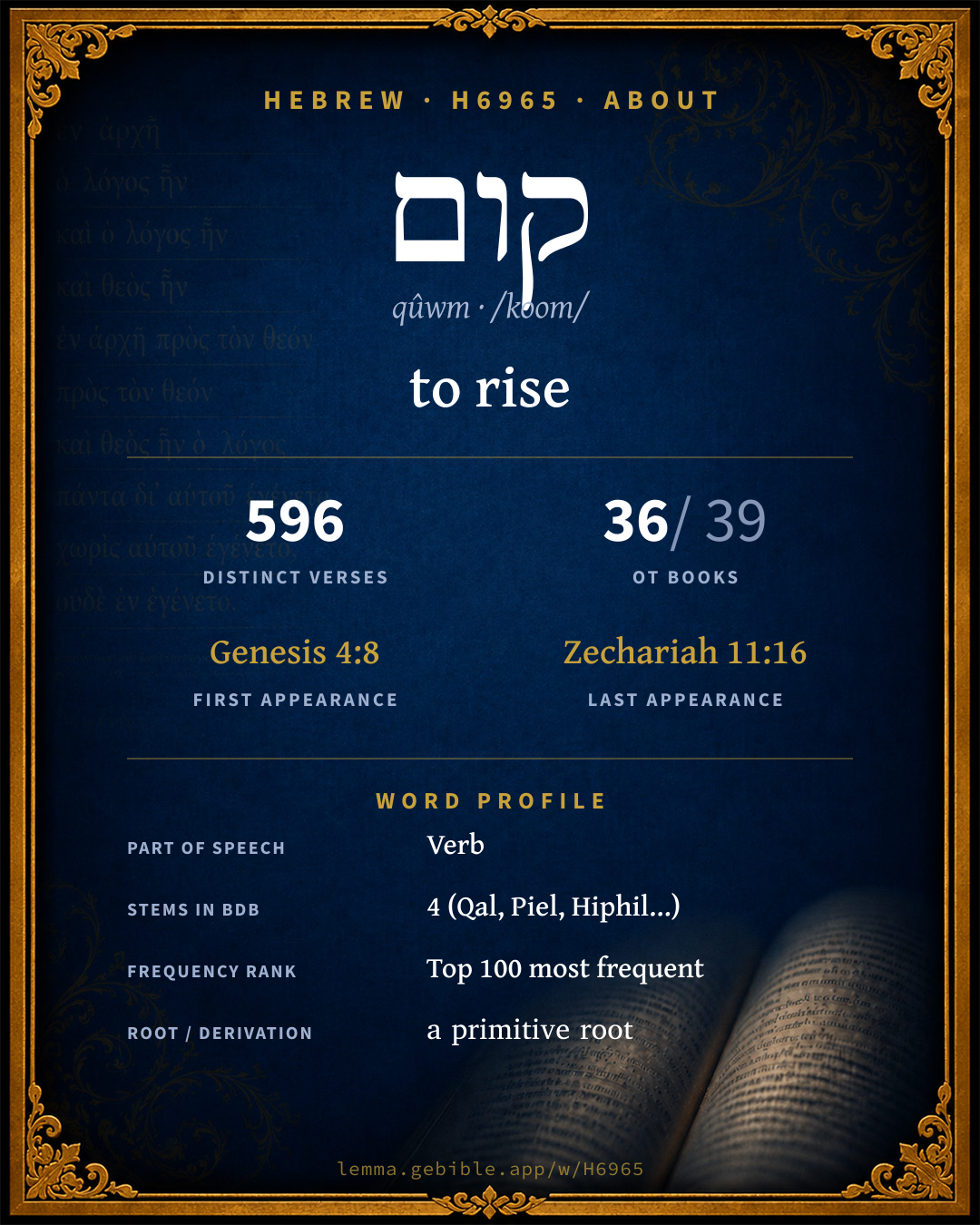
קוּם
to rise
also: arise, stand, rise up, stand up fuller range ↓
Full lexicon entry — Brown-Driver-Briggs (BDB)
From Brown-Driver-Briggs (BDB)
Where this word appears
See every Qal verb in the Hebrew Bible →
Grammar key — what these labels mean
Part of speech
- Verb
- An action or state-of-being word.
- Noun
- A naming word — a person, place, thing, or idea.
Noun type
- Proper
- A name of a specific person, place, or people (e.g. Abraham, Zion, Israel).
Stem
- Qal
- The basic, simple active stem — the plain form of the verb (“he wrote”). Here: ‘arise’
- Hiphil
- The causative active stem (“he caused / brought about”). Here: ‘cause to arise’
- Piel
- An intensive or resultative active stem. Here: ‘fulfil’
- Hophal
- The passive counterpart of the Hiphil (“he was caused to…”).
- Hithpolel
- The reflexive counterpart of the Polel.
- Polel
- A stem of hollow/geminate roots functioning like the Piel — intensive active.
Form
- Sequential Imperfect
- An imperfect with prefixed waw — the standard past-narrative form (waw-consecutive imperfect).
- Imperative
- A direct command (“write!”).
- Imperfect
- An incomplete, ongoing, or future action (“he will / would write”).
- Sequential Perfect
- A perfect with prefixed waw continuing a preceding imperfect or command (waw-consecutive perfect).
- Perfect
- A completed action or state — Hebrew marks aspect (completeness) more than strict tense (“he wrote”).
- Infinitive Construct
- A bound verbal noun, frequently with prepositions (“to write / in writing”).
- Participle Active
- A verbal adjective expressing ongoing or characteristic action (“writing / one who writes”).
- Cohortative
- A first-person volitional form expressing wish or resolve (“let me / let us write”).
- Infinitive Absolute
- An unbound verbal noun, often intensifying or standing in for a finite verb.
- Jussive
- A third- or second-person volitional form expressing wish or command (“let him write”).
State
- Absolute
- The independent form of a noun, not bound to a following word.
- Construct
- A noun bound to a following noun in a possessive / “of” relationship (the construct chain).
Person
- 3rd Person
- The one spoken about (“he / she / it / they”).
- 2nd Person
- The one addressed (“you”).
- 1st Person
- The speaker (“I / we”).
Gender
- Masculine
- Grammatically masculine.
- Common
- Either gender — not distinguished for this form.
- Feminine
- Grammatically feminine.
Number
- Singular
- One.
- Plural
- More than one (in Hebrew, generally three or more).
38 verses where H6965 appears in the Qal stem in the Book of 1 Samuel. Filtered view — show all forms. Click any verse to open its interlinear word-by-word view. Verse text shown in the World English Bible for context — . Each verse’s Hebrew form is shown with its reference; the English is not keyword-highlighted, since the data carries no word-level English alignment. Use “Compare translations” on any verse to read it across multiple English versions. This concordance covers the Hebrew Bible; Septuagint (Greek Old Testament) occurrences are not indexed here.
1 Samuel
- 1 Samuel 1:9 וַ/תָּ֣קָם conj + Qal wimpf 3fs So Hannah rose up after they had eaten in Shiloh, and after they had drunk. Now Eli the priest was sitting on his seat by the door-post of the temple of Yahweh.
- 1 Samuel 3:6 וַ/יָּ֤קָם conj + Qal wimpf 3ms Yahweh called yet again, Samuel. Samuel arose and went to Eli, and said, Here am I; for you called me. He answered, I didn't call, my son; lie down again.
- 1 Samuel 3:8 וַ/יָּ֨קָם֙ conj + Qal wimpf 3ms Yahweh called Samuel again the third time. He arose and went to Eli, and said, Here am I; for you called me. Eli perceived that Yahweh had called the child.
- 1 Samuel 4:15 קָ֔מָה Qal pf 3fs Now Eli was ninety-eight years old; and his eyes were set, so that he could not see.
- 1 Samuel 9:3 וְ/ק֣וּם conj + Qal impv 2ms The donkeys of Kish, Saul's father, were lost. Kish said to Saul his son, Take now one of the servants with you, and arise, go seek the donkeys.
- 1 Samuel 9:26 ק֖וּמָ/ה וַ/יָּ֣קָם Qal impv 2ms + sfx h conj + Qal wimpf 3ms They arose early: and it happened about the spring of the day, that Samuel called to Saul on the housetop, saying, Up, that I may send you away. Saul arose, and they went out both of them, he and Samuel, abroad.
- 1 Samuel 13:14 תָק֑וּם Qal impf 3fs But now your kingdom shall not continue: Yahweh has sought him a man after his own heart, and Yahweh has appointed him to be prince over his people, because you have not kept that which Yahweh commanded you.
- 1 Samuel 13:15 וַ/יָּ֣קָם conj + Qal wimpf 3ms Samuel arose, and got him up from Gilgal to Gibeah of Benjamin. Saul numbered the people who were present with him, about six hundred men.
- 1 Samuel 16:12 ק֥וּם Qal impv 2ms He sent, and brought him in. Now he was ruddy, and withal of a beautiful face, and goodly to look on. Yahweh said, Arise, anoint him; for this is he.
- 1 Samuel 16:13 וַ/יָּ֣קָם conj + Qal wimpf 3ms Then Samuel took the horn of oil, and anointed him in the midst of his brothers: and the Spirit of Yahweh came mightily on David from that day forward. So Samuel rose up, and went to Ramah.
- 1 Samuel 17:35 וַ/יָּ֣קָם conj + Qal wimpf 3ms I went out after him, and struck him, and delivered it out of his mouth; and when he arose against me, I caught him by his beard, and struck him, and killed him.
- 1 Samuel 17:48 קָ֣ם Qal pf 3ms It happened, when the Philistine arose, and came and drew near to meet David, that David hurried, and ran toward the army to meet the Philistine.
- 1 Samuel 17:52 וַ/יָּקֻ֣מוּ conj + Qal wimpf 3mp The men of Israel and of Judah arose, and shouted, and pursued the Philistines, until you come to Gai, and to the gates of Ekron. The wounded of the Philistines fell down by the way to Shaaraim, even to Gath, and to Ekron.
- 1 Samuel 18:27 וַ/יָּ֨קָם conj + Qal wimpf 3ms and David arose and went, he and his men, and killed of the Philistines two hundred men; and David brought their foreskins, and they gave them in full number to the king, that he might be the king's son-in-law. Saul gave him Michal his daughter as wife.
- 1 Samuel 20:25 וַ/יָּ֨קָם֙ conj + Qal wimpf 3ms The king sat on his seat, as at other times, even on the seat by the wall; and Jonathan stood up, and Abner sat by Saul's side: but David's place was empty.
- 1 Samuel 20:34 וַ/יָּ֧קָם conj + Qal wimpf 3ms So Jonathan arose from the table in fierce anger, and ate no food the second day of the month; for he was grieved for David, because his father had done him shame.
- 1 Samuel 20:41 קָ֚ם Qal pf 3ms As soon as the boy was gone, David arose out of [a place] toward the South, and fell on his face to the ground, and bowed himself three times: and they kissed one another, and wept one with another, until David exceeded.
- 1 Samuel 20:42 וַ/יָּ֖קָם conj + Qal wimpf 3ms Jonathan said to David, Go in peace, because we have sworn both of us in the name of Yahweh, saying, Yahweh shall be between me and you, and between my seed and your seed, forever. He arose and departed: and Jonathan went into the city.
- 1 Samuel 21:10 וַ/יָּ֣קָם conj + Qal wimpf 3ms David arose, and fled that day for fear of Saul, and went to Achish the king of Gath.
- 1 Samuel 22:13 לָ/ק֥וּם prep + Qal inf.cs Saul said to him, Why have you conspired against me, you and the son of Jesse, in that you have given him bread, and a sword, and have inquired of God for him, that he should rise against me, to lie in wait, as at this day?
- 1 Samuel 23:4 ק֚וּם Qal impv 2ms Then David inquired of Yahweh yet again. Yahweh answered him, and said, Arise, go down to Keilah; for I will deliver the Philistines into your hand.
- 1 Samuel 23:13 וַ/יָּקָם֩ conj + Qal wimpf 3ms Then David and his men, who were about six hundred, arose and departed out of Keilah, and went wherever they could go. It was told Saul that David was escaped from Keilah; and he gave up going there.
- 1 Samuel 23:16 וַ/יָּ֨קָם֙ conj + Qal wimpf 3ms Jonathan, Saul's son, arose, and went to David into the wood, and strengthened his hand in God.
- 1 Samuel 23:24 וַ/יָּק֛וּמוּ conj + Qal wimpf 3mp They arose, and went to Ziph before Saul: but David and his men were in the wilderness of Maon, in the Arabah on the south of the desert.
- 1 Samuel 24:4 וַ/יָּ֣קָם conj + Qal wimpf 3ms The men of David said to him, Behold, the day of which Yahweh said to you, Behold, I will deliver your enemy into your hand, and you shall do to him as it shall seem good to you. Then David arose, and cut off the skirt of Saul's robe secretly.
- 1 Samuel 24:7 לָ/ק֣וּם קָ֥ם prep + Qal inf.cs Qal pf 3ms So David checked his men with these words, and didn't allow them to rise against Saul. Saul rose up out of the cave, and went on his way.
- 1 Samuel 24:8 וַ/יָּ֨קָם conj + Qal wimpf 3ms David also arose afterward, and went out of the cave, and cried after Saul, saying, My lord the king. When Saul looked behind him, David bowed with his face to the earth, and did obeisance.
- 1 Samuel 24:20 וְ/קָ֨מָה֙ conj + Qal wpf 3fs Now, behold, I know that you shall surely be king, and that the kingdom of Israel shall be established in your hand.
- 1 Samuel 25:1 וַ/יָּ֣קָם conj + Qal wimpf 3ms Samuel died; and all Israel gathered themselves together, and lamented him, and buried him in his house at Ramah. David arose, and went down to the wilderness of Paran.
- 1 Samuel 25:29 וַ/יָּ֤קָם conj + Qal wimpf 3ms Though men be risen up to pursue you, and to seek your soul, yet the soul of my lord shall be bound in the bundle of life with Yahweh your God; and the souls of your enemies, them shall he sling out, as from the hollow of a sling.
- 1 Samuel 25:41 וַ/תָּ֕קָם conj + Qal wimpf 3fs She arose, and bowed herself with her face to the earth, and said, Behold, your handmaid is a servant to wash the feet of the servants of my lord.
- 1 Samuel 25:42 וַ/תָּ֣קָם conj + Qal wimpf 3fs Abigail hurried, and arose, and rode on a donkey, with five ladies of hers who followed her; and she went after the messengers of David, and became his wife.
- 1 Samuel 26:2 וַ/יָּ֣קָם conj + Qal wimpf 3ms Then Saul arose, and went down to the wilderness of Ziph, having three thousand chosen men of Israel with him, to seek David in the wilderness of Ziph.
- 1 Samuel 26:5 וַ/יָּ֣קָם conj + Qal wimpf 3ms David arose, and came to the place where Saul had encamped; and David saw the place where Saul lay, and Abner the son of Ner, the captain of his host: and Saul lay within the place of the wagons, and the people were encamped round about him.
- 1 Samuel 27:2 וַ/יָּ֣קָם conj + Qal wimpf 3ms David arose, and passed over, he and the six hundred men who were with him, to Achish the son of Maoch, king of Gath.
- 1 Samuel 28:23 וַ/יָּ֨קָם֙ conj + Qal wimpf 3ms But he refused, and said, I will not eat. But his servants, together with the woman, constrained him; and he listened to their voice. So he arose from the earth, and sat on the bed.
- 1 Samuel 28:25 וַ/יָּקֻ֥מוּ conj + Qal wimpf 3mp and she brought it before Saul, and before his servants; and they ate. Then they rose up, and went away that night.
- 1 Samuel 31:12 וַ/יָּק֜וּמוּ conj + Qal wimpf 3mp all the valiant men arose, and went all night, and took the body of Saul and the bodies of his sons from the wall of Beth-shan; and they came to Jabesh, and burnt them there.
About this entry
At a glance — auto-summarized from this page’s data, not written by a person. Every figure links to its source below. This summary describes the numbers; it doesn’t interpret them.
“to rise” is the headline sense of the Hebrew verb קום (qûwm). Older and newer Bibles part ways — “arise” in the King James Version, “got up” (Berean Standard Bible) and “and” (unfoldingWord Literal Text) in modern versions. See the renderings breakdown. It appears 596 verses across 36 books of the Hebrew Bible, among its most common vocabulary. Scripture first uses it in Genesis 4:8. As a verb its force shifts by stem, across 4 stems (Qal, Piel, and more). See the sense tree, 596-verse concordance, and the renderings breakdown below.
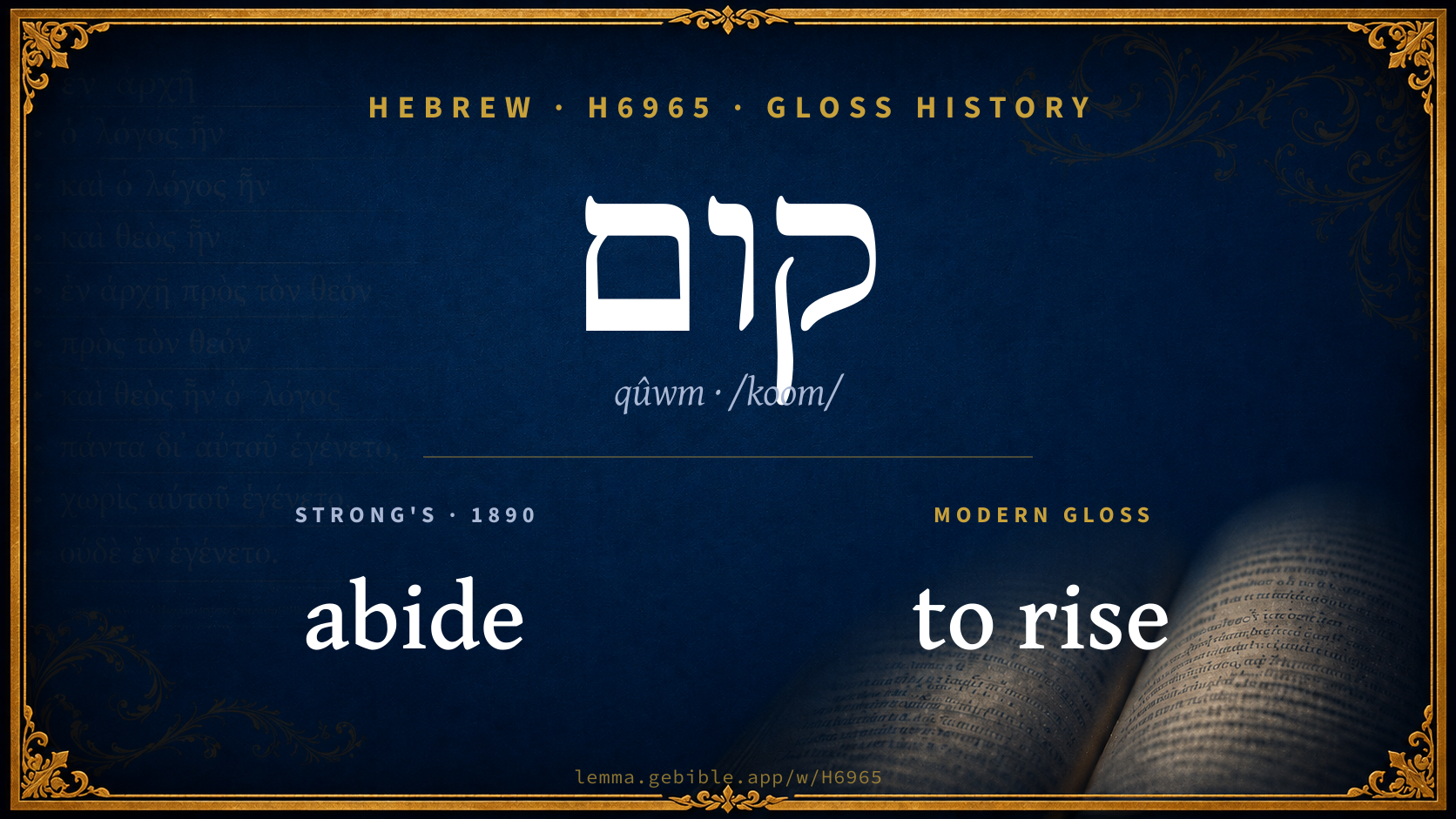
Gloss history
Strong's 1890 vs modern scholarship
About this word
Strong's H6965 catalogs a Hebrew word from the Hebrew Old Testament.
These counts are not copied from any lexicon or concordance. They are computed here, from the morphology-tagged Hebrew Old Testament. What Lemma adds →
- 596
- distinct verses
- The word appears in 596 distinct verses.
- 36 / 39
- OT books
- The word appears in 36 of 39 Old Testament books.
- #78
- by frequency
- Top 100 most frequent Hebrew words (rank 78 of 8,640 Hebrew words by occurrence).
View all 596 occurrences in the concordance →
By section of the Old Testament
By traditional corpus
Conventional, traditional groupings — biblical authorship is debated, so this is a traditional corpus grouping, not an authorship claim. Each share is this word’s portion of its verses in that division of the Hebrew canon. Each figure is a share of the word’s 596 distinct verses.
- Prophets (Nevi'im) 312 verses · 52%
- Writings (Ketuvim) 148 verses · 25%
- Torah (Pentateuch) 136 verses · 23%
How translations render this word
Counts come from each version’s own published word-to-Strong’s tagging or interlinear alignment — an approximate guide to how each version renders this word, not a word-level alignment the data otherwise carries. Because each total is that version’s own tagged count, the per-version totals vary from one another and need not match the appearance or distinct-verse counts above. These counts may also differ from a printed concordance because Lemma counts each distinctly tagged rendering and does not collapse phrase taggings into a single head-word total. This is a fixed set of word-tagged versions (KJV, ASV, BSB, ULT) and does not change with the reading translation you choose elsewhere. Each version’s license is shown beside its name below (and on Sources).
BDB lists this Strong’s number as 3 distinct words (homographs). Each count above pools all of them and is not split by sense — see the Senses section below. A low-frequency rendering may belong to a different one of those words, not the primary meaning.
- King James Version†: Arise 75×, Arose 70×, Rose up 47×
- American Standard Version†: Arose 63×, Arise 58×, Rose up 47×
- Berean Standard Bible†: Got up 43×, Get up 35×, Arise 28×
- unfoldingWord Literal Text†: And 86×, Arose 78×, Arise 76×
King James Version Public Domain
Renders H6965 across 629† tagged occurrences — most commonly:
Plus other, less common renderings. Plus 206 renderings that appear only once — usually multi-word phrases or single function words the recovered tagging swept in, not distinct renderings.
American Standard Version Public Domain
Renders H6965 across 627† tagged occurrences — most commonly:
Plus other, less common renderings. Plus 199 renderings that appear only once — usually multi-word phrases or single function words the recovered tagging swept in, not distinct renderings.
Berean Standard Bible Public Domain
Renders H6965 across 593† tagged occurrences — most commonly:
Plus other, less common renderings. Plus 179 renderings that appear only once — usually multi-word phrases or single function words the recovered tagging swept in, not distinct renderings. Not rendered by a distinct English word in 32 further occurrences.
unfoldingWord Literal Text CC BY-SA 4.0
Renders H6965 across 788† tagged occurrences — most commonly:
Plus other, less common renderings. Plus 150 renderings that appear only once — usually multi-word phrases or single function words the recovered tagging swept in, not distinct renderings.
55 senses and sub-senses in the full BDB
Hebrew verbs can shift meaning by stem (binyan): Qal is the basic action, Niphal is often passive or reflexive, Piel often intensifies or makes it factitive, and Hiphil is typically causative. The senses below are grouped under the stem BDB assigns to each. This entry also uses Hophal (the passive of Hiphil).
What do BDB’s symbols mean?
BDB uses these scholarly abbreviations:
| Symbol | Meaning |
|---|---|
| 𝔊 | the Septuagint (the ancient Greek translation, LXX) |
| 𝔙 | the Vulgate (the Latin translation) |
| 𝔖 | the Syriac version (the Peshitta) |
| 𝔗 | the Targum (the Aramaic translation) |
| ψ | the Psalms |
| √ | root (the underlying root or stem) |
| ‖ | parallel passage (a synonymous or contrasted parallel) |
| † | the dagger: every passage where the word occurs is cited |
The 55 senses and sub-senses the full Brown-Driver-Briggs lexicon distinguishes for this word, in lexicon order (not ranked by frequency), with BDB’s own verbatim wording and sub-sense lettering. Shown in Hebrew script with BDB’s own scholarly abbreviations. The condensed entry is in the Lexicon Entry tab. See also the Forms in the corpus table below.
קום I קַמְבֻּלָּי people of Gambulai SarowskyZAW 1912, 150–1 Je 51
קום II arise, stand up, stand
Qal
- Pf. 3 ms. קָם 1 S 17:48 +, וְקָאם consec. Ho 10:14 (Ges§ 72 p); 2 ms. קַמְתָּ 2 S 12:21, etc.; Impf. 3 ms. יָקוּם Ex 21:19, juss. יָקֻם Gn 27:31, (לָ֑ךְ) וְיָ֫קָם Jb 22:28 (Ges§ 109 h Dr§ 152(3)); וַיָּ֫קָם Gn 4:8 +, etc.; Imv. ms. קוּם Gn 13:17 +, fpl. קֹמְנָה Is 32:9, etc.; Inf. abs. קוֹם Je 44:29; cstr. קוּם Am 5:2 +, etc.; Pt. fs. קָמָה Mi 7:6; mpl. קָמִים 2 S 18:31 +, הַקּוֹמִים 2 K 16:17 (Ges§ 72 p), etc.;— e.g. 1 Samuel 17:48
- 1. arise: מִתַּחְתָּיו Ex 10:23 (E). Specif.: e.g. Exodus 10:23
- a. after lying down (sleep, sickness, mourning, etc.), 1 S 3:6, 8; 2 S 12:21; Ex 21:19; Gn 19:33, 35; 31:17; Ru 3:14; Ec 12:4 + 50 times; from lying dead, וַיָּקָם עַל־רַגְלָיו 2 K 13:21, cf. Jb 14:12 Is 26:14, 19 ψ 88:11; after falling Am 5:2; 8:14; Je 8:4; 25:27 + 4 times (chiefly fig.); after being smitten, wounded, etc. ψ 18:39 ‖ 2 S 22:39, Is 27:9 (of Asherim, etc.), 43:17 + 4 times; from sitting, reclining, especially at meals Gn 25:34; 1 S 1:9; 20:34 (מֵעִם הַשֻּׁלְחָן; v 25 see קָדַם), Est 7:7 (+ אֶל in constr. praegn.), but also Ju 3:20 (מֵעַל), 2 S 2:14(×2), 15, Jon 3:6 (מִכִּסְאוֹ), + 11 times, + (arise = stand up, in respect), Gn 19:1 (+ לִקְרָאתָם), 31:35 (מִפָּנֶיךָ), Lv 19:32 (מִפְּנֵי), Is 49:7; Jb 29:8; + וַיִּשְׁתַּחוּ 2 K 2:19, cf. Gn 23:7; Ex 33:10; 1 S 20:41; 25:41;—(v. also e); from kneeling (מִן, + מִלִּפְנֵי loc.) 1 K 8:54, from obeisance 1 S 25:42; Est 8:4; from bending over (עַל) dead Gn 23:3 (P). e.g. 1 Samuel 3:6
- b. out of (מִן) a condition, state, Ezr 9:5. e.g. Ezra 9:5
- c. of bear rising עַל pers., 1 S 17:35. e.g. 1 Samuel 17:35
- d. arise (+ stand) Ex 33:8 ψ 20:9 (fig. of success, prosperity), Jb 24:22 (id.), +; of sheaf Gn 37:7; of waters Jos 3:16 (נֵד־אֶחָד). e.g. Exodus 33:8
- e. constr. praegn. arise (and stand) for a purpose Nu 11:32 (E); over, עַל pers., 2 S 12:17. e.g. Numbers 11:32
- f. arise as prelim. to formal speech Ju 20:8; Mi 6:1; Je 1:17; 1 Ch 28:2 (עַל־רַגְלָיו), Pr 31:28; Jb 30:28 + 5 times; to testify (against) Dt 19:15, 16 (both ב pers.), ψ 27:12; 35:11, cf. also וַיָּקָם בִּי Jb 16:8 (of כַּחַשׁ q.v.; Bu כַּעַשׂ); to vindicate Jb 19:25 (עַל־עָפָר); to read aloud Ne 9:3 (עַל־עָמְדָם); to bless people 2 Ch 30:27 (priests). e.g. Judges 20:8
- g. to listen to God’s word Nu 23:18; Is 32:9; to praise God 2 Ch 20:19; Ne 9:4, 5. e.g. Numbers 23:18
- h. of noise, tumult Ho 10:14; of light Jb 25:3 (עַל pers.). e.g. Hosea 10:14
- 2. arise, in hostile sense (often with idea of suddenness); c. עַל pers. Dt 19:11 (out of ambush), 22:26; Ju 9:18; 20:5 ψ 27:3 (of war), Ob 1 (לַמִּלְחָמָה), + 11 times, + Jb 30:12 (according to Bu, reading עָלַי for עַל־יָמִין), + (of י׳) Am 7:9 (ב instr.), Is 14:22; 31:2; c. אֶל pers. Gn 4:8; 1 S 22:13; 24:8 (Gi v 7); c. ב pers. Mi 7:6 ψ 27:12 (false witness), Mi 7:6; c. עִם pers. ψ 94:16 (‖ יִתְיַצֵּב); v. especially pt. c. sf. = those rising up against me (thee, etc.) Ex 15:7; 32:25; Dt 33:11 + 8 times + ψ 109:28 (read קָמַי יֵבשׁוּ 𝔊 𝔙 Bae We Du, cf. Hup Dr); c. מִן from, out of Jos 8:7, 19 Ju 9:35, 43; 20:33; = revolt Nu 16:2 (לִפְנֵי pers.), 2 K 12:21; 2 Ch 13:6, cf. Hb 2:7. e.g. Deuteronomy 19:11
- 3. arise, abs., = become powerful Pr 28:12, 28. e.g. Proverbs 28:12
- 4. arise = come on the scene, appear, of leader, prophet, king Ju 5:7(×2); 10:1, 3 Dt 13:2; 34:10; Ex 1:8; 2 K 23:25; of years of famine Gn 41:30; c. אַחֲרֵי pers. Dt 29:21; Ju 2:10 1 K 3:12; c. תַּחַת, in place of, 1 K 8:20 = 2 Ch 6:10; Nu 32:14; c. עַל־מַמְלֶכֶת 2 Ch 21:4; c. מִן Nu 24:17 (sceptre out of Isr.); of calamity, Na 1:9; Pr 24:22; מִצָּהֳרַיִם יָקוּם הָ֑לֶד Jb 11:17 i.e. to shine upon thee. e.g. Judges 5:7
- 5. arise for, i.e. to become, c. ל rei; בְּיוֹם קוּמִי לְעַד Zp 3:8 (read לְעֵד, for a witness, 𝔊 𝔖 We Now GASm cf. Da); הֶחָמָס קָם לְמַטֵּה־רֶשַׁע Ez 7:11 (but dub.; Co Berthol Krae קָמֵל). e.g. Zephaniah 3:8
- 6.
- a. arise for action, especially of י׳ arising [from his throne], + inf. Is 2:19, 21; for judgment ψ 76:10 (לַמִּשְׁפָּט), Jb 31:14; often Imv. Nu 10:35 Je 2:27 ψ 3:8 + 8 times ψψ + 2 Ch 6:41 (c. לְנוּחֶ֑ךָ), ψ 132:8 (c. לִמְנוּחָתֶ֑ךָ); Impf. Is 28:21 + 4 times; Imv. also of men, arise! up! i.e. act! Ju 4:14 Ezr 10:4, of idols Je 2:28; Impf. of the tongue (personified) Is 54:17 (אִתָּךְ לַמִּשְׁפָּט). e.g. Isaiah 2:19
- b. arise (out of inaction), introducing some specific deed Gn 21:18; Ex 32:1; Ju 5:12; 8:20, 21; Je 49:14 (לַמִּלְחָמָה), Ob 1 (קוּמוּ וְנָקוּמָה עָלֶיהָ לַמִּלְחָמָה), + 37 times e.g. Genesis 21:18
- c. especially arise = start, make a move, to go somewhere, Gn 13:17; 19:14, 15; 1 S 9:3 Jon 1:3 (in flight), 3:3 + 110 times e.g. Genesis 13:17
- 7. stand: especially fig.
- a. = maintain oneself Jos 7:12, 13 (JE; לִפְנֵי pers.), Am 7:2, 5 Na 1:6 La 1:14 ψ 1:5; 24:3; Jb 41:18 (of sword), of courage (רוּח) Jos 2:11 (D; בְּאִישׁ, + לִפְנֵי pers.). e.g. Joshua 7:12
- b. = be established, confirmed, of kingdom 1 S 24:21 (בְּיָֽדְךָ; Gi v 20); of purchase Lv 27:19, c. ל pers. be assured to 25:30 Gn 23:17, 20 (all P). e.g. 1 Samuel 24:21
- c. stand, endure 1 S 13:14 Jb 8:15 (‖ עָמַד), 15:29. e.g. 1 Samuel 13:14
- d. = be fixed, of price, Lv 27:14, 17. e.g. Leviticus 27:14
- e. = be valid, of vows, Nu 30:5(×2) + 6 times Nu 30 + v 10 (c. עַל pers.; all P). e.g. Numbers 30:5
- f. = be proven Dt 19:15. e.g. Deuteronomy 19:15
- g. = be fulfilled Je 44:29 (impf. + inf. abs.; עַל pers.), Jb 22:28 (ל pers.); of י׳’s purpose Je 51:29 (עַל pers.), Is 14:24 Pr 19:21, cf. Je 44:28; Is 40:8; 46:10; of human plans, succeed Is 7:7; 8:10; 28:18; Pr 15:22. e.g. Jeremiah 44:29
- h. persist, עַל־נְדִיבוֹת יָקוּם Is 32:8 lit. on noble things doth he take his stand. e.g. Isaiah 32:8
- i. יָקוּם עַל־שֵׁם אָחִיו Dt 25:6 he shall stand upon the name of his dead brother, represent him. e.g. Deuteronomy 25:6
- j. of eyes, = be set, fixed, without vision 1 S 4:15 1 K 14:4 (עַיִן 1 i). e.g. 1 Samuel 4:15
Piel
- Pf. 3 ms. קִיַּם Est 9:31, 32; 3 pl. קִיְּמוּ v 27, 31; Impf. 1 s. וָאֲקַיֵּמָ֑ה ψ 119:106; Imv. ms. sf. קַיְּמֵנִי v 28; inf. cstr. לְקַיִּם Ez 13:6 +;—late (Aramaic): e.g. Esther 9:31
- 1. fulfil, Ez 13:6 ψ 119:106. e.g. Ezekiel 13:6
- 2.
- a. confirm, ratify, Ru 4:7. e.g. Ruth 4:7
- b. confirm, establish, of י׳ ψ 119:28 (c. sf. acc.). e.g. Psalms 119:28
- c. impose, an obligation, עַל pers. Est 9:21, 31b, עַל reflex. v 27, 31 c; c. acc. rei v 29, 31 a. 32. †Pōʿl. raise up: Impf. 2 ms. תְּקוֹמֵם Is 58:12; 1 s. אֲקוֹמֵם 44:26; 3 mpl. יְקוֹמֵ֑מוּ 61:4 (all of rebuilding);—יְקוֹמֵם Mi 2:8, read תָּקוּמוּ We Now, or קָמִים GASm Buhl. †Hithpōʿl. raise oneself, = rise up: Pt. fs. מִתְקוֹמָמָה Jb 20:27 (לְ pers. against); ms. sf. -מְמִי 27:7 one rising up against me (‖ אֹיְבִי); pl. abs. -מְמִים ψ 17:7; sf. -מְמַי 59:2; v. also 139:21, reading וּבְמִתְקוֹמְמֶיךָ (for MT וּבִתְק׳; ‖ מְשַׂנְאֶיךָ); see also קוט. e.g. Esther 9:21
Hiphil
- Pf. 3 ms. הֵקִים Jos 4:9 +; 2 ms. וַהֲקֵמֹתָ֫ Ex 26:30; Dt 27:2; 1 s. הֲקִימֹתִי 1 S 15:13, הֲקִמֹתִי Gn 9:17 +, etc.; Impf. 3 ms. יָקִים Dt 18:15 +; juss. יָקֵם 1 S 1:23 +; וַיָּ֫קֶם Ju 2:16 +; 2 fpl. תָּקִ֫ימְנָה Je 44:25, etc.; Imv. ms. הָקֵם 2 S 7:25 +, etc.; Inf. abs. הָקֵים Je 44:25, הָקֵם Dt 22:4 Ju 7:19; cstr. הָקִים 2 S 3:10 +, etc.; Pt. מֵקִים Am 6:14 +, etc.;— e.g. Joshua 4:9
- 1. cause to arise, raise:
- a. the prostrate (acc. pers. vel rei) 2 S 12:17 (מִן־הָאָרֶץ), Dt 22:4 (הָקֵם תָּקִים עִמּוֹ) ψ 41:11 Ec 4:10(×2); fig. Am 5:2; 9:11(×2) Ho 6:2; Is 49:8; 1 S 2:8 = ψ 113:7 (‖ הֵרִים), Jb 4:4; Je 50:32. e.g. 2 Samuel 12:17
- b. from throne (מִן) Is 14:9. e.g. Isaiah 14:9
- c. lift up shield (צִנָּה) against (עַל) Ez 26:8. e.g. Ezekiel 26:8
- d. fig. raise (to dignity, power) Is 49:6. e.g. Isaiah 49:6
- 2.
- a. raise, set up, stones Jos 4:9 (JE; בְּתוֹךְ loc.), v 20 (JE; ב loc.), 24:26 (E; שָׁם, תַּחַת loc.), Dt 27:2; pillars 1 K 7:21(×3) ‖ 2 Ch 3:17 Ex 40:18 (P); מַצֵּבָה, פֶּסֶל Ju 18:30 (ל reflex.), Lv 26:1 Dt 16:22; throne, fig., 2 S 3:10, king Dt 28:36 (both c. עַל over). e.g. Joshua 4:9
- b. erect, build: Is 23:13 Ex 26:30; heap of stones over (עַל) Jos 7:26; 8:29; altar 2 S 24:18 (לי׳) ‖ 1 Ch 21:18 (id.), 1 K 16:32 (לבעל), 2 K 21:3 (id.) = 2 Ch 33:3 (לבעלים); curtains Je 10:20 (of Judah’s tent, in fig.); tabern., etc., Ex 40:2, 18, 33 + 4 times Nu; erect against (עַל) Is 29:3. e.g. Isaiah 23:13
- c. fig. of setting up law ψ 78:5 (עֵדוּת; ‖ שִׂים). e.g. Psalms 78:5
- 3. raise up = bring on the scene: c. acc., sons in place of (תַּחַת) fathers Jos 5:7, אַחֲרֵי 2 S 7:12 = 1 Ch 17:11, 1 K 15:4; raise up זֶרַע לִאָחִיךָ Gn 38:8 (J); judges Ju 2:16, 18 (לָהֶם), cf. 3:9, 15 (both ל pers.); king Je 30:9, צֶמַח צַדִּיק 23:5, prophet Je 29:15 Dt 18:15, 18, priest 1 S 2:35 (all ל pers.); shepherds, etc. Mi 5:5 (עַל against), Zc 11:16; לְהָקִים לְאָחִיו שֵׁם Dt 25:7; plant of name Ez 34:29 (ל pers.); evil (רָעָה) 2 S 12:11 (עַל against). e.g. Joshua 5:7
- 4.
- a. raise up = rouse, stir up (lion, in fig.) Gn 49:9 (poem) = Nu 24:9 (JE). e.g. Genesis 49:9
- b. instigate, c. acc. pers. + עַל against Am 6:14 1 S 22:8; + ל pers. 1 K 11:14, 23; c. acc. alone Hb 1:6. e.g. Amos 6:14
- 5. raise up = constitute, הָקִיס־אֹתְךָ … לוֹ לְעָם Dt 29:12 cf. 28:9 Jb 16:12; וָאָקִים מִבְּנֵיכֶם לִנְבִיאִים Am 2:11; יָקֵם סְעָרָה לִדְמָמָה ψ 107:29 (cf. Qal 5). e.g. Deuteronomy 29:12
- 6. cause to stand:
- a. set, station, sentinels Ju 7:19 (הָקֵם הֵקִים), Je 51:12, cf. 6:17 (עַל pers.), 23:4 Ez 34:23; set feet on (עַל) rock ψ 40:3. e.g. Judges 7:19
- b. cause to hold one’s ground ψ 89:44 (בַּמִּלְחָמָה). e.g. Psalms 89:44
- c. establish throne 2 Ch 7:18, כָּל־אַפְסֵי־אָ֑רֶץ Pr 30:4. e.g. 2 Chronicles 7:18
- d. establish (make, ratify) covenant, of י׳, c. אֶת (prep.) pers. Gn 6:18; 9:9, 11; 17:19, 21; Ex 6:4 (all P); Ez 16:62; c. בֵּין … בֵּין Gn 9:17; 17:7 (both P); c. ל pers. Ez 16:60. e.g. Genesis 6:18
- e. = make binding, a vow Nu 30:14, 15(×2). e.g. Numbers 30:14
- f. = carry out, give effect to (DrSm. 1, 23), oath, covenant, vow, word, plan, command, of man 1 S 15:11, 13 + 6 times; of י׳ Gn 26:3; Lv 26:9; 1 S 1:23; 1 K 6:12 Dt 8:18 Je 23:20 + 18 times e.g. 1 Samuel 15:11
- g. לְהָקִים שֵׁם־הַמֵּת עַל־נַחֲלָתוֹ Ru 4:5, 10 to cause the dead man’s name to stand upon his inheritance (cf. Qal 7 i). e.g. Ruth 4:5
Hophal
- Pf. 3 ms. הֻ֫קַם עָ֑ל 2 S 23:1 be raised up (on הֻ֫קַּם van d. H., v. Dr); הוּקַם be set up Ex 40:17 (of tabern.); הוּקַם אֶת־דִּבְרֵי פ׳ Je 35:14 be held upright (Ges§ 121 a), i.e. observed, obeyed. e.g. 2 Samuel 23:1
Senses from the full Brown-Driver-Briggs lexicon (Brown, Driver, Briggs; Oxford 1906 — public domain), digitized via Sefaria, supplemented by the OpenScriptures HebrewLexicon (CC BY 4.0). Full attribution on Sources.
Word origin
I. קַמְבֻּלָּי people of Gambulai SarowskyZAW 1912, 150–1 Je 51:1.
I. vb. arise, stand up, stand;—(NH in der. spec. and deriv.; Ph. Hiph. Pt. and מקם place; Arabic قَامَ (و) stand, rise, Ethiopic ቆመ: stand, stop; Sab. מקם, place, HomChrest. 127; Aramaic קוּם, ܩܳܡ = BH, so Old Aramaic Nab. קום; Palm. Aph. אקים erect statue; cf. prob. Assyrian Kumu (k = כ), place, dwelling, kum, kêmu, in place of, and perhaps kaiamânu, enduring, constant (v. כִּיּוּן); Thes cp. also Sam. ࠒࠏࠌ, live, cf. especially 𝔗 Pa.);—
— Brown-Driver-Briggs (Oxford 1906, public domain), digitized via Sefaria, supplemented by the OpenScriptures HebrewLexicon (CC BY 4.0). See Sources.
Origin: a primitive root
Jastrow Dictionary
A second Hebrew/Aramaic lexicon for comparison, covering Aramaic and post-biblical (Talmudic, Targumic, Midrashic) usage that the biblical-Hebrew BDB does not. Matched by lemma rather than by Strong’s number, so a lemma may carry more than one Jastrow headword (shown separately below), and the entries cover usage well beyond the Bible.
קוּם
- (b. h.) to stand up, rise; to stand, exist. Sifré Deut. 357 (ref. to Deut. XXXIV, 10) אבל באומות קָם וכ׳ but among the nations he (a prophet like Moses) has existed &c.; R. Hash. 21ᵇ בנביאים לא קם וכ׳ among the prophets never one arose like Moses, but among the rulers one did arise (Solomon). Tanḥ. B’shall. 16 שכל הַקָּם … כאילו קם וכ׳ whoever rises against Israel is considered as if he rose against the Sh’khinah. Ib. (ref. to Ex. XV, 7) הרבית … כל הקָּמִים לנגדך thou hast often shown thyself glorious over all that rose against thee; a. v. fr.—קוּם עֲשֵׂה rise and do, a transgression of a prohibitive law which you must repair by an action, v. נָתַק. Ḥull. XII, 4. Macc. 15ᵇ, v. infra; a. fr.—V. קַיָּים. e.g. Deuteronomy 34:10
- 1. to establish; to attest, identify. Gitt. 2ᵇ אין עדים מצויין לקַיְּימוֹ no witnesses are likely to be found to attest it (identify the signatures). Ib. 6ᵃ כולי עלמא בעינן לקיימו all agree that identifiation by witnesses is required. B. Mets. 7ᵃ מודה בשטר … צריך לקיימו even if the debtor admits that he has written the note, the creditor must establish its identity (or else the debtor may maintain that the debt has been paid). Gitt. III, 4 וקיְּימוּ את דבריו and they sustained his opinion. Keth. 20ᵃ אין מְקַיְּימִין … אלא משטר וכ׳ a document can be identified only by comparison of the signatures with those on a document that had been disputed and declared valid in court. Ib. אין מקיימין … משתי כתובות וכ׳ a document can be identified only by comparison of signatures with two marriage deeds or deeds of sale of two fields &c. Ned. 72ᵃ שמע וק׳ if he heard her vow and confirmed it. Y. R. Hash. I, 56ᶜ top קִיַּימְתִּיהָ כשחל וכ׳ I sustain that opinion for a case when &c.; a. fr.—Part. pass. מְקוּיָּים. B. Mets. l. c. במק׳ דברי וכ׳ if the document has been identified, all agree &c.; a. e.
- 2. to fulfill, carry out, execute. Yoma 28ᵇ ק׳ אברהם וכ׳ Abraham fulfilled the whole Law. Macc. l. c. כל מצות … ק׳ וכ׳ in the case of a transgression of a prohibitive law for which reparation is commanded, if the transgressor fulfills the prescribed reparation, he is free (from legal punishment), but if he made the reparation impossible &c. Ib. ור"ש בן ל׳ קִיְּימוֹ ולא קִיְּימוֹ R. S. ben L. reads, if he makes reparation (he is free), and if he refuses, (he is punished); ib. 15ᵃ למאן דאמר ק׳ ולא ק׳ according to him who reads ḳiyy’mo v’lo ḳiyy’mo (punishment can be executed as soon as one refuses to make reparation, although reparation is not made impossible); Ḥull. 141ᵃ. Ab. IV, 9 כל הַמְקַיֵּים … לקַיְּימָהּ מעושר he who maintains (studies and observes) the Law in poverty, shall finally maintain it in wealth. Sot. 13ᵃ sq. אמרו ק׳ זה כל וכ׳ they said, this one (Joseph in the coffin) has fulfilled what is written in this (the tablets in the ark of the covenant). Y. R. Hash. I, 57ᵇ top רצה מְקַיְּימָהּ if he so desires, he observes it (his own decree). Ber. 9ᵇ ועבדום … ק׳ בהם וכ׳ the Lord fulfilled on them ‘and they shall make them serve &c.’ (Gen. XV, 14), but he did not fulfill on them &c.; a. v. fr.—מה אני מקיים וכ׳ how can I maintain the words &c., i.e. in what way can this Scriptural verse which seems to conflict with my opinion be interpreted? R. Hash. 21ᵇ אלא מה אני מקיים ביקש וכ׳ and how do I interpret the verse biḳḳesh &c. (Koh. XII, 10)? Y. Kidd. I, 61ᶜ bot. מה מקיים … בנים how does R. Elazar interpret banim &c. (Deut. XIV, 1)?; a. fr. e.g. Genesis 15:14
- 3. to sustain, preserve alive, save. Snh. IV, 5 כל המקיים … כאילו ק׳ וכ׳ he who saves one life … is considered … as if he had preserved the whole world; B. Bath. 11ᵃ. Ab. V, 1 צדיקים שמקיימין את העילם וכ׳ the righteous who sustain the world which was created &c. Kil. V, 8 המקיים קוצים בכרם he who keeps (cultivates) thorns in a vineyard. Ib. דבר שכמוהו מקיימין a plant of the kind that people are wont to cultivate; a. e.—4) to place (on the chafing stove). Tosef. Sabb. III, 1 ואין מקיימין עליה וכ׳ (not לה) you must not place dishes on it, until it is swept or covered with ashes. Ib. 3; Y. ib. III, beg. 5ᶜ; a. e.
- 1. to be established, identified. Gitt. I, 3 יִתְקַיֵּים בחותמיו let the genuineness of the document be established through its signers (the witnesses subscribed or through others identifying their signatures); a. fr.
- 2. to be fulfilled, realized. Macc. 24ᵇ עד שלא נִתְקַיְּימָה … שלא תִתְקַיֵּים נבואתו וכ׳ as long as the prophecy of Uriah (Mic. III, 12) was not fulfilled, I was afraid lest Zechariah’s prophecy (Zech. VIII, 4) fail to come true; עכשיו שנתקיימה … מִתְקַיֶּימֶת now that Uriah’s prophecy has been fulfilled, it is sure that Zechariah’s will come true. Tosef. Snh. XI, 8; Y. ib. XI, 30ᵃ bot. וכולן נִתְקַיְּימוּ, v. מִדָּה. Ber. 55ᵃ מקצתו מתקיים וכ׳ part of a dream may come true, but the whole of it will not. Midr. Till. to Ps. I, 3 מִתְקַיְּימוֹת are executed, v. עֵצָה II; a. fr. e.g. Micah 3:12
- 3. to be preserved; to last, endure. Gitt. II, 3 בכל דבר שאינו מתקיים with any writing-ink which does not endure. Pes. 68ᵇ אילמלא … לא נתקיימו וכ׳ but for the Law, heaven and earth would not continue to exist. Taan. 7ᵃ מה … מִתְקַיְּימִין וכ׳ as these three liquids can be preserved only in the lowest kind of vessels, so will the words of the Law stay with him only whose mind is lowly. Erub. 54ᵃ תלמודו מתק׳ בידו his learning will remain with him (in his memory). Shebi. VII, 2 מתק׳ בארץ plants the roots of which continue in the ground (perennials). Ab. IV, 11 כל כנסיה … סופה להִתְקַיֵּים every union for a sacred purpose is destined to last. Ib. V, 17 כל מחלוקת … סופה להתק׳ a contest for a sacred purpose is bound to have an enduring effect; a. fr.
- 4. to be maintained, be harmonised. Mekh. Mishp. s. 20 כיצד יִתְקַיְּימוּ שני מקראות הללו how can these two verses be harmonised?; a. fr.
- 1. to put up, erect. Ex. R. s. 52 בואו שנָקִים וכ׳ come, for we will put up the Tabernacle. Ib. שרתה … והֵקִימוֹ the holy spirit came upon him, and he put it up. Tanḥ. P’ḳudé 11 אני כותב עליך שאתה הֲקִימֹתוֹ I will record about thee, that thou didst put it up; a. fr.
- 2. to confirm (a woman’s vow). Ned. 67ᵇ אי ה׳ ה׳ if he (the father) has confirmed it, it stands confirmed (the betrothed cannot annul it). Ib. 69ᵃ יש שאלה בהָקֵם can a confirmation (by one of the two, the father or the husband) be reconsidered? (v. שְׁאֵלָה), v. הָקֵם; a. e.
- to be put up. Tanḥ. l. c. כיון שה׳ המשכן מיד וכ׳ as soon as the Tabernacle was erected, the Divine Presence came down &c. Tanḥ. Naso 23. Num. R. s. 12; a. fr.
קוּם ²
- 1. same. Targ. Gen. XXII, 3. Targ. Lev. XXV, 30; a. v. fr.—Part. קָאֵים, apocop. קָאֵי (q. v.); קָיֵם, קָיֵים; f. קָיְימָא; pl. קָיְימִין; קָיְימָן, קָיְמ׳. Targ. Josh. IV, 10. Targ. O. Ex. XXVI, 15 (Y. קַיָּמִין); a. v. fr.—B. Mets. 19ᵃ (expl. דייתיקי) דא תהי למֵיקַם וכ׳ this is to stand and be, that when I die &c. B. Bath. 43ᵇ bot. ארעא היכא דקָיְימָא תֵיקוּם let the land remain where it is (in the possession of the present incumbent). Gen. R. s. 65 ברייך יְקוּם לך may thy Creator stand by thee. Koh. R. to XI, 1 היידי הוא גברא דקָם ליה עיגוליה here is (I am) the man whom his loaf of bread assisted (who was rewarded for throwing his bread into the sea). Y. Ab. Zar. II, 40ᶜ bot. וקָמוּן and they remained (in the trade), v. עֲקַר I. Macc. 22ᵇ דקָיְימֵי מקמי וכ׳ who stand up before a scroll of the Law and do not stand up before a great man. Kidd. 33ᵇ קום מקמיה אביך stand up before thy father. Ib. קָאִימְנָא מקמיה I should stand up before him. Ib.ᵃ מֵיקַם לא קָאֵי הידור וכ׳ he stood not up before them (gentile old men), but he showed them honor. B. Mets. 7ᵃ ברשותיה קָיְימָא it is in his possession. Lev. R. s. 16 (ref. to Is. V, 19) נדע דמן הוא דקיימא וכ׳ that we know whose counsel will stand (prevail), ours or his; ib. לא ק׳ דידי וק׳ דלהון my counsel does not stand, shall theirs stand?; Yalk. Is. 266 הא קָמַת דידהון דידי לא now, theirs is carried out, and mine should not be?; Yalk. Lam. 1033, sq. (read עצא for על); Pesik. Vattom., p. 133ᵃ (corr. acc.). Y. Ter. I, 40ᵇ top בחרש אנן קָיְימִין we are standing at (are treating of) the case of a deaf mute. Y. Maasr. I, 51ᵇ, a. fr. (ב)מה (א)נן קיימין what are we treating of?; a. v. fr.—Yeb. 32ᵃ וקם ליה באשר לא יבנה וכ׳ (by giving ḥălitsah to one of his brother’s widows) he has been declared one ‘who does not build up his brother’s house’ (Deut. XXV, 9), and the Law says, when one has once refused ‘to build’, one must not ‘build’ again (marry another of his brother’s widows); ib. 44ᵃ.—Shebu. 26ᵃ כי הוו קיימי מקמיה דרב (Ms. F. מפטרי) when they were out of Rab’s sight, opp. כי אתו לקמיה.—ק׳ על, also ק׳ ב־ (cmp. עמד) a) to ascertain. Ab. Zar. 35ᵇ ליכא למֵיקַם עלה דמילתא it cannot be ascertained; a. e.—B. Mets. 19ᵃ קָמוּ … במילתא the Rabbis ascertained the case, v. קִים. Yeb. 31ᵃ; a. fr.—b) to bargain for. Gen. R. s. 11 אנא … קיימין עילויה myself and a certain Jew were bargaining for it (the fish); a. e.—קם ליה בדרבה מיניה, v. קִים.—תֵּיקוּ, נֵיקוּ = תֵּיקוּם, נֵיקוּם. B. Kam. 96ᵃ תקנתא לעכ"ום נ׳ ונעביד shall we get up and make rules for the benefit of gentile (robbers)? Zeb. 17ᵃ כל חדא וחדא ת׳ בדוכתה (not בדוכתיה; Ms. M. תיקום) let each verse stand in its own place, i.e. you can draw no analogies between them.—Esp. תיקו let it stand, i.e. the question remains undecided. B. Kam. l. c. Ḥull. 46ᵃ; a. fr. e.g. Isaiah 5:19
- 2. (v. עָמַד) to curdle. Ab. Zar. 35ᵇ נישקול מיניה קלי ונֵיקוּם (prob. to be read ונוֹקִים) let one take a little of it and curdle it. Ib. קיימי, v. נַסְיוּבֵי.
- 3. to cause to stand (v. קִים).—Inf. מִיקְמָא, מִיקְמָה, v. Af
- , אוֹקֵי
- 1. to put up, erect; to appoint, place; to maintain. Targ. O. Ex. XL, 2 תָּקִים (ed. Berl. a. Y. תְּקִים). Ib. 18 ואָקֵים (ed. Berl. ואָקֵים a. ואֵקִים). Targ. O. Deut. XXV, 7 לאָקָמָא ed. Berl. (oth. ed. לַאֲקָ׳; Y. למִיקְמָא). Targ. Ps. LXXVIII, 13. Targ. Prov. XXIX, 4; a. fr.—B. Mets. 39ᵇ מוֹקְמִינָן … לינוקא we (the court) appoint a guardian over it in behalf of the minor. Ib. מיגו דמוֹקִים … מוקמינן וכ׳ since one appoints a guardian for the one-sixth portion, we may just as well appoint one for the other sixth. B. Bath. 33ᵃ אוֹקְמָהּ … בידיה R. Ḥ. placed it in his possession, i.e. decided that it belonged to him. Ib. 34ᵃ מוֹקְמִינָן לה בידיה we would place (or leave) it in his possession; a. v. fr.—Taan. 8ᵃ, a. fr. אוקים … אמורא, v. אֲמוֹרָא.—Esp. a) to put a case, to treat with reference to. B. Bath. 44ᵃ ולוֹקְמָהּ בגזלן why does he not put the case as treating of a robber?; ולוקמה ביורש let him say, it refers to the case of an heir!; a. fr.—b) to let stand, place, leave (under the presumption). Keth. 12ᵇ, a. e. אוקי ממונא בחזקת מריה leave the money where it is, on the presumption that it belongs to its present owner, i.e. possession has the benefit of the doubt. Ib. אוֹקְמָהּ אחזקה leave the woman in her ascertained condition (v. חֲזָקָה), i.e. consider her as having married as a virgin. Yeb. 31ᵃ אוקי תרי להדי תרי ואשה אוקמה אחזקה leave the two witnesses (on the one side) against the two witnesses (on the other side), and leave the woman &c.; a. fr.—c) to establish, prove. Num. R. s. 6, end ורבנן מוֹקְמִין מהאי קרא וכ׳ and the Rabbis prove from this verse, that as atonement takes place in day-time, so &c.; a. e.—d) א׳ טבאות [to place right] to guarantee, secure. Y. Gitt. I, end, 43ᵈ אנן בעי תְּקִימִינָן ט׳ (not טבאת) we want thee to secure us (against an eventual loss of the money which thou art collecting from us for our creditors); בההוא דלא יכיל למִיקְמָה גרמיה ט׳ in the case of one who has no opportunity to secure himself (who cannot get a collector to take the risk), ברם ההוא דיכיל למיקמה וכ׳ but if he finds a collector to take the risk, he may take it away from the one and give it to the other; Y. Kidd. III, 64ᵃ.—
- 2. (v. עָמַד) to make consistent, curdle. Ab. Zar. 35ᵃ [read:] כיון דאוֹקְמֵיה איסורא הוא דקא מוֹקִים ליה וכ׳ (v. Ms. M. in Rabb. D. S. a. l., a. note) since it had the effect of curdling the milk, it is the forbidden matter that gave it substance, and therefore it (that forbidden substance) is to be considered as if it were there in its natural state. Ib.ᵇ, v. supra.
- to put up; to be placed. Targ. Ex. XL, 17. Targ. Lev. XVI, 10; a. e.
- to put up, erect. Targ. Is. XLIV, 26; a. e.
- 1. as preced. Pi., to establish, confirm, fulfill &c. Targ. O. Deut. XXXII, 8 (Y. Af.). Targ. Num. XXX, 14. Targ. Is. l. c. Targ. Ps. CXIX, 106; a. fr.—Ned. 70ᵃ דהא קַיְּימֵיה לנדריה היום (not קיימי, v. Rashi) for he has confirmed the vow to-day. Ib. (h. form) כיון דקִיְּימוֹ קִיְּימוֹ since he once confirmed it, it remains confirmed. Keth. 19ᵃ זילו קַיְּימוּ שטרייכו go and get evidence for the identification of your documents, and then come to court. Y. Gitt. I, end, 43ᵈ קיַּימְתֵּיה מדאמר וכ׳ thou canst substantiate thy opinion by referring to what R. … said. Pesik. Haʿomer, p. 72ᵇ למְקַיְּימָא לכון וכ׳ in order to fulfill on you the prophecy (Deut. XXXIII, 29) &c.; Yalk. Lev. 643; Pesik. R. s. 18. Y. Ab. Zar. V, 44ᵈ ואנא יכיל קַיֵּים and I can ascertain it (by experiment); a. v. fr.—Part. pass. מְקַיַּים. Ber. 55ᵃ לא חלמא טבא מק׳ וכ׳ (Ms. F. מתקיים) neither a good dream comes true entirely, nor a bad dream &c. e.g. Deuteronomy 33:29
- 2. (v. קְיָים) to swear, vow. Targ. Num. XXX, 3. Targ. Gen. XXVIII, 20. Targ. O. Lev. V, 4; a. e.
- as preced. Hithpa. Targ. Num. XIV, 38. Targ. Ez. XXXIII, 12; a. fr.—Y. Sabb. VI, end, 8ᵈ [read:] תִּתְקַיֵּים לכון נפשיכין בהדין יומכון היך דקַיַּימְתּוּן וכ׳ may your life be restored on that day of yours (when your time comes), as you have restored my life on this day. Erub. 54ᵃ כי היכי דתתקיים בידך ותוריך חיי (not ביך, v. Rabb. D. S. a. l.) in order that it (thy learning) may be preserved in thy possession, and thou mayest live long; a. e.
קוֹם
- (v. preced.Pe. 2, a. Af. 2) curdled milk, curd; [Maim. whey]. Ned. VI, 5. Ib. 52ᵇ. Y. ib. VI, 39ᵈ top מהו בק׳ חלבא מקטרא what is ḳom? ‘Bound milk.’
A Dictionary of the Targumim, the Talmud Babli and Yerushalmi, and the Midrashic Literature (Marcus Jastrow; London, Luzac, 1903) — Public Domain. Digitized via Sefaria. Digitized via Sefaria. Full attribution on Sources.
Forms in the corpus
The 364 distinct written forms H6965 takes in the Hebrew Bible, most frequent first — each parse links to that stem’s occurrences in the concordance. Hebrew forms include their vowel points and cantillation, so a single lemma takes many written forms.
The 60 most common forms are shown; 304 rarer forms follow in the full concordance.
Same root — word family
Other BDB entries built from the same root as H6965, grouped by Strong’s listed origin. These share a root / origin per the lexicon — not necessarily a shared meaning. Each links to that word’s own entry.
Derived from this word
- יקום yᵉqûwm H3351 substance
- מקום mâqôwm H4725 place
- קום qûwm H6966 to arise
- קומה qôwmâh H6967 height
- קוממיות qôwmᵉmîyûwth H6968 uprightness
- קים qîym H7009 adversary
- קימה qîymâh H7012 rising up
- קמה qâmâh H7054 standing grain
- תקומה tᵉqûwmâh H8617 standing
- תקומם tᵉqôwmêm H8618 rising against
Proper names from this root
People and places named from this root — a name, not an additional meaning of the word.
- יקים Yâqîym H3356 Jakim
- יקמיה Yᵉqamyâh H3359 Jecamiah
- יקמעם Yᵉqamʻâm H3360 Jekameam
- יקמעם Yoqmᵉʻâm H3361 Jokmeam
- קמואל Qᵉmûwʼêl H7055 Kemuel
- קמון Qâmôwn H7056 Camon
Compare all same-root words → Showing 4 of 17 — not the complete family. 6 of the same-root words are proper names (people or places). They share a root, not necessarily a meaning.
Septuagint verse parallels
This word appears in 546 verses that also exist in the Greek Old Testament (Septuagint), out of the 596 Hebrew verses it occurs in. You can read those verses in Greek by switching the Old Testament edition to the Septuagint.
Read these verses in the Septuagint
- Genesis 4:8
- Exodus 1:8
- Leviticus 19:32
- Numbers 1:51
- Deuteronomy 2:13
- Joshua 1:2
- Judges 2:10
- Ruth 1:6
- 1 Samuel 1:9
- 2 Samuel 2:14
- 1 Kings 1:49
- 2 Kings 1:3
This is a verse-level parallel only — the same verses exist in both the Hebrew and Greek Old Testaments. No word-level Hebrew↔Greek correspondence is claimed: the data carries no such alignment, so no Greek word is shown as this Hebrew word’s translation. Coverage is not total — the Septuagint omits the deuterocanon and renumbers the Psalms, so some Hebrew verses have no direct Greek parallel.