
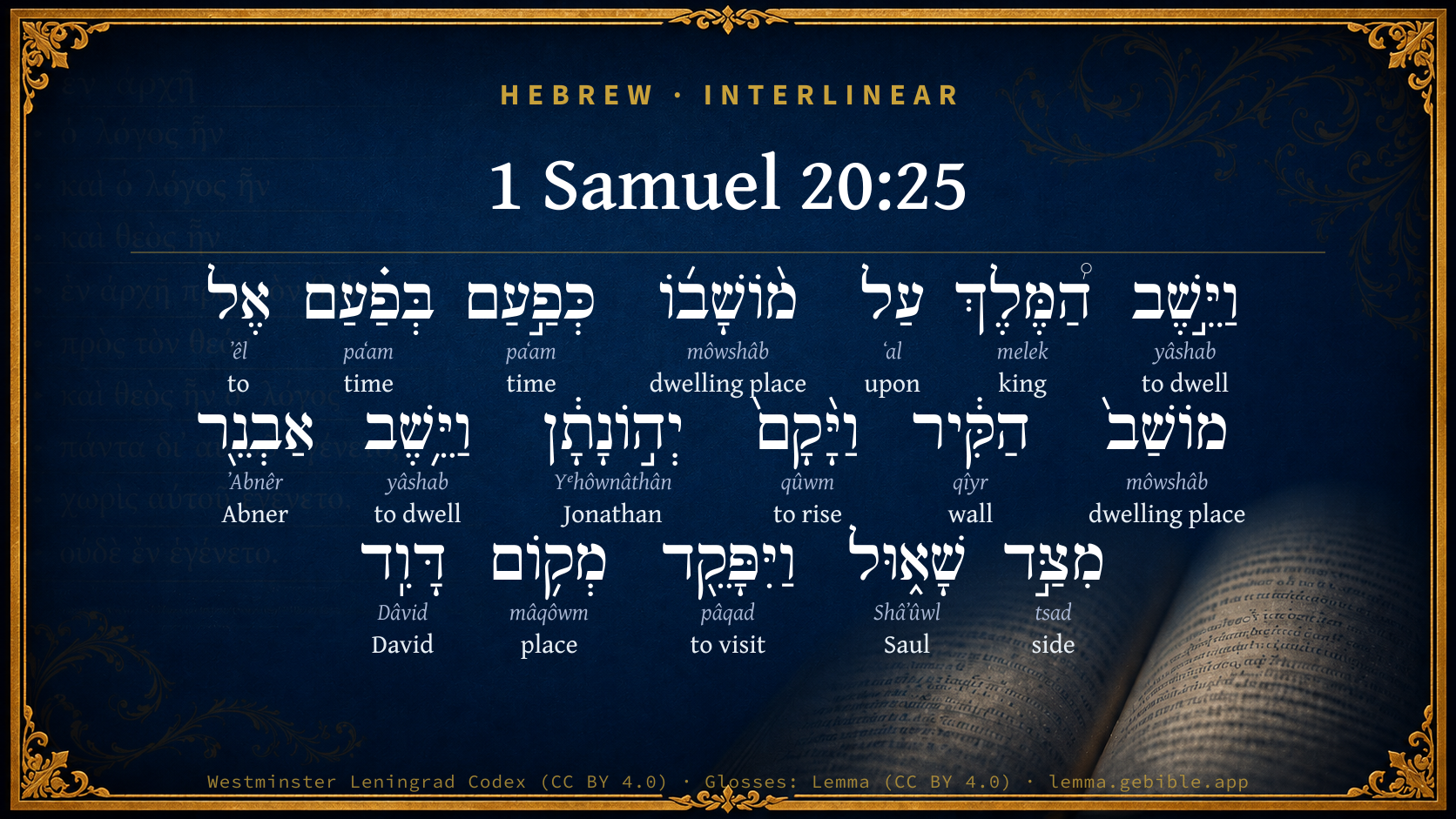
1 Samuel 20:25

Hebrew (Westminster Leningrad Codex) 1 Samuel 20:25 appears in the Hebrew Old Testament. The text above is from the Westminster Leningrad Codex. Each word links to its Strong’s number, a concise gloss, and parsing drawn from the Open Scriptures Hebrew Bible morphology. Click any word for its full Brown-Driver-Briggs (BDB) entry.
Download image
Cite this verse

1 Samuel 20:25 (World English Bible). Public Domain. Lemma interlinear Bible study tool, https://lemma.gebible.app/v/1-samuel/20/25.

Show BibTeX & RIS
BibTeX
RIS
English Translation
The king sat on his seat, as at other times, even on the seat by the wall; and Jonathan stood up, and Abner sat by Saul's side: but David's place was empty.
World English Bible · Public Domain
Download a study sheet

One document with this verse’s original text, its word-by-word gloss line, the meaning frame, cross-references with their text, attributed commentary, and full source and license credits — printable, and it pastes into notes with its structure intact.

This verse Autodidact and up

Study sheet (.html) Plain text (.txt)

A passage Seminary Student

Up to 50 verses in one chapter. A passage sheet keeps up to 6 commentary sources and 12 cross-references per verse, in the order this page ranks them, and says so on the sheet whenever that leaves anything out. Ask for a single verse and you get the Autodidact verse sheet above.

Everything on this page stays free to read, with no account — the sheet is a download of what is already on screen, not access to it.

Want to remove ads? Support Godless Engineer
Compare translations 3

The same verse in 3 English versions, stacked beneath the original-language interlinear above. Click any original word for its lexicon entry.

Each is an independent rendering of the whole verse — the interlinear is not word-aligned to these translations.

Highlighted words mark where these versions differ — a whole-verse word diff, not a word-by-word alignment.

  • World English Bible Public Domain
    The king sat on his seat, as at other times, even on the seat by the wall; and Jonathan stood up, and Abner sat by Saul's side: but David's place was empty.
  • King James Version Public Domain
    And the king sat upon his seat, as at other times, even upon a seat by the wall: and Jonathan arose, and Abner sat by Saul's side, and David's place was empty.
  • unfoldingWord Literal Text CC BY-SA 4.0
    And the king sat on his seat, as time by time, on the seat the wall. And Jonathan arose, and Abner sat by the side of Saul. And the place of David was missing.

unfoldingWord Literal Text — © unfoldingWord, licensed CC BY-SA 4.0. Word-aligned USFM3 via Door43 (git.door43.org/unfoldingWord/en_ult).

Versions to compare (up to 4)

3 of 4 selected

Show all 18 translations

Every available English version of this verse, each an independent rendering of the whole verse.

  • World English Bible Public Domain
    The king sat on his seat, as at other times, even on the seat by the wall; and Jonathan stood up, and Abner sat by Saul's side: but David's place was empty.
  • Berean Standard Bible Public Domain
    He sat in his usual place by the wall, opposite Jonathan and beside Abner, but David’s place was empty.
  • Majority Standard Bible Public Domain
    He sat in his usual place by the wall, opposite Jonathan and beside Abner, but David’s place was empty.
  • King James Version Public Domain
    And the king sat upon his seat, as at other times, even upon a seat by the wall: and Jonathan arose, and Abner sat by Saul's side, and David's place was empty.
  • American Standard Version (1901) Public Domain
    And the king sat upon his seat, as at other times, even upon the seat by the wall; and Jonathan stood up, and Abner sat by Saul's side: but David's place was empty.
  • Revised Version (1885) Public Domain
    And the king sat upon his seat, as at other times, even upon the seat by the wall; and Jonathan stood up, and Abner sat by Saul’s side: but David’s place was empty.
  • Geneva Bible (1599) Public Domain
    And the King sate, as at other times vpon his seate, euen vpon his seate by the wall: and Ionathan arose, and Abner sate by Sauls side, but Dauids place was emptie.
  • Douay-Rheims (1899) Public Domain
    And when the king sat down upon his chair (according to custom) which was beside the wall, Jonathan arose, and Abner sat by Saul's side, and David's place appeared empty.
  • Young's Literal Translation Public Domain
    and the king sitteth on his seat, as time by time, on a seat by the wall, and Jonathan riseth, and Abner sitteth at the side of Saul, and David's place is looked after.
  • Literal Standard Version CC BY-SA 4.0
    and the king sits on his seat, as time by time, on a seat by the wall, and Jonathan rises, and Abner sits at the side of Saul, and David’s place is looked after.
  • Unlocked Literal Bible CC BY-SA 4.0
    The king sat on his seat, as usual, on the seat by the wall. Jonathan stood up, and Abner sat by Saul's side. But David's place was empty.
  • unfoldingWord Literal Text CC BY-SA 4.0
    And the king sat on his seat, as time by time, on the seat the wall. And Jonathan arose, and Abner sat by the side of Saul. And the place of David was missing.
  • Darby Bible Public Domain
    And the king sat on his seat, as at other times, on the seat by the wall; and Jonathan arose, and Abner sat by Saul's side, and David's place was empty.
  • World Messianic Bible Public Domain
    The king sat on his seat, as at other times, even on the seat by the wall; and Jonathan stood up, and Abner sat by Saul’s side, but David’s place was empty.
  • Webster's Bible Public Domain
    And the king sat upon his seat, as at other times, even upon a seat by the wall: and Jonathan arose, and Abner sat by Saul's side, and David's place was empty.
  • Free Bible Version CC BY-SA 4.0
    He sat in his usual place by the wall opposite Jonathan. Abner sat next to Saul, but David's place was empty.
  • Bible in Basic English Public Domain
    And the king took his seat, as at other times, by the wall: and Jonathan was in front, and Abner was seated by Saul's side, but there was no one in David's seat.
  • JPS Tanakh (1917) Public Domain
    And the king sat upon his seat, as at other times, even upon the seat by the wall; and Jonathan stood up, and Abner sat by Saul's side; but David's place was empty.

Literal Standard Version (2020), Covenant Press — licensed CC BY-SA 4.0. Text via the HelloAO Bible API (eBible.org). Unlocked Literal Bible (unfoldingWord) — licensed CC BY-SA 4.0. Text via the HelloAO Bible API (eBible.org). unfoldingWord Literal Text — © unfoldingWord, licensed CC BY-SA 4.0. Word-aligned USFM3 via Door43 (git.door43.org/unfoldingWord/en_ult). Free Bible Version, Dr. Jonathan Gallagher — licensed CC BY-SA 4.0. Text via the HelloAO Bible API (eBible.org).

Word by word

More ways to search: Search by grammar → Find every occurrence → Compare this word →

Practice this passage: Drill this verse → Learn its vocabulary →

מִצַּ֣ד
tsad
H6654
“from · side of”
Preposition + Noun, Common, Masculine, Singular, Construct
Part of Speech
Preposition + Noun
Type
Common
Gender
Masculine
Number
Singular
State
Construct
Full BDB Definition

Origin: contr from an unused root meaning to sidle off

TWOT: 1876a

side
  1. וַיֵּ֣שֶׁב yâshab H3427 “and · to dwell” Conjunction + Verb, Qal, Sequential Imperfect, 3rd Person, Masculine, Singular
  2. הַ֠מֶּלֶךְ melek H4428 “the · king” Particle, Definite Article + Noun, Common, Masculine, Singular, Absolute
  3. עַל ʻal H5921 “upon” Preposition
  4. מ֨וֹשָׁב֜וֹ môwshâb H4186 “dwelling place · his” Noun, Common, Masculine, Singular, Construct + Suffix, Personal, 3rd Person, Masculine, Singular
  5. כְּפַ֣עַם paʻam H6471 “like/as · time” Preposition + Noun, Common, Feminine, Singular, Absolute
  6. בְּפַ֗עַם paʻam H6471 “in/at · time” Preposition + Noun, Common, Feminine, Singular, Absolute
  7. אֶל ʼêl H413 “to” Preposition
  8. מוֹשַׁב֙ môwshâb H4186 “dwelling place of” Noun, Common, Masculine, Singular, Construct
  9. הַקִּ֔יר qîyr H7023 “the · wall” Particle, Definite Article + Noun, Common, Masculine, Singular, Absolute
  10. וַיָּ֨קָם֙ qûwm H6965 “and · to rise” Conjunction + Verb, Qal, Sequential Imperfect, 3rd Person, Masculine, Singular
  11. יְה֣וֹנָתָ֔ן Yᵉhôwnâthân H3083 “Jonathan” Noun, Proper
  12. וַיֵּ֥שֶׁב yâshab H3427 “and · to dwell” Conjunction + Verb, Qal, Sequential Imperfect, 3rd Person, Masculine, Singular
  13. אַבְנֵ֖ר ʼAbnêr H74 “Abner” Noun, Proper
  14. שָׁא֑וּל Shâʼûwl H7586 “Saul” Noun, Proper
  15. וַיִּפָּקֵ֖ד pâqad H6485 “and · to visit” Conjunction + Verb, Niphal, Sequential Imperfect, 3rd Person, Masculine, Singular
  16. מְק֥וֹם mâqôwm H4725 “place of” Noun, Common, Masculine, Singular, Construct
  17. דָּוִֽד Dâvid H1732 “David” Noun, Proper

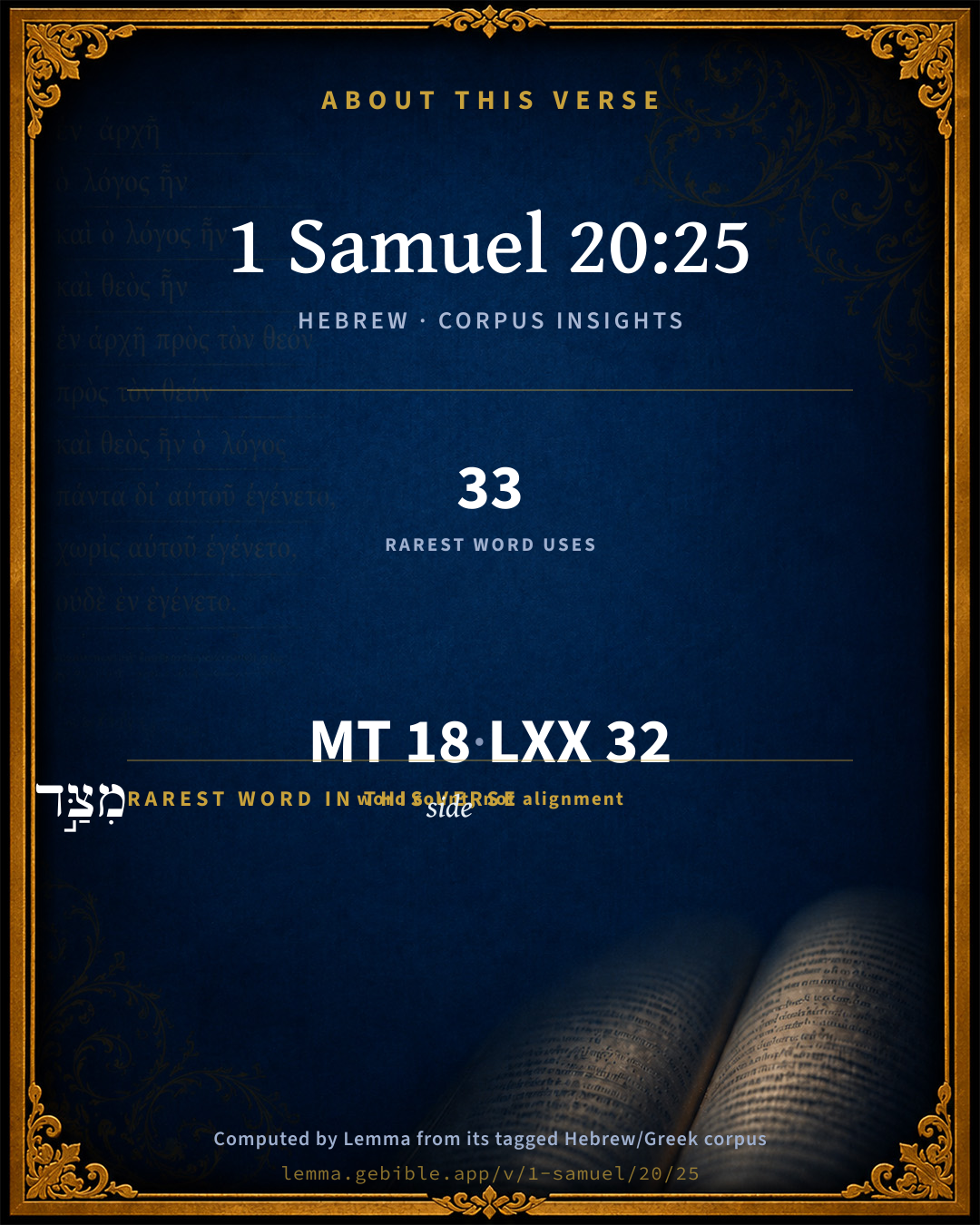
About this verse

These counts appear in no published source. They are computed here, from the morphology-tagged text and Lemma’s own curated glosses. What Lemma adds →

18
words
15
distinct lemmas
Historical
section

Shared distinctive vocabulary

מִצַּ֣ד side H6654 occurs in 27 verses of the Hebrew Bible. Also found in:

Grammatical profile

  • 4 verbs
  • 12 nouns
  • 2 prepositions

Verb forms

  • וַיֵּ֣שֶׁב Qal · Sequential Imperfect
  • וַיָּ֨קָם֙ Qal · Sequential Imperfect
  • וַיֵּ֥שֶׁב Qal · Sequential Imperfect
  • וַיִּפָּקֵ֖ד Niphal · Sequential Imperfect

Repetition

Words recur within this verse — often emphatic in Hebrew:

  • וַיֵּ֣שֶׁב to dwell H3427 ×2
  • מ֨וֹשָׁב֜וֹ dwelling place H4186 ×2
  • כְּפַ֣עַם time H6471 ×2

Hebrew & Septuagint length

In English translation the verse runs 32 words from the Hebrew and 37 from the Septuagint (LXX English) — closely comparable.

A rough comparison of the two English renderings, which tokenize alike — not a word-level alignment.

Word counts can differ between the Hebrew and the Greek without any difference in meaning — e.g. the Hebrew direct-object marker אֵת has no separate Greek word, and Greek often adds the article ὁ.

In the original languages it is 18 Hebrew tokens and 32 Greek tokens — but the two are counted differently (Hebrew bundles its prefixes and suffixes into one token; the Greek is in lemma form), so that isn’t a like-for-like length.

Cross-references

2

Topical passages linked to 1 Samuel 20:25 in the Treasury of Scripture Knowledge — connected by theme and wording, ordered by reader-vote popularity; previews shown in the World English Bible.

  • 1 Samuel 20:18 Then Jonathan said to him, Tomorrow is the new moon: and you will be missed, because your seat will be empty.
  • Judges 16:20 She said, The Philistines are on you, Samson. He awoke out of his sleep, and said, I will go out as at other times, and shake myself free. But he didn't know that Yahweh had departed from him.

Cross-references courtesy of OpenBible.info (CC BY 4.0).

Hebrew and Greek witnesses Masoretic Hebrew ↔ Greek Septuagint

The same verse in the two great witnesses to the Old Testament, shown verse-for-verse.

These are two independent witnesses, not word-aligned to each other, and the Septuagint is shown in lemma (dictionary) form.

Hebrew 1 Samuel 20:25 Masoretic · Westminster Leningrad Codex

וַיֵּ֣שֶׁב הַ֠מֶּלֶךְ עַל מ֨וֹשָׁב֜וֹ כְּפַ֣עַם בְּפַ֗עַם אֶל מוֹשַׁב֙ הַקִּ֔יר וַיָּ֨קָם֙ יְה֣וֹנָתָ֔ן וַיֵּ֥שֶׁב אַבְנֵ֖ר מִצַּ֣ד שָׁא֑וּל וַיִּפָּקֵ֖ד מְק֥וֹם דָּוִֽד

The king sat on his seat, as at other times, even on the seat by the wall; and Jonathan stood up, and Abner sat by Saul's side: but David's place was empty.

World English Bible · Public Domain

Greek LXX 1 Samuel 20:25 Septuagint · lemma form

καί καταἵζω ὁ βασιλεύς ἐπί ὁ καθέδρα αὐτός ὡς ἅπαξ καί ἅπαξ ἐπί ὁ καθέδρα παρά τοῖχος καί προφθάνθ ὁ ιωναθαν καί καταἵζω αβεννηρ ἐκ πλάγιος σαούλ καί ἐπισκέπτομαι ὁ τόπος δαυίδ

And he sat upon his seat as in former times, even on his seat by the wall, and he went before Jonathan; and Abenner sat on one side of Saul, and the place of David was empty.

LXX2012 (modern English Septuagint) · Public Domain

On this verse, Ellicott's Commentary for English Readers discusses the Septuagint’s reading. Read the note in Commentary ↓

Hebrew: Westminster Leningrad Codex (CC BY 4.0). Greek: Septuagint (public domain); English from LXX2012 (modern English Septuagint) (Public Domain). How the Septuagint differs from the Hebrew →

Targum (Aramaic paraphrase)

1

The Targum is the ancient Jewish Aramaic paraphrase of the Hebrew Scriptures — an interpretive translation, not the Hebrew text itself. Onkelos (literal) and Pseudo-Jonathan (expansive) render the Torah, and Jonathan the Prophets. Coverage is partial: where no permissively-licensed English translation exists for a verse, only the Aramaic is shown. This is verse-level text, not a word-by-word alignment to the Hebrew.

  1. Targum Jonathan Prophets (Joshua–Malachi)
    וְאַסְחַר מַלְכָּא עַל שִׁוְיֵיהּ כִּזְמַן בִּזְמַן עַל שִׁוְיֵה דִמְתַקַן לֵיהּ בִּסְטַר כּוֹתְלָא וְקָם יְהוֹנָתָן וְאַסְחַר אַבְנֵר מִסִטְרָא דְשָׁאוּל וַהֲוָה אַתְרָא דְדָוִד מַרְוָח:

    (no public-domain English translation for this verse)

    Targum Jonathan — Aramaic: “Mikraot Gedolot” (public domain). English: “Sefaria Community Translation” (CC0 1.0 (public-domain dedication)); “London "Chaldee Paraphrase," 1871” (public domain). Text via Sefaria.

Commentary

Notes on 1 Samuel 20:25 from classic Christian and Jewish commentators (each source and its license shown beneath its notes). The classic Christian expositions comment on the surrounding passage and are grouped to its opening verse, so a note may address several verses; the Jewish commentaries on the Tanakh (Rashi and others) are per-verse, so they appear only where the commentator wrote on this verse.

Lemma curates 59 commentaries, every one of them public domain or Creative Commons licensed, each selected and text-cleaned for this edition rather than reprinted as found. About our sources →

Trapp's Complete Commentary

John Trapp

1Sa 20:25 And the king sat upon his seat, as at other times, [even] upon a seat by the wall: and Jonathan arose, and Abner sat by Saul’s side, and David’s place was empty.

Ver. 25. And Jonathan arose,] viz., To sit down at the table by his father; or perhaps in honour of Abner, and to give him place; as not willing to sit so near his father, but pretending some other thing to avoid the danger which be feared.

John Trapp, A Commentary or Exposition upon All the Books of the Old and New Testament (1647–1656) — public domain. Text from a community e-Sword module.

The Biblical Illustrator

Joseph S. Exell

1Sa_20:25

Davids place warn empty.

The empty place

And the king sat upon his seat, as at other times, even upon a seat by the wall: and Jonathan arose, and Abner sat by Sauls side, and Davids place was empty (1Sa_20:25). I shall look at these words in the spirit of accommodation to the ordinance of the Lords Supper. There, too, will be a feast, a feast provided not by an earthly king, but by Him who is the King of kings. Let us consider some of the reasons which may probably be assigned for these vacant places.

1. But some places are empty. Some are empty, and we may envy the men and women, brothers and sisters in Christ, who once sat there, but will sit there no more. They are gone to claim the inheritance of which the Lord said, I will give it you.

2. But other places are vacant not through this heavenly translation. And as we ask, Where are they who usually occupy them? the answer comes, They are suffering under the Lords hand. Yes, many places are empty for this reason, and where this is the reason the vacancy is no reproach.

3. Sometimes Davids place is empty because he is engaged in Christian work.

4. Other places, too, are vacant from motives which are entitled to tender consideration, and which also require as tender correction. They fear they are not in a true and befitting mood for the sacrament. They are cold. They know not bow it is, but somehow the spiritual temperature is low.

5. But other places are empty for reasons less worthy. Their blank spaces tell, it may be, of hearts that are dying through habitual sin, or habitual neglect of the very conditions of life. (E. Mailer, D. D.)

The empty place: A Christmas Day sermon

I. The empty place in the persecutors house: Davids place was empty. David had good reason for vacating his place at Sauls table, for the passionate king was so malicious, and so embittered against him, that he sought his life. The child of a Roman noble had stepped into some little place where humble and unlettered people met to hear the gospel preached, to sing songs in the name of Jesus, and to keep holy one day in the week; and there that youthful heart had learnt the story of the cross, and by the grace of God had been brought to love the Saviour. As soon as the fact was made known, the officers of justice would take away the child from the fathers house, and hale the young believer off to prison, and so another seat was empty. You know how it was in our own land, how many a seat was empty during the persecutions of Queen Mary. If martyr days should come back again, could we vacate our places? Could the husband let his wife and children go for Christs sake?

II. There is another place which sometimes becomes empty, that is, the place of sinful pleasures. This empty place is the result of the working of Gods grace in the heart.

III. The place of our occupation has been empty.

IV. During the past year, many of you now present have had a place is the assembly of Gods people.

V. I have now to say just a few words specially to the members of the church about their place at the prayer meeting.

VI. There is another Davids place that is sometimes empty, and that ought not to be so, it is the place of christian service.

VII. Again, I hope that our place at the Lords table will not be empty at any time when it is possible for us to occupy it.

VIII. When you will be keeping the Christmas feast, there will be many family gatherings, and in those family gatherings there will be some households where Davids place will be empty.

IX. There will be no empty place in heaven. In that great family gathering up above, they will not be able to say, Davids place is empty. (C. H. Spurgeon.)

The Biblical Illustrator, edited by Joseph S. Exell (c. 1880s–1900s) — public domain. Text from a community e-Sword module.

Tyndale Open Study Notes

Tyndale Open Resources

20:25 Abner was Saul’s cousin and served as commander of Saul’s army (14:50; 17:55). His importance is indicated by his position beside the king at this festival.

Tyndale Open Study Notes — © Tyndale Open Resources, licensed CC BY-SA 4.0. Text via the HelloAO Bible API.

Jamieson, Fausset & Brown

Robert Jamieson, A. R. Fausset & David Brown

SAUL, MISSING DAVID, SEEKS TO KILL JONAHAN. (1Sa. 20:24-40)

the king sat upon his seat, as at other times . . . by the wall--The left-hand corner at the upper end of a room was and still is in the East, the most honorable place. The person seated there has his left arm confined by the wall, but his right hand is at full liberty. From Abner's position next the king, and David's seat being left empty, it would seem that a state etiquette was observed at the royal table, each of the courtiers and ministers having places assigned them according to their respective gradations of rank.

Jonathan arose--either as a mark of respect on the entrance of the king, or in conformity with the usual Oriental custom for a son to stand in presence of his father.

Jamieson, Fausset & Brown — Commentary Critical and Explanatory on the Whole Bible (1871) — public domain (CC PDM 1.0). Text via the HelloAO Bible API.

Adam Clarke's Commentary

Verse 25. The king sat upon his seat] It seems that there was one table for Saul, Jonathan, David, and Abner; Saul having the chief seat, that next to the wall. As only four sat at this table, the absence of any one would soon be noticed.

Adam Clarke's Commentary on the Bible (1810–1826) — public domain. Text from a community e-Sword/MySword module.

Ellicott's Commentary for English Readers

(25) David’s place was empty.—All took place as the two friends had calculated. Saul’s seat was by the wall—then, as now, in the East the highest place of honour was opposite the door. The exact meaning of the phrase, “and Jonathan arose,” has been disputed. The LXX. translate here from a different text thus: “He (Saul) went before Jonathan.” Keil speaks of this, however, as “the senseless rendering of the Greek Version.” The sense in which this difficult passage is understood by Abarbanel and Rashi seems on the whole the best. Understanding that Jonathan had already seated himself after Saul, and that David’s absence was observed, “he (Jonathan) arose and seated Abner at Saul’s side,” that is, in the place left vacant by David’s absence, in order that the seat next to Saul might not be empty, he himself having taken the seat on the other side of Saul. This rendering considers vayêshev as causative, a verb in the Hipnil conjugation, written defectively, as in 2Ch_10:2; so Lange, who also quotes Kitto as suggesting an explanation of Saul’s expecting David’s presence at all at the new moon feast. David, after the strange events at Naioth by Ramah, would suppose (so the king thought) that Saul’s feelings towards him had undergone a complete change, and that now, after the ecstasy into which Saul had fallen, he would be once more friendly with him as aforetime.

A Bible Commentary for English Readers, edited by Charles John Ellicott (1878–1897) — public domain. Text from a community e-Sword module.

The Cambridge Bible for Schools and Colleges

gen. ed. J. J. S. Perowne

25. upon a seat by the wall] Saul occupied the place of honour at the top or the centre of the table opposite the entrance.

and Jonathan arose] This appears to mean that Jonathan first occupied his usual seat by Saul’s side, but when Abner entered resigned the place to him, probably not wishing to sit next his father in David’s absence. The Sept. has a different reading, “And he preceded Jonathan,” which is equally obscure. Josephus says, “When they had sat down beside Saul, Jonathan on the right, and Abner on the left.”

The Cambridge Bible for Schools and Colleges (gen. ed. J. J. S. Perowne; Cambridge University Press, 1878–1918) — public domain. Text from a community e-Sword module.

John Gill's Exposition

And the king sat upon his seat as at other times,.... Upon the seat he usually sat on:

even upon a seat by the wall; on a couch by the side of the wall; or, as Jarchi and R. Isaiah say, at the head of the couch by the wall, which was the most honourable place; and Kimchi observes, it was the custom in those days to eat meat sitting on beds or couches, see Sa1 28:23,

and Jonathan arose; either in reverence to his father, when he came in and took his seat, or in respect to Abner upon his coming in, being the son of Saul's uncle, and general of the army; for though he arose, he did not depart, it is plain he sat down again, Sa1 20:34. Kimchi thinks, that after Jonathan had sat down at the side of his father, he arose and placed Abner there, because he would not be near his father, that if he should be wroth with him on account of David, he might not be near him to smite him:

and Abner sat by Saul's side; according to Josephus (c) Jonathan sat at his right hand and Abner on the left, and it was usual for the master, or principal person, to sit in the middle; so Dido in Virgil (d). Abarbinel places them thus, Saul was at the head of the table, and David was used to sit by him, and Jonathan by David, and Abner by Jonathan; and now the king sat in his place, and Jonathan in his place, and Abner after him; and David's place being empty, Jonathan was left next to his father, without any between; wherefore he now arose from his place, and Abner sat on that side where Saul was, so that Abner was between Jonathan and Saul:

and David's place was empty; where he used to sit at table, he not being there, and no one taking it.

(c) Antiqu. l. 6. c. 11. sect. 9. (d) "----- mediamque locavit". Aeneid. 1. prope finem. Vid. Servium in ib.

John Gill's Exposition of the Whole Bible (1746–1763) — public domain (CC PDM 1.0). Text via the HelloAO Bible API.

Haydock's Catholic Bible Commentary

Arose, out of respect. Septuagint, "he had the precedence over Jonathan" alone, as the latter sat "on the king’s right hand, and Abner on the left," Arabic. (Calmet) --- David’s place was after Abner. (Menochius)

George Leo Haydock (1774–1849), Haydock's Catholic Family Bible and Commentary, 1859 edition — public domain. Excludes Psalms (Douay-Rheims chapter numbering differs from Protestant) and Deuterocanonical books (Catholic canon only).

Matthew Poole's English Annotations

Jonathan arose, to wit, from his seat where he was sat next to the king, whence he arose, and stood up at Abner’s coming, to do honour to him, who was his father’s cousin, and the general of the army. David’s place seems to have been next to Abner, on the same side with him.

Matthew Poole's English Annotations on the Holy Bible (1683–1685) — public domain. Text from a community e-Sword/MySword module.

Whedon's Commentary on the Bible

Daniel D. Whedon

25. Upon a seat by the wall — The uppermost seat opposite the entrance to the room, and consequently by the wall. See cut appended to note on Mat_23:6.

And Jonathan arose — The meaning seems to be that Jonathan was sitting by Saul’s side, and when Abner entered he arose and gave to him the seat of honour he had himself been occupying.

Daniel D. Whedon (gen. ed.), Commentary on the Old and New Testaments (1874–1909) — public domain. Text from a community e-Sword module.

John Wesley's Explanatory Notes

Arose - He rose from his seat where he was sat next the king, and stood at Abner's coming, to do honour to him, who was his father's cousin, and the general of the army.

John Wesley, Explanatory Notes Upon the Whole Bible (1754–1765) — public domain. Text via the GEBible commentary corpus.

Rashi

Rabbi Shlomo Yitzchaki (Rashi)

On the seat against the wall. At the head of the couch, next to the wall.

Yonoson rose. He stood up from his place, because it is not proper for a son to recline beside his father; their custom was to eat while reclining on couches, and Dovid would recline between Yonoson and Shaul. Now that Dovid did not come, Yonoson did not recline until Avneir sat down beside Shaul, and afterwards, Yonoson sat beside Avneir. And if you say that he did not sit as all, Scripture states, 'And Yonoson rose from the table,' implying that he had been sitting.

Rashi on the Tanakh — English translations: “The Judaica Press complete Tanach with Rashi, translated by A. J. Rosenberg” (CC BY 4.0); “Pentateuch with Rashi's commentary by M. Rosenbaum and A.M. Silbermann, 1929-1934” (public domain); “The Metsudah Tanach series, Lakewood, N.J” (CC BY 4.0); and “The Book of Joshua, Metsudah Publications, 1997” (CC BY 4.0). Text via Sefaria.

Lesson kit

Teaching starters — assembled from the data on this page, not authored interpretation. Every prompt links to the verse data it draws on. Edit before teaching.

1 Samuel, in the Historical, opens this verse with 18 words (15 distinct Hebrew lemmas). Its most distinctive word is tsad (“side”). A historical commentator’s framing appears above. Read the whole chapter for the surrounding context.

Discussion questions

  1. What does “side” (tsad) contribute to the verse as a whole?
  2. How does Genesis 6:16, which shares the word «side», read alongside this verse?
  3. What does the repetition of “to dwell” (2× in this one verse) do in this verse?
  4. The translations on this page render this verse differently — a whole-verse word diff, not a word-by-word alignment. What might account for the different wordings?
  5. «וַיֵּ֣שֶׁב» is a Qal Sequential Imperfect verb. How does that grammatical form shape the action described?
  6. Compare how Trapp's Complete Commentary and The Biblical Illustrator read this verse. Where do they agree or differ?

Things to notice

Reading settings

Reading text

Shown beneath each verse's original-language words.

Old Testament
Old Testament edition

Read the OT as the Masoretic Hebrew (MT) or the Greek Septuagint (LXX).

English shown for the Greek Septuagint (in the Hebrew ↔ Greek comparison).

Comparing translations? Open the Compare panel on any verse page to stack up to four side by side.