
Numbers 30:14

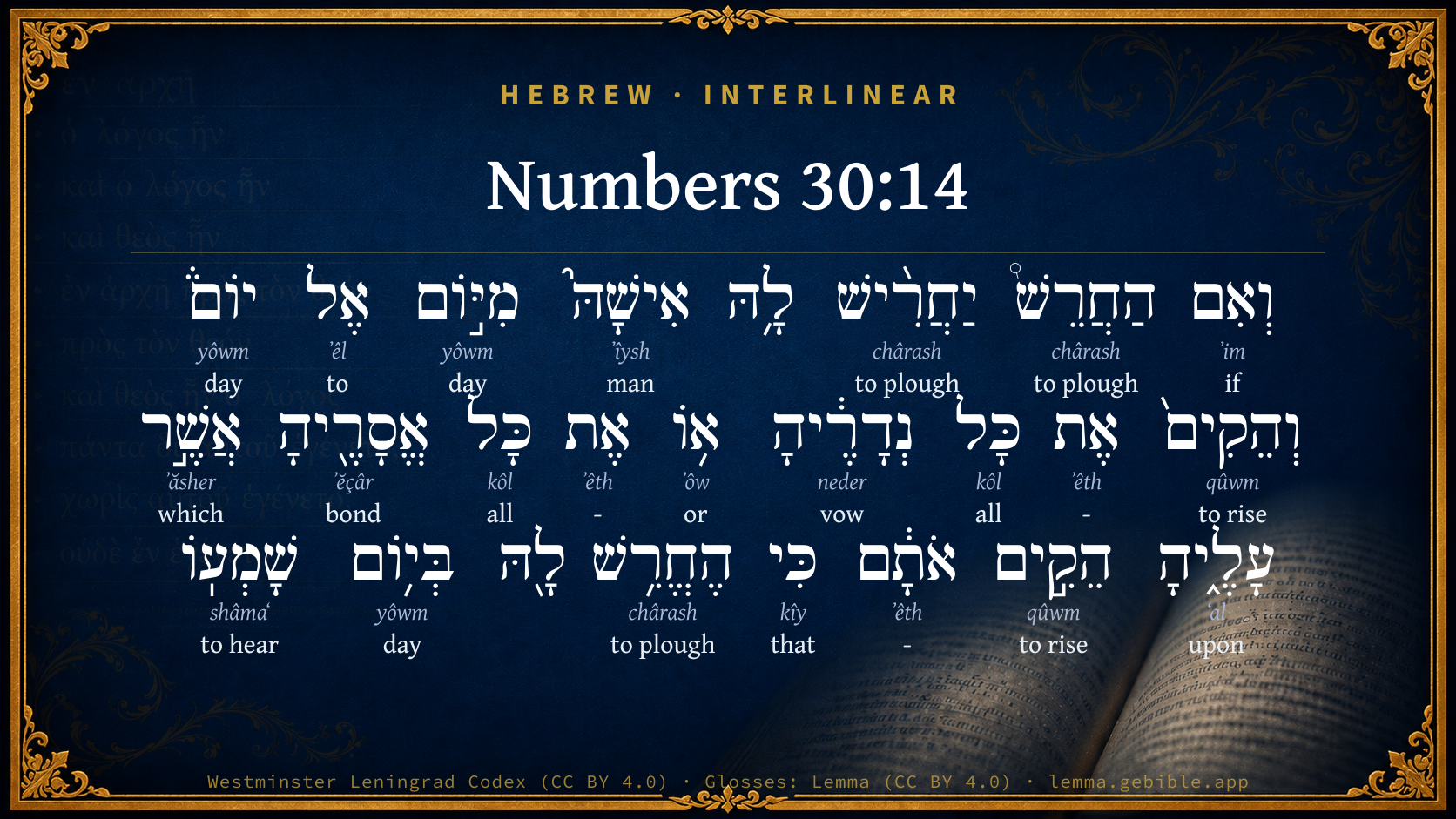
Hebrew (Westminster Leningrad Codex) Numbers 30:14 appears in the Hebrew Old Testament. The text above is from the Westminster Leningrad Codex. Each word links to its Strong’s number, a concise gloss, and parsing drawn from the Open Scriptures Hebrew Bible morphology. Click any word for its full Brown-Driver-Briggs (BDB) entry.
Download image
Cite this verse

Numbers 30:14 (World English Bible). Public Domain. Lemma interlinear Bible study tool, https://lemma.gebible.app/v/numbers/30/14.

Show BibTeX & RIS
BibTeX
RIS
English Translation
But if her husband altogether hold his peace at her from day to day, then he establishes all her vows, or all her bonds, which are on her: he has established them, because he held his peace at her in the day that he heard them.
World English Bible · Public Domain
Download a study sheet

One document with this verse’s original text, its word-by-word gloss line, the meaning frame, cross-references with their text, attributed commentary, and full source and license credits — printable, and it pastes into notes with its structure intact.

This verse Autodidact and up

Study sheet (.html) Plain text (.txt)

A passage Seminary Student

Up to 50 verses in one chapter. A passage sheet keeps up to 6 commentary sources and 12 cross-references per verse, in the order this page ranks them, and says so on the sheet whenever that leaves anything out. Ask for a single verse and you get the Autodidact verse sheet above.

Everything on this page stays free to read, with no account — the sheet is a download of what is already on screen, not access to it.

Want to remove ads? Support Godless Engineer
Compare translations 3

The same verse in 3 English versions, stacked beneath the original-language interlinear above. Click any original word for its lexicon entry.

Each is an independent rendering of the whole verse — the interlinear is not word-aligned to these translations.

Highlighted words mark where these versions differ — a whole-verse word diff, not a word-by-word alignment.

  • World English Bible Public Domain
    But if her husband altogether hold his peace at her from day to day, then he establishes all her vows, or all her bonds, which are on her: he has established them, because he held his peace at her in the day that he heard them.
  • King James Version Public Domain
    But if her husband altogether hold his peace at her from day to day; then he establisheth all her vows, or all her bonds, which are upon her: he confirmeth them, because he held his peace at her in the day that he heard them.
  • unfoldingWord Literal Text CC BY-SA 4.0
    And if her husband is wholly silent to her from day to day, then he will make all her vows or all her binding vows which are on her stand. He made them stand because he was silent to her on the day of his hearing.

unfoldingWord Literal Text — © unfoldingWord, licensed CC BY-SA 4.0. Word-aligned USFM3 via Door43 (git.door43.org/unfoldingWord/en_ult).

Versions to compare (up to 4)

3 of 4 selected

Show all 18 translations

Every available English version of this verse, each an independent rendering of the whole verse.

  • World English Bible Public Domain
    But if her husband altogether hold his peace at her from day to day, then he establishes all her vows, or all her bonds, which are on her: he has established them, because he held his peace at her in the day that he heard them.
  • Berean Standard Bible Public Domain
    But if her husband says nothing to her from day to day, then he confirms all the vows and pledges that bind her. He has confirmed them, because he said nothing to her on the day he heard about them.
  • Majority Standard Bible Public Domain
    But if her husband says nothing to her from day to day, then he confirms all the vows and pledges that bind her. He has confirmed them, because he said nothing to her on the day he heard about them.
  • King James Version Public Domain
    But if her husband altogether hold his peace at her from day to day; then he establisheth all her vows, or all her bonds, which are upon her: he confirmeth them, because he held his peace at her in the day that he heard them.
  • American Standard Version (1901) Public Domain
    But if her husband altogether hold his peace at her from day to day, then he establisheth all her vows, or all her bonds, which are upon her: he hath established them, because he held his peace at her in the day that he heard them.
  • Revised Version (1885) Public Domain
    But if her husband altogether hold his peace at her from day to day; then he establisheth all her vows, or all her bonds, which are upon her: he hath established them, because he held his peace at her in the day that he heard them.
  • Geneva Bible (1599) Public Domain
    So euery vowe, and euery othe or bonde, made to humble the soule, her husband may stablish it, or her husband may breake it.
  • Douay-Rheims (1899) Public Domain
    If she vow and bind herself by oath, to afflict her soul by fasting, or abstinence from other things, it shall depend on the will of her husband, whether she shall do it, or not do it.
  • Young's Literal Translation Public Domain
    and if her husband certainly keep silent at her, from day unto day, then he hath established all her vows, or all her bonds which `are' upon her; he hath established them, for he hath kept silent at her in the day of his hearing;
  • Literal Standard Version CC BY-SA 4.0
    and if her husband certainly keeps silent to her from day to day, then he has established all her vows or all her bonds which [are] on her; he has established them, for he has kept silent to her in the day of his hearing;
  • Unlocked Literal Bible CC BY-SA 4.0
    But if he says nothing at all to her day after day, then he confirms all her vows and binding promises that she has made. He has confirmed them because he has said nothing to her at the time that he heard about them.
  • unfoldingWord Literal Text CC BY-SA 4.0
    And if her husband is wholly silent to her from day to day, then he will make all her vows or all her binding vows which are on her stand. He made them stand because he was silent to her on the day of his hearing.
  • Darby Bible Public Domain
    And if her husband be altogether silent at her from day to day, then he hath established all her vows or all her bonds which are upon her; he hath confirmed them, for he hath been silent at her in the day that he heard them.
  • World Messianic Bible Public Domain
    But if her husband says nothing to her from day to day, then he establishes all her vows or all her pledges which are on her. He has established them, because he said nothing to her in the day that he heard them.
  • Webster's Bible Public Domain
    \\30:13\\Every vow, and every binding oath to afflict the soul, her husband may establish it, or her husband may make it void.
  • Free Bible Version CC BY-SA 4.0
    But if her husband doesn't ever say a word to her about it, then he is assumed to have confirmed all the solemn promises and pledges she has made.
  • Bible in Basic English Public Domain
    Every oath, and every undertaking which she gives, to keep herself from pleasure, may be supported or broken by her husband.
  • JPS Tanakh (1917) Public Domain
    (30-15) But if her husband altogether hold his peace at her from day to day, then he causeth all her vows to stand, or all her bonds, which are upon her; he hath let them stand, because he held his peace at her in the day that he heard them.

Literal Standard Version (2020), Covenant Press — licensed CC BY-SA 4.0. Text via the HelloAO Bible API (eBible.org). Unlocked Literal Bible (unfoldingWord) — licensed CC BY-SA 4.0. Text via the HelloAO Bible API (eBible.org). unfoldingWord Literal Text — © unfoldingWord, licensed CC BY-SA 4.0. Word-aligned USFM3 via Door43 (git.door43.org/unfoldingWord/en_ult). Free Bible Version, Dr. Jonathan Gallagher — licensed CC BY-SA 4.0. Text via the HelloAO Bible API (eBible.org).

Word by word

More ways to search: Search by grammar → Find every occurrence → Compare this word →

Practice this passage: Drill this verse → Learn its vocabulary →

אֱסָרֶ֖יהָ
ʼĕçâr
H632
“bonds · her”
Noun, Common, Masculine, Plural, Construct + Suffix, Personal, 3rd Person, Feminine, Singular
Part of Speech
Noun
Type
Common
Gender
Masculine
Number
Plural
State
Construct
Full BDB Definition

Origin: from H631

TWOT: 141d

bond, binding obligation, obligation
  1. וְאִם ʼim H518 “and · if” Conjunction + Conjunction
  2. הַחֲרֵשׁ֩ chârash H2790 “to plough” Verb, Hiphil, Infinitive Absolute
  3. יַחֲרִ֨ישׁ chârash H2790 “to plough” Verb, Hiphil, Imperfect, 3rd Person, Masculine, Singular
  4. אִישָׁהּ֮ ʼîysh H376 “man · her” Noun, Common, Masculine, Singular, Construct + Suffix, Personal, 3rd Person, Feminine, Singular
  5. מִיּ֣וֹם yôwm H3117 “from · day” Preposition + Noun, Common, Masculine, Singular, Absolute
  6. אֶל ʼêl H413 “to” Preposition
  7. יוֹם֒ yôwm H3117 “day” Noun, Common, Masculine, Singular, Absolute
  8. וְהֵקִים֙ qûwm H6965 “and · to rise” Conjunction + Verb, Hiphil, Sequential Perfect, 3rd Person, Masculine, Singular
  9. אֶת ʼêth H853 “-” Particle, Direct Object
  10. כָּל kôl H3605 “all of” Noun, Common, Masculine, Singular, Construct
  11. נְדָרֶ֔יהָ neder H5088 “vows · her” Noun, Common, Masculine, Plural, Construct + Suffix, Personal, 3rd Person, Feminine, Singular
  12. א֥וֹ ʼôw H176 “or” Conjunction
  13. אֶת ʼêth H853 “-” Particle, Direct Object
  14. כָּל kôl H3605 “all of” Noun, Common, Masculine, Singular, Construct
  15. אֲשֶׁ֣ר ʼăsher H834 “which” Particle, Relative
  16. עָלֶ֑יהָ ʻal H5921 “upon · her” Preposition + Suffix, Personal, 3rd Person, Feminine, Singular
  17. הֵקִ֣ים qûwm H6965 “to rise” Verb, Hiphil, Perfect, 3rd Person, Masculine, Singular
  18. אֹתָ֔ם ʼêth H853 “- · them” Particle, Direct Object + Suffix, Personal, 3rd Person, Masculine, Plural
  19. כִּי kîy H3588 “that” Conjunction
  20. הֶחֱרִ֥שׁ chârash H2790 “to plough” Verb, Hiphil, Perfect, 3rd Person, Masculine, Singular
  21. בְּי֥וֹם yôwm H3117 “in/at · day of” Preposition + Noun, Common, Masculine, Singular, Construct
  22. שָׁמְעֽוֹ shâmaʻ H8085 “to hear · him” Verb, Qal, Infinitive Construct + Suffix, Personal, 3rd Person, Masculine, Singular

About this verse

These counts appear in no published source. They are computed here, from the morphology-tagged text and Lemma’s own curated glosses. What Lemma adds →

25
words
15
distinct lemmas
Pentateuch
section

Notable vocabulary

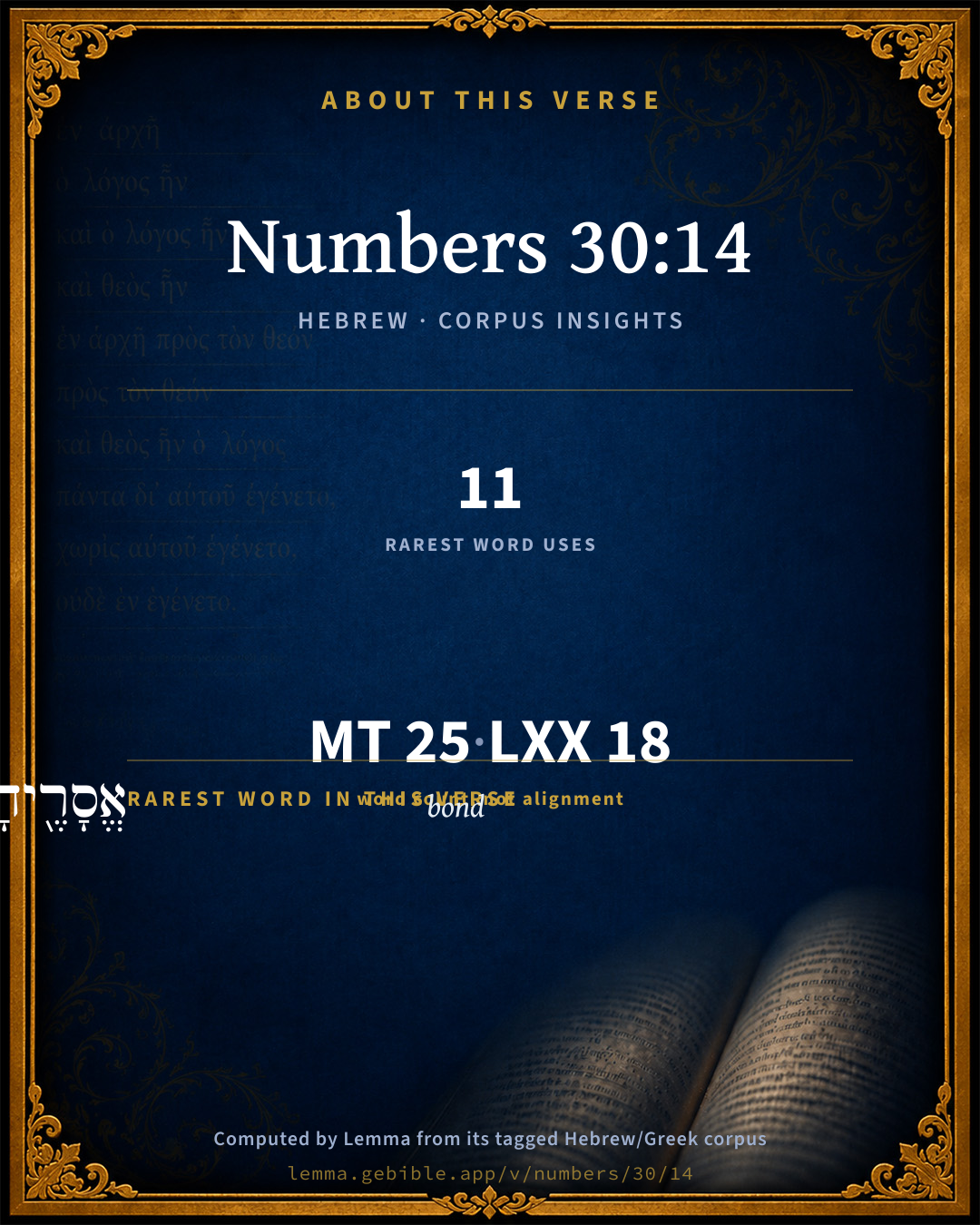
The rarest word here is אֱסָרֶ֖יהָ bond H632 — appearing just 11 times in the whole Hebrew Bible.

Shared distinctive vocabulary

אֱסָרֶ֖יהָ bond H632 occurs in 10 verses of the Hebrew Bible. Also found in:

Grammatical profile

  • 6 verbs
  • 8 nouns
  • 4 prepositions
  • 3 conjunctions
  • 4 particles

Verb forms

  • הַחֲרֵשׁ֩ Hiphil · Infinitive Absolute
  • יַחֲרִ֨ישׁ Hiphil · Imperfect
  • וְהֵקִים֙ Hiphil · Sequential Perfect
  • הֵקִ֣ים Hiphil · Perfect
  • הֶחֱרִ֥שׁ Hiphil · Perfect
  • שָׁמְעֽוֹ Qal · Infinitive Construct

Repetition

Words recur within this verse — often emphatic in Hebrew:

  • הַחֲרֵשׁ֩ to plough H2790 ×3
  • מִיּ֣וֹם day H3117 ×3
  • וְהֵקִים֙ to rise H6965 ×2
  • כָּל all H3605 ×2

Hebrew & Septuagint length

In English translation the verse runs 46 words from the Hebrew and 23 from the Septuagint (LXX English) — the Septuagint runs noticeably shorter here. See the side-by-side →

A rough comparison of the two English renderings, which tokenize alike — not a word-level alignment.

Word counts can differ between the Hebrew and the Greek without any difference in meaning — e.g. the Hebrew direct-object marker אֵת has no separate Greek word, and Greek often adds the article ὁ.

In the original languages it is 25 Hebrew tokens and 18 Greek tokens — but the two are counted differently (Hebrew bundles its prefixes and suffixes into one token; the Greek is in lemma form), so that isn’t a like-for-like length.

Hebrew and Greek witnesses Masoretic Hebrew ↔ Greek Septuagint

The same verse in the two great witnesses to the Old Testament, shown verse-for-verse.

Here the Septuagint runs noticeably shorter than the Hebrew — LXX2012 (modern English Septuagint) 23 words vs World English Bible 46. A rough length comparison of the two English translations, not a word-level alignment — read both below.

These are two independent witnesses, not word-aligned to each other, and the Septuagint is shown in lemma (dictionary) form.

Hebrew Numbers 30:14 Masoretic · Westminster Leningrad Codex

וְאִם הַחֲרֵשׁ֩ יַחֲרִ֨ישׁ לָ֥הּ אִישָׁהּ֮ מִיּ֣וֹם אֶל יוֹם֒ וְהֵקִים֙ אֶת כָּל נְדָרֶ֔יהָ א֥וֹ אֶת כָּל אֱסָרֶ֖יהָ אֲשֶׁ֣ר עָלֶ֑יהָ הֵקִ֣ים אֹתָ֔ם כִּי הֶחֱרִ֥שׁ לָ֖הּ בְּי֥וֹם שָׁמְעֽוֹ

But if her husband altogether hold his peace at her from day to day, then he establishes all her vows, or all her bonds, which are on her: he has established them, because he held his peace at her in the day that he heard them.

World English Bible · Public Domain

Greek LXX Numbers 30:14 Septuagint · lemma form

πᾶς εὐχή καί πᾶς ὅρκος δεσμός κακόω ψυχή ὁ ἀνήρ αὐτός ἵστημι αὐτός καί ὁ ἀνήρ αὐτός περιαἱρέω

Every vow, and every binding oath to afflict her soul, her husband shall confirm it to her, or her husband shall cancel it.

LXX2012 (modern English Septuagint) · Public Domain

Hebrew: Westminster Leningrad Codex (CC BY 4.0). Greek: Septuagint (public domain); English from LXX2012 (modern English Septuagint) (Public Domain). How the Septuagint differs from the Hebrew →

Targum (Aramaic paraphrase)

2

The Targum is the ancient Jewish Aramaic paraphrase of the Hebrew Scriptures — an interpretive translation, not the Hebrew text itself. Onkelos (literal) and Pseudo-Jonathan (expansive) render the Torah, and Jonathan the Prophets. Coverage is partial: where no permissively-licensed English translation exists for a verse, only the Aramaic is shown. This is verse-level text, not a word-by-word alignment to the Hebrew.

  1. Targum Onkelos Torah (Genesis–Deuteronomy)
    כָּל נְדַר וְכָל קִיוּמַת אִסַר לְסַגָפָא נְפָשׁ בַּעֲלַהּ יְקַיְמִינוּן וּבַעֲלַהּ יְבַטְלִינוּן

    (no public-domain English translation for this verse)

    Targum Onkelos — Aramaic: “Onkelos Genesis” (public domain); “Onkelos Exodus” (public domain); “Onkelos Leviticus” (public domain); “Onkelos Numbers” (public domain); “Onkelos Deuteronomy” (public domain). English: “Sefaria Community Translation” (CC0 1.0 (public-domain dedication)); “J.W. Etheridge. The Targums of Onkelos and Jonathan Ben Uzziel on the Pentateuch. London: Longmans, Green, 1862” (public domain). Text via Sefaria.

  2. Targum Pseudo-Jonathan Torah (Genesis–Deuteronomy)
    כָּל נִדְרָא וְכָל קִיוּם אִסְרָא לְסַגָפָא נְפַשׁ בַּעֲלָהּ יְקַיְימִינוּן וּבַעֲלָהּ יְבַטֵילִינוּן

    Every vow, every oath-bond to chasten the soul, her husband may ratify or annul.

    Targum Pseudo-Jonathan — Aramaic: “Targum Jonathan on Genesis” (public domain); “Targum Jonathan on Exodus” (public domain); “Targum Jonathan on Leviticus” (public domain); “Targum Jonathan on Numbers” (public domain); “Targum Jonathan on Deuteronomy” (public domain). English: “The Targum of Jonathan ben Uzziel, trans. J. W. Etheridge, London, 1862” (public domain). Text via Sefaria.

Commentary

Notes on Numbers 30:14 from classic Christian and Jewish commentators (each source and its license shown beneath its notes). The classic Christian expositions comment on the surrounding passage and are grouped to its opening verse, so a note may address several verses; the Jewish commentaries on the Tanakh (Rashi and others) are per-verse, so they appear only where the commentator wrote on this verse.

Lemma curates 59 commentaries, every one of them public domain or Creative Commons licensed, each selected and text-cleaned for this edition rather than reprinted as found. About our sources →

Geneva Bible (1599)

Geneva Bible translators

To mortify herself by abstinence or other bodily exercise.

Geneva Bible (1599) marginal notes — public domain. Text via Bolls.life.

John Gill's Exposition

But if her husband altogether hold his peace at her from day today,.... Said not one word to her day after day, neither on the day he heard her vow, nor the day following:

then he establisheth all her vows, or all her bonds, which are upon her; by his silence:

he confirmeth them, because he held his peace at her, in the day that he heard them; for not to contradict them was to confirm them.

John Gill's Exposition of the Whole Bible (1746–1763) — public domain (CC PDM 1.0). Text via the HelloAO Bible API.

Haydock's Catholic Bible Commentary

It. The Rabbins restrain this law to fasting and abstinence. But the Hebrew seems more general, (ver. 13,) "every vow, and every binding oath to afflict the soul, her husband may ratify or annul." The vows of abstinence are most common, and generally more disagreeable to husbands. (Calmet) --- St. Augustine (q. 59,) thinks it unreasonable that the husband should have a control over the vows of continency in his wife, any more than she could have over him, in this particular, as their rights are equal: he seems inclined to allow him to annul the vows of abstinence only. Indeed this seems to be the meaning of afflicting the soul, which is done by submitting to various restraints, required on days of fasting. See Leviticus xxiii. 27. (Haydock) --- In things which could nowise hurt the parent or husband, many believe, that the person who had made a vow, was bound to perform it secretly, even though the superior had declared his dissent. But with respect to fasting, pilgrimages, &c., which could not be performed without his knowledge, it does not seem that they were under any farther obligation, even though the superior should retract what he had connived at for a whole day. In doubtful cases inferiors must not refuse to obey. The sin lies at the door of him who exercises his authority in an improper manner. (Lyranus) (Tirinus) (ver. 16.)

George Leo Haydock (1774–1849), Haydock's Catholic Family Bible and Commentary, 1859 edition — public domain. Excludes Psalms (Douay-Rheims chapter numbering differs from Protestant) and Deuterocanonical books (Catholic canon only).

Rashi

Rabbi Shlomo Yitzchaki (Rashi)

כל נדר וכל שבעת אסר וגו׳ EVERY VOW AND EVERY BINDING OATH [TO AFFLICT THE SOUL HER HUSBAND MAY CONFIRM IT OR HER HUSBAND MAY ANNUL IT] — Because it states that a husband may annul his wife’s vows, one might think that all vows are implied! It therefore states: “[every vow] …to afflict the soul” — he may annul only vows to afflict the soul, and these are set forth in Treatise Nedarim 79b.

Rashi on the Tanakh — English translations: “The Judaica Press complete Tanach with Rashi, translated by A. J. Rosenberg” (CC BY 4.0); “Pentateuch with Rashi's commentary by M. Rosenbaum and A.M. Silbermann, 1929-1934” (public domain); “The Metsudah Tanach series, Lakewood, N.J” (CC BY 4.0); and “The Book of Joshua, Metsudah Publications, 1997” (CC BY 4.0). Text via Sefaria.

Ramban (Nachmanides)

Rabbi Moshe ben Nachman (Ramban / Nachmanides)

EVERY VOW, AND EVERY BINDING OATH TO AFFLICT THE SOUL, [HER HUSBAND MAY ESTABLISH IT, AND HER HUSBAND MAY MAKE IT VOID]. “Since He had said [in the preceding verses] that a husband may annul [his wife’s vows], I might think that this includes all her vows! Scripture therefore says, to afflict the soul, meaning that he can only annul vows which afflict the soul, and they are explained in Tractate Nedarim.” These are the words of Rashi. But his language here is [too] concise, because a husband annuls vows which afflict the soul, such as [if she vows] “The fruits of the world be forbidden to me,” or even if she [only] vowed that she would not taste one of all the kinds [of fruits]; and likewise he may annul matters [which concern the relationship] between himself and his wife, even if they do not involve affliction of the soul, such as [if she swore] “I will not paint [my eyes]” or “I will not put powder on my face,” or “I will not have sexual intercourse,” these being matters about which He said, between a man and his wife, as is explained in the last chapter of Tractate Nedarim. Such is also the law with respect to the father himself, as we have been taught in the Sifre: 155. “I only know that a husband may annul vows [which concern the relationship] between himself and his wife, and vows which afflict the soul, [to the exclusion of other vows which he may not annul]. Whence do I know that the father [is similarly limited in his rights]? You can reason [in the following manner] etc… But I have not succeeded in establishing [the father’s law] by reason. Therefore Scripture says: These are the statutes, which the Eternal commanded Moses, between a man and his wife, between a father and his daughter. [This teaches us that] we must of necessity compare the father to the husband, sothat just as the husband may only annul vows [which concern the relationship] between himself and his wife, and matters which involve affliction of the soul, so also the father may only annul matters [which concern the laws] between him and her, and matters which involve affliction of the soul.” It is also taught in this way in the Gemara Yerushalmi of Tractate Nedarim.

Ramban (Nachmanides) on the Tanakh — English translation: “Commentary on the Torah by Ramban (Nachmanides). Translated and annotated by Charles B. Chavel. New York, Shilo Pub. House, 1971-1976” (CC BY 4.0). Text via Sefaria.

Lesson kit

Teaching starters — assembled from the data on this page, not authored interpretation. Every prompt links to the verse data it draws on. Edit before teaching.

Numbers, in the Pentateuch, opens this verse with 25 words (15 distinct Hebrew lemmas). Its most distinctive word is ʼĕçâr (“bond”). The Greek Septuagint runs shorter here. A historical commentator’s framing appears above. Read the whole chapter for the surrounding context.

Discussion questions

  1. How does “bond” (ʼĕçâr) shape what this verse is saying?
  2. Numbers 30:2 shares the word «bond» with this verse. How do the two illuminate each other?
  3. “to plough” occurs 3× in this one verse. What is the effect of the repetition?
  4. Compared with the Hebrew, the Septuagint runs shorter here. What questions does that raise?
  5. These translations render this verse differently. What is at stake in choosing one wording over another?
  6. The verb «הַחֲרֵשׁ֩» is Hiphil Infinitive Absolute. How does its form color the action?
  7. Reading how Geneva Bible (1599) and John Gill's Exposition read this verse, where do the two commentators agree and where do they part?

Things to notice

Reading settings

Reading text

Shown beneath each verse's original-language words.

Old Testament
Old Testament edition

Read the OT as the Masoretic Hebrew (MT) or the Greek Septuagint (LXX).

English shown for the Greek Septuagint (in the Hebrew ↔ Greek comparison).

Comparing translations? Open the Compare panel on any verse page to stack up to four side by side.