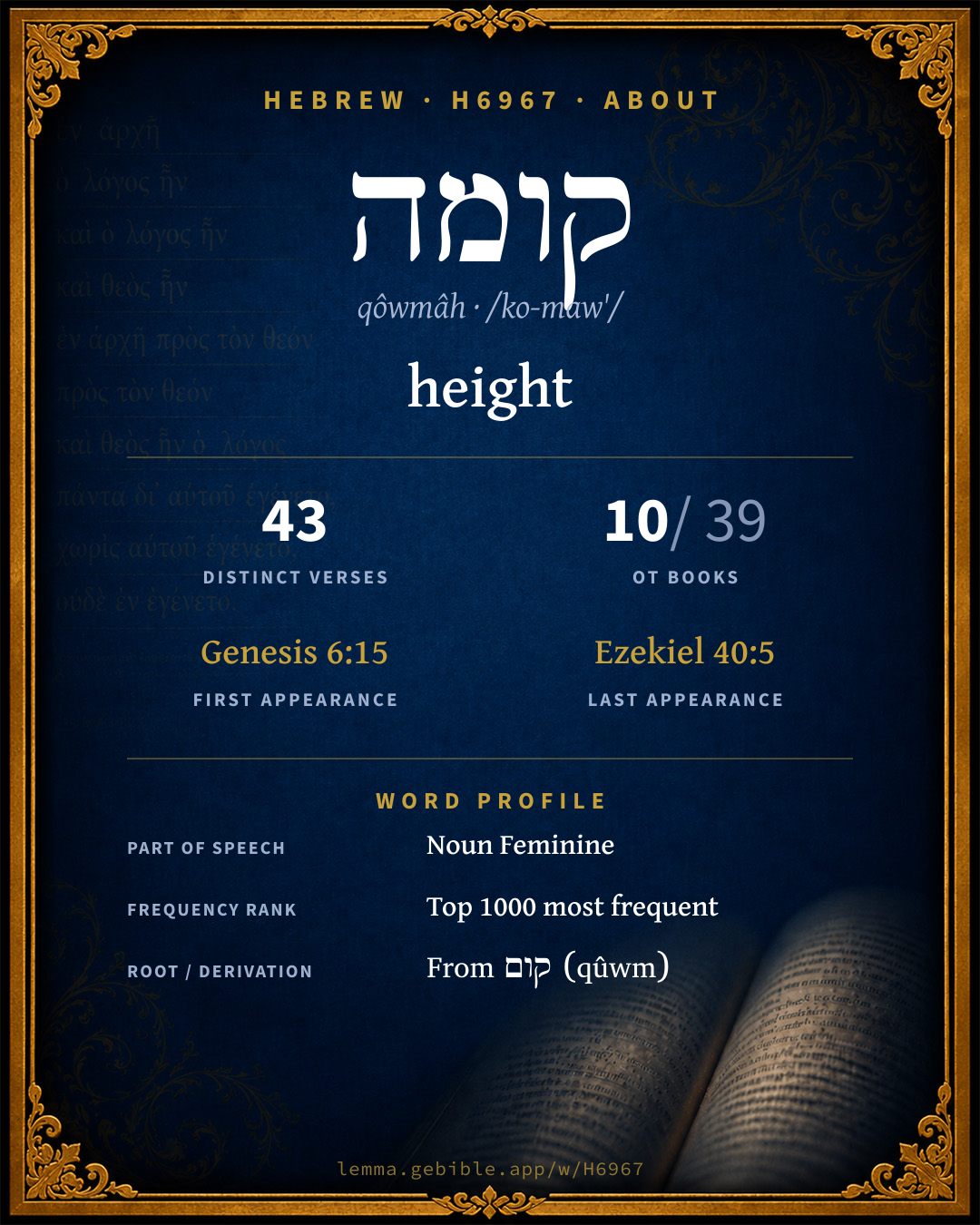
קוֹמָה
height
‘height’ is one of 2 main senses fuller range ↓
Full lexicon entry — Brown-Driver-Briggs (BDB)
From Brown-Driver-Briggs (BDB)
Where this word appears
See every Construct-state word in the Hebrew Bible →
Grammar key — what these labels mean
Part of speech
- Noun
- A naming word — a person, place, thing, or idea.
Noun type
- Common
- A common noun — a general class of person, place, or thing (“king,” “city,” “water”), not a specific name.
State
- Construct
- A noun bound to a following noun in a possessive / “of” relationship (the construct chain).
- Absolute
- The independent form of a noun, not bound to a following word.
Gender
- Feminine
- Grammatically feminine.
Number
- Singular
- One.
Grammatical forms
- Noun, Common, Feminine, Singular, Construct 37 times (80%)
- Noun, Common, Feminine, Singular, Absolute 9 times (20%)
Parsed forms decoded from the imported morphology (morphhb / Westminster Leningrad Codex — WLC text public domain, morphhb tagging CC BY 4.0), counted across 46 parsed occurrences — not distinct verses.
Every verse where H6967 appears — 43 distinct verses across 10 books. Click any verse to open its interlinear word-by-word view. Verse text shown in the World English Bible for context — . Each verse’s Hebrew form is shown with its reference; the English is not keyword-highlighted, since the data carries no word-level English alignment. Use “Compare translations” on any verse to read it across multiple English versions. This concordance covers the Hebrew Bible; Septuagint (Greek Old Testament) occurrences are not indexed here.
Genesis 1 verse
Exodus 10 verses
- Exodus 25:10 קֹמָתֽ/וֹ n c fs cs + sfx pers 3ms "They shall make an ark of acacia wood. Its length shall be two and a half cubits, its breadth a cubit and a half, and a cubit and a half its height.
- Exodus 25:23 קֹמָתֽ/וֹ n c fs cs + sfx pers 3ms "You shall make a table of acacia wood. Two cubits shall be its length, and a cubit its breadth, and one and a half cubits its height.
- Exodus 27:1 קֹמָתֽ/וֹ n c fs cs + sfx pers 3ms "You shall make the altar of acacia wood, five cubits long, and five cubits broad; the altar shall be foursquare: and its height shall be three cubits.
- Exodus 27:18 וְ/קֹמָ֛ה conj + n c fs The length of the court shall be one hundred cubits, and the breadth fifty every where, and the height five cubits, of fine twined linen, and their sockets of brass.
- Exodus 30:2 קֹמָת֑/וֹ n c fs cs + sfx pers 3ms Its length shall be a cubit, and its breadth a cubit. It shall be square, and its height shall be two cubits. Its horns shall be of one piece with it.
- Exodus 37:1 קֹמָתֽ/וֹ n c fs cs + sfx pers 3ms Bezalel made the ark of acacia wood. Its length was two and a half cubits, and its breadth a cubit and a half, and a cubit and a half its height.
- Exodus 37:10 קֹמָתֽ/וֹ n c fs cs + sfx pers 3ms He made the table of acacia wood. Its length was two cubits, and its breadth was a cubit, and its height was a cubit and a half.
- Exodus 37:25 קֹֽמָת֔/וֹ n c fs cs + sfx pers 3ms He made the altar of incense of acacia wood. It was square: its length was a cubit, and its breadth a cubit. Its height was two cubits. Its horns were of one piece with it.
- Exodus 38:1 קֹמָתֽ/וֹ n c fs cs + sfx pers 3ms He made the altar of burnt offering of acacia wood. It was square. Its length was five cubits, its breadth was five cubits, and its height was three cubits.
- Exodus 38:18 וְ/קוֹמָ֤ה conj + n c fs The screen for the gate of the court was the work of the embroiderer, of blue, purple, scarlet, and fine twined linen. Twenty cubits was the length, and the height in the breadth was five cubits, like to the hangings of the court.
1 Samuel 2 verses
- 1 Samuel 16:7 קוֹמָת֖/וֹ n c fs cs + sfx pers 3ms But Yahweh said to Samuel, "Don't look on his face, or on the height of his stature; because I have rejected him: for [Yahweh sees] not as man sees; for man looks at the outward appearance, but Yahweh looks at the heart."
- 1 Samuel 28:20 קֽוֹמָת/וֹ֙ n c fs cs + sfx pers 3ms Then Saul fell immediately his full length on the earth, and was sore afraid, because of the words of Samuel: and there was no strength in him; for he had eaten no bread all the day, nor all the night.
1 Kings 12 verses
- 1 Kings 6:2 קוֹמָתֽ/וֹ n c fs cs + sfx pers 3ms The house which king Solomon built for Yahweh, the length of it was sixty cubits, and the breadth of it twenty [cubits], and the height of it thirty cubits.
- 1 Kings 6:10 קֽוֹמָת֑/וֹ n c fs cs + sfx pers 3ms He built the stories against all the house, each five cubits high: and they rested on the house with timber of cedar.
- 1 Kings 6:20 קֽוֹמָת֔/וֹ n c fs cs + sfx pers 3ms Within the oracle was [a space of] twenty cubits in length, and twenty cubits in breadth, and twenty cubits in the height of it; and he overlaid it with pure gold: and he covered the altar with cedar.
- 1 Kings 6:23 קוֹמָתֽ/וֹ n c fs cs + sfx pers 3ms In the oracle he made two cherubim of olive-wood, each ten cubits high.
- 1 Kings 6:26 קוֹמַת֙ n c fs cs The height of the one cherub was ten cubits, and so was it of the other cherub.
- 1 Kings 7:2 קוֹמָת֑/וֹ n c fs cs + sfx pers 3ms For he built the house of the forest of Lebanon; the length of it was one hundred cubits, and the breadth of it fifty cubits, and the height of it thirty cubits, on four rows of cedar pillars, with cedar beams on the pillars.
- 1 Kings 7:15 קוֹמַת֙ n c fs cs For he fashioned the two pillars of brass, eighteen cubits high apiece: and a line of twelve cubits compassed either of them about.
- 1 Kings 7:16 קוֹמַת֙ קוֹמַ֖ת n c fs cs n c fs cs He made two capitals of molten brass, to set on the tops of the pillars: the height of the one capital was five cubits, and the height of the other capital was five cubits.
- 1 Kings 7:23 קוֹמָת֔/וֹ n c fs cs + sfx pers 3ms He made the molten sea of ten cubits from brim to brim, round in compass, and the height of it was five cubits; and a line of thirty cubits compassed it round about.
- 1 Kings 7:27 קוֹמָתָֽ/הּ n c fs cs + sfx pers 3fs He made the ten bases of brass; four cubits was the length of one base, and four cubits the breadth of it, and three cubits the height of it.
- 1 Kings 7:32 וְ/קוֹמַת֙ conj + n c fs cs The four wheels were underneath the panels; and the axles of the wheels were in the base: and the height of a wheel was a cubit and half a cubit.
- 1 Kings 7:35 קוֹמָ֖ה n c fs In the top of the base was there a round compass half a cubit high; and on the top of the base the stays of it and the panels of it were of the same.
2 Kings 2 verses
- 2 Kings 19:23 קוֹמַ֤ת n c fs cs By your messengers you have defied the Lord, and have said, With the multitude of my chariots am I come up to the height of the mountains, to the innermost parts of Lebanon; and I will cut down the tall cedars of it, and the choice fir trees of it; and I will enter into his farthest lodging-place, the forest of his fruitful field.
- 2 Kings 25:17 קוֹמַ֣ת וְ/קוֹמַ֣ת n c fs cs conj + n c fs cs The height of the one pillar was eighteen cubits, and a capital of brass was on it; and the height of the capital was three cubits, with network and pomegranates on the capital round about, all of brass: and like to these had the second pillar with network.
2 Chronicles 3 verses
- 2 Chronicles 4:1 קוֹמָתֽ/וֹ n c fs cs + sfx pers 3ms Moreover he made an altar of brass, twenty cubits the length of it, and twenty cubits the breadth of it, and ten cubits the height of it.
- 2 Chronicles 4:2 קֽוֹמָת֔/וֹ n c fs cs + sfx pers 3ms Also he made the molten sea of ten cubits from brim to brim, round in compass; and the height of it was five cubits; and a line of thirty cubits compassed it round about.
- 2 Chronicles 6:13 קוֹמָת֑/וֹ n c fs cs + sfx pers 3ms (for Solomon had made a brazen scaffold, five cubits long, and five cubits broad, and three cubits high, and had set it in the midst of the court; and on it he stood, and kneeled down on his knees before all the assembly of Israel, and spread forth his hands toward heaven;)
Song of Solomon 1 verse
Isaiah 2 verses
- Isaiah 10:33 הַ/קּוֹמָה֙ ptcl def.art + n c fs Behold, the Lord, Yahweh of Hosts, will lop the boughs with terror: and the high of stature shall be hewn down, and the lofty shall be brought low.
- Isaiah 37:24 קוֹמַ֤ת n c fs cs By your servants have you defied the Lord, and have said, With the multitude of my chariots am I come up to the height of the mountains, to the innermost parts of Lebanon; and I will cut down the tall cedars of it, and the choice fir trees of it; and I will enter into its farthest height, the forest of its fruitful field;
Jeremiah 2 verses
- Jeremiah 52:21 קומה קוֹמַת֙ n c fs cs n c fs cs As for the pillars, the height of the one pillar was eighteen cubits; and a line of twelve cubits did compass it; and the thickness of it was four fingers: it was hollow.
- Jeremiah 52:22 וְ/קוֹמַ֨ת conj + n c fs cs A capital of brass was on it; and the height of the one capital was five cubits, with network and pomegranates on the capital round about, all of brass: and the second pillar also had like these, and pomegranates.
Ezekiel 8 verses
- Ezekiel 13:18 קוֹמָ֖ה n c fs and say, Thus says the Lord Yahweh: Woe to the women who sew pillows on all elbows, and make kerchiefs for the head of [persons of] every stature to hunt souls! Will you hunt the souls of my people, and save souls alive for yourselves?
- Ezekiel 17:6 קוֹמָ֗ה n c fs It grew, and became a spreading vine of low stature, whose branches turned toward him, and the roots of it were under him: so it became a vine, and brought forth branches, and shot forth sprigs.
- Ezekiel 19:11 קֽוֹמָת֖/וֹ n c fs cs + sfx pers 3ms It had strong rods for the scepters of those who bore rule, and their stature was exalted among the thick boughs, and they were seen in their height with the multitude of their branches.
- Ezekiel 31:3 קוֹמָ֑ה n c fs Behold, the Assyrian was a cedar in Lebanon with beautiful branches, and with a forest-like shade, and of high stature; and its top was among the thick boughs.
- Ezekiel 31:5 קֹמָת֔/וֹ n c fs cs + sfx pers 3ms Therefore its stature was exalted above all the trees of the field; and its boughs were multiplied, and its branches became long by reason of many waters, when it shot [them] forth.
- Ezekiel 31:10 בְּ/קוֹמָ֑ה prep + n c fs Therefore thus said the Lord Yahweh: Because you are exalted in stature, and he has set his top among the thick boughs, and his heart is lifted up in his height;
- Ezekiel 31:14 בְ/קוֹמָתָ֜/ם prep + n c fs cs + sfx pers 3mp to the end that none of all the trees by the waters exalt themselves in their stature, neither set their top among the thick boughs, nor that their mighty ones stand up on their height, [even] all who drink water: for they are all delivered to death, to the lower parts of the earth, in the midst of the children of men, with those who go down to the pit.
- Ezekiel 40:5 וְ/קוֹמָ֖ה conj + n c fs Behold, a wall on the outside of the house round about, and in the man's hand a measuring reed six cubits long, of a cubit and a handbreadth each: so he measured the thickness of the building, one reed; and the height, one reed.
About this entry
At a glance — auto-summarized from this page’s data, not written by a person. Every figure links to its source below. This summary describes the numbers; it doesn’t interpret them.
קומה (qôwmâh) is a Hebrew noun most often rendered “height.” Where the King James Version says “height,” newer translations reach for “high” (Berean Standard Bible); the renderings breakdown has the detail. The Hebrew Bible uses it across 43 verses — moderately common. 1 Kings dominates its distribution — 12 of 43 verses. It is not a single-sense word — see its full sense range. The sections below give every sense, occurrence, and version rendering.
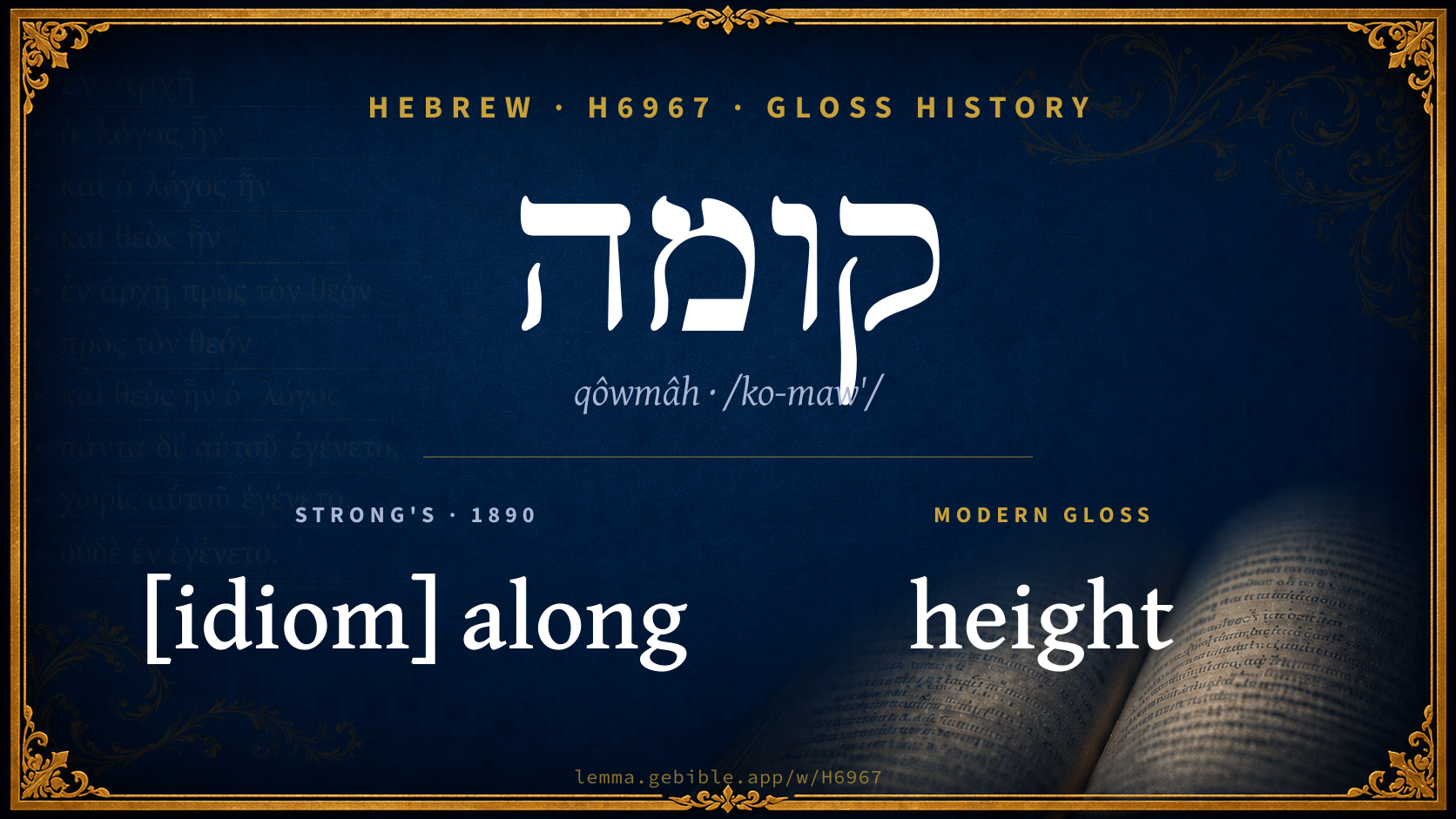
Gloss history
Strong's 1890 vs modern scholarship
About this word
Strong's H6967 catalogs a Hebrew word from the Hebrew Old Testament.
These counts are not copied from any lexicon or concordance. They are computed here, from the morphology-tagged Hebrew Old Testament. What Lemma adds →
- 43
- distinct verses
- The word appears in 43 distinct verses.
- 10 / 39
- OT books
- The word appears in 10 of 39 Old Testament books.
- #796
- by frequency
- Top 1000 most frequent Hebrew words (rank 796 of 8,640 Hebrew words by occurrence).
View all 43 occurrences in the concordance →
By section of the Old Testament
By traditional corpus
Conventional, traditional groupings — biblical authorship is debated, so this is a traditional corpus grouping, not an authorship claim. Each share is this word’s portion of its verses in that division of the Hebrew canon. Each figure is a share of the word’s 43 distinct verses.
- Prophets (Nevi'im) 28 verses · 65%
- Torah (Pentateuch) 11 verses · 26%
- Writings (Ketuvim) 4 verses · 9%
How translations render this word
Counts come from each version’s own published word-to-Strong’s tagging or interlinear alignment — an approximate guide to how each version renders this word, not a word-level alignment the data otherwise carries. Because each total is that version’s own tagged count, the per-version totals vary from one another and need not match the appearance or distinct-verse counts above. These counts may also differ from a printed concordance because Lemma counts each distinctly tagged rendering and does not collapse phrase taggings into a single head-word total. This is a fixed set of word-tagged versions (KJV, ASV, BSB, ULT) and does not change with the reading translation you choose elsewhere. Each version’s license is shown beside its name below (and on Sources).
- King James Version: Height 23×, Stature 6×, High 5×
- American Standard Version: Height 15×, Stature 7×, Height thereof 5×
- Berean Standard Bible: High 27×, Height 7×, Tall 2×
- unfoldingWord Literal Text: Height 16×, Was its height 7×, Height of 4×
King James Version Public Domain
Renders H6967 across 45 tagged occurrences — most commonly:
Plus 9 renderings that appear only once — usually multi-word phrases or single function words the recovered tagging swept in, not distinct renderings.
American Standard Version Public Domain
Renders H6967 across 45 tagged occurrences — most commonly:
Plus 7 renderings that appear only once — usually multi-word phrases or single function words the recovered tagging swept in, not distinct renderings.
Berean Standard Bible Public Domain
Renders H6967 across 42 tagged occurrences — most commonly:
Plus 4 renderings that appear only once — usually multi-word phrases or single function words the recovered tagging swept in, not distinct renderings. Not rendered by a distinct English word in 3 further occurrences.
unfoldingWord Literal Text CC BY-SA 4.0
Renders H6967 across 46 tagged occurrences — most commonly:
Plus 7 renderings that appear only once — usually multi-word phrases or single function words the recovered tagging swept in, not distinct renderings.
Senses in the full BDB
What do BDB’s symbols mean?
BDB uses these scholarly abbreviations:
| Symbol | Meaning |
|---|---|
| 𝔊 | the Septuagint (the ancient Greek translation, LXX) |
| 𝔙 | the Vulgate (the Latin translation) |
| 𝔖 | the Syriac version (the Peshitta) |
| 𝔗 | the Targum (the Aramaic translation) |
| ψ | the Psalms |
| √ | root (the underlying root or stem) |
| ‖ | parallel passage (a synonymous or contrasted parallel) |
| † | the dagger: every passage where the word occurs is cited |
The 3 senses and sub-senses the full Brown-Driver-Briggs lexicon distinguishes for this word, in lexicon order (not ranked by frequency), with BDB’s own verbatim wording and sub-sense lettering. Shown in Hebrew script with BDB’s own scholarly abbreviations. The condensed entry is in the Lexicon Entry tab. See also the Forms in the corpus table below.
- 1. height, of pers., stature 1 S 16:7 Ez 13:18; Ct 7:8; מְלֹא־קוֹמָתוֹ 1 S 28:20 his full length. e.g. 1 Samuel 16:7
- 2. of tree 2 K 19:23 = Is 37:24; in fig. Is 10:33; Ez 31:3, 5, 10, 14; of vine (fig.) Ez 19:11 and שִׁפְלַת ק׳ 17:6 low of height. e.g. 2 Kings 19:23
- 3. of artificial structures: temple, its parts, furnishings, etc., 1 K 6:2 + 12 times 1 K 6, 7; 2 K 25:17(×2) = Je 52:21, 22; 2 Ch 4:1, 2; 6:13; a wall Ez 40:5; tabern. and furnishings Ex 25:10, 23 + 8 times Ex (all P); Noah’s ark Gn 6:15 (P). e.g. 1 Kings 6:2
Senses from the full Brown-Driver-Briggs lexicon (Brown, Driver, Briggs; Oxford 1906 — public domain), digitized via Sefaria, supplemented by the OpenScriptures HebrewLexicon (CC BY 4.0). Full attribution on Sources.
Word origin
n.f. height;—abs. קוֹמָה Ex 38:18 +, קֹמָה 27:18; cstr. קוֹמַת 1 K 6:26 +; sf. קוֹמָתוֹ 7:23 +, קֹמָתוֹ Ex 25:10 +, etc.;—
— Brown-Driver-Briggs (Oxford 1906, public domain), digitized via Sefaria, supplemented by the OpenScriptures HebrewLexicon (CC BY 4.0). See Sources.
Derived from קום (qûwm) (H6965) — to rise.
Jastrow Dictionary
A second Hebrew/Aramaic lexicon for comparison, covering Aramaic and post-biblical (Talmudic, Targumic, Midrashic) usage that the biblical-Hebrew BDB does not. Matched by lemma rather than by Strong’s number, so a lemma may carry more than one Jastrow headword (shown separately below), and the entries cover usage well beyond the Bible.
קוֹמָה
- height, stature, man’s height. Esth. R. to I, 6 מלא ק׳ וכ׳ space for the whole length of a human body &c., v. פֶּרח. Gen. R. s. 12; Num. R. s. 13 (among the seven things that were taken away from Adam) זיוו וחייו וקוֹמָתוֹ his beauty, his life’s length, and his high stature (which was diminished). Ib. ק׳ של מיות, v. מֵיוֹת. Bekh. 45ᵇ, a. fr. בעלי ק׳ men of high stature. B. Kam. 60ᵃ, v. קָמָה; a. fr.—ק׳ זקופה, v. זָקַף. [Gen. R. s. 53 קומתו של אברהם, v. קָמָה.]—Pl. קוֹמוֹת. Snh. VI, 4 שתי ק׳ the height of two men.
A Dictionary of the Targumim, the Talmud Babli and Yerushalmi, and the Midrashic Literature (Marcus Jastrow; London, Luzac, 1903) — Public Domain. Digitized via Sefaria. Digitized via Sefaria. Full attribution on Sources.
Forms in the corpus
The 31 distinct written forms H6967 takes in the Hebrew Bible, most frequent first — each parse links to that state’s occurrences in the concordance. Hebrew forms include their vowel points and cantillation, so a single lemma takes many written forms.
Same root — word family
Other BDB entries built from the same root as H6967, grouped by Strong’s listed origin. These share a root / origin per the lexicon — not necessarily a shared meaning. Each links to that word’s own entry.
Derives from
Shares the same root
- יקום yᵉqûwm H3351 substance
- מקום mâqôwm H4725 place
- קום qûwm H6966 to arise
- קוממיות qôwmᵉmîyûwth H6968 uprightness
- קים qîym H7009 adversary
- קימה qîymâh H7012 rising up
- קמה qâmâh H7054 standing grain
- תקומה tᵉqûwmâh H8617 standing
- תקומם tᵉqôwmêm H8618 rising against
Proper names from this root
People and places named from this root — a name, not an additional meaning of the word.
- יקים Yâqîym H3356 Jakim
- יקמיה Yᵉqamyâh H3359 Jecamiah
- יקמעם Yᵉqamʻâm H3360 Jekameam
- יקמעם Yoqmᵉʻâm H3361 Jokmeam
- קמואל Qᵉmûwʼêl H7055 Kemuel
- קמון Qâmôwn H7056 Camon
Compare all same-root words → Showing 4 of 17 — not the complete family. 6 of the same-root words are proper names (people or places). They share a root, not necessarily a meaning.
Septuagint verse parallels
This word appears in 42 verses that also exist in the Greek Old Testament (Septuagint), out of the 43 Hebrew verses it occurs in. You can read those verses in Greek by switching the Old Testament edition to the Septuagint.
Read these verses in the Septuagint
- Genesis 6:15
- Exodus 25:10
- 1 Samuel 16:7
- 1 Kings 6:2
- 2 Kings 19:23
- 2 Chronicles 4:1
- Song of Solomon 7:7
- Isaiah 10:33
- Jeremiah 52:21
- Ezekiel 13:18
This is a verse-level parallel only — the same verses exist in both the Hebrew and Greek Old Testaments. No word-level Hebrew↔Greek correspondence is claimed: the data carries no such alignment, so no Greek word is shown as this Hebrew word’s translation. Coverage is not total — the Septuagint omits the deuterocanon and renumbers the Psalms, so some Hebrew verses have no direct Greek parallel.