
Judges 7:19

Hebrew (Westminster Leningrad Codex) Judges 7:19 appears in the Hebrew Old Testament. The text above is from the Westminster Leningrad Codex. Each word links to its Strong’s number, a concise gloss, and parsing drawn from the Open Scriptures Hebrew Bible morphology. Click any word for its full Brown-Driver-Briggs (BDB) entry.
Download image
Cite this verse

Judges 7:19 (World English Bible). Public Domain. Lemma interlinear Bible study tool, https://lemma.gebible.app/v/judges/7/19.

Show BibTeX & RIS
BibTeX
RIS
English Translation
So Gideon, and the hundred men who were with him, came to the outermost part of the camp in the beginning of the middle watch, when they had but newly set the watch: and they blew the trumpets, and broke in pieces the pitchers that were in their hands.
World English Bible · Public Domain
Download a study sheet

One document with this verse’s original text, its word-by-word gloss line, the meaning frame, cross-references with their text, attributed commentary, and full source and license credits — printable, and it pastes into notes with its structure intact.

This verse Autodidact and up

Study sheet (.html) Plain text (.txt)

A passage Seminary Student

Up to 50 verses in one chapter. A passage sheet keeps up to 6 commentary sources and 12 cross-references per verse, in the order this page ranks them, and says so on the sheet whenever that leaves anything out. Ask for a single verse and you get the Autodidact verse sheet above.

Everything on this page stays free to read, with no account — the sheet is a download of what is already on screen, not access to it.

Want to remove ads? Support Godless Engineer
Compare translations 3

The same verse in 3 English versions, stacked beneath the original-language interlinear above. Click any original word for its lexicon entry.

Each is an independent rendering of the whole verse — the interlinear is not word-aligned to these translations.

Highlighted words mark where these versions differ — a whole-verse word diff, not a word-by-word alignment.

  • World English Bible Public Domain
    So Gideon, and the hundred men who were with him, came to the outermost part of the camp in the beginning of the middle watch, when they had but newly set the watch: and they blew the trumpets, and broke in pieces the pitchers that were in their hands.
  • King James Version Public Domain
    So Gideon, and the hundred men that were with him, came unto the outside of the camp in the beginning of the middle watch; and they had but newly set the watch: and they blew the trumpets, and brake the pitchers that were in their hands.
  • unfoldingWord Literal Text CC BY-SA 4.0
    So Gideon and the 100 men who with him came to the edge of the camp, the start of the middle watch. Stationing, they had just stationed the guards, and they blew on the shofars and shattered the jars that in their hand.

unfoldingWord Literal Text — © unfoldingWord, licensed CC BY-SA 4.0. Word-aligned USFM3 via Door43 (git.door43.org/unfoldingWord/en_ult).

Versions to compare (up to 4)

3 of 4 selected

Show all 18 translations

Every available English version of this verse, each an independent rendering of the whole verse.

  • World English Bible Public Domain
    So Gideon, and the hundred men who were with him, came to the outermost part of the camp in the beginning of the middle watch, when they had but newly set the watch: and they blew the trumpets, and broke in pieces the pitchers that were in their hands.
  • Berean Standard Bible Public Domain
    Gideon and the hundred men with him reached the outskirts of the camp at the beginning of the middle watch, just after the changing of the guard. They blew their horns and broke the jars that were in their hands.
  • Majority Standard Bible Public Domain
    Gideon and the hundred men with him reached the outskirts of the camp at the beginning of the middle watch, just after the changing of the guard. They blew their horns and broke the jars that were in their hands.
  • King James Version Public Domain
    So Gideon, and the hundred men that were with him, came unto the outside of the camp in the beginning of the middle watch; and they had but newly set the watch: and they blew the trumpets, and brake the pitchers that were in their hands.
  • American Standard Version (1901) Public Domain
    So Gideon, and the hundred men that were with him, came unto the outermost part of the camp in the beginning of the middle watch, when they had but newly set the watch: and they blew the trumpets, and brake in pieces the pitchers that were in their hands.
  • Revised Version (1885) Public Domain
    So Gideon, and the hundred men that were with him, came unto the outermost part of the camp in the beginning of the middle watch, when they had but newly set the watch: and they blew the trumpets, and brake in pieces the pitchers that were in their hands.
  • Geneva Bible (1599) Public Domain
    So Gideon and the hundreth men that were with him, came vnto the outside of the hoste, in the beginning of the middle watche, and they raised vp the watchmen, and they blew with their trumpets, and brake the pitchers that were in their handes.
  • Douay-Rheims (1899) Public Domain
    And Gedeon, and the three hundred men that were with him, went into part of the camp, at the beginning of the midnight watch, and the watchmen being alarmed, they began to sound their trumpets, and to clap the pitchers one against another.
  • Young's Literal Translation Public Domain
    And Gideon cometh -- and the hundred men who `are' with him -- into the extremity of the camp, `at' the beginning of the middle watch (it hath only just confirmed the watchmen), and they blow with trumpets -- dashing in pieces also the pitchers which `are' in their hand;
  • Literal Standard Version CC BY-SA 4.0
    And Gideon comes—and the hundred men who [are] with him—into the extremity of the camp, [at] the beginning of the middle watch (they had just posted watchmen), and they blow with horns—also dashing in pieces the pitchers which [are] in their hand;
  • Unlocked Literal Bible CC BY-SA 4.0
    So Gideon and the hundred men who were with him came to the edge of the camp, right at the beginning of the middle watch. Just as the Midianites were changing guard, they blew the trumpets and broke the jars that were in their hands.
  • unfoldingWord Literal Text CC BY-SA 4.0
    So Gideon and the 100 men who with him came to the edge of the camp, the start of the middle watch. Stationing, they had just stationed the guards, and they blew on the shofars and shattered the jars that in their hand.
  • Darby Bible Public Domain
    So Gideon and the hundred men who were with him came to the outskirts of the camp at the beginning of the middle watch, when they had just set the watch; and they blew the trumpets and smashed the jars that were in their hands.
  • World Messianic Bible Public Domain
    So Gideon and the hundred men who were with him came to the outermost part of the camp in the beginning of the middle watch, when they had but newly set the watch. Then they blew the shofars and broke in pieces the pitchers that were in their hands.
  • Webster's Bible Public Domain
    So Gideon, and the hundred men that were with him, came to the outside of the camp in the beginning of the middle watch; and they had but newly set the watch: and they blew the trumpets, and broke the pitchers that were in their hands.
  • Free Bible Version CC BY-SA 4.0
    Gideon and the hundred men who with him arrived at the edge of the camp around midnight, after the guards were changed. They blew their trumpets and smashed the jars they were holding.
  • Bible in Basic English Public Domain
    So Gideon and the three hundred men who were with him came to the outer line of tents, at the start of the middle watch, when the watchmen had only then taken their stations; and the horns were sounded and the vessels broken.
  • JPS Tanakh (1917) Public Domain
    So Gideon, and the hundred men that were with him, came unto the outermost part of the camp in the beginning of the middle watch, when they had but newly set the watch; and they blew the horns, and broke in pieces the pitchers that were in their hands.

Literal Standard Version (2020), Covenant Press — licensed CC BY-SA 4.0. Text via the HelloAO Bible API (eBible.org). Unlocked Literal Bible (unfoldingWord) — licensed CC BY-SA 4.0. Text via the HelloAO Bible API (eBible.org). unfoldingWord Literal Text — © unfoldingWord, licensed CC BY-SA 4.0. Word-aligned USFM3 via Door43 (git.door43.org/unfoldingWord/en_ult). Free Bible Version, Dr. Jonathan Gallagher — licensed CC BY-SA 4.0. Text via the HelloAO Bible API (eBible.org).

Word by word

More ways to search: Search by grammar → Find every occurrence → Compare this word →

Practice this passage: Drill this verse → Learn its vocabulary →

הָאַשְׁמֹ֣רֶת
ʼashmurâh
H821
“the · watch”
Particle, Definite Article + Noun, Common, Feminine, Singular, Absolute
Part of Speech
Particle + Noun
Type
Common
Gender
Feminine
Number
Singular
State
Absolute
Full BDB Definition

Origin: from H8104

TWOT: 2414e

watch (a period of time), night-watch
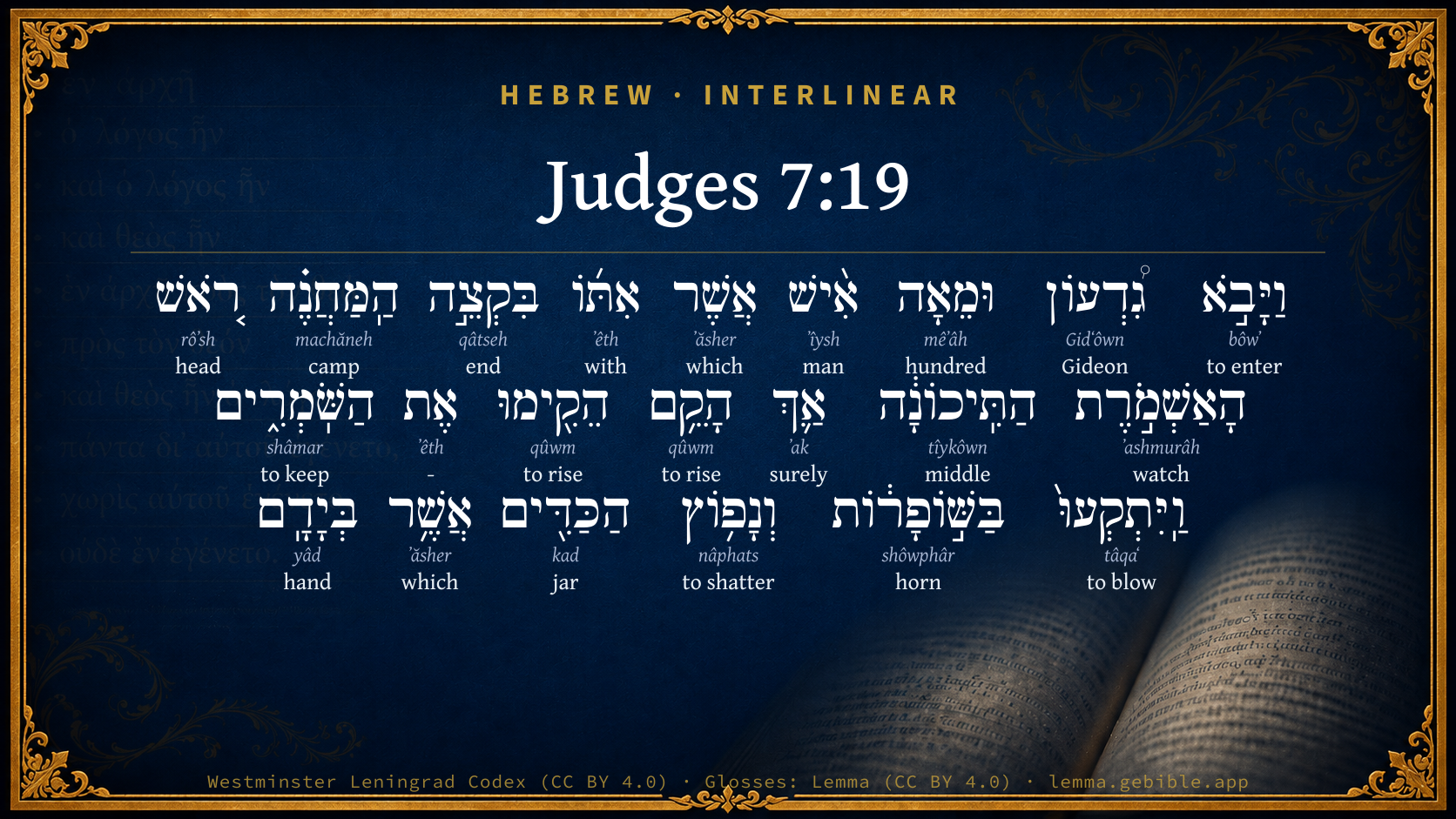
  1. וַיָּבֹ֣א bôwʼ H935 “and · to enter” Conjunction + Verb, Qal, Sequential Imperfect, 3rd Person, Masculine, Singular
  2. גִ֠דְעוֹן Gidʻôwn H1439 “Gideon” Noun, Proper
  3. וּמֵאָה mêʼâh H3967 “and · hundred” Conjunction + Adjective, Cardinal number, Both, Singular, Absolute
  4. אִ֨ישׁ ʼîysh H376 “man” Noun, Common, Masculine, Singular, Absolute
  5. אֲשֶׁר ʼăsher H834 “which” Particle, Relative
  6. אִתּ֜וֹ ʼêth H854 “with · him” Preposition + Suffix, Personal, 3rd Person, Masculine, Singular
  7. בִּקְצֵ֣ה qâtseh H7097 “in/at · end of” Preposition + Noun, Common, Both, Singular, Construct
  8. הַֽמַּחֲנֶ֗ה machăneh H4264 “the · camp” Particle, Definite Article + Noun, Common, Both, Singular, Absolute
  9. רֹ֚אשׁ rôʼsh H7218 “head of” Noun, Common, Masculine, Singular, Construct
  10. הַתִּֽיכוֹנָ֔ה tîykôwn H8484 “the · middle” Particle, Definite Article + Adjective, Adjective, Feminine, Singular, Absolute
  11. אַ֛ךְ ʼak H389 “surely” Particle, Accusative
  12. הָקֵ֥ם qûwm H6965 “to rise” Verb, Hiphil, Infinitive Absolute
  13. הֵקִ֖ימוּ qûwm H6965 “to rise” Verb, Hiphil, Perfect, 3rd Person, Common, Plural
  14. אֶת ʼêth H853 “-” Particle, Direct Object
  15. הַשֹּֽׁמְרִ֑ים shâmar H8104 “the · keeping” Particle, Definite Article + Verb, Qal, Participle Active, Masculine, Plural, Absolute
  16. וַֽיִּתְקְעוּ֙ tâqaʻ H8628 “and · to blow” Conjunction + Verb, Qal, Sequential Imperfect, 3rd Person, Masculine, Plural
  17. בַּשּׁ֣וֹפָר֔וֹת shôwphâr H7782 “in/at the · horns” Preposition, Determined + Noun, Common, Masculine, Plural, Absolute
  18. וְנָפ֥וֹץ nâphats H5310 “and · to shatter” Conjunction + Verb, Qal, Infinitive Absolute
  19. הַכַּדִּ֖ים kad H3537 “the · jars” Particle, Definite Article + Noun, Common, Feminine, Plural, Absolute
  20. אֲשֶׁ֥ר ʼăsher H834 “which” Particle, Relative
  21. בְּיָדָֽם yâd H3027 “in/at · hand · their” Preposition + Noun, Common, Both, Singular, Construct + Suffix, Personal, 3rd Person, Masculine, Plural

About this verse

These counts appear in no published source. They are computed here, from the morphology-tagged text and Lemma’s own curated glosses. What Lemma adds →

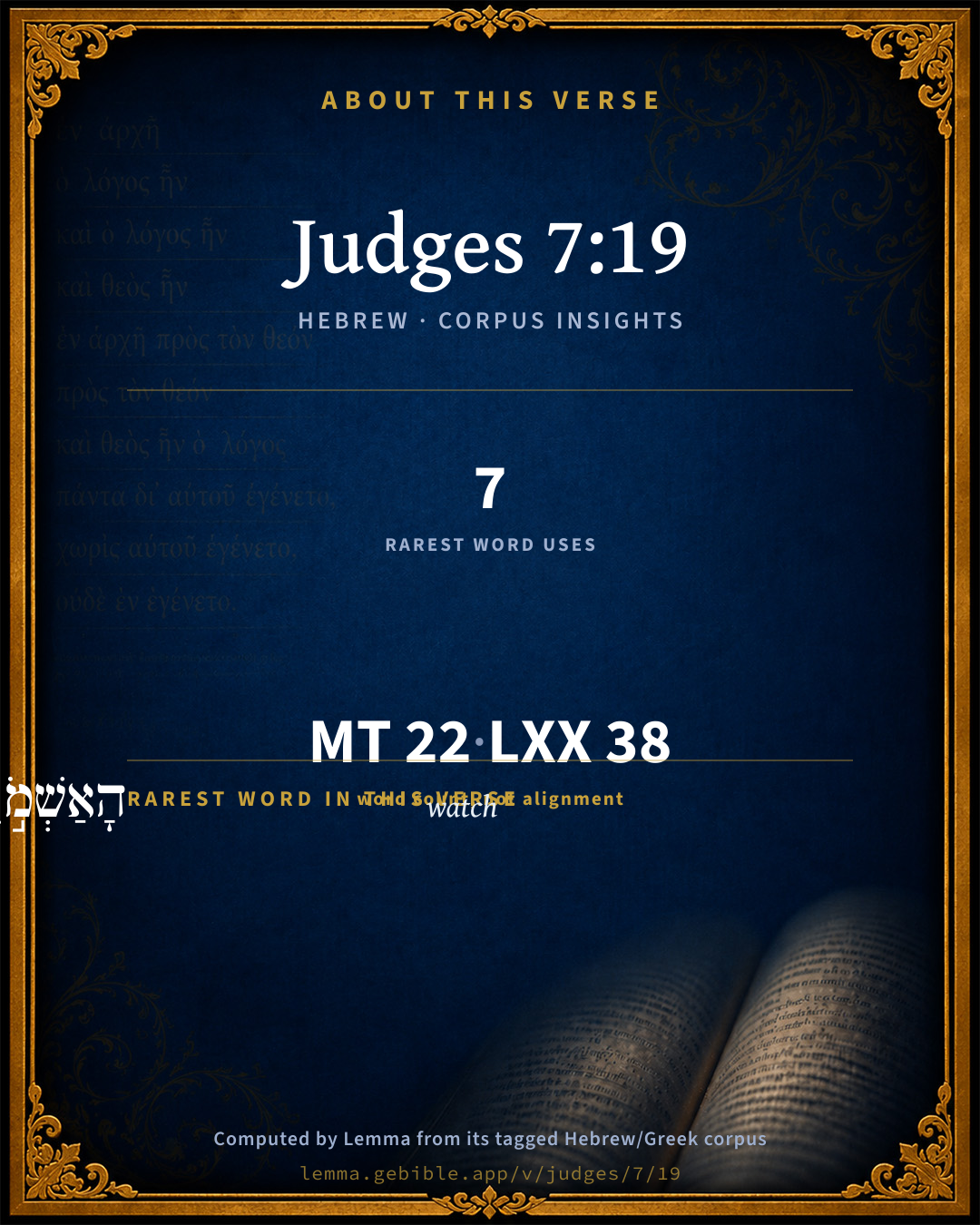
22
words
20
distinct lemmas
Historical
section

Notable vocabulary

The rarest word here is הָאַשְׁמֹ֣רֶת watch H821 — appearing just 7 times in the whole Hebrew Bible.

Shared distinctive vocabulary

הָאַשְׁמֹ֣רֶת watch H821 occurs in 7 verses of the Hebrew Bible. Also found in:

Grammatical profile

  • 6 verbs
  • 9 nouns
  • 2 adjectives
  • 1 preposition
  • 4 particles

Verb forms

  • וַיָּבֹ֣א Qal · Sequential Imperfect
  • הָקֵ֥ם Hiphil · Infinitive Absolute
  • הֵקִ֖ימוּ Hiphil · Perfect
  • הַשֹּֽׁמְרִ֑ים Qal · Participle Active
  • וַֽיִּתְקְעוּ֙ Qal · Sequential Imperfect
  • וְנָפ֥וֹץ Qal · Infinitive Absolute

Repetition

Words recur within this verse — often emphatic in Hebrew:

  • הָקֵ֥ם to rise H6965 ×2
  • אֲשֶׁר which H834 ×2

Hebrew & Septuagint length

In English translation the verse runs 49 words from the Hebrew and 45 from the Septuagint (LXX English) — closely comparable.

A rough comparison of the two English renderings, which tokenize alike — not a word-level alignment.

Word counts can differ between the Hebrew and the Greek without any difference in meaning — e.g. the Hebrew direct-object marker אֵת has no separate Greek word, and Greek often adds the article ὁ.

In the original languages it is 22 Hebrew tokens and 38 Greek tokens — but the two are counted differently (Hebrew bundles its prefixes and suffixes into one token; the Greek is in lemma form), so that isn’t a like-for-like length.

Cross-references

8

Topical passages linked to Judges 7:19 in the Treasury of Scripture Knowledge — connected by theme and wording, ordered by reader-vote popularity; previews shown in the World English Bible.

  • Exodus 14:24 It happened in the morning watch, that Yahweh looked out on the host of the Egyptians through the pillar of fire and of cloud, and confused the Egyptian army.
  • Psalms 2:9 You shall break them with a rod of iron. You shall dash them in pieces like a potter's vessel."
  • Revelation 16:15 "Behold, I come like a thief. Blessed is he who watches, and keeps his clothes, so that he doesn't walk naked, and they see his shame."
  • Judges 7:16 He divided the three hundred men into three companies, and he put into the hands of all of them trumpets, and empty pitchers, with torches within the pitchers.
  • Jeremiah 13:13–14 Then shall you tell them, Thus says Yahweh, Behold, I will fill all the inhabitants of this land, even the kings who sit on David's throne, and the priests, and the prophets, and all the inhabitants of Jerusalem, with drunkenness.
  • Jeremiah 19:1–11 Thus said Yahweh, Go, and buy a potter's earthen bottle, and [take] of the elders of the people, and of the elders of the priests;
  • Matthew 25:6 But at midnight there was a cry, 'Behold! The bridegroom is coming! Come out to meet him!'
  • 1 Thessalonians 5:2 For you yourselves know well that the day of the Lord comes like a thief in the night.

Cross-references courtesy of OpenBible.info (CC BY 4.0).

Hebrew and Greek witnesses Masoretic Hebrew ↔ Greek Septuagint

The same verse in the two great witnesses to the Old Testament, shown verse-for-verse.

These are two independent witnesses, not word-aligned to each other, and the Septuagint is shown in lemma (dictionary) form.

Hebrew Judges 7:19 Masoretic · Westminster Leningrad Codex

וַיָּבֹ֣א גִ֠דְעוֹן וּמֵאָה אִ֨ישׁ אֲשֶׁר אִתּ֜וֹ בִּקְצֵ֣ה הַֽמַּחֲנֶ֗ה רֹ֚אשׁ הָאַשְׁמֹ֣רֶת הַתִּֽיכוֹנָ֔ה אַ֛ךְ הָקֵ֥ם הֵקִ֖ימוּ אֶת הַשֹּֽׁמְרִ֑ים וַֽיִּתְקְעוּ֙ בַּשּׁ֣וֹפָר֔וֹת וְנָפ֥וֹץ הַכַּדִּ֖ים אֲשֶׁ֥ר בְּיָדָֽם

So Gideon, and the hundred men who were with him, came to the outermost part of the camp in the beginning of the middle watch, when they had but newly set the watch: and they blew the trumpets, and broke in pieces the pitchers that were in their hands.

World English Bible · Public Domain

Greek LXX Judges 7:19 Septuagint · lemma form

καί εἰςἔρχομαι γεδεων καί ὁ ἑκατόν ἀνήρ ὁ μετά αὐτός ἐν ἀρχή ὁ παρεμβολή ἐν ἀρχή ὁ φυλακή μέσος καί ἐγείρω ἀγείρω ὁ φυλάσσω καί σαλπίζω ἐν ὁ κερατίνη καί ἐκτινάσσω ὁ ὑδρία ὁ ἐν ὁ χείρ αὐτός

And Gedeon and the hundred men that were with him came to the extremity of the army in the beginning of the middle watch; and they completely roused the guards, and sounded with the horns, and they broke the pitchers that were in their hands,

LXX2012 (modern English Septuagint) · Public Domain

Hebrew: Westminster Leningrad Codex (CC BY 4.0). Greek: Septuagint (public domain); English from LXX2012 (modern English Septuagint) (Public Domain). How the Septuagint differs from the Hebrew →

Targum (Aramaic paraphrase)

1

The Targum is the ancient Jewish Aramaic paraphrase of the Hebrew Scriptures — an interpretive translation, not the Hebrew text itself. Onkelos (literal) and Pseudo-Jonathan (expansive) render the Torah, and Jonathan the Prophets. Coverage is partial: where no permissively-licensed English translation exists for a verse, only the Aramaic is shown. This is verse-level text, not a word-by-word alignment to the Hebrew.

  1. Targum Jonathan Prophets (Joshua–Malachi)
    וַאֲתָא גִדְעוֹן וּמְאָה גַבְרָא דְעִמֵיהּ בִּסְיָפֵי מַשְׁרִיתָא בְּרֵישׁ מַטַרְתָּא מְצִיעֲתָא בְּרַם אֲקָמָא אֲקִימוּ יַת נָטְרַיָא וּתְקָעוּ בְּשׁוֹפָרַיָא וּנְפָצוּ כַדִין דְבִידֵיהוֹן:

    (no public-domain English translation for this verse)

    Targum Jonathan — Aramaic: “Mikraot Gedolot” (public domain). English: “Sefaria Community Translation” (CC0 1.0 (public-domain dedication)); “London "Chaldee Paraphrase," 1871” (public domain). Text via Sefaria.

Commentary

Notes on Judges 7:19 from classic Christian and Jewish commentators (each source and its license shown beneath its notes). The classic Christian expositions comment on the surrounding passage and are grouped to its opening verse, so a note may address several verses; the Jewish commentaries on the Tanakh (Rashi and others) are per-verse, so they appear only where the commentator wrote on this verse.

Lemma curates 59 commentaries, every one of them public domain or Creative Commons licensed, each selected and text-cleaned for this edition rather than reprinted as found. About our sources →

Trapp's Complete Commentary

John Trapp

Jdg 7:19 So Gideon, and the hundred men that [were] with him, came unto the outside of the camp in the beginning of the middle watch; and they had but newly set the watch: and they blew the trumpets, and brake the pitchers that [were] in their hands.

Ver. 19. In the beginning of the middle watch.] He took the advantage of the night, to beat up their quarters. Nox formidinem auxit. Night is full of error and terror.

John Trapp, A Commentary or Exposition upon All the Books of the Old and New Testament (1647–1656) — public domain. Text from a community e-Sword module.

Joseph Benson's Commentary

Jdg 7:19. Middle watch — That is, of the second watch; for though afterward the night was divided into four watches by the Romans, (Mat 14:25,) yet in more ancient times, and in the eastern parts, it was divided into three: he chose the dark and dead of the night, to increase their terror by the trumpets, whose sound would then be loudest, and the lamps, whose light would then shine most brightly, to surprise them, and conceal the smallness of their numbers.

Joseph Benson's Commentary on the Old and New Testaments (1811–1818) — public domain. Text from a community e-Sword module.

Ellicott's Commentary for English Readers

(19) The middle watch.—The Jews anciently divided the night, from 6 P.M. to 6 A.M., into three watches (Exo_14:24; 1Sa_11:11). The subsequent division into four watches of three hours each was borrowed from the Romans (Mat_14:25; Mar_6:48). At the beginning of the middle watch—i.e., soon after 10 at night—would be the time at which the host would be buried in their first sleep.

They had but newly set the watch.—Literally, scarcely—or. “just in rousing they roused the watch.” The attack took place at the moment of confusion caused by changing the watch.

A Bible Commentary for English Readers, edited by Charles John Ellicott (1878–1897) — public domain. Text from a community e-Sword module.

The Cambridge Bible for Schools and Colleges

gen. ed. J. J. S. Perowne

19. the middle watch] The night was therefore divided into three watches: cf. ‘the morning watch’ Exo_14:24, 1Sa_11:11. The beginning of the middle watch would be about midnight. In later times the Jews adopted the Roman custom of dividing the night into four watches, St Mar_13:35, St Mat_14:25, St Luk_12:38.

The Cambridge Bible for Schools and Colleges (gen. ed. J. J. S. Perowne; Cambridge University Press, 1878–1918) — public domain. Text from a community e-Sword module.

John Gill's Exposition

So Gideon, and the one hundred men that were with him,.... Which was one of the three companies his army was divided into, and which company he had the command of particularly:

came unto the outside of the camp, in the beginning of the middle watch; the second watch, for the night was divided into three watches; for though in later times there were four watches, among the Romans (h), and which the Jews received from them; hence in the New Testament we read of the fourth watch; yet in earlier times, with the Jews and other eastern nations, there were but three watches, as affirmed by Jarchi and Kimchi on the place: and very wisely did Gideon fix on this watch for the time of his coming; for had he come at the first watch, many as yet might not have been in bed, or at least not fallen asleep; and had he come in the third watch, many might have been awake out of their sleep, and others up; but he took this time, a little after midnight, in the dead of the night, when the whole army was fast asleep:

and they had but newly set the watch; the first watch were just gone off, and the second were placed in their room; but since such an observation seems in a good measure unnecessary, for as Gideon came in the beginning of the watch it must in course be newly set; rather the words may be rendered, "in raising they raised up the watch" (i); that is, Gideon and his men did it by their approach; and they might call to them on purpose to give the alarm to the army, who upon that would at once hear the sound of the trumpets, and the clattering of the pitchers, and see the torches burning, to their great surprise:

and they blew the trumpets, and brake the pitchers that were in their hands; as soon as they came up to the watch and had raised them; this did Gideon and his hundred men.

(h) Liv. Hist. l. 36. c. 24. "Suidas in. voce" "et in voce" (i) "suscitando suscitaverunt custodes", Pagninus, Montanus.

John Gill's Exposition of the Whole Bible (1746–1763) — public domain (CC PDM 1.0). Text via the HelloAO Bible API.

Albert Barnes' Notes on the Bible

The middle watch - The old Jewish division of the night was three watches of four hours each. They are alluded to in Exo 14:24; 1Sa 11:11; Psa 63:6; Psa 90:4; Psa 119:148; Psa 130:6; Lam 2:19. After the Jews fell under the power of the Romans, they used the Roman division of four watches of three hours each Mat 14:25; Mar 13:35.

“The beginning” of the watch would be about eleven o’clock at night.

Albert Barnes' Notes on the Bible (1834–1885) — public domain. Text from a community e-Sword/MySword module.

Haydock's Catholic Bible Commentary

Watch. This was the second of the three watches known to the ancient Hebrews: in the New Testament, they followed the Roman discipline, and admitted four, Matthew xiv. 25. (Calmet) --- Menochius thinks they did the same at this time. (Haydock) --- Alarmed. They were not asleep. (Menochius) --- We read of similar stratagems in the Roman history. The Falisci threw the Romans into consternation, by appearing among them in mourning weeds; (Calmet) others read in priestly attire, (Haydock) with flambeaux and serpents; as those of Veii did by means of burning torches. (Grotius; Fontin., Strat, ii. 4, &c.) (Calmet) --- Trumpets. In a mystical sense, the preachers of the gospel, in order, to spiritual conquests, must not only sound with the trumpet of the word of God, but must also break the earthen pitchers, by the mortification of the flesh and its passions, and carry lamps in their hands by the light of their virtues. (Challoner) --- These lamps denote the virtues and miracles of the martyrs. (Ven. Bede, c. 5.) The things which would seem ridiculous, fill the enemy with terror and dismay. ( ibid.[Ven. Bede, c. 5.]) (Worthington)

George Leo Haydock (1774–1849), Haydock's Catholic Family Bible and Commentary, 1859 edition — public domain. Excludes Psalms (Douay-Rheims chapter numbering differs from Protestant) and Deuterocanonical books (Catholic canon only).

Matthew Poole's English Annotations

Of the middle watch, i.e. of the second watch; for though afterwards the night was divided into four watches by the Romans, Mat 14:25, yet in more ancient times, and in the eastern parts, it was divided into three. He chose the dark and dead of the night to increase their terror by the trumpets, whose sound would then be loudest and best heard, and the lamps, whose light would then shine most brightly, and seem biggest, to surprise them at disadvantage, and to conceal the smallness of their numbers.

Matthew Poole's English Annotations on the Holy Bible (1683–1685) — public domain. Text from a community e-Sword/MySword module.

Whedon's Commentary on the Bible

Daniel D. Whedon

19. The beginning of the middle watch — At midnight. Anciently the Israelites seem to have divided the night into three watches — evening, midnight, and morning watches. Exo_14:24; 1Sa_11:11. Later they adopted from the Roman’s the custom of four watches. Mat_14:25; Mar_6:48.

Daniel D. Whedon (gen. ed.), Commentary on the Old and New Testaments (1874–1909) — public domain. Text from a community e-Sword module.

The Pulpit Commentary

The middle watch. The ancient Israelites divided the night into three watches of four hours each, from sunset to sunrise, i.e. from six p.m. to six a.m. The first watch, from six to ten, is not mentioned in the Old Testament; but we have the middle watch mentioned here (from ten to two), and the morning watch (from two till six): Exo_14:24 and 1Sa_11:11. According to this, Gideon"s attack would have taken place soon after ten p.m., or towards eleven, the time when the sleep would be the deepest, the watchmen of the first watch having lately fallen into their first sleep. The later Israelites adopted the Roman division of the night into four watches. (Mat_14:25 Mar_6:48; cf. Mar_13:35)

The Pulpit Commentary (1880–1919), ed. H.D.M. Spence-Jones & Joseph S. Exell — public domain. Text from a community e-Sword module.

John Wesley's Explanatory Notes

Middle watch - That is, of the second watch; for though afterward the night was divided into four watches by the Romans, Matt. xiv, 25, yet in more ancient times, and in the eastern parts, it was divided into three: he chose the dark and dead of the night, to increase their terror by the trumpets, whose sound would then be loudest, and the lamps, whose light would then shine most brightly, to surprise them, and conceal the smallness of their numbers.

John Wesley, Explanatory Notes Upon the Whole Bible (1754–1765) — public domain. Text via the GEBible commentary corpus.

Keil & Delitzsch

C. F. Keil & F. Delitzsch

Gideon then proceeded with the 100 who were with him, i.e., the company which was led by himself personally, to the end of the hostile camp, at the beginning of the middle watch, i.e., at midnight ראשׁ is an accusative defining the time: see Ges. 118, 2, and Ewald, 204, a. The only other watch that is mentioned in the Old Testament beside the middle night-watch, is the morning night-watch (Exo 14:24; Sa1 11:11), from which it has been correctly inferred, that the Israelites divided the night into three night-watches. The division into four watches (Mat 14:25; Mar 6:48) was first adopted by the Jews from the Romans. "They (the Midianites) had only (just) posted the watchmen (of the middle watch)," - a circumstantial clause, introduced to give greater distinctness to the situation. When the first sentries were relieved, and the second posted, so that they thought they might make quite sure of their night's rest once more, Gideon and his host arrived at the end of the camp, and, as we must supply from the context, the other two hosts at two other ends of the camp, who all blew their trumpets, breaking the pitchers in their hands at the same time. The inf. abs. נפוץ, as a continuation of the finite verb יתקעוּ, indicates that the fact was contemporaneous with the previous one (see Ewald, 351, c.).

Keil & Delitzsch — Biblical Commentary on the Old Testament (1861–1891) — public domain (CC PDM 1.0). Text via the HelloAO Bible API. (Old Testament only.)

unfoldingWord translationNotes

Door43 World Missions Community

hundred men

"100 men" (See: Numbers)

right at the beginning of the middle watch

The beginning of the middle watch would be around 10 o'clock at night.

translationWords

Gideon

watch (biblical time)

Midian

trumpet

unfoldingWord translationNotes — © Distant Shores Media and the Door43 World Missions Community, licensed CC BY-SA 4.0. Source: git.door43.org/Door43/en_tn.

Rashi

Rabbi Shlomo Yitzchaki (Rashi)

Had posted. The soldiers had already posted the sentries who were assigned to the middle watch. Members of the military usually assign sentry duty so that some serve during the first third of the night, some during the second third, and some during the final third.

And smashed the pitchers. And broke the pitchers which were in their hands.

Rashi on the Tanakh — English translations: “The Judaica Press complete Tanach with Rashi, translated by A. J. Rosenberg” (CC BY 4.0); “Pentateuch with Rashi's commentary by M. Rosenbaum and A.M. Silbermann, 1929-1934” (public domain); “The Metsudah Tanach series, Lakewood, N.J” (CC BY 4.0); and “The Book of Joshua, Metsudah Publications, 1997” (CC BY 4.0). Text via Sefaria.

Lesson kit

Teaching starters — assembled from the data on this page, not authored interpretation. Every prompt links to the verse data it draws on. Edit before teaching.

Judges, in the Historical, opens this verse with 22 words (20 distinct Hebrew lemmas). Its most distinctive word is ʼashmurâh (“watch”). A historical commentator’s framing appears above. Read the whole chapter for the surrounding context.

Discussion questions

  1. How does “watch” (ʼashmurâh) shape what this verse is saying?
  2. How does Exodus 14:24, which shares the word «watch», read alongside this verse?
  3. What does the repetition of “to rise” (2× in this one verse) do in this verse?
  4. These translations render this verse differently. What is at stake in choosing one wording over another?
  5. «וַיָּבֹ֣א» is a Qal Sequential Imperfect verb. How does that grammatical form shape the action described?
  6. Compare how Trapp's Complete Commentary and Joseph Benson's Commentary read this verse. Where do they agree or differ?

Things to notice

Reading settings

Reading text

Shown beneath each verse's original-language words.

Old Testament
Old Testament edition

Read the OT as the Masoretic Hebrew (MT) or the Greek Septuagint (LXX).

English shown for the Greek Septuagint (in the Hebrew ↔ Greek comparison).

Comparing translations? Open the Compare panel on any verse page to stack up to four side by side.