Esther 8:4

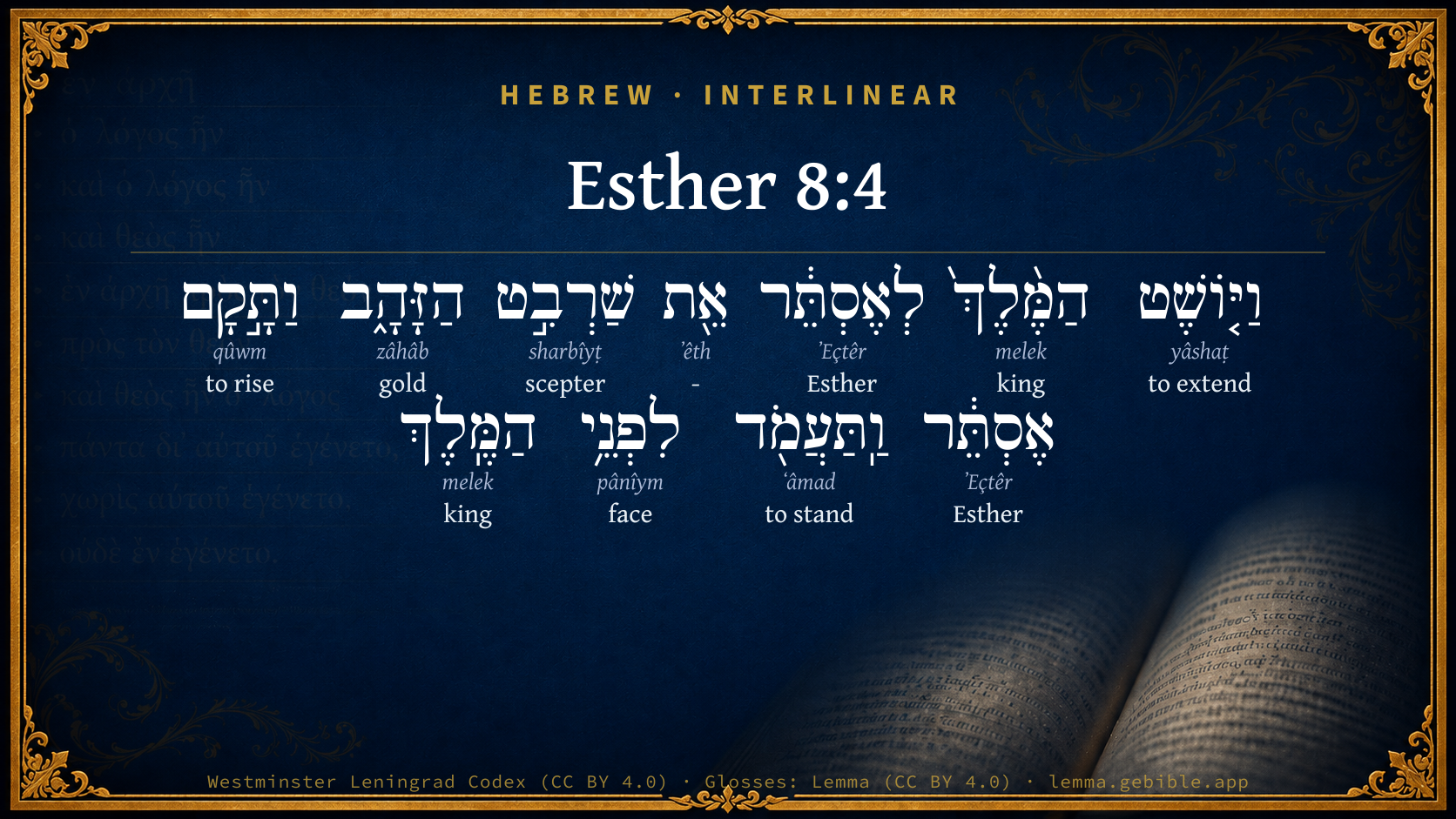
Hebrew (Westminster Leningrad Codex) Esther 8:4 appears in the Hebrew Old Testament. The text above is from the Westminster Leningrad Codex. Each word links to its Strong’s number, a concise gloss, and parsing drawn from the Open Scriptures Hebrew Bible morphology. Click any word for its full Brown-Driver-Briggs (BDB) entry.
Download image
Cite this verse

Esther 8:4 (World English Bible). Public Domain. Lemma interlinear Bible study tool, https://lemma.gebible.app/v/esther/8/4.

Show BibTeX & RIS
BibTeX
RIS
English Translation
Then the king held out to Esther the golden scepter. So Esther arose, and stood before the king.
World English Bible · Public Domain
Download a study sheet

One document with this verse’s original text, its word-by-word gloss line, the meaning frame, cross-references with their text, attributed commentary, and full source and license credits — printable, and it pastes into notes with its structure intact.

This verse Autodidact and up

Study sheet (.html) Plain text (.txt)

A passage Seminary Student

Up to 50 verses in one chapter. A passage sheet keeps up to 6 commentary sources and 12 cross-references per verse, in the order this page ranks them, and says so on the sheet whenever that leaves anything out. Ask for a single verse and you get the Autodidact verse sheet above.

Everything on this page stays free to read, with no account — the sheet is a download of what is already on screen, not access to it.

Want to remove ads? Support Godless Engineer
Compare translations 3

The same verse in 3 English versions, stacked beneath the original-language interlinear above. Click any original word for its lexicon entry.

Each is an independent rendering of the whole verse — the interlinear is not word-aligned to these translations.

Highlighted words mark where these versions differ — a whole-verse word diff, not a word-by-word alignment.

  • World English Bible Public Domain
    Then the king held out to Esther the golden scepter. So Esther arose, and stood before the king.
  • King James Version Public Domain
    Then the king held out the golden sceptre toward Esther. So Esther arose, and stood before the king,
  • unfoldingWord Literal Text CC BY-SA 4.0
    And the king held out to Esther the scepter of gold, so Esther rose up and stood before the face of the king.

unfoldingWord Literal Text — © unfoldingWord, licensed CC BY-SA 4.0. Word-aligned USFM3 via Door43 (git.door43.org/unfoldingWord/en_ult).

Versions to compare (up to 4)

3 of 4 selected

Show all 18 translations

Every available English version of this verse, each an independent rendering of the whole verse.

  • World English Bible Public Domain
    Then the king held out to Esther the golden scepter. So Esther arose, and stood before the king.
  • Berean Standard Bible Public Domain
    The king extended the gold scepter toward Esther, and she arose and stood before the king.
  • Majority Standard Bible Public Domain
    The king extended the gold scepter toward Esther, and she arose and stood before the king.
  • King James Version Public Domain
    Then the king held out the golden sceptre toward Esther. So Esther arose, and stood before the king,
  • American Standard Version (1901) Public Domain
    Then the king held out to Esther the golden sceptre. So Esther arose, and stood before the king.
  • Revised Version (1885) Public Domain
    Then the king held out to Esther the golden sceptre. So Esther arose, and stood before the king.
  • Geneva Bible (1599) Public Domain
    And the King held out the golden scepter toward Ester. Then arose Ester, and stood before the King,
  • Douay-Rheims (1899) Public Domain
    But he, as the manner was, held out the golden sceptre with his hand, which was the sign of clemency: and she arose up and stood before him,
  • Young's Literal Translation Public Domain
    and the king holdeth out to Esther the golden sceptre, and Esther riseth, and standeth before the king,
  • Literal Standard Version CC BY-SA 4.0
    and the king holds out to Esther the golden scepter, and Esther rises, and stands before the king,
  • Unlocked Literal Bible CC BY-SA 4.0
    Then the king held out the golden scepter to Esther, she arose and stood before the king.
  • unfoldingWord Literal Text CC BY-SA 4.0
    And the king held out to Esther the scepter of gold, so Esther rose up and stood before the face of the king.
  • Darby Bible Public Domain
    And the king held out the golden sceptre toward Esther. And Esther arose and stood before the king,
  • World Messianic Bible Public Domain
    Then the king held out to Esther the golden scepter. So Esther arose, and stood before the king.
  • Webster's Bible Public Domain
    Then the king held out the golden scepter towards Esther. So Esther arose, and stood before the king,
  • Free Bible Version CC BY-SA 4.0
    Once again the king held out the golden scepter to Esther. She got up and stood before him.
  • Bible in Basic English Public Domain
    Then the king put out the rod of gold to Esther, and she got up before the king.
  • JPS Tanakh (1917) Public Domain
    Then the king held out to Esther the golden sceptre. So Esther arose, and stood before the king.

Literal Standard Version (2020), Covenant Press — licensed CC BY-SA 4.0. Text via the HelloAO Bible API (eBible.org). Unlocked Literal Bible (unfoldingWord) — licensed CC BY-SA 4.0. Text via the HelloAO Bible API (eBible.org). unfoldingWord Literal Text — © unfoldingWord, licensed CC BY-SA 4.0. Word-aligned USFM3 via Door43 (git.door43.org/unfoldingWord/en_ult). Free Bible Version, Dr. Jonathan Gallagher — licensed CC BY-SA 4.0. Text via the HelloAO Bible API (eBible.org).

Word by word

More ways to search: Search by grammar → Find every occurrence → Compare this word →

Practice this passage: Drill this verse → Learn its vocabulary →

וַיּ֤וֹשֶׁט
yâshaṭ
H3447
“and · to extend”
Conjunction + Verb, Hiphil, Sequential Imperfect, 3rd Person, Masculine, Singular
Part of Speech
Conjunction + Verb
Stem
Hiphil
Form
Sequential Imperfect
Person
3rd Person
Gender
Masculine
Number
Singular
Full BDB Definition

Origin: a primitive root

TWOT: 925

(Hiphil) to hold out, extend
  1. הַמֶּ֨לֶךְ֙ melek H4428 “the · king” Particle, Definite Article + Noun, Common, Masculine, Singular, Absolute
  2. לְאֶסְתֵּ֔ר ʼEçtêr H635 “to/for · Esther” Preposition + Noun, Proper
  3. אֵ֖ת ʼêth H853 “-” Particle, Direct Object
  4. שַׁרְבִ֣ט sharbîyṭ H8275 “scepter of” Noun, Common, Masculine, Singular, Construct
  5. הַזָּהָ֑ב zâhâb H2091 “the · gold” Particle, Definite Article + Noun, Common, Masculine, Singular, Absolute
  6. וַתָּ֣קָם qûwm H6965 “and · to rise” Conjunction + Verb, Qal, Sequential Imperfect, 3rd Person, Feminine, Singular
  7. אֶסְתֵּ֔ר ʼEçtêr H635 “Esther” Noun, Proper
  8. וַֽתַּעֲמֹ֖ד ʻâmad H5975 “and · to stand” Conjunction + Verb, Qal, Sequential Imperfect, 3rd Person, Feminine, Singular
  9. לִפְנֵ֥י pânîym H6440 “to/for · face(s) of” Preposition + Noun, Common, Both, Plural, Construct
  10. הַמֶּֽלֶךְ melek H4428 “the · king” Particle, Definite Article + Noun, Common, Masculine, Singular, Absolute

About this verse

These counts appear in no published source. They are computed here, from the morphology-tagged text and Lemma’s own curated glosses. What Lemma adds →

11
words
9
distinct lemmas
Historical
section

Notable vocabulary

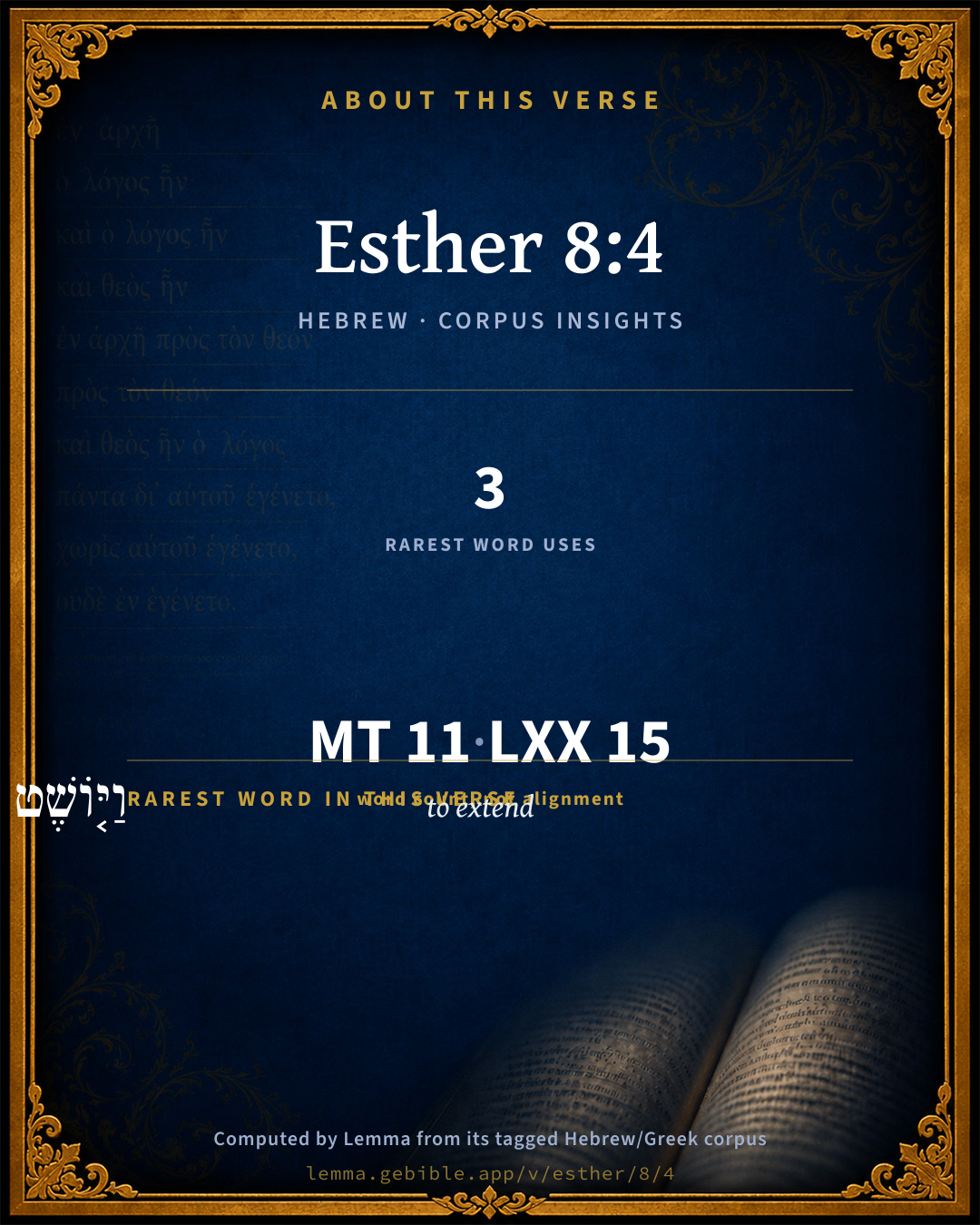
The rarest word here is וַיּ֤וֹשֶׁט to extend H3447 — appearing just 3 times in the whole Hebrew Bible.

Shared distinctive vocabulary

וַיּ֤וֹשֶׁט to extend H3447 occurs in 3 verses of the Hebrew Bible. Also found in:

Grammatical profile

  • 3 verbs
  • 7 nouns
  • 1 particle

Verb forms

  • וַיּ֤וֹשֶׁט Hiphil · Sequential Imperfect
  • וַתָּ֣קָם Qal · Sequential Imperfect
  • וַֽתַּעֲמֹ֖ד Qal · Sequential Imperfect

Repetition

Words recur within this verse — often emphatic in Hebrew:

  • הַמֶּ֨לֶךְ֙ king H4428 ×2
  • לְאֶסְתֵּ֔ר Esther H635 ×2

Hebrew & Septuagint length

In English translation the verse runs 18 words from the Hebrew and 18 from the Septuagint (LXX English) — the same length.

A rough comparison of the two English renderings, which tokenize alike — not a word-level alignment.

Word counts can differ between the Hebrew and the Greek without any difference in meaning — e.g. the Hebrew direct-object marker אֵת has no separate Greek word, and Greek often adds the article ὁ.

In the original languages it is 11 Hebrew tokens and 15 Greek tokens — but the two are counted differently (Hebrew bundles its prefixes and suffixes into one token; the Greek is in lemma form), so that isn’t a like-for-like length.

Cross-references

2

Topical passages linked to Esther 8:4 in the Treasury of Scripture Knowledge — connected by theme and wording, ordered by reader-vote popularity; previews shown in the World English Bible.

  • Esther 5:2 It was so, when the king saw Esther the queen standing in the court, that she obtained favor in his sight; and the king held out to Esther the golden scepter that was in his hand. So Esther drew near, and touched the top of the scepter.
  • Esther 4:11 All the king's servants, and the people of the king's provinces, do know, that whoever, whether man or woman, shall come to the king into the inner court, who is not called, there is one law for him, that he be put to death, except those to whom the king shall hold out the golden scepter, that he may live: but I have not been called to come in to the king these thirty days.

Cross-references courtesy of OpenBible.info (CC BY 4.0).

Hebrew and Greek witnesses Masoretic Hebrew ↔ Greek Septuagint

The same verse in the two great witnesses to the Old Testament, shown verse-for-verse.

These are two independent witnesses, not word-aligned to each other, and the Septuagint is shown in lemma (dictionary) form.

Hebrew Esther 8:4 Masoretic · Westminster Leningrad Codex

וַיּ֤וֹשֶׁט הַמֶּ֨לֶךְ֙ לְאֶסְתֵּ֔ר אֵ֖ת שַׁרְבִ֣ט הַזָּהָ֑ב וַתָּ֣קָם אֶסְתֵּ֔ר וַֽתַּעֲמֹ֖ד לִפְנֵ֥י הַמֶּֽלֶךְ

Then the king held out to Esther the golden scepter. So Esther arose, and stood before the king.

World English Bible · Public Domain

Greek LXX Esther 8:4 Septuagint · lemma form

ἐκτείνω δέ ὁ βασιλεύς εσθηρ ὁ ῥάβδος ὁ χρυσοῦς ἐκἐγείρω δέ εσθηρ παραἵστημι ὁ βασιλεύς

Then the king stretched out to Esther the golden sceptre: and Esther arose to stand near the king.

LXX2012 (modern English Septuagint) · Public Domain

Hebrew: Westminster Leningrad Codex (CC BY 4.0). Greek: Septuagint (public domain); English from LXX2012 (modern English Septuagint) (Public Domain). How the Septuagint differs from the Hebrew →

Commentary

Notes on Esther 8:4 from classic Christian and Jewish commentators (each source and its license shown beneath its notes). The classic Christian expositions comment on the surrounding passage and are grouped to its opening verse, so a note may address several verses; the Jewish commentaries on the Tanakh (Rashi and others) are per-verse, so they appear only where the commentator wrote on this verse.

Lemma curates 59 commentaries, every one of them public domain or Creative Commons licensed, each selected and text-cleaned for this edition rather than reprinted as found. About our sources →

Trapp's Complete Commentary

John Trapp

Est 8:4 Then the king held out the golden sceptre toward Esther. So Esther arose, and stood before the king,

Ver. 4. Then the king held out the golden sceptre] It appeareth by this, that she once more put her life in her hand; hazarding it for her people’s safety (as Arsinoe interposed her own body between her children and the murderers sent to slay them), and so performing her promise made to Mordecai, Est 4:16. God’s children are all such as will not lie, Isa 63:8; if they swear to their hurt, yet they dare not change, Psa 15:4, dare not say and unsay, 2Co 1:18-19. Of many promises it may be said, as Tertullian doth to the peacock, that they are all in changeable colours; as often changed as moved. Holy Esther was none such; no more was that blessed martyr of Jesus Christ, Mr Hawkes, when in the flames remembering his promise to certain friends (to give them a sign whether the rage of the pain were tolerable), be reached up his hands burning on a light fire, and clapped them over his head three times together, to the great astonishment of the beholders, but especially to them who understood the matter.

So Esther arose, and stood before the king] Experience had bred confidence. They likewise that humble themselves under the mighty hand of God shall be exalted in due time, 1Pe 5:6. And as the lower the ebb the higher will be the tide; so the lower we descend in humiliation, the higher shall we ascend in exaltation.

John Trapp, A Commentary or Exposition upon All the Books of the Old and New Testament (1647–1656) — public domain. Text from a community e-Sword module.

Joseph Benson's Commentary

Est 8:4-6. Then the king held out the golden sceptre — Esther had presumed to come a second time into the king’s presence without being called: which he did not take ill, but by this token graciously invited her to approach him, indicating that he accepted her person. So Esther arose — Having before fallen at his feet; and stood before the king — As a petitioner for her people; and said, If it please the king, &c. — She uses various expressions, that she might confirm the king’s favour by such a full submission to his good pleasure. Even then, when we have ever so much reason and justice on our side, and have ever so clear a cause to plead, yet it becomes us to speak to our superiors with humility and modesty, and all possible expressions of respect. There is nothing lost by decency and good breeding. Let it be written to reverse the letters devised by Haman — She prudently takes off the hatefulness of the action from the king, and lays it upon Haman, who had for his own ends contrived the whole business, and circumvented the king in it. For how can I endure to see the destruction of my kindred? — My heart will sink under it, and I shall never be able to survive it. She does not urge the innocence of the Jews, but only pleads their affinity to her: probably she knew that this plea would have more weight with the king, even than one grounded on their innocence.

Joseph Benson's Commentary on the Old and New Testaments (1811–1818) — public domain. Text from a community e-Sword module.

Geneva Bible (1599)

Geneva Bible translators

Read Esther 5:2.

Geneva Bible (1599) marginal notes — public domain. Text via Bolls.life.

Jamieson, Fausset & Brown

Robert Jamieson, A. R. Fausset & David Brown

Then the king held out the golden sceptre toward Esther--in token that her request was accepted, and that she needed no longer to maintain the humble attitude of a suppliant.

Jamieson, Fausset & Brown — Commentary Critical and Explanatory on the Whole Bible (1871) — public domain (CC PDM 1.0). Text via the HelloAO Bible API.

Ellicott's Commentary for English Readers

(4) The king held out the golden sceptre.—See Note on Est_4:11.

A Bible Commentary for English Readers, edited by Charles John Ellicott (1878–1897) — public domain. Text from a community e-Sword module.

The Cambridge Bible for Schools and Colleges

gen. ed. J. J. S. Perowne

4. held out to Esther the golden sceptre] Cp. Est_4:11, Est_5:2. On this occasion, however, the king’s action was not in order to permit approach with a petition, but in token of the favourable hearing granted to a request already made.

The Cambridge Bible for Schools and Colleges (gen. ed. J. J. S. Perowne; Cambridge University Press, 1878–1918) — public domain. Text from a community e-Sword module.

John Gill's Exposition

Then the king held out the golden sceptre towards Esther,.... As a token that she had not incurred his displeasure by coming into his presence without leave, and that she was admitted to speak and make her request; see Est 5:3

so Esther arose and stood before the king; she rose from the ground on which she lay prostrate, and stood upon her feet, in an humble manner, to make her speech, and present her petition to the king.

John Gill's Exposition of the Whole Bible (1746–1763) — public domain (CC PDM 1.0). Text via the HelloAO Bible API.

Matthew Poole's English Annotations

The king held out the golden sceptre; in token that he accepted her person and petition, and that she should stand upon her feet.

Matthew Poole's English Annotations on the Holy Bible (1683–1685) — public domain. Text from a community e-Sword/MySword module.

Whedon's Commentary on the Bible

Daniel D. Whedon

4. Held out the golden sceptre — We understand that the queen first came and fell weeping before the king, but said nothing until he held out the sceptre. Then she arose, and stood before him, and made the request of which a mere summary is given in the preceding verse. The language of her address is given in the two following verses.

Daniel D. Whedon (gen. ed.), Commentary on the Old and New Testaments (1874–1909) — public domain. Text from a community e-Sword module.

The Pulpit Commentary

Then the king held out the golden sceptre. Either Esther had again intruded on the king uninvited, or there was a double use of the golden sceptre.

1. In the pardon of those who so intruded; and,

2. In the ordinary granting of requests. It was perhaps held out on this occasion simply to express a readiness to do as Esther desired.

The Pulpit Commentary (1880–1919), ed. H.D.M. Spence-Jones & Joseph S. Exell — public domain. Text from a community e-Sword module.

Lesson kit

Teaching starters — assembled from the data on this page, not authored interpretation. Every prompt links to the verse data it draws on. Edit before teaching.

Esther, in the Historical, opens this verse with 11 words (9 distinct Hebrew lemmas). Its most distinctive word is yâshaṭ (“to extend”). A historical commentator’s framing appears above. Read the whole chapter for the surrounding context.

Discussion questions

  1. How does “to extend” (yâshaṭ) shape what this verse is saying?
  2. How does Esther 4:11, which shares the word «to extend», read alongside this verse?
  3. What does the repetition of “king” (2× in this one verse) do in this verse?
  4. These translations render this verse differently. What is at stake in choosing one wording over another?
  5. «וַיּ֤וֹשֶׁט» is a Hiphil Sequential Imperfect verb. How does that grammatical form shape the action described?
  6. Compare how Trapp's Complete Commentary and Joseph Benson's Commentary read this verse. Where do they agree or differ?

Things to notice

Reading settings

Reading text

Shown beneath each verse's original-language words.

Old Testament
Old Testament edition

Read the OT as the Masoretic Hebrew (MT) or the Greek Septuagint (LXX).

English shown for the Greek Septuagint (in the Hebrew ↔ Greek comparison).

Comparing translations? Open the Compare panel on any verse page to stack up to four side by side.