1 Samuel 20:42

Hebrew (Westminster Leningrad Codex) 1 Samuel 20:42 appears in the Hebrew Old Testament. The text above is from the Westminster Leningrad Codex. Each word links to its Strong’s number, a concise gloss, and parsing drawn from the Open Scriptures Hebrew Bible morphology. Click any word for its full Brown-Driver-Briggs (BDB) entry.
Download image
Cite this verse

1 Samuel 20:42 (World English Bible). Public Domain. Lemma interlinear Bible study tool, https://lemma.gebible.app/v/1-samuel/20/42.

Show BibTeX & RIS
BibTeX
RIS
English Translation
Jonathan said to David, Go in peace, because we have sworn both of us in the name of Yahweh, saying, Yahweh shall be between me and you, and between my seed and your seed, forever. He arose and departed: and Jonathan went into the city.
World English Bible · Public Domain
Download a study sheet

One document with this verse’s original text, its word-by-word gloss line, the meaning frame, cross-references with their text, attributed commentary, and full source and license credits — printable, and it pastes into notes with its structure intact.

This verse Autodidact and up

Study sheet (.html) Plain text (.txt)

A passage Seminary Student

Up to 50 verses in one chapter. A passage sheet keeps up to 6 commentary sources and 12 cross-references per verse, in the order this page ranks them, and says so on the sheet whenever that leaves anything out. Ask for a single verse and you get the Autodidact verse sheet above.

Everything on this page stays free to read, with no account — the sheet is a download of what is already on screen, not access to it.

Want to remove ads? Support Godless Engineer
Compare translations 3

The same verse in 3 English versions, stacked beneath the original-language interlinear above. Click any original word for its lexicon entry.

Each is an independent rendering of the whole verse — the interlinear is not word-aligned to these translations.

Highlighted words mark where these versions differ — a whole-verse word diff, not a word-by-word alignment.

  • World English Bible Public Domain
    Jonathan said to David, Go in peace, because we have sworn both of us in the name of Yahweh, saying, Yahweh shall be between me and you, and between my seed and your seed, forever. He arose and departed: and Jonathan went into the city.
  • King James Version Public Domain
    And Jonathan said to David, Go in peace, forasmuch as we have sworn both of us in the name of the LORD, saying, The LORD be between me and thee, and between my seed and thy seed for ever. And he arose and departed: and Jonathan went into the city.
  • unfoldingWord Literal Text CC BY-SA 4.0
    And Jonathan said to David, “Go in peace, because we, the two of us, have sworn in the name of Yahweh, saying, ‘Yahweh is between me and between you, and between my seed and between your seed, forever.’” And he arose and went, and Jonathan entered the city.

unfoldingWord Literal Text — © unfoldingWord, licensed CC BY-SA 4.0. Word-aligned USFM3 via Door43 (git.door43.org/unfoldingWord/en_ult).

Versions to compare (up to 4)

3 of 4 selected

Show all 18 translations

Every available English version of this verse, each an independent rendering of the whole verse.

  • World English Bible Public Domain
    Jonathan said to David, Go in peace, because we have sworn both of us in the name of Yahweh, saying, Yahweh shall be between me and you, and between my seed and your seed, forever. He arose and departed: and Jonathan went into the city.
  • Berean Standard Bible Public Domain
    And Jonathan said to David, “Go in peace, for the two of us have sworn in the name of the LORD, saying, ‘May the LORD be a witness between you and me, and between your descendants and mine forever.’” Then David got up and departed, and Jonathan went back into the city.
  • Majority Standard Bible Public Domain
    And Jonathan said to David, “Go in peace, for the two of us have sworn in the name of the LORD, saying, ‘May the LORD be a witness between you and me, and between your descendants and mine forever.’” Then David got up and departed, and Jonathan went back into the city.
  • King James Version Public Domain
    And Jonathan said to David, Go in peace, forasmuch as we have sworn both of us in the name of the LORD, saying, The LORD be between me and thee, and between my seed and thy seed for ever. And he arose and departed: and Jonathan went into the city.
  • American Standard Version (1901) Public Domain
    And Jonathan said to David, Go in peace, forasmuch as we have sworn both of us in the name of Jehovah, saying, Jehovah shall be between me and thee, and between my seed and thy seed, for ever. And he arose and departed: and Jonathan went into the city.
  • Revised Version (1885) Public Domain
    And Jonathan said to David, Go in peace, forasmuch as we have sworn both of us in the name of the LORD, saying, The LORD shall be between me and thee, and between my seed and thy seed, for ever. And he arose and departed: and Jonathan went into the city.
  • Geneva Bible (1599) Public Domain
    Therefore Ionathan said to Dauid, Goe in peace: that which we haue sworne both of vs in the Name of the Lord, saying, The Lord be betweene me and thee, and betweene my seede and betweene thy seede, let it stand for euer.
  • Douay-Rheims (1899) Public Domain
    And Jonathan said to David: Go in peace: and let all stand that we have sworn both of us in the name of the Lord, saying: The Lord be between me and thee, and between my seed and thy seed for ever.
  • Young's Literal Translation Public Domain
    and Jonathan saith to David, `Go in peace, in that we have sworn -- we two -- in the name of Jehovah, saying, Jehovah is between me and thee, and between my seed and thy seed -- unto the age;' and he riseth and goeth; and Jonathan hath gone in to the city.
  • Literal Standard Version CC BY-SA 4.0
    and Jonathan says to David, “Go in peace, in that we have sworn—the two of us—in the Name of YHWH, saying, YHWH is between me and you, and between my seed and your seed—for all time”; and he rises and goes; and Jonathan has gone into the city.
  • Unlocked Literal Bible CC BY-SA 4.0
    Jonathan said to David, “Go in peace, because we have both sworn in the name of Yahweh and said, 'May Yahweh be between you and me, and between my descendants and your descendants, forever.'” Then David stood up and left, and Jonathan returned to the city.
  • unfoldingWord Literal Text CC BY-SA 4.0
    And Jonathan said to David, “Go in peace, because we, the two of us, have sworn in the name of Yahweh, saying, ‘Yahweh is between me and between you, and between my seed and between your seed, forever.’” And he arose and went, and Jonathan entered the city.
  • Darby Bible Public Domain
    And Jonathan said to David, Go in peace, forasmuch as we have both of us sworn in the name of Jehovah, saying, Jehovah be between me and thee, and between my seed and thy seed for ever! And he arose and departed; and Jonathan went into the city.
  • World Messianic Bible Public Domain
    Jonathan said to David, “Go in peace, because we have both sworn in the LORD’s name, saying, ‘The LORD is between me and you, and between my offspring and your offspring, forever.’” He arose and departed; and Jonathan went into the city.
  • Webster's Bible Public Domain
    And Jonathan said to David, Go in peace, forasmuch as we have sworn both of us in the name of the LORD, saying, The LORD be between me and thee, and between my seed and thy seed for ever.\\
  • Free Bible Version CC BY-SA 4.0
    Jonathan said to David, “Go in peace, for the two of us have sworn a solemn oath in the name of the Lord. We said, ‘The Lord will be a witness between me and you, and between my descendants and your descendants forever.’” Then David left, and Jonathan went back to town.
  • Bible in Basic English Public Domain
    And Jonathan said to David, Go in peace, for we two have taken an oath, in the name of the Lord, saying, The Lord will be between me and you, and between my seed and your seed for ever. Then David went away, and Jonathan went into the town.
  • JPS Tanakh (1917) Public Domain
    And Jonathan said to David: 'Go in peace, forasmuch as we have sworn both of us in the name of the LORD, saying: The LORD shall be between me and thee, and between my seed and thy seed, for ever.' (21-1) And he arose and departed; and Jonathan went into the city.

Literal Standard Version (2020), Covenant Press — licensed CC BY-SA 4.0. Text via the HelloAO Bible API (eBible.org). Unlocked Literal Bible (unfoldingWord) — licensed CC BY-SA 4.0. Text via the HelloAO Bible API (eBible.org). unfoldingWord Literal Text — © unfoldingWord, licensed CC BY-SA 4.0. Word-aligned USFM3 via Door43 (git.door43.org/unfoldingWord/en_ult). Free Bible Version, Dr. Jonathan Gallagher — licensed CC BY-SA 4.0. Text via the HelloAO Bible API (eBible.org).

Word by word

More ways to search: Search by grammar → Find every occurrence → Compare this word →

Practice this passage: Drill this verse → Learn its vocabulary →

וִיהוֹנָתָ֖ן
Yᵉhôwnâthân
H3083
“and · Jonathan”
Conjunction + Noun, Proper
Part of Speech
Conjunction + Noun
Type
Proper
Full BDB Definition

Origin: from H3068 and H5414

TWOT: None

Jonathan or Jehonathan = "Jehovah has given" - a son of king Saul and a friend of David - a son of the high priest Abiathar and the last descendant of Eli of whom we hear - a nephew of David who like David slew a giant of Gath - an uncle of David - one of David's mighty warriors - one of David's treasurers - a scribe in the time of Jeremiah - a Levite and father of Zechariah, a priest who blew the trumpet at the dedication of the wall - a son or descendant of Gershom, the son of Moses, and a priest to the tribe of Dan - a son of Kareah and a brother of Johanan; a Judaite captain after the fall of Jerusalem - another Judaite father of Peleth - father of Ebed in the time of Ezra - son of Asahel in the time of Ezra - a priest of the family of Melicu in the time of Nehemiah - son of Joiada and his successor to the high priesthood in the time of Nehemiah
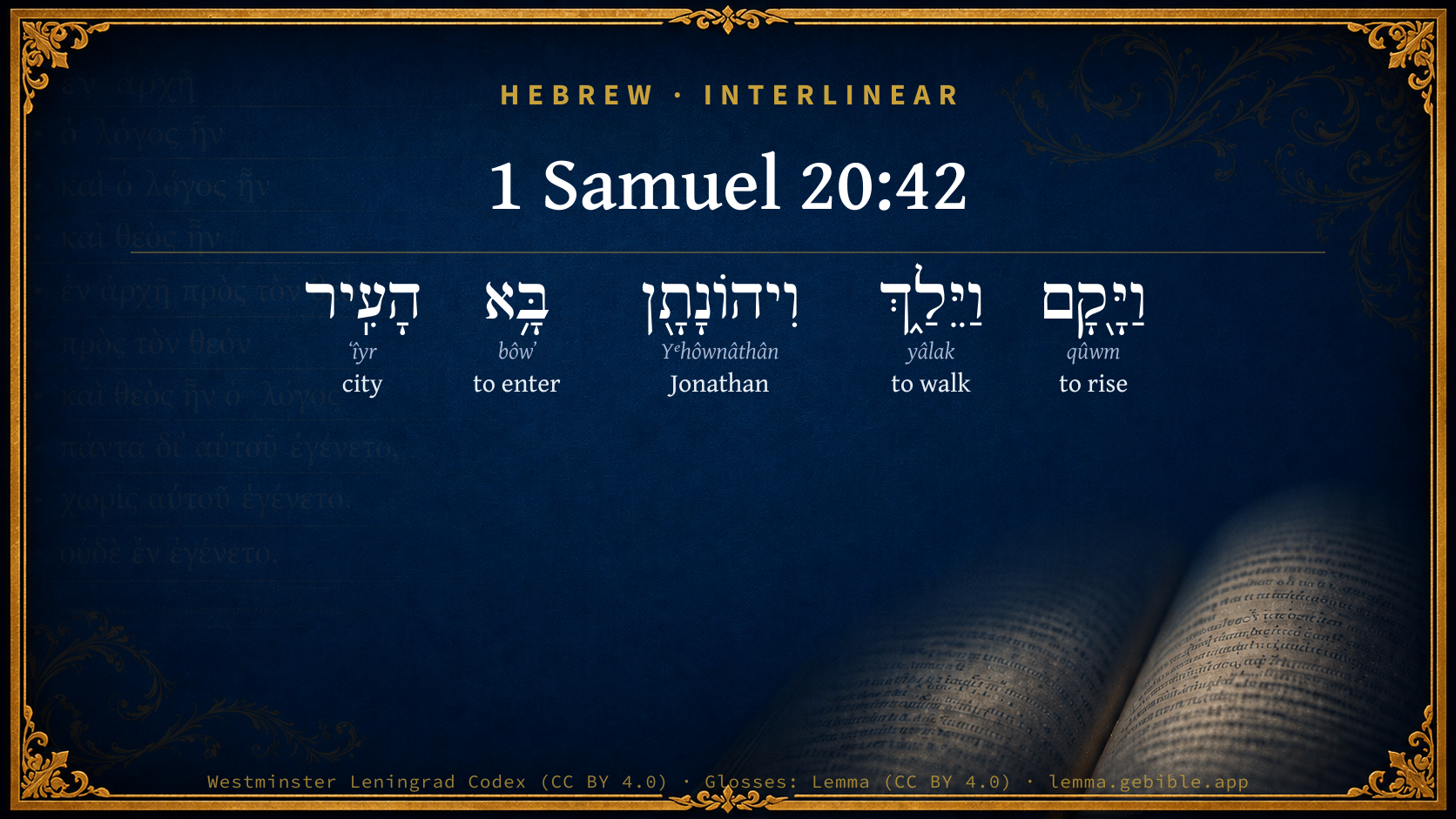
  1. וַיָּ֖קָם qûwm H6965 “and · to rise” Conjunction + Verb, Qal, Sequential Imperfect, 3rd Person, Masculine, Singular
  2. וַיֵּלַ֑ךְ yâlak H3212 “and · to walk” Conjunction + Verb, Qal, Sequential Imperfect, 3rd Person, Masculine, Singular
  3. בָּ֥א bôwʼ H935 “to enter” Verb, Qal, Perfect, 3rd Person, Masculine, Singular
  4. הָעִֽיר ʻîyr H5892 “the · city” Particle, Definite Article + Noun, Common, Feminine, Singular, Absolute

About this verse

These counts appear in no published source. They are computed here, from the morphology-tagged text and Lemma’s own curated glosses. What Lemma adds →

5
words
5
distinct lemmas
Historical
section

Grammatical profile

  • 3 verbs
  • 2 nouns

Verb forms

  • וַיָּ֖קָם Qal · Sequential Imperfect
  • וַיֵּלַ֑ךְ Qal · Sequential Imperfect
  • בָּ֥א Qal · Perfect

Hebrew & Septuagint length

In English translation the verse runs 45 words from the Hebrew and 54 from the Septuagint (LXX English) — closely comparable.

A rough comparison of the two English renderings, which tokenize alike — not a word-level alignment.

Word counts can differ between the Hebrew and the Greek without any difference in meaning — e.g. the Hebrew direct-object marker אֵת has no separate Greek word, and Greek often adds the article ὁ.

Cross-references

7

Topical passages linked to 1 Samuel 20:42 in the Treasury of Scripture Knowledge — connected by theme and wording, ordered by reader-vote popularity; previews shown in the World English Bible.

  • 1 Samuel 1:17 Then Eli answered, Go in peace; and the God of Israel grant your petition that you have asked of him.
  • 1 Samuel 23:18 They two made a covenant before Yahweh: and David abode in the wood, and Jonathan went to his house.
  • 1 Samuel 20:22–23 But if I say thus to the boy, Behold, the arrows are beyond you; go your way; for Yahweh has sent you away.
  • Numbers 6:26 Yahweh lift up his face toward you, And give you peace.'
  • 1 Samuel 20:15 but also you shall not cut off your kindness from my house forever; no, not when Yahweh has cut off the enemies of David everyone from the surface of the earth.
  • Luke 7:50 He said to the woman, "Your faith has saved you. Go in peace."
  • Acts 16:36 The jailer reported these words to Paul, saying, "The magistrates have sent to let you go; now therefore come out, and go in peace."

Cross-references courtesy of OpenBible.info (CC BY 4.0).

Hebrew and Greek witnesses Masoretic Hebrew ↔ Greek Septuagint

The same verse in the two great witnesses to the Old Testament, shown verse-for-verse.

These are two independent witnesses, not word-aligned to each other, and the Septuagint is shown in lemma (dictionary) form.

Hebrew 1 Samuel 20:42 Masoretic · Westminster Leningrad Codex

וַיָּ֖קָם וַיֵּלַ֑ךְ וִיהוֹנָתָ֖ן בָּ֥א הָעִֽיר

Jonathan said to David, Go in peace, because we have sworn both of us in the name of Yahweh, saying, Yahweh shall be between me and you, and between my seed and your seed, forever. He arose and departed: and Jonathan went into the city.

World English Bible · Public Domain

Greek LXX 1 Samuel 20:42 Septuagint · lemma form

καί εἶπον ιωναθαν πορεύομαι εἰς εἰρήνη καί ὡς ὄμνυμι ἐγώ ἀμφότεροι ἐν ὄνομα κύριος λέγω κύριος εἰμί μάρτυς ἀνά μέσος ἐγώ καί σύ καί ἀνά μέσος ὁ σπέρμα ἐγώ καί ἀνά μέσος ὁ σπέρμα σύ ἕως αἰών

And Jonathan said to David, Go in peace, and as we have both sworn in the name of the Lord, saying, The Lord shall be witness between me and you, and between my seed and your seed for ever—even so let it be. And David arose and departed, and Jonathan went into the city.

LXX2012 (modern English Septuagint) · Public Domain

Hebrew: Westminster Leningrad Codex (CC BY 4.0). Greek: Septuagint (public domain); English from LXX2012 (modern English Septuagint) (Public Domain). How the Septuagint differs from the Hebrew →

Targum (Aramaic paraphrase)

1

The Targum is the ancient Jewish Aramaic paraphrase of the Hebrew Scriptures — an interpretive translation, not the Hebrew text itself. Onkelos (literal) and Pseudo-Jonathan (expansive) render the Torah, and Jonathan the Prophets. Coverage is partial: where no permissively-licensed English translation exists for a verse, only the Aramaic is shown. This is verse-level text, not a word-by-word alignment to the Hebrew.

  1. Targum Jonathan Prophets (Joshua–Malachi)
    וַאֲמַר יְהוֹנָתָן לְדָוִד אֱזֵיל לִשְׁלָם דְקַיֵמְנָא תַרְוֵינָא אֲנַחְנָא בִּשְׁמָא דַייָ לְמֵימַר מֵימְרָא דַייָ יְהֵי סָהִיד בֵּינָא וּבֵינָךְ וּבֵין בְּנַי וּבֵין בְּנָךְ עַד עָלְמָא:

    (no public-domain English translation for this verse)

    Targum Jonathan — Aramaic: “Mikraot Gedolot” (public domain). English: “Sefaria Community Translation” (CC0 1.0 (public-domain dedication)); “London "Chaldee Paraphrase," 1871” (public domain). Text via Sefaria.

Commentary

Notes on 1 Samuel 20:42 from classic Christian and Jewish commentators (each source and its license shown beneath its notes). The classic Christian expositions comment on the surrounding passage and are grouped to its opening verse, so a note may address several verses; the Jewish commentaries on the Tanakh (Rashi and others) are per-verse, so they appear only where the commentator wrote on this verse.

Lemma curates 59 commentaries, every one of them public domain or Creative Commons licensed, each selected and text-cleaned for this edition rather than reprinted as found. About our sources →

Trapp's Complete Commentary

John Trapp

1Sa 20:42 And Jonathan said to David, Go in peace, forasmuch as we have sworn both of us in the name of the LORD, saying, The LORD be between me and thee, and between my seed and thy seed for ever. And he arose and departed: and Jonathan went into the city.

Ver. 42. Forasmuch as we have sworn both of us.] Some read it, What things soever we have sworn, &c., making it to be an elliptical broken speech: as it is usual with those that are in heaviness to utter half sentences, &c.

John Trapp, A Commentary or Exposition upon All the Books of the Old and New Testament (1647–1656) — public domain. Text from a community e-Sword module.

The Biblical Illustrator

Joseph S. Exell

1Sa_20:42

And Jonathan said to David, Go in peace, forasmuch as we have sworn both of us in the name of the Lord.

Real friendship

All faithful friends went on a pilgrimage years ago, and none of them have ever come back; so wrote one of the Puritan divines, whose heart was depressed at the time most likely. Perhaps the best definition of friendship is that given by Addison: it is a strong and habitual inclination in two persons to promote the good and happiness of each other.

I. True friendship requires some acknowledged basis of individual worth. To be very popular is very different from being beloved. Froissart says of Gaston de Foix, In everything he was so perfect that he cannot be praised too much; he loved what ought to be beloved, and hated what ought to be condemned; and he never had miscreant with him.

II. True friendship demands courage and self-sacrifice in instant answer to the call. When Jonathan rose up from the table there was more than one javelin in the air coming towards him; there was the mad kings wrath shooting lances of fire also.

III. True friendship becomes more disinterested as it becomes more loving.

IV. True friendship shows itself by delicate and sometimes mysterious signals of communication. Indeed, when two men become fast and sympathetic comrades, we sometimes fail to discover what they find in each other so companionable.

V. True friendship finds its highest model in the Lord of life and glory. (C. S. Robinson, D. D.)

Divine goodness in human friendship

I. In its freedom from all jealousy, Jonathans conduct was most exemplary. It was here that the son proved himself to be so much more noble than the father; for Jonathan saw himself surpassed by David, and yet was his faithful friend, and indeed found one reason for his love in that superiority which David had secured.

II. The friendship of Jonathan was eminently practical. It did not consist either of fair and flattering words which he uttered, or of a mere luxury of sentiment which be enjoyed. On the very first day of its life it proved its power, by prompting Jonathan to put his royal robes on Davids shoulder, to gird his sword on Davids thigh, and to place his bow in Davids hands; as much as to say, I will give thee of my best. Thou art more of a kings son than I am. These befit thee more than me. There are friendships in the world which cost those who cherish them nothing, and like many other cheap things they are worth just what they cost.

III. Jonathans friendship for David was eminently unselfish. It was much that he could do for David; it was but little that David could do for him. Personally, he had no interest in Davids continued life and increasing power; but, speaking after the manner of men, his interest lay in the opposite direction. To Sauls selfish heart this nobleness of love and self-forgetfulness seemed nothing but wilful wickedness and sheer madness. How could he comprehend it?

IV. Jonathans friendship had the crowning grace of constancy. It began in the midst of Davids new-born posterity, but it lasted through all his reverses.

1. There is one fact belonging to this history which has seldom had the attention it deserves. While Jonathan was always faithful to David, he was never false to his lather. Some men wail cultivate one virtue alone, and make it an Aarons rod--swallowing up all the other virtues; but this man did not suffer his virtues as a friend to devour his virtues as a son.

2. It needs no word to prove that the friendship we have been studying must have been a great help and blessing to David. How great, is known only to Him by whom the boon was bestowed.

3. As we contemplate the character of Jonathan, we are made increasingly thankful that the immortality of the good is revealed in Gods Word beyond the possibility of doubt or question. We are forbidden to think that the love of Jonathans heart, which wrought so beneficently on earth, labours no longer for the welfare of the others. Can it be possible that the God who created it in His own image doomed it to indolence? Would not that be to doom the possessor of it to misery? (C. Vines.)

.

The Biblical Illustrator, edited by Joseph S. Exell (c. 1880s–1900s) — public domain. Text from a community e-Sword module.

Joseph Benson's Commentary

1Sa 20:42. Jonathan said, The Lord be between thee and me, &c. — As much as to say, Fear not but I will faithfully keep my covenant with thee; as I doubt not of thy perpetual steadfastness in it with me and my posterity. And this must be our satisfaction in this sad separation. And he arose and departed — That is, David left Jonathan, that he might avoid the effects of Saul’s wrath, and escape immediate destruction; and Jonathan returned to his family and friends. And it appears that these two friends never met again on earth, except once, and that was by stealth in a wood, chap. 23. 16. But their spirits have long been united in the paradise of God, and they shall spend an eternity together in their complete persons, in that world of love and harmony where, the former things being passed away, friends united in heart will be separated no more!

Joseph Benson's Commentary on the Old and New Testaments (1811–1818) — public domain. Text from a community e-Sword module.

Tyndale Open Study Notes

Tyndale Open Resources

20:42 sworn loyalty to each other in the Lord’s name: See 18:3; 20:15-17; 23:16-18.

Tyndale Open Study Notes — © Tyndale Open Resources, licensed CC BY-SA 4.0. Text via the HelloAO Bible API.

Geneva Bible (1599)

Geneva Bible translators

Which oath he calleth in the eighth verse, the covenant of the Lord.

Geneva Bible (1599) marginal notes — public domain. Text via Bolls.life.

Jamieson, Fausset & Brown

Robert Jamieson, A. R. Fausset & David Brown

Jonathan said to David, Go in peace--The interview being a stolen one, and every moment precious, it was kindness in Jonathan to hasten his friend's departure.

Next: 1 Samuel Chapter 21

Jamieson, Fausset & Brown — Commentary Critical and Explanatory on the Whole Bible (1871) — public domain (CC PDM 1.0). Text via the HelloAO Bible API.

Ellicott's Commentary for English Readers

(42) Go in peace.—The abruptness of the closing words is most natural, and accords with the evident deep emotion of the speaker. David’s heart was too full to reply to his friend’s words; blinded with tears, he seems to have hurried away speechless.

“We may indeed wonder at the delicacy of feeling and the gentleness of the sentiments which these two men in those old rough times entertained for one another. No ancient writer has set before us so noble an example of a heartfelt, unselfish, and thoroughly human state of feeling, and none has described friendship with such entire truth in all its relations, and with such complete and profound knowledge of the human heart.”—Phillipson, quoted by Payne Smith.

A Bible Commentary for English Readers, edited by Charles John Ellicott (1878–1897) — public domain. Text from a community e-Sword module.

The Cambridge Bible for Schools and Colleges

gen. ed. J. J. S. Perowne

42. forasmuch as, &c.] It is better to follow the marginal rendering in assuming an aposiopesis, which corresponds with Jonathan’s deep emotion. “That which we have sworn, &c.”—remember! Jonathan’s parting charge reminds David of their mutual vow.

The Cambridge Bible for Schools and Colleges (gen. ed. J. J. S. Perowne; Cambridge University Press, 1878–1918) — public domain. Text from a community e-Sword module.

John Gill's Exposition

And Jonathan said to David, go in peace,.... In peace of mind, committing himself, his family, and affairs, to the providence of God, who would take care of him, and keep him in safety from the evil designs of Saul; and particularly he would have him be easy with respect to what had passed between them two, not doubting but it would be faithfully observed on both sides:

forasmuch as we have sworn both of us in the name of the Lord: had made a covenant with each other by an oath, in the name and presence of God as a witness to it:

saying, the Lord be between me and thee, and between my seed and thy seed for ever; as a witness of the agreement between them, including them and their offspring, and as a revenger of such that should break it. The Targum is,"the Word of the Lord be between thee and me, &c."

and he arose and departed; that is, David arose from the ground, and took his leave of Jonathan, and departed into the country for the safety of his person and life:

and Jonathan went into the city; into the city of Gibeah, where Saul dwelt and had his court.

Next: 1 Samuel Chapter 21

John Gill's Exposition of the Whole Bible (1746–1763) — public domain (CC PDM 1.0). Text via the HelloAO Bible API.

Albert Barnes' Notes on the Bible

Jonathan went into the city - From which one may infer, what the after history also indicates, that Jonathan’s filial duty and patriotism prevented a complete rupture with his father. Jonathan’s conduct in this, as in everything, was most admirable.

Albert Barnes' Notes on the Bible (1834–1885) — public domain. Text from a community e-Sword/MySword module.

Haydock's Catholic Bible Commentary

Stand. This is not expressed in the text, which is left imperfect, (Haydock) to denote the anguish of the parting friends, (Menochius) very beautifully. (Salien) --- David did not exactly comply with this covenant, and his grandson lost half the kingdom, 2 Kings xix. (Tirinus)

George Leo Haydock (1774–1849), Haydock's Catholic Family Bible and Commentary, 1859 edition — public domain. Excludes Psalms (Douay-Rheims chapter numbering differs from Protestant) and Deuterocanonical books (Catholic canon only).

Matthew Poole's English Annotations

We have sworn both of us; therefore doubt not but I will ever love thee, and faithfully serve thee; and the like I assure myself from thee; and this must be our comfort in our state of separation.

Matthew Poole's English Annotations on the Holy Bible (1683–1685) — public domain. Text from a community e-Sword/MySword module.

Rashi

Rabbi Shlomo Yitzchaki (Rashi)

Go to peace. And the oath which we have sworn, may ה׳ be its witness forever.

Rashi on the Tanakh — English translations: “The Judaica Press complete Tanach with Rashi, translated by A. J. Rosenberg” (CC BY 4.0); “Pentateuch with Rashi's commentary by M. Rosenbaum and A.M. Silbermann, 1929-1934” (public domain); “The Metsudah Tanach series, Lakewood, N.J” (CC BY 4.0); and “The Book of Joshua, Metsudah Publications, 1997” (CC BY 4.0). Text via Sefaria.

Lesson kit

Teaching starters — assembled from the data on this page, not authored interpretation. Every prompt links to the verse data it draws on. Edit before teaching.

1 Samuel, in the Historical, opens this verse with 5 words (5 distinct Hebrew lemmas). Its most distinctive word is Yᵉhôwnâthân (“Jonathan”). A historical commentator’s framing appears above. Read the whole chapter for the surrounding context.

Discussion questions

  1. What does “Jonathan” (Yᵉhôwnâthân) contribute to the verse as a whole?
  2. 1 Samuel 1:17 shares this passage’s theme. How do the two illuminate each other?
  3. The translations on this page render this verse differently — a whole-verse word diff, not a word-by-word alignment. What might account for the different wordings?
  4. The verb «וַיָּ֖קָם» is Qal Sequential Imperfect. How does its form color the action?
  5. Reading how Trapp's Complete Commentary and The Biblical Illustrator read this verse, where do the two commentators agree and where do they part?

Things to notice

Reading settings

Reading text

Shown beneath each verse's original-language words.

Old Testament
Old Testament edition

Read the OT as the Masoretic Hebrew (MT) or the Greek Septuagint (LXX).

English shown for the Greek Septuagint (in the Hebrew ↔ Greek comparison).

Comparing translations? Open the Compare panel on any verse page to stack up to four side by side.