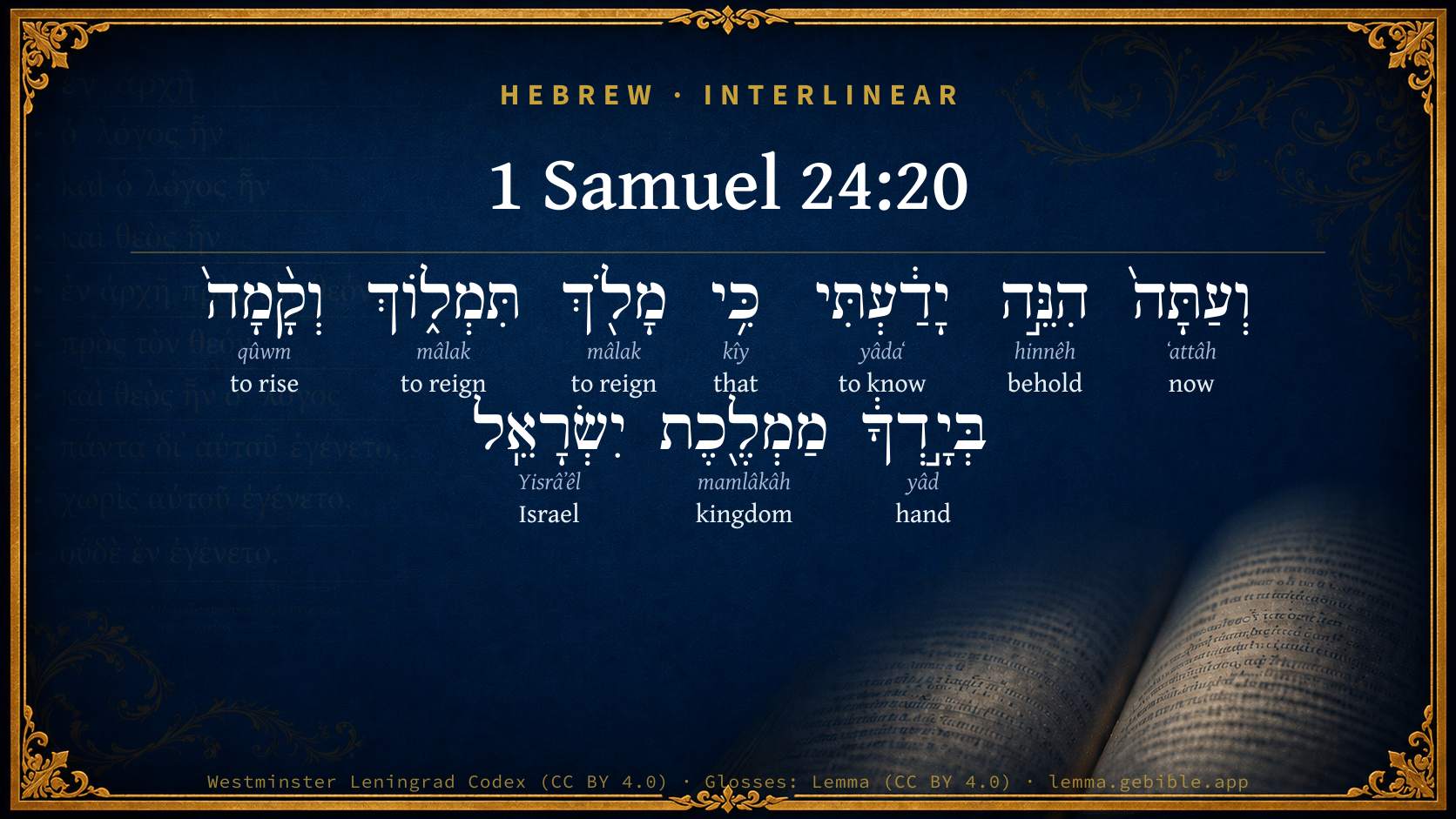
1 Samuel 24:20

Hebrew (Westminster Leningrad Codex) 1 Samuel 24:20 appears in the Hebrew Old Testament. The text above is from the Westminster Leningrad Codex. Each word links to its Strong’s number, a concise gloss, and parsing drawn from the Open Scriptures Hebrew Bible morphology. Click any word for its full Brown-Driver-Briggs (BDB) entry.
Download image
Cite this verse

1 Samuel 24:20 (World English Bible). Public Domain. Lemma interlinear Bible study tool, https://lemma.gebible.app/v/1-samuel/24/20.

Show BibTeX & RIS
BibTeX
RIS
English Translation
Now, behold, I know that you shall surely be king, and that the kingdom of Israel shall be established in your hand.
World English Bible · Public Domain
Download a study sheet

One document with this verse’s original text, its word-by-word gloss line, the meaning frame, cross-references with their text, attributed commentary, and full source and license credits — printable, and it pastes into notes with its structure intact.

This verse Autodidact and up

Study sheet (.html) Plain text (.txt)

A passage Seminary Student

Up to 50 verses in one chapter. A passage sheet keeps up to 6 commentary sources and 12 cross-references per verse, in the order this page ranks them, and says so on the sheet whenever that leaves anything out. Ask for a single verse and you get the Autodidact verse sheet above.

Everything on this page stays free to read, with no account — the sheet is a download of what is already on screen, not access to it.

Want to remove ads? Support Godless Engineer
Compare translations 3

The same verse in 3 English versions, stacked beneath the original-language interlinear above. Click any original word for its lexicon entry.

Each is an independent rendering of the whole verse — the interlinear is not word-aligned to these translations.

Highlighted words mark where these versions differ — a whole-verse word diff, not a word-by-word alignment.

  • World English Bible Public Domain
    Now, behold, I know that you shall surely be king, and that the kingdom of Israel shall be established in your hand.
  • King James Version Public Domain
    And now, behold, I know well that thou shalt surely be king, and that the kingdom of Israel shall be established in thine hand.
  • unfoldingWord Literal Text CC BY-SA 4.0
    And now, behold, I know that reigning, you will reign, and the kingdom of Israel will stand in your hand.

unfoldingWord Literal Text — © unfoldingWord, licensed CC BY-SA 4.0. Word-aligned USFM3 via Door43 (git.door43.org/unfoldingWord/en_ult).

Versions to compare (up to 4)

3 of 4 selected

Show all 18 translations

Every available English version of this verse, each an independent rendering of the whole verse.

  • World English Bible Public Domain
    Now, behold, I know that you shall surely be king, and that the kingdom of Israel shall be established in your hand.
  • Berean Standard Bible Public Domain
    Now I know for sure that you will be king, and that the kingdom of Israel will be established in your hands.
  • Majority Standard Bible Public Domain
    Now I know for sure that you will be king and that the kingdom of Israel will be established in your hands.
  • King James Version Public Domain
    And now, behold, I know well that thou shalt surely be king, and that the kingdom of Israel shall be established in thine hand.
  • American Standard Version (1901) Public Domain
    And now, behold, I know that thou shalt surely be king, and that the kingdom of Israel shall be established in thy hand.
  • Revised Version (1885) Public Domain
    And now, behold, I know that thou shalt surely be king, and that the kingdom of Israel shall be established in thine hand.
  • Geneva Bible (1599) Public Domain
    For who shall finde his enemie, and let him depart free? wherefore the Lord render thee good for that thou hast done vnto me this day.
  • Douay-Rheims (1899) Public Domain
    For who when he hath found his enemy, will let him go well away? But the Lord reward thee for this good turn, for what thou hast done to me this day.
  • Young's Literal Translation Public Domain
    `And, now, lo, I have known that thou dost certainly reign, and the kingdom of Israel hath stood in thy hand;
  • Literal Standard Version CC BY-SA 4.0
    And now, behold, I have known that you certainly reign, and the kingdom of Israel has stood in your hand;
  • Unlocked Literal Bible CC BY-SA 4.0
    Now, I know that you will surely be king and that the kingdom of Israel will be established in your hand.
  • unfoldingWord Literal Text CC BY-SA 4.0
    And now, behold, I know that reigning, you will reign, and the kingdom of Israel will stand in your hand.
  • Darby Bible Public Domain
    And now behold, I know that thou shalt certainly be king, and that the kingdom of Israel shall be established in thy hand.
  • World Messianic Bible Public Domain
    Now, behold, I know that you will surely be king, and that the kingdom of Israel will be established in your hand.
  • Webster's Bible Public Domain
    \\24:19\\For if a man findeth his enemy, will he let him go away well? wherefore the LORD reward thee with good, for what thou hast done to me this day.
  • Free Bible Version CC BY-SA 4.0
    Listen, I know you definitely will be king, and your rule over the kingdom of Israel will be secure.
  • Bible in Basic English Public Domain
    If a man comes across his hater, will he let him get away safe? so may you be rewarded by the Lord for what you have done for me today.
  • JPS Tanakh (1917) Public Domain
    (24-21) And now, behold, I know that thou shalt surely be king, and that the kingdom of Israel shall be established in thy hand.

Literal Standard Version (2020), Covenant Press — licensed CC BY-SA 4.0. Text via the HelloAO Bible API (eBible.org). Unlocked Literal Bible (unfoldingWord) — licensed CC BY-SA 4.0. Text via the HelloAO Bible API (eBible.org). unfoldingWord Literal Text — © unfoldingWord, licensed CC BY-SA 4.0. Word-aligned USFM3 via Door43 (git.door43.org/unfoldingWord/en_ult). Free Bible Version, Dr. Jonathan Gallagher — licensed CC BY-SA 4.0. Text via the HelloAO Bible API (eBible.org).

Word by word

More ways to search: Search by grammar → Find every occurrence → Compare this word →

Practice this passage: Drill this verse → Learn its vocabulary →

About this verse

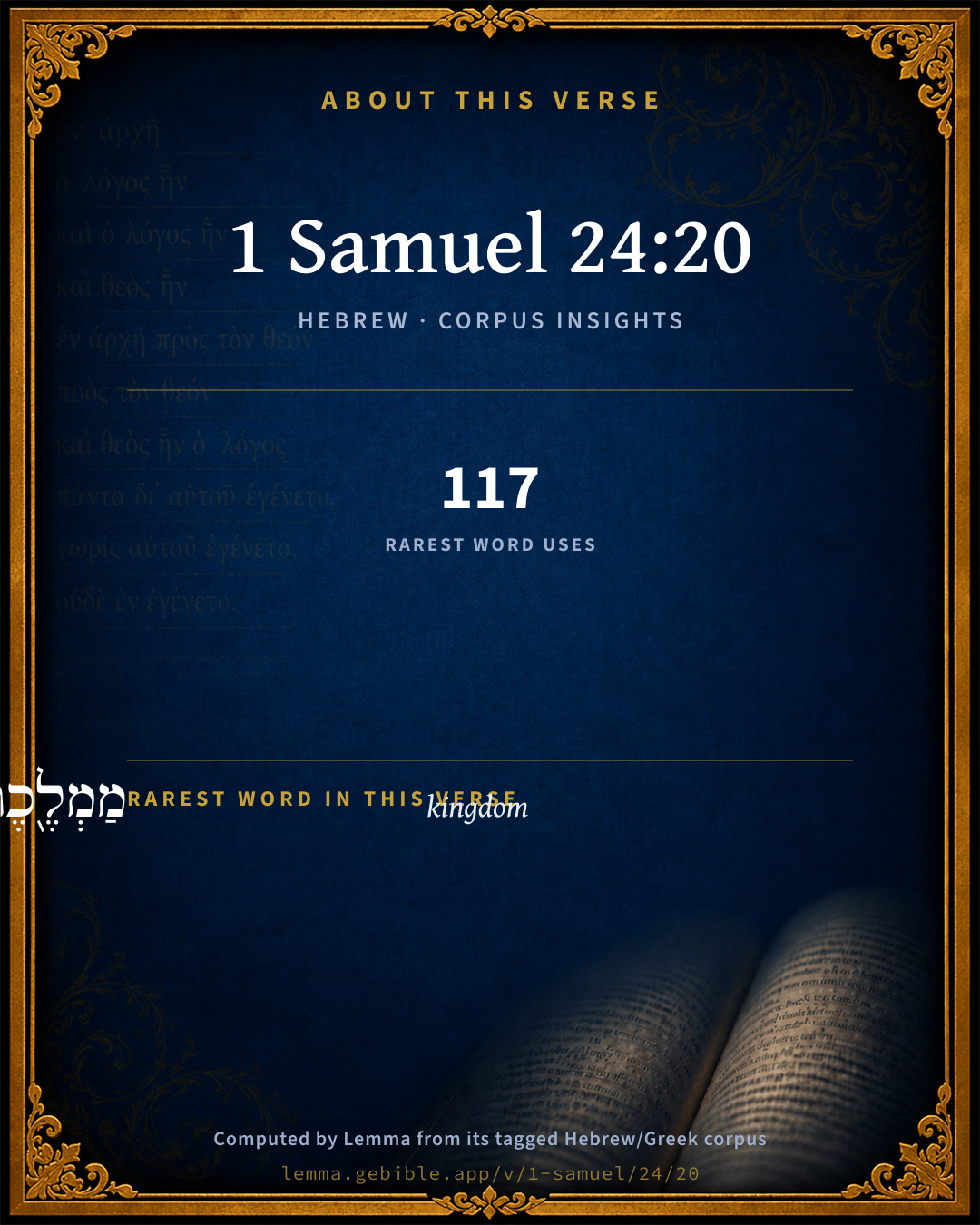
These counts appear in no published source. They are computed here, from the morphology-tagged text and Lemma’s own curated glosses. What Lemma adds →

10
words
9
distinct lemmas
Historical
section

Grammatical profile

  • 4 verbs
  • 3 nouns
  • 1 conjunction
  • 1 adverb
  • 1 particle

Verb forms

  • יָדַ֔עְתִּי Qal · Perfect
  • מָלֹ֖ךְ Qal · Infinitive Absolute
  • תִּמְל֑וֹךְ Qal · Imperfect
  • וְקָ֨מָה֙ Qal · Sequential Perfect

Repetition

A word recurs within this verse — often emphatic in Hebrew:

  • מָלֹ֖ךְ to reign H4427 ×2

Hebrew & Septuagint length

In English translation the verse runs 22 words from the Hebrew and 32 from the Septuagint (LXX English) — the Septuagint runs noticeably longer here. See the side-by-side →

A rough comparison of the two English renderings, which tokenize alike — not a word-level alignment.

Word counts can differ between the Hebrew and the Greek without any difference in meaning — e.g. the Hebrew direct-object marker אֵת has no separate Greek word, and Greek often adds the article ὁ.

Cross-references

8

Topical passages linked to 1 Samuel 24:20 in the Treasury of Scripture Knowledge — connected by theme and wording, ordered by reader-vote popularity; previews shown in the World English Bible.

  • 1 Samuel 23:17 He said to him, Don't be afraid; for the hand of Saul my father shall not find you; and you shall be king over Israel, and I shall be next to you; and that also Saul my father knows.
  • 2 Samuel 3:17–18 Abner had communication with the elders of Israel, saying, In times past you sought for David to be king over you:
  • Matthew 2:3–6 When Herod the king heard it, he was troubled, and all Jerusalem with him.
  • 1 Samuel 13:14 But now your kingdom shall not continue: Yahweh has sought him a man after his own heart, and Yahweh has appointed him to be prince over his people, because you have not kept that which Yahweh commanded you.
  • 1 Samuel 20:30–31 Then Saul's anger was kindled against Jonathan, and he said to him, You son of a perverse rebellious woman, don't I know that you have chosen the son of Jesse to your own shame, and to the shame of your mother's nakedness?
  • Job 15:25 Because he has stretched out his hand against God, And behaves himself proudly against the Almighty;
  • Matthew 2:13 Now when they had departed, behold, an angel of the Lord appeared to Joseph in a dream, saying, "Arise and take the young child and his mother, and flee into Egypt, and stay there until I tell you, for Herod will seek the young child to destroy him."
  • Matthew 2:16 Then Herod, when he saw that he was mocked by the wise men, was exceedingly angry, and sent out, and killed all the male children who were in Bethlehem and in all the surrounding countryside, from two years old and under, according to the exact time which he had learned from the wise men.

Cross-references courtesy of OpenBible.info (CC BY 4.0).

Hebrew and Greek witnesses Masoretic Hebrew ↔ Greek Septuagint

The same verse in the two great witnesses to the Old Testament, shown verse-for-verse.

Here the Septuagint runs noticeably longer than the Hebrew — LXX2012 (modern English Septuagint) 32 words vs World English Bible 22. A rough length comparison of the two English translations, not a word-level alignment — read both below.

These are two independent witnesses, not word-aligned to each other, and the Septuagint is shown in lemma (dictionary) form.

Hebrew 1 Samuel 24:20 Masoretic · Westminster Leningrad Codex

וְעַתָּה֙ הִנֵּ֣ה יָדַ֔עְתִּי כִּ֥י מָלֹ֖ךְ תִּמְל֑וֹךְ וְקָ֨מָה֙ בְּיָ֣דְךָ֔ מַמְלֶ֖כֶת יִשְׂרָאֵֽל

Now, behold, I know that you shall surely be king, and that the kingdom of Israel shall be established in your hand.

World English Bible · Public Domain

Greek LXX 1 Samuel 24:20 Septuagint · lemma form

καί ὅτι εἰ εὑρίσκω τις ὁ ἐχθρός αὐτός ἐν θλῖψις καί ἐκπέμπω αὐτός ἐν ὁδός ἀγαθός καί κύριος ἀντι ἀποτίνω αὐτός ἀγαθός καθώς ποιέω σήμερον

And if any one should find his enemy in distress, and should send him forth in a good way, then the Lord will reward him good, as you have done this day.

LXX2012 (modern English Septuagint) · Public Domain

Hebrew: Westminster Leningrad Codex (CC BY 4.0). Greek: Septuagint (public domain); English from LXX2012 (modern English Septuagint) (Public Domain). How the Septuagint differs from the Hebrew →

Targum (Aramaic paraphrase)

1

The Targum is the ancient Jewish Aramaic paraphrase of the Hebrew Scriptures — an interpretive translation, not the Hebrew text itself. Onkelos (literal) and Pseudo-Jonathan (expansive) render the Torah, and Jonathan the Prophets. Coverage is partial: where no permissively-licensed English translation exists for a verse, only the Aramaic is shown. This is verse-level text, not a word-by-word alignment to the Hebrew.

  1. Targum Jonathan Prophets (Joshua–Malachi)
    וַאֲרֵי יַשְׁכַּח גְבַר יַת בְּעֵיל דְבָבֵיהּ וְיִשְׁלְחִנֵיהּ בְּאוֹרַח תַּקָנָא וַיָי יְשַׁלְמִנָךְ טַבְתָא חֲלַף יוֹמָא דֵין דַעֲבַדְתָּא לִי:

    (no public-domain English translation for this verse)

    Targum Jonathan — Aramaic: “Mikraot Gedolot” (public domain). English: “Sefaria Community Translation” (CC0 1.0 (public-domain dedication)); “London "Chaldee Paraphrase," 1871” (public domain). Text via Sefaria.

Commentary

Notes on 1 Samuel 24:20 from classic Christian and Jewish commentators (each source and its license shown beneath its notes). The classic Christian expositions comment on the surrounding passage and are grouped to its opening verse, so a note may address several verses; the Jewish commentaries on the Tanakh (Rashi and others) are per-verse, so they appear only where the commentator wrote on this verse.

Lemma curates 59 commentaries, every one of them public domain or Creative Commons licensed, each selected and text-cleaned for this edition rather than reprinted as found. About our sources →

Trapp's Complete Commentary

John Trapp

1Sa 24:20 And now, behold, I know well that thou shalt surely be king, and that the kingdom of Israel shall be established in thine hand.

Ver. 20. And now, behold, I know well.] How knew he this? Nimirum ex ipsis Davidis moribus, saith Chrysostom. Surely by David’s kingly virtues, and good success, whereby God made him formidable to his enemies, but amiable and admirable in the eyes of all Israel. Saul’s sin therefore was the greater in persecuting David, whom he knew God had set up. See Psa 4:2-4.

John Trapp, A Commentary or Exposition upon All the Books of the Old and New Testament (1647–1656) — public domain. Text from a community e-Sword module.

Joseph Benson's Commentary

1Sa 24:20-21. And now I know well that thou shalt surely be king — These wonderful dispensations of Divine Providence over David, and David’s no less wonderful virtue, at last convinced Saul that God designed him to be the king of his people, and that none could hinder his establishment. That thou wilt not destroy my name, &c. — As it was usual for kings to do in those days, generally destroying the families of those to whose thrones they were advanced.

Joseph Benson's Commentary on the Old and New Testaments (1811–1818) — public domain. Text from a community e-Sword module.

Tyndale Open Study Notes

Tyndale Open Resources

24:20 I realize that you are surely going to be king: This was Saul’s first open admission of the truth (cp. 23:17).

Tyndale Open Study Notes — © Tyndale Open Resources, licensed CC BY-SA 4.0. Text via the HelloAO Bible API.

Geneva Bible (1599)

Geneva Bible translators

Hebrew, a good way.

Geneva Bible (1599) marginal notes — public domain. Text via Bolls.life.

Adam Clarke's Commentary

Verse 20. I know well that thou shalt surely be king] Hebrew, Reigning, thou shalt reign. He knew this before; and yet he continued to pursue him with the most deadly hatred.

Adam Clarke's Commentary on the Bible (1810–1826) — public domain. Text from a community e-Sword/MySword module.

Ellicott's Commentary for English Readers

(20) And now, behold, I know well that thou shalt surely be king.—Clericus (in Lange) says: “From this great magnanimity of David, Saul concluded that a man who was much superior in soul to kings could not but reign.” This is a good comment, and doubtless expresses something of what was in Saul’s mind on this occasion; but more must have been behind to have induced the king to make such a speech to David. Never had he for one moment forgotten his old friend’s words—the words of Samuel, whom he too well knew was the prophet of the Most High—when he with all solemnity announced to him, as a message from heaven, that the Lord had rent the kingdom from him, and had given it to a neighbour that was better than he (1Sa_15:21). Since that awful denunciation, the unhappy Saul was only too sensible that the blessing of Jehovah of Hosts no longer rested on his head, no longer blessed his going out and coming in, while the strange, bright career of the son of Jesse seemed to point him out as the neighbour on whom the choice of God had fallen. Rumours, too, of a mysterious anointing must have long ere this reached Saul; this, joined to the passionate advocacy of Jonathan, and the quiet, steady friendship of Samuel, no doubt convinced King Saul that in the son of Jesse he saw Israel’s future monarch. Strong, therefore, in this conviction, and for the time humiliated and grieved at the sorry part he had been playing in this restless persecution of one destined to fill so great a position, the king positively entreats the outlaw to swear to him the strange promise contained in the next (21st) verse.

A Bible Commentary for English Readers, edited by Charles John Ellicott (1878–1897) — public domain. Text from a community e-Sword module.

The Cambridge Bible for Schools and Colleges

gen. ed. J. J. S. Perowne

20. I know well, &c.] See note on 1Sa_28:9. And yet, knowing the Will of God, he resists it!

the kingdom of Israel shall be established in thine hand] A sad echo of Samuel’s words to himself, “But now thy kingdom shall not be established” (1Sa_13:14).

The Cambridge Bible for Schools and Colleges (gen. ed. J. J. S. Perowne; Cambridge University Press, 1878–1918) — public domain. Text from a community e-Sword module.

John Gill's Exposition

And now, behold, I know well that thou shalt surely be king,.... Not merely by the common report, that he was anointed by Samuel, to which yet he might give credit; but by the providence of God prospering and preserving him, and by his princely spirit and behaviour, and by calling to mind what Samuel had said to him, that his kingdom should be given to a neighbour of his better than he, and so David was by his own confession, Sa1 24:17; and the cutting off the skirt of his garment might put him in remembrance of the rending of the skirt of Samuel's mantle, upon which he told Saul his kingdom should be rent from him; though some think that was Saul's skirt, and so now he knew thereby, when David cut off his skirt, that the kingdom would be his; and it is a tradition of the Jews (f), that Samuel said to him at that time, that he that cut off the skirt of his garment should reign after him:

and that the kingdom of Israel shall be established in thine hand; and not be rent from him; and yet notwithstanding after this he sought to destroy him.

(f) Midrash Tillim apud Abarbinel. in loc.

John Gill's Exposition of the Whole Bible (1746–1763) — public domain (CC PDM 1.0). Text via the HelloAO Bible API.

Matthew Poole's English Annotations

I know well, or, am convinced, not only by the fame of Samuel’s anointing thee, but by God’s singular providence watching over thee, and by that good Spirit and those great and princely virtues wherewith God hath endowed thee.

Matthew Poole's English Annotations on the Holy Bible (1683–1685) — public domain. Text from a community e-Sword/MySword module.

Whedon's Commentary on the Bible

Daniel D. Whedon

20. I know well that thou shalt surely be king — The anointing by Samuel, the triumph over Goliath, the homage paid him by the enthusiastic people, and all the providential deliverances from the deadly pursuits of Saul, together with this last affair in the cave, thoroughly convinced the king that David was that neighbour who, according to Samuel’s prophecy, (1Sa_15:28,) was destined to succeed him on the throne. Here again, in fact, Saul is among the prophets, and thus confirms by his own words the predictions of Samuel.

Daniel D. Whedon (gen. ed.), Commentary on the Old and New Testaments (1874–1909) — public domain. Text from a community e-Sword module.

The Pulpit Commentary

Vers. 20-22. I know well that thou shalt surely be king. Jonathan had expressed a similar conviction, (1Sa_23:17) and probably there was a growing popular belief that David was the person in whom Samuel"s prophetic words (1Sa_15:28) were to be fulfilled. Something may even have been known of the selection of David and his anointing at Bethlehem; not perhaps by the king, but in an indistinct way by the people. As for Saul himself, he must long have felt that God"s blessing had departed from him, and, brooding perpetually over Samuel"s words, it required but little discernment on his part to make him see that the kingdom which he had forfeited was to be bestowed upon one so worthy of it, and so manifestly protected and blessed by God. He therefore makes David swear that he will not cut off his seed after him; (see on 1Sa_20:15) and so they part. Saul returns to Gibeah, while David and his men gat them up unto the hold. The word gat up, mounted, suggests that the hold, or fastness, was their previous haunt at Hachilah: They would go down to En-gedi, and the difficulty of obtaining food there for 600 men would be insurmountable, except for a very short period. On the other side of the desert they were in a pastoral country, and the large flock masters there probably from time to time sent them supplies. The position of David was thus improved for the present by Saul s reconciliation with him.

The Pulpit Commentary (1880–1919), ed. H.D.M. Spence-Jones & Joseph S. Exell — public domain. Text from a community e-Sword module.

Keil & Delitzsch

C. F. Keil & F. Delitzsch

This wish was expressed in perfect sincerity. David's behaviour towards him had conquered for the moment the evil demon of his heart, and completely altered his feelings. In this better state of mind he felt impelled even to give utterance to these words, "I know that thou wilt be king, and the sovereignty will have perpetuity in thy hand." Saul could not prevent this conviction from forcing itself upon him, after his own rejection and the failure of all that he attempted against David; and it was this which drove him to persecute David whenever the evil spirit had the upper hand in his soul. But now that better feelings had arisen in his mind, he uttered it without envy, and merely asked David to promise on oath that he would not cut off his descendants after his death, and seek to exterminate his name from his father's house. A name is exterminated when the whole of the descendants are destroyed, - a thing of frequent occurrence in the East in connection with a change of dynasties, and one which occurred again and again even in the kingdom of the ten tribes (vid., Kg1 15:28., Sa1 16:11.; 2 Kings 10).

Keil & Delitzsch — Biblical Commentary on the Old Testament (1861–1891) — public domain (CC PDM 1.0). Text via the HelloAO Bible API. (Old Testament only.)

Lesson kit

Teaching starters — assembled from the data on this page, not authored interpretation. Every prompt links to the verse data it draws on. Edit before teaching.

1 Samuel, in the Historical, opens this verse with 10 words (9 distinct Hebrew lemmas). Its most distinctive word is mamlâkâh (“kingdom”). The Greek Septuagint runs longer here. A historical commentator’s framing appears above. Read the whole chapter for the surrounding context.

Discussion questions

  1. The word mamlâkâh carries the sense “kingdom.” How does it shape the verse?
  2. 1 Samuel 23:17 shares this passage’s theme. How do the two illuminate each other?
  3. “to reign” occurs 2× in this one verse. What is the effect of the repetition?
  4. Compared with the Hebrew, the Septuagint runs longer here. What questions does that raise?
  5. These translations render this verse differently; the difference is in the English rendering, not the original. What questions does that raise?
  6. The verb «יָדַ֔עְתִּי» is Qal Perfect. How does its form color the action?
  7. Reading how Trapp's Complete Commentary and Joseph Benson's Commentary read this verse, where do the two commentators agree and where do they part?

Things to notice

  • These translations choose different wording for 10 words in this verse.
  • “to reign” occurs 2× in this single verse.
  • 9 distinct Hebrew lemmas span 10 words in this verse.

Reading settings

Reading text

Shown beneath each verse's original-language words.

Old Testament
Old Testament edition

Read the OT as the Masoretic Hebrew (MT) or the Greek Septuagint (LXX).

English shown for the Greek Septuagint (in the Hebrew ↔ Greek comparison).

Comparing translations? Open the Compare panel on any verse page to stack up to four side by side.