
Isaiah 14:9

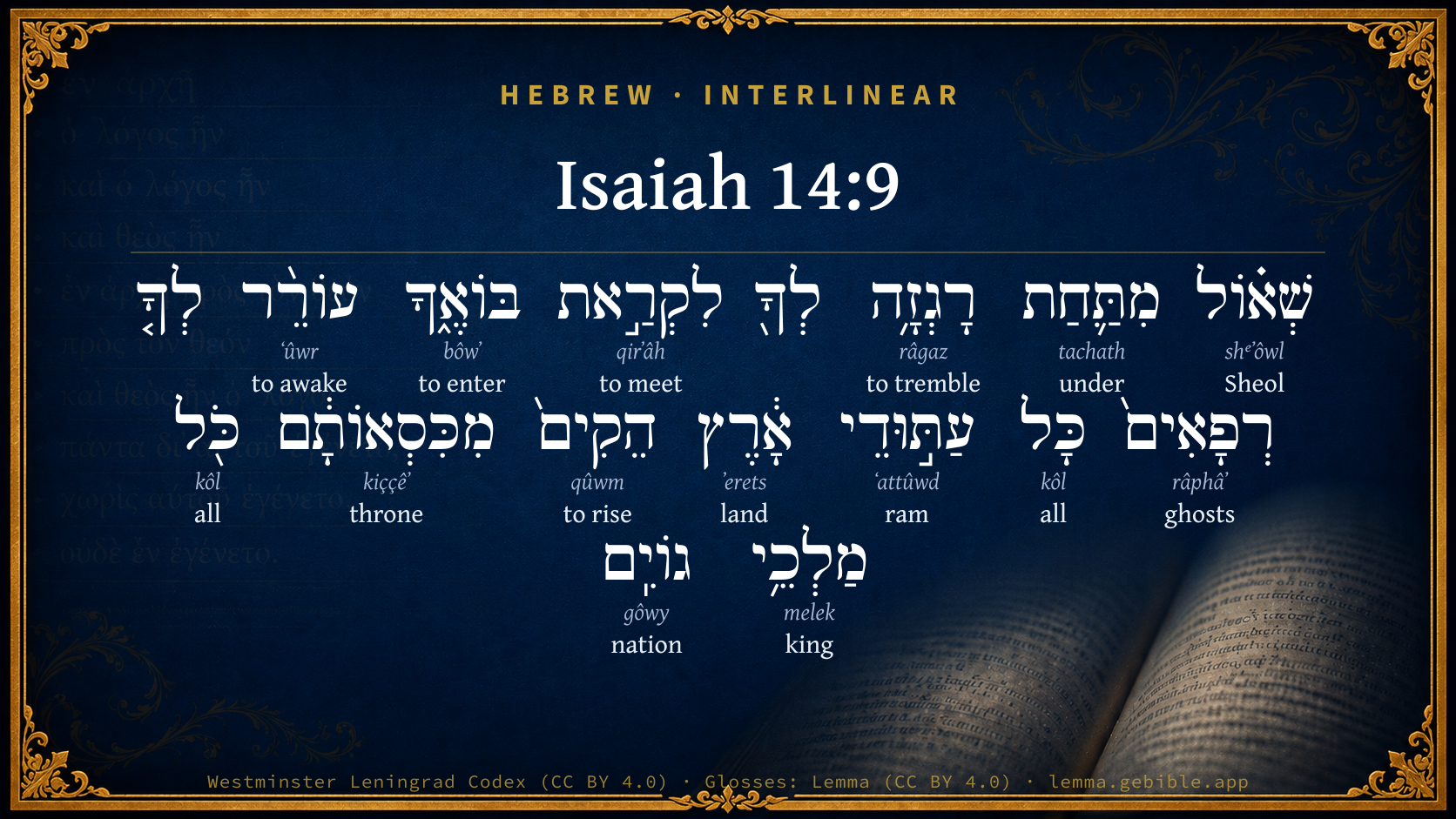
Hebrew (Westminster Leningrad Codex) Isaiah 14:9 appears in the Hebrew Old Testament. The text above is from the Westminster Leningrad Codex. Each word links to its Strong’s number, a concise gloss, and parsing drawn from the Open Scriptures Hebrew Bible morphology. Click any word for its full Brown-Driver-Briggs (BDB) entry.
Download image
Cite this verse

Isaiah 14:9 (World English Bible). Public Domain. Lemma interlinear Bible study tool, https://lemma.gebible.app/v/isaiah/14/9.

Show BibTeX & RIS
BibTeX
RIS
English Translation
Sheol from beneath is moved for you to meet you at your coming; it stirs up the dead for you, even all the chief ones of the earth; it has raised up from their thrones all the kings of the nations.
World English Bible · Public Domain
Download a study sheet

One document with this verse’s original text, its word-by-word gloss line, the meaning frame, cross-references with their text, attributed commentary, and full source and license credits — printable, and it pastes into notes with its structure intact.

This verse Autodidact and up

Study sheet (.html) Plain text (.txt)

A passage Seminary Student

Up to 50 verses in one chapter. A passage sheet keeps up to 6 commentary sources and 12 cross-references per verse, in the order this page ranks them, and says so on the sheet whenever that leaves anything out. Ask for a single verse and you get the Autodidact verse sheet above.

Everything on this page stays free to read, with no account — the sheet is a download of what is already on screen, not access to it.

Want to remove ads? Support Godless Engineer
Compare translations 3

The same verse in 3 English versions, stacked beneath the original-language interlinear above. Click any original word for its lexicon entry.

Each is an independent rendering of the whole verse — the interlinear is not word-aligned to these translations.

Highlighted words mark where these versions differ — a whole-verse word diff, not a word-by-word alignment.

  • World English Bible Public Domain
    Sheol from beneath is moved for you to meet you at your coming; it stirs up the dead for you, even all the chief ones of the earth; it has raised up from their thrones all the kings of the nations.
  • King James Version Public Domain
    Hell from beneath is moved for thee to meet thee at thy coming: it stirreth up the dead for thee, even all the chief ones of the earth; it hath raised up from their thrones all the kings of the nations.
  • unfoldingWord Literal Text CC BY-SA 4.0
    Sheol from beneath trembles for you, to meet your coming. It awakens the Raphaites for you, all of the leaders of the earth. It raises all of the kings of the nations from their thrones.

unfoldingWord Literal Text — © unfoldingWord, licensed CC BY-SA 4.0. Word-aligned USFM3 via Door43 (git.door43.org/unfoldingWord/en_ult).

Versions to compare (up to 4)

3 of 4 selected

Show all 18 translations

Every available English version of this verse, each an independent rendering of the whole verse.

  • World English Bible Public Domain
    Sheol from beneath is moved for you to meet you at your coming; it stirs up the dead for you, even all the chief ones of the earth; it has raised up from their thrones all the kings of the nations.
  • Berean Standard Bible Public Domain
    Sheol beneath is eager to meet you upon your arrival. It stirs the spirits of the dead to greet you—all the rulers of the earth. It makes all the kings of the nations rise from their thrones.
  • Majority Standard Bible Public Domain
    Sheol beneath is eager to meet you upon your arrival. It stirs the spirits of the dead to greet you—all the rulers of the earth. It makes all the kings of the nations rise from their thrones.
  • King James Version Public Domain
    Hell from beneath is moved for thee to meet thee at thy coming: it stirreth up the dead for thee, even all the chief ones of the earth; it hath raised up from their thrones all the kings of the nations.
  • American Standard Version (1901) Public Domain
    Sheol from beneath is moved for thee to meet thee at thy coming; it stirreth up the dead for thee, even all the chief ones of the earth; it hath raised up from their thrones all the kings of the nations.
  • Revised Version (1885) Public Domain
    Hell from beneath is moved for thee to meet thee at thy coming: it stirreth up the dead for thee, even all the chief ones of the earth; it hath raised up from their thrones all the kings of the nations.
  • Geneva Bible (1599) Public Domain
    Hel beneath is mooued for thee to meete thee at thy comming, raising vp the deade for thee, euen all the princes of the earth, and hath raised from their thrones all the Kinges of the nations.
  • Douay-Rheims (1899) Public Domain
    Hell below was in an uproar to meet thee at thy coming, it stirred up the giants for thee. All the princes of the earth are risen up from their thrones, all the princes of nations.
  • Young's Literal Translation Public Domain
    Sheol beneath hath been troubled at thee, To meet thy coming in, It is waking up for thee Rephaim, All chiefs ones of earth, It hath raised up from their thrones All kings of nations.
  • Literal Standard Version CC BY-SA 4.0
    Sheol beneath has been troubled at you, || To meet your coming in, || It is waking up Rephaim for you, || All chief ones of earth, || It has raised up from their thrones || All kings of nations.
  • Unlocked Literal Bible CC BY-SA 4.0
    Sheol below is eager to meet you when you go there. It arouses the dead for you, all the kings of the earth, making them rise up from their thrones, all the kings of the nations.
  • unfoldingWord Literal Text CC BY-SA 4.0
    Sheol from beneath trembles for you, to meet your coming. It awakens the Raphaites for you, all of the leaders of the earth. It raises all of the kings of the nations from their thrones.
  • Darby Bible Public Domain
    Sheol from beneath is moved for thee to meet [thee] at thy coming, stirring up the dead for thee, all the he-goats of the earth; making to rise from their thrones all the kings of the nations.
  • World Messianic Bible Public Domain
    Sheol from beneath has moved for you to meet you at your coming. It stirs up the departed spirits for you, even all the rulers of the earth. It has raised up from their thrones all the kings of the nations.
  • Webster's Bible Public Domain
    Hell from beneath is moved for thee to meet thee at thy coming: it stirreth up the dead for thee, even all the chief ones of the earth; it hath raised up from their thrones all the kings of the nations.
  • Free Bible Version CC BY-SA 4.0
    Those in the grave beneath are keen to meet you when you arrive. It wakes the spirits of the dead to welcome you, those of all the rulers of the earth. All the kings of the nations stand up from their thrones.
  • Bible in Basic English Public Domain
    The underworld is moved at your coming: the shades of the dead are awake before you, even the strong ones of the earth; all the kings of the world have got up from their seats.
  • JPS Tanakh (1917) Public Domain
    The nether-world from beneath is moved for thee to meet thee at thy coming; the shades are stirred up for thee, even all the chief ones of the earth; all the kings of the nations are raised up from their thrones.

Literal Standard Version (2020), Covenant Press — licensed CC BY-SA 4.0. Text via the HelloAO Bible API (eBible.org). Unlocked Literal Bible (unfoldingWord) — licensed CC BY-SA 4.0. Text via the HelloAO Bible API (eBible.org). unfoldingWord Literal Text — © unfoldingWord, licensed CC BY-SA 4.0. Word-aligned USFM3 via Door43 (git.door43.org/unfoldingWord/en_ult). Free Bible Version, Dr. Jonathan Gallagher — licensed CC BY-SA 4.0. Text via the HelloAO Bible API (eBible.org).

Word by word

More ways to search: Search by grammar → Find every occurrence → Compare this word →

Practice this passage: Drill this verse → Learn its vocabulary →

רְפָאִים֙
râphâʼ
H7496
“ghosts”
Noun, Common, Masculine, Plural, Absolute
Part of Speech
Noun
Type
Common
Gender
Masculine
Number
Plural
State
Absolute
Full BDB Definition

Origin: from H7495 in the sense of H7503

TWOT: 2198c

ghosts of the dead, shades, spirits
  1. שְׁא֗וֹל shᵉʼôwl H7585 “Sheol” Noun, Proper
  2. מִתַּ֛חַת tachath H8478 “from · under” Preposition + Preposition
  3. רָגְזָ֥ה râgaz H7264 “to tremble” Verb, Qal, Perfect, 3rd Person, Feminine, Singular
  4. לִקְרַ֣את qirʼâh H7125 “to meet” Preposition + Verb, Qal, Infinitive Construct
  5. בּוֹאֶ֑ךָ bôwʼ H935 “to enter · you” Verb, Qal, Infinitive Construct + Suffix, Personal, 2nd Person, Masculine, Singular
  6. עוֹרֵ֨ר ʻûwr H5782 “to awake” Verb, Polel, Perfect, 3rd Person, Masculine, Singular
  7. כָּל kôl H3605 “all of” Noun, Common, Masculine, Singular, Construct
  8. עַתּ֣וּדֵי ʻattûwd H6260 “rams of” Noun, Common, Masculine, Plural, Construct
  9. אָ֔רֶץ ʼerets H776 “land” Noun, Common, Both, Singular, Absolute
  10. הֵקִים֙ qûwm H6965 “to rise” Verb, Hiphil, Perfect, 3rd Person, Masculine, Singular
  11. מִכִּסְאוֹתָ֔ם kiççêʼ H3678 “from · thrones · their” Preposition + Noun, Common, Masculine, Plural, Construct + Suffix, Personal, 3rd Person, Masculine, Plural
  12. כֹּ֖ל kôl H3605 “all of” Noun, Common, Masculine, Singular, Construct
  13. מַלְכֵ֥י melek H4428 “kings of” Noun, Common, Masculine, Plural, Construct
  14. גוֹיִֽם gôwy H1471 “nations” Noun, Common, Masculine, Plural, Absolute

About this verse

These counts appear in no published source. They are computed here, from the morphology-tagged text and Lemma’s own curated glosses. What Lemma adds →

17
words
14
distinct lemmas
Prophets
section

Notable vocabulary

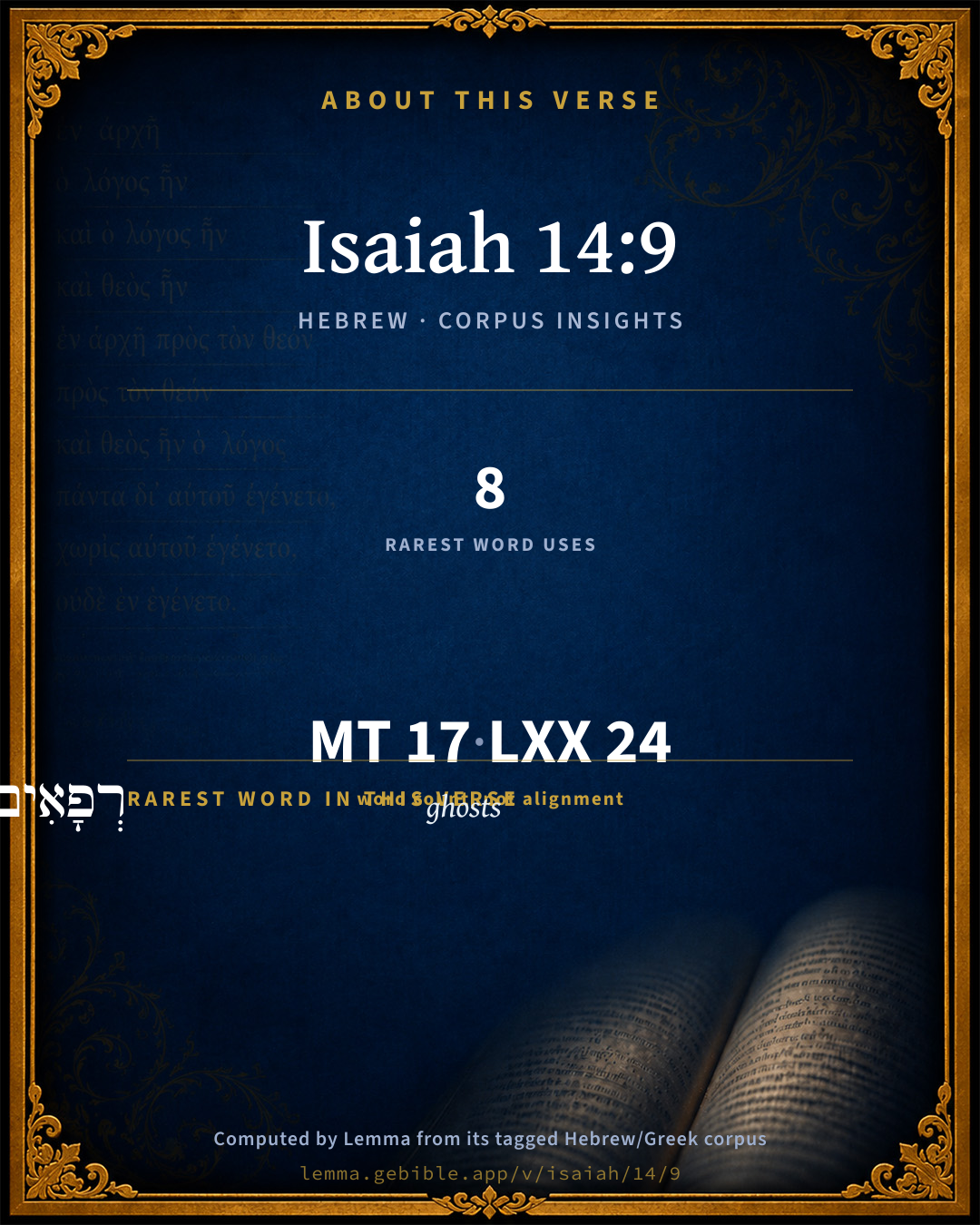
The rarest word here is רְפָאִים֙ ghosts H7496 — appearing just 8 times in the whole Hebrew Bible.

Shared distinctive vocabulary

רְפָאִים֙ ghosts H7496 occurs in 8 verses of the Hebrew Bible. Also found in:

Grammatical profile

  • 5 verbs
  • 9 nouns
  • 3 prepositions

Verb forms

  • רָגְזָ֥ה Qal · Perfect
  • לִקְרַ֣את Qal · Infinitive Construct
  • בּוֹאֶ֑ךָ Qal · Infinitive Construct
  • עוֹרֵ֨ר Polel · Perfect
  • הֵקִים֙ Hiphil · Perfect

Repetition

A word recurs within this verse — often emphatic in Hebrew:

Hebrew & Septuagint length

In English translation the verse runs 41 words from the Hebrew and 38 from the Septuagint (LXX English) — closely comparable.

A rough comparison of the two English renderings, which tokenize alike — not a word-level alignment.

Word counts can differ between the Hebrew and the Greek without any difference in meaning — e.g. the Hebrew direct-object marker אֵת has no separate Greek word, and Greek often adds the article ὁ.

In the original languages it is 17 Hebrew tokens and 24 Greek tokens — but the two are counted differently (Hebrew bundles its prefixes and suffixes into one token; the Greek is in lemma form), so that isn’t a like-for-like length.

Cross-references

3

Topical passages linked to Isaiah 14:9 in the Treasury of Scripture Knowledge — connected by theme and wording, ordered by reader-vote popularity; previews shown in the World English Bible.

  • Ezekiel 32:21–32 The strong among the mighty shall speak to him out of the midst of Sheol with those who help him: they are gone down, they lie still, even the uncircumcised, slain by the sword.
  • Jeremiah 50:8 Flee out of the midst of Babylon, and go forth out of the land of the Chaldeans, and be as the male goats before the flocks.
  • Proverbs 15:24 The path of life leads upward for the wise, To keep him from going downward to Sheol.

Cross-references courtesy of OpenBible.info (CC BY 4.0).

Hebrew and Greek witnesses Masoretic Hebrew ↔ Greek Septuagint

The same verse in the two great witnesses to the Old Testament, shown verse-for-verse.

These are two independent witnesses, not word-aligned to each other, and the Septuagint is shown in lemma (dictionary) form.

Hebrew Isaiah 14:9 Masoretic · Westminster Leningrad Codex

שְׁא֗וֹל מִתַּ֛חַת רָגְזָ֥ה לְךָ֖ לִקְרַ֣את בּוֹאֶ֑ךָ עוֹרֵ֨ר לְךָ֤ רְפָאִים֙ כָּל עַתּ֣וּדֵי אָ֔רֶץ הֵקִים֙ מִכִּסְאוֹתָ֔ם כֹּ֖ל מַלְכֵ֥י גוֹיִֽם

Sheol from beneath is moved for you to meet you at your coming; it stirs up the dead for you, even all the chief ones of the earth; it has raised up from their thrones all the kings of the nations.

World English Bible · Public Domain

Greek LXX Isaiah 14:9 Septuagint · lemma form

ὁ ᾅδης κάτωθεν πικραίνω συνἀντάω σύ συνἐγείρω σύ πᾶς ὁ γίγας ὁ ἄρχω ὁ γῆ ὁ ἐγείρω ἐκ ὁ θρόνος αὐτός πᾶς βασιλεύς ἔθνος

Hell from beneath is provoked to meet you: all the great ones that have ruled over the earth have risen up together against you, they that have raised up from their thrones all the kings of the nations.

LXX2012 (modern English Septuagint) · Public Domain

On this verse, Jamieson, Fausset & Brown discusses the Septuagint’s reading. Read the note in Commentary ↓

Hebrew: Westminster Leningrad Codex (CC BY 4.0). Greek: Septuagint (public domain); English from LXX2012 (modern English Septuagint) (Public Domain). How the Septuagint differs from the Hebrew →

Targum (Aramaic paraphrase)

1

The Targum is the ancient Jewish Aramaic paraphrase of the Hebrew Scriptures — an interpretive translation, not the Hebrew text itself. Onkelos (literal) and Pseudo-Jonathan (expansive) render the Torah, and Jonathan the Prophets. Coverage is partial: where no permissively-licensed English translation exists for a verse, only the Aramaic is shown. This is verse-level text, not a word-by-word alignment to the Hebrew.

  1. Targum Jonathan Prophets (Joshua–Malachi)
    שְׁאוֹל מִלְרַע זָעַת לָךְ לִקֳדָמוּת מֵיתָךְ אֲעִירַת לָךְ גִבָּרִין כָּל עַתִּירֵי נִכְסַיָא אָקִימוּ מִכּוּרְסְוַתְהוֹן כָּל מַלְכֵי עַמְמַיָא:

    Hell from beneath is moved for thee, to meet thee at thy coming; she rouseth for thee the mighty: all the rich in treasures, all the kings of the nations rise from their thrones.

    Targum Jonathan — Aramaic: “Mikraot Gedolot” (public domain). English: “Sefaria Community Translation” (CC0 1.0 (public-domain dedication)); “London "Chaldee Paraphrase," 1871” (public domain). Text via Sefaria.

Commentary

Notes on Isaiah 14:9 from classic Christian and Jewish commentators (each source and its license shown beneath its notes). The classic Christian expositions comment on the surrounding passage and are grouped to its opening verse, so a note may address several verses; the Jewish commentaries on the Tanakh (Rashi and others) are per-verse, so they appear only where the commentator wrote on this verse.

Lemma curates 59 commentaries, every one of them public domain or Creative Commons licensed, each selected and text-cleaned for this edition rather than reprinted as found. About our sources →

Jamieson, Fausset & Brown

Robert Jamieson, A. R. Fausset & David Brown

THE SCENE CHANGES FROM EARTH TO HELL. (Isa 14:9-11)

moved--put into agitation.

for thee--that is, "at thee"; towards thee; explained by "to meet thee at thy coming" [MAURER].

chief ones--literally, "goats"; so rams, leaders of the flock; princes (Zac 10:3). The idea of wickedness on a gigantic scale is included (Eze 34:17; Mat 25:32-33). MAGEE derives "Rephaim" (English Version, "the dead") from a Hebrew root, "to resolve into first elements"; so "the deceased" (Isa 26:14) "ghosts" (Pro 21:16). These being magnified by the imagination of the living into gigantic stature, gave their name to giants in general (Gen 6:4; Gen 14:5; Eze 32:18, Eze 32:21). "Rephaim," translated in the Septuagint, "giants" (compare see on Job 26:5-6). Thence, as the giant Rephaim of Canaan were notorious even in that guilty land, enormous wickedness became connected with the term. So the Rephaim came to be the wicked spirits in Gehenna, the lower of the two portions into which Sheol is divided.

Jamieson, Fausset & Brown — Commentary Critical and Explanatory on the Whole Bible (1871) — public domain (CC PDM 1.0). Text via the HelloAO Bible API.

Trapp's Complete Commentary

John Trapp

Isa 14:9 Hell from beneath is moved for thee to meet [thee] at thy coming: it stirreth up the dead for thee, [even] all the chief ones of the earth; it hath raised up from their thrones all the kings of the nations.

Ver. 9. Hell from beneath is moved for thee.] Infernus ab inferendo; shaal, from its unsatiableness, and continual craving. Here is an ironic and poetic representation of the King of Babylon’s coming into hell, and his entertainment there; the dead kings rising from their places for reverence to receive him.

Even all the chief ones of the earth.] Heb., The he-goats, such as lead and go before the flock; such rhetoric as this we meet with in Lucian’s Dialogues. Of Laurentius Valla, that great critic, who found fault with almost all Latin authors, one made this tetrastich;

“ Nunc postquam manes defunctus Valla petivit,

Non audet Pluto verba Latina loqui.

Iupiter hunc caeli dignatus honore fuisset,

Censarem linguae sed timer ipse sum. ”

- Trithem.

From their thrones,] i.e., From their "sepulchres," saith Piscator.

John Trapp, A Commentary or Exposition upon All the Books of the Old and New Testament (1647–1656) — public domain. Text from a community e-Sword module.

The Biblical Illustrator

Joseph S. Exell

Isa_14:9

Hell from beneath is moved for thee

The first five minutes after death

There is a very well-known story told of a man who had served his king and country in many a distant land, and in many a strange experience, coming back home, and talking to his friends of the wonderful sights which he had seen, and the wonderful experiences which he had gone through.

And when they remarked to him on the sort of wonders he had experienced and known, he checked them with saying, There is something more wonderful than anything I have yet known, which I still have to experience, and when they asked him what it was, he said, It is the first five minutes after death. The first five minutes after death! It was upon what happens in the first five minutes after death that the prophet was exercising himself here in this particular prophecy. (Davey Biggs, D. D.)

Life beyond the grave

1. The prophet believed that for those who pass through the gate of death there would be recognition in the strange life beyond the grave. He believed that those who were inhabiting that world before other individuals entered into it would know them, would be there ready to greet them, greet them as in this ease with horror, with dismay, with, as it were, congratulations that what had been tyrannical in the world of life before death had now, as it were, found its level, the opportunity of tyranny gone.

The prophet pictures the expectation that there was in the hearts of those who had known what it was to be cruelly oppressed in this world when their oppressor came to join them. He shows that the attitude of those who were within the grave in the unseen world was one of expectation.

2. There is memory there, memory not only of our past selves, but about other people; memory, too, of those living on the earth. (Davey Biggs, D. D.)

Recognition beyond the grave

We know that what was only conjecture in the mind of the prophet when he painted hell stirring up the dead to meet Belshazzar, King of Babylon, has become certainty through the revelation given to us by our Lord Jesus Christ. I do not know how anybody can read through the parable of the rich man and Lazarus and not feel that, whatever the intention was with which the parable was spoken, incidentally our Lord does teach us that in the life beyond the grave the personality which we have known here in this life continues. As personality shows itself in self-consciousness, so our Lord shows that the rich man and Lazarus are conscious of their own existence. There is mutual recognition too. The rich man has not any doubt whatever who it is in whose bosom Lazarus was reposing; and I suppose at the very least fifteen centuries parted them. In the same mysterious way Peter, James, and John on the Mount of Transfiguration knew that it was Moses and Elijah who were talking with the Messiah. There is a wonderful power of recognition of even those whom we have never met. We shall know, and our Lord Jesus Christ wishes us to know that we shall know, the great people in the past to whom we owe such great debts. (Davey Biggs, D. D.)

The Biblical Illustrator, edited by Joseph S. Exell (c. 1880s–1900s) — public domain. Text from a community e-Sword module.

Whedon's Commentary on the Bible

Daniel D. Whedon

9. While it is all quiet on the earth, it is all excitement in the regions below. The bold personification goes on, but in the world invisible, and a good reading of this verse is as follows:

Hell from beneath — Or, The kingdom of the dead below, is all in an uproar on account of thee, to meet thee at thy coming; it stirreth up the shades for thee, all the he-goats of the earth; it raiseth up from their throne-seats all the kings of the nations.”

Hell — On this word see notes on Isa_5:14. There is something awfully grand and fearful in the sheol, the underworld of the Hebrews, the hades of the New Testament, and the “hell” of the English Old Testament: an immense subterranean kingdom, (Isa_14:9; Jer_5:14; Job_26:6,) thickly dark, (Job_10:21-22,) deeply gullied, (Proverbs 9:19,) closed with strong gates, (Isa_38:10,) and a place whence there is no escape, (Job_7:9-10; Luk_16:26;) all which passages, too, describe the popular conceptions of the Hebrews and Jews poetically embellished, as well as express what to the Hebrews contained an indisputable doctrine, namely, that of life after death.

Stirreth up the dead — The “dead” — Hebrew, רפאים, rephaim — rendered, in Isa_26:14, “deceased;” in Deu_2:11; Deu_3:11, giants; (so the Septuagint and Vulgate;) either from being long time dead, or because shades or spectres may be conceived as actually larger than living men.

Chief ones of the earth — Literally, he-goats; bellwethers, leaders. Isa_3:6; Zec_10:3.

Their thrones — The personification retains for the shadowy souls of the great, their relative positions, even in the underworld.

Daniel D. Whedon (gen. ed.), Commentary on the Old and New Testaments (1874–1909) — public domain. Text from a community e-Sword module.

The Preacher's Complete Homiletical Commentary

Joseph S. Exell (gen. ed.)

THE GRAVE AND ITS MYSTERIES

Isa_14:9-12. Hell from beneath is moved for thee, &c.

I. There is an invisible world (H. E. I., 2173–2175). II. Its inhabitants stand in a mysterious relation to this. III. Are conscious of passing events. IV. Despise all earthly distinctions. V. Await the coming of their fellows. VI. Receive them according to their moral character.—J. Lyth, D.D.: Homiletical Treasury, part i. p. 20.

The Preacher's Complete Homiletical Commentary (gen. ed. Joseph S. Exell; Funk & Wagnalls, c. 1892) — public domain (pre-1929). A full-Bible homiletical/sermon-outline anthology covering 65 of 66 books (2 John is absent from the source module). Text from a community e-Sword module.

Tyndale Open Study Notes

Tyndale Open Resources

14:9 The Babylonians saw the place of the dead (Hebrew Sheol) as a place of no return. • stand up (literally get up from their thrones): The thrones reflect the Babylonian concept of the life hereafter as a continuation of the same mode of existence as the present life. It appears that the other kings are honoring the great king of Babylon, but the next verses tell a different story.

Tyndale Open Study Notes — © Tyndale Open Resources, licensed CC BY-SA 4.0. Text via the HelloAO Bible API.

Geneva Bible (1599)

Geneva Bible translators

As though they feared, lest thou shouldest trouble the dead, as thou didst the living: and here he derideth the proud tyranny of the wicked, which know not that all creatures wish their destruction, that they may rejoice.

Geneva Bible (1599) marginal notes — public domain. Text via Bolls.life.

Adam Clarke's Commentary

Verse 9. Hell from beneath is moved for thee to meet thee] That is, Nebuchadnezzar. "It (hell) hath raised up from their thrones all the kings of the earth; - the ghosts (rephaim) of all the mighty ones, or goats, (עתודי attudey,) of the earth - all the oppressors of mankind." What a most terrible idea is here! Tyrannical kings who have oppressed and spoiled mankind, are here represented as enthroned in hell; and as taking a Satanic pleasure in seeing others of the same description enter those abodes of misery!

Adam Clarke's Commentary on the Bible (1810–1826) — public domain. Text from a community e-Sword/MySword module.

Ellicott's Commentary for English Readers

(9) Hell from beneath is moved for thee . . .—“Hell,” or Sheol, is, as elsewhere, the shadow-world, the region of the dead. Into that world the king of Babylon descends. The “dead” and the Rephaim are there, the giant-spectres, now faint and feeble (Deu_2:11; Deu_3:11), of departed forms of greatness. The verb (“it stirreth up”), which is masculine, while the noun is feminine, seems to personify Sheol, as Hades is personified in Rev_20:14. The “chief ones” are, literally, the he-goats, or “bell-wethers” of the flock (Isa_34:6; Zec_10:3), of which Hades is the shepherd (Psa_49:14). Even in Sheol the kings of the earth retain their former majesty, and sit on thrones apart from the vulgar dead. In Eze_32:17-32 we have a reproduction of the same imagery, and the kings appear, each with his “weapons of war.” The whole passage finds a striking parallel in the Assyrian legend of the Descent of Ishtar (Records of the Past, i. p. 144), where Hades is described.

“The abode of darkness and famine.

* * * * * *

Night is not seen—in darkness they dwell.

Ghosts, like birds, flutter their wings there.

On the door and gate-posts the dust lies undisturbed.

* * * * * * *

To be the ruler of a palace shall be thy rank;

A throne of state shall be thy seat.”

A Bible Commentary for English Readers, edited by Charles John Ellicott (1878–1897) — public domain. Text from a community e-Sword module.

The Cambridge Bible for Schools and Colleges

gen. ed. J. J. S. Perowne

9. Hell from beneath] Rather, Sheol beneath. It is best to retain the Hebrew name of the under-world (shì’ôl) as is sometimes done by the Revisers, though not in this passage. An almost exact equivalent would be the Greek Hades, For the dead, render the shades (rìphâ’îm) as in R.V. marg.

the chief ones] lit. “the he-goats,” a figurative designation of kings (Jer_1:8; Zec_10:3).

9–11. The second strophe forms an effective contrast to the first. He who had so long troubled the earth becomes a disturbing presence in the under-world; the earth is now at rest, Sheol is troubled.

The Cambridge Bible for Schools and Colleges (gen. ed. J. J. S. Perowne; Cambridge University Press, 1878–1918) — public domain. Text from a community e-Sword module.

John Gill's Exposition

Hell from beneath is moved for thee,.... Or the "grave", or the place and state of the dead, and particularly of the damned, meaning those that are in such a place and state; and the sense is, that not only the inhabitants of the earth, and the trees upon it, express their joy at the fall of the king of Babylon, but those that are under the earth, in the grave, or in hell, are affected with it, and moved on account of it, not with fear and dread, as they were in his and their life time, as Kimchi suggests; but they are represented as in motion, and that as attended with a great noise, because of the multitude of them, upon hearing of his death, and his entrance into the regions of the dead:

to meet thee at thy coming: as kings used to be met when they, and as he used to be when he, entered into any city that was taken, to salute him, and congratulate him upon his entrance into the dark regions of death, the grave, and hell; a biting sarcasm:

it stirreth up the dead for thee; the dead that are in it, in hell or the grave; not to oppose him, but to welcome him into their parts, as being now one of them, and to be joined to their company; hell or the grave is said to rouse them, as if they were asleep, and took no notice of the death of so great a monarch, who was just making his public entry among them. The word "Rephaim", here used, is sometimes rendered "giants", as in Deu 2:11 and Jarchi interprets it of the Anakim; and so the Targum,

"it raiseth up unto thee mighty men;''

for not the common people among the dead, but the princes and great ones of the earth, whom the Babylonian monarch had subdued and slain, and to whom he was well known, are intended, as appears by what follows:

even all the chief ones of the earth; or the "great goats"; the leaders and commanders of the people, who, as goats go before and lead the flock, so they the people. The Targum calls them

"all the rich in substance;''

who were persons of wealth, power, and authority, when on earth:

it hath raised up from their thrones all the kings of the nations; to offer in a jeering manner their thrones to him, who had been obliged, in their life time and his, to surrender to him their crowns, and thrones, and kingdoms; but by their thrones here are meant their sepulchres, built, as many of them were, in great pomp and splendour; for kings at death have no other thrones but their graves. Aben Ezra says, it was the custom of the Babylonians to set thrones in the sepulchres of their kings.

John Gill's Exposition of the Whole Bible (1746–1763) — public domain (CC PDM 1.0). Text via the HelloAO Bible API.

Albert Barnes' Notes on the Bible

Hell from beneath - The scene is now changed. The prophet had represented the people of all the subject nations as rejoicing that the king of Babylon had fallen, and had introduced even the trees of the forest as breaking forth into joy at this event. He now transfers the scene to the mournful regions of the dead; follows the spirit of the departed king of Babylon - the man who once gloried in the magnificence of his kingdom and his court, and who was more distinguished for pride and arrogance than all other monarchs - down to the land of darkness, and describes his reception there. This portion of the ode is signally sublime, and is managed with great power and skill. It is unequalled, perhaps, by any writings for boldness, majesty, and, at the same time, for its severe sarcasm. The word ‘hell’ here (שׁאול she'ôl) is rendered by the Vulgate, “infernus;” and by the Septuagint, ὁ ᾅδης ho Hadēs, “Hades.”

It properly means the grave, and then the dark regions of the lower world - the region of ghosts and shades a place where thick darkness reigns. The verb from which it is derived means, properly, “to ask, to demand, to require, to seek;” and this name (שׁאול she'ôl) is supposed to have been given to the grave, and to the regions of departed spirits, from the insatiable demand which they are constantly making of the living (see the note at Isa 5:14, where the word is explained). The word denotes, says Taylor (“Heb. Con.”), ‘The underground parts of the earth, otherwise called the nether, or lower parts of the earth; the earth beneath in opposition to the earth above, where people and other animals live. In “sheol” are the foundations of the mountains Deu 32:22. In “sheol “men penetrate by digging into the earth Amo 9:2. Into “sheol” the roots of trees do strike down Eze 31:16.

Into “sheol,” Korah, Dathan, and Abiram went down alive Num 16:30, Num 16:33. In “sheol” the body is corrupted and consumed by worms Job 17:13-14; Psa 16:10; Psa 49:14. They that rest together in the dust are said “to go down to the bars, or strong gates of sheol” Job 17:16. In “sheol” there is no knowledge, nor can any praise God or give thanks there Psa 6:5; Ecc 9:10; Isa 38:10-11. “Sheol” and the pit, death and corruption, are synonymous Psa 16:10; Psa 89:48; Pro 1:12; Pro 7:27; Eze 31:16; Hos 13:14. A grave is one particular cavity purposely digged for the interment of a dead person; “sheol” is a collective name for all the graves. He that is in the grave is in “sheol;” but he that is in “sheol” may not be in a grave, but in any pit, or in the sea. In short, it is the region of the dead; which is figuratively considered as a city or large habitation with gates and bars in which there are many chambers Pro 7:27.’ “Sheol” is never full, but is always asking or craving more Pro 27:20; Heb 2:5. Here it means, not a place of punishment, but the region of the dead, where the ghosts of the departed are considered as residing together.

From beneath - From beneath the earth. “Sheol” was always represented as being “in” or “under” the ground, and the grave was the avenue or door that led to it (see the note at Isa 5:14.)

Is moved for thee - Is roused to meet thee; is surprised that a monarch once so proud and magnificent is descending to it. The image here is taken from the custom of the ancients in burying, especially of burying princes and kings. This was usually done in caves or sepulchres excavated from a rock (see the notes and illustrations on Isa 66:4). Mr. Stephens, in his “Travels in Egypt, Arabia Petrea, and the Holy land,” has given an account of the manner in which he passed a night in Petra, which may serve to illustrate this passage: ‘We ascended the valley, and rising to the summit of the rocky rampart, of Petra, it was almost dark when we found ourselves opposite a range of tombs in the suburbs of the city. Here we dismounted; and selecting from among them one which, from its finish and dimensions, must have been the last abode of some wealthy Edomite, we prepared to pass the night within its walls.

In the front part of it was a large chamber, about twenty-five feet square, and ten feet high; and behind this was another of smaller dimensions, furnished with receptacles of the dead, not arranged after the manner of shelves along the wall, as in the catacombs I had seen in Italy and Egypt, but cut lengthwise in the rock, like ovens, so as to admit the insertion of the body with the feet foremost. My plans for the morrow being all arranged, the Bedouins stretched themselves out in the outer chamber, while I went within; and seeking out a tomb as far back as I could find, I crawled in feet first, and found myself very much in the condition of a man buried alive. I had just room enough to turn round; and the worthy old Edomite for whom the tomb was made, never slept in it more quietly than I did.’ (Vol. ii. pp. 82, 83, 86.) To understand the passage before us, we are to form the idea of an immense and gloomy cavern, all around which are niches or cells made to receive the bodies of the dead. In this vast vault monarchs repose in grandeur suitable to their former rank, each on his couch, ‘in glory,’ with their arms beside them (see Isa 14:18). These mighty shades - these departed monarchs - are represented as rising from their couches to meet the descending king of Babylon, and receive him with insults on his fall. The Hebrew word for “moved” denotes more than our translation conveys. It means that they were “agitated” - they “trembled” - they advanced toward the descending monarch with trepidation. The idea of the shades of the mighty dead thus being troubled, and rising to meet the king of Babylon, is one that is exceedingly sublime.

It stireth up - “Sheol” stirreth up; that is, they are stirred up or excited. So the Septuagint renders it ‘All the giants who rule the earth rise up to thee.’

The dead - Hebrew, רפאים repā'ı̂ym. The Septuagint renders this, Ὁι γίγαντες hoi gigantes ‘giants.’ So the Vulgate and the Chaldee, The meaning of this word has been a subject of great difference of opinion among lexicographers. It is sometimes found as a gentile noun to denote the sons of Raphah, called “Rephaim” 2Sa 21:16, 2Sa 21:18, a Canaanite race of giants that lived beyond Jordan Gen 14:5; Gen 15:20, from whom Og the son of Bashan was descended Deu 3:11. It is sometimes used to denote all the giant tribes of Canaan Deu 2:11, Deu 2:20; and is particularly applied to people of extraordinary strength among the Philistines 2Sa 21:16, 2Sa 21:18. Vitringa supposes that the term was given to the spirits of the dead on account of the fact that they appeared to be “larqer” than life; that they in their form and stature resembled giants. But a more probable opinion is, that it is applied to the shades of the dead as being weak, feeble, or without power or sensation, from the word רפא râpâ', weak, feeble, powerless. This interpretation is strongly confirmed by the place before us Isa 14:10, ‘Art thou become weak as we?’ The word is rendered ‘giants’ in the following places: Deu 2:11, Deu 2:20; Deu 3:13; Jos 21:4; Jos 15:8; Jos 17:15; Jos 18:16; 2Sa 21:16, 2Sa 21:18, 2Sa 21:20, 2Sa 21:22; 1Ch 20:5-6, 1Ch 20:8. It is rendered ‘Rephaims,’ Gen 14:5; Gen 15:20; 2Sa 5:18, 2Sa 5:22; 2Sa 23:13. It is rendered ‘the dead’ Job 26:5; Psa 88:10; Pro 2:18; Pro 9:18; Pro 21:16; Isa. 26:29; and once it is rendered ‘deceased,’ Isa 26:14. It here means the departed spirits of the dead - the inhabitants of that dark and dismal region, conceived by the Hebrews to be situated beneath the ground, where dwell the departed dead before their final destiny is fixed - called “sheol” or “hades.” It is not the residence of the wicked only - the place of punishment - but the place where all the dead are supposed to be congregated before their final doom is pronounced.

(The author entertains unique views of the state of knowledge among the Hebrews regarding the future world - views which will be found fully canvassed in the preface to the volumes on Job. As to the alleged notion of all the dead dwelling in some dismal region before their final doom is pronounced, we have there taken pains to show that the righteous in ancient times entertained no such gloomy expectations. The opinions of the ancient Hebrews on this subject, must be taken from passages in which they expressly treat of it, and intimate plainly what their belief is, and not from passages confessedly full of poetical imagery. Nor are we to construe popular and poetical phraseology so strictly and literally as to form a theological creed out of it, in contradiction to the actual belief of those who daily used that phraseology. Because Englishmen speak of the dead “indiscriminately” as having “gone to the grave,” and “to the land of spirits,” must we, out of this, construct a Popish purgatory as the national belief?

Yet this would be just as reasonable in the case of the English, as in the case of the Jews. The reader will appreciate the following observations of Professor Alexander on the place: ‘Two expressions have been faithfully transcribed by interpreters, from one another, in relation to this passage, with a very equivocal effect upon its exposition. The one is, that it is full of biting sarcasm - an unfortunate suggestion of Calvin’s, which puts the reader on the scent for irony, and even wit, instead of opening his mind to impressions of sublimity and tragic grandeur. The other, for which Calvin is in no degree responsible, is, that we have before us not a mere prosopopeia, or poetical creation of the highest order, but a chapter from the popular belief of the Jews, as to the locality, contents, and transactions of the unseen world. Thus Gesenius, in his Lexicon and Commentary, gives a minute topographical description of “Sheol,” as the Hebrews believed it to exist.

With equal truth, a diligent compiler might construct a map of hell, as conceived of by the English Puritans, from the descriptive portions of the Paradise Lost. The infidel interpreters of Germany regard the scriptural and Classical mythology precisely in the same light. But when Christian writers copy their expressions or ideas, they should take pains to explain whether the popular belief of which they speak was true or false, and, if false, how it could lie countenanced and sanctioned by inspired writers. This kind of exposition is, moreover, chargeable with a rhetorical incongruity, in landing the creative genius of the poet, and yet making all his grand creations commonplace articles of popular belief. The true view of the matter, as determined both by piety and taste, appears to be, that the passage now before ns comprehends two elements, and only two religious verities or certain facts, and poetical embellishments. The admission of a “tertium quid,” in the shape of superstitious fables, is as false in rhetoric as in theology.’)

The chief ones of the earth. - Margin, ‘Leaders,’ or ‘great goats.’ The Hebrew word means properly “great goats,” or goats that are leaders of the flock. Perhaps there is intended to be a slight degree of sarcasm in applying this word to princes and monarchs. It is nowhere else applied to princes, though the word is often used or applied to rams, or to the chief goats of a flock.

From their thrones - In “hades,” or “sheol.” They are there represented as occupying an eminence similar to that which distinguished them on earth.

Albert Barnes' Notes on the Bible (1834–1885) — public domain. Text from a community e-Sword/MySword module.

Haydock's Catholic Bible Commentary

Hell is personified, deriding the Chaldean monarch, Baltassar, who perished the very night after he had profaned the sacred vessels, Daniel v. 3. He probably received only the burial of an ass, ver. 11, 19. (Calmet)

George Leo Haydock (1774–1849), Haydock's Catholic Family Bible and Commentary, 1859 edition — public domain. Excludes Psalms (Douay-Rheims chapter numbering differs from Protestant) and Deuterocanonical books (Catholic canon only).

Matthew Poole's English Annotations

Hell; or, the grave, as the same word is rendered, Isa 14:11, and in innumerable other places; to which he elegantly ascribeth sense and speech, as poets and orators frequently do.

The chief ones, Heb. the he-goats; which lead and govern the flock. From their thrones; from their several graves, which he seems to call their thrones by way of irony or derision, the only thrones now left to them. Thrones both paved and covered with worms, as is noted, Isa 14:11, instead of their former thrones made of ivory or silver, and adorned with gold and precious stones.

Matthew Poole's English Annotations on the Holy Bible (1683–1685) — public domain. Text from a community e-Sword/MySword module.

The Pulpit Commentary

Hell from beneath. The Hebrew Sheol corresponded nearly to the Greek Hades, and the Latin Inferi. It was a dismal region in the center of the earth, whither departed souls descended, and where they remained thenceforth. There were various depths in it, each apparently more dismal than the preceding; but there is no evidence that it was considered to contain any place of happiness, until after the return from the Captivity. The prophet here represents Sheol as disturbed by the advent of the Babylonian monarch, and as rousing itself to receive him. The great ones of the earth, and the kings, who are kings even in Hades, and sit upon thrones, are especially moved by the occasion, and prepare to meet and greet their brother. Personal identity and continued consciousness of it after death are assumed; and the former earthly rank of the inmates seems to be recognized and maintained. It stirreth up the dead. Hell in the aggregate the place personified proceeds to arouse the individual inmates, who are called re-phaim the word commonly translated "giants", (Deu_2:11, 20 13:12Jo 12:4 13:12, etc.) but meaning properly "feeble ones." The shades or ghosts of the departed were regarded as weak and nerveless, in comparison with living men (compare the Homeric eidwla kamontwn ). All the chief ones; literally, the he-goats. (comp. Jer_1:8 Jer_51:40 Zec_10:3) Raised up from their thrones; i.e. "caused to rise up from their thrones," and stand in eager expectation of what was about to happen.

Vers. 9-23. Song of redeemed Israel: the scene in Hades.

I ENTRANCE OF THE TYRANT INTO THE UNDERWORLD. (Vers. 9-11.) The realm of the departed trembles with the excitement of expectation as the great potentate of Babylonia approaches to take up his abode in those gloomy regions. The shades of departed chiefs and kings bestir themselves, and rise from their thrones in amazement to greet the newcomer. "Hast thou also become weak like us? Art thou become one of us?" His pomp and splendor is cast down to the lowest depth, the sound of his festive harp is silenced in that joyless place. Instead of his costly rugs, maggots are now his bedclothes, and his counterpane worms.

II IDEAS OF THE UNDERWORLD. These pictures reach far back into antiquity, and represent a deep and universal belief in the heart of mankind. Sheol among the Hebrews, Hades and Tartaros among the Greeks, the realm of Dis or Pluto among the Romans, are different representations of the same ideas of conscience. But with the Hebrew it is connected more sublimely and simply with the faith in the one supreme and righteous God.

1. It is viewed as a stale of physical exhaustion. In Homer ("Odyssey," 11.) the departed are described as faint, helpless ghosts, who recover nor memory and consciousness till they have drunk of the blood poured by Odysseus into the trench. And when his mother has thus revived and has spoken to him"Thrice in my arms I strove her shade to hind; Thrice through my arms she slipp"d like empty wind, Or dreams, the vain illusion of the mind.... All, all are such when life the body leaves No more the substance of the man remains, Nor bounds the blood along the purple veins.

Pale and wan beneath those "nether skies," their lot is in extreme contrast to that of their friends who still breathe in realms of cheerful day.

2. It is a place of profound sadness and regret. Who can forget the piercing pathos of Achilles" words when Odysseus hails him as a king among the shades, even as on earth he had been a guardian divinity to his countrymen"Talk not of ruling in this dolorous gloom, Nor think vain words (he cried) can ease my doom. Rather I"d choose laboriously to bear A weight of woes and breathe the vital air, A slave to some poor hind that toils for bread, Than reign the sceptered monarch of the dead.

Oh, how gladly, exclaims Virgil, in describing the suicides in hell, would they now endure poverty and toil beneath the deep sky! But vain the wish; justice forbids, and they must remain confined in the horrid swamp, with its melancholy waters, shut in by the ninefold stream of Styx. A sullen discontent is the mood of others, like Ajax, brooding over the loss of the prize of arms. It is a scene of hopelessness. The descent is easy; but to retrace the steps the Roman poet admits the possibility only to a few, sons of gods, favored by Jupiter, or inspired by superhuman virtue. Says the gloomy Italian, "All hope abandon, ye who enter here." In the soul, where all these dread events must happen, first and last, what is this weakness, this unavailing regret, this void of hope, but the reaction of powers abused, of passions indulged beyond their proper bound? According to our sowing must be our reaping, and our daily deeds must be reflecting their color upon the wall of the inner chamber of the mind, till it becomes to us either prison or palace, a hell or a heaven.

III THE CONTEMPLATION OF PAST GREATNESS. From the depth of sorrow men learn to measure past blessings, from the lowest point of abject humiliation the height of previous greatness. Two things, in all history, in all legend, in the experience of daily life, impress the imagination, and through the imagination the moral conscience the rise of the obscure into glory, and the fall of the great into ignominy. Such changes hint at a great law, the principle of which is one, the effects of whose operation are dual and diverse. The King of Babel had been as the morning star, the type of the Orient in all its splendor of intellectual light, heralding the dawn and the onward march of the sun. How true a proposition is it in reference to human culture, "Light comes from the East!" Babylonia was an early center of such culture; and dimly through the records of the past we may there discern all those passions and energies at work in that great kingdom which lead first to external greatness, then to moral corruption, finally to external ruin. The remains of Oriental architecture, as significant to those who understand the ethical meaning of art as a whole literature could have been, speak of a towering ambition, such as the prophet here describes. In no way can we be more astonished at the vastness of the passions of man"s little heart, than in contemplating those colossal tombs and temples and palaces of ancient lands. They seem a visible challenge to time, a defiance of death, an arrogation of divinity and of immortality. To the prophet they, with other accompaniments of despotic power, appeared as the attempt of vain man to measure himself with heaven. The secret thought he detects in the heart of the tyrant is, "To heaven I will ascend, beyond God"s stars I will raise my throne, and sit down on the mount of all the gods, in the extreme north; will ascend to the heights of the clouds, and make myself like the Most High." The north was in ancient thought generally the sacred quarter. Zeus dwelt in Olympus, on the north borders of Greece. Apollo came from the Hyperboreans, the people beyond the north wind. Zion is on the sides of the north, the city of the great king." And in his epiphany in the tempest, Jehovah comes in majesty from the north. The magnificent heathen would then have rivaled him. He said in his heart as he looked on his palaces and hanging gardens, as he reviewed his troops, as he listened to the echoes of Western alarms, "By the strength of my hand I have done it;" "As one gathereth deserted eggs, I have gathered all the earth". (Isa_10:11, Isa_10:14) He felt himself to be like a magnificent tree, deftly striking his roots through the whole succulence of the earth, overtopping all other growths, sheltering all fowls in his branches, all beasts, yea, all nations, in his shade. All other trees, the cedar in the garden of God, the fir tree and the chestnut, seemed to envy him. (Eze 30) And now! Oh, tragic change! his boughs are broken, his branches scattered on the earth, his shade deserted; the birds and beasts remain, but only as haunters of a ruin. "Now thou art east into hell, into the lowest depth.

IV ASTONISHMENT AT PRESENT IGNOMINY.

1. The world looks on. "Is this the man who made the earth tremble through and through, who shook the kingdoms to their base? who made the world as a desert, and destroyed its cities, and let not his captives return home?" The scene is changed from Hades; no longer is the monarch viewed even as in the underworld, to which only the buried could pass. It is an outcast corpse the spectators look upon, and no sight could to ancient feeling be more abhorrent, or signify more deeply the curse of a hero"s end. The other kings of the peoples rest each in his magnificent mausoleum; he lies amongst the meanest corpses of those slain upon the battle-field; not even hastily interred in a hole filled with stones, but liable to be trampled underfoot by the victor. He who would have grasped the earth in his ambitious embrace, cannot now find six feet of it to shelter his remains. The lurid light of such an end is cast back upon the beginning. To a prophetic eye false greatness is already smitten by the Divine judgment, the effects of which will be one day the amazement and the horror of men.

2. The prophet reads the moral. Such an end of the waster of lands and fierce murderer of peoples must serve as example and prototype to all times. It is no mere personal, but a dynastic doom. The seed of evil-doers, the tyrant"s progeny, will pass into oblivion; his sons will expiate his offences in a bath of blood, so that the very species of human savages called "tyrants" shall no more be propagated. Every general truth has its particular application to a given time and condition; so every particular catastrophe that fills the nations with amaze is to be traced up to some great central ever-working cause. And for good or for evil, there is organic sympathy in the lives and fates of individuals. If we wrench ourselves not free from the family vice, what can we expect but the family doom? If we are partakers, by the force of custom or example, of the sins of our party, profession, class, we may not be exempt from the moral disgrace which must sooner or later overtake it.

V CLOSING ORACLE. It uses images of the utmost energy and tragic vehemence. Jehovah will root out of Babylon name and remnant, sprout and shoot. It shall become the heritage of hedgehogs and swamps," shall be swept with the besom of destruction. The doom of great cities what is it but the doom of individuals "writ large?" In that doom may be seen eternal justice; can we find mixing with it eternal mercy, eternal love? In these scenes of horror on earth, in the reflected miseries of Hades? Must history ever pursue its spiral course, and epicycle upon epicycle of sin and damnation eternally succeed? Let us fall back upon our deepest hopes, and think that the yearning of the creature cannot exceed that of the Creator, and that at the foundation of hell"s floor must still be Divine justice and love. So Dante sang"Justice the founder of my fabric moved; To rear me was the task of power Divine, Supremest wisdom, and primeval love. J.

The Hebrew conception of Sheol.

Henderson says, "In this verse the state of the dead is represented as thrown into great agitation, on its being announced that the mighty King of Babylon is about to enter. Personages of the same rank, as the fittest to conduct the ceremony of his reception, and the most likely to sympathize with him, are selected to present themselves and address him on the occasion. They rise from their thrones of state on which they had been sitting perpetuating in mock majesty the pageant which they had exhibited while on earth." Sheol is here used collectively of the entire population of shades. The word means first a grave, or individual sepulcher, and then the grave as a general receptacle, indiscriminately occupied by all the dead without respect to character." In its further signification it means the abode of disembodied souls, and these are regarded poetically as retaining not only a form, but a position also, analogous to that which they had on earth. It is an interesting and important, though a difficult question, how far we may regard Holy Scripture as colored by the common conceptions of a future state in ancient times. We need not regard such conceptions as tree, because they belonged rather to the imaginations of men than to the revelations of God. The subject may profitably be discussed under the following headings; but little or no treatment is suggested, because different conclusions are reached by different schools of theologians.

I On the nature and occupations of the future state, or condition of the dead, no precise revelations were made in olden times.

II Men seem to have been left to fashion the future by their own imaginations. The general line of thought seems to have been started by Egyptian notions concerning the dead; but each nation put its characteristic seal upon its eschatology.

III There is a very real sense in which "life and immortality have been brought to light" by Jesus Christ.

IV But the light he sheds falls rather on the character of the future than on the form of it. He meets all that man actually requires to know; he satisfies man in nothing that he too curiously seeks to know. The essence of Christ"s revelation of the future is, that moral goodness is crowned with everlasting blessedness. R.T.

The Pulpit Commentary (1880–1919), ed. H.D.M. Spence-Jones & Joseph S. Exell — public domain. Text from a community e-Sword module.

John Wesley's Explanatory Notes

Thrones - From their graves, which he seems to call their thrones by way of irony: the only thrones now left to them. Thrones both paved and covered with worms, instead of their former thrones, adorned with gold and precious stones.

John Wesley, Explanatory Notes Upon the Whole Bible (1754–1765) — public domain. Text via the GEBible commentary corpus.

Keil & Delitzsch

C. F. Keil & F. Delitzsch

But whilst it has become so quiet on earth, there is the most violent agitation in the regions below. "The kingdom of the dead below is all in uproar on account of thee, to meet thy coming; it stirreth up the shades for thee, all the he-goats of the earth; it raiseth up from their throne-seats all the kings of the nations." The notion of Hades, notwithstanding the mythological character which it had assumed, was based upon the double truth, that what a man has been, and the manner in which he has lived on this side the grave, are not obliterated on the other side, but are then really brought to light, and that there is an immaterial self-formation of the soul, in which all that a man has become under certain divinely appointed circumstances, by his own self-determination, is, as it were, reflected in a mirror, and that in a permanent form. This psychical image, to which the dead body bears the same relation as the shattered mould to a cast, is the shade-like corporeality of the inhabitants of Hades, in which they appear essentially though spiritually just as they were on this side the grave. This is the deep root of what the prophet has here expressed in a poetical form; for it is really a mâshâl that he has interwoven with his prophecy here. All Hades is overwhelmed with excitement and wonder, now that the king of Babel, that invincible ruler of the world, who, if not unexpected altogether, was not expected so soon, as actually approaching. From עורר onwards, Sheol, although a feminine, might be the subject; in which case the verb would simply have reverted from the feminine to the radical masculine form. But it is better to regard the subject as neuter; a nescio quid, a nameless power. The shades are suddenly seized with astonishment, more especially the former leaders (leading goats or bell-wethers) of the herds of nations, so that, from sheer amazement, they spring up from their seats.

Keil & Delitzsch — Biblical Commentary on the Old Testament (1861–1891) — public domain (CC PDM 1.0). Text via the HelloAO Bible API. (Old Testament only.)

J. A. Alexander on Isaiah

Joseph Addison Alexander

The bold personification is now extended from the earth and its forests to the invisible or lower world, the inhabitants of which are represented as aroused at the approach of the new victim and as coming forth to meet him. “Hell from beneath is moved (or in commotion) for thee (i.e., on account of thee) to meet thee (at) thy coming; it rouses for thee the giants (the gigantic shades or specters), all the chief ones (literally he-goats) of the earth; it raises from their thrones all the kings of the nations.” The word translated Hell has already been explained (see above, Isa 5:14) as meaning first a grave or individual sepulchre, and then the grave as a general receptacle, indiscriminately occupied by all the dead without respect to character, as when we say, the rich and the poor, the evil and the good, lie together in the grave, not in a single tomb, which would be false, but under ground and in a common state of death and burial.

The English word Hell, though now appropriated to the condition or the place of future torments, corresponds, in etymology and early usage, to the Hebrew word in question. The passage comprehends two elements and only two, religious verities or certain facts, and poetical embellishments. It may not be easy to distinguish clearly between these; but it is only between these that we are able or have any occasion to distinguish. The admission of a third in the shape of superstitious fables, is as false in rhetoric as in theology. The shades or specters of the dead might naturally be conceived as actually larger than the living man, since that which is shadowy and indistinct is commonly exaggerated by the fancy. Or there may be an allusion to the Canaanitish giants who were exterminated by divine command, and might well be chosen to represent the whole class of departed sinners. Or in this particular case, we may suppose the kings and great ones of the earth to be distinguished from the vulgar dead as giants or gigantic forms.

Joseph Addison Alexander, The Prophecies of Isaiah (1846–1847; New York: Scribner, 1870–1878) — public domain. Text from a community e-Sword module.

Scofield Reference Notes

C. I. Scofield

hell

Heb. "Sheol," Also; 15 (See Scofield "Hab 2:5")

The Scofield Reference Bible (1917 edition), notes by C. I. Scofield — public domain. Text from a community e-Sword module.

Rashi

Rabbi Shlomo Yitzchaki (Rashi)

toward your arrival When you descend to Gehinnom, and what is the quaking? To arouse toward you...

giants Heb. רְפָאִים, the giants lying there.

all the chiefs of the earth [lit. the he-goats.] All the kings of the nations, the princes, and the princesses, are compared by Scripture, to bulls, to cows, and to he-goats. Comp. (Psalms 22:13) “Bulls surrounded me.” Also (Amos 4:1): “The cows of the Bashan that were on Mt. Shomron,” and here he compares them to he-goats.

he caused to rise he threw

from their thrones [i.e.,] the messenger of Gehinnom caused all the kings of the nations [to rise] from their thrones. [according to mss. and Shem Ephraim]

Rashi on the Tanakh — English translations: “The Judaica Press complete Tanach with Rashi, translated by A. J. Rosenberg” (CC BY 4.0); “Pentateuch with Rashi's commentary by M. Rosenbaum and A.M. Silbermann, 1929-1934” (public domain); “The Metsudah Tanach series, Lakewood, N.J” (CC BY 4.0); and “The Book of Joshua, Metsudah Publications, 1997” (CC BY 4.0). Text via Sefaria.

Ibn Ezra

Rabbi Abraham ibn Ezra

שאול The grave. It is common; therefore רׇגְזׇה (femin.) and עורר (mas.).

רפאים The dead. The א is, perhaps, instead of ה (the root being רפה to be weak).

עתודי The chiefs (lit., the he-goats) Comp. An he goat also and a king (Prov. 30:31).

It hath raised up from their thrones. They were rising from their thrones as if they were alive; it is possible that the Babylonians had the custom of having thrones in the graves of their kings.

Ibn Ezra on the Tanakh — English translations: “Sefaria Community Translation” (CC0 1.0 (public-domain dedication)); “Yalkut, Sifsei Chachomim Chumash, Metsudah Publications, 2009” (CC BY 4.0); and “Commentary of Ibn Ezra on Isaiah - trans. by M. Friedlander, 1873” (public domain). Text via Sefaria.

Lesson kit

Teaching starters — assembled from the data on this page, not authored interpretation. Every prompt links to the verse data it draws on. Edit before teaching.

Isaiah, in the Prophets, opens this verse with 17 words (14 distinct Hebrew lemmas). Its most distinctive word is râphâʼ (“ghosts”). A historical commentator’s framing appears above. Read the whole chapter for the surrounding context.

Discussion questions

  1. How does “ghosts” (râphâʼ) shape what this verse is saying?
  2. How does Job 26:5, which shares the word «ghosts», read alongside this verse?
  3. What does the repetition of “all” (2× in this one verse) do in this verse?
  4. The translations on this page render this verse differently — a whole-verse word diff, not a word-by-word alignment. What might account for the different wordings?
  5. «רָגְזָ֥ה» is a Qal Perfect verb. How does that grammatical form shape the action described?
  6. Compare how Jamieson, Fausset & Brown and Trapp's Complete Commentary read this verse. Where do they agree or differ?

Things to notice

Reading settings

Reading text

Shown beneath each verse's original-language words.

Old Testament
Old Testament edition

Read the OT as the Masoretic Hebrew (MT) or the Greek Septuagint (LXX).

English shown for the Greek Septuagint (in the Hebrew ↔ Greek comparison).

Comparing translations? Open the Compare panel on any verse page to stack up to four side by side.