1 Samuel 23:24

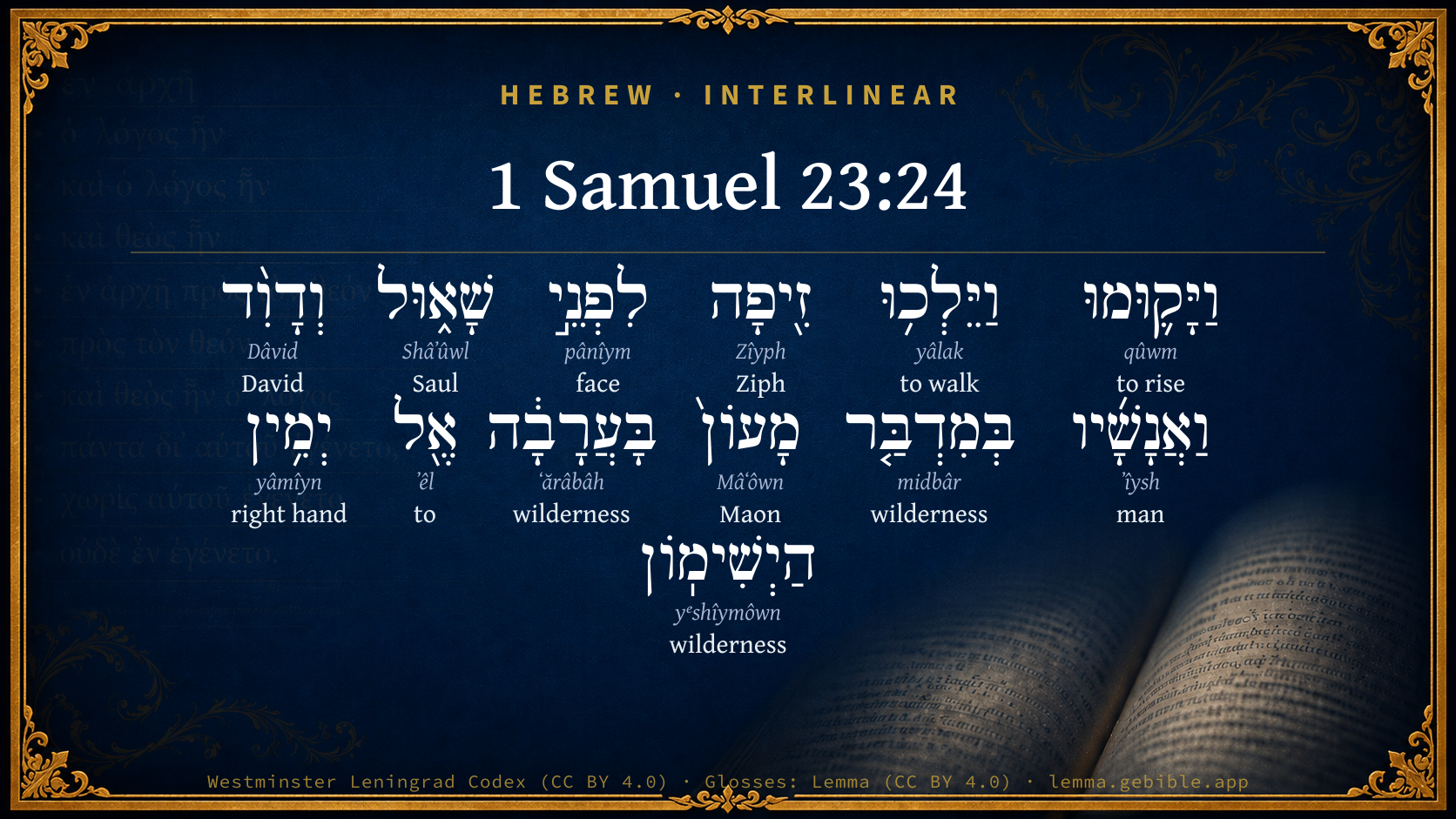
Hebrew (Westminster Leningrad Codex) 1 Samuel 23:24 appears in the Hebrew Old Testament. The text above is from the Westminster Leningrad Codex. Each word links to its Strong’s number, a concise gloss, and parsing drawn from the Open Scriptures Hebrew Bible morphology. Click any word for its full Brown-Driver-Briggs (BDB) entry.
Download image
Cite this verse

1 Samuel 23:24 (World English Bible). Public Domain. Lemma interlinear Bible study tool, https://lemma.gebible.app/v/1-samuel/23/24.

Show BibTeX & RIS
BibTeX
RIS
English Translation
They arose, and went to Ziph before Saul: but David and his men were in the wilderness of Maon, in the Arabah on the south of the desert.
World English Bible · Public Domain
Download a study sheet

One document with this verse’s original text, its word-by-word gloss line, the meaning frame, cross-references with their text, attributed commentary, and full source and license credits — printable, and it pastes into notes with its structure intact.

This verse Autodidact and up

Study sheet (.html) Plain text (.txt)

A passage Seminary Student

Up to 50 verses in one chapter. A passage sheet keeps up to 6 commentary sources and 12 cross-references per verse, in the order this page ranks them, and says so on the sheet whenever that leaves anything out. Ask for a single verse and you get the Autodidact verse sheet above.

Everything on this page stays free to read, with no account — the sheet is a download of what is already on screen, not access to it.

Want to remove ads? Support Godless Engineer
Compare translations 3

The same verse in 3 English versions, stacked beneath the original-language interlinear above. Click any original word for its lexicon entry.

Each is an independent rendering of the whole verse — the interlinear is not word-aligned to these translations.

Highlighted words mark where these versions differ — a whole-verse word diff, not a word-by-word alignment.

  • World English Bible Public Domain
    They arose, and went to Ziph before Saul: but David and his men were in the wilderness of Maon, in the Arabah on the south of the desert.
  • King James Version Public Domain
    And they arose, and went to Ziph before Saul: but David and his men were in the wilderness of Maon, in the plain on the south of Jeshimon.
  • unfoldingWord Literal Text CC BY-SA 4.0
    And they arose and went Ziph to the face of Saul. Now David and his men in the wilderness of Maon, in the Arabah at the south of Jeshimon.

unfoldingWord Literal Text — © unfoldingWord, licensed CC BY-SA 4.0. Word-aligned USFM3 via Door43 (git.door43.org/unfoldingWord/en_ult).

Versions to compare (up to 4)

3 of 4 selected

Show all 18 translations

Every available English version of this verse, each an independent rendering of the whole verse.

  • World English Bible Public Domain
    They arose, and went to Ziph before Saul: but David and his men were in the wilderness of Maon, in the Arabah on the south of the desert.
  • Berean Standard Bible Public Domain
    So they set out and went to Ziph ahead of Saul. Now David and his men were in the Wilderness of Maon in the Arabah south of Jeshimon,
  • Majority Standard Bible Public Domain
    So they set out and went to Ziph ahead of Saul. Now David and his men were in the Wilderness of Maon in the Arabah south of Jeshimon,
  • King James Version Public Domain
    And they arose, and went to Ziph before Saul: but David and his men were in the wilderness of Maon, in the plain on the south of Jeshimon.
  • American Standard Version (1901) Public Domain
    And they arose, and went to Ziph before Saul: but David and his men were in the wilderness of Maon, in the Arabah on the south of the desert.
  • Revised Version (1885) Public Domain
    And they arose, and went to Ziph before Saul: but David and his men were in the wilderness of Maon, in the Arabah on the south of the desert.
  • Geneva Bible (1599) Public Domain
    Then they arose and went to Ziph before Saul, but Dauid and his men were in the wildernesse of Maon, in the playne on the right hande of Ieshimon.
  • Douay-Rheims (1899) Public Domain
    And they arose and went to Ziph before Saul: and David and his men were in the desert of Maon, in the plain at the right hand of Jesimon.
  • Young's Literal Translation Public Domain
    And they rise and go to Ziph before Saul, and David and his men `are' in the wilderness of Maon, in the plain, at the south of the desolate place.
  • Literal Standard Version CC BY-SA 4.0
    And they rise and go to Ziph before Saul, and David and his men [are] in the wilderness of Maon, in the plain, at the south of the desolate place.
  • Unlocked Literal Bible CC BY-SA 4.0
    Then they rose up and went to Ziph ahead of Saul. Now David and his men were in the wilderness of Maon, in the Arabah to the south of Jeshimon.
  • unfoldingWord Literal Text CC BY-SA 4.0
    And they arose and went Ziph to the face of Saul. Now David and his men in the wilderness of Maon, in the Arabah at the south of Jeshimon.
  • Darby Bible Public Domain
    And they arose and went to Ziph before Saul; but David and his men were in the wilderness of Maon, in the plain on the south of the waste.
  • World Messianic Bible Public Domain
    They arose, and went to Ziph before Saul; but David and his men were in the wilderness of Maon, in the Arabah on the south of the desert.
  • Webster's Bible Public Domain
    And they arose, and went to Ziph before Saul: but David and his men were in the wilderness of Maon, in the plain on the south of Jeshimon.
  • Free Bible Version CC BY-SA 4.0
    So the people of Ziph set off, returning to Ziph ahead of Saul. David and his men were in the Desert of Maon in the Arabah Valley in the southern wastelands.
  • Bible in Basic English Public Domain
    And they went back and came to Ziph before Saul: but David and his men were in the waste land of Maon, in the dry land south of the waste land.
  • JPS Tanakh (1917) Public Domain
    And they arose, and went to Ziph before Saul; but David and his men were in the wilderness of Maon, in the Arabah on the south of Jeshimon.

Literal Standard Version (2020), Covenant Press — licensed CC BY-SA 4.0. Text via the HelloAO Bible API (eBible.org). Unlocked Literal Bible (unfoldingWord) — licensed CC BY-SA 4.0. Text via the HelloAO Bible API (eBible.org). unfoldingWord Literal Text — © unfoldingWord, licensed CC BY-SA 4.0. Word-aligned USFM3 via Door43 (git.door43.org/unfoldingWord/en_ult). Free Bible Version, Dr. Jonathan Gallagher — licensed CC BY-SA 4.0. Text via the HelloAO Bible API (eBible.org).

Word by word

More ways to search: Search by grammar → Find every occurrence → Compare this word →

Practice this passage: Drill this verse → Learn its vocabulary →

מָעוֹן֙
Mâʻôwn
H4584
“Maon”
Noun, Proper
Part of Speech
Noun
Type
Proper
Full BDB Definition

Origin: the same as H4583

TWOT: None

Maon or Maonites = "habitation" - a man of Judah (noun proper masculine) - the inhabitants of the city of Maon (noun proper masculine) - a city of Judah located 8 miles south of Hebron (noun proper locative)
  1. וַיָּק֛וּמוּ qûwm H6965 “and · to rise” Conjunction + Verb, Qal, Sequential Imperfect, 3rd Person, Masculine, Plural
  2. וַיֵּלְכ֥וּ yâlak H3212 “and · to walk” Conjunction + Verb, Qal, Sequential Imperfect, 3rd Person, Masculine, Plural
  3. זִ֖יפָה Zîyph H2128 “Ziph · toward” Noun, Proper + Suffix, Demonstrative
  4. לִפְנֵ֣י pânîym H6440 “to/for · face(s) of” Preposition + Noun, Common, Both, Plural, Construct
  5. שָׁא֑וּל Shâʼûwl H7586 “Saul” Noun, Proper
  6. וְדָוִ֨ד Dâvid H1732 “and · David” Conjunction + Noun, Proper
  7. וַאֲנָשָׁ֜יו ʼîysh H376 “and · men · his” Conjunction + Noun, Common, Masculine, Plural, Construct + Suffix, Personal, 3rd Person, Masculine, Singular
  8. בְּמִדְבַּ֤ר midbâr H4057 “in/at · wilderness of” Preposition + Noun, Common, Masculine, Singular, Construct
  9. בָּעֲרָבָ֔ה ʻărâbâh H6160 “in/at the · wilderness” Preposition, Determined + Noun, Common, Feminine, Singular, Absolute
  10. אֶ֖ל ʼêl H413 “to” Preposition
  11. יְמִ֥ין yâmîyn H3225 “right hand of” Noun, Common, Feminine, Singular, Construct
  12. הַיְשִׁימֽוֹן yᵉshîymôwn H3452 “the · wilderness” Particle, Definite Article + Noun, Common, Masculine, Singular, Absolute

About this verse

These counts appear in no published source. They are computed here, from the morphology-tagged text and Lemma’s own curated glosses. What Lemma adds →

13
words
13
distinct lemmas
Historical
section

Notable vocabulary

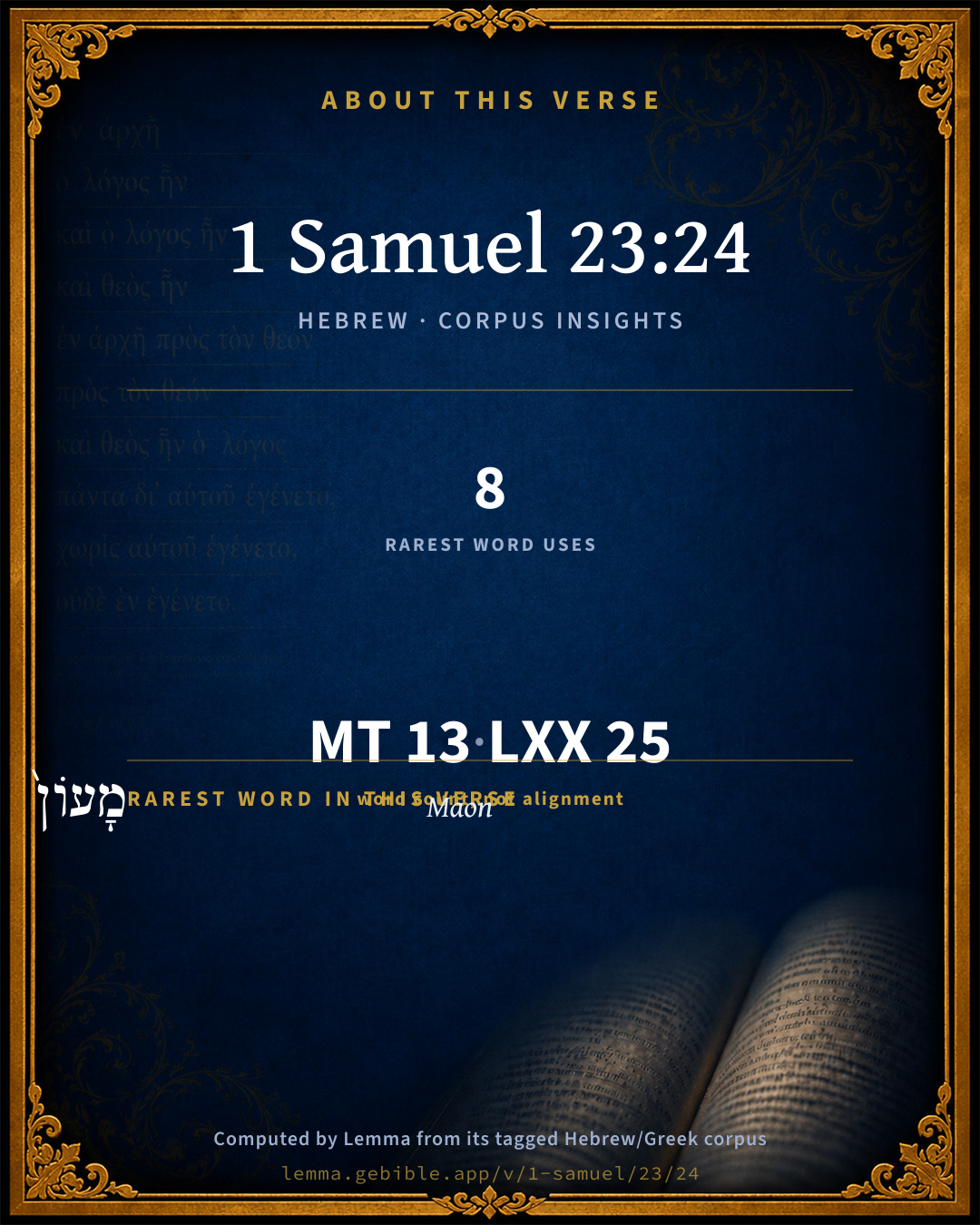
The rarest word here is מָעוֹן֙ Maon H4584 — appearing just 8 times in the whole Hebrew Bible.

Shared distinctive vocabulary

מָעוֹן֙ Maon H4584 occurs in 6 verses of the Hebrew Bible. Also found in:

Grammatical profile

  • 2 verbs
  • 10 nouns
  • 1 preposition

Verb forms

  • וַיָּק֛וּמוּ Qal · Sequential Imperfect
  • וַיֵּלְכ֥וּ Qal · Sequential Imperfect

Hebrew & Septuagint length

In English translation the verse runs 28 words from the Hebrew and 25 from the Septuagint (LXX English) — closely comparable.

A rough comparison of the two English renderings, which tokenize alike — not a word-level alignment.

Word counts can differ between the Hebrew and the Greek without any difference in meaning — e.g. the Hebrew direct-object marker אֵת has no separate Greek word, and Greek often adds the article ὁ.

In the original languages it is 13 Hebrew tokens and 25 Greek tokens — but the two are counted differently (Hebrew bundles its prefixes and suffixes into one token; the Greek is in lemma form), so that isn’t a like-for-like length.

Cross-references

2

Topical passages linked to 1 Samuel 23:24 in the Treasury of Scripture Knowledge — connected by theme and wording, ordered by reader-vote popularity; previews shown in the World English Bible.

  • Joshua 15:55 Maon, Carmel, and Ziph, and Jutah,
  • 1 Samuel 25:2 There was a man in Maon, whose possessions were in Carmel; and the man was very great, and he had three thousand sheep, and a thousand goats: and he was shearing his sheep in Carmel.

Cross-references courtesy of OpenBible.info (CC BY 4.0).

Hebrew and Greek witnesses Masoretic Hebrew ↔ Greek Septuagint

The same verse in the two great witnesses to the Old Testament, shown verse-for-verse.

These are two independent witnesses, not word-aligned to each other, and the Septuagint is shown in lemma (dictionary) form.

Hebrew 1 Samuel 23:24 Masoretic · Westminster Leningrad Codex

וַיָּק֛וּמוּ וַיֵּלְכ֥וּ זִ֖יפָה לִפְנֵ֣י שָׁא֑וּל וְדָוִ֨ד וַאֲנָשָׁ֜יו בְּמִדְבַּ֤ר מָעוֹן֙ בָּעֲרָבָ֔ה אֶ֖ל יְמִ֥ין הַיְשִׁימֽוֹן

They arose, and went to Ziph before Saul: but David and his men were in the wilderness of Maon, in the Arabah on the south of the desert.

World English Bible · Public Domain

Greek LXX 1 Samuel 23:24 Septuagint · lemma form

καί ἀναἵστημι ὁ ζιφαῖος καί πορεύομαι ἔμπροσθεν σαούλ καί δαυίδ καί ὁ ἀνήρ αὐτός ἐν ὁ ἔρημος ὁ μααν κατά ἑσπέρα ἐκ δεξιός ὁ ιεσσαιμου

And the Ziphites arose, and went before Saul: and David and his men were in the wilderness of Maon, westward, to the right of Jessaemon.

LXX2012 (modern English Septuagint) · Public Domain

Hebrew: Westminster Leningrad Codex (CC BY 4.0). Greek: Septuagint (public domain); English from LXX2012 (modern English Septuagint) (Public Domain). How the Septuagint differs from the Hebrew →

Targum (Aramaic paraphrase)

1

The Targum is the ancient Jewish Aramaic paraphrase of the Hebrew Scriptures — an interpretive translation, not the Hebrew text itself. Onkelos (literal) and Pseudo-Jonathan (expansive) render the Torah, and Jonathan the Prophets. Coverage is partial: where no permissively-licensed English translation exists for a verse, only the Aramaic is shown. This is verse-level text, not a word-by-word alignment to the Hebrew.

  1. Targum Jonathan Prophets (Joshua–Malachi)
    וְקָמוּ וַאֲזַלוּ לְזִיף קֳדָם שָׁאוּל וְדָוִד וְגַבְרוּהִי בְּמַדְבְּרָא דְמָעוֹן בְּמֵישְׁרָא דְמִדָרוֹם לִישִׁימוֹן:

    (no public-domain English translation for this verse)

    Targum Jonathan — Aramaic: “Mikraot Gedolot” (public domain). English: “Sefaria Community Translation” (CC0 1.0 (public-domain dedication)); “London "Chaldee Paraphrase," 1871” (public domain). Text via Sefaria.

Commentary

Notes on 1 Samuel 23:24 from classic Christian and Jewish commentators (each source and its license shown beneath its notes). The classic Christian expositions comment on the surrounding passage and are grouped to its opening verse, so a note may address several verses; the Jewish commentaries on the Tanakh (Rashi and others) are per-verse, so they appear only where the commentator wrote on this verse.

Lemma curates 59 commentaries, every one of them public domain or Creative Commons licensed, each selected and text-cleaned for this edition rather than reprinted as found. About our sources →

Trapp's Complete Commentary

John Trapp

1Sa 23:24 And they arose, and went to Ziph before Saul: but David and his men [were] in the wilderness of Maon, in the plain on the south of Jeshimon.

Ver. 24. And went to Ziph before Saul.] As his guides and forerunners, fearing him as the heathens did their Vejoves, lest he should serve them as he had lately done the city of Nob.

John Trapp, A Commentary or Exposition upon All the Books of the Old and New Testament (1647–1656) — public domain. Text from a community e-Sword module.

Joseph Benson's Commentary

1Sa 23:24-25. But David and his men were in the wilderness of Maon — Having heard what the Ziphites had undertaken, David disappointed their design by going into another place, with which, it is likely, they were not so well acquainted. For Maon was a distant wilderness from Ziph, though both were in the tribe of Judah. Saul also and his men went to seek him — Hearing, it is likely, by the Ziphites, whither he was gone. Therefore he came down into a rock — Some craggy, desolate place, where he thought Saul would not find him; or rather, into a cave which was in the rock, where, at first, he might think to hide himself; but, on further consideration, he removed from thence upon Saul’s approach.

Joseph Benson's Commentary on the Old and New Testaments (1811–1818) — public domain. Text from a community e-Sword module.

Tyndale Open Study Notes

Tyndale Open Resources

23:24 Maon was about three miles directly south of the wilderness of Ziph (23:14), approximately ten miles south of Hebron. • The Arabah Valley is a deep rift stretching from above the Sea of Galilee down both sides of the Jordan River to the Dead Sea.

Tyndale Open Study Notes — © Tyndale Open Resources, licensed CC BY-SA 4.0. Text via the HelloAO Bible API.

Ellicott's Commentary for English Readers

(24) In the wilderness of Maon.—Still further to the south. The name of this district is still preserved in the village or small town of Main, which is built on a prominent conical hill.

In the plain.—This accurate description was, no doubt, inserted by the compiler of these books, owing to the intense interest which the wanderings of this favourite hero and king excited among his countrymen. We can well imagine how gladly the dwellers in Judea, especially in later days—after the glorious reign of David had changed the tribes struggling with the surrounding petty nations for very existence into a great and renowned nation—would trace out the itinerary of the great king as he fled for his life before Saul. Is it too much to assume that each of these spots, which to us is little more than a hard, dry name, for a long period were the resort of reverent and curious pilgrims, anxious to gaze on localities made sacred by the weary wanderings and the hair-breadth escapes of the glorious king of Israel?

The plain.—Literally, the Arabah, the desert track which extends along the Jordan Valley from the Dead Sea to the Lake of Gennesareth; it is now called El-Ghor. The term is also applied to the desolate valley which lies between the Dead Sea and the Gulf of Akaba. Stanley, in his Sinai and Palestine, has given a picturesque description of these weird districts.

A Bible Commentary for English Readers, edited by Charles John Ellicott (1878–1897) — public domain. Text from a community e-Sword module.

The Cambridge Bible for Schools and Colleges

gen. ed. J. J. S. Perowne

24. in the wilderness of Maon] The district round the conical hill about seven miles south of Hebron still known as Tell Maîn. It is mentioned in Jos_15:55 among the cities of Judah in the mountains. It was the home of Nabal (ch. 1Sa_25:2).

in the plain on the south of Jeshimon] In the steppe on the south of the Waste. The Arâbah or “steppe” is here the name of the district south of “the Waste,” where the plateau falls away towards the plains of Beersheba. The term Arâbah generally denotes either the depressed valley of the Jordan, or the valley between the Dead Sea and the Gulf of Akaba, but neither of these can be intended here.

The Cambridge Bible for Schools and Colleges (gen. ed. J. J. S. Perowne; Cambridge University Press, 1878–1918) — public domain. Text from a community e-Sword module.

John Gill's Exposition

And they arose, and went to Ziph, before Saul,.... Not before his person, as if he went with them, and they before him leading the way; but they went thither before he went, to prepare things more exactly, and with more certainty, before he came, and in order to return to him again and go with him:

but David and his men were in the wilderness at Maon; for by the time the Ziphites returned home, David had intelligence of their design, and therefore removed from the wilderness of Ziph to the wilderness of Maon; which, though in the same tribe, was a distinct place; See Gill on Jos 15:55,

in the plain on the south of Jeshimon; the same as in Sa1 23:19; only David was now farther to the south of it, and in a plain, whereas before he was on an hill.

John Gill's Exposition of the Whole Bible (1746–1763) — public domain (CC PDM 1.0). Text via the HelloAO Bible API.

Albert Barnes' Notes on the Bible

The plain - The Arabah, the desert tract which extends along the valley of the Jordan from the Dead Sea to the Lake of Gennesareth, now called El-Ghor. The word is now given by the Arabs to the valley between the Dead Sea and the Gulf of Akaba.

Albert Barnes' Notes on the Bible (1834–1885) — public domain. Text from a community e-Sword/MySword module.

Haydock's Catholic Bible Commentary

Maon, in Arabia Petrea, not far from Bersabee. (Calmet)

George Leo Haydock (1774–1849), Haydock's Catholic Family Bible and Commentary, 1859 edition — public domain. Excludes Psalms (Douay-Rheims chapter numbering differs from Protestant) and Deuterocanonical books (Catholic canon only).

Matthew Poole's English Annotations

Before Saul, to prepare things for Saul, who marched after them.

In the wilderness of Maon, whither he went from the wilderness of Ziph, upon suspicion or information that Saul was coming thither.

Matthew Poole's English Annotations on the Holy Bible (1683–1685) — public domain. Text from a community e-Sword/MySword module.

Whedon's Commentary on the Bible

Daniel D. Whedon

24. Wilderness of Maon — This lay about four miles southeast of Ziph, and is still marked by the modern Main. Compare Jos_15:55. Thus as David found himself pursued and hunted even by the Ziphites, he retreated still further to the south.

On the south of Jeshimon — Rather, on the right of the desert. See note on 1Sa_23:19.

Daniel D. Whedon (gen. ed.), Commentary on the Old and New Testaments (1874–1909) — public domain. Text from a community e-Sword module.

The Pulpit Commentary

While the Ziphites were conferring with Saul and gathering information David had moved about six miles to the south of Ziph, and was in the wilderness of Maon. This town is still called Main, and occupies a conical hill, whence Robinson ("Bibl. Res.," 2:433) counted no less than nine cities belonging to the hill country of Judah. Conder ("Tent Work," 2:90) calls it a great hump of rock. In the plain on the south of Jeshimon. Literally, "in the "Arabah to the right of the desert." The "Arabah was the name of the low-lying desert tract extending along the valley of the Jordan from the lake of Gennesareth to the Dead Sea. Maon lay upon the edge of this depression, in the southern portion of the Jeshimon or Solitude.

Vers. 24-28. (THE WILDERNESS OF MAON.)

A marvellous escape.

they called that place Sela-hammahlekoth the cliff of separations (ver. 28). It seemed as if at length Saul was about to accomplish his purpose. Led by the treacherous Ziphites, he went down to the hill of Hachilah, from which David had withdrawn to "the wilderness of Maon, in the plain on the south of the desert." In his further pursuit (ver. 25) there was but a short distance between them Saul standing on a ridge of Hachilah, David on a rock or precipice in Maon; but a deep chasm separated them from each other. And when "Saul and his men were encircling David and his men to seize them, and David was sore troubled to escape" (ver. 26), "there came a messenger unto Saul, saying, Haste thee, and come; for the Philistines have invaded the land." Thus his purpose was suddenly and effectually defeated. The escape of David suggests, concerning the dealings of God with his servants, that

I HE SOMETIMES SUFFERS THEM TO BE REDUCED TO SEVERE STRAITS. Danger is imminent, the enemy exults, their own wisdom and strength are unavailing, and they are full of anxiety and dread. They have no resource but to betake themselves to "the Rock of Israel;" if he should fail them they are lost; and it is to constrain them to seek refuge in him that they are beaten off from every other. (see 1Sa_7:12)

II HE NEVER SUFFERS THEM TO CONTINUE THEREIN WITHOUT HELP. Although the space that separates them from destruction be narrow, it is impassable; for the invisible hand of God is there, and the enemy cannot go a step further than he permits. "He shall cover thee with his feathers," etc.. (Psa_91:4) Sometimes nothing more can be done than to "stand still and see the salvation of the Lord;" if an effort to escape must be made, it is still he who saves, and to him we must ever look in faith and prayer. "What doth not prayer overcome and conquer? What doth not resistance drive back when accompanied by distrust of self and trust in God? And in what battle can he be conquered who stands in the presence of God with an earnest resolve to please him?" (Scupoli). "When I cry unto thee, then shall mine enemies turn back," etc. (Psa_56:9)

III HE OFTEN DELIVERS THEM AT THE MOMENT OF THEIR GREATEST PERIL. He does so both in temporal calamity and in spiritual trouble, labour and conflict. At the point of despair deliverance comes. (Mic_7:8) And thereby his interposition is rendered more apparent, the designs of the enemy are more signally frustrated, and the gratitude of his servants is more fully excited. "David was delivered at the last hour, it is true; but this never strikes too late for the Lord to furnish in it a proof to those that trust in him that his word is yea and amen when it says, "I will never leave thee nor forsake thee (Krummacher).

IV HE MAKES USE OF VARIOUS AND UNEXPECTED MEANS FOR THEIR DELIVERANCE (ver. 27). Who could have predicted the arrival of such a message? The incursion of the Philistines was the natural result of the course pursued by Saul in levying war (ver. 8), going out to seek the life of David (ver. 15), and leaving the country unprotected; but the message came at the opportune moment by the overruling providence of God. His resources are boundless; he employs his enemies for the preservation of his friends, diverts their attention to other objects, and impels them to spend their strength in conflict with each other. "The Lord knoweth how to deliver the godly out of temptations". (2Pe_2:9)

V HIS INTERPOSITION ON THEIR BEHALF SHOULD BE GRATEFULLY RECORDED; as it was in the name which was given to the spot, and still more fully in the psalm ending

With willing mind will I sacrifice unto thee; I will give thanks to thy name, O Jehovah, for it is good. For out of all distress hath he delivered me, And upon mine enemies hath mine eye seen its desire". D. (Psa 54:8, Psa 54:9)

The Pulpit Commentary (1880–1919), ed. H.D.M. Spence-Jones & Joseph S. Exell — public domain. Text from a community e-Sword module.

Keil & Delitzsch

C. F. Keil & F. Delitzsch

With this answer the Ziphites arose and "went to Ziph before Saul" (who would speedily follow with his warriors); but David had gone farther in the meantime, and was with his men "in the desert of Maon, in the steppe to the south of the wilderness." Maon, now Man, is about three hours and three-quarters S.S.E. of Hebron (see at Jos 15:55), and therefore only two hours from Ziph, from which it is visible. "The table-land appears to terminate here; nevertheless the principal ridge of the southern mountains runs for a considerable distance towards the south-west, whereas towards the south-east the land falls off more and more into a lower table-land." This is the Arabah or steppe on the right of the wilderness (v. de Velde, ii. pp. 107-8).

Keil & Delitzsch — Biblical Commentary on the Old Testament (1861–1891) — public domain (CC PDM 1.0). Text via the HelloAO Bible API. (Old Testament only.)

unfoldingWord translationNotes

Door43 World Missions Community

Then they rose up

They stopped what they had been doing. The reader should not believe that they were sitting or lying.

Then they

"Then the Ziphites"

Ziph

This is the name of a place. See how you translated this in 1 Samuel 23:14.

Jeshimon

This is the name of a desert area near the Dead Sea. It can also be translated as "the Judean Wilderness" or "the wasteland." See how you translated this in 1 Samuel 23:19. (See: How to Translate Names)

David was told of it

This can be translated in active form. AT: "Someone told David that they were coming" or "David learned that they were coming" (See: Active or Passive)

rocky hill

a hill covered with many rocks or boulders

the wilderness of Maon

This is the name of the deserted area around the city of Maon in southern Judah. (See: How to Translate Names)

translationWords

Saul (OT)

David

desert

Arabah

unfoldingWord translationNotes — © Distant Shores Media and the Door43 World Missions Community, licensed CC BY-SA 4.0. Source: git.door43.org/Door43/en_tn.

Rashi

Rabbi Shlomo Yitzchaki (Rashi)

Ahead of Shaul. For Shaul was destined to go after them, and they went before him, to search exactly [where Dovid was].

Rashi on the Tanakh — English translations: “The Judaica Press complete Tanach with Rashi, translated by A. J. Rosenberg” (CC BY 4.0); “Pentateuch with Rashi's commentary by M. Rosenbaum and A.M. Silbermann, 1929-1934” (public domain); “The Metsudah Tanach series, Lakewood, N.J” (CC BY 4.0); and “The Book of Joshua, Metsudah Publications, 1997” (CC BY 4.0). Text via Sefaria.

Lesson kit

Teaching starters — assembled from the data on this page, not authored interpretation. Every prompt links to the verse data it draws on. Edit before teaching.

1 Samuel, in the Historical, opens this verse with 13 words (13 distinct Hebrew lemmas). Its most distinctive word is Mâʻôwn (“Maon”). A historical commentator’s framing appears above. Read the whole chapter for the surrounding context.

Discussion questions

  1. How does “Maon” (Mâʻôwn) shape what this verse is saying?
  2. How does Joshua 15:55, which shares the word «Maon», read alongside this verse?
  3. The translations on this page render this verse differently — a whole-verse word diff, not a word-by-word alignment. What might account for the different wordings?
  4. «וַיָּק֛וּמוּ» is a Qal Sequential Imperfect verb. How does that grammatical form shape the action described?
  5. Compare how Trapp's Complete Commentary and Joseph Benson's Commentary read this verse. Where do they agree or differ?

Things to notice

Reading settings

Reading text

Shown beneath each verse's original-language words.

Old Testament
Old Testament edition

Read the OT as the Masoretic Hebrew (MT) or the Greek Septuagint (LXX).

English shown for the Greek Septuagint (in the Hebrew ↔ Greek comparison).

Comparing translations? Open the Compare panel on any verse page to stack up to four side by side.