
Hosea 10:14

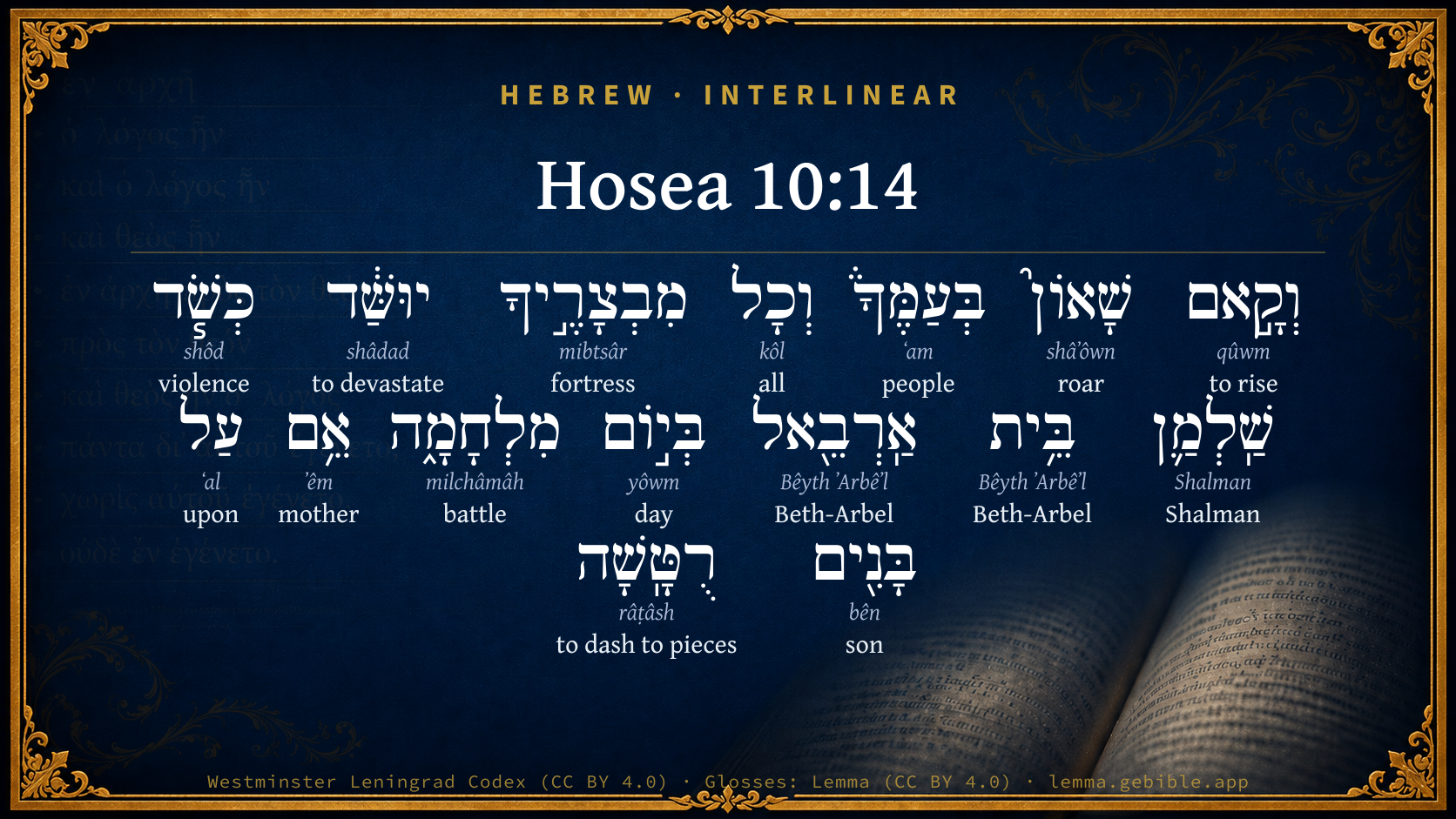
Hebrew (Westminster Leningrad Codex) Hosea 10:14 appears in the Hebrew Old Testament. The text above is from the Westminster Leningrad Codex. Each word links to its Strong’s number, a concise gloss, and parsing drawn from the Open Scriptures Hebrew Bible morphology. Click any word for its full Brown-Driver-Briggs (BDB) entry.
Download image
Cite this verse

Hosea 10:14 (World English Bible). Public Domain. Lemma interlinear Bible study tool, https://lemma.gebible.app/v/hosea/10/14.

Show BibTeX & RIS
BibTeX
RIS
English Translation
Therefore a battle roar will arise among your people, And all your fortresses will be destroyed, As Shalman destroyed Beth Arbel in the day of battle. The mother was dashed in pieces with her children.
World English Bible · Public Domain
Highlights
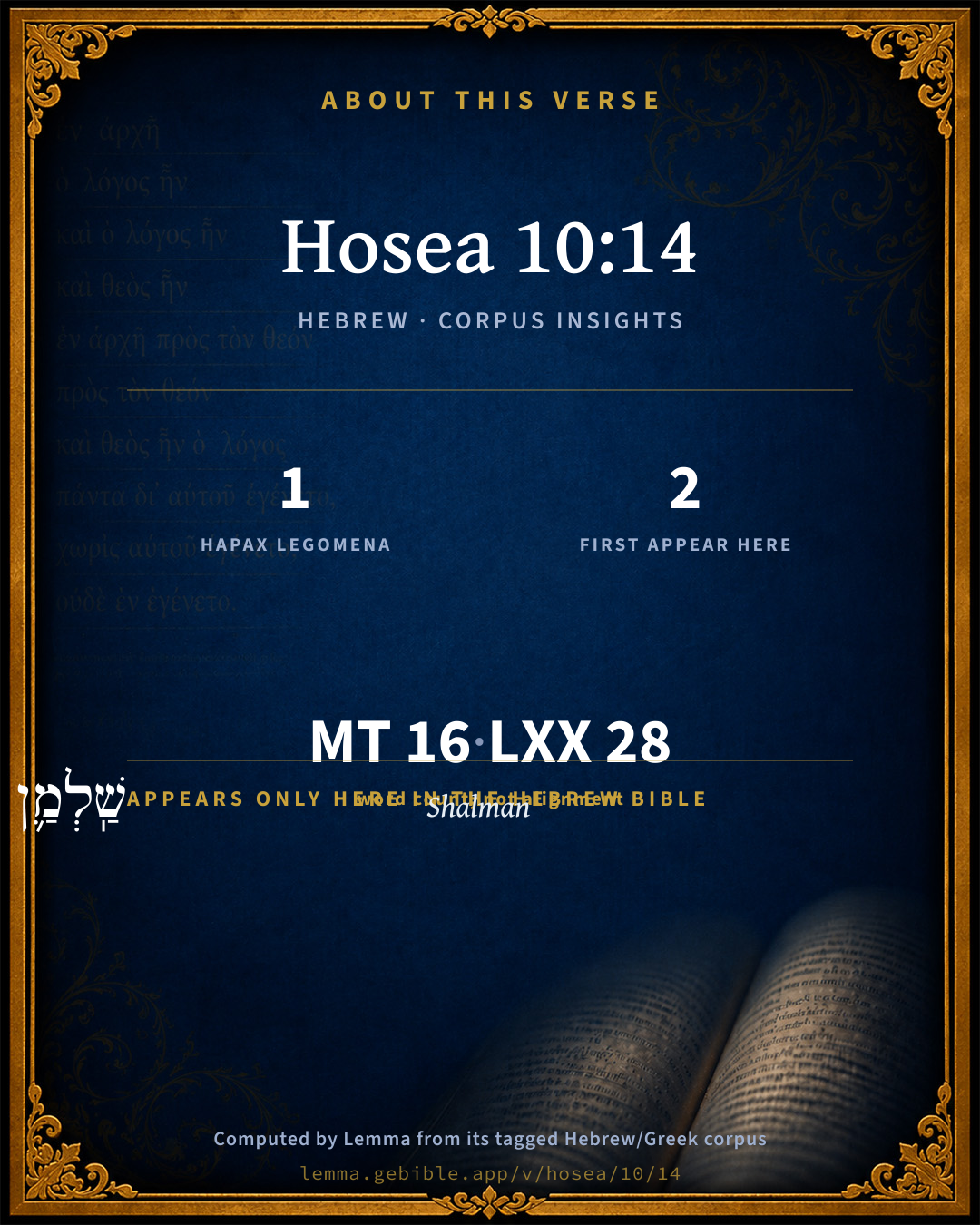
  • 1 hapax legomenon — only here in the Hebrew Bible
  • 2 first appearances in the Hebrew Bible
Full analysis ↓
Download a study sheet

One document with this verse’s original text, its word-by-word gloss line, the meaning frame, cross-references with their text, attributed commentary, and full source and license credits — printable, and it pastes into notes with its structure intact.

This verse Autodidact and up

Study sheet (.html) Plain text (.txt)

A passage Seminary Student

Up to 50 verses in one chapter. A passage sheet keeps up to 6 commentary sources and 12 cross-references per verse, in the order this page ranks them, and says so on the sheet whenever that leaves anything out. Ask for a single verse and you get the Autodidact verse sheet above.

Everything on this page stays free to read, with no account — the sheet is a download of what is already on screen, not access to it.

Want to remove ads? Support Godless Engineer
Compare translations 3

The same verse in 3 English versions, stacked beneath the original-language interlinear above. Click any original word for its lexicon entry.

Each is an independent rendering of the whole verse — the interlinear is not word-aligned to these translations.

Highlighted words mark where these versions differ — a whole-verse word diff, not a word-by-word alignment.

  • World English Bible Public Domain
    Therefore a battle roar will arise among your people, And all your fortresses will be destroyed, As Shalman destroyed Beth Arbel in the day of battle. The mother was dashed in pieces with her children.
  • King James Version Public Domain
    Therefore shall a tumult arise among thy people, and all thy fortresses shall be spoiled, as Shalman spoiled Betharbel in the day of battle: the mother was dashed in pieces upon her children.
  • unfoldingWord Literal Text CC BY-SA 4.0
    And a tumult will arise among your people, and all your fortresses will be destroyed, as Shalman destroyed Beth Arbel on the day of battle— a mother was dashed to pieces upon sons.

unfoldingWord Literal Text — © unfoldingWord, licensed CC BY-SA 4.0. Word-aligned USFM3 via Door43 (git.door43.org/unfoldingWord/en_ult).

Versions to compare (up to 4)

3 of 4 selected

Show all 18 translations

Every available English version of this verse, each an independent rendering of the whole verse.

  • World English Bible Public Domain
    Therefore a battle roar will arise among your people, And all your fortresses will be destroyed, As Shalman destroyed Beth Arbel in the day of battle. The mother was dashed in pieces with her children.
  • Berean Standard Bible Public Domain
    the roar of battle will rise against your people, so that all your fortresses will be demolished as Shalman devastated Beth-arbel in the day of battle, when mothers were dashed to pieces along with their children.
  • Majority Standard Bible Public Domain
    the roar of battle will rise against your people, so that all your fortresses will be demolished as Shalman devastated Beth-arbel in the day of battle, when mothers were dashed to pieces along with their children.
  • King James Version Public Domain
    Therefore shall a tumult arise among thy people, and all thy fortresses shall be spoiled, as Shalman spoiled Betharbel in the day of battle: the mother was dashed in pieces upon her children.
  • American Standard Version (1901) Public Domain
    Therefore shall a tumult arise among thy people, and all thy fortresses shall be destroyed, as Shalman destroyed Beth-arbel in the day of battle: the mother was dashed in pieces with her children.
  • Revised Version (1885) Public Domain
    Therefore shall a tumult arise among thy people, and all thy fortresses shall be spoiled, as Shalman spoiled Beth-arbel in the day of battle: the mother was dashed in pieces with her children.
  • Geneva Bible (1599) Public Domain
    Therefore shall a tumult arise among thy people, and all thy munitions shall be destroyed, as Shalman destroyed Beth-arbell in the daie of battell: the mother with the children was dashed in pieces.
  • Douay-Rheims (1899) Public Domain
    A tumult shall arise among thy people: and all thy fortresses shall be destroyed as Salmana was destroyed, by the house of him that judged Baal in the day of battle, the mother being dashed in pieces upon her children.
  • Young's Literal Translation Public Domain
    And rise doth a tumult among thy people, And all thy fortresses are spoiled, As the spoiling of Shalman of Beth-Arbel, In a day of battle, Mother against sons dashed in pieces.
  • Literal Standard Version CC BY-SA 4.0
    And a tumult rises among your people, || And all your fortresses are spoiled, || As the spoiling of Shalman of Beth-Arbel, || In a day of battle, || Mother against sons dashed in pieces.
  • Unlocked Literal Bible CC BY-SA 4.0
    So a tumult of war will rise among your people, and all your fortified cities will be destroyed. It will be as Shalman destroyed Beth Arbel on a day of battle, when mothers were dashed to pieces with their children.
  • unfoldingWord Literal Text CC BY-SA 4.0
    And a tumult will arise among your people, and all your fortresses will be destroyed, as Shalman destroyed Beth Arbel on the day of battle— a mother was dashed to pieces upon sons.
  • Darby Bible Public Domain
    And a tumult shall arise among thy peoples, and all thy fortresses shall be spoiled, as Shalman spoiled Beth-arbel in the day of battle: the mother was dashed in pieces with the children.
  • World Messianic Bible Public Domain
    Therefore a battle roar will arise among your people, and all your fortresses will be destroyed, as Shalman destroyed Beth Arbel in the day of battle. The mother was dashed in pieces with her children.
  • Webster's Bible Public Domain
    Therefore shall a tumult arise among thy people, and all thy fortresses shall be plundered, as Shalman plundered Beth-arbel in the day of battle: the mother was dashed in pieces upon her children.
  • Free Bible Version CC BY-SA 4.0
    The terrifying noise of battle will rise against your people, and all your fortresses will be destroyed, just as Shalman devastated Beth Arbel in the time of war. Even mothers and children were dashed to pieces.
  • Bible in Basic English Public Domain
    So a great outcry will go up from among your people, and all your strong places will be broken, as Beth-arbel was broken by Shalman in the day of war, as the mother was broken on the rocks with her children.
  • JPS Tanakh (1917) Public Domain
    Therefore shall a tumult arise among thy hosts, and all thy fortresses shall be spoiled, as Shalman spoiled Beth-arbel in the day of battle; the mother was dashed in pieces with her children.

Literal Standard Version (2020), Covenant Press — licensed CC BY-SA 4.0. Text via the HelloAO Bible API (eBible.org). Unlocked Literal Bible (unfoldingWord) — licensed CC BY-SA 4.0. Text via the HelloAO Bible API (eBible.org). unfoldingWord Literal Text — © unfoldingWord, licensed CC BY-SA 4.0. Word-aligned USFM3 via Door43 (git.door43.org/unfoldingWord/en_ult). Free Bible Version, Dr. Jonathan Gallagher — licensed CC BY-SA 4.0. Text via the HelloAO Bible API (eBible.org).

Word by word

More ways to search: Search by grammar → Find every occurrence → Compare this word →

Practice this passage: Drill this verse → Learn its vocabulary →

שַֽׁלְמַ֛ן
Shalman
H8020
“Shalman”
Noun, Proper
Part of Speech
Noun
Type
Proper
Full BDB Definition

Origin: of foreign derivation

TWOT: None

Shalman = "fire-worshipper" - a contraction for Shalmaneser king of Assyria - maybe an obscure Assyrian king, predecessor of Pul
  1. וְקָ֣אם qûwm H6965 “and · to rise” Conjunction + Verb, Qal, Sequential Perfect, 3rd Person, Masculine, Singular
  2. שָׁאוֹן֮ shâʼôwn H7588 “roar” Noun, Common, Masculine, Singular, Absolute
  3. בְּעַמֶּךָ֒ ʻam H5971 “in/at · people · your” Preposition + Noun, Common, Masculine, Singular, Construct + Suffix, Personal, 2nd Person, Masculine, Singular
  4. וְכָל kôl H3605 “and · all of” Conjunction + Noun, Common, Masculine, Singular, Construct
  5. מִבְצָרֶ֣יךָ mibtsâr H4013 “fortresses · your” Noun, Common, Masculine, Plural, Construct + Suffix, Personal, 2nd Person, Masculine, Singular
  6. יוּשַּׁ֔ד shâdad H7703 “to devastate” Verb, Qal Passive, Imperfect, 3rd Person, Masculine, Singular
  7. כְּשֹׁ֧ד shôd H7701 “like/as · violence of” Preposition + Noun, Common, Masculine, Singular, Construct
  8. בֵּ֥ית Bêyth ʼArbêʼl H1009 “Beth-Arbel” Noun, Proper
  9. אַֽרְבֵ֖אל Bêyth ʼArbêʼl H1009 “Beth-Arbel” Noun, Proper
  10. בְּי֣וֹם yôwm H3117 “in/at · day of” Preposition + Noun, Common, Masculine, Singular, Construct
  11. מִלְחָמָ֑ה milchâmâh H4421 “battle” Noun, Common, Feminine, Singular, Absolute
  12. אֵ֥ם ʼêm H517 “mother” Noun, Common, Feminine, Singular, Absolute
  13. עַל ʻal H5921 “upon” Preposition
  14. בָּנִ֖ים bên H1121 “sons” Noun, Common, Masculine, Plural, Absolute
  15. רֻטָּֽשָׁה râṭâsh H7376 “to dash to pieces” Verb, Pual, Perfect, 3rd Person, Feminine, Singular

About this verse

These counts appear in no published source. They are computed here, from the morphology-tagged text and Lemma’s own curated glosses. What Lemma adds →

16
words
15
distinct lemmas
Prophets
section

Notable vocabulary

1 hapax legomenon — a word that appears only here in the entire Hebrew Bible:

  • שַֽׁלְמַ֛ן Shalman H8020

First appearance in Scripture

These words make their first canonical appearance in the Hebrew Bible here:

  • שַֽׁלְמַ֛ן Shalman H8020
  • בֵּ֥ית Beth-Arbel H1009

Grammatical profile

  • 3 verbs
  • 12 nouns
  • 1 preposition

Verb forms

  • וְקָ֣אם Qal · Sequential Perfect
  • יוּשַּׁ֔ד Qal Passive · Imperfect
  • רֻטָּֽשָׁה Pual · Perfect

Repetition

A word recurs within this verse — often emphatic in Hebrew:

  • בֵּ֥ית Beth-Arbel H1009 ×2

Hebrew & Septuagint length

In English translation the verse runs 35 words from the Hebrew and 42 from the Septuagint (LXX English) — closely comparable.

A rough comparison of the two English renderings, which tokenize alike — not a word-level alignment.

Word counts can differ between the Hebrew and the Greek without any difference in meaning — e.g. the Hebrew direct-object marker אֵת has no separate Greek word, and Greek often adds the article ὁ.

In the original languages it is 16 Hebrew tokens and 28 Greek tokens — but the two are counted differently (Hebrew bundles its prefixes and suffixes into one token; the Greek is in lemma form), so that isn’t a like-for-like length.

Cross-references

17

Topical passages linked to Hosea 10:14 in the Treasury of Scripture Knowledge — connected by theme and wording, ordered by reader-vote popularity; previews shown in the World English Bible.

  • Hosea 13:16 Samaria will bear her guilt; For she has rebelled against her God. They will fall by the sword. Their infants will be dashed in pieces, And their pregnant women will be ripped open."
  • 2 Kings 18:9–10 It happened in the fourth year of king Hezekiah, which was the seventh year of Hoshea son of Elah king of Israel, that Shalmaneser king of Assyria came up against Samaria, and besieged it.
  • Habakkuk 1:10 Yes, he scoffs at kings, and princes are a derision to him. He laughs at every stronghold, for he builds up an earthen ramp, and takes it.
  • Genesis 32:11 Please deliver me from the hand of my brother, from the hand of Esau: for I fear him, lest he come and strike me, and the mothers with the children.
  • 2 Kings 17:16 They forsook all the commandments of Yahweh their God, and made them molten images, even two calves, and made an Asherah, and worshiped all the host of the sky, and served Baal.
  • 2 Kings 18:33 Has any of the gods of the nations ever delivered his land out of the hand of the king of Assyria?
  • 2 Kings 19:11–13 Behold, you have heard what the kings of Assyria have done to all lands, by destroying them utterly: and shall you be delivered?
  • Isaiah 13:16–18 Their infants also shall be dashed in pieces before their eyes; their houses shall be rifled, and their wives ravished.
  • Isaiah 17:3 The fortress shall cease from Ephraim, and the kingdom from Damascus, and the remnant of Syria; they shall be as the glory of the children of Israel, says Yahweh of Hosts.
  • Isaiah 22:1–4 The burden of the valley of vision. What ails you now, that you are wholly gone up to the housetops?
  • Isaiah 33:14 The sinners in Zion are afraid; trembling has seized the godless ones: Who among us can dwell with the devouring fire? who among us can dwell with everlasting burning?
  • Jeremiah 48:41 Kerioth is taken, and the strongholds are seized, and the heart of the mighty men of Moab at that day shall be as the heart of a woman in her pangs.
  • Amos 3:8 The lion has roared. Who will not fear? The Lord Yahweh has spoken. Who can but prophesy?
  • Amos 9:5 For the Lord, Yahweh of Hosts, is he who touches the land and it melts, and all who dwell in it will mourn; and it will rise up wholly like the River, and will sink again, like the River of Egypt.
  • Nahum 3:10 Yet was she carried away. She went into captivity. Her young children also were dashed in pieces at the head of all the streets, and they cast lots for her honorable men, and all her great men were bound in chains.
  • Nahum 3:12 All your fortresses will be like fig trees with the first-ripe figs: if they are shaken, they fall into the mouth of the eater.
  • Jeremiah 13:14 I will dash them one against another, even the fathers and the sons together, says Yahweh: I will not pity, nor spare, nor have compassion, that I should not destroy them.

Cross-references courtesy of OpenBible.info (CC BY 4.0).

Hebrew and Greek witnesses Masoretic Hebrew ↔ Greek Septuagint

The same verse in the two great witnesses to the Old Testament, shown verse-for-verse.

These are two independent witnesses, not word-aligned to each other, and the Septuagint is shown in lemma (dictionary) form.

Hebrew Hosea 10:14 Masoretic · Westminster Leningrad Codex

וְקָ֣אם שָׁאוֹן֮ בְּעַמֶּךָ֒ וְכָל מִבְצָרֶ֣יךָ יוּשַּׁ֔ד כְּשֹׁ֧ד שַֽׁלְמַ֛ן בֵּ֥ית אַֽרְבֵ֖אל בְּי֣וֹם מִלְחָמָ֑ה אֵ֥ם עַל בָּנִ֖ים רֻטָּֽשָׁה

Therefore a battle roar will arise among your people, And all your fortresses will be destroyed, As Shalman destroyed Beth Arbel in the day of battle. The mother was dashed in pieces with her children.

World English Bible · Public Domain

Greek LXX Hosea 10:14 Septuagint · lemma form

καί ἐκ ἀναἵστημι ἀπώλεια ἐν ὁ λαός σύ καί πᾶς ὁ περιτειχίζω σύ οἴχομαι ὡς ἄρχων σαλαμαν ἐκ ὁ οἶκος ιεροβααλ ἐν ἡμέρα πόλεμος μήτηρ ἐπί τέκνον ἐδαφίζω

Therefore shall destruction rise up among your people, and all your strong places shall be ruined: as a prince Solomon departed out of the house of Jeroboam, in the days of battle they dashed the mother to the ground upon the children,

LXX2012 (modern English Septuagint) · Public Domain

On this verse, Trapp's Complete Commentary discusses the Septuagint’s reading. Read the note in Commentary ↓

Hebrew: Westminster Leningrad Codex (CC BY 4.0). Greek: Septuagint (public domain); English from LXX2012 (modern English Septuagint) (Public Domain). How the Septuagint differs from the Hebrew →

Targum (Aramaic paraphrase)

1

The Targum is the ancient Jewish Aramaic paraphrase of the Hebrew Scriptures — an interpretive translation, not the Hebrew text itself. Onkelos (literal) and Pseudo-Jonathan (expansive) render the Torah, and Jonathan the Prophets. Coverage is partial: where no permissively-licensed English translation exists for a verse, only the Aramaic is shown. This is verse-level text, not a word-by-word alignment to the Hebrew.

  1. Targum Jonathan Prophets (Joshua–Malachi)
    וִיקוּם אִתְרְגוּשָׁא בְּעַמָךְ וְכָל כְּרַכָּךְ יִתְבַּזְזוּן כְּבִזַת שְׁלָמָא כִּכְמָנָא בְּיוֹמָא דִקְרָבָא אֵם עַל בְּנִין קְטִילַת:

    (no public-domain English translation for this verse)

    Targum Jonathan — Aramaic: “Mikraot Gedolot” (public domain). English: “Sefaria Community Translation” (CC0 1.0 (public-domain dedication)); “London "Chaldee Paraphrase," 1871” (public domain). Text via Sefaria.

Commentary

Notes on Hosea 10:14 from classic Christian and Jewish commentators (each source and its license shown beneath its notes). The classic Christian expositions comment on the surrounding passage and are grouped to its opening verse, so a note may address several verses; the Jewish commentaries on the Tanakh (Rashi and others) are per-verse, so they appear only where the commentator wrote on this verse.

Lemma curates 59 commentaries, every one of them public domain or Creative Commons licensed, each selected and text-cleaned for this edition rather than reprinted as found. About our sources →

Trapp's Complete Commentary

John Trapp

Hos 10:14 Therefore shall a tumult arise among thy people, and all thy fortresses shall be spoiled, as Shalman spoiled Betharbel in the day of battle: the mother was dashed in pieces upon [her] children.

Ver. 14. Therefore shall a tumult arise among the people, &c.] Even among those mighty men, wherein ye trusted, shall there be seditious tumults, that shall soon bring all into a miserable confusion. Intestine commotions may undo a people, as a man may die of an inward bleeding. (Virg. Aeneid. lib. 1),

“ Ac veluti in magno populo cum saepe coorta est

Seditio, saevitque animis ignobile vulgus. ”

When the multitude is in a rage they are like to a tiled house that is on fire (saith one), there is no coming near the house, the tiles do so fly about your face; so it is in tumults, there is no coming near to talk to them, to convince them; but they are ready to fly presently upon you. In Ket’s sedition, Dr Parker, in his sermon before the rebels, near Norwich, touched them for their misliving so near that they went near to touch him for his life. The rude rage of the rebels was such, that some, being disabled almost to hold up their weapons, would strive what they could to strike their enemies; others being thrust through the body with a spear, would run themselves farther, to reach those that deadly wounded them. Yea, boys were observed to be so desperately resolved, as to pull arrows out of their own flesh, and deliver them to be shot again by the archers on their side. There are none so insolent and cruel as the vilest of the people, when they are got together in a head. What havoc made the seditious in Jerusalem a little before the last destruction of it! the Guelphs and Ghibellines in Italy! Wat Tyler and his accomplices here! That rebel, held up by the many headed multitude, dared to say, that all the laws of England should come out of his mouth. The Hebrew word ( שׁאון) here used signifieth an inundation, or multitude of waters, which overran their banks with violence and roaring. The people are a most dangerous and heady water, when once it is out; it is like a sweeping rain which leaveth no food, Pro 28:3. The Septuagint render it, Destruction. Sal. Jarchi saith, it signifieth the voice of those that cry, Fugite, Fugite, Away, Away, the enemy is at hand, &c. Some say, to the same purpose, that it signifieth clamorem meticulosorum, the crying of those that are scared, as when there is luctus ubique paver, et plurima morti imago. See Amo 2:2 Zep 1:15.

And all thy fortresses shall be spoiled] Yea, though they be munitions of rocks. "Thy terribleness hath deceived thee, and the pride of thine own heart, O thou that dwellest in the clefts of the rock, that holdest the height of the hill: though thou shouldest make thy nest as high as the eagle, I will bring thee down from thence, saith the Lord," Jer 49:16. And again, "All thy strongholds shall be like fig trees with the firstripe figs; if they be shaken, they shall even fall into the mouth of the eater, who shall devour them at a bite," Nah 3:12.

As Shalman spoiled Betharbel] Shalman signifieth peaceable (saith an interpreter), a man of a calm spirit; but he answered not his name; for he exercised greatest cruelty. There is not a more troublesome sea than that which is called Mare pacificum, Pacific Ocean. There is often aliud in titulo, aliud in pyxide Different in name from practice. Absalom signifieth the Father’s peace; but he proved otherwise than was hoped.

“ Fallitur augurio spes bona saepe suo. ”

But this Shalman is by the best interpreters thought to be Shalmaneser, king of Assyria, in this prophet’s time. Shalman is vex truncata, a name cut off to the halves; a thing very ordinary in all the learned languages, as were easy to instance. See Isa 15:2. Bamoth for Bamoth-Baal, Jos 13:17. Chamath for Chamath-Dor. Hesiod puts Bρι for Bριαροι, Ennius hath Fabric for Fabricius. This Shalmaneser (or, as Luther will have it, some other great warrior called Shalman, not elsewhere mentioned in Scripture, but not unknown to the ten tribes) did cruel execution, it seems, upon Betharbel, a city beyond Jordan, /Apc 1Ma 9:2, like as Tamerlane (for a terror to the Greek empire, much whereof he afterwards subdued) did at Sebastia; where he made a merciless slaughter of all sexes and sizes; whereby he held the whole East in such awe, as that he was commonly called The wrath of God, and terror of the world. There are those who think this Arbel to be the same as that Arbela, where Alexander defeated Darius, and won the Persian monarchy. They make it a city or country of Assyria, beneath Arpad, and hinted at by Rabshakeh, 2Ki 18:34. "Where are the gods of Hamath and Arpad?" sc. Shalmaneser hath utterly destroyed them. See 2Ki 15:29; 2Ki 17:24; 2Ki 19:13. Arbel is by some interpreted the city of Bel, where Belus or Baal was worshipped. By others Betharbel is interpreted as the house of the ensnaring god, the god of policy or subtilty. It seemed to them that the people of this place had a god that they thought would ensnare and ensnarl all their enemies; but it proved much otherwise.

For, the mother was dashed in pieces upon her children] Dashed against tbe ground (so the word signifieth), against the walls, or pavements. See Gen 32:11 Psa 137:9 Isa 13:16 ( רטשׁ והבציזוים. Sept.). Such is the savage cruelty of war, when God lets it out. Such was the barbarous dealing of the French in the Parisian massacre, such the Sicilian Vespers, and at Merindoll, where the paps of many women were cut off, which gave suck to their children; which, looking for suck at their mother’s breasts being dead before, died also for hunger. Was not this to "kill the mother with the children?" which God forbade by a symbol of taking the dam with the young, Deu 22:6, and again of killing the ewe and the lamb both in one day, Lev 22:28. The Spaniards murdered fify million Indians in forty-two years, as Acosta, the Jesuit, testifieth. Arsenoe was killed upon her children by her bloody brother, Ptolemy, king of Egypt. And another of that name killed thirty thousand Jews, and compelled the living to feed upon the flesh of the dead. When the Switzers vanquished the Thericenses in battle, they banqueted in the place where they won the victory; using the dead bodies of their adversaries instead of stools and tables. The sight of such like cruelties, common in war, might well make Zwinglius say, when he had been abroad with the army, that he had found more wickedness and bad counsels and courses therein than ever he had known before, either by experience or out of books. This passage in God’s book (and the like, Hos 13:16, "their infants shall be dashed in pieces, and their women with child shall be ripped up") he could not be ignorant of. The prophet refers his hearers to a sad example of fresh bleeding cruelty, well known to them; that they might relent, repent, and prevent the like misery upon themselves. This is the use we should all put such examples to. Luk 13:2-3; Luk 13:5; Luk 17:26; Luk 17:28 1Co 10:6-8; 1Co 10:11.

John Trapp, A Commentary or Exposition upon All the Books of the Old and New Testament (1647–1656) — public domain. Text from a community e-Sword module.

The Preacher's Complete Homiletical Commentary

Joseph S. Exell (gen. ed.)

CRITICAL NOTES.—

Hos_10:14. Tumult] War (Amo_2:2). People] Lit. peoples, “not, as God willed them to be, one people, for they had no principle of oneness or stability, who had no legitimate succession, either of kings or of priests” [Pusey]. Against all Israel and the tribes connected with her should tumultuous war arise. Shal-] Shalmanezer king of Assyria. The mother] and children, inhuman cruelty, commonly practised (2Ki_8:12; Isa_13:16; Psa_137:8).

Hos_10:15. Bethel] The seat of idolatry prepares this destruction for the people. Wick-] Lit. the evil of your evil. “Wickedness in its second potency, extreme wickedness” [Keil]. Morning] In the hope from alliance with Egypt against Assyria, when prosperity was expected to dawn; or suddenly and surely shall the kingdom be utterly cut off.

HOMILETICS

THE EVIL OF EVILS.—Hos_10:14-15

Therefore, such the fruit of departing from God, and trusting in idols and mighty men. Tumults from within would prepare the nation for invasion without. The king would be cut off and the kingdom destroyed by a sudden stroke. Idolatry and the corruption of pure religion will bring judgment upon the Church. Sin is the evil of evils, the source of all sorrows.

I. It creates national wars. Nations get angry and disagree. High attitudes and great tones are assumed, and war must support the dignity and maintain the interests of the throne. Insults to flags and ambassadors, petty offences to rulers, the policy of cabinets and the intrigue of courts, have been motives to war.

1. We have aggressive war. Nations are not satisfied with their natural boundaries; for gain and self-aggrandizement they must invade the territories of others. Ambition, passion for empire and glory, desire for vengeance and plunder, lead them to unjust and unnatural aggression.

2. We have civil war. “Therefore shall a tumult arise among thy people.” Nations, one in language and interests, are divided by enmity and tumult. In Israel there was no central principle, no oneness nor stability. Confused noise and war sprang from the midst of their own ranks (Amo_2:2). There were peoples, not, as God willed them to be, one, but many. Foreign wars are dreadful enough, but civil wars are fratricidal and abominably wicked. France, England, and America have been rent asunder by civil discord, and bled to the core through the evil of evils.

II. It creates social revolutions.

1. Kings are dethroned. “The king of Israel shall utterly be cut off.” Israel, like the dislocated state of Rome under the first emperors, was distracted by anarchy and usurpation. There was no legitimate succession of kings or priests, for they made both, but not through God. “Each successor had the same right as his predecessor, the right of might, and furnished an example and precedent and sanction to the murder of himself or of his son.” Monarchs are exalted and dethroned by political factions and civil broils. They rise suddenly from the ranks, crown themselves with honour, and are “cut off” in their projects. Sin creates wars which mingle royal blood with common gore, and starts revolutions which sweep monarchies and republics to destruction, like chaff before the storm.

2. Subjects are enslaved. Obedience to arbitrary power begets servility and slavery. Subsidies have been given for the loan or purchase of armies. Men have been hired to slaughter their fellow-men! The people have been reduced to bondage, intellectual, political, and moral degradation. Taxes, laws, and princes have fettered their freedom. Immorality and crime have undermined the health, and polluted the character of the people. The rule of the oppressor “is like a sweeping rain which leaveth no food” in fertile districts (Pro_28:3).

III. It leads to cruel deeds. In the wickedness of Israel there was an essence of wickedness, malice within malice. This brought—

1. The devastation of land. The day of battle spoiled all the fortresses of Israel. Their strongholds were taken by the enemy, and their fair cities levelled to the ground. Their land was swept by foreign invasion and domestic strife, filled with violence, and “wasting and destruction within their borders” (Isa_60:18).

2. The murder of its inhabitants. With inhuman cruelty “the mother was dashed to pieces upon her children.” Neither sex nor age are spared by barbarity. Men like Herod have been ferocious as brutes. Nations ancient and modern have stained their names with crimes dark as hell. “In Rama was there a voice heard, lamentation, and weeping, and great mourning; Rachel weeping for her children, and would not be comforted, because they are not.” Such are some of the ravages produced by sin. Wars which ravaged fields and sacked cities; kings dethroned and palaces plundered; people enslaved and virtue violated; families murdered and hearts broken in agony and despair; crimes arresting the pursuits of commerce and arts, extinguishing the lights of science and religion, and filling kingdoms with pestilence and murder. These and a thousand other evils spring directly or indirectly from the evil of all evils. “That sin might appear exceeding sinful.”

ILLUSTRATIONS TO CHAPTER 10

Hos_10:14-15. The evil of sin. It debases body, mind, and soul, robs of domestic peace and enjoyment, and spreads contagion all around. It is rebellion against God and injurious to man. Once all the evil in the world was comprehended in one sinful thought, but now its results are a horrid progeny of evils. Ambition. If kings would only determine not to extend their dominions until they had filled them with happiness, they would find the smallest territories too large, and the longest life too short, for the full accomplishment of so grand and noble an ambition [Colton].

The Preacher's Complete Homiletical Commentary (gen. ed. Joseph S. Exell; Funk & Wagnalls, c. 1892) — public domain (pre-1929). A full-Bible homiletical/sermon-outline anthology covering 65 of 66 books (2 John is absent from the source module). Text from a community e-Sword module.

Tyndale Open Study Notes

Tyndale Open Resources

10:14 When Shalman destroyed Beth-arbel: This event is not mentioned elsewhere in the Bible or in other available sources, but it was evidently well known to Hosea’s audience.

Tyndale Open Study Notes — © Tyndale Open Resources, licensed CC BY-SA 4.0. Text via the HelloAO Bible API.

Geneva Bible (1599)

Geneva Bible translators

That is, Shalmaneser in the destruction of that city spared neither kind nor age.

Geneva Bible (1599) marginal notes — public domain. Text via Bolls.life.

Jamieson, Fausset & Brown

Robert Jamieson, A. R. Fausset & David Brown

tumult--a tumultuous war.

among thy people--literally, "peoples": the war shall extend to the whole people of Israel, through all the tribes, and the peoples allied to her.

Shalman spoiled Beth-arbel--that is, Shalmaneser, a compound name, in which the part common to it and the names of three other Assyrian kings, is omitted; Tiglath-pileser, Esar-haddon, Shar-ezer. So Jeconiah is abbreviated to Coniah. Arbel was situated in Naphtali in Galilee, on the border nearest Assyria. Against it Shalmaneser, at his first invasion of Israel (Kg2 17:3), vented his chief rage. God threatens Israel's fortresses with the same fate as Arbel suffered "in the day (on the occasion) of the battle" then well-known, though not mentioned elsewhere (compare Kg2 18:34). This event, close on the reign of Hezekiah, shows the inscription of Hosea (Hos 1:1) to be correct.

Jamieson, Fausset & Brown — Commentary Critical and Explanatory on the Whole Bible (1871) — public domain (CC PDM 1.0). Text via the HelloAO Bible API.

Adam Clarke's Commentary

Verse 14. Shall a tumult arise] The enemy shall soon fall upon thy people, and take all thy fortified places.

As Shalman spoiled Beth-arbel] Some think that this refers to Jerubbaal, or Gideon's victory over Zalmunna, general of the Midianites; see Jdg 7:1-8:21. Others think that an allusion is made here to the destruction of Arbela, a city of Armenia, by Shalmaneser, here called Shalman; and this while he was only general of the Assyrian forces, and not yet king. I think the history to which this refers is unknown. It seems that it was distinguished by some remarkable ferocities.

The mother was dashed in pieces upon her children.] But when, where, how, and by whom, still remain unknown. Conjecture in such a case must be useless.

Adam Clarke's Commentary on the Bible (1810–1826) — public domain. Text from a community e-Sword/MySword module.

John Calvin's Commentaries

The Prophet here denounces punishment, having before exposed to view the sins of the people, and sufficiently proved them guilty, who by subterfuges avoided judgement. He now adds, that God would be a just avenger. A tumult then shall arise among thy people Thou hast hitherto satiated thyself with falsehood; for hope in thine own courage has inebriated thee, and also a false notion of wisdom; but the Lord will suddenly stir up tumults among thy people; that is, a tumult shall in one moment arise on every side. He intimates that its progress would not be slow, but that the tumult would be each as would confound things from one corner of the land to the other. A tumult then, or perdition, shall arise among thy people; for the word שאון, shaun, “on” means perdition or destruction; but I prefer “tumult,” as the verb, קאם“kam” seems to require. “Every one of thy fortresses,” he says, “shall be demolished.” He shows that whatever strength the people had would be weak and wholly useless, when the Lord had begun to raise a tumult; for this tumult would reduce to ruin all their fortified cities.

He then adds an instance, which some refer to Shalmanezar. He only mentions Shaman; and Shalmanezar is indeed a compound name; but it is not known whether the Prophet had put down here his name in its simple form, Shaman: and then he mentions Betharbel, a city, referred to in some parts of Scripture, which was, with respect to Judea, beyond Jordan. If we receive this opinion, it seems that the Prophet wished to revive the memory of a recent slaughter, “Ye know what lately happened to you when Shalmanezar marched with so much cruelty through your country, when he laid waste your villages and towns and cities, and ye especially know how fierce the battle was in Betharbel, when a carnage was made, when mothers were violently thrown on their children, when the enemy spared neither sex nor age, which in the worst wars is a most cruel thing.” Such, then, may have been the meaning of the Prophet. But others think that he relates a history, which is nowhere else to be told. However this may be, it appears that the Prophet spake of some slaughter which was in his day well known. Then the report of it was common enough, whether it was a slaughter made by Shalmanezar, or any other, of which there is no express mention found. We now see the meaning of the Prophet; but we cannot finish to-day.

John Calvin's Commentaries (1540-1563) — public domain. Text from the Calvin Translation Society English edition (1840s-50s) via the Christian Classics Ethereal Library (ccel.org). Calvin's coverage is partial (roughly two-thirds of the Bible); uncommented books and verses are honest gaps, never fabricated. The 19th-century editor's footnotes and remarks are omitted so the notes are faithfully Calvin's own voice.

Ellicott's Commentary for English Readers

(14) Then comes the crash of the thunder-peal. The prophet seems to hear the advance of the invading army, and see the fall of Samaria’s fortress.

Shalman.—The references in the margin are not to the same historic event. The allusion is very obscure. Schrader (Keilinschriften, 2nd ed., pp. 440-2) suggests two theories: one that it refers to an episode in the campaign of Shalmaneser III. to the “cedar country” (Lebanon), in 775 B.C., or to Damascus in 773. He might then have penetrated into the Transjordanic country, and destroyed Arbela, near Pella (Beth-arbel). The other theory, that we have here a mention of the Moabitish king Salmanu, whose name occurs in Tiglath-pileser’s inscription, is far-fetched and improbable. On the other hand, Geiger, following the hint of Jerome, identifies Shalman with Zalmunna (Jdg_8:18; comp. Psa_83:11). The kind of barbarity here referred to is illustrated by 2Ki_8:12; Psa_137:8-9.

A Bible Commentary for English Readers, edited by Charles John Ellicott (1878–1897) — public domain. Text from a community e-Sword module.

The Cambridge Bible for Schools and Colleges

gen. ed. J. J. S. Perowne

14, 15. In a few words the prophet describes the crash of Israel’s ruin (comp. Hos_13:16).

Therefore] The prophet simply connects the judgment by an ‘and’; but the next verse clearly shows that sequence is here identical with consequence.

a tumult] i.e., the tumult, or, more exactly, the ‘roar’, of an advancing army (as in Isa_17:12).

among thy people] Rather, against thy peoples. The tribes of Israel are called peoples, as in Deu_33:3.

as Shalman spoiled Beth-arbel, &c.] It would seem that the prophet refers to some event of recent times which took place in the immediate neighbourhood of Ephraim. Beth-arbel will then be, not the Assyrian Arbela, but either the place so called on the west of the lake of Tiberias, or more probably that near Pella, on the east of the Jordan. Who Shalman was, is altogether uncertain. Schrader thinks that he was either Shalmaneser III., who made an expedition to the ‘cedar country’ (Lebanon) in 775 b.c., and to Damascus in 773–2, on which occasions he may have penetrated into the Transjordanic country, and destroyed the last-mentioned Arbela, or else a Moabitish king Salamanu, mentioned by Tiglath-Pileser as his tributary, who, like other Moabitish kings, very possibly made incursions into the land of Israel. It is against the former view that the abbreviation Shalman nowhere else occurs, and that ‘king’ or ‘king of Assyria’ is not added. But the latter view, though plausible (the Hebrew word is strictly, not Shalman, but Shalìman), is not the only possible one. The Septuagint renders ‘prince Salaman,’ which, if we may take it as a variant, will point rather to a general (= ‘prince of the host’) than to a king. The name occurs again on a Palmyrene inscription, so that there may have been several other Shalmans. The barbarities attending the capture of Beth-arbel seem to have made a deep impression on the Israelites; Mr Huxtable aptly reminds us of the horrors of the sack of Magdeburg. Comp. 2Ki_8:12; Psa_137:8-9. [The Septuagint, the Syro-Hexaplar, the Old Latin, and the Vulgate, followed by Bishop Horsley and the Jewish scholar Abraham Geiger, suppose a reference to Zalmunna (Σαλμανά, Salmana) who was slain by Gideon or Jerubbaal according to Judges 8. This hint will enable the reader to understand the singular renderings of these ancient versions.]

The Cambridge Bible for Schools and Colleges (gen. ed. J. J. S. Perowne; Cambridge University Press, 1878–1918) — public domain. Text from a community e-Sword module.

John Gill's Exposition

Therefore shall a tumult arise among thy people,.... Because of their wickedness and vain confidence, the Assyrian army should invade them; which would cause a tumultuous noise to be made throughout the tribes in all cities and towns, a cry, a howling, and lamentation; especially among fearful and timorous ones as women and children; who would be thrown into a panic at hearing the news of a powerful foreign enemy entering their country, and laying waste all before them; a voice of clamour, as Jarchi observes, crying, flee, flee:

and all thy fortresses shall be spoiled; the strong holds, in which they put their confidence for safety; everyone of these should be taken and demolished by the enemy, in all parts of the kingdom; so that there should be none left to flee unto no place of retreat:

as Shalman spoiled Betharbel in the day of battle; that is, Shalmaneser king of Assyria, his name being abbreviated, as Bethaven is called Aven, Hos 10:8; who had lately, though there in no account of it elsewhere, spoiled this place, demolished its fortresses, and destroyed the inhabitants of it; which is thought to be either the city of Arbel beyond Jordan, in the Apocrypha:

"Who went forth by the way that leadeth to Galgala, and pitched their tents before Masaloth, which is in Arbela, and after they had won it, they slew much people.'' (1 Maccabees 9:2)

which Josephus (k) calls a city of Galilee, and sometimes a village; and which, according to him, was not far from Sipphore, and in lower Galilee near to which thieves and robbers dwelt in caves and dens, difficult to come at; and so a Jewish writer (l) places Arbel between Sipphore and Tiberias; and elsewhere (m) mention is made of the valley of Arbel, near to these places: and Jerom (n) says, there was the village Arbel beyond Jordan, on the borders of Pella, a city of Palestine; and another of this name in the large plain, nine miles from the town of Legio: and he also speaks of an Arbela, the border of the tribe of Judah to the east; perhaps the same with Harbaalah, whence Arbela, or the mount of Baalah, Jos 15:11; now one or other of these places might be laid waste by this king of Assyria, in the first year of Hoshea, when he came up against him, and made him tributary: though some think Arbela in Assyria or Armenia is meant, famous for the utter defeat of Darius by Alexander, four hundred years after this, when it might have been rebuilt, and become considerable again: some of the Jewish writers (o) say there was a place near Nineveh so called; Benjamin of Tudela says (p), from Nineveh to Arbel is one "parsa", or four miles: and others (q) think Samaria itself is meant; but that cannot be, since the destruction of that city is here prophesied of, which should be as this: some conjecture it was the temple of a deity called Arbel, as Schmidt: but, be it what or where it will, here was a great devastation and slaughter made; which at this time was well known, and to which the desolation that would be made in the land of Israel is compared. The Vulgate Latin version is, "as Salmana was wasted by the house of him who judged Baal in the day of battle"; which patrons and defenders of interpret of the slaughter of Zalmunna by Jerubbaal, that is, Gideon; but the names of the one and the other are very different; nor does the text speak of the slaughter of a prince, but of the destruction of a city, and not of Shalman, but of Arbel; and refers not to an ancient, but recent history. Mr. Whiston (r) places the spoil of Arbela in the year 3272 A.M. or before Christ 732;

the mother was dashed in pieces with her children: women big with child, or having their children in their arms, had no mercy shown them, but were destroyed together; so it had been at Arbel, and would be again in Israel, which was dreadful to think of: according to Kimchi and Ben Melech, Arbel was the name of a great man in those days, whose family, meant by beth or a house, was thus cruelly destroyed.

(k) Antiqu. l. 12. c. 11. sect. 1. & l. 14. c. 15. sect. 4. In Vita sua, sect. 69. p. 922, 934. (l) Juchasin, fol. 65. 1. (m) T. Hieros. Beracot, fol. 2, 3. & Taaniot, fol. 69. 2. Shirhashirim Rabba, fol. 34. 3. (n) De locis Heb. fol. 87. L. (o) Juchasin, ut supra. (fol. 65. 1.) (p) Itinerar. p. 62. (q) Juchasin, ib. (fol. 65. 1.) R. Joseph Kimchi in David Kimchi in loc. (r) Chronological Tables, cent. 8.

John Gill's Exposition of the Whole Bible (1746–1763) — public domain (CC PDM 1.0). Text via the HelloAO Bible API.

Albert Barnes' Notes on the Bible

Therefore shall a tumult arise among thy people - Literally, “peoples.” Such was the immediate fruit of departing from God and trusting in human beings and idols. They trusted in their own might, and the multitude of their people. That might should, through intestine division and anarchy, become their destruction. As in the dislocated state of the Roman empire under the first emperors, so in lsrael, the successive usurpers arose out of their armies, armies , “the multitude of their mighty ones,” in whom they trusted. The “confused noise” of “war” should first “arise in” the midst of their own “peoples.” They are spoken of not as one, but as many; “peoples,” not, as God willed them to be, one people, for they had no principle of oneness or stability, who had no legitimate succession, either of kings or of priests; who had “made kings, but not through” God. Each successor had the same right as his predecessor, the right of might, and furnished an example and precedent and sanction to the murderer of himself or of his son.

All thy fortresses shall be spoiled - Literally, “the whole of thy fortresses shall be wasted.” He speaks of the whole as one. Their fenced cities, which cut off all approach, should be one waste. They had forsaken God, their “fortress and deliverer,” and so He gave up their fortresses to the enemy, so that all and each of them were laid waste. The confusion, begun among themselves, prepared for destruction by the enemy. Of this he gives one awful type.

As Shalman spoiled - (or wasted) Beth-Arbel in the day of battle “Shalman” is, no doubt, “Shalmaneser king of Assyria,” who came up against Hoshea, early in his reign, “and he became a servant to him and brought him a present 2Ki 17:3. Shalman” being the characteristic part of the name , the prophet probably omitted the rest, on the ground of the rhythm. “Beth-Arbel” is a city, which the Greeks, retaining, in like way, only the latter and characteristic half of the name, called Arbela .

Of the several cities called Arbela, that celebrated in Grecian history, was part of the Assyrian empire. Two others, one “in the mountain-district of Pella” , and so on the East side of Jordan, the other between Sepphoris and Tiberias , (and so in Naphthali) must, together with the countries in which they lay, have fallen into the bands of the Assyrians in the reign of “Tiglath-pileser,” who “took - Gilead and Galilee, all the land of Naphtali” 2Ki 15:29, in the reign of Pekah. The whole country, East of Jordan, being now in the hands of Shalmaneser, his natural approach to Samaria was over the Jordan, through the valley or plain of Jezreel. Here was the chief wealth of Israel, and the fittest field for the Assyrian horse. Over the Jordan then, from where Israel itself came when obedient to God, from where came the earlier instruments of God’s chastisements, came doubtless the host of Shalmaneser, along the “great plain” of Esdraelon. “In that plain” also lay an “Arbela,” “nine miles from Legion” . Legion itself was at the Western extremity of the plain, as Scythopolis or Bethshean lay at the East .

It was about fifteen miles West of Nazareth , and ten miles from Jezreel . Beth-Arbel must accordingly have lain somewhere in the middle of the valley of Jezreel. Near this Arbela, then, Israel must have sustained a decisive defeat from Shalmaneser. For the prophet does not say only, that he “spoiled Beth-Arbel,” but that he did this “in a day of battle.” Here Hosea, probably in the last years of his life, saw the fulfillment of his own earlier prophecy; and “God brake the bow of Israel in the valley of Jezreel” Hos 1:5.

The mother was dashed to pieces on the children - It was an aggravation of this barbarity, that, first the infants were dashed against the stones before their mother’s eyes, then the mothers themselves were dashed upon them. Syrians 2Ki 8:12, Assyrians , Medes Isa 13:16, Babylonians Psa 137:8-9, used this barbarity. India has borne witness to us of late, how pagan nature remains the same.

It may be that, in the name “Betharbel,” the prophet alludes to the name “Bethel.” : As “Betharbel,” i. e., “the house,” or it may be the idolatrous “temple of Arbel,” rescued it not, but was rather the cause of its destruction, so shall Bethel. The holy places of Israel, the memorials of the free love of God to their forefathers, were pledges to “them,” the children of those forefathers, that, so long as they continued in the faith of their fathers, God the Unchangeable, would continue those same mercies to them. When they “turned” Bethel, “the house of God,” into Bethaven, “house of vanity,” then it became, like Betharbel, literally, “house of ambush of God,” the scene and occasion of their desolation.

Albert Barnes' Notes on the Bible (1834–1885) — public domain. Text from a community e-Sword/MySword module.

Haydock's Catholic Bible Commentary

Tumult. Hebrew shaon; the din of war, (Haydock) or cry of soldiers. (Calmet) ---Salmana, king of the Madianites, was destroyed by the house; that is, by the followers of him that judgeth Baal; that is, of Gedeon, who threw down the altar of Baal, and was therefore called Jerobaal. See Judges vi. and viii. (Challoner) --- Of him. Roman Septuagint, "of Jeroboam." But St. Jerome, &c., have, Jerobaal. Theodoret, "in the house of Arbeel." Hebrew, "as Salmana ruined the house of Arbela." There were many places of this name; but none of great note, taken by Salmanasar. Some think that he took it before he was king. Yet this is all uncertain, and the Hebrew seems rather changed, so that we should read with the Alexandrian manuscript. St. Jerome, &c., Jerobaal, who defeated the Madianites, and treated Succoth with great severity, Judges viii. 15. (Calmet)

George Leo Haydock (1774–1849), Haydock's Catholic Family Bible and Commentary, 1859 edition — public domain. Excludes Psalms (Douay-Rheims chapter numbering differs from Protestant) and Deuterocanonical books (Catholic canon only).

Matthew Poole's English Annotations

Therefore, since such are their sins, and such will be their disappointments, since their refuges will be so vain, cud their enemies so many and strong,

shall a tumult arise; a discontent, murmur, and outcry, as of men affrighted, not knowing what course to take when the alarm is given, and certain news cometh, that Shalmaneser comes with his army against the kingdom of Israel.

Among thy people; the Israelites, among all sorts of people, among all the tribes of the kingdom.

All thy fortresses shall be spoiled; every one of thy strong holds, those impregnable fortifications on which thou hast laid out all that art and diligence could, to make them able to break the power of the enemy that dares besiege them, these, every one of them, (as the Hebrew construction bears it,) shall be wasted.

Shalman; it is most probably spoken of Shalmaneser, though abbreviated, which is usual in all writings of history; so Alexander or Pompey, without the addition of Great, and so here Shalman without eser, or surnamed prince.

Betharbel, possibly Arbel here may be the name of a man whose house and family Shalman destroyed, and so this passage might be read, the house of Arbel; but the more likely reading is as we read it, so it is the name of some country or city, or both. We meet with a city of this name, famous for the overthrow which Alexander gave to Darius, and probable it is that this might be that Arbel or Beth-arbel here spoken of, rebuilt and grown great again since the sack of it by Shallman, which was at least four hundred years before the overthrow of Darius. It was a city of Assyria, and gave name, Arbelis, to a country or region, part of Assyria, and lay somewhat below Arpad.

In the day of battle: of this war we no where else read; it is likely it was not long before the war with Samaria and the ten tribes, that the memory of that severity was fresh, and the particulars then well known.

The mother was dashed in pieces upon her children; all were put to the sword, and the city utterly destroyed.

Matthew Poole's English Annotations on the Holy Bible (1683–1685) — public domain. Text from a community e-Sword/MySword module.

The Pulpit Commentary

Therefore shall a tumult arise among thy people, and all thy fortresses shall be spoiled. This was the fruit of their doings, the result of their sins. The tumult of war is already heard, and the work of destruction has begun. The word shaon, tumult, is from hav, as applied to the loud rushing of waters, then the tumult of advancing warriors. The preposition be is rendered

(1) as above by the Authorized Version, Umbreit, and others; and, joined with "peoples" (which is plural), signifies that the confused noise of war would be heard among their own peoples, or the multitude of the mighty ones in whom they had had such confidence; or the plural may refer to the tribes of Israel, each of which was an though Keil would confine this meaning to Pentateuchal times. Host of the versions read the singular, like our own Authorized Version, yet it must still be referred to the people of Israel. But

(2) the preposition is translated "against" by many modern interpreters, and thus the confused noise of the advance of the enemy against Israel is denoted. The attack of the invaders is directed against the fortresses , or fenced cities, so called from a verb denoting "to cut off" (dxb), as if all approach to them were cut off, and assault impossible. Nevertheless they were to go down, all of them, before the enemy laid waste and spoiled; while inhuman cruelty would characterize the conquerors. As an illustration of or specimen resembling that cruelty, an obscure piece of history is quoted. As Shalman spoiled Beth-arbel in the day of battle: the mother was dashed in pieces upon her children. In the great variety of opinion with respect to the event referred to, and the consequent diversity of exposition, we shall not venture to do more than select that which on the whole, notwithstanding a certain chronological difficulty that lies against it, appears the most probable. Accordingly, Beth-arbel may have been Arbela, mentioned in RAPC 1Ma 9:2 and more than once by Josephus, in Upper Galilee, in the tribe of Naphtali, between Sephoris and Tiberias, now Irbid; and Shalman may be an abbreviation for Shalmaneser; while the circumstance here mentioned may have been an incident of the campaign of which we read in 2Ki_17:3, 2Ki_17:5. "Against him came up Shalmaneser King of Assyria; and Hoshea became his servant.... Then the King of Assyria came up throughout all the land, and went up to Samaria, and besieged it three years." The manifestation of the cruelty was when the mother, with true motherly affection, bent over her children to defend them, and she and they perished in a common ruin, or when the children were dashed to the ground before their mother"s eyes, and she, done to death, hurled upon them.

The Pulpit Commentary (1880–1919), ed. H.D.M. Spence-Jones & Joseph S. Exell — public domain. Text from a community e-Sword module.

John Wesley's Explanatory Notes

As Shalman - Probably Salmaneser. Beth-arbel - It was a city of Assyria, and gave name to a country or region in part of Assyria.

John Wesley, Explanatory Notes Upon the Whole Bible (1754–1765) — public domain. Text via the GEBible commentary corpus.

Keil & Delitzsch

C. F. Keil & F. Delitzsch

"And tumult will arise against thy peoples, and all thy fortifications are laid waste, as Shalman laid Beth-Arbeel waste in the day of the war: mother and children are dashed to pieces. Hos 10:15. Thus hath Bethel done to you because of the wickedness of your wickedness: in the morning dawn the king of Israel is cut off, cut off." קאם with א as mater lect. (Ewald, 15, e), construed with ב: to rise up against a person, as in Psa 27:12; Job 16:8. שׁאון, war, tumult, as in Amo 2:2. בּעמּיך: against thy people of war. The expression is chosen with a reference to rōbh gibbōrı̄m (the multitude of mighty men), in which Israel put its trust. The meaning, countrymen, or tribes, is restricted to the older language of the Pentateuch. The singular יוּשּׁד refers to כּל, as in Isa 64:10, contrary to the ordinary language (cf. Ewald, 317, c). Nothing is known concerning the devastation of Beth-Arbeel by Shalman; and hence there has always been great uncertainty as to the meaning of the words. Shalman is no doubt a contracted form of Shalmanezer, the king of Assyria, who destroyed the kingdom of the ten tribes (Kg2 17:6). Bēth-'arbē'l is hardly Arbela of Assyria, which became celebrated through the victory of Alexander (Strab. Isa 16:1, Isa 16:3), since the Israelites could scarcely have become so well acquainted with such a remote city, as that the prophet could hold up the desolation that befel it as an example to them, but in all probability the Arbela in Galilaea Superior, which is mentioned in 1 Maccabees 9:2, and very frequently in Josephus, a place in the tribe of Naphtali, between Sephoris and Tiberias (according to Robinson, Pal. iii. pp. 281-2, and Bibl. Researches, p. 343: the modern Irbid). The objection offered by Hitzig, - viz. that shōd is a noun in Hos 9:6; Hos 7:13; Hos 12:2, and that the infinitive construct, with ל prefixed, is written לשׁדד in Jer 47:4; and lastly, that if Shalman were the subject, we should expect the preposition את before בּית, - is not conclusive, and the attempt which he makes to explain Salman-Beth-Arbel from the Sanscrit is not worth mentioning. The clause "mother and children," etc., a proverbial expression denoting inhuman cruelty (see at Gen 32:12), does not merely refer to the conduct of Shalman in connection with Beth-arbel, possibly in the campaign mentioned in Kg2 17:3, but is also intended to indicate the fate with which the whole of the kingdom of Israel was threatened. In Kg2 17:16 this threat concludes with an announcement of the overthrow of the monarchy, accompanied by another allusion to the guilt of the people. The subject to כּכה עשׂה is Beth-el (Chald.), not Shalman or Jehovah. Bethel, the seat of the idolatry, prepares this lot for the people on account of its great wickedness. עשׂה is a perf. proph.' and רעת רעתכם, wickedness in its second potency, extreme wickedness (cf. Ewald, 313, c). Basshachar, in the morning-dawn, i.e., at the time when prosperity is once more apparently about to dawn, tempore pacis alluscente (Cocc., Hgst.). The gerund נדמה adds to the force; and מלך ישׂ is not this or the other king, but as in Kg2 17:7, the king generally, i.e., the monarchy of Israel.

Keil & Delitzsch — Biblical Commentary on the Old Testament (1861–1891) — public domain (CC PDM 1.0). Text via the HelloAO Bible API. (Old Testament only.)

unfoldingWord translationNotes

Door43 World Missions Community

It will be as Shalman destroyed Beth Arbel on a day of battle

The coming war is being compared to a battle long ago.

Shalman

This is the name of a king who destroyed the city of Beth Arbel around 740 BC. His army murdered women and children in the attack. (See: How to Translate Names)

Beth Arbel

This is likely the name of a city of the tribe of Naphtali. (See: How to Translate Names)

So it will happen to you, Bethel, because of your great wickedness

Here "Bethel" represents the people who live there. The prophet addresses the people of Bethel as if they were there listening to him. (See: Metonymy and Apostrophe)

translationWords

people group

stronghold

children

Bethel

evil

king

Israel

cut off

unfoldingWord translationNotes — © Distant Shores Media and the Door43 World Missions Community, licensed CC BY-SA 4.0. Source: git.door43.org/Door43/en_tn.

Rashi

Rabbi Shlomo Yitzchaki (Rashi)

And a tumult shall rise in your peoples i.e., a voice shouting, “Flee! Flee!”

as the plunder of a peaceful people by an ambush Like plunderers who come upon a tranquil people suddenly with an ambush, for they did not beware of them to flee from before them, and they plunder everything.

an ambush Heb. בֵּית אַרְבֵּאל. Jonathan renders: a place of ambush (בֵּית מַאֲרָב), and the “aleph” “lammed” are superfluous. Comp. יִזְרְעֶאל, which is not the name of a city, e.g., (above 2: 24) “And they shall answer Jezreel,” and he called it with the expression of a name. Here, too, he called it as a sort of name. In this manner, Menahem (Machbereth Menahem p. 34) classified it, but Dunash (Teshuvoth Dunash p. 49) interprets it as a placename.

was dashed to pieces Heb. רֻטָּשָׁה, split. Comp. (Isa. 13:18) “shall dash (תְּרַטַשְנָא) youths”; (ibid. v. 16) “and their babes shall be dashed (יְרֻטָשׁוּ).” Another explanation of רֻטָּשָׁה is “abandoned,” like נֻטָּשָׁה.

Rashi on the Tanakh — English translations: “The Judaica Press complete Tanach with Rashi, translated by A. J. Rosenberg” (CC BY 4.0); “Pentateuch with Rashi's commentary by M. Rosenbaum and A.M. Silbermann, 1929-1934” (public domain); “The Metsudah Tanach series, Lakewood, N.J” (CC BY 4.0); and “The Book of Joshua, Metsudah Publications, 1997” (CC BY 4.0). Text via Sefaria.

Lesson kit

Teaching starters — assembled from the data on this page, not authored interpretation. Every prompt links to the verse data it draws on. Edit before teaching.

Hosea, in the Prophets, opens this verse with 16 words (15 distinct Hebrew lemmas). Its most distinctive word is Shalman (“Shalman”). A historical commentator’s framing appears above. Read the whole chapter for the surrounding context.

Discussion questions

  1. What does “Shalman” (Shalman) contribute to the verse as a whole?
  2. This verse holds 1 word here found nowhere else in the Hebrew Bible. What might the rare word draw attention to?
  3. 2 words here appear for the first time in Scripture. What is being introduced at this debut?
  4. Hosea 13:16 shares this passage’s theme. How do the two illuminate each other?
  5. “Beth-Arbel” occurs 2× in this one verse. What is the effect of the repetition?
  6. These translations render this verse differently. What is at stake in choosing one wording over another?
  7. The verb «וְקָ֣אם» is Qal Sequential Perfect. How does its form color the action?
  8. Reading how Trapp's Complete Commentary and The Preacher's Complete Homiletical Commentary read this verse, where do the two commentators agree and where do they part?

Things to notice

  • 1 word in this verse appears nowhere else in the Hebrew Bible.
  • 2 words make their first canonical appearance in Scripture here.
  • This verse counts 16 Hebrew ↔ 28 Greek words.
  • These translations choose different wording for 13 words in this verse.
  • “Beth-Arbel” occurs 2× in this single verse.

Reading settings

Reading text

Shown beneath each verse's original-language words.

Old Testament
Old Testament edition

Read the OT as the Masoretic Hebrew (MT) or the Greek Septuagint (LXX).

English shown for the Greek Septuagint (in the Hebrew ↔ Greek comparison).

Comparing translations? Open the Compare panel on any verse page to stack up to four side by side.