
Numbers 30:4

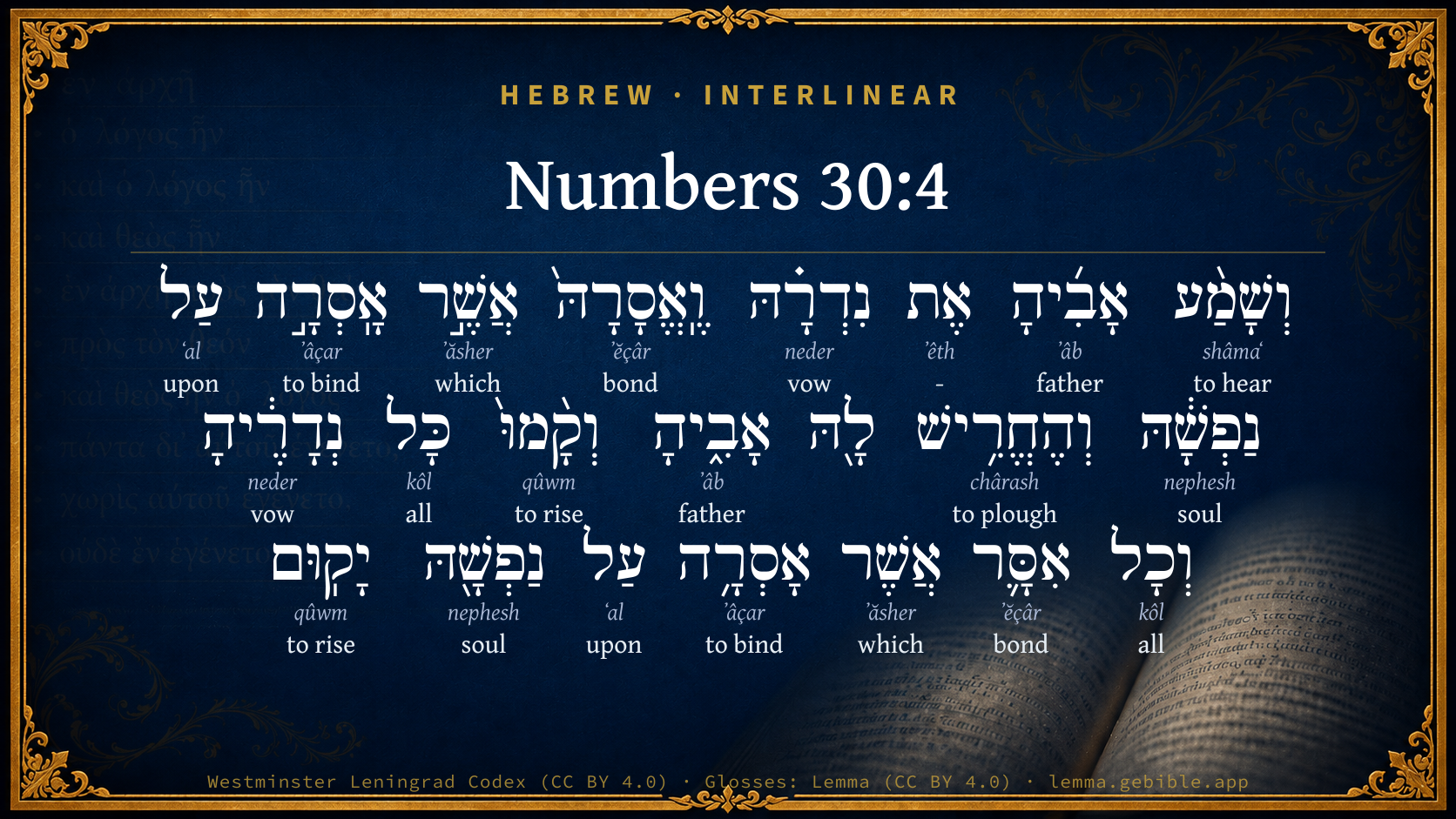
Hebrew (Westminster Leningrad Codex) Numbers 30:4 appears in the Hebrew Old Testament. The text above is from the Westminster Leningrad Codex. Each word links to its Strong’s number, a concise gloss, and parsing drawn from the Open Scriptures Hebrew Bible morphology. Click any word for its full Brown-Driver-Briggs (BDB) entry.
Download image
Cite this verse

Numbers 30:4 (World English Bible). Public Domain. Lemma interlinear Bible study tool, https://lemma.gebible.app/v/numbers/30/4.

Show BibTeX & RIS
BibTeX
RIS
English Translation
and her father hears her vow, and her bond with which she has bound her soul, and her father holds his peace at her; then all her vows shall stand, and every bond with which she has bound her soul shall stand.
World English Bible · Public Domain
Download a study sheet

One document with this verse’s original text, its word-by-word gloss line, the meaning frame, cross-references with their text, attributed commentary, and full source and license credits — printable, and it pastes into notes with its structure intact.

This verse Autodidact and up

Study sheet (.html) Plain text (.txt)

A passage Seminary Student

Up to 50 verses in one chapter. A passage sheet keeps up to 6 commentary sources and 12 cross-references per verse, in the order this page ranks them, and says so on the sheet whenever that leaves anything out. Ask for a single verse and you get the Autodidact verse sheet above.

Everything on this page stays free to read, with no account — the sheet is a download of what is already on screen, not access to it.

Want to remove ads? Support Godless Engineer
Compare translations 3

The same verse in 3 English versions, stacked beneath the original-language interlinear above. Click any original word for its lexicon entry.

Each is an independent rendering of the whole verse — the interlinear is not word-aligned to these translations.

Highlighted words mark where these versions differ — a whole-verse word diff, not a word-by-word alignment.

  • World English Bible Public Domain
    and her father hears her vow, and her bond with which she has bound her soul, and her father holds his peace at her; then all her vows shall stand, and every bond with which she has bound her soul shall stand.
  • King James Version Public Domain
    And her father hear her vow, and her bond wherewith she hath bound her soul, and her father shall hold his peace at her; then all her vows shall stand, and every bond wherewith she hath bound her soul shall stand.
  • unfoldingWord Literal Text CC BY-SA 4.0
    and her father hears her vow and her binding vow that she bound on her life, and her father is silent to her, then all her vows shall stand, and every binding vow that she has bound on her life shall stand.

unfoldingWord Literal Text — © unfoldingWord, licensed CC BY-SA 4.0. Word-aligned USFM3 via Door43 (git.door43.org/unfoldingWord/en_ult).

Versions to compare (up to 4)

3 of 4 selected

Show all 18 translations

Every available English version of this verse, each an independent rendering of the whole verse.

  • World English Bible Public Domain
    and her father hears her vow, and her bond with which she has bound her soul, and her father holds his peace at her; then all her vows shall stand, and every bond with which she has bound her soul shall stand.
  • Berean Standard Bible Public Domain
    and her father hears about her vow or pledge but says nothing to her, then all the vows or pledges by which she has bound herself shall stand.
  • Majority Standard Bible Public Domain
    and her father hears about her vow or pledge but says nothing to her, then all the vows or pledges by which she has bound herself shall stand.
  • King James Version Public Domain
    And her father hear her vow, and her bond wherewith she hath bound her soul, and her father shall hold his peace at her; then all her vows shall stand, and every bond wherewith she hath bound her soul shall stand.
  • American Standard Version (1901) Public Domain
    and her father heareth her vow, and her bond wherewith she hath bound her soul, and her father holdeth his peace at her; then all her vows shall stand, and every bond wherewith she hath bound her soul shall stand.
  • Revised Version (1885) Public Domain
    and her father heareth her vow, and her bond wherewith she hath bound her soul, and her father holdeth his peace at her: then all her vows shall stand, and every bond wherewith she hath bound her soul shall stand.
  • Geneva Bible (1599) Public Domain
    If a woman also vow a vow vnto the Lord, and binde her selfe by a bonde, being in her fathers house, in the time of her youth,
  • Douay-Rheims (1899) Public Domain
    If a woman vow any thing, and bind herself by an oath, being in her father's house, and but yet a girl in age: if her father knew the vow that she hath promised, and the oath wherewith she hath bound her soul, and held his peace, she shall be bound by the vow:
  • Young's Literal Translation Public Domain
    and her father hath heard her vow, and her bond which she hath bound on her soul, and her father hath kept silent at her, then have all her vows been established, and every bond which she hath bound on her soul is established.
  • Literal Standard Version CC BY-SA 4.0
    and her father has heard her vow and her bond which she has bound on her soul, and her father has kept silent to her, then all her vows have been established, and every bond which she has bound on her soul is established.
  • Unlocked Literal Bible CC BY-SA 4.0
    if her father hears the vow and the promise by which she has bound herself, and if he says nothing to reverse her, then all her vows will remain in force. Every promise by which she has bound herself will remain in force.
  • unfoldingWord Literal Text CC BY-SA 4.0
    and her father hears her vow and her binding vow that she bound on her life, and her father is silent to her, then all her vows shall stand, and every binding vow that she has bound on her life shall stand.
  • Darby Bible Public Domain
    and her father hear her vow, and her bond wherewith she hath bound her soul, and her father shall be silent at her, then all her vows shall stand, and every bond wherewith she hath bound her soul shall stand.
  • World Messianic Bible Public Domain
    and her father hears her vow and her pledge with which she has bound her soul, and her father says nothing to her, then all her vows shall stand, and every pledge with which she has bound her soul shall stand.
  • Webster's Bible Public Domain
    \\30:3\\If a woman also shall vow a vow to the LORD, and bind herself by a bond, being in her father's house in her youth;
  • Free Bible Version CC BY-SA 4.0
    and her father finds out about her promise or pledge but doesn't say anything to her, all the promises or pledges she has sworn to do will stand.
  • Bible in Basic English Public Domain
    If a woman, being young and under the authority of her father, takes an oath to the Lord or gives an undertaking;
  • JPS Tanakh (1917) Public Domain
    (30-5) and her father heareth her vow, or her bond wherewith she hath bound her soul, and her father holdeth his peace at her, then all her vows shall stand, and every bond wherewith she hath bound her soul shall stand.

Literal Standard Version (2020), Covenant Press — licensed CC BY-SA 4.0. Text via the HelloAO Bible API (eBible.org). Unlocked Literal Bible (unfoldingWord) — licensed CC BY-SA 4.0. Text via the HelloAO Bible API (eBible.org). unfoldingWord Literal Text — © unfoldingWord, licensed CC BY-SA 4.0. Word-aligned USFM3 via Door43 (git.door43.org/unfoldingWord/en_ult). Free Bible Version, Dr. Jonathan Gallagher — licensed CC BY-SA 4.0. Text via the HelloAO Bible API (eBible.org).

Word by word

More ways to search: Search by grammar → Find every occurrence → Compare this word →

Practice this passage: Drill this verse → Learn its vocabulary →

וֶֽאֱסָרָהּ֙
ʼĕçâr
H632
“and · bond · her”
Conjunction + Noun, Common, Masculine, Singular, Construct + Suffix, Personal, 3rd Person, Feminine, Singular
Part of Speech
Conjunction + Noun
Type
Common
Gender
Masculine
Number
Singular
State
Construct
Full BDB Definition

Origin: from H631

TWOT: 141d

bond, binding obligation, obligation
  1. וְשָׁמַ֨ע shâmaʻ H8085 “and · to hear” Conjunction + Verb, Qal, Sequential Perfect, 3rd Person, Masculine, Singular
  2. אָבִ֜יהָ ʼâb H1 “father · her” Noun, Common, Masculine, Singular, Construct + Suffix, Personal, 3rd Person, Feminine, Singular
  3. אֶת ʼêth H853 “-” Particle, Direct Object
  4. נִדְרָ֗הּ neder H5088 “vow · her” Noun, Common, Masculine, Singular, Construct + Suffix, Personal, 3rd Person, Feminine, Singular
  5. אֲשֶׁ֣ר ʼăsher H834 “which” Particle, Relative
  6. אָֽסְרָ֣ה ʼâçar H631 “to bind” Verb, Qal, Perfect, 3rd Person, Feminine, Singular
  7. עַל ʻal H5921 “upon” Preposition
  8. נַפְשָׁ֔הּ nephesh H5315 “soul · her” Noun, Common, Both, Singular, Construct + Suffix, Personal, 3rd Person, Feminine, Singular
  9. וְהֶחֱרִ֥ישׁ chârash H2790 “and · to plough” Conjunction + Verb, Hiphil, Sequential Perfect, 3rd Person, Masculine, Singular
  10. אָבִ֑יהָ ʼâb H1 “father · her” Noun, Common, Masculine, Singular, Construct + Suffix, Personal, 3rd Person, Feminine, Singular
  11. וְקָ֨מוּ֙ qûwm H6965 “and · to rise” Conjunction + Verb, Qal, Sequential Perfect, 3rd Person, Common, Plural
  12. כָּל kôl H3605 “all of” Noun, Common, Masculine, Singular, Construct
  13. נְדָרֶ֔יהָ neder H5088 “vows · her” Noun, Common, Masculine, Plural, Construct + Suffix, Personal, 3rd Person, Feminine, Singular
  14. וְכָל kôl H3605 “and · all of” Conjunction + Noun, Common, Masculine, Singular, Construct
  15. אִסָּ֛ר ʼĕçâr H632 “bond” Noun, Common, Masculine, Singular, Absolute
  16. אֲשֶׁר ʼăsher H834 “which” Particle, Relative
  17. אָסְרָ֥ה ʼâçar H631 “to bind” Verb, Qal, Perfect, 3rd Person, Feminine, Singular
  18. עַל ʻal H5921 “upon” Preposition
  19. נַפְשָׁ֖הּ nephesh H5315 “soul · her” Noun, Common, Both, Singular, Construct + Suffix, Personal, 3rd Person, Feminine, Singular
  20. יָקֽוּם qûwm H6965 “to rise” Verb, Qal, Imperfect, 3rd Person, Masculine, Singular

About this verse

These counts appear in no published source. They are computed here, from the morphology-tagged text and Lemma’s own curated glosses. What Lemma adds →

22
words
12
distinct lemmas
Pentateuch
section

Notable vocabulary

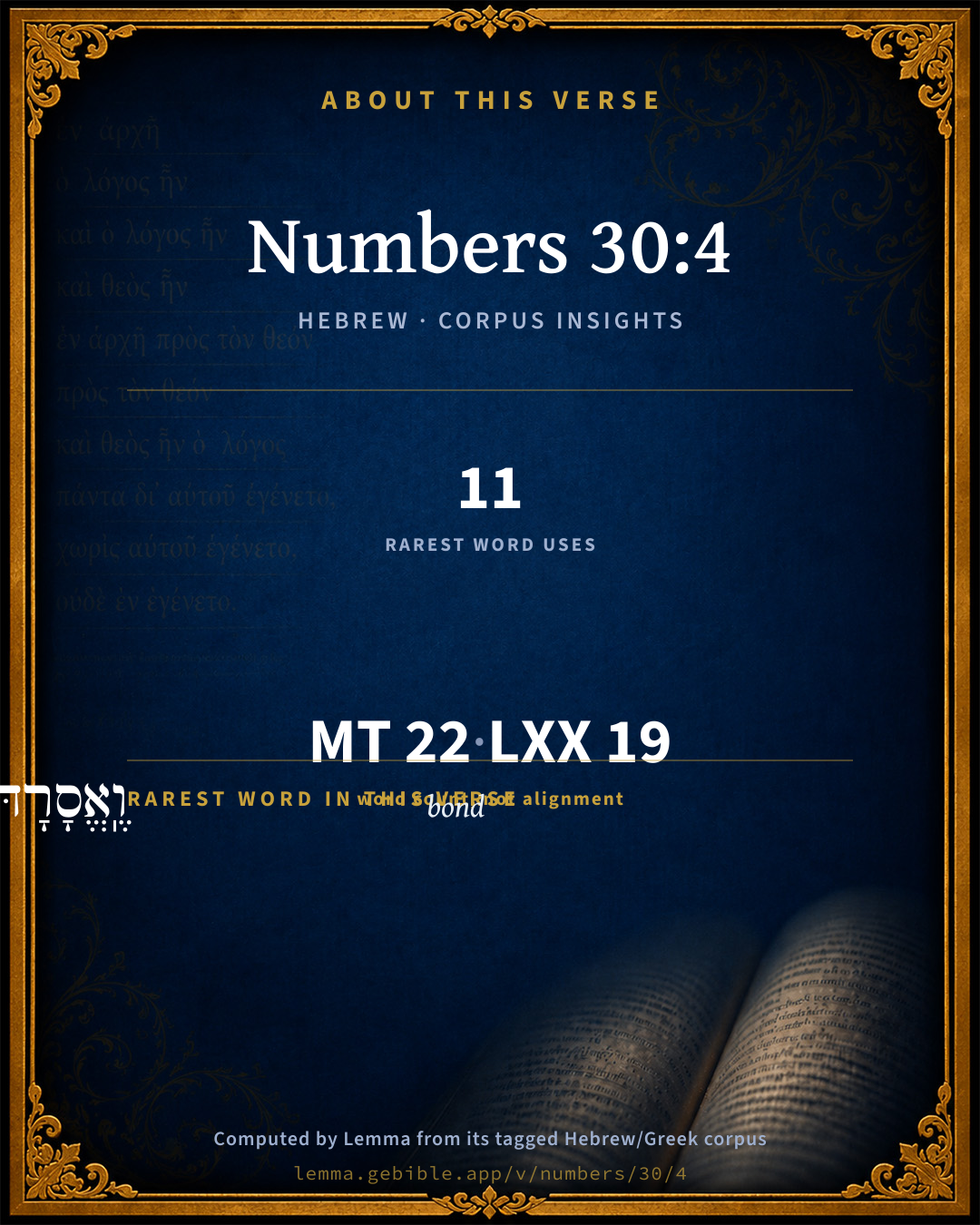
The rarest word here is וֶֽאֱסָרָהּ֙ bond H632 — appearing just 11 times in the whole Hebrew Bible.

Shared distinctive vocabulary

וֶֽאֱסָרָהּ֙ bond H632 occurs in 10 verses of the Hebrew Bible. Also found in:

Grammatical profile

  • 6 verbs
  • 10 nouns
  • 3 prepositions
  • 3 particles

Verb forms

  • וְשָׁמַ֨ע Qal · Sequential Perfect
  • אָֽסְרָ֣ה Qal · Perfect
  • וְהֶחֱרִ֥ישׁ Hiphil · Sequential Perfect
  • וְקָ֨מוּ֙ Qal · Sequential Perfect
  • אָסְרָ֥ה Qal · Perfect
  • יָקֽוּם Qal · Imperfect

Repetition

Words recur within this verse — often emphatic in Hebrew:

  • אָבִ֜יהָ father H1 ×2
  • נִדְרָ֗הּ vow H5088 ×2
  • וֶֽאֱסָרָהּ֙ bond H632 ×2
  • אָֽסְרָ֣ה to bind H631 ×2
  • עַל upon H5921 ×2
  • נַפְשָׁ֔הּ soul H5315 ×2
  • וְקָ֨מוּ֙ to rise H6965 ×2
  • כָּל all H3605 ×2
  • אֲשֶׁ֣ר which H834 ×2

Hebrew & Septuagint length

In English translation the verse runs 42 words from the Hebrew and 55 from the Septuagint (LXX English) — closely comparable.

A rough comparison of the two English renderings, which tokenize alike — not a word-level alignment.

Word counts can differ between the Hebrew and the Greek without any difference in meaning — e.g. the Hebrew direct-object marker אֵת has no separate Greek word, and Greek often adds the article ὁ.

In the original languages it is 22 Hebrew tokens and 19 Greek tokens — but the two are counted differently (Hebrew bundles its prefixes and suffixes into one token; the Greek is in lemma form), so that isn’t a like-for-like length.

Hebrew and Greek witnesses Masoretic Hebrew ↔ Greek Septuagint

The same verse in the two great witnesses to the Old Testament, shown verse-for-verse.

These are two independent witnesses, not word-aligned to each other, and the Septuagint is shown in lemma (dictionary) form.

Hebrew Numbers 30:4 Masoretic · Westminster Leningrad Codex

וְשָׁמַ֨ע אָבִ֜יהָ אֶת נִדְרָ֗הּ וֶֽאֱסָרָהּ֙ אֲשֶׁ֣ר אָֽסְרָ֣ה עַל נַפְשָׁ֔הּ וְהֶחֱרִ֥ישׁ לָ֖הּ אָבִ֑יהָ וְקָ֨מוּ֙ כָּל נְדָרֶ֔יהָ וְכָל אִסָּ֛ר אֲשֶׁר אָסְרָ֥ה עַל נַפְשָׁ֖הּ יָקֽוּם

and her father hears her vow, and her bond with which she has bound her soul, and her father holds his peace at her; then all her vows shall stand, and every bond with which she has bound her soul shall stand.

World English Bible · Public Domain

Greek LXX Numbers 30:4 Septuagint · lemma form

ἐάν δέ γυνή εὔχομαι εὐχή κύριος ἤ ὁρίζω ὁρισμός ἐν ὁ οἶκος ὁ πατήρ αὐτός ἐν ὁ νεότης αὐτός

And if a woman shall vow a vow to the Lord, or bind herself with an obligation in her youth in her father's house; and her father should hear her vows and her obligations, wherewith she has bound her soul, and her father should hold his peace at her, then all her vows shall stand,

LXX2012 (modern English Septuagint) · Public Domain

Hebrew: Westminster Leningrad Codex (CC BY 4.0). Greek: Septuagint (public domain); English from LXX2012 (modern English Septuagint) (Public Domain). How the Septuagint differs from the Hebrew →

Targum (Aramaic paraphrase)

2

The Targum is the ancient Jewish Aramaic paraphrase of the Hebrew Scriptures — an interpretive translation, not the Hebrew text itself. Onkelos (literal) and Pseudo-Jonathan (expansive) render the Torah, and Jonathan the Prophets. Coverage is partial: where no permissively-licensed English translation exists for a verse, only the Aramaic is shown. This is verse-level text, not a word-by-word alignment to the Hebrew.

  1. Targum Onkelos Torah (Genesis–Deuteronomy)
    וְאִתְּתָא אֲרֵי תִדַר נְדַר קֳדָם יְיָ וְתֵיסַר אִסָר בְּבֵית אֲבוּהָא בְּרַבְיוּתָהָא

    And any woman who vows a vow before God, or prohibits a prohibition in her father's house, as a young girl

    Targum Onkelos — Aramaic: “Onkelos Genesis” (public domain); “Onkelos Exodus” (public domain); “Onkelos Leviticus” (public domain); “Onkelos Numbers” (public domain); “Onkelos Deuteronomy” (public domain). English: “Sefaria Community Translation” (CC0 1.0 (public-domain dedication)); “J.W. Etheridge. The Targums of Onkelos and Jonathan Ben Uzziel on the Pentateuch. London: Longmans, Green, 1862” (public domain). Text via Sefaria.

  2. Targum Pseudo-Jonathan Torah (Genesis–Deuteronomy)
    וְאִתְּתָא דְלָא עָבְרַת תְּרֵיסַר שְׁנִין אֲרוּם תִּידַר נְדַר קֳדָם יְיָ וְתֵיסַר אִיסַר בְּבֵית אִיבָהָא עַד תְּרֵיסַר שְׁנִין

    And a female who hath not passed twelve years when she hath vowed a vow before the Lord, and hath bound herself in her father's house until her thirteenth year;

    Targum Pseudo-Jonathan — Aramaic: “Targum Jonathan on Genesis” (public domain); “Targum Jonathan on Exodus” (public domain); “Targum Jonathan on Leviticus” (public domain); “Targum Jonathan on Numbers” (public domain); “Targum Jonathan on Deuteronomy” (public domain). English: “The Targum of Jonathan ben Uzziel, trans. J. W. Etheridge, London, 1862” (public domain). Text via Sefaria.

Commentary

Notes on Numbers 30:4 from classic Christian and Jewish commentators (each source and its license shown beneath its notes). The classic Christian expositions comment on the surrounding passage and are grouped to its opening verse, so a note may address several verses; the Jewish commentaries on the Tanakh (Rashi and others) are per-verse, so they appear only where the commentator wrote on this verse.

Lemma curates 59 commentaries, every one of them public domain or Creative Commons licensed, each selected and text-cleaned for this edition rather than reprinted as found. About our sources →

Trapp's Complete Commentary

John Trapp

Num 30:4 And her father hear her vow, and her bond wherewith she hath bound her soul, and her father shall hold his peace at her: then all her vows shall stand, and every bond wherewith she hath bound her soul shall stand.

Ver. 4. And her father shall hold his peace.] Qui tacet, consentire videtur, a rule in civil law; silence is a kind of consent.

Then all her vows shall stand.] Provided that she vow, (1,) Such things as are lawful and warrantable by the word; for to vow to do evil is an utter abomination; {as Act 23:14 Deu 23:18} (2.) Such things as are possible and in her power, either naturally or by the assistance of God’s grace promised to her: such is not the Popish vowing of virginity, since omnes non capiant hoc, all men cannot contain. Their vows of continency breed all manner of incontinency in their clergy.

John Trapp, A Commentary or Exposition upon All the Books of the Old and New Testament (1647–1656) — public domain. Text from a community e-Sword module.

Joseph Benson's Commentary

Num 30:4. And her father hear her vow — Either when she spake the words, or by her acquainting him therewith, as she was bound to do. If it be asked why sons are not mentioned as well as daughters, since both, in their younger years, are under the power of their parents; the answer is, that the cases are quite different; for the sons may soon have it in their power, when become masters of families, to perform the vows which they had made in their minority; but daughters, who pass from the father’s jurisdiction into the power of a husband, are perpetually dependant, either upon their fathers or husbands, and so have no right to make vows without the consent either of the one or the other, except in the case of widowhood or divorce, which is specified, Num 30:9.

Joseph Benson's Commentary on the Old and New Testaments (1811–1818) — public domain. Text from a community e-Sword module.

The Cambridge Bible for Schools and Colleges

gen. ed. J. J. S. Perowne

4. heareth her vow] i.e. comes to hear of it; Num_30:7-8 shew that it does not necessarily mean that he is present when she actually utters her vow.

The Cambridge Bible for Schools and Colleges (gen. ed. J. J. S. Perowne; Cambridge University Press, 1878–1918) — public domain. Text from a community e-Sword module.

John Gill's Exposition

And her father hear her vow, and her bond wherewith she hath bound her soul,.... Her vow, which is binding upon her, or her vow and an oath annexed to it; which makes it still more strongly binding; and this he hears himself, or it is reported to him by others: and her father shall hold his peace at her; shall not reprove her for it, nor contradict her in it: then all her vows shall stand; be they what, or as many as they may:

and every bond wherewith she hath bound her soul shall stand; his silence being to be interpreted as approving of them, and consenting to them.

John Gill's Exposition of the Whole Bible (1746–1763) — public domain (CC PDM 1.0). Text via the HelloAO Bible API.

Haydock's Catholic Bible Commentary

Girl in age, not 12; or, if more, at least not married, nor out of her father’s house, ver. 17. For either of these conditions rendered a girl incapable of binding herself irrevocably. The father, or all who had the care of her, might rescind her vow, provided they did it as soon as it came to their knowledge, or on the same day, ver. 15. Boys under 13, were under similar restrictions. (Grotius) --- Wives, and, in general, all who are under subjection, could not dispose of themselves without the consent of their superiors, as their want of prudence, &c., might have otherwise injured what belonged, in some measure, to another. (Haydock) --- The law, therefore, submits their case to the decision of their immediate judges. (Calmet) --- But if the thing, which a person vowed, was already of strict obligation, as to fast on the day of expiation, (Leviticus xxiii. 29,) no one could presume to hinder his wife from complying with this double duty. (Worthington)

George Leo Haydock (1774–1849), Haydock's Catholic Family Bible and Commentary, 1859 edition — public domain. Excludes Psalms (Douay-Rheims chapter numbering differs from Protestant) and Deuterocanonical books (Catholic canon only).

Matthew Poole's English Annotations

Her father; under which title seem to be comprehended, as in other places of Scripture, masters, magistrates, and all other superiors, in such cases wherein their right is given away by the inferior’s vow; as for instance, when a servant vows to go a long journey for his friend, and his master will not permit him to do so; but not in other cases; as if a servant vows to do something for another in that time which his master alloweth to his own use and disposal, in this case his vow binds him, but not in the former.

And her father shall hold his peace; his silence being an interpretative consent, and much more if he declares his approbation of it.

Shall stand, i.e. be established, or confirmed, or be in force.

Matthew Poole's English Annotations on the Holy Bible (1683–1685) — public domain. Text from a community e-Sword/MySword module.

Whedon's Commentary on the Bible

Daniel D. Whedon

4. Her father… hold his peace — Keep silent and interpose no objection. The principle involved is, that the father and the daughter are one in responsibility, and the undisclaimed vow of the daughter becomes positively obligatory upon the daughter, and permissively obligatory upon the father. The absence of a similar law respecting the son in his minority, together with the following statute placing the wife’s vow under the arbitration of her husband, marks an imperfect stage of religious freedom which culminated in the perfect emancipation of woman by Christ. Gal_3:28.

Daniel D. Whedon (gen. ed.), Commentary on the Old and New Testaments (1874–1909) — public domain. Text from a community e-Sword module.

Rashi

Rabbi Shlomo Yitzchaki (Rashi)

בבית אביה [IF A WOMAN VOW] … BEING IN HER FATHER’S HOUSE — i.e., under her father’s control, but the law here stated applies even though she be not in his house, provided she be under his control (Sifrei Bamidbar 153:4).

בנעורה IN HER YOUTH — when she is a נערה i.e., in the first state of womanhood, but not when she is a קטנה, a minor, and not when she is a בוגרת (in full womanhood); for so far as a minor is concerned, her vow is in general no vow (it is null and void ab initio), and a בוגרת is not under her father’s control so that he can annul her vows. What is a קטנה, a minor, in respect to vows? We may gather this from what our Rabbis said: a woman of eleven years and one day must have her vows investigated until she reaches the age of twelve years; if she understands in Whose name it is that she has made the vow or in Whose name it is she has dedicated the thing, her vow is a vow, but a woman of twelve years and a day does not require any investigation regarding her vow (Niddah 56b).

Rashi on the Tanakh — English translations: “The Judaica Press complete Tanach with Rashi, translated by A. J. Rosenberg” (CC BY 4.0); “Pentateuch with Rashi's commentary by M. Rosenbaum and A.M. Silbermann, 1929-1934” (public domain); “The Metsudah Tanach series, Lakewood, N.J” (CC BY 4.0); and “The Book of Joshua, Metsudah Publications, 1997” (CC BY 4.0). Text via Sefaria.

Ramban (Nachmanides)

Rabbi Moshe ben Nachman (Ramban / Nachmanides)

AND IF A WOMAN VOWETH A VOW UNTO THE ETERNAL … 5. AND HER FATHER HEARETH HER VOW. Scripture wanted to mention the [case of] prohibition first [in Verses 4-5, namely that if she makes a vow and her father is quiet about it or confirms it, then all her vows shall stand..] in order to tell us that a young girl [in her father’s house] is also subject to the negative commandment mentioned [previously], that he shall not break his word, and therefore if her father confirms her vow [expressly or tacitly] the vow shall stand, but if he disallowed her, it shall not stand. And Scripture states [in conclusion], and the Eternal will forgive her, because her father disallowed her, in order to tell us that G-d will only forgive her if she acted [in disregard of her vow] after her father had disallowed it, but not [if she broke it] at the beginning, that is, if she [first] transgressed her vow and later on her father disallowed it, just as the Rabbis have said: “[The father or husband] ‘cuts off’ [the vow from the moment that he disallows it], but [unlike a Sage] he does not uproot it retrospectively.” the time of “release” or “annulment.” In the case of the release by the Sage, since it takes effect retrospectively, there is no sin. In the case of the father or the husband, however, there is a sin entailed.

Ramban (Nachmanides) on the Tanakh — English translation: “Commentary on the Torah by Ramban (Nachmanides). Translated and annotated by Charles B. Chavel. New York, Shilo Pub. House, 1971-1976” (CC BY 4.0). Text via Sefaria.

Lesson kit

Teaching starters — assembled from the data on this page, not authored interpretation. Every prompt links to the verse data it draws on. Edit before teaching.

Numbers, in the Pentateuch, opens this verse with 22 words (12 distinct Hebrew lemmas). Its most distinctive word is ʼĕçâr (“bond”). A historical commentator’s framing appears above. Read the whole chapter for the surrounding context.

Discussion questions

  1. The word ʼĕçâr carries the sense “bond.” How does it shape the verse?
  2. How does Numbers 30:2, which shares the word «bond», read alongside this verse?
  3. What does the repetition of “father” (2× in this one verse) do in this verse?
  4. These translations render this verse differently; the difference is in the English rendering, not the original. What questions does that raise?
  5. «וְשָׁמַ֨ע» is a Qal Sequential Perfect verb. How does that grammatical form shape the action described?
  6. Compare how Trapp's Complete Commentary and Joseph Benson's Commentary read this verse. Where do they agree or differ?

Things to notice

Reading settings

Reading text

Shown beneath each verse's original-language words.

Old Testament
Old Testament edition

Read the OT as the Masoretic Hebrew (MT) or the Greek Septuagint (LXX).

English shown for the Greek Septuagint (in the Hebrew ↔ Greek comparison).

Comparing translations? Open the Compare panel on any verse page to stack up to four side by side.