
Numbers 23:18

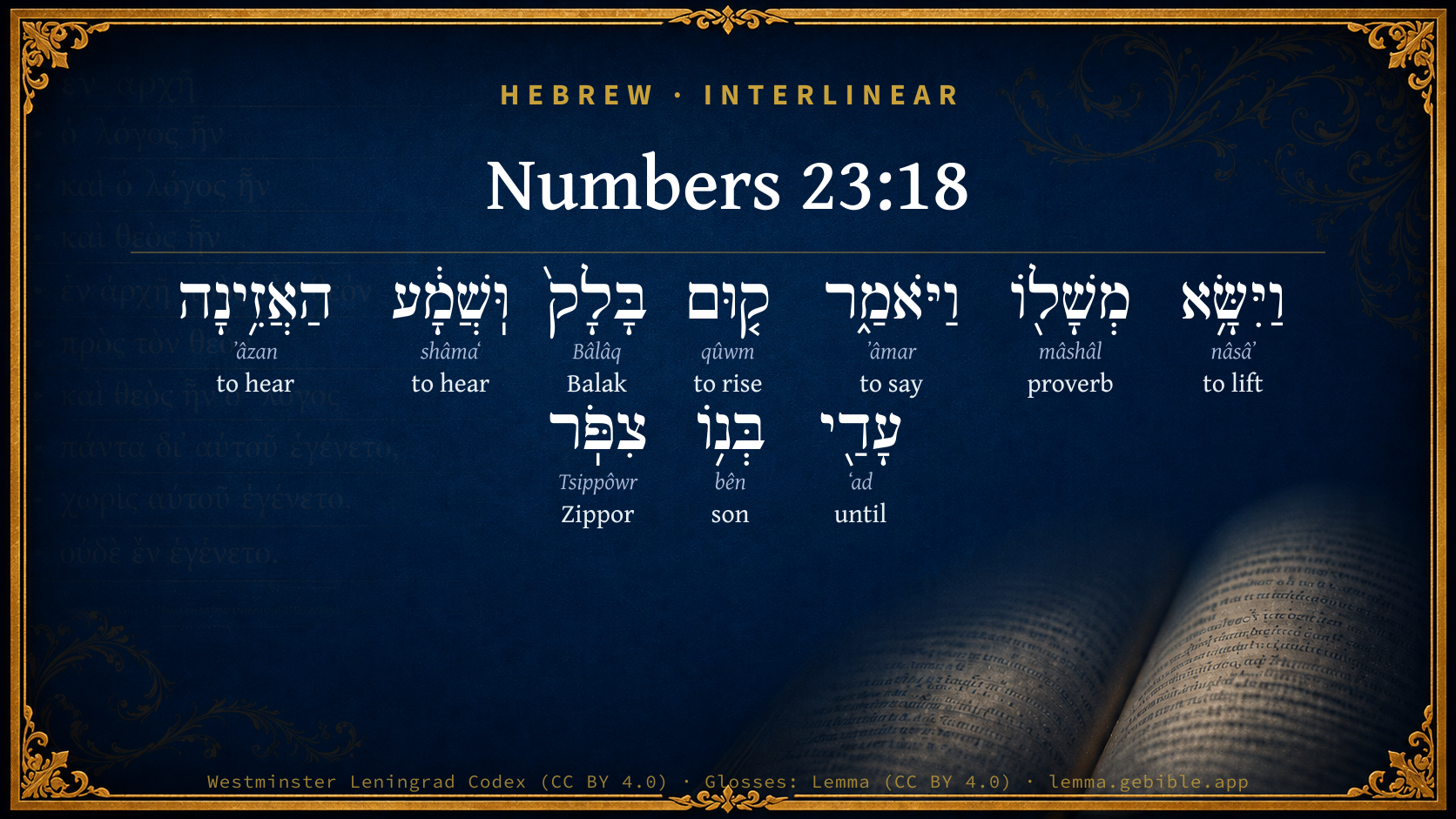
Hebrew (Westminster Leningrad Codex) Numbers 23:18 appears in the Hebrew Old Testament. The text above is from the Westminster Leningrad Codex. Each word links to its Strong’s number, a concise gloss, and parsing drawn from the Open Scriptures Hebrew Bible morphology. Click any word for its full Brown-Driver-Briggs (BDB) entry.
Download image
Cite this verse

Numbers 23:18 (World English Bible). Public Domain. Lemma interlinear Bible study tool, https://lemma.gebible.app/v/numbers/23/18.

Show BibTeX & RIS
BibTeX
RIS
English Translation
He took up his parable, and said, Rise up, Balak, and hear; Listen to me, you son of Zippor:
World English Bible · Public Domain
Download a study sheet

One document with this verse’s original text, its word-by-word gloss line, the meaning frame, cross-references with their text, attributed commentary, and full source and license credits — printable, and it pastes into notes with its structure intact.

This verse Autodidact and up

Study sheet (.html) Plain text (.txt)

A passage Seminary Student

Up to 50 verses in one chapter. A passage sheet keeps up to 6 commentary sources and 12 cross-references per verse, in the order this page ranks them, and says so on the sheet whenever that leaves anything out. Ask for a single verse and you get the Autodidact verse sheet above.

Everything on this page stays free to read, with no account — the sheet is a download of what is already on screen, not access to it.

Want to remove ads? Support Godless Engineer
Compare translations 3

The same verse in 3 English versions, stacked beneath the original-language interlinear above. Click any original word for its lexicon entry.

Each is an independent rendering of the whole verse — the interlinear is not word-aligned to these translations.

Highlighted words mark where these versions differ — a whole-verse word diff, not a word-by-word alignment.

  • World English Bible Public Domain
    He took up his parable, and said, Rise up, Balak, and hear; Listen to me, you son of Zippor:
  • King James Version Public Domain
    And he took up his parable, and said, Rise up, Balak, and hear; hearken unto me, thou son of Zippor:
  • unfoldingWord Literal Text CC BY-SA 4.0
    And he lifted up his discourse and said, “Rise up, Balak, and hear! Give ear to me, son of Zippor!

unfoldingWord Literal Text — © unfoldingWord, licensed CC BY-SA 4.0. Word-aligned USFM3 via Door43 (git.door43.org/unfoldingWord/en_ult).

Versions to compare (up to 4)

3 of 4 selected

Show all 18 translations

Every available English version of this verse, each an independent rendering of the whole verse.

  • World English Bible Public Domain
    He took up his parable, and said, Rise up, Balak, and hear; Listen to me, you son of Zippor:
  • Berean Standard Bible Public Domain
    Then Balaam lifted up an oracle, saying: “Arise, O Balak, and listen; give ear to me, O son of Zippor.
  • Majority Standard Bible Public Domain
    Then Balaam lifted up an oracle, saying: “Arise, O Balak, and listen; give ear to me, O son of Zippor.
  • King James Version Public Domain
    And he took up his parable, and said, Rise up, Balak, and hear; hearken unto me, thou son of Zippor:
  • American Standard Version (1901) Public Domain
    And he took up his parable, and said, Rise up, Balak, and hear; Hearken unto me, thou son of Zippor:
  • Revised Version (1885) Public Domain
    And he took up his parable, and said, Rise up, Balak, and hear; Hearken unto me, thou son of Zippor:
  • Geneva Bible (1599) Public Domain
    And he vttered his parable, and sayde, Rise vp, Balak, and heare: hearken vnto me, thou sonne of Zippor.
  • Douay-Rheims (1899) Public Domain
    But he taking up his parable, said: Stand, O Balac, and give ear: hear, thou son of Sephor:
  • Young's Literal Translation Public Domain
    And he taketh up his simile, and saith: `Rise, Balak, and hear; Give ear unto me, son of Zippor!
  • Literal Standard Version CC BY-SA 4.0
    And he takes up his allegory and says: “Rise, Balak, and hear; Give ear to me, son of Zippor!
  • Unlocked Literal Bible CC BY-SA 4.0
    Balaam began his prophecy. He said, “Rise up, Balak, and hear. Listen to me, you son of Zippor.
  • unfoldingWord Literal Text CC BY-SA 4.0
    And he lifted up his discourse and said, “Rise up, Balak, and hear! Give ear to me, son of Zippor!
  • Darby Bible Public Domain
    Then he took up his parable and said, Rise up, Balak, and hear! hearken unto me, son of Zippor!
  • World Messianic Bible Public Domain
    He took up his parable, and said, “Rise up, Balak, and hear! Listen to me, you son of Zippor.
  • Webster's Bible Public Domain
    And he took up his parable, and said, Rise, Balak, and hear; hearken to me, thou son of Zippor:
  • Free Bible Version CC BY-SA 4.0
    This is the prophecy that Balaam delivered: “Stand up, Balak, and pay attention! Listen to me, son of Zippor!
  • Bible in Basic English Public Domain
    And in the words which the Lord had given him he said, Up! Balak, and give ear; give attention to me, O son of Zippor:
  • JPS Tanakh (1917) Public Domain
    And he took up his parable, and said: Arise, Balak, and hear; give ear unto me, thou son of Zippor:

Literal Standard Version (2020), Covenant Press — licensed CC BY-SA 4.0. Text via the HelloAO Bible API (eBible.org). Unlocked Literal Bible (unfoldingWord) — licensed CC BY-SA 4.0. Text via the HelloAO Bible API (eBible.org). unfoldingWord Literal Text — © unfoldingWord, licensed CC BY-SA 4.0. Word-aligned USFM3 via Door43 (git.door43.org/unfoldingWord/en_ult). Free Bible Version, Dr. Jonathan Gallagher — licensed CC BY-SA 4.0. Text via the HelloAO Bible API (eBible.org).

Word by word

More ways to search: Search by grammar → Find every occurrence → Compare this word →

Practice this passage: Drill this verse → Learn its vocabulary →

צִפֹּֽר
Tsippôwr
H6834
“Zippor”
Noun, Proper
Part of Speech
Noun
Type
Proper
Full BDB Definition

Origin: the same as H6833

TWOT: None

Zippor = "sparrow" - father of Balak the king of Moab at the time of the exodus
  1. וַיִּשָּׂ֥א nâsâʼ H5375 “and · to lift” Conjunction + Verb, Qal, Sequential Imperfect, 3rd Person, Masculine, Singular
  2. מְשָׁל֖וֹ mâshâl H4912 “proverb · his” Noun, Common, Masculine, Singular, Construct + Suffix, Personal, 3rd Person, Masculine, Singular
  3. וַיֹּאמַ֑ר ʼâmar H559 “and · to say” Conjunction + Verb, Qal, Sequential Imperfect, 3rd Person, Masculine, Singular
  4. ק֤וּם qûwm H6965 “rise” Verb, Qal, Imperative, 2nd Person, Masculine, Singular
  5. בָּלָק֙ Bâlâq H1111 “Balak” Noun, Proper
  6. וּֽשֲׁמָ֔ע shâmaʻ H8085 “and · hear” Conjunction + Verb, Qal, Imperative, 2nd Person, Masculine, Singular
  7. הַאֲזִ֥ינָה ʼâzan H238 “hear” Verb, Hiphil, Imperative, 2nd Person, Masculine, Singular + Suffix, h
  8. עָדַ֖י ʻad H5704 “until · me” Preposition + Suffix, Personal, 1st Person, Common, Singular
  9. בְּנ֥וֹ bên H1121 “son · his” Noun, Common, Masculine, Singular, Construct + Suffix, Personal, 3rd Person, Masculine, Singular

About this verse

These counts appear in no published source. They are computed here, from the morphology-tagged text and Lemma’s own curated glosses. What Lemma adds →

10
words
10
distinct lemmas
Pentateuch
section

Notable vocabulary

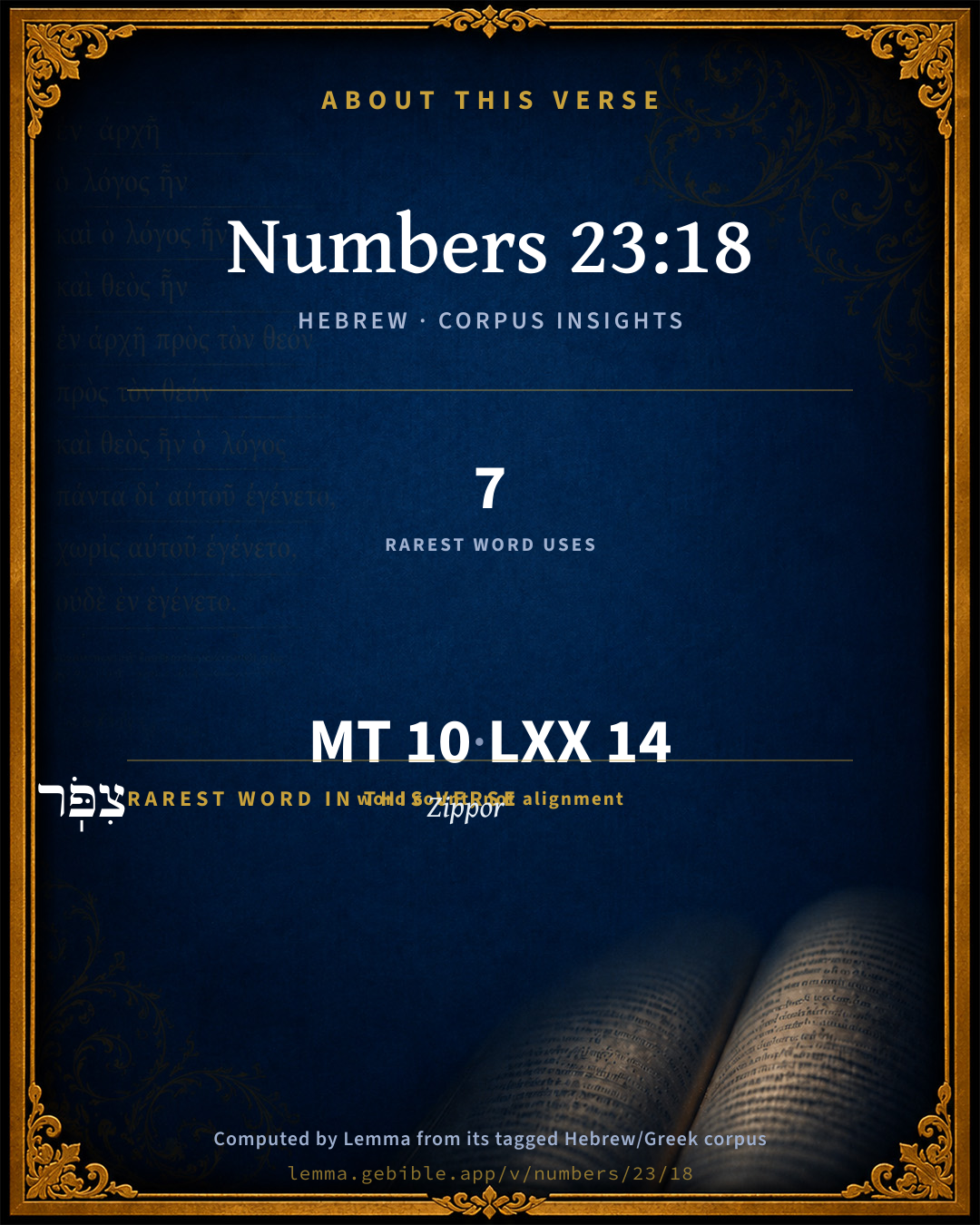
The rarest word here is צִפֹּֽר Zippor H6834 — appearing just 7 times in the whole Hebrew Bible.

Shared distinctive vocabulary

צִפֹּֽר Zippor H6834 occurs in 7 verses of the Hebrew Bible. Also found in:

Grammatical profile

  • 5 verbs
  • 4 nouns
  • 1 preposition

Verb forms

  • וַיִּשָּׂ֥א Qal · Sequential Imperfect
  • וַיֹּאמַ֑ר Qal · Sequential Imperfect
  • ק֤וּם Qal · Imperative
  • וּֽשֲׁמָ֔ע Qal · Imperative
  • הַאֲזִ֥ינָה Hiphil · Imperative

Hebrew & Septuagint length

In English translation the verse runs 19 words from the Hebrew and 21 from the Septuagint (LXX English) — closely comparable.

A rough comparison of the two English renderings, which tokenize alike — not a word-level alignment.

Word counts can differ between the Hebrew and the Greek without any difference in meaning — e.g. the Hebrew direct-object marker אֵת has no separate Greek word, and Greek often adds the article ὁ.

In the original languages it is 10 Hebrew tokens and 14 Greek tokens — but the two are counted differently (Hebrew bundles its prefixes and suffixes into one token; the Greek is in lemma form), so that isn’t a like-for-like length.

Cross-references

1

Topical passages linked to Numbers 23:18 in the Treasury of Scripture Knowledge — connected by theme and wording, ordered by reader-vote popularity; previews shown in the World English Bible.

  • Judges 3:20 Ehud came to him; and he was sitting by himself alone in the cool upper room. Ehud said, I have a message from God to you. He arose out of his seat.

Cross-references courtesy of OpenBible.info (CC BY 4.0).

Hebrew and Greek witnesses Masoretic Hebrew ↔ Greek Septuagint

The same verse in the two great witnesses to the Old Testament, shown verse-for-verse.

These are two independent witnesses, not word-aligned to each other, and the Septuagint is shown in lemma (dictionary) form.

Hebrew Numbers 23:18 Masoretic · Westminster Leningrad Codex

וַיִּשָּׂ֥א מְשָׁל֖וֹ וַיֹּאמַ֑ר ק֤וּם בָּלָק֙ וּֽשֲׁמָ֔ע הַאֲזִ֥ינָה עָדַ֖י בְּנ֥וֹ צִפֹּֽר

He took up his parable, and said, Rise up, Balak, and hear; Listen to me, you son of Zippor:

World English Bible · Public Domain

Greek LXX Numbers 23:18 Septuagint · lemma form

καί ἀναλαμβάνω ὁ παραβολή αὐτός εἶπον ἀναἵστημι βαλακ καί ἀκούω ἐνὠτίζομαι μάρτυς υἱός σεπφωρ

And he took up his parable, and said, rise up, Balac, and hear; listen as a witness, you son of Sepphor.

LXX2012 (modern English Septuagint) · Public Domain

On this verse, Haydock's Catholic Bible Commentary discusses the Septuagint’s reading. Read the note in Commentary ↓

Hebrew: Westminster Leningrad Codex (CC BY 4.0). Greek: Septuagint (public domain); English from LXX2012 (modern English Septuagint) (Public Domain). How the Septuagint differs from the Hebrew →

Targum (Aramaic paraphrase)

2

The Targum is the ancient Jewish Aramaic paraphrase of the Hebrew Scriptures — an interpretive translation, not the Hebrew text itself. Onkelos (literal) and Pseudo-Jonathan (expansive) render the Torah, and Jonathan the Prophets. Coverage is partial: where no permissively-licensed English translation exists for a verse, only the Aramaic is shown. This is verse-level text, not a word-by-word alignment to the Hebrew.

  1. Targum Onkelos Torah (Genesis–Deuteronomy)
    וּנְטַל מַתְלֵיהּ וַאֲמַר קוּם בָּלָק וּשְׁמַע אָצִית לְמֵימְרִי בַּר צִפֹּר

    (no public-domain English translation for this verse)

    Targum Onkelos — Aramaic: “Onkelos Genesis” (public domain); “Onkelos Exodus” (public domain); “Onkelos Leviticus” (public domain); “Onkelos Numbers” (public domain); “Onkelos Deuteronomy” (public domain). English: “Sefaria Community Translation” (CC0 1.0 (public-domain dedication)); “J.W. Etheridge. The Targums of Onkelos and Jonathan Ben Uzziel on the Pentateuch. London: Longmans, Green, 1862” (public domain). Text via Sefaria.

  2. Targum Pseudo-Jonathan Torah (Genesis–Deuteronomy)
    וּנְטַל מְתַל נְבוּתֵיהּ וַאֲמַר קוּם בָּלָק וּשְׁמַע אָצִית מִילַי בְּרֵיהּ דְצִפּוֹר

    And he took up the parable of his prophecy, and said: Arise, Balak, and hear; listen to my words, Bar Zippor.

    Targum Pseudo-Jonathan — Aramaic: “Targum Jonathan on Genesis” (public domain); “Targum Jonathan on Exodus” (public domain); “Targum Jonathan on Leviticus” (public domain); “Targum Jonathan on Numbers” (public domain); “Targum Jonathan on Deuteronomy” (public domain). English: “The Targum of Jonathan ben Uzziel, trans. J. W. Etheridge, London, 1862” (public domain). Text via Sefaria.

Commentary

Notes on Numbers 23:18 from classic Christian and Jewish commentators (each source and its license shown beneath its notes). The classic Christian expositions comment on the surrounding passage and are grouped to its opening verse, so a note may address several verses; the Jewish commentaries on the Tanakh (Rashi and others) are per-verse, so they appear only where the commentator wrote on this verse.

Lemma curates 59 commentaries, every one of them public domain or Creative Commons licensed, each selected and text-cleaned for this edition rather than reprinted as found. About our sources →

The Cambridge Bible for Schools and Colleges

gen. ed. J. J. S. Perowne

18–24. Balaam’s second prophetic message. This consists of eleven, or (see on Num_23:23) more probably ten, couplets. Balaam declares that God will never change His mind (as Balak had thought, Num_23:13), and that He had bidden him to bless and not curse (Num_23:18 b–20). Israel is without calamity, and is victorious (Num_23:21). God brings him triumphantly from Egypt, and all men must tell of His doings (Num_23:22 a, Num_23:23b). Israel is as strong as the wild ox, and as fierce as a lion (Num_23:22 b, Num_23:24).

The Cambridge Bible for Schools and Colleges (gen. ed. J. J. S. Perowne; Cambridge University Press, 1878–1918) — public domain. Text from a community e-Sword module.

Trapp's Complete Commentary

John Trapp

Num 23:18 And he took up his parable, and said, Rise up, Balak, and hear; hearken unto me, thou son of Zippor:

Ver. 18. Rise up, Balak.] The greatest potentate must reverently attend to the word of God. Ehud, though a fat unwieldy man, stood up to hear a message from God. {Jdg 3:20} So did Constantine the Great, {a} and our Edward VI, hear sermons standing, and usually uncovered. {b}

{a} Euseb.

{b} Act. and Mon.

John Trapp, A Commentary or Exposition upon All the Books of the Old and New Testament (1647–1656) — public domain. Text from a community e-Sword module.

Joseph Benson's Commentary

Num 23:18. Rise up, Balak — In these words Balaam calls on the king to receive the message of the great God with reverence and diligent attention; as if he had said, Rouse up thyself and carefully mind what I say.

Joseph Benson's Commentary on the Old and New Testaments (1811–1818) — public domain. Text from a community e-Sword module.

Tyndale Open Study Notes

Tyndale Open Resources

23:18-24 This oracle emphasizes God’s faithfulness to his people—he would stay with them and keep all of his promises.

Tyndale Open Study Notes — © Tyndale Open Resources, licensed CC BY-SA 4.0. Text via the HelloAO Bible API.

Jamieson, Fausset & Brown

Robert Jamieson, A. R. Fausset & David Brown

Rise up--As Balak was already standing (Num 23:17), this expression is equivalent to "now attend to me." The counsels and promises of God respecting Israel are unchangeable; and no attempt to prevail on Him to reverse them will succeed, as they may with a man.

Jamieson, Fausset & Brown — Commentary Critical and Explanatory on the Whole Bible (1871) — public domain (CC PDM 1.0). Text via the HelloAO Bible API.

John Gill's Exposition

And he took up his parable,.... Pronounced the word put into his mouth:

and said, rise up Balak, and hear; not from his seat, as Eglon a successor of his did, Jdg 3:20 for he was now standing by his burnt offering; but the sense is, that he would raise his attention, and stir up himself with all diligence to hear what he was about to say:

hearken unto me, thou son of Zippor; or to his word, as the Targums of Onkelos and Jonathan, which follow.

John Gill's Exposition of the Whole Bible (1746–1763) — public domain (CC PDM 1.0). Text via the HelloAO Bible API.

Haydock's Catholic Bible Commentary

Hear. Hebrew, "to me." Septuagint read had, instead of hadai, and translate, "Give ear, thou witness, (martus) son," &c. (Haydock)

George Leo Haydock (1774–1849), Haydock's Catholic Family Bible and Commentary, 1859 edition — public domain. Excludes Psalms (Douay-Rheims chapter numbering differs from Protestant) and Deuterocanonical books (Catholic canon only).

Matthew Poole's English Annotations

Rise up: this word implies, either,

1. The reverence wherewith he should hear and receive God’s message, as Eglon did, Jdg 3:20, which might have been probable, if Balak had been now sitting, as Ehud there was; but he was standing, Num 23:15; or rather,

2. The diligent attention required; Rouse up thyself, and carefully mind what I say.

Matthew Poole's English Annotations on the Holy Bible (1683–1685) — public domain. Text from a community e-Sword/MySword module.

Whedon's Commentary on the Bible

Daniel D. Whedon

18. Rise up, Balak, and hear — The king, who was already in an erect bodily attitude, is called to elevate his thoughts for the reception of the divine revelation. He is called to a hearing with an alert and minute attention.

Daniel D. Whedon (gen. ed.), Commentary on the Old and New Testaments (1874–1909) — public domain. Text from a community e-Sword module.

John Wesley's Explanatory Notes

Rise up - This word implies the diligent attention required; rouse up thyself and carefully mind what I say.

John Wesley, Explanatory Notes Upon the Whole Bible (1754–1765) — public domain. Text via the GEBible commentary corpus.

Keil & Delitzsch

C. F. Keil & F. Delitzsch

The second saying. - "Up, Balak, and hear! Hearken to me, son of Zippor!" קוּם, "stand up," is a call to mental elevation, to the perception of the word of God; for Balak was standing by his sacrifice (Num 23:17). האזין with עד, as in Job 32:11, signifies a hearing which presses forward to the speaker, i.e., in keen and minute attention (Hengstenberg). בּנו, with the antiquated union vowel for בּן; see at Gen 1:24.

Num 23:19

"God is not a man, that He should lie; nor a son of man, that He should repent: hath He said, and should He not do it? and spoken, and should not carry it out?"

Num 23:20

"Behold, I have received to bless: and He hath blessed; and I cannot turn it." Balaam meets Balak's expectation that he will take back the blessing that he has uttered, with the declaration, that God does not alter His purposes like changeable and fickle men, but keeps His word unalterably, and carries it into execution. The unchangeableness of the divine purposes is a necessary consequence of the unchangeableness of the divine nature. With regard to His own counsels, God repents of nothing; but this does not prevent the repentance of God, understood as an anthropopathic expression, denoting the pain experienced by the love of God, on account of the destruction of its creatures (see at Gen 6:6, and Exo 32:14). The ה before הוּא Num 23:19) is the interrogative ה (see Ges. 100, 4). The two clauses of Num 23:19, "Hath He spoken," etc., taken by themselves, are no doubt of universal application; but taken in connection with the context, they relate specially to what God had spoken through Balaam, in his first utterance with reference to Israel, as we may see from the more precise explanation in Num 23:20, "Behold, I have received to bless' (לקח, taken, accepted), etc. השׁיב, to lead back, to make a thing retrograde (Isa 43:13). Samuel afterwards refused Saul's request in these words of Balaam (Num 23:19), when he entreated him to revoke his rejection on the part of God (Sa1 15:29).

Num 23:21

After this decided reversal of Balak's expectations, Balaam carried out still more fully the blessing which had been only briefly indicated in his first utterance. "He beholds not wickedness in Jacob, and sees not suffering in Israel: Jehovah his God is with him, and the shout (jubilation) of a king in the midst of him." The subject in the first sentence is God (see Hab 1:3, Hab 1:13). God sees not און, worthlessness, wickedness, and עמל, tribulation, misery, as the consequence of sin, and therefore discovers no reason for cursing the nation. That this applied to the people solely by virtue of their calling as the holy nation of Jehovah, and consequently that there is no denial of the sin of individuals, is evident from the second hemistich, which expresses the thought of the first in a positive form: so that the words, "Jehovah his God is with him," correspond to the words, "He beholds not wickedness;" and "the shout of a king in the midst of it," to His not seeing suffering. Israel therefore rejoiced in the blessing of God only so long as it remained faithful to the idea of its divine calling, and continued in covenant fellowship with the Lord. So long the power of the world could do it no harm. The "shout of a king" in Israel is the rejoicing of Israel at the fact that Jehovah dwells and rules as King in the midst of it (cf. Exo 15:18; Deu 33:5). Jehovah had manifested Himself as King, by leading them out of Egypt.

Num 23:22

"God brings them out of Egypt; his strength is like that of a buffalo." אל is God as the strong, or mighty one. The participle מוציאם is not used for the preterite, but designates the leading out as still going on, and lasting till the introduction into Canaan. The plural suffix, ם-, is used ad sensum, with reference to Israel as a people. Because God leads them, they go forward with the strength of a buffalo. תּועפות, from יעף, to weary, signifies that which causes weariness, exertion, the putting forth of power; hence the fulness of strength, ability to make or bear exertions. ראם is the buffalo or wild ox, an indomitable animal, which is especially fearful on account of its horns (Job 39:9-11; Deu 33:17; Psa 22:22).

Num 23:23

The fellowship of its God, in which Israel rejoiced, and to which it owed its strength, was an actual truth. "For there is no augury in Jacob, and no divination in Israel. At the time it is spoken to Jacob, and to Israel what God doeth." כּי does not mean, "so that, as an introduction to the sequel," as Knobel supposes, but "for," as a causal particle. The fact that Israel was not directed, like other nations, to the uncertain and deceitful instrumentality of augury and divination, but enjoyed in all its concerns the immediate revelation of its God, furnished the proof that it had its God in the midst of it, and was guided and endowed with power by God Himself. נחשׁ and קסם, οἰωνισμός and μαντεία, augurium et divinatio (lxx, Vulg.), were the two means employed by the heathen for looking into futurity. The former (see at Lev 19:26) was the unfolding of the future from signs in the phenomena of nature, and inexplicable occurrences in animal and human life; the latter, prophesying from a pretended or supposed revelation of the Deity within the human mind. כּעת, "according to the time," i.e., at the right time, God revealed His acts, His counsel, and His will to Israel in His word, which He had spoken at first to the patriarchs, and afterwards through Moses and the prophets. In this He revealed to His people in truth, and in a way that could not deceive, what the heathen attempted in vain to discover through augury and divination (cf. Deu 18:14-19).

(Note: "What is here affirmed of Israel, applies to the Church of all ages, and also to every individual believer. The Church of God knows from His word what God does, and what it has to do in consequence. The wisdom of this world resembles augury and divination. The Church of God, which is in possession of His word, has no need of it, and it only leads its followers to destruction, from inability to discern the will of God. To discover this with certainty, is the great privilege of the Church of God" (Hengstenberg).)

Num 23:24

Through the power of its God, Israel was invincible, and would crush all its foes. "Behold, it rises up, a people like the lioness, and lifts itself up like the lion. It lies not down till it eats dust, and drinks the blood of the slain." What the patriarch Jacob prophesied of Judah, the ruler among his brethren, in Gen 49:9, Balaam here transfers to the whole nation, to put to shame all the hopes indulged by the Moabitish king of the conquest and destruction of Israel.

Keil & Delitzsch — Biblical Commentary on the Old Testament (1861–1891) — public domain (CC PDM 1.0). Text via the HelloAO Bible API. (Old Testament only.)

Rashi

Rabbi Shlomo Yitzchaki (Rashi)

קום בלק RISE UP, BALAK — When he perceived that he was mocking at him, he set himself to annoy him, saying, “Stand on your feet; you have no right to remain seated, seeing that I am sent to you on a mission by the Omnipresent” (Midrash Tanchuma, Balak 13).

בנו צפור SON OF ZIPPOR — This (the suffix ו to mark the construct) is often found as a Biblical Hebrew form, as in (Psalms 50:10), “beast of (חיתו) the forest”; (Genesis 1:24) “beast of (חיתו) the earth”; (Psalms 114:8), “to a spring of (מעינו) water”.

Rashi on the Tanakh — English translations: “The Judaica Press complete Tanach with Rashi, translated by A. J. Rosenberg” (CC BY 4.0); “Pentateuch with Rashi's commentary by M. Rosenbaum and A.M. Silbermann, 1929-1934” (public domain); “The Metsudah Tanach series, Lakewood, N.J” (CC BY 4.0); and “The Book of Joshua, Metsudah Publications, 1997” (CC BY 4.0). Text via Sefaria.

Lesson kit

Teaching starters — assembled from the data on this page, not authored interpretation. Every prompt links to the verse data it draws on. Edit before teaching.

Numbers, in the Pentateuch, opens this verse with 10 words (10 distinct Hebrew lemmas). Its most distinctive word is Tsippôwr (“Zippor”). A historical commentator’s framing appears above. Read the whole chapter for the surrounding context.

Discussion questions

  1. How does “Zippor” (Tsippôwr) shape what this verse is saying?
  2. Numbers 22:2 shares the word «Zippor» with this verse. How do the two illuminate each other?
  3. These translations render this verse differently. What is at stake in choosing one wording over another?
  4. The verb «וַיִּשָּׂ֥א» is Qal Sequential Imperfect. How does its form color the action?
  5. Reading how The Cambridge Bible for Schools and Colleges and Trapp's Complete Commentary read this verse, where do the two commentators agree and where do they part?

Things to notice

Reading settings

Reading text

Shown beneath each verse's original-language words.

Old Testament
Old Testament edition

Read the OT as the Masoretic Hebrew (MT) or the Greek Septuagint (LXX).

English shown for the Greek Septuagint (in the Hebrew ↔ Greek comparison).

Comparing translations? Open the Compare panel on any verse page to stack up to four side by side.