

Isaiah 28:21

Hebrew (Westminster Leningrad Codex) Isaiah 28:21 appears in the Hebrew Old Testament. The text above is from the Westminster Leningrad Codex. Each word links to its Strong’s number, a concise gloss, and parsing drawn from the Open Scriptures Hebrew Bible morphology. Click any word for its full Brown-Driver-Briggs (BDB) entry.
Download image
Cite this verse

Isaiah 28:21 (World English Bible). Public Domain. Lemma interlinear Bible study tool, https://lemma.gebible.app/v/isaiah/28/21.

Show BibTeX & RIS
BibTeX
RIS
English Translation
For Yahweh will rise up as on Mount Perazim, he will be angry as in the valley of Gibeon; that he may do his work, his strange work, and bring to pass his act, his strange act.
World English Bible · Public Domain
Highlights
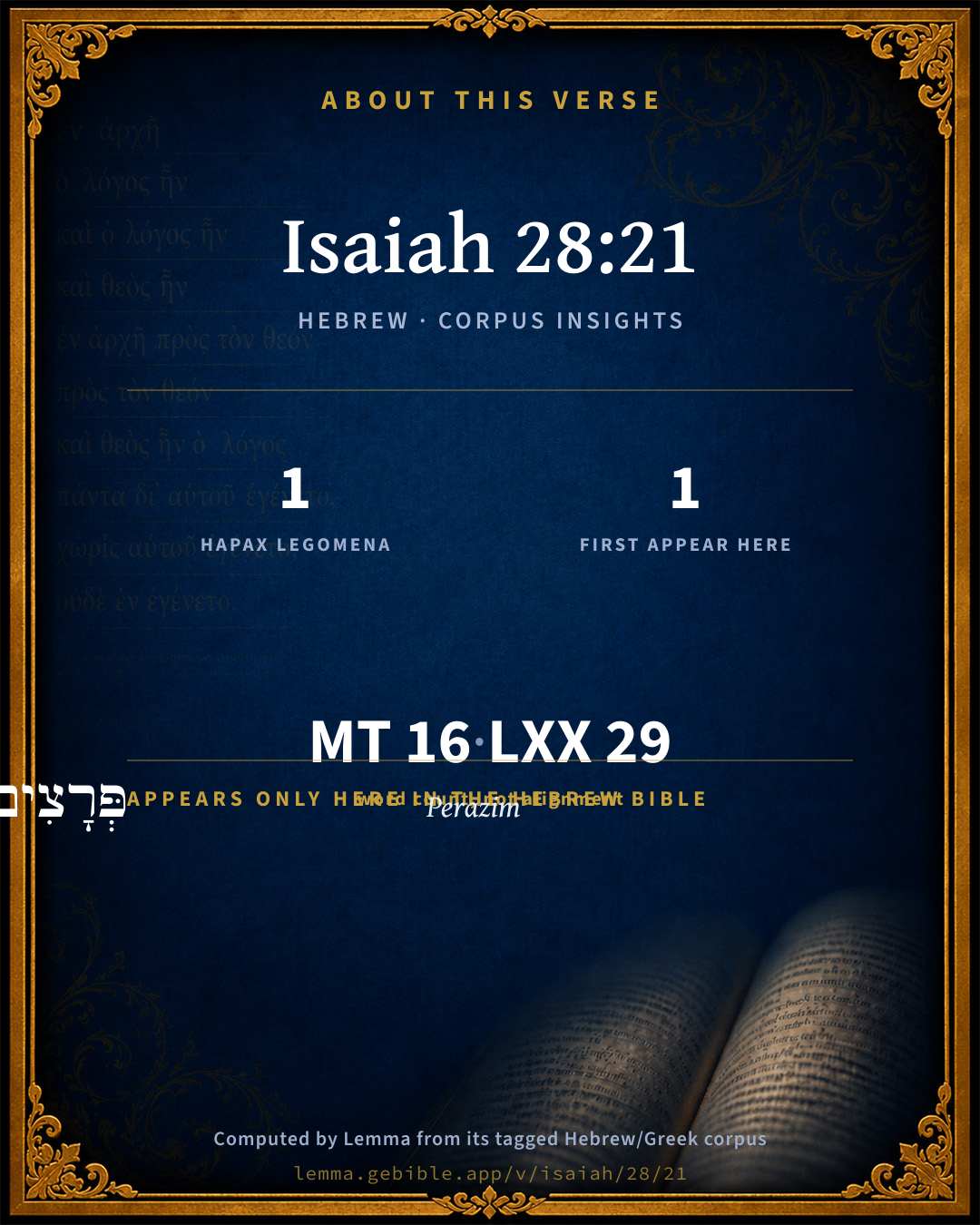
  • 1 hapax legomenon — only here in the Hebrew Bible
  • 1 first appearance in the Hebrew Bible
Full analysis ↓
Download a study sheet

One document with this verse’s original text, its word-by-word gloss line, the meaning frame, cross-references with their text, attributed commentary, and full source and license credits — printable, and it pastes into notes with its structure intact.

This verse Autodidact and up

Study sheet (.html) Plain text (.txt)

A passage Seminary Student

Up to 50 verses in one chapter. A passage sheet keeps up to 6 commentary sources and 12 cross-references per verse, in the order this page ranks them, and says so on the sheet whenever that leaves anything out. Ask for a single verse and you get the Autodidact verse sheet above.

Everything on this page stays free to read, with no account — the sheet is a download of what is already on screen, not access to it.

Want to remove ads? Support Godless Engineer
Compare translations 3

The same verse in 3 English versions, stacked beneath the original-language interlinear above. Click any original word for its lexicon entry.

Each is an independent rendering of the whole verse — the interlinear is not word-aligned to these translations.

Highlighted words mark where these versions differ — a whole-verse word diff, not a word-by-word alignment.

  • World English Bible Public Domain
    For Yahweh will rise up as on Mount Perazim, he will be angry as in the valley of Gibeon; that he may do his work, his strange work, and bring to pass his act, his strange act.
  • King James Version Public Domain
    For the LORD shall rise up as in mount Perazim, he shall be wroth as in the valley of Gibeon, that he may do his work, his strange work; and bring to pass his act, his strange act.
  • unfoldingWord Literal Text CC BY-SA 4.0
    For Yahweh will arise as Mount Perazim, he will rage as the Valley of Gibeon, to work his work—strange his work— and to do his deed—foreign his deed.

unfoldingWord Literal Text — © unfoldingWord, licensed CC BY-SA 4.0. Word-aligned USFM3 via Door43 (git.door43.org/unfoldingWord/en_ult).

Versions to compare (up to 4)

3 of 4 selected

Show all 18 translations

Every available English version of this verse, each an independent rendering of the whole verse.

  • World English Bible Public Domain
    For Yahweh will rise up as on Mount Perazim, he will be angry as in the valley of Gibeon; that he may do his work, his strange work, and bring to pass his act, his strange act.
  • Berean Standard Bible Public Domain
    For the LORD will rise up as at Mount Perazim. He will rouse Himself as in the Valley of Gibeon, to do His work, His strange work, and to perform His task, His disturbing task.
  • Majority Standard Bible Public Domain
    For the LORD will rise up as at Mount Perazim. He will rouse Himself as in the Valley of Gibeon, to do His work, His strange work, and to perform His task, His disturbing task.
  • King James Version Public Domain
    For the LORD shall rise up as in mount Perazim, he shall be wroth as in the valley of Gibeon, that he may do his work, his strange work; and bring to pass his act, his strange act.
  • American Standard Version (1901) Public Domain
    For Jehovah will rise up as in mount Perazim, he will be wroth as in the valley of Gibeon; that he may do his work, his strange work, and bring to pass his act, his strange act.
  • Revised Version (1885) Public Domain
    For the LORD shall rise up as in mount Perazim, he shall be wroth as in the valley of Gibeon; that he may do his work, his strange work, and bring to pass his act, his strange act.
  • Geneva Bible (1599) Public Domain
    For the Lord shall stand as in mount Perazim: hee shall be wroth as in the valley of Gibeon, that he may do his worke, his strage worke, and bring to passe his acte, his strange acte.
  • Douay-Rheims (1899) Public Domain
    For the Lord shall stand up as in the mountain of divisions: he shall be angry as in the valley which is in Gabaon: that he may do his work, his strange work: that he may perform his work, his work is strange to him.
  • Young's Literal Translation Public Domain
    For as `at' mount Perazim rise doth Jehovah, As `at' the valley in Gibeon He is troubled, To do His work -- strange `is' His work, And to do His deed -- strange `is' His deed.'
  • Literal Standard Version CC BY-SA 4.0
    For as YHWH rises [at] Mount Perazim, || As He is troubled [at] the valley in Gibeon, || To do His work—strange [is] His work, || And to do His deed—strange [is] His deed.”
  • Unlocked Literal Bible CC BY-SA 4.0
    Yahweh will rise up as on Mount Perazim; he will rouse himself as in the Valley of Gibeon to do his work, his strange work, and perform his strange deed.
  • unfoldingWord Literal Text CC BY-SA 4.0
    For Yahweh will arise as Mount Perazim, he will rage as the Valley of Gibeon, to work his work—strange his work— and to do his deed—foreign his deed.
  • Darby Bible Public Domain
    For Jehovah will rise up as on mount Perazim, he will be moved with anger as in the valley of Gibeon; that he may do his work, his strange work, and perform his act, his unwonted act.
  • World Messianic Bible Public Domain
    For the LORD will rise up as on Mount Perazim. He will be angry as in the valley of Gibeon; that he may do his work, his unusual work, and bring to pass his act, his extraordinary act.
  • Webster's Bible Public Domain
    For the LORD will rise as on mount Perazim, he will be wroth as in the valley of Gibeon, that he may do his work, his strange work; and bring to pass his act, his strange act.
  • Free Bible Version CC BY-SA 4.0
    The Lord will come on the attack like he did to the Philistines at Mount Perazim, like he shook them in the Valley of Gibeon, coming to do what he has to do, his strange work; coming to act as he must, his unusual action.
  • Bible in Basic English Public Domain
    For the Lord will come up as on Mount Perazim, he will be moved to wrath as in the valley of Gibeon; so that he may do his work--strange is his work; and give effect to his act--unnatural is his act.
  • JPS Tanakh (1917) Public Domain
    For the LORD will rise up as in mount Perazim, He will be wroth as in the valley of Gibeon; that He may do His work, strange is His work, and bring to pass His act, strange is His act.

Literal Standard Version (2020), Covenant Press — licensed CC BY-SA 4.0. Text via the HelloAO Bible API (eBible.org). Unlocked Literal Bible (unfoldingWord) — licensed CC BY-SA 4.0. Text via the HelloAO Bible API (eBible.org). unfoldingWord Literal Text — © unfoldingWord, licensed CC BY-SA 4.0. Word-aligned USFM3 via Door43 (git.door43.org/unfoldingWord/en_ult). Free Bible Version, Dr. Jonathan Gallagher — licensed CC BY-SA 4.0. Text via the HelloAO Bible API (eBible.org).

Word by word

More ways to search: Search by grammar → Find every occurrence → Compare this word →

Practice this passage: Drill this verse → Learn its vocabulary →

פְּרָצִים֙
pᵉrâtsîym
H6559
“Perazim”
Noun, Proper
Part of Speech
Noun
Type
Proper
Full BDB Definition

Origin: pl. of H6556

TWOT: None

Perazim = "breaches" - a mountain in Palestine - possibly the same as 'Baal-perazim' which was the scene of a victory of David over the Philistines located in the valley of Rephaim, south of Jerusalem, on the road to Bethlehem
  1. כִּ֤י kîy H3588 “that” Conjunction
  2. כְהַר har H2022 “like/as · mountain of” Preposition + Noun, Common, Masculine, Singular, Construct
  3. יָק֣וּם qûwm H6965 “to rise” Verb, Qal, Imperfect, 3rd Person, Masculine, Singular
  4. יְהוָ֔ה Yᵉhôvâh H3068 “LORD” Noun, Proper
  5. כְּעֵ֖מֶק ʻêmeq H6010 “like/as · valley” Preposition + Noun, Common, Masculine, Singular, Absolute
  6. בְּגִבְע֣וֹן Gibʻôwn H1391 “in/at · Gibeon” Preposition + Noun, Proper
  7. יִרְגָּ֑ז râgaz H7264 “to tremble” Verb, Qal, Imperfect, 3rd Person, Masculine, Singular
  8. לַעֲשׂ֤וֹת ʻâsâh H6213 “to do” Preposition + Verb, Qal, Infinitive Construct
  9. מַעֲשֵׂ֨הוּ֙ maʻăseh H4639 “work · his” Noun, Common, Masculine, Singular, Construct + Suffix, Personal, 3rd Person, Masculine, Singular
  10. זָ֣ר zûwr H2114 “strange” Adjective, Adjective, Masculine, Singular, Absolute
  11. מַעֲשֵׂ֔הוּ maʻăseh H4639 “work · his” Noun, Common, Masculine, Singular, Construct + Suffix, Personal, 3rd Person, Masculine, Singular
  12. וְלַֽעֲבֹד֙ ʻâbad H5647 “and · to serve” Conjunction + Preposition + Verb, Qal, Infinitive Construct
  13. עֲבֹ֣דָת֔וֹ ʻăbôdâh H5656 “service · his” Noun, Common, Feminine, Singular, Construct + Suffix, Personal, 3rd Person, Masculine, Singular
  14. נָכְרִיָּ֖ה nokrîy H5237 “foreign” Adjective, Adjective, Feminine, Singular, Absolute
  15. עֲבֹדָתֽוֹ ʻăbôdâh H5656 “service · his” Noun, Common, Feminine, Singular, Construct + Suffix, Personal, 3rd Person, Masculine, Singular

About this verse

These counts appear in no published source. They are computed here, from the morphology-tagged text and Lemma’s own curated glosses. What Lemma adds →

16
words
14
distinct lemmas
Prophets
section

Notable vocabulary

1 hapax legomenon — a word that appears only here in the entire Hebrew Bible:

  • פְּרָצִים֙ Perazim H6559

First appearance in Scripture

This word makes its first canonical appearance in the Hebrew Bible here:

  • פְּרָצִים֙ Perazim H6559

Shared distinctive vocabulary

בְּגִבְע֣וֹן Gibeon H1391 occurs in 35 verses of the Hebrew Bible. Also found in:

Grammatical profile

  • 4 verbs
  • 9 nouns
  • 2 adjectives
  • 1 conjunction

Verb forms

  • יָק֣וּם Qal · Imperfect
  • יִרְגָּ֑ז Qal · Imperfect
  • לַעֲשׂ֤וֹת Qal · Infinitive Construct
  • וְלַֽעֲבֹד֙ Qal · Infinitive Construct

Repetition

Words recur within this verse — often emphatic in Hebrew:

  • מַעֲשֵׂ֨הוּ֙ work H4639 ×2
  • עֲבֹ֣דָת֔וֹ service H5656 ×2

Hebrew & Septuagint length

In English translation the verse runs 37 words from the Hebrew and 43 from the Septuagint (LXX English) — closely comparable.

A rough comparison of the two English renderings, which tokenize alike — not a word-level alignment.

Word counts can differ between the Hebrew and the Greek without any difference in meaning — e.g. the Hebrew direct-object marker אֵת has no separate Greek word, and Greek often adds the article ὁ.

In the original languages it is 16 Hebrew tokens and 29 Greek tokens — but the two are counted differently (Hebrew bundles its prefixes and suffixes into one token; the Greek is in lemma form), so that isn’t a like-for-like length.

Cross-references

15

Topical passages linked to Isaiah 28:21 in the Treasury of Scripture Knowledge — connected by theme and wording, ordered by reader-vote popularity; previews shown in the World English Bible.

  • 1 Chronicles 14:11 So they came up to Baal Perazim, and David struck them there; and David said, God has broken my enemies by my hand, like the breach of waters. Therefore they called the name of that place Baal Perazim.
  • Joshua 10:12 Then spoke Joshua to Yahweh in the day when Yahweh delivered up the Amorites before the children of Israel; and he said in the sight of Israel, Sun, stand you still on Gibeon; You, Moon, in the valley of Aijalon.
  • 2 Samuel 5:20 David came to Baal Perazim, and David struck them there; and he said, Yahweh has broken my enemies before me, like the breach of waters. Therefore he called the name of that place Baal Perazim.
  • Joshua 10:10 Yahweh confused them before Israel, and he killed them with a great slaughter at Gibeon, and chased them by the way of the ascent of Beth Horon, and struck them to Azekah, and to Makkedah.
  • 2 Samuel 5:25 David did so, as Yahweh commanded him, and struck the Philistines from Geba until you come to Gezer.
  • 1 Chronicles 14:16 David did as God commanded him: and they struck the host of the Philistines from Gibeon even to Gezer.
  • Lamentations 2:15 All that pass by clap their hands at you; They hiss and wag their head at the daughter of Jerusalem, [saying], Is this the city that men called The perfection of beauty, The joy of the whole earth?
  • Deuteronomy 29:21–24 Yahweh will set him apart to evil out of all the tribes of Israel, according to all the curses of the covenant that is written in this book of the law.
  • Isaiah 28:19 As often as it passes though, it shall take you; for morning by morning shall it pass through, by day and by night: and it shall be nothing but terror to understand the message.
  • Isaiah 29:14 therefore, behold, I will proceed to do a marvelous work among this people, even a marvelous work and a wonder; and the wisdom of their wise men shall perish, and the understanding of their prudent men shall be hid.
  • Luke 19:41–44 When he drew near, he saw the city and wept over it,
  • Isaiah 10:12 Therefore it shall happen that, when the Lord has performed his whole work on Mount Zion and on Jerusalem, I will punish the fruit of the stout heart of the king of Assyria, and the glory of his high looks.
  • Jeremiah 30:14 All your lovers have forgotten you; they don't seek you: for I have wounded you with the wound of an enemy, with the chastisement of a cruel one, for the greatness of your iniquity, because your sins were increased.
  • Lamentations 3:33 For he does not afflict willingly, nor grieve the children of men.
  • Ezekiel 33:21 It happened in the twelfth year of our captivity, in the tenth [month], in the fifth [day] of the month, that one who had escaped out of Jerusalem came to me, saying, The city has been struck.

Cross-references courtesy of OpenBible.info (CC BY 4.0).

Hebrew and Greek witnesses Masoretic Hebrew ↔ Greek Septuagint

The same verse in the two great witnesses to the Old Testament, shown verse-for-verse.

These are two independent witnesses, not word-aligned to each other, and the Septuagint is shown in lemma (dictionary) form.

Hebrew Isaiah 28:21 Masoretic · Westminster Leningrad Codex

כִּ֤י כְהַר פְּרָצִים֙ יָק֣וּם יְהוָ֔ה כְּעֵ֖מֶק בְּגִבְע֣וֹן יִרְגָּ֑ז לַעֲשׂ֤וֹת מַעֲשֵׂ֨הוּ֙ זָ֣ר מַעֲשֵׂ֔הוּ וְלַֽעֲבֹד֙ עֲבֹ֣דָת֔וֹ נָכְרִיָּ֖ה עֲבֹדָתֽוֹ

For Yahweh will rise up as on Mount Perazim, he will be angry as in the valley of Gibeon; that he may do his work, his strange work, and bring to pass his act, his strange act.

World English Bible · Public Domain

Greek LXX Isaiah 28:21 Septuagint · lemma form

ὥσπερ ὄρος ἀσεβής ἀναἵστημι καί εἰμί ἐν ὁ φάραγξ γαβαων μετά θυμός ποιέω ὁ ἔργον αὐτός πικρία ἔργον ὁ δέ θυμός αὐτός ἀλλοτρίως χράω καί ὁ πικρία αὐτός ἀλλότριος

The Lord shall rise up as a mountain of ungodly men, and shall be in the valley of Gabaon; he shall perform his works with wrath, even a work of bitterness, and his wrath shall deal strangely, and his destruction shall be strange.

LXX2012 (modern English Septuagint) · Public Domain

Hebrew: Westminster Leningrad Codex (CC BY 4.0). Greek: Septuagint (public domain); English from LXX2012 (modern English Septuagint) (Public Domain). How the Septuagint differs from the Hebrew →

Targum (Aramaic paraphrase)

1

The Targum is the ancient Jewish Aramaic paraphrase of the Hebrew Scriptures — an interpretive translation, not the Hebrew text itself. Onkelos (literal) and Pseudo-Jonathan (expansive) render the Torah, and Jonathan the Prophets. Coverage is partial: where no permissively-licensed English translation exists for a verse, only the Aramaic is shown. This is verse-level text, not a word-by-word alignment to the Hebrew.

  1. Targum Jonathan Prophets (Joshua–Malachi)
    אֲרֵי כְּמָא דְזָעוּ טוּרַיָא כַּד אִיתְגְלֵי יְקָרָא דַייָ בְּיוֹמֵי עוּזִיָה מַלְכָּא וּכְנִיסִין דַעֲבַד לִיהוֹשֻׁעַ בְּמֵישַׁר גִבְעוֹן לְאִתְפְּרַע מֵרַשִׁיעַיָא דַעֲבַרוּ עַל מֵימְרֵהּ כֵּן יִתְגְלֵי לְאִתְפְּרָעָא מִדְעָבְדִין עוֹבָדִין נוּכְרָאִין עוֹבָדֵיהוֹן וּמִדְפָלְחִין פּוּלְחַן טַעֲוָתָא פּוּלְחַנְהוֹן:

    For as the mountains trembled when the glory of the Lord was revealed in the days of king Uzziah, and in the wonders which He performed for Joshua in the valley of Gibeon, taking vengeance on the wicked, who had transgressed against His Word: so shall He be revealed to take vengeance on them, who work works, strange works, and on those who worship with idolatrous worship.

    Targum Jonathan — Aramaic: “Mikraot Gedolot” (public domain). English: “Sefaria Community Translation” (CC0 1.0 (public-domain dedication)); “London "Chaldee Paraphrase," 1871” (public domain). Text via Sefaria.

Commentary

Notes on Isaiah 28:21 from classic Christian and Jewish commentators (each source and its license shown beneath its notes). The classic Christian expositions comment on the surrounding passage and are grouped to its opening verse, so a note may address several verses; the Jewish commentaries on the Tanakh (Rashi and others) are per-verse, so they appear only where the commentator wrote on this verse.

Lemma curates 59 commentaries, every one of them public domain or Creative Commons licensed, each selected and text-cleaned for this edition rather than reprinted as found. About our sources →

Trapp's Complete Commentary

John Trapp

Isa 28:21 For the LORD shall rise up as [in] mount Perazim, he shall be wroth as [in] the valley of Gibeon, that he may do his work, his strange work; and bring to pass his act, his strange act.

Ver. 21. As in Mount Perazim.] See 2Sa 5:20. God usually sitteth amidst his people in his mercy seat, or throne of grace; neither ariseth he to punish them till much provoked, and then he may possibly deal as severely with them as he did with the Philistines at Mount Perazim, or with the Amorites in the valley of Gibeon. {Jos 10:10} But then he doth "his work, his strange work, and brings to pass his act, his strange act" - i.e., That which is neither his wont nor his delight. {Lam 3:33 Mic 7:18 Eze 33:11} To fall foul upon his people by his plagues and judgments, goeth as much against the heart with him as against the hair with them. And besides, by doing this his "strange work," he maketh way for the doing of his own proper work. {1Co 11:32}

John Trapp, A Commentary or Exposition upon All the Books of the Old and New Testament (1647–1656) — public domain. Text from a community e-Sword module.

MacLaren's Expositions of Holy Scripture

Alexander MacLaren

Isaiah

GOD’S STRANGE WORK

Isa 28:21.

How the great events of one generation fall dead to another! There is something very pathetic in the oblivion that swallows up world-resounding deeds. Here the prophet selects two instances which to him are solemn and singular examples of divine judgment, and we have difficulty in finding out to what he refers. To him they seemed the most luminous illustrations he could find of the principle which he is proclaiming, and to us all the light is burned out of them. They are the darkest portion of the verse. Several different events have been suggested. But most probably the historical references here are to David’s slaughter of the Philistines {2Sa 5:1 - 2Sa 5:25, and 1Ch 14:1 - 1Ch 14:17}. This is probable, but by no means certain. If so, the words are made still more threatening by asserting that He will treat the Israelites as if they were Philistines. But the point on which we should concentrate attention is this remarkable expression, according to which judgment is God’s strange work. And that is made more emphatic by the use of a word translated ‘act,’ which means service, and is almost always used for work that is hard and heavy-a toil or a task.

I. The work in which God delights.

It is here implied that the opposite kind of activity is congenial to Him. The text declares judgment to be an anomaly, out of His ordinary course of action and foreign to His nature.

We may pause for a moment on that great thought that God has a usual course of action, which is usual because it is the spontaneous expression and true mirror of His character. What He thus does shows that character to His creatures, who cannot see Him but in the glass of His works, and have to infer His nature, as they best may, from His works. The Bible begins with His nature and thence interprets His work.

The work in which God delights is the utterance of His love in blessing.

The very essence of love is self-manifestation.

The very being of God is love, and all being delights in its own self-manifestation, in its own activity.

How great the thought is that He is glad when we let Him satisfy His nature by making us glad!

The ordinary course of His government in the world is blessing.

II. The Task in which He does not delight, or His Strange Work.

The consequences of sin are God’s work. The miseries consequent on sin are self-inflicted, but they are also God’s judgments on sin. We may say that sin automatically works out its results, but its results follow by the will of God on account of sin.

That work is a necessity arising from the nature of God. It is foreign to His heart but not to His nature. God is both ‘the light of Israel’ for blessing, and ‘a consuming fire.’ The two opposite effects are equally the result of the contact of God and man. Light pains a diseased eye and gladdens a sound one. The sun seen through a mist becomes like a ball of red-hot iron. The whole revelation of God becomes a pain to an unloving soul.

But God’s very love compels Him to punish.

Some modern notions of the love of God seem to strike out righteousness from His nature altogether, and substitute for it a mere good nature which is weakness, not love, and is cruelty, not kindness.

There is nothing in the facts of the world or in the teachings of the gospel which countenances the notion of a God whose fondness prevents Him from scourging.

What do you call it when a father spares the rod and spoils the child?

Even this world is a very serious place for a man who sets himself against its laws. Its punishments come down surely and not always slowly. There is nothing in it to encourage the idea of impunity.

That work is to Him an Unwelcome Necessity. Bold words. ‘I have no pleasure in the death of a sinner.’ ‘He doth not willingly inflict.’ The awful power of sin to divert the current of blessing. Christ’s tears over Jerusalem. How unwelcome that work is to them is shown by the slowness of His judgments, by multiplied warnings. ‘Rising up early,’ He tells men that He will smite, in order that He may never need to smite.

That work is a certainty. However reluctantly He smites, the blow will fall.

III. The Strange Work of Redemption.

The mightiest miracle. The revelation of God’s deepest nature. The wonder of the universe.

Alexander MacLaren, Expositions of Holy Scripture (1904–1910) — public domain. Text from a community e-Sword module.

Tyndale Open Study Notes

Tyndale Open Resources

28:21 as he did . . . at Mount Perazim: See 2 Sam 5:20. • God had rescued Israel through a hailstorm at Gibeon (Josh 10:10-12), but now he would turn against them.

Tyndale Open Study Notes — © Tyndale Open Resources, licensed CC BY-SA 4.0. Text via the HelloAO Bible API.

Geneva Bible (1599)

Geneva Bible translators

Where Joshua discomfited five kings of the Amorites, Josh. 10:12.

When David overcame the Philistines, 2 Sam. 5:20; 1 Chron. 14:11.

Geneva Bible (1599) marginal notes — public domain. Text via Bolls.life.

Jamieson, Fausset & Brown

Robert Jamieson, A. R. Fausset & David Brown

Perazim--In the valley of Rephaim (Sa2 5:18, Sa2 5:20; Ch1 14:11), there Jehovah, by David, broke forth as waters do, and made a breach among the Philistines, David's enemies, as Perazim means, expressing a sudden and complete overthrow.

Gibeon-- (Ch1 14:16; Sa2 5:25, Margin); not Joshua's victory (Jos 10:10).

strange--as being against His own people; judgment is not what God delights in; it is, though necessary, yet strange to Him (Lam 3:33).

work--punishing the guilty (Isa 10:12).

Jamieson, Fausset & Brown — Commentary Critical and Explanatory on the Whole Bible (1871) — public domain (CC PDM 1.0). Text via the HelloAO Bible API.

Adam Clarke's Commentary

Verse 21. As in Mount Perazim] כהר kehar; but בהר bahar, IN the mount, is the reading of two of Kennicott's, one of De Rossi's, and one of my own MSS.

Adam Clarke's Commentary on the Bible (1810–1826) — public domain. Text from a community e-Sword/MySword module.

Ellicott's Commentary for English Readers

(21) The Lord shall rise up as in mount Perazim . . .—The point of the reference to David’s victories at Baal Perazim (2Sa_5:20; 1Ch_14:11), and at Gibeon (1Ch_14:16) is that then Jehuah had interposed on behalf of His people against their enemies. The “new and strange” work—the very paradox of prophecy—was that He would now rise up to overthrow His own people.

A Bible Commentary for English Readers, edited by Charles John Ellicott (1878–1897) — public domain. Text from a community e-Sword module.

The Cambridge Bible for Schools and Colleges

gen. ed. J. J. S. Perowne

21. The “strangeness” of Jehovah’s work (Isa_5:12, Isa_10:12) consists in his fighting with the foreigners against his own people. The historical allusions are to David’s victories over the Philistines in the vicinity of Jerusalem; see 2Sa_5:20 f.; 1Ch_14:11 f. (Baal-Perazim); 2Sa_5:25 (Geba); 1Ch_14:16 (Gibeon, as here). The last part reads: to perform his act—strange is his act! and to work his work—barbarous is his work!

The Cambridge Bible for Schools and Colleges (gen. ed. J. J. S. Perowne; Cambridge University Press, 1878–1918) — public domain. Text from a community e-Sword module.

John Gill's Exposition

Now therefore be ye not mockers,.... At the words of the prophets, and the judgments denounced by them, which is very common, when they are deferred, and not immediately executed: this was the case before the destruction of Jerusalem by the Chaldeans, and one cause of it, Ch2 36:16 and also by the Romans; see Act 13:41,

lest your bands be made strong; punishment become heavier, and more grievous; and so the Syriac version renders it; as prisoners that attempt to make their escape have their bonds and fetters made faster, and so are put to more pain and distress; to which the allusion seems to be, signifying, that by scoffing and mocking at the word of God they would bring upon themselves greater and sorer punishments, Heb 10:29,

for I have heard from the Lord GOD of hosts; in a vision from him, by a spirit of prophecy, as a secret communicated by him; for whatever the Lord did he usually made it known to his prophets; and it might be depended upon what they said, as being what the Lord had declared in their hearing; see Amo 3:7,

a consumption, even determined upon the whole earth: or, "on the whole land", the land of Judea; for this destruction seems only to respect that; and is the same with "the consummation, and that determined", that should be "poured upon the desolate", Dan 9:27 which manifestly designs the destruction of the Jews by the Romans, which was an affair determined by the Lord, whose counsel shall stand, and therefore would surely come to pass.

John Gill's Exposition of the Whole Bible (1746–1763) — public domain (CC PDM 1.0). Text via the HelloAO Bible API.

Albert Barnes' Notes on the Bible

For the Lord shall rise up - To rise up is indicative of going forth to judgment, as when one rises from his seat to accomplish anything.

As in mount Perazim - There is reference here, doubtless, to the event recorded in 2Sa 5:20-21, and 1Ch 14:11, where David is said to have defeated the Philistines at Baal-Perazim. This place was near to the valley of Rephaim 2Sa 5:19, and not far from Jerusalem. The word ‘Perazim’ is from פרץ pârats, to tear, or break forth, as waters do that have been confined; and is indicative of sudden judgment, and of a complete overthrow. It was on that account given to the place where David obtained a signal and complete victory 2Sa 5:20; and it is here referred to, to denote that God would come forth in a sudden manner to destroy Jerusalem and Judea. He would come upon them like bursting waters, and sweep them away to a distant land.

As in the valley of Gibeon - In 1Ch 14:16, it is said that after the victory of Baal-Perazim, ‘David smote the host of the Philistines from Gibeon even to Gaza.’ This victory is doubtless referred to here, and not the victory of Joshua over the Gibeonites Jos 10:10, as Vitringa and others suppose.

That he may do his work, his strange work - This is called his strange work because it would be inflicted on his people. He had destroyed their enemies often, but now he was about to engage in the unusual work of coming forth against his own people, and sweeping them away to a distant land. The work of judgment and punishment may be called the “strange” work of God always, inasmuch as it is not that in which he delights to engage, and is foreign to the benevolence of his heart. It is especially so when his own people are the objects of his displeasure, and when their sins are such as to demand that he should visit them with the tokens of his wrath.

Albert Barnes' Notes on the Bible (1834–1885) — public domain. Text from a community e-Sword/MySword module.

Haydock's Catholic Bible Commentary

As in, &c. As the Lord fought against the Philistines in Baal Pharisim, (2 Kings v.) and against the Chanaanites, in the valley of Gabaon, Josue x. (Challoner) --- Strange. He punished unwillingly. (Calmet) --- "It is not God’s work to ruin what he has created." (St. Jerome) --- He will punish in an extraordinary manner those scoffers, ver. 15., and Numbers xvi. 29. (Piscator)

George Leo Haydock (1774–1849), Haydock's Catholic Family Bible and Commentary, 1859 edition — public domain. Excludes Psalms (Douay-Rheims chapter numbering differs from Protestant) and Deuterocanonical books (Catholic canon only).

Matthew Poole's English Annotations

Shall rise up, to act and fight against you; as he is said to sit still, when he doth forbear to act.

Mount Perazim where he fought against the Philistines, 2Sa 5:20. The valley of Gibeon; where he fought against the Canaanites, Jos 10:10, &c, and afterwards against the Philistines, 1Ch 14:16.

His strange work; the execution of his judgment against Israel, which he calleth his strange work, to intimate either,

1. That God would punish them not with ordinary punishments, but in a most dreadful, and singular, and extraordinary manner; such a judgment being called

a marvellous work, Isa 29:14, although the Hebrew word there used be not the same with this, but of a much differing signification. Or rather,

2. That this work of bringing total and irrecoverable destruction upon Israel was contrary to the benignity of his own nature, and to the usual way of dealing with his people, whom he used and delighted to protect, and spare, and bless; and whom, even when he is angry with them, and punisheth them, he handleth more gently than he doth other persons, in judgment remembering mercy to them, as was noted, Isa 27:7,8; see also Isa 26:11.

Matthew Poole's English Annotations on the Holy Bible (1683–1685) — public domain. Text from a community e-Sword/MySword module.

Whedon's Commentary on the Bible

Daniel D. Whedon

21. As in Mount Perazim — See 2Sa_5:20-21, where, with trust in Jehovah, David burst through and defeated the Philistines. 1Ch_14:11. So shall be the rising up and bursting through of Jehovah in his wrath. No light, no fringe of promise, lines this dreaded woe. Is there not something more than Syrian invasion here? What means the strange work which God will do other than this? As he had often punished Israel’s enemies with a furious “bursting through,” so now he will in same way punish Israel itself.

Daniel D. Whedon (gen. ed.), Commentary on the Old and New Testaments (1874–1909) — public domain. Text from a community e-Sword module.

The Pulpit Commentary

The Lord shall rise up as in Mount Perazim. The "Mount Perazim" of this passage is probably the same as the "Baal-Perazim" of 1Ch_14:11, where David completely defeated the Philistines by the Divine help. This victory is connected with another over the same nation in the valley of Gibeon. (1Ch_14:13-16) Now, however, God was to be on the side of the enemies of his people, who were to suffer as the Philistines had suffered in the olden time. This punishment of Ida own people by the sword of foreigners was strange work on God"s parta strange act. But it was their strange conduct which caused God"s strange action. They had become as it were, Philistines.

The Pulpit Commentary (1880–1919), ed. H.D.M. Spence-Jones & Joseph S. Exell — public domain. Text from a community e-Sword module.

John Wesley's Explanatory Notes

Perazim - Where he fought against the Philistines, 2 Sam. v, 20. Gibeon - Where he fought against the Canaanites, Josh. x, 10, &c. and afterwards against the Philistines, 1 Chron. xiv, 16. Strange work - For this work of bringing total destruction upon Israel, was contrary to the benignity of his own nature, and to the usual way of dealing with his people.

John Wesley, Explanatory Notes Upon the Whole Bible (1754–1765) — public domain. Text via the GEBible commentary corpus.

Keil & Delitzsch

C. F. Keil & F. Delitzsch

It would be with them as it was with the Philistines when David turned their army into water at Baal-perazim (Sa2 5:20; Ch1 14:11), or when on another occasion he drove them before him from Gibeon to Gezer (Ch1 14:13.). "For Jehovah will rise up as in the mountain of Perazim, and be wroth as in the valley at Gibeon to work His work; astonishing is His work; and to act His act: strange is His act." The Targum wrongly supposes the first historical reminiscence to refer to the earthquake in the time of Uzziah, and the second to Joshua's victory over the Amorites. The allusion really is to the two shameful defeats which David inflicted upon the Philistines. There was a very good reason why victories over the Philistines especially should serve as similes. The same fate awaited the Philistines at the hands of the Assyrians, as predicted by the prophet in Isa 14:28. (cf., Isa 20:1-6). And the strangeness and verity of Jehovah's work were just this, that it would fare no better with the magnates of Judah at the hand of Asshur, than it had with the Philistines at the hand of David on both those occasions. The very same thing would now happen to the people of the house of David as formerly to its foes. Jehovah would have to act in opposition to His gracious purpose. He would have to act towards His own people as He once acted towards their foes. This was the most paradoxical thing of all that they would have to experience.

Keil & Delitzsch — Biblical Commentary on the Old Testament (1861–1891) — public domain (CC PDM 1.0). Text via the HelloAO Bible API. (Old Testament only.)

J. A. Alexander on Isaiah

Joseph Addison Alexander

“For like Mount Perazim shall Jehovah rise up like the valley in Gibeon shall he rage, to do his work, his strange work; and to perform his task, his strange task.” Into such a condition as that just described they shall be brought, for some of the most fearful scenes of ancient history are yet to be repeated. Interpreters are not agreed as to the precise events referred to in the first clause. The common opinion is, that it alludes to the slaughter of the Philistines described in 2Sa 5:18-25 and 1Ch 14:9-16, in the latter of which places Gibeon is substituted for Geba. The valley meant will then be the valley of Rephaim. That these were foreigners and heathen, only adds to the force of the threatening, by making it to mean that as God had dealt with these in former times, he was now about to deal with the unbelieving and unfaithful sons of Israel. It is indeed not only implied but expressed, that He intended to depart from His usual mode of treating them, in which sense the judgments here denounced are called a strange work, (i.e., foreign from the ordinary course of divine providence). The idea that punishment is God’s strange work because at variance with His goodness, is not only less appropriate in this connection, but inconsistent with the tenor of Scripture, which describes His vindicatory justice as an essential attribute of His nature.

Joseph Addison Alexander, The Prophecies of Isaiah (1846–1847; New York: Scribner, 1870–1878) — public domain. Text from a community e-Sword module.

Rashi

Rabbi Shlomo Yitzchaki (Rashi)

For like the mountain of breaches Jonathan paraphrases: For, just as the mountains quaked when the glory of the Lord was revealed on the day of King Uzziah, (supra. 6:4,) and as the miracles He performed for Joshua in the valley of Gibeon (Jos. 10:12f) (to punish the wicked who transgressed His word,) so shall He be revealed to punish those who perform (strange deeds, strange are their deeds, and those who worship pagan deities, strange is their worship).

strange is His deed He will seem to you as a stranger, for He will bring upon them ([all other editions:] upon you) harsh retribution.

and to perform His work (וְלַעֲבֹד עֲבֹדָתוֹ) like work of the soil, ‘laborer’ in O.F.

Rashi on the Tanakh — English translations: “The Judaica Press complete Tanach with Rashi, translated by A. J. Rosenberg” (CC BY 4.0); “Pentateuch with Rashi's commentary by M. Rosenbaum and A.M. Silbermann, 1929-1934” (public domain); “The Metsudah Tanach series, Lakewood, N.J” (CC BY 4.0); and “The Book of Joshua, Metsudah Publications, 1997” (CC BY 4.0). Text via Sefaria.

Ibn Ezra

Rabbi Abraham ibn Ezra

As in mount Perazim, known by the wars of David (2 Sam. 5:20); the place was called בעל פרצים place of breaches, because the Philistines were suddenly defeated there in a miraculous way.

As in the valley of Gibeon (Jos. 10:12), where sun and moon stood still. That He may do His work, His strange work. In the same way God will make a strange war against Israel, such as was never heard of before.

And bring to pass His act, His strange act. A mere repetition of the preceding idea, not an exceptional instance.

Ibn Ezra on the Tanakh — English translations: “Sefaria Community Translation” (CC0 1.0 (public-domain dedication)); “Yalkut, Sifsei Chachomim Chumash, Metsudah Publications, 2009” (CC BY 4.0); and “Commentary of Ibn Ezra on Isaiah - trans. by M. Friedlander, 1873” (public domain). Text via Sefaria.

Lesson kit

Teaching starters — assembled from the data on this page, not authored interpretation. Every prompt links to the verse data it draws on. Edit before teaching.

Isaiah, in the Prophets, opens this verse with 16 words (14 distinct Hebrew lemmas). Its most distinctive word is pᵉrâtsîym (“Perazim”). A historical commentator’s framing appears above. Read the whole chapter for the surrounding context.

Discussion questions

  1. What does “Perazim” (pᵉrâtsîym) contribute to the verse as a whole?
  2. This verse holds 1 word here found nowhere else in the Hebrew Bible. What might the rare word draw attention to?
  3. The word “Perazim” first appears here in Scripture. What is being introduced at this debut?
  4. Joshua 9:3 shares the word «Gibeon» with this verse. How do the two illuminate each other?
  5. “work” occurs 2× in this one verse. What is the effect of the repetition?
  6. The translations on this page render this verse differently — a whole-verse word diff, not a word-by-word alignment. What might account for the different wordings?
  7. The verb «יָק֣וּם» is Qal Imperfect. How does its form color the action?
  8. Reading how Trapp's Complete Commentary and MacLaren's Expositions of Holy Scripture read this verse, where do the two commentators agree and where do they part?

Things to notice

  • 1 word in this verse appears nowhere else in the Hebrew Bible.
  • 1 word makes its first canonical appearance in Scripture here.
  • This verse counts 16 Hebrew ↔ 29 Greek words.
  • These translations choose different wording for 18 words in this verse.
  • “work” occurs 2× in this single verse.

Reading settings

Reading text

Shown beneath each verse's original-language words.

Old Testament
Old Testament edition

Read the OT as the Masoretic Hebrew (MT) or the Greek Septuagint (LXX).

English shown for the Greek Septuagint (in the Hebrew ↔ Greek comparison).

Comparing translations? Open the Compare panel on any verse page to stack up to four side by side.