
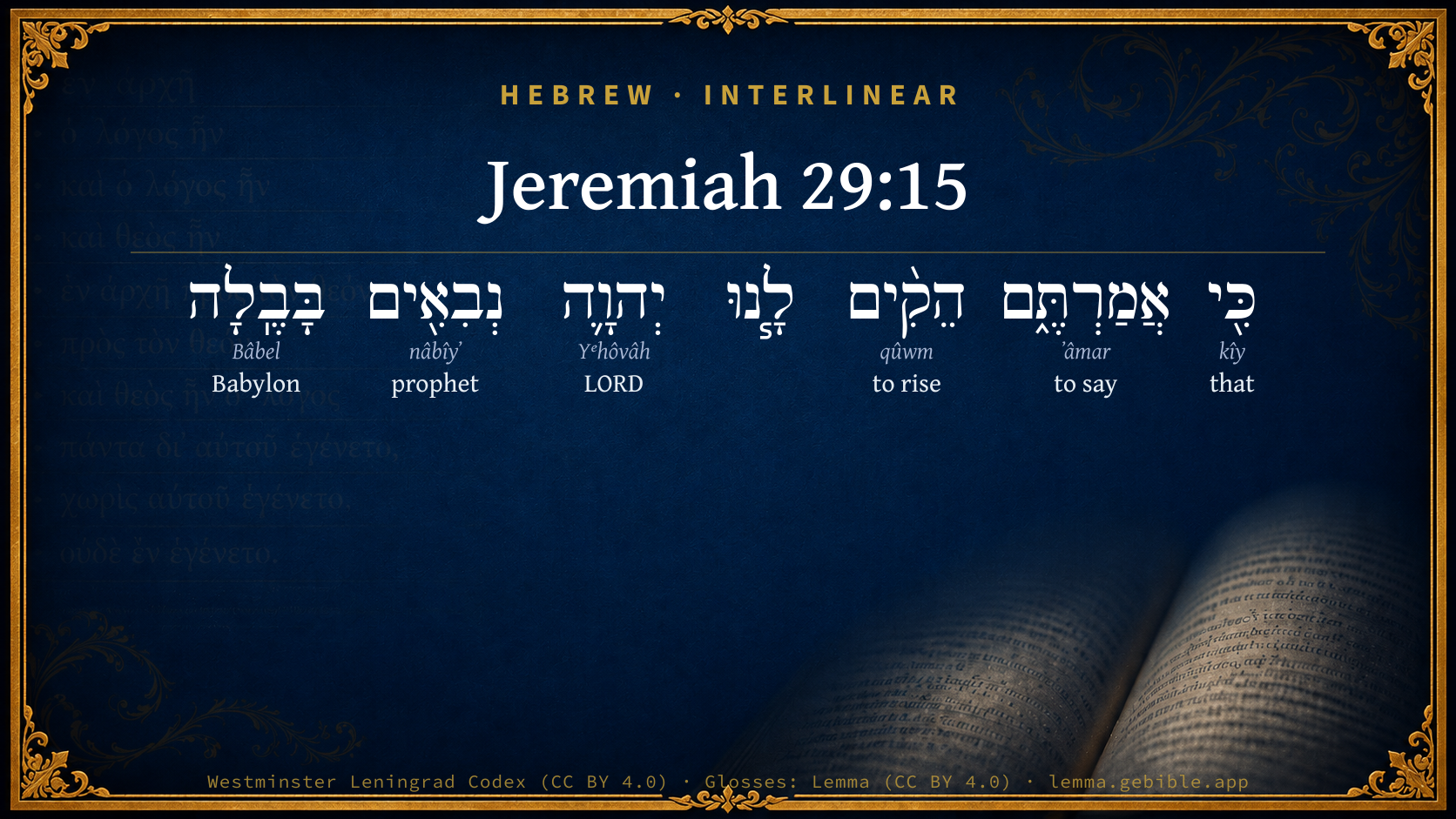
Jeremiah 29:15

Hebrew (Westminster Leningrad Codex) Jeremiah 29:15 appears in the Hebrew Old Testament. The text above is from the Westminster Leningrad Codex. Each word links to its Strong’s number, a concise gloss, and parsing drawn from the Open Scriptures Hebrew Bible morphology. Click any word for its full Brown-Driver-Briggs (BDB) entry.
Download image
Cite this verse

Jeremiah 29:15 (World English Bible). Public Domain. Lemma interlinear Bible study tool, https://lemma.gebible.app/v/jeremiah/29/15.

Show BibTeX & RIS
BibTeX
RIS
English Translation
Because you have said, Yahweh has raised us up prophets in Babylon;
World English Bible · Public Domain
Download a study sheet

One document with this verse’s original text, its word-by-word gloss line, the meaning frame, cross-references with their text, attributed commentary, and full source and license credits — printable, and it pastes into notes with its structure intact.

This verse Autodidact and up

Study sheet (.html) Plain text (.txt)

A passage Seminary Student

Up to 50 verses in one chapter. A passage sheet keeps up to 6 commentary sources and 12 cross-references per verse, in the order this page ranks them, and says so on the sheet whenever that leaves anything out. Ask for a single verse and you get the Autodidact verse sheet above.

Everything on this page stays free to read, with no account — the sheet is a download of what is already on screen, not access to it.

Want to remove ads? Support Godless Engineer
Compare translations 3

The same verse in 3 English versions, stacked beneath the original-language interlinear above. Click any original word for its lexicon entry.

Each is an independent rendering of the whole verse — the interlinear is not word-aligned to these translations.

Highlighted words mark where these versions differ — a whole-verse word diff, not a word-by-word alignment.

  • World English Bible Public Domain
    Because you have said, Yahweh has raised us up prophets in Babylon;
  • King James Version Public Domain
    Because ye have said, The LORD hath raised us up prophets in Babylon;
  • unfoldingWord Literal Text CC BY-SA 4.0
    Since you said that Yahweh has raised up prophets for us in Babylon,

unfoldingWord Literal Text — © unfoldingWord, licensed CC BY-SA 4.0. Word-aligned USFM3 via Door43 (git.door43.org/unfoldingWord/en_ult).

Versions to compare (up to 4)

3 of 4 selected

Show all 18 translations

Every available English version of this verse, each an independent rendering of the whole verse.

  • World English Bible Public Domain
    Because you have said, Yahweh has raised us up prophets in Babylon;
  • Berean Standard Bible Public Domain
    Because you may say, “The LORD has raised up for us prophets in Babylon,”
  • Majority Standard Bible Public Domain
    Because you may say, “The LORD has raised up for us prophets in Babylon,”
  • King James Version Public Domain
    Because ye have said, The LORD hath raised us up prophets in Babylon;
  • American Standard Version (1901) Public Domain
    Because ye have said, Jehovah hath raised us up prophets in Babylon;
  • Revised Version (1885) Public Domain
    For ye have said, The LORD hath raised us up prophets in Babylon.
  • Geneva Bible (1599) Public Domain
    Because ye haue sayd, The Lord hath raised vs vp Prophets in Babel,
  • Douay-Rheims (1899) Public Domain
    Because you have said: The Lord hath raised us up prophets in Babylon:
  • Young's Literal Translation Public Domain
    `Because ye have said, Jehovah hath raised up to us prophets in Babylon,
  • Literal Standard Version CC BY-SA 4.0
    Because you have said, YHWH has raised up prophets to us in Babylon,
  • Unlocked Literal Bible CC BY-SA 4.0
    Since you said that Yahweh has raised up prophets for us in Babylon,
  • unfoldingWord Literal Text CC BY-SA 4.0
    Since you said that Yahweh has raised up prophets for us in Babylon,
  • Darby Bible Public Domain
    If ye say, Jehovah hath raised us up prophets in Babylon;
  • World Messianic Bible Public Domain
    Because you have said, “The LORD has raised us up prophets in Babylon,”
  • Webster's Bible Public Domain
    Because ye have said, The LORD hath raised up for us prophets in Babylon;
  • Free Bible Version CC BY-SA 4.0
    But if you argue, “The Lord has provided prophets for us in Babylon,”
  • Bible in Basic English Public Domain
    For you have said, The Lord has given us prophets in Babylon.
  • JPS Tanakh (1917) Public Domain
    For ye have said: 'The LORD hath raised us up prophets in Babylon.'

Literal Standard Version (2020), Covenant Press — licensed CC BY-SA 4.0. Text via the HelloAO Bible API (eBible.org). Unlocked Literal Bible (unfoldingWord) — licensed CC BY-SA 4.0. Text via the HelloAO Bible API (eBible.org). unfoldingWord Literal Text — © unfoldingWord, licensed CC BY-SA 4.0. Word-aligned USFM3 via Door43 (git.door43.org/unfoldingWord/en_ult). Free Bible Version, Dr. Jonathan Gallagher — licensed CC BY-SA 4.0. Text via the HelloAO Bible API (eBible.org).

Word by word

More ways to search: Search by grammar → Find every occurrence → Compare this word →

Practice this passage: Drill this verse → Learn its vocabulary →

About this verse

These counts appear in no published source. They are computed here, from the morphology-tagged text and Lemma’s own curated glosses. What Lemma adds →

7
words
6
distinct lemmas
Prophets
section

Grammatical profile

  • 2 verbs
  • 3 nouns
  • 1 preposition
  • 1 conjunction

Verb forms

  • אֲמַרְתֶּ֑ם Qal · Perfect
  • הֵקִ֨ים Hiphil · Perfect

Cross-references

4

Topical passages linked to Jeremiah 29:15 in the Treasury of Scripture Knowledge — connected by theme and wording, ordered by reader-vote popularity; previews shown in the World English Bible.

  • Jeremiah 28:1–17 It happened the same year, in the beginning of the reign of Zedekiah king of Judah, in the fourth year, in the fifth month, that Hananiah the son of Azzur, the prophet, who was of Gibeon, spoke to me in the house of Yahweh, in the presence of the priests and of all the people, saying,
  • Jeremiah 29:8–9 For thus says Yahweh of hosts, the God of Israel: Don't let your prophets who are in the midst of you, and your diviners, deceive you; neither listen you to your dreams which you cause to be dreamed.
  • Ezekiel 1:1 Now it happened in the thirtieth year, in the fourth [month], in the fifth [day] of the month, as I was among the captives by the river Chebar, that the heavens were opened, and I saw visions of God.
  • Ezekiel 1:3 the word of Yahweh came expressly to Ezekiel the priest, the son of Buzi, in the land of the Chaldeans by the river Chebar; and the hand of Yahweh was there on him.

Cross-references courtesy of OpenBible.info (CC BY 4.0).

Hebrew and Greek witnesses Masoretic Hebrew ↔ Greek Septuagint

The same verse in the two great witnesses to the Old Testament, shown verse-for-verse.

These are two independent witnesses, not word-aligned to each other, and the Septuagint is shown in lemma (dictionary) form.

Hebrew Jeremiah 29:15 Masoretic · Westminster Leningrad Codex

כִּ֖י אֲמַרְתֶּ֑ם הֵקִ֨ים לָ֧נוּ יְהוָ֛ה נְבִאִ֖ים בָּבֶֽלָה

Because you have said, Yahweh has raised us up prophets in Babylon;

World English Bible · Public Domain

Greek LXX Structure differs

In the Septuagint, Jeremiah is about an eighth shorter than the Hebrew and arranges its material differently — the Oracles Against the Nations (Hebrew chapters 46–51) appear in the middle of the Greek book, after 25:13. Because the chapter and verse boundaries do not line up, a verse-for-verse comparison with the Hebrew is not shown.

A verse-for-verse comparison isn’t shown here because the chapters and verses don’t line up. Switch to the LXX edition with the MT / LXX toggle above to read the Greek directly.

On this verse, The Cambridge Bible for Schools and Colleges discusses the Septuagint’s reading. Read the note in Commentary ↓

Hebrew: Westminster Leningrad Codex (CC BY 4.0). Greek: Septuagint (public domain); English from a public-domain English Septuagint. How the Septuagint differs from the Hebrew →

Targum (Aramaic paraphrase)

1

The Targum is the ancient Jewish Aramaic paraphrase of the Hebrew Scriptures — an interpretive translation, not the Hebrew text itself. Onkelos (literal) and Pseudo-Jonathan (expansive) render the Torah, and Jonathan the Prophets. Coverage is partial: where no permissively-licensed English translation exists for a verse, only the Aramaic is shown. This is verse-level text, not a word-by-word alignment to the Hebrew.

  1. Targum Jonathan Prophets (Joshua–Malachi)
    אֲרֵי אֲמַרְתּוּן אֲקֵים לָנָא יְיָ מַלְפִין בְּבָבֶל:

    (no public-domain English translation for this verse)

    Targum Jonathan — Aramaic: “Mikraot Gedolot” (public domain). English: “Sefaria Community Translation” (CC0 1.0 (public-domain dedication)); “London "Chaldee Paraphrase," 1871” (public domain). Text via Sefaria.

Commentary

Notes on Jeremiah 29:15 from classic Christian and Jewish commentators (each source and its license shown beneath its notes). The classic Christian expositions comment on the surrounding passage and are grouped to its opening verse, so a note may address several verses; the Jewish commentaries on the Tanakh (Rashi and others) are per-verse, so they appear only where the commentator wrote on this verse.

Lemma curates 59 commentaries, every one of them public domain or Creative Commons licensed, each selected and text-cleaned for this edition rather than reprinted as found. About our sources →

Matthew Henry's Commentary

Jeremiah, having given great encouragement to those among the captives whom he knew to be serious and well-affected, assuring them that God had very kind and favourable intentions concerning them, here turns to those among them who slighted the counsels and comforts that Jeremiah ministered to them and depended upon what the false prophets flattered them with. When this letter came from Jeremiah they would be ready to say, "Why should he make himself so busy, and take upon him to advise us? The Lord has raised us up prophets in Babylon, Jer 29:15. We are satisfied with those prophets, and can depend upon them, and have no occasion to hear from any prophets in Jerusalem." See the impudent wickedness of this people; as the prophets, when they prophesied lies, said that they had them from God, so the people, when they invited those prophets thus to flatter them, fathered it upon God, and said that it was the Lord that raised them up those prophets. Whereas we may be sure that those who harden people in their sins, and deceive them with false and groundless hopes of God's mercy, are no prophets of God's raising up. These prophets of their own told them that no more should be carried captive, but that those who were in captivity should shortly return. Now, in answer to this, 1. The prophet here foretells the utter destruction of those who remained still at Jerusalem, notwithstanding what those false prophets said to the contrary: "As for the king and people that dwell in the city, who, you think, will be ready to bid you welcome when you return, you are deceived; they shall be followed with one judgment after another, sword, famine, and pestilence, which shall cut off multitudes; and the poor and miserable remains shall be removed into all kingdoms of the earth," Jer 29:16, Jer 29:18. And thus God will make them, or rather deal with them accordingly, as the salt that has lost its savour, which, being good for nothing, is cast to the dunghill, and so are rotten figs. This refers to the vision and the prophecy upon it which we had Jer 24:1-10. And the reason given for these proceedings against them is the same that has often been given and will justify God in the eternal ruin of impenitent sinners (Jer 29:19): Because they have not hearkened to my words. I called, but they refused. 2. He foretells the judgment of God upon the false prophets in Babylon, who deceived the people of God there. He calls upon all the children of the captivity, who boasted of them as prophets of God's raising up (Jer 29:20): "Stand still, and hear the doom of the prophets you are so fond of." The two prophets are named here, Ahab and Zedekiah, Jer 29:21. Observe, (1.) The crimes charged upon them - impiety and immorality: They prophesied lies in God's name (Jer 29:21), and again (Jer 29:23), They have spoken lying words in my name. Lying was bad, lying to the people of God to delude them into a false hope was worse, but fathering their lies upon the God of truth was worst of all. And no marvel if those that had the face to do that could allow themselves in the gratification of those vile affections to which God, in a way of righteous judgment, gave them up. They have done villainy in Israel, for they have committed adultery with their neighbours' wives. Adultery is villainy in Israel, and in such as pretend to be prophets, who by such wickednesses manifestly disprove their own pretensions. God never sent such profligate wretches on his errands. He is the Lord God of the holy prophets, not of such impure ones. Here it appears why they flattered others in their sins - because they could not reprove them without condemning themselves. These lewd practices of theirs they knew how to conceal from the eye of the world, that they might preserve their credit; but I know it and am a witness, saith the Lord. The most secret sins are known to God; he can see the villainy that is covered with the thickest cloak of hypocrisy, and there is a day coming when he will bring to light all these hidden works of darkness and every man will appear in his own colours. (2.) The judgments threatened against them: The king of Babylon shall slay them before your eyes; nay, he shall put them to a miserable death, roast them in the fire, Jer 29:22. We may suppose that it was not for their impiety and immorality that Nebuchadnezzar punished them thus severely, but for sedition, and some attempts of their turbulent spirits upon the public peace, and stirring up the people to revolt and rebel. So much of their wickedness shall then be detected, and in such a wretched manner they shall end their days, that their names shall be a curse among the captives in Babylon, Jer 29:22. When men would imprecate the greatest evil upon one they hated they would think they could not load them with a heavier curse, in fewer words, than to say, The Lord make thee like Zedekiah and like Ahab. Thus were they made ashamed of the prophets they had been proud of, and convinced at last of their folly in hearkening to them. God's faithful prophets were sometimes charged with being the troublers of the land, and as such were tortured and slain; but their names were a blessing when they were gone and their memory sweet, not as these false prophets. As malefactors are attended with infamy and disgrace, so martyrs with glory and honour.

Matthew Henry's Commentary on the Whole Bible (1708–1710) — public domain (CC PDM 1.0). Text via the HelloAO Bible API.

The Cambridge Bible for Schools and Colleges

gen. ed. J. J. S. Perowne

15. This v. naturally links with Jer_29:21 ff., while the intervening vv. make an apparent severance in the logical connexion, and are absent from LXX, except in a certain recension (Lucianic), where, however, they precede Jer_29:15. With this transposition, as at least modifying the objection arising from the break of logical connexion, Gi. agrees, maintaining, as he does, their genuineness. Co. (and so Du.) refuses to consider the vv. as belonging to the original letter, making Jer_29:16-18 to be in substance a reproduction of Jer_24:8 f., Jer_29:19 to have its origin in Jer_24:4 ff. and parallel passages, and Jer_29:20 to be taking up the line of thought anew from Jer_29:16. Dr. suggests that, as the passage seems out of place in a letter to the Jews in Babylonia, dealing as it does with the fate of the Jerusalem Jews, it belongs only to the recension of that letter which subsequently was incorporated in this Book. If we are to abide by the MT. in the matter, the sense appears to be this: One of the difficulties raised by the exiles when the prospect of seventy years’ captivity was held out to them would be, We have prophets here at Babylon who tell us just the reverse of all this. Which shall we believe? To this the reply of Jeremiah is twofold. (i) These prophets’ teaching shall soon be disproved. The king and the remnants of the kingdom, upon whose continued existence at Jerusalem they lay such stress, will soon pass away. Ye shall not soon be restored to your brethren, but they shall be exiles and scattered like to you. (ii) The false prophets, who thus delude you, shall themselves miserably perish and become a proverb and by-word.

For] rather, Because, connecting this v. directly with Jer_29:21. “Because ye congratulate yourselves on having prophets in your exile, I tell you how soon ye shall discover that they are valueless.”

15–19. The impending fate of Zedekiah and his people. Cp. Jer_24:8-10.

The Cambridge Bible for Schools and Colleges (gen. ed. J. J. S. Perowne; Cambridge University Press, 1878–1918) — public domain. Text from a community e-Sword module.

Trapp's Complete Commentary

John Trapp

Jer 29:15 Because ye have said, The LORD hath raised us up prophets in Babylon;

Ver. 15. Because ye have said.] From the heirs of the promises he turneth his speech to others, qui praesumendo sperant, et sperando pereunt.

John Trapp, A Commentary or Exposition upon All the Books of the Old and New Testament (1647–1656) — public domain. Text from a community e-Sword module.

Joseph Benson's Commentary

Jer 29:15. Because ye have said, &c. — The LXX. have transposed this verse, and placed it “where,” says Blaney, “it undoubtedly ought to stand,” immediately before Jer 29:21; “this emendation,” says he, “I have adopted, as by it a due order and connection are restored, both in the place from whence the verse is removed, and in that to which it is transferred, a sufficient proof of its authenticity.” The Lord hath raised us up prophets in Babylon — This is meant of the false prophets who foretold nothing but peace and prosperity. The reader will easily observe how properly this sentence, as Blaney has just observed, would follow Jer 29:20, and precede Jer 29:21, and how well it would connect with both.

Joseph Benson's Commentary on the Old and New Testaments (1811–1818) — public domain. Text from a community e-Sword module.

Keil & Delitzsch

C. F. Keil & F. Delitzsch

Jeremiah informs the captives of the judgments that is to gall on such as are still left in the land. Jer 29:15. "If ye say: Jahveh hath raised us up prophets in Babylon - Jer 29:16. Yea, thus saith Jahveh of the king that sitteth upon the throne of David, and of all the people that dwelleth in this city, your brethren that are not gone forth with you into captivity, Jer 29:17. Thus saith Jahveh of hosts: Behold, I send amongst them the sword, famine, and pestilence, and make them like horrible figs, that cannot be eaten for badness, Jer 29:18. And hunt after them with the sword, the famine, and the pestilence, and give them to be abused to all the kingdoms of the earth, to be a curse, and an astonishment, and a hissing, and a reproach among all the peoples whither I have driven them; Jer 29:19. Inasmuch as they have not hearkened to my words, saith Jahveh, wherewith I sent to them my servants the prophets, from early morning on sending them, and ye have not hearkened, saith Jahveh. Jer 29:20. But ye, hear the word of Jahveh, all ye captives whom I have sent from Jerusalem to Babylon." - The design with which Jeremiah tells the captives of this judgment may be gathered from the terms of Jer 29:15, with which this prophecy is introduced: God had raised up to us prophets in Babel (בּבלה, lit., as far as Babel, i.e., extending His agency so far beyond the bounds of Judah). Hence it is clear that the announcement of judgment to come on those left in the land is in direct opposition to the predictions of the prophets that had appeared in Babylon. these prophesied a swift end to Chaldean domination and an immediate return of the exiles to their fatherland. So long as one of David's posterity sat on his throne in Jerusalem, and so long as the kingdom of Judah was maintained, the partial captivity of the people and removal of the plundered treasures of the temple would appear as a calamity which might soon be repaired. The false prophets in Babylon laid, therefore, great stress on the continued existence of the kingdom, with its capital and the temple, in their efforts to obtain belief amongst the exiles. As Ng. justly remarks, it was to take this ground from beneath their feet that Jeremiah predicted expulsion and destruction against the people of Jerusalem. The prophecy does indeed bear upon the inhabitants of Jerusalem, "but not in the first reference; its immediate purpose was to overthrow the foundations on which the false prophets of the exile stood" (Ng.). Taken thus, these verses form and integral part of the message sent by Jeremiah to the exiles, which was of no small weight for quieting the excitement, nourished by the false prophets, which reigned amongst them. One is struck by the want of connection between Jer 29:15 and Jer 29:16. The beginning of Jer 29:16, "Yea, thus saith," comes directly after the end of Jer 29:15 without any joining link. Ng. holds the כּי to be the pleonastic כּי which often introduces a saying. But its position before the "thus saith" makes this impossible. Here it serves to strengthen the asseveration: yea, thus fitly introducing what Jahveh says to the contrary; and Jer 29:15 and Jer 29:16 are, tersely and immediately, set over against one another. "If ye say" means: as regards your saying that Jahveh hath raised you up prophets in Babylon, the answer is: Thus hath Jahveh said. This is the connection of Jer 29:16 with Jer 29:15.

(Note: By the above exposition of the connection and progress of the thought, are disposed of all the objections that have been brought by Houb., Lud. Capp., Ven., etc., against the genuineness of these verses, or, at least, against the true position for them. The fact of their being wanting in the lxx, on which Hitz. mainly grounds his charge of spuriousness, proves nothing more than that these translators were unable to understand the train of thought in the verses, especially seeing that the substance of them has several times been expressed by Jeremiah, particularly Jer 29:17 and Jer 29:18; Jer 24:9-10, cf. Jer 15:4; Jer 19:8; with Jer 29:19 cf. Jer 7:13, Jer 7:25. Against the attempts to alter the text, Graf's remarks are admirable: "It is much easier to explain how the passage was omitted as out of place by the lxx than to show how it could have been introduced as an interpolation. It is too long for a mere marginal gloss that had at a later time found its way into the text; and why it should have been placed here, would remain all the more incomprehensible if it were so wholly unconnected with the body of the text. We cannot admit that it is merely an erroneous displacement of b. 15, which originally stood before Jer 29:21; since it is less likely that Jer 29:16 could have come directly after Jer 29:14. In respect of form, Jer 29:16-20 is connected with and forms a continuation of what precedes. Jer 29:20 implies the presence of Jer 29:16 as an antithesis, and at the same time completes again the connection that had been interrupted with Jer 29:15, and leads on to Jer 29:21. Connection in thought seems to be wanting only because Jer 29:16 does not express the connecting idea, and because the contrast is so abrupt." - The other arguments adduced by Hitz. to throw suspicion on the passage, we can afford to pass over as wholly without force.)

"Your brethren that," etc., is co-ordinate with "all the people." The words: "I make them like horrible figs," make allusion to the vision in Jer 24:2., but do not imply that this vision was known to the exiles, for they are quite intelligible to him who knows nothing of Jer 24:1-10 (Ng.). The adject. שׁער is found only here, from שׁער, shudder; horrible, that on tasting which one shudders. With Jer 29:18, cf. Jer 24:9. "Wherewith I sent my servants," i.e., commissioned them. This verb construed with double accus. as in Sa2 11:22; Isa 55:11. "Ye have not hearkened," the 2nd pers. instead of the 3rd, is hardly to be explained by the fact that the prophet here cites in full an often quoted saying (Hitz., Ng., etc.). The reason is that the prophet is thinking of the exiles also as having been equal to their brethren remaining in Judah in the matter of not hearkening. Thus the way is prepared for the summons: But ye, hear, Jer 29:20.

Keil & Delitzsch — Biblical Commentary on the Old Testament (1861–1891) — public domain (CC PDM 1.0). Text via the HelloAO Bible API. (Old Testament only.)

Tyndale Open Study Notes

Tyndale Open Resources

29:15 False prophets could still be found among the exiles; they held out hope for the survival of Jerusalem and a quick end to the Exile.

Tyndale Open Study Notes — © Tyndale Open Resources, licensed CC BY-SA 4.0. Text via the HelloAO Bible API.

Geneva Bible (1599)

Geneva Bible translators

As Ahab, Zedekiah and Shemaiah.

Geneva Bible (1599) marginal notes — public domain. Text via Bolls.life.

Jamieson, Fausset & Brown

Robert Jamieson, A. R. Fausset & David Brown

Because--referring not to the preceding words, but to Jer 29:10-11, "Jehovah saith this to you" (that is, the prophecy of the continuance of the captivity seventy years), "because ye have said, The Lord hath raised us up prophets in Babylon," namely, foretelling our speedy deliverance (this their prophecy is supposed, not expressed; accordingly, Jer 29:16-19 contradict this false hope again, Jer 29:8-9, Jer 29:21). He, in this fifteenth verse, turns his address from the godly (Jer 29:12-14) to the ungodly listeners, to false prophets.

Jamieson, Fausset & Brown — Commentary Critical and Explanatory on the Whole Bible (1871) — public domain (CC PDM 1.0). Text via the HelloAO Bible API.

Adam Clarke's Commentary

Verse 15. Because ye have said] The Septuagint very properly insert this verse between the twentieth and the twenty-first, and thus the connexion here is not disturbed, and the connexion below completed.

Adam Clarke's Commentary on the Bible (1810–1826) — public domain. Text from a community e-Sword/MySword module.

John Calvin's Commentaries

Many interpreters connect the first of these verses with the preceding ones, and they seem not to think so without reason; for the reason given is not unsuitable, if we refer to what the Prophet had said, even that the Jews were by no means to hope for a return until the end of seventy years. But the meaning I adopt is more probable; the particle כי, ki, is repeated; the first is causal, and the second an illative; and consistently with the usage of Scripture the learned and the experienced think that this is the real meaning of the Prophet. He then says, that the captives were very foolish who hoped for a quick end to their exile, because they had false prophets who gave them such a promise; ye have then said, that prophets have been given you, in Chaldea, and that God had there pitied you, because there are those who prophesy of a return in a short time. As then ye are so foolishly credulous, Thus saith Jehovah to your brethren, he then turns his discourse to the exiles, and exhorts them not to suffer themselves to be led astray. But here he indirectly reproves them, because they could not bear a condition which was even better than that of the residue, as though he had said, “What means this your unreasonableness! that when all your ways are closed up against you, and the power of your conqueror is so great that ye cannot move a finger without his nod, ye should yet think that you shall be set free in two years! and surely if you were before foolishly secure and confident, your calamities ought now to make you humble. But your brethren, who seem yet to enjoy liberty because they dwell at Jerusalem, (for those alone were then remaining,) even these your brethren suffer far more grievously than ye do.”

John Calvin's Commentaries (1540-1563) — public domain. Text from the Calvin Translation Society English edition (1840s-50s) via the Christian Classics Ethereal Library (ccel.org). Calvin's coverage is partial (roughly two-thirds of the Bible); uncommented books and verses are honest gaps, never fabricated. The 19th-century editor's footnotes and remarks are omitted so the notes are faithfully Calvin's own voice.

Ellicott's Commentary for English Readers

(15) Because ye have said, The Lord hath raised us up prophets . . .—The words point to the boast of some of the exiles, that they, too, had the guidance of prophets whom, as in Jer_29:20; Jer_29:24, they were inclined to follow in preference to Jeremiah. In answer to that boast, he emphasises the contrast between the exiles in whom the prophet sees the future hope of his nation and the worthless king (Zedekiah) and people who had been left in Jerusalem, and for whom he foretells yet sharper sufferings. The symbolism of the “vile figs” is reproduced in Jer_29:17 from Jer_24:1-2. The word for “vile” is, however, not the same as in that passage, and has the stronger force of “horrible” or “loathsome.”

A Bible Commentary for English Readers, edited by Charles John Ellicott (1878–1897) — public domain. Text from a community e-Sword module.

John Gill's Exposition

Because ye have said,.... That is, some of them; for here the Lord, by the prophet, turns from the godly among the captives, whom he had been advising, encouraging, and comforting before, to those who gave heed to the false prophets, who promised them a speedy return to their own land, and which they believed; and therefore rejected and despised the prophecies of Jeremiah, and others:

the Lord hath raised us up prophets in Babylon; and therefore stood in no need of other prophets that were in Judea, or in Jerusalem, nor should hearken to them; but believe those that were raised up among themselves, rather than others at a distance; and though these were false prophets, yet, being such that prophesied to them things that were agreeable, they were willing to believe them, and to consider them, and receive them, as prophets sent of God, when they were not.

John Gill's Exposition of the Whole Bible (1746–1763) — public domain (CC PDM 1.0). Text via the HelloAO Bible API.

Haydock's Catholic Bible Commentary

Said. Expressing your confidence in Providence; or rather, if we join this with what follows, he rebukes them for trusting in false prophets, who represented their condition as worse than that of their brethren, who were left behind; whereas it was really better, ver. 17., and chap. xxiv. 2, 8. (Calmet) --- The deluded people suppose that the false prophets had been sent by God. (Worthington)

George Leo Haydock (1774–1849), Haydock's Catholic Family Bible and Commentary, 1859 edition — public domain. Excludes Psalms (Douay-Rheims chapter numbering differs from Protestant) and Deuterocanonical books (Catholic canon only).

Matthew Poole's English Annotations

The prophet here turneth his speech to some wicked Jews that were in Babylon, or in Judea, and more believed some false prophets, who told them of a much quicker return, than Jeremiah telling them the truth from the mouth of God,

Matthew Poole's English Annotations on the Holy Bible (1683–1685) — public domain. Text from a community e-Sword/MySword module.

Whedon's Commentary on the Bible

Daniel D. Whedon

15. Ye have said — The connexion here is evident, though some have denied that there is any, and have decided this verse to be an interpolation. The fact that there was still a king sitting on the throne of David was doubtless urged as a proof that the reverses which had come to the kingdom were merely temporary. They themselves were unfortunately prisoners and exiles, but the throne of David and the services of the temple were visible sacraments of God’s favour and presence with his people. Hence, in the land of their exile their prophets were busy in flattering their hopes of a speedy deliverance. And so, in this passage, the prophet takes the very ground from beneath their feet by predicting the complete overthrow of the government at Jerusalem.

Daniel D. Whedon (gen. ed.), Commentary on the Old and New Testaments (1874–1909) — public domain. Text from a community e-Sword module.

The Pulpit Commentary

Vers. 15-23. Jeremiah"s denunciation of two leading false prophets at Babylon, with a digression on the fate of Zedekiah and Jerusalem. Some eminent critics maintain that vers. 16-20 are an interpolation, and this view is certainly supported By the omission of these verses in the Septuagint. It must also in fairness be admitted that the natural connection of ver. 15 is with ver. 21, not with ver. 16. But it does not follow that vers. 16-20 are an arbitrary interpolation. They may be regarded either as a digression in the original letter, or as inserted by an after-thought when the substance of the letter was brought into its present form.

The Pulpit Commentary (1880–1919), ed. H.D.M. Spence-Jones & Joseph S. Exell — public domain. Text from a community e-Sword module.

John Wesley's Explanatory Notes

Because - The prophet here turns his speech to some wicked Jews, that were in Babylon, or in Judea.

John Wesley, Explanatory Notes Upon the Whole Bible (1754–1765) — public domain. Text via the GEBible commentary corpus.

unfoldingWord translationNotes

Door43 World Missions Community

General Information:

Jeremiah speaks to the captive Israelites.

the king who sits on the throne of David

Sitting on the throne is a metonym for ruling as king. AT: "the king who rules the Israelites as David did" (See: Metonymy)

Yahweh of hosts says this

Jeremiah often uses these words to introduce an important message from Yahweh. See how you translated this in Jeremiah 6:6.

See

This alerts the reader to pay attention to what follows. AT: "Look" or "Listen" or "Pay attention"

I am about to send sword, famine, and disease on them

The word "sword" is a metonym for war. The sword, famine, and disease are spoken of as people who can obey Yahweh's command to harm the Israelites. AT: "I am going to punish them by having them die in war, from hunger, and from illness" (See: Metonymy and Personification)

For I will make them like rotten figs that are too bad to be eaten

Rotten figs are useless because they cannot be eaten, and Yahweh sees no use for the people of Israel. (See: Simile)

translationWords

raise

throne

David

brother

sword

famine

fig

unfoldingWord translationNotes — © Distant Shores Media and the Door43 World Missions Community, licensed CC BY-SA 4.0. Source: git.door43.org/Door43/en_tn.

Lesson kit

Teaching starters — assembled from the data on this page, not authored interpretation. Every prompt links to the verse data it draws on. Edit before teaching.

Jeremiah, in the Prophets, opens this verse with 7 words (6 distinct Hebrew lemmas). Its most distinctive word is Bâbel (“Babylon”). A historical commentator’s framing appears above. Read the whole chapter for the surrounding context.

Discussion questions

  1. What does “Babylon” (Bâbel) contribute to the verse as a whole?
  2. Jeremiah 28:1–17 shares this passage’s theme. How do the two illuminate each other?
  3. The translations on this page render this verse differently — a whole-verse word diff, not a word-by-word alignment. What might account for the different wordings?
  4. The verb «אֲמַרְתֶּ֑ם» is Qal Perfect. How does its form color the action?
  5. Reading how Matthew Henry's Commentary and The Cambridge Bible for Schools and Colleges read this verse, where do the two commentators agree and where do they part?

Things to notice

Reading settings

Reading text

Shown beneath each verse's original-language words.

Old Testament
Old Testament edition

Read the OT as the Masoretic Hebrew (MT) or the Greek Septuagint (LXX).

English shown for the Greek Septuagint (in the Hebrew ↔ Greek comparison).

Comparing translations? Open the Compare panel on any verse page to stack up to four side by side.