
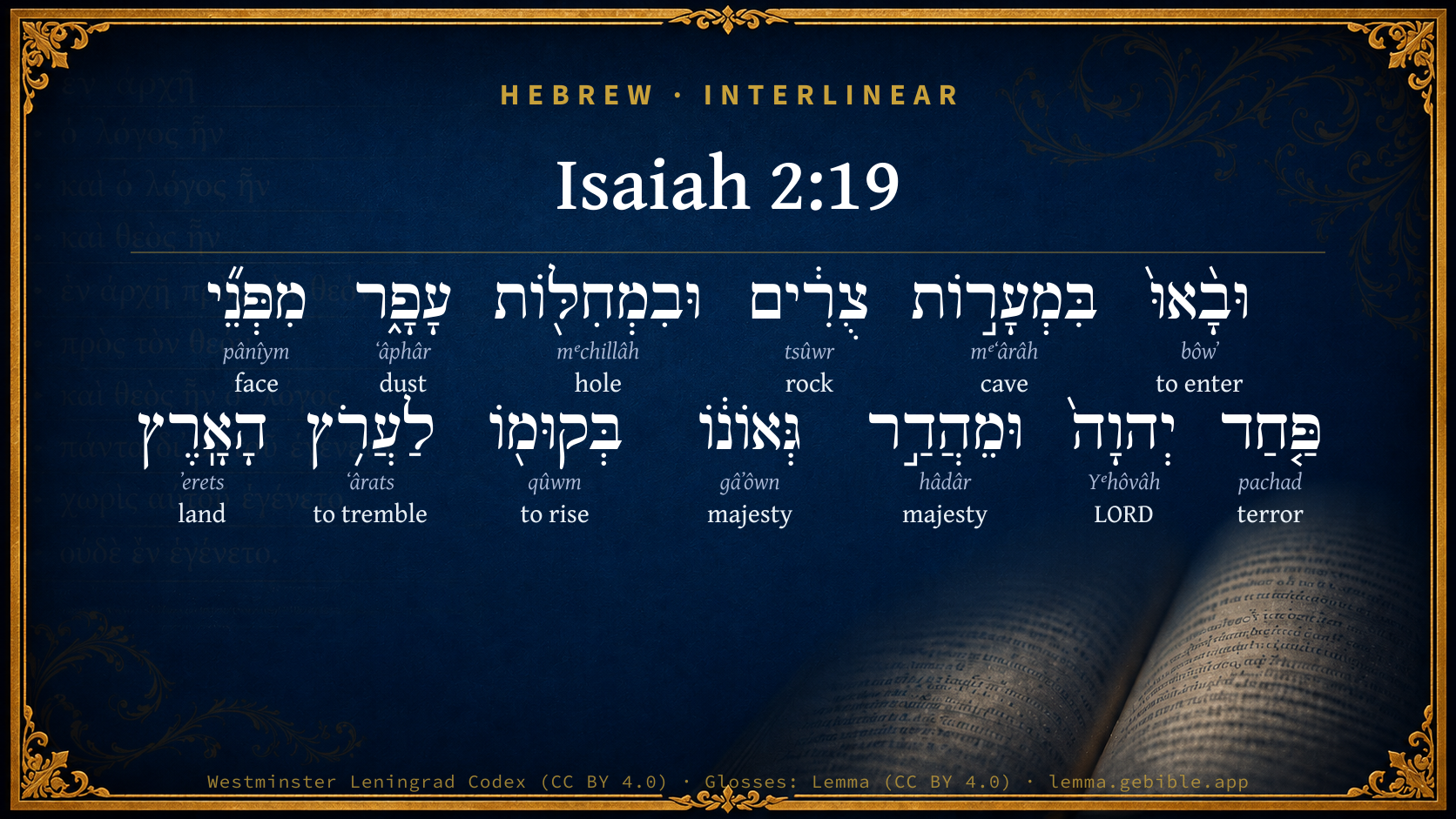
Isaiah 2:19

Hebrew (Westminster Leningrad Codex) Isaiah 2:19 appears in the Hebrew Old Testament. The text above is from the Westminster Leningrad Codex. Each word links to its Strong’s number, a concise gloss, and parsing drawn from the Open Scriptures Hebrew Bible morphology. Click any word for its full Brown-Driver-Briggs (BDB) entry.
Download image
Cite this verse

Isaiah 2:19 (World English Bible). Public Domain. Lemma interlinear Bible study tool, https://lemma.gebible.app/v/isaiah/2/19.

Show BibTeX & RIS
BibTeX
RIS
English Translation
Men shall go into the caves of the rocks, And into the holes of the earth, From before the terror of Yahweh, And from the glory of his majesty, When he arises to shake the earth mightily.
World English Bible · Public Domain
Highlights
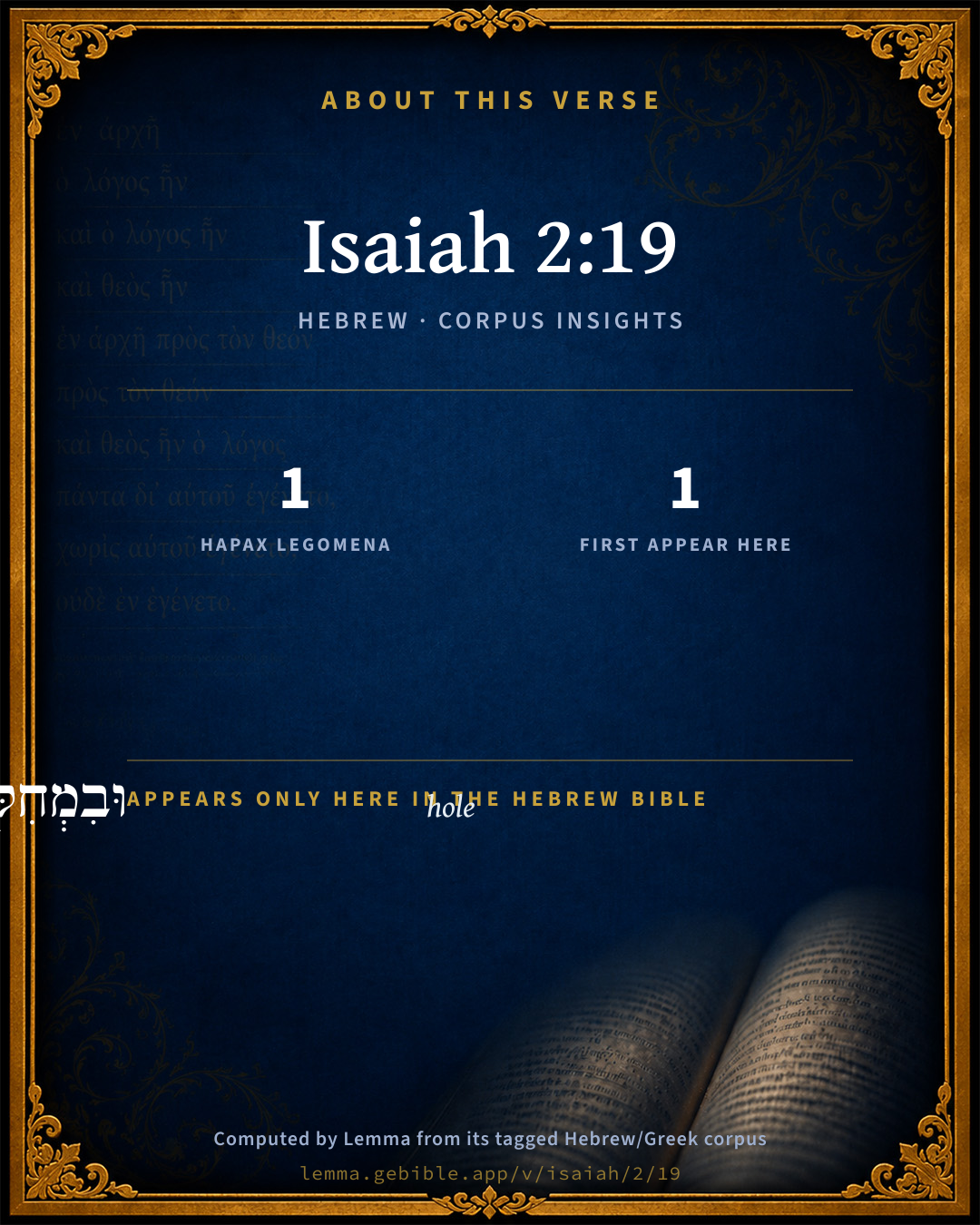
  • 1 hapax legomenon — only here in the Hebrew Bible
  • 1 first appearance in the Hebrew Bible
Full analysis ↓
Download a study sheet

One document with this verse’s original text, its word-by-word gloss line, the meaning frame, cross-references with their text, attributed commentary, and full source and license credits — printable, and it pastes into notes with its structure intact.

This verse Autodidact and up

Study sheet (.html) Plain text (.txt)

A passage Seminary Student

Up to 50 verses in one chapter. A passage sheet keeps up to 6 commentary sources and 12 cross-references per verse, in the order this page ranks them, and says so on the sheet whenever that leaves anything out. Ask for a single verse and you get the Autodidact verse sheet above.

Everything on this page stays free to read, with no account — the sheet is a download of what is already on screen, not access to it.

Want to remove ads? Support Godless Engineer
Compare translations 3

The same verse in 3 English versions, stacked beneath the original-language interlinear above. Click any original word for its lexicon entry.

Each is an independent rendering of the whole verse — the interlinear is not word-aligned to these translations.

Highlighted words mark where these versions differ — a whole-verse word diff, not a word-by-word alignment.

  • World English Bible Public Domain
    Men shall go into the caves of the rocks, And into the holes of the earth, From before the terror of Yahweh, And from the glory of his majesty, When he arises to shake the earth mightily.
  • King James Version Public Domain
    And they shall go into the holes of the rocks, and into the caves of the earth, for fear of the LORD, and for the glory of his majesty, when he ariseth to shake terribly the earth.
  • unfoldingWord Literal Text CC BY-SA 4.0
    And they will go into caves of the rocks and into holes of the ground from the face of the terror of Yahweh and from the splendor of his majesty when he arises to terrify the earth.

unfoldingWord Literal Text — © unfoldingWord, licensed CC BY-SA 4.0. Word-aligned USFM3 via Door43 (git.door43.org/unfoldingWord/en_ult).

Versions to compare (up to 4)

3 of 4 selected

Show all 18 translations

Every available English version of this verse, each an independent rendering of the whole verse.

  • World English Bible Public Domain
    Men shall go into the caves of the rocks, And into the holes of the earth, From before the terror of Yahweh, And from the glory of his majesty, When he arises to shake the earth mightily.
  • Berean Standard Bible Public Domain
    Men will flee to caves in the rocks and holes in the ground, away from the terror of the LORD and from the splendor of His majesty, when He rises to shake the earth.
  • Majority Standard Bible Public Domain
    Men will flee to caves in the rocks and holes in the ground, away from the terror of the LORD and from the splendor of His majesty, when He rises to shake the earth.
  • King James Version Public Domain
    And they shall go into the holes of the rocks, and into the caves of the earth, for fear of the LORD, and for the glory of his majesty, when he ariseth to shake terribly the earth.
  • American Standard Version (1901) Public Domain
    And men shall go into the caves of the rocks, and into the holes of the earth, from before the terror of Jehovah, and from the glory of his majesty, when he ariseth to shake mightily the earth.
  • Revised Version (1885) Public Domain
    And men shall go into the caves of the rocks, and into the holes of the earth, from before the terror of the LORD, and from the glory of his majesty, when he ariseth to shake mightily the earth.
  • Geneva Bible (1599) Public Domain
    Then they shall goe into the holes of the rockes, and into the caues of the earth, from before the feare of the Lord, and from the glory of his maiestie, when he shall arise to destroy the earth.
  • Douay-Rheims (1899) Public Domain
    And they shall go into the holes of rocks, and into the caves of the earth from the face of the fear of the Lord, and from the glory of his majesty, when he shall rise up to strike the earth.
  • Young's Literal Translation Public Domain
    And `men' have entered into caverns of rocks, And into caves of dust, Because of the fear of Jehovah, And because of the honour of His excellency, In His rising to terrify the earth.
  • Literal Standard Version CC BY-SA 4.0
    And [men] have entered into caverns of rocks, || And into caves of dust, || Because of the fear of YHWH, || And because of the honor of His excellence, || In His rising to terrify the earth.
  • Unlocked Literal Bible CC BY-SA 4.0
    Men will go into the caves of the rocks and the holes of the ground, from the terror of Yahweh, and from the glory of his majesty, when he rises to terrify the earth.
  • unfoldingWord Literal Text CC BY-SA 4.0
    And they will go into caves of the rocks and into holes of the ground from the face of the terror of Yahweh and from the splendor of his majesty when he arises to terrify the earth.
  • Darby Bible Public Domain
    And they shall go into the caves of the rocks, and into the holes of the earth, from before the terror of Jehovah, and from the glory of his majesty, when he shall arise to terrify the earth.
  • World Messianic Bible Public Domain
    Men shall go into the caves of the rocks, and into the holes of the earth, from before the terror of the LORD, and from the glory of his majesty, when he arises to shake the earth mightily.
  • Webster's Bible Public Domain
    And they shall go into the holes of the rocks, and into the caves of the earth, for fear of the LORD, and for the glory of his majesty, when he ariseth to shake terribly the earth.
  • Free Bible Version CC BY-SA 4.0
    People will run away into rock caves and holes in the ground to try and hide from the terrifying presence of the Lord, from the glory of his majesty, when he arrives to shake the earth.
  • Bible in Basic English Public Domain
    And men will go into cracks of the rocks, and into holes of the earth, for fear of the Lord, and before the glory of his power, when he comes out of his place, shaking the earth with his strength.
  • JPS Tanakh (1917) Public Domain
    And men shall go into the caves of the rocks, and into the holes of the earth, from before the terror of the LORD, and from the glory of His majesty, when He ariseth to shake mightily the earth.

Literal Standard Version (2020), Covenant Press — licensed CC BY-SA 4.0. Text via the HelloAO Bible API (eBible.org). Unlocked Literal Bible (unfoldingWord) — licensed CC BY-SA 4.0. Text via the HelloAO Bible API (eBible.org). unfoldingWord Literal Text — © unfoldingWord, licensed CC BY-SA 4.0. Word-aligned USFM3 via Door43 (git.door43.org/unfoldingWord/en_ult). Free Bible Version, Dr. Jonathan Gallagher — licensed CC BY-SA 4.0. Text via the HelloAO Bible API (eBible.org).

Word by word

More ways to search: Search by grammar → Find every occurrence → Compare this word →

Practice this passage: Drill this verse → Learn its vocabulary →

וּבִמְחִלּ֖וֹת
mᵉchillâh
H4247
“and · in/at · holes of”
Conjunction + Preposition + Noun, Common, Feminine, Plural, Construct
Part of Speech
Conjunction + Preposition + Noun
Type
Common
Gender
Feminine
Number
Plural
State
Construct
Full BDB Definition

Origin: from H2490

TWOT: 660f

hole, cavern
  1. וּבָ֨אוּ֙ bôwʼ H935 “and · to enter” Conjunction + Verb, Qal, Sequential Perfect, 3rd Person, Common, Plural
  2. בִּמְעָר֣וֹת mᵉʻârâh H4631 “in/at · caves of” Preposition + Noun, Common, Feminine, Plural, Construct
  3. צֻרִ֔ים tsûwr H6697 “rocks” Noun, Common, Masculine, Plural, Absolute
  4. עָפָ֑ר ʻâphâr H6083 “dust” Noun, Common, Masculine, Singular, Absolute
  5. מִפְּנֵ֞י pânîym H6440 “from · face(s) of” Preposition + Noun, Common, Both, Plural, Construct
  6. פַּ֤חַד pachad H6343 “terror of” Noun, Common, Masculine, Singular, Construct
  7. יְהוָה֙ Yᵉhôvâh H3068 “LORD” Noun, Proper
  8. וּמֵהֲדַ֣ר hâdâr H1926 “and · from · majesty of” Conjunction + Preposition + Noun, Common, Masculine, Singular, Construct
  9. גְּאוֹנ֔וֹ gâʼôwn H1347 “majesty · his” Noun, Common, Masculine, Singular, Construct + Suffix, Personal, 3rd Person, Masculine, Singular
  10. בְּקוּמ֖וֹ qûwm H6965 “in/at · to rise · him” Preposition + Verb, Qal, Infinitive Construct + Suffix, Personal, 3rd Person, Masculine, Singular
  11. לַעֲרֹ֥ץ ʻârats H6206 “to tremble” Preposition + Verb, Qal, Infinitive Construct
  12. הָאָֽרֶץ ʼerets H776 “the · land” Particle, Definite Article + Noun, Common, Both, Singular, Absolute

About this verse

These counts appear in no published source. They are computed here, from the morphology-tagged text and Lemma’s own curated glosses. What Lemma adds →

13
words
13
distinct lemmas
Prophets
section

Notable vocabulary

1 hapax legomenon — a word that appears only here in the entire Hebrew Bible:

  • וּבִמְחִלּ֖וֹת hole H4247

First appearance in Scripture

This word makes its first canonical appearance in the Hebrew Bible here:

  • וּבִמְחִלּ֖וֹת hole H4247

Shared distinctive vocabulary

לַעֲרֹ֥ץ to tremble H6206 occurs in 15 verses of the Hebrew Bible. Also found in:

Grammatical profile

  • 3 verbs
  • 10 nouns

Verb forms

  • וּבָ֨אוּ֙ Qal · Sequential Perfect
  • בְּקוּמ֖וֹ Qal · Infinitive Construct
  • לַעֲרֹ֥ץ Qal · Infinitive Construct

Hebrew & Septuagint length

In English translation the verse runs 37 words from the Hebrew and 43 from the Septuagint (LXX English) — closely comparable.

A rough comparison of the two English renderings, which tokenize alike — not a word-level alignment.

Word counts can differ between the Hebrew and the Greek without any difference in meaning — e.g. the Hebrew direct-object marker אֵת has no separate Greek word, and Greek often adds the article ὁ.

Cross-references

28

Topical passages linked to Isaiah 2:19 in the Treasury of Scripture Knowledge — connected by theme and wording, ordered by reader-vote popularity; previews shown in the World English Bible.

  • Isaiah 2:10 Enter into the rock, And hide in the dust, From before the terror of Yahweh, And from the glory of his majesty.
  • Luke 23:30 Then they will begin to tell the mountains, 'Fall on us!' and tell the hills, 'Cover us.'
  • Isaiah 2:21 To go into the caverns of the rocks, And into the clefts of the ragged rocks, From before the terror of Yahweh, And from the glory of his majesty, When he arises to shake the earth mightily.
  • Hosea 10:8 The high places also of Aven, the sin of Israel, will be destroyed. The thorn and the thistle will come up on their altars. They will tell the mountains, "Cover us!" and the hills, "Fall on us!"
  • Haggai 2:6 For this is what Yahweh of Hosts says: 'Yet once, it is a little while, and I will shake the heavens, the earth, the sea, and the dry land;
  • Hebrews 12:26 whose voice shook the earth, then, but now he has promised, saying, "Yet once more I will shake not only the earth, but also the heavens."
  • Revelation 6:12–15 I saw when he opened the sixth seal, and there was a great earthquake. The sun became black as sackcloth made of hair, and the whole moon became as blood.
  • Revelation 11:19 God's temple that is in heaven was opened, and the ark of the Lord's covenant was seen in his temple. Lightnings, sounds, thunders, an earthquake, and great hail followed.
  • 1 Samuel 13:6 When the men of Israel saw that they were in a strait (for the people were distressed), then the people did hide themselves in caves, and in thickets, and in rocks, and in coverts, and in pits.
  • 1 Samuel 14:11 Both of them disclosed themselves to the garrison of the Philistines: and the Philistines said, Behold, the Hebrews come forth out of the holes where they had hid themselves.
  • Psalms 7:6 Arise, Yahweh, in your anger. Lift up yourself against the rage of my adversaries. Awake for me. You have commanded judgment.
  • Psalms 18:6–15 In my distress I called on Yahweh, And cried to my God. He heard my voice out of his temple, My cry before him came into his ears.
  • Psalms 76:7–9 You, even you, are to be feared. Who can stand in your sight when you are angry?
  • Psalms 114:5–7 What was it, you sea, that you fled? You Jordan, that you turned back?
  • Isaiah 30:32 Every stroke of the appointed staff, which Yahweh shall lay on him, shall be with [the sound of] tambourines and harps; and in battles with the brandishing [of his arm] will he fight with them.
  • Jeremiah 16:16 Behold, I will send for many fishermen, says Yahweh, and they shall fish them up; and afterward I will send for many hunters, and they shall hunt them from every mountain, and from every hill, and out of the clefts of the rocks.
  • Micah 1:3–4 For, behold, Yahweh comes forth out of his place, And will come down and tread on the high places of the earth.
  • Micah 7:17 They will lick the dust like a serpent. Like crawling things of the earth they shall come trembling out of their dens. They will come with fear to Yahweh our God, And will be afraid because of you.
  • Nahum 1:3–6 Yahweh is slow to anger, and great in power, and will by no means leave the guilty unpunished. Yahweh has his way in the whirlwind and in the storm, and the clouds are the dust of his feet.
  • Habakkuk 3:3–14 God came from Teman, The Holy One from Mount Paran. Selah. His glory covered the heavens, And his praise filled the earth.
  • Haggai 2:21–22 "Speak to Zerubbabel, governor of Judah, saying, 'I will shake the heavens and the earth.
  • 2 Thessalonians 1:9 who will pay the penalty: eternal destruction from the face of the Lord and from the glory of his might,
  • Hebrews 11:38 (of whom the world was not worthy), wandering in deserts, mountains, caves, and the holes of the earth.
  • 2 Peter 3:10–13 But the day of the Lord will come as a thief in the night; in which the heavens will pass away with a great noise, and the elements will be dissolved with fervent heat, and the earth and the works that are in it will be burned up.
  • Revelation 9:6 In those days people will seek death, and will in no way find it. They will desire to die, and death will flee from them.
  • Revelation 11:13 In that day there was a great earthquake, and a tenth of the city fell. Seven thousand people were killed in the earthquake, and the rest were terrified, and gave glory to the God of heaven.
  • Revelation 16:18 There were lightnings, sounds, and thunders; and there was a great earthquake, such as was not since there were men on the earth, so great an earthquake, so mighty.
  • Revelation 20:11 I saw a great white throne, and him who sat on it, from whose face the earth and the heaven fled away. There was found no place for them.

Cross-references courtesy of OpenBible.info (CC BY 4.0).

Hebrew and Greek witnesses Masoretic Hebrew ↔ Greek Septuagint

The same verse in the two great witnesses to the Old Testament, shown verse-for-verse.

These are two independent witnesses, not word-aligned to each other, and the Septuagint is shown in lemma (dictionary) form.

Hebrew Isaiah 2:19 Masoretic · Westminster Leningrad Codex

וּבָ֨אוּ֙ בִּמְעָר֣וֹת צֻרִ֔ים וּבִמְחִלּ֖וֹת עָפָ֑ר מִפְּנֵ֞י פַּ֤חַד יְהוָה֙ וּמֵהֲדַ֣ר גְּאוֹנ֔וֹ בְּקוּמ֖וֹ לַעֲרֹ֥ץ הָאָֽרֶץ

Men shall go into the caves of the rocks, And into the holes of the earth, From before the terror of Yahweh, And from the glory of his majesty, When he arises to shake the earth mightily.

World English Bible · Public Domain

Greek LXX Isaiah 2:19 Septuagint · lemma form

εἰςφέρω εἰς ὁ σπήλαιον καί εἰς ὁ σχισμάς ὁ πέτρος καί εἰς ὁ τρώγλν ὁ γῆ ἀπό πρόσωπον ὁ φόβος κύριος καί ἀπό ὁ δόξα ὁ ἰσχύς αὐτός ὅταν ἀναἵστημι θραύω ὁ γῆ

having carried them into the caves, and into the clefts of the rocks, and into the caverns of the earth, for fear of the Lord, and by reason of the glory of his might, when he shall arise to strike terribly the earth.

LXX2012 (modern English Septuagint) · Public Domain

Hebrew: Westminster Leningrad Codex (CC BY 4.0). Greek: Septuagint (public domain); English from LXX2012 (modern English Septuagint) (Public Domain). How the Septuagint differs from the Hebrew →

Targum (Aramaic paraphrase)

1

The Targum is the ancient Jewish Aramaic paraphrase of the Hebrew Scriptures — an interpretive translation, not the Hebrew text itself. Onkelos (literal) and Pseudo-Jonathan (expansive) render the Torah, and Jonathan the Prophets. Coverage is partial: where no permissively-licensed English translation exists for a verse, only the Aramaic is shown. This is verse-level text, not a word-by-word alignment to the Hebrew.

  1. Targum Jonathan Prophets (Joshua–Malachi)
    וְיַעֲלוּן בִּמְעָרַת טִנָרַיָא וּבִמְחִילֵי עַפְרָא מִן קֳדָם דְחַלְתָּא דַייָ וּמִזִיו יְקָרֵיהּ בְּאִתְגַלְיוּתֵי לְמִתְבַר רַשִׁיעֵי אַרְעָא:

    And they shall go into the caves of the rocks, and into the caverns of the earth, for the fear of the Lord, and for the brightness of His glory, when He shall be revealed to destroy the wicked of the earth.

    Targum Jonathan — Aramaic: “Mikraot Gedolot” (public domain). English: “Sefaria Community Translation” (CC0 1.0 (public-domain dedication)); “London "Chaldee Paraphrase," 1871” (public domain). Text via Sefaria.

Commentary

Notes on Isaiah 2:19 from classic Christian and Jewish commentators (each source and its license shown beneath its notes). The classic Christian expositions comment on the surrounding passage and are grouped to its opening verse, so a note may address several verses; the Jewish commentaries on the Tanakh (Rashi and others) are per-verse, so they appear only where the commentator wrote on this verse.

Lemma curates 59 commentaries, every one of them public domain or Creative Commons licensed, each selected and text-cleaned for this edition rather than reprinted as found. About our sources →

John Gill's Exposition

To go into the clifts of the rocks, and into the tops of the ragged rocks,.... That is, the idolaters shall either go there themselves; or they shall cause their idols to go there, thither they shall cast them; though the former sense seems the best, because of what follows,

for fear of the Lord, &c. See Gill on Isa 2:10, Isa 2:19.

John Gill's Exposition of the Whole Bible (1746–1763) — public domain (CC PDM 1.0). Text via the HelloAO Bible API.

Trapp's Complete Commentary

John Trapp

Isa 2:19 And they shall go into the holes of the rocks, and into the caves of the earth, for fear of the LORD, and for the glory of his majesty, when he ariseth to shake terribly the earth.

Ver. 19. And they shall go into the holes.] See Isa 2:10.

John Trapp, A Commentary or Exposition upon All the Books of the Old and New Testament (1647–1656) — public domain. Text from a community e-Sword module.

The Biblical Illustrator

Joseph S. Exell

Isa_2:19

And they shall go into the holes of the rocks

No escape from the judgments of God

They shall vainly seek to escape, as unarmed peasants or women fly into the nearest cave or hole when they hear the hoofs of some plundering tribe of Edom or Ishmael from the desert; but the judgment of Jehovah shall reach them, as the earthquake (then, as now, not uncommon in Judaea) would bring down the reck on him who sought refuge in it.

(Sir E. Strachey, Bart.)

For fear of the Lord

The fear of the Lord

1. It is some alleviation of a mans misfortune, if he knows the worst of it. For the apprehension of evil is sometimes worse than the evil itself. But this rule holds good only in temporal evils.

2. In the present state of things, men can harden their hearts against all the threatenings and terrors of the Lord: and have so accustomed themselves to dispute and disbelieve everything which is supernatural, that the concerns of another world make but faint impressions upon them.

3. The great foundation, therefore, on which the substance of our religion is built, is the belief of that day when God shall call men to an account for all the works which they have done in this life, and shall deal with them according to the promises and threatenings of His own word.

4. The way not to be afraid of the wrath of God then, is to stand in awe of it now.

5. He hath declared that He hath an extraordinary indignation at proud men, i.e., such as have no regard for His laws, and that He will one day effectually humble them.

6. When we fear God as a merciful and gracious Father, we live easy in His family, and rejoice in His presence; but a guilty fear causes us to fly from

Him like our first parent, dreading Him as justly provoked to be angry with us, and ready to execute His threatened judgments upon us.

7. The fear of the Lord, says Solomon, is the beginning of wisdom; and I will venture to add, that it is the end of it too: for a man can never be denominated wise without this fear; whenever he lays it aside, he certainly plays the fool.

8. There is no man who, by daily reading and hearing of Gods Word, keeps the rule of his life in his eye, but must see that he has manifold reasons to be humbled for not acting up to it.

9. And as horrible fear, so shall shame and confusion of face be the portion of all those who will not now be restrained by a virtuous modesty from offending against God.

10. Let us, then, wisely make choice of these restraints in due season, and keep up their influence so strong in our minds, that no sinful temptation, even in the closest retirement and most secret corner, may ever be able to prevail against them. (W. Reading, M. A.)

The Biblical Illustrator, edited by Joseph S. Exell (c. 1880s–1900s) — public domain. Text from a community e-Sword module.

Joseph Benson's Commentary

Isa 2:19. And they — The idolatrous Israelites; shall go into the holes of the rocks, &c. — Their usual places of retreat in cases of danger; see Jos 10:16; Jdg 6:2; 1Sa 13:6. The idea is taken from the nature of the land of Canaan; which was full of caves and dens; for fear of the Lord, and the glory of his majesty, &c. — “The meaning is, that there should be, at this time, a great and most bright display of the divine majesty and justice, which the impious and hypocritical could not bear; and that, struck with the terror of the divine judgment, they should consult for their safety, with the utmost terror and consternation, in caves, dens, and holes of the earth.” “The Prophet Hosea hath carried the same image further, and added great strength and spirit to it, Hos 10:8. They shall say to the mountains, Cover us; and to the hills, Fall on us; which image, together with these of Isaiah, is adopted by the sublime author of the Rev 6:15-16.” See Dodd and Bishop Lowth.

Joseph Benson's Commentary on the Old and New Testaments (1811–1818) — public domain. Text from a community e-Sword module.

Keil & Delitzsch

C. F. Keil & F. Delitzsch

What the idolaters themselves will do when Jehovah has so completely deprived their idols of all their divinity, is then described in Isa 2:19 : "And they will creep into caves in the rocks, and cellars in the earth, before the terrible look of Jehovah, and before the glory of His majesty, when He ariseth to put the earth in terror." Meârâh is a natural cave, and mechillah a subterraneous excavation: this is apparently the distinction between the two synonyms. "To put the earth in terror:" lârotz hâ-aretz, a significant paronomasia, which can be reproduced in Latin, thus: ut terreat terram. Thus the judgment would fall upon the earth without any limitation, upon men universally (compare the word hâ-âdâm in Isa 2:20, which is scarcely ever applied to a single individual (Jos 14:15), excepting, of course, the first man, but generally to men, or to the human race) and upon the totality of nature as interwoven in the history of man - one complete whole, in which sin, and therefore wrath, had gained the upper hand. When Jehovah rose up, i.e., stood up from His heavenly throne, to reveal the glory manifested in heaven, and turn its judicial fiery side towards the sinful earth, the earth would receive such a shock as would throw it into a state resembling the chaos of the beginning. We may see very clearly from Rev 6:15, where this description is borrowed, that the prophet is here describing the last judgment, although from a national point of view and bounded by a national horizon.

Keil & Delitzsch — Biblical Commentary on the Old Testament (1861–1891) — public domain (CC PDM 1.0). Text via the HelloAO Bible API. (Old Testament only.)

Geneva Bible (1599)

Geneva Bible translators

Hos. 10:8; Luke 23:30; Rev. 6:16; Rev. 9:6

Geneva Bible (1599) marginal notes — public domain. Text via Bolls.life.

Jamieson, Fausset & Brown

Robert Jamieson, A. R. Fausset & David Brown

The fulfilment answers exactly to the threat (Isa 2:10).

they--the idol-worshippers.

caves--abounding in Judea, a hilly country; hiding-places in times of alarm (Sa1 13:6).

shake . . . earth--and the heavens also (Heb 12:26). Figure for severe and universal judgments.

Jamieson, Fausset & Brown — Commentary Critical and Explanatory on the Whole Bible (1871) — public domain (CC PDM 1.0). Text via the HelloAO Bible API.

Adam Clarke's Commentary

Verse 19. - 21. Into the holes of the rocks - "Into caverns of rocks"] The country of Judea being mountainous and rocky, is full of caverns, as appears from the history of David's persecution under Saul. At En-gedi, in particular, there was a cave so large that David with six hundred men hid themselves in the sides of it; and Saul entered the mouth of the cave without perceiving that any one was there, 1Sa 24:3. Josephus, Antiq., lib. xiv., c. 15, and Bell. Jud., lib. 1, c. 16, tells us of a numerous gang of banditti, who, having infested the country, and being pursued by Herod with his army retired into certain caverns almost inaccessible, near Arbela in Galilee, where they were with great difficulty subdued. Some of these were natural, others artificial. "Beyond Damascus," says Strabo, lib. xvi., "are two mountains called Trachones, from which the country has the name of Trachonitis; and from hence towards Arabia and Iturea, are certain rugged mountains, in which there are deep caverns, one of which will hold four thousand men." Tavernier, Voyage de Perse, part ii., chap. iv., speaks of a grot, between Aleppo and Bir, that would hold near three thousand horse. "Three hours distant from Sidon, about a mile from the sea, there runs along a high rocky mountain, in the sides of which are hewn a multitude of grots, all very little differing from each other. They have entrances about two feet square: on the inside you find in most or all of them a room of about four yards square. There are of these subterraneous caverns two hundred in number. It may, with probability at least, be concluded that these places were contrived for the use of the living, and not of the dead. Strabo describes the habitations of the Troglodytae to have been somewhat of this kind." - Maundrell, p. 118. The Horites, who dwelt in Mount Seir, were Troglodytae, as their name הרים horim, imports. But those mentioned by Strabo were on each side of the Arabian gulf. Mohammed (Koran, chap. xv. xxvi.) speaks of a tribe of Arabians, the tribe of Thamud, "who hewed houses out of the mountains, to secure themselves." Thus, "because of the Midianites, the children of Israel made them the dens which are in the mountains, and caves and strong holds," Jdg 6:2. To these they betook themselves for refuge in times of distress and hostile invasion: "When the men of Israel saw that they were in a strait, for the people were distressed, then the people did hide themselves in caves, and in thickets, and in rocks, and in high places, and in pits," 1Sa 13:6, and see Jer 41:9. Therefore "to enter into the rock, to go into the holes of the rocks, and into the caves of the earth," was to them a very proper and familiar image to express terror and consternation. The prophet Hosea, Ho 10:8, hath carried the same image farther, and added great strength and spirit to it:

"They shall say to the mountains, Cover us;

And to the hills, Fall on us;"

which image, together with these of Isaiah, is adopted by the sublime author of the Revelation, Re 6:15-16, who frequently borrows his imagery from our prophet. - L.

Adam Clarke's Commentary on the Bible (1810–1826) — public domain. Text from a community e-Sword/MySword module.

Ellicott's Commentary for English Readers

(19) And they shall go into the holes of the rocks.—The imagery of the earthquake in Uzziah’s reign (see Note on Isa_2:10) is still present to Isaiah’s thoughts. (See Rev_6:15.)

When he ariseth to shake terribly the earth.—The Hebrew verb and noun have the emphasis of a paronomasia which cannot be reproduced in English, but of which the Latin “ut terreat terram” gives some idea.

A Bible Commentary for English Readers, edited by Charles John Ellicott (1878–1897) — public domain. Text from a community e-Sword module.

The Cambridge Bible for Schools and Colleges

gen. ed. J. J. S. Perowne

19. they shall go] i.e., as R.V., men shall go.

holes of the rocks … earth] Better: caves of the rocks and into the holes of the dust (R.V. and marg.; see on Isa_2:10 above).

to shake terribly the earth] R.V. has “to shake mightily,” but the strict rendering is to terrify the earth: a paronomasia in Heb., easily imitated in Latin, “ut terreat terram.” There is an undoubted allusion to an earthquake. Isaiah must have experienced the great earthquake in the reign of Uzziah (Amo_1:1; Zec_14:5); and the deep impression made on his youthful mind furnished him with a presentiment of the terror of the great day of Jehovah.

The Cambridge Bible for Schools and Colleges (gen. ed. J. J. S. Perowne; Cambridge University Press, 1878–1918) — public domain. Text from a community e-Sword module.

Albert Barnes' Notes on the Bible

And they shall go - That is, the worshippers of idols.

Into the holes of the rocks - Judea was a mountainous country, and the mountains abounded with caves that offered a safe retreat for those who were in danger. Many of those caverns were very spacious. At En-gedi, in particular, a cave is mentioned where David with six hundred men hid himself from Saul in the “sides” of it; 1 Sam. 24. Sometimes caves or dens were artificially constructed for refuge or defense in danger; Jdg 6:2; 1Sa 13:6. Thus, ‘because of the Midianites, the children of Israel made them the dens which are in the mountains, and caves, and strong holds.’ Jdg 6:2. To these they fled in times of hostile invasion. ‘When the men of Israel saw that they were in a strait (for the people were distressed), then the people did hide themselves in caves, and in thickets, and in rocks, and in high places, and in pits;’ 1Sa 13:6; compare Jer 41:9. Mahomet speaks of a tribe of Arabians, the tribe of Thamud, who ‘hewed houses out of the mountains to secure themselves;’ Koran, ch. xv. and xxvi. Grots or rooms hewed out of rocks for various purposes are often mentioned by travelers in Oriental regions: see Maundrell, p. 118, and Burckhardt’s “Travels in Syria,” and particularly Laborde’s “Journey to Arabia Petrea.” Such caves are often mentioned by Josephus as affording places of refuge for banditti and robbers; “Ant.,” B. xiv. ch. 15, and “Jewish Wars,” B. i. ch. 16. To enter into the caves and dens, therefore, as places of refuge, was a very natural image to denote consternation. The meaning here is, that the worshippers of idols should be so alarmed as to seek for a place of security and refuge; compare Isa 2:10.

When he ariseth - This is an expression often used in the Scriptures to denote the commencement of doing anything. It is here derived, perhaps, from the image of one who has been in repose - as of a lion or warrior, rousing up suddenly, and putting forth mighty efforts.

To shake terribly the earth - An image denoting the presence of God, for judgment or punishment. One of the magnificent images which the sacred writers often use to denote the presence of the Lord is, that the earth shakes and trembles; the mountains bow and are convulsed; 2Sa 22:8 : ‘Then the earth shook and trembled; the foundations of heaven moved, because he was wroth;’ See also Isa 2:9-16; Jdg 5:4; Hab 3:6-10 : ‘The mountains saw thee and trembled;’ Heb 12:26 : ‘Whose voice then shook the earth.’ The image here denotes that he would come forth in such wrath that the very earth should tremble, as if alarmed his presence. The mind cannot conceive more sublime images than are thus used by the sacred writers.

Albert Barnes' Notes on the Bible (1834–1885) — public domain. Text from a community e-Sword/MySword module.

Matthew Poole's English Annotations

They, the idolatrous Israelites,

shall go into the holes of the rocks, and into the caves of the earth; their usual places of retreat in cases of danger; of which see Jos 10:16; Jdg 6:2; 1Sa 13:6.

To shake terribly the earth; either properly, or rather figuratively, to send dreadful judgments upon the inhabitants of the land.

Matthew Poole's English Annotations on the Holy Bible (1683–1685) — public domain. Text from a community e-Sword/MySword module.

Whedon's Commentary on the Bible

Daniel D. Whedon

19. Holes of the rocks — In Isa_2:10 similar language is used as a warning, but here it is a direct prediction. Idols, the whole mass of them, shall pass away into their natural utter nothingness.

When he ariseth — Literally, In his arising; in God’s addressing himself with terribly obvious purpose.

Shake… earth — The intimation seems to be a recent earthquake, and all this prophetic speech may have taken advantage of the event when the worldly indifference of the people was for the time arrested. Amos speaks of the great earthquake in Uzziah’s reign. Amo_1:1. God is the immediate cause of all physical phenomena, and he makes the physical serve the moral. In all his great comings to “shake terribly the earth,” he uses the one phenomenon as the means to engage serious attention, the other, as the end, to wit, to secure moral reformation.

Daniel D. Whedon (gen. ed.), Commentary on the Old and New Testaments (1874–1909) — public domain. Text from a community e-Sword module.

The Pulpit Commentary

They shall go into the holes of the rooks, etc. (see ver. 10, which is an exhortation to do what this verse declares will be done). On the abundant caves of Palestine, see note on the former passage. To shake terribly the earth; literally, to affright the earth. It is not said in what way he will affright it. The cognate Arabic verb has the meaning "to shake;" but it is not clear that the Hebrew one has ever this sense.

The Pulpit Commentary (1880–1919), ed. H.D.M. Spence-Jones & Joseph S. Exell — public domain. Text from a community e-Sword module.

John Wesley's Explanatory Notes

They - The idolatrous Israelites.

John Wesley, Explanatory Notes Upon the Whole Bible (1754–1765) — public domain. Text via the GEBible commentary corpus.

J. A. Alexander on Isaiah

Joseph Addison Alexander

This verse differs from the tenth only by substituting a direct prediction for a warning or exhortation, and by adding the design of God’s terrible appearance. “And they (the idolaters, or men indefinitely) shall enter into the caves of the rocks and into the holes of the earth, from before the terror of Jehovah and the glory of His majesty in His arising (i.e., when he arises) to terrify the earth.” The first word rendered earth is the same that was translated dust in v. 10, but even there it signifies the solid surface rather than the crumbling particles which we call dust. The most exact translation would perhaps be ground. God is said to arise when He addresses Himself to anything, especially after a season of apparent inaction.

Joseph Addison Alexander, The Prophecies of Isaiah (1846–1847; New York: Scribner, 1870–1878) — public domain. Text from a community e-Sword module.

Rashi

Rabbi Shlomo Yitzchaki (Rashi)

And they shall come [i.e.,] the inhabitants of the earth shall come into the caves of the rocks.

and into the hollows They are caves.

when He rises for Judgment Day.

to break the earth to break the wicked of the earth.

Rashi on the Tanakh — English translations: “The Judaica Press complete Tanach with Rashi, translated by A. J. Rosenberg” (CC BY 4.0); “Pentateuch with Rashi's commentary by M. Rosenbaum and A.M. Silbermann, 1929-1934” (public domain); “The Metsudah Tanach series, Lakewood, N.J” (CC BY 4.0); and “The Book of Joshua, Metsudah Publications, 1997” (CC BY 4.0). Text via Sefaria.

Lesson kit

Teaching starters — assembled from the data on this page, not authored interpretation. Every prompt links to the verse data it draws on. Edit before teaching.

Isaiah, in the Prophets, opens this verse with 13 words (13 distinct Hebrew lemmas). Its most distinctive word is mᵉchillâh (“hole”). A historical commentator’s framing appears above. Read the whole chapter for the surrounding context.

Discussion questions

  1. What does “hole” (mᵉchillâh) contribute to the verse as a whole?
  2. 1 word here appears nowhere else in the Hebrew Bible. Why might the author reach for such rare wording?
  3. This is the first place “hole” appears in Scripture (first appears here). What does its debut here establish?
  4. How does Deuteronomy 1:29, which shares the word «to tremble», read alongside this verse?
  5. These translations render this verse differently. What is at stake in choosing one wording over another?
  6. «וּבָ֨אוּ֙» is a Qal Sequential Perfect verb. How does that grammatical form shape the action described?
  7. Compare how John Gill's Exposition and Trapp's Complete Commentary read this verse. Where do they agree or differ?

Things to notice

  • 1 word in this verse appears nowhere else in the Hebrew Bible.
  • 1 word makes its first canonical appearance in Scripture here.
  • These translations choose different wording for 18 words in this verse.
  • 13 distinct Hebrew lemmas span 13 words in this verse.

Reading settings

Reading text

Shown beneath each verse's original-language words.

Old Testament
Old Testament edition

Read the OT as the Masoretic Hebrew (MT) or the Greek Septuagint (LXX).

English shown for the Greek Septuagint (in the Hebrew ↔ Greek comparison).

Comparing translations? Open the Compare panel on any verse page to stack up to four side by side.