Micah 3:12

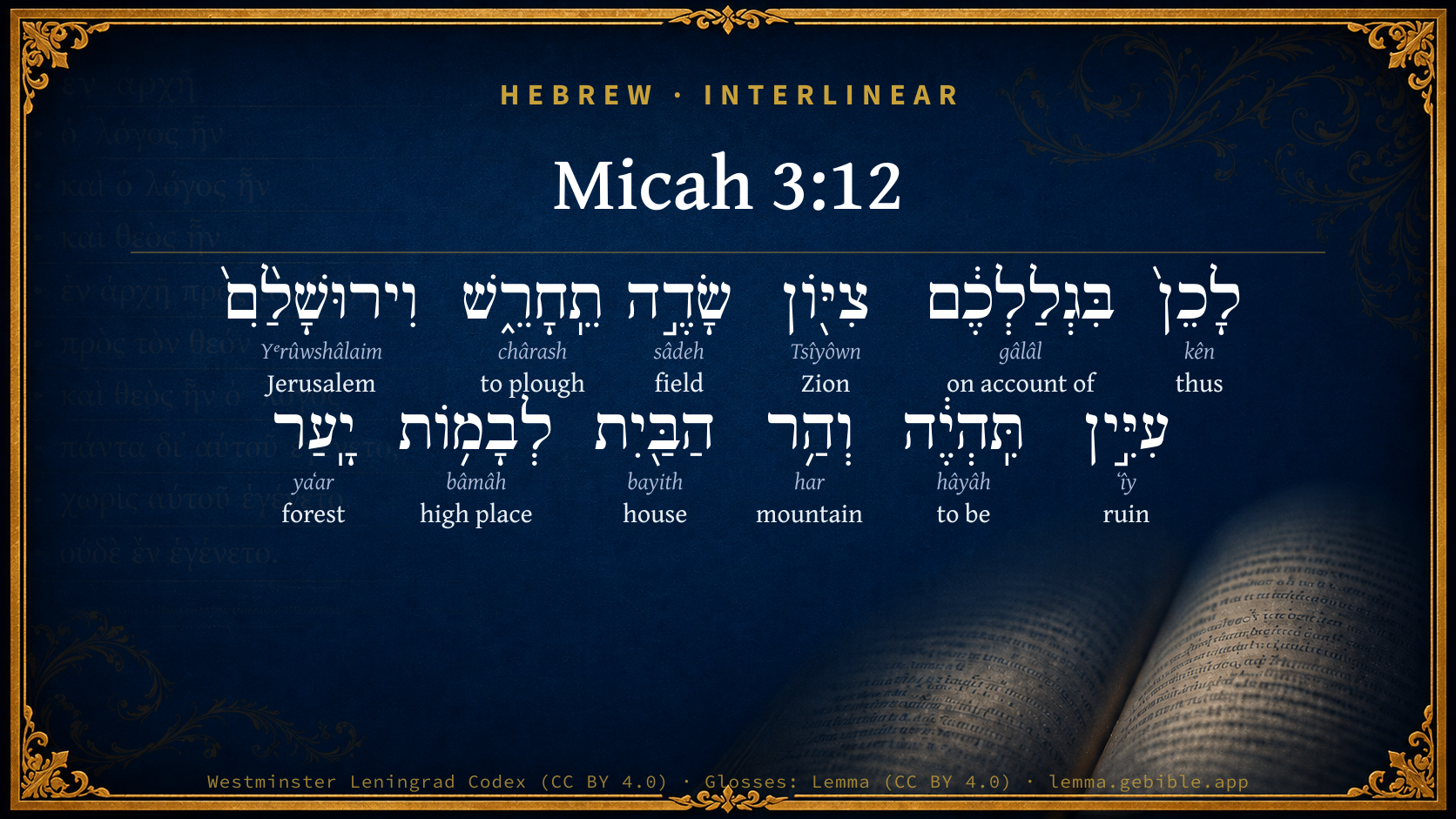
Hebrew (Westminster Leningrad Codex) Micah 3:12 appears in the Hebrew Old Testament. The text above is from the Westminster Leningrad Codex. Each word links to its Strong’s number, a concise gloss, and parsing drawn from the Open Scriptures Hebrew Bible morphology. Click any word for its full Brown-Driver-Briggs (BDB) entry.
Download image
Cite this verse

Micah 3:12 (World English Bible). Public Domain. Lemma interlinear Bible study tool, https://lemma.gebible.app/v/micah/3/12.

Show BibTeX & RIS
BibTeX
RIS
English Translation
Therefore Zion for your sake will be plowed like a field, And Jerusalem will become heaps of rubble, And the mountain of the temple like the high places of a forest.
World English Bible · Public Domain
Download a study sheet

One document with this verse’s original text, its word-by-word gloss line, the meaning frame, cross-references with their text, attributed commentary, and full source and license credits — printable, and it pastes into notes with its structure intact.

This verse Autodidact and up

Study sheet (.html) Plain text (.txt)

A passage Seminary Student

Up to 50 verses in one chapter. A passage sheet keeps up to 6 commentary sources and 12 cross-references per verse, in the order this page ranks them, and says so on the sheet whenever that leaves anything out. Ask for a single verse and you get the Autodidact verse sheet above.

Everything on this page stays free to read, with no account — the sheet is a download of what is already on screen, not access to it.

Want to remove ads? Support Godless Engineer
Compare translations 3

The same verse in 3 English versions, stacked beneath the original-language interlinear above. Click any original word for its lexicon entry.

Each is an independent rendering of the whole verse — the interlinear is not word-aligned to these translations.

Highlighted words mark where these versions differ — a whole-verse word diff, not a word-by-word alignment.

  • World English Bible Public Domain
    Therefore Zion for your sake will be plowed like a field, And Jerusalem will become heaps of rubble, And the mountain of the temple like the high places of a forest.
  • King James Version Public Domain
    Therefore shall Zion for your sake be plowed as a field, and Jerusalem shall become heaps, and the mountain of the house as the high places of the forest.
  • unfoldingWord Literal Text CC BY-SA 4.0
    Therefore, because of you, Zion will be plowed a field, and Jerusalem will become heaps, and the mountain of the house, as high places of a forest.

unfoldingWord Literal Text — © unfoldingWord, licensed CC BY-SA 4.0. Word-aligned USFM3 via Door43 (git.door43.org/unfoldingWord/en_ult).

Versions to compare (up to 4)

3 of 4 selected

Show all 18 translations

Every available English version of this verse, each an independent rendering of the whole verse.

  • World English Bible Public Domain
    Therefore Zion for your sake will be plowed like a field, And Jerusalem will become heaps of rubble, And the mountain of the temple like the high places of a forest.
  • Berean Standard Bible Public Domain
    Therefore, because of you, Zion will be plowed like a field, Jerusalem will become a heap of rubble, and the temple mount a wooded ridge.
  • Majority Standard Bible Public Domain
    Therefore, because of you, Zion will be plowed like a field, Jerusalem will become a heap of rubble, and the temple mount a wooded ridge.
  • King James Version Public Domain
    Therefore shall Zion for your sake be plowed as a field, and Jerusalem shall become heaps, and the mountain of the house as the high places of the forest.
  • American Standard Version (1901) Public Domain
    Therefore shall Zion for your sake be plowed as a field, and Jerusalem shall become heaps, and the mountain of the house as the high places of a forest.
  • Revised Version (1885) Public Domain
    Therefore shall Zion for your sake be plowed as a field, and Jerusalem shall become heaps, and the mountain of the house as the high places of a forest.
  • Geneva Bible (1599) Public Domain
    Therefore shall Zion for your sake bee plowed as a field, and Ierusalem shalbe an heape, and the mountaine of the house, as the hye places of the forest.
  • Douay-Rheims (1899) Public Domain
    Therefore, because of you, Sion shall be ploughed as a field, and Jerusalem shall be as a heap of stones, and the mountain of the temple as the high places of the forests.
  • Young's Literal Translation Public Domain
    Therefore, for your sake, Zion is ploughed a field, and Jerusalem is heaps, And the mount of the house `is' for high places of a forest!
  • Literal Standard Version CC BY-SA 4.0
    Therefore, for your sake, Zion is plowed a field, and Jerusalem is heaps, || And the mountain of the house [is] for high places of a forest!
  • Unlocked Literal Bible CC BY-SA 4.0
    Therefore, because of you, Zion will become a plowed field, Jerusalem will become a heap of rubble, and the hill of the temple will become a thicket.
  • unfoldingWord Literal Text CC BY-SA 4.0
    Therefore, because of you, Zion will be plowed a field, and Jerusalem will become heaps, and the mountain of the house, as high places of a forest.
  • Darby Bible Public Domain
    Therefore shall Zion for your sake be ploughed [as] a field, and Jerusalem shall become heaps, and the mountain of the house as the high places of a forest.
  • World Messianic Bible Public Domain
    Therefore Zion for your sake will be plowed like a field, and Jerusalem will become heaps of rubble, and the mountain of the temple like the high places of a forest.
  • Webster's Bible Public Domain
    Therefore shall Zion for your sake be plowed as a field, and Jerusalem shall become heaps, and the mountain of the house as the high places of the forest.
  • Free Bible Version CC BY-SA 4.0
    Therefore because of you Zion will become a plowed field and Jerusalem a heap of rubble, and the Temple mount will be overgrown.
  • Bible in Basic English Public Domain
    For this reason, Zion will be ploughed like a field because of you, and Jerusalem will become a mass of broken walls, and the mountain of the house like a high place in the woods.
  • JPS Tanakh (1917) Public Domain
    Therefore shall Zion for your sake be plowed as a field, and Jerusalem shall become heaps, and the mountain of the house as the high places of a forest.

Literal Standard Version (2020), Covenant Press — licensed CC BY-SA 4.0. Text via the HelloAO Bible API (eBible.org). Unlocked Literal Bible (unfoldingWord) — licensed CC BY-SA 4.0. Text via the HelloAO Bible API (eBible.org). unfoldingWord Literal Text — © unfoldingWord, licensed CC BY-SA 4.0. Word-aligned USFM3 via Door43 (git.door43.org/unfoldingWord/en_ult). Free Bible Version, Dr. Jonathan Gallagher — licensed CC BY-SA 4.0. Text via the HelloAO Bible API (eBible.org).

Word by word

More ways to search: Search by grammar → Find every occurrence → Compare this word →

Practice this passage: Drill this verse → Learn its vocabulary →

עִיִּ֣ין
ʻîy
H5856
“ruins”
Noun, Common, Masculine, Plural, Absolute
Part of Speech
Noun
Type
Common
Gender
Masculine
Number
Plural
State
Absolute
Full BDB Definition

Origin: from H5753

TWOT: 1577d

ruin, heap of ruins
  1. לָכֵן֙ kên H3651 “to/for · thus” Preposition + Adverb
  2. בִּגְלַלְכֶ֔ם gâlâl H1558 “in/at · on account of · your” Preposition + Noun, Common, Masculine, Singular, Construct + Suffix, Personal, 2nd Person, Masculine, Plural
  3. צִיּ֖וֹן Tsîyôwn H6726 “Zion” Noun, Proper
  4. שָׂדֶ֣ה sâdeh H7704 “field” Noun, Common, Masculine, Singular, Absolute
  5. תֵֽחָרֵ֑שׁ chârash H2790 “to plough” Verb, Niphal, Imperfect, 3rd Person, Feminine, Singular
  6. וִירוּשָׁלִַ֨ם֙ Yᵉrûwshâlaim H3389 “and · Jerusalem” Conjunction + Noun, Proper
  7. תִּֽהְיֶ֔ה hâyâh H1961 “to be” Verb, Qal, Imperfect, 3rd Person, Feminine, Singular
  8. וְהַ֥ר har H2022 “and · mountain of” Conjunction + Noun, Common, Masculine, Singular, Construct
  9. הַבַּ֖יִת bayith H1004 “the · house” Particle, Definite Article + Noun, Common, Masculine, Singular, Absolute
  10. לְבָמ֥וֹת bâmâh H1116 “to/for · high places of” Preposition + Noun, Common, Feminine, Plural, Construct
  11. יָֽעַר yaʻar H3293 “forest” Noun, Common, Masculine, Singular, Absolute

About this verse

These counts appear in no published source. They are computed here, from the morphology-tagged text and Lemma’s own curated glosses. What Lemma adds →

12
words
12
distinct lemmas
Prophets
section

Notable vocabulary

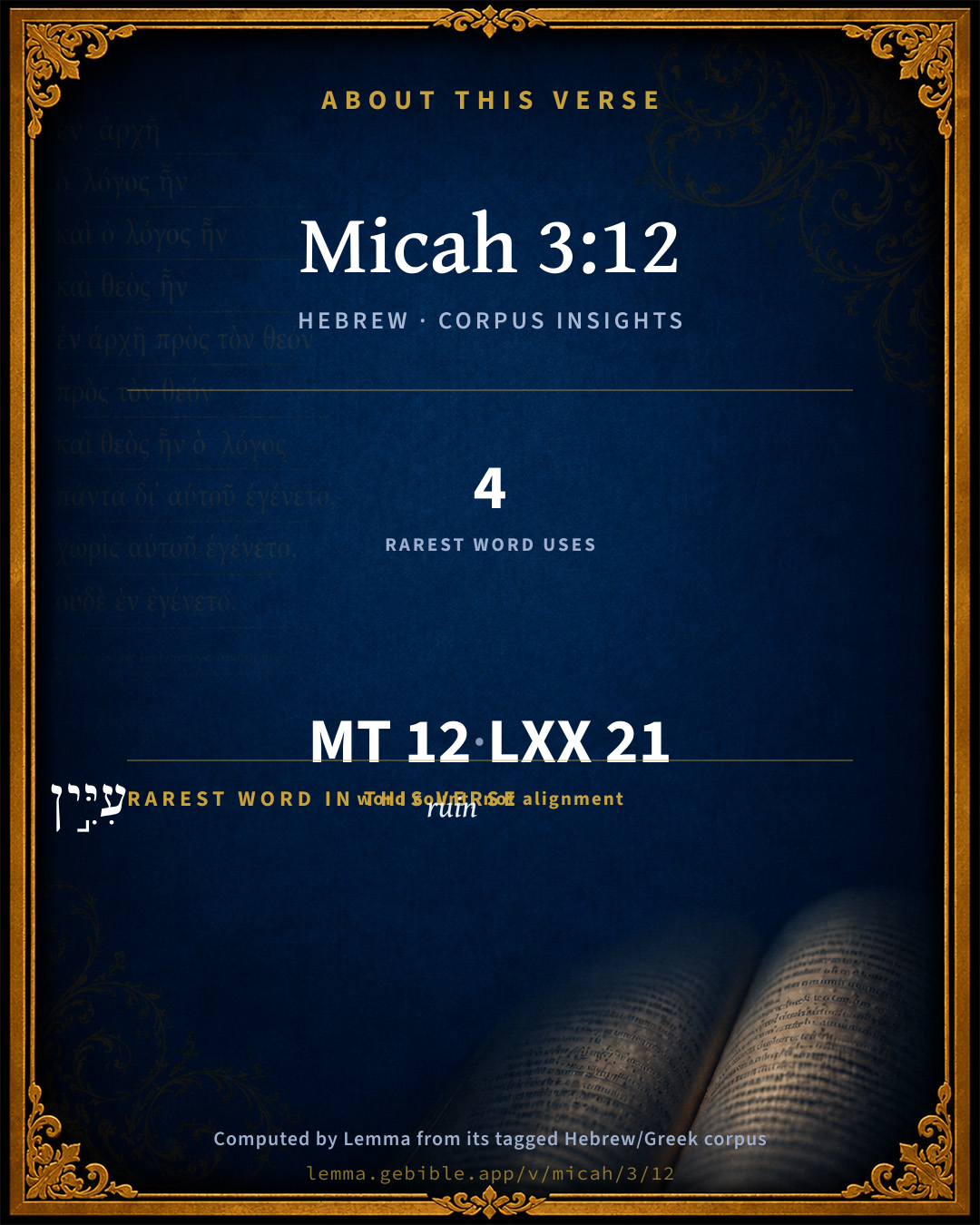
The rarest word here is עִיִּ֣ין ruin H5856 — appearing just 4 times in the whole Hebrew Bible.

Shared distinctive vocabulary

עִיִּ֣ין ruin H5856 occurs in 4 verses of the Hebrew Bible. Also found in:

Grammatical profile

  • 2 verbs
  • 9 nouns
  • 1 adverb

Verb forms

  • תֵֽחָרֵ֑שׁ Niphal · Imperfect
  • תִּֽהְיֶ֔ה Qal · Imperfect

Hebrew & Septuagint length

In English translation the verse runs 31 words from the Hebrew and 32 from the Septuagint (LXX English) — closely comparable.

A rough comparison of the two English renderings, which tokenize alike — not a word-level alignment.

Word counts can differ between the Hebrew and the Greek without any difference in meaning — e.g. the Hebrew direct-object marker אֵת has no separate Greek word, and Greek often adds the article ὁ.

In the original languages it is 12 Hebrew tokens and 21 Greek tokens — but the two are counted differently (Hebrew bundles its prefixes and suffixes into one token; the Greek is in lemma form), so that isn’t a like-for-like length.

Cross-references

8

Topical passages linked to Micah 3:12 in the Treasury of Scripture Knowledge — connected by theme and wording, ordered by reader-vote popularity; previews shown in the World English Bible.

  • Jeremiah 26:18 Micah the Morashtite prophesied in the days of Hezekiah king of Judah; and he spoke to all the people of Judah, saying, Thus says Yahweh of Hosts: Zion shall be plowed as a field, and Jerusalem shall become heaps, and the mountain of the house as the high places of a forest.
  • Psalms 79:1 God, the nations have come into your inheritance. They have defiled your holy temple. They have laid Jerusalem in heaps.
  • Micah 4:1–2 But in the latter days, It will happen that the mountain of Yahweh's temple will be established on the top of the mountains, And it will be exalted above the hills; And peoples will stream to it.
  • Psalms 107:34 And a fruitful land into a salt waste, For the wickedness of those who dwell in it.
  • Micah 1:6 Therefore I will make Samaria like a rubble heap of the field, Like places for planting vineyards; And I will pour down its stones into the valley, And I will uncover its foundations.
  • Matthew 24:2 But he answered them, "Don't you see all of these things? Most assuredly I tell you, there will not be left here one stone on another, that will not be thrown down."
  • Isaiah 2:2–3 It shall happen in the latter days, that the mountain of Yahweh's house shall be established on the top of the mountains, And shall be raised above the hills; And all nations shall flow to it.
  • Acts 6:13–14 and set up false witnesses who said, "This man never stops speaking blasphemous words against this holy place and the law.

Cross-references courtesy of OpenBible.info (CC BY 4.0).

Hebrew and Greek witnesses Masoretic Hebrew ↔ Greek Septuagint

The same verse in the two great witnesses to the Old Testament, shown verse-for-verse.

These are two independent witnesses, not word-aligned to each other, and the Septuagint is shown in lemma (dictionary) form.

Hebrew Micah 3:12 Masoretic · Westminster Leningrad Codex

לָכֵן֙ בִּגְלַלְכֶ֔ם צִיּ֖וֹן שָׂדֶ֣ה תֵֽחָרֵ֑שׁ וִירוּשָׁלִַ֨ם֙ עִיִּ֣ין תִּֽהְיֶ֔ה וְהַ֥ר הַבַּ֖יִת לְבָמ֥וֹת יָֽעַר

Therefore Zion for your sake will be plowed like a field, And Jerusalem will become heaps of rubble, And the mountain of the temple like the high places of a forest.

World English Bible · Public Domain

Greek LXX Micah 3:12 Septuagint · lemma form

διά οὗτος διά σύ σιων ὡς ἀγρός ἀροτριάω καί ἰερουσαλήμ ὡς ὀπωροφυλάκιον εἰμί καί ὁ ὄρος ὁ οἶκος ὡς ἄλσος δρυμός

Therefore on your account Sion shall be plowed as a field, and Jerusalem shall be as a storehouse of fruits, and the mountain of the house as a grove of the forest.

LXX2012 (modern English Septuagint) · Public Domain

On this verse, The Pulpit Commentary discusses the Septuagint’s reading. Read the note in Commentary ↓

Hebrew: Westminster Leningrad Codex (CC BY 4.0). Greek: Septuagint (public domain); English from LXX2012 (modern English Septuagint) (Public Domain). How the Septuagint differs from the Hebrew →

Targum (Aramaic paraphrase)

1

The Targum is the ancient Jewish Aramaic paraphrase of the Hebrew Scriptures — an interpretive translation, not the Hebrew text itself. Onkelos (literal) and Pseudo-Jonathan (expansive) render the Torah, and Jonathan the Prophets. Coverage is partial: where no permissively-licensed English translation exists for a verse, only the Aramaic is shown. This is verse-level text, not a word-by-word alignment to the Hebrew.

  1. Targum Jonathan Prophets (Joshua–Malachi)
    בְּכֵן בְּדִיל חוֹבֵיכוֹן צִיוֹן חֲקַל תִּתְרְדֵי וִירוּשְׁלֵם לְיַגְרִין תְּהֵי וְטוּר בֵּית מַקְדְשָׁא לְחִישַׁת חוּרְשָׁא:

    (no public-domain English translation for this verse)

    Targum Jonathan — Aramaic: “Mikraot Gedolot” (public domain). English: “Sefaria Community Translation” (CC0 1.0 (public-domain dedication)); “London "Chaldee Paraphrase," 1871” (public domain). Text via Sefaria.

Commentary

Notes on Micah 3:12 from classic Christian and Jewish commentators (each source and its license shown beneath its notes). The classic Christian expositions comment on the surrounding passage and are grouped to its opening verse, so a note may address several verses; the Jewish commentaries on the Tanakh (Rashi and others) are per-verse, so they appear only where the commentator wrote on this verse.

Lemma curates 59 commentaries, every one of them public domain or Creative Commons licensed, each selected and text-cleaned for this edition rather than reprinted as found. About our sources →

Jamieson, Fausset & Brown

Robert Jamieson, A. R. Fausset & David Brown

mic 3:12Jer 26:18 quotes this verse. The Talmud and MAIMONIDES record that at the destruction of Jerusalem by the Romans under Titus, Terentius Rufus, who was left in command of the army, with a ploughshare tore up the foundations of the temple.

mountain of the house--the height on which the temple stands.

as the high places of the forest--shall become as heights in a forest overrun with wild shrubs and brushwood.

Next: Micah Chapter 4

Jamieson, Fausset & Brown — Commentary Critical and Explanatory on the Whole Bible (1871) — public domain (CC PDM 1.0). Text via the HelloAO Bible API.

Adam Clarke's Commentary

Verse 12. Therefore shall Zion - be ploughed as a field] It shall undergo a variety of reverses and sackages, till at last there shall not be one stone left on the top of another, that shall not be pulled down; and then a plough shall be drawn along the site of the walls, to signify an irreparable and endless destruction. Of this ancient custom Horace speaks, Odar. lib. i., Od. 16, ver. 18.

Altis urbibus ultimae

Stetere causae cur perirent

Funditus, imprimeretque muris

Hostile aratrum exercitus insolens

"From hence proud cities date their utter falls;

When, insolent in ruin, o'er their walls

The wrathful soldier drags the hostile plough,

That haughty mark of total overthrow."

FRANCIS.

Thus did the Romans treat Jerusalem when it was taken by Titus. Turnus Rufus, or as he is called by St. Jerome, Titus Arinius Rufus, or Terentius Rufus, according to Josephus, caused a plough to be drawn over all the courts of the temple to signify that it should never be rebuilt, and the place only serve for agricultural purposes. See Clarke on Mt 24:2. Thus Jerusalem became heaps, an indiscriminate mass of ruins and rubbish; and the mountain of the house, Mount Moriah, on which the temple stood, became so much neglected after the total destruction of the temple, that it soon resembled the high places of the forest. What is said here may apply also, as before hinted, to the ruin of the temple by Nebuchadnezzar in the last year of the reign of Zedekiah, the last king of the Jews.

As the Masoretes, in their division of the Bible, reckon the twelve minor prophets but as one book, they mark this verse, (Mic 3:12,) the MIDDLE verse of these prophets.

Adam Clarke's Commentary on the Bible (1810–1826) — public domain. Text from a community e-Sword/MySword module.

Trapp's Complete Commentary

John Trapp

Mic 3:12 Therefore shall Zion for your sake be plowed [as] a field, and Jerusalem shall become heaps, and the mountain of the house as the high places of the forest.

Ver. 12. Therefore shall Zion for your sake be plowed as a field] Even for your sakes, O wicked princes, priests, and prophets; you are the traitors that have betrayed us all into the hands of Divine justice. To be angry with us for saying so, and telling you what to trust to, is as if some fond people should be angry with the herald, or the trumpet, as the cause of their wars.

Zion shall be plowed as a field] Shall be utterly laid waste and levelled. Conquerors used to plough up those places that they would not have rebuilt; and to sow them with salt, Jdg 9:45. It must needs be a dismal destruction that is described in such exquisite terms. Alterius perditio tua sit cautio. This threatening of the prophet took so well that the judgment was respited for over a hundred years, Jer 26:19. But now men’s hearts are more hardened, and therefore their destruction more hastened.

And Jerusalem shall become heaps] Rupes ruderum. This they once thought as possible as to overthrow God’s own throne; the very disciples had a conceit that the world could not outlast the temple, as may be gathered from Mat 24:3. But they (some of them) lived to see themselves confuted, and our Saviour’s words verified, "There shall not be left here one stone upon another that shall not be thrown down," Mat 24:2.

And the mountain of the house] That famous house, that was worthily reckoned one of the seven wonders of the world, and stood upon Mount Moriah.

As the high places of the forest] As woody and desert places, fit only for wild beasts. Lege et Luge, Read and weep, saith one, speaking of Jerusalem’s desolation.

John Trapp, A Commentary or Exposition upon All the Books of the Old and New Testament (1647–1656) — public domain. Text from a community e-Sword module.

Joseph Benson's Commentary

Mic 3:12. Therefore shall Zion for your sake — That is, because of your transgressions, ye judges, priests, and prophets; be ploughed as a field — “There is nothing which hinders us from referring this prophecy to the first destruction of Jerusalem: for though the foundations of the walls were left, yet a great number of houses within the city were overturned, as well by the Chaldeans as by the Jews themselves; who possibly used the materials to repair the breaches made in the walls during the long siege they underwent; when there could be no wonder if many places were ploughed as a field, for the purposes of corn, which before were gardens and houses: see 1Ma 4:38. The prophecy, however, may have a further respect to the total destruction of Jerusalem when Terentius Rufus, by the order of Titus, ploughed up the very foundations of it.” See Houbigant and Calmet. And Jerusalem shall become heaps — The word heaps alludes to the heaps of stones laid up together in fields newly ploughed. And the mountain of the house — That is, of the Lord’s house; as the high places of the forest — The place where the temple stood, which was upon mount Moriah, shall be overrun with grass and shrubs, like mountains situated in a forest. This is that passage, quoted Jer 26:18, which Hezekiah and his princes took in good part, yea, it seems, they believed and laid it to heart, in consequence whereof they repented, and so the execution of it did not come in their days.

Joseph Benson's Commentary on the Old and New Testaments (1811–1818) — public domain. Text from a community e-Sword module.

Tyndale Open Study Notes

Tyndale Open Resources

3:12 Mount Zion, where the Lord once lived, would become a thicket, an uninhabitable wilderness. Utter destruction awaited the fallen Jerusalem. Jeremiah later quoted this passage (Jer 26:18). • Just as a field needs to be cleared to prepare it for cultivation, Jerusalem had to be reduced to ruins in judgment.

Tyndale Open Study Notes — © Tyndale Open Resources, licensed CC BY-SA 4.0. Text via the HelloAO Bible API.

Geneva Bible (1599)

Geneva Bible translators

Read Jer. 26:18.

Geneva Bible (1599) marginal notes — public domain. Text via Bolls.life.

John Calvin's Commentaries

Now follows a threatening, Therefore, on your account, Zion as a field shall be plowed, and Jerusalem a heap shall be, and the mount of the house as the high places of a forest We here see how intolerable to God hypocrites are; for it was no ordinary proof of a dreadful vengeance, that the Lord should expose to reproach the holy city, and mount Zion, and his own temple. This revenge, then, being so severe, shows that to God there is nothing less tolerable than that false confidence with which hypocrites swell, for it brings dishonor on God himself; for they could not boast that they were God’s people without aspersing him with many reproaches. What then is the meaning of this, “God is in the midst of us,” except that they thereby declared that they were the representatives (vicarios) of God, that the kingdom was sacred and also the priesthood? Since then they boasted that they did not presumptuously claim either the priesthood or the regal power, but that they were divinely appointed, we hence see that their profanation of God’s name was most shameful. It is then no wonder that God was so exceedingly displeased with them: and hence the Prophet says, For you shall Zion as a field be plowed; as though he said, “This is like something monstrous, that the temple should be subverted, that the holy mount and the whole city should be entirely demolished, and that nothing should remain but a horrible desolation, — who can believe all this? It shall however, take place, and it shall take place on your account; you will have to bear the blame of this so monstrous a change.” For it was as though God had thrown heaven and earth into confusion; inasmuch as he himself was the founder of the temple; and we know with what high encomiums the place was honored. Since then the temple was built, as it were, by the hand of God, how could it be otherwise, but that, when destroyed, the waste and desolate place should be regarded as a memorable proof of vengeance? There is therefore no doubt but that Micah intended to mark out the atrocity of their guilt, when he says, For you shall Zion as a field be plowed, Jerusalem shall become a heap of stones; that is, it shall be so desolated, that no vestige of a city, well formed and regularly built, shall remain.

And the mount of the house, etc. He again mentions Zion, and not without reason: for the Jews thought that they were protected by the city Jerusalem; the whole country rested under its shadow, because it was the holy habitation of God. And again, the city itself depended on the temple, and it was supposed, that it was safe under this protection, and that it could hardly be demolished without overthrowing the throne of God himself: for as God dwelt between the cherubim, it was regarded by the people as a fortress incapable of being assailed. As then the holiness of the mount deceived them, it was necessary to repeat what was then almost incredible, at least difficult of being believed. He therefore adds, The mount of the house shall be as the high places of a forest; that is, trees shall grow there.

Why does he again declare what had been before expressed with sufficient clearness? Because it was not only a thing difficult to be believed, but also wholly inconsistent with reason, when what the Lord had said was considered, and that overlooked which hypocrites ever forget. God had indeed made a covenant with the people; but hypocrites wished to have God, as it were, bound to them, and, at the same time, to remain themselves free, yea, to have a full liberty to lead a wicked life. Since then the Jews were fixed in this false opinion, — that God could not be disunited from his people, the Prophet confirms the same truth, that the mount of the house would be as the high places of a forest. And, by way of concession, he calls it the mount of the house, that is, of the temple; as though he said, “Though God had chosen to himself a habitation, in which to dwell, yet this favor shall not keep the temple from being deserted and laid waste; for it has been profaned by your wickedness.”

Let us now see at what time Micah delivered this prophecy. This we learn from Jeremiah 26; for when Jeremiah prophesied against the temple, he was immediately seized and cast into prison; a tumultuous council was held, and he was well nigh being brought forth unto execution. All the princes condemned him; and when now he had no hope of deliverance, he wished, not so much to plead his own cause, as to denounce a threatening on them, that they might know that they could effect no good by condemning an innocent man. “Micah, the Morasthite,” he said, “prophesied in the days of Hezekiah, and said thus, ‘Zion as a field shall be plowed, Jerusalem shall be a heap, and the mount of the house as the high placers of a forest.’” Did the king and the people, he said, consult together to kill him? Nay, but the king turned, and so God repented; that is, the Lord deferred his vengeance; for king Hezekiah humbly deprecated the punishment which had been denounced. We now then know with certainty the time.

But it was strange that under such a holy king so many and so shameful corruptions prevailed, for he no doubt tried all he could to exercise authority over the people, and by his own example taught the judges faithfully and uprightly to discharge their office; but he was not able, with all his efforts, to prevent the Priests, and the Judges, and the Prophets, from being mercenaries. We hence learn how sedulously pious magistrates ought to labor, lest the state of the Church should degenerate; for however vigilant they may be, they can yet hardly, even with the greatest care, keep things (as mankind are so full of vices) from becoming very soon worse. This is one thing. And now the circumstance of the time ought to be noticed for another purpose: Micah hesitated not to threaten with such a judgment the temple and the city, though he saw that the king was endued with singular virtues. He might have thought thus with himself, “King Hezekiah labored strenuously in the execution of his high office: now if a reproof so sharp and so severe will reach his ears, he will either despond, or think me to be a man extremely rigid, or, it may be, he will become exasperated against sound doctrine.” The Prophet might have weighed these things in his mind; but, nevertheless, he followed his true course in teaching, and there is no doubt but that his severity pleased the king, for we know that he was oppressed with great cares and anxieties, because he could not, by all his striving, keep within proper bounds his counselors, the priests and the prophets. He therefore wished to have God’s servants as his helpers. And this is what pious magistrates always desire, that their toils may in some measure be alleviated by the aid of the ministers of the word; for when the ministers of the word only teach in a cold manner, and are not intent on reproving vices, the severity of the magistrates will be hated by the people. “Why, see, the ministers say nothing, and we hence conclude that they do not perceive so great evils; and yet the magistrates with the drawn sword inflict new punishments daily.” When, therefore, teachers are thus silent, a greater odium no doubt is incurred by the magistrates: it is hence, as I have said, a desirable thing for them, that the free reproofs of teachers should be added to the punishments and judgments of the law.

We further see how calm and meek was the spirit of the king, that he could bear the great severity of the Prophet: Behold, he said, on your accounts etc.: “Thou oughtest at least to have excepted” me.” For the king was not himself guilty. Why then did he connect him with the rest? Because the whole body was infected with contagion, and he spoke generally; and the good king did not retort nor even murmur, but, as we have recited from Jeremiah, he humbly deprecated the wrath of God, as though a part of the guilt belonged to him. Now follows —

John Calvin's Commentaries (1540-1563) — public domain. Text from the Calvin Translation Society English edition (1840s-50s) via the Christian Classics Ethereal Library (ccel.org). Calvin's coverage is partial (roughly two-thirds of the Bible); uncommented books and verses are honest gaps, never fabricated. The 19th-century editor's footnotes and remarks are omitted so the notes are faithfully Calvin's own voice.

Ellicott's Commentary for English Readers

(12) Therefore shall Zion . . .—Micah declared this sentence of Divine judgment with an intrepidity that was long remembered by the Jews. More than a century later the elders of the land, speaking in justification of the course taken by Jeremiah, used as a precedent the example of Micah. They spake to all the assembly of the people, saying, “Micah the Morasthite prophesied in the days of Hezekiah, king of Judah, saying, ‘Thus saith the Lord of hosts, Zion shall be plowed like a field, and Jerusalem shall become heaps, and the mountain of the house as the high places of a forest.’ Did Hezekiah, king of Judah, and all Judah put him at all to death? Did he not fear the Lord, and besought the Lord, and the Lord repented Him of the evil which He had pronounced against them?” (Jer_26:17-19).

Shall become heaps.—So also, in after-days, the doom of Jerusalem was pronounced by our Lord: “The days will come when there shall not be left one stone upon another that shall not be thrown down.”

A Bible Commentary for English Readers, edited by Charles John Ellicott (1878–1897) — public domain. Text from a community e-Sword module.

The Cambridge Bible for Schools and Colleges

gen. ed. J. J. S. Perowne

12. be plowed as a field] This striking prophecy was quoted at a critical point in the history of Jeremiah when ‘the priests and the prophets and all the people’ had pronounced sentence of death upon the prophet by acclamation. ‘Certain of the elders of the land’ we are told invoked the respectful treatment of Micah by king Hezekiah as a precedent for granting Jeremiah a similar immunity. So far from putting Micah to death, Hezekiah, they declare, had been moved by his sombre prediction to ‘fear the Lord and beseech the Lord,’ ‘and the Lord repented him of the evil which he had pronounced upon them’ (Jer_26:17-19). In fact, all prophecy is conditional. The prophets declare the great principles of God’s moral government, and apply them to individual cases. But if the moral conditions of the cases to which these principles are applied be altered, the threatening or the promise is postponed, modified, or recalled. We have no difficulty therefore, in reconciling the genuineness of Micah’s prophecy with the fact thus stated by Dean Stanley. “The destruction which was then threatened has never been completely fulfilled. Part of the southeastern portion of the city has for several centuries been arable land; but the rest has always been within the walls. In the Maccabæan wars (1Ma_4:38) the Temple courts were overgrown with shrubs, but this has never been the case since.” (Jewish Church, ii. 464.) There is a parallel to this passage of Micah in Isaiah (Isa_32:13-14), which is all the more remarkable as Isaiah generally predicts the destruction of the Assyrians and the deliverance of Jerusalem (e.g. Isa_29:5, Isa_30:19, Isa_31:4). At the time when Micah and Isaiah delivered their gloomy vaticinations, the moral state of Jerusalem must have been worse than usual. The uncompromising severity with which they announced the inevitable punishment was (as Jer_26:17-19 shews) the means chosen of God for producing at least a partial repentance.

the mountain of the house] i.e. mount Moriah.

as the high places of the forest] Rather, heights in the wood. The temple-mount shall be overgrown with low brushwood (comp. Isa_32:13). The word rendered ‘heights’ (bâmôth) may also mean ‘high places,’ and perhaps the writer means to suggest that the temple shall be treated no better than if it were a ‘high place.’ The plural ‘heights’ to correspond to the plural ‘heaps.’

The Cambridge Bible for Schools and Colleges (gen. ed. J. J. S. Perowne; Cambridge University Press, 1878–1918) — public domain. Text from a community e-Sword module.

John Gill's Exposition

Therefore shall Zion for your sake be ploughed as a field,.... That is, for your sins, as the Targum; for the bloodshed, injustice, and avarice of the princes, priests, and prophets; not that the common people were free from crimes; but these are particularly mentioned, as being ringleaders into sin, and who ought to have set better examples; as also to take off their vain confidence in themselves, who thought that Zion and Jerusalem would be built up and established by them, and preserved for their sakes; as well as to show the prophet's boldness and intrepidity in his rebukes and menaces of them: now this was prophesied of in the days of Hezekiah, before the invasion of Judea and siege of Jerusalem by Sennacherib; it was deferred upon the repentance and reformation of the people; and was fulfilled in part at the destruction of Jerusalem by the Chaldeans, when the city was reduced to a heap of rubbish; and more fully when it was destroyed by the Romans, and ploughed up by Terentius, or Turnus Rufus, as the Jews say; so that there was not a house or building left upon it, but it became utterly desolate and uninhabited, especially in the reign of Adrian:

and Jerusalem shall become heaps; not only the city of David, built on Mount Zion, should be demolished, but the other part of the city called Jerusalem should be thrown down, and its walls and houses lie in heaps, like heaps of stones in the midst of a ploughed field:

and the mountain of the house as the high places of the forest; Mount Moriah, on which the temple was built; hence called here, by the Targum, the mountain of the house of the sanctuary; the temple upon it should be destroyed, and not one, tone left upon another; and the place on which it stood be covered with grass and trees, with briers and thorns, as a forest is, all which have been exactly fulfilled. The Jews say (i) of Turnus Rufus before mentioned, that he both ploughed up the city of Jerusalem, and the temple, the ground on which they stood; and Jerom (k) affirms the temple was ploughed up by Titus Annius Ruffus; which, as it literally fulfilled this prophecy, denotes the utter destruction of them; for, as it was usual with the ancients to mark out with a plough the ground on which a city was designed to be built; so they drew one over the spot where any had stood, which was become desolate, and to signify that the city was no more to be rebuilt and inhabited: thus Seneca (l), Horace (m), and other writers, express the utter destruction of a city by such phrases.

(i) T. Hieros. Taaniot. fol. 69. 2. Juchasin, fol. 36. 2. & Ganz Tzemach David, par. 1. fol. 28. 1. (k) Comment. in Zech. viii. 19. (l) "Aratrum vetustis urbibus inducere", Seneca de Clementia, l. 1. c. 26. (m) "------Imprimeretque muris Hostile aratrum exercitus insolens". Hor. Carmin. l. 1. Ode 36.

Next: Micah Chapter 4

John Gill's Exposition of the Whole Bible (1746–1763) — public domain (CC PDM 1.0). Text via the HelloAO Bible API.

Albert Barnes' Notes on the Bible

Therefore shall Zion for your sake - for your sake shall Zion

Be plowed as a field - They thought to be its builders; they were its destroyers. They imagined to advance or secure its temporal prosperity by bloods; they (as men ever do first or last,) ruined it. Zion might have stood, but for these its acute, far-sighted politicians, who scorned the warnings of the prophets, as well-meant ignorance of the world or of the necessities of the state. They taught, perhaps they thought, that “for Zion’s sake” they, (act as they might,) were secure. Practical Antinomians! God says, that, “for their sake,” Zion, defiled by their deeds, should be destroyed. The fulfillment of the prophecy was delayed by the repentance under Hezekiah. Did he not, the elders ask Jer 26:19, fear the Lord and besought the Lord, and the Lord repented Him of the evil which He had pronounced against them? But the prophecy remained, like that of Jonah against Nineveh, and, when man undid and in act repented of his repentanee, it found its fulfillment.

Jerusalem shall become heaps - (Literally, of ruins) and “the mountain of the house,” Mount Moriah, on which the house of God stood, “as the high places of the forest,” literally “as high places of a forest.” It should return wholly to what it had been, before Abraham offered up the typical sacrifice of his son, a wild and desolate place covered with tangled thickets Gen 22:13.

The prophecy had a first fulfillment at its first capture by Nebuchadnezzar. Jeremiah mourns over it; “Because of the mountain of Zion which is desolate, foxes walk” Lam 5:18 (habitually upon it. Nehemiah said, “Ye see the distress that we are in, how Jerusalem lieth waste” Neh 2:17; and Sanballat mocked at the attempts to rebuild it, as a thing impossible; “Will they revive the stones out of the heaps of dust, and these too, burned?” (Neh 4:2, (3:34, Hebrew)), and the builders complained; “The strength of the bearers of burdens is decayed (literally, sinketh under them), and there is much dust, and we are not able to build the wall” (Neh 4:10, (Neh 4:4, Hebrew)). In the desolation under Antiochus again it is related; “they saw the sanctuary desolate, and the altar profaned, and the gates burned up, and shrubs growing in the courts, as in a forest or in one of the mountains” (1 Macc. 4:38). When, by the shedding of the Blood of the Lord, they “filled up the measure of their fathers” Mat 23:32, and called the curse upon themselves, “His Blood be upon us and upon our children” Mat 27:25, destruction came upon them to the uttermost.

With the exception of three towers, left to exhibit the greatness of Roman prowess in destroying such and so strong a city, they , “so levelled to the ground the whole circuit of the city, that to a stranger it presented no token of ever having been inhabited.” He “effaced the rest of the city,” says the Jewish historian, himself an eyewitness . The elder Pliny soon after, 77 a.d., speaks of it, as a city which had been and was not . “Where was Jerusalem, far the most renowned city, not of Judaea only, but of the East” , a funeral pile.”

With this corresponds Jerome’s statement , “relics of the city remained for fifty years until the Emperor Hadrian.” Still it was in utter ruins . The toleration of the Jewish school at Jamnia the more illustrates the desolation of Jerusalem where there was none. The Talmud relates how R. Akiba smiled when others wept at seeing a fox coming out of the Holy of holies. This prophecy of Micah being fulfilled, he looked the more for the prophecy of good things to come, connected therewith. Not Jerusalem only, but well-nigh all Judaea was desolated by that war, in which a million and a half perished , beside all who were sold as slaves. “Their country to which you would expell them, is destroyed, and there is no place to receive them,” was Titus’ expostulation to the Antiochenes, who desired to be rid of the Jews their fellow-citizens.

A pagan historian relates how, before the destruction by Hadrian , “many wolves and hyenas entered their cities howling.” Titus however having left above 6,000 Roman soldiers on the spot, a civil population was required to minister to their needs. The Christians who, following our Lord’s warning, had fled to Pella , returned to Jerusalem , and continued there until the second destruction by Hadrian, under fifteen successive Bishops . Some few Jews had been left there ; some very probably returned, since we hear of no prohibition from the Romans, until after the fanatic revolt under Barcocheba. But the fact that when toward the close of Trajan’s reign they burst out simultaneously, in one wild frenzy , upon the surrounding pagan, all along the coast of Africa, Libya, Cyrene, Egypt, the Thebais, Mesopotamia, Cyprus , there was no insurrection in Judaea, implies that there were no great numbers of Jews there.

Judaea, aforetime the center of rebellion, contributed nothing to that wide national insurrection, in which the carnage was so terrible, as though it had been one convulsive effort of the Jews to root out their enemies . Even in the subsequent war under Hadrian, Orosius speaks of them, as “laying waste the province of Palestine, once their own,” as though they had gained possession of it from without, not by insurrection within it. The Jews assert that in the time of Joshua Ben Chananiah (under Trajan) “the kingdom of wickedness decreed that the temple should be rebuilt” . If this was so, the massacres toward the end of Trajan’s reign altered the policy of the Empire. Apparently the Emperors attempted to extinguish the Jewish, as, at other times, the Christian faith. A pagan Author mentions the prohibition of circumcision .

The Jerusalem Talmud speaks of many who for fear became uncircumcised, and renewed the symbol of their faith “when Bar Cozibah got the better, so as to reign 2 12 years among them.” The Jews add, that the prohibition extended to the keeping of the sabbath and the reading of the law . Hadrian’s city, Aelia, was doubtless intended, not only for a strong position, but also to efface the memory of Jerusalem by the Roman and pagan city which was to replace it. Christians, when persecuted, suffered; Jews rebelled. The recognition of Barcocheba, who gave himself out as the Messiah , by Akibah and “all the wise (Jews) of his generation” , made the war national.

Palestine was the chief seat of the war, but not its source. The Jews throughout the Roman world were in arms against their conquerors ; and the number of fortresses and villages which they got possession of, and which were destroyed by the Romans , shows that their successes were far beyond Judaea. Their measures in Judaea attest the desolate condition of the country. They fortified, not towns, but “the advantageous positions of the country, strengthened them with mines and walls, that, if defeated, they might have places of refuge, and communication among themselves underground unperceived.”

For two years, (as appears from the coins struck by Barcocheba They had possession of Jerusalem. It was essential to his claim to be a temporal Messiah. They proposed, at least, to “rebuild their temple” and restore their polity.” But they could not fortify Jerusalem. Its siege is just named ; but the one place which obstinately resisted the Romans was a strong city near Jerusalem , known before only as a deeply indented mountain tract, Bether . Probably, it was one of the strong positions, fortified in haste, at the beginning of the war .

The Jews fulfilled our Lord’s words, “I am come in My Father’s Name and ye receive Me not; if another shall come in his own name, him ye will receive” Joh 5:43. Their first destruction was the punishment of their Deicide, the crucifixion of Jesus, the Christ; their second they brought upon themselves by accepting a false Christ, a robber and juggler . “580,000 are said to have perished in battle” , besides “an incalculable number by famine and fire, so that all Judaea was made well-nigh a desert.” The Jews say that “no olives remained in Palestine.” Hadrian “destroyed it,” making it “an utter desolation” and “effacing all remains of it.” “We read” , says Jerome (in Joe 1:4), “the expedition of Aelius Hadrianus against the Jews, who so destroyed Jerusalem and its walls, as, from the fragments and ashes of the city to build a city, named from himself, Aelia.” At this time there appears to have been a formal act, whereby the Romans marked the legal annihilation of cities; an act esteemed, at this time, one of most extreme severity . When a city was to be built, its compass was marked with a plow; the Romans, where they willed to unmake a city, did, on rare occasions, turn up its soil with the plow. Hence, the saying , “A city with a plow is built, with a plow overthrown.” The city so plowed forfeited all civil rights ; it was counted to have ceased to be.

The symbolical act under Hadrian appears to have been directed against both the civil and religious existence of their city, since the revolts of the Jews were mixed up with their religious hopes. The Jews relate that both the city generally, and the Temple, were plowed. The plowing of the city was the last of those mournful memories, which made the month Ab a time of sorrow. But the plowing of the temple is also especially recorded. Jerome says , “In this (the 5th Month) was the Temple at Jerusalem burnt and destroyed, both by Nebuchadnezzar, and many years afterward by Titus and Vespasian; the city Bether, whither thousands of Jews had fled, was taken; the Temple was plowed, as an insult to the conquered race, by Titus Annius Rufus.” The Gemara says , “When Turnus, (or it may be “when Tyrant) Rutus plowed the porch,” (of the temple) Perhaps Hadrian meant thus to declare the desecration of the site of the Temple, and so to make way for the further desecration by his temple of Jupiter. He would declare the worship of God at an end.

The horrible desecration of placing the temple of Ashtaroth over the Holy Sepulchre was probably a part of the same policy, to make the Holy City utterly pagan. The “Capitoline” was part of its new name in honor of the Jupiter of the Roman Capitol. Hadrian intended, not to rebuild Jerusalem, but to build a new city under his own name . “The city being thus bared of the Jewish nation, and its old inhabitants having been utterly destroyed, and an alien race settled there, the Roman city which afterward arose, having changed its name, is called Aelia in honor of the Emperor Aelius Hadrianus.” It was a Roman colony , with Roman temples, Roman amphitheaters.

Idolatry was stamped on its coins . Hadrian excluded from it, on the North, almost the whole of Bezetha or the new city, which Agrippa had enclosed by his wall, and, on the South, more than half of Mount Zion , which was left, as Micah foretold, to be plowed as a field. The Jews themselves were prohibited from entering the Holy Land , so that the pagan Celsus says , “they have neither a clod nor a hearth left.” Aelia, then, being a new city, Jerusalem was spoken of, as having ceased to be. The Roman magistrates, even in Palestine, did not know the name . Christians too used the name Aelia and that, in solemn documents, as the Dr. of Nice .

In the 4th century the city was still called Aelia by the Christians , and, on the first Mohammedan coin in the 7th century, it still bore that name. A series of writers speak of the desolation of Jerusalem. In the next century Origen addresses a Jew , “If going to the earthly city, Jerusalem, thou shalt find it overthrown, reduced to dust and ashes, weep not, as ye now do.” : “From that (Hadrian’s) time until now, the extremest desolation having taken possession of the place, their once renowned hill of Zion - now no wise differing from the rest of the country, is cultivated by Romans, so that we ourselves have with our own eyes observed the place plowed by oxen and sown all over. And Jerusalem, being inhabited by aliens, has to this day the stones gathered out of it, all the inhabitants, in our own times too, gathering up the stones out of its ruins for their private or public and common buildings. You may observe with your own eyes the mournful sight, how the stones from the Temple itself and from the Holy of holies have been taken for the idol-temples and to build amphitheaters.” : “Their once holy place has now come to such a state, as in no way to fall short of the overthrow of Sodom.” Hilary, who had been banished into the East, says , “The Royal city of David, taken by the Babylonians and overthrown, held not its queenly dignity under the rule of its lords; but, taken afterward and burnt by the Romans, it now is not.”

Cyril of Jerusalem, Bishop of the new town, and delivering his catechetical lectures in the Church of the Holy Sepulchre, pointed out to his hearers the fulfillment of prophecy ; “The place (Zion) is now filled with gardens of cucumbers.” “If they (the Jews) plead the captivity,” says Athanasius , “and say that on that ground Jerusalem is not.” “The whole world, over which they are scattered,” says Gregory of Nazianzum , “is one monument of their calamity, their worship closed, and the soil of Jerusalem itself scarcely known.”

It is apparently part of the gradual and increasing fulfillment of God’s word, that the plowing of the city and of the site of the Temple, and the continued cultivation of so large a portion of Zion, are recorded in the last visitation when its iniquity was full. It still remains plowed as a field. : “At the time I visited this sacred ground, one part of it supported a crop of barley, another was undergoing the labor of the plow, and the soil, turned up, consisted of stone and lime filled with earth, such as is usually met with in the foundations of ruined cities. It is nearly a mile in circumference.” : “On the southeast Zion slopes down, in a series of cultivated terraces, sharply though not abruptly, to the sites of the Kings’ gardens. Here and around to the south the whole declivities are sprinkled with olive trees, which grow luxuriantly among the narrow slips of corn.” Not Christians only, but Jews also have seen herein the fulfillment upon themselves of Micah’s words, spoken now “26 centuries ago.”

Albert Barnes' Notes on the Bible (1834–1885) — public domain. Text from a community e-Sword/MySword module.

Haydock's Catholic Bible Commentary

Forests, after its destruction by Nabuchodonosor. (Calmet) --- In the space of three years’ neglect, shrubs were growing in the courts of the temple, 1 Machabees iv. 38. (Haydock) --- Rufus ploughed up the spot where the temple had stood, after the Romans had burnt it down. (St. Jerome; Josephus, Jewish Wars vii. 20.) --- This prediction made a deep impression on the minds of the people. It caused them to refrain from killing Jeremias, ver. 1. (Calmet)

George Leo Haydock (1774–1849), Haydock's Catholic Family Bible and Commentary, 1859 edition — public domain. Excludes Psalms (Douay-Rheims chapter numbering differs from Protestant) and Deuterocanonical books (Catholic canon only).

Matthew Poole's English Annotations

By this it appears that this sermon was preached to Judah and its governors, priests, and prophets, who were thus wicked in Ahaz’s time, and probably continued so in the beginning of Hezekiah’s time. Jeremiah puts this out of all doubt, Jer 26:18, saying that Micah spake these words to all Judah. As for the time, it was in all likelihood before the thirteenth year of Hezekiah, say some; I rather think it was in the very beginning of Hezekiah, and that this might awaken them of that age to comply with Hezekiah in the reformation. Zion here is threatened as endangered, nay ruined, by the sins of magistrates, priests, and prophets: they thought that Zion should be their safety, however they sinned; God by his prophet assures them the quite contrary, their sins should be the danger and destruction of Zion.

For your sake; because your sins are so great and many. God would have spared Sodom for the sake of righteous men, these may be safety to a city; but God will not spare the wicked for any place’s sake, nor shall a temple be more security to a wicked people than heaven was to sinning angels. Though these flagitious men cried out against Micah, and suchlike men, as a public danger, truth is, the injustice, idolatry, and inhumanity of public persons were the great danger.

Ploughed as a field; either by the enemy and conqueror, thereby forbidding it to be ploughed without his leave, or by such as remained after the body of the people were carried captive. Jerusalem, one of the goodliest cities of the world, proud in its lofty and beautiful buildings, the city of the great King, shall become heaps; shall all lie in rubbish, its stately buildings shall be demolished and lie buried in their own ruins.

The mountain of the house, holy mountain, on which the temple, one of the wonders of the world, did stand, beautified with rarest buildings,

as the high places of the forest; shall lie so long waste as to be run over with wood as a forest, and be a lodge of wild beasts.

Matthew Poole's English Annotations on the Holy Bible (1683–1685) — public domain. Text from a community e-Sword/MySword module.

Whedon's Commentary on the Bible

Daniel D. Whedon

12. The inevitable results of such criminal folly must be severe judgment.

Zion… Jerusalem… mountain of the house — The three names might denote three distinct sections of the capital: Zion, the southeast spur of Mount Ophel, the ancient Jebusite stronghold, including the royal palaces; the mountain of the house, the temple area; Jerusalem, the city proper; or they might be understood as synonymous expressions, each denoting the entire city, the three expressions being used to make possible the use of several verbs; such usage would emphasize the completeness of the destruction. Whichever of these two interpretations one may accept, there can be no doubt that the prophet means to foretell the utter destruction of Jerusalem. It will fall into ruin and will be plowed like a field; even the temple mount will be forsaken and will be turned into jungle. Concerning the fulfillment of this prophecy, Stanley says: “The destruction which was then threatened has never been completely fulfilled. Part of the southeast portion of the city has for several centuries been arable land, but the rest has always been within the walls. In the Maccabean wars (1Ma_4:38) the temple courts were overgrown with shrubs, but this has never been the case since.” With this prophecy compare Isa_32:13-14. The utterance of Micah is quoted in Jer_26:18, in defense of Jeremiah, who was accused of blasphemy because he predicted a similar destruction of Jerusalem.

Daniel D. Whedon (gen. ed.), Commentary on the Old and New Testaments (1874–1909) — public domain. Text from a community e-Sword module.

The Pulpit Commentary

This is the prophecy quoted by the elders to King Jehoiakim. (Jer_26:17, etc.) It may have been delivered before Hezekiah"s time originally, and repeated in his reign, when it was productive of a reformation. The denunciation is a mourn-fill contrast to the announcement Mic_2:12; but it was never completely fulfilled, being, like all such judgments, conditioned by circumstances. Therefore... for your sake. For the crimes of rulers, priests, and prophets. Shall Zion... be ploughed as a field. Three localities are specified which destruction shall overtake Zion, Jerusalem, and the temple. Zion means that part of the city where stood the royal palace. The prophecy relates primarily to the destruction of the city by the Chaldeans, when, as Jeremiah testifies, (Lam_5:18) Zion was desolate and foxes walked upon it. The expression in the text may be hyperbolical, but we know that the ploughing up of the foundations of captured cities is often alluded to. Thus Horace, "Carm.," 1:16, 20"...imprimeretque muris Hostile aratrum exercitus insolens. (Comp. "Propert.," 3:7, 41; and for the whole passage, Isa_32:13, Isa_32:14) "The general surface of Mount Zion descends steeply eastwards into the Tyropoeon and Kidron, and southwards into the Valley of Hinnom. The whole of the hill here is under cultivation, and presents a most literal fulfilment of Micah"s prophecy" (Thomson, "The Land and the Book," p. 540). "From the spot on which I stood," says Dr. Porter, "I saw the plough at work in the little fields that now cover the site of Zion" ("Illustrations of Bible Prophecy," p. 17). Jerusalem shall become heaps. The city proper shall become heaps of ruins (Jer_9:11 Neh_2:17 Neh_4:2) Septuagint, wv opwrofulakion estai , "as a storehouse for fruits," as in Psa_78:1. The mountain of the house. The mountain on which the temple was built, Mount Moriah, and therefore the temple itself, no longer mentioned as the Lord"s dwelling place. As the high places of the forest; or, as wooded heights, returning, as it were, to the wild condition in which it lay when Abraham offered his sacrifice thereon. In the time of the Maccabees, after its profanation by tile heathen, the account speaks of shrubs growing in the courts as in a forest or in one of the mountains. (RAPC 1Ma 4:38) Such was to be the fate of the temple in which they put their trust and made their boast.

The desolating effects of sin.

The Book of Micah may popularly be considered as consisting of three sections the first setting forth national guilt and corruption (ch. 1-3); the second (ch. 4, 5) as presenting glimpses of a brighter and better age; and the third (ch. 6, 7) as unfolding the nature and importance of sincere and practical religion, and the Divine mercy to all who thus turn to God and serve him with all their hearts. The verse before us closes the first part of the prophecy, and presents to us the culmination of a course of impiety and iniquity. We have described here that "death" which "sin when it is finished" ever "bringeth forth". (Jam_1:15) Notice

I THE HISTORICAL FACT OF THE MATERIAL DESOLATION WHICH WAS TO RESULT FROM THE PREVAILING NATIONAL TRANSGRESSION. (Ver. 12) Observe:

1. This prophecy was doubtless oft repeated by the prophet. That it was uttered by him during the reign of Hezekiah is clear from Jeremiah. (Jer_26:17, Jer_26:19) But it had probably been uttered by him previously, for the words which follow, (Mic_4:1-3) and which are closely connected with them, were quoted by Isaiah from Micah during the earlier reign of Jotham. (Isa_2:2 Isa_2:4) The prophets enforced their teaching by constant reiteration. "To write the same things," etc. (Php_3:1)

2. The faithful utterance of this dark saying" was the means of working a temporary reformation. (See Jer_26:17, Jer_26:19) It might have exposed the seer to the greatest peril. To declare such evil omens at a time when the prosperity of the land was reviving under the wise rule of Hezekiah might have involved the prophet in suffering, and even death. But, happily, it had its desired effect; it caused the king and the people to bow before God in humiliation, and "judgment" against the evil works which had been wrought "was not executed speedily". (Jer_26:19)

3. Though thus delayed, the destruction of the land was ultimately effected. Dean Stanley observed in reference to this prediction by Micah, "The destruction which was then threatened has never been completely fulfilled. Part of the southeastern portion of the city has for several centuries been arable land, but the rest has always been within the walls. In the Maccabean wars (RAPC 1Ma 4:38) the temple courts were overgrown with shrubs, but this has never been the case since" ("Jewish Church," 2:464). It is possible to be too literal in our interpretations, and the facts of history are simply sufficient to indicate how entirely that which Micah predicted (ver. 12) has come to pass (see Richardson"s "Travels," p. 359; Keith on "Prophecy," p. 257; Porter"s "Handbook," p. 92).

II CONSIDER THIS AS SYMBOLICAL OF THAT SPIRITUAL DESOLATION WHICH IS EVER THE OUTCOME OF EVIL. It is the natural tendency of sin to render the transgressor desolate in heart; indeed, a man cannot indulge in a course of evil without his inner self, his spiritual being, becoming waste. A man yields to the sin of avarice, and perhaps as the result of its indulgence he gains his hundreds and thousands, gets the best of many a bargain, and at length amasses a fortune; but then he loses peace of mind, kindliness of heart, the joy resulting from cherishing all generous impulses, and probably also his soul; so that whilst in the worldly sense he has succeeded, he has prospered at a terrible sacrifice, even the withering of his highest and noblest powers; he has "got on," has "risen in the world," but his heart is left void and desolate. So also is it with unholy ambition. We think of Sennacherib saying to Hezekiah, "Where are the gods of Hamath?" etc., (Isa_36:19, Isa_36:20) thus proclaiming defiantly his victories; or of Herod sitting upon his throne, arrayed in gorgeous apparel, making his oration to the people, and priding himself in their flattery as he heard their cry, "It is the voice of a god, and not of a man"; (Act_12:21, Act_12:22) and whilst on the one hand we see in them representatives of the lovers of power, of outward show, of flattery and applause, we see on the other hand men who, amidst all these outward pretences, were inwardly empty, waste, desolate. And there may be this spiritual desolation amidst much of apparent good. It does not follow that because a man is becoming thus spiritually desolate, his heart is necessarily closed against all that is good, or that because a man is susceptible of some good he is not spiritually becoming waste. There may be love of kindred with all those praiseworthy acts to which this may prompt. There may be large and generous sympathies. Attention, too, may even be paid to religious observances; and yet with all this the heart may be closed to the heavenly influences of the Spirit of God, and may be found at length a moral waste. (Pro_4:23) Think of the inestimable value of that Sacrifice, the design of which was the putting away of sin and the raising to honour and dignity those whom sin had covered with ignominy and had plunged into ruin. Our very desolation has rendered us the objects of the special concern of the Most High. (Joh_3:16) Trusting to Christ, we become delivered from sin with all its thraldom and misery. And the happy era shall at length dawn, to which we look forward with longing, expectant hearts, when the entire moral aspect of the universe shall be changed, and "the desert rejoice and blossom as the rose."

The Pulpit Commentary (1880–1919), ed. H.D.M. Spence-Jones & Joseph S. Exell — public domain. Text from a community e-Sword module.

John Wesley's Explanatory Notes

For your sake - Because of your sins. The mountain - The mountain, on which the temple stood. This is that passage, which is quoted, Jer. xxvi, 18, which Hezekiah and his princes took well: yea, they repented and so the execution of it did not come in their days.

John Wesley, Explanatory Notes Upon the Whole Bible (1754–1765) — public domain. Text via the GEBible commentary corpus.

Keil & Delitzsch

C. F. Keil & F. Delitzsch

"Therefore will Zion for your sake be ploughed as a field, and Jerusalem become stone heaps, and the mountain of the house become forest heights." Lâkhēn (therefore) applies primarily to Mic 3:11, directing the threat of punishment by בּגללכם to all the sinners mentioned there; but it also points back to Mic 3:9, Mic 3:10, expressing what is there indicated by "this." Zion is not "the site on which the city stood," or Jerusalem, "the mass of houses in the city," as Maurer and Caspari suppose; but Zion is that portion of the city which contained the royal palace, and Jerusalem the rest of the city (cf. Mic 4:8). The mountain of the house, i.e., the temple hill, is also specially mentioned, for the purpose of destroying all false trust in the temple (cf. Jer 7:4). The predicates are divided rhetorically, and the thought is this: the royal palace, the city, and the temple shall be so utterly destroyed, that of all the houses and palaces only heaps of rubbish will remain, and the ground upon which the city stood will be partly used as a ploughed field, and partly overgrown with bushes (cf. Isa 32:13-14). On sâdeh as an accusative of effect (as a field = becoming a field), see Ewald, 281, e; and for the plural form עיּין, see Ewald, 177, a. Habbayith (the house) is probably chosen intentionally instead of bēth Yehōvâh (the house of Jehovah), because the temple ceased to be the dwelling-place of Jehovah as soon as it was destroyed. Hence in Ezekiel (Eze 10:18., Eze 11:22.) the Schechinah departs before the Babylonians destroy it. With regard to the fulfilment of this threat, see the points discussed at Mic 4:10.

Keil & Delitzsch — Biblical Commentary on the Old Testament (1861–1891) — public domain (CC PDM 1.0). Text via the HelloAO Bible API. (Old Testament only.)

Scofield Reference Notes

C. I. Scofield

Therefore

Prediction of the destruction of Jerusalem, fulfilled A.D. 70. Cf. Dan 9:26

The Scofield Reference Bible (1917 edition), notes by C. I. Scofield — public domain. Text from a community e-Sword module.

unfoldingWord translationNotes

Door43 World Missions Community

because of you

Here "you" refers to the priests, prophets, and leaders (Micah 3:11).

Zion will become a plowed field ... and the hill of the temple will become a thicket

"Zion" and "the hill of the temple" refer to the same place. When a farmer plows a field, he turns over all the dirt and uproots all the plants that are growing there. A thicket is so full of bushes that no one can use it for anything. These two metaphors cannot be literally true at the same time, but they emphasize that Yahweh will allow the invaders to completely destroy the temple area. (See: Metaphor)

a plowed field

"a field that a farmer has plowed"

a thicket

a place where many small woody plants grow

translationWords

Jerusalem

ruin

temple

unfoldingWord translationNotes — © Distant Shores Media and the Door43 World Missions Community, licensed CC BY-SA 4.0. Source: git.door43.org/Door43/en_tn.

Rashi

Rabbi Shlomo Yitzchaki (Rashi)

Jerusalem shall become heaps Heb. עִיּין.

Rashi on the Tanakh — English translations: “The Judaica Press complete Tanach with Rashi, translated by A. J. Rosenberg” (CC BY 4.0); “Pentateuch with Rashi's commentary by M. Rosenbaum and A.M. Silbermann, 1929-1934” (public domain); “The Metsudah Tanach series, Lakewood, N.J” (CC BY 4.0); and “The Book of Joshua, Metsudah Publications, 1997” (CC BY 4.0). Text via Sefaria.

Lesson kit

Teaching starters — assembled from the data on this page, not authored interpretation. Every prompt links to the verse data it draws on. Edit before teaching.

Micah, in the Prophets, opens this verse with 12 words (12 distinct Hebrew lemmas). Its most distinctive word is ʻîy (“ruin”). A historical commentator’s framing appears above. Read the whole chapter for the surrounding context.

Discussion questions

  1. How does “ruin” (ʻîy) shape what this verse is saying?
  2. Psalms 79:1 shares the word «ruin» with this verse. How do the two illuminate each other?
  3. These translations render this verse differently. What is at stake in choosing one wording over another?
  4. The verb «תֵֽחָרֵ֑שׁ» is Niphal Imperfect. How does its form color the action?
  5. Reading how Jamieson, Fausset & Brown and Adam Clarke's Commentary read this verse, where do the two commentators agree and where do they part?

Things to notice

Reading settings

Reading text

Shown beneath each verse's original-language words.

Old Testament
Old Testament edition

Read the OT as the Masoretic Hebrew (MT) or the Greek Septuagint (LXX).

English shown for the Greek Septuagint (in the Hebrew ↔ Greek comparison).

Comparing translations? Open the Compare panel on any verse page to stack up to four side by side.