
1 Samuel 18:27

Hebrew (Westminster Leningrad Codex) 1 Samuel 18:27 appears in the Hebrew Old Testament. The text above is from the Westminster Leningrad Codex. Each word links to its Strong’s number, a concise gloss, and parsing drawn from the Open Scriptures Hebrew Bible morphology. Click any word for its full Brown-Driver-Briggs (BDB) entry.
Download image
Cite this verse

1 Samuel 18:27 (World English Bible). Public Domain. Lemma interlinear Bible study tool, https://lemma.gebible.app/v/1-samuel/18/27.

Show BibTeX & RIS
BibTeX
RIS
English Translation
and David arose and went, he and his men, and killed of the Philistines two hundred men; and David brought their foreskins, and they gave them in full number to the king, that he might be the king's son-in-law. Saul gave him Michal his daughter as wife.
World English Bible · Public Domain
Download a study sheet

One document with this verse’s original text, its word-by-word gloss line, the meaning frame, cross-references with their text, attributed commentary, and full source and license credits — printable, and it pastes into notes with its structure intact.

This verse Autodidact and up

Study sheet (.html) Plain text (.txt)

A passage Seminary Student

Up to 50 verses in one chapter. A passage sheet keeps up to 6 commentary sources and 12 cross-references per verse, in the order this page ranks them, and says so on the sheet whenever that leaves anything out. Ask for a single verse and you get the Autodidact verse sheet above.

Everything on this page stays free to read, with no account — the sheet is a download of what is already on screen, not access to it.

Want to remove ads? Support Godless Engineer
Compare translations 3

The same verse in 3 English versions, stacked beneath the original-language interlinear above. Click any original word for its lexicon entry.

Each is an independent rendering of the whole verse — the interlinear is not word-aligned to these translations.

Highlighted words mark where these versions differ — a whole-verse word diff, not a word-by-word alignment.

  • World English Bible Public Domain
    and David arose and went, he and his men, and killed of the Philistines two hundred men; and David brought their foreskins, and they gave them in full number to the king, that he might be the king's son-in-law. Saul gave him Michal his daughter as wife.
  • King James Version Public Domain
    Wherefore David arose and went, he and his men, and slew of the Philistines two hundred men; and David brought their foreskins, and they gave them in full tale to the king, that he might be the king's son in law. And Saul gave him Michal his daughter to wife.
  • unfoldingWord Literal Text CC BY-SA 4.0
    and David arose and went, he and his men, and he struck two hundred men among the Philistines. And David brought their foreskins, and they filled them to the king, to make himself son-in-law of the king. And Saul gave Michal, his daughter, to him for a wife.

unfoldingWord Literal Text — © unfoldingWord, licensed CC BY-SA 4.0. Word-aligned USFM3 via Door43 (git.door43.org/unfoldingWord/en_ult).

Versions to compare (up to 4)

3 of 4 selected

Show all 18 translations

Every available English version of this verse, each an independent rendering of the whole verse.

  • World English Bible Public Domain
    and David arose and went, he and his men, and killed of the Philistines two hundred men; and David brought their foreskins, and they gave them in full number to the king, that he might be the king's son-in-law. Saul gave him Michal his daughter as wife.
  • Berean Standard Bible Public Domain
    David and his men went out and killed two hundred Philistines. He brought their foreskins and presented them as payment in full to become the king’s son-in-law. Then Saul gave his daughter Michal to David in marriage.
  • Majority Standard Bible Public Domain
    David and his men went out and killed two hundred Philistines. He brought their foreskins and presented them as payment in full to become the king’s son-in-law. Then Saul gave his daughter Michal to David in marriage.
  • King James Version Public Domain
    Wherefore David arose and went, he and his men, and slew of the Philistines two hundred men; and David brought their foreskins, and they gave them in full tale to the king, that he might be the king's son in law. And Saul gave him Michal his daughter to wife.
  • American Standard Version (1901) Public Domain
    and David arose and went, he and his men, and slew of the Philistines two hundred men; and David brought their foreskins, and they gave them in full number to the king, that he might be the king's son-in-law. And Saul gave him Michal his daughter to wife.
  • Revised Version (1885) Public Domain
    and David arose and went, he and his men, and slew of the Philistines two hundred men; and David brought their foreskins, and they gave them in full tale to the king, that he might be the king’s son in law. And Saul gave him Michal his daughter to wife.
  • Geneva Bible (1599) Public Domain
    Afterwarde Dauid arose with his men, and went and slewe of the Philistims two hundreth men: and Dauid brought their foreskinnes, and they gaue them wholly to the King that hee might be the Kings sonne in lawe: therefore Saul gaue him Michal his daughter to wife.
  • Douay-Rheims (1899) Public Domain
    And after a few days David rose up, and went with the men that were under him, and he slew of the Philistines two hundred men, and brought their foreskins and numbered them out to the king, that he might be his son in law. Saul therefore gave him Michol his daughter to wife.
  • Young's Literal Translation Public Domain
    and David riseth and goeth, he and his men, and smiteth among the Philistines two hundred men, and David bringeth in their foreskins, and they set them before the king, to be son-in-law to the king; and Saul giveth to him Michal his daughter for a wife.
  • Literal Standard Version CC BY-SA 4.0
    and David rises and goes, he and his men, and strikes two hundred men among the Philistines, and David brings in their foreskins, and they set them before the king, to be son-in-law of the king; and Saul gives his daughter Michal to him for a wife.
  • Unlocked Literal Bible CC BY-SA 4.0
    Before those days had expired, David went with his men and killed two hundred Philistines. David brought their foreskins, and they gave them in full number to the king, so that he might be the king's son-in-law. So Saul gave him Michal his daughter as his wife.
  • unfoldingWord Literal Text CC BY-SA 4.0
    and David arose and went, he and his men, and he struck two hundred men among the Philistines. And David brought their foreskins, and they filled them to the king, to make himself son-in-law of the king. And Saul gave Michal, his daughter, to him for a wife.
  • Darby Bible Public Domain
    when David arose and went, he and his men, and smote of the Philistines two hundred men; and David brought their foreskins, and they delivered them in full to the king, that he might be the king's son-in-law. And Saul gave him Michal his daughter as wife.
  • World Messianic Bible Public Domain
    David arose and went, he and his men, and killed two hundred men of the Philistines. Then David brought their foreskins, and they gave them in full number to the king, that he might be the king’s son-in-law. Then Saul gave him Michal his daughter as wife.
  • Webster's Bible Public Domain
    Wherefore David arose and went, he and his men, and slew of the Philistines two hundred men; and David brought their foreskins, and they gave them in full number to the king, that he might be the king's son-in-law. And Saul gave him Michal his daughter for a wife.
  • Free Bible Version CC BY-SA 4.0
    David set off with his men and killed two hundred Philistines, and brought back their foreskins. They counted them all out before the king so that David could become the king's son-in-law. So Saul gave him his daughter Michal in marriage.
  • Bible in Basic English Public Domain
    So David and his men got up and went, and put to death two hundred of the Philistines; and David took their private parts and gave the full number of them to the king, so that he might be the king's son-in-law. And Saul gave him his daughter Michal for his wife.
  • JPS Tanakh (1917) Public Domain
    and David arose and went, he and his men, and slew of the Philistines two hundred men; and David brought their foreskins, and they gave them in full number to the king, that he might be the king's son-in-law. And Saul gave him Michal his daughter to wife.

Literal Standard Version (2020), Covenant Press — licensed CC BY-SA 4.0. Text via the HelloAO Bible API (eBible.org). Unlocked Literal Bible (unfoldingWord) — licensed CC BY-SA 4.0. Text via the HelloAO Bible API (eBible.org). unfoldingWord Literal Text — © unfoldingWord, licensed CC BY-SA 4.0. Word-aligned USFM3 via Door43 (git.door43.org/unfoldingWord/en_ult). Free Bible Version, Dr. Jonathan Gallagher — licensed CC BY-SA 4.0. Text via the HelloAO Bible API (eBible.org).

Word by word

More ways to search: Search by grammar → Find every occurrence → Compare this word →

Practice this passage: Drill this verse → Learn its vocabulary →

עָרְלֹ֣תֵיהֶ֔ם
ʻorlâh
H6190
“foreskins · their”
Noun, Common, Feminine, Plural, Construct + Suffix, Personal, 3rd Person, Masculine, Plural
Part of Speech
Noun
Type
Common
Gender
Feminine
Number
Plural
State
Construct
Full BDB Definition

Origin: from H6189

TWOT: 1695a

foreskin, uncircumcised
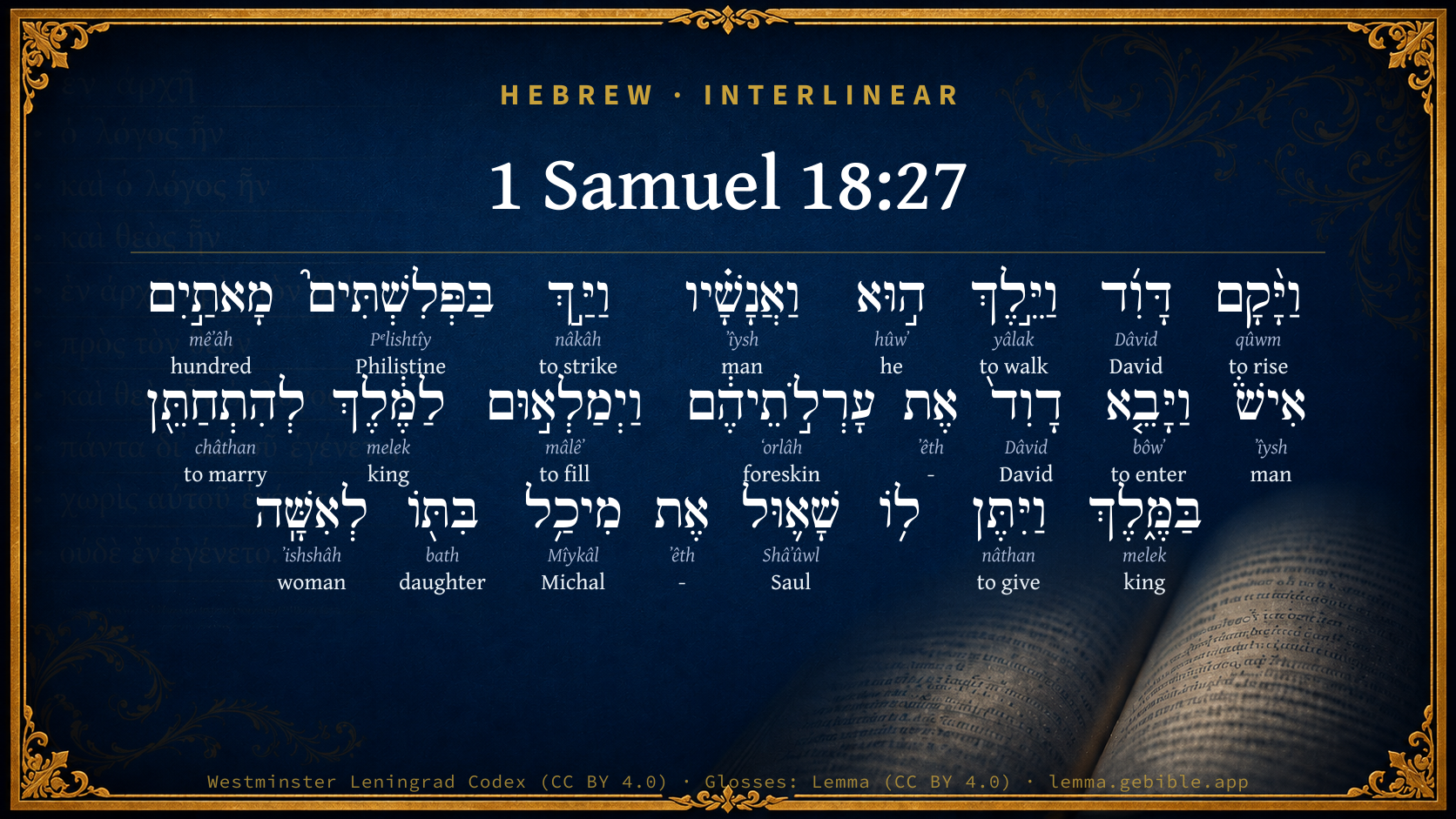
  1. וַיָּ֨קָם qûwm H6965 “and · to rise” Conjunction + Verb, Qal, Sequential Imperfect, 3rd Person, Masculine, Singular
  2. דָּוִ֜ד Dâvid H1732 “David” Noun, Proper
  3. וַיֵּ֣לֶךְ yâlak H3212 “and · to walk” Conjunction + Verb, Qal, Sequential Imperfect, 3rd Person, Masculine, Singular
  4. ה֣וּא hûwʼ H1931 “he” Pronoun, Personal, 3rd Person, Masculine, Singular
  5. וַאֲנָשָׁ֗יו ʼîysh H376 “and · men · his” Conjunction + Noun, Common, Masculine, Plural, Construct + Suffix, Personal, 3rd Person, Masculine, Singular
  6. וַיַּ֣ךְ nâkâh H5221 “and · to strike” Conjunction + Verb, Hiphil, Sequential Imperfect, 3rd Person, Masculine, Singular
  7. בַּפְּלִשְׁתִּים֮ Pᵉlishtîy H6430 “in/at the · Philistines” Preposition, Determined + Noun, Gentilic, Masculine, Plural, Absolute
  8. מָאתַ֣יִם mêʼâh H3967 “hundred” Adjective, Cardinal number, Both, Dual, Absolute
  9. אִישׁ֒ ʼîysh H376 “man” Noun, Common, Masculine, Singular, Absolute
  10. וַיָּבֵ֤א bôwʼ H935 “and · to enter” Conjunction + Verb, Hiphil, Sequential Imperfect, 3rd Person, Masculine, Singular
  11. דָוִד֙ Dâvid H1732 “David” Noun, Proper
  12. אֶת ʼêth H853 “-” Particle, Direct Object
  13. וַיְמַלְא֣וּם mâlêʼ H4390 “and · to fill · them” Conjunction + Verb, Piel, Sequential Imperfect, 3rd Person, Masculine, Plural + Suffix, Personal, 3rd Person, Masculine, Plural
  14. לַמֶּ֔לֶךְ melek H4428 “to/for the · king” Preposition, Determined + Noun, Common, Masculine, Singular, Absolute
  15. לְהִתְחַתֵּ֖ן châthan H2859 “to marry” Preposition + Verb, Hithpael, Infinitive Construct
  16. בַּמֶּ֑לֶךְ melek H4428 “in/at the · king” Preposition, Determined + Noun, Common, Masculine, Singular, Absolute
  17. וַיִּתֶּן nâthan H5414 “and · to give” Conjunction + Verb, Qal, Sequential Imperfect, 3rd Person, Masculine, Singular
  18. שָׁא֛וּל Shâʼûwl H7586 “Saul” Noun, Proper
  19. אֶת ʼêth H853 “-” Particle, Direct Object
  20. מִיכַ֥ל Mîykâl H4324 “Michal” Noun, Proper
  21. בִּתּ֖וֹ bath H1323 “daughter · his” Noun, Common, Feminine, Singular, Construct + Suffix, Personal, 3rd Person, Masculine, Singular
  22. לְאִשָּֽׁה ʼishshâh H802 “to/for · woman” Preposition + Noun, Common, Feminine, Singular, Absolute

About this verse

These counts appear in no published source. They are computed here, from the morphology-tagged text and Lemma’s own curated glosses. What Lemma adds →

24
words
19
distinct lemmas
Historical
section

Notable vocabulary

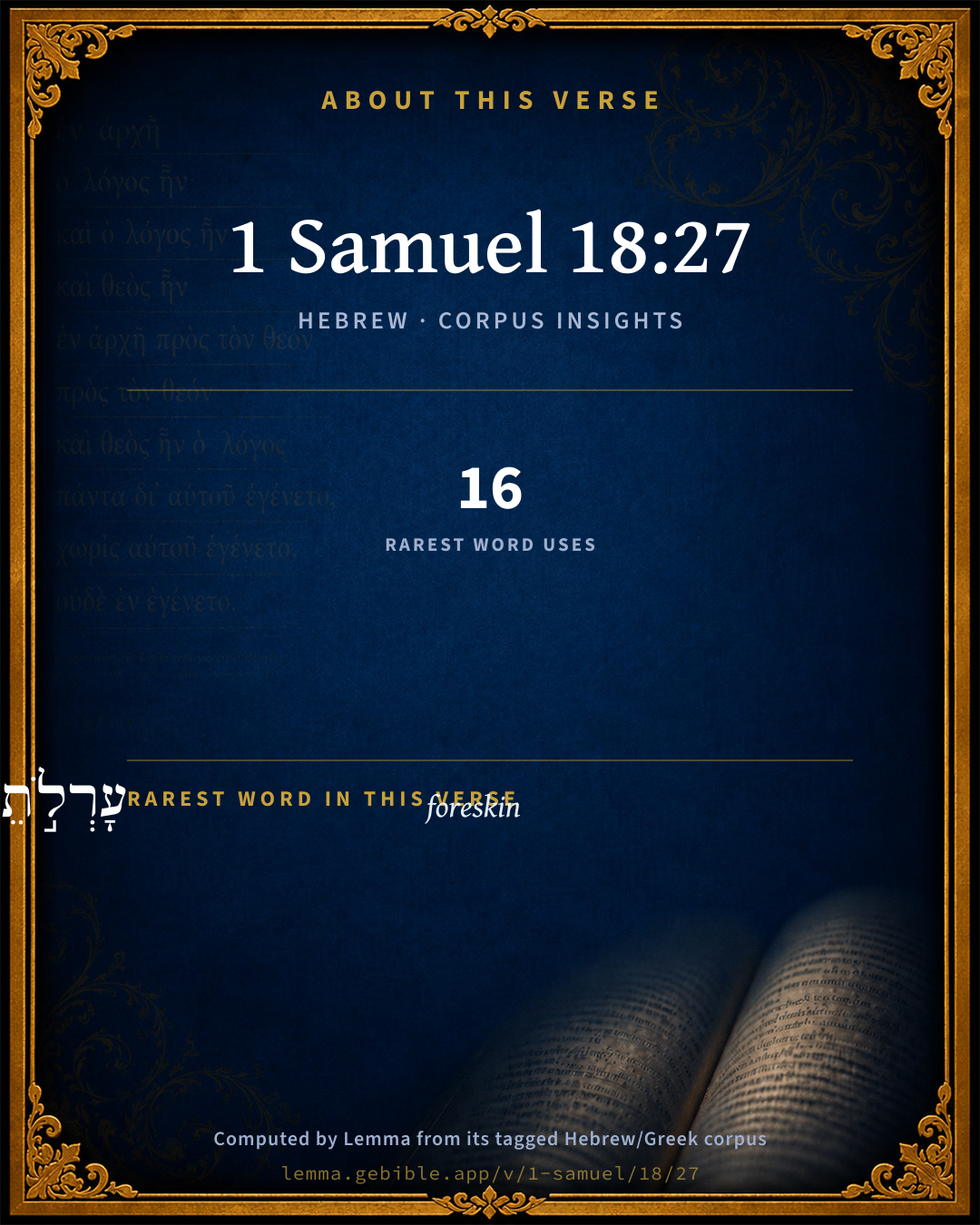
The rarest word here is עָרְלֹ֣תֵיהֶ֔ם foreskin H6190 — appearing just 16 times in the whole Hebrew Bible.

Shared distinctive vocabulary

עָרְלֹ֣תֵיהֶ֔ם foreskin H6190 occurs in 16 verses of the Hebrew Bible. Also found in:

Grammatical profile

  • 7 verbs
  • 12 nouns
  • 1 adjective
  • 1 pronoun
  • 1 preposition
  • 2 particles

Verb forms

  • וַיָּ֨קָם Qal · Sequential Imperfect
  • וַיֵּ֣לֶךְ Qal · Sequential Imperfect
  • וַיַּ֣ךְ Hiphil · Sequential Imperfect
  • וַיָּבֵ֤א Hiphil · Sequential Imperfect
  • וַיְמַלְא֣וּם Piel · Sequential Imperfect
  • לְהִתְחַתֵּ֖ן Hithpael · Infinitive Construct
  • וַיִּתֶּן Qal · Sequential Imperfect

Repetition

Words recur within this verse — often emphatic in Hebrew:

  • דָּוִ֜ד David H1732 ×2
  • וַאֲנָשָׁ֗יו man H376 ×2
  • לַמֶּ֔לֶךְ king H4428 ×2

Hebrew & Septuagint length

In English translation the verse runs 47 words from the Hebrew and 37 from the Septuagint (LXX English) — closely comparable.

A rough comparison of the two English renderings, which tokenize alike — not a word-level alignment.

Word counts can differ between the Hebrew and the Greek without any difference in meaning — e.g. the Hebrew direct-object marker אֵת has no separate Greek word, and Greek often adds the article ὁ.

Cross-references

3

Topical passages linked to 1 Samuel 18:27 in the Treasury of Scripture Knowledge — connected by theme and wording, ordered by reader-vote popularity; previews shown in the World English Bible.

  • 2 Samuel 3:14 David sent messengers to Ish-bosheth, Saul's son, saying, Deliver me my wife Michal, whom I pledged to be married to me for one hundred foreskins of the Philistines.
  • Judges 14:19 The Spirit of Yahweh came mightily on him, and he went down to Ashkelon, and struck thirty men of them, and took their spoil, and gave the changes [of clothing] to those who declared the riddle. His anger was kindled, and he went up to his father's house.
  • 1 Samuel 18:13 Therefore Saul removed him from him, and made him his captain over a thousand; and he went out and came in before the people.

Cross-references courtesy of OpenBible.info (CC BY 4.0).

Hebrew and Greek witnesses Masoretic Hebrew ↔ Greek Septuagint

The same verse in the two great witnesses to the Old Testament, shown verse-for-verse.

These are two independent witnesses, not word-aligned to each other, and the Septuagint is shown in lemma (dictionary) form.

Hebrew 1 Samuel 18:27 Masoretic · Westminster Leningrad Codex

וַיָּ֨קָם דָּוִ֜ד וַיֵּ֣לֶךְ ה֣וּא וַאֲנָשָׁ֗יו וַיַּ֣ךְ בַּפְּלִשְׁתִּים֮ מָאתַ֣יִם אִישׁ֒ וַיָּבֵ֤א דָוִד֙ אֶת עָרְלֹ֣תֵיהֶ֔ם וַיְמַלְא֣וּם לַמֶּ֔לֶךְ לְהִתְחַתֵּ֖ן בַּמֶּ֑לֶךְ וַיִּתֶּן ל֥וֹ שָׁא֛וּל אֶת מִיכַ֥ל בִּתּ֖וֹ לְאִשָּֽׁה

and David arose and went, he and his men, and killed of the Philistines two hundred men; and David brought their foreskins, and they gave them in full number to the king, that he might be the king's son-in-law. Saul gave him Michal his daughter as wife.

World English Bible · Public Domain

Greek LXX 1 Samuel 18:27 Septuagint · lemma form
And David arose, and went, he and his men, and struck among the Philistines one hundred men: and he brought their foreskins, and he becomes the king's son-in-law, and Saul gives him Melchol his daughter to wife.

LXX2012 (modern English Septuagint) · Public Domain

On this verse, Adam Clarke's Commentary discusses the Septuagint’s reading. Read the note in Commentary ↓

Hebrew: Westminster Leningrad Codex (CC BY 4.0). Greek: Septuagint (public domain); English from LXX2012 (modern English Septuagint) (Public Domain). How the Septuagint differs from the Hebrew →

Targum (Aramaic paraphrase)

1

The Targum is the ancient Jewish Aramaic paraphrase of the Hebrew Scriptures — an interpretive translation, not the Hebrew text itself. Onkelos (literal) and Pseudo-Jonathan (expansive) render the Torah, and Jonathan the Prophets. Coverage is partial: where no permissively-licensed English translation exists for a verse, only the Aramaic is shown. This is verse-level text, not a word-by-word alignment to the Hebrew.

  1. Targum Jonathan Prophets (Joshua–Malachi)
    וְקָם דָוִד וַאֲזַל הוּא וְגַבְרוֹהִי וּקְטַל בִּפְלִשְׁתָּאֵי מָאתָן גַבְרָא וְאַיְתֵי דָוִד יַת עָרְלַתְהוֹן וְאַשְׁלֵמִינוּן לְמַלְכָּא לְאִתְחַתָּנָא בְּמַלְכָּא וִיהַב לֵיה שָׁאוּל יַת מִיכַל בְּרַתֵּיהּ לְאִתּוּ:

    (no public-domain English translation for this verse)

    Targum Jonathan — Aramaic: “Mikraot Gedolot” (public domain). English: “Sefaria Community Translation” (CC0 1.0 (public-domain dedication)); “London "Chaldee Paraphrase," 1871” (public domain). Text via Sefaria.

Commentary

Notes on 1 Samuel 18:27 from classic Christian and Jewish commentators (each source and its license shown beneath its notes). The classic Christian expositions comment on the surrounding passage and are grouped to its opening verse, so a note may address several verses; the Jewish commentaries on the Tanakh (Rashi and others) are per-verse, so they appear only where the commentator wrote on this verse.

Lemma curates 59 commentaries, every one of them public domain or Creative Commons licensed, each selected and text-cleaned for this edition rather than reprinted as found. About our sources →

Trapp's Complete Commentary

John Trapp

1Sa 18:27 Wherefore David arose and went, he and his men, and slew of the Philistines two hundred men; and David brought their foreskins, and they gave them in full tale to the king, that he might be the king’s son in law. And Saul gave him Michal his daughter to wife.

Ver. 27. Two hundred men.] He doubled the number of foreskins required: (1.) To cut off all cavils; (2.) To show to Saul his liberality and generosity. Strabo saith {a} that among the old Germans none might marry a wife, who had not first presented to their king the head of an enemy cut off. In the year 959 our King Edgar, to free his country from wolves, enjoined the prince of North Wales to bring him yearly three hundred skins of them for a tribute.

{a} Geog., lib. xv.

John Trapp, A Commentary or Exposition upon All the Books of the Old and New Testament (1647–1656) — public domain. Text from a community e-Sword module.

Geneva Bible (1599)

Geneva Bible translators

Meaning, David and his soldiers.

Geneva Bible (1599) marginal notes — public domain. Text via Bolls.life.

Jamieson, Fausset & Brown

Robert Jamieson, A. R. Fausset & David Brown

David . . . slew of the Philistines two hundred men--The number was doubled, partly to show his respect and attachment to the princess, and partly to oblige Saul to the fulfilment of his pledge.

Jamieson, Fausset & Brown — Commentary Critical and Explanatory on the Whole Bible (1871) — public domain (CC PDM 1.0). Text via the HelloAO Bible API.

Adam Clarke's Commentary

Verse 27. Slew - two hundred men.] The Septuagint has only one hundred men. Saul covenanted with David for a hundred; and David himself says, 2Sa 3:14, that he espoused Michal for a hundred: hence it is likely that one hundred is the true reading.

Adam Clarke's Commentary on the Bible (1810–1826) — public domain. Text from a community e-Sword/MySword module.

The Cambridge Bible for Schools and Colleges

gen. ed. J. J. S. Perowne

27. two hundred men] He slew double the stipulated number of Philistines. The Sept. however reads “one hundred.” Cp. 2Sa_3:14.

in full tale] “Tale” = a number told or counted off, a reckoning. Compare

“Every shepherd tells his tale

Under the hawthorn in the dale.”

Milton, L’Allegro, l. 67.

The Cambridge Bible for Schools and Colleges (gen. ed. J. J. S. Perowne; Cambridge University Press, 1878–1918) — public domain. Text from a community e-Sword module.

Matthew Poole's English Annotations

He doubled the number required; partly to oblige Saul the more to the performance of his promise; and partly to show his great respect and affection to Saul’s daughter.

Matthew Poole's English Annotations on the Holy Bible (1683–1685) — public domain. Text from a community e-Sword/MySword module.

Whedon's Commentary on the Bible

Daniel D. Whedon

27. Two hundred men — Twice the number required. “This was another great exploit — far more arduous, although less renowned, than the overthrow of Goliath. It must have attracted great attention at the time, and have conduced in no small degree to the public estimation in which David was held.” — Kitto.

Daniel D. Whedon (gen. ed.), Commentary on the Old and New Testaments (1874–1909) — public domain. Text from a community e-Sword module.

John Wesley's Explanatory Notes

Two hundred - He doubled the number required; to oblige Saul the more to the performance of his promise; and to shew his great respect and affection to Saul's daughter.

John Wesley, Explanatory Notes Upon the Whole Bible (1754–1765) — public domain. Text via the GEBible commentary corpus.

unfoldingWord translationNotes

Door43 World Missions Community

two hundred Philistines

This can be rendered numerically. AT: "200 Philistines" (See: Numbers)

they gave them in full number to the king

"David and his men gave all of them to the king"

Saul saw, and he knew

Here the words "saw" and "knew" share similar meanings and emphasize that Saul knew with certainty. AT: "Saul recognized" (See: Doublet)

Michal, Saul's daughter, loved him

Here "loved" means she had romantic feelings for David.

translationWords

king

Yahweh

love

fear

unfoldingWord translationNotes — © Distant Shores Media and the Door43 World Missions Community, licensed CC BY-SA 4.0. Source: git.door43.org/Door43/en_tn.

Rashi

Rabbi Shlomo Yitzchaki (Rashi)

Dovid rose and went, he and his men…and gave them all. Presenter in O.F.

Rashi on the Tanakh — English translations: “The Judaica Press complete Tanach with Rashi, translated by A. J. Rosenberg” (CC BY 4.0); “Pentateuch with Rashi's commentary by M. Rosenbaum and A.M. Silbermann, 1929-1934” (public domain); “The Metsudah Tanach series, Lakewood, N.J” (CC BY 4.0); and “The Book of Joshua, Metsudah Publications, 1997” (CC BY 4.0). Text via Sefaria.

Lesson kit

Teaching starters — assembled from the data on this page, not authored interpretation. Every prompt links to the verse data it draws on. Edit before teaching.

1 Samuel, in the Historical, opens this verse with 24 words (19 distinct Hebrew lemmas). Its most distinctive word is ʻorlâh (“foreskin”). A historical commentator’s framing appears above. Read the whole chapter for the surrounding context.

Discussion questions

  1. The word ʻorlâh carries the sense “foreskin.” How does it shape the verse?
  2. Genesis 17:11 shares the word «foreskin» with this verse. How do the two illuminate each other?
  3. “David” occurs 2× in this one verse. What is the effect of the repetition?
  4. The translations on this page render this verse differently — a whole-verse word diff, not a word-by-word alignment. What might account for the different wordings?
  5. The verb «וַיָּ֨קָם» is Qal Sequential Imperfect. How does its form color the action?
  6. Reading how Trapp's Complete Commentary and Geneva Bible (1599) read this verse, where do the two commentators agree and where do they part?

Things to notice

Reading settings

Reading text

Shown beneath each verse's original-language words.

Old Testament
Old Testament edition

Read the OT as the Masoretic Hebrew (MT) or the Greek Septuagint (LXX).

English shown for the Greek Septuagint (in the Hebrew ↔ Greek comparison).

Comparing translations? Open the Compare panel on any verse page to stack up to four side by side.