Ezekiel 13:6

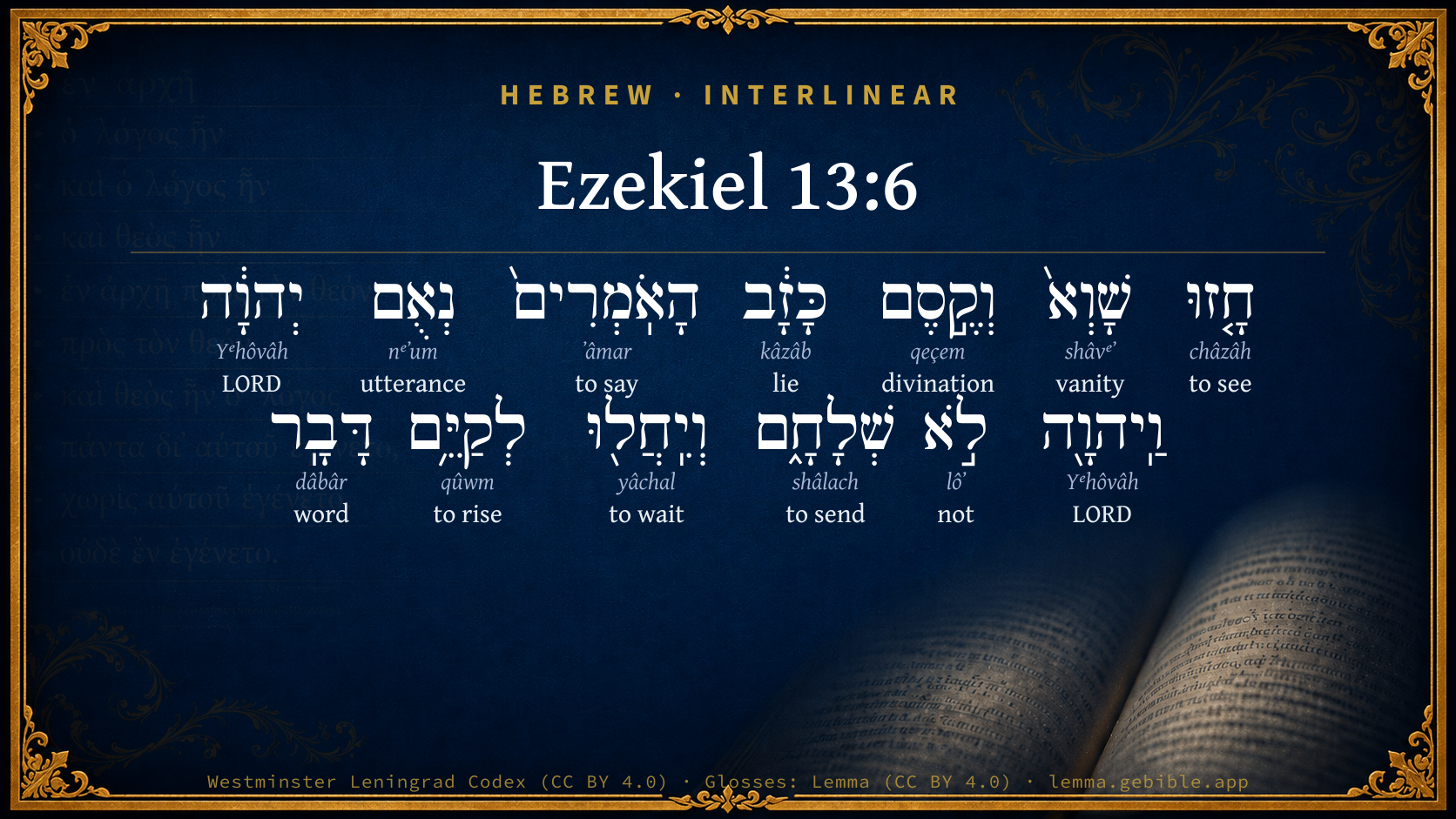
Hebrew (Westminster Leningrad Codex) Ezekiel 13:6 appears in the Hebrew Old Testament. The text above is from the Westminster Leningrad Codex. Each word links to its Strong’s number, a concise gloss, and parsing drawn from the Open Scriptures Hebrew Bible morphology. Click any word for its full Brown-Driver-Briggs (BDB) entry.
Download image
Cite this verse

Ezekiel 13:6 (World English Bible). Public Domain. Lemma interlinear Bible study tool, https://lemma.gebible.app/v/ezekiel/13/6.

Show BibTeX & RIS
BibTeX
RIS
English Translation
They have seen falsehood and lying divination, who say, Yahweh says; but Yahweh has not sent them: and they have made men to hope that the word would be confirmed.
World English Bible · Public Domain
Download a study sheet

One document with this verse’s original text, its word-by-word gloss line, the meaning frame, cross-references with their text, attributed commentary, and full source and license credits — printable, and it pastes into notes with its structure intact.

This verse Autodidact and up

Study sheet (.html) Plain text (.txt)

A passage Seminary Student

Up to 50 verses in one chapter. A passage sheet keeps up to 6 commentary sources and 12 cross-references per verse, in the order this page ranks them, and says so on the sheet whenever that leaves anything out. Ask for a single verse and you get the Autodidact verse sheet above.

Everything on this page stays free to read, with no account — the sheet is a download of what is already on screen, not access to it.

Want to remove ads? Support Godless Engineer
Compare translations 3

The same verse in 3 English versions, stacked beneath the original-language interlinear above. Click any original word for its lexicon entry.

Each is an independent rendering of the whole verse — the interlinear is not word-aligned to these translations.

Highlighted words mark where these versions differ — a whole-verse word diff, not a word-by-word alignment.

  • World English Bible Public Domain
    They have seen falsehood and lying divination, who say, Yahweh says; but Yahweh has not sent them: and they have made men to hope that the word would be confirmed.
  • King James Version Public Domain
    They have seen vanity and lying divination, saying, The LORD saith: and the LORD hath not sent them: and they have made others to hope that they would confirm the word.
  • unfoldingWord Literal Text CC BY-SA 4.0
    The people have false visions and make false predictions, those who say, “Such and such is Yahweh’s declaration.” Yahweh has not sent them, but they nevertheless have made people hope that their messages would come true.

unfoldingWord Literal Text — © unfoldingWord, licensed CC BY-SA 4.0. Word-aligned USFM3 via Door43 (git.door43.org/unfoldingWord/en_ult).

Versions to compare (up to 4)

3 of 4 selected

Show all 18 translations

Every available English version of this verse, each an independent rendering of the whole verse.

  • World English Bible Public Domain
    They have seen falsehood and lying divination, who say, Yahweh says; but Yahweh has not sent them: and they have made men to hope that the word would be confirmed.
  • Berean Standard Bible Public Domain
    They see false visions and speak lying divinations. They claim, ‘Thus declares the LORD,’ when the LORD did not send them; yet they wait for the fulfillment of their message.
  • Majority Standard Bible Public Domain
    They see false visions and speak lying divinations. They claim, ‘Thus declares the LORD,’ when the LORD did not send them; yet they wait for the fulfillment of their message.
  • King James Version Public Domain
    They have seen vanity and lying divination, saying, The LORD saith: and the LORD hath not sent them: and they have made others to hope that they would confirm the word.
  • American Standard Version (1901) Public Domain
    They have seen falsehood and lying divination, that say, Jehovah saith; but Jehovah hath not sent them: and they have made men to hope that the word would be confirmed.
  • Revised Version (1885) Public Domain
    They have seen vanity and lying divination, that say, The LORD saith; and the LORD hath not sent them: and they have made men to hope that the word should be confirmed.
  • Geneva Bible (1599) Public Domain
    They haue seene vanitie, and lying diuination, saying, The Lord sayth it, and the Lord hath not sent them: and they haue made others to hope that they would cofirme the word of their prophecie.
  • Douay-Rheims (1899) Public Domain
    They see vain things, and they foretell lies, saying: The Lord saith: whereas the Lord hath not sent them: and they have persisted to confirm what they have said.
  • Young's Literal Translation Public Domain
    They have seen vanity, and lying divination, Who are saying: An affirmation of Jehovah, And Jehovah hath not sent them, And they have hoped to establish a word.
  • Literal Standard Version CC BY-SA 4.0
    They have seen vanity, and lying divination, || Who are saying: A declaration of YHWH, || And YHWH has not sent them, || And they have hoped to establish a word.
  • Unlocked Literal Bible CC BY-SA 4.0
    The people have false visions and make false predictions, those who say, “Such and such is Yahweh's declaration.” Yahweh has not sent them, but they nevertheless have made people hope that their messages would come true.
  • unfoldingWord Literal Text CC BY-SA 4.0
    The people have false visions and make false predictions, those who say, “Such and such is Yahweh’s declaration.” Yahweh has not sent them, but they nevertheless have made people hope that their messages would come true.
  • Darby Bible Public Domain
    They have seen vanity and lying divination, that say, Jehovah saith! and Jehovah hath not sent them; and they make [them] to hope that the word will be fulfilled.
  • World Messianic Bible Public Domain
    They have seen falsehood and lying divination, who say, ‘The LORD says;’ but the LORD has not sent them. They have made men to hope that the word would be confirmed.
  • Webster's Bible Public Domain
    They have seen vanity and lying divination, saying, The LORD saith: and the LORD hath not sent them: and they have made others to hope that they would confirm the word.
  • Free Bible Version CC BY-SA 4.0
    The visions they see are false, and the prophecies they give are lies. They claim, ‘This is what the Lord says,’ when the Lord didn't send them. Even so they still expect their message to be fulfilled!
  • Bible in Basic English Public Domain
    They have seen visions without substance and made use of secret arts, who say, The Lord has said; and the Lord has not sent them: hoping that the word would have effect.
  • JPS Tanakh (1917) Public Domain
    They have seen vanity and lying divination, that say: The LORD saith; and the LORD hath not sent them, yet they hope that the word would be confirmed!

Literal Standard Version (2020), Covenant Press — licensed CC BY-SA 4.0. Text via the HelloAO Bible API (eBible.org). Unlocked Literal Bible (unfoldingWord) — licensed CC BY-SA 4.0. Text via the HelloAO Bible API (eBible.org). unfoldingWord Literal Text — © unfoldingWord, licensed CC BY-SA 4.0. Word-aligned USFM3 via Door43 (git.door43.org/unfoldingWord/en_ult). Free Bible Version, Dr. Jonathan Gallagher — licensed CC BY-SA 4.0. Text via the HelloAO Bible API (eBible.org).

Word by word

More ways to search: Search by grammar → Find every occurrence → Compare this word →

Practice this passage: Drill this verse → Learn its vocabulary →

וְקֶ֣סֶם
qeçem
H7081
“and · divination of”
Conjunction + Noun, Common, Masculine, Singular, Construct
Part of Speech
Conjunction + Noun
Type
Common
Gender
Masculine
Number
Singular
State
Construct
Full BDB Definition

Origin: from H7080

TWOT: 2044a

divination, witchcraft - of the nations, Balaam - of false prophets - in a good sense (king's lips as oracles)
  1. חָ֤זוּ châzâh H2372 “to see” Verb, Qal, Perfect, 3rd Person, Common, Plural
  2. שָׁוְא֙ shâvᵉʼ H7723 “vanity” Noun, Common, Masculine, Singular, Absolute
  3. כָּזָ֔ב kâzâb H3577 “lie” Noun, Common, Masculine, Singular, Absolute
  4. הָאֹֽמְרִים֙ ʼâmar H559 “the · saying” Particle, Definite Article + Verb, Qal, Participle Active, Masculine, Plural, Absolute
  5. נְאֻם nᵉʼum H5002 “utterance of” Noun, Common, Masculine, Singular, Construct
  6. יְהוָ֔ה Yᵉhôvâh H3068 “LORD” Noun, Proper
  7. וַֽיהוָ֖ה Yᵉhôvâh H3068 “and · LORD” Conjunction + Noun, Proper
  8. לֹ֣א lôʼ H3808 “not” Particle, Negative
  9. שְׁלָחָ֑ם shâlach H7971 “to send · them” Verb, Qal, Perfect, 3rd Person, Masculine, Singular + Suffix, Personal, 3rd Person, Masculine, Plural
  10. וְיִֽחֲל֖וּ yâchal H3176 “and · to wait” Conjunction + Verb, Piel, Sequential Perfect, 3rd Person, Common, Plural
  11. לְקַיֵּ֥ם qûwm H6965 “to rise” Preposition + Verb, Piel, Infinitive Construct
  12. דָּבָֽר dâbâr H1697 “word” Noun, Common, Masculine, Singular, Absolute

About this verse

These counts appear in no published source. They are computed here, from the morphology-tagged text and Lemma’s own curated glosses. What Lemma adds →

13
words
12
distinct lemmas
Prophets
section

Notable vocabulary

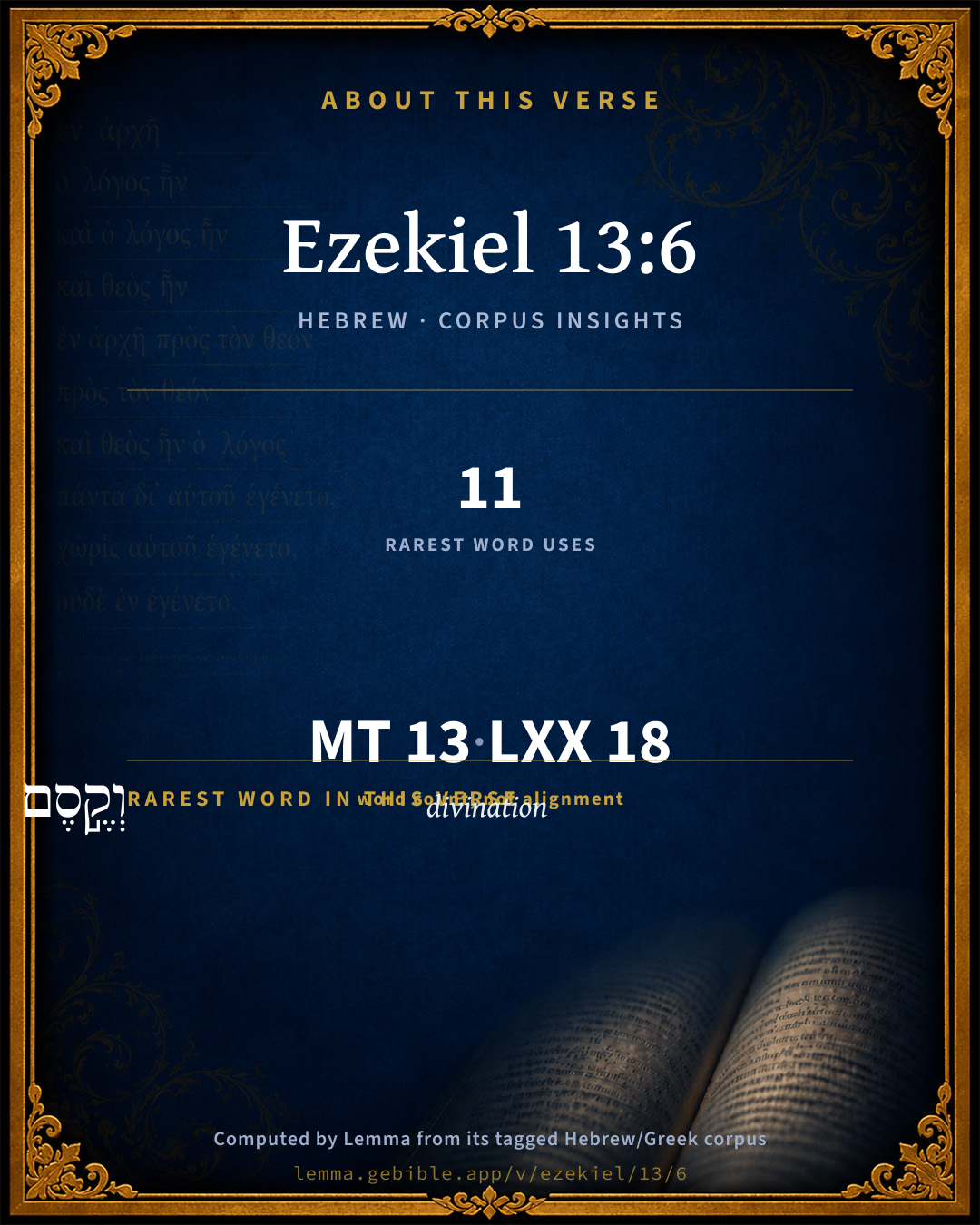
The rarest word here is וְקֶ֣סֶם divination H7081 — appearing just 11 times in the whole Hebrew Bible.

Shared distinctive vocabulary

וְקֶ֣סֶם divination H7081 occurs in 11 verses of the Hebrew Bible. Also found in:

Grammatical profile

  • 5 verbs
  • 7 nouns
  • 1 particle

Verb forms

  • חָ֤זוּ Qal · Perfect
  • הָאֹֽמְרִים֙ Qal · Participle Active
  • שְׁלָחָ֑ם Qal · Perfect
  • וְיִֽחֲל֖וּ Piel · Sequential Perfect
  • לְקַיֵּ֥ם Piel · Infinitive Construct

Repetition

A word recurs within this verse — often emphatic in Hebrew:

  • יְהוָ֔ה LORD H3068 ×2

Hebrew & Septuagint length

In English translation the verse runs 30 words from the Hebrew and 35 from the Septuagint (LXX English) — closely comparable.

A rough comparison of the two English renderings, which tokenize alike — not a word-level alignment.

Word counts can differ between the Hebrew and the Greek without any difference in meaning — e.g. the Hebrew direct-object marker אֵת has no separate Greek word, and Greek often adds the article ὁ.

In the original languages it is 13 Hebrew tokens and 18 Greek tokens — but the two are counted differently (Hebrew bundles its prefixes and suffixes into one token; the Greek is in lemma form), so that isn’t a like-for-like length.

Cross-references

23

Topical passages linked to Ezekiel 13:6 in the Treasury of Scripture Knowledge — connected by theme and wording, ordered by reader-vote popularity; previews shown in the World English Bible.

  • Jeremiah 28:15 Then said the prophet Jeremiah to Hananiah the prophet, Hear now, Hananiah: Yahweh has not sent you; but you make this people to trust in a lie.
  • Jeremiah 29:8 For thus says Yahweh of hosts, the God of Israel: Don't let your prophets who are in the midst of you, and your diviners, deceive you; neither listen you to your dreams which you cause to be dreamed.
  • Ezekiel 22:28 Her prophets have daubed for them with whitewash, seeing false visions, and divining lies to them, saying, Thus says the Lord Yahweh, when Yahweh has not spoken.
  • Jeremiah 37:19 Where now are your prophets who prophesied to you, saying, The king of Babylon shall not come against you, nor against this land?
  • Ezekiel 21:29 while they see for you false visions, while they divine lies to you, to lay you on the necks of the wicked who are deadly wounded, whose day is come in the time of the iniquity of the end.
  • Jeremiah 14:14 Then Yahweh said to me, The prophets prophesy lies in my name; I didn't send them, neither have I commanded them, neither spoke I to them: they prophesy to you a lying vision, and divination, and a thing of nothing, and the deceit of their own heart.
  • Zechariah 10:2 For the teraphim have spoken vanity, and the diviners have seen a lie; And they have told false dreams. They comfort in vain. Therefore they go their way like sheep. They are oppressed, because there is no shepherd.
  • 1 Kings 22:6 Then the king of Israel gathered the prophets together, about four hundred men, and said to them, Shall I go against Ramoth-gilead to battle, or shall I forbear? They said, Go up; for the Lord will deliver it into the hand of the king.
  • 1 Kings 22:27 and say, Thus says the king, Put this fellow in the prison, and feed him with bread of affliction and with water of affliction, until I come in peace.
  • 1 Kings 22:37 So the king died, and was brought to Samaria; and they buried the king in Samaria.
  • Proverbs 14:15 A simple man believes everything, But the prudent man carefully considers his ways.
  • Jeremiah 23:31–32 Behold, I am against the prophets, says Yahweh, who use their tongues, and say, He says.
  • Jeremiah 28:2 Thus speaks Yahweh of Hosts, the God of Israel, saying, I have broken the yoke of the king of Babylon.
  • Jeremiah 29:31 Send to all them of the captivity, saying, Thus says Yahweh concerning Shemaiah the Nehelamite: Because Shemaiah has prophesied to you, and I didn't send him, and he has caused you to trust in a lie;
  • Lamentations 2:14 Your prophets have seen for you false and foolish visions; They have not uncovered your iniquity, to bring back your captivity, But have seen for you false oracles and causes of banishment.
  • Ezekiel 12:23–24 Tell them therefore, Thus says the Lord Yahweh: I will make this proverb to cease, and they shall no more use it as a proverb in Israel; but tell them, The days are at hand, and the fulfillment of every vision.
  • Ezekiel 13:7 Haven't you seen a false vision, and haven't you spoken a lying divination, in that you say, Yahweh says; but I have not spoken?
  • Ezekiel 13:22–23 Because with lies you have grieved the heart of the righteous, whom I have not made sad; and strengthened the hands of the wicked, that he should not return from his wicked way, and be saved alive:
  • Ezekiel 21:23 It shall be to them as a false divination in their sight, who have sworn oaths to them; but he brings iniquity to memory, that they may be taken.
  • Mark 13:6 For many will come in my name, saying, 'I am he!' and will lead many astray.
  • Mark 13:22–23 For there will arise false christs and false prophets, and will show signs and wonders, that they may lead astray, if possible, even the chosen ones.
  • 2 Thessalonians 2:11 Because of this, God sends them a working of error, that they should believe a lie;
  • 2 Peter 2:18 For, uttering great swelling words of emptiness, they entice in the lusts of the flesh, by licentiousness, those who are indeed escaping from those who live in error;

Cross-references courtesy of OpenBible.info (CC BY 4.0).

Hebrew and Greek witnesses Masoretic Hebrew ↔ Greek Septuagint

The same verse in the two great witnesses to the Old Testament, shown verse-for-verse.

These are two independent witnesses, not word-aligned to each other, and the Septuagint is shown in lemma (dictionary) form.

Hebrew Ezekiel 13:6 Masoretic · Westminster Leningrad Codex

חָ֤זוּ שָׁוְא֙ וְקֶ֣סֶם כָּזָ֔ב הָאֹֽמְרִים֙ נְאֻם יְהוָ֔ה וַֽיהוָ֖ה לֹ֣א שְׁלָחָ֑ם וְיִֽחֲל֖וּ לְקַיֵּ֥ם דָּבָֽר

They have seen falsehood and lying divination, who say, Yahweh says; but Yahweh has not sent them: and they have made men to hope that the word would be confirmed.

World English Bible · Public Domain

Greek LXX Ezekiel 13:6 Septuagint · lemma form

βλέπω ψευδής μαντεύομαι μάταιος ὁ λέγω λέγω κύριος καί κύριος οὐ ἀποστέλλω αὐτός καί ἄρχω ὁ ἀναἵστημι λόγος

In the day of the Lord, have not stood, seeing false visions, prophesying vanities, who say, The Lord says, and the Lord has not sent them, and they began to try to confirm the word.

LXX2012 (modern English Septuagint) · Public Domain

Hebrew: Westminster Leningrad Codex (CC BY 4.0). Greek: Septuagint (public domain); English from LXX2012 (modern English Septuagint) (Public Domain). How the Septuagint differs from the Hebrew →

Targum (Aramaic paraphrase)

1

The Targum is the ancient Jewish Aramaic paraphrase of the Hebrew Scriptures — an interpretive translation, not the Hebrew text itself. Onkelos (literal) and Pseudo-Jonathan (expansive) render the Torah, and Jonathan the Prophets. Coverage is partial: where no permissively-licensed English translation exists for a verse, only the Aramaic is shown. This is verse-level text, not a word-by-word alignment to the Hebrew.

  1. Targum Jonathan Prophets (Joshua–Malachi)
    מִתְנַבָּן שְׁקַר וּמַלְפַן כַּדְבִין אָמְרִין אֲמַר יְיָ וַיָי לָא שַׁלְחִינוּן וּמַחְצְפִין דְתִתְקַייָם מִלַתְהוֹן:

    (no public-domain English translation for this verse)

    Targum Jonathan — Aramaic: “Mikraot Gedolot” (public domain). English: “Sefaria Community Translation” (CC0 1.0 (public-domain dedication)); “London "Chaldee Paraphrase," 1871” (public domain). Text via Sefaria.

Commentary

Notes on Ezekiel 13:6 from classic Christian and Jewish commentators (each source and its license shown beneath its notes). The classic Christian expositions comment on the surrounding passage and are grouped to its opening verse, so a note may address several verses; the Jewish commentaries on the Tanakh (Rashi and others) are per-verse, so they appear only where the commentator wrote on this verse.

Lemma curates 59 commentaries, every one of them public domain or Creative Commons licensed, each selected and text-cleaned for this edition rather than reprinted as found. About our sources →

Ellicott's Commentary for English Readers

(6) They have made others to hope.—Omit the word “others,” which is not in the original, and translate, “The Lord hath not sent them that they should hope”—i.e., they have no ground to expect that their prophecies will prove true, because they have no warrant for uttering them.

EXCURSUS D: ON CHAPTER 13:6, 7, AND 17.

In these verses a broad and crucial distinction is made between the self-imagined vision and that which is sent from the Lord. It may be that in this case the prophets and prophetesses were untrue to their own convictions, and wilfully declared what they knew to be false; or it may be that they simply uttered as God’s message that which they had persuaded themselves would be the issue. This point is not entirely clear from the passage, and is of secondary importance. What deserves to be carefully noted is the difference here made between subjective views of truth—that which conies “out of their own heart”—and those objective communications which God gave to His true prophets. This distinction has a most important bearing upon the whole subject of revelation, and establishes clearly the fact that the Scriptures look upon it as something expressly communicated to their writers, and not as a thing which could be the result of their own thought and reflection. He, therefore, who puts “Thus saith the Lord” before that which God has not in some objective way made known to him, must fall under the condemnation pronounced here and elsewhere upon “the prophet which shall presume to speak a word in my name, which I have not commanded him to speak” (Deu_18:20).

A Bible Commentary for English Readers, edited by Charles John Ellicott (1878–1897) — public domain. Text from a community e-Sword module.

Trapp's Complete Commentary

John Trapp

Eze 13:6 They have seen vanity and lying divination, saying, The LORD saith: and the LORD hath not sent them: and they have made [others] to hope that they would confirm the word.

Ver. 6. They have seen vanity.] This is soon seen. {Eze 13:3}

Saying, The Lord saith.] By a lying pretence, familiar with falsaries, to father their fancies upon God.

John Trapp, A Commentary or Exposition upon All the Books of the Old and New Testament (1647–1656) — public domain. Text from a community e-Sword module.

Joseph Benson's Commentary

Eze 13:6-9. They have seen vanity and lying divinations — They have uttered false prophecies concerning peace and prosperity, pretending to have seen that which they did not see, and producing that as a divine truth which they knew to be a detestable lie. They have made others — Who were so simple as to believe them; to hope that they would confirm the word — Or rather, that the word would be confirmed. Their speaking with so much assurance made others confidently expect that the event would answer their predictions, and that the judgments which the true prophets had threatened in the name of God would never come, whereby they hardened those in sin whom they ought to have endeavoured to bring to repentance. Therefore, because ye have spoken vanity — Have uttered mere fictions and lies, with a view to your own advantage. Behold, I am against you, saith the Lord God — And who can be for you when I am against you? And my hand shall be upon the prophets — My power striking them so, that it shall be evident they fall under my displeasure; as Pelatiah, Eze 11:13, and Hananiah, Jer 28:15. They shall not be in the assembly of my people — Of those who shall hereafter worship me in Jerusalem; or, in the secret council of those who shall consult on public affairs. They shall not be members of my church here, nor partake of the communion of saints hereafter. The Hebrew word סוד, here rendered assembly, properly signifies a secret assembly, or privy council; such as are acquainted with the secret intents and purposes of their prince. Hence it is applied to God’s chosen people, those that are acquainted with the whole counsel of God, and whom he instructs and directs by his Holy Spirit: see notes on Psa 25:14; Jer 23:18. The prophet, therefore, here tells these men who pretended to know so much of the secrets of the Almighty that they should never be of the number of those favourites of heaven to whom God would reveal himself and his counsels. Neither shall they be written, &c. — The sense of this clause is nearly the same with that of the preceding; the words containing an allusion to the registers usually kept of the members of cities or corporations, to the privileges of which societies none are admitted but they whose names are entered into such registers. The false prophets, it seems, promised a speedy return to the exiles; God, therefore, tells them that they should never live to see it, nor should their names be entered into the register of those that should return home. Neither shall they enter into the land of Israel —

They shall never see their own country again, nor shall they have a share in the blessings peculiar to true Israelites: see Lowth.

Joseph Benson's Commentary on the Old and New Testaments (1811–1818) — public domain. Text from a community e-Sword module.

Tyndale Open Study Notes

Tyndale Open Resources

13:6-7 Although the false prophets knew that their words were lies and false predictions, they confidently expected God to fulfill their prophecies. These false hopes gave God’s people a false sense of security that would prove empty and destructive on the coming day of judgment (cp. Jer 6:14).

Tyndale Open Study Notes — © Tyndale Open Resources, licensed CC BY-SA 4.0. Text via the HelloAO Bible API.

Jamieson, Fausset & Brown

Robert Jamieson, A. R. Fausset & David Brown

made others to hope, &c.--rather, "they hoped" to confirm (that is, 'make good') their word, by the event corresponding to their prophecy. The Hebrew requires this [HAVERNICK]. Also the parallel clause, "they have seen vanity," implies that they believed their own lie (Th2 2:11). Subjective revelation is false unless it rests on the objective.

Jamieson, Fausset & Brown — Commentary Critical and Explanatory on the Whole Bible (1871) — public domain (CC PDM 1.0). Text via the HelloAO Bible API.

John Calvin's Commentaries

Here again he pronounces generally that those false prophets were vain, and this assertion depends upon the principle that they had spoken from their own heart or spirit, for nothing false or vain can proceed from God. It follows, therefore, that they are here condemned of vanity and lying, because they dared falsely to use the name of God when they uttered nothing but their own dreams. He now confirms what we saw in the last verse, when he says, they hoped to establish their word. Hence they puffed up the people with vain hope, when they said that God would not be so severe as to exact continual punishment of the holy and elect nation. True prophets also often recall sinners to the mercy of God, and magnify it so, that those who wrestle with despair may not doubt God’s long-suffering, since he is said to be slow to anger, and inclined to reconciliation; and his pity endures for a life, while his anger passes away in a moment. (Numbers 14:18; Psalm 103:8, and Psalm 30:5.) True prophets indeed act thus; but they join two members which must not be separated, otherwise God himself would be, as it were, dissipated. Hence, when true prophets exhort sinners to hope and predict God’s freeness to pardon, they likewise discourse about penitence; they do not indulge sinners, but rouse them, nay, wound them sharply with a sense of God’s anger, so as in some way to stir them up, since God’s mercy is set before us for that end, that by it we may seek life. Hence we must be dead in ourselves; but false prophets sever between the two, and divide God, as it were, in half, since they speak only of his freeness to forgive, and declare his clemency to be set before all, while they are profoundly silent about repentance. Now, therefore, we see why the Prophet here reproves these traitors who abused the name of God, since they made the people to hope. Without hope, indeed, the sinner could not be animated to seek God: but they promised peace, as he will say directly, when there was no peace. Therefore let us proceed with the exposition.

John Calvin's Commentaries (1540-1563) — public domain. Text from the Calvin Translation Society English edition (1840s-50s) via the Christian Classics Ethereal Library (ccel.org). Calvin's coverage is partial (roughly two-thirds of the Bible); uncommented books and verses are honest gaps, never fabricated. The 19th-century editor's footnotes and remarks are omitted so the notes are faithfully Calvin's own voice.

The Cambridge Bible for Schools and Colleges

gen. ed. J. J. S. Perowne

6, 7. Their prophecies are false: they are self-deceived

6. have made others to hope] Rather: they have hoped for the confirmation of the word. The usual sense of the verb is to “hope;” only in a single passage (Psa_119:49) does it appear to mean to “cause to hope.” The false prophets looked for the confirmation (in fulfilment) of their prophecies and visions—they were self-deceived, not consciously false. Prophecy being an inward thing, a speaking by the spirit in the mind and to the mind, there was no external criterion, and while the true prophet had the witness in himself that he was true, the false prophet might not be aware that he was false (Jer_23:21; Jer_23:31). It is an interesting question what kind of mental experience the true prophet had, which verified to him his own genuineness.

Eze_13:8-9. Chastisement from Jehovah upon these prophets.

Because these prophets speak falsely Jehovah is against them, for he is the living and the true (Eze_13:8); but that which God is against must speedily feel the effects of his opposition—his hand will be upon them (Eze_13:9). There is no inert, inoperative opposition on God’s part. The sweep of his operation is so vast that its movement may be unperceived, as the earth appears to stand still, though moving with inconceivable rapidity, but its effect will become apparent.

The Cambridge Bible for Schools and Colleges (gen. ed. J. J. S. Perowne; Cambridge University Press, 1878–1918) — public domain. Text from a community e-Sword module.

John Gill's Exposition

Therefore thus saith the Lord God,.... This is what he says, and it may be depended on will come to pass; though the other he said not, they said he did, but was a lying divination:

because ye have spoken vanity, and seen lies; which will in the issue prove so, lying and deceitful; what never came from God, but from themselves and the father of lies, and would never be accomplished:

therefore, behold, I am against you, saith the Lord God; or, "I unto you"; which may be supplied thus, "I come", or "will come, unto you" (f); in a way of providence, and chastise and punish you; see Rev 2:16; or I will be your adversary; and a sad thing it is for any to have God to be against them; there is no contending with him; none ever hardened themselves against him, and prospered; men are but with him as stubble, or as thorns and briers to a consuming fire.

(f) "ecce ego ad vos", V. L. "sub. venio", Grotius; "veniam", Piscator, Starckius; "venturus sum cum ira mea", Vatablus.

John Gill's Exposition of the Whole Bible (1746–1763) — public domain (CC PDM 1.0). Text via the HelloAO Bible API.

Albert Barnes' Notes on the Bible

And they have made others ... - Rather, “and they hope for the confirmation of their word.” They come to believe their own lies.

Albert Barnes' Notes on the Bible (1834–1885) — public domain. Text from a community e-Sword/MySword module.

Matthew Poole's English Annotations

They have seen; they pretend to have seen, but still they see nothing, as Eze 13:2. The prophet speaks as if indeed they had seen, but the very censure of the things they said they saw clears it, that all was but pretence.

Vanity and lying divination; things that have no ground or foundation, and which will never be, and are therefore called vanity and lying divinations.

The Lord saith; foretelleth and promiseth.

Hath not sent them; never revealed any such thing to them, or bade them tell the Jews any such thing.

They have made others; by their pretences and arguments they have wheedled some into a belief of their word, and into a hope of that they promise; and so the credulous Jew is undone by his prophet, who tells him all is well, and needs no alteration, and all will be well, and they need fear no desolation.

Matthew Poole's English Annotations on the Holy Bible (1683–1685) — public domain. Text from a community e-Sword/MySword module.

Whedon's Commentary on the Bible

Daniel D. Whedon

6. Have made others to hope — Rather, they hoped for the word to be confirmed. They have seen vanity (literally, nothingness, falsehood), and yet they have deceived themselves with the hope that the lies which they have prophesied will come true. There is no suggestion here that these false prophets really believed themselves to have received a message from God (vs. Davidson), though in other places it is made plain that a prophet who willfully persists in prophesying lies may at last be unable to discriminate between the true and the false.

Daniel D. Whedon (gen. ed.), Commentary on the Old and New Testaments (1874–1909) — public domain. Text from a community e-Sword module.

The Pulpit Commentary

The Lord saith. The verb is that specially used for the utterance of prophets, and the deceivers used it without the authority of a true mission. For they have made others (or, men) to hope, etc., as in the Authorized Version and Revised Version, read, with the margin of Revised Version, they hope to confirm their word, taking the verb as in Psa_119:43, Psa_119:49; Job_6:11, et al. . So the Vulgate, persereraverunt confirmare. Through deceiving others, they came to deceive themselves, and were really expecting a fulfilment.

The Pulpit Commentary (1880–1919), ed. H.D.M. Spence-Jones & Joseph S. Exell — public domain. Text from a community e-Sword module.

John Wesley's Explanatory Notes

Vanity - Things that have no foundation.

John Wesley, Explanatory Notes Upon the Whole Bible (1754–1765) — public domain. Text via the GEBible commentary corpus.

Rashi

Rabbi Shlomo Yitzchaki (Rashi)

They prophesied Heb. חָזוּ, a term for prophecy.

and expect their words to be fulfilled Heb. וְיִחֲלוּ. “Now how do they expect that their words will be fulfilled?” [The word is] an expression of hope (תּוֹחֶלֶת). Some say that it is ecuydiyant in Old French, and they hoped. [Other editions read: et croiront, and they believed.] Another explanation: An expression of waiting.

Rashi on the Tanakh — English translations: “The Judaica Press complete Tanach with Rashi, translated by A. J. Rosenberg” (CC BY 4.0); “Pentateuch with Rashi's commentary by M. Rosenbaum and A.M. Silbermann, 1929-1934” (public domain); “The Metsudah Tanach series, Lakewood, N.J” (CC BY 4.0); and “The Book of Joshua, Metsudah Publications, 1997” (CC BY 4.0). Text via Sefaria.

Lesson kit

Teaching starters — assembled from the data on this page, not authored interpretation. Every prompt links to the verse data it draws on. Edit before teaching.

Ezekiel, in the Prophets, opens this verse with 13 words (12 distinct Hebrew lemmas). Its most distinctive word is qeçem (“divination”). A historical commentator’s framing appears above. Read the whole chapter for the surrounding context.

Discussion questions

  1. How does “divination” (qeçem) shape what this verse is saying?
  2. How does Numbers 22:7, which shares the word «divination», read alongside this verse?
  3. What does the repetition of “LORD” (2× in this one verse) do in this verse?
  4. The translations on this page render this verse differently — a whole-verse word diff, not a word-by-word alignment. What might account for the different wordings?
  5. «חָ֤זוּ» is a Qal Perfect verb. How does that grammatical form shape the action described?
  6. Compare how Ellicott's Commentary for English Readers and Trapp's Complete Commentary read this verse. Where do they agree or differ?

Things to notice

Reading settings

Reading text

Shown beneath each verse's original-language words.

Old Testament
Old Testament edition

Read the OT as the Masoretic Hebrew (MT) or the Greek Septuagint (LXX).

English shown for the Greek Septuagint (in the Hebrew ↔ Greek comparison).

Comparing translations? Open the Compare panel on any verse page to stack up to four side by side.