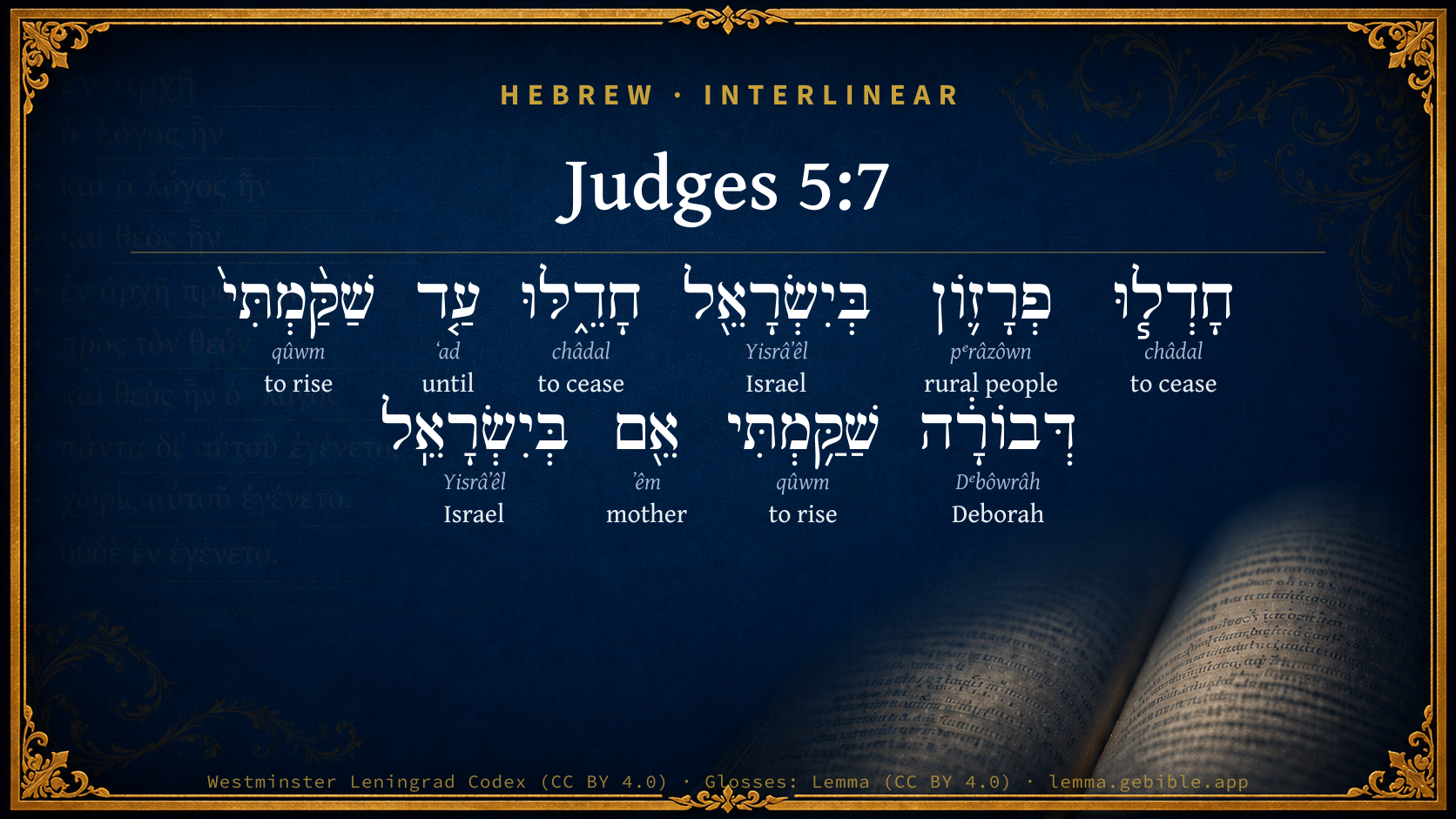
Judges 5:7

Hebrew (Westminster Leningrad Codex) Judges 5:7 appears in the Hebrew Old Testament. The text above is from the Westminster Leningrad Codex. Each word links to its Strong’s number, a concise gloss, and parsing drawn from the Open Scriptures Hebrew Bible morphology. Click any word for its full Brown-Driver-Briggs (BDB) entry.
Download image
Cite this verse

Judges 5:7 (World English Bible). Public Domain. Lemma interlinear Bible study tool, https://lemma.gebible.app/v/judges/5/7.

Show BibTeX & RIS
BibTeX
RIS
English Translation
The rulers ceased in Israel, they ceased, Until that I Deborah arose, That I arose a mother in Israel.
World English Bible · Public Domain
Highlights
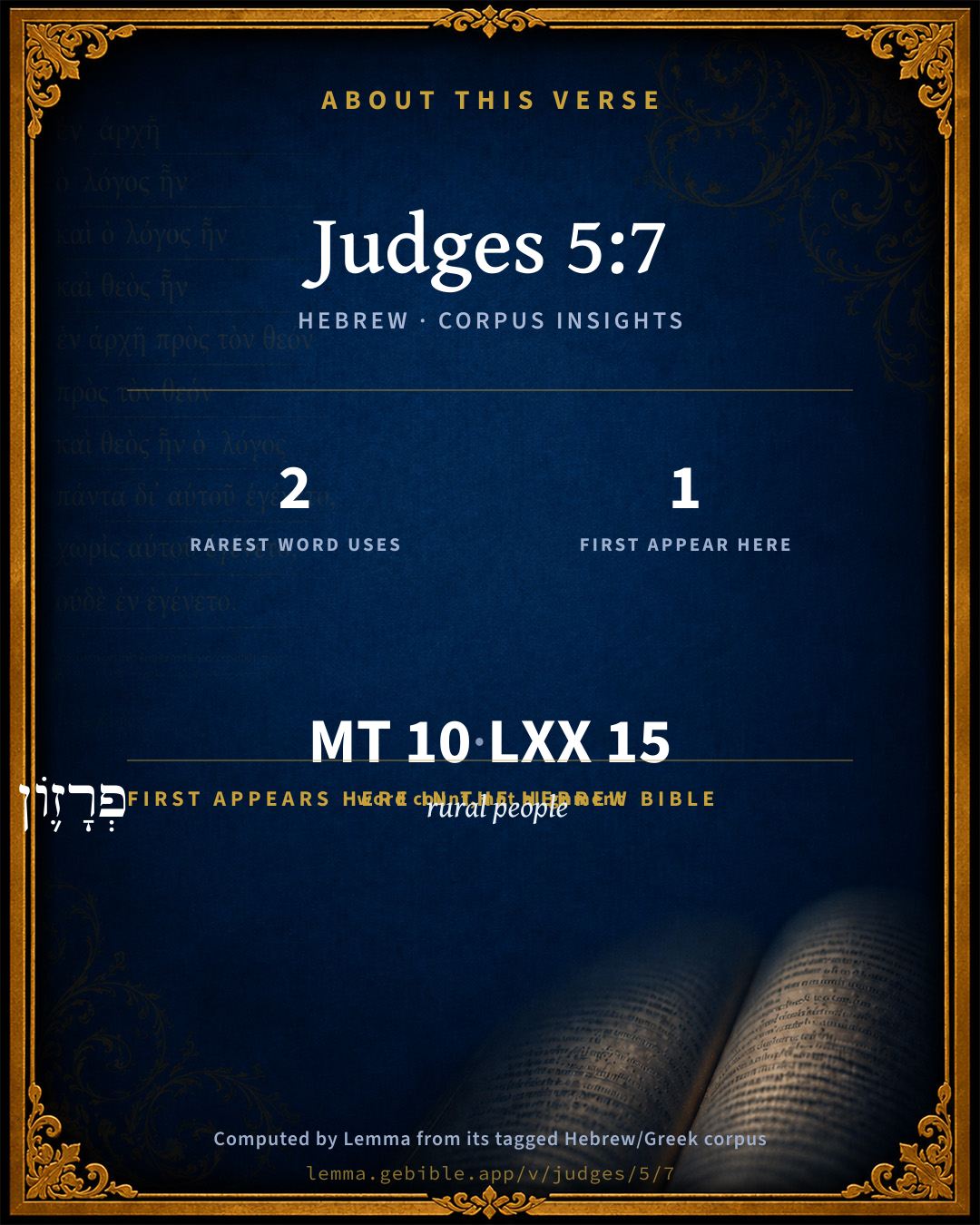
  • 1 first appearance in the Hebrew Bible
Full analysis ↓
Download a study sheet

One document with this verse’s original text, its word-by-word gloss line, the meaning frame, cross-references with their text, attributed commentary, and full source and license credits — printable, and it pastes into notes with its structure intact.

This verse Autodidact and up

Study sheet (.html) Plain text (.txt)

A passage Seminary Student

Up to 50 verses in one chapter. A passage sheet keeps up to 6 commentary sources and 12 cross-references per verse, in the order this page ranks them, and says so on the sheet whenever that leaves anything out. Ask for a single verse and you get the Autodidact verse sheet above.

Everything on this page stays free to read, with no account — the sheet is a download of what is already on screen, not access to it.

Want to remove ads? Support Godless Engineer
Compare translations 3

The same verse in 3 English versions, stacked beneath the original-language interlinear above. Click any original word for its lexicon entry.

Each is an independent rendering of the whole verse — the interlinear is not word-aligned to these translations.

Highlighted words mark where these versions differ — a whole-verse word diff, not a word-by-word alignment.

  • World English Bible Public Domain
    The rulers ceased in Israel, they ceased, Until that I Deborah arose, That I arose a mother in Israel.
  • King James Version Public Domain
    The inhabitants of the villages ceased, they ceased in Israel, until that I Deborah arose, that I arose a mother in Israel.
  • unfoldingWord Literal Text CC BY-SA 4.0
    The peasantry ceased in Israel, they ceased, until when I, Deborah, arose, when I arose, a mother in Israel!

unfoldingWord Literal Text — © unfoldingWord, licensed CC BY-SA 4.0. Word-aligned USFM3 via Door43 (git.door43.org/unfoldingWord/en_ult).

Versions to compare (up to 4)

3 of 4 selected

Show all 18 translations

Every available English version of this verse, each an independent rendering of the whole verse.

  • World English Bible Public Domain
    The rulers ceased in Israel, they ceased, Until that I Deborah arose, That I arose a mother in Israel.
  • Berean Standard Bible Public Domain
    Life in the villages ceased; it ended in Israel, until I, Deborah, arose, a mother in Israel.
  • Majority Standard Bible Public Domain
    Life in the villages ceased; it ended in Israel, until I, Deborah, arose, a mother in Israel.
  • King James Version Public Domain
    The inhabitants of the villages ceased, they ceased in Israel, until that I Deborah arose, that I arose a mother in Israel.
  • American Standard Version (1901) Public Domain
    The rulers ceased in Israel, they ceased, Until that I Deborah arose, That I arose a mother in Israel.
  • Revised Version (1885) Public Domain
    The rulers ceased in Israel, they ceased, until that I Deborah arose, that I arose a mother in Israel.
  • Geneva Bible (1599) Public Domain
    The townes were not inhabited: they decayed, I say, in Israel, vntill I Deborah came vp, which rose vp a mother in Israel.
  • Douay-Rheims (1899) Public Domain
    The valiant men ceased, and rested in Israel: until Debbora arose, a mother arose in Israel.
  • Young's Literal Translation Public Domain
    Villages ceased in Israel -- they ceased, Till that I arose -- Deborah, That I arose, a mother in Israel.
  • Literal Standard Version CC BY-SA 4.0
    Villages ceased in Israel—they ceased, || Until I arose—Deborah, || That I arose, a mother in Israel.
  • Unlocked Literal Bible CC BY-SA 4.0
    There were few rural people in Israel, until I, Deborah, arose—arose as a mother in Israel!
  • unfoldingWord Literal Text CC BY-SA 4.0
    The peasantry ceased in Israel, they ceased, until when I, Deborah, arose, when I arose, a mother in Israel!
  • Darby Bible Public Domain
    The peasantry ceased in Israel, they ceased until you arose, Deb'orah, arose as a mother in Israel.
  • World Messianic Bible Public Domain
    The rulers ceased in Israel. They ceased until I, Deborah, arose; Until I arose a mother in Israel.
  • Webster's Bible Public Domain
    The inhabitants of the villages ceased, they ceased in Israel, until that I Deborah arose, that I arose a mother in Israel.
  • Free Bible Version CC BY-SA 4.0
    Village life in Israel was abandoned until I, Deborah, came on the scene as a mother in Israel.
  • Bible in Basic English Public Domain
    Country towns were no more in Israel, *** were no more, till you, Deborah, came up, till you came up as a mother in Israel.
  • JPS Tanakh (1917) Public Domain
    The rulers ceased in Israel, they ceased, until that thou didst arise, Deborah, that thou didst arise a mother in Israel.

Literal Standard Version (2020), Covenant Press — licensed CC BY-SA 4.0. Text via the HelloAO Bible API (eBible.org). Unlocked Literal Bible (unfoldingWord) — licensed CC BY-SA 4.0. Text via the HelloAO Bible API (eBible.org). unfoldingWord Literal Text — © unfoldingWord, licensed CC BY-SA 4.0. Word-aligned USFM3 via Door43 (git.door43.org/unfoldingWord/en_ult). Free Bible Version, Dr. Jonathan Gallagher — licensed CC BY-SA 4.0. Text via the HelloAO Bible API (eBible.org).

Word by word

More ways to search: Search by grammar → Find every occurrence → Compare this word →

Practice this passage: Drill this verse → Learn its vocabulary →

About this verse

These counts appear in no published source. They are computed here, from the morphology-tagged text and Lemma’s own curated glosses. What Lemma adds →

10
words
7
distinct lemmas
Historical
section

Notable vocabulary

The rarest word here is פְרָז֛וֹן rural people H6520 — appearing just 2 times in the whole Hebrew Bible.

First appearance in Scripture

This word makes its first canonical appearance in the Hebrew Bible here:

  • פְרָז֛וֹן rural people H6520

Shared distinctive vocabulary

פְרָז֛וֹן rural people H6520 occurs in 2 verses of the Hebrew Bible. Also found in:

Grammatical profile

  • 4 verbs
  • 5 nouns
  • 1 preposition

Verb forms

  • חָדְל֧וּ Qal · Perfect
  • חָדֵ֑לּוּ Qal · Perfect
  • שַׁקַּ֨מְתִּי֙ Qal · Perfect
  • שַׁקַּ֥מְתִּי Qal · Perfect

Repetition

Words recur within this verse — often emphatic in Hebrew:

  • חָדְל֧וּ to cease H2308 ×2
  • בְּיִשְׂרָאֵ֖ל Israel H3478 ×2
  • שַׁקַּ֨מְתִּי֙ to rise H6965 ×2

Hebrew & Septuagint length

In English translation the verse runs 19 words from the Hebrew and 18 from the Septuagint (LXX English) — closely comparable.

A rough comparison of the two English renderings, which tokenize alike — not a word-level alignment.

Word counts can differ between the Hebrew and the Greek without any difference in meaning — e.g. the Hebrew direct-object marker אֵת has no separate Greek word, and Greek often adds the article ὁ.

In the original languages it is 10 Hebrew tokens and 15 Greek tokens — but the two are counted differently (Hebrew bundles its prefixes and suffixes into one token; the Greek is in lemma form), so that isn’t a like-for-like length.

Cross-references

5

Topical passages linked to Judges 5:7 in the Treasury of Scripture Knowledge — connected by theme and wording, ordered by reader-vote popularity; previews shown in the World English Bible.

  • 2 Samuel 20:19 I am of those who are peaceable and faithful in Israel: you seek to destroy a city and a mother in Israel: why will you swallow up the inheritance of Yahweh?
  • Isaiah 49:23 Kings shall be your nursing fathers, and their queens your nursing mothers: they shall bow down to you with their faces to the earth, and lick the dust of your feet; and you shall know that I am Yahweh; and those who wait for me shall not be disappointed.
  • Judges 4:4–6 Now Deborah, a prophetess, the wife of Lappidoth, she judged Israel at that time.
  • Esther 9:19 Therefore do the Jews of the villages, who dwell in the unwalled towns, make the fourteenth day of the month Adar [a day of] gladness and feasting, and a good day, and of sending portions one to another.
  • Romans 16:13 Greet Rufus, the chosen in the Lord, and his mother and mine.

Cross-references courtesy of OpenBible.info (CC BY 4.0).

Hebrew and Greek witnesses Masoretic Hebrew ↔ Greek Septuagint

The same verse in the two great witnesses to the Old Testament, shown verse-for-verse.

These are two independent witnesses, not word-aligned to each other, and the Septuagint is shown in lemma (dictionary) form.

Hebrew Judges 5:7 Masoretic · Westminster Leningrad Codex

חָדְל֧וּ פְרָז֛וֹן בְּיִשְׂרָאֵ֖ל חָדֵ֑לּוּ עַ֤ד שַׁקַּ֨מְתִּי֙ דְּבוֹרָ֔ה שַׁקַּ֥מְתִּי אֵ֖ם בְּיִשְׂרָאֵֽל

The rulers ceased in Israel, they ceased, Until that I Deborah arose, That I arose a mother in Israel.

World English Bible · Public Domain

Greek LXX Judges 5:7 Septuagint · lemma form

ἐκλείπω δυνατός ἐν ἰσραήλ ἐκλείπω ἕως ὅς ἀναἵστημι δεββωρα ἕως ὅς ἀναἵστημι μήτηρ ἐν ἰσραήλ

The mighty men in Israel failed, they failed until Debbora arose, until she arose a mother in Israel.

LXX2012 (modern English Septuagint) · Public Domain

On this verse, Ellicott's Commentary for English Readers discusses the Septuagint’s reading. Read the note in Commentary ↓

Hebrew: Westminster Leningrad Codex (CC BY 4.0). Greek: Septuagint (public domain); English from LXX2012 (modern English Septuagint) (Public Domain). How the Septuagint differs from the Hebrew →

Targum (Aramaic paraphrase)

1

The Targum is the ancient Jewish Aramaic paraphrase of the Hebrew Scriptures — an interpretive translation, not the Hebrew text itself. Onkelos (literal) and Pseudo-Jonathan (expansive) render the Torah, and Jonathan the Prophets. Coverage is partial: where no permissively-licensed English translation exists for a verse, only the Aramaic is shown. This is verse-level text, not a word-by-word alignment to the Hebrew.

  1. Targum Jonathan Prophets (Joshua–Malachi)
    חֲרוֹבָא קִרְוֵי פַצְחַיָא דַהֲווֹ יַתְבִין בְּאַרְעָא דְיִשְׂרָאֵל אִצְטְדִיאָה וְאִטַלְטַלוּ דַיָרֵיהוֹן עַד דְאִשְׁתַּלְחֵית אֲנָא דְבוֹרָה אִשְׁתַּלְחֵית לְהִתְנַבָּאָה עַל דְבֵית יִשְׂרָאֵל:

    (no public-domain English translation for this verse)

    Targum Jonathan — Aramaic: “Mikraot Gedolot” (public domain). English: “Sefaria Community Translation” (CC0 1.0 (public-domain dedication)); “London "Chaldee Paraphrase," 1871” (public domain). Text via Sefaria.

Commentary

Notes on Judges 5:7 from classic Christian and Jewish commentators (each source and its license shown beneath its notes). The classic Christian expositions comment on the surrounding passage and are grouped to its opening verse, so a note may address several verses; the Jewish commentaries on the Tanakh (Rashi and others) are per-verse, so they appear only where the commentator wrote on this verse.

Lemma curates 59 commentaries, every one of them public domain or Creative Commons licensed, each selected and text-cleaned for this edition rather than reprinted as found. About our sources →

Trapp's Complete Commentary

John Trapp

Jdg 5:7 [The inhabitants of] the villages ceased, they ceased in Israel, until that I Deborah arose, that I arose a mother in Israel.

Ver. 7. The inhabitants of the villages ceased.] As now they do in Hungary, where the Turk wasteth at pleasure. They want but another Hunniades at the heels of them, who fought five times upon one day with the Turks, and five times foiled and put them to flight: and at that famous battle of Vascape, with fifteen thousand soldiers, he overthrew Abedin Bassa with fourscore thousand fighting men.

Until that I Deborah arose.] This she speaketh not as vaunting of herself, but to the glory of God, who had made use of her as his unworthy instrument to excite Barak to this expedition.

That I arose a mother in Israel.] A mater patrioe, a governess and protectress: such as was our English Deborah, Queen Elizabeth, whose usual saying was that she could believe nothing of her people that parents would not believe of their children. {a}

{a} Camden’s Elisab., 205.

John Trapp, A Commentary or Exposition upon All the Books of the Old and New Testament (1647–1656) — public domain. Text from a community e-Sword module.

Joseph Benson's Commentary

Jdg 5:7. The inhabitants of the villages ceased — The people forsook all their unfortified towns, not being able to protect them from military insolence. A mother — That is, to be to them as a mother, to instruct, and rule, and protect them, which duties a mother owes to her children.

Joseph Benson's Commentary on the Old and New Testaments (1811–1818) — public domain. Text from a community e-Sword module.

Geneva Bible (1599)

Geneva Bible translators

Miraculously stirred up of God to pity them and deliver them.

Geneva Bible (1599) marginal notes — public domain. Text via Bolls.life.

Adam Clarke's Commentary

Verse 7. The villages ceased] The people were obliged to live together in fortified places; or in great numbers, to protect each other against the incursions of bands of spoilers.

Adam Clarke's Commentary on the Bible (1810–1826) — public domain. Text from a community e-Sword/MySword module.

Ellicott's Commentary for English Readers

(7) The inhabitants of the villages ceased.—The one Hebrew word for “the inhabitants of the villages” is perâzôn. The rendering of our version is supported by the Chaldee, and by the meaning of the analogous words in Deu_3:5.1Sa_6:18, &c. But this cannot be the meaning in Jdg_5:11; and it is far more probable that the LXX. (Cod. B) is right in rendering it “princes” (dunatoi; Vulgate, fortes), though the difficulty of the word is shown by its being simply transliterated (phrazon) in the Alexandrine MS. The meaning probably is “warlike chiefs” (comp. Hab_3:14). Luther renders it “peasants.”

A mother in Israel.—For this metaphor, comp. 2Sa_20:19; Job_29:16; Gen_45:8.

A Bible Commentary for English Readers, edited by Charles John Ellicott (1878–1897) — public domain. Text from a community e-Sword module.

The Cambridge Bible for Schools and Colleges

gen. ed. J. J. S. Perowne

7. The rulers ceased] The Targ., Peshitto, Jewish commentators followed by AV., treat the Hebr. pìrâzôn (sing.), found only here and Jdg_5:11, as equivalent to pìrâzôth (plur.) = ‘open regions,’ ‘hamlets,’ as opposed to walled towns, Eze_38:11, Zec_2:3; hence perâzî ‘hamlet-dweller’ 1Sa_6:18 and, doubtfully, Perizzites Jdg_1:5 n. But this rendering inhabitants of villages does not suit Jdg_5:11; ‘the righteous acts towards his peasantry’ makes sense in English, but it does not fairly represent the harshness of the Hebrew. Another ancient rendering, is ‘powerful ones,’ LXX. B, Vulgate fortes, rulers, more strictly ‘power,’ ‘rule’; but this, though suitable for Jdg_5:11, has no support in usage or etymology. The meaning of the word here and in Jdg_5:11 must be left uncertain. In the following words ceased in Israel, they ceased, the repetition of the verb is either accidental, or a clause has dropped out.

Until that I Deborah arose] till thou didst arise, Deborah, didst arise etc. The verb is to be taken as 2nd fem. (archaic), on account of the address in Jdg_5:12, though the Massoretic scribes intended the form to be 1st pers., as it usually is: LXX, Vulgate 3rd pers., Peshitto, Targ. 1st pers.

a mother in Israel] Cf. the use of father in. Isa_22:21; Job_29:16.

The Cambridge Bible for Schools and Colleges (gen. ed. J. J. S. Perowne; Cambridge University Press, 1878–1918) — public domain. Text from a community e-Sword module.

John Gill's Exposition

The inhabitants of the villages ceased,.... Not only did those Canaanitish robbers go upon the highway, and robbed all they met with, which made travelling difficult and dangerous; but entered into the villages and unwalled towns, and broke into houses and plundered them; so that the inhabitants of them were obliged to quit their dwellings, and go into the fortified cities for security; by which means the villages were left empty, and in time fell to ruin, and ceased:

they ceased in Israel: for they were the villages which belonged to the Israelites that were plundered, and not those that belonged to any of the Canaanites; and these were the unhappy circumstances Israel were under

until that I Deborah arose, that I arose a mother in Israel; until it pleased God to raise her up, and endow her in a very wonderful and extraordinary manner with gifts qualifying her to be a nursing mother to Israel, to teach and instruct them in the mind and will of God, to administer judgement and justice to them, to protect and defend them, and in all which she discovered a maternal affection for them; and as a good judge and ruler of a people may be called the father of them, so she, being a woman, is with propriety called a mother in Israel, having an affectionate concern for them as her children: now, till she arose, there was no perfect salvation and deliverance wrought for them, since the death of Ehud, even throughout the days of Shamgar and Jael; which is observed to excite praise and thankfulness on the present occasion, which hereby became the more illustrious.

John Gill's Exposition of the Whole Bible (1746–1763) — public domain (CC PDM 1.0). Text via the HelloAO Bible API.

Albert Barnes' Notes on the Bible

Render the word “villages” (here and in Jdg 5:11) judgment, rule, or judges, rulers. The sense is “The princes (or magistrates) ceased in Israel,” i. e. there was no one to do justice in the gate, or defend men from their oppressors.

Albert Barnes' Notes on the Bible (1834–1885) — public domain. Text from a community e-Sword/MySword module.

Haydock's Catholic Bible Commentary

Valiant. Hebrew is also translated, "the villages ceased," as no one thought himself in safety out of the strong cities. --- Until. Hebrew, "until I, Debbora, arose, that I arose, a mother," &c. The Holy Ghost obliges her to declare her own praises. She deserved the glorious title of "mother of her country." --- Mother denotes an authority, mixed with sweetness: such had been exercised by Debbora, in deciding the controversies of the people, (Calmet) and in directing them to follow the right path. (Haydock)

George Leo Haydock (1774–1849), Haydock's Catholic Family Bible and Commentary, 1859 edition — public domain. Excludes Psalms (Douay-Rheims chapter numbering differs from Protestant) and Deuterocanonical books (Catholic canon only).

Matthew Poole's English Annotations

The villages ceased; the people forsook all their unfortified towns, as not being able to protect them from military insolence.

A mother, i.e. to be to them as a mother, to instruct, and rule, and protect them, which duties a mother oweth to her children as far as she is able.

Matthew Poole's English Annotations on the Holy Bible (1683–1685) — public domain. Text from a community e-Sword/MySword module.

Whedon's Commentary on the Bible

Daniel D. Whedon

7. Ceased the government — During the long period of subjection and disorder just described, there ceased to be any government in Israel worthy of the name. Dominion was in the hands of foreign rulers, and the Hebrew people were shut up in their towns and villages, not daring to go forth; the laws were not observed, and even the work of Shamgar seems to have been only a throwing off of the yoke by one grand feat of strength; and not a government of the people.

They ceased — That is, the ruling powers, the civil rulers, which the word government necessarily implies.

Etymologically, there is much reason to cling to the common version, villages, for פרזון, which we have rendered government; but the same word occurs again in Jdg_5:11, and in such a connexion as to make no tolerable sense if rendered villages. We therefore give the above explanation, which has the support of the Septuagint, Vulgate, Gesenius, Furst, and many of the best scholars. I,

Deborah — These words, in the absence of any thing sufficient to make it improbable, clearly fix the authorship of this song in the prophetess herself.

A mother in Israel — As a distinguished chieftain, providentially raised up to lead a nation through a revolution, or to throw off a foreign yoke, is called a father of his country, so Deborah arose, a mother in Israel.

Daniel D. Whedon (gen. ed.), Commentary on the Old and New Testaments (1874–1909) — public domain. Text from a community e-Sword module.

The Pulpit Commentary

Instead of The inhabitants of the villages ceased, some render the leaders ceased. Till Deborah arose and stirred up Barak, there was no one to put himself at the head of the people.

HOMILIES BY W.F. ADENEY Ver. 7. A mother in Israel.

The position and character of Deborah and her mission to Israel are suggestive of the Scriptural teaching concerning women and their work.

I GOD RAISED UP A WOMAN FOR THE DELIVERANCE OF HIS PEOPLE. Deborah appears in the line of deliverers. The others are all fighting men. In the present instance a warrior, Barak, is associated with the prophetess; yet it is not he, but the woman, Deborah, who secured victory, for she tells us that the hamlets were deserted until she arose. The Bible assigns great honour and high privileges to women. In Jewish history they are often prominent and famous for noble services. Women were among the most honoured of the disciples of Christ. In spite of the narrow views regarding the rightful position of women with which St. Paul is credited, that great apostle was ready to recognise the valuable work of women in the Church. (Php_4:3) Women have peculiar powers for such work as requires sympathy and the gentleness which is at the root of true greatness. (Psa_18:35) And many women who are not called to imitate the heroic career of Deborah may take example from the compassion of Pharaoh"s daughter, the hospitality of Abigail, and the charity of Dorcas.

II THE WOMAN CHOSEN FOR THE DELIVERANCE OF ISRAEL WAS A MOTHER. The peculiar virtue of celibacy is a late invention which finds no basis in the Bible. There marriage is honourable, (Heb_13:4) and to mothers a peculiar honour is given. (1Ti_2:15) The joys and cares of maternity deepen the nature of women and develop the noblest and most Divine of all affections a mother"s strong, tender, devoted love. A true mother will not have the less affection for others because her first duty is to her own children. She is no perfect mother, even, whose whole affection and care is confined to her family. With her maternal affection is little more than a form of selfishness, the offspring being regarded as an enlargement of the personality of the parent. The true mother is motherly in her nature, and shows her motherliness in all relations of life; so that to her friends, her nation, and the needy, her thought and care partake of the mother"s fond, self-sacrificing devotion. Therefore patriotism is not antagonistic to maternal affection, but offers a field for its noblest efforts.

III THOUGH A MOTHER IS CHOSEN FOR THE WORK OF DELIVERING ISRAEL, SHE IS NOT CALLED TO SACRIFICE ANY WOMANLY GRACE IN PERFORMING THE TASK. Deborah was no Amazon. Hers was not the fierce fighting of Barak. She was a prophetess.

1. Her mission was to inspire and encourage. This is one of woman"s noblest works. Women are unfaithful when they check their sons or husbands in the performance of dangerous duties.

2. Her mission was also to utter Gods praises after victory had been secured. Women, more sensitive than men, should be able to arouse songs of thanksgiving, while men may be slower to awake to the full feeling of gratitude. In leading the praises of the Church women have a truly womanly mission. A.

The Pulpit Commentary (1880–1919), ed. H.D.M. Spence-Jones & Joseph S. Exell — public domain. Text from a community e-Sword module.

John Wesley's Explanatory Notes

Ceased - The people forsook all their unfortified towns, not being able to protect them from military insolence. A mother - That is, to be to them as a mother, to instruct, and rule, and protect them, which duties a mother owes to her children.

John Wesley, Explanatory Notes Upon the Whole Bible (1754–1765) — public domain. Text via the GEBible commentary corpus.

unfoldingWord translationNotes

Door43 World Missions Community

I, Deborah, arose—arose as a mother in Israel

Deborah speaks of becoming a leader in Israel as if she were a mother taking care of young children. AT: "I, Deborah, began to lead—I took care of the Israelites as a mother takes care of her children" (See: Metaphor)

they chose new gods

The full meaning of this statement can be made explicit. AT: "the people of Israel worshiped new gods" (See: Assumed Knowledge and Implicit Information)

there was fighting at the city gates

Here "gates" represents the entire city. The full meaning of this statement can be made explicit. AT: "enemies attacked the people within the Israelite cities" (See: Synecdoche and Assumed Knowledge and Implicit Information)

there were no shields or spears seen among forty thousand in Israel

This statement is probably an exaggeration about how few weapons the Israelites had. AT: "few weapons for battle remained in Israel" (See: Hyperbole and Generalization)

forty thousand in Israel

"40,000 in Israel" (See: Numbers)

translationWords

Israel

false god

gate

shield

spear

unfoldingWord translationNotes — © Distant Shores Media and the Door43 World Missions Community, licensed CC BY-SA 4.0. Source: git.door43.org/Door43/en_tn.

Rashi

Rabbi Shlomo Yitzchaki (Rashi)

Exposure was discontinued. Exposed, unwalled cities were discontinued as dwelling places, because of the enemies, and they flocked to the fortified cities.

Until I rose. This vowelization for the “segol” in the opening ‘ש’ of שקמתי. The “kametz” vowelization of the opening ‘ש’ is substituted for the “segol”. is the same as שֶׁקַמְתִּי Similarly, 'That you are speaking to me'

Rashi on the Tanakh — English translations: “The Judaica Press complete Tanach with Rashi, translated by A. J. Rosenberg” (CC BY 4.0); “Pentateuch with Rashi's commentary by M. Rosenbaum and A.M. Silbermann, 1929-1934” (public domain); “The Metsudah Tanach series, Lakewood, N.J” (CC BY 4.0); and “The Book of Joshua, Metsudah Publications, 1997” (CC BY 4.0). Text via Sefaria.

Radak

Rabbi David Kimhi (Radak)

Inhabitation of the villages (perazon) ceased: Perazon is a noun relating to unwalled towns. And both [mentions of] shekamti have a patach gadol [under] the shin in place of a patach katan.

Radak on the Tanakh — English translations: “Sefaria Community Translation” (CC0 1.0 (public-domain dedication)); “Eliyahu Munk, HaChut Hameshulash” (CC BY 4.0); “Rabbi Mike Feuer, Jerusalem Anthology” (CC BY 4.0); and “R. David Kimhi on the first book of Psalms, Translated by R.G. Finch, London, 1919” (public domain). Text via Sefaria.

Lesson kit

Teaching starters — assembled from the data on this page, not authored interpretation. Every prompt links to the verse data it draws on. Edit before teaching.

Judges, in the Historical, opens this verse with 10 words (7 distinct Hebrew lemmas). Its most distinctive word is pᵉrâzôwn (“rural people”). A historical commentator’s framing appears above. Read the whole chapter for the surrounding context.

Discussion questions

  1. The word pᵉrâzôwn carries the sense “rural people.” How does it shape the verse?
  2. The word “rural people” first appears here in Scripture. What is being introduced at this debut?
  3. Judges 5:11 shares the word «rural people» with this verse. How do the two illuminate each other?
  4. “to cease” occurs 2× in this one verse. What is the effect of the repetition?
  5. These translations render this verse differently. What is at stake in choosing one wording over another?
  6. The verb «חָדְל֧וּ» is Qal Perfect. How does its form color the action?
  7. Reading how Trapp's Complete Commentary and Joseph Benson's Commentary read this verse, where do the two commentators agree and where do they part?

Things to notice

Reading settings

Reading text

Shown beneath each verse's original-language words.

Old Testament
Old Testament edition

Read the OT as the Masoretic Hebrew (MT) or the Greek Septuagint (LXX).

English shown for the Greek Septuagint (in the Hebrew ↔ Greek comparison).

Comparing translations? Open the Compare panel on any verse page to stack up to four side by side.