
Zechariah 11:16

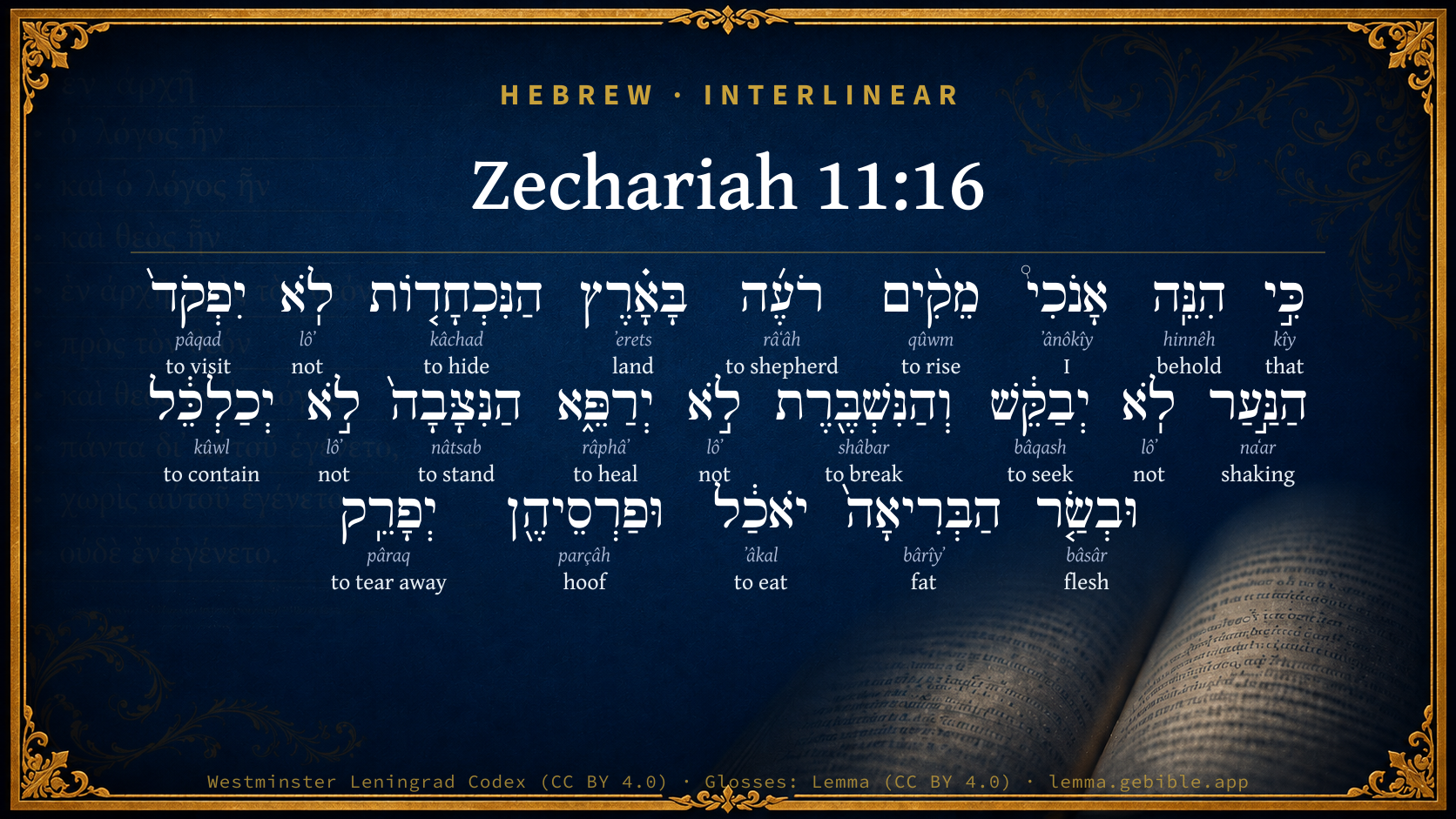
Hebrew (Westminster Leningrad Codex) Zechariah 11:16 appears in the Hebrew Old Testament. The text above is from the Westminster Leningrad Codex. Each word links to its Strong’s number, a concise gloss, and parsing drawn from the Open Scriptures Hebrew Bible morphology. Click any word for its full Brown-Driver-Briggs (BDB) entry.
Download image
Cite this verse

Zechariah 11:16 (World English Bible). Public Domain. Lemma interlinear Bible study tool, https://lemma.gebible.app/v/zechariah/11/16.

Show BibTeX & RIS
BibTeX
RIS
English Translation
For, behold, I will raise up a shepherd in the land, who will not visit those who are cut off, neither will seek those who are scattered, nor heal that which is broken, nor feed that which is sound; but he will eat the flesh of the fat sheep, and will tear their hoofs in pieces.
World English Bible · Public Domain
Highlights
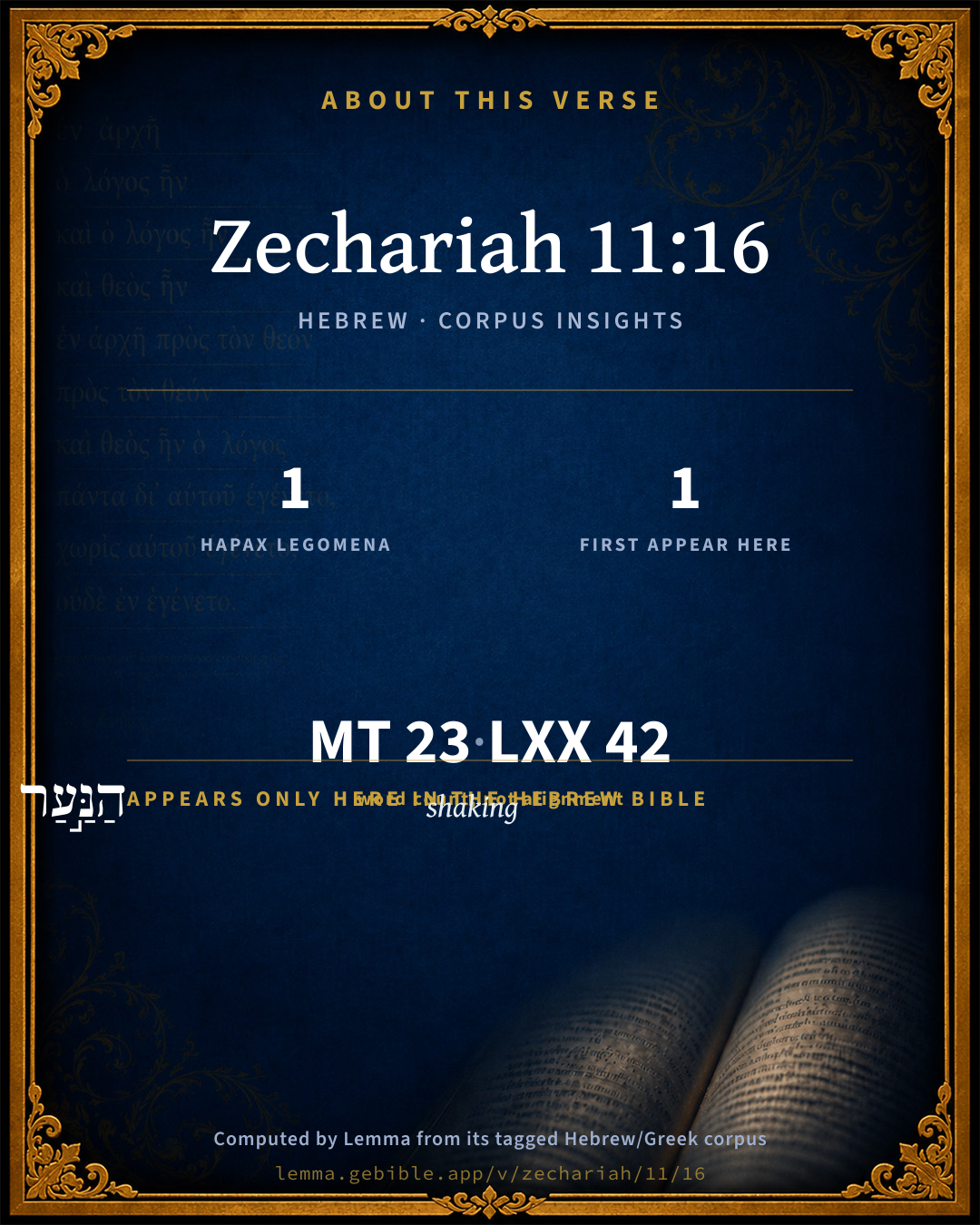
  • 1 hapax legomenon — only here in the Hebrew Bible
  • 1 first appearance in the Hebrew Bible
Full analysis ↓
Download a study sheet

One document with this verse’s original text, its word-by-word gloss line, the meaning frame, cross-references with their text, attributed commentary, and full source and license credits — printable, and it pastes into notes with its structure intact.

This verse Autodidact and up

Study sheet (.html) Plain text (.txt)

A passage Seminary Student

Up to 50 verses in one chapter. A passage sheet keeps up to 6 commentary sources and 12 cross-references per verse, in the order this page ranks them, and says so on the sheet whenever that leaves anything out. Ask for a single verse and you get the Autodidact verse sheet above.

Everything on this page stays free to read, with no account — the sheet is a download of what is already on screen, not access to it.

Want to remove ads? Support Godless Engineer
Compare translations 3

The same verse in 3 English versions, stacked beneath the original-language interlinear above. Click any original word for its lexicon entry.

Each is an independent rendering of the whole verse — the interlinear is not word-aligned to these translations.

Highlighted words mark where these versions differ — a whole-verse word diff, not a word-by-word alignment.

  • World English Bible Public Domain
    For, behold, I will raise up a shepherd in the land, who will not visit those who are cut off, neither will seek those who are scattered, nor heal that which is broken, nor feed that which is sound; but he will eat the flesh of the fat sheep, and will tear their hoofs in pieces.
  • King James Version Public Domain
    For, lo, I will raise up a shepherd in the land, which shall not visit those that be cut off, neither shall seek the young one, nor heal that that is broken, nor feed that that standeth still: but he shall eat the flesh of the fat, and tear their claws in pieces.
  • unfoldingWord Literal Text CC BY-SA 4.0
    for see, I am about to set in place a shepherd in the land. He will not care for the perishing sheep. He will not seek out the sheep gone missing, nor heal the crippled sheep. He will not feed the sheep that are healthy, but will eat the flesh of the fattened sheep and will tear off their hooves.

unfoldingWord Literal Text — © unfoldingWord, licensed CC BY-SA 4.0. Word-aligned USFM3 via Door43 (git.door43.org/unfoldingWord/en_ult).

Versions to compare (up to 4)

3 of 4 selected

Show all 18 translations

Every available English version of this verse, each an independent rendering of the whole verse.

  • World English Bible Public Domain
    For, behold, I will raise up a shepherd in the land, who will not visit those who are cut off, neither will seek those who are scattered, nor heal that which is broken, nor feed that which is sound; but he will eat the flesh of the fat sheep, and will tear their hoofs in pieces.
  • Berean Standard Bible Public Domain
    For behold, I will raise up a shepherd in the land who will neither care for the lost, nor seek the young, nor heal the broken, nor sustain the healthy, but he will devour the flesh of the choice sheep and tear off their hooves.
  • Majority Standard Bible Public Domain
    For behold, I will raise up a shepherd in the land who will neither care for the lost, nor seek the young, nor heal the broken, nor sustain the healthy, but he will devour the flesh of the choice sheep and tear off their hooves.
  • King James Version Public Domain
    For, lo, I will raise up a shepherd in the land, which shall not visit those that be cut off, neither shall seek the young one, nor heal that that is broken, nor feed that that standeth still: but he shall eat the flesh of the fat, and tear their claws in pieces.
  • American Standard Version (1901) Public Domain
    For, lo, I will raise up a shepherd in the land, who will not visit those that are cut off, neither will seek those that are scattered, nor heal that which is broken, nor feed that which is sound; but he will eat the flesh of the fat `sheep', and will tear their hoofs in pieces.
  • Revised Version (1885) Public Domain
    For, lo, I will raise up a shepherd in the land, which shall not visit those that be cut off, neither shall seek those that be scattered, nor heal that that is broken; neither shall he feed that which is sound, but he shall eat the flesh of the fat, and shall tear their hoofs in pieces.
  • Geneva Bible (1599) Public Domain
    For loe, I will rayse vp a shepheard in the land, which shall not looke for the thing, that is lost, nor seeke the tender lambes, nor heale that that is hurt, nor feede that that standeth vp: but he shall eate the flesh of the fat, and teare their clawes in pieces.
  • Douay-Rheims (1899) Public Domain
    For behold I will raise up a shepherd in the land, who shall not visit what is forsaken, nor seek what is scattered, nor heal what is broken, nor nourish that which standeth, and he shall eat the flesh of the fat ones, and break their hoofs.
  • Young's Literal Translation Public Domain
    For lo, I am raising up a shepherd in the land, The cut off he doth not inspect, The shaken off he doth not seek, And the broken he doth not heal, The standing he doth not sustain, And the flesh of the fat he doth eat, And their hoofs he doth break off.
  • Literal Standard Version CC BY-SA 4.0
    For behold, I am raising up a shepherd in the land, || The cut off he does not inspect, || The shaken off he does not seek, || And the broken he does not heal, || The standing he does not sustain, || And the flesh of the fat he eats, || And their hooves he breaks off.
  • Unlocked Literal Bible CC BY-SA 4.0
    for see, I am about to set in place a shepherd in the land. He will not care for the perishing sheep. He will not seek out the sheep gone missing, nor heal the crippled sheep. He will not feed the sheep that are healthy, but will eat the flesh of the fattened sheep and will tear off their hooves.
  • unfoldingWord Literal Text CC BY-SA 4.0
    for see, I am about to set in place a shepherd in the land. He will not care for the perishing sheep. He will not seek out the sheep gone missing, nor heal the crippled sheep. He will not feed the sheep that are healthy, but will eat the flesh of the fattened sheep and will tear off their hooves.
  • Darby Bible Public Domain
    For behold, I will raise up a shepherd in the land, who shall not visit those that are about to perish, neither shall seek that which is strayed away, nor heal that which is wounded, nor feed that which is sound; but he will eat the flesh of the fat, and tear their hoofs in pieces.
  • World Messianic Bible Public Domain
    For, behold, I will raise up a shepherd in the land who will not visit those who are cut off, neither will seek those who are scattered, nor heal that which is broken, nor feed that which is sound; but he will eat the meat of the fat sheep, and will tear their hoofs in pieces.
  • Webster's Bible Public Domain
    For lo, I will raise up a shepherd in the land, who shall not visit those that are cut off, neither shall seek the young one, nor heal that which is broken, nor feed that which standeth still: but he shall eat the flesh of the fat, and tear their claws in pieces.
  • Free Bible Version CC BY-SA 4.0
    For I am placing a shepherd in charge of the land who won't care for those who are dying, or look for the lost, or heal the injured, or feed the healthy. Instead he will eat the meat from the fattest sheep. He even tears their hooves off.
  • Bible in Basic English Public Domain
    For see, I will put a sheep-keeper over the land, who will have no care for that which is cut off, and will not go in search of the wanderers, or make well what is broken, and he will not give food to that which is ill, but he will take for his food the flesh of the fat, and let their feet be broken.
  • JPS Tanakh (1917) Public Domain
    For, lo, I will raise up a shepherd in the land, who will not think of those that are cut off, neither will seek those that are young, nor heal that which is broken; neither will he feed that which standeth still, but he will eat the flesh of the fat, and will break their hoofs in pieces.'

Literal Standard Version (2020), Covenant Press — licensed CC BY-SA 4.0. Text via the HelloAO Bible API (eBible.org). Unlocked Literal Bible (unfoldingWord) — licensed CC BY-SA 4.0. Text via the HelloAO Bible API (eBible.org). unfoldingWord Literal Text — © unfoldingWord, licensed CC BY-SA 4.0. Word-aligned USFM3 via Door43 (git.door43.org/unfoldingWord/en_ult). Free Bible Version, Dr. Jonathan Gallagher — licensed CC BY-SA 4.0. Text via the HelloAO Bible API (eBible.org).

Word by word

More ways to search: Search by grammar → Find every occurrence → Compare this word →

Practice this passage: Drill this verse → Learn its vocabulary →

הַנַּ֣עַר
naʻar
H5289
“the · shaking”
Particle, Definite Article + Noun, Common, Masculine, Singular, Absolute
Part of Speech
Particle + Noun
Type
Common
Gender
Masculine
Number
Singular
State
Absolute
Full BDB Definition

Origin: from H5287 in its derivative sense of tossing about

TWOT: 1388a

a shaking, scattering
  1. כִּ֣י kîy H3588 “that” Conjunction
  2. הִנֵּֽה hinnêh H2009 “behold” Particle, Demonstrative
  3. אָנֹכִי֩ ʼânôkîy H595 “I” Pronoun, Personal, 1st Person, Common, Singular
  4. מֵקִ֨ים qûwm H6965 “rising” Verb, Hiphil, Participle Active, Masculine, Singular, Absolute
  5. רֹעֶ֜ה râʻâh H7462 “shepherding” Verb, Qal, Participle Active, Masculine, Singular, Absolute
  6. בָּאָ֗רֶץ ʼerets H776 “in/at the · land” Preposition, Determined + Noun, Common, Both, Singular, Absolute
  7. הַנִּכְחָד֤וֹת kâchad H3582 “the · hidden” Particle, Definite Article + Verb, Niphal, Participle Passive, Feminine, Plural, Absolute
  8. לֹֽא lôʼ H3808 “not” Particle, Negative
  9. יִפְקֹד֙ pâqad H6485 “to visit” Verb, Qal, Imperfect, 3rd Person, Masculine, Singular
  10. לֹֽא lôʼ H3808 “not” Particle, Negative
  11. יְבַקֵּ֔שׁ bâqash H1245 “to seek” Verb, Piel, Imperfect, 3rd Person, Masculine, Singular
  12. וְהַנִּשְׁבֶּ֖רֶת shâbar H7665 “and · the · broken” Conjunction + Particle, Definite Article + Verb, Niphal, Participle Passive, Feminine, Singular, Absolute
  13. לֹ֣א lôʼ H3808 “not” Particle, Negative
  14. יְרַפֵּ֑א râphâʼ H7495 “to heal” Verb, Piel, Imperfect, 3rd Person, Masculine, Singular
  15. הַנִּצָּבָה֙ nâtsab H5324 “the · standing” Particle, Definite Article + Verb, Niphal, Participle Active, Feminine, Singular, Absolute
  16. לֹ֣א lôʼ H3808 “not” Particle, Negative
  17. יְכַלְכֵּ֔ל kûwl H3557 “to contain” Verb, Pilpel, Imperfect, 3rd Person, Masculine, Singular
  18. וּבְשַׂ֤ר bâsâr H1320 “and · flesh of” Conjunction + Noun, Common, Masculine, Singular, Construct
  19. הַבְּרִיאָה֙ bârîyʼ H1277 “the · fat” Particle, Definite Article + Adjective, Adjective, Feminine, Singular, Absolute
  20. יֹאכַ֔ל ʼâkal H398 “to eat” Verb, Qal, Imperfect, 3rd Person, Masculine, Singular
  21. וּפַרְסֵיהֶ֖ן parçâh H6541 “and · hooves · their” Conjunction + Noun, Common, Feminine, Plural, Construct + Suffix, Personal, 3rd Person, Feminine, Plural
  22. יְפָרֵֽק pâraq H6561 “to tear away” Verb, Piel, Imperfect, 3rd Person, Masculine, Singular

About this verse

These counts appear in no published source. They are computed here, from the morphology-tagged text and Lemma’s own curated glosses. What Lemma adds →

23
words
20
distinct lemmas
Prophets
section

Notable vocabulary

1 hapax legomenon — a word that appears only here in the entire Hebrew Bible:

  • הַנַּ֣עַר shaking H5289

First appearance in Scripture

This word makes its first canonical appearance in the Hebrew Bible here:

  • הַנַּ֣עַר shaking H5289

Shared distinctive vocabulary

יְפָרֵֽק to tear away H6561 occurs in 10 verses of the Hebrew Bible. Also found in:

Grammatical profile

  • 11 verbs
  • 4 nouns
  • 1 adjective
  • 1 pronoun
  • 1 conjunction
  • 5 particles

Verb forms

  • מֵקִ֨ים Hiphil · Participle Active
  • רֹעֶ֜ה Qal · Participle Active
  • הַנִּכְחָד֤וֹת Niphal · Participle Passive
  • יִפְקֹד֙ Qal · Imperfect
  • יְבַקֵּ֔שׁ Piel · Imperfect
  • וְהַנִּשְׁבֶּ֖רֶת Niphal · Participle Passive
  • יְרַפֵּ֑א Piel · Imperfect
  • הַנִּצָּבָה֙ Niphal · Participle Active
  • יְכַלְכֵּ֔ל Pilpel · Imperfect
  • יֹאכַ֔ל Qal · Imperfect
  • יְפָרֵֽק Piel · Imperfect

Repetition

A word recurs within this verse — often emphatic in Hebrew:

Hebrew & Septuagint length

In English translation the verse runs 56 words from the Hebrew and 61 from the Septuagint (LXX English) — closely comparable.

A rough comparison of the two English renderings, which tokenize alike — not a word-level alignment.

Word counts can differ between the Hebrew and the Greek without any difference in meaning — e.g. the Hebrew direct-object marker אֵת has no separate Greek word, and Greek often adds the article ὁ.

In the original languages it is 23 Hebrew tokens and 42 Greek tokens — but the two are counted differently (Hebrew bundles its prefixes and suffixes into one token; the Greek is in lemma form), so that isn’t a like-for-like length.

Cross-references

15

Topical passages linked to Zechariah 11:16 in the Treasury of Scripture Knowledge — connected by theme and wording, ordered by reader-vote popularity; previews shown in the World English Bible.

  • Jeremiah 23:2 Therefore thus says Yahweh, the God of Israel, against the shepherds who feed my people: You have scattered my flock, and driven them away, and have not visited them; behold, I will visit on you the evil of your doings, says Yahweh.
  • Ezekiel 34:2–6 Son of man, prophesy against the shepherds of Israel, prophesy, and tell them, even to the shepherds, Thus says the Lord Yahweh: Woe to the shepherds of Israel who feed themselves! Shouldn't the shepherds feed the sheep?
  • John 10:1 "Most assuredly, I tell you, one who doesn't enter by the door into the sheep fold, but climbs up some other way, the same is a thief and a robber.
  • John 10:12–13 He who is a hired hand, and not a shepherd, who doesn't own the sheep, sees the wolf coming, leaves the sheep, and flees. The wolf snatches the sheep, and scatters them.
  • Genesis 31:38 These twenty years have I been with you. Your ewes and your female goats have not cast their young, and I haven't eaten the rams of your flocks.
  • Genesis 33:13 Jacob said to him, "My lord knows that the children are tender, and that the flocks and herds with me have their young, and if they overdrive them one day, all the flocks will die.
  • 1 Samuel 17:34–35 David said to Saul, Your servant was keeping his father's sheep; and when there came a lion, or a bear, and took a lamb out of the flock,
  • Isaiah 40:11 He will feed his flock like a shepherd, he will gather the lambs in his arm, and carry them in his bosom, [and] will gently lead those who have their young.
  • Jeremiah 23:22 But if they had stood in my council, then had they caused my people to hear my words, and had turned them from their evil way, and from the evil of their doings.
  • Ezekiel 34:10 Thus says the Lord Yahweh: Behold, I am against the shepherds; and I will require my sheep at their hand, and cause them to cease from feeding the sheep; neither shall the shepherds feed themselves any more; and I will deliver my sheep from their mouth, that they may not be food for them.
  • Ezekiel 34:16 I will seek that which was lost, and will bring back that which was driven away, and will bind up that which was broken, and will strengthen that which was sick: but the fat and the strong I will destroy; I will feed them in justice.
  • Ezekiel 34:21 Because you thrust with side and with shoulder, and push all the diseased with your horns, until you have scattered them abroad;
  • Matthew 23:2–4 saying, "The scribes and the Pharisees sat on Moses' seat.
  • Matthew 23:13–29 "Woe to you, scribes and Pharisees, hypocrites! For you devour widows' houses, and as a pretense you make long prayers. Therefore you will receive greater condemnation.
  • Luke 12:45–46 But if that servant says in his heart, 'My lord delays his coming,' and begins to beat the menservants and the maidservants, and to eat and drink, and to be drunken,

Cross-references courtesy of OpenBible.info (CC BY 4.0).

Hebrew and Greek witnesses Masoretic Hebrew ↔ Greek Septuagint

The same verse in the two great witnesses to the Old Testament, shown verse-for-verse.

These are two independent witnesses, not word-aligned to each other, and the Septuagint is shown in lemma (dictionary) form.

Hebrew Zechariah 11:16 Masoretic · Westminster Leningrad Codex

כִּ֣י הִנֵּֽה אָנֹכִי֩ מֵקִ֨ים רֹעֶ֜ה בָּאָ֗רֶץ הַנִּכְחָד֤וֹת לֹֽא יִפְקֹד֙ הַנַּ֣עַר לֹֽא יְבַקֵּ֔שׁ וְהַנִּשְׁבֶּ֖רֶת לֹ֣א יְרַפֵּ֑א הַנִּצָּבָה֙ לֹ֣א יְכַלְכֵּ֔ל וּבְשַׂ֤ר הַבְּרִיאָה֙ יֹאכַ֔ל וּפַרְסֵיהֶ֖ן יְפָרֵֽק

For, behold, I will raise up a shepherd in the land, who will not visit those who are cut off, neither will seek those who are scattered, nor heal that which is broken, nor feed that which is sound; but he will eat the flesh of the fat sheep, and will tear their hoofs in pieces.

World English Bible · Public Domain

Greek LXX Zechariah 11:16 Septuagint · lemma form

διότι ἰδού ἐγώ ἐκἐγείρω ποιμήν ἐπί ὁ γῆ ὁ ἐκλιμπάνω οὐ μή ἐπισκέπτομαι καί ὁ διασκορπίζω οὐ μή ζητέω καί ὁ συντρίβω οὐ μή ἰάομαι καί ὁ ὁλόκληρος οὐ μή καταεὐθύνω καί ὁ κρέας ὁ ἐκλεκτός καταἐσθίω καί ὁ ἀστράγαλος αὐτός ἐκστρέφω

For, behold, I will raise up a shepherd against the land: he shall not visit that which is perishing, and he shall not seek that which is scattered, and he shall not heal that which is bruised, nor guide that which is whole: but he shall devour the flesh of the choice ones, and shall dislocate the joints of their necks.

LXX2012 (modern English Septuagint) · Public Domain

On this verse, Joseph Benson's Commentary discusses the Septuagint’s reading. Read the note in Commentary ↓

Hebrew: Westminster Leningrad Codex (CC BY 4.0). Greek: Septuagint (public domain); English from LXX2012 (modern English Septuagint) (Public Domain). How the Septuagint differs from the Hebrew →

Targum (Aramaic paraphrase)

1

The Targum is the ancient Jewish Aramaic paraphrase of the Hebrew Scriptures — an interpretive translation, not the Hebrew text itself. Onkelos (literal) and Pseudo-Jonathan (expansive) render the Torah, and Jonathan the Prophets. Coverage is partial: where no permissively-licensed English translation exists for a verse, only the Aramaic is shown. This is verse-level text, not a word-by-word alignment to the Hebrew.

  1. Targum Jonathan Prophets (Joshua–Malachi)
    אֲרֵי הָא אֲנָא מֵקִים פַּרְנָסָא בְּאַרְעָא דְשָׁגָן לָא יִבְעֵי דְאִיטַלְטָלוּ לָא יִתְבַּע דִתְבִירִין לָא יַסֵי דְקַיְמִין לָא יִסוֹבַר וְנִכְסֵי עַתִירַיָא יִבּוֹז וּשְׁאָרְהוֹן יְגַמַר:

    (no public-domain English translation for this verse)

    Targum Jonathan — Aramaic: “Mikraot Gedolot” (public domain). English: “Sefaria Community Translation” (CC0 1.0 (public-domain dedication)); “London "Chaldee Paraphrase," 1871” (public domain). Text via Sefaria.

Commentary

Notes on Zechariah 11:16 from classic Christian and Jewish commentators (each source and its license shown beneath its notes). The classic Christian expositions comment on the surrounding passage and are grouped to its opening verse, so a note may address several verses; the Jewish commentaries on the Tanakh (Rashi and others) are per-verse, so they appear only where the commentator wrote on this verse.

Lemma curates 59 commentaries, every one of them public domain or Creative Commons licensed, each selected and text-cleaned for this edition rather than reprinted as found. About our sources →

Trapp's Complete Commentary

John Trapp

Zec 11:16 For, lo, I will raise up a shepherd in the land, [which] shall not visit those that be cut off, neither shall seek the young one, nor heal that that is broken, nor feed that that standeth still: but he shall eat the flesh of the fat, and tear their claws in pieces.

Ver. 16. For, lo, I will raise up a shepherd in the land] Evil shepherds (that is, rulers in State and Church, see Jer 6:3 Nah 3:18 Isa 44:28) are set up by God for a punishment of a sinful people. {See Trapp on "Zec 11:15"} The evil shepherd here meant was Antiochus Epiphanes, saith Theodoret; Herod, the infanticide, saith Montanus; Titus and the Romans, saith a Castro; all the perverse priests and princes that ruled over the Jews, after the time of this prophecy, saith a Lapide; as Jason, Menelaus, 2Ma 4:1-50; 2Ma 5:1-27, Herod, Pilate, Annas and Caiaphas, the Scribes and Pharisees; but especially antichrist (according to Joh 5:43), whose forerunners all the former were. Of one Pope it is said, by those of his own side, that he entered upon the government of the Church as a fox, reigned as a wolf, died as a dog; and it is true enough of all the rest, and to them the following words do most fitly agree.

Who shall not visit those that be cut off] Or, look for the thing that is lost. Illos qui erraverunt, non quaerent, saith the ChaIdee: the word signifieth such as are hidden in thickets, hung among thorns and briers, and there likely to perish without help.

Neither shall seek the young one] The tender lambs of Christ, which Peter was doubly charged to feed. Stolidam non requiret, saith the Tigurine translation. Lambs are silly things, very apt to straggle; and least able of any creature to find their way home again.

Nor heal that that is broken] David, by leaping over the pale, as it were, of God’s precepts, brake his bones, Psa 51:8, and felt the fall the longest day of his life; so may any of Christ’s flock. The good Shepherd, therefore, in pera gestat unguentum, hath his medicines ready in scrip, to apply as need requireth. Not so the idol shepherd, who will rather break the sound than bind up the broken.

Nor feed that that standeth still] Or, that is well underlaid, and is full of vigour. Vatablus rendereth it, Eam quae restitat, non portabit. He will not carry that which can go no further. Hitherto the negligence of these evil shepherds. Followeth next their cruelty, and that is more than bestial. For the ravening beasts lightly leave some foot or bone undevoured, Amo 3:12; but these do not only eat the flesh of the flock, and suck the fat, but barbarously tear the claws also in pieces, exercise utmost immunity; as it is here graphically and gallantly described.

John Trapp, A Commentary or Exposition upon All the Books of the Old and New Testament (1647–1656) — public domain. Text from a community e-Sword module.

Joseph Benson's Commentary

Zec 11:16. For lo, I will raise up a shepherd in the land — A shepherd, in the singular number, denotes a succession of such shepherds as are described in the following words. So a succession of priests is represented under the single person of Levi, Mal 2:5-6. Since the Jews had rejected the true Shepherd, God threatens to send, or permit to arise, among them, such shepherds to rule or teach them as should be notorious for their negligence and avarice, their cruelty and oppression. This may be understood either of the blind guides of whom Christ speaks, and whose character he describes at large, Mat 23:13-33; namely, the scribes and Pharisees, the priests and doctors of their law; or of the avaricious, tyrannical, and unmerciful princes, that should rule them with rigour, and make their own land as much a place of bondage to them as ever Egypt or Babylon had been. And when they had rejected him by whom princes decree justice, it was just that they should be given over into the power of those who should decree unrighteous decrees. It is probable, also, that there is a reference here to the false prophets and false Christs, which, as our Lord foretold, Mat 24:5, should arise. Many such there were, who, by their seditious practices, provoked the Romans, and hastened on the ruin of the Jewish nation: but it is very remarkable that they were never deceived by a counterfeit Messiah till they had refused and rejected the true Messiah. The prophet proceeds to describe the character of these foolish shepherds, in the following words: 1st, They should be negligent; which shall not visit those that be cut off — Or, as the LXX. render it, το εκλιμπανον, that which is missing, or has wandered from the flock; and it may signify that which is ready to perish. Neither shall seek the young one — Which are most apt to perish through weakness; he alludes to the lambs which, on account of their tender age, are not able to follow the flock. Nor heal that which is broken — Which has received some hurt, but shall leave it to die of its wounds. Nor feed that that standeth still — Not able to go forward. Blayney renders the word, made to stand, or set up again after sickness. “Such,” says he,” it is well known, require much care to nourish and support them, in order to their regaining strength; a care which the foolish shepherd will not bestow upon them.” Or, as the LXX. render it, το ολοκληρον ου μη κατευθυνη, nor shall direct that which is whole, mentioned in opposition to those that wander, or are diseased. 2d, These shepherds would be luxurious; he shall eat the flesh of the fat — That is, instead of preserving the best of his flock, in order to increase it, he kills them to indulge his own appetite: or, enriches himself by oppressing, or otherwise taking from those that are persons of property: like that wicked servant that said, My lord delays his coming, he eats and drinks with the drunken, serving his own belly. 3d, They are tyrannical and cruel to the flock. And tear their claws [or, as it ought to be rendered, break their hoofs] in pieces — This implies the same as when it is said (Eze 34:4) of such shepherds, With force and with cruelty have ye ruled them. The unwise shepherd, instead of being tender and gentle with his flock, is supposed to drag them about with his iron crook, or to over-drive them in rough and stony ground, so as to break their hoofs. Or, he imposes burdens and hardships upon them that they are unable to bear. Upon the whole, a sluggish, negligent, covetous, riotous, oppressive, and cruel government, priesthood, or ministry, is here shadowed out by a foolish shepherd.

Joseph Benson's Commentary on the Old and New Testaments (1811–1818) — public domain. Text from a community e-Sword module.

Tyndale Open Study Notes

Tyndale Open Resources

11:16 Tear off their hooves is a Hebrew idiom for a wanton and ravenous search for the last morsel of edible meat on an animal carcass (see Mic 3:3).

Tyndale Open Study Notes — © Tyndale Open Resources, licensed CC BY-SA 4.0. Text via the HelloAO Bible API.

Geneva Bible (1599)

Geneva Bible translators

And is in health and sound.

Geneva Bible (1599) marginal notes — public domain. Text via Bolls.life.

Jamieson, Fausset & Brown

Robert Jamieson, A. R. Fausset & David Brown

in the land--Antichrist will probably he a Jew, or at least one in Judea.

not visit . . . neither . . . seek . . . heal . . . broken, nor feed . . . but . . . eat . . . flesh . . . tear--Compare similar language as to the unfaithful shepherds of Israel in Eze 34:2-4. This implies, they shall be paid in kind. Such a shepherd in the worst type shall "tear" them for a limited time.

those . . . cut off--"those perishing" [Septuagint], that is, those sick unto death, as if already cut off.

the young--The Hebrew is always used of human youths, who are really referred to under the image of the young of the flock. Ancient expositors [Chaldee Version, JEROME, &c.] translate, "the straying," "the dispersed"; so GESENIUS.

broken--the wounded.

standeth still--with faintness lagging behind.

tear . . . claws--expressing cruel voracity; tearing off the very hoofs (compare Exo 10:26), giving them excruciating pain, and disabling them from going in quest of pasture.

Jamieson, Fausset & Brown — Commentary Critical and Explanatory on the Whole Bible (1871) — public domain (CC PDM 1.0). Text via the HelloAO Bible API.

Adam Clarke's Commentary

Verse 16. I will raise up a shepherd in the land] Some wicked king; and Newcome supposes Hoshea may be meant. See 2Kg 17:1-2, and to such an abominable sovereign the prophecy may well apply.

Adam Clarke's Commentary on the Bible (1810–1826) — public domain. Text from a community e-Sword/MySword module.

John Calvin's Commentaries

Behold, he says, I will set a shepherd in the land. God had now, as we have said, renounced the office of a shepherd; but he afterwards set over them wolves, and thieves, and robbers, instead of shepherds, that is, when he executed his dreadful judgment on the Jews: and he shows at the same time what sort of shepherds they would be who in future should possess power over them.

They were to be such as would not look after what had been cut off. Some consider the word הנכחדות, enecachedut, as signifying the sick sheep; but they are in my judgment mistaken; for careful shepherds seek what is lost, or what has disappeared from the flock; and this is what Zechariah means, for he says, he will not visit, that is, he will look after what has been cut off from the flock. Then he says, he will not seek הנער, enor, the young. Some explain this of fat lambs; but others more correctly of those which are tender, not as yet accustomed to follow the shepherd; for sheep by long use keep from going astray, but lambs are more apt to wander from the flock, and are easily scattered here and there. This is the reason why Zechariah makes it one of the duties of a good shepherd to seek what is yet young. He adds in the third place, the sick, What is wounded, he says, he will not heal: and lastly, he will not feed what stands, that is, what is sound. The word literally is, to stand; but it means full vigor or strength. What then is vigorous and sound he will not feed. He then says, The flesh, of the fat he will devour, yea, he will break their hoofs. By these words he amplifies the cruelty of the shepherd; for he will not be satisfied with the fat flesh, without breaking also the bones and the hoofs, as though his barbarity would exceed that of wolves and wild beasts.

We now then see the import of this prophecy: and it seems to have been added, that the Jews might not flatter themselves with an external and evanescent form of government, after having departed from God, and after the covenant which he had made with that nation, having been also renounced by him, so that he should be no longer their Father, or Guardian, or Shepherd. Hypocrites, we know, do not easily put off their obstinacy; though God’s vengeance should be manifest, yet we see how they harden themselves, especially when they can cover their wickedness under some false pretense, a striking example of which we observe among the Papists. We now then perceive the design of the Holy Spirit, when the Prophet is bid to assume the character, and take the implements, of a foolish shepherd.

If any one objects, and says that this was not suitable to a true Prophet of God, the answer is plain — the Prophet deviated not from the right course of his calling, though he assumed the character of a foolish shepherd, an instance of which we have already seen in Hosea, who was commanded to take a harlot, and to beget spurious children from one who had been infamous in her character. (Hosea 1:2.) As this was a vision presented to Hosea, it does not follow that he did anything disgraceful, so as to prevent him from exercising the office of a holy teacher. So also now, God simply shows to us what would be the fixture condition of that reprobate people.

It must further be noticed, that when anything of a right and good government remains in the external form, there is no reason to conclude from this that God is the ruler, for, as we have already said, it is a ridiculous and senseless glorying when men are inflated and take pride in mere titles or names of distinction. Let us then take heed, that those who bear rule be rightly called by God, and let them afterwards discharge their office faithfully, otherwise they may be a hundred times called pastors, after having attained this degree of honor, and be after all no better than wolves and robbers; for no one is a true pastor whom the Lord does not rule by his Spirit, and who is not his minister, and no ungodly pastors, however they may assume the title, can be called the ministers of God, when he has already, as we see here, forsaken the people.

It must at the same time be observed, that it happens not except through the just judgment of God, that things grow worse and worse, and at length become wholly degenerated; and those who loudly boast and seek to be esteemed by all as pastors, are altogether senseless, for God has not appointed them, and the whole filth of the Papal clergy is at this day a manifest evidence of God’s wrath and indignation, for he thus justly punishes the contempt of his word, and that perverseness by which the world thus awfully provoked him. Though God has been graciously calling the whole world to himself, we yet see how his favor has been rejected, and we also see how almost all have gone on in their obstinacy. God had indeed in his great goodness borne for some ages with this great wickedness, and when he began to punish the ungrateful, he did not break out to extreme vengeance, for he added to scourges heavier scourges, but at length he was constrained to make his wrath to flow like a deluge. Hence has arisen that dreadful confusion which is seen under the Papacy; and this is what the words of the Prophet mean when God declares here that foolish pastors would be set up by his command and through his power, as he would thus execute his judgment on the ungodly.

Now as the Prophet enumerates here those things which are inconsistent with the duty of a good shepherd, we may hence learn, on the other hand, what it is to rule the Church rightly and according to God’s will, and also what are the attributes or marks of a good pastor. Whosoever then would be owned as a good pastor in the Church, must visit those who have been cut off, seek the young, strive to heal the wounded, and feed well the sound and the vigorous; and he must also abstain from every kind of cruelty, and he must not be given to the indulgence of his appetite, nor regard gain, nor exercise any tyranny. Whosoever will thus conduct himself, will prove that he is really a true pastor. But what can be more preposterous than for those to be called pastors who have no flock under their care? who plunder, and gather, and accumulate what they afterward spend in dissipation?

As then it is quite evident, that all those under the Papacy who are called bishops, seek the office for no other end but that they may live sumptuously, without any care or labor, and indulge in pleasures, and also spend in the gratification of their lust what is unjustly got, — as then they are known to be idlers and cruel tyrants, such as the Prophet here describes, do we not clearly see how childishly they boast of their hierarchy, and at the same time declare that they derive their origin from the Apostles? For what sort of successor to Peter or to Paul, is he who exercises the most barbarous tyranny, and who thinks himself not bound to take care of the flock? We then see that there is at this day under the Papacy a striking representation of what the Prophet says here; there is a certain form of government, but God is wholly separated from such a mask or phantom. But we must also bear in mind, that the world suffers merited punishment on account of its ingratitude, when it is thus cruelly and shamefully treated; for it is but just that they who will not bear the easy yoke of Christ, should be made subject to the power of the Devil, and be trodden under foot and disgracefully oppressed by tyrants. This is God’s righteous judgment. The Church, we know, would not have been turned upside down had not the greater part rejected the doctrine of salvation, and shaken off all religion; hence God is in a manner constrained by so great and by such unbridled wantonness to renounce his office of a shepherd. It then follows —

John Calvin's Commentaries (1540-1563) — public domain. Text from the Calvin Translation Society English edition (1840s-50s) via the Christian Classics Ethereal Library (ccel.org). Calvin's coverage is partial (roughly two-thirds of the Bible); uncommented books and verses are honest gaps, never fabricated. The 19th-century editor's footnotes and remarks are omitted so the notes are faithfully Calvin's own voice.

Ellicott's Commentary for English Readers

(16) The young one.—Better, the scattered. The foolish shepherd we understand to mean all the misrulers of Israel from the time of the decline of the glories of the Maccabean period to the day when they themselves declared “We have no king but Cæsar.” With the latter part of the verse comp. Dan_7:7; Dan_7:19; Dan_7:23, and contrast it with Eze_34:16.

A Bible Commentary for English Readers, edited by Charles John Ellicott (1878–1897) — public domain. Text from a community e-Sword module.

The Cambridge Bible for Schools and Colleges

gen. ed. J. J. S. Perowne

16. cut off] i.e. destroyed, or lost. See Zec_11:9, and comp. Exo_23:23. “Pastores seduli requirunt siquid est perditum, vel siquid evanuit in grege: et hoc intelligit Zacharias per visitationem.” Calvin.

the young one] Rather, the scattered, lit. the dispersion, τὸ ἐσκορπισμένον, LXX. dispersum, Jerome.

feed that that standeth still] Rather, nourish that that standeth (firm). τὸ ὁλόκληρον. LXX. that which is sound, R. V. Pusey compares the petition in the Litany, “that it may please Thee to strengthen such as do stand.” Another view is that they that stand, are the sheep which stand still, unable through weakness and weariness to go forward. But the word seems always to be used of standing firmly, not of coming to a stand-still through infirmity.

claws] Rather, hoofs. Like a voracious man, who not content with eating the flesh of the fat, tears to pieces and sucks the goodness out of the very hoofs. “Videtur diffringere ungulas esse hominis voracis, ipsas ungulas frangentis et exsudentis.” Maurer. For a like picture both of neglect of duty and of cruelty in a shepherd see Eze_34:4.

The Cambridge Bible for Schools and Colleges (gen. ed. J. J. S. Perowne; Cambridge University Press, 1878–1918) — public domain. Text from a community e-Sword module.

John Gill's Exposition

For, lo, I will raise up a shepherd in the land,.... Not in the land of Judea, but in the Roman empire; and so not Herod, nor King Agrippa, as Kimchi; nor Antiochus Epiphanes, as others; nor those wicked priests and princes, who governed after the times of Zechariah; nor the Scribes and Pharisees in Christ's times, though they are often called fools by him, and were truly foolish shepherds; nor even Titus Vespasian, who destroyed the city and temple; nor Bar Cozba, who set up for the Messiah, and was a false one; or any other of that sort. Calmet (s) thinks this designs the Roman emperors, successors of Tiberius, under whom Jesus Christ was crucified. Caligula succeeded Tiberius. Claudius Caligula, and Nero succeeded Claudius: everyone knows (adds he) the characters of those princes, that they were truly foolish shepherds, mad, wicked, and cruel: but rather it intends shepherd, or shepherds, not in a civil, but in an ecclesiastic sense; all such after Christ, who took upon them this office, but did not perform it aright, as heretics, false teachers, with which the first ages abounded; and especially it points at the bishop of Rome, and all under him, when he fell off from the true doctrine and discipline of the Gospel, the man of sin, or antichrist, as Jerom rightly observes; who, though his coming is according to the working of Satan, yet may be said to be raised up by the Lord, because he suffered him to rise; and by his secret providence, and wise ordination in righteous judgment, he came to the height of his power: with him agrees the name of a "shepherd"; he calls himself the vicar of Christ, the chief shepherd and bishop of souls; Peter's successor, who was ordered to feed the sheep and lambs of Christ; and universal pastor, and a single one, that will not admit of any associate. The character of a "foolish" one belongs to him, though he would be thought to be wise; nor is he wanting in wicked craft and cunning, but ignorant of the pastoral office, and how to feed the church of God; and is a wicked or evil shepherd, as the word (t) used is pretty much the same in sound with our English word "evil": he governing the flock, not with and according to the word of God, but according to his own will and laws; for his "instruments" are laws of his own making, an exercise of tyrannical power over kings and princes, unwritten traditions, pardons, indulgences, &c.:

which shall not visit those that be cut off; not that cut off themselves, or are cut off by the church; but such that go astray, wander from the fold, and are in danger of being lost; that are perishing, as Jarchi explains the word; these he looks not after, nor has he any regard to their spiritual and eternal welfare:

neither shall seek the young one; the lamb, the tender of the flock; he will not do as the good shepherd does, carry the lambs in his arms, Isa 40:11 or, "that which wanders" (u); that strays from the fold, and out of the pastures, or the right way:

nor heal that that is broken; that is of a broken and of a contrite spirit; or whose bones are broken, and consciences wounded, through falls into sin:

nor feed that that standeth still; that can not move from its place to get fresh pasture, but is obliged to stay where it is, and needs supply and support there:

but he shall eat the flesh of the fat; that is, as the Targum well explains it,

"shall spoil the substance of the rich;''

see Rev 18:3,

and tear their claws in pieces; take all their power and privileges from them; all which well agrees with the pope of Rome.

(s) Dictionary, in the word "Shepherds." (t) (u) "errantem", Noldius; "quod prae ruditate evagatur", Cocceius.

John Gill's Exposition of the Whole Bible (1746–1763) — public domain (CC PDM 1.0). Text via the HelloAO Bible API.

Albert Barnes' Notes on the Bible

I will raise up - God supplies the strength or wisdom which people abuse to sin. He, in His Providence, disposeth the circumstances, of which the ambitious avail themselves. antichrist, whom the Jews look for, will be as much an instrument of God for the perfecting the elect, as the Chaldees Hab 1:6 or the Assyrians Amo 6:14 whom God raised up, for the chastisement of His former people, or the Medes against Babylon Isa 13:17.

Which shall not visit them that be cut off - Zechariah uses the imagery, yet not the exact words of Jeremiah Jer 23:1-2 and Ezekiel Eze 34:3-4. Neglect of every duty of a shepherd to his flock, to the sick, the broken, the sound; direct injury of them, preying upon them, make up the picture.

Which shall not visit - Or tend, “that which is cut off:” fulfilling God’s judgment, “that which is to be cut off let it be cut off” Zec 11:9.

Neither shall seek the young one - Better, “the scattered , dispersed,” as the Good Shepherd “came to seek and to save that which was lost” Luk 19:10; Mat 18:11. “Nor heal that which is broken; bound not,” Ezekiel says Eze 34:4. : “The broken legs of sheep are healed no otherwise than those of people; rolled in wool impregnated with oil and wine, and then bound up with splinters placed round about it.”

Nor feed that which standeth still - Better, “the whole” Yet Jonathan renders as English), as the word always means, “in its good estate,” like our prayer, “that Thou wouldest strengthen those who do stand.”

Albert Barnes' Notes on the Bible (1834–1885) — public domain. Text from a community e-Sword/MySword module.

Haydock's Catholic Bible Commentary

Hoofs, with excessive travelling. (Calmet) --- They shew no pity, but are wholly intent on their own pleasures. (Haydock)

George Leo Haydock (1774–1849), Haydock's Catholic Family Bible and Commentary, 1859 edition — public domain. Excludes Psalms (Douay-Rheims chapter numbering differs from Protestant) and Deuterocanonical books (Catholic canon only).

Matthew Poole's English Annotations

I will raise up a shepherd; as a just punishment of their sin in refusing Christ, the wise and good Shepherd; his government they would not accept to their salvation, that they choose shall be to their ruin.

Which shall not visit those that be cut off, or, that are hidden; it is a foolish shepherd who seeks not out those that are lost to bring them home.

Neither shall seek the young one; which are aptest to perish through weakness.

Nor heal that that is broken; but leaves it to die of its wounds.

Nor feed that that standeth still; either not able to go forward, or, hungry, stops to eat, but the shepherd will not wait while this is done.

But he shall eat the flesh of the fat, will feast on the fattest of the flock and tear their claws in pieces; and with cruelty extort all from them, tear off their skin to the very nails. In brief, a sluggish, negligent, covetous, riotous, oppressive, and cruel government, shadowed out by a foolish shepherd, is the punishment of the sins of the Jews.

Matthew Poole's English Annotations on the Holy Bible (1683–1685) — public domain. Text from a community e-Sword/MySword module.

The Pulpit Commentary

I will raise up a shepherd in the land. God explains the reason of the symbolical character which he directed the prophet to assume. He was going to allow the people to be chastised by an instrument whom he would permit to work his will upon them. As this evil shepherd was to arise to punish them for their rejection of Messiah, he must represent some person or power that existed subsequent to Christ"s death. Many consider that he symbolizes the Romans; but these people could not be deemed to exercise pastoral care over the Israelites, nor could their neglect of this (ver. 17) be attributed to them as a sin; nor, again, did their destruction follow upon the overthrow of the Jewish polity (ver. 18). Others see here a prediction of the coming of antichrist; but the character of "shepherd" does not suit his attributes as given elsewhere; at any rate. This cannot be the primary reference of the symbol, though all evil powers that oppose the Church of Christ are in some sense images and anticipations of antichrist. The genuine reference here is to the native chiefs and rulers ("in the land") who arose in the later times of the nation monsters like Herod, false Christs and false prophets, (Mat_24:5, Mat_24:11, Mat_24:12, 24 Mar_13:22) hirelings who made merchandise of the flock, teachers who came in their own name, (Joh_5:43) and deceived the people to their destruction. Which shall not visit those that be cut off; or, those that are perishing. This foolish shepherd shall perform none of the offices of a good shepherd; he will not care for and tend those that are in danger of death. (Jer_23:2) The young one; rather, those that are scattered; Septuagint, to eskorpismenon : Vulgate, dispersum. (Mat_18:12) That that is broken. Bruised, or with limb fractured. Feed that that standeth still; literally, that standeth; i.e. is sound and healthy. This shepherd attended neither to the diseased nor to the healthy sheep. Septuagint, to dloklhron , "that which is whole." He shall eat the flesh of the fat. He thinks only how to get personal advantage from the flock. (comp. Eze_34:2-8) Tear their claws (hoofs) in pieces, as some say, by making them traverse rough places, and not caring where he led them; but as such travelling would not specially injure sheep, and as the immediate context is concerned with their treatment as food, it is better to see here a picture of a greedy and voracious man who tears asunder the very hoofs to suck out all the nourishment he can find, or one who mutilates the fattest of his flock, that they may not stray, and that he may always have a dainty morsel at hand.

The Pulpit Commentary (1880–1919), ed. H.D.M. Spence-Jones & Joseph S. Exell — public domain. Text from a community e-Sword module.

John Wesley's Explanatory Notes

Who shall not visit - Who seeks not out those that are lost. The young one - Which are aptest to perish through weakness. Nor heal - But leaves it to die of its wounds. That stand still - Not able to go forward. Will eat - Feast on the fattest of the flock. Tear their claws - Tear off their skin unto the very nails; in brief, a sluggish, negligent, covetous, riotous, oppressive, and cruel government, is shadowed out by a foolish shepherd.

John Wesley, Explanatory Notes Upon the Whole Bible (1754–1765) — public domain. Text via the GEBible commentary corpus.

Rashi

Rabbi Shlomo Yitzchaki (Rashi)

Those that are cut off The shepherd will not remember to seek the lost ones.

the foolish ones he shall not seek Jonathan renders: Those that wandered off he shall not seek. The word הַנַּעַר means the foolish ones that do not know to enter the fold.

the one that can stand The one that has a little strength to stand on its feet and requires help, [the one that needs] to be led slowly. Menahem (Machbereth p. 148) explained: and the swollen one, as in (Num. 5:22), “to cause the belly to swell.”

he shall not bear Jonathan renders. he shall not bear. It is the custom of the shepherd to carry the lambs in his bosom.

And the flesh of the fat one he shall eat He will finish the money of the wealthy.

and their hoofs he shall break until they are finished. Daniel (7:7) stated a figure similar to this: “It devoured and broke in pieces, and the residue it trampled with its foot.”

Rashi on the Tanakh — English translations: “The Judaica Press complete Tanach with Rashi, translated by A. J. Rosenberg” (CC BY 4.0); “Pentateuch with Rashi's commentary by M. Rosenbaum and A.M. Silbermann, 1929-1934” (public domain); “The Metsudah Tanach series, Lakewood, N.J” (CC BY 4.0); and “The Book of Joshua, Metsudah Publications, 1997” (CC BY 4.0). Text via Sefaria.

Lesson kit

Teaching starters — assembled from the data on this page, not authored interpretation. Every prompt links to the verse data it draws on. Edit before teaching.

Zechariah, in the Prophets, opens this verse with 23 words (20 distinct Hebrew lemmas). Its most distinctive word is naʻar (“shaking”). A historical commentator’s framing appears above. Read the whole chapter for the surrounding context.

Discussion questions

  1. What does “shaking” (naʻar) contribute to the verse as a whole?
  2. This verse holds 1 word here found nowhere else in the Hebrew Bible. What might the rare word draw attention to?
  3. The word “shaking” first appears here in Scripture. What is being introduced at this debut?
  4. Genesis 27:40 shares the word «to tear away» with this verse. How do the two illuminate each other?
  5. “not” occurs 4× in this one verse. What is the effect of the repetition?
  6. These translations render this verse differently; the difference is in the English rendering, not the original. What questions does that raise?
  7. The verb «מֵקִ֨ים» is Hiphil Participle Active. How does its form color the action?
  8. Reading how Trapp's Complete Commentary and Joseph Benson's Commentary read this verse, where do the two commentators agree and where do they part?

Things to notice

  • 1 word in this verse appears nowhere else in the Hebrew Bible.
  • 1 word makes its first canonical appearance in Scripture here.
  • This verse counts 23 Hebrew ↔ 42 Greek words.
  • These translations choose different wording for 36 words in this verse.
  • “not” occurs 4× in this single verse.

Reading settings

Reading text

Shown beneath each verse's original-language words.

Old Testament
Old Testament edition

Read the OT as the Masoretic Hebrew (MT) or the Greek Septuagint (LXX).

English shown for the Greek Septuagint (in the Hebrew ↔ Greek comparison).

Comparing translations? Open the Compare panel on any verse page to stack up to four side by side.