
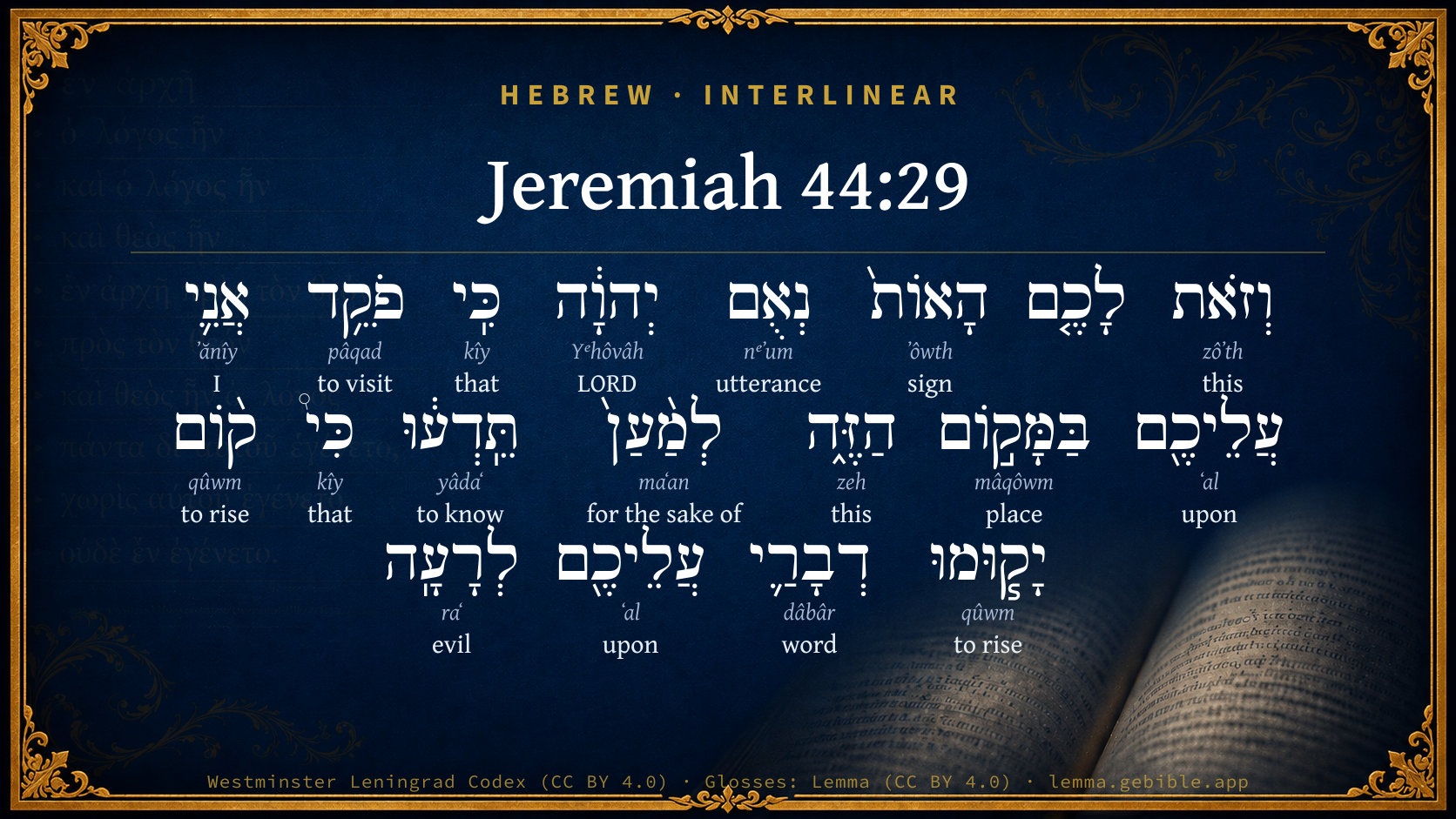
Jeremiah 44:29

Hebrew (Westminster Leningrad Codex) Jeremiah 44:29 appears in the Hebrew Old Testament. The text above is from the Westminster Leningrad Codex. Each word links to its Strong’s number, a concise gloss, and parsing drawn from the Open Scriptures Hebrew Bible morphology. Click any word for its full Brown-Driver-Briggs (BDB) entry.
Download image
Cite this verse

Jeremiah 44:29 (World English Bible). Public Domain. Lemma interlinear Bible study tool, https://lemma.gebible.app/v/jeremiah/44/29.

Show BibTeX & RIS
BibTeX
RIS
English Translation
This shall be the sign to you, says Yahweh, that I will punish you in this place, that you may know that my words shall surely stand against you for evil:
World English Bible · Public Domain
Download a study sheet

One document with this verse’s original text, its word-by-word gloss line, the meaning frame, cross-references with their text, attributed commentary, and full source and license credits — printable, and it pastes into notes with its structure intact.

This verse Autodidact and up

Study sheet (.html) Plain text (.txt)

A passage Seminary Student

Up to 50 verses in one chapter. A passage sheet keeps up to 6 commentary sources and 12 cross-references per verse, in the order this page ranks them, and says so on the sheet whenever that leaves anything out. Ask for a single verse and you get the Autodidact verse sheet above.

Everything on this page stays free to read, with no account — the sheet is a download of what is already on screen, not access to it.

Want to remove ads? Support Godless Engineer
Compare translations 3

The same verse in 3 English versions, stacked beneath the original-language interlinear above. Click any original word for its lexicon entry.

Each is an independent rendering of the whole verse — the interlinear is not word-aligned to these translations.

Highlighted words mark where these versions differ — a whole-verse word diff, not a word-by-word alignment.

  • World English Bible Public Domain
    This shall be the sign to you, says Yahweh, that I will punish you in this place, that you may know that my words shall surely stand against you for evil:
  • King James Version Public Domain
    And this shall be a sign unto you, saith the LORD, that I will punish you in this place, that ye may know that my words shall surely stand against you for evil:
  • unfoldingWord Literal Text CC BY-SA 4.0
    This will be the sign for you—this is Yahweh’s declaration—that I am setting against you in this place, so that you will know that my words will certainly attack you with disaster.’

unfoldingWord Literal Text — © unfoldingWord, licensed CC BY-SA 4.0. Word-aligned USFM3 via Door43 (git.door43.org/unfoldingWord/en_ult).

Versions to compare (up to 4)

3 of 4 selected

Show all 18 translations

Every available English version of this verse, each an independent rendering of the whole verse.

  • World English Bible Public Domain
    This shall be the sign to you, says Yahweh, that I will punish you in this place, that you may know that my words shall surely stand against you for evil:
  • Berean Standard Bible Public Domain
    This will be a sign to you that I will punish you in this place, declares the LORD, so that you may know that My threats of harm against you will surely stand.
  • Majority Standard Bible Public Domain
    This will be a sign to you that I will punish you in this place, declares the LORD, so that you may know that My threats of harm against you will surely stand.
  • King James Version Public Domain
    And this shall be a sign unto you, saith the LORD, that I will punish you in this place, that ye may know that my words shall surely stand against you for evil:
  • American Standard Version (1901) Public Domain
    And this shall be the sign unto you, saith Jehovah, that I will punish you in this place, that ye may know that my words shall surely stand against you for evil:
  • Revised Version (1885) Public Domain
    And this shall be the sign unto you, saith the LORD, that I will punish you in this place, that ye may know that my words shall surely stand against you for evil:
  • Geneva Bible (1599) Public Domain
    And this shall be a signe vnto you, saith the Lord, whe I visit you in this place, that ye may know that my words shall surely stand against you for euill.
  • Douay-Rheims (1899) Public Domain
    And this shall be a sign to you, saith the Lord, that I will punish you in this place: that you may know that my words shall be accomplished indeed against you for evil.
  • Young's Literal Translation Public Domain
    `And this `is' to you the sign -- an affirmation of Jehovah -- that I am seeing after you in this place, so that ye know that My words are certainly established against you for evil;
  • Literal Standard Version CC BY-SA 4.0
    And this [is] the sign to you—a declaration of YHWH—that I am seeing after you in this place, so that you know that My words are certainly established against you for calamity—
  • Unlocked Literal Bible CC BY-SA 4.0
    This will be the sign for you—this is Yahweh's declaration—that I am setting against you in this place, so that you will know that my words will certainly attack you with disaster.'
  • unfoldingWord Literal Text CC BY-SA 4.0
    This will be the sign for you—this is Yahweh’s declaration—that I am setting against you in this place, so that you will know that my words will certainly attack you with disaster.’
  • Darby Bible Public Domain
    And this shall be the sign unto you, saith Jehovah, that I will punish you in this place, that ye may know that my words shall certainly stand against you for evil:
  • World Messianic Bible Public Domain
    “‘This will be the sign to you,’ says the LORD, ‘that I will punish you in this place, that you may know that my words will surely stand against you for evil.’
  • Webster's Bible Public Domain
    And this shall be a sign to you, saith the LORD, that I will punish you in this place, that ye may know that my words shall surely stand against you for evil:
  • Free Bible Version CC BY-SA 4.0
    This is your sign to prove that I'm going to punish you here, declares the Lord, so that you'll know for certain that my threats against you will really happen.
  • Bible in Basic English Public Domain
    And this will be the sign to you, says the Lord, that I will give you punishment in this place, so that you may see that my words will certainly have effect against you for evil:
  • JPS Tanakh (1917) Public Domain
    And this shall be the sign unto you, saith the LORD, that I will punish you in this place, that ye may know that My words shall surely stand against you for evil;

Literal Standard Version (2020), Covenant Press — licensed CC BY-SA 4.0. Text via the HelloAO Bible API (eBible.org). Unlocked Literal Bible (unfoldingWord) — licensed CC BY-SA 4.0. Text via the HelloAO Bible API (eBible.org). unfoldingWord Literal Text — © unfoldingWord, licensed CC BY-SA 4.0. Word-aligned USFM3 via Door43 (git.door43.org/unfoldingWord/en_ult). Free Bible Version, Dr. Jonathan Gallagher — licensed CC BY-SA 4.0. Text via the HelloAO Bible API (eBible.org).

Word by word

More ways to search: Search by grammar → Find every occurrence → Compare this word →

Practice this passage: Drill this verse → Learn its vocabulary →

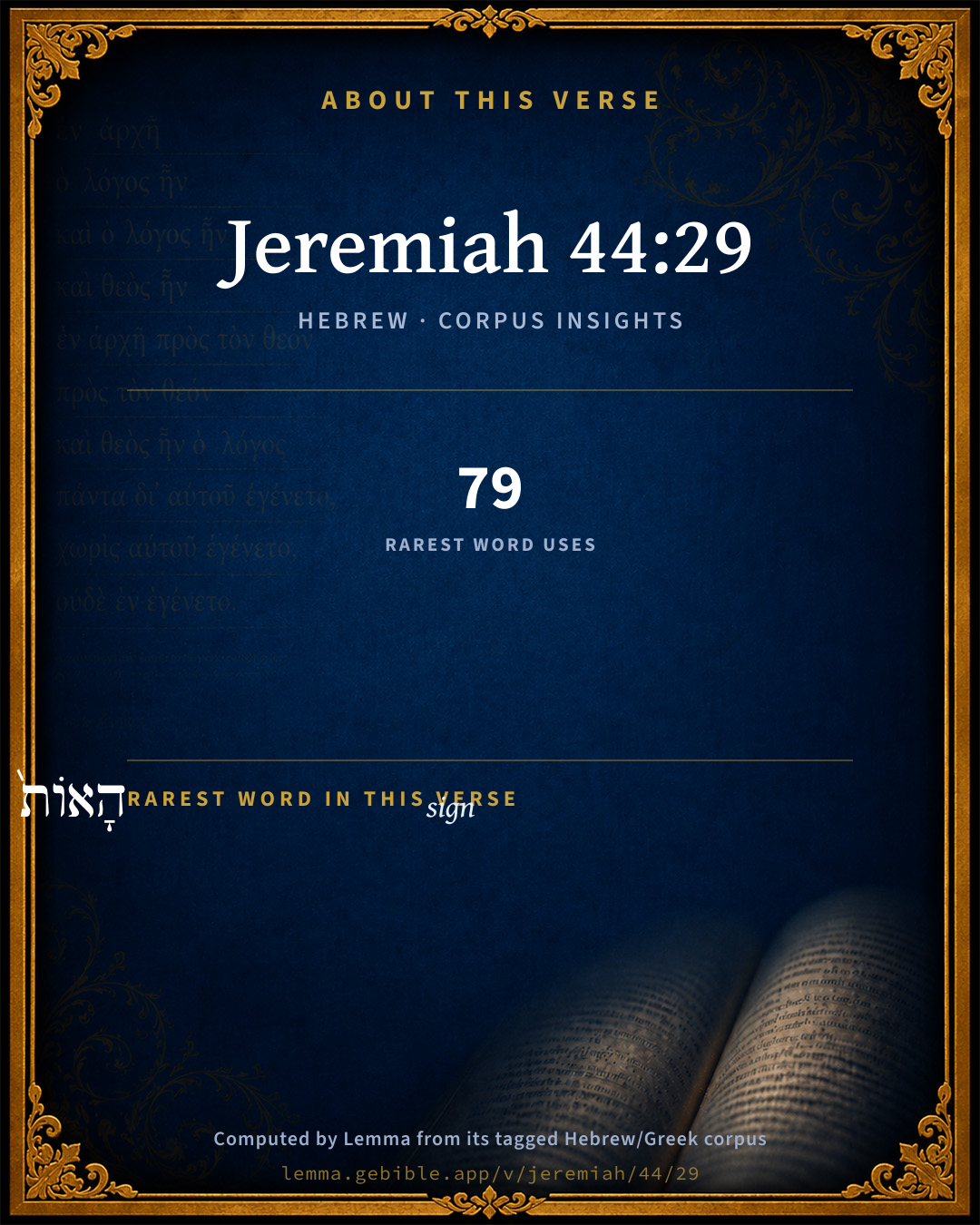
הָאוֹת֙
ʼôwth
H226
“the · sign”
Particle, Definite Article + Noun, Common, Both, Singular, Absolute
Part of Speech
Particle + Noun
Type
Common
Gender
Both
Number
Singular
State
Absolute
Full BDB Definition

Origin: probably from H225 (in the sense of appearing)

TWOT: 41a

sign, signal - a distinguishing mark - banner - remembrance - miraculous sign - omen - warning - token, ensign, standard, miracle, proof
  1. וְזֹאת zôʼth H2063 “and · this” Conjunction + Pronoun, Demonstrative, Feminine, Singular
  2. נְאֻם nᵉʼum H5002 “utterance of” Noun, Common, Masculine, Singular, Construct
  3. יְהוָ֔ה Yᵉhôvâh H3068 “LORD” Noun, Proper
  4. כִּֽי kîy H3588 “that” Conjunction
  5. פֹקֵ֥ד pâqad H6485 “visiting” Verb, Qal, Participle Active, Masculine, Singular, Absolute
  6. אֲנִ֛י ʼănîy H589 “I” Pronoun, Personal, 1st Person, Common, Singular
  7. עֲלֵיכֶ֖ם ʻal H5921 “upon · you” Preposition + Suffix, Personal, 2nd Person, Masculine, Plural
  8. בַּמָּק֣וֹם mâqôwm H4725 “in/at the · place” Preposition, Determined + Noun, Common, Masculine, Singular, Absolute
  9. הַזֶּ֑ה zeh H2088 “the · this” Particle, Definite Article + Pronoun, Demonstrative, Masculine, Singular
  10. לְמַ֨עַן֙ maʻan H4616 “for the sake of” Preposition
  11. תֵּֽדְע֔וּ yâdaʻ H3045 “to know” Verb, Qal, Imperfect, 2nd Person, Masculine, Plural
  12. כִּי֩ kîy H3588 “that” Conjunction
  13. ק֨וֹם qûwm H6965 “to rise” Verb, Qal, Infinitive Absolute
  14. יָק֧וּמוּ qûwm H6965 “to rise” Verb, Qal, Imperfect, 3rd Person, Masculine, Plural
  15. דְבָרַ֛י dâbâr H1697 “words · my” Noun, Common, Masculine, Plural, Construct + Suffix, Personal, 1st Person, Common, Singular
  16. עֲלֵיכֶ֖ם ʻal H5921 “upon · you” Preposition + Suffix, Personal, 2nd Person, Masculine, Plural
  17. לְרָעָֽה raʻ H7451 “to/for · evil” Preposition + Noun, Common, Feminine, Singular, Absolute

About this verse

These counts appear in no published source. They are computed here, from the morphology-tagged text and Lemma’s own curated glosses. What Lemma adds →

19
words
15
distinct lemmas
Prophets
section

Grammatical profile

  • 4 verbs
  • 6 nouns
  • 3 pronouns
  • 4 prepositions
  • 2 conjunctions

Verb forms

  • פֹקֵ֥ד Qal · Participle Active
  • תֵּֽדְע֔וּ Qal · Imperfect
  • ק֨וֹם Qal · Infinitive Absolute
  • יָק֧וּמוּ Qal · Imperfect

Repetition

Words recur within this verse — often emphatic in Hebrew:

  • עֲלֵיכֶ֖ם upon H5921 ×2
  • ק֨וֹם to rise H6965 ×2
  • כִּֽי that H3588 ×2

Cross-references

9

Topical passages linked to Jeremiah 44:29 in the Treasury of Scripture Knowledge — connected by theme and wording, ordered by reader-vote popularity; previews shown in the World English Bible.

  • Proverbs 19:21 There are many plans in a man's heart, But Yahweh's counsel will prevail.
  • Matthew 24:15–16 "When, therefore, you see the abomination of desolation, which was spoken of through Daniel the prophet, standing in the holy place (let the reader understand),
  • Isaiah 40:8 The grass withers, the flower fades; but the word of our God shall stand forever.
  • Jeremiah 44:30 Thus says Yahweh, Behold, I will give Pharaoh Hophra king of Egypt into the hand of his enemies, and into the hand of those who seek his life; as I gave Zedekiah king of Judah into the hand of Nebuchadrezzar king of Babylon, who was his enemy, and sought his life.
  • 1 Samuel 2:34 This shall be the sign to you, that shall come on your two sons, on Hophni and Phinehas: in one day they shall die both of them.
  • Matthew 24:32–34 "Now from the fig tree learn this parable. When its branch has now become tender, and puts forth its leaves, you know that the summer is near.
  • Mark 13:14–16 But when you see the abomination of desolation, spoken of by Daniel the prophet, standing where it ought not (let the reader understand), then let those who are in Judea flee to the mountains,
  • Luke 21:20–21 "But when you see Jerusalem surrounded by armies, then know that its desolation is at hand.
  • Luke 21:29–33 He told them a parable. "See the fig tree, and all the trees.

Cross-references courtesy of OpenBible.info (CC BY 4.0).

Hebrew and Greek witnesses Masoretic Hebrew ↔ Greek Septuagint

The same verse in the two great witnesses to the Old Testament, shown verse-for-verse.

These are two independent witnesses, not word-aligned to each other, and the Septuagint is shown in lemma (dictionary) form.

Hebrew Jeremiah 44:29 Masoretic · Westminster Leningrad Codex

וְזֹאת לָכֶ֤ם הָאוֹת֙ נְאֻם יְהוָ֔ה כִּֽי פֹקֵ֥ד אֲנִ֛י עֲלֵיכֶ֖ם בַּמָּק֣וֹם הַזֶּ֑ה לְמַ֨עַן֙ תֵּֽדְע֔וּ כִּי֩ ק֨וֹם יָק֧וּמוּ דְבָרַ֛י עֲלֵיכֶ֖ם לְרָעָֽה

This shall be the sign to you, says Yahweh, that I will punish you in this place, that you may know that my words shall surely stand against you for evil:

World English Bible · Public Domain

Greek LXX Structure differs

In the Septuagint, Jeremiah is about an eighth shorter than the Hebrew and arranges its material differently — the Oracles Against the Nations (Hebrew chapters 46–51) appear in the middle of the Greek book, after 25:13. Because the chapter and verse boundaries do not line up, a verse-for-verse comparison with the Hebrew is not shown.

A verse-for-verse comparison isn’t shown here because the chapters and verses don’t line up. Switch to the LXX edition with the MT / LXX toggle above to read the Greek directly.

Hebrew: Westminster Leningrad Codex (CC BY 4.0). Greek: Septuagint (public domain); English from a public-domain English Septuagint. How the Septuagint differs from the Hebrew →

Targum (Aramaic paraphrase)

1

The Targum is the ancient Jewish Aramaic paraphrase of the Hebrew Scriptures — an interpretive translation, not the Hebrew text itself. Onkelos (literal) and Pseudo-Jonathan (expansive) render the Torah, and Jonathan the Prophets. Coverage is partial: where no permissively-licensed English translation exists for a verse, only the Aramaic is shown. This is verse-level text, not a word-by-word alignment to the Hebrew.

  1. Targum Jonathan Prophets (Joshua–Malachi)
    וְדָא לְכוֹן אָתָא אֲמַר יְיָ אֲרֵי אֲנָא מַסְעַר עֲלֵיכוֹן בְּאַתְרָא הָדֵין בְּדִין דְתֵידְעוּן אֲרֵי אִתְקַיָמָא יִתְקַיְמוּן פִּתְגָמֵי עֲלֵיכוֹן לְבִישָׁא:

    (no public-domain English translation for this verse)

    Targum Jonathan — Aramaic: “Mikraot Gedolot” (public domain). English: “Sefaria Community Translation” (CC0 1.0 (public-domain dedication)); “London "Chaldee Paraphrase," 1871” (public domain). Text via Sefaria.

Commentary

Notes on Jeremiah 44:29 from classic Christian and Jewish commentators (each source and its license shown beneath its notes). The classic Christian expositions comment on the surrounding passage and are grouped to its opening verse, so a note may address several verses; the Jewish commentaries on the Tanakh (Rashi and others) are per-verse, so they appear only where the commentator wrote on this verse.

Lemma curates 59 commentaries, every one of them public domain or Creative Commons licensed, each selected and text-cleaned for this edition rather than reprinted as found. About our sources →

Trapp's Complete Commentary

John Trapp

Jer 44:29 And this [shall be] a sign unto you, saith the LORD, that I will punish you in this place, that ye may know that my words shall surely stand against you for evil:

Ver. 29. That I will punish you in this place.] Which you looked upon as a place of surest security and safeguard, and would not hearken to me opening my bounties bosom to you at home.

John Trapp, A Commentary or Exposition upon All the Books of the Old and New Testament (1647–1656) — public domain. Text from a community e-Sword module.

Joseph Benson's Commentary

Jer 44:29-30. And this shall be a sign unto you — Signs are usually antecedent to the thing signified, as Isa 38:7; but here, as Exo 3:12, Isa 37:30, and Luk 2:12, the word is taken, in a larger sense, for a circumstance that should attend the thing signified. It may be observed, however, that although the destruction of these Jews, and that of Pharaoh, were things immediately following each other, yet the latter was in order before the other. I will give Pharaoh-hophra into the hand of his enemies — Pharaoh was a name common, in ancient times, to all the kings of Egypt; but several of them had some additional epithet to distinguish them from the rest. Thus the predecessor of this king was called Pharaoh- nechoh, 2Ki 23:29. This Pharaoh-hophra appears to have been the same that is called by profane authors Apries; and his unfortunate end, in exact conformity with this prediction, is particularly related by Herodotus, lib. 2. cap. 169, and by Diodorus Siculus, lib. 1. p. 43. “His subjects rebelling, he sent Amasis, one of his generals, to reduce them to their duty; but no sooner had Amasis begun to make his speech than they fixed a helmet on his head, and proclaimed him king. Amasis accepted the title, and confirmed the Egyptians in their rebellion; and the greater part of the nation declaring for him, Apries was obliged to retire into Upper Egypt; and the country, being thus weakened by intestine war, was attacked and easily overcome by Nebuchadnezzar, who, on quitting it, left Amasis his viceroy. After Nebuchadnezzar’s departure, Apries marched against Amasis, but, being defeated at Memphis, was taken prisoner, carried to Sais, and strangled in his own palace; thus verifying this prophecy.” See Rollin’s Ancient Hist., vol. 1., and Bishop Newton on the Prophecies, vol. 1. p. 362.

Joseph Benson's Commentary on the Old and New Testaments (1811–1818) — public domain. Text from a community e-Sword module.

Whedon's Commentary on the Bible

Daniel D. Whedon

29, 30. This shall be a sign… I will give Pharaoh-hophra, etc. — This monarch succeeded to the Egyptian throne the year before the capture of Jerusalem. He reigned nineteen years. Finally a rebellion occurred on account of his defeat by the Cyrenians, and the suspicion that he had betrayed the native troops in order to establish his personal ascendency by means of his mercenaries. Amasis commanded the Egyptians and Hophra the Greek mercenaries. The latter was defeated and taken prisoner, and, after being kept some time in confinement, he was given up to his enemies, who put him to death by strangling.

Some expositors have objected to the genuineness of the passage, Jer_44:29-30, on internal grounds: 1) That the fulfilment is too exact. 2) That it is too remote. 3) That the style is dead and mechanical. 4) There is no other such sign in Jeremiah. But there is little force in any of these considerations, while the last is evidently in favour of the genuineness of the passage. If there is nothing like it, it is not likely to be an interpolation. As to the objection that the fulfilment was too distant to be a sign to those to whom Jeremiah spoke, we have to say: (a) To be a sign it need not be immediate. Its value as such is increased rather than diminished by the lapse of time. (b) But its fulfilment began within possibly six or eight years. Hophra had now been two years on the throne. It has been estimated that he was ten years a prisoner. His death occurred nineteen years after he became king.

Some difficulty has been experienced by Nagelsbach in reconciling the apparent teaching of this chapter, that the Jews in Egypt should be utterly exterminated, with the fact that in the time of Alexander they were very numerous, and Ptolemy Philadelphus at one time liberated 100,000 Jewish slaves. In reply: 1) This chapter denounces extermination against such Jews only as at that time went down to Egypt contrary to the command of God, and persisted in their idolatry. Those who were there before, those who came after, (and Ptolemy I., about 320 B.C., captured Jerusalem on a sabbath day, took a great number of captives, and carried them down into Egypt,) and those who maintained the worship of Jehovah, are excluded from the judgments denounced in this chapter. 2) There is no proof that at the time of Alexander the Jews in Egypt were very numerous. 3) Centuries of time provide for great increase, not only by propagation, but also by immigration.

Daniel D. Whedon (gen. ed.), Commentary on the Old and New Testaments (1874–1909) — public domain. Text from a community e-Sword module.

Keil & Delitzsch

C. F. Keil & F. Delitzsch

In confirmation of this threatening, the Lord gives them another sign which, when it is fulfilled, will let them know that the destruction announced to them shall certainly befall them. The token consists in the giving up of King Hophra into the hand of his enemies. As certainly as this shall take place, so certainly shall the extermination of the Jews in Egypt ensue. The name חפרע is rendered Οὐάφρις in Manetho, in the classical writers ̓Απρίης, Apris, who, according to Herodotus (ii. 161), reigned twenty-five years, but nineteen according to Manetho (cf. Boeckh, Manetho, etc., p. 341ff.). His death took place in the year 570 b.c. This date is reached by a comparison of the following facts: - Cambyses conquered Egypt in the year 525; and in the preceding year Amasis had died, after a reign of forty-four years (Herod. iii. 10). Hence Amasis - who took Apris prisoner, and gave him up to the common people, who killed him (Herod. ii. 161-163, 169) - must have commenced his reign in the year 570. On the death of Apris, or Hophra, cf. the explanation given on p. 353f., where we have shown that the words, "I will give him into the hand of his enemies, and of those who seek his life," when compared with what is said of Zedekiah, "into the hand of Nebuchadnezzar his enemy," do not require us to assume that Hophra was killed by Nebuchadnezzar, and can very well be harmonized with the notice of Herodotus regarding the death of this king.

Hitzig and Graf have taken objection to this sign given by Jeremiah, and regard Jer 44:29, Jer 44:30 as a spurious vaticinium ex eventu, the work of another hand. The reasons they urge are, that it is scarcely possible Jeremiah could have lived till 570; that Jer 44:29. would be the only place where Jeremiah offered such a criterion; and that, even as it is, these verses contain nothing original, but, by their stiff and lifeless parallelism, are easily seen to be an artificial conclusion. Of these three arguments, the last can prove nothing, since it is merely a subjective opinion on an aesthetic point. The second, again, rather declares for than against the genuineness. For "if it were not Jeremiah's usual, elsewhere, to offer some criterion, then such an interpolation would have been all the more carefully avoided" (Ngelsbach). Of course we do not find any other signs of this kind in Jeremiah; but it does not follow from this that he could not offer such a thing in a special case. Yet the ground taken up by Ngelsbach, as sufficient to establish this position, seems quite untenable, viz., that the announcement of the fate in store for the king must have been the answer of the true God to the presumptuous boast of Apris, mentioned by Herodotus, "that even God could not dethrone him, so firmly did he think he was established:" this view of the matter seems too remote from the object of Jeremiah's address. And finally, the first-named objection receives importance only on the supposition that "an event which was intended to serve as אות, a sign or criterion, must be something that was to happen immediately, or within a brief appointed period of time, so that a person might be able, from the occurrence of the one, to conclude that what had been foretold about a later period would as certainly take place" (Graf). But there are no sufficient grounds for this hypothesis. If no definite time be fixed for the occurrence of this sign, then it may not appear till a considerable time afterwards, and yet be a pledge for the occurrence of what was predicted for a still later period. That Jeremiah lived till the year 570 is certainly not inconceivable, but it is not likely that he uttered the prophecy now before us at the advanced age of nearly eighty years. Now, if his address is allowed to be a real prophecy, and not a mere vaticinium ex eventu, as Hitzig, looking from his dogmatic standpoint, considers it, then it must have been uttered before the year 570; but whether this was two, or five, or ten years before, makes no material difference. The address itself contains nothing to justify the assumption of Graf, that it is closely connected with the prophecy in Jer 43:8-13, and with the warning against the migration into Egypt, Jer 42. That the Jews spoken of had not been long in Egypt, cannot be inferred from Jer 44:8, Jer 44:12, and Jer 44:18; on the contrary, the fact that they had settled down in different parts of Egypt, and had assembled at Pathros for a festival, shows that they had been living there for a considerable time before. Nor does it follow, from the statement in Jer 44:14 that they longed to return to Judah, that they had gone to Egypt some months before. The desire to return into the land of their fathers remains, in a measure, in the heart of the Jew even at the present day. After all, then, no valid reason can be assigned for doubting the genuineness of these verses.

On the fulfilment of these threatenings Ngelsbach remarks: "Every one must be struck on finding that, in Jer 44, the extermination of the Jews who dwelt in Egypt is predicted; while some centuries later, the Jews in Egypt were very numerous, and that country formed a central point for the Jewish exiles (cf. Herzog, Real-Encycl. xvii. S. 285). Alexander the Great found so many Jews in Egypt, that he peopled with Jews, in great measure, the city he had founded and called after himself (cf. Herzog, i. S. 235). How did these Jews get to Egypt? Whence the great number of Jews whom Alexander found already in Egypt? I am inclined to think that we must consider them, for the most part, as the descendants of those who had come into the country with Jeremiah. But, according to this view of the matter, Jeremiah's prophecy has not been fulfilled." Ngelsbach therefore thinks we must assume that idolatrous worship, through time, almost entirely ceased among the exiled Jews in Egypt as it did among those in Babylon, and that the Lord then, in return, as regards the penitents, repented of the evil which He had spoken against them (Jer 26:13, Jer 26:19). But this whole explanation is fundamentally wrong, since the assertion, that Alexander the Great found so many Jews in Egypt, that with them mainly he peopled the city of Alexandria which he had founded, is contrary to historic testimony. In Herzog (Real-Encycl. i. S. 235), to which Ngelsbach refers for proof on the point, nothing of the kind is to be found, but rather the opposite, viz., the following: "Soon after the foundation of Alexandria by Alexander the Great, this city became not merely the centre of Jewish Hellenism in Egypt, but generally speaking the place of union between Oriental and Occidental Jews. The external condition of the Jews of Alexandria must, on the whole, be characterized as highly prosperous. The first Jewish settlers had, indeed, been compelled by Alexander the Great to take up their residence in the city (Josephus, Antt. xv. 3. 1); so, too, were other Jews, by Ptolemy I. or Lagi (ibid. xii. 2. 4). But both of these monarchs granted them the same rights and privileges as the Macedonians, including Greek citizenship; and in consequence of the extremely advantageous position of the city, it speedily increased in importance. A still larger number, therefore, soon went thither of their own accord, and adopted the Greek language." In this account, the quotation from Josephus, Antt. xv. 3. 1, is certainly incorrect; for neither is there in that passage any testimony borne to the measures attributed to Alexander, nor are there any other historical testimonies given from antiquity. But as little can we find any proofs that Alexander the Great found so many Jews in Egypt that he could, to a large extent, people with them the city he had founded. It is merely testified by Josephus (Antt. xi. 8. 5), and by Hecataeus in Josephus (contra Ap. i. 22; p. 457, ed. Haverc.), that Alexander had Jewish soldiers in his army; it is further evident, from a notice in Josephus, de bell. Jud. ii. 18. 7, contra Ap. ii. 4) cf. Curtius Rufus, iv. 8), that the newly founded city, even under Alexander, immediately after it was commenced, and still more under Ptolemy Lagi (cf. Josephus, Antt. xii. 1, and Hecataeus in Jos. contra Ap. i. 22, p. 455), attracted a constantly increasing multitude of Jewish immigrants. This same Ptolemy, after having subdued Phoenicia and Coele-Syria in the year 320, and taken Jerusalem also, it would seem, by a stratagem on a Sabbath day, transported many captives and hostages out of the whole country into Egypt; many, too, must have been sold at that time as slaves to the inhabitants of such a wealthy country as Egypt: see a statement in the book of Aristeas, at the end of Havercamp's edition of Josephus, ii. p. 104. In the same place, and in Josephus' Antt. xii. 1, Ptolemy is said to have armed 30,000 Jewish soldiers, placed them as garrisons in the fortresses, and granted them all the rights of Macedonian citizens (ἰσοπολιτεία). Ewald well says, History of the People of Israel, vol. iv. of second edition, p. 254: "When we further take into consideration, that, in addition to all other similar disasters which had previously befallen them, many Jews were removed to Egypt (especially by Ochus, after Egypt had been reconquered), we can easily explain how Ptolemy Philadelphus can be said to have liberated 100,000 Egyptian Jews. Aristeas' Book, p. 105." This much, at least, is proved by these various notices, - that, in order to understand how such a vast increase took place in the number of the Jews in Egypt, we do not need to regard them as the descendants of those who removed thither with Jeremiah, and so to question the fulfilment of the prophecy now before us. Jeremiah does not, of course, threaten with destruction all those Jews who live in Egypt, but only those who at that time went thither against the divine will, and there persevered in their idolatry. We do not know how great may have been the number of these immigrants, but they could hardly exceed two thousand, - perhaps, indeed, there were not so many. All these, as had been foretold them, may have perished in the conquest of Egypt by the Chaldeans, and afterwards, through the sword, famine, and pestilence; for the myriads of Jews in Egypt at the time of Ptolemy Lagi could easily have removed thither during the period of 250 years intermediate between the immigration in Jeremiah's time and the foundation of Alexandria, partly as prisoners and slaves, partly through voluntary settlement.

Keil & Delitzsch — Biblical Commentary on the Old Testament (1861–1891) — public domain (CC PDM 1.0). Text via the HelloAO Bible API. (Old Testament only.)

Jamieson, Fausset & Brown

Robert Jamieson, A. R. Fausset & David Brown

this . . . sign unto you--The calamity of Pharaoh-hophra (see on Jer 44:30) shall be a sign to you that as he shall fall before his enemy, so you shall subsequently fall before Nebuchadnezzar (Mat 24:8) [GROTIUS]. CALVIN makes the "sign" to be simultaneous with the event signified, not antecedent to it, as in Exo 3:12. The Jews believed Egypt impregnable, so shut in was it by natural barriers. The Jews being "punished in this place" will be a sign that their view is false, and God's threat true. He calls it "a sign unto you," because God's prediction is equivalent to the event, so that they may even now take it as a sign. When fulfilled it would cease to be a sign to them: for they would be dead.

Jamieson, Fausset & Brown — Commentary Critical and Explanatory on the Whole Bible (1871) — public domain (CC PDM 1.0). Text via the HelloAO Bible API.

John Calvin's Commentaries

Jeremiah seals his prophecy by adding a sign which yet was to be coincident with it. It was not then, as they say, a premonstrative sign. And doubtless the Jews were wholly unworthy that God should shew them anything extraordinary; but this sign was only added, that they might know that they in vain trusted in the protection of Egypt, and also that every excuse might be taken away.

This brief notice may perhaps be obscure. We shall therefore refer to a distinction that exists: some signs precede the time and order of things, but others are connected with the events themselves. The signs which precede events avail to prepare the minds of the faithful, so that they may not doubt but that God will do what he has promised, as when Gideon sought a sign from God, and it was granted to him; the ground was wet with dew, while the fleece remained dry; and then the fleece remained dry when the ground was wet. (Judges 6:36-40.) By this sign Gideon was encouraged to proceed in his course, when before doubt made him inert Gideon was torpid, but when he saw by this miracle that victory would be given him, he boldly undertook the work assigned to him. The greatest portion of signs are of this kind. But there are other signs which do not precede events, but shew that when the time is fulfilled the events have been truly predicted, as when God said to Moses,

“This sign I give thee, that after ye have come out of Egypt ye shall sacrifice to me in this mountain.” (Exodus 3:12)

Neither Moses nor the people could know anything by that sign before they had departed from Egypt. But after they were delivered they there gave thanks on the third day to God their Redeemer.

Hence signs refer sometimes to past time, and sometimes to what is future. Those which refer to the future are such as we call premonstrative, as the case was with Gideon, who took up arms with alacrity, because he knew that he was fighting under God’s banner; and he was fully persuaded of a victory when he understood that God would be his leader.

John Calvin's Commentaries (1540-1563) — public domain. Text from the Calvin Translation Society English edition (1840s-50s) via the Christian Classics Ethereal Library (ccel.org). Calvin's coverage is partial (roughly two-thirds of the Bible); uncommented books and verses are honest gaps, never fabricated. The 19th-century editor's footnotes and remarks are omitted so the notes are faithfully Calvin's own voice.

The Cambridge Bible for Schools and Colleges

gen. ed. J. J. S. Perowne

29. And this shall be the sign] It has been inferred, but unnecessarily, from the close correspondence of these vv. with the above piece of history that these two verses are an interpolation made after the event. Pharaoh Hophra (the Greek Apries) reigned from b.c. 589 to c. 570, when he was overthrown by the troops whom he had sent against Cyrene, and who had mutinied (Herod. II. 152 ff.). Amasis succeeded him and handed him over to the Egyptians, who strangled him seven years later (Herod. II. 161–163, 169).

The Cambridge Bible for Schools and Colleges (gen. ed. J. J. S. Perowne; Cambridge University Press, 1878–1918) — public domain. Text from a community e-Sword module.

John Gill's Exposition

And this shall be a sign unto you, saith the Lord, that I will punish you in this place,.... In Egypt, as before threatened; and what follows is a confirming sign that so it would be; and which, when observed by some, gave the hint to them to make their escape; though others, being hardened in their idolatry, impenitence, and unbelief, continued, and perished:

that ye may know that my words shall surely stand against you for evil; which sign, when they should see, they might assure themselves that the threatenings of evil to them would certainly be accomplished, as sure as they saw the sign given, which is as follows:

John Gill's Exposition of the Whole Bible (1746–1763) — public domain (CC PDM 1.0). Text via the HelloAO Bible API.

Matthew Poole's English Annotations

Signs are usually antecedent to the thing signified, but the word is taken in a larger notion in this place, for that which should attend the thing signified by it, as Exo 3:12; besides, though their destruction and the destruction of Pharaoh-hophra were things immediately following one another, yet the latter was in order before the other.

Matthew Poole's English Annotations on the Holy Bible (1683–1685) — public domain. Text from a community e-Sword/MySword module.

The Pulpit Commentary

A sign; rather, the sign.

The Pulpit Commentary (1880–1919), ed. H.D.M. Spence-Jones & Joseph S. Exell — public domain. Text from a community e-Sword module.

John Wesley's Explanatory Notes

This shall be a sign - Signs are usually antecedent to the thing signified, but the word is taken in a larger notion in this place for that which should attend the thing signified by it.

John Wesley, Explanatory Notes Upon the Whole Bible (1754–1765) — public domain. Text via the GEBible commentary corpus.

unfoldingWord translationNotes

Door43 World Missions Community

this is Yahweh's declaration

Yahweh speaks of himself by name to express the certainty of what he is declaring. See how you translated this in Jeremiah 1:8. AT: "this is what Yahweh has declared" or "this is what I, Yahweh, have declared" (See: First, Second, or Third Person)

I am setting against you

This is an idiom. AT: "I am opposed to you" (See: Idiom)

my words will certainly attack you with disaster

Yahweh causing disaster on the people as he promised is spoken of as if his word would attack them. AT: "what I have said will happen and you will have a disaster" (See: Personification)

Look

"Listen" or "Pay attention"

I am about to give Pharaoh Hophra king of Egypt into the hand of his enemies and into the hand of those who seek to kill him

Here "hand" represents power or control. AT: "I will allow the enemies who want to kill Pharaoh Hophra, the king of Egypt, to defeat him" (See: Metonymy)

Hophra

This is the name of a man. (See: How to Translate Names)

when I gave Zedekiah king of Judah into the hand of Nebuchadnezzar king of Babylon, his enemy who sought his life

Here "hand" represents power or control. And, Nebuchadnezzar represents his whole army. The phrase "sought his life" is an idiom that means to want to kill someone. AT: "when I allowed the army of Nebuchadnezzar to defeat Zedekiah king of Judah" (See: Metonymy and Idiom)

translationWords

sign

declare

Pharaoh

hand

adversary

Zedekiah

king

Judah

Nebuchadnezzar

Babylon

unfoldingWord translationNotes — © Distant Shores Media and the Door43 World Missions Community, licensed CC BY-SA 4.0. Source: git.door43.org/Door43/en_tn.

Lesson kit

Teaching starters — assembled from the data on this page, not authored interpretation. Every prompt links to the verse data it draws on. Edit before teaching.

Jeremiah, in the Prophets, opens this verse with 19 words (15 distinct Hebrew lemmas). Its most distinctive word is ʼôwth (“sign”). A historical commentator’s framing appears above. Read the whole chapter for the surrounding context.

Discussion questions

  1. The word ʼôwth carries the sense “sign.” How does it shape the verse?
  2. Proverbs 19:21 shares this passage’s theme. How do the two illuminate each other?
  3. “upon” occurs 2× in this one verse. What is the effect of the repetition?
  4. The translations on this page render this verse differently — a whole-verse word diff, not a word-by-word alignment. What might account for the different wordings?
  5. The verb «פֹקֵ֥ד» is Qal Participle Active. How does its form color the action?
  6. Reading how Trapp's Complete Commentary and Joseph Benson's Commentary read this verse, where do the two commentators agree and where do they part?

Things to notice

Reading settings

Reading text

Shown beneath each verse's original-language words.

Old Testament
Old Testament edition

Read the OT as the Masoretic Hebrew (MT) or the Greek Septuagint (LXX).

English shown for the Greek Septuagint (in the Hebrew ↔ Greek comparison).

Comparing translations? Open the Compare panel on any verse page to stack up to four side by side.