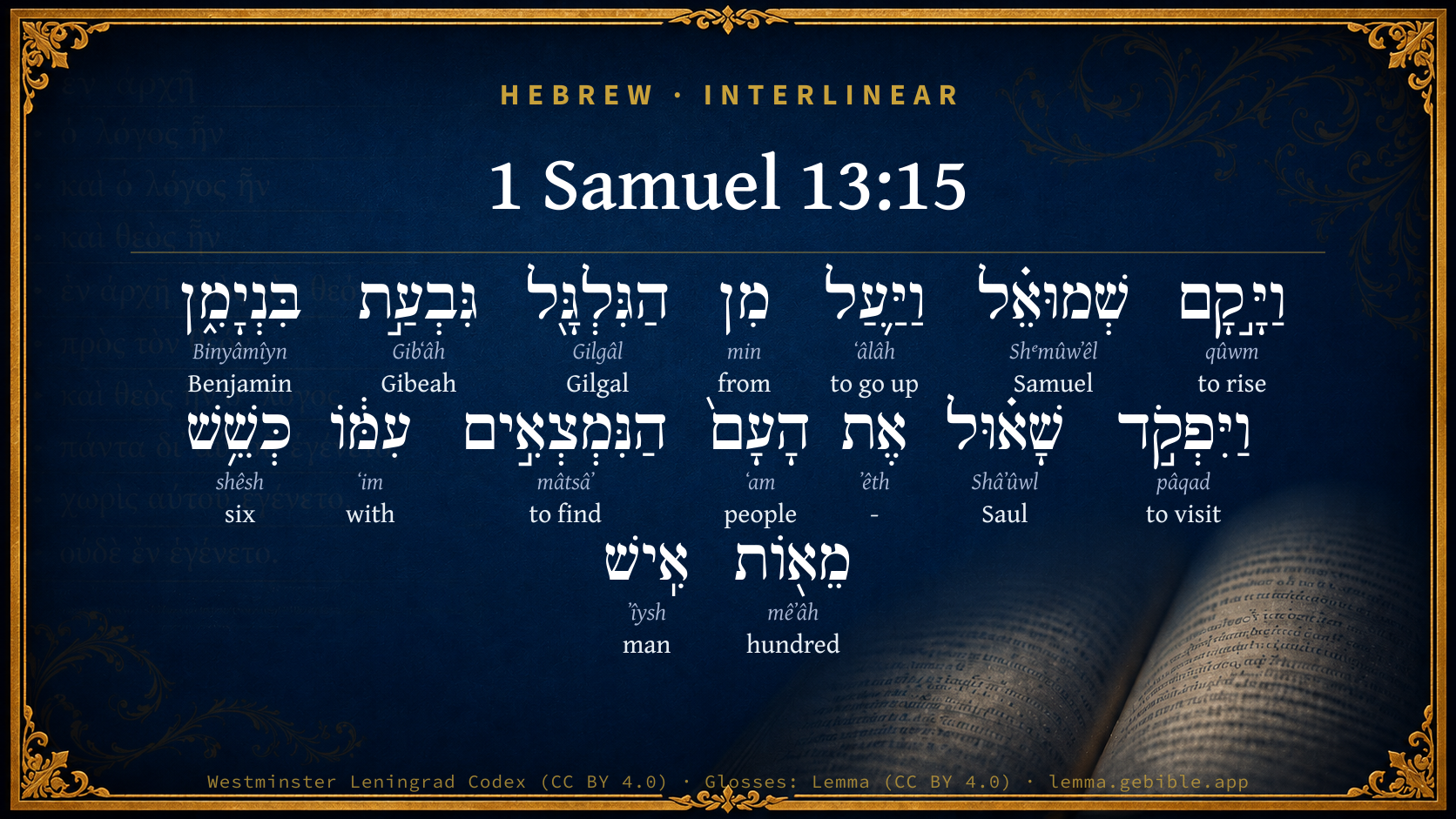
1 Samuel 13:15

Hebrew (Westminster Leningrad Codex) 1 Samuel 13:15 appears in the Hebrew Old Testament. The text above is from the Westminster Leningrad Codex. Each word links to its Strong’s number, a concise gloss, and parsing drawn from the Open Scriptures Hebrew Bible morphology. Click any word for its full Brown-Driver-Briggs (BDB) entry.
Download image
Cite this verse

1 Samuel 13:15 (World English Bible). Public Domain. Lemma interlinear Bible study tool, https://lemma.gebible.app/v/1-samuel/13/15.

Show BibTeX & RIS
BibTeX
RIS
English Translation
Samuel arose, and got him up from Gilgal to Gibeah of Benjamin. Saul numbered the people who were present with him, about six hundred men.
World English Bible · Public Domain
Download a study sheet

One document with this verse’s original text, its word-by-word gloss line, the meaning frame, cross-references with their text, attributed commentary, and full source and license credits — printable, and it pastes into notes with its structure intact.

This verse Autodidact and up

Study sheet (.html) Plain text (.txt)

A passage Seminary Student

Up to 50 verses in one chapter. A passage sheet keeps up to 6 commentary sources and 12 cross-references per verse, in the order this page ranks them, and says so on the sheet whenever that leaves anything out. Ask for a single verse and you get the Autodidact verse sheet above.

Everything on this page stays free to read, with no account — the sheet is a download of what is already on screen, not access to it.

Want to remove ads? Support Godless Engineer
Compare translations 3

The same verse in 3 English versions, stacked beneath the original-language interlinear above. Click any original word for its lexicon entry.

Each is an independent rendering of the whole verse — the interlinear is not word-aligned to these translations.

Highlighted words mark where these versions differ — a whole-verse word diff, not a word-by-word alignment.

  • World English Bible Public Domain
    Samuel arose, and got him up from Gilgal to Gibeah of Benjamin. Saul numbered the people who were present with him, about six hundred men.
  • King James Version Public Domain
    And Samuel arose, and gat him up from Gilgal unto Gibeah of Benjamin. And Saul numbered the people that were present with him, about six hundred men.
  • unfoldingWord Literal Text CC BY-SA 4.0
    And Samuel arose and went up from Gilgal to Gibeah of Benjamin. And Saul mustered the people being found with him, about 600 men.

unfoldingWord Literal Text — © unfoldingWord, licensed CC BY-SA 4.0. Word-aligned USFM3 via Door43 (git.door43.org/unfoldingWord/en_ult).

Versions to compare (up to 4)

3 of 4 selected

Show all 18 translations

Every available English version of this verse, each an independent rendering of the whole verse.

  • World English Bible Public Domain
    Samuel arose, and got him up from Gilgal to Gibeah of Benjamin. Saul numbered the people who were present with him, about six hundred men.
  • Berean Standard Bible Public Domain
    Then Samuel set out from Gilgal and went up to Gibeah in Benjamin. And Saul numbered the troops who were with him, about six hundred men.
  • Majority Standard Bible Public Domain
    Then Samuel set out from Gilgal and went up to Gibeah in Benjamin. And Saul numbered the troops who were with him, about six hundred men.
  • King James Version Public Domain
    And Samuel arose, and gat him up from Gilgal unto Gibeah of Benjamin. And Saul numbered the people that were present with him, about six hundred men.
  • American Standard Version (1901) Public Domain
    And Samuel arose, and gat him up from Gilgal unto Gibeah of Benjamin. And Saul numbered the people that were present with him, about six hundred men.
  • Revised Version (1885) Public Domain
    And Samuel arose, and gat him up from Gilgal unto Gibeah of Benjamin. And Saul numbered the people that were present with him, about six hundred men.
  • Geneva Bible (1599) Public Domain
    And Samuel arose, and gate him vp from Gilgal in Gibeah of Beniamin: and Saul nombred the people that were found with him, about sixe hundreth men.
  • Douay-Rheims (1899) Public Domain
    And Samuel arose and went up from Galgal to Gabaa of Benjamin. And the rest of the people went up after Saul, to meet the people who fought against them, going from Galgal to Gabaa in the hill of Benjamin. And Saul numbered the people, that were found with him, about six hundred men.
  • Young's Literal Translation Public Domain
    And Samuel riseth, and goeth up from Gilgal to Gibeah of Benjamin; and Saul inspecteth the people who are found with him, about six hundred men,
  • Literal Standard Version CC BY-SA 4.0
    And Samuel rises, and goes up from Gilgal to Gibeah of Benjamin; and Saul inspects the people who are found with him, about six hundred men,
  • Unlocked Literal Bible CC BY-SA 4.0
    Then Samuel arose and went up from Gilgal to Gibeah of Benjamin. Then Saul numbered the people who were present with him, about six hundred men.
  • unfoldingWord Literal Text CC BY-SA 4.0
    And Samuel arose and went up from Gilgal to Gibeah of Benjamin. And Saul mustered the people being found with him, about 600 men.
  • Darby Bible Public Domain
    And Samuel arose and went up from Gilgal to Gibeah of Benjamin. And Saul numbered the people that were found with him, about six hundred men.
  • World Messianic Bible Public Domain
    Samuel arose, and went from Gilgal to Gibeah of Benjamin. Saul counted the people who were present with him, about six hundred men.
  • Webster's Bible Public Domain
    And Samuel arose, and went up from Gilgal to Gibeah of Benjamin. And Saul numbered the people that were present with him, about six hundred men.
  • Free Bible Version CC BY-SA 4.0
    Then Samuel left Gilgal. The rest of the soldiers followed Saul to meet the army, going from Gilgal to Geba in Benjamin. Saul counted the number of soldiers who were with him and there were about six hundred.
  • Bible in Basic English Public Domain
    Then Samuel went up from Gilgal and the rest of the people went up after Saul against the men of war, and they came from Gilgal to Gibeah in the land of Benjamin: and Saul took the number of the people who were with him, about six hundred men.
  • JPS Tanakh (1917) Public Domain
    And Samuel arose, and got him up from Gilgal unto Gibeath-benjamin. And Saul numbered the people that were present with him, about six hundred men.

Literal Standard Version (2020), Covenant Press — licensed CC BY-SA 4.0. Text via the HelloAO Bible API (eBible.org). Unlocked Literal Bible (unfoldingWord) — licensed CC BY-SA 4.0. Text via the HelloAO Bible API (eBible.org). unfoldingWord Literal Text — © unfoldingWord, licensed CC BY-SA 4.0. Word-aligned USFM3 via Door43 (git.door43.org/unfoldingWord/en_ult). Free Bible Version, Dr. Jonathan Gallagher — licensed CC BY-SA 4.0. Text via the HelloAO Bible API (eBible.org).

Word by word

More ways to search: Search by grammar → Find every occurrence → Compare this word →

Practice this passage: Drill this verse → Learn its vocabulary →

הַגִּלְגָּ֖ל
Gilgâl
H1537
“the · Gilgal”
Particle, Definite Article + Noun, Proper
Part of Speech
Particle + Noun
Type
Proper
Full BDB Definition

Origin: the same as H1536

TWOT: None

Gilgal = "a wheel, rolling" - the first site of an Israelite camp west of the Jordan, east of Jericho, here Samuel was judge, and Saul was made king; later used for illicit worship - dwelling place of prophets in northern Israel about four miles - a region conquered by Joshua, site unsure
  1. וַיָּ֣קָם qûwm H6965 “and · to rise” Conjunction + Verb, Qal, Sequential Imperfect, 3rd Person, Masculine, Singular
  2. שְׁמוּאֵ֗ל Shᵉmûwʼêl H8050 “Samuel” Noun, Proper
  3. וַיַּ֛עַל ʻâlâh H5927 “and · to go up” Conjunction + Verb, Qal, Sequential Imperfect, 3rd Person, Masculine, Singular
  4. מִן min H4480 “from” Preposition
  5. גִּבְעַ֣ת Gibʻâh H1390 “Gibeah” Noun, Proper
  6. בִּנְיָמִ֑ן Binyâmîyn H1144 “Benjamin” Noun, Proper
  7. וַיִּפְקֹ֣ד pâqad H6485 “and · to visit” Conjunction + Verb, Qal, Sequential Imperfect, 3rd Person, Masculine, Singular
  8. שָׁא֗וּל Shâʼûwl H7586 “Saul” Noun, Proper
  9. אֶת ʼêth H853 “-” Particle, Direct Object
  10. הָעָם֙ ʻam H5971 “the · people” Particle, Definite Article + Noun, Common, Masculine, Singular, Absolute
  11. הַנִּמְצְאִ֣ים mâtsâʼ H4672 “the · finding” Particle, Definite Article + Verb, Niphal, Participle Active, Masculine, Plural, Absolute
  12. עִמּ֔וֹ ʻim H5973 “with · him” Preposition + Suffix, Personal, 3rd Person, Masculine, Singular
  13. כְּשֵׁ֥שׁ shêsh H8337 “like/as · six” Preposition + Adjective, Cardinal number, Feminine, Singular, Absolute
  14. מֵא֖וֹת mêʼâh H3967 “hundred” Adjective, Cardinal number, Both, Plural, Absolute
  15. אִֽישׁ ʼîysh H376 “man” Noun, Common, Masculine, Singular, Absolute

About this verse

These counts appear in no published source. They are computed here, from the morphology-tagged text and Lemma’s own curated glosses. What Lemma adds →

16
words
16
distinct lemmas
Historical
section

Shared distinctive vocabulary

הַגִּלְגָּ֖ל Gilgal H1537 occurs in 39 verses of the Hebrew Bible. Also found in:

Grammatical profile

  • 4 verbs
  • 7 nouns
  • 2 adjectives
  • 2 prepositions
  • 1 particle

Verb forms

  • וַיָּ֣קָם Qal · Sequential Imperfect
  • וַיַּ֛עַל Qal · Sequential Imperfect
  • וַיִּפְקֹ֣ד Qal · Sequential Imperfect
  • הַנִּמְצְאִ֣ים Niphal · Participle Active

Hebrew & Septuagint length

In English translation the verse runs 25 words from the Hebrew and 49 from the Septuagint (LXX English) — the Septuagint runs noticeably longer here. See the side-by-side →

A rough comparison of the two English renderings, which tokenize alike — not a word-level alignment.

Word counts can differ between the Hebrew and the Greek without any difference in meaning — e.g. the Hebrew direct-object marker אֵת has no separate Greek word, and Greek often adds the article ὁ.

Cross-references

3

Topical passages linked to 1 Samuel 13:15 in the Treasury of Scripture Knowledge — connected by theme and wording, ordered by reader-vote popularity; previews shown in the World English Bible.

  • 1 Samuel 13:2 Saul chose him three thousand men of Israel, of which two thousand were with Saul in Michmash and in the Mount of Bethel, and one thousand were with Jonathan in Gibeah of Benjamin: and the rest of the people he sent every man to his tent.
  • 1 Samuel 14:2 Saul abode in the uttermost part of Gibeah under the pomegranate tree which is in Migron: and the people who were with him were about six hundred men;
  • 1 Samuel 13:6–7 When the men of Israel saw that they were in a strait (for the people were distressed), then the people did hide themselves in caves, and in thickets, and in rocks, and in coverts, and in pits.

Cross-references courtesy of OpenBible.info (CC BY 4.0).

Hebrew and Greek witnesses Masoretic Hebrew ↔ Greek Septuagint

The same verse in the two great witnesses to the Old Testament, shown verse-for-verse.

Here the Septuagint runs noticeably longer than the Hebrew — LXX2012 (modern English Septuagint) 49 words vs World English Bible 25. A rough length comparison of the two English translations, not a word-level alignment — read both below.

These are two independent witnesses, not word-aligned to each other, and the Septuagint is shown in lemma (dictionary) form.

Hebrew 1 Samuel 13:15 Masoretic · Westminster Leningrad Codex

וַיָּ֣קָם שְׁמוּאֵ֗ל וַיַּ֛עַל מִן הַגִּלְגָּ֖ל גִּבְעַ֣ת בִּנְיָמִ֑ן וַיִּפְקֹ֣ד שָׁא֗וּל אֶת הָעָם֙ הַנִּמְצְאִ֣ים עִמּ֔וֹ כְּשֵׁ֥שׁ מֵא֖וֹת אִֽישׁ

Samuel arose, and got him up from Gilgal to Gibeah of Benjamin. Saul numbered the people who were present with him, about six hundred men.

World English Bible · Public Domain

Greek LXX 1 Samuel 13:15 Septuagint · lemma form

καί ἀναἵστημι σαμουηλ καί ἀποἔρχομαι ἐκ γάλγαλα εἰς ὁδός αὐτός καί ὁ κατάλειμμα ὁ λαός ἀναβαίνω ὀπίσω σαούλ εἰς ἀπάντησις ὀπίσω ὁ λαός ὁ πολεμιστής αὐτός παραγίγνομαι ἐκ γάλγαλα εἰς γαβαα βενιαμίν καί ἐπισκέπτομαι σαούλ ὁ λαός ὁ εὑρίσκω μετά αὐτός ὡς ἑξακόσιοι ἀνήρ

And Samuel arose, and departed from Galgala, and the remnant of the people went after Saul to meet him after the men of war, when they had come out of Galgala to Gabaa of Benjamin. And Saul numbered the people that were found with him, about six hundred men.

LXX2012 (modern English Septuagint) · Public Domain

On this verse, Haydock's Catholic Bible Commentary discusses the Septuagint’s reading. Read the note in Commentary ↓

Hebrew: Westminster Leningrad Codex (CC BY 4.0). Greek: Septuagint (public domain); English from LXX2012 (modern English Septuagint) (Public Domain). How the Septuagint differs from the Hebrew →

Targum (Aramaic paraphrase)

1

The Targum is the ancient Jewish Aramaic paraphrase of the Hebrew Scriptures — an interpretive translation, not the Hebrew text itself. Onkelos (literal) and Pseudo-Jonathan (expansive) render the Torah, and Jonathan the Prophets. Coverage is partial: where no permissively-licensed English translation exists for a verse, only the Aramaic is shown. This is verse-level text, not a word-by-word alignment to the Hebrew.

  1. Targum Jonathan Prophets (Joshua–Malachi)
    וְקָם שְׁמוּאֵל וּסְלִיק מִן גִלְגָלָא לְגִבְעֲתָא דְבִנְיָמִין וּמְנָא שָׁאוּל יַת עַמָא דְאִשְׁתְּכָּחוּ עִמֵיהּ כְּשִׁית מֵאָה גַבְרָא:

    (no public-domain English translation for this verse)

    Targum Jonathan — Aramaic: “Mikraot Gedolot” (public domain). English: “Sefaria Community Translation” (CC0 1.0 (public-domain dedication)); “London "Chaldee Paraphrase," 1871” (public domain). Text via Sefaria.

Commentary

Notes on 1 Samuel 13:15 from classic Christian and Jewish commentators (each source and its license shown beneath its notes). The classic Christian expositions comment on the surrounding passage and are grouped to its opening verse, so a note may address several verses; the Jewish commentaries on the Tanakh (Rashi and others) are per-verse, so they appear only where the commentator wrote on this verse.

Lemma curates 59 commentaries, every one of them public domain or Creative Commons licensed, each selected and text-cleaned for this edition rather than reprinted as found. About our sources →

Matthew Henry's Commentary

Here, 1. Samuel departs in displeasure. Saul has set up for himself, and now he is left to himself: Samuel gat him from Gilgal (Sa1 13:15), and it does not appear that he either prayed with Saul or directed him. Yet in going up to Gibeah of Benjamin, which was Saul's city, he intimated that he had not quite abandoned him, but waited to do him a kindness another time. Or he went to the college of the prophets there, to pray for Saul when he did not think fit to pray with him. 2. Saul goes after him to Gibeah, and there musters his army, and finds his whole number to be but 600 men, Sa1 13:15, Sa1 13:16. Thus were they for their sin diminished and brought low. 3. The Philistines ravage the country, and put all the adjacent parts under contribution. The body of their army, or standing camp (as it is called in the margin, Sa1 13:23), lay in an advantageous pass at Michmash, but thence they sent out three separate parties or detachments that took several ways, to plunder the country, and bring in provisions for the army, Sa1 13:17, Sa1 13:18. By these the land of Israel was both terrified and impoverished, and the Philistines were animated and enriched. This the sin of Israel brought upon them, Isa 42:24. 4. The Israelites that take the field with Saul are unarmed, having only slings and clubs, not a sword or spear among them all, except what Saul and Jonathan themselves have, Sa1 13:19, Sa1 13:22. See here, (1.) How politic the Philistines were, when they had power in their hands, and did what they pleased in Israel. They put down all the smiths' shops, transplanted the smiths into their own country, and forbade any Israelite, under severe penalties, to exercise the trade or mystery of working in brass or iron, though they had rich mines of both (Deu 8:9) in such plenty that it was said of Asher, his shoes shall be iron and brass, Deu 33:25. This was subtilely done of the Philistines, for hereby they not only prevented the people of Israel from making themselves weapons of war (by which they would be both disused to military exercises and unfurnished when there was occasion), but obliged them to a dependence upon them even for the instruments of husbandry; they must go to them, that is, to some or other of their garrisons, which were dispersed in the country, to have all their iron-work done, and no more might an Israelite do than use a file (Sa1 13:20, Sa1 13:21), and no doubt the Philistines' smiths brought the Israelites long bills for work done. (2.) How impolitic Saul was, that did not, in the beginning of his reign, set himself to redress this grievance. Samuel's not doing it was very excusable; he fought with other artillery; thunder and lightning, in answer to his prayer, were to him instead of sword and spear; but for Saul, that pretended to be a king like the kings of the nations, to leave his soldiers without swords and spears, and take no care to provide them, especially when he might have done it out of the spoils of the Ammonites whom he conquered in the beginning of his reign, was such a piece of negligence as could by no means be excused. (3.) How slothful and mean-spirited the Israelites were, that suffered the Philistines thus to impose upon them and had no thought nor spirit to help themselves. It was reckoned very bad with them when there was not a shield or spear found among 40,000 in Israel (Jdg 5:8), and it was not better now, when there was never an Israelite with a sword by his side but the king and his son, never a soldier, never a gentleman; surely they were reduced to this, or began to be so, in Samuel's time, for we never find him with sword or spear in his hand. If they had not been dispirited, they could not have been disarmed, but it was sin that made them naked to their shame.

Matthew Henry's Commentary on the Whole Bible (1708–1710) — public domain (CC PDM 1.0). Text via the HelloAO Bible API.

Trapp's Complete Commentary

John Trapp

1Sa 13:15 And Samuel arose, and gat him up from Gilgal unto Gibeah of Benjamin. And Saul numbered the people [that were] present with him, about six hundred men.

Ver. 15. Unto Gibeah of Benjamin.] Whither also went Saul and his forces: either with Samuel, or soon after him. For though Samuel had sharply reproved and threatened Saul, yet he would not leave him in that distress. Some think that Samuel therefore went before to Gibeah, where the company of the prophets was, that he might there, together with them, pray to God for Saul’s better success.

John Trapp, A Commentary or Exposition upon All the Books of the Old and New Testament (1647–1656) — public domain. Text from a community e-Sword module.

Joseph Benson's Commentary

1Sa 13:15-17. Saul numbered the people, about six hundred men — A strange alteration since the last year, when, going out against the Ammonites, he had three hundred thousand with him, besides those of Judah, chap. 1Sa 11:6. Saul, and the people, abode in Gibeah — This was a strong place, in which they could defend themselves better than in the open field. The spoilers came out, in three companies — The Philistines sent out parties three several ways, to ravage the country, there being none to oppose them. This, we find from sundry instances, was the method which the enemies of Israel usually took to distress them.

Joseph Benson's Commentary on the Old and New Testaments (1811–1818) — public domain. Text from a community e-Sword module.

Tyndale Open Study Notes

Tyndale Open Resources

13:15 only 600 were left: Most of the 3,000 troops (13:2) had abandoned Saul (13:6-7).

Tyndale Open Study Notes — © Tyndale Open Resources, licensed CC BY-SA 4.0. Text via the HelloAO Bible API.

Geneva Bible (1599)

Geneva Bible translators

And went to his city Ramah.

Geneva Bible (1599) marginal notes — public domain. Text via Bolls.life.

Jamieson, Fausset & Brown

Robert Jamieson, A. R. Fausset & David Brown

Samuel . . . gat him . . . unto Gibeah . . . and Saul, and Jonathan his son, and the people that were present with them, abode in Gibeah--Saul removed his camp thither, either in the hope that, it being his native town, he would gain an increase of followers or that he might enjoy the counsels and influence of the prophet.

Jamieson, Fausset & Brown — Commentary Critical and Explanatory on the Whole Bible (1871) — public domain (CC PDM 1.0). Text via the HelloAO Bible API.

Adam Clarke's Commentary

Verse 15. And Samuel arose] Though David, in the Divine purpose, is appointed to be captain over the people, yet Saul is not to be removed from the government during his life; Samuel therefore accompanies him to Gibeah, to give him the requisite help in this conjuncture.

About six hundred men.] The whole of the Israelitish army at this time, and not one sword or spear among them!

Adam Clarke's Commentary on the Bible (1810–1826) — public domain. Text from a community e-Sword/MySword module.

Ellicott's Commentary for English Readers

(15) And Samuel arose.—Although the close union between the prophet and the king was thus disturbed by the unhappy self-willed conduct of Saul, by which he virtually threw away the power which had been conferred on him, still Samuel does not as yet break off friendly relations with Saul. Perhaps the noble old man still hoped that the brilliant and gallant king would recognise his fatal error.

From Gilgal, we read, Samuel passed to Gibeah of Benjamin, the home of Saul: there, no doubt, he took counsel with and encouraged Jonathan, who was stationed there, and whose splendid gallantry was soon after to be called into action again.

And Saul numbered the people.—The disobedience of Saul had availed nothing. Instead of being able to lead a host against the Philistine army, the camp of Israel became deserted. Even his small division of regulars seems to have melted away; only six hundred answered to the despairing king’s roll-call. It would seem as though the Divine punishment had begun already.

A Bible Commentary for English Readers, edited by Charles John Ellicott (1878–1897) — public domain. Text from a community e-Sword module.

The Cambridge Bible for Schools and Colleges

gen. ed. J. J. S. Perowne

15–18. The Philistine invasion

15. And Samuel arose] The Sept. has a fuller text, which gives the connexion more clearly thus; “And Samuel arose and departed from Gilgal. And the remnant of the people went up after Saul to join the men of war [or, to the battle after the men of war]: and when they were come from Gilgal to Gibeah of Benjamin, Saul numbered, &c.” After Samuel’s departure Saul marched up and effected a junction with Jonathan at Gibeah or Geba.

about six hundred men] Cp. 1Sa_14:2. Saul’s precipitate action failed to produce the desired result of holding the army together.

The Cambridge Bible for Schools and Colleges (gen. ed. J. J. S. Perowne; Cambridge University Press, 1878–1918) — public domain. Text from a community e-Sword module.

John Gill's Exposition

And Samuel arose,.... Seemingly in wrath and displeasure, not staying to offer up the peace offerings which remained; and though no mention is made of Saul's going with him, yet it seems as if he did, or at least quickly followed him, as appears from the next verse:

and got him up from Gilgal unto Gibeah of Benjamin; the native place of Saul, thereby directing Saul where he should go, and which might be a stronger place than Gilgal; or however where he might expect to be joined by more persons of his own tribe, as well as in the first place protect and defend that; and it looks by Samuel's going thither, though he was displeased with Saul, yet that he did not intend to forsake him directly and entirely:

and Saul numbered the people that were present with him, about six hundred men: which was done either before he left Gilgal, or as soon as he came to Gibeah; so great a desertion was there from him, that of the 3000 first chosen by him, and of the people after called and gathered to him at Gilgal, only six hundred remained with him; a small number indeed to encounter so large an army the Philistines had brought into the field, and which therefore Saul could not face.

John Gill's Exposition of the Whole Bible (1746–1763) — public domain (CC PDM 1.0). Text via the HelloAO Bible API.

Albert Barnes' Notes on the Bible

Samuel arose - Saul could not return to his own station at Michmash, seeing it was occupied by the Philistines; so, perhaps by Samuel’s advice (since, according to the text, he preceded him there), he effected a junction with Jonathan at Gibeah. Some would read “Saul” instead of “Samuel.”

Albert Barnes' Notes on the Bible (1834–1885) — public domain. Text from a community e-Sword/MySword module.

Haydock's Catholic Bible Commentary

Samuel. Piscator suspects that we ought to read Saul, as no mention is made of the prophet in the sequel of this war, and he is never consulted. (Calmet) --- Josephus says he returned home. (Haydock) --- But all the versions are conformable to the text: and Samuel went with the king and his 600 soldiers, to Gabaa, (Calmet) that he might not appear to retain any ill-will towards Saul, and that his followers might not be quite dispirited, as they knew that he had the thunderbolts of heaven in his hand; and if he was with them, they had nothing to fear from the myriads of their opponents. His presence was very seasonable, for they had to cut their way through the enemy. (Salien) --- And the....Benjamin. All this is omitted in Hebrew, Chaldean, and in many Greek and Latin copies. (Calmet) --- It is found in the Alexandrian and Vatican Septuagint. --- In the hill, is a translation of Gabaa, which alone occurs in those editions. (Haydock)

George Leo Haydock (1774–1849), Haydock's Catholic Family Bible and Commentary, 1859 edition — public domain. Excludes Psalms (Douay-Rheims chapter numbering differs from Protestant) and Deuterocanonical books (Catholic canon only).

Matthew Poole's English Annotations

Unto Gibeah of Benjamin; whither Saul also followed him, as appears from the next verse; either because it was better fortified than Gilgal; or because he expected a greater increase of his army there, it being in his own tribe, and nearer the heart of his kingdom; or because he hoped for Samuel’s assistance there.

Matthew Poole's English Annotations on the Holy Bible (1683–1685) — public domain. Text from a community e-Sword/MySword module.

Whedon's Commentary on the Bible

Daniel D. Whedon

15. About six hundred men — Alas! Whither had gone the two thousand select warriors that were with him on the heights of Michmash? Fled to the thickets and the caves. Ammonites they can boldly fight and conquer; but when the Philistines threaten with numbers as the sand of the sea, their memory is filled with past oppressions, and they cower and tremble at the thoughts of battle.

Daniel D. Whedon (gen. ed.), Commentary on the Old and New Testaments (1874–1909) — public domain. Text from a community e-Sword module.

The Pulpit Commentary

CONTINUANCE OF THE WAR (vers. 15-18).

Samuel gat him up from Gilgal to Gibeah of Benjamin. Samuel would pass by Gibeah on his way to his own home at Ramah; but he seems to have tarried there to encourage the people; and probably he carried instructions from Saul to Jonathan to unite his forces with him, as we next find the father and son there in company. Even if this be not so, yet friendly relations must have continued between Saul and Samuel, as the latter would otherwise certainly not have chosen Saul"s home for his halting place; nor would he go thither without seeing Jonathan, and giving him aid and counsel. Saul numbered. See on 1Sa_11:8. After summoning the whole nation there did not remain with him even as many as a third of his selected band.

The Pulpit Commentary (1880–1919), ed. H.D.M. Spence-Jones & Joseph S. Exell — public domain. Text from a community e-Sword module.

unfoldingWord translationNotes

Door43 World Missions Community

Samuel arose and went up

This is an idiom for "Samuel left and went up." (See: Idiom)

went up from Gilgal

Gilgal is a city. See how you translated this in 1 Samuel 7:15.

Gibeah of Benjamin

Gibeah is a town. See how you translated this in 1 Samuel 10:26.

six hundred men

"600 men" (See: Numbers)

Geba of Benjamin

Geba is a town. See how you translated this in 1 Samuel 13:03.

Philistines camped at Michmash

Michmash is the name of a place. See how you translated this in 1 Samuel 13:02.

translationWords

Gilgal

Gibeah

Benjamin

people group

Jonathan

Philistines

unfoldingWord translationNotes — © Distant Shores Media and the Door43 World Missions Community, licensed CC BY-SA 4.0. Source: git.door43.org/Door43/en_tn.

Rashi

Rabbi Shlomo Yitzchaki (Rashi)

Who were [still] with him. For the people had scattered from him, and these remained.

Rashi on the Tanakh — English translations: “The Judaica Press complete Tanach with Rashi, translated by A. J. Rosenberg” (CC BY 4.0); “Pentateuch with Rashi's commentary by M. Rosenbaum and A.M. Silbermann, 1929-1934” (public domain); “The Metsudah Tanach series, Lakewood, N.J” (CC BY 4.0); and “The Book of Joshua, Metsudah Publications, 1997” (CC BY 4.0). Text via Sefaria.

Lesson kit

Teaching starters — assembled from the data on this page, not authored interpretation. Every prompt links to the verse data it draws on. Edit before teaching.

1 Samuel, in the Historical, opens this verse with 16 words (16 distinct Hebrew lemmas). Its most distinctive word is Gilgâl (“Gilgal”). The Greek Septuagint runs longer here. A historical commentator’s framing appears above. Read the whole chapter for the surrounding context.

Discussion questions

  1. How does “Gilgal” (Gilgâl) shape what this verse is saying?
  2. Deuteronomy 11:30 shares the word «Gilgal» with this verse. How do the two illuminate each other?
  3. Compared with the Hebrew, the Septuagint runs longer here. What questions does that raise?
  4. The translations on this page render this verse differently — a whole-verse word diff, not a word-by-word alignment. What might account for the different wordings?
  5. The verb «וַיָּ֣קָם» is Qal Sequential Imperfect. How does its form color the action?
  6. Reading how Matthew Henry's Commentary and Trapp's Complete Commentary read this verse, where do the two commentators agree and where do they part?

Things to notice

Reading settings

Reading text

Shown beneath each verse's original-language words.

Old Testament
Old Testament edition

Read the OT as the Masoretic Hebrew (MT) or the Greek Septuagint (LXX).

English shown for the Greek Septuagint (in the Hebrew ↔ Greek comparison).

Comparing translations? Open the Compare panel on any verse page to stack up to four side by side.