1 Samuel 28:25

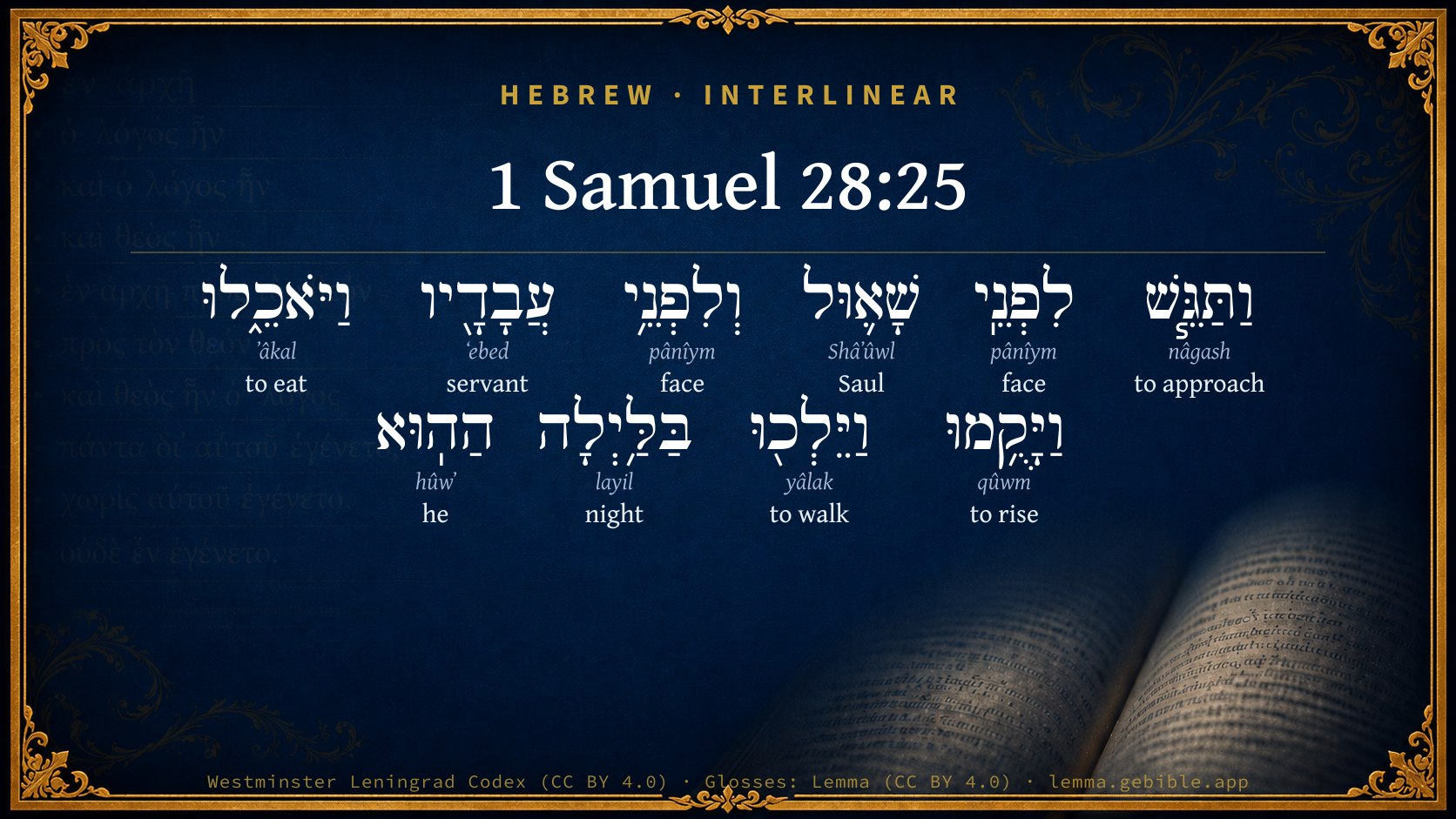
Hebrew (Westminster Leningrad Codex) 1 Samuel 28:25 appears in the Hebrew Old Testament. The text above is from the Westminster Leningrad Codex. Each word links to its Strong’s number, a concise gloss, and parsing drawn from the Open Scriptures Hebrew Bible morphology. Click any word for its full Brown-Driver-Briggs (BDB) entry.
Download image
Cite this verse

1 Samuel 28:25 (World English Bible). Public Domain. Lemma interlinear Bible study tool, https://lemma.gebible.app/v/1-samuel/28/25.

Show BibTeX & RIS
BibTeX
RIS
English Translation
and she brought it before Saul, and before his servants; and they ate. Then they rose up, and went away that night.
World English Bible · Public Domain
Download a study sheet

One document with this verse’s original text, its word-by-word gloss line, the meaning frame, cross-references with their text, attributed commentary, and full source and license credits — printable, and it pastes into notes with its structure intact.

This verse Autodidact and up

Study sheet (.html) Plain text (.txt)

A passage Seminary Student

Up to 50 verses in one chapter. A passage sheet keeps up to 6 commentary sources and 12 cross-references per verse, in the order this page ranks them, and says so on the sheet whenever that leaves anything out. Ask for a single verse and you get the Autodidact verse sheet above.

Everything on this page stays free to read, with no account — the sheet is a download of what is already on screen, not access to it.

Want to remove ads? Support Godless Engineer
Compare translations 3

The same verse in 3 English versions, stacked beneath the original-language interlinear above. Click any original word for its lexicon entry.

Each is an independent rendering of the whole verse — the interlinear is not word-aligned to these translations.

Highlighted words mark where these versions differ — a whole-verse word diff, not a word-by-word alignment.

  • World English Bible Public Domain
    and she brought it before Saul, and before his servants; and they ate. Then they rose up, and went away that night.
  • King James Version Public Domain
    And she brought it before Saul, and before his servants; and they did eat. Then they rose up, and went away that night.
  • unfoldingWord Literal Text CC BY-SA 4.0
    And she brought it to the face of Saul and to the face of his servants, and they ate. And they arose and went in that night.

unfoldingWord Literal Text — © unfoldingWord, licensed CC BY-SA 4.0. Word-aligned USFM3 via Door43 (git.door43.org/unfoldingWord/en_ult).

Versions to compare (up to 4)

3 of 4 selected

Show all 18 translations

Every available English version of this verse, each an independent rendering of the whole verse.

  • World English Bible Public Domain
    and she brought it before Saul, and before his servants; and they ate. Then they rose up, and went away that night.
  • Berean Standard Bible Public Domain
    She served it to Saul and his servants, and they ate. And that night they got up and left.
  • Majority Standard Bible Public Domain
    She served it to Saul and his servants, and they ate. And that night they got up and left.
  • King James Version Public Domain
    And she brought it before Saul, and before his servants; and they did eat. Then they rose up, and went away that night.
  • American Standard Version (1901) Public Domain
    and she brought it before Saul, and before his servants; and they did eat. Then they rose up, and went away that night.
  • Revised Version (1885) Public Domain
    and she brought it before Saul, and before his servants; and they did eat. Then they rose up, and went away that night.
  • Geneva Bible (1599) Public Domain
    Then she brought them before Saul, and before his seruants: and when they had eaten, they stoode, and went away the same night.
  • Douay-Rheims (1899) Public Domain
    And set it before Saul, and before his servants. And when they had eaten they rose up, and walked all that night.
  • Young's Literal Translation Public Domain
    and bringeth nigh before Saul, and before his servants, and they eat, and rise, and go on, during that night.
  • Literal Standard Version CC BY-SA 4.0
    and brings [them] near before Saul, and before his servants, and they eat, and rise, and go on during that night.
  • Unlocked Literal Bible CC BY-SA 4.0
    She brought it before Saul and his servants, and they ate. Then they got up and left that night.
  • unfoldingWord Literal Text CC BY-SA 4.0
    And she brought it to the face of Saul and to the face of his servants, and they ate. And they arose and went in that night.
  • Darby Bible Public Domain
    and she brought it near before Saul, and before his servants, and they ate. And they rose up and went away that night.
  • World Messianic Bible Public Domain
    She brought it before Saul and before his servants, and they ate. Then they rose up and went away that night.
  • Webster's Bible Public Domain
    And she brought it before Saul, and before his servants; and they ate. Then they arose and went away that night.
  • Free Bible Version CC BY-SA 4.0
    She served the meal to Saul and his men, and they ate it. Then they got up and left, the same night.
  • Bible in Basic English Public Domain
    And she put it before Saul and his servants, and they had a meal. Then they got up and went away the same night.
  • JPS Tanakh (1917) Public Domain
    and she brought it before Saul, and before his servants; and they did eat. Then they rose up, and went away that night.

Literal Standard Version (2020), Covenant Press — licensed CC BY-SA 4.0. Text via the HelloAO Bible API (eBible.org). Unlocked Literal Bible (unfoldingWord) — licensed CC BY-SA 4.0. Text via the HelloAO Bible API (eBible.org). unfoldingWord Literal Text — © unfoldingWord, licensed CC BY-SA 4.0. Word-aligned USFM3 via Door43 (git.door43.org/unfoldingWord/en_ult). Free Bible Version, Dr. Jonathan Gallagher — licensed CC BY-SA 4.0. Text via the HelloAO Bible API (eBible.org).

Word by word

More ways to search: Search by grammar → Find every occurrence → Compare this word →

Practice this passage: Drill this verse → Learn its vocabulary →

וַתַּגֵּ֧שׁ
nâgash
H5066
“and · to approach”
Conjunction + Verb, Hiphil, Sequential Imperfect, 3rd Person, Feminine, Singular
Part of Speech
Conjunction + Verb
Stem
Hiphil
Form
Sequential Imperfect
Person
3rd Person
Gender
Feminine
Number
Singular
Full BDB Definition

Origin: a primitive root

TWOT: 1297

to draw near, approach - (Qal) to draw or come near - of humans - of sexual intercourse - of inanimate subject - to approach one another - (Niphal) to draw near - (Hiphil) to cause to approach, bring near, bring - (Hophal) to be brought near - (Hithpael) to draw near
  1. לִפְנֵֽי pânîym H6440 “to/for · face(s) of” Preposition + Noun, Common, Both, Plural, Construct
  2. שָׁא֛וּל Shâʼûwl H7586 “Saul” Noun, Proper
  3. וְלִפְנֵ֥י pânîym H6440 “and · to/for · face(s) of” Conjunction + Preposition + Noun, Common, Both, Plural, Construct
  4. עֲבָדָ֖יו ʻebed H5650 “servants · his” Noun, Common, Masculine, Plural, Construct + Suffix, Personal, 3rd Person, Masculine, Singular
  5. וַיֹּאכֵ֑לוּ ʼâkal H398 “and · to eat” Conjunction + Verb, Qal, Sequential Imperfect, 3rd Person, Masculine, Plural
  6. וַיָּקֻ֥מוּ qûwm H6965 “and · to rise” Conjunction + Verb, Qal, Sequential Imperfect, 3rd Person, Masculine, Plural
  7. וַיֵּלְכ֖וּ yâlak H3212 “and · to walk” Conjunction + Verb, Qal, Sequential Imperfect, 3rd Person, Masculine, Plural
  8. בַּלַּ֥יְלָה layil H3915 “in/at the · night” Preposition, Determined + Noun, Common, Masculine, Singular, Absolute
  9. הַהֽוּא hûwʼ H1931 “the · he” Particle, Definite Article + Pronoun, Personal, 3rd Person, Masculine, Singular

About this verse

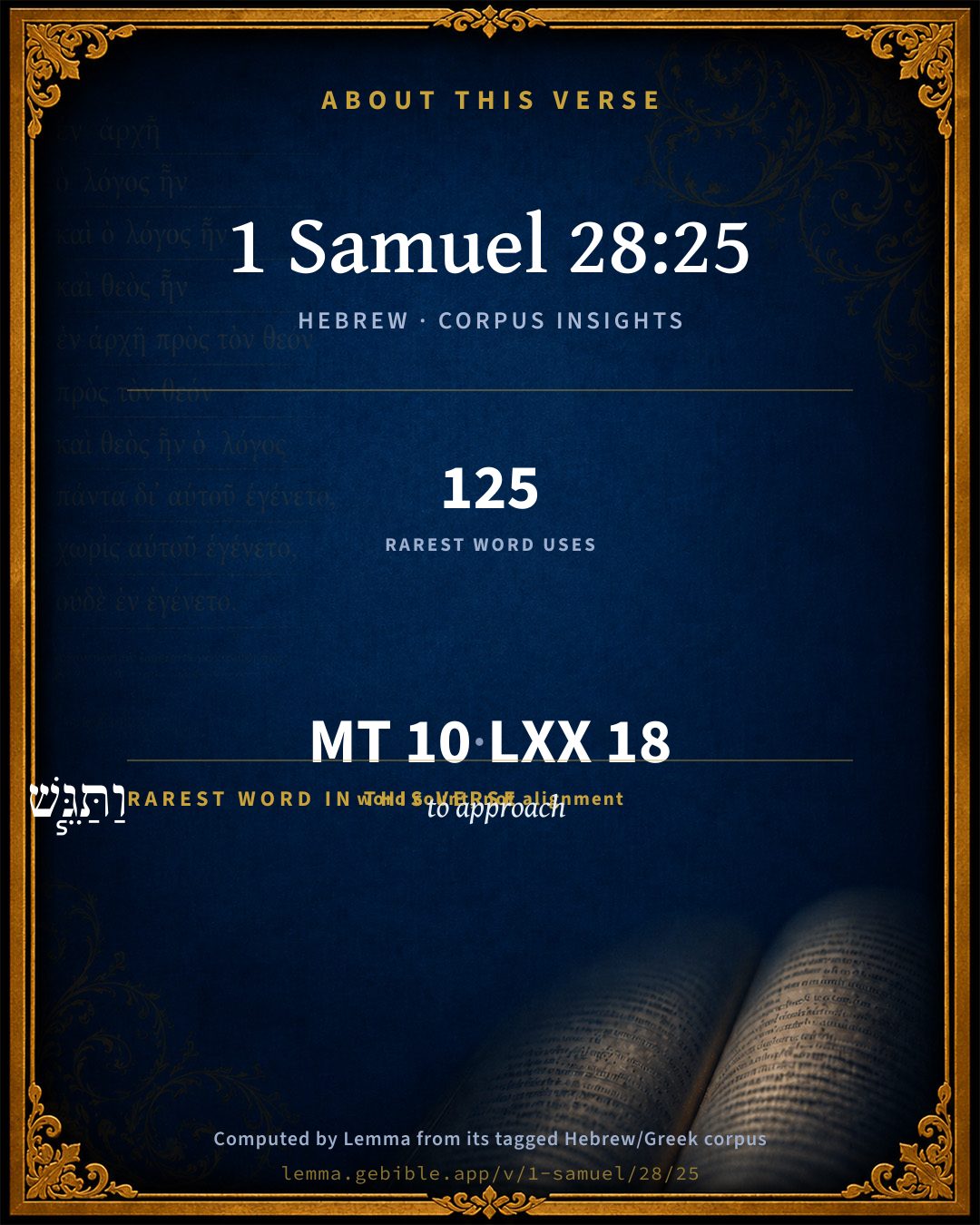
These counts appear in no published source. They are computed here, from the morphology-tagged text and Lemma’s own curated glosses. What Lemma adds →

10
words
9
distinct lemmas
Historical
section

Grammatical profile

  • 4 verbs
  • 5 nouns
  • 1 pronoun

Verb forms

  • וַתַּגֵּ֧שׁ Hiphil · Sequential Imperfect
  • וַיֹּאכֵ֑לוּ Qal · Sequential Imperfect
  • וַיָּקֻ֥מוּ Qal · Sequential Imperfect
  • וַיֵּלְכ֖וּ Qal · Sequential Imperfect

Repetition

A word recurs within this verse — often emphatic in Hebrew:

  • לִפְנֵֽי face H6440 ×2

Hebrew & Septuagint length

In English translation the verse runs 22 words from the Hebrew and 21 from the Septuagint (LXX English) — closely comparable.

A rough comparison of the two English renderings, which tokenize alike — not a word-level alignment.

Word counts can differ between the Hebrew and the Greek without any difference in meaning — e.g. the Hebrew direct-object marker אֵת has no separate Greek word, and Greek often adds the article ὁ.

In the original languages it is 10 Hebrew tokens and 18 Greek tokens — but the two are counted differently (Hebrew bundles its prefixes and suffixes into one token; the Greek is in lemma form), so that isn’t a like-for-like length.

Hebrew and Greek witnesses Masoretic Hebrew ↔ Greek Septuagint

The same verse in the two great witnesses to the Old Testament, shown verse-for-verse.

These are two independent witnesses, not word-aligned to each other, and the Septuagint is shown in lemma (dictionary) form.

Hebrew 1 Samuel 28:25 Masoretic · Westminster Leningrad Codex

וַתַּגֵּ֧שׁ לִפְנֵֽי שָׁא֛וּל וְלִפְנֵ֥י עֲבָדָ֖יו וַיֹּאכֵ֑לוּ וַיָּקֻ֥מוּ וַיֵּלְכ֖וּ בַּלַּ֥יְלָה הַהֽוּא

and she brought it before Saul, and before his servants; and they ate. Then they rose up, and went away that night.

World English Bible · Public Domain

Greek LXX 1 Samuel 28:25 Septuagint · lemma form

καί προςἄγω ἐνώπιον σαούλ καί ἐνώπιον ὁ παῖς αὐτός καί ἐσθίω καί ἀναἵστημι καί ἀποἔρχομαι ὁ νύξ ἐκεῖνος

And she brought the meat before Saul, and before his servants; and they ate, and rose up, and departed that night.

LXX2012 (modern English Septuagint) · Public Domain

Hebrew: Westminster Leningrad Codex (CC BY 4.0). Greek: Septuagint (public domain); English from LXX2012 (modern English Septuagint) (Public Domain). How the Septuagint differs from the Hebrew →

Targum (Aramaic paraphrase)

1

The Targum is the ancient Jewish Aramaic paraphrase of the Hebrew Scriptures — an interpretive translation, not the Hebrew text itself. Onkelos (literal) and Pseudo-Jonathan (expansive) render the Torah, and Jonathan the Prophets. Coverage is partial: where no permissively-licensed English translation exists for a verse, only the Aramaic is shown. This is verse-level text, not a word-by-word alignment to the Hebrew.

  1. Targum Jonathan Prophets (Joshua–Malachi)
    וְקָרֵיבַת קֳדָם שָׁאוּל וְקָדָם עַבְדוֹהִי וַאֲכַלוּ וְקָמוּ וַאֲזַלוּ בְּלֵילְיָא הַהוּא:

    (no public-domain English translation for this verse)

    Targum Jonathan — Aramaic: “Mikraot Gedolot” (public domain). English: “Sefaria Community Translation” (CC0 1.0 (public-domain dedication)); “London "Chaldee Paraphrase," 1871” (public domain). Text via Sefaria.

Commentary

Notes on 1 Samuel 28:25 from classic Christian and Jewish commentators (each source and its license shown beneath its notes). The classic Christian expositions comment on the surrounding passage and are grouped to its opening verse, so a note may address several verses; the Jewish commentaries on the Tanakh (Rashi and others) are per-verse, so they appear only where the commentator wrote on this verse.

Lemma curates 59 commentaries, every one of them public domain or Creative Commons licensed, each selected and text-cleaned for this edition rather than reprinted as found. About our sources →

Adam Clarke's Commentary

Verse 25. They rose up, and went away that night.] The transactions of this chapter occupy one night only.

1. Saul came by night to En-dor, 1Sa 28:8.

2. He consulted the woman, and had his conference with Samuel the same night; for no time whatever appears to have been lost after his arrival at En-dor.

3. He was overcome by the heavy tidings which he heard; and which for a time appear to have deprived him of all power.

4. The woman kills a calf; dresses a part; makes and bakes bread; and Saul and his servants eat. And,

5. They rose and went away that night, 1Sa 28:25. The next day, in all probability, the battle happened in which Israel was defeated, and Saul and his sons lost their lives.

THERE is a considerable diversity of opinion, both among learned and pious men, relative to the subject mentioned in this chapter, that of raising Samuel from the dead. Some deny the possibility of the thing, and say that it was the devil that personified Samuel; and others, that the whole was the imposition of this cunning woman, and that there was no supernatural agency in the business. This is not a proper place to argue the point. I have given my opinion in the notes. I may sum up in a few particulars.

1. I believe there is a supernatural and spiritual world, in which HUMAN spirits, both good and bad, live in a state of consciousness.

2. I believe there is an invisible world, in which various orders of spirits, not human, live and act.

3. I believe that any of these spirits may, according to the order of God, in the laws of their place of residence, have intercourse with this world, and become visible to mortals.

4. I believe there is a possibility, by arts not strictly good, to evoke and have intercourse with spirits, not HUMAN; and to employ, in a certain limited way, their power and influence.

5. I believe that the woman of En-dor had no power over Samuel; and that no incantation can avail over any departed saint of God, nor indeed over any human disembodied spirit.

6. I believe Samuel did actually appear to Saul; and that he was sent by the especial mercy of God to warn this infatuated king of his approaching death, that he might have an opportunity to make his peace with his Maker.

7. I believe that the woman found, from the appearances, that her real or pretended charms had no effect; and that what now took place came from a totally different disposition of things from those with which she was conversant.

8. I believe that direct, circumstantial, and unequivocal oracles were now delivered concerning things which neither human nor diabolical wisdom could foresee or penetrate; that the defeat of the Israelites, and the death of Saul and his three sons on the following day, were matters which, from their nature, could only be known to God himself; and that no demon or bad spirit could be employed in such a transaction.

Adam Clarke's Commentary on the Bible (1810–1826) — public domain. Text from a community e-Sword/MySword module.

Joseph Benson's Commentary

1Sa 28:25. They arose up and went away that night — “What remorse,”

says Delaney, “what desolation of mind, what horrors of guilt, what terrors and anticipations of divine wrath haunted him by the way, may no reader ever learn from his own experience!” Some have expressed a hope, that as, no doubt, his past sins were now brought to his remembrance, he felt contrition for them. Of this, however, the Holy Ghost is silent; and considering that at last he was guilty of self-murder we have no reason to think he experienced any repentance that was of any service to his immortal interests.

Joseph Benson's Commentary on the Old and New Testaments (1811–1818) — public domain. Text from a community e-Sword module.

Jamieson, Fausset & Brown

Robert Jamieson, A. R. Fausset & David Brown

Then they rose up, and went away that night--Exhausted by long abstinence, overwhelmed with mental distress, and now driven to despair, the cold sweat broke on his anxious brow, and he sank helpless on the ground. But the kind attentions of the woman and his servants having revived him, he returned to the camp to await his doom.

Next: 1 Samuel Chapter 29

Jamieson, Fausset & Brown — Commentary Critical and Explanatory on the Whole Bible (1871) — public domain (CC PDM 1.0). Text via the HelloAO Bible API.

Ellicott's Commentary for English Readers

(25) Went away that night.—The same night they retraced their steps, and returned to Gilboa. “Saul was too hardened in his sin to express any grief or pain, either on his own account or because of the predicted fate of his sons or his people. In stolid desperation he went to meet his destiny. This was the terrible end of one whom the Spirit of God had once taken possession of and turned into another man—of one who had been singularly endowed with Divine gifts to enable him to act as the leader of the people of God.”—O. von Gerlach.

A Bible Commentary for English Readers, edited by Charles John Ellicott (1878–1897) — public domain. Text from a community e-Sword module.

John Gill's Exposition

And she brought it before Saul, and before his servants, and they did eat,.... Of the fatted calf, and unleavened bread, which she set upon a table before them, in the best manner she could:

then they rose up, and went away that night; that it might not be seen in what house they had been, and that they might get to the camp without being discovered by the Philistines, or known by the Israelites that they had been out.

Next: 1 Samuel Chapter 29

John Gill's Exposition of the Whole Bible (1746–1763) — public domain (CC PDM 1.0). Text via the HelloAO Bible API.

Matthew Poole's English Annotations

i.e. Before morning; for he came by night, 1Sa 28:8, and went away before day; not willing to have it discovered that he had consulted with a witch.

Matthew Poole's English Annotations on the Holy Bible (1683–1685) — public domain. Text from a community e-Sword/MySword module.

Whedon's Commentary on the Bible

Daniel D. Whedon

25. Went away that night — And returned to his camp on the heights of Gilboa. Some have questioned whether Saul could have travelled from the top of Gilboa to Endor and back in one night, besides holding the interview with the witch. Supposing him to have taken the route indicated in the note on 1Sa_28:7, it can be shown to have been by no means impossible. In May, 1852, Dr. Robinson travelled from the Wady Jalud, at the eastern base of Gilboa, to within a mile of Endor, in two hours and forty minutes, besides stopping thirty-five minutes to lunch. — Bib. Res., vol. iii, pp. 338-340. Doubtless Saul, travelling probably more rapidly and by well known paths, could have gone down from the top of Gilboa to the same valley, and thence nearly in the route pursued by Dr. Robinson, and have reached Endor in less than three hours. His return could have been effected in the same length of time; and, allowing two hours for his interview with the witch, the whole affair need not have occupied more than eight hours, while it is possible it may have been done in much less time.

Daniel D. Whedon (gen. ed.), Commentary on the Old and New Testaments (1874–1909) — public domain. Text from a community e-Sword module.

Lesson kit

Teaching starters — assembled from the data on this page, not authored interpretation. Every prompt links to the verse data it draws on. Edit before teaching.

1 Samuel, in the Historical, opens this verse with 10 words (9 distinct Hebrew lemmas). Its most distinctive word is nâgash (“to approach”). A historical commentator’s framing appears above. Read the whole chapter for the surrounding context.

Discussion questions

  1. What does “to approach” (nâgash) contribute to the verse as a whole?
  2. What does the repetition of “face” (2× in this one verse) do in this verse?
  3. These translations render this verse differently; the difference is in the English rendering, not the original. What questions does that raise?
  4. «וַתַּגֵּ֧שׁ» is a Hiphil Sequential Imperfect verb. How does that grammatical form shape the action described?
  5. Compare how Adam Clarke's Commentary and Joseph Benson's Commentary read this verse. Where do they agree or differ?

Things to notice

Reading settings

Reading text

Shown beneath each verse's original-language words.

Old Testament
Old Testament edition

Read the OT as the Masoretic Hebrew (MT) or the Greek Septuagint (LXX).

English shown for the Greek Septuagint (in the Hebrew ↔ Greek comparison).

Comparing translations? Open the Compare panel on any verse page to stack up to four side by side.