1 Samuel 27:2

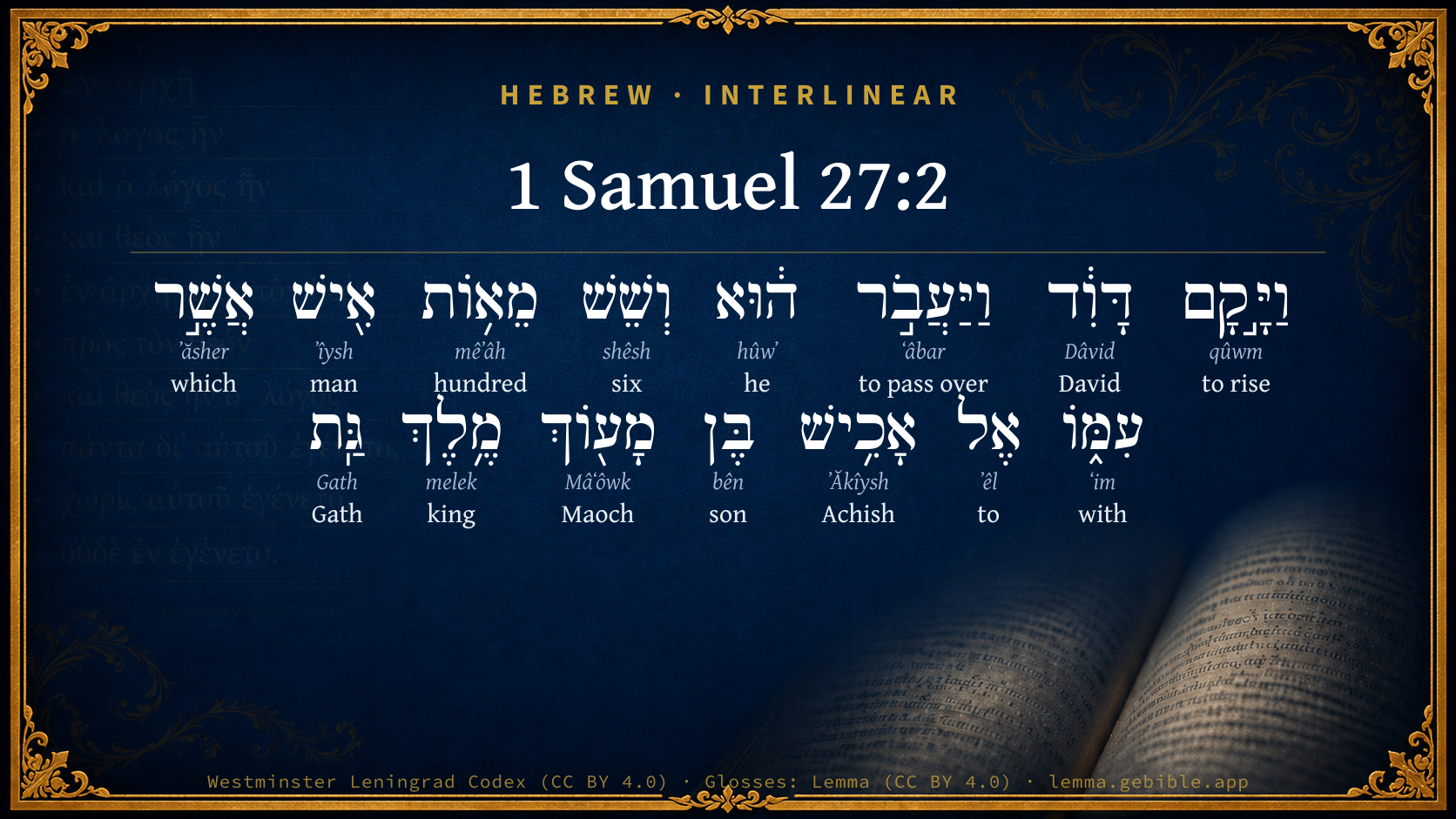
Hebrew (Westminster Leningrad Codex) 1 Samuel 27:2 appears in the Hebrew Old Testament. The text above is from the Westminster Leningrad Codex. Each word links to its Strong’s number, a concise gloss, and parsing drawn from the Open Scriptures Hebrew Bible morphology. Click any word for its full Brown-Driver-Briggs (BDB) entry.
Download image
Cite this verse

1 Samuel 27:2 (World English Bible). Public Domain. Lemma interlinear Bible study tool, https://lemma.gebible.app/v/1-samuel/27/2.

Show BibTeX & RIS
BibTeX
RIS
English Translation
David arose, and passed over, he and the six hundred men who were with him, to Achish the son of Maoch, king of Gath.
World English Bible · Public Domain
Highlights
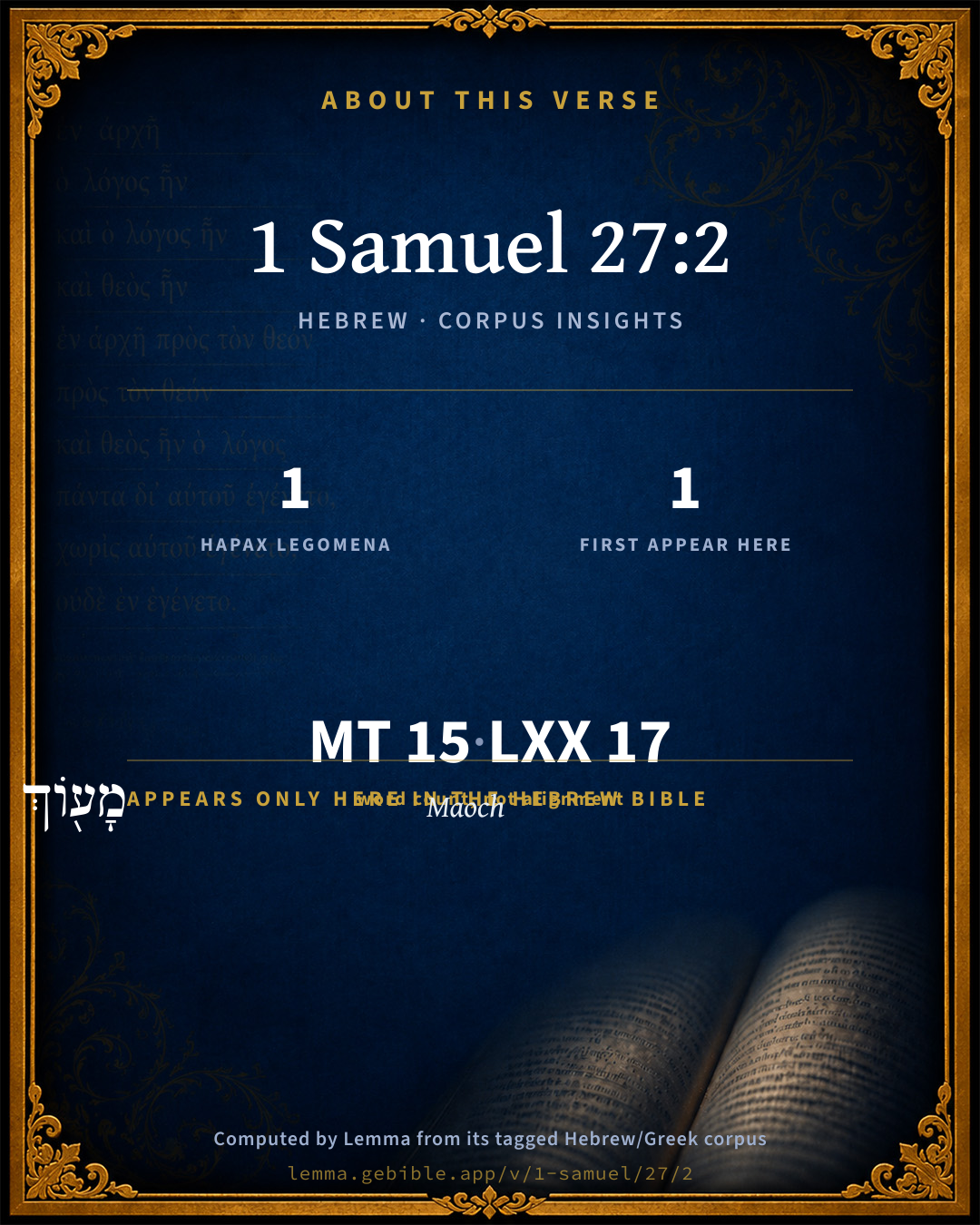
  • 1 hapax legomenon — only here in the Hebrew Bible
  • 1 first appearance in the Hebrew Bible
Full analysis ↓
Download a study sheet

One document with this verse’s original text, its word-by-word gloss line, the meaning frame, cross-references with their text, attributed commentary, and full source and license credits — printable, and it pastes into notes with its structure intact.

This verse Autodidact and up

Study sheet (.html) Plain text (.txt)

A passage Seminary Student

Up to 50 verses in one chapter. A passage sheet keeps up to 6 commentary sources and 12 cross-references per verse, in the order this page ranks them, and says so on the sheet whenever that leaves anything out. Ask for a single verse and you get the Autodidact verse sheet above.

Everything on this page stays free to read, with no account — the sheet is a download of what is already on screen, not access to it.

Want to remove ads? Support Godless Engineer
Compare translations 3

The same verse in 3 English versions, stacked beneath the original-language interlinear above. Click any original word for its lexicon entry.

Each is an independent rendering of the whole verse — the interlinear is not word-aligned to these translations.

Highlighted words mark where these versions differ — a whole-verse word diff, not a word-by-word alignment.

  • World English Bible Public Domain
    David arose, and passed over, he and the six hundred men who were with him, to Achish the son of Maoch, king of Gath.
  • King James Version Public Domain
    And David arose, and he passed over with the six hundred men that were with him unto Achish, the son of Maoch, king of Gath.
  • unfoldingWord Literal Text CC BY-SA 4.0
    And David arose and passed over, he and 600 men who with him, to Achish. The son of Maoch, the king of Gath.

unfoldingWord Literal Text — © unfoldingWord, licensed CC BY-SA 4.0. Word-aligned USFM3 via Door43 (git.door43.org/unfoldingWord/en_ult).

Versions to compare (up to 4)

3 of 4 selected

Show all 18 translations

Every available English version of this verse, each an independent rendering of the whole verse.

  • World English Bible Public Domain
    David arose, and passed over, he and the six hundred men who were with him, to Achish the son of Maoch, king of Gath.
  • Berean Standard Bible Public Domain
    So David set out with his six hundred men and went to Achish son of Maoch, the king of Gath.
  • Majority Standard Bible Public Domain
    So David set out with his six hundred men and went to Achish son of Maoch, the king of Gath.
  • King James Version Public Domain
    And David arose, and he passed over with the six hundred men that were with him unto Achish, the son of Maoch, king of Gath.
  • American Standard Version (1901) Public Domain
    And David arose, and passed over, he and the six hundred men that were with him, unto Achish the son of Maoch, king of Gath.
  • Revised Version (1885) Public Domain
    And David arose, and passed over, he and the six hundred men that were with him, unto Achish the son of Maoch, king of Gath.
  • Geneva Bible (1599) Public Domain
    Dauid therefore arose, and he, and the sixe hundreth men that were with him, went vnto Achish the sonne of Maoch King of Gath.
  • Douay-Rheims (1899) Public Domain
    And David arose and went away, both he and the six hundred men that were with him, to Achis the son of Maoch, king of Geth.
  • Young's Literal Translation Public Domain
    And David riseth, and passeth over, he and six hundred men who `are' with him, unto Achish son of Maoch king of Gath;
  • Literal Standard Version CC BY-SA 4.0
    And David rises, and passes over, he and six hundred men who [are] with him, to Achish son of Maoch king of Gath;
  • Unlocked Literal Bible CC BY-SA 4.0
    David arose and passed over, he and the six hundred men who were with him, to Achish son of Maok, the king of Gath.
  • unfoldingWord Literal Text CC BY-SA 4.0
    And David arose and passed over, he and 600 men who with him, to Achish. The son of Maoch, the king of Gath.
  • Darby Bible Public Domain
    And David arose and passed over, he and the six hundred men that were with him, to Achish, the son of Maoch, king of Gath.
  • World Messianic Bible Public Domain
    David arose and passed over, he and the six hundred men who were with him, to Achish the son of Maoch, king of Gath.
  • Webster's Bible Public Domain
    And David arose, and he passed over with the six hundred men that were with him to Achish, the son of Maoch, king of Gath.
  • Free Bible Version CC BY-SA 4.0
    So David and the six hundred men with him set off, crossed the border, and went to Achish, son of Maoch, the king of Gath.
  • Bible in Basic English Public Domain
    So David and the six hundred men who were with him went over to Achish, the son of Maoch, king of Gath.
  • JPS Tanakh (1917) Public Domain
    And David arose, and passed over, he and the six hundred men that were with him, unto Achish the son of Maoch, king of Gath.

Literal Standard Version (2020), Covenant Press — licensed CC BY-SA 4.0. Text via the HelloAO Bible API (eBible.org). Unlocked Literal Bible (unfoldingWord) — licensed CC BY-SA 4.0. Text via the HelloAO Bible API (eBible.org). unfoldingWord Literal Text — © unfoldingWord, licensed CC BY-SA 4.0. Word-aligned USFM3 via Door43 (git.door43.org/unfoldingWord/en_ult). Free Bible Version, Dr. Jonathan Gallagher — licensed CC BY-SA 4.0. Text via the HelloAO Bible API (eBible.org).

Word by word

More ways to search: Search by grammar → Find every occurrence → Compare this word →

Practice this passage: Drill this verse → Learn its vocabulary →

מָע֖וֹךְ
Mâʻôwk
H4582
“Maoch”
Noun, Proper
Part of Speech
Noun
Type
Proper
Full BDB Definition

Origin: from H4600

TWOT: None

Maoch = "oppression" - father of king Achish of Gath with whom David took refuge
  1. וַיָּ֣קָם qûwm H6965 “and · to rise” Conjunction + Verb, Qal, Sequential Imperfect, 3rd Person, Masculine, Singular
  2. דָּוִ֔ד Dâvid H1732 “David” Noun, Proper
  3. וַיַּעֲבֹ֣ר ʻâbar H5674 “and · to pass over” Conjunction + Verb, Qal, Sequential Imperfect, 3rd Person, Masculine, Singular
  4. ה֔וּא hûwʼ H1931 “he” Pronoun, Personal, 3rd Person, Masculine, Singular
  5. וְשֵׁשׁ shêsh H8337 “and · six” Conjunction + Adjective, Cardinal number, Feminine, Singular, Absolute
  6. מֵא֥וֹת mêʼâh H3967 “hundred” Adjective, Cardinal number, Both, Plural, Absolute
  7. אִ֖ישׁ ʼîysh H376 “man” Noun, Common, Masculine, Singular, Absolute
  8. אֲשֶׁ֣ר ʼăsher H834 “which” Particle, Relative
  9. עִמּ֑וֹ ʻim H5973 “with · him” Preposition + Suffix, Personal, 3rd Person, Masculine, Singular
  10. אֶל ʼêl H413 “to” Preposition
  11. אָכִ֥ישׁ ʼĂkîysh H397 “Achish” Noun, Proper
  12. בֶּן bên H1121 “son of” Noun, Common, Masculine, Singular, Construct
  13. מֶ֥לֶךְ melek H4428 “king of” Noun, Common, Masculine, Singular, Construct
  14. גַּֽת Gath H1661 “Gath” Noun, Proper

About this verse

These counts appear in no published source. They are computed here, from the morphology-tagged text and Lemma’s own curated glosses. What Lemma adds →

15
words
15
distinct lemmas
Historical
section

Notable vocabulary

1 hapax legomenon — a word that appears only here in the entire Hebrew Bible:

  • מָע֖וֹךְ Maoch H4582

First appearance in Scripture

This word makes its first canonical appearance in the Hebrew Bible here:

  • מָע֖וֹךְ Maoch H4582

Shared distinctive vocabulary

אָכִ֥ישׁ Achish H397 occurs in 20 verses of the Hebrew Bible. Also found in:

Grammatical profile

  • 2 verbs
  • 7 nouns
  • 2 adjectives
  • 1 pronoun
  • 2 prepositions
  • 1 particle

Verb forms

  • וַיָּ֣קָם Qal · Sequential Imperfect
  • וַיַּעֲבֹ֣ר Qal · Sequential Imperfect

Hebrew & Septuagint length

In English translation the verse runs 24 words from the Hebrew and 22 from the Septuagint (LXX English) — closely comparable.

A rough comparison of the two English renderings, which tokenize alike — not a word-level alignment.

Word counts can differ between the Hebrew and the Greek without any difference in meaning — e.g. the Hebrew direct-object marker אֵת has no separate Greek word, and Greek often adds the article ὁ.

In the original languages it is 15 Hebrew tokens and 17 Greek tokens — but the two are counted differently (Hebrew bundles its prefixes and suffixes into one token; the Greek is in lemma form), so that isn’t a like-for-like length.

Cross-references

4

Topical passages linked to 1 Samuel 27:2 in the Treasury of Scripture Knowledge — connected by theme and wording, ordered by reader-vote popularity; previews shown in the World English Bible.

  • 1 Samuel 21:10 David arose, and fled that day for fear of Saul, and went to Achish the king of Gath.
  • 1 Samuel 25:13 David said to his men, Gird you on every man his sword. They girded on every man his sword; and David also girded on his sword: and there went up after David about four hundred men; and two hundred abode by the baggage.
  • 1 Samuel 30:8 David inquired of Yahweh, saying, If I pursue after this troop, shall I overtake them? He answered him, Pursue; for you shall surely overtake [them], and shall without fail recover [all].
  • 1 Kings 2:39–40 It happened at the end of three years, that two of the servants of Shimei ran away to Achish, son of Maacah, king of Gath. They told Shimei, saying, Behold, your servants are in Gath.

Cross-references courtesy of OpenBible.info (CC BY 4.0).

Hebrew and Greek witnesses Masoretic Hebrew ↔ Greek Septuagint

The same verse in the two great witnesses to the Old Testament, shown verse-for-verse.

These are two independent witnesses, not word-aligned to each other, and the Septuagint is shown in lemma (dictionary) form.

Hebrew 1 Samuel 27:2 Masoretic · Westminster Leningrad Codex

וַיָּ֣קָם דָּוִ֔ד וַיַּעֲבֹ֣ר ה֔וּא וְשֵׁשׁ מֵא֥וֹת אִ֖ישׁ אֲשֶׁ֣ר עִמּ֑וֹ אֶל אָכִ֥ישׁ בֶּן מָע֖וֹךְ מֶ֥לֶךְ גַּֽת

David arose, and passed over, he and the six hundred men who were with him, to Achish the son of Maoch, king of Gath.

World English Bible · Public Domain

Greek LXX 1 Samuel 27:2 Septuagint · lemma form

καί ἀναἵστημι δαυίδ καί ὁ τετρακόσιοι ἀνήρ μετά αὐτός καί πορεύομαι πρός αγχους υἱός αμμαχ βασιλεύς γεθ

So David arose, and the six hundred men that were with him, and he went to Anchus, son Ammach, king of Geth.

LXX2012 (modern English Septuagint) · Public Domain

Hebrew: Westminster Leningrad Codex (CC BY 4.0). Greek: Septuagint (public domain); English from LXX2012 (modern English Septuagint) (Public Domain). How the Septuagint differs from the Hebrew →

Targum (Aramaic paraphrase)

1

The Targum is the ancient Jewish Aramaic paraphrase of the Hebrew Scriptures — an interpretive translation, not the Hebrew text itself. Onkelos (literal) and Pseudo-Jonathan (expansive) render the Torah, and Jonathan the Prophets. Coverage is partial: where no permissively-licensed English translation exists for a verse, only the Aramaic is shown. This is verse-level text, not a word-by-word alignment to the Hebrew.

  1. Targum Jonathan Prophets (Joshua–Malachi)
    וְקָם דָוִד וַעֲבַר הוּא וְשִׁית מְאָה גַבְרָא דְעִמֵיהּ לְוַת אָכִישׁ בַּר מָעוֹךְ מַלְכָּא דְגַת:

    (no public-domain English translation for this verse)

    Targum Jonathan — Aramaic: “Mikraot Gedolot” (public domain). English: “Sefaria Community Translation” (CC0 1.0 (public-domain dedication)); “London "Chaldee Paraphrase," 1871” (public domain). Text via Sefaria.

Commentary

Notes on 1 Samuel 27:2 from classic Christian and Jewish commentators (each source and its license shown beneath its notes). The classic Christian expositions comment on the surrounding passage and are grouped to its opening verse, so a note may address several verses; the Jewish commentaries on the Tanakh (Rashi and others) are per-verse, so they appear only where the commentator wrote on this verse.

Lemma curates 59 commentaries, every one of them public domain or Creative Commons licensed, each selected and text-cleaned for this edition rather than reprinted as found. About our sources →

Trapp's Complete Commentary

John Trapp

1Sa 27:2 And David arose, and he passed over with the six hundred men that [were] with him unto Achish, the son of Maoch, king of Gath.

Ver. 2. And David arose, and he passed over with the six hundred men.] Who might have done far better service in fighting against the Philistines in that fatal battle; {1Sa 31:1-7} and haply have hindered that great slaughter of God’s people: but there was a providence in it, God fetching good out of evil; as the Athenians fancied that their goddess Minerva ordered their evil counsels to the best events. The Philistines entertained them gladly, as the Persians did Themistocles, the Lacedemonians Alcibiades, and the Volscians Coriolanus. But David and his men may no more be excused herein, say some, than if a captain with a band of men being Christian should flee to the Turk to fight for him. Others think that he did well and wisely; from whom I dissent.

Unto Achish … king of Gath.] But fide publica, it is like; upon better security beforehand given than formerly was had; else he would hardly have ventured.

John Trapp, A Commentary or Exposition upon All the Books of the Old and New Testament (1647–1656) — public domain. Text from a community e-Sword module.

Joseph Benson's Commentary

1Sa 27:2. Unto Achish the son of Maoch — “Most writers agree that this Achish, to whom David now fled, was not the Achish by whom he was so inhospitably received, and from whom he so narrowly escaped, when he was before at Gath. His being here called Achish the son of Maoch, sufficiently implies him to have been another person; for those words can, in the nature of the thing, have no use but to distinguish this Achish from another of the same name. And indeed this Achish seems as well distinguished from the other by the rest of his character, as by that of the son of Maoch. But this, by the way, is a fair proof that this book was written at the time that it is said to have been written; insomuch as this distinction was information enough to the people of that age, but could neither be given nor received as such either by any writer or reader of any subsequent age.” — Delaney.

Joseph Benson's Commentary on the Old and New Testaments (1811–1818) — public domain. Text from a community e-Sword module.

Tyndale Open Study Notes

Tyndale Open Resources

27:2 This was David’s second sojourn with Achish, the Philistine king (see 21:10-15). On both occasions, David lied to him (see 27:10).

Tyndale Open Study Notes — © Tyndale Open Resources, licensed CC BY-SA 4.0. Text via the HelloAO Bible API.

Jamieson, Fausset & Brown

Robert Jamieson, A. R. Fausset & David Brown

Achish, the son of Maoch, king of Gath--The popular description of this king's family creates a presumption that he was a different king from the reigning sovereign on David's first visit to Gath. Whether David had received a special invitation from him or a mere permission to enter his territories, cannot be determined. It is probable that the former was the case. From the universal notoriety given to the feud between Saul and David, which had now become irreconcilable, it might appear to Achish good policy to harbor him as a guest, and so the better pave the way for the hostile measures against Israel which the Philistines were at this time meditating.

Jamieson, Fausset & Brown — Commentary Critical and Explanatory on the Whole Bible (1871) — public domain (CC PDM 1.0). Text via the HelloAO Bible API.

Adam Clarke's Commentary

Verse 2. David arose, and he passed over - unto Achish] There is not one circumstance in this transaction that is not blameable. David joins the enemies of his God and of his country, acts a most inhuman part against the Geshurites and Amalekites, without even the pretense of a Divine authority; tells a most deliberate falsehood to Achish, his protector, relative to the people against whom he had perpetrated this cruel act; giving him to understand that he had been destroying the Israelites, his enemies. I undertake no defence of this conduct of David; it is all bad, all defenceless; God vindicates him not. The inspired penman tells what he did, but passes no eulogium upon his conduct; and it is false to say that, because these things are recorded, therefore they are approved. In all these transactions David was in no sense a man after God's own heart. Chandler attempts to vindicate all this conduct: those who can receive his saying, let them receive it.

Adam Clarke's Commentary on the Bible (1810–1826) — public domain. Text from a community e-Sword/MySword module.

Ellicott's Commentary for English Readers

(2) The six hundred men.—This was the original number. They still formed the nucleus of the force, but the total number was now far larger. These “six hundred” had each their households, besides which, many a group of warriors, large and small, had already joined the now renowned standard of the future king.

Achish, the son of Maoch, king of Gath.—The same, we believe, as that Achish to whom David fled before (see 1Sa_21:11), and identical with Achish, son of Maachah (1Ki_2:39). This would involve the necessity of ascribing a fifty years’ reign to this prince. (Such a lengthy reign is quite possible.) The whole of Philistia subsequently fell under King David’s rule. It seems, however, that he permitted, even after the conquest, Achish to remain in his old city of Gath, most likely as his tributary: thus, we may suppose, paying back the old debt of kindness to Achish.

A Bible Commentary for English Readers, edited by Charles John Ellicott (1878–1897) — public domain. Text from a community e-Sword module.

The Cambridge Bible for Schools and Colleges

gen. ed. J. J. S. Perowne

2. Achish, the son of Maoch] If he was the same as the Achish of 1Sa_21:10, and the Achish son of Maachah of 1Ki_2:39, he must have reigned some fifty years. But more probably the same name was borne by different individuals.

The Cambridge Bible for Schools and Colleges (gen. ed. J. J. S. Perowne; Cambridge University Press, 1878–1918) — public domain. Text from a community e-Sword module.

John Gill's Exposition

And David arose,.... From the place where he was:

and he passed over; the borders of land of Canaan:

with the six hundred men that were with him; having neither lost any, nor had any added to him, since he was at Keilah, Sa1 23:13,

unto Achish, the son of Maoch, king of Gath; whether this was the same Achish David was with before, Sa1 21:10, is not certain; it seems as if he was not the same, since he is described as the son of Maoch, as if it was to distinguish him from him; though it is not improbable that he was the same person. Some think (a) that he is described not from his father, but from his mother, whose name was Maacha. The circumstances of David were now very much altered from what they were when he went to Gath before; then he went secretly, now openly; then as a person unknown, now as well known; then alone, now with six hundred men; then when discovered he was seized by the princes of Gath, and brought before the king, and was driven from his presence; but now he came either at the invitation of Achish, hearing how he had been treated by Saul, and thinking to attach him to his interest, and make him more and more the enemy of Saul, and so free himself from a very powerful one, and of whose wisdom and prudence, and military skill, and courage, and valour, he might hope to avail himself; or David sent an embassy to him, to treat with him about his coming into his country, and settlement in it, and terms to mutual satisfaction were agreed upon.

(a) Hieron. Trad. Heb, in 2 Reg. fol. 78. E.

John Gill's Exposition of the Whole Bible (1746–1763) — public domain (CC PDM 1.0). Text via the HelloAO Bible API.

Haydock's Catholic Bible Commentary

Maoch, or Maacha, 3 Kings ii. 29. This king had perhaps seen David, when he counterfeited madness. But now he was convinced that, by granting him protection, he would greatly annoy Saul, and draw many brave men out of his dominions.

George Leo Haydock (1774–1849), Haydock's Catholic Family Bible and Commentary, 1859 edition — public domain. Excludes Psalms (Douay-Rheims chapter numbering differs from Protestant) and Deuterocanonical books (Catholic canon only).

Matthew Poole's English Annotations

It might seem a bold adventure; but,

1. He thought himself forced to it by Saul’s inveterate rage, and continued resolutions to persecute him.

2. It is probable he had sent some persons to treat with him, and had agreed upon conditions, and received assurance of his safe and peaceable abode with him.

3. David reasonably thought that Achish would gladly receive him, as indeed he did; partly, because he saw Saul’s implacable enmity against him; partly, because by this means he should be freed from the most formidable enemy which he had in all Israel, who might do him most mischief in the battle; which it seems at this time he designed; and partly, because he came not now alone, as he did before, but brought with him sufficient pledges of his fidelity to Achish; namely, all his soldiers, and his and their wives, 1Sa 27:3.

Matthew Poole's English Annotations on the Holy Bible (1683–1685) — public domain. Text from a community e-Sword/MySword module.

Whedon's Commentary on the Bible

Daniel D. Whedon

2. Achish, the son of Maoch — Probably the same person mentioned

1Sa_21:11. But David’s reception in Gath was very different from that of the former occasion. “The inveterate hatred of Saul, now so well known, was his recommendation, and no distrust could be entertained of a man who fled for his life to the enemies of his country — exasperated by wrongs, and willing, it might be supposed, to avenge them.” — Kitto.

Daniel D. Whedon (gen. ed.), Commentary on the Old and New Testaments (1874–1909) — public domain. Text from a community e-Sword module.

The Pulpit Commentary

Vers. 2-4. Achish, the son of Maoch. No doubt the Achish of 1Sa_21:10; but if the same as Achish, son of Maachah, in 1Ki_2:39, as is probably the case, he must have lived to a good old age. As it is said in 1Ch_18:1 that David conquered the Philistines, and took from them Gath and other towns, it would seem that he still permitted Achish to remain there as a tributary king, while Ziklag he kept as his private property (ver. 6). On the former occasion,. when David was alone, Achish had paid him but scant courtesy; but now that he came with 600 warriors, each with his household, and, therefore, with numerous followers, he shows him every respect, and for the time David and his men settle at Gath, and Saul gives over his pursuit, knowing that if he followed him into Philistine territory he would provoke a war, for which he was not now prepared. It has been pointed out that David probably introduced from Gath the style of music called Gittith. (Ps 8 Ps 81 Ps 84., titles)

The Pulpit Commentary (1880–1919), ed. H.D.M. Spence-Jones & Joseph S. Exell — public domain. Text from a community e-Sword module.

John Wesley's Explanatory Notes

He forsakes the place where God had settled him, chap. xxii, 5, and given him both assurance and experience of his protection there.

John Wesley, Explanatory Notes Upon the Whole Bible (1754–1765) — public domain. Text via the GEBible commentary corpus.

unfoldingWord translationNotes

Door43 World Missions Community

David arose and passed over

"David took action; he passed over"

passed over

"passed over the border between Israel and Philistia"

six hundred men

600 (See: Numbers)

Achish

This is the name of a man. See how you translated this in 1 Samuel 21:10. (See: How to Translate Names)

Maok

This is the name of a man. (See: How to Translate Names)

Ahinoam

This is the name of a woman. See how you translated this in 1 Samuel 14:50. (See: How to Translate Names)

Abigail

This is the name of a woman. See how you translated this in 1 Samuel 25:3. (See: How to Translate Names)

Nabal

This is the name of a man. See how you translated this in 1 Samuel 25:3. (See: How to Translate Names)

Saul was told

This can be stated in active form. AT: "Someone told Saul" or "Saul heard" (See: Active or Passive)

translationWords

raise

king

Gath

life

household

Jezreel

Carmel

unfoldingWord translationNotes — © Distant Shores Media and the Door43 World Missions Community, licensed CC BY-SA 4.0. Source: git.door43.org/Door43/en_tn.

Lesson kit

Teaching starters — assembled from the data on this page, not authored interpretation. Every prompt links to the verse data it draws on. Edit before teaching.

1 Samuel, in the Historical, opens this verse with 15 words (15 distinct Hebrew lemmas). Its most distinctive word is Mâʻôwk (“Maoch”). A historical commentator’s framing appears above. Read the whole chapter for the surrounding context.

Discussion questions

  1. What does “Maoch” (Mâʻôwk) contribute to the verse as a whole?
  2. 1 word here appears nowhere else in the Hebrew Bible. Why might the author reach for such rare wording?
  3. This is the first place “Maoch” appears in Scripture (first appears here). What does its debut here establish?
  4. How does 1 Samuel 21:10, which shares the word «Achish», read alongside this verse?
  5. These translations render this verse differently; the difference is in the English rendering, not the original. What questions does that raise?
  6. «וַיָּ֣קָם» is a Qal Sequential Imperfect verb. How does that grammatical form shape the action described?
  7. Compare how Trapp's Complete Commentary and Joseph Benson's Commentary read this verse. Where do they agree or differ?

Things to notice

Reading settings

Reading text

Shown beneath each verse's original-language words.

Old Testament
Old Testament edition

Read the OT as the Masoretic Hebrew (MT) or the Greek Septuagint (LXX).

English shown for the Greek Septuagint (in the Hebrew ↔ Greek comparison).

Comparing translations? Open the Compare panel on any verse page to stack up to four side by side.