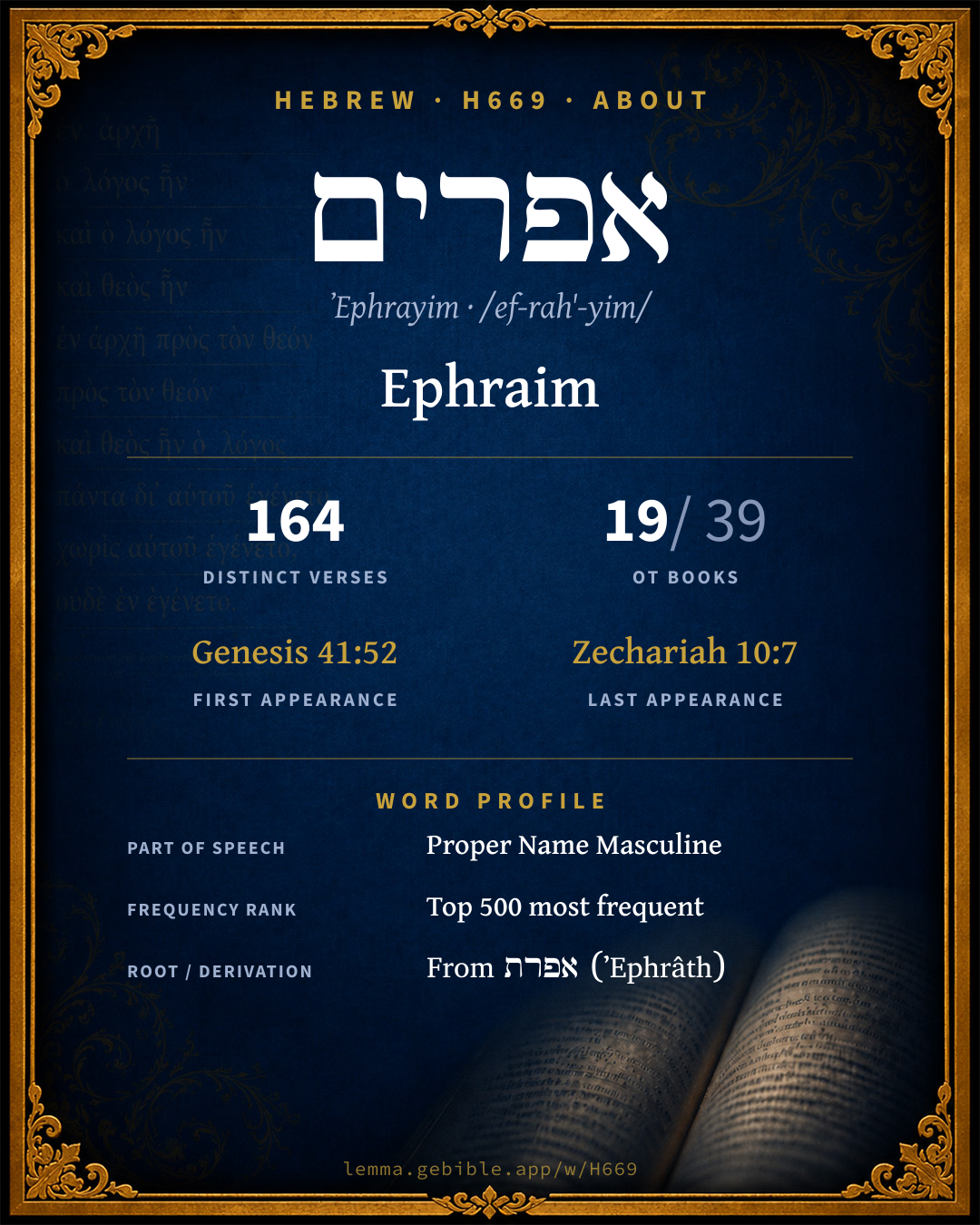
אֶפְרַ֫יִם
Ephraim
BDB lists 7 entries for ‘Ephraim’ fuller range ↓
Full lexicon entry — Brown-Driver-Briggs (BDB)
From Brown-Driver-Briggs (BDB)
Where this word appears
Grammar key — what these labels mean
Part of speech
- Noun
- A naming word — a person, place, thing, or idea.
Noun type
- Proper
- A name of a specific person, place, or people (e.g. Abraham, Zion, Israel).
Every verse where H669 appears — 164 distinct verses across 19 books. Click any verse to open its interlinear word-by-word view. Verse text shown in the World English Bible for context — . Each verse’s Hebrew form is shown with its reference; the English is not keyword-highlighted, since the data carries no word-level English alignment. Use “Compare translations” on any verse to read it across multiple English versions. This concordance covers the Hebrew Bible; Septuagint (Greek Old Testament) occurrences are not indexed here.
Genesis 9 verses
- Genesis 41:52 אֶפְרָ֑יִם n Proper The name of the second, he called Ephraim: "For God has made me fruitful in the land of my affliction."
- Genesis 46:20 אֶפְרָֽיִם n Proper To Joseph in the land of Egypt were born Manasseh and Ephraim, whom Asenath, the daughter of Potiphera, priest of On, bore to him.
- Genesis 48:1 אֶפְרָֽיִם n Proper It happened after these things, that someone said to Joseph, "Behold, your father is sick." He took with him his two sons, Manasseh and Ephraim.
- Genesis 48:5 אֶפְרַ֨יִם֙ n Proper Now your two sons, who were born to you in the land of Egypt before I came to you into Egypt, are mine; Ephraim and Manasseh, even as Reuben and Simeon, will be mine.
- Genesis 48:13 אֶפְרַ֤יִם n Proper Joseph took them both, Ephraim in his right hand toward Israel's left hand, and Manasseh in his left hand toward Israel's right hand, and brought them near to him.
- Genesis 48:14 אֶפְרַ֨יִם֙ n Proper Israel stretched out his right hand, and laid it on Ephraim's head, who was the younger, and his left hand on Manasseh's head, guiding his hands knowingly, for Manasseh was the firstborn.
- Genesis 48:17 אֶפְרַ֖יִם אֶפְרַ֖יִם n Proper n Proper When Joseph saw that his father laid his right hand on the head of Ephraim, it displeased him. He held up his father's hand, to remove it from Ephraim's head to Manasseh's head.
- Genesis 48:20 כְּ/אֶפְרַ֖יִם אֶפְרַ֖יִם prep + n Proper n Proper He blessed them that day, saying, "In you will Israel bless, saying, 'God make you as Ephraim and as Manasseh'" He set Ephraim before Manasseh.
- Genesis 50:23 לְ/אֶפְרַ֔יִם prep + n Proper Joseph saw Ephraim's children to the third generation. The children also of Machir, the son of Manasseh, were born on Joseph's knees.
Numbers 12 verses
- Numbers 1:10 לְ/אֶפְרַ֕יִם prep + n Proper Of the children of Joseph: Of Ephraim: Elishama the son of Ammihud. Of Manasseh: Gamaliel the son of Pedahzur.
- Numbers 1:32 אֶפְרַ֔יִם n Proper Of the children of Joseph, of the children of Ephraim, their generations, by thir families, by their fathers' houses, according to the number of the names, from twenty years old and upward, all who were able to go out to war;
- Numbers 1:33 אֶפְרָ֑יִם n Proper those who were numbered of them, of the tribe of Ephraim, were forty thousand five hundred.
- Numbers 2:18 אֶפְרַ֛יִם אֶפְרַ֔יִם n Proper n Proper "On the west side shall be the standard of the camp of Ephraim according to their divisions: and the prince of the children of Ephraim shall be Elishama the son of Ammihud.
- Numbers 2:24 אֶפְרַ֗יִם n Proper "All who were numbered of the camp of Ephraim were one hundred eight thousand one hundred, according to their divisions. They shall set out third.
- Numbers 7:48 אֶפְרָ֑יִם n Proper On the seventh day Elishama the son of Ammihud, prince of the children of Ephraim
- Numbers 10:22 אֶפְרַ֖יִם n Proper The standard of the camp of the children of Ephraim set forward according to their hosts: and over his host was Elishama the son of Ammihud.
- Numbers 13:8 אֶפְרָ֖יִם n Proper Of the tribe of Ephraim, Hoshea the son of Nun.
- Numbers 26:28 וְ/אֶפְרָֽיִם conj + n Proper The sons of Joseph after their families: Manasseh and Ephraim.
- Numbers 26:35 אֶפְרַיִם֮ n Proper These are the sons of Ephraim after their families: of Shuthelah, the family of the Shuthelahites; of Becher, the family of the Becherites; of Tahan, the family of the Tahanites.
- Numbers 26:37 אֶפְרַ֨יִם֙ n Proper These are the families of the sons of Ephraim according to those who were numbered of them, thirty-two thousand five hundred. These are the sons of Joseph after their families.
- Numbers 34:24 אֶפְרַ֖יִם n Proper Of the tribe of the children of Ephraim a prince, Kemuel the son of Shiphtan.
Deuteronomy 2 verses
- Deuteronomy 33:17 אֶפְרַ֔יִם n Proper The firstborn of his herd, majesty is his; His horns are the horns of the wild-ox: With them he shall push the peoples all of them, [even] the ends of the earth: They are the ten thousands of Ephraim, They are the thousands of Manasseh.
- Deuteronomy 34:2 אֶפְרַ֖יִם n Proper and all Naphtali, and the land of Ephraim and Manasseh, and all the land of Judah, to the hinder sea,
Joshua 18 verses
- Joshua 14:4 וְ/אֶפְרָ֑יִם conj + n Proper For the children of Joseph were two tribes, Manasseh and Ephraim: and they gave no portion to the Levites in the land, save cities to dwell in, with the suburbs of it for their cattle and for their substance.
- Joshua 16:4 וְ/אֶפְרָֽיִם conj + n Proper The children of Joseph, Manasseh and Ephraim, took their inheritance.
- Joshua 16:5 אֶפְרַ֖יִם n Proper The border of the children of Ephraim according to their families was [thus]: the border of their inheritance eastward was Ataroth Addar, to Beth Horon the upper;
- Joshua 16:8 אֶפְרַ֖יִם n Proper From Tappuah the border went along westward to the brook of Kanah; and the goings out of it were at the sea. This is the inheritance of the tribe of the children of Ephraim according to their families;
- Joshua 16:9 אֶפְרַ֔יִם n Proper together with the cities which were set apart for the children of Ephraim in the midst of the inheritance of the children of Manasseh, all the cities with their villages.
- Joshua 16:10 אֶפְרַ֨יִם֙ n Proper They didn't drive out the Canaanites who lived in Gezer: but the Canaanites dwell in the midst of Ephraim to this day, and are become servants to do forced labor.
- Joshua 17:8 אֶפְרָֽיִם n Proper The land of Tappuah belonged to Manasseh; but Tappuah on the border of Manasseh belonged to the children of Ephraim.
- Joshua 17:9 לְ/אֶפְרַ֔יִם prep + n Proper The border went down to the brook of Kanah, southward of the brook: these cities belonged to Ephraim among the cities of Manasseh: and the border of Manasseh was on the north side of the brook, and the goings out of it were at the sea:
- Joshua 17:10 לְ/אֶפְרַ֗יִם prep + n Proper southward it was Ephraim's, and northward it was Manasseh's, and the sea was his border; and they reached to Asher on the north, and to Issachar on the east.
- Joshua 17:15 אֶפְרָֽיִם n Proper Joshua said to them, If you are a great people, go up to the forest, and cut down for yourself there in the land of the Perizzites and of the Rephaim; since the hill-country of Ephraim is too narrow for you.
- Joshua 17:17 לְ/אֶפְרַ֥יִם prep + n Proper Joshua spoke to the house of Joseph, even to Ephraim and to Manasseh, saying, You are a great people, and have great power; you shall not have one lot only:
- Joshua 19:50 אֶפְרָ֑יִם n Proper according to the commandment of Yahweh they gave him the city which he asked, even Timnathserah in the hill-country of Ephraim; and he built the city, and lived therein.
- Joshua 20:7 אֶפְרָ֑יִם n Proper They set apart Kedesh in Galilee in the hill-country of Naphtali, and Shechem in the hill-country of Ephraim, and Kiriath Arba (the same is Hebron) in the hill-country of Judah.
- Joshua 21:5 אֶ֠פְרַיִם n Proper The rest of the children of Kohath had by lot out of the families of the tribe of Ephraim, and out of the tribe of Dan, and out of the half-tribe of Manasseh, ten cities.
- Joshua 21:20 אֶפְרָֽיִם n Proper The families of the children of Kohath, the Levites, even the rest of the children of Kohath, they had the cities of their lot out of the tribe of Ephraim.
- Joshua 21:21 אֶפְרָ֑יִם n Proper They gave them Shechem with its suburbs in the hill-country of Ephraim, the city of refuge for the manslayer, and Gezer with its suburbs,
- Joshua 24:30 אֶפְרָ֑יִם n Proper They buried him in the border of his inheritance in Timnathserah, which is in the hill-country of Ephraim, on the north of the mountain of Gaash.
- Joshua 24:33 אֶפְרָֽיִם n Proper Eleazar the son of Aaron died; and they buried him in the hill of Phinehas his son, which was given him in the hill-country of Ephraim.
Judges 22 verses
- Judges 1:29 וְ/אֶפְרַ֨יִם֙ conj + n Proper Ephraim didn't drive out the Canaanites who lived in Gezer; but the Canaanites lived in Gezer among them.
- Judges 2:9 אֶפְרָ֑יִם n Proper They buried him in the border of his inheritance in Timnath Heres, in the hill country of Ephraim, on the north of the mountain of Gaash.
- Judges 3:27 אֶפְרָ֑יִם n Proper It happened, when he had come, that he blew a trumpet in the hill-country of Ephraim; and the children of Israel went down with him from the hill-country, and he before them.
- Judges 4:5 אֶפְרָ֑יִם n Proper She lived under the palm tree of Deborah between Ramah and Bethel in the hill-country of Ephraim: and the children of Israel came up to her for judgment.
- Judges 5:14 אֶפְרַ֗יִם n Proper Out of Ephraim [came down] they whose root is in Amalek; After you, Benjamin, among your peoples; Out of Machir came down governors, Out of Zebulun those who handle the marshal's staff.
- Judges 7:24 אֶפְרַ֜יִם אֶפְרַ֨יִם֙ n Proper n Proper Gideon sent messengers throughout all the hill-country of Ephraim, saying, Come down against Midian, and take before them the waters, as far as Beth Barah, even the Jordan. So all the men of Ephraim were gathered together, and took the waters as far as Beth Barah, even the Jordan.
- Judges 8:1 אֶפְרַ֗יִם n Proper The men of Ephraim said to him, Why have you served us thus, that you didn't call us, when you went to fight with Midian? They did chide with him sharply.
- Judges 8:2 אֶפְרַ֖יִם n Proper He said to them, What have I now done in comparison with you? Isn't the gleaning of the grapes of Ephraim better than the vintage of Abiezer?
- Judges 10:1 אֶפְרָֽיִם n Proper After Abimelech there arose to save Israel Tola the son of Puah, the son of Dodo, a man of Issachar; and he lived in Shamir in the hill-country of Ephraim.
- Judges 10:9 אֶפְרָ֑יִם n Proper The children of Ammon passed over the Jordan to fight also against Judah, and against Benjamin, and against the house of Ephraim; so that Israel was sore distressed.
- Judges 12:1 אֶפְרַ֔יִם n Proper The men of Ephraim were gathered together, and passed northward; and they said to Jephthah, Why did you pass over to fight against the children of Ammon, and didn't call us to go with you? we will burn your house on you with fire.
- Judges 12:4 אֶפְרָ֑יִם אֶפְרַ֗יִם אֶפְרַ֨יִם֙ אֶפְרַ֖יִם n Proper n Proper n Proper n Proper Then Jephthah gathered together all the men of Gilead, and fought with Ephraim; and the men of Gilead struck Ephraim, because they said, You are fugitives of Ephraim, you Gileadites, in the midst of Ephraim, [and] in the midst of Manasseh.
- Judges 12:5 לְ/אֶפְרָ֑יִם אֶפְרַ֨יִם֙ prep + n Proper n Proper The Gileadites took the fords of the Jordan against the Ephraimites. It was so, that when [any of] the fugitives of Ephraim said, Let me go over, the men of Gilead said to him, Are you an Ephraimite? If he said, No;
- Judges 12:6 מֵֽ/אֶפְרַ֔יִם prep + n Proper then said they to him, Say now Shibboleth; and he said Sibboleth; for he couldn't manage to pronounce it right: then they laid hold on him, and killed him at the fords of the Jordan. There fell at that time of Ephraim forty-two thousand.
- Judges 12:15 אֶפְרַ֔יִם n Proper Abdon the son of Hillel the Pirathonite died, and was buried in Pirathon in the land of Ephraim, in the hill-country of the Amalekites.
- Judges 17:1 אֶפְרָ֖יִם n Proper There was a man of the hill-country of Ephraim, whose name was Micah.
- Judges 17:8 אֶפְרַ֛יִם n Proper The man departed out of the city, out of Bethlehem Judah, to sojourn where he could find [a place], and he came to the hill-country of Ephraim to the house of Micah, as he traveled.
- Judges 18:2 אֶפְרַ֨יִם֙ n Proper The children of Dan sent of their family five men from their whole number, men of valor, from Zorah, and from Eshtaol, to spy out the land, and to search it; and they said to them, Go, search the land. They came to the hill-country of Ephraim, to the house of Micah, and lodged there.
- Judges 18:13 אֶפְרָ֑יִם n Proper They passed there to the hill-country of Ephraim, and came to the house of Micah.
- Judges 19:1 אֶפְרַ֔יִם n Proper It happened in those days, when there was no king in Israel, that there was a certain Levite sojourning on the farther side of the hill-country of Ephraim, who took to him a concubine out of Bethlehem Judah.
- Judges 19:16 אֶפְרַ֔יִם n Proper Behold, there came an old man from his work out of the field at even: now the man was of the hill-country of Ephraim, and he sojourned in Gibeah; but the men of the place were Benjamites.
- Judges 19:18 אֶפְרַיִם֒ n Proper He said to him, We are passing from Bethlehem Judah to the farther side of the hill-country of Ephraim; from there am I, and I went to Bethlehem Judah: and I am [now] going to the house of Yahweh; and there is no man who takes me into his house.
1 Samuel 3 verses
- 1 Samuel 1:1 אֶפְרָ֑יִם n Proper Now there was a certain man of Ramathaim Zophim, of the hill-country of Ephraim, and his name was Elkanah, the son of Jeroham, the son of Elihu, the son of Tohu, the son of Zuph, an Ephraimite:
- 1 Samuel 9:4 אֶפְרַ֛יִם n Proper He passed through the hill-country of Ephraim, and passed through the land of Shalishah, but they didn't find them: then they passed through the land of Shaalim, and there they weren't there: and he passed through the land of the Benjamites, but they didn't find them.
- 1 Samuel 14:22 אֶפְרַ֨יִם֙ n Proper Likewise all the men of Israel who had hid themselves in the hill-country of Ephraim, when they heard that the Philistines fled, even they also followed hard after them in the battle.
2 Samuel 4 verses
- 2 Samuel 2:9 אֶפְרַ֨יִם֙ n Proper and he made him king over Gilead, and over the Ashurites, and over Jezreel, and over Ephraim, and over Benjamin, and over all Israel.
- 2 Samuel 13:23 אֶפְרָ֑יִם n Proper It happened after two full years, that Absalom had sheep-shearers in Baal Hazor, which is beside Ephraim: and Absalom invited all the king's sons.
- 2 Samuel 18:6 אֶפְרָֽיִם n Proper So the people went out into the field against Israel: and the battle was in the forest of Ephraim.
- 2 Samuel 20:21 אֶפְרַ֜יִם n Proper The matter is not so: but a man of the hill-country of Ephraim, Sheba the son of Bichri by name, has lifted up his hand against the king, even against David; deliver him only, and I will depart from the city. The woman said to Joab, Behold, his head shall be thrown to you over the wall.
1 Kings 2 verses
2 Kings 2 verses
- 2 Kings 5:22 אֶפְרַ֖יִם n Proper He said, All is well. My master has sent me, saying, Behold, even now there are come to me from the hill-country of Ephraim two young men of the sons of the prophets; please give them a talent of silver, and two changes of clothing.
- 2 Kings 14:13 אֶפְרַ֨יִם֙ n Proper Jehoash king of Israel took Amaziah king of Judah, the son of Jehoash the son of Ahaziah, at Beth-shemesh, and came to Jerusalem, and broke down the wall of Jerusalem from the gate of Ephraim to the corner gate, four hundred cubits.
1 Chronicles 9 verses
- 1 Chronicles 6:66 אֶפְרָֽיִם n Proper Some of the families of the sons of Kohath had cities of their borders out of the tribe of Ephraim.
- 1 Chronicles 6:67 אֶפְרָ֑יִם n Proper They gave to them the cities of refuge, Shechem in the hill-country of Ephraim with its suburbs; Gezer also with its suburbs,
- 1 Chronicles 7:20 אֶפְרַ֖יִם n Proper The sons of Ephraim: Shuthelah, and Bered his son, and Tahath his son, and Eleadah his son, and Tahath his son,
- 1 Chronicles 7:22 אֶפְרַ֥יִם n Proper Ephraim their father mourned many days, and his brothers came to comfort him.
- 1 Chronicles 9:3 אֶפְרַ֖יִם n Proper In Jerusalem lived of the children of Judah, and of the children of Benjamin, and of the children of Ephraim and Manasseh:
- 1 Chronicles 12:30 אֶפְרַ֔יִם n Proper Of the children of Ephraim twenty thousand eight hundred, mighty men of valor, famous men in their fathers' houses.
- 1 Chronicles 27:10 אֶפְרָ֑יִם n Proper The seventh [captain] for the seventh month was Helez the Pelonite, of the children of Ephraim: and in his division were twenty-four thousand.
- 1 Chronicles 27:14 אֶפְרָ֑יִם n Proper The eleventh [captain] for the eleventh month was Benaiah the Pirathonite, of the children of Ephraim: and in his division were twenty-four thousand.
- 1 Chronicles 27:20 אֶפְרַ֔יִם n Proper of the children of Ephraim, Hoshea the son of Azaziah: of the half-tribe of Manasseh, Joel the son of Pedaiah:
2 Chronicles 16 verses
- 2 Chronicles 13:4 אֶפְרָ֑יִם n Proper Abijah stood up on Mount Zemaraim, which is in the hill-country of Ephraim, and said, Hear me, Jeroboam and all Israel:
- 2 Chronicles 15:8 אֶפְרָ֑יִם n Proper When Asa heard these words, and the prophecy of Oded the prophet, he took courage, and put away the abominations out of all the land of Judah and Benjamin, and out of the cities which he had taken from the hill-country of Ephraim; and he renewed the altar of Yahweh, that was before the porch of Yahweh.
- 2 Chronicles 15:9 מֵ/אֶפְרַ֥יִם prep + n Proper He gathered all Judah and Benjamin, and those who sojourned with them out of Ephraim and Manasseh, and out of Simeon: for they fell to him out of Israel in abundance, when they saw that Yahweh his God was with him.
- 2 Chronicles 17:2 אֶפְרַ֔יִם n Proper He placed forces in all the fortified cities of Judah, and set garrisons in the land of Judah, and in the cities of Ephraim, which Asa his father had taken.
- 2 Chronicles 19:4 אֶפְרַ֔יִם n Proper Jehoshaphat lived at Jerusalem: and he went out again among the people from Beersheba to the hill-country of Ephraim, and brought them back to Yahweh, the God of their fathers.
- 2 Chronicles 25:7 אֶפְרָֽיִם n Proper But there came a man of God to him, saying, O king, don't let the army of Israel go with you; for Yahweh is not with Israel, [to wit], with all the children of Ephraim.
- 2 Chronicles 25:10 מֵֽ/אֶפְרַ֔יִם prep + n Proper Then Amaziah separated them, [to wit], the army that had come to him out of Ephraim, to go home again: therefore their anger was greatly kindled against Judah, and they returned home in fierce anger.
- 2 Chronicles 25:23 אֶפְרַ֨יִם֙ n Proper Joash king of Israel took Amaziah king of Judah, the son of Joash the son of Jehoahaz, at Beth-shemesh, and brought him to Jerusalem, and broke down the wall of Jerusalem from the gate of Ephraim to the corner gate, four hundred cubits.
- 2 Chronicles 28:7 אֶפְרַ֗יִם n Proper Zichri, a mighty man of Ephraim, killed Maaseiah the king's son, and Azrikam the ruler of the house, and Elkanah who was next to the king.
- 2 Chronicles 28:12 אֶפְרַ֗יִם n Proper Then certain of the heads of the children of Ephraim, Azariah the son of Johanan, Berechiah the son of Meshillemoth, and Jehizkiah the son of Shallum, and Amasa the son of Hadlai, stood up against those who came from the war,
- 2 Chronicles 30:1 אֶפְרַ֣יִם n Proper Hezekiah sent to all Israel and Judah, and wrote letters also to Ephraim and Manasseh, that they should come to the house of Yahweh at Jerusalem, to keep the Passover to Yahweh, the God of Israel.
- 2 Chronicles 30:10 אֶפְרַ֥יִם n Proper So the posts passed from city to city through the country of Ephraim and Manasseh, even to Zebulun: but they ridiculed them, and mocked them.
- 2 Chronicles 30:18 מֵֽ/אֶפְרַ֨יִם prep + n Proper For a multitude of the people, even many of Ephraim and Manasseh, Issachar and Zebulun, had not cleansed themselves, yet did they eat the Passover otherwise than it is written. For Hezekiah had prayed for them, saying, The good Yahweh pardon everyone
- 2 Chronicles 31:1 וּ/בְ/אֶפְרַ֥יִם conj + prep + n Proper Now when all this was finished, all Israel who were present went out to the cities of Judah, and broke in pieces the pillars, and hewed down the Asherim, and broke down the high places and the altars out of all Judah and Benjamin, in Ephraim also and Manasseh, until they had destroyed them all. Then all the children of Israel returned, every man to his possession, into their own cities.
- 2 Chronicles 34:6 וְ/אֶפְרַ֛יִם conj + n Proper [So did he] in the cities of Manasseh and Ephraim and Simeon, even to Naphtali, in their ruins round about.
- 2 Chronicles 34:9 וְ/אֶפְרַ֗יִם conj + n Proper They came to Hilkiah the high priest, and delivered the money that was brought into the house of God, which the Levites, the keepers of the threshold, had gathered of the hand of Manasseh and Ephraim, and of all the remnant of Israel, and of all Judah and Benjamin, and of the inhabitants of Jerusalem.
Nehemiah 2 verses
- Nehemiah 8:16 אֶפְרָֽיִם n Proper So the people went forth, and brought them, and made themselves booths, everyone on the roof of his house, and in their courts, and in the courts of the house of God, and in the broad place of the water gate, and in the broad place of the gate of Ephraim.
- Nehemiah 12:39 אֶ֠פְרַיִם n Proper and above the gate of Ephraim, and by the old gate, and by the fish gate, and the tower of Hananel, and the tower of Hammeah, even to the sheep gate: and they stood still in the gate of the guard.
Psalms 5 verses
- Psalms 60:7 וְ֭/אֶפְרַיִם conj + n Proper Gilead is mine, and Manasseh is mine. Ephraim also is the defense of my head. Judah is my scepter.
- Psalms 78:9 אֶפְרַ֗יִם n Proper The children of Ephraim, being armed and carrying bows, Turned back in the day of battle.
- Psalms 78:67 אֶ֝פְרַ֗יִם n Proper Moreover he rejected the tent of Joseph, And didn't choose the tribe of Ephraim,
- Psalms 80:2 אֶפְרַ֨יִם n Proper Before Ephraim and Benjamin and Manasseh, stir up your might! Come to save us!
- Psalms 108:8 וְ֭/אֶפְרַיִם conj + n Proper Gilead is mine. Manasseh is mine. Ephraim also is my helmet. Judah is my scepter.
Isaiah 11 verses
- Isaiah 7:2 אֶפְרָ֑יִם n Proper It was told the house of David, saying, "Syria is allied with Ephraim." His heart trembled, and the heart of his people, as the trees of the forest tremble with the wind.
- Isaiah 7:5 אֶפְרַ֥יִם n Proper Because Syria, Ephraim, and the son of Remaliah, have plotted evil against you, saying,
- Isaiah 7:8 אֶפְרַ֖יִם n Proper For the head of Syria is Damascus, and the head of Damascus is Rezin; and within sixty-five years Ephraim shall be broken in pieces, so that it shall not be a people;
- Isaiah 7:9 אֶפְרַ֨יִם֙ n Proper and the head of Ephraim is Samaria, and the head of Samaria is Remaliah's son. If you will not believe, surely you shall not be established.'"
- Isaiah 7:17 אֶפְרַ֖יִם n Proper Yahweh will bring on you, on your people, and on your father's house, days that have not come, from the day that Ephraim departed from Judah; even the king of Assyria.
- Isaiah 9:9 אֶפְרַ֖יִם n Proper All the people shall know, [even] Ephraim and the inhabitant of Samaria, who say in pride and in arrogance of heart,
- Isaiah 9:21 אֶפְרַ֗יִם וְ/אֶפְרַ֨יִם֙ n Proper conj + n Proper Manasseh, Ephraim; and Ephraim, Manasseh; and they together shall be against Judah. For all this his anger is not turned away, but his hand is stretched out still.
- Isaiah 11:13 אֶפְרַ֔יִם אֶפְרַ֨יִם֙ אֶפְרָֽיִם n Proper n Proper n Proper The envy also of Ephraim shall depart, and those who vex Judah shall be cut off: Ephraim shall not envy Judah, and Judah shall not vex Ephraim.
- Isaiah 17:3 מֵֽ/אֶפְרַ֔יִם prep + n Proper The fortress shall cease from Ephraim, and the kingdom from Damascus, and the remnant of Syria; they shall be as the glory of the children of Israel, says Yahweh of Hosts.
- Isaiah 28:1 אֶפְרַ֔יִם n Proper Woe to the crown of pride of the drunkards of Ephraim, and to the fading flower of his glorious beauty, which is on the head of the fat valley of those who are overcome with wine!
- Isaiah 28:3 אֶפְרָֽיִם n Proper The crown of pride of the drunkards of Ephraim shall be trodden under foot:
Jeremiah 7 verses
- Jeremiah 4:15 אֶפְרָֽיִם n Proper For a voice declares from Dan, and publishes evil from the hills of Ephraim:
- Jeremiah 7:15 אֶפְרָֽיִם n Proper I will cast you out of my sight, as I have cast out all your brothers, even the whole seed of Ephraim.
- Jeremiah 31:6 אֶפְרָ֑יִם n Proper For there shall be a day, that the watchmen on the hills of Ephraim shall cry, Arise you, and let us go up to Zion to Yahweh our God.
- Jeremiah 31:9 וְ/אֶפְרַ֖יִם conj + n Proper They shall come with weeping; and with petitions will I lead them: I will cause them to walk by rivers of waters, in a straight way in which they shall not stumble; for I am a father to Israel, and Ephraim is my firstborn.
- Jeremiah 31:18 אֶפְרַ֨יִם֙ n Proper I have surely heard Ephraim bemoaning himself [thus], You have chastised me, and I was chastised, as a calf unaccustomed [to the yoke]: turn you me, and I shall be turned; for you are Yahweh my God.
- Jeremiah 31:20 אֶפְרַ֗יִם n Proper Is Ephraim my dear son? is he a darling child? for as often as I speak against him, I do earnestly remember him still: therefore my heart yearns for him; I will surely have mercy on him, says Yahweh.
- Jeremiah 50:19 אֶפְרַ֛יִם n Proper I will bring Israel again to his pasture, and he shall feed on Carmel and Bashan, and his soul shall be satisfied on the hills of Ephraim and in Gilead.
Ezekiel 4 verses
- Ezekiel 37:16 אֶפְרַ֔יִם n Proper You, son of man, take one stick, and write on it, For Judah, and for the children of Israel his companions: then take another stick, and write on it, For Joseph, the stick of Ephraim, and [for] all the house of Israel his companions:
- Ezekiel 37:19 אֶפְרַ֔יִם n Proper tell them, Thus says the Lord Yahweh: Behold, I will take the stick of Joseph, which is in the hand of Ephraim, and the tribes of Israel his companions; and I will put them with it, [even] with the stick of Judah, and make them one stick, and they shall be one in my hand.
- Ezekiel 48:5 אֶפְרַ֥יִם n Proper By the border of Manasseh, from the east side to the west side, Ephraim, one [portion].
- Ezekiel 48:6 אֶפְרַ֗יִם n Proper By the border of Ephraim, from the east side even to the west side, Reuben, one [portion].
Hosea 32 verses
- Hosea 4:17 אֶפְרָ֖יִם n Proper Ephraim is joined to idols. Leave him alone!
- Hosea 5:3 אֶפְרַ֔יִם אֶפְרַ֔יִם n Proper n Proper I know Ephraim, And Israel is not hidden from me; For now, Ephraim, you have played the prostitute. Israel is defiled.
- Hosea 5:5 וְ/אֶפְרַ֗יִם conj + n Proper The pride of Israel testifies to his face. Therefore Israel and Ephraim will stumble in their iniquity. Judah also will stumble with them.
- Hosea 5:9 אֶפְרַ֨יִם֙ n Proper Ephraim will become a desolation in the day of rebuke. Among the tribes of Israel, I have made known that which will surely be.
- Hosea 5:11 אֶפְרַ֖יִם n Proper Ephraim is oppressed, He is crushed in judgment; Because he is intent in his pursuit of idols.
- Hosea 5:12 לְ/אֶפְרָ֑יִם prep + n Proper Therefore I am to Ephraim like a moth, And to the house of Judah like rottenness.
- Hosea 5:13 אֶפְרַ֜יִם אֶפְרַ֨יִם֙ n Proper n Proper When Ephraim saw his sickness, And Judah his wound, Then Ephraim went to Assyria, And sent to king Jareb: But he is not able to heal you, Neither will he cure you of your wound.
- Hosea 5:14 לְ/אֶפְרַ֔יִם prep + n Proper For I will be to Ephraim like a lion, And like a young lion to the house of Judah. I myself will tear in pieces and go away. I will carry off, and there will be no one to deliver.
- Hosea 6:4 אֶפְרַ֔יִם n Proper "Ephraim, what shall I do to you? Judah, what shall I do to you? For your love is like a morning cloud, And like the dew that disappears early.
- Hosea 6:10 לְ/אֶפְרַ֔יִם prep + n Proper In the house of Israel I have seen a horrible thing. There is prostitution in Ephraim. Israel is defiled.
- Hosea 7:1 אֶפְרַ֨יִם֙ n Proper When I would heal Israel, Then the iniquity of Ephraim is uncovered, Also the wickedness of Samaria; For they commit falsehood, And the thief enters in, And the gang of robbers ravages outside.
- Hosea 7:8 אֶפְרַ֕יִם אֶפְרַ֛יִם n Proper n Proper Ephraim, he mixes himself among the nations. Ephraim is a pancake not turned over.
- Hosea 7:11 אֶפְרַ֔יִם n Proper "Ephraim is like an easily deceived dove, without understanding. They call to Egypt. They go to Assyria.
- Hosea 8:9 אֶפְרַ֖יִם n Proper For they have gone up to Assyria, Like a wild donkey wandering alone. Ephraim has hired lovers for himself.
- Hosea 8:11 אֶפְרַ֛יִם n Proper Because Ephraim has multiplied altars for sinning, They became for him altars for sinning.
- Hosea 9:3 אֶפְרַ֨יִם֙ n Proper They won't dwell in Yahweh's land; But Ephraim will return to Egypt, And they will eat unclean food in Assyria.
- Hosea 9:8 אֶפְרַ֖יִם n Proper A prophet watches over Ephraim with my God. A fowler's snare is on all of his paths, And hostility in the house of his God.
- Hosea 9:11 אֶפְרַ֕יִם n Proper As for Ephraim, their glory will fly away like a bird. There will be no birth, none with child, and no conception.
- Hosea 9:13 אֶפְרַ֛יִם וְ/אֶפְרַ֕יִם n Proper conj + n Proper Ephraim, like I have seen Tyre, is planted in a pleasant place; But Ephraim will bring out his children to the killer.
- Hosea 9:16 אֶפְרַ֔יִם n Proper Ephraim is struck. Their root has dried up. They will bear no fruit. Even though they bring forth, yet I will kill the beloved ones of their womb."
- Hosea 10:6 אֶפְרַ֣יִם n Proper It also will be carried to Assyria for a present to a great king. Ephraim will receive shame, And Israel will be ashamed of his own counsel.
- Hosea 10:11 וְ/אֶפְרַ֜יִם אֶפְרַ֨יִם֙ conj + n Proper n Proper Ephraim is a trained heifer that loves to thresh; So I will put a yoke on her beautiful neck. I will set a rider on Ephraim. Judah will plow. Jacob will break his clods.
- Hosea 11:3 לְ/אֶפְרַ֔יִם prep + n Proper Yet I taught Ephraim to walk. I took them by his arms; But they didn't know that I healed them.
- Hosea 11:8 אֶפְרַ֗יִם n Proper "How can I give you up, Ephraim? How can I hand you over, Israel? How can I make you like Admah? How can I make you like Zeboiim? My heart is turned within me, My compassion is aroused.
- Hosea 11:9 אֶפְרָ֑יִם n Proper I will not execute the fierceness of my anger. I will not return to destroy Ephraim: For I am God, and not man; the Holy One in the midst of you; And I will not come in wrath.
- Hosea 11:12 אֶפְרַ֔יִם n Proper Ephraim surrounds me with falsehood, And the house of Israel with deceit; And Judah still us unruly with God, And is unfaithful to the Holy One.
- Hosea 12:1 אֶפְרַ֜יִם n Proper Ephraim feeds on wind, And chases the east wind. He continually multiplies lies and desolation. They make a covenant with Assyria, And oil is carried into Egypt.
- Hosea 12:8 אֶפְרַ֔יִם n Proper Ephraim said, "Surely I have become rich, I have found myself wealth. In all my wealth they won't find in me any iniquity that is sin."
- Hosea 12:14 אֶפְרַ֖יִם n Proper Ephraim has provoked to anger most bitterly. Therefore his blood will be left on him, And his his Lord will repay his contempt.
- Hosea 13:1 אֶפְרַ֨יִם֙ n Proper When Ephraim spoke, there was trembling. He exalted himself in Israel, But when he became guilty in Baal, he died.
- Hosea 13:12 אֶפְרָ֔יִם n Proper The guilt of Ephraim is stored up. His sin is stored up.
- Hosea 14:8 אֶפְרַ֕יִם n Proper Ephraim, what have I to do any more with idols? I answer, and will take care of him. I am like a green fir tree; From me your fruit is found."
Obadiah 1 verse
Zechariah 3 verses
- Zechariah 9:10 מֵ/אֶפְרַ֗יִם prep + n Proper I will cut off the chariot from Ephraim, And the horse from Jerusalem; And the battle bow will be cut off; And he will speak peace to the nations: And his dominion will be from sea to sea, And from the River to the ends of the earth.
- Zechariah 9:13 אֶפְרַ֔יִם n Proper For indeed I bend Judah as a bow for me. I have filled the bow with Ephraim; And I will stir up your sons, Zion, Against your sons, Greece, And will make you like the sword of a mighty man.
- Zechariah 10:7 אֶפְרַ֔יִם n Proper Ephraim will be like a mighty man, And their heart will rejoice as through wine; Yes, their children will see it, and rejoice. Their heart will be glad in Yahweh.
About this entry
At a glance — auto-summarized from this page’s data, not written by a person. Every figure links to its source below. This summary describes the numbers; it doesn’t interpret them.
אפרים — transliterated ʼEphrayim — is a Hebrew name carrying the sense “Ephraim.” It first appears in Genesis 41:52. The Hebrew Bible uses it across 164 verses — common. See 164-verse concordance and the renderings breakdown below.
Gloss history
Strong's 1890 vs modern scholarship
About this word
Strong's H669 catalogs a Hebrew word from the Hebrew Old Testament.
These counts are not copied from any lexicon or concordance. They are computed here, from the morphology-tagged Hebrew Old Testament. What Lemma adds →
- 164
- distinct verses
- The word appears in 164 distinct verses.
- 19 / 39
- OT books
- The word appears in 19 of 39 Old Testament books.
- #259
- by frequency
- Top 500 most frequent Hebrew words (rank 259 of 8,640 Hebrew words by occurrence).
View all 164 occurrences in the concordance →
By section of the Old Testament
By traditional corpus
Conventional, traditional groupings — biblical authorship is debated, so this is a traditional corpus grouping, not an authorship claim. Each share is this word’s portion of its verses in that division of the Hebrew canon. Each figure is a share of the word’s 164 distinct verses.
- Prophets (Nevi'im) 109 verses · 66%
- Writings (Ketuvim) 32 verses · 20%
- Torah (Pentateuch) 23 verses · 14%
How translations render this word
Counts come from each version’s own published word-to-Strong’s tagging or interlinear alignment — an approximate guide to how each version renders this word, not a word-level alignment the data otherwise carries. Because each total is that version’s own tagged count, the per-version totals vary from one another and need not match the appearance or distinct-verse counts above. These counts may also differ from a printed concordance because Lemma counts each distinctly tagged rendering and does not collapse phrase taggings into a single head-word total. This is a fixed set of word-tagged versions (KJV, ASV, BSB, ULT) and does not change with the reading translation you choose elsewhere. Each version’s license is shown beside its name below (and on Sources).
- King James Version: Ephraim 154×, Ephraim's 3×, Ephraimites 3×
- American Standard Version: Ephraim 157×, Manasseh is mine 2×
- Berean Standard Bible: Ephraim 151×, Ephraim’s 8×, Ephraimites 3×
- unfoldingWord Literal Text: Ephraim 170×, Ephraim s 2×
King James Version Public Domain
Renders H669 across 180 tagged occurrences — most commonly:
Plus 18 renderings that appear only once — usually multi-word phrases or single function words the recovered tagging swept in, not distinct renderings.
American Standard Version Public Domain
Renders H669 across 180 tagged occurrences — most commonly:
Plus 21 renderings that appear only once — usually multi-word phrases or single function words the recovered tagging swept in, not distinct renderings.
Berean Standard Bible Public Domain
Renders H669 across 173 tagged occurrences — most commonly:
Plus 9 renderings that appear only once — usually multi-word phrases or single function words the recovered tagging swept in, not distinct renderings. Not rendered by a distinct English word in 7 further occurrences.
unfoldingWord Literal Text CC BY-SA 4.0
Renders H669 across 175 tagged occurrences — most commonly:
Plus 3 renderings that appear only once — usually multi-word phrases or single function words the recovered tagging swept in, not distinct renderings.
7 senses and sub-senses in the full BDB
What do BDB’s symbols mean?
BDB uses these scholarly abbreviations:
| Symbol | Meaning |
|---|---|
| 𝔊 | the Septuagint (the ancient Greek translation, LXX) |
| 𝔙 | the Vulgate (the Latin translation) |
| 𝔖 | the Syriac version (the Peshitta) |
| 𝔗 | the Targum (the Aramaic translation) |
| ψ | the Psalms |
| √ | root (the underlying root or stem) |
| ‖ | parallel passage (a synonymous or contrasted parallel) |
| † | the dagger: every passage where the word occurs is cited |
The 7 senses and sub-senses the full Brown-Driver-Briggs lexicon distinguishes for this word, in lexicon order (not ranked by frequency), with BDB’s own verbatim wording and sub-sense lettering. Shown in Hebrew script with BDB’s own scholarly abbreviations. The condensed entry is in the Lexicon Entry tab. See also the Forms in the corpus table below.
- 1. 2nd son of Joseph Gn 41:52; 46:20; reckoned among sons of Jacob, blessed by him, and given preference over Manasseh 48:1, 5, 13, 14, 17(×2) (cf. v 19) v 20(×2); 50:23 Nu 1:10 1 Ch 7:20, 22. e.g. Genesis 41:52
- 2. בְּנֵי אֶפְרַיִם (= descendants, tribe of E.) Nu 1:32; 2:18, 24; 7:48; 10:22; 26:35, 37 Jos 16:5, 9 (boundaries of territory), 17:8 1 Ch 9:3; 12:30(31); 27:10, 14, 20 2 Ch 28:12; less often מַטֵּה א׳ Nu 1:33; 13:8 Jos 21:5 1 Ch 6:51; מַטֵּה בְנֵי א׳ Nu 34:24 Jos 16:8 cf. 14:4; שֵׁבֶט א׳ ψ 78:67 (‖ אֹהֶל יוֹסֵף); בֵּית א׳ Ju 10:9; also א׳ alone, tribe Ephraim Nu 26:28 Dt 33:17 Jos 16:10 + often; א׳ וּמְנַשֶּׁה Jos 17:17 cf. Ju 12:15 (א׳ א׳ ומ׳) 2 Ch 30:10 e.g. Numbers 1:32
- 3. הַר־אֶפְרַיִם the mountain-country of Ephraim, a ridge stretching from N. to S. through territory assigned to Ephr., with fruitful land on both slopes, especially the western (cf. Di Jos 16:1) Jos 17:15; 19:50; 20:7 Ju 2:9; 3:27; 4:5 + 26 times e.g. Joshua 16:1
- 4. by Ho & Is (rarely later) אֶפְרַיִם = kingdom of northern Israel (from Ephr. as largest & strongest tribe in it) Ho 4:17; 5:3(×2), 5 (‖ יִשְׂרָאֵל) v 11, 12 + 30 times Ho; Is 7:2, 5, 8, 9, 17 + 9 times Is; also Je 7:15; 31:9, 18, 20 Ez 37:16 (del. Co) v 19 ψ 78:9 2 Ch 25:7, 10 cf. 30:1 ψ 60:9 = 108:9; עָרֵי א׳ 2 Ch 17:2 cf. 34:6; שְׁדֵה א׳ Ob 19; hence א׳ alone in loc. sense 2 Ch 31:1; also Ho 5:9, where fem. (& perhaps Is 7:2). e.g. Hosea 4:17
- 5. יַעַר אֶפְרַיִם 2 S 18:6, E. of Jordan; 𝔊L Klo read יער מַחֲנַיִם, cf. 17:24, 27. e.g. 2 Samuel 18:6
- 6. name of a city near Baal-hazor 2 S 13:23 (= Ἐφραϊμ John 11:54 & 1 Macc 11:34? Klo comp. 𝔊L Γοφραιμ & עפרון, Qr עֶפְרַיִן 2 Ch 13:19; so previously Bö Th Ke cf. Dr). e.g. 2 Samuel 13:23
- 7. שַׁעַר אֶפְרַיִם a chief gate of Jerusalem 2 K 14:13 2 Ch 25:23 Ne 8:16; 12:39; perhaps at NW. angle, near Holy Sepulchre, cf. Schick-GutheZPV 1885. e.g. 2 Kings 14:13
Senses from the full Brown-Driver-Briggs lexicon (Brown, Driver, Briggs; Oxford 1906 — public domain), digitized via Sefaria, supplemented by the OpenScriptures HebrewLexicon (CC BY 4.0). Full attribution on Sources.
Word origin
n.pr.m. Ephraim (Gn 41:52 connected with הִפְרָה, Hiph. of פרה, cf. פרא Hiph. Ho 13:15).
— Brown-Driver-Briggs (Oxford 1906, public domain), digitized via Sefaria, supplemented by the OpenScriptures HebrewLexicon (CC BY 4.0). See Sources.
Derived from אפרת (ʼEphrâth) (H672) — Ephrath.
Jastrow Dictionary
A second Hebrew/Aramaic lexicon for comparison, covering Aramaic and post-biblical (Talmudic, Targumic, Midrashic) usage that the biblical-Hebrew BDB does not. Matched by lemma rather than by Strong’s number, so a lemma may carry more than one Jastrow headword (shown separately below), and the entries cover usage well beyond the Bible.
אֶפְרַיִם
- (b. h.) pr. n. m. Ephraim.
- 1. son of Joseph, progenitor of the tribe of Ephraim. Gen. R. s. 98; a. fr.
- 2. name of the expected Messiah, also called the Messiah, son of Joseph, in contradist., in contradist. to the Messiah of the tribe of Judah. Pesik. R. s. 36; 37.
- 3. a disciple of R. Meïr. B. Mets. 87ᵃ; Gen. R. s. 85 א׳ מקשאה E. the disputant.
- 4. *E. the Scribe, a disciple of Resh Lakish. B. Mets. end (Ms. M. א׳ מקשאה, v. Rabb. D. S. a. l. note).
A Dictionary of the Targumim, the Talmud Babli and Yerushalmi, and the Midrashic Literature (Marcus Jastrow; London, Luzac, 1903) — Public Domain. Digitized via Sefaria. Digitized via Sefaria. Full attribution on Sources.
Forms in the corpus
The 39 distinct written forms H669 takes in the Hebrew Bible, most frequent first — each parse links to that state’s occurrences in the concordance. Hebrew forms include their vowel points and cantillation, so a single lemma takes many written forms.
| Form | Parsing | Example | Uses |
|---|---|---|---|
| אֶפְרַ֔יִם | Noun, Proper | Deuteronomy 33:17 | 26 |
| אֶפְרָ֑יִם | Noun, Proper | Genesis 41:52 | 23 |
| אֶפְרַ֖יִם | Noun, Proper | Deuteronomy 34:2 | 21 |
| אֶפְרַ֨יִם֙ | Noun, Proper | Genesis 48:5 | 21 |
| אֶפְרָֽיִם | Noun, Proper | Genesis 46:20 | 16 |
| אֶפְרַ֗יִם | Noun, Proper | Ezekiel 48:6 | 11 |
| אֶפְרַ֛יִם | Noun, Proper | Hosea 7:8 | 7 |
| לְ/אֶפְרַ֔יִם | Noun, Proper | Genesis 50:23 | 5 |
| אֶפְרַ֜יִם | Noun, Proper | Hosea 5:13 | 4 |
| אֶפְרַ֥יִם | Noun, Proper | Ezekiel 48:5 | 4 |
| אֶפְרַ֕יִם | Noun, Proper | Hosea 7:8 | 3 |
| אֶפְרָ֖יִם | Noun, Proper | Hosea 4:17 | 3 |
| מֵֽ/אֶפְרַ֔יִם | Noun, Proper | 2 Chronicles 25:10 | 3 |
| אֶ֠פְרַיִם | Noun, Proper | Joshua 21:5 | 2 |
| אֶפְרַ֣יִם | Noun, Proper | Hosea 10:6 | 2 |
| וְ/אֶפְרַ֗יִם | Noun, Proper | Hosea 5:5 | 2 |
| וְ/אֶפְרַ֨יִם֙ | Noun, Proper | Isaiah 9:21 | 2 |
| וְ/אֶפְרָֽיִם | Noun, Proper | Joshua 16:4 | 2 |
| וְ֭/אֶפְרַיִם | Noun, Proper | Psalms 60:7 | 2 |
| לְ/אֶפְרָ֑יִם | Noun, Proper | Hosea 5:12 | 2 |
| אֶ֝פְרַ֗יִם | Noun, Proper | Psalms 78:67 | 1 |
| אֶפְרַ֤יִם | Noun, Proper | Genesis 48:13 | 1 |
| אֶפְרַ֨יִם | Noun, Proper | Psalms 80:2 | 1 |
| אֶפְרַיִם֒ | Noun, Proper | Judges 19:18 | 1 |
| אֶפְרַיִם֮ | Noun, Proper | Numbers 26:35 | 1 |
| אֶפְרָ֔יִם | Noun, Proper | Hosea 13:12 | 1 |
| וְ/אֶפְרַ֕יִם | Noun, Proper | Hosea 9:13 | 1 |
| וְ/אֶפְרַ֖יִם | Noun, Proper | Jeremiah 31:9 | 1 |
| וְ/אֶפְרַ֛יִם | Noun, Proper | 2 Chronicles 34:6 | 1 |
| וְ/אֶפְרַ֜יִם | Noun, Proper | Hosea 10:11 | 1 |
| וְ/אֶפְרָ֑יִם | Noun, Proper | Joshua 14:4 | 1 |
| וּ/בְ/אֶפְרַ֥יִם | Noun, Proper | 2 Chronicles 31:1 | 1 |
| כְּ/אֶפְרַ֖יִם | Noun, Proper | Genesis 48:20 | 1 |
| לְ/אֶפְרַ֕יִם | Noun, Proper | Numbers 1:10 | 1 |
| לְ/אֶפְרַ֗יִם | Noun, Proper | Joshua 17:10 | 1 |
| לְ/אֶפְרַ֥יִם | Noun, Proper | Joshua 17:17 | 1 |
| מֵ/אֶפְרַ֗יִם | Noun, Proper | Zechariah 9:10 | 1 |
| מֵ/אֶפְרַ֥יִם | Noun, Proper | 2 Chronicles 15:9 | 1 |
| מֵֽ/אֶפְרַ֨יִם | Noun, Proper | 2 Chronicles 30:18 | 1 |
Same root — word family
Other BDB entries built from the same root as H669, grouped by Strong’s listed origin. These share a root / origin per the lexicon — not necessarily a shared meaning. Each links to that word’s own entry.
Derives from
Proper names from this root
People and places named from this root — a name, not an additional meaning of the word.
Compare all same-root words → 2 of the same-root words are proper names (people or places). They share a root, not necessarily a meaning.
Bible dictionary
Public-domain dictionary articles matched to this entry by name (Ephraim). A biblical name can be shared by more than one person or place, so an article may treat several.
Easton's Bible Dictionary · M. G. Easton, 1897
Double fruitfulness ("for God had made him fruitful in the land of his affliction"). The second son of Joseph, born in Egypt (Gen. 41:52; 46:20). The first incident recorded regarding him is his being placed, along with his brother Manasseh, before their grandfather, Jacob, that he might bless them (48:10; comp. 27:1). The intention of Joseph was that the right hand of the aged patriarch should be placed on the head of the elder of the two; but Jacob set Ephraim the younger before his brother, "guiding his hands wittingly." Before Joseph's death, Ephraim's family had reached the third generation (Gen. 50:23).
Smith's Bible Dictionary · William Smith, 1863
a city "in the district near the wilderness" to which our Lord retired with his disciples when threatened with violence by the priests. (John 11:54)
In "Baal-hazor which is by Ephraim" was Absalom's sheepfarm, at which took place the murder of Amnon, one of the earliest precursors of the great revolt. (2 Samuel 13:23) There is no clue to its situation.
that portion of Canaan named after Joseph's second son. (Genesis 41:50-52) The boundaries of the portion of Ephraim are given in (Joshua 16:1-10) The south boundary was coincident for part of its length with the north boundary of Benjamin. It extended from the Jordan on the east, at the reach opposite Jericho, to the Mediterranean on the west, probably about Joppa. On the north of Ephraim and Manasseh were the tribes of Asher, Zebulun and Issachar. The territory thus allotted to the "house of Joseph" may be roughly estimated at 55 miles from east to west by 70 from north to south. It was one at once of great richness and great security. Its fertile plains and well-watered valleys could only be reached by a laborious ascent through steep and narrow ravines, all but impassable for an army. Under Joshua the tribe must have taken a high position in the nation, to judge from the tone which the Ephraimites assumed on occasions shortly subsequent to the conquest. After the revolt of Jeroboam the history of Ephraim is the history of the kingdom of Israel, since not only did the tribe become a kingdom, but the kingdom embraced little besides the tribe.
(double fruitfulness), the second son of Joseph by his wife Asenath. (B.C. 1715-1708.) The first indication we have of that ascendancy over his elder brother Manasseh which at a later period the tribe of Ephraim so unmistakably possessed is in the blessing of the children by Jacob. (Genesis 48:1) ...
Hitchcock's Bible Names Dictionary · Roswell D. Hitchcock, 1869
fruitful; increasing
Classic public-domain reference works; full attribution on Sources.
Septuagint verse parallels
This word appears in 156 verses that also exist in the Greek Old Testament (Septuagint), out of the 164 Hebrew verses it occurs in. You can read those verses in Greek by switching the Old Testament edition to the Septuagint.
Read these verses in the Septuagint
- Genesis 41:52
- Numbers 1:10
- Deuteronomy 33:17
- Joshua 14:4
- Judges 1:29
- 1 Samuel 1:1
- 2 Samuel 2:9
- 1 Kings 4:8
- 2 Kings 5:22
- 1 Chronicles 6:66
- 2 Chronicles 13:4
- Psalms 60:7
This is a verse-level parallel only — the same verses exist in both the Hebrew and Greek Old Testaments. No word-level Hebrew↔Greek correspondence is claimed: the data carries no such alignment, so no Greek word is shown as this Hebrew word’s translation. Coverage is not total — the Septuagint omits the deuterocanon and renumbers the Psalms, so some Hebrew verses have no direct Greek parallel.