
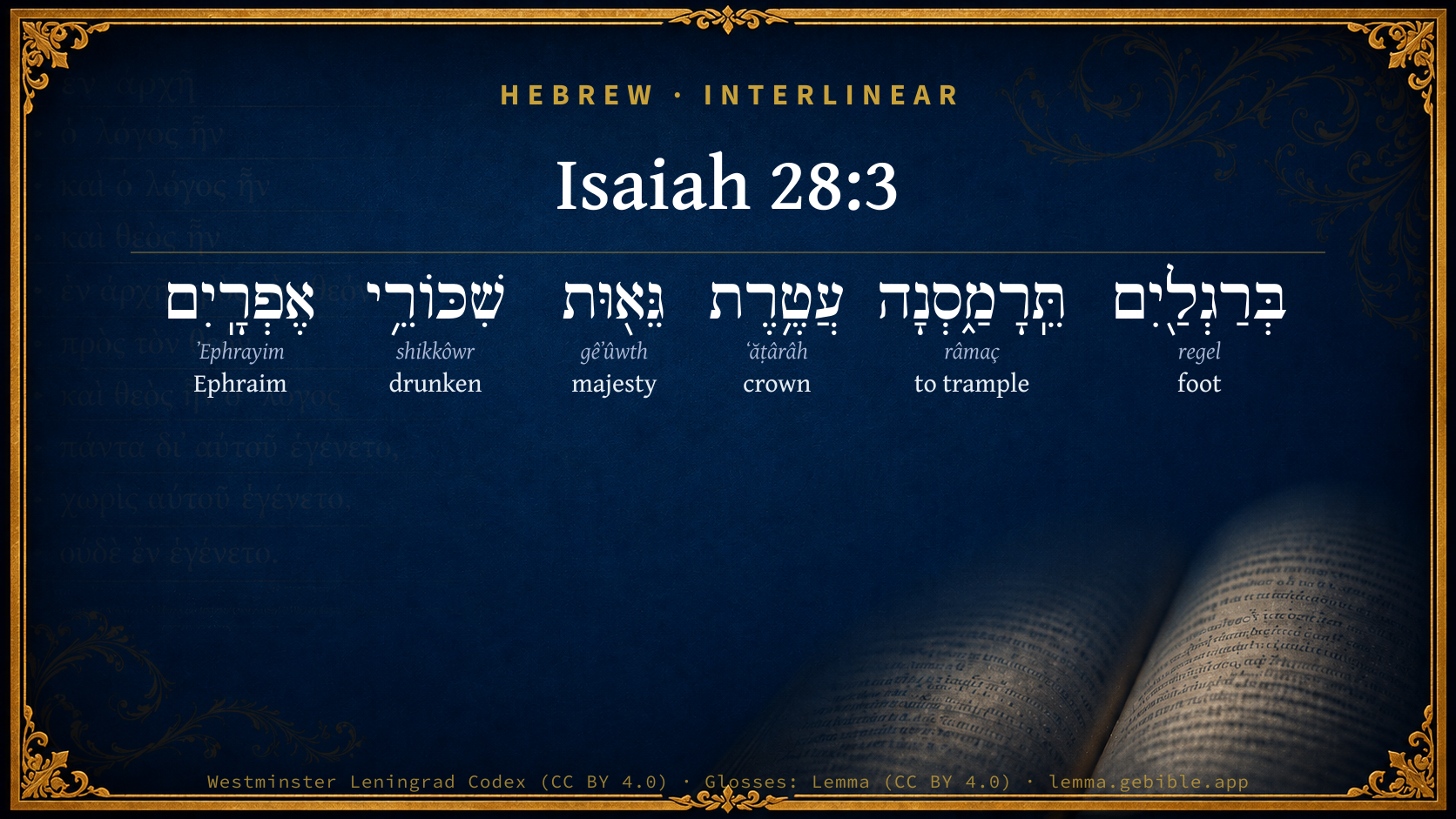
Isaiah 28:3

Hebrew (Westminster Leningrad Codex) Isaiah 28:3 appears in the Hebrew Old Testament. The text above is from the Westminster Leningrad Codex. Each word links to its Strong’s number, a concise gloss, and parsing drawn from the Open Scriptures Hebrew Bible morphology. Click any word for its full Brown-Driver-Briggs (BDB) entry.
Download image
Cite this verse

Isaiah 28:3 (World English Bible). Public Domain. Lemma interlinear Bible study tool, https://lemma.gebible.app/v/isaiah/28/3.

Show BibTeX & RIS
BibTeX
RIS
English Translation
The crown of pride of the drunkards of Ephraim shall be trodden under foot:
World English Bible · Public Domain
Download a study sheet

One document with this verse’s original text, its word-by-word gloss line, the meaning frame, cross-references with their text, attributed commentary, and full source and license credits — printable, and it pastes into notes with its structure intact.

This verse Autodidact and up

Study sheet (.html) Plain text (.txt)

A passage Seminary Student

Up to 50 verses in one chapter. A passage sheet keeps up to 6 commentary sources and 12 cross-references per verse, in the order this page ranks them, and says so on the sheet whenever that leaves anything out. Ask for a single verse and you get the Autodidact verse sheet above.

Everything on this page stays free to read, with no account — the sheet is a download of what is already on screen, not access to it.

Want to remove ads? Support Godless Engineer
Compare translations 3

The same verse in 3 English versions, stacked beneath the original-language interlinear above. Click any original word for its lexicon entry.

Each is an independent rendering of the whole verse — the interlinear is not word-aligned to these translations.

Highlighted words mark where these versions differ — a whole-verse word diff, not a word-by-word alignment.

  • World English Bible Public Domain
    The crown of pride of the drunkards of Ephraim shall be trodden under foot:
  • King James Version Public Domain
    The crown of pride, the drunkards of Ephraim, shall be trodden under feet:
  • unfoldingWord Literal Text CC BY-SA 4.0
    By feet they will be trampled, the crown of the pride of the drunkards of Ephraim.

unfoldingWord Literal Text — © unfoldingWord, licensed CC BY-SA 4.0. Word-aligned USFM3 via Door43 (git.door43.org/unfoldingWord/en_ult).

Versions to compare (up to 4)

3 of 4 selected

Show all 18 translations

Every available English version of this verse, each an independent rendering of the whole verse.

  • World English Bible Public Domain
    The crown of pride of the drunkards of Ephraim shall be trodden under foot:
  • Berean Standard Bible Public Domain
    The majestic crown of Ephraim’s drunkards will be trampled underfoot.
  • Majority Standard Bible Public Domain
    The majestic crown of Ephraim’s drunkards will be trampled underfoot.
  • King James Version Public Domain
    The crown of pride, the drunkards of Ephraim, shall be trodden under feet:
  • American Standard Version (1901) Public Domain
    The crown of pride of the drunkards of Ephraim shall be trodden under foot:
  • Revised Version (1885) Public Domain
    The crown of pride of the drunkards of Ephraim shall be trodden under foot:
  • Geneva Bible (1599) Public Domain
    They shall be troden vnder foote, euen the crowne and the pride of the drunkards of Ephraim.
  • Douay-Rheims (1899) Public Domain
    The crown of pride of the drunkards of Ephraim shall be trodden under feet.
  • Young's Literal Translation Public Domain
    By feet trodden down is the proud crown of the drunkards of Ephraim,
  • Literal Standard Version CC BY-SA 4.0
    The proud crown of the drunkards of Ephraim is trodden down by feet,
  • Unlocked Literal Bible CC BY-SA 4.0
    The proud garland of the drunkards of Ephraim will be trodden underfoot.
  • unfoldingWord Literal Text CC BY-SA 4.0
    By feet they will be trampled, the crown of the pride of the drunkards of Ephraim.
  • Darby Bible Public Domain
    The crown of pride of the drunkards of Ephraim shall be trodden under feet;
  • World Messianic Bible Public Domain
    The crown of pride of the drunkards of Ephraim will be trodden under foot.
  • Webster's Bible Public Domain
    The crown of pride, the drunkards of Ephraim shall be trodden under feet.
  • Free Bible Version CC BY-SA 4.0
    That crowning glory of Ephraim's drunks will be trampled underfoot.
  • Bible in Basic English Public Domain
    The crown of pride of those who are given up to wine in Ephraim will be crushed under foot;
  • JPS Tanakh (1917) Public Domain
    The crown of pride of the drunkards of Ephraim shall be trodden under foot;

Literal Standard Version (2020), Covenant Press — licensed CC BY-SA 4.0. Text via the HelloAO Bible API (eBible.org). Unlocked Literal Bible (unfoldingWord) — licensed CC BY-SA 4.0. Text via the HelloAO Bible API (eBible.org). unfoldingWord Literal Text — © unfoldingWord, licensed CC BY-SA 4.0. Word-aligned USFM3 via Door43 (git.door43.org/unfoldingWord/en_ult). Free Bible Version, Dr. Jonathan Gallagher — licensed CC BY-SA 4.0. Text via the HelloAO Bible API (eBible.org).

Word by word

More ways to search: Search by grammar → Find every occurrence → Compare this word →

Practice this passage: Drill this verse → Learn its vocabulary →

About this verse

These counts appear in no published source. They are computed here, from the morphology-tagged text and Lemma’s own curated glosses. What Lemma adds →

6
words
6
distinct lemmas
Prophets
section

Notable vocabulary

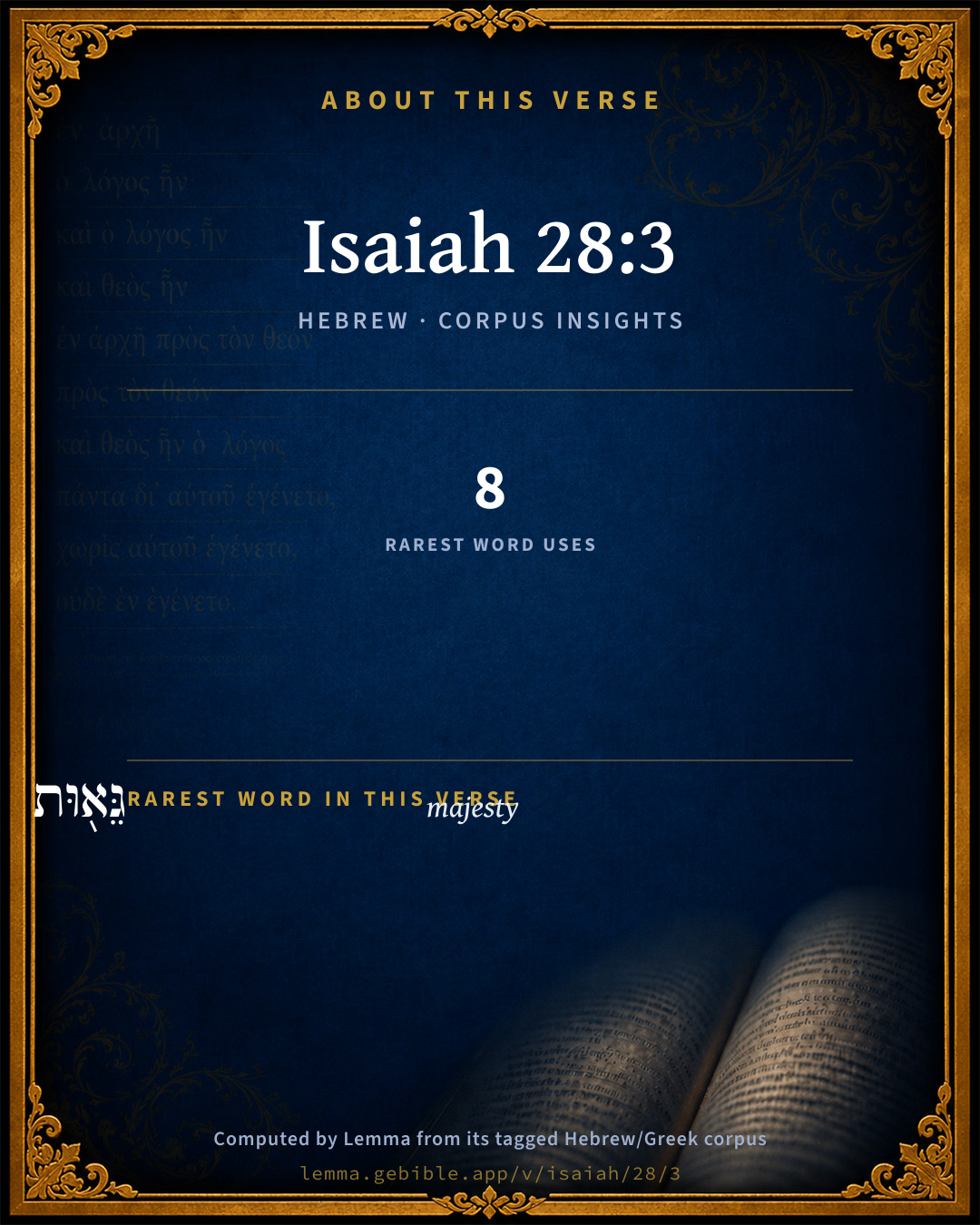
The rarest word here is גֵּא֖וּת majesty H1348 — appearing just 8 times in the whole Hebrew Bible.

Shared distinctive vocabulary

גֵּא֖וּת majesty H1348 occurs in 8 verses of the Hebrew Bible. Also found in:

Grammatical profile

  • 1 verb
  • 4 nouns
  • 1 adjective

Verb forms

  • תֵּֽרָמַ֑סְנָה Niphal · Imperfect

Hebrew & Septuagint length

In English translation the verse runs 14 words from the Hebrew and 19 from the Septuagint (LXX English) — closely comparable.

A rough comparison of the two English renderings, which tokenize alike — not a word-level alignment.

Word counts can differ between the Hebrew and the Greek without any difference in meaning — e.g. the Hebrew direct-object marker אֵת has no separate Greek word, and Greek often adds the article ὁ.

Cross-references

8

Topical passages linked to Isaiah 28:3 in the Treasury of Scripture Knowledge — connected by theme and wording, ordered by reader-vote popularity; previews shown in the World English Bible.

  • Isaiah 26:6 The foot shall tread it down; even the feet of the poor, and the steps of the needy.
  • Hebrews 10:29 How much worse punishment, do you think, will he be judged worthy of, who has trodden under foot the Son of God, and has counted the blood of the covenant with which he was sanctified an unholy thing, and has insulted the Spirit of grace?
  • 2 Kings 9:33 He said, Throw her down. So they threw her down; and some of her blood was sprinkled on the wall, and on the horses: and he trod her under foot.
  • Isaiah 28:1 Woe to the crown of pride of the drunkards of Ephraim, and to the fading flower of his glorious beauty, which is on the head of the fat valley of those who are overcome with wine!
  • Daniel 8:13 Then I heard a holy one speaking; and another holy one said to that certain one who spoke, How long shall be the vision [concerning] the continual [burnt-offering], and the disobedience that makes desolate, to give both the sanctuary and the host to be trodden under foot?
  • Revelation 11:2 Leave out the court which is outside of the temple, and don't measure it, for it has been given to the gentiles. They will tread the holy city under foot for forty-two months.
  • Isaiah 25:10 For in this mountain will the hand of Yahweh rest; and Moab shall be trodden down in his place, even as straw is trodden down in the water of the dung-hill.
  • Lamentations 1:15 The Lord has set at nothing all my mighty men in the midst of me; He has called a solemn assembly against me to crush my young men: The Lord has trodden as in a winepress the virgin daughter of Judah.

Cross-references courtesy of OpenBible.info (CC BY 4.0).

Hebrew and Greek witnesses Masoretic Hebrew ↔ Greek Septuagint

The same verse in the two great witnesses to the Old Testament, shown verse-for-verse.

These are two independent witnesses, not word-aligned to each other, and the Septuagint is shown in lemma (dictionary) form.

Hebrew Isaiah 28:3 Masoretic · Westminster Leningrad Codex

בְּרַגְלַ֖יִם תֵּֽרָמַ֑סְנָה עֲטֶ֥רֶת גֵּא֖וּת שִׁכּוֹרֵ֥י אֶפְרָֽיִם

The crown of pride of the drunkards of Ephraim shall be trodden under foot:

World English Bible · Public Domain

Greek LXX Isaiah 28:3 Septuagint · lemma form

καί ὁ πούς καταπατέω ὁ στέφανος ὁ ὕβρις ὁ μισθωτός ὁ ἐφράιμ

The crown of pride, the hirelings of Ephraim, shall be beaten down with the hands and with the feet.

LXX2012 (modern English Septuagint) · Public Domain

On this verse, John Gill's Exposition discusses the Septuagint’s reading. Read the note in Commentary ↓

Hebrew: Westminster Leningrad Codex (CC BY 4.0). Greek: Septuagint (public domain); English from LXX2012 (modern English Septuagint) (Public Domain). How the Septuagint differs from the Hebrew →

Targum (Aramaic paraphrase)

1

The Targum is the ancient Jewish Aramaic paraphrase of the Hebrew Scriptures — an interpretive translation, not the Hebrew text itself. Onkelos (literal) and Pseudo-Jonathan (expansive) render the Torah, and Jonathan the Prophets. Coverage is partial: where no permissively-licensed English translation exists for a verse, only the Aramaic is shown. This is verse-level text, not a word-by-word alignment to the Hebrew.

  1. Targum Jonathan Prophets (Joshua–Malachi)
    בְּרִגְלִין יִתְּדָשׁ כִּתְרָא דְגֵיוְתָנָא טִפְּשָׁא רַבָּא דְיִשְׂרָאֵל:

    The crown of the pride of the foolish prince of Israel shall be trodden down with feet.

    Targum Jonathan — Aramaic: “Mikraot Gedolot” (public domain). English: “Sefaria Community Translation” (CC0 1.0 (public-domain dedication)); “London "Chaldee Paraphrase," 1871” (public domain). Text via Sefaria.

Commentary

Notes on Isaiah 28:3 from classic Christian and Jewish commentators (each source and its license shown beneath its notes). The classic Christian expositions comment on the surrounding passage and are grouped to its opening verse, so a note may address several verses; the Jewish commentaries on the Tanakh (Rashi and others) are per-verse, so they appear only where the commentator wrote on this verse.

Lemma curates 59 commentaries, every one of them public domain or Creative Commons licensed, each selected and text-cleaned for this edition rather than reprinted as found. About our sources →

Trapp's Complete Commentary

John Trapp

Isa 28:3 The crown of pride, the drunkards of Ephraim, shall be trodden under feet:

Ver. 3. The crown {a} of pride … shall be trodden under foot.] This noteth utmost ignominy. Finge ideam animo, saith one here; imagine you saw Shalmaneser pulling the crown from the king of Israel’s head, throwing it to the ground, and then trampling on it. What brave rhetoric is here!

{a} The Romans pictured pride with a triple crown. On the first crown was written Transcendo; I excel, on the next, Non obedio; I do not submit, on the third, Perturbo I throw into confusion.

John Trapp, A Commentary or Exposition upon All the Books of the Old and New Testament (1647–1656) — public domain. Text from a community e-Sword module.

MacLaren's Expositions of Holy Scripture

Alexander MacLaren

Isaiah

THE JUDGMENT OF DRUNKARDS AND MOCKERS

A CROWN OF PRIDE OR A CROWN OF GLORY

Isa 28:3 - Isa 28:5.

The reference is probably to Samaria as a chief city of Israel. The image is suggested by the situation of Samaria, high on a hill-side, crowning the valley, and by the rich vegetation and bright flowers which makes it even now one of the few lovely scenes in Palestine; and by the luxurious riot and sensual excess that were always characteristic of the northern kingdom.

The destruction of Samaria and of the kingdom, then, is here prophesied-the garland will fade, the hail will batter all its drooping flowerets, and it shall be trodden under foot. Look at that withered wreath that gleamed yesterday on some fair head, to-day flung into the ashpit or kicked about the street. That is a modern rendering of the prophet’s imagery. But the reference goes further than merely to the city: the whole state of the nation is expressed by the symbol, as doomed to quick decay, fading in itself, and further smitten down by divine judgments.

There is a contrasted picture, that of ‘the residue of the people’ to whom there is an amaranthine crown, a festal diadem glorious and beautiful, which can never fade, even God Himself. To them who love Him He is an ornament, and His presence is the consecration of the true joyful feast. They who are crowned by Him are crowned, not for idle revelry, but for strenuous toil {‘sit in judgment’} and for brave purpose {‘turn the battle to the gate,’} and their coronation day is ever the day when earthly garlands are withered, whether it be the crises and convulsions of nations and institutions, or times of personal trial, or ‘in the hour of death or in the day of judgment.’

Expanding then these thoughts, we have-

I. All godless joys are but fading chaplets.

Of course the first application of such words is to purely sensuous delights.

Men who seek to make life a mere revel and banquet.

Nothing is so short-lived as gratification of appetite. It is not merely that each act lasts but for a moment, but also that past gratifications leave no sort of solace to the appetite behind them; whereas past acquirements or deeds of goodness are a perpetual joy as well as the foundation of the present. There is something essentially isolated in each act of sensuous delight. No man can by so willing recall the taste of eaten food, nor slake his thirst by remembrance of former draughts, or cool himself by thinking of ‘frosty Caucasus.’ But each such gratification is done when it is done, and there is an end of its power to gratify.

Further, the power of enjoyment wanes, though the lust for it waxes. Hence each act has less and less power of satisfying.

One sees blase young men of twenty-five. It was a man of under thirty-five who wrote, ‘Man delights not me, no, nor woman neither.’ It was a used-up roue that was represented as saying, ‘Vanity of vanities, all is vanity.’ It was of sensuous ‘pleasures’ that poor Burns wrote,-

‘Like the snowfall in the river,

A moment white,-then melts for ever.’

When a people is given over to such excess, late or soon the fate of Samaria comes upon them. Think of the French Revolution or of the fall of Rome, and learn that the prophet was announcing a law for all nations, in his fiery denunciation, and one which holds good to-day as ever.

But we may generalise more widely. Every godless life is essentially transitory; of course, all life is so in one view. But suppose two men, working side by side at the same occupation, passing through the same circumstances. So far as physical changes go, these men are the same. Both lose much. Both leave behind much. Both cease to be interested in much that was dear to them. Both die at last, and leave it all. Is there any difference? The transitoriness is the same, and the eternal consequences are eternal alike in both; and yet there is a very solemn sense in which the one man’s life has utterly perished, and the other’s abides. Suppose a man, educated to be a first-rate man of business, dies. Which of his trained faculties will he have scope for in that new order of things? Or a student, or a lawyer, or a statesman?

Oh, it is not our natural mortality that makes these thoughts so awful; but it is the thought that the man who is doing these things is immortal. The head which wears the fading wreath will live for ever. ‘What will ye do in the end?’

II. Godly life brings unfading joys.

Communion with God yields abiding joys. The law of change remains the same. The law of death remains the same. But the motives which direct and impel the godly man are beyond the reach of change.

The habits which he contracts are for heaven as well as for earth. The treasures which he amasses will always be his.

His life in its essence and his work are one in all worlds. What a grand continuity, then, knits into one a godly life whether it is lived on earth or in heaven!

Communion with God gives beauty and ornament to the whole character. It brings the true refining and perfecting of the soul. No doubt many Christian men, as we see them, are but poor specimens of this effect of godliness; still, it is an effect produced in proportion to the depth and continuity of their communion. We might dwell on the effect on Will, Affections, Understanding, produced by dwelling in God. It is simple fact that the highest conceivable type of beauty is only reached through communion with God.

Communion with God gives power as well as gladness. The life of abiding with God is also one of strenuous effort and real warfare. In the context it is promised that God will be for strength to them that turn the battle to the gate.

The luxurious life of self-indulgence ends, as all selfish life must do, in the vanishing of delights. The life of joy in God issues, as all true joy does, in power for work and in power for conflict.

‘God doth anoint thee with His odorous oil, to wrestle, not to reign.’

III. There will be a coronation day.

‘In that day,’ the day when ‘the crown of pride shall be trodden under foot,’ the people of God are crowned with the diadem of beauty which is God Himself. That twofold work of that one day suggests-

The double aspect of trials and sorrows.

The double aspect of death.

The double aspect of final Judgment.

‘Henceforth there is laid up for me a crown of righteousness, which the Lord, the righteous Judge, shall give me at that day.’

To be crowned or discrowned ‘in that day’ is the alternative set before each of us. Which of the two do we choose?

Alexander MacLaren, Expositions of Holy Scripture (1904–1910) — public domain. Text from a community e-Sword module.

Jamieson, Fausset & Brown

Robert Jamieson, A. R. Fausset & David Brown

crown . . . the drunkards--rather, "the crown of the drunkards."

Jamieson, Fausset & Brown — Commentary Critical and Explanatory on the Whole Bible (1871) — public domain (CC PDM 1.0). Text via the HelloAO Bible API.

Adam Clarke's Commentary

Verse 3. The crown of pride, the drunkards of Ephraim - "The proud crown of the drunkards of Ephraim"] I read עטרות ataroth, crowns, plural, to agree with the verb תרמסנה teramasnah, "shall be trodden down."

Adam Clarke's Commentary on the Bible (1810–1826) — public domain. Text from a community e-Sword/MySword module.

The Cambridge Bible for Schools and Colleges

gen. ed. J. J. S. Perowne

3. The verb shall be trodden is in the plural number. Apparently the prophet intended to include in its subject both the images of Isa_28:1; but his thoughts were diverted by the other figure which is developed in Isa_28:4. In the Hebr. the order is: With the feet shall be trodden down the proud crown of the, &c. (as Isa_28:1).

The Cambridge Bible for Schools and Colleges (gen. ed. J. J. S. Perowne; Cambridge University Press, 1878–1918) — public domain. Text from a community e-Sword module.

John Gill's Exposition

The crown of pride, the drunkards of Ephraim, shall be trodden under feet. Not only cast down with the hand, but trampled upon with the feet; showing their utter destruction, and the contempt with which they should be used; which, with their character, is repeated, to point out their sins, the cause of it, to denote the certainty of it, and that it might be taken notice of.

The crown of pride, the drunkards of Ephraim, shall be trodden under feet. Not only cast down with the hand, but trampled upon with the feet; showing their utter destruction, and the contempt with which they should be used; which, with their character, is repeated, to point out their sins, the cause of it, to denote the certainty of it, and that it might be taken notice of.

Isaiah 28:4

isa 28:4

isa 28:4

isa 28:4And the glorious beauty which is on the head of the fat valley,.... Meaning the riches and fruitfulness of the ten tribes, and especially of Samaria the head of them:

shall be a fading flower; as before declared, Isa 28:1 and here repeated to show the certainty of it, and to awaken their attention to it:

and as the hasty fruit before the summer; the first ripe fruit, that which is ripe before the summer fruits in common are. The Septuagint render it the first ripe fig; and so the Targum and Aben Ezra:

which when he that looketh upon it seeth it; that it is goodly and desirable, and so gathers it, Mic 7:1,

while it is yet in his hand he eateth it up; and as soon as he has got it into his hand, he cannot keep it there to look at, or forbear eating it, but greedily devours it, and swallows it down at once; denoting what a desirable prey the ten tribes would be to the Assyrian monarch, and how swift, sudden, and inevitable, would be their destruction.

John Gill's Exposition of the Whole Bible (1746–1763) — public domain (CC PDM 1.0). Text via the HelloAO Bible API.

Matthew Poole's English Annotations

The expression is emphatical; the crown which was upon their own heads shall be trodden under the feet of others; and they, whose drunkenness made them stagger and fall to the ground, shall be trodden down there.

Matthew Poole's English Annotations on the Holy Bible (1683–1685) — public domain. Text from a community e-Sword/MySword module.

Whedon's Commentary on the Bible

Daniel D. Whedon

3, 4. Trodden under feet — Thrust violently down so as to be trodden under the feet of the invader, (the Assyrian army under Shalmanezer in this case,) in the sixth year of the reign of Hezekiah, king of Judah.

As the hasty fruit — Denoting the early fig. The first crop of figs in Palestine comes in June, is comparatively scanty, and is used up as soon almost as it is ripe enough to eat: plucked as a dainty to be at once eaten. From August to November the later and larger fig crops come, and are stored for subsequent use.

The woe uttered will consist of the utter destruction of the city, the deportation of the people to Assyria, and the extinction thus of garlanded revels at Samaria. This actually took place, B.C. 721.

Daniel D. Whedon (gen. ed.), Commentary on the Old and New Testaments (1874–1909) — public domain. Text from a community e-Sword module.

The Pulpit Commentary

The crown of pride, the drunkards; rather, of the drunkards (comp. ver. 1). The "crown of pride" is scarcely "Samaria," as Delitzsch supposes, it is rather the self-complacent and boastful spirit of the Israelite people, which will be "trodden under foot" by the Assyrians.

The Pulpit Commentary (1880–1919), ed. H.D.M. Spence-Jones & Joseph S. Exell — public domain. Text from a community e-Sword module.

John Wesley's Explanatory Notes

Trodden - The expression is emphatical; the crown which was upon their own heads, shall be trodden under the feet of others; and they, whose drunkenness made them fall to the ground, shall be trodden down there.

John Wesley, Explanatory Notes Upon the Whole Bible (1754–1765) — public domain. Text via the GEBible commentary corpus.

J. A. Alexander on Isaiah

Joseph Addison Alexander

“With the feet shall be trodden the lofty crown of the drunkards of Ephraim. It is cast down by the hand and trampled under foot.”

Joseph Addison Alexander, The Prophecies of Isaiah (1846–1847; New York: Scribner, 1870–1878) — public domain. Text from a community e-Sword module.

unfoldingWord translationNotes

Door43 World Missions Community

General Information:

Isaiah continues to speak about the people and the city of Samaria as if they were a garland. (See: Isaiah 28:1-2)

The proud garland of the drunkards of Ephraim will be trodden underfoot

This can be stated in active form. AT: "The enemy army will crush the proud drunkards of Samaria as if they were crushing flowers under their feet" (See: Active or Passive)

proud garland ... of Ephraim ... that is on the head of the rich valley

A "garland" is a crown made of flowers. Here it represents the city of Samaria, the capital of Israel, which sits above a fertile valley. (See: Metaphor)

will be as the first ripe fig ... gulps it down

This speaks of the enemy soldiers seeing the beauty of Samaria and quickly plundering it as if they were a person who sees the first fig of the season and quickly eats it. (See: Simile)

translationWords

proud

Ephraim

glory

head

fig

hand

unfoldingWord translationNotes — © Distant Shores Media and the Door43 World Missions Community, licensed CC BY-SA 4.0. Source: git.door43.org/Door43/en_tn.

Ibn Ezra

Rabbi Abraham ibn Ezra

עטרת Crown. Singular form but plural sense; there are many instances of this usage.

Ibn Ezra on the Tanakh — English translations: “Sefaria Community Translation” (CC0 1.0 (public-domain dedication)); “Yalkut, Sifsei Chachomim Chumash, Metsudah Publications, 2009” (CC BY 4.0); and “Commentary of Ibn Ezra on Isaiah - trans. by M. Friedlander, 1873” (public domain). Text via Sefaria.

Lesson kit

Teaching starters — assembled from the data on this page, not authored interpretation. Every prompt links to the verse data it draws on. Edit before teaching.

Isaiah, in the Prophets, opens this verse with 6 words (6 distinct Hebrew lemmas). Its most distinctive word is gêʼûwth (“majesty”). A historical commentator’s framing appears above. Read the whole chapter for the surrounding context.

Discussion questions

  1. The word gêʼûwth carries the sense “majesty.” How does it shape the verse?
  2. Psalms 17:10 shares the word «majesty» with this verse. How do the two illuminate each other?
  3. These translations render this verse differently; the difference is in the English rendering, not the original. What questions does that raise?
  4. The verb «תֵּֽרָמַ֑סְנָה» is Niphal Imperfect. How does its form color the action?
  5. Reading how Trapp's Complete Commentary and MacLaren's Expositions of Holy Scripture read this verse, where do the two commentators agree and where do they part?

Things to notice

Reading settings

Reading text

Shown beneath each verse's original-language words.

Old Testament
Old Testament edition

Read the OT as the Masoretic Hebrew (MT) or the Greek Septuagint (LXX).

English shown for the Greek Septuagint (in the Hebrew ↔ Greek comparison).

Comparing translations? Open the Compare panel on any verse page to stack up to four side by side.