Jeremiah 31:6

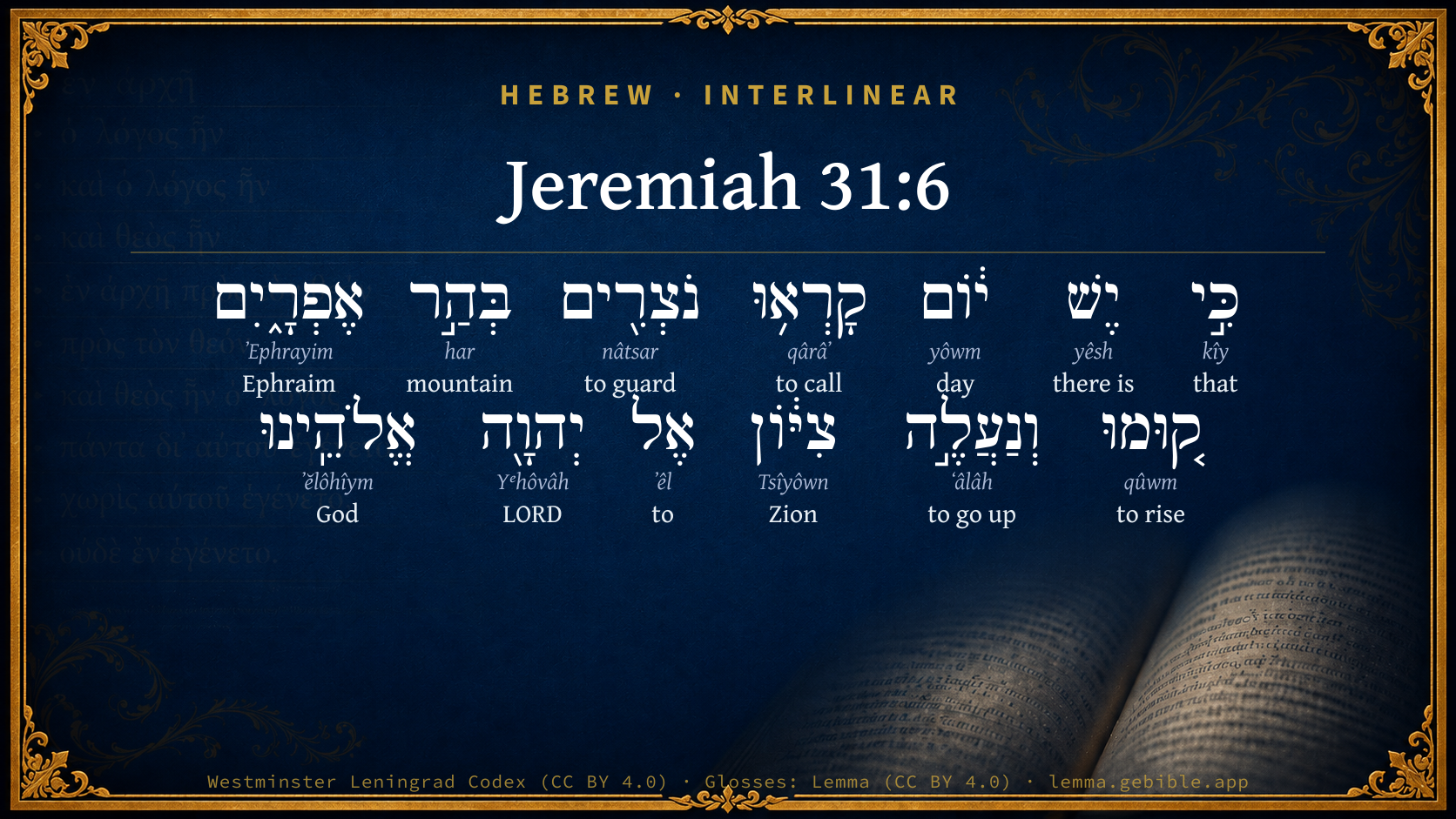
Hebrew (Westminster Leningrad Codex) Jeremiah 31:6 appears in the Hebrew Old Testament. The text above is from the Westminster Leningrad Codex. Each word links to its Strong’s number, a concise gloss, and parsing drawn from the Open Scriptures Hebrew Bible morphology. Click any word for its full Brown-Driver-Briggs (BDB) entry.
Download image
Cite this verse

Jeremiah 31:6 (World English Bible). Public Domain. Lemma interlinear Bible study tool, https://lemma.gebible.app/v/jeremiah/31/6.

Show BibTeX & RIS
BibTeX
RIS
English Translation
For there shall be a day, that the watchmen on the hills of Ephraim shall cry, Arise you, and let us go up to Zion to Yahweh our God.
World English Bible · Public Domain
Download a study sheet

One document with this verse’s original text, its word-by-word gloss line, the meaning frame, cross-references with their text, attributed commentary, and full source and license credits — printable, and it pastes into notes with its structure intact.

This verse Autodidact and up

Study sheet (.html) Plain text (.txt)

A passage Seminary Student

Up to 50 verses in one chapter. A passage sheet keeps up to 6 commentary sources and 12 cross-references per verse, in the order this page ranks them, and says so on the sheet whenever that leaves anything out. Ask for a single verse and you get the Autodidact verse sheet above.

Everything on this page stays free to read, with no account — the sheet is a download of what is already on screen, not access to it.

Want to remove ads? Support Godless Engineer
Compare translations 3

The same verse in 3 English versions, stacked beneath the original-language interlinear above. Click any original word for its lexicon entry.

Each is an independent rendering of the whole verse — the interlinear is not word-aligned to these translations.

Highlighted words mark where these versions differ — a whole-verse word diff, not a word-by-word alignment.

  • World English Bible Public Domain
    For there shall be a day, that the watchmen on the hills of Ephraim shall cry, Arise you, and let us go up to Zion to Yahweh our God.
  • King James Version Public Domain
    For there shall be a day, that the watchmen upon the mount Ephraim shall cry, Arise ye, and let us go up to Zion unto the LORD our God.
  • unfoldingWord Literal Text CC BY-SA 4.0
    For a day will come when the watchmen in the mountains of Ephraim will proclaim, ‘Arise, let us go up to Zion to Yahweh our God.’

unfoldingWord Literal Text — © unfoldingWord, licensed CC BY-SA 4.0. Word-aligned USFM3 via Door43 (git.door43.org/unfoldingWord/en_ult).

Versions to compare (up to 4)

3 of 4 selected

Show all 18 translations

Every available English version of this verse, each an independent rendering of the whole verse.

  • World English Bible Public Domain
    For there shall be a day, that the watchmen on the hills of Ephraim shall cry, Arise you, and let us go up to Zion to Yahweh our God.
  • Berean Standard Bible Public Domain
    For there will be a day when watchmen will call out on the hills of Ephraim, ‘Arise, let us go up to Zion, to the LORD our God!’”
  • Majority Standard Bible Public Domain
    For there will be a day when watchmen will call out on the hills of Ephraim, ‘Arise, let us go up to Zion, to the LORD our God!’”
  • King James Version Public Domain
    For there shall be a day, that the watchmen upon the mount Ephraim shall cry, Arise ye, and let us go up to Zion unto the LORD our God.
  • American Standard Version (1901) Public Domain
    For there shall be a day, that the watchmen upon the hills of Ephraim shall cry, Arise ye, and let us go up to Zion unto Jehovah our God.
  • Revised Version (1885) Public Domain
    For there shall be a day, that the watchmen upon the hills of Ephraim shall cry, Arise ye, and let us go up to Zion unto the LORD our God.
  • Geneva Bible (1599) Public Domain
    For the dayes shall come that the watchmen vpon the mount of Ephraim shall cry, Arise, and let vs go vp vnto Zion to the Lord our God.
  • Douay-Rheims (1899) Public Domain
    For there shall be a day, in which the watchmen on mount Ephraim, shall cry: Arise, and let us go up to Sion to the Lord our God.
  • Young's Literal Translation Public Domain
    For there is a day, Cried have watchmen on mount Ephraim, `Rise, and we go up to Zion, unto Jehovah our God;
  • Literal Standard Version CC BY-SA 4.0
    For there is a day, || Watchmen have cried on Mount Ephraim, || Rise, and we go up to Zion, to our God YHWH”;
  • Unlocked Literal Bible CC BY-SA 4.0
    For a day will come when the watchmen in the mountains of Ephraim will proclaim, 'Arise, let us go up to Zion to Yahweh our God.'
  • unfoldingWord Literal Text CC BY-SA 4.0
    For a day will come when the watchmen in the mountains of Ephraim will proclaim, ‘Arise, let us go up to Zion to Yahweh our God.’
  • Darby Bible Public Domain
    For there shall be a day, when the watchmen upon mount Ephraim shall cry, Arise, and let us go up to Zion, unto Jehovah our God.
  • World Messianic Bible Public Domain
    For there will be a day that the watchmen on the hills of Ephraim cry, ‘Arise! Let’s go up to Zion to the LORD our God.’”
  • Webster's Bible Public Domain
    For there shall be a day, that the watchmen upon the mount Ephraim shall cry, Arise ye, and let us go up to Zion to the LORD our God.
  • Free Bible Version CC BY-SA 4.0
    A day is coming when watchmen will call out from the hills of Ephraim, “Come on, let's go up to Zion, to worship the Lord our God!”
  • Bible in Basic English Public Domain
    For there will be a day when those who get in the grapes on the hills of Ephraim will be crying, Up! let us go up to Zion to the Lord our God.
  • JPS Tanakh (1917) Public Domain
    For there shall be a day, that the watchmen shall call upon the mount Ephraim: arise ye, and let us go up to Zion, unto the LORD our God.'

Literal Standard Version (2020), Covenant Press — licensed CC BY-SA 4.0. Text via the HelloAO Bible API (eBible.org). Unlocked Literal Bible (unfoldingWord) — licensed CC BY-SA 4.0. Text via the HelloAO Bible API (eBible.org). unfoldingWord Literal Text — © unfoldingWord, licensed CC BY-SA 4.0. Word-aligned USFM3 via Door43 (git.door43.org/unfoldingWord/en_ult). Free Bible Version, Dr. Jonathan Gallagher — licensed CC BY-SA 4.0. Text via the HelloAO Bible API (eBible.org).

Word by word

More ways to search: Search by grammar → Find every occurrence → Compare this word →

Practice this passage: Drill this verse → Learn its vocabulary →

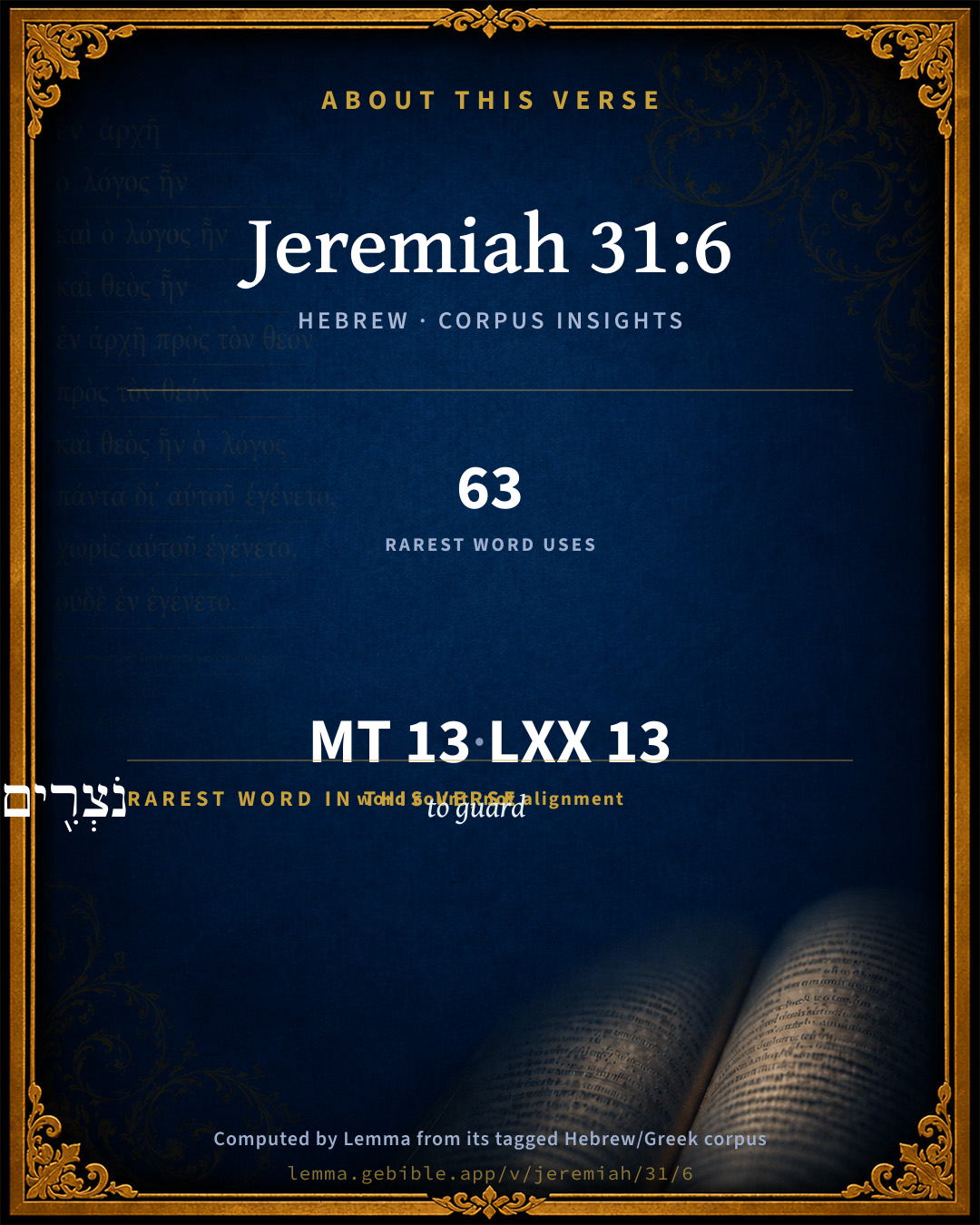
נֹצְרִ֖ים
nâtsar
H5341
“guarding”
Verb, Qal, Participle Active, Masculine, Plural, Absolute
Part of Speech
Verb
Stem
Qal
Form
Participle Active
Gender
Masculine
Number
Plural
State
Absolute
Full BDB Definition

Origin: a primitive root

TWOT: 1407

to guard, watch, watch over, keep - (Qal) - to watch, guard, keep - to preserve, guard from dangers - to keep, observe, guard with fidelity - to guard, keep secret - to be kept close, be blockaded - watchman (participle)
  1. כִּ֣י kîy H3588 “that” Conjunction
  2. יֶשׁ yêsh H3426 “there is” Particle, Demonstrative
  3. י֔וֹם yôwm H3117 “day” Noun, Common, Masculine, Singular, Absolute
  4. קָרְא֥וּ qârâʼ H7121 “to call” Verb, Qal, Perfect, 3rd Person, Common, Plural
  5. בְּהַ֣ר har H2022 “in/at · mountain of” Preposition + Noun, Common, Masculine, Singular, Construct
  6. אֶפְרָ֑יִם ʼEphrayim H669 “Ephraim” Noun, Proper
  7. ק֚וּמוּ qûwm H6965 “rise” Verb, Qal, Imperative, 2nd Person, Masculine, Plural
  8. וְנַעֲלֶ֣ה ʻâlâh H5927 “and · to go up” Conjunction + Verb, Qal, Cohortative, 1st Person, Common, Plural
  9. צִיּ֔וֹן Tsîyôwn H6726 “Zion” Noun, Proper
  10. אֶל ʼêl H413 “to” Preposition
  11. יְהוָ֖ה Yᵉhôvâh H3068 “LORD” Noun, Proper
  12. אֱלֹהֵֽינוּ ʼĕlôhîym H430 “God(s) · our” Noun, Common, Masculine, Plural, Construct + Suffix, Personal, 1st Person, Common, Plural

About this verse

These counts appear in no published source. They are computed here, from the morphology-tagged text and Lemma’s own curated glosses. What Lemma adds →

13
words
13
distinct lemmas
Prophets
section

Grammatical profile

  • 4 verbs
  • 6 nouns
  • 1 preposition
  • 1 conjunction
  • 1 particle

Verb forms

  • קָרְא֥וּ Qal · Perfect
  • נֹצְרִ֖ים Qal · Participle Active
  • ק֚וּמוּ Qal · Imperative
  • וְנַעֲלֶ֣ה Qal · Cohortative

Hebrew & Septuagint length

In the original languages it is 13 Hebrew tokens and 13 Greek tokens — but the two are counted differently (Hebrew bundles its prefixes and suffixes into one token; the Greek is in lemma form), so that isn’t a like-for-like length.

Cross-references

19

Topical passages linked to Jeremiah 31:6 in the Treasury of Scripture Knowledge — connected by theme and wording, ordered by reader-vote popularity; previews shown in the World English Bible.

  • Jeremiah 50:4–5 In those days, and in that time, says Yahweh, the children of Israel shall come, they and the children of Judah together; they shall go on their way weeping, and shall seek Yahweh their God.
  • Isaiah 2:2–4 It shall happen in the latter days, that the mountain of Yahweh's house shall be established on the top of the mountains, And shall be raised above the hills; And all nations shall flow to it.
  • Isaiah 52:7–8 How beautiful on the mountains are the feet of him who brings good news, who publishes peace, who brings good news of good, who publishes salvation, who says to Zion, Your God reigns!
  • Jeremiah 50:19 I will bring Israel again to his pasture, and he shall feed on Carmel and Bashan, and his soul shall be satisfied on the hills of Ephraim and in Gilead.
  • Micah 4:1–3 But in the latter days, It will happen that the mountain of Yahweh's temple will be established on the top of the mountains, And it will be exalted above the hills; And peoples will stream to it.
  • Zechariah 8:20–23 Thus says Yahweh of Hosts: "Many peoples, and the inhabitants of many cities will yet come;
  • 2 Chronicles 13:4 Abijah stood up on Mount Zemaraim, which is in the hill-country of Ephraim, and said, Hear me, Jeroboam and all Israel:
  • 2 Chronicles 30:5–11 So they established a decree to make proclamation throughout all Israel, from Beersheba even to Dan, that they should come to keep the Passover to Yahweh, the God of Israel, at Jerusalem: for they had not kept it in great numbers in such sort as it is written.
  • Ezra 8:15–20 I gathered them together to the river that runs to Ahava; and there we encamped three days: and I viewed the people, and the priests, and found there none of the sons of Levi.
  • Isaiah 11:11–13 It shall happen in that day, that the Lord will set his hand again the second time to recover the remnant of his people, who shall remain, from Assyria, and from Egypt, and from Pathros, and from Cush, and from Elam, and from Shinar, and from Hamath, and from the islands of the sea.
  • Isaiah 40:9 You who tell good news to Zion, go up on a high mountain; you who tell good news to Jerusalem, lift up your voice with strength; lift it up, don't be afraid; say to the cities of Judah, Behold, your God!
  • Isaiah 62:6 I have set watchmen on your walls, Jerusalem; they shall never hold their peace day nor night: you who call on Yahweh, take no rest,
  • Jeremiah 6:17 I set watchmen over you, [saying], Listen to the sound of the trumpet; but they said, We will not listen.
  • Ezekiel 3:17 Son of man, I have made you a watchman to the house of Israel: therefore hear the word at my mouth, and give them warning from me.
  • Ezekiel 33:2 Son of man, speak to the children of your people, and tell them, When I bring the sword on a land, and the people of the land take a man from among them, and set him for their watchman;
  • Hosea 1:11 The children of Judah and the children of Israel will be gathered together, and they will appoint themselves one head, and will go up from the land; for great will be the day of Jezreel.
  • Hosea 9:8 A prophet watches over Ephraim with my God. A fowler's snare is on all of his paths, And hostility in the house of his God.
  • Acts 8:5–8 Philip went down to the city of Samaria, and proclaimed to them the Christ.
  • Ezra 1:5 Then rose up the heads of fathers' [houses] of Judah and Benjamin, and the priests, and the Levites, even all whose spirit God had stirred to go up to build the house of Yahweh which is in Jerusalem.

Cross-references courtesy of OpenBible.info (CC BY 4.0).

Hebrew and Greek witnesses Masoretic Hebrew ↔ Greek Septuagint

The same verse in the two great witnesses to the Old Testament, shown verse-for-verse.

These are two independent witnesses, not word-aligned to each other, and the Septuagint is shown in lemma (dictionary) form.

Hebrew Jeremiah 31:6 Masoretic · Westminster Leningrad Codex

כִּ֣י יֶשׁ י֔וֹם קָרְא֥וּ נֹצְרִ֖ים בְּהַ֣ר אֶפְרָ֑יִם ק֚וּמוּ וְנַעֲלֶ֣ה צִיּ֔וֹן אֶל יְהוָ֖ה אֱלֹהֵֽינוּ

For there shall be a day, that the watchmen on the hills of Ephraim shall cry, Arise you, and let us go up to Zion to Yahweh our God.

World English Bible · Public Domain

Greek LXX Structure differs

In the Septuagint, Jeremiah is about an eighth shorter than the Hebrew and arranges its material differently — the Oracles Against the Nations (Hebrew chapters 46–51) appear in the middle of the Greek book, after 25:13. Because the chapter and verse boundaries do not line up, a verse-for-verse comparison with the Hebrew is not shown.

A verse-for-verse comparison isn’t shown here because the chapters and verses don’t line up. Switch to the LXX edition with the MT / LXX toggle above to read the Greek directly.

Hebrew: Westminster Leningrad Codex (CC BY 4.0). Greek: Septuagint (public domain); English from a public-domain English Septuagint. How the Septuagint differs from the Hebrew →

Targum (Aramaic paraphrase)

1

The Targum is the ancient Jewish Aramaic paraphrase of the Hebrew Scriptures — an interpretive translation, not the Hebrew text itself. Onkelos (literal) and Pseudo-Jonathan (expansive) render the Torah, and Jonathan the Prophets. Coverage is partial: where no permissively-licensed English translation exists for a verse, only the Aramaic is shown. This is verse-level text, not a word-by-word alignment to the Hebrew.

  1. Targum Jonathan Prophets (Joshua–Malachi)
    אֲרֵי אִית אֲרִיכוּת יוֹמַיָא וְסַגִי טוּבָא דַעֲתִיד לְמֵיתֵי לְצַדִיקַיָא דִנְטָרוּ אוֹרַיְתִי מִלְקַדְמִין חוּלְקֵיהוֹן בְּאַרְעָא דְיִשְׂרָאֵל דַהֲווֹ מְחַמְדִין לִשְׁנֵי נֶחֶמְתָא דְאַתְיָן דְאָמְרִין אֵימָתַי נָקוּם וְנִסַק לְצִיוֹן וְנִתְחֲזֵי קֳדָם יְיָ אֱלָהָנָא:

    For there are days and abundant goodness in the future for the righteous who kept my Torah from the beginning; their portion will be in the land of Israel, as they longed for the years of consolation that were coming, saying: When will we arise and go up to Zion and be seen before Hashem our God?

    Targum Jonathan — Aramaic: “Mikraot Gedolot” (public domain). English: “Sefaria Community Translation” (CC0 1.0 (public-domain dedication)); “London "Chaldee Paraphrase," 1871” (public domain). Text via Sefaria.

Commentary

Notes on Jeremiah 31:6 from classic Christian and Jewish commentators (each source and its license shown beneath its notes). The classic Christian expositions comment on the surrounding passage and are grouped to its opening verse, so a note may address several verses; the Jewish commentaries on the Tanakh (Rashi and others) are per-verse, so they appear only where the commentator wrote on this verse.

Lemma curates 59 commentaries, every one of them public domain or Creative Commons licensed, each selected and text-cleaned for this edition rather than reprinted as found. About our sources →

Trapp's Complete Commentary

John Trapp

Jer 31:6 For there shall be a day, [that] the watchmen upon the mount Ephraim shall cry, Arise ye, and let us go up to Zion unto the LORD our God.

Ver. 6. The watchmen upon the mount Ephraim.] Such as are set to keep those vineyards. {Jer 31:5}

Shall cry, Arise ye, and let us go up to Zion.] As the ten tribes first made defection, so shall they be forwardest in the reformation. England was the like alate.

John Trapp, A Commentary or Exposition upon All the Books of the Old and New Testament (1647–1656) — public domain. Text from a community e-Sword module.

The Biblical Illustrator

Joseph S. Exell

Jer_31:6

Arise ye, and let us go up to Zion unto the Lord our God.

The watchmans message to Israel

I. The message of the watchmen.

1. The Jewish people had been overthrown, taken captive, and dispersed. They were therefore to all appearance a forsaken people, their land bereft of its inhabitants was desolate, and they were removed from all they held most dear to them on earth, from the glory of their former national independence, and from the temple in which they and their fathers had worshipped through many generations. But they were to be restored to their old places, to the land of all others they held most sacred, to their former worship with all its wondrous beauty, and to the national distinctions and privileges which had so long marked their history. Some effort on their part was however necessary, they were to arise and then go up to Zion unto the Lord their God. And in Him too we find the motive of all our efforts to arise from thoughtlessness and folly, and the object worthy of our lifes battle and of our lifes journey. We pray you to think upon this. When you are asked to awake out of spiritual sleep,--when you are told the night is far spent and the day of Gods judgment is fast coming,--when any public or private duty is urged upon your attention,--when we utter warning voices, in the midst of homes and friends, at the most gladsome times,--it is that you also should arise, and go--not unto the priest alone, not unto the altar alone, not unto the Church alone, but that you first and chiefly should go unto the Lord your God.

2. It is true this message may be regarded in a prospective point of view. For, it is said, there shall be a day, &c. To us the message is a present one. At the birth of Christ a new era of life and liberty commenced for the Gentiles and for all the families of earth. We live amid the ruins of our own inherent depraved nature. We have the evidence within and around us that we are in bonds. But the cry of the watchman is sent to us now: and if we will be only wise enough to exercise our common senses, and rouse ourselves up from our spiritual lethargy, and seek for Gods help and mercy, we may arise, and go up among the congregations of His people, and realise in our hearts the great blessedness of His personal favour and presence of love.

II. Lessons.

1. One lesson to be inferred is the groundwork for the present aspiration of the Jew, and we may add, in another sense, the present aspiration of the Christian. The testimony of the prophecies of the Old Testament is supported by the testimony of providence. Even if the Jew should care but little, if anything, about the ancient prophecies, yet he is moved by the signs of the times. And more, he is influenced by feelings which he cannot account for, but which, when examined by the light of prophecy, receives an explanation in God s interposition by some means either direct or indirect. The Christian knows in a thousand ways that this earth, with all its gold, and honours and pleasures, is not our rest, and therefore how natural, like the Jew, that he should turn the eye of his faith to the city of his love, even in the heavens, the place which God has promised him for evermore. It is but reasonable that he should long for that.

2. Another lesson we are taught by the text is, namely, that the Almighty and Eternal Saviour of His people is to be found in the use of the ordinances of His Church. (W. D. Horwood.)

The Biblical Illustrator, edited by Joseph S. Exell (c. 1880s–1900s) — public domain. Text from a community e-Sword module.

Joseph Benson's Commentary

Jer 31:6-7. For there shall be a day, that the watchmen shall cry — By the watchmen are meant God’s prophets, or the ministers of his word, giving notice of his dispensations, and calling upon men to act suitably under them. The first reference may be to the leaders and teachers of the Jews, returning from Babylon, or to the general summons throughout all the ten tribes, for which Ephraim is put, to repair to Jerusalem, and join themselves to the true church, from which they had been so long separated; but, doubtless, in the full completion of the prophecy, by watchmen the preachers of the gospel are to be understood. The phrase, crying upon mount Ephraim, alludes to the custom of persons that had to publish any proclamation ascending to the top of some high hill, from whence their voice might be heard a great way off. See Jdg 9:7; 2Ch 13:4; Isa 40:9. The phrase, Arise ye, let us go up to Zion, &c, alludes to the Jewish custom of going in companies to Jerusalem at their three annual festivals. For thus saith the Lord, Sing with gladness, &c. — When ye see some dawning of these blessed times, express your joy for the restoration of Jacob’s posterity in the most public manner that can be; and shout among the chief of the nations — Namely, among the most potent nations from whence you are to be gathered. Or, persons belonging to the chief nations of the earth are here called upon to congratulate the Israelites on their restoration to their own land, and their conversion to the church of God, as Moses predicted, Deu 32:43, and the apostle exhorts, Rom 15:10, Rejoice, ye Gentiles, with his people; for when the promises made to the fathers are accomplished, the Gentiles shall glorify God for his mercy; as it is written, For this cause will I confess to thee among the Gentiles, and sing unto thy name, Rom 15:8. Publish ye, praise ye, and say, O Lord, save thy people — Publish these good tidings with the highest expressions of praise and glory to God; and likewise pray that he, who hath begun so glorious a work, would proceed and complete it.

Joseph Benson's Commentary on the Old and New Testaments (1811–1818) — public domain. Text from a community e-Sword module.

Tyndale Open Study Notes

Tyndale Open Resources

31:6 In the fully restored nation, the kingdom would no longer be divided (1 Kgs 12:16-29; Ezek 37:16-22).

Tyndale Open Study Notes — © Tyndale Open Resources, licensed CC BY-SA 4.0. Text via the HelloAO Bible API.

Geneva Bible (1599)

Geneva Bible translators

The Ministers of the word.

They shall exhort all to the embracing of the Gospel, as Isa. 2:3.

Geneva Bible (1599) marginal notes — public domain. Text via Bolls.life.

Jamieson, Fausset & Brown

Robert Jamieson, A. R. Fausset & David Brown

The watchmen stationed on eminences (types of the preachers of the gospel), shall summon the ten tribes to go up to the annual feasts at Jerusalem ("Zion"), as they used to do before the revolt and the setting up of the idol calves at Dan and Beer-sheba (Eze 37:21-22).

Mount Ephraim--not one single mountain, but the whole mountainous region of the ten tribes.

our God--from whom we formerly revolted, but who is now our God. An earnest of that good time to come is given in the partial success of the gospel in its first preaching in Samaria (John 4:1-42; Acts 8:5-25).

Jamieson, Fausset & Brown — Commentary Critical and Explanatory on the Whole Bible (1871) — public domain (CC PDM 1.0). Text via the HelloAO Bible API.

Adam Clarke's Commentary

Verse 6. For there shall be a day] Literally, for this is the day, or the day is come. The watchmen-the prophets.

Arise ye, and let us go up to Zion] Let both Israelites and Jews join together in the worship of the Lord.

Adam Clarke's Commentary on the Bible (1810–1826) — public domain. Text from a community e-Sword/MySword module.

John Calvin's Commentaries

The Prophet here amplifies the kindness of God, because he would not only restore the tribe of Judah, but also the ten tribes, who had previously been led into exile. He then promises here a full and complete restoration of the Church. The Prophets do not always speak in the same manner of the liberation of the people; sometimes they confine what they say to the tribe of Judah, as though the rest were in a hopeless state, but often they extend their prophecies to the whole body of the people. So in this place Jeremiah includes, together with the tribe of Judah, the ten tribes, and the half tribe of Benjamin, for some of the tribe of Benjamin had remained and had never revolted from the family of David. But they usually call the kingdom of Israel the ten tribes, and denote the kingdom of Judah by the name of that one tribe: thus the tribe of Benjamin, divided into two parts, is not mentioned.

The meaning, then, of the Prophet is, that when God redeemed his people, not only Judah would return, but also the Israelites, of whom there was hardly a hope, because they had been in exile for a long time; and as they had rejected the pure and legitimate worship of God, they might have been thought to have been excluded from the Church, for by their own perfidy they had shut out themselves, so that they were unworthy of so honorable a distinction. So the Prophet here declares that God’s favor would surpass the wickedness and perverseness of the people of Israel.

Hence he says that the day would come in which watch-men would cry on the mountain of Ephraim, etc. By Ephraim, as it is well known, are often to be understood the ten tribes, and that on account of Jeroboam, who first reigned over them. But we ought ever to remember, that under one tribe, in this case, are included all the ten tribes. When, therefore, the Prophet speaks of watchmen on Mount Ephraim, he means all the watchmen, placed on their watchtowers, through the whole kingdom of Israel. But the contrast ought to be noticed, for Jeroboam had closed up every passage by which the Israelites might ascend to Jerusalem; for he feared lest they should there hear of God’s covenant which he had made with David and his posterity. He was in at ease with himself, because he had obtained the kingdom by sinister means. God had, indeed, by his Prophet commanded him to be anointed a king; but it does not hence follow, that as to himself he had obtained the kingdom justly. It is true that God intended to punish Rehoboam and also the people; but he who had been the author of the revolt was perfidious in seeking to establish a kingdom for his posterity; he forbade any one to ascend to Jerusalem, and therefore he built altars in Dan and Bethel. (1 Kings 12:29-31) On this account the Prophet Hosea complains that they besieged the ways like thieves, and that many who ascended to Jerusalem to offer sacrifices to God were slain; and some were plundered and sent home. (Hosea 6:9) The contrast then is worthy of being noticed, when the Prophet says,

“Yet cry shall watchmen on Mount Ephraim, Arise, let us ascend to Zion to our God.”

For though in appearance they forsook only the posterity of David, they yet at the same time renounced the true and pure worship of God; and the religion which they followed under Jeroboam was spurious; for they ought to have offered sacrifices to God only in one place, for it is often found in the Law,

“Thou shalt come to the place which the Lord thy God shall choose.” (Deuteronomy 12:26)

But they having despised the place which God had appointed for himself, built altars elsewhere. Then their worship was nothing but superstition; and though they multiplied sacrifices, they did nothing but provoke God’s wrath; for it is not lawful for us to devise anything beyond what is prescribed in the Law.

The Prophet therefore says, Cry shall watchmen, Arise, let us ascend into Zion; that is, there will not be such a division among the people as there was formerly. For a few only worshipped God in the Temple which had beell built by his command, and the rest gave themselves up to numberless superstitions; but now they shall again unite in one body. In short, Jeremiah here teaches us, that all the children of Abraham would return to a fraternal agreement, and that there would be a bond between them, a unity of faith, for they would together unite in offering sacrifices, and no one would invent a god for himself.

Now this passage is especially useful; for we may hence learn what is the right state of the Church; it is when all agree in one faith. But we must, at the same time, see what is the foundation of this faith. The Papists indeed boast of this union, but yet they pass by what ought to hold the first place, that is, that all must have regard to the only true God, according to what they are taught by his word. Hence the Prophet here mentions Mount Sion, which had been chosen by God, that he might shew that no unity pleases God, unless men obey his word from the least to the greatest, and not follow their own imaginations, but embrace what he teaches and prescribes in his Law. This is the import of this passage. The Israelites shall then call him their God, from whom they had before wickedly departed. It follows —

John Calvin's Commentaries (1540-1563) — public domain. Text from the Calvin Translation Society English edition (1840s-50s) via the Christian Classics Ethereal Library (ccel.org). Calvin's coverage is partial (roughly two-thirds of the Bible); uncommented books and verses are honest gaps, never fabricated. The 19th-century editor's footnotes and remarks are omitted so the notes are faithfully Calvin's own voice.

Ellicott's Commentary for English Readers

(6) The watchmen upon the mount Ephraim shall cry . . .—The special fact is given as the ground of the previous prediction. The two kingdoms should be united, and therefore the possession of the vineyards should be undisturbed. The city of Samaria stood on one of the mountains of Ephraim. The “watchmen” may be either the sentinels stationed in the towers of the city, or, more probably, those that were on the look-out for the first appearance of the crescent moon as the signal for the observance either of the Passover or the new-moon festival. What follows is all but decisive in favour of the latter view. What is implied is that the rival worship in Bethel and in Dan, which had so long kept the ten tribes of Israel from the Temple at Jerusalem, should cease, and that from the mountains of Ephraim there should be heard the cry which, with a solitary exception in the reign of Hezekiah (2Ch_30:11; 2Ch_30:18), had not been heard for centuries—“Let us go up to Zion.” The long schism which had caused the ruin of the nation would at last be healed. Unity of worship, at once the ground and symbol of national unity, should be restored.

A Bible Commentary for English Readers, edited by Charles John Ellicott (1878–1897) — public domain. Text from a community e-Sword module.

The Cambridge Bible for Schools and Colleges

gen. ed. J. J. S. Perowne

6. watchmen] giving signals for the pilgrimage.

let us go up to Zion] for the schism between the Northern and Southern tribes is at an end.

The Cambridge Bible for Schools and Colleges (gen. ed. J. J. S. Perowne; Cambridge University Press, 1878–1918) — public domain. Text from a community e-Sword module.

John Gill's Exposition

For there shall be a day,.... The whole Gospel dispensation is "a day", made so by the bright rising of the sun of righteousness; here it seems to design some certain fixed period of time in that dispensation, when the light of the Gospel will break out most gloriously, and it will be a clear day; as it will be when the Jews will be converted:

that the watchmen upon the mount Ephraim; the same with the mountains of Samaria; for Samaria was the head or metropolis of Ephraim, Isa 7:9; and these are the watchmen that kept the vines there, Jer 31:5; for the allusion is not to watchmen of states and cities, but to watchers of vineyards, and to such the ministers of the Gospel are compared, Sol 1:6. Grotius thinks there is an allusion in the word "Notzerim" to the title of Nazarenes, given to Christ and his followers; and Abarbinel the Jew on the place observes, that the prophet, by the Holy Ghost, foresaw that the Romans would believe in Jesus of Nazareth, and therefore would be called Nazarenes from him; see Act 24:5; so that Christian ministers may be well thought to be here intended: who

shall cry, arise ye; lift up their voice like a trumpet, and cry aloud to persons as asleep, or in dead and lifeless frames, to awake, arouse, and rise up, and shake off their sloth and indolence, saying:

and let us go up to Zion unto the Lord our God; to the church of God, to attend the word of God, his worship and ordinances; to which sometimes there is a backwardness, arising from sloth, from a lukewarm frame of spirit, from a love of the world, and a vain conceit of their own sufficiency and knowledge; and it is the business of Gospel ministers to stir up persons to frequent the house of God, and attend public worship in it; since it is not only their duty, but their interest and privilege; here they have true pleasure, and real profit; and it is to their honour to continue here, and not forsake the assembling of themselves together: but they should not rest here, trusting to, and depending on, these things; but should go "to the Lord their God"; not only seek and pray unto him, but should be desirous of hearing of him, and from him; of seeing him, his power and his glory, and him in his beauty; and of having communion with him; and should exercise faith upon him as their own God. Christ seems to be intended; going to him is exercising faith upon him, for righteousness and strength, peace, pardon, life, and salvation; and saying, as Thomas did, "my Lord, and my God", Joh 20:28.

John Gill's Exposition of the Whole Bible (1746–1763) — public domain (CC PDM 1.0). Text via the HelloAO Bible API.

Albert Barnes' Notes on the Bible

This verse anticipates a time when the schism caused by Jeroboam is over. Ephraimite watchmen equally with the tribe of Judah watch for the new moon that they may go up to Jerusalem to keep the appointed Feasts.

Albert Barnes' Notes on the Bible (1834–1885) — public domain. Text from a community e-Sword/MySword module.

Haydock's Catholic Bible Commentary

Watchmen. Some were stationed on eminences to observe the first appearances of the moon, (Calmet) which was a sort of festival. (Haydock)

George Leo Haydock (1774–1849), Haydock's Catholic Family Bible and Commentary, 1859 edition — public domain. Excludes Psalms (Douay-Rheims chapter numbering differs from Protestant) and Deuterocanonical books (Catholic canon only).

Matthew Poole's English Annotations

That

Mount Ephraim was a part of the lot of the ten tribes is out of question. Whether by

watchmen be to be understood state sentinels set to give warning of dangers approaching, or keepers of vineyards, seemeth not much material. It is said they should call upon men to go up to Zion, that is, to the temple of the Lord at Jerusalem, to worship the Lord. The only question is, what time tills prophecy was fulfilled. For though Judah returned from the captivity of Babylon, yet the ten tribes (that we read of) never returned. Some think that it was fulfilled in the time of Ezra and Nehemiah, when though the body of the ten tribes returned not, yet many particular persons of those tribes did return and join themselves with those who returned out of the captivity of Babylon, and rebuilt both the city and the temple. Besides, it appeareth from Josephus, 1.13. cap. 5.8, that the Demetrii gave Samaria, Galilee, and Perea to the Jews. But the best interpreters judge that this prophecy was fulfilled under the gospel; for both Galilee and Samaria received the gospel, as appeareth from Act 8:1,5,9,14; 9:31.

Matthew Poole's English Annotations on the Holy Bible (1683–1685) — public domain. Text from a community e-Sword/MySword module.

Whedon's Commentary on the Bible

Daniel D. Whedon

6. Watchmen — That is, for the new moon, as marking the beginning of the religious festival. Mount Ephraim is mentioned as another representative section of the territory of the ten tribes. That the cry should be heard here. Let us go up to Zion, betokens a restored unity.

Daniel D. Whedon (gen. ed.), Commentary on the Old and New Testaments (1874–1909) — public domain. Text from a community e-Sword module.

The Pulpit Commentary

The termination of the schism between north and south will be shown by the anxiety of the Ephraimites (see on "Samaria," ver. 5) to take part with their brethren in the festival of the new moon. It was the custom, at any rate in later times, to station watchmen at elevated points to give notice of the first appearance of "the slender sickle, which shines so brightly in the clear Oriental heaven" Let us go up. Not with reference to the physical elevation of Jerusalem, for the phrase, "to go up," is used of an army withdrawing from Jerusalem. (Jer_21:2 Jer_34:21) This seems to indicate that the term was sometimes used in a weakened sense, to which parallels might easily be given. These words, "Arise ye, and let us go up," etc., were, at a later period, the formula with which the leader of the pilgrims from any particular district summoned the members of his caravan to fall into the procession.

The unity of the Church.

Ephraim represented the ten tribes of Israel, and Jerusalem the tribes of Judah and Benjamin, the sections of the divided kingdom. In days to come this division was to be healed, as the "watchmen" or prophets of Israel would lead their people to the temple at Jerusalem.

I THE IMPORTANCE OF UNITY AMONGST GOD"S PEOPLE IS SHOWN BY THE PROMINENCE GIVEN TO IT IN THIS PROPHECY. Dissension and strife between the followers of truth is not only an unseemly spectacle, it is productive of misery and ruin. Judah and the ten tribes were too jealous of one another to unite in works of defence or internal administration. The rival temples of Gerizim and Jerusalem were mischievous in their influence, and, as time would accentuate differences, there would be danger of the common truth being forgotten. The unity of the Church must ever be important to those whose hearts are filled with the love of God. Christ"s prayer (Joh_17:21) shows how dear the thought is to the purest and best. The children of God should be bound together in the closest bends of sympathy and love. Only thus will their efforts to evangelize the world be successful, and the glory of the kingdom of God be realized on earth.

II BY WHAT INFLUENCES WAS IT TO BE BROUGHT ABOUT? That there were various causes tending to this result is evident to every student of sacred history. But chief amongst these were:

1. The events of providence, by which they discovered, amidst exile and misery, a common brotherhood and faith, and attained to:

2. A more intense spiritual aim and life. The desire to meet with God overcame all prejudice and difference, and revealed the true unity of Israel. The nearer they were to God the nearer they became to one another, and the more they delighted in assembling together. (Ezr_3:1 Mic_4:2)

3. God was to manifest himself in the person of his Son at Jerusalem. To the temple, then, all eyes were increasingly turned as the appointed time drew on.

4. Through Christ"s connection with the temple, local holy places were abolished, and men sought God through him. (Joh_4:21) M.

The Pulpit Commentary (1880–1919), ed. H.D.M. Spence-Jones & Joseph S. Exell — public domain. Text from a community e-Sword module.

John Wesley's Explanatory Notes

Arise - This was fulfilled under the gospel; for both Galilee and Samaria received the gospel.

John Wesley, Explanatory Notes Upon the Whole Bible (1754–1765) — public domain. Text via the GEBible commentary corpus.

Rashi

Rabbi Shlomo Yitzchaki (Rashi)

the watchers shall call The lookouts at the tops of the lofty towers to announce with a voice heard a distance away. Another explanation: נֹצְרִים is like “He keeps (נֹצֵר) lovingkindness” (Exod. 34:7), an expression of keeping. That is to say: There is a day when they will call those who kept the Torah and say, “Rise...” And so did Jonathan render: There are many days and much goodness that is destined to come to the righteous who kept My Torah from days of old.

Rashi on the Tanakh — English translations: “The Judaica Press complete Tanach with Rashi, translated by A. J. Rosenberg” (CC BY 4.0); “Pentateuch with Rashi's commentary by M. Rosenbaum and A.M. Silbermann, 1929-1934” (public domain); “The Metsudah Tanach series, Lakewood, N.J” (CC BY 4.0); and “The Book of Joshua, Metsudah Publications, 1997” (CC BY 4.0). Text via Sefaria.

Lesson kit

Teaching starters — assembled from the data on this page, not authored interpretation. Every prompt links to the verse data it draws on. Edit before teaching.

Jeremiah, in the Prophets, opens this verse with 13 words (13 distinct Hebrew lemmas). Its most distinctive word is nâtsar (“to guard”). A historical commentator’s framing appears above. Read the whole chapter for the surrounding context.

Discussion questions

  1. The word nâtsar carries the sense “to guard.” How does it shape the verse?
  2. How does Jeremiah 50:4–5, which shares this passage’s theme, read alongside this verse?
  3. The translations on this page render this verse differently — a whole-verse word diff, not a word-by-word alignment. What might account for the different wordings?
  4. «קָרְא֥וּ» is a Qal Perfect verb. How does that grammatical form shape the action described?
  5. Compare how Trapp's Complete Commentary and The Biblical Illustrator read this verse. Where do they agree or differ?

Things to notice

Reading settings

Reading text

Shown beneath each verse's original-language words.

Old Testament
Old Testament edition

Read the OT as the Masoretic Hebrew (MT) or the Greek Septuagint (LXX).

English shown for the Greek Septuagint (in the Hebrew ↔ Greek comparison).

Comparing translations? Open the Compare panel on any verse page to stack up to four side by side.