Hosea 5:3

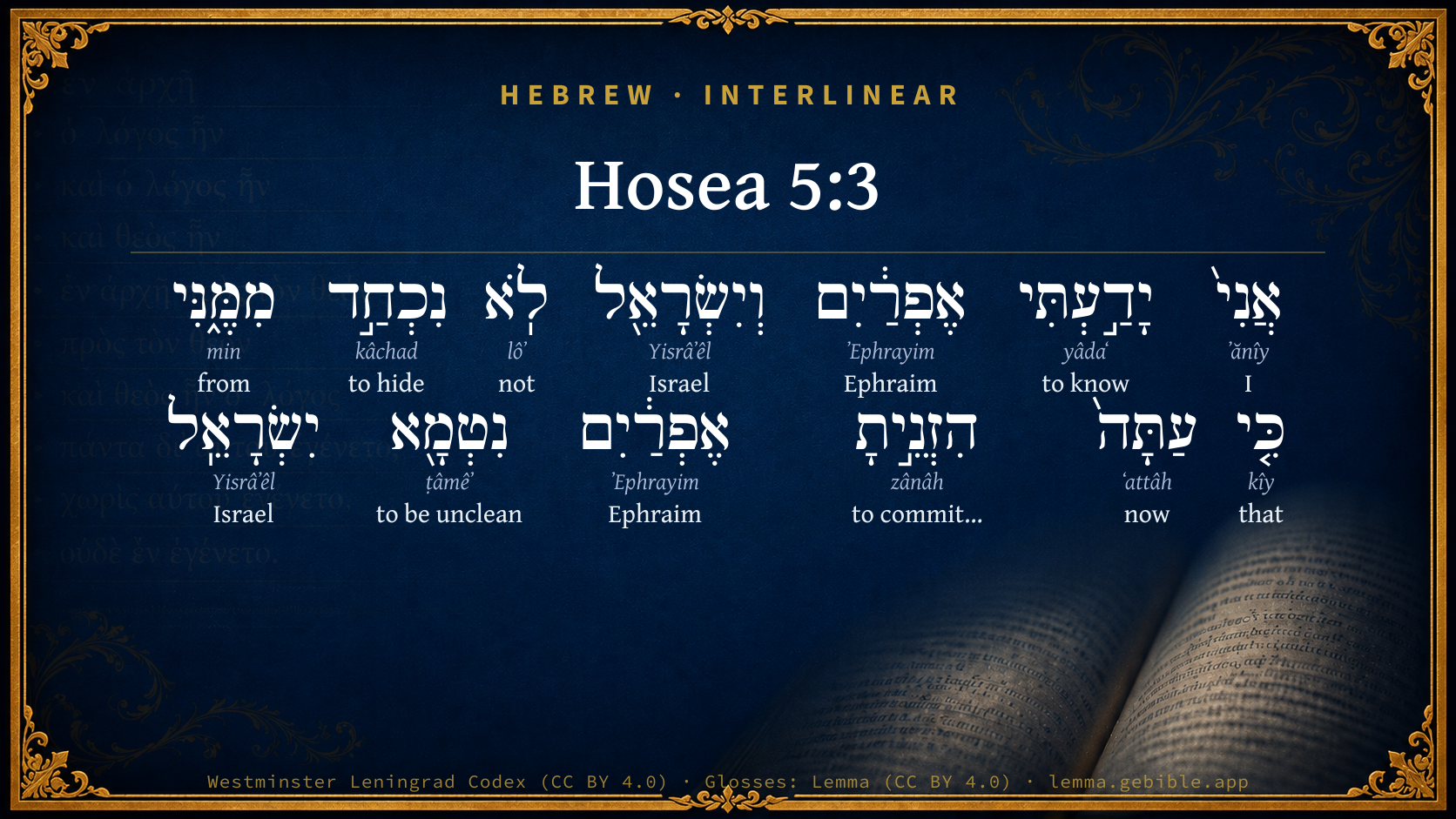
Hebrew (Westminster Leningrad Codex) Hosea 5:3 appears in the Hebrew Old Testament. The text above is from the Westminster Leningrad Codex. Each word links to its Strong’s number, a concise gloss, and parsing drawn from the Open Scriptures Hebrew Bible morphology. Click any word for its full Brown-Driver-Briggs (BDB) entry.
Download image
Cite this verse

Hosea 5:3 (World English Bible). Public Domain. Lemma interlinear Bible study tool, https://lemma.gebible.app/v/hosea/5/3.

Show BibTeX & RIS
BibTeX
RIS
English Translation
I know Ephraim, And Israel is not hidden from me; For now, Ephraim, you have played the prostitute. Israel is defiled.
World English Bible · Public Domain
Download a study sheet

One document with this verse’s original text, its word-by-word gloss line, the meaning frame, cross-references with their text, attributed commentary, and full source and license credits — printable, and it pastes into notes with its structure intact.

This verse Autodidact and up

Study sheet (.html) Plain text (.txt)

A passage Seminary Student

Up to 50 verses in one chapter. A passage sheet keeps up to 6 commentary sources and 12 cross-references per verse, in the order this page ranks them, and says so on the sheet whenever that leaves anything out. Ask for a single verse and you get the Autodidact verse sheet above.

Everything on this page stays free to read, with no account — the sheet is a download of what is already on screen, not access to it.

Want to remove ads? Support Godless Engineer
Compare translations 3

The same verse in 3 English versions, stacked beneath the original-language interlinear above. Click any original word for its lexicon entry.

Each is an independent rendering of the whole verse — the interlinear is not word-aligned to these translations.

Highlighted words mark where these versions differ — a whole-verse word diff, not a word-by-word alignment.

  • World English Bible Public Domain
    I know Ephraim, And Israel is not hidden from me; For now, Ephraim, you have played the prostitute. Israel is defiled.
  • King James Version Public Domain
    I know Ephraim, and Israel is not hid from me: for now, O Ephraim, thou committest whoredom, and Israel is defiled.
  • unfoldingWord Literal Text CC BY-SA 4.0
    I, I know Ephraim, and Israel is not hidden from me, for now you have prostituted, Ephraim; Israel is defiled.

unfoldingWord Literal Text — © unfoldingWord, licensed CC BY-SA 4.0. Word-aligned USFM3 via Door43 (git.door43.org/unfoldingWord/en_ult).

Versions to compare (up to 4)

3 of 4 selected

Show all 18 translations

Every available English version of this verse, each an independent rendering of the whole verse.

  • World English Bible Public Domain
    I know Ephraim, And Israel is not hidden from me; For now, Ephraim, you have played the prostitute. Israel is defiled.
  • Berean Standard Bible Public Domain
    I know all about Ephraim, and Israel is not hidden from Me. For now, O Ephraim, you have turned to prostitution; Israel is defiled.
  • Majority Standard Bible Public Domain
    I know all about Ephraim, and Israel is not hidden from Me. For now, O Ephraim, you have turned to prostitution; Israel is defiled.
  • King James Version Public Domain
    I know Ephraim, and Israel is not hid from me: for now, O Ephraim, thou committest whoredom, and Israel is defiled.
  • American Standard Version (1901) Public Domain
    I know Ephraim, and Israel is not hid from me; for now, O Ephraim, thou hast played the harlot, Israel is defiled.
  • Revised Version (1885) Public Domain
    I know Ephraim, and Israel is not hid from me: for now, O Ephraim, thou hast committed whoredom, Israel is defiled.
  • Geneva Bible (1599) Public Domain
    I knowe Ephraim, and Israel is not hid from me: for nowe, O Ephraim thou art become an harlot, and Israel is defiled.
  • Douay-Rheims (1899) Public Domain
    I know Ephraim, and Israel is not hid from me: for now Ephraim hath committed fornication, Israel is defiled.
  • Young's Literal Translation Public Domain
    I have known Ephraim, And Israel hath not been hid from me, For now thou hast gone a-whoring, Ephraim, Defiled is Israel.
  • Literal Standard Version CC BY-SA 4.0
    I have known Ephraim, || And Israel has not been hid from Me, || For now you have gone whoring, Ephraim, || Israel is defiled.
  • Unlocked Literal Bible CC BY-SA 4.0
    I know Ephraim, and Israel is not hidden from me. Ephraim, now you have become like a prostitute; Israel is defiled.
  • unfoldingWord Literal Text CC BY-SA 4.0
    I, I know Ephraim, and Israel is not hidden from me, for now you have prostituted, Ephraim; Israel is defiled.
  • Darby Bible Public Domain
    I know Ephraim, and Israel is not hid from me; for now, Ephraim, thou hast committed whoredom; Israel is defiled.
  • World Messianic Bible Public Domain
    I know Ephraim, and Israel is not hidden from me; for now, Ephraim, you have played the prostitute. Israel is defiled.
  • Webster's Bible Public Domain
    I know Ephraim, and Israel is not hid from me: for now, O Ephraim, thou art guilty of lewdness, and Israel is defiled.
  • Free Bible Version CC BY-SA 4.0
    I know Ephraim very well, and Israel cannot hide from me, for now Ephraim is a prostitute and Israel is defiled.
  • Bible in Basic English Public Domain
    I have knowledge of Ephraim, and Israel is not secret from me; for now, O Ephraim, you have been false to me, Israel has become unclean.
  • JPS Tanakh (1917) Public Domain
    I, even I, know Ephraim, and Israel is not hid from Me; for now, O Ephraim, thou hast committed harlotry, Israel is defiled.

Literal Standard Version (2020), Covenant Press — licensed CC BY-SA 4.0. Text via the HelloAO Bible API (eBible.org). Unlocked Literal Bible (unfoldingWord) — licensed CC BY-SA 4.0. Text via the HelloAO Bible API (eBible.org). unfoldingWord Literal Text — © unfoldingWord, licensed CC BY-SA 4.0. Word-aligned USFM3 via Door43 (git.door43.org/unfoldingWord/en_ult). Free Bible Version, Dr. Jonathan Gallagher — licensed CC BY-SA 4.0. Text via the HelloAO Bible API (eBible.org).

Word by word

More ways to search: Search by grammar → Find every occurrence → Compare this word →

Practice this passage: Drill this verse → Learn its vocabulary →

נִכְחַ֣ד
kâchad
H3582
“to hide”
Verb, Niphal, Perfect, 3rd Person, Masculine, Singular
Part of Speech
Verb
Stem
Niphal
Form
Perfect
Person
3rd Person
Gender
Masculine
Number
Singular
Full BDB Definition

Origin: a primitive root

TWOT: 972

to hide, conceal, cut off, cut down, make desolate, kick - (Niphal) - to be hidden - to be effaced, be destroyed, be cut off - (Piel) to cover, hide - (Hiphil) - to hide - to efface, annihilate
  1. אֲנִי֙ ʼănîy H589 “I” Pronoun, Personal, 1st Person, Common, Singular
  2. יָדַ֣עְתִּי yâdaʻ H3045 “to know” Verb, Qal, Perfect, 1st Person, Common, Singular
  3. אֶפְרַ֔יִם ʼEphrayim H669 “Ephraim” Noun, Proper
  4. וְיִשְׂרָאֵ֖ל Yisrâʼêl H3478 “and · Israel” Conjunction + Noun, Proper
  5. לֹֽא lôʼ H3808 “not” Particle, Negative
  6. מִמֶּ֑נִּי min H4480 “from · me” Preposition + Suffix, Personal, 1st Person, Common, Singular
  7. כִּ֤י kîy H3588 “that” Conjunction
  8. עַתָּה֙ ʻattâh H6258 “now” Adverb
  9. הִזְנֵ֣יתָ zânâh H2181 “to commit fornication” Verb, Hiphil, Perfect, 2nd Person, Masculine, Singular
  10. אֶפְרַ֔יִם ʼEphrayim H669 “Ephraim” Noun, Proper
  11. נִטְמָ֖א ṭâmêʼ H2930 “to be unclean” Verb, Niphal, Perfect, 3rd Person, Masculine, Singular
  12. יִשְׂרָאֵֽל Yisrâʼêl H3478 “Israel” Noun, Proper

About this verse

These counts appear in no published source. They are computed here, from the morphology-tagged text and Lemma’s own curated glosses. What Lemma adds →

13
words
11
distinct lemmas
Prophets
section

Shared distinctive vocabulary

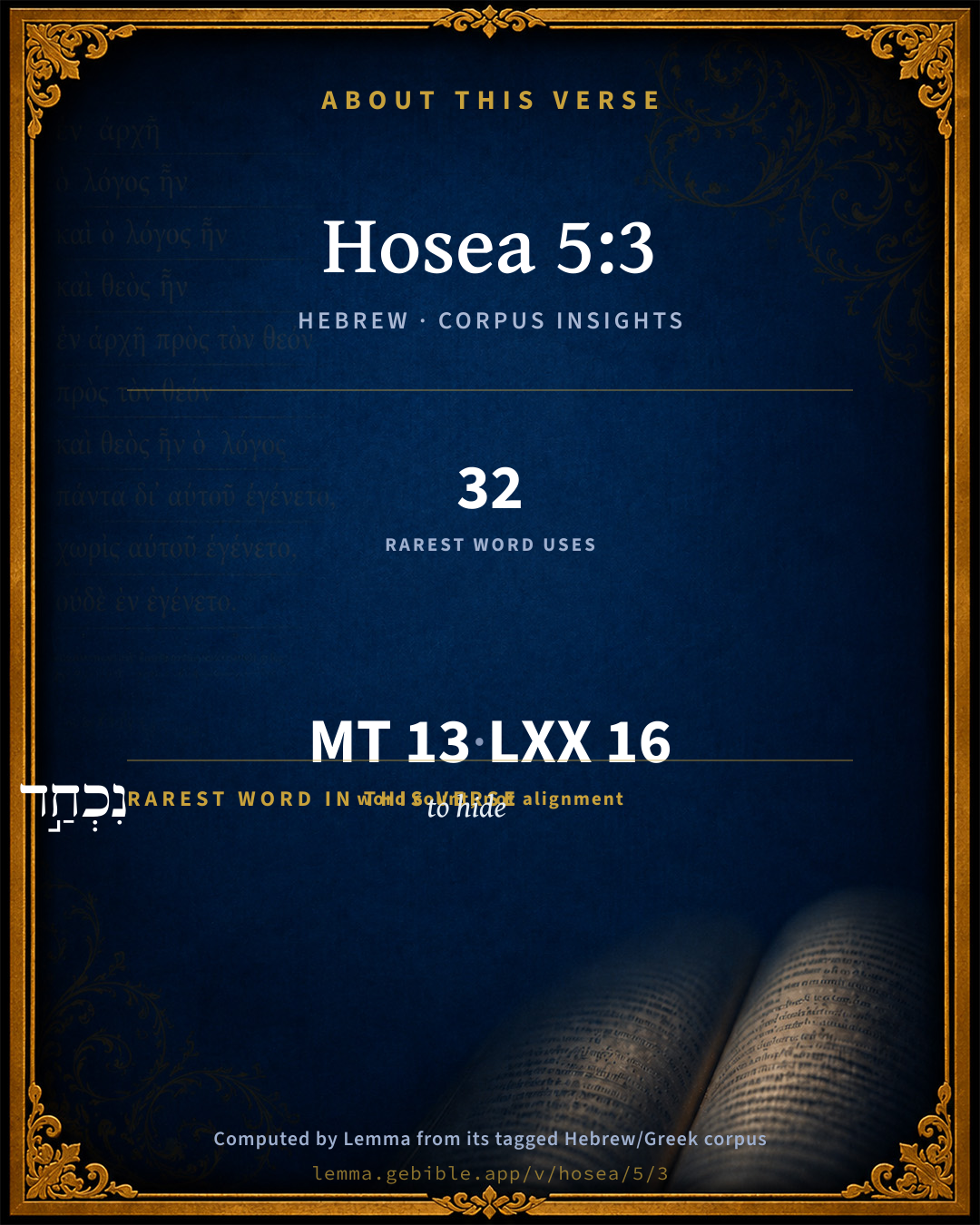
נִכְחַ֣ד to hide H3582 occurs in 30 verses of the Hebrew Bible. Also found in:

Grammatical profile

  • 4 verbs
  • 4 nouns
  • 1 pronoun
  • 1 preposition
  • 1 conjunction
  • 1 adverb
  • 1 particle

Verb forms

  • יָדַ֣עְתִּי Qal · Perfect
  • נִכְחַ֣ד Niphal · Perfect
  • הִזְנֵ֣יתָ Hiphil · Perfect
  • נִטְמָ֖א Niphal · Perfect

Repetition

Words recur within this verse — often emphatic in Hebrew:

  • אֶפְרַ֔יִם Ephraim H669 ×2
  • וְיִשְׂרָאֵ֖ל Israel H3478 ×2

Hebrew & Septuagint length

In English translation the verse runs 21 words from the Hebrew and 20 from the Septuagint (LXX English) — closely comparable.

A rough comparison of the two English renderings, which tokenize alike — not a word-level alignment.

Word counts can differ between the Hebrew and the Greek without any difference in meaning — e.g. the Hebrew direct-object marker אֵת has no separate Greek word, and Greek often adds the article ὁ.

In the original languages it is 13 Hebrew tokens and 16 Greek tokens — but the two are counted differently (Hebrew bundles its prefixes and suffixes into one token; the Greek is in lemma form), so that isn’t a like-for-like length.

Cross-references

20

Topical passages linked to Hosea 5:3 in the Treasury of Scripture Knowledge — connected by theme and wording, ordered by reader-vote popularity; previews shown in the World English Bible.

  • Amos 3:2 "You only have I chosen of all the families of the earth. Therefore I will punish you for all of your sins."
  • Hebrews 4:13 There is no creature that is hidden from his sight, but all things are naked and laid open before the eyes of him with whom we have to do.
  • Genesis 48:19–20 His father refused, and said, "I know, my son, I know. He also will become a people, and he also will be great. However, his younger brother will be greater than he, and his seed will become a multitude of nations."
  • Deuteronomy 33:17 The firstborn of his herd, majesty is his; His horns are the horns of the wild-ox: With them he shall push the peoples all of them, [even] the ends of the earth: They are the ten thousands of Ephraim, They are the thousands of Manasseh.
  • 1 Kings 12:26–33 Jeroboam said in his heart, Now will the kingdom return to the house of David:
  • 1 Kings 14:14–16 Moreover Yahweh will raise him up a king over Israel, who shall cut off the house of Jeroboam that day: but what? even now.
  • Isaiah 7:5 Because Syria, Ephraim, and the son of Remaliah, have plotted evil against you, saying,
  • Isaiah 7:8–9 For the head of Syria is Damascus, and the head of Damascus is Rezin; and within sixty-five years Ephraim shall be broken in pieces, so that it shall not be a people;
  • Isaiah 7:17 Yahweh will bring on you, on your people, and on your father's house, days that have not come, from the day that Ephraim departed from Judah; even the king of Assyria.
  • Ezekiel 23:5–21 Oholah played the prostitute when she was mine; and she doted on her lovers, on the Assyrians [her] neighbors,
  • Hosea 4:17–18 Ephraim is joined to idols. Leave him alone!
  • Hosea 5:9 Ephraim will become a desolation in the day of rebuke. Among the tribes of Israel, I have made known that which will surely be.
  • Hosea 5:11 Ephraim is oppressed, He is crushed in judgment; Because he is intent in his pursuit of idols.
  • Hosea 5:13 When Ephraim saw his sickness, And Judah his wound, Then Ephraim went to Assyria, And sent to king Jareb: But he is not able to heal you, Neither will he cure you of your wound.
  • Hosea 6:4 "Ephraim, what shall I do to you? Judah, what shall I do to you? For your love is like a morning cloud, And like the dew that disappears early.
  • Hosea 8:11 Because Ephraim has multiplied altars for sinning, They became for him altars for sinning.
  • Hosea 12:1 Ephraim feeds on wind, And chases the east wind. He continually multiplies lies and desolation. They make a covenant with Assyria, And oil is carried into Egypt.
  • Hosea 13:1 When Ephraim spoke, there was trembling. He exalted himself in Israel, But when he became guilty in Baal, he died.
  • Amos 5:12 For I know how many your offenses, And how great are your sins-- You who afflict the just, Who take a bribe, And who turn aside the needy in the courts.
  • Revelation 3:15 "I know your works, that you are neither cold nor hot. I wish you were cold or hot.

Cross-references courtesy of OpenBible.info (CC BY 4.0).

Hebrew and Greek witnesses Masoretic Hebrew ↔ Greek Septuagint

The same verse in the two great witnesses to the Old Testament, shown verse-for-verse.

These are two independent witnesses, not word-aligned to each other, and the Septuagint is shown in lemma (dictionary) form.

Hebrew Hosea 5:3 Masoretic · Westminster Leningrad Codex

אֲנִי֙ יָדַ֣עְתִּי אֶפְרַ֔יִם וְיִשְׂרָאֵ֖ל לֹֽא נִכְחַ֣ד מִמֶּ֑נִּי כִּ֤י עַתָּה֙ הִזְנֵ֣יתָ אֶפְרַ֔יִם נִטְמָ֖א יִשְׂרָאֵֽל

I know Ephraim, And Israel is not hidden from me; For now, Ephraim, you have played the prostitute. Israel is defiled.

World English Bible · Public Domain

Greek LXX Hosea 5:3 Septuagint · lemma form

ἐγώ γιγνώσκω ὁ ἐφράιμ καί ἰσραήλ οὐ ἀποεἰμί ἀπό ἐγώ διότι νῦν ἐκπορνεύω ἐφράιμ μιαίνω ἰσραήλ

I know Ephraim, and Israel is not far from me: for now Ephraim has gone grievously a-whoring, Israel is defiled.

LXX2012 (modern English Septuagint) · Public Domain

Hebrew: Westminster Leningrad Codex (CC BY 4.0). Greek: Septuagint (public domain); English from LXX2012 (modern English Septuagint) (Public Domain). How the Septuagint differs from the Hebrew →

Targum (Aramaic paraphrase)

1

The Targum is the ancient Jewish Aramaic paraphrase of the Hebrew Scriptures — an interpretive translation, not the Hebrew text itself. Onkelos (literal) and Pseudo-Jonathan (expansive) render the Torah, and Jonathan the Prophets. Coverage is partial: where no permissively-licensed English translation exists for a verse, only the Aramaic is shown. This is verse-level text, not a word-by-word alignment to the Hebrew.

  1. Targum Jonathan Prophets (Joshua–Malachi)
    קֳדָמָי גְלַן עוֹבָדֵי דְבֵית אֶפְרַיִם וּדְבֵית יִשְׂרָאֵל לָא מִטַמְרִין מִן קֳדָמַי אֲרֵי כְעַן טָעָן בֵּית אֶפְרַיִם אִסְתְּאָבוּ בֵּית יִשְׂרָאֵל:

    (no public-domain English translation for this verse)

    Targum Jonathan — Aramaic: “Mikraot Gedolot” (public domain). English: “Sefaria Community Translation” (CC0 1.0 (public-domain dedication)); “London "Chaldee Paraphrase," 1871” (public domain). Text via Sefaria.

Commentary

Notes on Hosea 5:3 from classic Christian and Jewish commentators (each source and its license shown beneath its notes). The classic Christian expositions comment on the surrounding passage and are grouped to its opening verse, so a note may address several verses; the Jewish commentaries on the Tanakh (Rashi and others) are per-verse, so they appear only where the commentator wrote on this verse.

Lemma curates 59 commentaries, every one of them public domain or Creative Commons licensed, each selected and text-cleaned for this edition rather than reprinted as found. About our sources →

Trapp's Complete Commentary

John Trapp

Hos 5:3 I know Ephraim, and Israel is not hid from me: for now, O Ephraim, thou committest whoredom, [and] Israel is defiled.

Ver. 3. I know Ephraim, and Israel is not hid from me] Those that by Ephraim understand the princes, and by Israel the common people, etiam hoc operae addant, et illud ex Scriptura probent, saith Tarnovius, let them prove what they say by Scripture, and we will say with them: till then we take them for synonyms ( Repetitione etiam auget populi rebellionem. Rivet). A hypocritical nation they were, Isa 9:17, and atheistically they thought, by hiding God from themselves, to hide themselves from God. Hear them else, Hos 12:8, "And Ephraim said, Yet I am become rich, I have found me out substance: in all my labours they shall find none iniquity in me that were sin": that were a heinous business that iniquity should be found in them, though they were a people laden with iniquity, Isa 1:4. But I know them through and through, intus et in cute, saith God, I am privy to all their plots and policies. And although they are profound to make slaughter (Tyndale reads it, They kill sacrifices on heaps to deceive), yet let not them be deceived, I am not mocked. They must not think to put me off with shows and shadows; to colour and cover their base spirits and vile ends with specious pretences. For I search the hearts, and try the reins: "neither is there any creature" (no, not the creature of the heart, the thoughts and intentions) "that is not manifest in his sight: but all things are naked and open" (naked for the outside, γυμνα, and open for the inside; the Greek word, τετραχηλισμενα, signifieth dissected, quartered, and as it were cleft through the backbone) "before the eye of him with whom we have to deal," Heb 4:13. Indeed, he is all eye; and every man before God is all window, ολοφθαλμος: so that no man needeth a window in his breast, pectus clathratum (as the heathen Momus wished), for God to look in at. "For his eyes are upon the ways of man, and he seeth all his goings. There is no darkness nor shadow of death where the workers of iniquity may hide themselves," Job 34:21-22. "His eyes behold, his eyelids try, the children of men," Psa 11:4. The former points out his knowledge, the latter his critical descant. David, Psa 139:8, findeth God not only at his finger ends, but at his tongue’s end too, Hos 5:4. His knowledge stays not here in the porch or lobbies, but passeth into the presence, yea, privy chamber, Hos 5:2, yea, my thoughts in potential before I think them. Deus intimo nostro nobis intimior. The word is to God a sea of glass, Rev 4:6, a clear transparent body: "and his eyes are as a flaming fire," Rev 1:14, which needs no outward light, because it seeth extramittendo by sending out a ray; so that the "night shineth as the day: the darkness and the light are both alike to him," Psa 139:12. What wonder therefore though he know Ephraim, and Israel is not hidden from him? And how should this both humble them (for which cause it is here urged) and caution them for the future, as it did that holy man, who had written upon the walls and windows of his study these verses,

“ Ne pecces, Deus ipse videt, bonus Angelus astat,

Accusat Satanas, et lex, mens conscia culpae. ”

For now, O Ephraim, thou committest whoredom, and Israel is defiled] In body and soul, rushing into all impiety without restraint; working all uncleanness with greediness, Eph 4:19, being filled "with all unrighteousness, fornication, wickedness, covetousness, maliciousness: full of envy, murder, debate, deceit," &c., Rom 1:29-30. All these evil things "come from within, and defile a man," Mar 7:23, worse than any leprosy, worse than the vomit of a dog, or the mire of a swine. It is the pollution of flesh and spirit, 2Co 7:1, it is the putrefication of a dead carcase, the sanies of a plague sore, the devil’s excrement, and that which defileth far worse than that which is cast into the draught, Mar 7:21. It sets defilement upon ourselves, others, the whole land, Jer 3:1, yea, upon the visible heavens, which must therefore be purged by that last fire. And this was typified by those many Levitical washings and purifications of garments, vessels, persons. "Wash you, therefore, make you clean, put away the evil of your doings," &c., Isa 1:16. "Wash thy heart from wickedness, O Jerusalem," not thy hands only, as Pilate, though those too, Jas 4:8 Jer 4:14. "Cleanse yourselves from all filthiness of flesh and spirit," 2Co 7:1. Of the flesh, that is, fleshly lusts and gross evils, as uncleanness, earthly mindedness; or of spirit, that is, those more spiritual lusts that lie more up in the heart of the country, such as are pride, creature confidence, self-deceit, presumption, &c. Out with all these: there is both a stain and a sting in them. Run to the bath of Christ’s blood, that blessed fountain, Zec 13:1, and there wash and be clean. Look not upon God’s Jordan with Syrian eyes, as Naaman did. Abanah and Pharpar may wash and scour; but Jordan is for cure. And if God see fit to lay us a frosting to fetch out our filth, yea, or cast into the fire to take away our defilements, let us be contented.

John Trapp, A Commentary or Exposition upon All the Books of the Old and New Testament (1647–1656) — public domain. Text from a community e-Sword module.

The Biblical Illustrator

Joseph S. Exell

Hos_5:3

I know Ephraim, and Israel is not hid from Me.

Knowledge as a basis of judgment

To know Ephraim is to know all his shifts, evasions, and cunning devices, all his plots, pretences, and base ends.

1. Gods eye is upon the secrets of mens hearts.

2. Gods eye upon our hearts and ways is a special means to humble us.

3. God will deal with men according to their present ways.

4. Defiled worship exceedingly defiles the souls of people.

5. A morally and religiously defiled nation is near to ruin. (Jeremiah Burroughs.)

Gods knowing

Emphasis is laid on the I. God had known Ephraim all along. However deep they may have laid their plans of blood, I have all along known them; nothing of them has been hid from Me. Even now, when under a fair outward show, they are veiling the depth of their sin, when they think their way is hid in darkness, I know their doings, that they are defiling themselves. Sin never wants specious excuse. Although (in some way unknown to us) not interfering with our free will, known unto God are our thoughts and words and deeds, before they are framed, while they are framed, while they are being spoken and done; known to Him is all which we do, and all which, under any circumstances, we should do. This He knows with a knowledge before the things were. How strange, then, to think of hiding from God a secret sin, when He knew, before He created thee, that He created thee liable to this very temptation, and to be assisted amidst it with just that grace which thou art resisting. (E. B. Pusey, D. D.)

Nothing hid from God

While the Americans were blockading Cuba, several captains endeavoured to elude their vigilance by night, trusting that the darkness would conceal them as they passed between the American war ships. But in almost every case, the dazzling rays of a searchlight frustrated the attempt, and the fugitive vessel was captured by the Americans. The brilliant searchlight, sweeping the broad ocean and revealing even the smallest craft on its surface, is but a faint type of the Eternal Light from which no sinner can hide his sin. (Sunday School Chronicle.)

The Biblical Illustrator, edited by Joseph S. Exell (c. 1880s–1900s) — public domain. Text from a community e-Sword module.

Joseph Benson's Commentary

Hos 5:3-5. I know Ephraim — I am perfectly well acquainted with the actions of Ephraim, the head of the ten tribes; and Israel is not hid from me — And the actions of the other nine tribes are no less known to me. Now, O Ephraim, thou committest whoredom — Even now, at this time, thou goest on in thy idolatry, notwithstanding all my rebukes and exhortations. They will not frame their doings to turn unto their God — They are so wholly inclined to idolatry, and it has got so fixed a root in their affections, that they cannot think of turning to the pure worship of the true God. And it even extinguishes all true knowledge and sense of him among them. Bishop Horsley renders the verse, Their perverse habits will not permit them to return unto their God; for a spirit of wantonness is within them, and the Jehovah they have not known. The pride of Israel doth testify to his face — The insolent behaviour of Israel toward God, whose worship they despise, both discovers itself in all their conduct, and testifies that their guilt is great, and deserves severe punishment. Archbishop Newcome renders this clause, The pride of Israel shall be humbled to his face; and Waterland, Shall be brought down in his sight. Therefore shall Israel and Ephraim fall, &c. — Be brought to utter ruin; Judah also shall fall with them — And the other two tribes of Judah and Benjamin, having followed their bad example, shall also be severely punished as well as they.

Joseph Benson's Commentary on the Old and New Testaments (1811–1818) — public domain. Text from a community e-Sword module.

Tyndale Open Study Notes

Tyndale Open Resources

5:3 you are utterly defiled: The word translated defiled is used frequently in the Pentateuch to describe ritual uncleanness, a physical condition that disqualified a person from worshiping God in the Temple (Lev 11–15). The prophets used the concept as a metaphor for Israel’s moral uncleanness as the result of her idolatry (Isa 6:5; Mic 2:10).

Tyndale Open Study Notes — © Tyndale Open Resources, licensed CC BY-SA 4.0. Text via the HelloAO Bible API.

Geneva Bible (1599)

Geneva Bible translators

They boasted themselves not only to be Israelites, but also Ephraimites, because their king Jeroboam came of that tribe.

Geneva Bible (1599) marginal notes — public domain. Text via Bolls.life.

Jamieson, Fausset & Brown

Robert Jamieson, A. R. Fausset & David Brown

Ephraim--the tribe so called, as distinguished from "Israel" here, the other nine tribes. It was always foremost of the tribes of the northern kingdom. For four hundred years in early history, it, with Manasseh and Benjamin, its two dependent tribes, held the pre-eminence in the whole nation. Ephraim is here addressed as foremost in idolatry.

I how . . . not hid from me--notwithstanding their supposed profound cunning (Hos 5:2; Rev 2:2, Rev 2:9, Rev 2:13, Rev 2:19).

now--"though I have been a rebuker of all them" (Hos 5:2) who commit such spiritual whoredoms, thou art now continuing in them.

Jamieson, Fausset & Brown — Commentary Critical and Explanatory on the Whole Bible (1871) — public domain (CC PDM 1.0). Text via the HelloAO Bible API.

Adam Clarke's Commentary

Verse 3. I know Ephraim] I know the whole to be idolaters.

Adam Clarke's Commentary on the Bible (1810–1826) — public domain. Text from a community e-Sword/MySword module.

John Calvin's Commentaries

God shows here that he is not pacified by the vain excuses which hypocrites allege, and by which they think that the judgment of God himself can be turned away. We see what great dullness there is in many, when God reproves them, and brings to light their vices; for they defend themselves with vain and frivolous excuses, and think that they thus put a restraint on God, so that he dares not urge them any more. In this way hypocrites elude every truth. But God here testifies, that men are greatly deceived when they thus judge, by their own perception, of that celestial tribunal to which they are summoned; I, he says, know Ephraim, and Israel is not hid from me There is to be understood an implied contrast, as though he said, that they were ignorant of themselves; for they covered their vices, as I have said, with frivolous excuses. God testifies that his eyes were not dazzled with such fine pretenses. “How much soever, then, Ephraim and Israel may excuse themselves, they shall not escape my judgment: vain and absurd are these shifts which they use; I indeed am not ignorant.”

Let us then learn not to belie, by our own notions, the judgment of God; and when he reproves us by his word, let us not delude ourselves by our own fancies; for they who harden themselves in such a state of security gain nothing. God sees more keenly than men. Let use then, beware of spreading a veil over our sins, for God’s eyes penetrate through all such excuses.

That he names Ephraim particularly, was not done, we know, without reason. From that tribe sprang the first Jeroboam: it was therefore by way of honor that the name of Ephraim was given to the ten tribes. But the Prophet names Ephraim here, who thought themselves superior to the other tribes, by way of reproach: I know them, and Israel is not hid from me He afterwards expresses what he knew of the people, which was, that Ephraim was wanton, and that Israel was polluted; as though he said “Contend as you please; but you will do so without profit: I have indeed my ears stunned by your lies; but after you have adduced everything, after you have sedulously pleaded your own cause, and have omitted nothing which may serve for an excuse, the fact still will be, that you are wantons and polluted.” In short, the Prophet confirms in this second clause what I have before stated, that men, when they flatter themselves, deceive themselves; for God in the meantime condemns them, and allows no disguise of this kind. Israel and Ephraim gloried, then, in their superstitions, as though they held God bound to them: “This is wantonness,” he says, “This is pollution.” The Prophet indeed does here cut off the handle from all those self-deceptions which men use as reasons, when they defend fictitious forms of worship; for God from on high proclaims, that all are polluted who turn aside from his word.

John Calvin's Commentaries (1540-1563) — public domain. Text from the Calvin Translation Society English edition (1840s-50s) via the Christian Classics Ethereal Library (ccel.org). Calvin's coverage is partial (roughly two-thirds of the Bible); uncommented books and verses are honest gaps, never fabricated. The 19th-century editor's footnotes and remarks are omitted so the notes are faithfully Calvin's own voice.

The Cambridge Bible for Schools and Colleges

gen. ed. J. J. S. Perowne

3. I know Israel] The pronoun is expressed for emphasis, I who punish Israel am well acquainted with its open and secret sins.

The Cambridge Bible for Schools and Colleges (gen. ed. J. J. S. Perowne; Cambridge University Press, 1878–1918) — public domain. Text from a community e-Sword module.

John Gill's Exposition

I know Ephraim, and Israel is not hid from me,.... Though they may cover their designs from men, and seek deep to hide their counsel from the Lord, and make plausible pretences for what they do, and put on an appearance of religion; yet God, who knows all men, and their hearts, cannot be deceived; he judges not according to outward appearance; all things are naked and open to him; nor can any hide themselves from him; he knows their persons, intentions, and designs, as well as actions. Kimchi interprets Ephraim of Jeroboam, the son of Nebat, who was of that tribe; others, of the tribe itself, and Israel of the other nine tribes; others take Ephraim for the ten tribes, and Israel for the two tribes: but it is best to understand Ephraim and Israel of the same, even of the ten tribes; whose works, as the Targum paraphrases it, the Lord knew, particularly what follows:

for now, O Ephraim, thou committest whoredom; both corporeal and spiritual adultery, which frequently went together, as observed in the preceding chapter: the Lord knew their corporeal whoredom, though ever so secretly committed, and their spiritual adultery or idolatry, under all the specious pretences of worshipping him; which was an abhorrence to him, as well as a pollution to them:

and Israel is defiled; with the same sins; for all sin is of a defiling nature, and especially those mentioned, which defile body and soul, and render men loathsome and abominable in the sight of God.

John Gill's Exposition of the Whole Bible (1746–1763) — public domain (CC PDM 1.0). Text via the HelloAO Bible API.

Albert Barnes' Notes on the Bible

I know Ephraim - There is much emphasis on the “I.” It is like our, “I have known,” or “I, I, have known.” God had known him all along, if we may so speak. However deep they may have laid their plans of blood, however they would or do hide them from man, and think that no eye seeth them, and say, “Who seeth me? and who knoweth me? I, to whose eyes all things are naked and opened Heb 4:13, have all along known them, and nothing of them has been hid from Me. For, He adds, even now, now when, under a fair outward show, they are veiling the depth of their sin, now, when they think that their way is hid in darkness, I know their doings, that they are defiling themselves. Sin never wanted specious excuse. Now too unbelievers are mostly fond of precisely those characters in Holy Scripture, whom God condemns. Jeroboam doubtless was accounted a patriot, vindicating his country from oppressive taxation, which Rehoboam insolently threatened. Jerusalem, as lying in the Southernmost tribe, was represented, as ill-selected for the place of the assemblage of the tribes. Bethel, on the contrary, was hallowed by visions; it had been the abode, for a time, of the ark.

It lay in the tribe of Ephraim, which they might think to have been unjustly deprived of its privilege. Dan was a provision for the Northern tribes. Such was the exterior. God says in answer, “I know Ephraim.” “Known unto God are all his works from the beginning of the world” Act 15:18. Although (in some way unknown to us) not interfering with our free-will, known unto God are our thoughts and words and deeds, before they are framed, while they are framed, while they are being spoken and done; known to Him is all which we do, and all which, under any circumstances, we should do. This he knows with a knowledge, before the things were. : “All His creatures, corporeal or spiritual, He doth not therefore know, because they are; but they therefore are, because He knoweth them. For He was not ignorant, what He was about to create; nor did He know them, after He had created them, in any other way than before. For no accession to His knowledge came from them; but, they existing when and as was meet, that knowledge remained as it was.” How strange then to think of hiding from God a secret sin, when He knew, before He created thee, that He created thee liable to this very temptation, and to be assisted amidst it with just that grace which thou art resisting! God had known Israel, but it was not with the knowledge of love, of which He says, “The Lord knoweth the way of the righteous” Psa 1:6, and, “if any man love God, the same is known of Him, but with the knowledge of condemnation, whereby He, the Searcher of hearts, knows the sin which He judges” 1Co 8:3.

Albert Barnes' Notes on the Bible (1834–1885) — public domain. Text from a community e-Sword/MySword module.

Matthew Poole's English Annotations

These revolters neither are nor can be so deep as to conceal themselves, their designs, contrivances, and practices, from me; I thoroughly know Ephraim. The revolters are also called

Israel in this verse, who is not hid from me. It is an elegant repetition of the same thing in different words.

Thou committest whoredom; all thy fair pretences thou canst put upon thy devised religion cannot better it, still it is downright idolatry or spiritual whoredom.

And Israel is defiled: Israel here is Ephraim; and when Israel is said to be polluted, it is to be understood both of spiritual and corporal pollution, which mostly are linked together, and draw on each other.

Matthew Poole's English Annotations on the Holy Bible (1683–1685) — public domain. Text from a community e-Sword/MySword module.

The Pulpit Commentary

I know Ephraim, and Israel is not hid from me. All attempts at concealment are vain, though sinners try ever so much to hide their sins from the Divine Majesty. However deep they dig downward, God will bring their evil doings up and out to the light of day and punish them. For now, O Ephraim, thou committest whoredom, and Israel is defiled. Israel is the northern kingdom, and Ephraim, being the most powerful tribe, is often identified with Israel; here, however, they are distinguished Israel is the kingdom as a whole, and Ephraim is its leading tribe. This powerful tribe, ever envious of Judah, was the ringleader in the calf worship of Jeroboam and other idolatries; and through Ephraim"s evil influence the other tribes, and so all Israel, were defiled.

HOMILIES BY J.R. THOMSON Ver. 3. Divine omniscience.

Uninspired teachers often act upon imperfect information. Ministers of religion take some people to be better and others to be worse than they really are. From this unavoidable infirmity of men the omniscient God is free. In dealing with a sinful soul or a sinful community he speaks and acts from a perfect knowledge.

I THE FACT OF DIVINE OMNISCIENCE. It is incredible that there should be any bounds to Divine knowledge; yet it is scarcely to be realized by us that there should be none. See how this thought inspired the psalmist (Psalm 139). This natural attribute of the Creator is one mode, so to speak, of his infinite perfection.

II THE BEARING OF THE DIVINE OMNISCIENCE UPON THE STATE OF THE SINNER.

1. No aggravation of the sinner"s guilt is hid. If Ephraim sinned against light, this was known to Jehovah; if Israel rejected the counsels of the prophets divinely sent, this was not hid from him.

2. No extenuation of the sinner"s guilt is hid. The temptation to which he yields, the weakness which succumbs, the regret and remorse which follow sin, all are known to Heaven.

3. The judgment which God passes is righteous and unquestionable. There is no escape from the Divine tribunal to our own; for the voice within accords with that from above.

III THE PRACTICAL LESSONS OF THE DIVINE OMNISCIENCE.

1. It should lead to a full and immediate confession. God knows all, and if we do not acknowledge our sin it will not be hid from him. Whilst "if we confess our sins, he is faithful and just to forgive.

2. It should lead us to watchfulness and prayer. If his eye is ever upon us, let our eyes ever be up unto him; if hid ear is ever open, let our cry ever ascend unto him.

3. It should lead the accepted soul to constant relieve, ship with God. To the Christian the thought of the Divine omniscience is fraught with holy, filial, rejoicing confidence. It is not only our sins that are not hidden from him; he knows our prayers, our love, our hopes, our all. T.

The Pulpit Commentary (1880–1919), ed. H.D.M. Spence-Jones & Joseph S. Exell — public domain. Text from a community e-Sword module.

Keil & Delitzsch

C. F. Keil & F. Delitzsch

"I know Ephraim, and Israel is not hid from me: for now, O Ephraim, thou hast committed whoredom; Israel has defiled itself. Hos 5:4. Their works do not allow to return to their God, for the spirit of whoredom is in them, and they know not Jehovah." By עתּה, the whoredom of Ephraim is designated as in fact lying before them, and therefore undeniable; but not, as Hitzig supposes, an act which has taken place once for all, viz., the choice of a king, by which the severance of the kingdoms and the previous idolatry had been sanctioned afresh. נטמא, defiled by whoredom, i.e., idolatry. Their works do not allow them to return to their God, because the works are merely an emanation of the character and state of the heart, and in their hearts the demon of whoredom has its seat (cf. Hos 4:12), and the knowledge of the Lord is wanting; that is to say, the demoniacal power of idolatry has taken complete possession of the heart, and stifled the knowledge of the true God. The rendering, "they do not direct their actions to this," is incorrect, and cannot be sustained by an appeal to the use of נתן לב in Jdg 15:1 and Sa1 24:8., or to Jdg 3:28.

Keil & Delitzsch — Biblical Commentary on the Old Testament (1861–1891) — public domain (CC PDM 1.0). Text via the HelloAO Bible API. (Old Testament only.)

unfoldingWord translationNotes

Door43 World Missions Community

General Information:

Yahweh is talking about Israel.

I know Ephraim, and Israel is not hidden from me

Here, "Ephraim" and "Israel" both refer to the whole northern kingdom of Israel, and represent the people who live there. Here God says that he knows what they are like and what they are doing. (See: Synecdoche and Metonymy and Parallelism)

Ephraim, now you have become like a prostitute

Ephraim is presented in terms of a prostitute because the people have become unfaithful to God, as a prostitute is faithful to no man. (See: Simile)

for the mind of adultery is in them

This means they have the desire to be unfaithful to God. They want to worship idols.

to turn to God ... they do not know Yahweh

The translator can represent this as "to turn to me ... they do not know me," or "to turn to me ... they do not know me, Yahweh."

they do not know Yahweh

Israel no longer obeys Yahweh in any way. They do not acknowledge Yahweh as their God.

translationWords

know

Ephraim

Israel

prostitute

defile

works

turn

God

adultery

Yahweh

unfoldingWord translationNotes — © Distant Shores Media and the Door43 World Missions Community, licensed CC BY-SA 4.0. Source: git.door43.org/Door43/en_tn.

Rashi

Rabbi Shlomo Yitzchaki (Rashi)

for now you have committed harlotry, O Ephraim Until Hosea son of Elah, they blamed their sins on their kings, who prevented them from going on the pilgrimages. This one arose and abolished the sentries; yet they did not go up. Therefore, they were exiled. For now you have committed harlotry, O Ephraim, and they cannot blame the king. I learned this in Seder Olam (ch. 22).

Rashi on the Tanakh — English translations: “The Judaica Press complete Tanach with Rashi, translated by A. J. Rosenberg” (CC BY 4.0); “Pentateuch with Rashi's commentary by M. Rosenbaum and A.M. Silbermann, 1929-1934” (public domain); “The Metsudah Tanach series, Lakewood, N.J” (CC BY 4.0); and “The Book of Joshua, Metsudah Publications, 1997” (CC BY 4.0). Text via Sefaria.

Lesson kit

Teaching starters — assembled from the data on this page, not authored interpretation. Every prompt links to the verse data it draws on. Edit before teaching.

Hosea, in the Prophets, opens this verse with 13 words (11 distinct Hebrew lemmas). Its most distinctive word is kâchad (“to hide”). A historical commentator’s framing appears above. Read the whole chapter for the surrounding context.

Discussion questions

  1. How does “to hide” (kâchad) shape what this verse is saying?
  2. Genesis 47:18 shares the word «to hide» with this verse. How do the two illuminate each other?
  3. “Ephraim” occurs 2× in this one verse. What is the effect of the repetition?
  4. These translations render this verse differently. What is at stake in choosing one wording over another?
  5. The verb «יָדַ֣עְתִּי» is Qal Perfect. How does its form color the action?
  6. Reading how Trapp's Complete Commentary and The Biblical Illustrator read this verse, where do the two commentators agree and where do they part?

Things to notice

Reading settings

Reading text

Shown beneath each verse's original-language words.

Old Testament
Old Testament edition

Read the OT as the Masoretic Hebrew (MT) or the Greek Septuagint (LXX).

English shown for the Greek Septuagint (in the Hebrew ↔ Greek comparison).

Comparing translations? Open the Compare panel on any verse page to stack up to four side by side.